Search Results: "tg"

8 May 2009

Jaldhar Vyas: New GnuPG Key

-----BEGIN PGP SIGNED MESSAGE-----
Hash: SHA1 - -----BEGIN PGP SIGNED MESSAGE-----
Hash: SHA256 Recently there has been some brouhaha about migrating away from SHA-1 digests as used in GnuPG and to this end I followed the procedure described by Daniel Kahn Gillmor and created a new key which I will get signed at the Debian NYC meetup tonight and use to replace my existing key for signing packages. The old key (which is still valid btw) is: pre. pub 1024D/EE6DC66A 1999-12-16
Key fingerprint = 48DF D000 3BE7 1FF8 D9C1 5832 DA46 0E47 EE6D C66A And the new key is: pre. pub 2048R/C4794DAF 2009-05-08
Key fingerprint = 37EF 5B02 19C3 0C6E 47B2 51D0 EAA6 38FA C479 4DAF You can fetch the new key from http://people.debian.org/~jaldhar/gpg.txt or from the public keyservers (I don't know if there is a lag in how quickly new keys are made available.) This message has been signed with both the old and new keys.
- -----BEGIN PGP SIGNATURE-----
Version: GnuPG v1.4.9 (GNU/Linux) iQEcBAEBCAAGBQJKBLrsAAoJEOqmOPrEeU2vfzIH/A99fMg6fC30GEm6SavJY4lt
hNS7N95dAn8iSGWfWgRv7t3ePAwmiIAZrcsFsjFgpS5IlZOTj9cFjTTz9Tgj030V
s55BSiM8yVrwnsgmZOHoVcQitS7i3b/I4AD/7Nrgx711GEIKesi1/O7eY1h0NaBM
kKlgIxg4GW1BFWd6P6XGtquO5ERYKUAkWRuPpxwUThlLbkXt0AOkWD13pmVD6adw
ZZwTPbFHQ/xvdYLwwSCZWXoPsrmuYcxlTcCzGkWISBPof6wmOkVshUAO6flVqKJ/
lm6rhpDKVgC/M1dOyDR9yh+Na3rgBFP0lOrJZpjW93Wld19v/yY6DSyZdJZoIOE=
=mDg8
- -----END PGP SIGNATURE-----
-----BEGIN PGP SIGNATURE-----
Version: GnuPG v1.4.9 (GNU/Linux) iEYEARECAAYFAkoEuwsACgkQ2kYOR+5txmp31gCgjoG/Y5W0QMkVY9fafZPb5SUb
MzEAn253UwCq+8UbdyD+ls7ZAcSvSt4h
=/lhN
-----END PGP SIGNATURE-----

David Welton: Ruby, Soap4R, WSSE Authentication

I've been doing some work for a client, where we have to interact with a web service front end for Oracle (which also means that everything reflects Oracle's "delightful" shortened table names, like UsrAddrsPhn...). I didn't find a lot out there to do this in Ruby, except this helpful post: http://willcannings.wordpress.com/2008/07/06/wsse-authentication-in-ruby-soap4r/ However, it wasn't quite enough for what we're doing, as we have to deal with a nonce parameter as well. Here's the snippet of code I created:
require 'rubygems'
gem 'soap4r'
require 'base64'
require 'soap/rpc/driver'
require 'soap/wsdlDriver'
wsdl_url = ARGV.shift
proxy    = SOAP::WSDLDriverFactory.new(wsdl_url).create_rpc_driver
# run ruby with -d to see SOAP wiredumps.
proxy.wiredump_dev = STDERR if $DEBUG
require 'soap/header/simplehandler'
require 'soap/element'
require 'xsd/datatypes'
class WsseAuthHeader < SOAP::Header::Handler
  NAMESPACE= 'http://docs.oasis-open.org/wss/2004/01/oasis-200401-wss-wssecurity-secext-1.0.xsd'
  USERNAME  = 'Not really the username'
  PASSWORD  = 'Put your own password here'
  def initialize()
    super(XSD::QName.new(NAMESPACE, 'Security'))
  end
  def on_outbound
    security = SOAP::SOAPElement.new('wsse:Security')
    security.extraattr['xmlns:wsse'] =
      'http://docs.oasis-open.org/wss/2004/01/oasis-200401-wss-wssecurity-secext-1.0.xsd'
    unt = SOAP::SOAPElement.new('wsse:UsernameToken')
    unt.extraattr['xmlns:wsu'] =
      'http://docs.oasis-open.org/wss/2004/01/oasis-200401-wss-wssecurity-utility-1.0.xsd'
    un = SOAP::SOAPElement.new('wsse:Username', USERNAME)
    unt.add(un)
    pw = SOAP::SOAPElement.new('wsse:Password', PASSWORD)
    pw.extraattr['Type'] =
      'http://docs.oasis-open.org/wss/2004/01/oasis-200401-wss-username-token-profile-1.0#PasswordText'
    unt.add(pw)
    # Create a nonce...
    nonce = SOAP::SOAPElement.new('wsse:Nonce', Base64.encode64((rand() * 1000000000).to_i.to_s))
    nonce.extraattr['EncodingType'] =
      'http://docs.oasis-open.org/wss/2004/01/oasis-200401-wss-soap-message-security-1.0#Base64Binary'
    unt.add(nonce)
    # The time format returned by XSDDateTime isn't quite right, so we
    # fiddle with it a bit.
    unt.add(SOAP::SOAPElement.new('wsu:Created',
                                  XSD::XSDDateTime.new(Time.now.utc - 30).to_s.gsub(/..*/, "") + "Z"))
    security.add(unt)
    return SOAP::SOAPHeaderItem.new(security, true)
  end
end
proxy.headerhandler << WsseAuthHeader.new()
... call proxy methods to interact with web service ...
The key thing is to dress up the outgoing header with all the right XML, including Nonce and Created parameters. This code was created by matching the XML generated by the Java code used to interact with this "JAX-WS" web service. All in all, it's a bit of a mess compared to a nice REST style web service. Hopefully the above code will be useful to others who are in a similar situation.

6 May 2009

Tore S. Bekkedal: Why public health care is a no-brainer to me

I m a social democrat/democratic socialist, and I m baffled by the health care system in the United States. I thought I d jot down/brain dump my main arguments for public health care: Everyone needs health care, but nobody seeks it out
Health care is a necessity in unpleasant circumstances. When you break your leg, you need health care. Very few people break their legs intentionally to stay at a nice hospital. Therefore, it is not a resource likely to be wasted once people are given free access to it. Given that everyone needs it when they need it and don t when they don t, paying it via the state budget is unlikely to cause waste.
Hospitals become badly run when run for profit
I think the point of motivation from the objective self-interest is overstated and harmfully over-emphasized, but the point bears making. For-profit hospitals are run for profit. Fancy that. A for-profit institution has an interest in your using their services as much as possible, at the expense of who-ever is paying the bill, be it your health insurance, or your fifth mortgage. A public institution wants to get you out of the system as soon as possible - by curing you. So the self-interest of the patient aligns much better with a public hospital. Although a certain measure of inefficiency is added when run by a governmental organization, I believe the inefficiency induced by the hospital s profit motive is probably much greater, perhaps more so in countries without a corporate culture in the government that seems to accept ineptitude. Close enough for government work is *not* a phrase used in Norway - for a reason. (Nevertheless, it bears mentioning that the most efficently-run hospital in the United States is the government-run Veteran s Aid.)
Denying health care to people who need it is not nice
The justification that a system has to be that way for the greater good is dangerous and bad and wrong. People needing health care should have it under all circumstances, and I consider it a matter of elementary respect for the dignity of human life that health care should be a right of citizenship. What kind of society measures the worth of a human being by the size of their wallet?
Healthy people are more productive
If you re the bean-counter sort, this point may appeal to you. I don t think it very relevant, but it seems quite plausible. The societal cost of people calling in sick is probably greater than any potential cost in efficiency from nationalization.
One point specific to the US: The current implementation in the US is, AFAICT, deeply flawed and needs Change (WCBI) anyway.
The US health care system is insanely flawed. It needs to change anyway - why not do so with a bang rather than a whimper. I think that the Democratic resurgency has given the party a mandate for quite a lot of bang. When a president wins on a single word, change , then go change things.
Got any more points? Disagree? I d love a conversation in the comments.

1 May 2009

Obey Arthur Liu: Z rich, Switzerland for the summer (housing? DebConf?)

Z rich Google Earth I got a summer internship at Google in Z rich, Switzerland, so I ll be moving there this summer. Any DD working there ? I already went to Z rich once last year and it was quite a cool place. I briefly met Cate and I know that there are other DDs there (hi Madduck!). I look forward to meeting more of you. Now there are two issues I d like help with, dear Z richer Lazyweb, housing and flight to DebConf. Can I haz apartment Looking for an apartment in Z rich seems very very very hard.. So far I only found a few apartment/hotel geared towards rich expats staying for few months (the kind like Citadines). It s ungodly expensive (like 2200+ CHF a month for one room), but sure available and well placed.. Here s what I need:

I don t have much more criterias, as long as I can find something. We re about a few dozens Google interns all (desperately) looking for accomodation in Z rich. We re all good neighbours, don t party all night and all have very good references. Please contact me if you \<know someone who\>* know something, I d be very grateful. Can I haz DebConf I m going to DebConf this year in Spain, along with all the Google Summer of Code students who can make it. I m going to reserve my flight in the next few days. I think I ll only go to DebConf proper, arriving on the 23rd and leaving on the 31st of July. I m not decided yet on the last point. So, any of you coming to DebConf from Z rich ?

Simon McVittie: Implementing D-Bus clients with telepathy-glib (and telepathy-qt4)

(The much-delayed part 2 in an ongoing series: shiny things in telepathy-glib) Over a year ago I explained my first major round of work on telepathy-glib, with which it could be used to implement D-Bus services. I started to write this post shortly after, but then got distracted by a bee or something; recent discussion about having a D-Bus binding in GLib has finally prompted me to finish it. The second major round of work on telepathy-glib dealt with implementing client code, and went sufficiently well that telepathy-qt4 (currently under development) uses essentially the same model. Again, while telepathy-glib is intended for Telepathy implementors, I think TpProxy's ideas are generically useful, particularly for "large" D-Bus APIs.

Some background: dbus-glib and libtelepathy
GObject-CRITICAL: Assertion failed: proxy->convenient
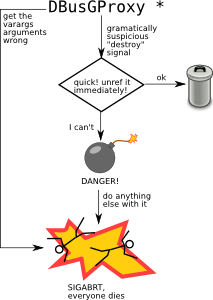
The life-cycle of a DBusGProxy (PD clipart credit: karderio and Andy)
The API provided by dbus-glib for client code is, er, rather less than ideal. The basic object is DBusGProxy, which has a few problems. There's one per interface, rather than one per object; this leads to a maze of twisty GObjects, all suspiciously similar. Our old client library, libtelepathy, got round this by subclassing DBusGProxy to make helper objects called TpChan, TpConn etc., which were simultaneously the proxy for the "main" interface (Channel, Connection etc.), and a factory for proxies for the other interfaces (like Channel.Type.Text and Channel.Interface.Password). This still wasn't ideal, but it was a start. If you use a DBusGProxy in any way after it has emitted the destroy signal, this is considered to be invalid use of the API, and dbus-glib asserts all over the place. We'd rather it didn't do that - remote objects becoming invalid is a fact of life, and if you don't immediately discard all your references to those objects, remote operations on them should just give you a runtime error. You have to be prepared to handle such runtime errors already, because any IPC call can fail at any time. The main API for calling methods uses varargs and is rather subtle. Notably, the calling convention for variant parameters (of D-Bus signature 'v') is not consistent with the calling convention for any other container. For any other container, for instance a GPtrArray *, you pass in a GPtrArray ** pointing to a GPtrArray * variable containing NULL; on success, a pointer to a new GPtrArray is written into that variable. For variant parameters, though, you must pass in a GValue * pointing to a zero-filled GValue, and the result will be written into that GValue. dbus-binding-tool generates thin wrappers around this method-calling API which provide type-safety, although they can't directly specify a non-default timeout. As for signals, before binding to a signal, you have to tell dbus-glib about its signature. This tells dbus-glib how it should push the signal arguments onto the C stack (in GObject terminology: how it should marshal them), to match the signature of the signal-handler function. The documentation claims that this isn't necessary for objects supporting the Introspect method, but that's untrue - on the other hand, if the documented behaviour actually happened, I would consider this to be a critical bug in dbus-glib, since it would enable remote objects to crash dbus-glib clients (by causing signal arguments to be pushed onto the stack in a way that does not match the signature of the signal handler). Of course, the signal-adding function takes varargs, and has to be called exactly once per signal per object. If you don't, dbus-glib asserts when you connect to the signal; if you call it twice, dbus-glib asserts anyway.

TpProxy TpProxy is a GObject subclass vaguely inspired by Python's dbus.proxy.ProxyObject. It isn't a subclass of DBusGProxy, which lets us encapsulate dbus-glib almost completely - in fact, all the references to DBusGProxy are in a separate header, proxy-subclass.h, only used by subclasses of TpProxy (as opposed to normal library API users). TpProxy instances are per-remote-object (per-object-path) like in dbus-python, rather than per-interface like in dbus-glib or QtDBus. As explained below, I believe that this is the most natural object mapping for D-Bus interfaces; in practice it tends to lead to clearer code for us, since one remote object often maps nicely to one UI element (of course, if your objects only have one interface, this approach is no better or worse than dbus-glib's). TpProxy provides support for the following common D-Bus things:
  • Calling methods
  • Connecting to signals
  • Objects becoming invalid
  • Objects with optional interfaces
  • Extensibility
It doesn't currently provide any particular help with Properties - the Properties interface is just another interface as far as we're concerned. We find that, in practice, that's not a problem (even though we use D-Bus properties extensively). In telepathy-qt4 we basically reinvented TpProxy in C++, as Tp::DBusProxy. I've put in some comments below illustrating how the general ideas we used in TpProxy translate into a different object mapping.

Calling methods Method calls on TpProxy are done through auto-generated wrapper functions, much like DBusGProxy. These look something like this:
typedef void (*tp_cli_channel_callback_for_close) (TpChannel *proxy,
    /* any 'out' arguments would go here - Close() doesn't have any */
    const GError *error, gpointer user_data,
    GObject *weak_object);
TpProxyPendingCall *tp_cli_channel_call_close (TpChannel *proxy,
    gint timeout_ms,
    /* any 'in' arguments would go here - Close() doesn't have any */
    tp_cli_channel_callback_for_close callback,
    gpointer user_data,
    GDestroyNotify destroy,
    GObject *weak_object);
Methods for some interfaces, like DBus.Properties, are available on TpProxy itself; others, like Telepathy's Channel.anything, are only available on a particular subclass, like TpChannel. Things to note here:
  • It's an asynchronous call with a callback. General design principle: "this is IPC, get over it". We don't try to hide the fact that IPC is taking place by doing pseudo-blocking calls.
  • The timeout is explicit (although you can always pass -1 to let libdbus pick a "reasonable" default for you). This is because the remote service might not respond, and API users should be at least vaguely aware of this: "this is IPC, get over it".
  • The callback isn't a GCallback; it has an explicit signature, for some semblance of type-safety (it's not much, but it's better than nothing).
  • The callback takes a GError, because any IPC call can fail for any reason.
  • A TpProxyPendingCall * is returned. This is a pointer to an object that only exists until just after the callback is called (so you can ignore it if you don't want it), with a method you can call to cancel the method call (with hindsight this is not ideal, and if I was writing this API now, I'd use gio's GCancellable). "Cancel" is perhaps slightly misleading: the method call still takes place (it was already in libdbus's outgoing queue) but the result gets ignored and the callback isn't called. This is mostly so you an object can forget all the calls it was busy making at the time that the results become irrelevant (e.g. the object is destroyed).
  • There is an extra weak_object argument, which is weakly referenced and is passed to the callback: in practice, most users of telepathy-glib use this as well as or instead of user_data. If the weak_object runs out of references, the callback is automatically cancelled, which means that in practice, explicit cancellation is almost never needed.
  • The generated code has as its first argument a suitable subclass of TpProxy, in this case TpChannel (we tell the code generator about subclasses).
  • You can't see it in the API, but the TpProxy gains an extra ref while a method call is in progress, so you never have to worry about what happens if the proxy gets unreffed during a method call.
  • There's an explicit destructor for the user_data, which is called even if you "cancel" the method call.
In telepathy-qt4, these methods are on small generated helper classes similar to dbus-python's dbus.Interface, one per interface (we provide accessors for them on the non-generated DBusProxy subclass). Instead of using callbacks, we return a temporary QObject per call, which emits a Qt signal on success or failure (that's how all async calls in QtDBus work).

Connecting to signals Similarly, signals have some generated functions:
typedef void (*tp_cli_channel_signal_callback_closed) (TpChannel *proxy,
    /* any arguments would go here - Closed doesn't have any */
    gpointer user_data, GObject *weak_object);
TpProxySignalConnection *tp_cli_channel_connect_to_closed (TpChannel *proxy,
    tp_cli_channel_signal_callback_closed callback,
    gpointer user_data,
    GDestroyNotify destroy,
    GObject *weak_object,
    GError **error);
API notes for these:
  • The callback doesn't take a GError any more, because signals can't fail; the weak_object and the user_data are the same as for method calls
  • This isn't actually a GObject signal at all: those aren't particularly typesafe, and lack namespacing. This might not be very binding-friendly, we haven't tried doing that yet... it might be worth introducing a signal with details, like in dbus-glib, for which these functions are "C bindings".
  • The returned TpProxySignalConnection lets you disconnect from the signal, just like the TpProxyPendingCall above; it can safely be ignored
  • Similarly, if the weak_object dies, then the signal automatically disconnects
  • It is possible for connecting to a signal to fail: this happens if the proxy doesn't actually have the requested interface. If this happens, it's graceful, not a crash. In practice, the flow of code is almost always such that error can safely be NULL because the interfaces are already known.
In telepathy-qt4 the per-interface generated helper classes emit Qt signals. In many cases, we end up proxying these signals by responding to them in the hand-written Tp::DBusProxy subclass by emitting a different signal, in order to give them a nicer representation.

Becoming invalid This is IPC, and any error can happen to you at any time. We found that it was useful to have a general concept of "this object is no longer useful", so we introduced the concept of an object becoming invalidated. The invalidation reason is stored on the object as a GError. If this GError is NULL (as it is initially), then the object is still expected to be valid; if it's non-NULL, the remote object has vanished and the local proxy no longer works. There are several ways a TpProxy can become invalid:
  • its bus name falls off the bus (the process exited or crashed)
  • application-specific reasons (usually triggered by a D-Bus signal in a subclass, like the Telepathy Channel's Closed signal)
  • the GObject gets disposed
Method calls on an invalidated object always fail, with the invalidation reason as the error. This means that calling a method on a TpProxy should never crash your process. The method's callback has to be prepared to handle an error in any case, because this is Sparta^WIPC, so there's no loss in giving it another error. Connecting to signals on an invalidated object always fails, and any existing signal connections are disconnected when it becomes invalidated. This means that if a new remote object appears, and it happens to have the same object path, bus name etc. as the old one, you won't get its signals. A TpProxy can either be bound to a unique bus name or a well-known bus name. In the equivalent code in telepathy-qt4, we call this "stateful" or "stateless" - these names don't capture the intention perfectly, but they're the best we could come up with. A proxy for a stateful API like Telepathy's Channel should always bind to a unique name - when the unique name falls off the bus, the TpProxy becomes invalidated automatically, representing the fact that the Channel you had no longer exists, and nothing can be a perfect replacement for it (the VoIP call has already been terminated, you've already left the chatroom, or whatever - if you make another Channel, that's e.g. a distinct VoIP call). A proxy for a stateless API like Telepathy's ConnectionManager, where an exiting process can disappear, be service-activated again, and still have exactly the same API, should bind to the well-known name. Proxies for well-known names aren't invalidated when the process exits. Qt doesn't have a natural equivalent for GError, so the invalidation reasons in telepathy-qt4 are just a pair of strings, the namespaced name and the message - basically a libdbus DBusError. The principle is the same, though.

Optional interfaces As mentioned above, TpProxy instances are per-remote-object (per-object-path) like in dbus-python, rather than per-interface like in dbus-glib or QtDBus. I believe that this is the most natural object mapping for the D-Bus object model, because the D-Bus interfaces on a remote object can behave like any of these:
  • classes and subclasses (Telepathy.Channel.Type.Text is a Telepathy.Channel)
  • shared interfaces (some Telepathy.Channel objects, of many Types, implement Telepathy.Channel.Interface.Group; any D-Bus object can implement DBus.Properties)
  • optional features (some Telepathy.Channel.Type.Text objects implement Telepathy.Channel.Interface.ChatStates, some do not)
  • discoverable extensions (some Telepathy.Channel.Type.Text objects implement Telepathy.Channel.Interface.Messages, which is more or less Text 2.0)
The way in which interfaces are discovered is also variable. The "classic" D-Bus way to discover interfaces would be to call Introspect. Telepathy services still support that style of introspection, but we don't use it for anything beyond d-feet:
  • Introspect returns a blob of XML, which you have to parse into something useful; if it was in a D-Bus data structure, you'd already have some sensible data structure.
  • Finding out more information about the supported interfaces than their names isn't very useful: in a static language like C you already need to know the methods, signals, properties and their signatures in order to write and compile your code, and in a dynamic language like Python consumers of Introspect end up being remotely crashable by services with unexpected method signatures (this is one of dbus-python's big mistakes in my opinion).
  • If a method that you want to call turns out to be missing, the worst that can happen (in a competently written service) is that it fails with a D-Bus error - and you have to handle D-Bus errors anyway, because this is IPC and anything could fail.
  • Static bindings like dbus-glib have poor support for removing interfaces for which C code exists at runtime, whereas Telepathy needs features like an IM connection that might or might not support avatars (we don't get to find out until we've successfully connected to the server).
Instead, our older interfaces have a method on the "base class" (Channel, Connection etc.) called GetInterfaces, which just returns an array of strings. Newer interfaces (like Account), and older interfaces that have been ported (like Channel), have a property called Interfaces which is, again, an array of strings - this lets us combine the download of the interfaces list with downloading other basic information in a GetAll call. To cater for all these ways to use interfaces, the TpProxy base class has very basic support for interface discovery - you can ask it whether it supports an interface, and you can tell it that it does, in fact, support an interface. Asking which interfaces are supported is directly useful for library users; it's also used as a check by the generated method-call and signal-connection stubs, which return a canned error (Telepathy.Error.NotImplemented in Telepathy's case) if the object isn't known to have the interface. Telling TpProxy that it does support an interface is intended for use by subclasses, and might have been protected if we were writing C++: what happens in practice is that a concrete subclass like TpChannel knows how to discover the fully supported interfaces for this particular object, does so, and calls methods on the TpProxy to tell it which interfaces can work.

Extensibility The API stubs used by TpProxy to call methods and bind to signals are generated from XML documents containing an augmented form of D-Bus introspection data. These XML documents contain various Telepathy-specific extensions, but none of the extensions are language-specific - telepathy-glib, telepathy-python and telepathy-qt4 all operate from exactly the same XML specification. telepathy-qt4's different object-mapping did require us to tighten up some rules that were previously only conventions, but even so, the format is the same. I think this is vitally important - it just doesn't scale to have one set of language-specific annotations in a D-Bus API for each language that will have bindings. One thing that we make heavy use of is what I call "Ugly_Case", which is camel-case with underscores at word boundaries. This gives us a simple, unambiguous and foolproof rule to use in code generators whenever we generate any of the popular conventions for identifiers:
  • CamelCase: delete underscores
  • javaCamelCase: force everything before the first underscore to lower case, then delete underscores
  • lower_case: force everything to lower case, retain underscores
  • UPPER_CASE: force everything to upper case, retain underscores
dbus-glib, by contrast, applies a complex and subtly buggy algorithm to the CamelCase D-Bus names, which results in our SendDTMF method being mapped into GLib as send_dt_mf, and requires that telepathy-glib's Python reimplementation of dbus-binding-tool uses a bug-for-bug compatible implementation (we ended up reimplementing dbus-binding-tool in order to generate the TpProxy-based bindings). Our code generation tools are still rather ad-hoc, because so is our spec format, but for draft interfaces it's possible to copy them into individual projects and use them to generate additional methods for TpProxy or any subclass. This is how we implement unfinished APIs like geolocation in Empathy, for instance. The Interfaces or GetInterfaces hook described above is entirely usable for these extension interfaces, and in fact that's how they're set up. In telepathy-qt4, the generated method stubs are genuine C++ methods, so we can't just append methods to an existing class: this is why we have one helper class per interface, so individual clients can generate a helper class for their particular version of an unfinished API, and instantiate an object of this class attached to a particular Tp::DBusProxy. When an interface becomes stable, it can be added to the set of interfaces for which code is generated in telepathy-glib or telepathy-qt4, at which point any client or service that was already using the final draft of that interface can easily be ported to the library version using sed (the API remains the same).

Becoming ready The concept of being "ready" does not directly exist in TpProxy, but is implemented in TpChannel, TpConnection and TpConnectionManager. The idea is that a freshly created proxy object isn't really fully usable yet - you have to connect to basic signals and recover the initial state of the remote object, as well as checking which extension interfaces are supported. In many well-designed D-Bus APIs you can do this initial setup with a few signal connections and a DBus.Properties.GetAll call. After doing that initial setup (which has to be done asynchronously, because it's IPC), the TpProxy subclass has a local cache of the remote object's state (not necessarily in the same format as the representation on the bus), which can be accessed synchronously at any time, and will be updated in response to change-notification signals. TpChannel and subclasses like it have explicit support for checking for readiness, and having a callback called when the object is ready or invalidated (whichever happens first). The "ready" property also supports the GObject notify signal. telepathy-qt4 took this concept and ran with it - there is library support for objects that can become ready, including a mixin. If I had as much time to work on telepathy-glib as I wish I had, this would be one of the first telepathy-qt4 features to be added to telepathy-glib.

Features becoming ready Going beyond that, in an extensible framework like Telepathy it's probable that not every client understands (or wants to understand) every feature of every object, so it's highly inefficient for every proxy object to subscribe to all the change notification signals and cache all the remote state on the off-chance that the library user wants them. In the API for TpContact (which is not actually a TpProxy for various reasons) we introduced the concept of optional features; telepathy-qt4 extended this idea throughout the library. The idea is that each library user knows which of the optional features are "interesting" to it, and makes a single asynchronous call (which expands into a series of D-Bus calls inside the library) to download the state for core functionality plus all of the selected features, and subscribe to change notification for all of those. This is another telepathy-qt4 thing that telepathy-glib still needs to catch up with; until someone works out how to make the clone() syscall apply to programmers, I fear all libraries are doomed to lag behind how their designers want them to look :-) (license: CC-BY-3.0 / LGPL-2.1+)

29 April 2009

Gustavo Noronha Silva: WebKitGTK+ 1.1.6, and on patch reviewing

This time, I won t bother too much with release announcement. Xan has done that job for us =D. The good news that preceeded this release by about a week is that now both me and Xan are reviewers for the GTK+ port, so we are able to approve patches, too, along with the already existing reviewers. This may help our port move forward more quickly. If you think your patch is an easy review, or urgent, do catch us on IRC, and let us know, since our port has quite a backlog, and it may be sometime before our scanning of the list catches your entry =). Thanks to everyone who contributed to this release. I am sure there are many rough edges to sharpen on the new features, so come test and report bugs, (and provide patches if possible =)) please!

Biella Coleman: The Politics of Open Source

Call for papers: JITP-2010
The Politics of Open Source
May 6-7, 2010 - Amherst, Massachusetts Full Paper Submission Due Date: January 10, 2010 Approach
Free/Libre and Open Source Software (FOSS) has made significant advances, both technically and organizationally, since its emergence in the mid-1980s. Over the last decade, it has moved from a software development approach involving mostly volunteers to a more complex ecology where firms, nonprofit organizations, government agencies and volunteers may be involved. Moreover, the production paradigm continues to expand to other areas of digital content (e.g., Creative Commons, Wikipedia, Connexions, etc.). In this conference we use the phrase open source to capture this broader phenomenon. The Program Committee encourages disciplinary and interdisciplinary approaches to the study of open source, broadly defined. Politics in the conference title, can have many interpretations. Political issues closely tied to the free and open source software movement(s) include: national government policies related to the adoption of open source technologies or questions related to interoperability and open standards, software patents, vendor lock-in, and copyright. These are central themes we expect may be discussed in this forum. In this context, we welcome international submissions since differences in the political perspective appear in international contexts. However, topics related to how the concept of openness has led to various interpretations, adaptations, and applications of open source in other domains, and political issues that surround these broader innovations, are also welcome. Specific topics might include, but are not limited to: General topics related to the politics of open source:
+ How open source software or its principles are changing politics
+ Emerging transparencies in software, systems and society
+ Open source in the developing world and other international contexts
+ The political economy of open source
+ Digital divides and open source Open source and the public sector:
+ Open source software and transparency in government
+ Government policies toward open source and open standards
+ Regulation and open source Open source and democracy:
+ Open source and democratic engagement
+ Open source voting systems
+ Activism, political mobilization and open source The expansion of open source into other domains:
+ Understanding how open source collaboration works and how it can be extended into other areas of collective action
+ Policy areas, such as the effects of free textbooks on education policy or the politics of One Laptop Per Child
+ The political implications of open source in other cultural domains Keynote Speakers
We are pleased to confirm Eric von Hippel (MIT) and Clay Johnson (Sunlight Labs) as the daily keynote speakers for JITP-2010. Paper Submissions
Authors are invited to prepare and submit to JITP a manuscript following one of the six submission formats by January 10, 2010. These formats include research papers, policy viewpoints, workbench notes, review essays, book reviews, and papers on teaching innovation. The goal is to produce a special issue, or double issue, of JITP with a wide variety of approaches to the broad theme of The Politics of Open Source.

How to Submit
Everything you need to know about how to prepare and submit a strong JITP paper is documented at http://www.jitp.net/. Papers will be put through an expedited blind peer review process by the Program Committee, and authors will be notified about a decision by March 10, 2010. A small number of papers will be accepted for presentation at the conference. Other paper authors will be invited to present a poster during the Friday evening reception. All posters must include a YouTube version of their research findings. Best Paper and Poster Cash Prizes
The author (or authors) of the best research paper will receive a single $1,000 prize. The creator (or creators) of the best poster/research presentation will also receive a single prize of $1,000. Program Committee
M.V. Lee Badgett, University of Massachusetts Amherst
Paul M.A. Baker, Georgia Institute of Technology
Deborah Bryant, Oregon State University Open Source Lab
Andrea Calderaro, European University Institute
Mark Cassell, Kent State University
Edward Cherlin, Earth Treasury
Gabriella Coleman, New York University
Doug Downham, University of Massachusetts Amherst
Robert English, Daystar Computing & University of Massachusetts Amherst
Joseph Feller, University College Cork
Jelena Karanovic, Rutgers University
Dave Karpf, University of Pennsylvania/Miller Center for Public Affairs
Jeremy Hunsinger, Virginia Tech
Andrea Kavanaugh, Virginia Tech
Jose Marichal, California Lutheran University
Jens Hardings Perl, Pontificia Universidad Cat lica de Chile
Charlie Schweik, University of Massachusetts Amherst, co-chair
Stuart Shulman, University of Massachusetts Amherst, co-chair
Megan Squire, Elon University
Krishna Ravi Srinivas, Research Information System For Developing Nations
Louis Suarez-Potts, Sun Microsystems, Inc. & OpenOffice.org
Anas Tawileh, Cardiff University & Meedan.net

22 April 2009

Alastair McKinstry: pkg-config, -as-needed and multiple compilers

At work I've been promoting the use of pkg-config and modules to solve the problems of avoiding hard-coded paths and an environment where we've multiple compilers. In summary, "module load intel-cc" to load the intel compiler, "module load netcdf-intel" to, which among other things appends /ichec/packages/netcdf/4.0-intel/pkgconfig to $PKG_CONFIG_PATH, and then:
NCDF_INCS :=  pkg-config netcdf --cflags 
NCDF_LIBS :=  pkg-config netcdf --libs 
in the application code. Replace "intel-cc" and "netcdf-intel" with "gcc" and "netcdf-gcc", and it builds with gcc. This would work better if upstream supplied .pc files, which means the next stage in world domination is to send patches to do just that. But it's not that easy, apparently. netcdf (for example) supplies two libraries, libnetcdf.so and libnetcff.so, with the second including code only needed for Fortran. So, for gcc I have the following netcdf file:
prefix=/ichec/packages/netcdf/4.0-gcc
exec_prefix=$ prefix 
libdir=$ prefix /lib
includedir=$ prefix /include
Name: netcdf
Description: netCDF libraries, include files and development tools (gcc version)
Version: 4.0
Libs: -L$ libdir  -Wl,--as-needed -lnetcdf   -lnetcdff 
Cflags: -I$ includedir 
While for Intel I have:
prefix=/ichec/packages/netcdf/4.0-intel
# Add fortran libs 
forlibs=/ichec/packages/intel/fce/11.0.081/lib/intel64
exec_prefix=$ prefix 
libdir=$ prefix /lib
includedir=$ prefix /include
Name: netcdf
Description: netCDF libraries, include files and development tools
Version: 4.0
Libs: -L$ libdir  -lnetcdf -L$ forlibs   -lnetcdff -lifcore
Cflags: -I$ includedir 
The main problem is that --as-needed is not understood by non GNU-ld linkers, and must be conditionally removed somehow. Any ideas ? (There is a second wrinkle of needing to add additional libraries for Intel Fortran here, but I'm sure I can remove that with the addition of more .pc files.). A second issue is that --as-needed can break otherwise working pkg-config usages. Thanks to galtgendo at PhP Bugs for this example:
alastair@ailm:~$ cc -o testx  -Wl,--as-needed  pkg-config glib-2.0 --cflags  test.c  pkg-config glib-2.0 --libs 
works, but:
alastair@ailm:~$ cc -o testx  -Wl,--as-needed  pkg-config glib-2.0 --cflags    pkg-config glib-2.0 --libs  test.c
/tmp/ccsUEwtk.o: In function  main':
test.c:(.text+0x20): undefined reference to  g_print'
collect2: ld returned 1 exit status
The problem being that --as-needed removes libraries as unnecessary before the linker sees the test.o code. Tags , , , , ,

16 April 2009

Gustavo Noronha Silva: WebKitGTK+ 1.1.5

So, we are still mostly able to keep our release each two weeks promise. For this release we have two big additions to the support side of the project: translations support, and gtk-doc support. The former is made of the usual makefile rules used by gettext-enabled projects with a rework to fit in the non-recursive build process of WebKitGTK+. The later is not as well integrated yet, so you have to go manually to WebKit/gtk/docs and type make, but not before editing WebKit/gtk/webkit/webkitprivate.cpp and adding a call to g_thread_init(NULL); to webkit_init(). You get the idea, we need help in polishing this one. As for code, Xan Lopez has been doing some serious work on accessibility support, using ATK. After the a11y hackfest he landed a number of patches moving forward in this direction. It looks like we will be able to meet the requirements for becoming blessed for use by GNOME. We also got a nice printing API, that allows applications to stop using the nasty hack that would send a print() call through javascript. They are also able to control/monitor the print process, or automate it, so that no print dialog is shown, if they wish. That s it, come join the party =D. Now, for 1.1.6, I m hoping Diego finishes the spelling check patch, and it would be awesome to have Jan s proper error reporting!

Adrian von Bidder: Free Software @Work

Yay! I'm finally allowed to (and starting to) port the application I'm working on at work from Oracle to PostgreSQL. Oh, and I note that PostgreSQL 8.4 (beta out yesterday) introduces support for WITH RECURSIVE queries (closures, or for you Oracle folks, CONNECT BY, if I understand the feature correctly), the lack of which has always made tree / graph type data structures a pain to work with in current and older versions. Of course, many other improvements, too.

Martin F. Krafft: Government exaction

Do you listen to the radio? I don t, and there are multiple reasons for that: First and foremost, I don t like the music they play these days. Even though there are stations which will occasionally play a more eclectic tune, the Swiss government does not, to my knowledge, dictate any quota, like New Zealand actually requires stations to broadcast New Zealand music at least 20% of the time. The result is music made by producers, who stand pop icons with little clothing in front of microphones, instruct them to move their bodies in obscene ways, and coach them to croak songs someone else wrote en masse in some basement somewhere. All those songs sound alike. To ensure a constant supply of pop dolls, they hype television shows with titles such as Germany s seeks the next superstar , when most of Germany actually couldn t care less, and only those with vacuous brain capacity follow with excitement, because they wouldn t know what else to do. Second, I don t have the time or energy to listen to discussion rounds on the radio, especially not when topic are about society , which noone can define in the first place. Wittgenstein always had it right. The same goes for most commentaries. If I don t have anything to do, I prefer to listen to birds in the trees, rather than someone s polished opinion. The scariest aspect is that those people actually believe that they have something worthwhile to say, and so do their producers and the other staff, when in most cases, they don t. At least not worthwhile to people who have other things occupying their minds. I also don t like someone to make a pre-selection of news and squash that into 5-15 minute time slots, to be read out by dull-sounding speakers. I d rather skim over articles, and the Web ensures that I get the information I want much quicker than the radio stations can transmit them. And sports over the radio waves makes me come close to aural epileptic seizures. I am painting the sky black a bit. I am fully aware that there exist people with thought-provoking arguments, that some stations play interesting music I would otherwise never discover, and that the radio is a source of entertainment in the lives of thousands of other people who are less privileged than me. But when the Billag rang my doorbell today and wanted CHF 14,10 per month for posession of any device capable of turning radio waves into sound, including those radio waves broadcast over the Internet these days, I got a bit furious. In the past, they concentrated only on actual radio and TV receivers. When I moved into my previous flat in Zurich in 2002, they wanted money because my stereo had a tuner button. I refused to pay, opened the device, unsoldered the radio coil, and sent it to them with an angry letter of refusal; they let me off the hook. Since then, they changed the law in 2007 (but haven t actually updated the forms they force you to sign) to include audio players, cellular phones, and computers, which are all radio-capable. I d really prefer if they used their funds to revert that trend, or at least remove the loudspeakers from all mobile phones. But instead, this morning, I skid right into their claws. As I said before, the radio is also a social support system, and as such I have less of a problem to subsidise it. However, given that I strongly disagree with the quality level broadcast, I would prefer to direct my money towards causes I consider more useful, and with which I could better identify. Unfortunately, the whole system is governmentalised to the point where this choice is taken away from me. The Billag website helpfully offers answers to the common questions, including one along the lines of quality. They suggest that you get in touch directly with the programme directors to complain about their content, and offer suggestions. Shortly after I moved to Zurich, Radio Lora offered me a radio show. Radio Lora is a private station, but they also receive subsidies from the monies exacted by the government, so I am using them as an example here. I suggested that I concentrated only on progressive and psychedelic rock from the sixties and the seventies. They refused the show in the end, claiming that this would not be what their listeners want. So instead I now get to pay for content that is deemed more appropriate. I can only imagine the pains I d have to go through to be able to host a radio show concentrating on eclectic tunes on one of the public radio stations. And even if I succeeded (without becoming a full-time public radio broadcaster), then I could only contribute a few hours a week to that content. If you ask me, the Swiss government is overstepping its competencies a bit. NP: Mono: Hymn to the Immortal Wind

15 April 2009

Michal &#268;iha&#345;: Gammu stable version 1.24.0

Gammu 1.24.0 is out! It does not bring any new outstanding features, just small optimizations in SMSD, documentation improvements and various bug fixes. Full list of changes: You can download from usual place: http://cihar.com/gammu/, Debian users will find packages in unstable soon, SUSE, Fedora and Mandriva users can check repository in OpenSuse Build Service and Ubuntu in my PPA.

13 April 2009

Simon McVittie: DSpam and how not to do it

At some point I might document my current e-mail setup, but for now, here's the bit that caused plenty of frustration on Friday. Many howtos for postfix and dspam will tell you that if you embed user IDs in the signature with PgSQLUIDInSignature on (or the MySQL equivalent, you can do something like this for retraining, and set it up to receive spam@example.com:
# master.cf
dspamretrain unix -     n       n       -       10      pipe
  flags=R user=dspam argv=/usr/bin/dspam --user dspam
      --class=$ nexthop  --source=error
# mailbox_transport map
spam    dspamretrain:spam
notspam dspamretrain:innocent
in which --user dspam names an arbitrary user (dspam will extract the uid from the signature and switch from "dspam" to the correct user, but the command line argument is still required, for no particular reason). I said it named an arbitrary user, but actually that's a lie. The things to be careful of are: Having failed at both of those, my retrain address wasn't working, and sadness ensued.

11 April 2009

Chris Lamb: Installing FogBugz the Debian way

Yeah, proprietary software is bad, but let's at least install it the Debian way. The following walkthrough assumes Debian lenny.

#!/bin/sh
set -e
for PEAR_PKG in Auth_SASL HTTP_Client Mail_Mime XML_Tree
do
        PKG_TEMP=$(mktemp -d)
        cd $ PKG_TEMP 
        pear download $ PEAR_PKG 
        dh-make-pear $ PEAR_PKG *.tgz
        cd $(find -mindepth 1 -type d   head -n1)
        dpkg-buildpackage -uc -us -rfakeroot
        sudo dpkg -i ../*.deb
        rm -rf $ PKG_TEMP 
done
$ sudo ./install.sh
/***************************************\
*            FogBugz 6 Setup
\***************************************/
--    Checking for required tools
 +      found mono 1.9.1
[..]

10 April 2009

Obey Arthur Liu: Google Summer of Code 2009: Debian s Shortlist

Copy of http://lists.debian.org/debian-devel/2009/04/msg00421.html. Hi folks, We have been pretty busy these past few weeks with the whole Google Summer of Code 2009 student application process.
I can say that we have this year a very good set of proposals and I d like to thank all the students and mentors for this. I am going to present to you our shortlist of projects that we would like to be funded and believe we can reasonably manage to get funded. As always, remember that the number of slots is not final yet at this point so we can t promise anything. The first preliminary slot count given today was *10* (same as last year) and we hope to get *2* more (as we did last year). This shortlist is alphabetically ordered because we don t want to reveal the current internal rankings. I am inviting you to debate what you think is cool, what is useful, what is important to Debian, maybe give us pointers to resources or people that could be helpful for the projects. We will try to alter our current rankings to reflect the zeitgeist in Debian, while taking into account the personal information that we have about each student involved. The deadline for any modification is on the 15th, so get everything in by the 14th. The final selected projects will be announced by Google April 20th, ~12 noon PDT / 19:00 UTC. We ll have another announcement then. Three proposals need or may need a mentor, I indicated it. For more information about the projects or mentoring and how to talk to us directly, scroll down past the list. Debian s Shortlist : - Aptitude Package Management History Tracking
- Automatic Debug Packages Creation and Handling
- Debbugs Web UI: Amancay Strikes Back
- Control Files Parsing/Editing Library/Qt4-Debconf Qt4-Perl bindings
- Debian-Installer Support for GNU/kFreeBSD
- KDE/Qt4 Adept 3.0 Package Manager
- Large Scientific Dataset Package Management
- MIPS N32 ABI Port
- MTD Embedded Onboard flash Partitioning and Installation
- On-demand Cloud Computing with Amazon EC2 and Eucalyptus Integration
- Port back update-manager to Debian and all Derivatives
- Debian Autobuilding Infrastructure Rewrite And the details: Aptitude Package Management History Tracking Student: Cristian Mauricio Porras Duarte, Mentor: Daniel Burrows Aptitude currently does not track actions that the user has performed beyond a single session of the program. One of the most frequent requests from users is to find out when they made a change to a package, or why a package was changed; we want to store this information and expose it in the UI in convenient locations. As a side effect, this might also provide some ability to revert past changes. Automatic Debug Packages Creation and Handling Student: Emilio Pozuelo Monfort, Mentor: Marc Brockschmidt This proposal aims at providing debug binary packages for the packages in the Debian archive in an automatic manner, moving them away from the official Debian archive to an special one. This has the benefits of providing thousands of debug packages without any work needed from the developers, for all the architectures, without bloating
the archive. Debbugs Web UI: Amancay Strikes Back Student: Diego Escalante Urrelo, Mentor: Margarita Manterola The Amancay project aims to be a new read/write web frontend to Debian s BTS; allowing DDs and contributors to easily interact with bugs via an intuitive yet powerful interface, enabling new workflows and creating new contribution opportunities like triaging while upholding reporting quality. Control Files Parsing/Editing Library/Qt4-Debconf Qt4-Perl bindings Student: Jonathan Yu, Mentor: (probably) Dominique Dumont see below This project proposes a common library for parsing and manipulating Debian Control files, including control, copyright and changelog. Main ideas include validating and parsing of these files, with both Strict and Quirks modes for the parser. The second idea is a new frontend for Debconf using Qt4 (for which Perl bindings will be written). Debian-Installer Support for GNU/kFreeBSD Student: Luca Favatella, Mentor: Aurelien Jarno GNU/kFreeBSD is currently using a hacked version of the FreeBSD installer combined with crosshurd as its own installer. While this works more or less correctly for standard installations (read: the exact same installation as in the documentation), it does not allow any changes in the installation process except the hard disk partitioning. This project is about porting debian-installer on GNU/kFreeBSD, and to a bigger extent, make debian-installer less Linux dependant. KDE/Qt4 Adept 3.0 Package Manager Student: Mateusz Marek, Mentor: NEEDS MENTOR, see below. Finish Adept 3.0, a fully integrated package manager for Qt4/KDE4. Adept is currently the only viable path to a Debian native package manager on KDE that would support modern features such as tags, indexed search or good conflict resolving. With Aptitude-gtk still in development and only available for GTK+ and (K)PackageKit having fundamental problems, Debian needs this project to stay in control of its package management on KDE after much neglect in the recent years. Large Scientific Dataset Package Management Student: Roy Flemming Hvaara, Mentor: Charles Plessy Large public datasets, like databases for bioinformatics are typically too big and too volatile to fit the traditional source/binary packaging scheme of Debian. There are some programs that are distributed in Debian, like blast and emboss, that can index specialised databases, but Debian lacks a tool to install or update the datasets they need and keep their indexing in sync. MIPS N32 ABI Port Student: Sha Liu, Mentor: Anthony Fok This project first focuses on creating a new MIPS N32 ABI port for Debian. Different from O32 and N64, N32 is an address model which has most 64-bit capabilities but using 32-bit data structures to save space and process time. A second focus will be given on making such a mipsn32el arch fully optimized for the Loongson 2F CPU which gains more and more popularity in subnotebooks/netbooks in many countries. MTD Embedded Onboard flash Partitioning and Installation Student: Per Andersson, Mentor: Wookey Many embedded devices have MTD onboard flash as persistent storage like the Kurobox Pro NAS, the Neo Freerunner, the Sheeva Plug or the OLPC. With MTD flash being so popular and with increases in capacity, support for MTD partition/installation would make Debian even more interesting to a wide range of of devices, making it one step closer to being universal. On-demand Cloud Computing with Amazon EC2 and Eucalyptus Integration Student: David Wendt Jr, Mentor: (probably) Steffen Moeller see below In many academic fields, as well as commercial industries, people use clusters to distribute tasks among multiple machines. Many times this is done by packaging a whole operating system disk image, uploading it onto the cluster, and having the cluster run it in a VM. This project intends to make it easier for Debian to distribute prepared disk images templates like they distribute CD images now, for the users to recreate or customise these templates with Debian packages and for administrators to host such clusters with Debian. Port back update-manager to Debian and all Derivatives Student: Stephan Peijnik, Mentor: Michael Vogt The project would involve taking the distribution-(Ubuntu-)specific update-manager code, analyzing it, and creating a package with just its core functionality, decoupling the distribution-specific parts and thus making the core code extensible by distribution-specific add-ons. This in turn would remove the need of porting update-manager to Debian with every upstream release. An additional optional goal would be replacing the synaptics-backend with a python-apt based one. Debian Autobuilding Infrastructure Rewrite Student: Philipp Kern, Mentor: Luk Claes Rewrite the software that currently runs the Debian autobuilding infrastructure in a way that makes it more maintainable and robust. It will use Python as its programming language and PostgreSQL for the database backend. By harmonizing buildds, many build failures can be prevented and wasteful workload on buildd volunteers can be reduced. On mentoring: Petr Rockai, the original developer of Adept has offered help to anyone willing to adopt Adept. Sune Vuorela has offered help for any Qt4 and KDE related issues. *We really need a mentor here*. The student is quite competent but Google dictates that we provide a mentor to handle student management. Dominique Dumont, although not DD, has signaled interest in mentoring this, although it hasn t been confirmed yet. Sune Vuorela has offered to help co-mentor for the Qt4-Debconf and Qt4-Perl bindings part. Steffen Moeller has signaled interest in mentoring this, although it hasn t been formally confirmed yet. Charles Plessy of the Debian Med team will provide help for use cases related issues. Eric Hammond, developer of the original vmbuilder image creation tool and maintainer of a set of Debian and Ubuntu images will provide help for Amazon EC2 and image creation issues. Chris Grzegorczyk from the Eucalyptus team will provide help for Eucalyptus and Eucalyptus/Debian integration issues. Contacting us: Considering the tight schedule, most stuff happens live on IRC: #debian-soc on irc.debian.org You can also consult our wiki page for some additional information:
<http://wiki.debian.org/SummerOfCode2009> We have a mailing-list at:
<http://lists.alioth.debian.org/mailman/listinfo/soc-coordination> Keep this discussion on debian-devel@lists.debian.org while cc-ing soc-coordination@lists.alioth.debian.org. This thread is for debian-devel primarily.

7 April 2009

Steve Kemp: I think you should let this one go

I work with log files a lot. Most of the logfiles I work with are in a standard format of some kind, and most often they are rotated upon a daily basis. (Examples include syslog, qpsmtpd, and Apache logfiles.) I wish there were a general purpose way to say "grep time-range pattern logfile". Right now, for example, I've just deployed some changes upon a cluster of hosts. Now I want to see only messages that refer to a particular area of the codebase only those that occurred after 23:00 - which is when I did the commit/push/pull dance. I've written a quick hack - tgrep (time-grep) - which allows simple before/equal/after/range grepping :
# show matching lines after 23:00PM
tgrep \>23:00:00 -i subject /var/log/qpsmtpd/qpsmtpd.log
# show matching lines in the interval 23:00PM 23:15PM
tgrep 23:00:00-23:15:00 -i -r subject /var/log/qpsmtpd/
If there is a common way of doing this "properly" then I'd love to be educated, failing that take it if it is useful (moreutils?) ObFilm: Chasing Amy

6 April 2009

Gustavo Noronha Silva: W7K+ g3s l10n s5t

Or WebKitGTK+ gains localization support ! Continuing our quest to finish off old bugs, and plug the bigger and more visible missing holes in functionality, a lot of work went into making WebKitGTK+ l10n-capable. This work has been committed today. This means we will now be able to translate things like dialogs, context menus, form elements, and any other string that makes sense to translate and is generated by WebKitGTK+.
Epiphany showing off WebKitGTK+\'s localization
Don t be fooled by the fact that the context menu is talking about spell checking, by the way. This is still something we do not support, and is only there because Epiphany doesn t override WebKitGTK+ s default context menus. I know that diegoe is working on it, though.

5 April 2009

Jose Carlos Garcia Sogo: Backup your system for a desktop user

While Linux and Debian are plenty of programs for backing up your system, things change when you need a backup system for a common desktop user. In this area there is a lot of room for improvement, as programs for KDE and GNOME are years behind what programs for Windows and Mac OS X are offering.
There has been some programs intents of writing a good program, full featured and with a nice graphical interface, as Simple Backup, and its fork Not So Simple Backup, pybackpack, or TimeVault, an intent to clone Apple s TImeMachine, and it s fork TimeVaultNG written for KDE. Those are projects that start with a great impulse, even some of the mentored by Google Summer of Code, and when they reach some basic functionality, they get abandoned or not being properly maintained.
What I would like to see for a backup system for desktop user is: A lot of improvement and innovation has taken place in Linux Desktop during all these years, but backups are also important for SOHO users, and they need a well integrated program for doing that, as console based solutions usually require configuration skills which desktop users don t have.
Updated 6th April 22:26 CEST: I have been recommended in comments to try Back in Time and D j Dup. Both are in active delopment, which is a bonus. The first one works in a similar way to TimeVault, while the second one works using duplicity as backend, but has support to upload the resulting files to a remote server using SSH or to Amazon S3. I will investigate more on these apps.

1 April 2009

Gustavo Noronha Silva: Joining Collabora

In other news, I am now working for Collabora! It is a great opportunity for me, and I will do my best to be on par with the great people that are now my colleagues. I have had the pleasure of working with Marco Barisione, and Pierre-Luc on WebKitGTK+, for some time, and some (most? =)) of them are also fellow Debian and GNOME developers, so I feel at home. Contributing to WebKitGTK+ and Epiphany is something I do as part of my job too, now, and I m not planning on dropping my volunteer contributions =). I have actually landed some patches, and worked on the 1.1.4 release with my @collabora.co.uk address already, and I hope the future holds more opportunity for such contributions!

Next.

Previous.