Search Results: "sf"

14 August 2017

Michal Čihař: New projects on Hosted Weblate

Hosted Weblate provides also free hosting for free software projects. The hosting requests queue was over one month long, so it's time to process it and include new project. This time, the newly hosted projects include: If you want to support this effort, please donate to Weblate, especially recurring donations are welcome to make this service alive. You can do them on Liberapay or Bountysource.

Filed under: Debian English SUSE Weblate

11 August 2017

Mike Gabriel: @DebConf 2017: Ayatana Indicators

On last Tuesday, I gave a 20 min talk about Ayatana Indicators at DebConf 17 in Montreal. Ayatana Indicators Talk The talk had video coverage, so big thanks to the DebConf video team for making it possible to send the below video link around to people in the world: http://meetings-archive.debian.net/pub/debian-meetings/2017/debconf17/ay... The document of notes shown in the video is available on Debian's Infinote (Gobby) server:
$ sudo apt-get install gobby
$ sudo gobby infinote://gobby.debian.org/debconf17/talk/ayatana-indicators 
The major outcome of this talk was getting to know Dimitri John Ledkov from the Foundation Team at Canonical Ltd. We agreed on investigating the following actions, targetting the Ubuntu 18.04 LTS release and later on Debian 10 (aka buster): Upstream Todos Debian/Ubuntu Todos Please get in Touch... As this is going to be quite an effort, esp. if we want to get this done until 18.04 LTS, let me say, that this blog post is a call for help. If you are attached to Ubuntu and have used desktops with indicator support until now, please get in touch with the Ayatana Indicators team upstream as well as downstream (Debian/Ubuntu). Contact: Looking forward to meeting you online or on person and possibly working together with you on this transition project.

9 August 2017

Petter Reinholdtsen: Simpler recipe on how to make a simple $7 IMSI Catcher using Debian

On friday, I came across an interesting article in the Norwegian web based ICT news magazine digi.no on how to collect the IMSI numbers of nearby cell phones using the cheap DVB-T software defined radios. The article refered to instructions and a recipe by Keld Norman on Youtube on how to make a simple $7 IMSI Catcher, and I decided to test them out. The instructions said to use Ubuntu, install pip using apt (to bypass apt), use pip to install pybombs (to bypass both apt and pip), and the ask pybombs to fetch and build everything you need from scratch. I wanted to see if I could do the same on the most recent Debian packages, but this did not work because pybombs tried to build stuff that no longer build with the most recent openssl library or some other version skew problem. While trying to get this recipe working, I learned that the apt->pip->pybombs route was a long detour, and the only piece of software dependency missing in Debian was the gr-gsm package. I also found out that the lead upstream developer of gr-gsm (the name stand for GNU Radio GSM) project already had a set of Debian packages provided in an Ubuntu PPA repository. All I needed to do was to dget the Debian source package and built it. The IMSI collector is a python script listening for packages on the loopback network device and printing to the terminal some specific GSM packages with IMSI numbers in them. The code is fairly short and easy to understand. The reason this work is because gr-gsm include a tool to read GSM data from a software defined radio like a DVB-T USB stick and other software defined radios, decode them and inject them into a network device on your Linux machine (using the loopback device by default). This proved to work just fine, and I've been testing the collector for a few days now. The updated and simpler recipe is thus to
  1. start with a Debian machine running Stretch or newer,
  2. build and install the gr-gsm package available from http://ppa.launchpad.net/ptrkrysik/gr-gsm/ubuntu/pool/main/g/gr-gsm/,
  3. clone the git repostory from https://github.com/Oros42/IMSI-catcher,
  4. run grgsm_livemon and adjust the frequency until the terminal where it was started is filled with a stream of text (meaning you found a GSM station).
  5. go into the IMSI-catcher directory and run 'sudo python simple_IMSI-catcher.py' to extract the IMSI numbers.
To make it even easier in the future to get this sniffer up and running, I decided to package the gr-gsm project for Debian (WNPP #871055), and the package was uploaded into the NEW queue today. Luckily the gnuradio maintainer has promised to help me, as I do not know much about gnuradio stuff yet. I doubt this "IMSI cacher" is anywhere near as powerfull as commercial tools like The Spy Phone Portable IMSI / IMEI Catcher or the Harris Stingray, but I hope the existance of cheap alternatives can make more people realise how their whereabouts when carrying a cell phone is easily tracked. Seeing the data flow on the screen, realizing that I live close to a police station and knowing that the police is also wearing cell phones, I wonder how hard it would be for criminals to track the position of the police officers to discover when there are police near by, or for foreign military forces to track the location of the Norwegian military forces, or for anyone to track the location of government officials... It is worth noting that the data reported by the IMSI-catcher script mentioned above is only a fraction of the data broadcasted on the GSM network. It will only collect one frequency at the time, while a typical phone will be using several frequencies, and not all phones will be using the frequencies tracked by the grgsm_livemod program. Also, there is a lot of radio chatter being ignored by the simple_IMSI-catcher script, which would be collected by extending the parser code. I wonder if gr-gsm can be set up to listen to more than one frequency?

6 August 2017

Daniel Silverstone: STM32 and RTFM

I have been working with STM32 chips on-and-off for at least eight, possibly closer to nine years. About as long as ST have been touting them around. I love the STM32, and have done much with them in C. But, as my previous two posts may have hinted, I would like to start working with Rust instead of C. To that end, I have been looking with great joy at the work which Jorge Aparicio has been doing around Cortex-M3 and Rust. I've had many comments in person at Debconf, and also several people mention on Twitter, that they're glad more people are looking at this. But before I can get too much deeper into trying to write my USB stack, I need to sort a few things from what Jorge has done as demonstration work.

Okay, this is fast, but we need Ludicrous speed All of Jorge's examples seem to leave the system clocks in a fairly default state, excepting turning on the clocks to the peripherals needed during the initialisation phase. Sadly, if we're going to be running the USB at all, we need the clocks to run a tad faster. Since my goal is to run something moderately CPU intensive on the end of the USB too, it makes sense to try and get our STM32 running at maximum clock speed. For the one I have, that's 72MHz rather than the 8MHz it starts out with. Nine times more cycles to do computing in makes a lot of sense. As I said above, I've been doing STM32 in C a lot for many years; and fortunately I have built systems with the exact chip that's on the blue-pill before. As such, if I rummage, I can find some old C code which does what we need...
    /* Enable HSE */
    RCC_HSEConfig(RCC_HSE_ON);
    /* Wait till HSE is ready */
    HSEStartUpStatus = RCC_WaitForHSEStartUp();
    if (HSEStartUpStatus == SUCCESS)
     
      /* Enable Prefetch Buffer */
      FLASH_PrefetchBufferCmd(FLASH_PrefetchBuffer_Enable);
      /* Flash 2 wait state */
      FLASH_SetLatency(FLASH_Latency_2);
      /* HCLK = SYSCLK */
      RCC_HCLKConfig(RCC_SYSCLK_Div1);
      /* PCLK2 = HCLK */
      RCC_PCLK2Config(RCC_HCLK_Div1);
      /* PCLK1 = HCLK/2 */
      RCC_PCLK1Config(RCC_HCLK_Div2);
      /* ADCCLK = PCLK2/6 */
      RCC_ADCCLKConfig(RCC_PCLK2_Div6);
      /* PLLCLK = 8MHz * 9 = 72 MHz */
      RCC_PLLConfig(RCC_PLLSource_HSE_Div1, RCC_PLLMul_9);
      /* Enable PLL */
      RCC_PLLCmd(ENABLE);
      /* Wait till PLL is ready */
      while (RCC_GetFlagStatus(RCC_FLAG_PLLRDY) == RESET)
       
      /* Select PLL as system clock source */
      RCC_SYSCLKConfig(RCC_SYSCLKSource_PLLCLK);
      /* Wait till PLL is used as system clock source */
      while (RCC_GetSYSCLKSource() != 0x08)
       
     
This code, rather conveniently, uses an 8MHz external crystal so we can almost direct-port it to the blue-pill Rust code and see how we go. If you're used to the CMSIS libraries for STM32, then you won't completely recognise the above since it uses the pre-CMSIS core libraries to do its thing. Library code from 2008 and it's still good on today's STM32s providing they're in the right family :-) A direct conversion to Rust, using Jorge's beautifully easy to work with crates made from svd2rust results in:
    fn make_go_faster(rcc: &RCC, flash: &FLASH)  
        rcc.cr.modify( _, w  w.hseon().enabled());
        while !rcc.cr.read().hserdy().is_ready()  
        flash.acr.modify( _, w  w.prftbe().enabled());
        flash.acr.modify( _, w  w.latency().two());
        rcc.cfgr.modify( _, w  w
                        .hpre().div1()
                        .ppre2().div1()
                        .ppre1().div2()
                        // .adcpre().bits(8)
                        .pllsrc().external()
                        .pllxtpre().div1()
                        .pllmul().mul9()
        );
        rcc.cr.modify( _, w  w.pllon().enabled());
        while rcc.cr.read().pllrdy().is_unlocked()  
        rcc.cfgr.modify( _,w  w.sw().pll());
        while !rcc.cfgr.read().sws().is_pll()  
     
Now, I've not put the comments in which were in the C code, because I'm being very lazy right now, but if you follow the two together you should be able to work it through. I don't have timeouts for the waits, and you'll notice a single comment there (I cannot set up the ADC prescaler because for some reason the SVD is missing any useful information and so the generated crate only carries an unsafe function (bits()) and I'm trying to steer clear of unsafe for now. Still, I don't need the ADC immediately, so I'm okay with this. By using this function in the beginning of the init() function of the blinky example, I can easily demonstrate the clock is going faster since the LED blinks more quickly. This function demonstrates just how simple it is to take bit-manipulation from the C code and turn it into (admittedly bad looking) Rust with relative ease and without any of the actual bit-twiddling. I love it.

Mess with time, and you get unexpected consequences Sadly, when you mess with the clock tree on a microcontroller, you throw a lot of things out of whack. Not least, by adjusting the clock frequency up we end up adjusting the AHB, APB1, and APB2 clock frequencies. This has direct consequences for peripherals floating around on those busses. Fortunately Jorge thought of this and while the blue-pill crate hard-wires those frequencies to 8MHz, they are, at least, configurable in code in some sense. If we apply the make_go_faster() function to the serial loopback example, it simply fails to work because now the bus which the USART1 peripheral is connected to (APB2) is going at a different speed from the expected power-on default of 8MHz. If you remember from the function, we did .hpre().div1() which set HCLK to 72MHz, then .ppre1().div2() which sets the APB1 bus clock to be HCLK divided by 2, and .ppre2().div1() which sets APB2 bus clock to be HCLK. This means that we'd need to alter src/lib.rs to reflect these changes in the clock frequences and in theory loopback would start working once more. It'd be awkward to try and demonstrate all that to you since I only have a phone camera to hand, but if you own a blue-pill then you can clone Jorge's repo and have a go yourself and see that I'm not bluffing you. With all this done, it'll be time to see if we can bring the USB peripheral in the STM32 online, and that will be the topic of my next post in this discovery series.

5 August 2017

Daniel Silverstone: USB Device Stacks, on RTFM, part 2

Previously we talked about all the different kinds of descriptors which USB devices use to communicate their capability. This is important stuff because to write any useful USB device firmware we need to be able to determine how to populate our descriptors. However, having that data on the device is entirely worthless without an understanding of how it gets from the device to the host so that it can be acted upon. To understand that, let's look at the USB wire protocol.
Note, I'll again be talking mostly about USB2.0 low- and full-speed. I believe that high speed is approximately the same but with faster wires, except not quite that simple.

Down to the wire I don't intend to talk about the actual electrical signalling, though it's not un-reasonable for you to know that USB is a pair of wires forming a differentially signalled bidirectional serial communications link. The host is responsible for managing all the framing and timing on the link, and for formatting the communications into packets. There are a number of packet types which can appear on the USB link:
Packet type Purpose
Token Packet When the host wishes to send a message to the Control endpoint to configure the device, read data IN, or write data OUT, it uses this to start the transaction.
Data(0/1) Packet Following a Setup, In, or Out token, a Data packet is a transfer of data (in either direction). The 0 and 1 alternate to provide a measure of confidence against lost packets.
Handshake Packet Following a data packet of some kind, the other end may ACK the packet (all was well), NAK the packet (report that the device cannot, temporarily, send/receive data, or that an interrupt endpoint isn't triggered), or STALL the bus in which case the host needs to intervene.
Start of Frame Every 1ms (full-speed) the host will send a SOF packet which carries a frame number. This can be used to help keep time on very simple devices. It also divides the bus into frames within which bandwidth is allocated.
As an example, when the host wishes to perform a control transfer, the following packets are transacted in turn:
  1. Setup Token - The host addresses the device and endpoint (OUT0)
  2. Data0 Packet - The host transmits a GET_DESCRIPTOR for the device descriptor
  3. Ack Packet - The device acknowledges receipt of the request
This marks the end of the first transaction. The device decodes the GET_DESCRIPTOR request and prepares the device descriptor for transmission. The transmission occurs as the next transaction on the bus. In this example, we're assuming 8 byte maximum transmission sizes, for illustrative purposes.
  1. In Token - The host addresses the device and endpoint (IN0)
  2. Data1 Packet - The device transmits the first 8 bytes of the descriptor
  3. Ack Packet - The host acknowledges the data packet
  4. In Token - The host addresses the device and endpoint (IN0)
  5. Data0 Packet - The device transmits the remaining 4 bytes of the descriptor (padded)
  6. Ack Packet - The host acknowledges the data packet
The second transaction is now complete, and the host has all the data it needs to proceed. Finally a status transaction occurs in which:
  1. Out Token - The host addresses the device and endpoint (OUT0)
  2. Data1 Packet - The host transmits a 0 byte data packet to indicate successful completion
  3. Ack Packet - The device acknowledges the completion, indicating its own satisfaction
And thus ends the full control transaction in which the host retrieves the device descriptor. From a high level, we need only consider the activity which occurs at the point of the acknowledgement packets. In the above example:
  1. On the first ACK the device prepares IN0 to transmit the descriptor, readying whatever low level device stack there is with a pointer to the descriptor and its length in bytes.
  2. On the second ACK the low levels are still thinking.
  3. On the third ACK the transmission from IN0 is complete and the endpoint no longer expects to transfer data.
  4. On the fourth ACK the control transaction is entirely complete.

Thinking at the low levels of the control interface Before we can build a high level USB stack, we need to consider the activity which might occur at the lower levels. At the low levels, particularly of the device control interface, work has to be done at each and every packet. The hardware likely deals with the token packet for us, leaving the data packets for us to process, and the resultant handshake packets will be likely handled by the hardware in response to our processing the data packets. Since every control transaction is initiated by a setup token, let's look at the setup requests which can come our way...
Setup Packet (Data) Format
Field Name Byte start Byte length Encoding Meaning
bmRequestType 0 1 Bitmap Describes the kind of request, and the target of it. See below.
bRequest 1 1 Code The request code itself, meanings of the rest of the fields vary by bRequest
wValue 2 2 Number A 16 bit value whose meaning varies by request type
wIndex 4 2 Number A 16 bit value whose meaning varies by request type but typically encodes an interface number or endpoint.
wLength 6 2 Number A 16 bit value indicating the length of the transfer to come.
Since bRequest is essentially a switch against which multiple kinds of setup packet are selected between, here's the meanings of a few...
GET_DESCRIPTOR (Device) setup packet
Field Name Value Meaning
bmRequestType 0x08 Data direction is IN (from device to host), recipient is the device
bRequest 0x06 GET_DESCRIPTOR (in this instance, the device descriptor is requested)
wValue 0x0001 This means the device descriptor
wIndex 0x0000 Irrelevant, there's only 1 device descriptor anyway
wLength 12 This is the length of a device descriptor (12 bytes)
SET_ADDRESS to set a device's USB address
Field Name Value Meaning
bmRequestType 0x00 Data direction is OUT (from host to device), recipient is the device
bRequest 0x05 SET_ADDRESS (Set the device's USB address)
wValue 0x00nn The address for the device to adopt (max 127)
wIndex 0x0000 Irrelevant for address setting
wLength 0 There's no data transfer expected for this setup operation
Most hardware blocks will implement an interrupt at the point that the Data packet following the Setup packet has been receive. This is typically called receiving a 'Setup' packet and then it's up to the device stack low levels to determine what to do and dispatch a handler. Otherwise an interrupt will fire for the IN or OUT tokens and if the endpoint is zero, the low level stack will handle it once more. One final thing worth noting about SET_ADDRESS is that it doesn't take effect until the completion of the zero-length "status" transaction following the setup transaction. As such, the status request from the host will still be sent to address zero (the default for new devices).

A very basic early "packet trace" This is an example, and is not guaranteed to be the packet sequence in all cases. It's a good indication of the relative complexity involved in getting a fresh USB device onto the bus though... When a device first attaches to the bus, the bus is in RESET state and so the first event a device sees is a RESET which causes it to set its address to zero, clear any endpoints, clear the configuration, and become ready for control transfers. Shortly after this, the device will become suspended. Next, the host kicks in and sends a port reset of around 30ms. After this, the host is ready to interrogate the device. The host sends a GET_DESCRIPTOR to the device, whose address at this point is zero. Using the information it receives from this, it can set up the host-side memory buffers since the device descriptor contains the maximum transfer size which the device supports. The host is now ready to actually 'address' the device, and so it sends another reset to the device, again around 30ms in length. The host sends a SET_ADDRESS control request to the device, telling it that its new address is nn. Once the acknowledgement has been sent from the host for the zero-data status update from the device, the device sets its internal address to the value supplied in the request. From now on, the device shall respond only to requests to nn rather than to zero. At this point, the host will begin interrogating further descriptors, looking at the configuration descriptors and the strings, to build its host-side representation of the device. These will be GET_DESCRIPTOR and GET_STRING_DESCRIPTOR requests and may continue for some time. Once the host has satisfied itself that it knows everything it needs to about the device, it will issue a SET_CONFIGURATION request which basically starts everything up in the device. Once the configuration is set, interrupt endpoints will be polled, bulk traffic will be transferred, Isochronous streams begin to run, etc.

Okay, but how do we make this concrete? So far, everything we've spoken about has been fairly abstract, or at least "soft". But to transfer data over USB does require some hardware. (Okay, okay, we could do it all virtualised, but there's no fun in that). The hardware I'm going to be using for the duration of this series is the STM32 on the blue-pill development board. This is a very simple development board which does (in theory at least) support USB device mode. If we view the schematic for the blue-pill, we can see a very "lightweight" USB interface which has a pullup resistor for D+. This is the way that a device signals to the host that it is present, and that it wants to speak at full-speed. If the pullup were on D- then it would be a low-speed device. High speed devices need a little more complexity which I'm not going to go into for today. The USB lines connect to pins PA11 and PA12 which are the USB pins on the STM32 on the board. Since USB is quite finicky, the STM32 doesn't let you remap that function elsewhere, so this is all looking quite good for us so far. The specific STM32 on the blue-pill is the STM32F103C8T6. By viewing its product page on ST's website we can find the reference manual for the part. Jumping to section 23 we learn that this STM32 supports full-speed USB2.0 which is convenient given the past article and a half. We also learn it supports up to eight endpoints active at any one time, and offers double-buffering for our bulk and isochronous transfers. It has some internal memory for packet buffering, so it won't use our RAM bandwidth while performing transfers, which is lovely. I'm not going to distill the rest of that section here, because there's a large amount of data which explains how the USB macrocell operates. However useful things to note are:
  • How IN OUT and SETUP transfers work.
  • How the endpoint buffer memory is configured.
  • That all bus-powered devices MUST respond to suspend/resume properly
  • That the hardware will prioritise endpoint interrupts for us so that we only need deal with the most pressing item at any given time.
  • There is an 'Enable Function' bit in the address register which must be set or we won't see any transactions at all.
  • How the endpoint registers signal events to the device firmware.
Next time, we're going to begin the process of writing a very hacky setup routine to try and initialise the USB device macrocell so that we can see incoming transactions through the ITM. It should be quite exciting, but given how complex this will be for me to learn, it might be a little while before it comes through.

4 August 2017

Daniel Silverstone: USB Device Stacks, on RTFM

I have been spending time with Jorge Aparicio's RTFM for Cortex M3 framework for writing Rust to target Cortex-M3 devices from Arm (and particularly the STM32F103 from ST Microelectronics). Jorge's work in this area has been of interest to me ever since I discovered him working on this stuff a while ago. I am very tempted by the idea of being able to implement code for the STM32 with the guarantees of Rust and the language features which I have come to love such as the trait system. I have been thinking to myself that, while I admire and appreciate the work done on the GNUK, I would like to, personally, have a go at implementing some kind of security token on an STM32 as a USB device. And with the advent of the RTFM for M3 work, and Jorge's magical tooling to make it easier to access and control the registers on an M3 microcontroller, I figured it'd be super-nice to do this in Rust, with all the advantages that entails in terms of isolating unsafe behaviour and generally having the potential to be more easily verified as not misbehaving. To do this though, means that I need a USB device stack which will work in the RTFM framework. Sadly it seems that, thus-far, only Jorge has been working on drivers for any of the M3 devices his framework supports. And one person can only do so much. So, in my infinite madness, I decided I should investigate the complexity of writing a USB device stack in Rust for the RTFM/M3 framework. (Why I thought this was a good idea is lost to the mists of late night Googling, but hey, it might make a good talk at the next conference I go to). As such, this blog post, and further ones along these lines, will serve as a partial tour of what I'm up to, and a partial aide-memoir for me about learning USB. If I get something horribly wrong, please DO contact me to correct me, otherwise I'll just continue to be wrong. If I've simplified something but it's still strictly correct, just let me know if it's an oversimplification since in a lot of cases there's no point in me putting the full details into a blog posting. I will mostly be considering USB2.0 protocol details but only really for low and full speed devices. (The hardware I'm targetting does low-speed and full-speed, but not high-speed. Though some similar HW does high-speed too, I don't have any to hand right now)

A brief introduction to USB In order to go much further, I needed a grounding in USB. It's a multi-layer protocol as you might expect, though we can probably ignore the actual electrical layer since any device we might hope to support will have to have a hardware block to deal with that. We will however need to consider the packet layer (since that will inform how the hardware block is implemented and thus its interface) and then the higher level protocols on top. USB is a deliberately asymmetric protocol. Devices are meant to be significantly easier to implement, both in terms of hardware and software, as compared with hosts. As such, despite some STM32s having OTG ports, I have no intention of supporting host mode at this time. USB is arranged into a set of busses which are, at least in the USB1.1 case, broadcast domains. As such, each device has an address assigned to it by the host during an early phase called 'configuration'. Once the address is assigned, the device is expected to only ever respond to messages addressed to it. Note that since everything is asymmetric in USB, the device can't send messages on its own, but has to be asked for them by the host, and as such the addressing is always from host toward device. USB devices then expose a number of endpoints through which communication can flow IN to the host or OUT to the device. Endpoints are not bidirectional, but the in and out endpoints do overlap in numbering. There is a special pair of endpoints, IN0 and OUT0 which, between them, form what I will call the device control endpoints. The device control endpoints are important since every USB device MUST implement them, and there are a number of well defined messages which pass over them to control the USB device. In theory a bare minimum USB device would implement only the device control endpoints.

Configurations, and Classes, and Interfaces, Oh My! In order for the host to understand what the USB device is, and what it is capable of, part of the device control endpoints' responsibility is to provide a set of descriptors which describe the device. These descriptors form a heirarchy and are then glommed together into a big lump of data which the host can download from the device in order to decide what it is and how to use it. Because of various historical reasons, where a multi-byte value is used, they are defined to be little-endian, though there are some BCD fields. Descriptors always start with a length byte and a type byte because that way the host can parse/skip as necessary, with ease. The first descriptor is the device descriptor, is a big one, and looks like this:
Device Descriptor
Field Name Byte start Byte length Encoding Meaning
bLength 0 1 Number Size of the descriptor in bytes (18)
bDescriptorType 1 1 Constant Device Descriptor (0x01)
bcdUSB 2 2 BCD USB spec version compiled with
bDeviceClass 4 1 Class Code, assigned by USB org (0 means "Look at interface descriptors", common value is 2 for CDC)
bDeviceSubClass 5 1 SubClass Code, assigned by USB org (usually 0)
bDeviceProtocol 6 1 Protocol Code, assigned by USB org (usually 0)
bMaxPacketSize 7 1 Number Max packet size for IN0/OUT0 (Valid are 8, 16, 32, 64)
idVendor 8 2 ID 16bit Vendor ID (Assigned by USB org)
idProduct 10 2 ID 16bit Product ID (Assigned by manufacturer)
bcdDevice 12 2 BCD Device version number (same encoding as bcdUSB)
iManufacturer 14 1 Index String index of manufacturer name (0 if unavailable)
iProduct 15 1 Index String index of product name (0 if unavailable)
iSerialNumber 16 1 Index String index of device serial number (0 if unavailable)
bNumConfigurations 17 1 Number Count of configurations the device has.
This looks quite complex, but breaks down into a relatively simple two halves. The first eight bytes carries everything necessary for the host to be able to configure itself and the device control endpoints properly in order to communicate effectively. Since eight bytes is the bare minimum a device must be able to transmit in one go, the host can guarantee to get those, and they tell it what kind of device it is, what USB protocol it supports, and what the maximum transfer size is for its device control endpoints. The encoding of the bcdUSB and bcdDevice fields is interesting too. It is of the form 0xMMmm where MM is the major number, mm the minor. So USB2.0 is encoded as 0x0200, USB1.1 as 0x0110 etc. If the device version is 17.36 then that'd be 0x1736. Other fields of note are bDeviceClass which can be 0 meaning that interfaces will specify their classes, and idVendor/idProduct which between them form the primary way for the specific USB device to be identified. The Index fields are indices into a string table which we'll look at later. For now it's enough to know that wherever a string index is needed, 0 can be provided to mean "no string here". The last field is bNumConfigurations and this indicates the number of ways in which this device might function. A USB device can provide any number of these configurations, though typically only one is provided. If the host wishes to switch between configurations then it will have to effectively entirely quiesce and reset the device. The next kind of descriptor is the configuration descriptor. This one is much shorter, but starts with the same two fields:
Configuration Descriptor
Field Name Byte start Byte length Encoding Meaning
bLength 0 1 Number Size of the descriptor in bytes (9)
bDescriptorType 1 1 Constant Configuration Descriptor (0x02)
wTotalLength 2 2 Number Size of the configuration in bytes, in total
bNumInterfaces 4 1 Number The number of interfaces in this configuration
bConfigurationValue 5 1 Number The value to use to select this configuration
iConfiguration 6 1 Index The name of this configuration (0 for unavailable)
bmAttributes 7 1 Bitmap Attributes field (see below)
bMaxPower 8 1 Number Maximum bus power this configuration will draw (in 2mA increments)
An important field to consider here is the bmAttributes field which tells the host some useful information. Bit 7 must be set, bit 6 is set if the device would be self-powered in this configuration, bit 5 indicates that the device would like to be able to wake the host from sleep mode, and bits 4 to 0 must be unset. The bMaxPower field is interesting because it encodes the power draw of the device (when set to this configuration). USB allows for up to 100mA of draw per device when it isn't yet configured, and up to 500mA when configured. The value may be used to decide if it's sensible to configure a device if the host is in a low power situation. Typically this field will be set to 50 to indicate the nominal 100mA is fine, or 250 to request the full 500mA. Finally, the wTotalLength field is interesting because it tells the host the total length of this configuration, including all the interface and endpoint descriptors which make it up. With this field, the host can allocate enough RAM to fetch the entire configuration descriptor block at once, simplifying matters dramatically for it. Each configuration has one or more interfaces. The interfaces group some endpoints together into a logical function. For example a configuration for a multifunction scanner/fax/printer might have an interface for the scanner function, one for the fax, and one for the printer. Endpoints are not shared among interfaces, so when building this table, be careful. Next, logically, come the interface descriptors:
Interface Descriptor
Field Name Byte start Byte length Encoding Meaning
bLength 0 1 Number Size of the descriptor in bytes (9)
bDescriptorType 1 1 Constant Interface Descriptor (0x04)
bInterfaceNumber 2 1 Number The number of the interface
bAlternateSetting 3 1 Number The interface alternate index
bNumEndpoints 4 1 Number The number of endpoints in this interface
bInterfaceClass 5 1 Class The interface class (USB Org defined)
bInterfaceSubClass 6 1 SubClass The interface subclass (USB Org defined)
bInterfaceProtocol 7 1 Protocol The interface protocol (USB Org defined)
iInterface 8 1 Index The name of the interface (or 0 if not provided)
The important values here are the class/subclass/protocol fields which provide a lot of information to the host about what the interface is. If the class is a USB Org defined one (e.g. 0x02 for Communications Device Class) then the host may already have drivers designed to work with the interface meaning that the device manufacturer doesn't have to provide host drivers. The bInterfaceNumber is used by the host to indicate this interface when sending messages, and the bAlternateSetting is a way to vary interfaces. Two interfaces with the came bInterfaceNumber but different bAlternateSettings can be switched between (like configurations, but) without resetting the device. Hopefully the rest of this descriptor is self-evident by now. The next descriptor kind is endpoint descriptors:
Endpoint Descriptor
Field Name Byte start Byte length Encoding Meaning
bLength 0 1 Number Size of the descriptor in bytes (7)
bDescriptorType 1 1 Constant Endpoint Descriptor (0x05)
bEndpointAddress 2 1 Endpoint Endpoint address (see below)
bmAttributes 3 1 Bitmap Endpoint attributes (see below)
wMaxPacketSize 4 2 Number Maximum packet size this endpoint can send/receive
bInterval 6 1 Number Interval for polling endpoint (in frames)
The bEndpointAddress is a 4 bit endpoint number (so there're 16 endpoint indices) and a bit to indicate IN vs. OUT. Bit 7 is the direction marker and bits 3 to 0 are the endpoint number. This means there are 32 endpoints in total, 16 in each direction, 2 of which are reserved (IN0 and OUT0) giving 30 endpoints available for interfaces to use in any given configuration. The bmAttributes bitmap covers the transfer type of the endpoint (more below), and the bInterval is an interval measured in frames (1ms for low or full speed, 125 s in high speed). bInterval is only valid for some endpoint types. The final descriptor kind is for the strings which we've seen indices for throughout the above. String descriptors have two forms:
String Descriptor (index zero)
Field Name Byte start Byte length Encoding Meaning
bLength 0 1 Number Size of the descriptor in bytes (variable)
bDescriptorType 1 1 Constant String Descriptor (0x03)
wLangID[0] 2 2 Number Language code zero (e.g. 0x0409 for en_US)
wLangID[n] 4.. 2 Number Language code n ...
This form (for descriptor 0) is that of a series of language IDs supported by the device. The device may support any number of languages. When the host requests a string descriptor, it will supply both the index of the string and also the language id it desires (from the list available in string descriptor zero). The host can tell how many language IDs are available simply by dividing bLength by 2 and subtracting 1 for the two header bytes. And for string descriptors of an index greater than zero:
String Descriptor (index greater than zero)
Field Name Byte start Byte length Encoding Meaning
bLength 0 1 Number Size of the descriptor in bytes (variable)
bDescriptorType 1 1 Constant String Descriptor (0x03)
bString 2.. .. Unicode The string, in "unicode" format
This second form of the string descriptor is simply the the string is in what the USB spec calls 'Unicode' format which is, as of 2005, defined to be UTF16-LE without a BOM or terminator. Since string descriptors are of a variable length, the host must request strings in two transactions. First a request for 2 bytes is sent, retrieving the bLength and bDescriptorType fields which can be checked and memory allocated. Then a request for bLength bytes can be sent to retrieve the entire string descriptor.

Putting that all together Phew, this is getting to be quite a long posting, so I'm going to leave this here and in my next post I'll talk about how the host and device pass packets to get all that information to the host, and how it gets used.

2 August 2017

Markus Koschany: PDFsam: How to upgrade a Maven application for Debian

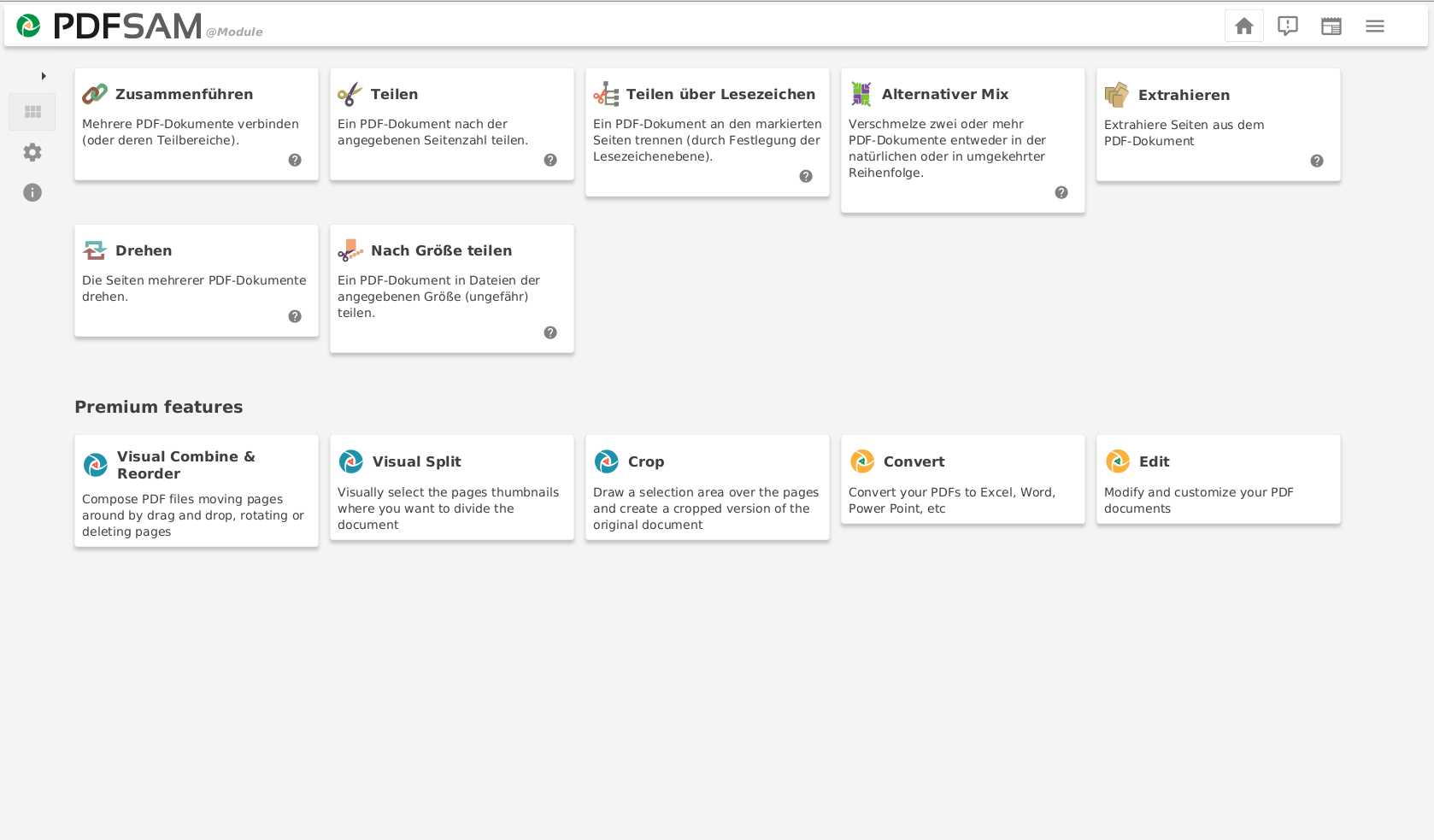
In the coming weeks and months I intend to write a mini series about packaging Java software for Debian. The following article basically starts in the middle of this journey because the PDFsam upgrade is still fresh in my mind. It requires some preexisting knowledge about build tools like Maven and some Java terminology. But do not fear. Hopefully it will make sense in the end when all pieces fall into place. A month ago I decided to upgrade PDFsam, a Java application to split, merge, extract, mix and rotate PDF documents. The current version 1.1.4 is already seven years old and uses Ant as its build system. Unfortunately up to now nobody was interested enough to invest the time to upgrade it to the latest version. A quick internet search unveils that the current sources can be found on github.com. Another brief look reveals we are dealing with a Maven project here because we can find a pom.xml file in the root directory and there is no sign of Ant s typical build.xml file anymore. Here are some general tips how to proceed from this point by using the PDFsam upgrade as an example. Find out how many new dependencies you really need The pom.xml file declares its dependencies in the <dependencies> section. It is good practice to inspect the pom.xml file and determine how much work will be required to upgrade the package. A seasoned Java packager will quickly find common dependencies like Hibernate or the Apache Commons libraries. Fortunately for you they are already packaged in Debian because a lot of projects depend on them. If you are unsure what is and what is not packaged for Debian, tracker.debian.org and codesearch.debian.net are useful tools to search for those packages. If in doubt just ask on debian-java@lists.debian.org. There is no automagical tool (yet) to find out what dependencies are really new (we talk about mh_make soon) but if you use the aforementioned tools and websites you will notice that in June 2017 one could not find the following artifacts: fontawesomefx, eventstudio, sejda-* and jackson-jr-objects. There are also jdepend and testFx but notice they are marked as <scope>test</scope> meaning they are only required if you would like to run upstream s test suite as well. For the sake of simplicity, it is best to ignore them for now and to focus on packaging only dependencies which are really needed to compile the application. Test dependencies can always be added later. This pom.xml investigation leads us to the following conclusion: PDFsam depends on Sejda, a PDF library. Basically Sejda is the product of a major refactoring that happened years ago and allows upstream to develop PDFsam faster and in multiple directions. For Debian packagers it is quite clear now that the upgrade of PDFsam is in reality more like packaging a completely new application. The inspection of Sejda s pom.xml file (another Maven project) reveals we also have to package imgscalr, Twelvemonkeys and SAMBox. We continue with these pom.xml analyses and end up with these new source packages: jackson-jr, libimgscalr-java, libsambox-java, libsejda-java, libsejda-injector-java, libsejda-io-java, libsejda-eventstudio-java, libtwelvemonkeys-java, fontawesomefx and libpdfbox2-java. Later I discovered that gettext-maven-plugin was also required. This was not obvious at first glance if you only check the pom.xml in the root directory but PDFsam and Sejda are multi-module projects! In this case every subdirectory (module) contains another pom.xml with additional information, so ideally you should check those too before you decide to start with your packaging. But don t worry it is often possible to ignore modules with a simple ignore rule inside your debian/*.poms file. The package will have less functionality but it can be still useful if you only need a subset of the modules. Of course in this case ignoring the gettext-maven-plugin artifact would result in a runtime error. C est la vie. A brief remark about Java package names: Java library packages must be named like libXXX-java. This is important for binary packages to avoid naming collisions. We are more tolerant when it comes to source package names but in general we recommend to use the exact same name as for the binary package. There are exceptions like prefixing source packages with their well known project name like jackson-XXX or jboss-XXX but this should only be used when there are already existing packages that use such a naming scheme. If in doubt, talk to us. mh_make or how to quickly generate an initial debian directory Packaging a Maven library is usually not very difficult even if it consists of multiple modules. The tricky part is to get the maven.rules, maven.IgnoreRules and your *.poms file right but debian/rules often only consists of a single dh line and the rest is finding the build-dependencies and adding them to debian/control. A small tool called mh_make, which is included in maven-debian-helper, can lend you a helping hand. The tool is not perfect yet. It requires that most build-dependencies are already installed on your local system, otherwise it won t create the initial debian directory and will only produce some unfinished (but in some cases still useful) files. A rule of thumb is to start with a package that does not depend on any other new dependency and requires the fewest build-dependencies. I have chosen libtwelvemonkeys-java because it was the simplest package and met the aforementioned criteria. Here is how mh_make looks like in action. (The animated GIF was created with Byzanz) First of all download the release tarball, unpack it and run mh_make inside the root directory. Ok, what is happening here? First you can choose a source and binary package name. Then disable the tests and don t run javadoc to create the documentation. This will simplify things a little. Tests and javadoc settings can be added later. Choose the version you want to package and then you can basically follow the default recommendations and confirm them by hitting the Enter key. Throughout the project we choose to transform the upstream version with the symbolic debian version. Remember that Java/Maven is version-centric. This will ensure that our Maven dependencies are always satisfied later and we can simply upgrade our Maven libraries and don t have to change the versions by hand in various pom.xml files; maven-debian-helper will automatically transform them for us to debian . Enable all modules. If you choose not to, you can select each module individually. Note that later on some of the required build-dependencies cannot be found because they are either not installed (libjmagick6-java) or they cannot be found in Debian s Maven repository under /usr/share/maven-repo. You can fix this by entering a substitution rule or, as I did in this case, you can just ignore these artifacts for now. They will be added to maven.IgnoreRules. In order to successfully compile your program you have to remove them from this file later again, create the correct substitution rule in maven.rules and add the missing build-dependencies to debian/control. For now we just want to quickly create our initial debian directory. If everything went as planned a complete debian directory should be visible in your root directory. The only thing left is to fix the substitution rule for the Servlet API 3.1. Add libservlet3.1-java to Build-Depends and the following rule to maven.rules: javax.servlet s/servlet-api/javax.servlet-api/ * s/.*/3.1/ * *
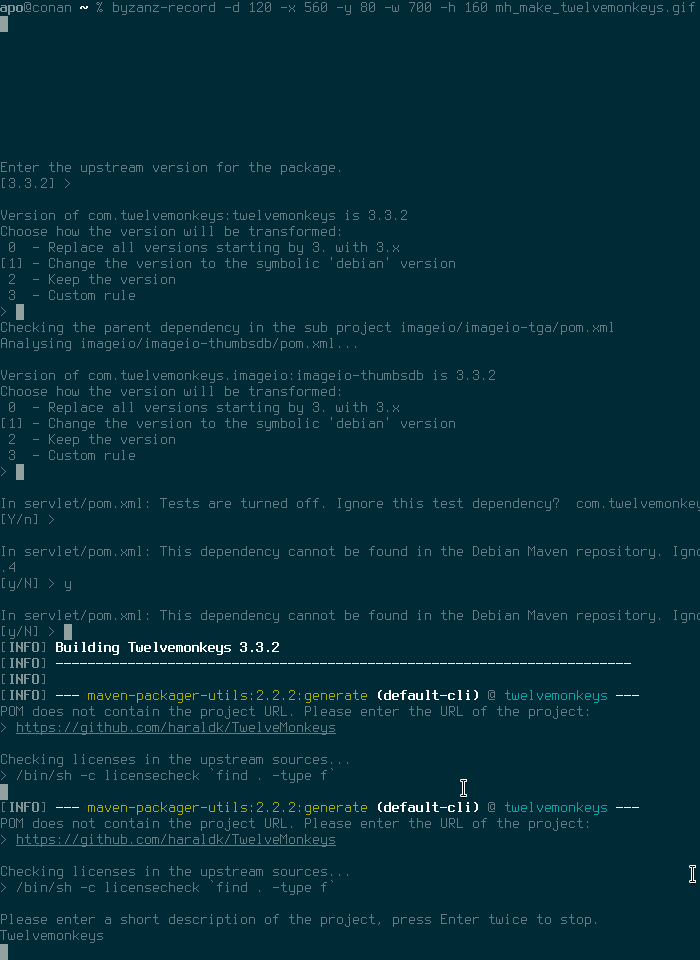
s/javax.servlet/javax.servlet.jsp/ s/jsp-api/javax.servlet.jsp-api/ * s/.*/2.3/ * * The maven.rules file consists of multiple rows separated by six columns. The values represent groupId, artifactId, type, version number and two fields which I never use.  You can just use an asterisk to match any value. Every value can be substituted. This is necessary when the value of upstream s pom.xml file differs from Debian s system packages. This happens frequently for API packages which are uploaded to Maven Central multiple times under a different groupId/artifactId but provide the same features. In this case the Twelvemonkeys pom requires an older API version but Debian is already at version 3.1. Note that we require a strict version number in this case because libservlet3.1-java does not use a symbolic debian version since we provide more than one Servlet API in the archive and this measure prevents conflicts. Thanks for reading this far. More articles about Java packaging will follow in the near future and hopefully they will clarify some terms and topics which could only be briefly mentioned in this post.
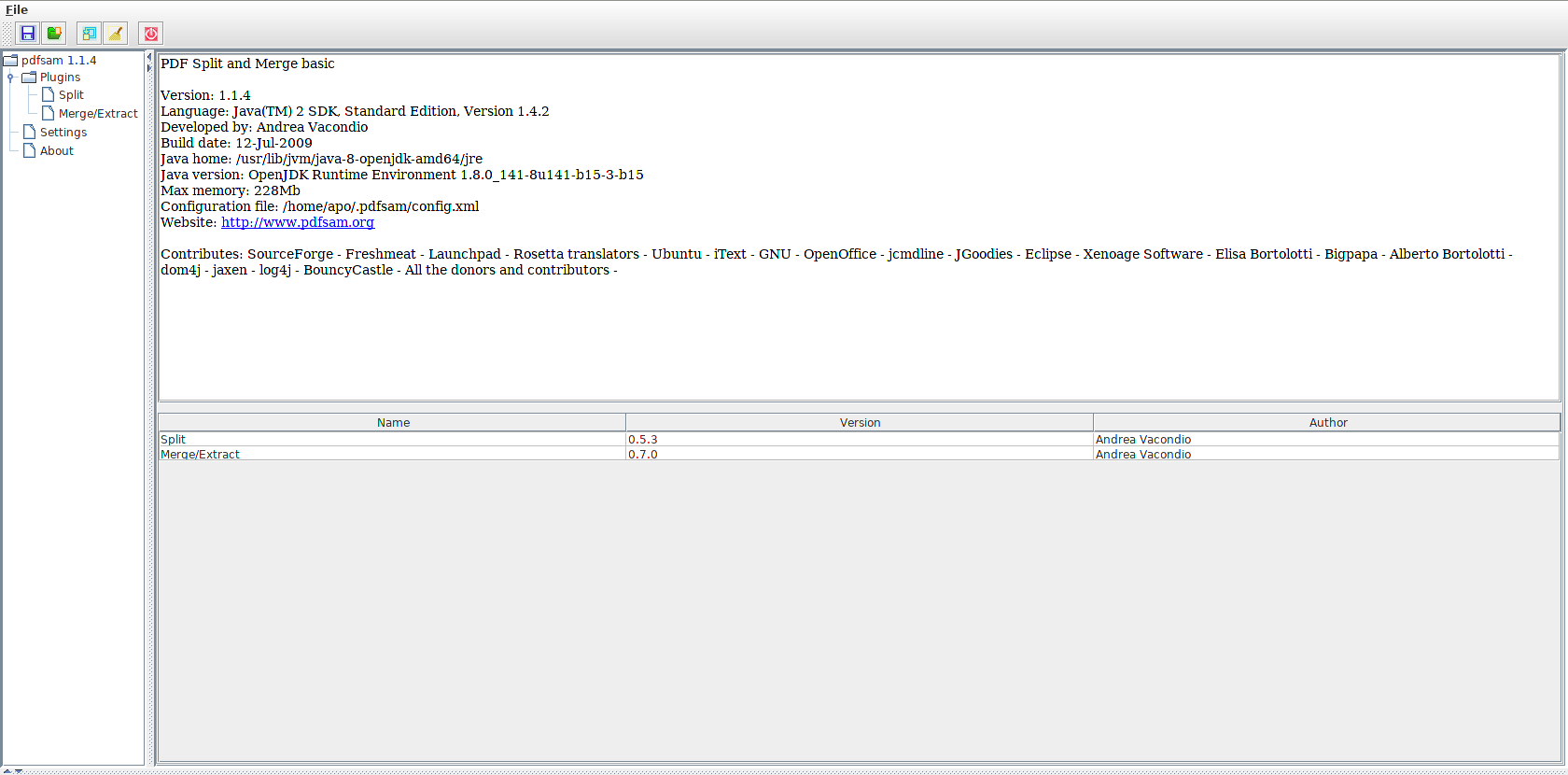
before

and after

1 August 2017

Russ Allbery: Review: The Fifth Season

Review: The Fifth Season, by N.K. Jemisin
Series: The Broken Earth #1
Publisher: Orbit
Copyright: 2015
ISBN: 0-316-22930-X
Format: Kindle
Pages: 497
The world of The Fifth Season is one of near-constant seismic activity. Volcanoes, massive earthquakes, and all the catastrophes that follow them are a constant threat. Civilization barely survives the turmoil, and only because of two things: strict cultural rules about how to handle a "fifth season" of heavy seismic activity and its aftermath (called stonelore), and the orogenes. Orogenes are humans (well, there is some debate about that) who have an organ that others don't, a biological ability to manipulate the seismic activity and the earth itself. They can protect others by damping down activity, smoothing faults, and redirecting seismic shock waves, but they can also destroy: pull earth out of shape, set off quakes, and create paths for magma to surface. And, to gather the power to manipulate the earth, they draw energy from everything around them, including from other people, often fatally. Orogenes are feared and hated by the typical person. The Stillness, the ironically-named continent on which this book is set, is very old and has had numerous civilizations destroyed by some seismic catastrophe. The landscape is scattered with useless or dangerous remnants of previous forgotten civilizations; the history, likewise, with only the stonelore and some muddled mythology available to most people. The current rulers have kept their empire for a surprising length of time, however, due mostly to the stable ground beneath their centrally-located capital. That stability comes from Fulcrum-trained orogenes, who are taken from their family as children and trained harshly to serve their society by suppressing or fixing dangerous seismic events. Fulcrum orogenes don't have an awful life (well, most of them; for some, it is pure torture), but they're effectively slaves, kept under the watchful eye of Guardians who have mysterious powers of their own. Against this background, The Fifth Season tells three interwoven stories. Essun lives in a small village (comm) at the start of the book, leading a quiet life, until one of her children is beaten to death by her husband following a seismic event that he thinks the child stopped. He's taken their other child and left. Essun, severely traumatized, heads after him to attempt a rescue, or at least revenge. Damaya is a child from another comm who is sold to the Guardians by her parents when she demonstrates orogenic ability, and who goes through Fulcrum training. And Syenite is a Fulcrum orogene, assigned to a field mission with a difficult but very senior orogene named Alabaster. All of these stories eventually interweave, and eventually reveal where they fit in the somewhat unobvious chronology of the story, but it takes some time to get there. It also takes some time for the primary characters to have much in the way of agency. Essun starts with the most, once she recovers her senses enough to start her hunt for revenge. Syenite is ambitious but junior, and Damaya is a child, trying to navigate an unknown world of student politics and strict rules. And all three of the main characters are orogenes, rogga when one is being insulting, and this world does not like orogenes. At all. The Fifth Season starts with an unusual narrative style: a conversational narrator who begins with some of the world background and some mysterious scenes that didn't make sense until much later in the book (late enough that I didn't remember them or make sense of them until I re-read them for this review). The book then focuses on Essun, whose scenes are written in second person present. Normally I think second person feels weirdly intrusive and off-putting, but once I got used to it here, I think it works as well as I've seen it work anywhere. I also see why Jemisin did it: Essun starts the story so traumatized that she's partly disassociating. First person wouldn't have worked, and the second-person voice gives that trauma some immediacy and emotional heft that would have been hard to achieve in third person. The story starts slowly, and builds slowly, as the world is introduced and Jemisin lays down the texture and history of the world. The world-building is ambitious in tracing down the ramifications of the seismic chaos and the implications of orogene ability (although it's best to think of it as pure magic, despite the minor science fiction trappings). But through that world-building, what this story is building is a deep, powerful, frustrated rage. The Fifth Season is an angry book. It's a book about outcasts, about slaves. About people who, even if they're succeeding within the parameters they're given, are channeled and stymied and controlled. It's a story about smiling, kind paternalism hiding lies, control, and abuse, about how hard it is to find enough space from the smothering destructiveness of a totalitarian culture to let yourself relax. It's a story about the horrible things people are willing to do to those they don't consider fully human, and all the ways in which safety, expediency, tradition, culture, and established social roles conspire to keep people within the box where they belong. And it's a story about how being constantly on edge, constantly dreading the next abuse, breaking under it, and being left wanting to burn the whole world to the ground. I struggled at the start of this book, but it grew on me, and by about halfway through it had me hooked completely. At first, Syenite's part of the story (the most traditionally told) was my favorite, but the coming-of-age stories of her and Damaya were overtaken by Essun's far more complex, cautious, and battle-weary tale. And I loved Jemisin's world-building. There's a lot of depth here, a lot of things going on that are unexplained but clearly important, and a restraint and maturity in how the world is revealed that makes it feel older and more layered than Jemisin's The Hundred Thousand Kingdoms. The major drawback of this book is that it is very much the first book of a series, and it doesn't so much have an ending as a hard stop. It's not quite a cliff-hanger, but it's nearly as unsatisfying as one. Most of the major questions of the book who the stone eaters are and what they want, and the fate of Essun's husband and child, just to name two are still unresolved at the end of the story. There is a bit of emotional closure, but not a true moment of catharsis for all of the rage. Hopefully that will be coming in a future book. This is a very unusual story, mixing fantasy and a sort of magic (orogeny) with some science fiction elements and a deep history. It's gritty, textured, emotional, and furious, and very much worth reading. I'm looking forward to the next book in the series. Followed by The Obelisk Gate. Rating: 8 out of 10

31 July 2017

Jonathan McDowell: How to make a keyring

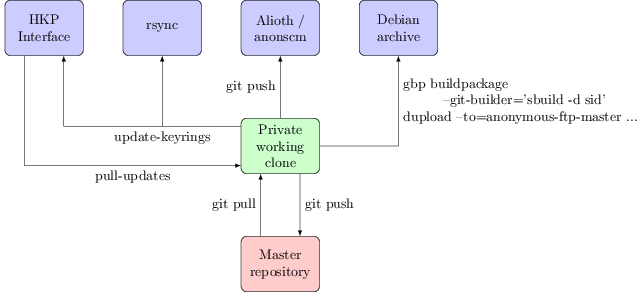
Every month or two keyring-maint gets a comment about how a key update we say we ve performed hasn t actually made it to the active keyring, or a query about why the keyring is so out of date, or told that although a key has been sent to the HKP interface and that is showing the update as received it isn t working when trying to upload to the Debian archive. It s frustrating to have to deal with these queries, but the confusion is understandable. There are multiple public interfaces to the Debian keyrings and they re not all equal. This post attempts to explain the interactions between them, and how I go about working with them as part of the keyring-maint team. First, a diagram to show the different interfaces to the keyring and how they connect to each other: keyring-maint workflow
Public interfaces

rsync: keyring.debian.org::keyrings This is the most important public interface; it s the one that the Debian infrastructure uses. It s the canonical location of the active set of Debian keyrings and is what you should be using if you want the most up to date copy. The validity of the keyrings can be checked using the included sha512sums.txt file, which will be signed by whoever in keyring-maint did the last keyring update.

HKP interface: hkp://keyring.debian.org/ What you talk to with gpg --keyserver keyring.debian.org. Serves out the current keyrings, and accepts updates to any key it already knows about (allowing, for example, expiry updates, new subkeys + uids or new signatures without the need to file a ticket in RT or otherwise explicitly request it). Updates sent to this interface will be available via it within a few hours, but must be manually folded into the active keyring. This in general happens about once a month when preparing for a general update of the keyring; for example b490c1d5f075951e80b22641b2a133c725adaab8. Why not do this automatically? Even though the site uses GnuPG to verify incoming updates there are still occasions we ve seen bugs (such as #787046, where GnuPG would always import subkeys it didn t understand, even when that subkey was already present). Also we don t want to allow just any UID to be part of the keyring. It is thus useful to retain a final set of human based sanity checking for any update before it becomes part of the keyring proper.

Alioth/anonscm: https://anonscm.debian.org/git/keyring/keyring/ A public mirror of the git repository the keyring-maint team use to maintain the keyring. Every action is recorded here, and in general each commit should be a single action (such as adding a new key, doing a key replacement or moving a key between keyrings). Note that pulling in the updates sent via HKP count as a single action, rather than having a commit per key updated. This mirror is updated whenever a new keyring is made active (i.e. made available via the rsync interface). Until that point pending changes are kept private; we sometimes deal with information such as the fact someone has potentially had a key compromised that we don t want to be public until we ve actually disabled it. Every keyring push (as we refer to the process of making a new keyring active) is tagged with the date it was performed. Releases are also tagged with their codenames, to make it easy to do comparisons over time.

Debian archive This is actually the least important public interface to the keyring, at least from the perspective of the keyring-maint team. No infrastructure makes use of it and while it s mostly updated when a new keyring is made active we only make a concerted effort to do so when it is coming up to release. It s provided as a convenience package rather than something which should be utilised for active verification of which keys are and aren t currently part of the keyring.

Team interface

Master repository: kaufmann.debian.org:/srv/keyring.debian.org/master-keyring.git The master git repository for keyring maintenance is stored on kaufmann.debian.org AKA keyring.debian.org. This system is centrally managed by DSA, with only DSA and keyring-maint having login rights to it. None of the actual maintenance work takes place here; it is a bare repo providing a central point for the members of keyring-maint to collaborate around.

Private interface

Private working clone This is where all of the actual keyring work happens. I have a local clone of the repository from kaufmann on a personal machine. The key additions / changes I perform all happen here, and are then pushed to the master repository so that they re visible to the rest of the team. When preparing to make a new keyring active the changes that have been sent to the HKP interface are copied from kaufmann via scp and folded in using the pull-updates script. The tree is assembled into keyrings with a simple make and some sanity tests performed using make test. If these are successful the sha512sums.txt file is signed using gpg --clearsign and the output copied over to kaufmann. update-keyrings is then called to update the active keyrings (both rsync + HKP). A git push public pushes the changes to the public repository on anonscm. Finally gbp buildpackage --git-builder='sbuild -d sid' tells git-buildpackage to use sbuild to build a package ready to be uploaded to the archive. Hopefully that helps explain the different stages and outputs of keyring maintenance; I m aware that it would be a good idea for this to exist somewhere on keyring.debian.org as well and will look at doing so.

Russell Coker: Running a Tor Relay

I previously wrote about running my SE Linux Play Machine over Tor [1] which involved configuring ssh to use Tor. Since then I have installed a Tor hidden service for ssh on many systems I run for clients. The reason is that it is fairly common for them to allow a server to get a new IP address by DHCP or accidentally set their firewall to deny inbound connections. Without some sort of VPN this results in difficult phone calls talking non-technical people through the process of setting up a tunnel or discovering an IP address. While I can run my own VPN for them I don t want their infrastructure tied to mine and they don t want to pay for a 3rd party VPN service. Tor provides a free VPN service and works really well for this purpose. As I believe in giving back to the community I decided to run my own Tor relay. I have no plans to ever run a Tor Exit Node because that involves more legal problems than I am willing or able to deal with. A good overview of how Tor works is the EFF page about it [2]. The main point of a Middle Relay (or just Relay ) is that it only sends and receives encrypted data from other systems. As the Relay software (and the sysadmin if they choose to examine traffic) only sees encrypted data without any knowledge of the source or final destination the legal risk is negligible. Running a Tor relay is quite easy to do. The Tor project has a document on running relays [3], which basically involves changing 4 lines in the torrc file and restarting Tor. If you are running on Debian you should install the package tor-geoipdb to allow Tor to determine where connections come from (and to not whinge in the log files). ORPort [IPV6ADDR]:9001 If you want to use IPv6 then you need a line like the above with IPV6ADDR replaced by the address you want to use. Currently Tor only supports IPv6 for connections between Tor servers and only for the data transfer not the directory services. Data Transfer I currently have 2 systems running as Tor relays, both of them are well connected in a European DC and they are each transferring about 10GB of data per day which isn t a lot by server standards. I don t know if there is a sufficient number of relays around the world that the share of the load is small or if there is some geographic dispersion algorithm which determined that there are too many relays in operation in that region.

29 July 2017

Antoine Beaupr : My free software activities, July 2017

Debian Long Term Support (LTS) This is my monthly working on Debian LTS. This time I worked on various hairy issues surrounding ca-certificates, unattended-upgrades, apache2 regressions, libmtp, tcpdump and ipsec-tools.

ca-certificates updates I've been working on the removal of the Wosign and StartCom certificates (Debian bug #858539) and, in general, the synchronisation of ca-certificates across suites (Debian bug #867461) since at least last march. I have made an attempt at summarizing the issue which led to a productive discussion and it seems that, in the end, the maintainer will take care of synchronizing information across suites. Guido was right in again raising the question of synchronizing NSS across all suites (Debian bug #824872) which itself raised the other question of how to test reverse dependencies. This brings me back to Debian bug #817286 which, basically proposed the idea of having "proposed updates" for security issues. The problem is while we can upload test packages to stable proposed-updates, we can't do the same in LTS because the suite is closed and we operate only on security packages. This issue came up before in other security upload and we need to think better about how to solve this.

unattended-upgrades Speaking of security upgrades brings me to the question of a bug (Debian bug #867169) that was filed against the wheezy version of unattended-upgrades, which showed that the package simply stopped working since the latest stable release, because wheezy became "oldoldstable". I first suggested using the "codename" but that appears to have been introduced only after wheezy. In the end, I proposed a simple update that would fix the configuration files and uploaded this as DLA-1032-1. This is thankfully fixed in later releases and will not require such hackery when jessie becomes LTS as well.

libmtp Next up is the work on the libmtp vulnerabilities (CVE-2017-9831 and CVE-2017-9832). As I described in my announcement, the work to backport the patch was huge, as upstream basically backported a whole library from the gphoto2 package to fix those issues (and probably many more). The lack of a test suite made it difficult to trust my own work, but given that I had no (negative) feedback, I figured it was okay to simply upload the result and that became DLA-1029-1.

tcpdump I then looked at reproducing CVE-2017-11108, a heap overflow triggered tcpdump would parse specifically STP packets. In Debian bug #867718, I described how to reproduce the issue across all suites and opened an issue upstream, given that the upstream maintainers hadn't responded responded in weeks according to notes in the RedHat Bugzilla issue. I eventually worked on a patch which I shared upstream, but that was rejected as they were already working on it in their embargoed repository. I can explain this confusion and duplication of work with:
  1. the original submitter didn't really contact security@tcpdump.org
  2. he did and they didn't reply, being just too busy
  3. they replied and he didn't relay that information back
I think #2 is most likely: the tcpdump.org folks are probably very busy with tons of reports like this. Still, I should probably have contacted security@tcpdump.org directly before starting my work, even though no harm was done because I didn't divulge issues that were already public. Since then, tcpdump has released 4.9.1 which fixes the issue, but then new CVEs came out that will require more work and probably another release. People looking into this issue must be certain to coordinate with the tcpdump security team before fixing the actual issues.

ipsec-tools Another package that didn't quite have a working solution is the ipsec-tools suite, in which the racoon daemon was vulnerable to a remotely-triggered DOS attack (CVE-2016-10396). I reviewed and fixed the upstream patch which introduced a regression. Unfortunately, there is no test suite or proof of concept to control the results. The reality is that ipsec-tools is really old, and should maybe simply be removed from Debian, in favor of strongswan. Upstream hasn't done a release in years and various distributions have patched up forks of those to keep it alive... I was happy, however, to know that a maintainer will take care of updating the various suites, including LTS, with my improved patch. So this fixes the issue for now, but I would strongly encourage users to switch away from ipsec-tools in the future.

apache2 Finally, I was bitten by the old DLA-841-1 upload I did all the way back in February, as it introduced a regression (Debian bug #858373). It turns out it was possible to segfault Apache workers with a trivial HTTP request, in certain (rather exotic, I might add) configurations (ErrorDocument 400 directive pointing to a cgid script in worker mode). Still, it was a serious regression and I found a part of the nasty long patch we worked on back then that was faulty, and introduced a small fix to correct that. The proposed package unfortunately didn't yield any feedback, and I can only assume it will work okay for people. The result is the DLA-841-2 upload which fixes the regression. I unfortunately didn't have time to work on the remaining CVEs affecting apache2 in LTS at the time of writing.

Triage I also did some miscellaneous triage by filing Debian bug #867477 for poppler in an effort to document better the pending issue. Next up was some minor work on eglibc issues. CVE-2017-8804 has a patch, but it's been disputed. since the main victim of this and the core of the vulnerability (rpcbind) has already been fixed, I am not sure this vulnerability is still a thing in LTS at all. I also looked at CVE-2014-9984, but the code is so different in wheezy that I wonder if LTS is affected at all. Unfortunately, the eglibc gymnastics are a little beyond me and I do not feel confident enough to just push those issues aside for now and let them open for others to look at.

Other free software work And of course, there's my usual monthly volunteer work. My ratio is a little better this time, having reached an about even ratio between paid and volunteer work, whereas this was 60% volunteer work in march.

Announcing ecdysis I recently published ecdysis, a set of template and code samples that I frequently reuse across project. This is probably the least pronounceable project name I have ever chosen, but this is somewhat on purpose. The goal of this project is not collaboration or to become a library: it's just a personal project which I share with the world as a curiosity. To quote the README file:
The name comes from what snakes and other animals do to "create a new snake": they shed their skin. This is not so appropriate for snakes, as it's just a way to rejuvenate their skin, but is especially relevant for anthropods since then "ecdysis" may be associated with a metamorphosis:
Ecdysis is the moulting of the cuticle in many invertebrates of the clade Ecdysozoa. Since the cuticle of these animals typically forms a largely inelastic exoskeleton, it is shed during growth and a new, larger covering is formed. The remnants of the old, empty exoskeleton are called exuviae. Wikipedia
So this project is metamorphosed into others when the documentation templates, code examples and so on are reused elsewhere. For that reason, the license is an unusally liberal (for me) MIT/Expat license. The name also has the nice property of being absolutely unpronounceable, which makes it unlikely to be copied but easy to search online.
It was an interesting exercise to go back into older projects and factor out interesting code. The process is not complete yet, as there are older projects I'm still curious in reviewing. A bunch of that code could also be factored into upstream project and maybe even the Python standard library. In short, this is stuff I keep on forgetting how to do: a proper setup.py config, some fancy argparse extensions and so on. Instead of having to remember where I had written that clever piece of code, I now shove it in the crazy chaotic project where I can find it again in the future.

Beets experiments Since I started using Subsonic (or Libresonic) to manage the music on my phone, album covers are suddenly way more interesting. But my collection so far has had limited album covers: my other media player (gmpc) would download those on the fly on its own and store them in its own database - not on the filesystem. I guess this could be considered to be a limitation of Subsonic, but I actually appreciate the separation of duty here. Garbage in, garbage out: the quality of Subsonic's rendering depends largely on how well setup your library and tags are. It turns out there is an amazing tool called beets to do exactly that kind of stuff. I originally discarded that "media library management system for obsessive-compulsive [OC] music geeks", trying to convince myself i was not an "OC music geek". Turns out I am. Oh well. Thanks to beets, I was able to download album covers for a lot of the albums in my collection. The only covers that are missing now are albums that are not correctly tagged and that beets couldn't automatically fix up. I still need to go through those and fix all those tags, but the first run did an impressive job at getting album covers. Then I got the next crazy idea: after a camping trip where we forgot (again) the lyrics to Georges Brassens, I figured I could start putting some lyrics on my ebook reader. "How hard can that be?" of course, being the start of another crazy project. A pull request and 3 days later, I had something that could turn a beets lyrics database into a Sphinx document which, in turn, can be turned into an ePUB. In the process, I probably got blocked from MusixMatch a hundred times, but it's done. Phew! The resulting e-book is about 8000 pages long, but is still surprisingly responsive. In the process, I also happened to do a partial benchmark of Python's bloom filter libraries. The biggest surprise there was the performance of the set builtin: for small items, it is basically as fast as a bloom filter. Of course, when the item size grows larger, its memory usage explodes, but in this case it turned out to be sufficient and bloom filter completely overkill and confusing. Oh, and thanks to those efforts, I got admitted in the beetbox organization on GitHub! I am not sure what I will do with that newfound power: I was just scratching an itch, really. But hopefully I'll be able to help here and there in the future as well.

Debian package maintenance I did some normal upkeep on a bunch of my packages this month, that were long overdue:
  • uploaded slop 6.3.47-1: major new upstream release
  • uploaded an NMU for maim 5.4.64-1.1: maim was broken by the slop release
  • uploaded pv 1.6.6-1: new upstream release
  • uploaded kedpm 1.0+deb8u1 to jessie (oldstable): one last security fix (Debian bug #860817, CVE-2017-8296) for that derelict password manager
  • uploaded charybdis 3.5.5-1: new minor upstream release, with optional support for mbedtls
  • filed Debian bug #866786 against cryptsetup to make the remote initramfs SSH-based unlocking support multiple devices: thanks to the maintainer, this now works flawlessly in buster and may be backported to stretch
  • expanded on Debian bug #805414 against gdm3 and Debian bug #845938 against pulseaudio, because I had trouble connecting my computer to this new Bluetooth speaker. turns out this is a known issue in Pulseaudio: whereas it releases ALSA devices, it doesn't release Bluetooth devices properly. Documented this more clearly in the wiki page
  • filed Debian bug #866790 regarding old stray Apparmor profiles that were lying around my system after an upgrade, which got me interested in Debian bug #830502 in turn
  • filed Debian bug #868728 against cups regarding a weird behavior I had interacting with a network printer. turns out the other workstation was misconfigured... why are printers still so hard?
  • filed Debian bug #870102 to automate sbuild schroots upgrades
  • after playing around with rash tried to complete the packaging (Debian bug #754972) of percol with this pull request upstream. this ended up to be way too much overhead and I reverted to my old normal history habits.

Robert McQueen: Hello again!

Like all good blog posts, this one starts with an apology about not blogging for ages in my case it looks like it s been about 7 years which is definitely a new personal best (perhaps the equally or more remarkable thing is that I have diligently kept WordPress running in the meantime). In that time, as you might expect, a few things have happened, like I met a wonderful woman and fell in love and we have two wonderful children. I also decided to part ways with my first baby and leave my role as CTO & co-founder of Collabora. This was obviously a very tough decision it s a fantastic team where I met and made many life-long friends, and they are still going strong and doing awesome things with Open Source. However, shortly after that, in February last year, I was lucky enough to land what is basically a dream job working at Endless Computers as the VP of Deployment. As I m sure most readers know, Endless is building an OS to bring personal computing to millions of new users across the world. It s based on Free Software like GNOME, Debian, ostree and Flatpak, and the more successful Endless is, the more people who get access to education, technology and opportunity and the more FOSS users and developers there will be in the world. But in my role, I get to help define the product, understand our users and how technology might help them, take Open Source out to new people, solve commercial problems to get Endless OS out into the world, manage a fantastic team and work with bright people, learn from great managers and mentors, and still find time to squash bugs, review and write more code than I used to. Like any startup, we have a lot to do and not enough time to do it, so although there aren t quite enough days in the week, I m really happy! In any case, the main point of this blog post is that I m at GUADEC in Manchester right now, and I d like to blog about Flathub, but I thought it would be weird to just show up and say that after 7 years of silence without saying hello again.

25 July 2017

Satyam Zode: Maya - the OpenEBS Go Kit Project

The Kit project in Go is the common project containing all the standard libraries or packages used across all the Go projects in the organization. Motivation I attended GopherCon India 2017, there was a talk on Package Oriented Design In Go by William Kennedy. In that talk, William explained some really important and thoughtful design principles which We can apply in our day to day life, while writing Go. Hence, I wanted to apply these design philosophies to the Go projects in which I have been working on as a part of OpenEBS project. I learnt a good practice of having a Go Kit project at the organization level from William s talk. What is the Kit Project? The Kit project in Go is the common project containing all the standard libraries or packages used across all the Go projects in the organization. Packages in the Kit project should follow design philosophies. Need for a Kit project Sometimes, We write same Go packages again and again to do the same task at different levels in the different Go projects under the same organization. For example, we write custom logger package in the different Go projects. If the custom logger package is same across the organization and can be reused by simply importing it, then this custom logger package is the perfect fit for Kit project. You can sense how much time and cost it will save for us when we have a Kit project. How to convert existing projects to have kit Maya is the kit project in the progress. I will walk through our journey of creating a Kit project called maya for OpenEBS organization from existing Go projects. At OpenEBS, as a open source and growing Go project, We value Go principles and We try hard to leverage Go s offerings. Maya is the Kit project for the Application projects like maya-apiserver, maya-storage-bot etc. Maya contains all the kubernetes & nomad API s, common utilities etc. needed for development of maya-apiserver and maya-storage-bot. In the near future, we are trying to push our custom libraries to maya. So that, it will become a promising Go kit project for OpenEBS community. We have specifically followed the package oriented design principles in Go to create maya as a kit project. Project structure for the Maya as Kit project Example usage of maya kit project in maya-apiserver Maya-apiserver uses maya as a Kit project. Maya-apiserver exposes OpenEBS operations in form of REST APIs. This allows multiple clients e.g. volume related plugins to consume OpenEBS storage operations exposed by Maya API server. Conclusion Go Kit project should contain packages which are usable, purposeful and portable. Go Kit projects will improve the efficiency of the organization at both human and code level.

18 July 2017

Daniel Silverstone: Yay, finished my degree at last

A little while back, in June, I sat my last exam for what I hoped would be the last module in my degree. For seven years, I've been working on a degree with the Open University and have been taking advantage of the opportunity to have a somewhat self-directed course load by taking the 'Open' degree track. When asked why I bothered to do this, I guess my answer has been a little varied. In principle it's because I felt like I'd already done a year's worth of degree and didn't want it wasted, but it's also because I have been, in the dim and distant past, overlooked for jobs simply because I had no degree and thus was an easy "bin the CV". Fed up with this, I decided to commit to the Open University and thus began my journey toward 'qualification' in 2010. I started by transferring the level 1 credits from my stint at UCL back in 1998/1999 which were in a combination of basic programming in Java, some mathematics including things like RSA, and some psychology and AI courses which at the time were aiming at a degree called 'Computer Science with Cognitive Sciences'. Then I took level 2 courses, M263 (Building blocks of software), TA212 (The technology of music) and MS221 (Exploring mathematics). I really enjoyed the mathematics course and so... At level 3 I took MT365 (Graphs, networks and design), M362 (Developing concurrent distributed systems), TM351 (Data management and analysis - which I ended up hating), and finally finishing this June with TM355 (Communications technology). I received an email this evening telling me the module result for TM355 had been posted, and I logged in to find I had done well enough to be offered my degree. I could have claimed my degree 18+ months ago, but I persevered through another two courses in order to qualify for an honours degree which I have now been awarded. Since I don't particularly fancy any ceremonial awarding, I just went through the clicky clicky and accepted my qualification of 'Batchelor of Science (Honours) Open, Upper Second-class Honours (2.1)' which grants me the letters 'BSc (Hons) Open (Open)' which, knowing me, will likely never even make it onto my CV because I'm too lazy. It has been a significant effort, over the course of the past few years, to complete a degree without giving up too much of my personal commitments. In addition to earning the degree, I have worked, for six of the seven years it has taken, for Codethink doing interesting work in and around Linux systems and Trustable software. I have designed and built Git server software which is in use in some universities, and many companies, along with a good few of my F/LOSS colleagues. And I've still managed to find time to attend plays, watch films, read an average of 2 novel-length stories a week (some of which were even real books), and be a member of the Manchester Hackspace. Right now, I'm looking forward to a stress free couple of weeks, followed by an immense amount of fun at Debconf17 in Montr al!

14 July 2017

Norbert Preining: TeX Live contrib repository (re)new(ed)

It is my pleasure to announce the renewal/rework/restart of the TeX Live contrib repository service. The repository is collecting packages that cannot enter TeX Live directly (mostly due to license reasons), but are free to distribute. The basic idea is to provide a repository mimicking Debian s nonfree branch. The packages on this site are not distributed inside TeX Live proper for one or another of the following reasons: In short, anything related to TeX that can not be on TeX Live but can still legally be distributed over the Internet can hav e a placeon TLContrib. Currently there are 52 packages in the repository, falling roughly into the following categories: The full list of packages can be seen here. The ultimate goal is to provide a companion to the core TeX Live (tlnet) distribution in much the same way as Debian s non-free tree is a companion to the normal distribution. The goal is not to replace TeX Live: packages that could go into TeX Live itself should stay (or be added) there. TLContrib is simply trying to fill in a gap in the current distribution system. Quick Start If you are running the current version of TeX Live, which is 2017 at the moment, the following code will suffice:
  tlmgr repository add http://contrib.texlive.info/current tlcontrib
  tlmgr pinning add tlcontrib '*'
In future there might be releases for certain years. Verification The packages are signed with my GnuPG RSA key: 0x6CACA448860CDC13. tlmgr will automatically verify authenticity if you add my key:
  curl -fsSL https://www.preining.info/rsa.asc   tlmgr key add -
After that tlmgr will tell you about failed authentication of this repository. History Taco Hoekwater started in 2010, but it hasn t seen much activity in recent years. Taco agreed to hand it over to myself, who is currently maintaining the repository. Big thanks to Taco for his long support and cooperation. In contrast to the original tlcontrib page, we don t offer an automatic upload of packages or user registration. If you want to add packages here, see below. Adding packages If you want to see a package included here that cannot enter TeX Live proper, the following ways are possible (from most appreciated to least appreciated): Git repository The packages are kept in a git repository and the tlmgr repo is built from after changes. The location is https://git.texlive.info/tlcontrib. Enjoy.

5 July 2017

Shirish Agarwal: Debian 9 release party at Co-hive

Dear all, This would be a biggish one so please have a chai/coffee or something stronger as it would take a while. I would start with attempt at some alcohol humor. While some people know that I have had a series of convulsive epileptic seizure I had shared bits about it in another post as well. Recovery is going through allopathic medicines as well as physiotherapy which I go to every alternate day. One of the exercises that I do in physiotherapy sessions is walk cross-legged on a line. While doing it today, it occurred to me that this is the same test that a Police inspector would do if they caught you drinking or are suspected of drunk driving. While some in the police force have now also have breath analyzer machines to determine alcohol content in the breath and body (and ways to deceive it are also there) the above exercise is still an integral part of examination. Now few of my friends who do drink have and had made expertise of walking on a line, while I due to this neurological disorder still have issues of walking on a line. So while I don t think of a drinking party in the near future (6 months at least), if I ever do get caught with a friend who is drunk (by association I would also be a suspect) by a policeman who doesn t have a breath analyzer machine, I could be in a lot of trouble. In addition if I tell him I have a neurological disorder I am bound to land up in a cell as he will think I m trying to make a fool of him. If you are able to picturize the situation, I m sure you will get a couple of laughs. Now coming to the release party, I was a bit apprehensive. It s been quite a while I had faced an audience and just coming out of illness didn t know how well or ill-prepared I would be for the session. I had forsaken/given up exercising two days earlier before the event as I wanted to have loose body, loose limbs all over. I also took a mild sedative (1mg) the day before just so I will have a fit night sleep and be able to focus all my energies on the big day. (I don t recommend sedatives unless the doctor prescribes) and I did have a doctor prescription so was able to have a nice sleep. I didn t do any Debian study as I hoped my somewhat long experience with both Ubuntu and Debian should help me. On the d-day, I had asked dhanesh (the organizer of the event) to accompany me from home to venue and back as I was unsure of the journey as it was around 9-10 kms. from my place and while I had been to the venue about couple of years back, I had just a mild remembrance of the place. Anyways, Dhanesh compiled with my request and together we reached the venue before the appointed 1500 hrs. As it was a Sunday I was unsure as how many people would turn up as people usually like to cozy up on a Sunday. Around 1530 hrs everybody showed up The whole group It included couple of co-organizers with most people being newbies so while I had thought of showing how to contribute via reporting bugs or putting up patches, had to set that aside and explain how things work in free software and open-source world. We didn t get into the debate of free vs open-source or free/open-source/open-core as that would have been counter-productive and probably confusing for newbies. We did however share the debian tree structure debian-tree-structure-discussion I was stumped by /var and /proc . I hadn t taken my lappy as it is expensive (a lenovo thinkpad I love very dearly) and I was unsure if I would be able to take care of it (weight wise). Dhanesh had told me that he had Debian on his lappy + zsh both of which are my favourites. While back at home I realized /var has been relegated to having apache/server logs and stuff like that, I do recall (vaguely) a thread on debian-devel about removing /var although that discussion went nowhere. One of the bugs that we hit early on is that nobody had enough space on their hdd to have Debian comfortably. It took a while to get an external hdd and push some of the content from somebody s lappy to the external drive to have space for the installation. I did share the /. /home, optional swap while Dhanesh helped by sharing about having a separate /boot partition as well which I had forgotten. I can t even begin to remember the number of times having a separate /boot partition has helped me in all of my systems. That done, we did try to install/show Debian 9 without network but were hit with #866629 so wasn t able to complete the installation. We had got the latest 9.0.1 as I had seen Steve s message about issues with the live images but even then we were hit with the above bug. As shared in the bug history, it might be a good idea to have the last couple of RC s (Release Candidate releases) as pre-release parties so people have a chance to report bugs and get them fixed. It was also nice to see Praveen raising the seriousness of the bug shared above. The next day I also filed #866971 as I had mistaken the release to be a regular release and not the live instance. I have pushed my rationale and hope the right thing happens. As installation takes a bit of time, we used the time to share about Google s Summer of Code and absence of Debian from GSoC this year. I should have directed them to an itfoss article I wrote sometime ago and also shared that Debian is also looking to having a similar apprenticeship within Debian itself. There were questions about why Debian would like to take the administrative overhead, my response was that it probably had to do with Debian wanting more control over the process. While Debian has had some great luck getting all number of seats that it asks for in GSoC, the ball is always in Google s court. Having that uncertainty off would be beneficial to Debian both in short-term as well as long-term. One interesting stat that was shared with me was that something akin to 89 students from India had been selected this year to GSoC even with the lower stipend and that is a far cry from the 10-15 students who are able to complete GSoC every year. Let s see what happens this year. One of the interesting fact/gossip I shared with them is that Google uses a modified/forked Debian internally which it probably would never release ever. There were quite a few queries about GSoC which resulted into how contributions are made and how git had become the master of all VCS (Version Control Systems). While I do have pet bugs about git (the biggest one being for places/countries having not big bandwidth git fails many a times while cloning). I *think* the bug has been reported enough times but haven t seen any improvements yet. There is a need of a solution like wget and wget -c so git just works even under the most trying circumstances (bandwidth wise) We also shared what a repo is and Dhanesh helpfully did a git shortlog to show people how commits are commented. It was from his official work so he couldn t show anything apart from the shortlog. I also shared how non-technical people can help with regard to documentation, artwork but didn t get into any concrete examples although wiki.debian.org would have been a good start. I also don t know if it s a fact or not but it seems/seemed that moinmoin (the current wiki solution used by debian) seems to have got sectional edit feature which I used sometime back. If moinmoin has got this feature then it is on par with mediawiki, although do know that mediawiki has lot more features going for it. Dhanesh did manage to install a Debian 8.0.7 (while 8.8.0 was the last release) which might have been better. The debian-installer (d-i) looks the same even though I know there are improvements with respect to UEFI and many updated components. There are and were many bugs which I wanted to share but didn t know if it was the right forum or not, for e.g. #597176 which probably needs improvements in other libraries along with the JPEG 2000 support #604859 all of which I m subscribed to. We also had a talk about code documentation and code readability, python (as almost everything in Debian is based on python) I had actually wanted to show metrics.debian.net but had seen it was down the day before and again checked to see it is down now as well, hence reported it, will hopefully come on Debian BTS some time soonish. The idea was to share that Debian does have/uses other programming languages as well and is only limited by people interested in a specific language and be willing to package and maintain packages in that specific programming language. As Dhanesh was part of Firefox OS and a Campus Ambassador we did discuss what went wrong in Firefox OS deployment and Firefox as a whole, specifically between the community and Mozilla the Corporation. In this there were lots that was lot that I wasn t able to share as had become tired otherwise would have shared that ncurses debian-installer interface although bit ugly to look at is still good as it has speech for visually differently abled people as well as people with poor sight. There is and was lots to share about Debian but was conscious that I might over-burden the audience and my stamina was also stretched. We also shared about automated builds bud didn t show either travis.debian.net or jeankins.debian.net We also had a small discussion about Artificial Intelligence, Robotics and how the outlook for people coming in Computer Science looks today. One thing I forgot to share we did do the cake-cutting together Dhanesh-Shirish cutting cake together Dhanesh is on the left while I m on the right. We did have a cute 3-4 year old boy as our guest as well bud didn t get good pictures of him. Lastly, the Debian cake itself Debian 9 cake We also talked about the kernel and subsystem maintainers and how Linus is the overlord. Look forward to comments. I am hoping Dhanesh might recollect some points that I might have missed/forgotten. Update 07/07/17 All programming languages stats. can be seen here
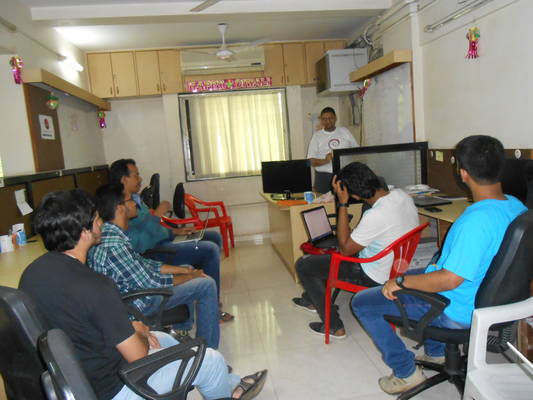
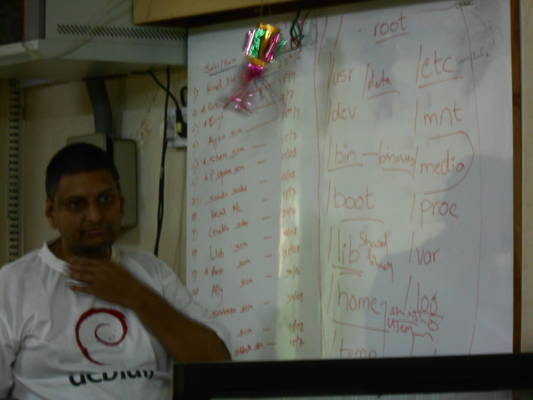
Filed under: Miscellenous Tagged: #alcohol humor, #co-hive, #crystal-gazing, #Debian bugs, #Debian cake, #Debian-release-party-9-pune, #live-installer, #moinmoin, #planet-debian, debian-installer, Pune

3 July 2017

Antoine Beaupr : My free software activities, June 2017

Debian Long Term Support (LTS) This is my monthly Debian LTS report. This time I worked on Mercurial, sudo and Puppet.

Mercurial remote code execution I issued DLA-1005-1 to resolve problems with the hg server --stdio command that could be abused by "remote authenticated users to launch the Python debugger, and consequently execute arbitrary code, by using --debugger as a repository name" (CVE-2017-9462). Backporting the patch was already a little tricky because, as is often the case in our line of work, the code had changed significantly in newer version. In particular, the commandline dispatcher had been refactored which made the patch non-trivial to port. On the other hand, mercurial has an extensive test suite which allowed me to make those patches in all confidence. I also backported a part of the test suite to detect certain failures better and to fix the output so that it matches the backported code. The test suite is slow, however, which meant slow progress when working on this package. I also noticed a strange issue with the test suite: all hardlink operations would fail. Somehow it seems that my new sbuild setup doesn't support doing hardlinks. I ended up building a tarball schroot to build those types of packages, as it seems the issue is related to the use of overlayfs in sbuild. The odd part is my tests of overlayfs, following those instructions, show that it does support hardlinks, so there maybe something fishy here that I misunderstand. This, however, allowed me to get a little more familiar with sbuild and the schroots. I also took this opportunity to optimize the builds by installing an apt-cacher-ng proxy to speed up builds, which will also be useful for regular system updates.

Puppet remote code execution I have issued DLA-1012-1 to resolve a remote code execution attack against puppetmaster servers, from authenticated clients. To quote the advisory: "Versions of Puppet prior to 4.10.1 will deserialize data off the wire (from the agent to the server, in this case) with a attacker-specified format. This could be used to force YAML deserialization in an unsafe manner, which would lead to remote code execution." The fix was non-trivial. Normally, this would have involved fixing the YAML parsing, but this was considered problematic because the ruby libraries themselves were vulnerable and it wasn't clear we could fix the problem completely by fixing YAML parsing. The update I proposed took the bold step of switching all clients to PSON and simply deny YAML parsing from the server. This means all clients need to be updated before the server can be updated, but thankfully, updated clients will run against an older server as well. Thanks to LeLutin at Koumbit for helping in testing patches to solve this issue.

Sudo privilege escalation I have issued DLA-1011-1 to resolve an incomplete fix for a privilege escalation issue (CVE-2017-1000368 from CVE-2017-1000367). The backport was not quite trivial as the code had changed quite a lot since wheezy as well. Whereas mercurial's code was more complex, it's nice to see that sudo's code was actually simpler and more straightforward in newer versions, which is reassuring. I uploaded the packages for testing and uploaded them a year later. I also took extra time to share the patch in the Debian bugtracker, so that people working on the issue in stable may benefit from the backported patch, if needed. One issue that came up during that work is that sudo doesn't have a test suite at all, so it is quite difficult to test changes and make sure they do not break anything.

Should we upload on fridays? I brought up a discussion on the mailing list regarding uploads on fridays. With the sudo and puppet uploads pending, it felt really ... daring to upload both packages, on a friday. Years of sysadmin work hardwired me to be careful on fridays; as the saying goes: "don't deploy on a friday if you don't want to work on the weekend!" Feedback was great, but I was surprised to find that most people are not worried worried about those issues. I have tried to counter some of the arguments that were brought up: I wonder if there could be a disconnection here between the package maintainer / programmer work and the sysadmin work that is at the receiving end of that work. Having myself to deal with broken updates in the past, I'm surprised this has never come up in the discussions yet, or that the response is so underwhelming. So far, I'll try to balance the need for prompt security updates and the need for stable infrastructure. One does not, after all, go without the other...

Triage I also did small fry triage: Hopefully some of those will come to fruitition shortly.

Other work My other work this month was a little all over the place.

Stressant Uploaded a new release (0.4.1) of stressant to split up the documentation from the main package, as the main package was taking up too much space according to grml developers. The release also introduces limited anonymity option, by blocking serial numbers display in the smartctl output.

Debiman Also did some small followup on the debiman project to fix the FAQ links.

Local server maintenance I upgraded my main server to Debian stretch. This generally went well, althought the upgrade itself took way more time than I would have liked (4 hours!). This is partly because I have a lot of cruft installed on the server, but also because of what I consider to be issues in the automation of major Debian upgrades. For example, I was prompted for changes in configuration files at seemingly random moments during the upgrade, and got different debconf prompts to answer. This should really be batched together, and unfortunately I had forgotten to use the home-made script I established when i was working at Koumbit which shortens the upgrade a bit. I wish we would improve on our major upgrade mechanism. I documented possible solutions for this in the AutomatedUpgrade wiki page, but I'm not sure I see exactly where to go from here. I had a few regressions after the upgrade:
  • the infrared remote control stopped working: still need to investigate
  • my home-grown full-disk encryption remote unlocking script broke, but upstream has a nice workaround, see Debian bug #866786
  • gdm3 breaks bluetooth support (Debian bug #805414 - to be fair, this is not a regression in stretch, it's just that I switched my workstation from lightdm to gdm3 after learning that the latter can do rootless X11!)

Docker and Subsonic I did my first (and late?) foray into Docker and containers. My rationale was that I wanted to try out Subsonic, an impressive audio server which some friends have shown me. Since Subsonic is proprietary, I didn't want it to contaminate the rest of my server and it seemed like a great occasion to try out containers to keep things tidy. Containers may also allow me to transparently switch to the FLOSS fork LibreSonic once the trial period is over. I have learned a lot and may write more about the details of that experience soon, for now you can look at the contributions I made to the unofficial Subsonic docker image, but also the LibreSonic one. Since Subsonic also promotes album covers as first-class citizens, I used beets to download a lot of album covers, which was really nice. I look forward to using beets more, but first I'll need to implement two plugins.

Wallabako I did a small release of wallabako to fix the build with the latest changes in the underlying wallabago library, which led me to ask upstream to make versionned releases. I also looked into creating a separate documentation site but it looks like mkdocs doesn't like me very much: the table of contents is really ugly...

Small fry That's about it! And that was supposed to be a slow month...

1 July 2017

Keith Packard: DRM-lease-4

DRM leasing part three (vblank) The last couple of weeks have been consumed by getting frame sequence numbers and events handled within the leasing environment (and Vulkan) correctly. Vulkan EXT_display_control extension This little extension provides the bits necessary for applications to track the display of frames to the user.
VkResult
vkGetSwapchainCounterEXT(VkDevice           device,
             VkSwapchainKHR         swapchain,
             VkSurfaceCounterFlagBitsEXT    counter,
             uint64_t           *pCounterValue);
This function just retrieves the current frame count from the display associated with swapchain.
VkResult
vkRegisterDisplayEventEXT(VkDevice          device,
              VkDisplayKHR          display,
              const VkDisplayEventInfoEXT   *pDisplayEventInfo,
              const VkAllocationCallbacks   *pAllocator,
              VkFence           *pFence);
This function creates a fence that will be signaled when the specified event happens. Right now, the only event supported is when the first pixel of the next display refresh cycle leaves the display engine for the display. If you want something fancier (like two frames from now), you get to do that on your own using this basic function. drmWaitVBlank drmWaitVBlank is the existing interface for all things sequence related and has three modes (always nice to have one function do three things, I think). It can:
  1. Query the current vblank number
  2. Block until a specified vblank number
  3. Queue an event to be delivered at a specific vblank number
This interface has a few issues: For leases, figuring out the index into the kernel list of crtcs is pretty tricky -- our lease has a subset of those crtcs, so we can't actually compute the global crtc index. drmCrtcGetSequence
int drmCrtcGetSequence(int fd, uint32_t crtcId,
               uint64_t *sequence, uint64_t *ns);
Here's a simple new function hand it a crtc ID and it provides the current frame sequence number and the time when that frame started (in nanoseconds). drmCrtcQueueSequence
int drmCrtcQueueSequence(int fd, uint32_t crtcId,
                 uint32_t flags, uint64_t sequence,
             uint64_t user_data);
struct drm_event_crtc_sequence  
    struct drm_event    base;
    __u64           user_data;
    __u64           time_ns;
    __u64           sequence;
 ;
This will cause a CRTC_SEQUENCE event to be delivered at the start of the specified frame sequence. That event will include the frame when the event was actually generated (in case it's late), along with the time (in nanoseconds) when that frame was started. The event also includes a 64-bit user_data value, which can be used to hold a pointer to whatever data the application wants to see in the event handler. The 'flags' argument contains a combination of:
#define DRM_CRTC_SEQUENCE_RELATIVE      0x00000001  /* sequence is relative to current */
#define DRM_CRTC_SEQUENCE_NEXT_ON_MISS      0x00000002  /* Use next sequence if we've missed */
#define DRM_CRTC_SEQUENCE_FIRST_PIXEL_OUT   0x00000004  /* Signal when first pixel is displayed */
These are similar to the values provided for the drmWaitVBlank function, except I've added a selector for when the event should be delivered to align with potential future additions to Vulkan. Right now, the only time you can ask for is first-pixel-out, which says that the event should correspond to the display of the first pixel on the screen. DRM events Vulkan fences With the kernel able to deliver a suitable event at the next frame, all the Vulkan code needed was a to create a fence and hook it up to such an event. The existing fence code only deals with rendering fences, so I added window system interface (WSI) fencing infrastructure and extended the radv driver to be able to handle both kinds of fences within that code. Multiple waiting threads I've now got three places which can be waiting for a DRM event to appear:
  1. Frame sequence fences.
  2. Wait for an idle image. Necessary when you want an image to draw the next frame to.
  3. Wait for the previous flip to complete. The kernel can only queue one flip at a time, so we have to make sure the previous flip is complete before queuing another one.
Vulkan allows these to be run from separate threads, so I needed to deal with multiple threads waiting for a specific DRM event at the same time. XCB has the same problem and goes to great lengths to manage this with a set of locking and signaling primitives so that only one thread is ever doing poll or read from the socket at time. If another thread wants to read at the same time, it will block on a condition variable which is then signaled by the original reader thread at the appropriate time. It's all very complicated, and it didn't work reliably for a number of years. I decided to punt and just create a separate thread for processing all DRM events. It blocks using poll(2) until some events are readable, processes those and then broadcasts to a condition variable to notify any waiting threads that 'something' has happened. Each waiting thread simply checks for the desired condition and if not satisfied, blocks on that condition variable. It's all very simple looking, and seems to work just fine. Code Complete, Validation Remains At this point, all of the necessary pieces are in place for the VR application to take advantage of an HMD using only existing Vulkan extensions. Those will be automatically mapped into DRM leases and DRM events as appropriate. The VR compositor application is working pretty well; tests with Dota 2 show occasional jerky behavior in complex scenes, so there's clearly more work to be done somewhere. I need to go write a pile of tests to independently verify that my code is working. I wonder if I'll need to wire up some kind of light sensor so I can actually tell when frames get displayed as it's pretty easy to get consistent-but-wrong answers in this environment. Source Code

Russ Allbery: End of month haul

For some reason, June is always incredibly busy for me. It's historically the most likely month in which I don't post anything here at all except reviews (and sometimes not even that). But I'm going to tell you about what books I bought (or were given to me) on the very last day of the month to break the pattern of no journal postings in June. Ted Chiang Arrival (Stories of Your Life) (sff collection)
Eoin Colfer Artemis Fowl (sff)
Philip K. Dick The Man Who Japed (sff)
Yoon Ha Lee Raven Strategem (sff)
Paul K. Longmore Why I Burned My Book (nonfiction)
Melina Marchetta The Piper's Son (mainstream)
Jules Verne For the Flag (sff, sort of) This is a more than usually eclectic mix. The Chiang is his Stories of Your Life collection reissued under the title of Arrival to cash in on the huge success of the movie based on one of his short stories. I'm not much of a short fiction reader, but I've heard so many good things about Chiang that I'm going to give it a try. The Longmore is a set of essays about disability rights that has been on my radar for a while. I finally got pushed into buying it (plus the first Artemis Fowl book and the Marchetta) because I've been reading back through every review Light has written. (I wish I were even close to that amusingly snarky in reviews, and she manages to say in a few paragraphs what usually takes me a whole essay.) Finally, the Dick and the Verne were gifts from a co-worker from a used book store in Ireland. Minor works by both authors, but nice, old copies of the books.

Russ Allbery: Review: Make It Stick

Review: Make It Stick, by Peter C. Brown, et al.
Author: Peter C. Brown
Author: Henry L. Roediger III
Author: Mark A. McDaniel
Publisher: Belknap Press
Copyright: 2014
ISBN: 0-674-72901-3
Format: Kindle
Pages: 255
Another read for the work book club. "People generally are going about learning in the wrong ways." This is the first sentence of the preface of this book by two scientists (Roediger and McDaniel are both psychology researchers specializing in memory) and a novelist and former management consultant (Brown). The goal of Make It Stick is to apply empirical scientific research to the problem of learning, specifically retention of information for long-term use. The authors aim to convince the reader that subjective impressions of the effectiveness of study habits are highly deceptive, and that scientific evidence points strongly towards mildly counter-intuitive learning methods that don't feel like they're producing as good of results. I have such profound mixed feelings about this book. Let's start with the good. Make It Stick is a book containing actual science. The authors quote the studies, results, and scientific argument at length. There are copious footnotes and an index, as well as recommended reading. And the science is concrete and believable, as is the overlaid interpretation based on cognitive and memory research. The book's primary argument is that short-term and long-term memory are very different things, that what we're trying to achieve when we say "learning" is based heavily on long-term memory and recall of facts for an extended time after study, and that building this type of recall requires not letting our short-term memory do all the work. We tend towards study patterns that show obvious short-term improvement and that produce an increased feeling of effortless recall of the material, but those study patterns are training short-term memory and mean the knowledge slips away quickly. Choosing learning methods that instead make us struggle a little with what we're learning are significantly better. It's that struggle that leads to committing the material to long-term memory and building good recall pathways for it. On top of this convincingly-presented foundation, the authors walk through learning methods that feel worse in the moment but have better long-term effects: mixing practice of different related things (different types of solids when doing geometry problems, different pitches in batting practice) and switching types before you've mastered the one you're working on, forcing yourself to interpret and analyze material (such as writing a few paragraphs of summary in your own words) instead of re-reading it, and practicing material at spaced intervals far enough apart that you've forgotten some of the material and have to struggle to recall it. Possibly the most useful insight here (at least for me) was the role of testing in learning, not as just a way of measuring progress, but as a learning tool. Frequent, spaced, cumulative testing forces exactly the type of recall that builds long-term memory. The tests themselves help improve our retention of what we're learning. It's bad news for people like me who were delighted to leave school and not have to take a test again, but viewing tests as a more effective learning tool than re-reading and review (which they are) does cast them in a far more positive light. This is all solid stuff, and I'm very glad the research underlying this book exists and that I now know about it. But there are some significant problems with its presentation. The first is that there just isn't much here. The two long paragraphs above summarize nearly all of the useful content of this book. The authors certainly provide more elaboration, and I haven't talked about all of the study methods they mention or some of the useful examples of their application. But 80% of it is there, and the book is intentionally repetitive (because it tries to follow the authors' advice on learning theory). Make It Stick therefore becomes tedious and boring, particularly in the first four chapters. I was saying a lot of "yes, yes, you said that already" and falling asleep while trying to read it. The summaries at the end of the book are a bit better, but you will probably not need most of this book to get the core ideas. And then there's chapter five, which ends in a train wreck. Chapter five is on cognitive biases, and I see why the authors wanted to include it. The Dunning-Kruger effect is directly relevant to their topic. It undermines our ability to learn, and is yet another thing that testing helps avoid. Their discussion of Daniel Kahneman's two system theory (your fast, automatic, subconscious reactions and your slow, thoughtful, conscious processing) is somewhat less directly relevant, but it's interesting stuff, and it's at least somewhat related to the short-term and long-term memory dichotomy. But some of the stories they choose to use to illustrate this are... deeply unfortunate. Specifically, the authors decided to use US police work in multiple places as their example of choice for two-system thinking, and treat it completely uncritically. Some of you are probably already wincing because you can see where this is going. They interview a cop who, during scenario training for traffic stops, was surprised by the car trunk popping open and a man armed with a shotgun popping out of it. To this day, he still presses down on the trunk of the car as he walks up; it's become part of his checklist for every traffic stop. This would be a good example if the authors realized how badly his training has failed and deconstructed it, but they're apparently oblivious. I wanted to reach into the book and shake them. People have a limited number of things they can track and follow as part of a procedure, and some bad trainer has completely wasted part of this cop's attention in every traffic stop and thereby made him less safe! Just calculate the chances that someone would be curled up in an unlocked trunk with a shotgun and a cop would just happen to stop that car for some random reason, compared to any other threat the cop could use that same attention to watch for. This is exactly the type of scenario that's highly memorable but extremely improbable and therefore badly breaks human risk analysis. It's what Bruce Schneier calls a movie plot threat. The correct reaction to movie plot threats is to ignore them; wasting effort on mitigating them means not having that effort to spend on mitigating some other less memorable but more likely threat. This isn't the worst, though. The worst is the very next paragraph, also from police training, of showing up at a domestic call, seeing an armed person on the porch who stands up and walks away when ordered to drop their weapon, and not being sure how to react, resulting in that person (in the simulated exercise) killing the cop before they did anything. The authors actually use this as an example of how the cop was using system two and needed to train to use system one in that situation to react faster, and that this is part of the point of the training. Those of us who have been paying attention to the real world know what using system one here means: the person on the porch gets shot if they're black and doesn't get shot if they're white. The authors studiously refuse to even hint at this problem. I would have been perfectly happy if this book avoided the unconscious bias aspect of system one thinking. It's a bit far afield of the point of the book, and the authors are doubtless trying to stay apolitical. But that's why you pick some other example. You cannot just drop this kind of thing on the page and then refuse to even comment on it! It's like writing a chapter about the effect of mass transit on economic development, choosing Atlanta as one of your case studies, and then never mentioning race. Also, some editor seriously should have taken an ax to the sentence where the authors (for no justified reason) elaborate a story to describe a cop maiming a person, solely to make a cliched joke about how masculinity is defined by testicles and how people who lose body parts are less human. Thanks, book. This was bad enough that it dominated my memory of this chapter, but, reviewing the book for this review, I see it was just a few badly chosen examples at the end of the chapter and one pointless story at the start. The rest of the chapter is okay, although it largely summarizes things covered better in other books. The most useful part that's relevant to the topic of the book is probably the discussion of peer instruction. Just skip over all the police bits; you won't be missing anything. Thankfully, the rest of the book mostly avoids failing quite this hard. Chapter six does open with the authors obliviously falling for a string of textbook examples of survivorship bias (immediately after the chapter on cognitive biases!), but they shortly thereafter settle down to the accurate and satisfying work of critiquing theories of learning methods and types of intelligence. And by critiquing, I mean pointing out that they're mostly unscientific bullshit, which is fighting the good fight as far as I'm concerned. So, mixed feelings. The science seems solid, and is practical and directly applicable to my life. Make It Stick does an okay job at presenting it, but gets tedious and boring in places, particularly near the beginning. And there are a few train-wreck examples that had me yelling at the book and scribbling notes, which wasn't really the cure for boredom I was looking for. I recommend being aware of this research, and I'm glad the authors wrote this book, but I can't really recommend the book itself as a reading experience. Rating: 6 out of 10

Next.

Previous.
