Search Results: "rul"

20 December 2013

Lars Wirzenius: Configuring gitano

I recently set up a Gitano instance as http://git.liw.fi/. Gitano is a very nice git server, which adds user and group management and access control in front of git itself, and keeps all configuration in git, where it's traceable and auditable nicely. It's also a command line based thing, rather than a slow, resource-hungry web application, and so much more to my liking. Daniel, the Gitano upstream, has a "gitano-all" source tree for creating an unofficial Gitano Debian package, which includes cgit, a fast git web interface. This is not ever going to be accepted in Debian, of course, but it makes it easier to install Gitano on your server. This hanky-panky is needed because Gitano and cgit both use libgit2, and that's a library without a stable API at this time. This makes is difficult to package for Debian. cgit seems to embed other such projects as well. Anyway, once you've installed the Gitano software (and cgit, if you want that), there's the matter of setting up a Gitano instance. Each Gitano instance is its own Unix user, accessed over ssh. Thus, one machine can host any number of Gitano instances, and they'll be nicely isolated from each other by normal Unix setup. Each instance manages its own set of Gitano users and group, which only exist within that instance. Users are identified by ssh public keys: there are no passwords. Here's my slightly edited checklist for setting up a Gitano instance. It assumes Gitano and cgit and their dependencies are installed. Setup Gitano itself: Setup a git daemon for public git repositories:
git stream tcp nowait nobody /usr/bin/git 
git daemon --inetd 
--interpolated-path=/home/git/repos/%D /home/git/repos
Setup cgit and Apache:
# CGIT stuff
DirectoryIndex /cgi-bin/cgit/cgit.cgi
Alias /cgit.png /usr/share/cgit/htdocs/cgit.png
Alias /cgit.css /usr/share/cgit/htdocs/cgit.css
<Directory "/home/git/repos">
    Options FollowSymlinks Indexes
    Allow from all
    AllowOverride none
    Order allow,deny
</Directory>
# Enable caching of up to 1000 output entriess
cache-size=1000
# Specify some default clone prefixes
clone-prefix=git://testgit
# Specify the css url
css=/cgit.css
# Specify the logo url
logo=/cgit.png
# Show extra links for each repository on the index page
enable-index-links=1
# Show number of affected files per commit on the log pages
enable-log-filecount=1
# Show number of added/removed lines per commit on the log pages
enable-log-linecount=1
# Set the title and heading of the repository index page
root-title=testgit
root-desc=Lars's test git repositories
# Allow download of tar.gz, tar.bz2 and zip-files
snapshots=tar.gz
#source-filter=/usr/lib/cgit/filters/syntax-highlighting.sh
remove-suffix=1
enable-git-config=1
strict-export=git-daemon-export-ok
scan-path=/home/git/repos
##
## List of common mimetypes
##
mimetype.git=image/git
mimetype.html=text/html
mimetype.jpg=image/jpeg
mimetype.pdf=application/pdf
mimetype.png=image/png
mimetype.svg=image/svg+xml
Finally, you should review, and possibly alter, Gitano access control rules. Some Gitano commands: Happy hacking. PS. I wrote a yarn test suite for my Gitano ACL, which may be interesting if you're new to Gitano.

19 December 2013

Matthew Palmer: Truly, nothing is safe

Quoted from a recent Debian Security Advisory:
Genkin, Shamir and Tromer discovered that RSA key material could be extracted by using the sound generated by the computer during the decryption of some chosen ciphertexts.
Side channel attacks are the ones that terrify me the most. You can cryptanalyse the algorithm and audit the implementation as much as you like, and then still disclose key material because your computer makes noise.

18 December 2013

Daniel Pocock: Embedding Python in multi-threaded C++ applications

Embedding Python into other applications to provide a scripting mechanism is a popular practice. Ganglia can run user-supplied Python scripts for metric collection and the Blender project does it too, allowing users to develop custom tools and use script code to direct their animations. There are various reasons people choose Python:
  • Modern, object orientated style of programming
  • Interpreted language (no need to compile things, just edit and run the code)
  • Python has a vast array of modules providing many features such as database and network access, data processing, etc
The bottom line is that the application developer who chooses to embed Python in their existing application can benefit from the product of all this existing code multiplied by the imagination of their users. Enter repro repro is the SIP proxy of the reSIProcate project. reSIProcate is an advanced SIP implementation developed in C++. repro is a multi-threaded process. repro's most serious competitor is the Kamailio SIP proxy. Kamailio has its own bespoke scripting language that it has inherited from the SIP Express Router (SER) family of projects. repro has always been far more rigid in its capabilities than Kamailio. On the other hand, while Kamailio has given users great flexibility, it has also come at a cost: users can easily build configurations that are not valid or may not do what they really intend if they don't understand the intricacies of the SIP protocol. Here is an example of the Kamailio configuration script (from Daniel's excellent blog about building a Skype-like service in less than an hour) Kamailio also has a wide array of plugins for things like database and LDAP access. repro only had embedded bdb and MySQL support. Embedding Python into repro appears to be a quick way to fill many of these gaps and allow users to combine the power of the reSIProcate stack with their own custom routing logic. On the other hand, it is not simply copying the Kamailio scripting solution: rather, it provides a distinctive alternative. Starting the integration Embedding Python is such a popular practice that there is even dedicated documentation on the subject. As well as looking there, I also looked over the example provided by the embedded Python module for Ganglia. Looking over the Ganglia mod_python code I noticed a lot of boilerplate code for reference counting and other tedious activities. Given that reSIProcate is C++ code, I thought I would look for a C++ solution to this and I came across PyCXX. PyCXX is licensed under BSD-like terms similar to reSIProcate itself so it is a good fit. There is also the alternative Boost.Python API, however, reSIProcate has been built without Boost dependencies so I decided to stick with PyCXX. I looked over the PyCXX examples and the documentation and was able to complete a first cut of the embedded Python scripting feature very quickly. Using PyCXX One unusual thing I noticed about PyCXX is that the Debian package, python-cxx-dev does not provide any shared library. Instead, some uncompiled source files are provided and each project using PyCXX must compile them and link them statically itself. Here is how I do that in the Makefile.am for pyroute in repro:
AM_CXXFLAGS = -I $(top_srcdir)
reproplugin_LTLIBRARIES = libpyroute.la
libpyroute_la_SOURCES = PyRoutePlugin.cxx
libpyroute_la_SOURCES += PyRouteWorker.cxx
libpyroute_la_SOURCES += $(PYCXX_SRCDIR)/cxxextensions.c
libpyroute_la_SOURCES += $(PYCXX_SRCDIR)/cxx_extensions.cxx
libpyroute_la_SOURCES += $(PYCXX_SRCDIR)/cxxsupport.cxx
libpyroute_la_SOURCES += $(PYCXX_SRCDIR)/../IndirectPythonInterface.cxx
libpyroute_la_CPPFLAGS = $(DEPS_PYTHON_CFLAGS)
libpyroute_la_LDFLAGS = -module -avoid-version
libpyroute_la_LDFLAGS += $(DEPS_PYTHON_LIBS)
EXTRA_DIST = example.py
noinst_HEADERS = PyRouteWorker.hxx
noinst_HEADERS += PyThreadSupport.hxx
The value PYCXX_SRCDIR must be provided on the configure command line. On Debian, it is /usr/share/python2.7/CXX/Python2 Going multi-threaded My initial implementation simply invoked the Python method from the main routing thread of the repro SIP proxy. This meant that it would only be suitable for executing functions that complete quickly, ruling out the use of any Python scripts that talk to network servers or other slow activities. When the proxy becomes heavily loaded, it is important that it can complete many tasks asynchronously, such as forwarding chat messages between users in real-time. Therefore, it was essential to extend the solution to run the Python scripts in a pool of worker threads. At this point, I had an initial feeling that there may be danger in just calling the Python methods from some other random threads started by my own code. I went to see the manual and I came across this specific documentation about the subject. It looks quite easy, just wrap the call to the user-supplied Python code in something like this:
PyGILState_STATE gstate;
gstate = PyGILState_Ensure();
/* Perform Python actions here. */
result = CallSomeFunction();
/* evaluate result or handle exception */
/* Release the thread. No Python API allowed beyond this point. */
PyGILState_Release(gstate);
Unfortunately, I found that this would not work and that one of two problems occur when using this code:
  • The thread blocks on the call to PyGILState_Ensure()
  • The program crashes with a segmentation fault when the call to a Python method was invoked
Exactly which of these outcomes I experienced seemed to depend on whether I tried to explicitly call PyEval_ReleaseThread() from the main thread after doing the Py_Initialize() and other setup tasks. I tried various permutations of using PyGILState_Ensure()PyGILState_Release() and/or PyEval_SaveThread()/PyEval_ReleaseThread() but I always had one of the same problems. The next thing that occurred to me is that maybe PyCXX provides some framework for thread integration: I had a look through the code and couldn't find any reference to the threading functionality from the C API. I went looking for more articles and mailing list discussions and found implementation notes such as this one in Linux Journal and this wiki from the Blender developers. Most of them just appeared to be repeating what was in the manual, with a few subtle differences, but none of this provided an immediate solution. Eventually, I discovered this other blog about concurrency with embedded Python and it suggests something not highlighted in any of the other resources: calling PyThreadState_New(m_interpreterState) in each thread after it starts and before it does anything else. Combining this with the use of PyEval_SaveThread()/PyEval_ReleaseThread() fixed the problem: the use of PyThreadState_New() was not otherwise mentioned in the relevant section of the Python guide. I decided to take this solution a step further and create a convenient C++ class to encapsulate the logic, you can see this in PyThreadSupport.hxx:
class PyExternalUser
 
   public:
      PyExternalUser(PyInterpreterState* interpreterState)
       : mInterpreterState(interpreterState),
         mThreadState(PyThreadState_New(mInterpreterState))  ;
   class Use
    
      public:
         Use(PyExternalUser& user)
          : mUser(user)
           PyEval_RestoreThread(mUser.getThreadState());  ;
         ~Use()   mUser.setThreadState(PyEval_SaveThread());  ;
      private:
         PyExternalUser& mUser;
    ;
   friend class Use;
   protected:
      PyThreadState* getThreadState()   return mThreadState;  ;
      void setThreadState(PyThreadState* threadState)   mThreadState = threadState;  ;
   private:
      PyInterpreterState* mInterpreterState;
      PyThreadState* mThreadState;
 ;
and the way to use it is demonstrated in the PyRouteWorker class. Observe how PyExternalUser::Use is instantiated in the PyRouteWorker::process() method: when it goes out of scope (either due to a normal return, an error or an exception) the necessary call to PyEval_SaveThread() is made in the PyExternalUser::Use::~Use() destructor. Using other Python modules and DSO problems All of the above worked for basic Python such as this trivial example script:
def on_load():
    '''Do initialisation when module loads'''
    print 'example: on_load invoked'
def provide_route(method, request_uri, headers):
    '''Process a request URI and return the target URI(s)'''
    print 'example: method = ' + method
    print 'example: request_uri = ' + request_uri
    print 'example: From = ' + headers["From"]
    print 'example: To = ' + headers["To"]
    routes = list()
    routes.append('sip:bob@example.org')
    routes.append('sip:alice@example.org')
    return routes
However, it needs a more credible and useful test: using the python-ldap module to try and query an LDAP server appears like a good choice. Upon trying to use import ldap in the Python script, repro would refuse to load the Python script, choking on an error like this:
Traceback (most recent call last):
  File "/usr/lib/python2.7/dist-packages/ldap/__init__.py", line 22, in 
    import _ldap
ImportError: /usr/lib/python2.7/dist-packages/_ldap.so: undefined symbol: PyExc_SystemError
I looked at the file _ldap.so and discovered that it is linked with the LDAP libraries but not explicitly linked to any version of the Python runtime libraries. It expects the application hosting it to provide the Python symbols globally. In my own implementation, my embedded Python encapsulation code is provide as a DSO plugin, similar to the way plugins are loaded in Ganglia or Apache. The DSO links to Python: the DSO is loaded by a dlopen() call from the main process. The main repro binary has no direct link to Python libraries. Adding RTLD_GLOBAL to the top-level dlopen() call for loading the plugin is one way to ensure the Python symbols are made available to the Python modules loaded indirectly by the Python interpreter. This solution may be suitable for applications that don't mix and match many different components. Doing something useful with it Now it was all working nicely, I took a boilerplate LDAP Python example and used it for making a trivial script that converts sip:user@example.org to something like sip:9001@pbx.example.org, assuming that 9001 is the telephoneNumber associated with the user@ email address in LDAP. It is surprisingly simple and easily adaptable to local requirements depending upon the local LDAP structures:
import ldap
from urlparse import urlparse
def on_load():
    '''Do initialisation when module loads'''
    #print 'ldap router: on_load invoked'
def provide_route(method, request_uri, headers):
    '''Process a request URI and return the target URI(s)'''
    #print 'ldap router: request_uri = ' + request_uri
    _request_uri = urlparse(request_uri)
    routes = list()
    
    # Basic LDAP server parameters:
    server_uri = 'ldaps://ldap.example.org'
    base_dn = "dc=example,dc=org"
    # this domain will be appended to the phone numbers when creating
    # the target URI:
    phone_domain = 'pbx.example.org'
    # urlparse is not great for "sip:" URIs,
    # the user@host portion is in the 'path' element:
    filter = "(&(objectClass=inetOrgPerson)(mail=%s))" % _request_uri.path
    #print "Using filter: %s" % filter
    try:
        con = ldap.initialize(server_uri)
        scope = ldap.SCOPE_SUBTREE
        retrieve_attributes = None
        result_id = con.search(base_dn, scope, filter, retrieve_attributes)
        result_set = []
        while 1:
            timeout = 1
            result_type, result_data = con.result(result_id, 0, None)
            if (result_data == []):
                break
            else:
                if result_type == ldap.RES_SEARCH_ENTRY:
                    result_set.append(result_data)
        if len(result_set) == 0:
            #print "No Results."
            return routes
        for i in range(len(result_set)):
            for entry in result_set[i]:
                if entry[1].has_key('telephoneNumber'):
                    phone = entry[1]['telephoneNumber'][0]
                    routes.append('sip:' + phone + '@' + phone_domain)
    except ldap.LDAPError, error_message:
        print "Couldn't Connect. %s " % error_message
    return routes
Embedded Python opens up a world of possibilities After Ganglia 3.1.0 introduced an embedded Python scripting facility, dozens of new modules started appearing in github. Python scripting lowers the barrier for new contributors to a project and makes it much easier to fine tune free software projects to meet local requirements: hopefully we will see similar trends with the repro SIP proxy and other projects that choose Python. The code is committed here in the reSIProcate repository. These features will appear in the next beta release of reSIProcate and Debian packages will be available in unstable in a few days.

C.J. Adams-Collier: Maxine is now running on mariadb

So back when I was working for MySQL AB as support manager for MaxDB, I created an IRC bot to help manage the #maxdb channel on Freenode. We didn t get a lot of traffic, and Daniel De Graaf mentioned that he could use a bot to help manage some iptables factoids over on #netfilter. So I had her join. He taught her all sorts of interesting things. She stored these factoids in a MySQL database. I have just migrated from MySQL to MariaDB which I compiled from source. Here are the packages: http://www.colliertech.org/~cjac/debian/
cjac@mariadb:~$ mysql -u root -p
Enter password: 
Welcome to the MariaDB monitor.  Commands end with ; or \g.
Your MariaDB connection id is 5322
Server version: 5.5.32-MariaDB-1-log (Debian)
Copyright (c) 2000, 2013, Oracle, Monty Program Ab and others.
Type 'help;' or '\h' for help. Type '\c' to clear the current input statement.
MariaDB [(none)]> use maxine;
Reading table information for completion of table and column names
You can turn off this feature to get a quicker startup with -A
Database changed
MariaDB [maxine]> 
15:22 < cj> maxine: iptables?
15:22 < maxine> hmmm... iptables is a generic table structure for the 
                definition of rulesets. Each rule within a chain consists of a 
                number of classifiers (iptables matches) and one optional 
                connected action (iptables target).

15 December 2013

Daniel Pocock: A bias against Bitcoin?

A statement from the European Banking Authority is warning people about the risks of using Bitcoin for payment and investment/speculation. The press notes that the EBA paper stops short of telling people not to use the digital currency. Many of the points made in the warning appear to be well founded on the facts: however, exactly the same points could be made about everything from gift vouchers to bullion. It is not clear why Bitcoin should be singled out for special attention like this. Yes, gold and silver bullion are not issued by any central authority. Bullion values rise and fall many times in each day. When bullion values dipped earlier in 2013, some short term speculators sold at a loss: but for every scared seller, there was also somebody else willing to buy. Has anybody seen any stories of disgruntled investors throwing their gold out with the rubbish when the market moved? A more interesting example is that of the gift vouchers offered by many chains of retail stores. With many stores going through restructuring and liquidation in recent years, customers holding the vouchers have been left high and dry. Unlike temporary dips in bullion or Bitcoin values, the vouchers have often become truly worthless. The story has been repeated again and again around the world, including HMV in the UK and Mothercare in Australia. Community sense When retailers enter bankruptcy, it is usually at the instigation of a single person such as a prominent shareholder or the lender. Bitcoin and bullion, on the other hand, are arguably much harder for any single person or small group to pull the plug on so dramatically. Their value depends on their widespread acceptance around the globe rather than any single point of failure. Bitcoin's future I'm yet to see any evidence that Bitcoin is a long term store of value. Even the most knowledgeable proponents of Bitcoin agree that it is not technically perfect, due to the lack of true anonymity. When a truly anonymous solution is found, it will be interesting to see if the industry migrates away from Bitcoin. On the other hand, the threat of a truly anonymous community cryptocurrency is a scary thing for governments in the surveillance age. It could be argued that governments may become active players in the Bitcoin market in order to keep more anonymous solutions from gaining market share. For example, if a government was to accept remittence of taxes by Bitcoin or if smaller countries were to use Bitcoin to facilitate foreign exchange (bypassing the use of US dollars) this would make the currency far more credible for other mainstream purposes.

14 December 2013

Dirk Eddelbuettel: random 0.2.2

A maintenance release of my random package for truly (hardware-based) random numbers (pulled from random.org) is now on CRAN. It's been a while since previous releases. The package is described in a detailed vignette as well as in a essay by Mads Haahr. Changes were minimal and driven mostly by some CRAN Policy changes which now prefer vignette sources files in (top-level) directory vignettes/ Courtesy of CRANberries, there is also a diffstat report for the most recent release. Current and previous releases are available here as well as on CRAN.

This post by Dirk Eddelbuettel originated on his Thinking inside the box blog. Please report excessive re-aggregation in third-party for-profit settings.

5 December 2013

Daniel Kahn Gillmor: The legal utility of deniability in secure chat

This Monday, I attended a workshop on Multi-party Off the Record Messaging and Deniability hosted by the Calyx Institute. The discussion was a combination of legal and technical people, looking at how the characteristics of this particular technology affect (or do not affect) the law. This is a report-back, since I know other people wanted to attend. I'm not a lawyer, but I develop software to improve communications security, I care about these questions, and I want other people to be aware of the discussion. I hope I did not misrepresent anything below. I'd be happy if anyone wants to offer corrections. BackgroundOff the Record Messaging (OTR) is a way to secure instant messaging (e.g. jabber/XMPP, gChat, AIM). The two most common characteristics people want from a secure instant messaging program are:
Authentication
Each participant should be able to know specifically who the other parties are on the chat.
Confidentiality
The content of the messages should only be intelligible to the parties involved with the chat; it should appear opaque or encrypted to anyone else listening in. Note that confidentiality effectively depends on authentication -- if you don't know who you're talking to, you can't make sensible assertions about confidentiality.
As with many other modern networked encryption schemes, OTR relies on each user maintaining a long-lived "secret key", and publishing a corresponding "public key" for their peers to examine. These keys are critical for providing authentication (and by extension, for confidentiality). But OTR offers several interesting characteristics beyond the common two. Its most commonly cited characteristics are "forward secrecy" and "deniability".
Forward secrecy
Assuming the parties communicating are operating in good faith, forward secrecy offers protection against a special kind of adversary: one who logs the encrypted chat, and subsequently steals either party's long-term secret key. Without forward secrecy, such an adversary would be able to discover the content of the messages, violating the confidentiality characteristic. With forward secrecy, this adversary is be stymied and the messages remain confidential.
Deniability
Deniability only comes into play when one of the parties is no longer operating in good faith (e.g. their computer is compromised, or they are collaborating with an adversary). In this context, if Alice is chatting with Bob, she does not want Bob to be able to cryptographically prove to anyone else that she made any of the specific statements in the conversation. This is the focus of Monday's discussion. To be clear, this kind of deniability means Alice can correctly say "you have no cryptographic proof I said X", but it does not let her assert "here is cryptographic proof that I did not say X" (I can't think of any protocol that offers the latter assertion). The opposite of deniability is a cryptographic proof of origin, which usually runs something like "only someone with access to Alice's secret key could have said X."
The traditional two-party OTR protocol has offered both forward secrecy and deniability for years. But deniability in particular is a challenging characteristic to provide for group chat which is the domain of Multi-Party OTR (mpOTR). You can read some past discussion about the challenges of deniability in mpOTR (and why it's harder when there are more than two people chatting) from the otr-users mailing list. If you're not doing anything wrong... The discussion was well-anchored by a comment from another participant who cheekily asked "If you're not doing anything wrong, why do you need to hide your chat at all, let alone be able to deny it?" The general sense of the room was that we'd all heard this question many times, from many people. There are lots of problems with the ideas behind the question from many perspectives. But just from a legal perspective, there are at least two problems with the way this question is posed: In these situations, people confront real risk from the law. If we care about these people, we need to figure out if we can build systems to help them reduce that legal risk (of course we also need to fix broken laws, and the legal environment in general, but those approaches were out of scope for this discussion). The Legal Utility of Deniability Monday's meeting was called specifically because it wasn't clear how much real-world usefulness there is in the "deniability" characteristic, and whether this feature is worth the development effort and implementation tradeoffs required. In particular, the group was interested in deniability's utility in legal contexts; many (most?) people in the room were lawyers, and it's also not clear that deniability has much utility outside of a formal legal setting. If your adversary isn't constrained by some rule of law, they probably won't care at all whether there is a cryptographic proof or not that you wrote a particular message (In retrospect, one possible exception is exposure in the media, but we did not discuss that scenario). Places of possible usefulness So where might deniability come in handy during civil litigation or a criminal trial? Presumably the circumstance is that a piece of a chat log is offered as incriminating evidence, and the defendant is trying to deny something that they appear to have said in the log. This denial could take place in two rather different contexts: during rules over admissibility of evidence, or (once admitted) in front of a jury. In legal wrangling over admissibility, apparently a lot of horse-trading can go on -- each side concedes some things in exchange for the other side conceding other things. It appears that cryptographic proof of origin (that is, a lack of deniability) on the chat logs themselves might reduce the amount of leverage a defense lawyer can get from conceding or arguing strongly over that piece of evidence. For example, if the chain of custody of a chat transcript is fuzzy (i.e. the transcript could have been mishandled or modified somehow before reaching trial), then a cryptographic proof of origin would make it much harder for the defense to contest the chat transcript on the grounds of tampering. Deniability would give the defense more bargaining power. In arguing about already-admitted evidence before a jury, deniability in this sense seems like a job for expert witnesses, who would need to convince the jury of their interpretation of the data. There was a lot of skepticism in the room over this, both around the possibility of most jurors really understanding what OTR's claim of deniability actually means, and on jurors' ability to distinguish this argument from a bogus argument presented by an opposing expert witness who is willing to lie about the nature of the protocol (or who misunderstands it and passes on their misunderstanding to the jury). The complexity of the tech systems involved in a data-heavy prosecution or civil litigation are themselves opportunities for lawyers to argue (and experts to weigh in) on the general reliability of these systems. Sifting through the quantities of data available and ensuring that the appropriate evidence is actually findable, relevant, and suitably preserved for the jury's inspection is a hard and complicated job, with room for error. OTR's deniability might be one more element in a multi-pronged attack on these data systems. These are the most compelling arguments for the legal utility of deniability that I took away from the discussion. I confess that they don't seem particularly strong to me, though some level of "avoiding a weaker position when horse-trading" resonates with me. What about the arguments against its utility? Limitations The most basic argument against OTR's deniability is that courts don't care about cryptographic proof for digital evidence. People are convicted or lose civil cases based on unsigned electronic communications (e.g. normal e-mail, plain chat logs) all the time. OTR's deniability doesn't provide any legal cover stronger than trying to claim you didn't write a given e-mail that appears to have originated from your account. As someone who understands the forgeability of e-mail, i find this overall situation troubling, but it seems to be where we are. Worse, OTR's deniability doesn't cover whether you had a conversation, just what you said in that conversation. That is, Bob can still cryptographically prove to an adversary (or before a judge or jury) that he had a communication with someone controlling Alice's secret key (which is probably Alice); he just can't prove that Alice herself said any particular part of the conversation he produces. Additionally, there are runtime tradeoffs depending on how the protocol manages to achieve these features. For example, forward secrecy itself requires an additional round trip or two when compared to authenticated, encrypted communications without forward secrecy (a "round trip" is a message from Alice to Bob followed by a message back from Bob to Alice). Getting proper deniability into the mpOTR spec might incur extra latency (imagine having to wait 60 seconds after everyone joins before starting a group chat, or a pause in the chat of 15 seconds when a new member joins) or extra computational power (meaning that they might not work well on slower/older devices) or an order of magnitude more bandwidth (meaning that chat might not work at all on a weak connection). There could also simply be complexity that makes it harder to correctly implement a protocol with deniability than an alternate protocol without deniability. Incorrectly-implemented software can put its users at risk. I don't know enough about the current state of mpOTR to know what the specific tradeoffs are for the deniability feature, but it's clear there will be some. Who decides whether the tradeoffs are worth the feature? Other kinds of deniability Further weakening the case for the legal utility of OTR's deniability, there seem to be other ways to get deniability in a legal context over a chat transcript. There are deniability arguments that can be made from outside the protocol. For example, you can always claim someone else took control of your computer while you were asleep or using the bathroom or eating dinner, or you can claim that your computer had a virus that exported your secret key and it must have been used by someone else. If you're desperate enough to sacrifice your digital identity, you could arrange to have your secret key published, at which point anyone can make signed statements with it. Having forward secrecy makes it possible to expose your secret key without exposing the content of your past communications to any listener who happened to log them. Conclusion My takeaway from the discussion is that the legal utility of OTR's deniability is non-zero, but quite low; and that development energy focused on deniability is probably only justified if there are very few costs associated with it. Several folks pointed out that most communications-security tools are too complicated or inconvenient to use for normal people. If we have limited development energy to spend on securing instant messaging, usability and ubiquity would be a better focus than this form of deniability. Secure chat systems that take too long to make, that are too complex, or that are too cumbersome are not going to be adopted. But this doesn't mean people won't chat at all -- they'll just use cleartext chat, or maybe they'll use supposedly "secure" protocols with even worse properties: for example, without proper end-to-end authentication (permitting spoofing or impersonation by the server operator or potentially by anyone else); with encryption that is reversible by the chatroom operator or flawed enough to be reversed by any listener with a powerful computer; without forward secrecy; or so on. As a demonstration of this, we heard some lawyers in the room admit to using Skype to talk with their clients even though they know it's not a safe communications channel because their clients' adversaries might have access to the skype messaging system itself. My conclusion from the meeting is that there are a few particular situations where deniability could be useful legally, but that overall, it is not where we as a community should be spending our development energy. Perhaps in some future world where all communications are already authenticated, encrypted, and forward-secret by default, we can look into improving our protocols to provide this characteristic, but for now, we really need to work on usability, popularization, and wide deployment. Thanks Many thanks to Nick Merrill for organizing the discussion, to Shayana Kadidal and Stanley Cohen for providing a wealth of legal insight and legal experience, to Tom Ritter for an excellent presentation of the technical details, and to everyone in the group who participated in the interesting and lively discussion. Tags: chat, deniability, otr, security

22 November 2013

Vincent Sanders: Error analysis is the sweet spot for improvement

Although Don Norman was discussing designers attitude to user errors I assert the same is true for programmers when we use static program analysis tools.

The errors, or rather defects in the jargon, that a static analysis tools produce can be considered low cost well formed bug reports available very early in the development process.

When I say low cost it is because they can be found by a machine without a user or fellow developer wasting their time finding them. Well formed comes because the machine can describe exactly how it came to the logical deduction leading to the defect.
IntroductionStatic analysis is in general terms using the computer to examine a program for logic errors beyond those of pure syntax before it is executed. Examining a running program for defects is known as dynamic program analysis and while a powerful tool in its own right is not the topic of discussion.

This analysis has historically been confined to compiled languages as their compilers already had the Abstract Syntax Tree (AST) of the code available for analysis. As an example the C language (released in 1972) had the lint tool (released in 1979) based on the PCC compiler.

Practical early compilers (I am generalising here as the 19070s were a time of white hot innovation in computing and examples of just about any innovation in the field could probably be found) were pretty primitive and produced executables which were less good than hand written assembler output. Due to practical constraints the progress of optimising compilers was not as rapid as might be desired so static analysis was largely used as an external process.

Before progressing I ought to explain why I just mixed the concept of an optimising compiler and static analysis. The act of optimisation within those compilers requires program analysis, from which they can generate defect reports which we all know and love as compiler warnings, also explaining why many warnings only appear at higher optimisation levels where deeper analysis is required.

The attentive reader may now enquire as to why we would need external analysis tools when our compilers already perform the task. The answer stems from the issue that a compiler is trying to reconcile many desirable traits including:
The slow progress in creating optimising compilers initially centred around the problem of getting the compiled output in a reasonable time to allow for a practical edit-compile-run-debug cycle although the issues more recently have moved more towards the compiler implementation costs.

Because the output generation time is still a significant factor compilers limit the level of static analysis performed to that strictly required to produce good output. In standard operation optimising compilers do not do the extended analysis necessary to find all the defects that might be detectable.

An example: compiling one 200,000 line C program with the clang (v3.3) compiler producing x86 instruction binaries at optimisation level 2 takes 70 seconds but using the clang based scan-build static analysis tool took 517 seconds or more than seven times as long.
Using static analysis
As already described warnings are a by-product of an optimising compilers analysis and most good programmers will endeavour to remove all warnings from a project. Thus almost all programmers are already using static analysis to some degree.

The external analysis tools available can produce many more defect reports than the compiler alone as long as the developer is prepared to wait for the output. Because of this delay static analysis is often done outside the usual developers cycle and often integrated into a projects Continuous Integration (CI) system.

The resulting defects are usually presented as annotated source code with a numbered list of logical steps which shows how the defect can present. For example the steps might highlight where a line of code allocates memory from the heap and then an exit path where no reference to the allocated memory is kept resulting in a resource leak.

Once the analysis has been performed and a list of defects generated the main problem with this technology rears its ugly head, that of so called "false positives". The analysis is fundamentally an undecidable problem (it is a variation of the halting problem) and relies on algorithms to generate approximate solutions. Because of this some of the identified defects are erroneous.

The level of erroneous defect reports varies depending on the codebase being analysed and how good the analysis tool being used is. It is not uncommon to see false positive rates, even with the best tools, in excess of 10%

Good tools allow for this and provide ways to supply additional context through model files or hints in the source code to suppress the incorrect defect reports. This is analogous to using asserts to explicitly constrain variable values or a type cast to suppress a type warning.

Even once the false positives have been dealt with there comes the problem of defects which while they may be theoretically possible take so many steps to achieve that their probability is remote at best. These defects are often better categorized as a missing constraint and the better analysis tools generate fewer than the more naive implementations.

An issue with some defect reports is that often defects will appear in a small number of modules within programs, generally where the developers already know the code is of poor quality, thus not adding useful knowledge about a project.

As with all code quality tools static analysis can be helpful but is not a panacea code may be completely defect free but still fail to function correctly.
Defect DensityA term that is often used as a metric for code quality is the defect density. This is nothing more than the ratio of defect to thousands of lines of code e.g. a defect density of 0.9 means that there is approximately one defect found in every 1100 lines of code.

The often quoted industry average defect density value is 1, as with all software metrics this can be a useful indicator but should not be used without understanding.

The value will be affected by improvements in the tool as well as how lines of code are counted so is exceptionally susceptible to gaming and long term trends must be treated with scepticism.
Practical examplesI have integrated two distinct static analysis tools into the development workflow for the NetSurf project which I shall present as case studies. These examples show a good open source solution and a commercial offering highlighting the issues with each.

Several other solutions, both open source and commercial, exist many of which have been examined and discarded as either impractical or proving less useful than those selected. However the investigation was not comprehensive and only considered what was practical for the project at the time.
clangThe clang project is a frontend to the LLVM project providing an optimising compiler for the C, C++ and objective C languages. As part of this project the compiler has been enhanced to run a collection of "checkers" which implement various methods of analysis on the code being compiled.

The "scan-build" tool is provided to make the using these features straightforward. This tool generates defect reports as a series of html files which show the analysis results.


NetSurf CI system scan-build overview
Because the scan-build takes in excess of eight minutes on powerful hardware the NetSurf developers are not going to run this tool themselves as a matter of course. To get the useful output without the downsides it was decided to integrate the scan into the CI system code quality checks.

NetSurf CI system scan-build result list
Whenever a git commit happens to the mainline branch and the standard check build completes successfully on all target architectures the scan is performed and the results are published as a list of defects.

The list is accessible directly through the CI interface and also incorporates a trend graph showing how many defects were detected in each build.

A scan-build report showing an extremely unlikely path to a defect
Each defect listed has a detail link which reveals the full analysis and logic necessary to cause the defect to occur.

Unfortunately even NetSurf which is a relatively small piece of software (around 200,000 lines of code at time of writing) causes 107 defects to be emitted by scan-build.

All but 25 of the defects are however "Dead Store" where the code has a value assigned but is never checked. These errors are simply not interesting to the developers and are occurring in code generated by a tool.

Of the remaining defects identified the majority are false positives and several (like the example in the image above) are simply improbable requiring a large number of steps to reach.

This shows up the main problem with the scan-build tool in that there is no way to suppress certain checks, mark defects as erroneous or avoid false positives using a model file. This reduces the usefulness of these builds because the developers all need to remember that this list of defects is not relevant.

Most of the NetSurf developers know that the project currently has 107 outstanding issues and if a code change or tool improvement were to change that value we have to manually work through the defect list one by one to check what had changed.
CoverityThe coverity SAVE tool is a commercial offering from a company founded in the Computer Systems Laboratory at Stanford University in Palo Alto, California. The results of the original novel research has produced a good solution which improved on analysis tools previously available.

Coverity Interface showing summary of NetSurf analysis. Layout issues are a NetSurf bug
The company hosts a gratis service for open source projects, they even provide scans for the Linux kernel so project size does not appear to be an issue.

The challenges faced integrating the coverity tool into the build process differed from clang however the issue of execution time remained and the CI service was used.

The coverity scanning tool is a binary executable which collects data on the build which is then submitted to the coverity service to be analysed. This tool obviously relies upon the developer running the executable to trust coverity to some degree.

A basic examination of the binary was performed and determined the executable was not establishing network connections or performing and observably undesirable behaviour. From this investigation the decision was made that running the tool inside a sandbox environment on a CI build slave was safe. The CI system also submits the collected results in a compressed form directly to the coverity scan service.

Care must be taken to only submit builds according to the services Acceptable Use Policy which limits the submission frequency of NetSurf scans to every other day. To ensure the project stays within the rules the build performed by the CI system is manually controlled and confined to a subset of NetSurf developers.

Coverity connect defect management console for NetSurfThe results are presented using the coverity connect web technology based defect management tool. Access to the coverity connect interface is controlled by a user management system which precludes publicly publishing the results within the CI system.

Unfortunately NetSurf itself does not currently have good enough JavaScript DOM bindings to support this interface so another browser must be used to view it.

Despite the drawbacks the quality of the analysis results is greatly superior to the clang solution. The false positive rate is very low while finding many real issues which had not been previously detected.

The analysis can be enhanced by use of collection configuration and modelling files which remove intended constructions from consideration reducing the false positive rate to very low levels. The ability to easily and persistently suppress false positives through the web interface is also available.

The false positive management capabilities coupled with a user interface that makes understanding the defect path simple make this solution very practical and indeed the NetSurf developers have removed over 50 actual issues within a relatively short period since the introduction of the tool.

Not all of those defects could be considered serious but they had the effect of encouraging deeper inspection of some very dubious smelling source.
ConclusionsThe principle conclusions of implementing and using static analysis have been:

When I started looking at this technology I was somewhat dubious about its usefulness but I have definitely changed my mind. It is a useful addition to any non-trivial project and the return on time and effort should be repaid handsomely in all but already perfect code (if you believe you have such code I have a bridge to sell you).

21 November 2013

Craig Small: Quieting dbus

I run a program called logcheck which regularly scans the logfiles looking for interesting things . One of these interesting things (to logcheck, not to me at first) was dbus complaining about mythtv. The logs look something like this:
Nov 17 05:08:18 elmo dbus-daemon[1621]: dbus[1621]: [system] Rejected send message, 2 matched rules; type="method_call", sender=":1.236" (uid=999 pid=3669 comm="/usr/bin/mythfilldatabase --verbose general --logl") interface="org.freedesktop.NetworkManager" member="GetDevices" error name="(unset)" requested_reply="0" destination="org.freedesktop.NetworkManager" (uid=0 pid=1930 comm="/usr/sbin/NetworkManager ")
What this is is the dbus daemon rejecting a message being sent from mythfilldatabase that wants to go to NetworkManager. Looking at NetworkManager s dbus configuration, its doing all the right things. So it s a simple matter of just fixing up the dbus configuration and you re done. Then I hit the first snag; the dbus documentation is a little sad. I remember seeing a show where they MRI scanned some artifacts to get to the writing and then used a maker-bot to recreate the hidden writing. They then painstakingly translated it using a team of experts to work out the English translation. Working out the dbus configurations is not quite that difficult, but it s close. The easiest way is to copy something and see if it works, which is what I did. I created a file /etc/dbus-1/system.d/mythtv.conf which permitted the myth user access to the GetDevices method. It looks like:
<!DOCTYPE busconfig PUBLIC
 "-//freedesktop//DTD D-BUS Bus Configuration 1.0//EN"
 "http://www.freedesktop.org/standards/dbus/1.0/busconfig.dtd">
<busconfig>
        <policy user="mythtv">
                <allow send_destination="org.freedesktop.NetworkManager"
                       send_interface="org.freedesktop.NetworkManager"
                       send_member="GetDevices"/>
        </policy>
</busconfig>
Reloaded dbus and all went quiet.

16 November 2013

Lars Wirzenius: Debian: developing it wrong

This is an essay form of a talk I have given today at the Cambridge Mini-debconf. The talk was videoed, so will presumably show up in the Debconf video archive eventually. Abstract Debian has a long and illustrious history. However, some of the things we do perhaps no longer make as much sense as they used to do. It's a new millennium, and we might find better ways of doing things. Things that used to be difficult might now be easy, if we dare look at things from a fresh perspective. I have been doing that at work, for the Baserock project, and this talk is a compilation of observations based on what I've learnt, concentrating on things that affect the development workflow of package maintainers. Introduction and background I have been a Debian developer since August, 1996 (modulo a couple of retirements), and have used it a little bit longer. I have done a variety of things for Debian, from maintaining PGP 2 packages to writing piuparts to blathering excessively on the mailing lists. My day job is to develop the Baserock system at Codethink. Baserock is a set of tools and workflows for developing embedded and appliance Linux systems. If you squint, it looks a bit like a source-based Linux distribution. I have worked on Baserock since September, 2011. Some of Baserock's design has been influenced by my experience with Debian. With Baserock I have the chance to fix all the things that are wrong in Debian, and this talk is me giving back to Debian by pointing out some the things I feel should be fixed. I don't have solutions for these problems: this is a bug report, not a patch. It's also perhaps a bit of a rant. I am specifically concentrating here on technical and tooling issues that affect the development process of Debian. I excluding social issues. I am also not trying to get Debian to switch to Baserock. Baserock is targeting embedded and appliance systems, and makes simplifying assumptions based on those targets, which Debian does not get to do. I am pointing out problems, and I am outlining solutions as implemented in Baserock, when I think the concept carries over well to Debian. Build tools should be intelligent, packaging should be dumb In Debian, the fundamental tool for compiling the upstream code and assembling a binary package is dpkg-buildpackage. It uses debian/rules, which is a Makefile with targets with specific names and semantics. By executing the right targets in the right order, dpkg-buildpackage tells the source package to build the binary package. On the one hand, this is a nice design, because it abstracts away the large variety of upstream build systems into one API for dpkg-buildpackage to use. On the other hand, it puts all the intelligence for how packages are built into the packages. Making packaging intelligent, rather than the build tool, means packagers need to do more work, and there's more work to do when, say, the Debian policy changes, or when there are other changes that affect a large number of packages. If packaging is intelligent, then every package needs changes. If the build tool is intelligent, then you change the build tool and re-build everything. In Baserock we put as much intelligence as we can into the Morph tool, which drives the build process. It turns out that today, unlike in 1995, most upstream projects use one of a handful well-known build systems: autotools, cpan, cmake, Python distutils, etc. With just a little extra logic in Morph we avoid having any delta against upstream in Baserock. This doesn't work for quite all upstream projects, of course, but we've spent the 2% (two, not twenty) of effort that solves 80% of the problem. In recent years, the dh approach to packaging has made a lot of packages be able to have only a minimal, 3-line debian/rules file. This is excellent. Wouldn't it be nice if even that wasn't needed? It'd save thousands of files in source packages across the archive, at least. It would be easy to: if the file is missing, have dpkg-buildpackage assume the 3-line version by default. Getting rid of a single file is, of course, not a particularly big win. The big win is the change in mindset: rather than dealing with all new issues in development by adding yet more fields to debian/control and more optional, competing tooling outside the core toolset, if you improve the tools everyone uses, then everyone's packages gets better. The goal should, in my opinion, be that for the large number of packages where upstream uses a well-known, well-behaved build system, and uses it in a reasonably sensible way, the Debian source package should not require anything added to make the package build. There will still be a need to add some stuff, such as the debian/copyright file, to make a good Debian package, but just getting the package to build should require nothing extra. (Side note: wouldn't it be nice if there was a well-known, widely used way to mark up copyright information so that debian/copyright could be constructed and updated automatically?) Configuration file handling on upgrades: add ucf to dpkg already In the 1990s, dpkg had excellent handling of configuration files and merging local changes with changes from the new package version, but it was excellent only because it tried to do that at all, and mostly nothing else did. It hasn't changed much, since, and it's not excellent on any absolute scale. We have the ucf tool, which can do a better job, but requires to be added to each package wanting to use it. Why don't we make dpkg smarter, instead? If ucf is not not good enough to be merged wholesale into dpkg, let's write something better. Making every package maintainer use ucf manually is just wasteful. This is not the kind of thing that should be done for each package separately: the package manager should be smart so that packaging can be stupid. The goal should be that dpkg is smart enough in its configuration file handling that having the package do it is a very rare special case. Clean building shouldn't be hard The basic tool for building a package is dpkg-buildpackage. It is ever so slightly cumbersome to use, so there are some wrappers, most importantly debuild. However, if you're making a build intended to be uploaded to the Debian archive, you should be doing a clean build. This means having to learn, configure, and use yet more tools. A clean build is important: security updates, development, debugging, quality control, porting, and user support become more difficult if we don't know how a package was built, and can't reproduce the build. It gets harder to keep build dependencies correct, making it harder for everyone to build things. Luckily, Debian has solved the clean build problem. Unluckily, it has solved it multiple times, creating the problem of having to choose the clean building approach you want to use. The default way of building is not clean, so then you have to remember to use the non-standard way. You also get to spend time maintaining the clean build environments yourself, since that doesn't seem to be fully automated. None of this is hard, as such, but it's extra friction in the development workflow. The primary approaches for clean building in Debian seem to be pbuilder, cowbuilder, and sbuild. I happen to use pbuilder myself, because it's what's been around the longest, but I make no claim of having made an informed choice. That is part of the problem here: why should I have to spend the effort to become informed to make a choice well? Why is the default way of building not clean? Don't say performance: Morph sets up a clean staging area in seconds, and does not offer you a choice of not doing so. It's a chroot, with everything but the build tree hardlinked from cached, unpacked build dependencies, and protected using read-only bind mounts. What's more, this approach avoids having to maintain the pbuilder base tarballs or sbuild chroots manually. It's all automatic, and up to date, for every build. Furthermore, the staging area contains only the specified build dependencies, and not anything else, meaning a build fails if a build dependency is missing, rather than succeeding because it happens to be in the default set of packages the build tool installs. Mass building shouldn't be hard Suppose you want to try out a large-scale change in Debian. It might be trying out a new version of GCC, or using llvm's clang as the default C compiler, or updating glibc, or doing a large library transition such as a new version of GTK+, or trying a new dpkg version, or even something more exploratory such as changing the default optimisation flags for all packages to see what breaks. All of these will require you to at least rebuild all affected packages. Ideally you'd test the built packages as well, but let's concentrate on the building for now. Here's what you do. You make the changes you want to try out, and build those packages. You create a dedicated APT repository, and upload your packages there. You configure your build environment to favour that APT repository. You make a list of all reverse build dependencies of the packages you changed. You write a script to build all of those, preferably so that if you change A, and rebuild B, then you also rebuild C which build depends on B. Each rebuilt package you also upload to your APT repository. You keep track of the build log, and success or failure, of each build. The people in Debian who do this kind of stuff regularly presumably have tools for doing it. It shouldn't be a rare, special thing, though. If my package has reverse build dependencies, I should at least consider testing building when I'm making changes. Otherwise, it might take years until the reverse build dependencies are rebuilt, and the problem is only found then, making it harder to fix. To be fair, building a lot of packages takes a lot of resources. It's not feasible to rebuild everything in Debian every time there's any change to, say, eglibc. However, it's feasible to do it, for large subsets of the archive, without huge hardware investments. One VCS to rule them all In 1995 there was really only one relevant version control system: CVS. It was not a great tool. In 2000, another contender existed: Subversion. It fixed some problems in CVS, but still wasn't a great tool. In 2005, there was a great upheaval and distributed version control systems started to become mainstream. There were a large handful of them. In 2010, it was becoming pretty clear that git had won. It's ugly, but it's powerful. I'm not going to debate the relative merits of different version control systems. Until recently, I was a Bazaar boy, and all of my personal projects were kept in Bazaar. (I have recently switched everything to git.) There are, however, strong benefits from everyone using the same system. Developers don't need to learn a dozen version control systems. Tools that operate on many repositories are easier to write and maintain. Workflows become simpler if one system can be assumed. Debian has a strong historical tendency to choose every option. This is sometimes a good thing, and sometimes a bad thing. For keeping source packages in version control I believe it is to be a bad thing. The status quo is that a Debian source package may not be in version control at all, or it might be in any version control system. This is acceptable when everyone only ever needs to maintain their own packages. However, in a distribution the size of Debian, that is not the case. NMUs, security support, archive wide transitions, and other situations arise when I might need to change yours, or you might need to change mine. We try to work around this by having a complicated source package format, using quilt to maintain patches to upstream semi-manually in a debian/patches directory. This is an awkward workflow. It's a workflow that trips up those that are not used to it. (I know quilt is a patch management system, not a version control system. I think git does it much better anyway.) It would be oh so much easier if everyone kept their source packages in the same, real version control system. I don't even care what it is, as long as it is powerful enough to handle the use cases we have. Imagine a world where every Debian source package is kept, for argument's sake, git, and everyone also uses the same layout and roughly the same workflow to maintain it. What would this mean? It would mean that if you want to inspect the history of your package, you know how to do that. If you want to merge in some bugfix from upstream code, you know how to do that, without having to figure out which of the several source package formats are in use. It would make feasible the development of more powerful, more higher level tooling. For example, it would allow Debian to have what we call system branches in Baserock. In Debian we have stable, testing, unstable, and experimental. We may get something like Ubuntu's PPAs, or perhaps an improved version of those. These are very poor versions of system branches, just like quilt is a poor way to manage patches and deltas against upstream. For example, you can upload an experimental version of gccto experimental, but then nobody else can upload another experimental version. You can set up your own PPA for this, but you'll still be affected by all the uploads to unstable while you're working. A Baserock system branch is a branch of the entire system, or the entire distribution in the case of Debian. It is isolated from other system branches. In branch in an individual repository is a well-known concept. A system branch is conceptually like branching every repository in the distribution at once. The actual implementation is more efficient, of course. This would be possible to implement without standardising on one version control system, but it would be much harder to implement, and would have to live with the lowest common denominator for features. CVS and Subversion, for example, don't really to merges, where Bazaar, Mercurial, and git do. Possible does not mean feasible. Any work you do in a system branch is isolated. Your work doesn't affect others, and theirs doesn't affect yours, until a merge happens. This is a simple, but very powerful tool. Cheap system branches, and powerful merging, makes it possible to do experiments safely, with little fuss. Combine that with being able to build everything cleanly and quickly, and get into a situation where there's no need to have make technical decisions based on arguments on mailing lists, and instead they can be done by choosing by looking at working code. I don't know how this could be implemented in Debian, but think about it. If Debian could have this, it might many archive-scale changes easier. debian/rules clean: really? One of the silliest things we require of packages is that they have a debian/rules clean rule that cleans up after a build perfectly so that we can do repeated builds in the same source tree. Let's just use git clean -fdx instead. This is a problem that is superbly well suited for automation. There is no point whatsover making packagers do any manual work for this. Large scale semi-mechanical changes require too much effort About a decade ago, we decided to follow a new version of the Filesystem Hierarchy Standard and transition from /usr/doc to /usr/share/doc. This was an almost entirely mechanical change: in many cases, a mere rebuild would fix it, and in almost every other case it was just a minor tweak to the packaging. A one-line change. It took us seven years to do this. Seven years. Think about it. In a recent discussion about building R binary data files from source at package build time it was suggested that we take 2-3 release cycles to get this done. That's four to six years. Think about it. These are not isolated cases. Every time we need to make a change that affects more than a small handful of packages, it becomes a major undertaking. Most of the time all the people involved in this are agreeable to the change, and welcome it. The change takes long because it requires co-ordinating a large number of people. Sometimes people are just busy. Sometimes they've left the project, but haven't properly orphaned their packages. Waiting for a timeout for answers about packages drags the process longer. Mechanical changes, or semi-mechanical ones, which are very easy and very quick to do should not take years. They should take an evening, no more. There's no end of changes we might want to do like this. In 2005 and 2006 I filed a few hundred bugs from failed piuparts runs. They're still being fixed, even when the fix is simple, such as adding a postrm script to remove, when the package is purged, a configuration file created by postinst, or starting the service with invoke-rc.d rather than running an init.d script directly. Mostly one-line changes. There's more mechanical changes that might happen. For example, changing the value of the VCS-Browser field when the Debian version control server changes domain names. It's not just about simple, mechanical changes, either. Transitions of important library packages, for example, which require changes to reverse dependencies due to a changed API are another source of pain. What should be a few evenings of build fixes can drag out to months of co-ordination. This is caused partly by technical issues, and partly due to social issues. The main social issue is that we have quite a strong ownership of packages, and NMUs are to be done carefully, and only in some cases. This is both good and bad, and I won't discuss that aspect now. The technical issues are that our tools are primarily intended for maintaining individual packages, rather than all of them together, making it harder to make even simple changes in large number of packages. In addition to easy mass building and system branches, as outlined above, large-scale changes would require testing tools so that you don't build the new package versions, but also test things automatically. Essentially, CI at the distribution level. Conclusion I've listed above a small variety of problems I see in the Debian development processes and tools. They're not the important part of this talk. The important part is that it we, the Debian developers, should look at our tools, and workflows, critically, and improve them when we can. Even small improvements are very useful, when they affect each of our twenty thousand source packages. The important change I argue for here is one in mindset, rather than any specific problem in any tool. We need a mindset of constant, incremental improvement for our tools.

15 November 2013

Paul Tagliamonte: Now introducing: Snitch!

Snitch is the first DSL I ve written in Hy. It may be the first Hy DSL ever, but I have nothing to prove that. Since I ve had a bit of time while the hard-working Alioth maintainers hack on getting vasks alive, I wrote Snitch (and set up the Debian view to be shown on fraked.debian.net - more to come!) Snitch's DSL looks like:

(rules "personal"
  (rule "pault.ag" pingable httpable)
  (rule "lucifer.pault.ag" pingable httpable))
Which expands out to quite a few lines that query the server s status using Snitch s informants, and insert the result into MongoDB. More to come!

13 November 2013

Hideki Yamane: latest freetype package (2.5.0.1)


During MiniDebConf in Taiwan, I've heard about freetype package is not updated for a while. I'm not sure why freetype maintainers haven't update it but anyway I've made an updated package (freetype 2.5.0.1 - it has a feature "new Adobe CFF rasterizer", see Google's blog post and Adobe's).

Changes:
freetype (2.5.0.1-0.1) UNRELEASED; urgency=low
.
* Non-maintainer upload.
* Now make it "multiple upstream source" style instead of "tar-in-tar".
New style makes it easier to check source code with search engine like
sources.debian.net.
* use "3.0 (quilt)" in debian/source/format
- merge debian/patches-freetype and patches-ft2demos to debian/patches
- drop patches since merged to upstream
+ savannah-bug-37907.patch
+ savannah-bug-37906.patch
+ savannah-bug-37905.patch
+ savannah-bug-35847.patch
+ savannah-bug-35833.patch
+ ft2demos-2.1.7-no-rpath.patch (cannot be applied)
- refresh patches
+ fix compiler warning in compiler_hardening_fixes.patch
* simplify debian/rules and separate some thing to debian/* files
- don't install GPLv2.TXT (not GPL.TXT)
* debian/control
- add "Build-Depends: libpng12-dev libpng-dev"
* update debian/libfreetype6.symbols

You can get its source package by
$ dget http://www.mithril-linux.org/~henrich/debian/package/temp/freetype_2.5.0.1-0.1.dsc

and can get .deb package
$ wget http://www.mithril-linux.org/~henrich/debian/package/temp/libfreetype6_2.5.0.1-0.1_amd64.deb

I've tested it with sid in VirtualBox image and get no weird thing. Could you test it? After that, I'll post to BTS.

Andrea Veri: Configuring DNSSEC on your personal domain

Today I ll be working out how to properly configure DNSSEC on a BIND9 installation, I ll also make sure to give you all the needed instructions to properly verify if a specific domain is being correctly covered by DNSSEC itself. In addition to that a few more details will be provided about adding the relevant SSHFP s entries on your DNS zone files to be able to automatically verify the authenticity of your domain when connecting to it with SSH avoiding any possible MITM attack. First of all, let s create the Zone Signing Key (ZSK) which is the key that will be responsible to sign any other record on the zone file which is not a DNSKEY record itself:
dnssec-keygen -a RSASHA1 -b 1024 -n ZONE gnome.org


Note: the dnssec-keygen binary file should be part of bind97 (RHEL 5) or bind (RHEL6) package according to yum whatprovides: RHEL 5:
32:bind97-9.7.0-17.P2.el5_9.2.x86_64 : The Berkeley Internet Name Domain (BIND) DNS (Domain Name System) server
Repo : rhel-x86_64-server-5
Matched from:
Filename : /usr/sbin/dnssec-keygen


RHEL 6:
32:bind-9.8.2-0.17.rc1.el6.3.x86_64 : The Berkeley Internet Name Domain (BIND) DNS (Domain Name System) server
Repo : rhel-x86_64-server-6
Matched from:
Filename : /usr/sbin/dnssec-keygen


Then, create the Key Signing Key (KSK), which will be used to sign all the DNSKEY records:
dnssec-keygen -a RSASHA1 -b 2048 -n ZONE -f KSK gnome.org


Creating the above keys can take several minutes, when done copy the public keys to the zone file this way:
cat Kgnome.org*.key >> gnome.org


When done you can clean out the useless bits from the zone file and just leave the DNSKEY records (which are not commented out as you will notice) An additional and cleaner way of accomplishing the above is to use the INCLUDE rule on the zone file itself as follows:
$INCLUDE /srv/dnssec-keys/Kgnome.org+005+12345.key
$INCLUDE /srv/dnssec-keys/Kgnome.org+005+67890.key


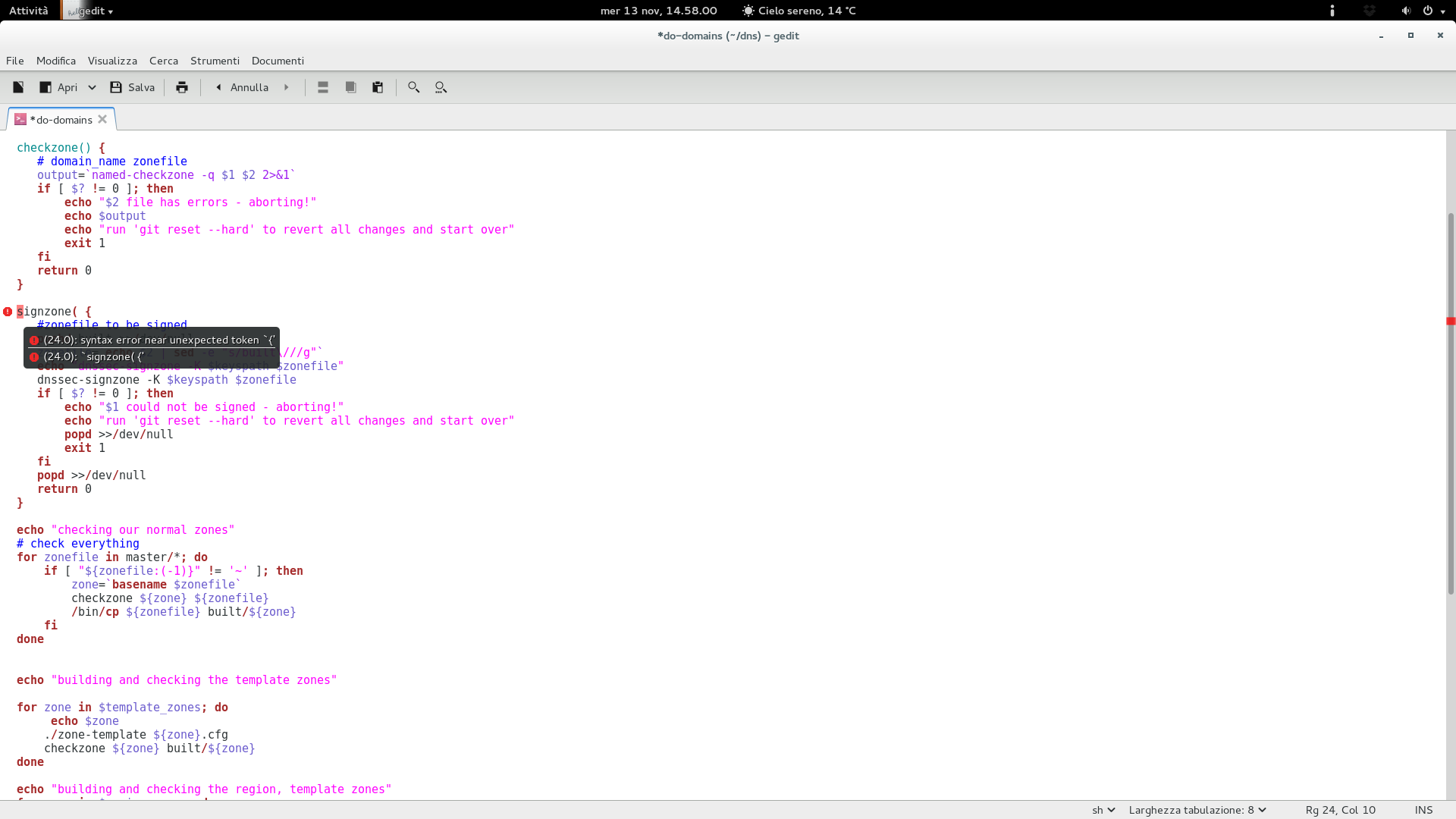
Choosing which method to use is really up to you. Once that is done you can go ahead and sign the zone file. As of myself I m making use of the do-domain script taken from the Fedora Infrastructure Team s repositories. If you are going to use it yourself, make sure to adjust all the relevant variables to match your setup, especially keyspath, region_zones, template_zone, signed_zones and AREA. The do-domain script also checks your zone file through named-checkzone before signing it.
/me while editing the do-domains script with the preview of gnome-code-assistance!

/me while editing the do-domains script with the preview of gnome-code-assistance!

If instead you don t want to use the script above, you can sign the zone file manually in the following way:
dnssec-signzone -K /path/to/your/dnssec/keys -e +3024000 -N INCREMENT gnome.org


By default, the above command will append .signed to the file name, you can modify that behaviour by appending the -f flag to the dnssec-signzone call. The -N INCREMENT will increment the serial number automatically making use of the RFC 1982 arithmetics while the -e flag will extend the zone signature end date from the default 30 days to 35. (this way we can safely run a monthly cron job that will sign the zone file automatically) You can make use of the following script to achieve the above:
#!/bin/sh
SIGNZONE="/usr/sbin/dnssec-signzone"
DNSSEC_KEYS="/srv/dnssec-keys"
NAMEDCHROOT="/var/named/chroot"
ZONEFILES="gnome.org"
cd $NAMEDCHROOT
for ZONE in $ZONEFILES; do
$SIGNZONE -K $DNSSEC_KEYS -e +3024000 -f $ZONE.signed -N INCREMENT $ZONE
done
/sbin/service named reload


Once the zone file has been signed just make sure to include it on named.conf and restart named:
zone "gnome.org"  
file "gnome.org.signed";
 ;


When you re done with that we should be moving ahead adding a DS record for our domain at our domain registrar. My example is taken from the known gandi.net registrar.
gandi

Gandi s DNSSEC interface

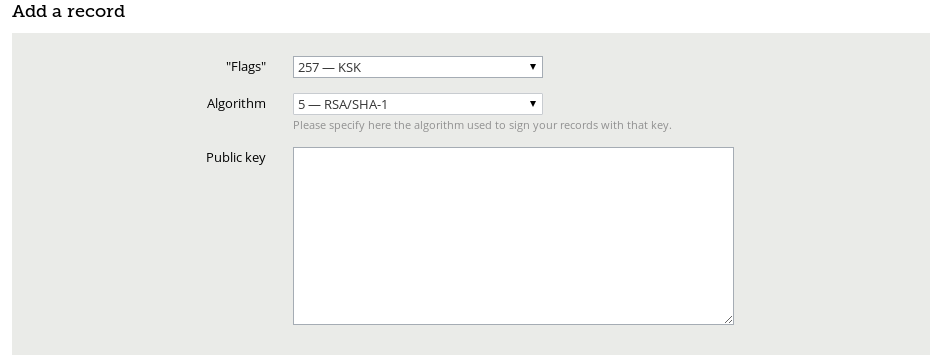
Select KSK (257) and (RSA/SHA-1) on the dropdown list and paste your public key on the box. You will find the public key you need on one of the Kgnome.org*.key files, you should look for the DNSKEY 257 entry as dig DNSKEY gnome.org shows:
;; ANSWER SECTION:
gnome.org. 888 IN DNSKEY 257 3 5 AwEAAbRD7AymDFuKc2iXta7HXZMleMkUMwjOZTsn4f75ZUp0of8TJdlU DtFtqifEBnFcGJU5r+ZVvkBKQ0qDTTjayL54Nz56XGGoIBj6XxbG8Es+ VbZCg0RsetDk5EsxLst0egrvOXga27jbsJ+7Me3D5Xp1bkBnQMrXEXQ9 C43QfO2KUWJVljo1Bii3fTfnHSLRUsbRn8Puz+orK71qxs3G9mgGR6rm n91brkpfmHKr3S9Rbxq8iDRWDPiCaWkI7qfASdFk4TLV0gSVlA3OxyW9 TCkPZStZ5r/WRW2jhUY/kjHERQd4qX5dHAuYrjJSV99P6FfCFXoJ3ty5 s3fl1RZaTo8=


Once that is done you should have a fully covered DNSSEC domain, you can verify that this way:
dig . DNSKEY   grep -Ev '^($ ;)' > root.keys
dig +sigchase +trusted-key=./root.keys gnome.org. A   cat -n


The result:
105 ;; WE HAVE MATERIAL, WE NOW DO VALIDATION
106 ;; VERIFYING DS RRset for org. with DNSKEY:59085: success
107 ;; OK We found DNSKEY (or more) to validate the RRset
108 ;; Ok, find a Trusted Key in the DNSKEY RRset: 19036
109 ;; VERIFYING DNSKEY RRset for . with DNSKEY:19036: success
110
111 ;; Ok this DNSKEY is a Trusted Key, DNSSEC validation is ok: SUCCESS

Bonus content: Adding SSHFP entries for your domain and verifying them You can retrieve the SSHFP entries for a specific host with the following command:
ssh-keygen -r $(hostname --fqdn) -f /etc/ssh/ssh_host_rsa_key.pub


When retrieved just add the SSHFP entry on the zone file for your domain and verify it:
ssh -oVerifyHostKeyDNS=yes -v subdomain.gnome.org


Or directly add the above parameter into your /etc/ssh/ssh_config file this way:
VerifyHostKeyDNS=yes


And run ssh -v subdomain.gnome.org , the result you should receive:
debug1: Server host key: RSA 00:39:fd:1a:a4:2c:6b:28:b8:2e:95:31:c2:90:72:03
debug1: found 1 secure fingerprints in DNS
debug1: matching host key fingerprint found in DNS
debug1: ssh_rsa_verify: signature correct

That s it! Enjoy!

12 November 2013

Russell Coker: Bad Advertising of Protoplast

Carpal Tunnel Syndrome In early 2010 I wrote about Carpal Tunnel Syndrome, I gave a picture of the wrist brace and a description of the process of creating it [1]. A few months later I wrote a follow-up about how the wrist brace had helped me, at the time I was anticipating wearing it at night for the rest of my life [2]. But my wrist has continued to improve. Nowadays I never wear the wrist brace and hardly even think of it. I am a little more careful about posture than I was before, but mostly it has no impact on my life. I think this counts as a full recovery. At the time I was mildly interested in buying some thermo-plastic of that type to make things, but the only source I found was Jaycar which sold 100 grams for $14.95, Jaycar prices have now dropped to $11.50 for 100 grams or $89.50 for a kilo but it s still expensive [3]. Protoplast When looking at the sites that link to my blog I saw a site advertising Protoplast which is a type of thermo-plastic that can be used for making things [4]. Protoplast have more reasonable prices, E30 ($AU42.75) for a kilo and their web site offers better prices for anyone who purchases 10kg or more (good for hackerspaces etc). As they post no further than Belgium they aren t an option for me but they do seem to make a good offer, better than Jaycar offers in Australia. Protoplast is probably a good product, but I think that their advert is misleading. While it is probably possible to make a wrist-brace similar to mine with Protoplast it s a fact that my wrist brace was not made with it. My wrist brace started out as a flat sheet of plastic which could be formed to the final product without being melted. Converting a packet of plastic granules (as sold by Protoplast or Jaycar) to a sheet to even start work on such a wrist brace would take some work. To make a sheet of plastic out of beads sold by Jaycar or Protoplast you would ideally completely melt the plastic, if you just softened the plastic then it wouldn t be as strong as using a pre-made sheet. During the time that I wore the wrist brace I probably repaired it more than 30 times, this wasn t particularly difficult to do, I poured boiling water over it to soften the part that cracked until it became tacky and then pushed it together again. But the result was significantly weaker than the original due to the difficulty in welding the broken sections together. I ended up cutting some strips from less important parts of the wrist brace (the part nearest to my elbow) to reinforce the weakest part which was between my thumb and fore-finger. That section ended up being about three times thicker than it was originally while also not being as strong as it was originally. I also had difficulty in making it flat so it wasn t nearly as comfortable as the original version. It seems rather misleading to include the picture of my wrist brace on a site advertising plastic which wasn t used to make it and which probably couldn t be used to make something that looks as good with the same ratio of strength to mass. But with a suitable disclaimer indicating that the user probably can t get the same result it would be OK to give it as an example of what could be done. I can imagine someone using a product like Protoplast to make a wrist brace that can hold a mobile phone, that can be worn with a watch, or has other features that aren t offered by medical staff. License Issues The license for my blog doesn t permit people to just copy pictures, it s a Creative Commons Attribution-Noncommercial-Share Alike based license [5]. I am interested in supporting companies that make interesting products and anything that can help people with medical issues is also of interest. So I wouldn t rule out the possibility of a free license for a picture from my blog to be used in the way that they used it (with a link back to the original blog post). But I would want a description that informs readers that it s not an item made with their product, merely something similar that can be used for inspiration.

10 November 2013

Gregor Herrmann: RC bugs 2013/45

here's the list of RC bugs I've worked on during the last week.
  • #713582 src:malaga: "malaga: FTBFS: ld: canvas.o: undefined reference to symbol 'ceil@@GLIBC_2.2.5'"
    add patches from Ubuntu / Matthias Klose, upload to DELAYED/2
  • #713595 src:goocanvas: "goocanvas: FTBFS: ld: demo.o: undefined reference to symbol 'sincos@@GLIBC_2.2.5'"
    add patch from Ubuntu / Matthias Klose, upload to DELAYED/2
  • #713635 src:osm-gps-map: "osm-gps-map: FTBFS: osm-gps-map-widget.c:778:21: error: format '%lld' expects argument of type 'long long int', but argument 4 has type 'goffset' [-Werror=format=]"
    add patch from upstream git, package FTBFS again later
  • #713666 src:gnustep-base: "gnustep-base: FTBFS: GSXML.m:983:38: error: dereferencing pointer to incomplete type"
    add patch from Ubuntu / Benjamin Drung, upload to DELAYED/2
  • #713700 src:gsnmp: "gsnmp: FTBFS: gsnmp.h:27:18: fatal error: gnet.h: No such file or directory"
    apply patch from Ubuntu / Daniel T Chen, upload to DELAYED/2
  • #713701 src:libmatchbox: "libmatchbox: FTBFS: ld: dump-image.o: undefined reference to symbol 'XOpenDisplay'"
    add patches from Ubuntu / Daniel T Chen, upload to DELAYED/2
  • #713708 src:gtkgl2: "gtkgl2: FTBFS: ld: zktor.o: undefined reference to symbol 'atan2@@GLIBC_2.2.5'"
    apply patch from Ubuntu / Daniel T Chen, upload to DELAYED/2
  • #713727 src:xmlroff: "xmlroff: FTBFS: ld: ../libfo/.libs/libfo-0.6.a(fo-datatype.o): undefined reference to symbol 'floor@@GLIBC_2.2.5'"
    apply patch from Ubuntu / Daniel T Chen, upload to DELAYED/2
  • #713728 src:matchbox-panel: "matchbox-panel: FTBFS: ld: mb-applet-menu-launcher.o: undefined reference to symbol 'XInternAtom'"
    update patch to link against more libs, upload to DELAYED/2
  • #724080 src:libgraph-perl: "libgraph-perl: FTBFS: make: *** [clean] Error 1"
    fix clean target in debian/rules, upload to DELAYED/2, then moved to 0-day with maintainer's consent
  • #724085 src:myspell: "myspell: FTBFS: POD errors"
    prepare a patch
  • #724115 src:hunspell: "hunspell: FTBFS: POD error"
    prepare a patch
  • #724142 src:xmltv: "xmltv: FTBFS: Tests failed"
    investigate error
  • #724750 electrum: "electrum fails to launch from terminal"
    add missing dependency, upload to DELAYED/2
  • #726801 biomaj: "biomaj: fails to install with Recommends enabled"
    tag unreproducible, later further analyzed as a java dependency problem by follow DD

9 November 2013

Bits from Debian: Last days to donate to Debian Outreach Program for Women

The matching program to help fund Debian participation in OPW will end in 6 days (November 14th). We need your help, and still have a ways to go to reach our funding targets. Please consider donating today! The rules are simple:
  • for each dollar donated by an individual to Debian through the mechanism, a sponsor will donate another dollar to Debian's OPW program;
  • individual donation in USD will be matched only up to 200 USD each;
  • only donations in USD will be matched;
  • the sponsor will match the donated funds up to a maximum total of 2500 USD;
  • all money raised through this program will be earmarked for OPW participation, either in 2013 or in the future;
  • this program will be in place until Nov 14th, so please act quickly!
If you'd like to participate as intern, the application deadline is very near (November 11th). You can find here more info on how to apply.

7 November 2013

Matt Zimmerman: Management: a rant

You keep using that word. I do not think it means what you think it means. -Inigo Montoya
Having worked in full-time management positions for some years now, I am increasingly convinced that management is widely misunderstood as a role, as a discipline and as a field, and that this makes a lot of lives more difficult and stressful than necessary. It is the subject of much speculation and misbelief, and I ve chosen a few of my favorite examples to deconstruct here. Misbelief #1: management is what managers do I ve noticed a trend among a certain class of companies, whose employees will tell anyone who will listen that there is no management in their organization, they never plan to have any, and neither should you. I think these statements are respectively a lie, a na ve belief, and a piece of bad advice. Usually, these companies are just a few years old and relatively small, most of the people in the company have been there for less than a year, and the speaker is trying to persuade us what a unique and innovative company they work for because nobody there is a manager . They invariably have not read The Tyranny of Structurelessness. Management is the practice of enabling people to effectively cooperate. A manager is someone whose job is to do that. It s that simple. It usually involves tasks such as sharing information, agreeing on a course of action, dividing up work, and figuring out what to do when there s a problem. They re things that every team needs to do, whether anyone is designated a manager or not. Teams can function without managers, but they can t function properly without management. Someone (or everyone) has to do the work to make cooperation possible. Modern management is a specialized discipline, which draws on a broad range of skills in communication, psychology, empathy, problem-solving, leadership, and more. These skills aren t unique to managers, but it often makes sense to designate certain people to do more of the management work, on behalf of the team. By devoting more of their time and attention to it, they free other members of the team to focus on other tasks. They can act as a coordinator to help the team stay in sync, and by focusing on this job, they may be able to do a better job of it, and acquire a higher level of skill through practice and study. But it remains an inherently collaborative practice. Misbelief #2: management is about telling people what to do There are many different varieties of management, each of which is oriented toward a particular type of team or organization. Factories are managed differently from design studios, large companies are managed differently from small companies, and every team has its own distinct management style which arises from the unique group of people involved. Some managers are specialists in a particular type of management, while others are more generalists. The telling people what to do style of management is called command and control . It s characterized by authority, hierarchy, and strict adherence to protocol. It s widely employed by military organizations, and by the managers we see in television and film. It has some advantages and disadvantages, which I won t discuss here. My point is that it is just one example, but this example is used to represent the general concept of management. Self-organization, where no one in particular is responsible for group decisions, is another, quite different, style of management. Small, self-organizing teams are capable of amazing feats of productivity. They re less difficult to manage because they re comparatively simple, and so simple tools and techniques work well. Everyone can be fully aware of what everyone else is doing, and new information propagates quickly throughout the team. But as the team or organization grows, it will often outgrow this way of working, and needs to adapt. There is no single management approach which works universally well. Misbelief #3: management is a promotion You know the story. When an employee is successful within their area of expertise, someone will eventually offer them a management role as a reward for their good work. This is utter nonsense. Management is not a promotion: it s a career change. It means starting over as a beginner in a new discipline and learning from the ground up. Domain expertise is important, as a manager needs to understand the work of the other people on their team, but it is no longer paramount. The team, the human system, becomes their focus. When organizations fail to provide career advancement within a discipline, people may turn to management as the only way to get promoted , only to discover that they are completely unprepared for this new field, and often their new job when they realize what they ve gotten into. If someone were promoted from a position as a financial analyst to a new job as a biochemist with no training or expertise, we would probably find this bizarre. But this is analogous to what happens to new managers all the time, and has become almost standard practice in many organizations and industries. So what? Management is misunderstood. So are science, engineering, and many other fields. What does it matter?
People leave managers not companies in the end, turnover is mostly a manager issue, - Marcus Buckingham & Curt Coffman, First, Break All the Rules
This mythology leads to massive organizational dysfunction, making it harder for everyone to do their jobs. It virtually guarantees incompetent management, which is a scourge on anyone who is exposed to it. It ruins days, weeks, jobs and careers. It leads talented people to leave companies, and it drives them out of their chosen professions. I recommend that we stop denigrating and ignoring management, and start doing a better job of it.

5 November 2013

Russ Allbery: Review: Asimov's, August 2011

Review: Asimov's Science Fiction, August 2011
Editor: Sheila Williams
Issue: Volume 35, No. 8
ISSN: 1065-2698
Pages: 112
The editorial this issue is about the Dell Magazines Award, so newsy without a lot of content (particularly since we don't get to read the winners). Silverberg's column is much more interesting, focusing on the complex rules of the honor code of the Albanian highlands and pointing out that there's more complexity and strangeness in things we can find on Earth than in a lot of science fiction. Even within the rules of real human cultures. James Patrick Kelly's column this issue is an interesting summary of what graduates of the Clarion writing workshop learned, in their own words. It's a nice barrage of quick writing tips, and an interesting view of what people take away from a writing workshop. The book review column this issue is Peter Heck's normal workman-like job. "The End of the Line" by Robert Silverberg: Someday, I really should read Lord Valentine's Castle. As you might guess from this comment, this is another Majipoor story. This one follows an official who is part of an advance party for the Coronal Lord, the ruler (of sorts). He's decided, as part of those duties, to take the opportunity to learn more about the aboriginal people of Majipoor: the somewhat mysterious metamorphs, or Piurivar. I'm not that familiar with the history of Majipoor, since all I've read is this story and one other, none of the novels. Apparently, knowing that the official in question is named Stiamot will place this story for more familiar readers. For the unfamiliar, such as myself, there's a lot of politics here and what's clearly background for a major event in the world, but as a standalone story it's a bit unsatisfying (and grim). It's not that clear why things had to turn out the way they did, and the characters seem largely without agency. It's well-written, but mostly a story for fans of the series, I think. (6) "Corn Teeth" by Melanie Tem: This is a tight third-person story about a human child raised by alien foster parents, and it's deeply disturbing. Not because of the fostering, which appears wonderful and loving, but because it's a train wreck sort of story: the reader can see the horrible coming and can't do anything about it (and it turns out even worse than one might expect). It's also a story built around failure of communication and failure of empathy, and has a monumentally depressing ending, the kind that leaves scars. I'm sure all of this is entirely intentional; it seems very well-written. But I really didn't want this much horrible misunderstanding and depressing hopelessness in my reading. (2) "Watch Bees" by Philip Brewer: I rather liked this story even if the protagonist is an awful person. The story is set in a future of bioengineered insects and hard economic times, and it features a man who is supposedly working his way from farm to farm to get back home. What he's actually after is more complicated and is closely related to the defense systems that keep intruders off of farms. You might guess some of the rest from the title. It's a story about understanding layered defense systems, and about economic warfare. I didn't care much for any of the characters, but the story is well-plotted and kept me interested in seeing what would happen next. (6) "For I Have Lain Me Down on the Stones of Loneliness and I'll Not Be Back Again" by Michael Swanwick: By Swanwick, so it's a little odd, but I found this story surprisingly moving and ambiguous. It's about an American of Irish descent, a trip to Ireland, and a love affair with a fierce Irish nationalist, all set against an SF background of an Earth conquered by benevolent aliens. It's angry, uncertain, fanatical, and realistic by turns, and left me with profound mixed feelings. I think it does a good job capturing in a brief story the emotional complexities of what it means to give onself to a cause. (7) "We Were Wonder Scouts" by Will Ludwigsen: This is a short and odd story about a variant of the Boy Scouts founded by a man who is a little too obsessed with the paranormal, and an outing in the woods that turns rather creepy. It's a type of story that I'm not very fond of: one that twists the delight of discovery into something dark and mundane. I suppose you could call it horror; it's more horror than fantasy, at least. Anyway, not my thing. (3) "Pairs" by Zachary Jernigan: This story, on the other hand, isn't as dark as it seems like it should be from the setup. Humans have been conquered and enslaved by more powerful alien races, and now human souls are a profitable business. The protagonist is a person who has been embodied in a spaceship, and who works with (and monitors) another largely insane embodied person as they work as couriers, carrying souls to their buyers. But neither of them are as fully under control as they might appear, which is the point of the story. There is no grand tale of redemption, and the price is high, but I found the psychological portrayal oddly satisfying and faintly hopeful, and I was intrigued by the world background. (7) "Paradise is a Walled Garden" by Lisa Goldstein: The cover story, this is by far the best story of the issue. It's steampunk, set in a world where Muslim civilization was not pressed back by Christianity and continues to thrive into the reign of Queen Elizabeth as, among other things, makers of automata. A girl has managed to get herself a job in a British factory by posing as a boy and is the first to sound the alarm when the automata that do most of the work go strangely (and violently) haywire. That leads to her being assigned to the subsequent delegation to Al-Andulus (Muslim Spain, if you're not familiar with that name from history). The protagonist is the best part of this story. She's thoughtful, resourceful, and delights in learning things, something that she's rarely had the opportunity to do. She's also utterly unintimidated. In Al-Andulus, she thrives, despite the contempt of the leader of the expedition and some dangerous intrigues around the source of the anomalous behavior. I won't spoil the ending, but it's a delight, leaving the reader with a lot of hope for her future. I also liked the portrayal of the Muslim world, which is engrossed in its own business and has its own advantages and disadvantages, but is at least open to and focused on learning and technological development. The contrast with the superstitious British delegation is both pointed and historically grounded in Muslim relations with Europe around the point of divergence of Goldstein's world. (8) Rating: 7 out of 10

4 November 2013

Matthias Klumpp: AppStream Clarifications

appstream-logoWhile reading stuff posted by others about AppStream, and because of the discussion happening about AppData on kde-core-devel right now, I feel the need to clarify a few things. Especially because some are implementing AppStream in a way which is not really ideal right now. This is to some extend my fault, because I should have communicated this in a much more visible way. To those people who don t know it already: AppStream is a Freedesktop project aiming at providing basic building blocks to create distro- and desktop-agnostic software centers. So, let s answer some questions about AppStream! Is AppStream GNOME or $distro specific? No, not at all! It was originally created by people from at least 4 different distributions, and I took great care of it not becoming specific to any desktop or distribution. GNOME just happened to go ahead and implement the specs, which was absolutely necessary, since there was less progress in implementing AppStream for a long time. How does AppStream actually work? AppStream is a bunch of things, so I will only focus on what we have specified right now and what is working. Basically, the distributor compiles a list of applications available in the repositories, and makes it available in some defined directories on the system. AppStream defines an XML specification for that, but since some peple don t want to use it or can t use it, there are also others ways to publish AppStream application data. For example, Debian will likely use YAML for that. This data is taked by the AppStream software (running as a PackageKit plugin) and transformed into a Xapian database. This database is then in turn used by software-centers, in combination with PackageKit, to present applications. This is the reason why it is bad to use the XML data directly it might not be available on every distribution. The Xapian database is what matters. The database can be accessed using libappstream, a GLib based library (so far, there was no need for a Qt version). Why is GNOME using the XML data directly then? The libappsream stuff was under heavy construction, and GNOME wanted to be fast and ship the stuff with Fedora in their next release. They ll likely switch to the Xapian db soon, or offer it as backend. Is AppStream already used in KDE? Yes, Apper can utilize it, see one of my previous blogposts. What is AppData? AppData is an initiative started by Richard Hughes in order to enhance the quality of applications descriptions shipped with AppStream. It defines a small file $appname.appdata.xml, which describes the application, sets screenshots etc. These files can be parsed at the distribution s side in order to enhance the app metadata. They can also be translated upstream. AppData might be merged into the XDG AppStream pages later, but that is to be discussed. Are application authors forced to ship AppData files? No, nobody is forced ;-) However, the GNOME Software application-center prefers applications shipping more metadata, and punishes the others, so shipping an AppData file makes sense for higher lising in GS. This is a policy decision by GNOME, KDE can make it s own ones here. Shipping AppData files makes sense, in general, because it enhances the metadata distributed with your application. It is also the file-format used by Listaller (well, a superset of it) in order to generate cross-distro app-packages, so you might want to consider adding one. Are there any rules for the AppData files? Yes, you can find them on the AppData specification page. However, these are more recommendations than forced , and it is currently aimed at GNOME apps. I later want to generalize that and create an own page with recommendations for KDE (martin had some good ideas already). Where do software-centers get the screenshots from? The screenshots are defined in AppData files, and the cached by the distributor. If there are no official screenshots, user-provided screenshots will be taken, using a screenshots-service with screenshots.d.n-like API. Where do I find the specs? The official AppStream spec, the thing which distributors should implement, can be found on Freedesktop. The AppData spec can be found here. It also includes some nice hints on how to handle screenshots etc. and includes it s own FAQ. Where do I find libappstream? The source code can be found on Gitorious, releases are available on fd.o software. Contributions to the code are welcome! I want to change X in the spec, because of argument Y which brings improvement Z Great! Please get in contact with me or Richard. The only feature we would not consider for the official standard is desktop/distro-specific stuff (which should be obvious ;-) ). I will extend this FAQ, if I feel the need for it, so this article might change a bit.

25 October 2013

Jan Wagner: PHP.net infected with Malware and Linux Malware Detect

As some of you might have noticed, the Site PHP.net was infected yesterday with Malware.
If you are running a shared hosting environment, you are also be faced with similar Malware problems. Beside XSS attacks and compromised server systems on OS-level, very widely used attack szenarios are stolen user credentials. A usefull mitigation strategy might be a web application firewall (WAF) like ModSecurity. Another way might be the Malware scanner Linux Malware Detect. The project describes itself:
**Description**
Linux Malware Detect (LMD) is a malware scanner for Linux released under the
GNU GPLv2 license, that is designed around the threats faced in shared hosted
environments. It uses threat data from network edge intrusion detection systems
to extract malware that is actively being used in attacks and generates
signatures for detection. In addition, threat data is also derived from user
submissions with the LMD checkout feature and from malware community resources.
The signatures that LMD uses are MD5 file hashes and HEX pattern matches, they
are also easily exported to any number of detection tools such as ClamAV.
**Features**
- MD5 file hash detection for quick threat identification
- HEX based pattern matching for identifying threat variants
- statistical analysis component for detection of obfuscated threats (e.g: base64)
- integrated detection of ClamAV to use as scanner engine for improved performance
- integrated signature update feature with -u update
- integrated version update feature with -d update-ver
- scan-recent option to scan only files that have been added/changed in X days
- scan-all option for full path based scanning
- checkout option to upload suspected malware to rfxn.com for review / hashing
- full reporting system to view current and previous scan results
- quarantine queue that stores threats in a safe fashion with no permissions
- quarantine batching option to quarantine the results of a current or past scans
- quarantine restore option to restore files to original path, owner and perms
- quarantine suspend account option to Cpanel suspend or shell revoke users
- cleaner rules to attempt removal of malware injected strings
- cleaner batching option to attempt cleaning of previous scan reports
- cleaner rules to remove base64 and gzinflate(base64 injected malware
- daily cron based scanning of all changes in last 24h in user homedirs
- daily cron script compatible with stock RH style systems, Cpanel & Ensim
- kernel based inotify real time file scanning of created/modified/moved files
- kernel inotify monitor that can take path data from STDIN or FILE
- kernel inotify monitor convenience feature to monitor system users
- kernel inotify monitor can be restricted to a configurable user html root
- kernel inotify monitor with dynamic sysctl limits for optimal performance
- kernel inotify alerting through daily and/or optional weekly reports
- e-mail alert reporting after every scan execution (manual & daily)
- path, extension and signature based ignore options
- background scanner option for unattended scan operations
- verbose logging & output of all actions
The recent development can be found at Github and in the last days I worked on packaging this into a Debian package 'maldetect'. If you want to give it a try on Debian, you could install the packages from our restricted repository:
    # wget "http://ftp.cyconet.org/debian/sources.list.d/restricted-cyconet.list" \
        -O /etc/apt/sources.list.d/restricted-cyconet.list
    # aptitude update
    # aptitude -t restricted install maldetect
For adding our archive key, you can just install the package "debian-cyconet-archive-keyring"

Next.

Previous.