Search Results: "pini"

11 November 2006

Andreas Barth: More apache chasing

Today, I continued chasing easy apache2 bugs. The following bugs seem to be easy to fix (and should be fixed in my opinion prior to Etch). Some more bugs were obviously outdated, so I closed them. I also started collecting information for the release notes about apache2.

10 November 2006

Daniel Stone: ripping on ubuntu is the new black

One of the annoying features of reading several planets, is that you end up reading entries from people you otherwise respect, who seem to have various complexes about nonsensical issues. We all saw the month in which half of Debian decided it was cool to rip on Ubuntu, and now apparently it's the new cool thing to do if you work on Fedora.

According to a particularly obnoxious entry, the quality or otherwise of Ubuntu's kernel[0] does 'damage to the free software community'. Now, they've focussed on binary drivers. Which is fair enough: I am personally quite uncomfortable with binary drivers, and extremely unimpressed with Ubuntu's recent move towards binary drivers by default. While I respect the fact that they still encourage users to install free drivers, providing them by default is not a winning move, in my opinion. But I'm not going to discuss this further right now, because if I do, the terrorists win.

The reason the terrorists win, is because some people like to furiously handwave and make strawmen. Apparently now, everyone who's ever touched Ubuntu is rabidly for binary drivers, but the problem here is the handwave from criticism of Fedora's alleged community into yet another ramble about the kernel tree and binary drivers.

I certainly hope the Fedora community is more mature than this, both in general, and in their ability to have a constructive debate about the level of its community involvement. Right now, it is not even disputed that there is effectively none. At first glance, they may appear similar, but if you look further, the similarities vanish. Anyone can come in and get involved in the decision making in Ubuntu, but more important than that, the process is at least completely transparent, so you can see what's going on, on public lists, at every step. Fedora does not have this: decisions magically appear On High from RHEL types. This is not necessarily a bad thing, and does not necessarily result in a lower-quality distribution, but if everyone could just accept this as being true and move on, rather than bitterly baiting a successful community distribution about it, I think everyone would be a lot happier.

The biggest difference is -- yes, basically all the Ubuntu core developers are employed by Canonical. These people were handpicked from the Debian community originally, and now a great deal of them start as Ubuntu community members, and are employed by Canonical because having them work full-time on this stuff would be awesome. The process is still entirely transparent: being employed is a mark of recognition (sorry), and a request to continue working on this even more, rather than a pre-requisite to being able to do anything. Witness Fedora Core vs. Fedora Extras, for example: there are quite a few packages that non-Red Hat employees are prevented from meaningfully contributing to.

So, the summary in a nutshell: binary drivers bad (and Ubuntu moves towards promoting same even worse), Fedora 'community' not at all, handwaves bad, refusal to get involved with a meaningful debate about community governance and structure without engaging in petty mudslinging and pointless handwaves inexcusable.

(Disclaimer: I am not involved with any distributions, nor do I have any professional affiliation with them either. I'm just an irritated observer.)

[0]: I don't claim to have any insider knowledge here; the only point at which its quality or otherwise has become an issue for me lately, is a random hang in gettimeofday() in a corner case recently, which I've been too lazy to isolate and report as a proper bug; I worked around it in the X server anyway.

7 November 2006

MJ Ray: Flash! Aaah-aaah! He'll destroy every one of us!

Apologies for the lame misquote of the Queen song, but I just couldn't resist it... (Steve commented: "Great film, and great song! I'm going to go find my soundtrack album now!" and Luis Villa added: "Anyone who likes that particular Queen owes it to themselves to check out the Kleptones Night at the Hip-Hopera, which I think I'm now going to run off and play myself." ) Flash is a bit of a problem for me in two ways:
  1. Free software players don't handle very much of it;
  2. Most Flash file authors make inaccessible rubbish;
It's not really surprising that free software players don't handle much of it, because Macromedia/Adobe have dragged their feet about open support for the format. That makes it a frustrating and difficult reverse-engineering task and most people who are good at reverse-engineering seem to concentrate on hardware drivers so far, which is A Good Thing in my opinion. On 7 November, Alex Hudson reported that Adobe make Flash scripting Free Software with Mozilla Foundation [FSFE Discussion via GMANE] - will this improve things? Ross Burton commented:
"The Adobe donation to Mozilla is just an EcmaScript 4 VM, which is a common language used by JavaScript, VBScript and whatever the Flash scripting language is called."

4 November 2006

John Goerzen: Desktop Linux Opinions?

I'm brainstorming about ways of setting up Linux desktops machines for people used to Window users on a LAN. It could be any size of LAN.

I'd like people to be able to sit down at any Linux machine on the LAN and log in -- probably use a LDAP directory for that, and NFS-mounted home directories. I wouldn't want to NFS-mount the entire thing for performance reasons.

So, some of the things I'm thinking about are:


2 November 2006

Gunnar Wolf: Oaxaca on fire

Before anything else: Please excuse some grammatical mistakes I've made in this post. You should understand the topic is really upsetting, and typing while searching for links, listening to news, and gathering the basic information for a five month old conflict is not exactly compatible with me spewing out proper English ;-)
Just to re-state the obvious: Mexico is, once again, on fire. This posting is mainly written with the Debian people in mind - An important number of them, after Debconf 6, went to visit Oaxaca - In late May, during the first weeks of this incredible, stupid and scary conflict we are now facing.
I've written in my blog every now and then about our political situation. Many of us had high hopes on our current government. We thought that the authoritarian regimes were a thing of the past, we hoped for real democracy, we hoped for a government that would honor human rights and solve long-standing topics for our society - Yes, we all knew president Fox came from a right-wing party, and didn't expect much advance in the social agenda -which many of us perceive as the real problem in Mexico- but still, hoped for openness and reconciliation with the past.
I won't repeat what I've extensively said over and over - The thing is, Fox's government continues to amaze us with its stupidity, with its near-sightedness, with its hypocresy. Fox's term is really close to an end - In one more month, the govt. will change hands to the first de-facto president since Carlos Salinas (going over another story we hoped to forget).
As some of you wittnessed, there was a popular protest taking place mainly in Oaxaca - Basically, the State's public elementary school teachers demanding better payment for their work. Such a protest is already a common occurrence in Mexico, as public school teachers are among the worstly paid workers (no wonder, then, our country is still undeveloped - Make public education worse, and you have the warranty of an unprepared, ignorant population). The teachers went on strike in early May, briefly returned to classes on late June to properly close the 2005-2006 lective year, but went back on strike afterwards.
Of course, the local government (Mexico is a federative republic, each state is autonomous and makes decisions independently) took a very long time to act - and acted the worst way possible: By sending policemen to forcefully throw the teachers from their camps in the downtown streets, with no negotiation, no answer, not a drop of common sense.
That led to the formation of the (pleonasmicaly named) APPO: Popular Assembly of Oaxaca's People - A group of people, partly formed by the unhappy teachers, mainly demanding the Oaxaca state governor to step down, after he proved he is inept for his office. And yes, I'm oversimplifying here, but I don't want to dig too much - There is fortunately plenty of available information in this regard.
That happened over four months ago. APPO kept control of the city. Nobody denies that this has caused Oaxaca, a city that attracts national and international tourism like few others in the country, a great deal of economic damage - Oaxacan people are, however, still sympathetic to APPO's demands. Governor Ulises Ruiz (from PRI, the party that ruled the country for over 70 years) has not been able to be seen in public in his state for some months already. The legislative power has also been unable to work properly, and the judicial power is half-dead, doing only its most basic tasks. Renowned jurists, such as Miguel ngel Granados Chapa, have repeatedly stated that this is enough for the Federal Senate to declare the governing powers in Oaxaca have disappeared - This would put an end to the conflict, leading to immediate elections, but the Senate has denied taking this course of action. Not only that, but the Federal government took the command of the local security forces, tacitly recognizing the local government is unable to coherently excersise their authority. After almost five months, last week they issued an unanymous -but mild- exhort, asking Ulises Ruiz to consider stepping down.
So far, 15 people have been killed in the different represive actions taken, first by the local police under local command, later by the local police under federal command, and starting last week, by the federal police. Today, it seems the army is getting in the conflict as well, despite promises of not doing so by the federal authorities - Of course, they have become masters in the art of breaking promises.
Why is the federal government upholding Ulises Ruiz? Simple: After the undeniable electoral fraud we had some months ago, there are too many indicatives pointing out that our (supposedly) elected president Felipe Calder n (FeCal, as he is better known as) will have a hard time becoming the president, and many people doubt he will be able to hold the authority for the six years. So far, he has shown no better aptitude as a statesman than Vicente Fox: Instead of boldly facing the claims of fraud, he just chickened out and has spent many months hiding from the public, appearing only for selected, friendly audiences. For many months already we have heard "Ulises ya cay , le sigue Calder n" (Ulises has fallen, Calder n is next). This country has not been so badly shaken in decades - Of course, Great Statesman Vicente Fox insists the country is in peace and there are no red spots. Fox even was stupid/blind enough to state that the problems in Oaxaca would be dealt with easily and successfully, just as the problems in Chiapas and Atenco were doing his term. During Fox's campaign, he promised to solve the centuries-old Chiapas problem (that resulted in the EZLN uprising in 1994) in just 15 minutes - He just has not had time to do so. Atenco? Yes, in 2002 an angry people made him step back from the most important project of his term (a new airport for Mexico City). In May 2006, Atenco sprang again to the news because of a massive repression - I'm not going into details on Atenco right now, as it would be off-topic, but you can look at my article in FeCal.org.mx or watch a very strong video by Canal Seis de Julio (both in Spanish only) for further details.
Last Friday, however, something was different. In a repressive action, a USA citizen, the Indymedia reporter and cameraman Brad Will was killed by a paramilitary group. Even more, he was killed while doing his work, and we can clearly see this evidence on his last tape. Of course, the US ambassador issued a warning, asking the US citizens not to go to Oaxaca. And, as Lorenzo Mayer says, hay de muertos and muertos - There are different categories of dead people. A highly visible US citizen is more important than the other 14 dead Mexicans, and now the Federal Preventive Police is clashing in Oaxaca.
What should be shocking, but is not so much to those of us who know this beaten country, is the attitude of the authority when taking the city. After five months of occupation, the Oaxacan people have got used to living with APPO - be it for good or for bad. Tourism has diminished, but the people's living sources have not been attacked. Of course, as soon as the Federal Police took the downtown areas, all sorts of reports of looting have been reported. The policemen are robbing even sodas and chips, and up to TVs and microwaves. As many people state, this is a very Kafkian country.
Of course, we don't know what will come next. Most of the city has been "freed", and the APPO is holding at the University. The University is autonomous, and the PFP commands have promised not to break its autonomy - but we don't believe that. There are fights very close to the University. The Rector himself spoke a couple of hours ago at Radio Universidad, the main broadcasting point for real news on this subject (I am following on the news thanks to KeHuelga, 102.9MHz FM in Southern Mexico City, or at their webpage, from where they link to many other underground or Internet radio stations joining in the broadcast), and the reports are dramatic. Dramatic, as well, is the way all of the commercial news sources are ignoring the facts.
I want to keep you updated, as one of the very few reasons things are not worse is the public opinion and, even more, the international pressure. I'm sorry I'm not giving more links right now, but I will soon. I don't want, of course, to flood people that read my blog through the different syndications with a technical profile, so updates via my blog will be quite sparse. If you can read Spanish, we have posted many articles at FeCal, and many other individual sites are also joining in. A couple of links, and I'm off for now.
1 November 2006

Wouter Verhelst: Hello 2.9.0!

No, not the Linux release of that version (that's still far away, if it will ever be developed, and I don't think I'll be wanting to run that if/when it does). Instead, I'm talking about the NBD userland tools of that version, which I just released. Today we're only a few weeks after the release of 2.8.7—sorry for all you packagers out there who now have to throw away your work. But it's well worth it; nbd-server now finally functions like a real UNIX daemon: you specify exports in a configuration file, you can export more than just one export from the same server, and it has some interesting new features today. If you ever looked at nbd-server and decided that the way it's implemented is too hackish for your taste, then 2.9.0 may be a good time to revisit that opinion. Of course, I should note that 2.9.0 is a .0 release, so does still need some testing in the wild, so might not yet be ready for your production server. But other than that, it should be pretty much okay and usable. Give it a try! In related news, Ronnie Sahlberg, one of the wireshark developers, has made my day by writing an NBD dissector, which I've been wanting to have for quite a while now. Happy happy, joy joy.

Andrew Pollock: [opinion] On Australia's non-ratification of the Kyoto agreement

Australia's continued refusal to sign-on to the Kyoto agreement made the BBC World news tonight, and it got me thinking. After seeing An Inconvenient Truth, and learning that Australia just doesn't rank when it comes to carbon dioxide emissions, it's really a moot point whether we get on board or not (but for the record, I think we should anyway, to put more pressure on the US). Beazley's taken the opportunity to say that if he got into office, he'd sign the agreement. But here's the deal: there are coast-to-coast Labor governments at the state-level. So what if Howard won't sign the agreement at the Federal level? If every state independently decides to legislate such that carbon emission levels are restricted to those of what the Kyoto agreement would require, then Australia has in essence signed on to it, whether Howard wants to or not. So all Beazley has to do is show a bit of political will, and that the states can tell the Federal government what to do. I'd like to see it happen.

30 October 2006

MJ Ray: Business: Taxes and Employment

I've written a little lately on the Dunc-Tank (a project to pay some key debian post-holders) and it's drawn some comments about running a business. I've owned businesses for years and there's a lot I don't know, but I've been frankly shocked by some of the comments. Here's two more. I wrote:
Double-taxation seems like something a good accountant should help to avoid - not heard of it being a significant problem often;
Today, I read a comment from Joe Buck:
"Self-employed people or contractors have to pay double Social Security taxes in the US. That's because, for salaried workers, the worker pays half and the employer pays half." "This is one factor contributing to why anyone considering leaving regular work and setting up shop as a contractor in the US needs to bill 2x their regularly hourly salary to wind up with the same standard of living. In addition to higher taxes, there's time between contracts, no paid time off, etc."
That's not double taxes. That's one tax split between two parties. Half plus half is one, not double. If the two parties (employer and employee) are the same (as in self-employment), you're still only paying the one tax. If the business is run half-decent, that tax will be figured into the cost of the worker, even if it's not in their posted gross salary. If the employer part is not widely known, that sounds like government slyness to me. Double-taxation is paying the same tax twice, not paying one tax split between employer and employee. By the way, I'm slightly surprised US contractors need to bill 2*gross. When taking on new contract staff at a UK university, I think the cost was estimated at 1.6*gross, and I think I've already mentioned that the cost for a UK SME seems to be about 1.5*gross. We're told that the US taxes less, so maybe work is much rarer there, or something. Which brings me to when I wrote:
I think running a business is a choice, not something anyone ever "had to" do.
to which Scott Robinson replied:
"That is certainly an odd perspective wrt. the choice of becoming an entrepreneur. Have you only lived in places where employment is guaranteed?"
As far as I know, I've never lived in a place with no jobs at all. Sometimes the jobs are crap and sometimes the terms for joining an existing business are crap (so in my opinion, they might as well not exist), but if you didn't want to run a business, you could avoid it. These are all things you weigh up when making your choice whether or not to run a business. Is there anywhere which forces workers to run businesses?

Jurij Smakov: Papers, please ?

Today I have witnessed an incident which involved a person getting kicked from #debian-devel, when he refused to disclose his real name (I did not notice any other disruptive behavior on his part). When I objected to that, I was quite surprised to find that quite a lot of people found this an acceptable administrative measure (the channel rules wiki page was promptly created to reflect that). While I find it totally acceptable, that a person must reveal his/her real name when becoming a Debian Developer, I think that having such a requirement in place for an unrestricted public Debian channel is completely inappropriate. In my opinion, the right to remain anonymous is fundamental, and I don’t care about the person’s real name, as long as he/she has something useful to contribute. I also believe that protection of this right is a part of the core Debian philosophy, as we refuse to recognize software as free, if it impedes on the person’s right to remain anonymous (”Dissident test” in the DFSG FAQ). Therefore, the support of fellow DDs (some of them actively involved in NM process) for such measures looks like nothing but pure hypocrisy to me. I have added a note stating my disagreement on this issue to the wiki page.

Axel Beckert: BarCamp Zurich -- Resume

The BarCamp Zurich 2006 is over. On the way there I thought about what I would do during time slots with no interesting talks. But when I tried to make up my personal schedule, I noticed that I rather would have the opposite problem: Too many interesting talks at the same time… Well, to many interesting talks at all, although I only went to tech talks and left out the biz talks. I first went to the Podcasting & Co. talk by Timo Hetzel, since I never heard or made a podcast, but was curious about podcasts in general. Besides statistics and rankings he spoke about where people listen to podcast (most listeners seem to do that during commuting), what people like in podcasts, why companies podcast, etc. And that a very big share of all podcast listeners use iTunes as podcast client and except juice (never heard of it before) all other podcast clients seem to be irrelevant. My conclusion: I haven’t missed anything not having listened to or made podcasts neither do I need to listen or make podcasts in the future. They’re irrelevant. To me. :-) Then I had to choose between the talks AJAX@localhost (PDF) by Harry Fuecks and Realtime Collaborative Text Editing and SubEthaEdit by the Coding Monkeys. I heard about realtime collaborative editing once know that it’s a challenging task for the developer. I also know what AJAX is (and that I would only use or recommend it for bells and whistles, but not for content in general), but “AJAX@localhost” sounded like writing normal applications using AJAX. It sounded interesting and evil at the same time. I had to go there! ;-) Others had similar expectations after reading the talk’s title, so I was quite surprised that it was about something completely different, namely about debugging AJAX on the localhost but under conditions usually only appearing if you’re running AJAX application not from localhost but from somewhere on the net: You may have different lags with every request, so some requests may reach the server before others, which may screw up the whole AJAX application, if the developers didn’t think about it and only tested it on localhost. (Hence the talk’s title…) My conlusion: I will use and recommend AJAX even more seldom, since there seem to be even more design misconceptions than I thought before. But I’ll once have a look at the Webtuesday meeting, he mentioned. For the third time-slot, I didn’t need long to decide where to go: I already knew a little bit about Microformats and I wanted to know more. Tag Trade also sounded interesting, but the second part of the talk’s title, Paid Learning sounded like business and so I had no scruples to cold-shoulder that talk. I probably didn’t learn anything really new in the microformats talk, but my knowledge about microformats is now more concrete, and after talking with Cédric Hüsler later during a break, I would even trust myself to start and define a new microformat. Then I went to the HG Caféteria together with Gürkan and two German guys. While waiting in the queue, we were talking about our jobs and our favourite Linux distributions. I got some rhubarb pie and a rum truffles, assuming that the Caféteria uses no alcohol in their products like all other SV restaurant I know. But this one seemed to have quite a lot of alcohol, since it felt like my breath was burning… Well, this resulted in my second SV feedback form submission… Next I went to Alex Schröder’s talk about multilingual websites, Oddmuse and the Emacs Wiki, although also the talk A-Life about simulating evolution sounded promising. Alex asked the listeners about their experiences with multilingual websites and showed what Oddmuse offers as partial solution to the general multilingualism problems. But regarding the comments from the auditorium, there probably won’t be a perfect solution until computers can translate perfectly… The next talk I visited was Gabor’s talk about his master thesis Organizing E-Mail which resulted in a soon to be released Mozilla Thunderbird extension called BuzzTrack. From the other concepts he showed, I found Microsoft’s SNARF (Social Network and Relationship Finder) and IBM’s Thread Arcs most interesting as well as the fact that there is no e-mail client seems to have a majority at all. Directly after Gabor I had my own talk about Understanding Shell Quoting, so I also couldn’t go to Adrian Heydecker’s talk about Learning with Hypertext and Search Engines. I had only about three and a half listeners of whom several to my surprise where here because they didn’t know what “shell quoting” is. I really didn’t expect that. But that seems to be one of the differences between a BarCamp and a Linux Conferences: People come here to see something new, something they haven’t heard about before. On Linux events most people come, because they already heard about some special topic and want to know more or learn something about it. On Linux event my shell talks usually were attracting many visitors while at a BarCamp, talks presenting an idea, a concept or a tool seem to much more interesting for the attendees. So for the next BarCamp I perhaps exhume my Website Meta Language talk which never seemed to hit the nerve of Linux event attendees, since it tried to “sell” a different concept of generating website than most were used to. At least one listener excepted the talk to be named “shell escaping”, but IMHO escaping is only one quoting technic and it’s not only used for quoting. But perhaps I should take the word “escaping” in the title though for the next time. Happily most of the listeners seem to have learned something new from the talk and Silvan Gebhardt was really happy about his new knowledge about ssh ~ escapes, although I mainly talked about how to quote them than how to use them. :-) During the last slot I visited the session about the upcoming BarCamp Alsace 2 and the yet to be planned BarCamp Rhine, a BarCamp to be held on a ship traveling from Basel in Switzerland down the Rhine, stopping in Strasbourg, Karlsruhe, Rhein-Main-Area and perhaps even Cologne and Amsterdam. Contrary to my initial thoughts, the day was over very fast and I had no single boring minute during the BarCamp. Wow! After we’ve been kicked out of the building by ETH janitors, we joined again at the Bar N-68. On the way there I met Urban M ller who attended BarCamp Zurich, too. We talked quite a lot and it was very interesting to see behind the scenes of e.g. map.search.ch. Later I joined the French speaking table, talking with Gregoire Japiot from WineCamp France and Alex Schröder. Around 9pm I left the N-68 as one of the last BarCampers, tired but with new knowledge, new ideas, new acquaintances and a new hobby: BarCamping. What a luck that BarCamps aren’t that often, otherwise I couldn’t afford this new hobby. ;-) As a relaxing end I met with Alex Schröder and Christophe Ducamp on Sunday morning for brunch in the restaurant Gloria in the Industriequartier. When we were leaving the Gloria I noticed their book board with a lots of BookCrossing books and I took “The Da Vinci Code” with me, since I saw the movie and people were telling me that the book is much better. I’ll see…

28 October 2006

Wouter Verhelst: Sharing a Developer's room with Ubuntu at the next FOSDEM?

I've been asked whether the Debian project would agree to sharing a Devroom with the Ubuntu folks at the next FOSDEM in Brussels. If you have an opinion on that, please reply to the mail I just sent to the debian-events-eu mailinglist about that subject.

27 October 2006

Scott James Remnant: What I want in edgy+1

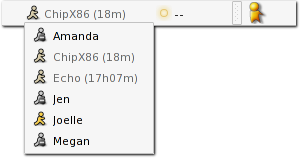
Now that edgy has been frozen for the beta release in a week’s time, and the next developer summit, where the plans for the next release will be discussed, has been announced, I think it’s the perfect time to start thinking about the kinds of features we want to see in that release. At our recent sprint in Wiesbaden, Mark reminded us that when Ubuntu first released we were leading the field in many of the components we installed by default. Many users came to us because we provided Linux 2.6, hotplug/udev and Project Utopia by default; along with the latest GNOME release and development framework. Now everybody does that, butwe led the way. With the dapper release, we produced something that could be supported for a long time. With edgy we’ve scratched our itches and fixed things under the hood that have been causing us problems. edgy+1 seems a good time to integrate the hottest new technologies and lead the way again. So what do I think is exciting, and what do I want in edgy+1? telepathy, farsight and galago Anybody who has used the 2006 software release for the Nokia 770 Internet Tablet will have seen these in action already. They’re, in my opinion, some of the most exciting projects currently being worked on; and ripe for integration into Ubuntu. Telepathy is a communication framework built on DBus that allows any application to establish communication with users all around the world, using any protocol from IRC to MSN to VoIP. It uses Farsight to provide the codecs and protocol support on top of the (GStreamer)[http://gstreamer.freedesktop.org/] media framework. And Galago glues it all together; providing presence information about contacts and allowing users to specify their own status. Galago Presence Applet This means that you’ll be able to contact your contacts. Your calendar alarm tells you that it’s a colleague’s birthday, you’d be able to click their name and see a selection of different ways that you can contact that person right now. From e-mail, opening an MSN or Jabber window or even establishing a VoIP or SIP call to them. The most exciting thing is that because every application on the desktop has easy access to this, people are coming up with fantastic ideas for using it! zeroconf By this, I mean zero configuration networking. Something the OLPC project appears to be going to do very well indeed. Where no existing network infrastructure exists, your computer should still be able to communicate with other nearby computers. It should use ad-hoc wireless networks, link-local IP addresses and server-free DNS resolution with libnss-mdns. Play games with your friends on the train without touching a button. Chat with other people in a lecture hall or at a conference where the existing network is unavailable. Hassle-free home and office networking without any complicated set up. Networking that “just works”. avahi Whether your computer is on an infrastructure or ad-hoc network, it should be able to locate resources on the network and share its own to other people. Avahi allows applications to, via DBus, do this by using a mulicast form of DNS; compatible with Apple’s Bonjour protocol. The immediately obvious benefits of this are that one can locate such things as file servers without any complicated directory; more fun things can be done too, such as sharing your music from RhythmBox with other users on the network. Combine it with telepathy, etc. and you can establish communication with anyone else, with a wide range of different protocols. The immediate problem here is that we currently have a “no open ports” policy, which if we’re going to give the users the opportunity to establish ad-hoc networks is almost certainly a very good thing. We already have exceptions for that policy for DNS and DHCP, it may be that Avahi (mDNS) joins that list. Another option is a “mobile-phone like” interface for enabling and disabling discovery and sharing. Bluetooth I don’t think we should stop discovery and sharing at 802.* networking either. Linux actually has a pretty decent bluetooth stack, it’s something that we should start taking advantage of. Your computer should be able to discover paired or known bluetooth devices when in range without intervention and communicate with them. If I attempt to establish a network connection, and my phone is nearby, that should be offered as a method for getting on the Internet. If possible, it should also be offered through telepathy as a method for contacting people in my address book! Synchronisation These technologies together give us a really big possibility, automatic synchronisation of user’s information. When I bring my laptop home, it should automatically update my desktop with any changes I’ve made to my address book or calendar, and any shared files, etc. Likewise it should be automatically be updated with any changes made on the network, to a company address book on a server, for example. And why stop there? Don’t use share your music, synchronise it so that your laptop, desktop and iPod have the same selection available at all times. Hassle-free backups is an obvious win here. But we’re stopping again. Why is my mobile phone, and PDA excluded from this? Via bluetooth, my address book and calendar should be automatically updated from these and these should be automatically updated themselves. If I add a new number to my phone’s memory, it should appear in my computer address book; and my computer should offer me the ability to contact that person (using VoIP, for example).

Julien Danjou: Knud can't

Or Dunc-tank in sorted order. I never wrote about this until now. But today, when I woke up, I had this strange feeling saying "jd, you gotta do something about DT today.". Actually, that was just my f**** alarm clock. And here I am, and I'm gonna talk to you about the dunc-tank experiment. First it's important to know what a real dunk tank is, because personally I've got no idea until I looked up on Google. So, you see? A dunk tank is a funny game finally. I must admit, if Anthony Towns was seated above the dunk, I would have vote in favor of DT!
Maybe I'm trying to give you some idea for the next DebConf, who knows More seriously, after the co-signed mail that Joerg Jaspert just sent, I wanted to say something more.
Some weeks ago, when our DPL (amen) asked us our opinion about that idea, I said "yeah, go ahead". Of course, that was my opinion at this time, and it changed a little. I still don't have objections about people getting paid, because I'm not jealous.
What does that mean? This means that if Debian was only composed of me, Anthony, and two release managers, I wouldn't have any problem. But that's not the case here, I discovered that there is a lots of people in Debian. Maybe should I tell DT people about that, don't you think? Reality is obviously different, and DT has been launched without a real consensus. We lost valuable people, and I dislike this project for that. We lost time. And we lost money, because time is money (don't beat me). That's an organised foutage de gueule [1] . But please, remember this is an experiment, so kids: don't do this at home.
Notes [1] Feel free to translate yourself

Sven Mueller: Debian and Dunc-Tank

Well, this really is a controversal topic to say the least. While having the RMs get paid to get Etch out might be a good thing, the big problem I see with dunctank is that it is initiated by people very prominent inside Debian and moreover by people perceived as friends of th RMs in question. Though dunctank says that is distinct from Debian, due to the high profile the people involved have inside the Debian community, this distinction might not be recognized by less careful observers. The second problem is that the payment the RMs get is not connected to well specified tasks, but they are for “working on the release of Debian “Etch”. And finally, there is the problem that this is said to be an experiment. However, a good experiment has well defined objectives and well defined boundary conditions. In other words: Regarding Dunc-Tank, it is unclear to me what the experiment is trying to achieve. I admit I voted as much in favor of the experiment as the GR allowed, but in the meantime, I regret doing so. My vote was because my impression was that Dunc-Tank would pay just enough to pay rent, food and the other usual expenses (insurances, debts etc.). But now each of the two RMs is supposed to receive 6k$. This surely is less than they could earn working as IT freelancers, but it sure exceeds their pure living expenses. While just covering their living expenses would be OK for me (in the sense that I could live with it, not in the sense of being happy about it), paying substantially more isn’t, but that’s just me. A DPL collecting money to pay certain DDs is always going to ask for trouble. Or as Ben collins put it back in 2001:
… use Debian money to pay developers. It can never be done fairly, or in a way so as not to piss someone off. It will always be susceptible to political gains and/or favoritism. This subject caused a lot of hatred, and in my opinion, the experiment is a failure. Though it might help to get Etch out in time, it caused many DDs to cut down on the time they spend on Debian, among them people like the DWN editor, who used to invest a lot of time. And this effect will not go away when Etch is released and is thus hurting Debian in the long run. The whole thing might have been a lot different if some random, mostly unknown DD (or even better: non-DD) had started dunc-tank, collecting money and finally paying some DDs to work on some specific tasks. But the fact that the DPL started it makes it so controversial. But on the other hand, it would have been less likely that dunc-tank collected enough money to do so in that case. Honestly, if I were to decide, I would drop dunc-tank completely once Etch has been released (it’s too late to do it now, it would just deprive Debian of the benefits and still cause all the negative side effects). The people who thought (and think) dunc-tank was a good idea could then restart it later under some different name and without involvement of the DPL. There is only one position in Debian I could see reasons why the person occupying it should receive some sort of compensation: The DPL. The reason I see here is that this position requires a lot of time if taken seriously. This also means that many people can’t reasonably apply for it since they would need to resign from their “real world” job.

23 October 2006

Ben Hutchings: Americans less crazy than their government

This survey on foreign policy suggests that the majority of Americans aren't quite as gung-ho as some of us might think.

21 October 2006

Andrew Pollock: [debian] Yuck

I'm not bashing Ubuntu, but I find stuff like this
apollock@icarus:~/bin$ grep-status -s Package,Version -F Status "install ok installed"   grep -B 1 ubuntu
Package: update-manager
Version: 0.42.2ubuntu22-5
in Debian to be a little bit gross. Sure, our users would have to have been under a rock for the last couple of years to not know about the relationship between Debian and Ubuntu, however I think it blurs the lines a bit to have packages in Debian with "ubuntu" in the version string, and changelog entries relating to distribution names that have no relevance to Debian. That's my humble opinion anyway. Seeing a package with "ubuntu" in the version string today was the straw that broke the camel's back. I've seen plenty of packages with Ubuntu codenames in the changelogs.

19 October 2006

Christian Perrier: Should I apologize?

(update with stupid formatting errors fixed) Yes, partly. Julien implictely asks for apologies in his recent blog posting. Because I usually don't like to let conflict rot, I tried thinking about it and draw conclusions. I still think that the attitude of people who started the incident at the JDLL has been really bad and gives a poor image of the Debian project. This is what I intended to explain to the Mozilla representative in my mail. I definitely feel the need to explain that Debian is anything but a monolithic project and when I feel that this project is hurted by the attitude of some of its members, yes I feel the need to correct people's feelings. This mail was sent before Julien sent more explanations, privately and publicly, to me when he read my blog posting. I have to admit that Julien explanations have been clear and detailed and give another light on that story. So, maybe after reading them, I would not have sent that very mail he obviously violently reacts about, or it would have been worded differently. For this, yes, I apologize, Julien. On that very action, I haven't been as wise as I thought. I indeed failed the exact same way I think you guys failed. Probably because I was deeply hurted by seeing someone I've crossed in the french free software community for nearly 15 years (Daniel Glazman) having such a poor opinion of the project that counts the most for me. Does this change what I think? Probably not. Yes, it is a bit paternalistic to think that part of our community is unecessarily childish in its way to express its opinions. *This* is what IMReallyNSHO hurts the project and this deeply lowers the credibility of Debian in the overall community and, I'm afraid, more especially in our country. So, no, I will not apologize for my opinions and, yes, I claim some experience in conflicts solving, negotiation handling and managing the public image of the work I'm involved in. The general conclusion of all this is certainly that I should really have kept my current stance: focus on technical stuff and avoid wasting time, and maybe hurt the project, in "political" discussions. So, please Julien, consider this: is that really fair for people who appreciate your work as well as those who share your ideas, to lower your involvment because you have a conflict with another person? With no doubt, your work in Debian has received deep respect by a vast majority of our fellow Debian contributors. So is the work by Joss, who is probably among the persons I disagree the most with in our French community and who dislikes myself the same way you do. So what? Is that fair to hurt the project because you've been hurted by one of its members? I don't think so and I really hope that people whose opinions you have more respect for than mine will convince you to reconsider that stance. OK, this will sound paternalistic again, so I should probably stop by now. That blog posting is likely be the last non technical until we release Etch. And, as I don't like discussing technical stuff in blogs, it will probably be the last one until we release Etch.

18 October 2006

Christian Perrier: Should I apologize?

Yes, partly. Julien implictely asks for apologies in his recent blog posting. Because I usually don't like to let conflict rot, I tried thinking about it and draw conclusions. I still think that the attitude of people who started the incident at the JDLL has been really bad and gives a poor image of the Debian project. This is what I intended to explain to the Mozilla representative in my mail. I definitely feel the need to explain that Debian is anything but a monolithic project and when I feel that this project is hurted by the attitude of some of its members, yes I feel the need to correct people's feelings. This mail was sent before Julien sent more explanations, privately and "a href="http://blog.technologeek.org/2006/10/15/29">publicly, to me when he read my blog posting. I have to admit that Julien explanations have been clear and detailed and give another light on that story. So, maybe after reading them, I would not have sent that very mail he obviously violently reacts about, or it would have been worded differently. For this, yes, I apologize, Julien. On that very action, I haven't been as wise as I thought. I indeed failed the exact same way I think you guys failed. Probably because I was deeply hurted by seeing someone I've corssed in the french free software community for nearly 15 years (Daniel Glazman) having such a poor opinion of the project that counts the most for me. Does this change what I think? Probably not. Yes, it is a bit paternalistic to think that part of our community is unecessarily childish in its way to express its opinions. *This* is what IMHO hurts the project and this deeply lowers the credibility of Debian in the overall community and, I'm afraid, more especially in our country. So, no I will not apologize for these opinions and, yes, I claim some experience in conflicts solving, negotiation handling and managing the public image of the work I'm involved in. The general conclusion of all this is certainly that I should really have kept my current stance: focus on technical stuff and avoid wasting time, and maybe hurt the project, in "political" discussions. So, please Julien, consider this: is that really fair for people who appreciate your work as well as those who share your ideas, to lower your involvment because you have a conflict with another person? With no doubt, your work in Debian has received deep respect by a vast majority of our fellow Debian contributors. So is the work by Joss, who is probably among the persons I disagree the most with in our French community and who dislikes myself the same way you do. So what? Is that fair to hurt the project because you've been hurted by one of its members? I don't think so and I really hope that people whose opinions you have more respect for than mine will convince you to reconsider that stance. OK, this will sound paternalistic again, so I should probably stop by now. That blog posting is likely be the last non technical until we release Etch. And, as I don't like discussing technical stuff in blogs, it will probably be the last one until we release Etch.

Russell Coker: mailing list culture

There is currently a big debate in progress in Debian. I am not going to mention any specifics because too much of it has already been blogged (maybe in the same syndication in which you read my blog).

I think that the way things are going is more an illustration of the failings of mailing list culture than of failings of Debian. Maybe another mechanism would be more productive in leading towards a solution.

One option that occurred to me is debate via wiki. If each side had a wiki page that they could modify then in a small amount of time we should get a set of two main consensus opinions which would each be explained clearly and summarised well. Then with two options clearly expressed the people who have less strong opinions could decide which option they favor. For this to be a quick solution honorable behaviour would be required from all people involved, if people start trying to sabotage the other group's wiki entries then it would significantly increase the time taken to achieve things.

Another possibility that occurred to me is debate via blog. The quality of blog postings is expected to be a lot higher than that of mailing list discussions as all posts are tied to the author's public image. Writing content-free messages on a mailing list is easy, but every blog entry needs to stand on it's own to a certain extent and anyone who writes flames in most of their blog entries will probably find that the readers like it less than the readers of a typical mailing list.

Maybe when an issue is recognised as highly contentious a few people could blog about it and then form groups to develop wikis to promote their views. A debate might start out with five or more different competing views, some of them would merge until there were only two main opinions being pushed. Then once the two remaining groups had sorted out their positions a vote would be easier to arrange.

What do you think?

Biella Coleman: Epiphany

The word on the streets (in my comments really) is that Epiphany may be the future of reliable web browsing so I will have to check it out. I also got an excited email today about a firefox plug-in that is for the (academic) gods: zotero… It looks pretty nifty and handy but since I don’t even use a bibliographic program like End Notes, at least I am not missing out on huge functionality, which reminds me, does anyone have opinions on good GUI free software bibliography programs ?

Next.

Previous.