Search Results: "mt"

7 May 2012

Cyril Brulebois: Debian XSF News #12

Time for a DXN#11 follow-up.
  1. The recent xserver-xorg-input-synaptics rc4 upload solved a lot of issues, but the 1.6.0 release (just uploaded) should fix some more. Enjoy!
  2. I ve also uploaded a new xorg-server, merging from upstream server-1.12-branch to get many XI2.2 bug fixes, along with an infinite loop bug fix (also seen with synaptics).
  3. Many drivers can no longer work on ia64 due to the recent changes, so we requested they be removed, which happened promptly!
  4. All XSF-maintained packages build happily against X server 1.12, meaning users can get back to running apt-get dist-upgrade blindly without having to fear the consequences. Pro tip: when you see something like xserver-xorg go away during a dist-upgrade, think twice before confirming!
  5. xf86-input-mtrack was recently fixed; xf86-video-glamo and xf86-video-msm fail to build (#671028, #671806), so they stay uninstallable for now. Thankfully nothing appears to depend on them, so they can be temporarily removed from testing if needs be.
  6. In the meanwhile, xserver-xorg-video-intel 2.19 was released. It will probably land into experimental first, until the new server and its drivers make it into testing.
  7. Andreas Beckmann asked me to mention the status of the binary drivers, so here is my take about them: fglrx still doesn t support X server 1.12 (LOL!). The other, big fat blobby driver is installable, and supposed to work.

30 April 2012

Pietro Abate: unburden my home dir

Today I installed unburden-home-dir and I'm very please with it. It's a simple script that takes care of your temporary files to move them outside your home directory. The main reason why I installed it is to minimize the number of read/writes of iceweasel. My favorite browser is apparently the culprit of 80% of read / write operations on disk even when it is idle... Moving the cache to tmpfs, I hope to reduce the IO on disk and to extend my battery life. Using a SSD I haven't noticed any remarkable benefits regarding performances, but I hope I'll manage to squeeze a bit more from my battery. Installing and configuring unburden-home-dir is straightforward. It is packaged for debian (experimental at the time of writing), and it is very easy to configure. Remember that if you want to have your cache on tmpfs, you need to ether mount a tmpfs-enabled file system somewhere or enable RAMTMP=yes in /etc/default/rcS (default in wheezy). After installing unburden-home-dir iotop shows a delightful page full of zeros :) ps: if you use duplicity, remember to specify the option --archive-dir to move the duplicity cache somewhere else...

26 April 2012

Olly Betts: Xapian GSoC 2012 Projects

At the end of the previous episode, you may remember our gallant heroes had a pile of 30 proposals to review. We soon spotted one more to mark as invalid (just a paste with our ideas list plus a some biographical details), and another got withdrawn by the student without explanation (but was low quality anyway), so that left us with 28. We had six volunteers for mentoring, and in the initial allocation we received five student slots from Google, but we asked nicely if we could have an extra one, and were lucky enough to get it. Last year we had four students, so that's a 50% increase. Here's those 28, broken down by the project idea:
  • 8 - Weighting Schemes
  • 6 - Learning to Rank
  • 3 - Dynamic Snippets
  • 2 - Lucene Backend
  • 2 - QueryParser improvements
  • 1 - Erlang Bindings
  • 1 - Improve C# and Java bindings
  • 1 - Improve PHP Bindings
  • 1 - Improve Python Bindings
  • 1 - Improving Japanese Support
  • 1 - Node.js Bindings
  • 1 - Postlist encodings
I find it interesting that the most popular three ideas have closer connections to Information Retrieval theory than most - probably these appeal to students who have taken IR courses and already have an interest and some knowledge of the project area. I think we should aim to get more ideas like these on the list in future years. It's worth noting that in several cases students had taken an idea in sufficiently different directions that there wasn't much overlap, so we didn't just pick the best proposal for each project idea to narrow things down. Also, the proposal isn't the only factor - we like to see applicants work on patch, and to interact with us on IRC and/or email. But in the end it happens we ended up with proposals which were all from different ideas - here are those we selected:
My congratulations to the lucky six, and my commiserations to those we weren't able to select. It wasn't an easy selection to make, and we truly appreciate the time you spent writing your proposal, working on patches, and on the rest of the application process. We'd encourage you to remain involved with Xapian, and to apply to us again next year if you're still eligible for GSoC.

21 April 2012

Diego Escalante Urrelo: Removing the hidden/system bit of vfat/fat32 files on GNU/Linux

Huelga, on flickr I just fixed an USB drive that apparently had been hit by a virus. All the top-level directories were invisible on Windows, but visible on GNU/Linux. First I thought that it was just the hidden bit. But turns out it was the system bit. I had completely forgotten that one even existed! After some googling I got this solved by using mtools:

  1. Create a ~/.mtoolsrc file with this:
    drive s: file="/dev/<your-usb-drive"
    mtools_skip_check=1 (otherwise it refuses to operate on the drive)
  2. Check for file attributes with mattrib:
    $ mattrib -/ s:
  3. Fix any broken stuff (this removes the hidden and system bits):
    $ mattrib -/ -h -s s:
Hope it saves your neck or the neck of someone that has to use Windows. Oh, and please, please, don t make your entire digital life depend on a tiny piece of plastic. Make backups on your real computer, or other drives.

20 April 2012

Jon Dowland: Abrash on working for Valve

I've just read and enjoyed this post by Mike Abrash about working at Valve. I enjoyed it for two reasons: firstly, doom played a pivotal role in shaping Abrash's thinking about the future of computing, or perhaps it shaped the future of computing itself. I'm not ashamed to admit that Doom played a pivotal role in making me the person I am today: it derailed my ambition to become a graphics designer, introduced me to the PC, programming and various other computer design technologies and concepts: things moved on from there. The second reason is the culture that Abrash describes at Valve: flat, creative-driven, unafraid of failure. I've been thinking a lot about work environments and the nature of management, both in the context of my work and Debian. What Abrash describes is still vastly different to life at University, but it did force me to reflect on how lucky I am to have the freedom and conditions I have, and consider the ways in which I define and shape the environment for myself and others.

18 April 2012

Richard Hartmann: Woegle is me

Google seems to become more and more annoying. Package download http://dl.google.com/linux/chrome/deb/ is slow. Not just slow, but slow. Any random apt-get update will take ages; just sitting there waiting for Google's servers to send any data. Downloading actual packages is slow, as well. Ironically, Google's PageRank will punish sites for loading slowly; it's a pity they don't use their considerable server & bandwidth capacities to fix slowness they are causing, themselves. Chrome Copy and paste is a central part of what I use a mouse for. X has had two copy buffers for as long as I can remember, one for mouse selection, pasting with middle mouse button and one for CTRL-c/CTRL-v. Chrome merges the two. That's bad enough in and as of itself, but every time Chrome gets focus, it will clobber anything you may have in your copy buffers at that time with anything that's selected. No matter if you selected it via mouse, via keyboard, a context switch autoselected something. Selection goes into buffer. Every time. Every. Single. Time. To add insult to injury, this is dependent on which tab is active. And if you happen to search on the site (CTRL-f), it will always use what's in the search bar to clobber buffers, no matter if anything on the actual website has been selected. I can't find the bug report about this at the moment, but Google's stance is that this is a feature and introducing an option for traditional copy & paste handling is not desirable. Google+ I get that they feel a need to combat Facebook, but still, pushing Google+ on you is just annoying. At least the Android application has had a permission change on ICS so it can not auto-update. It's the little things ;) WWW Unified branding, the need to support touch-based devices in their UI, etc. Still, GMail's new interface sucks and the old one will be going away for good. And while making some UI elements larger or displaying them unconditionally makes sense for hand-held portrait displays, this is highly annoying on wide-screen landscape displays. 1366x768 may have overtaken 1024x768, but 768 is a constant here and still not a lot. As an aside, hopefully the Apple Effect and the iPad 3 will break the age-long stalemate with regards to screen resolution. More is better, here. Android Bloatware Using stock Android means you won't get Facebook and other useless apps pre-installed. Yet, uninstalling stock applications, like Google+, is impossible. Rights management It's nice that I get to see what kind of access an application would like to have. It's not nice that I can not choose what access I am willing to grant any given application. I can make a binary decision, install or not install, but I can't refuse random access rights to applications. There are custom versions of Android out there which allow you to do this and many applications seem to cope with being unable to do some things. This should be a standard feature. Access management The concept of "access to USB storage" meaning "whatver your SD card or, in the Galaxy Nexus' case, just a specific directory" is also broken. There is a middle ground between "this application needs access to a large chunk of storage" and "this application needs complete access to said large chunk". Just assign the application a specific directory to write into and read from and done's done. Multi-user I can not hand anyone my phone to play a game or surf the Internet without giving them the ability to look through all my email, contacts, calendar, you name it. While I only give my phone to people I trust completely, this still sucks. How hard can it be to create a minimal guest mode which allows people to access a few pre-selected applications with a custom setting of if they are allowed to use cellular data and/or WiFi? Data access Authorized Access Ah, the big one.... Keep in mind that I am using Google's latest and greatest, the Samsung Galaxy Nexus GSM. It's as cutting-edge as you can get. Yes, having one continuous storage device is nice. But MTP support on Linux is abysmal and you are forced to access your data by means of MTP or PTP. gphoto2, gwenview, and gthumb are all unable to import any photos via PTP; no program I tried can transfer anything via MTP. gphoto2 will transfer the background images which APOD (highly recommended, by the way; there's also a donation application for this) stores on my phone. That's it. So, unless I send email to myself, use WiFi-based hacks, or root my phone, I can not access my data. On the strongest mobile platform in the world. Using the most powerful and versatile OS with up-to-date packages. In 2012. Yay. Unauthorized Access Not being able to access my data is a Bad Thing. Even worse is when others can access my data. Contrary to older Android versions, someone decided that it would be a good idea to allow MTP or PTP, only. As in "you can not disable MTP and PTP. One of them has the be activated." This is awesome when you want to charge your phone at an airport or at an acquaintance's possibly malware-ridden Windows machine. Everyone and their bot-herder can potentially access my data while I can not. Usability And while MTP/PTP is an either/or decision, they are using check-boxes, not radio buttons. There's a decade or more of UI experience about check-box versus radio button, so why not use it? I know of at least one owner of a Galaxy Nexus who was not even aware that he couldn't turn off MTP (the default) as the UI pretends otherwise. Opaqueness And good luck trying to contact anybody about this. Having filed a few bugs against Google stuff in the past, I simply gave up on it. Back when Gmail's mailing list filtering and labelling system was somewhat broken, I spent months hunting down people who knew people who knew someone who was able to actually do something about it.

17 April 2012

Russell Coker: The Most Important things for running a Reliable Internet Service

One of my clients is currently investigating new hosting arrangements. It s a bit of a complex process because there are lots of architectural issues relating to things such as the storage and backup of some terabytes of data and some serious computation on the data. Among other options we are considering cheap servers in the EX range from Hetzner [1] which provide 3TB of RAID-1 storage per server along with reasonable CPU power and RAM and Amazon EC2 [2]. Hetzner and Amazon aren t the only companies providing services that can be used to solve my client s problems, but they both provide good value for what they provide and we have prior experience with them. To add an extra complication my client did some web research on hosting companies and found that Hetzner wasn t even in the list of reliable hosting companies (whichever list that was). This is in some ways not particularly surprising, Hetzner offers servers without a full management interface (you can t see a serial console or a KVM, you merely get access to reset it) and the best value servers (the only servers to consider for many terabytes of data) have SATA disks which presumably have a lower MTBF than SAS disks. But I don t think that this is a real problem. Even when hardware that s designed for the desktop is run in a server room the reliability tends to be reasonable. My experience is that a desktop PC with two hard drives in a RAID-1 array will give a level of reliability in practice that compares very well to an expensive server with ECC RAM, redundant fans, redundant PSUs, etc. My experience is that the most critical factor for server reliability is management. A server that is designed to be reliable can give very poor uptime if poorly maintained or if there is no rapid way of discovering and fixing problems. But a system that is designed to be cheap can give quite good uptime if well maintained, if problems can be repidly discovered and fixed. A Brief Overview of Managing Servers There are text books about how to manage servers, so obviously I can t cover the topic in detail in a blog post. But here are some quick points. Note that I m not claiming that this list includes everything, please add comments about anything particularly noteworthy that you think I ve missed.
  1. For a server to be well managed it needs to be kept up to date. It s probably a good idea for management to have this on the list of things to do. A plan to check for necessary updates and apply them at fixed times (at least once a week) would be a good thing. My experience is that usually managers don t have anything to do with this and sysadmins either apply patches or not at their own whim.
  2. It is really ideal for people to know how all the software works. For every piece of software that s running it should either have come from a source that provides some degree of support (EG a Linux distribution) or be maintained by someone who knows it well. When you install custom software from people who become unavailable then it puts the reliability of the entire system at risk if anything breaks then you won t be able to get it fixed quickly.
  3. It should be possible to rapidly discover problems, having a client phone you to tell you that your web site is offline is a bad thing. Ideally you will have software like Nagios monitoring the network and reporting problems via a SMS gateway service such as ClickaTell.com. I am not sure that Nagios is the best network monitoring system or that ClickaTell is the best SMS gateway, but they have both worked well in my experience. If you think that there are better options for either of those then please write a comment.
  4. It should be possible to rapidly fix problems. That means that a sysadmin must be available 24*7 to respond to SMS and you must have a backup sysadmin for when the main person takes a holiday, or ideally two backup sysadmins so that if one is on holiday and another has an emergency then problems can still be fixed. Another thing to consider is that an increasing number of hotels, resorts, and cruise ships are providing net access. So you could decrease your need for backup sysadmins if you give a holiday bonus to a sysadmin who uses a hotel, resort, or cruise ship that has good net access. ;)
  5. If it seems likely that there may be some staff changes then it s a really good idea to hire a potential replacement on a casual basis so that they can learn how things work. There have been a few occasions when I started a sysadmin contract after the old sysadmin ceased being on speaking terms with the company owner. This made it difficult for me to learn what s going on.
  6. If your network is in any way complex (IE it s something that needs some skill to manage) then it will probably be impossible to hire someone who has experience in all the areas of technology at a salary you are prepared to pay. So you should assume that whoever you hire will do some learning on the job. This isn t necessarily a problem but is something that needs to be considered. If you use some unusual hardware or software and want it to run reliably then you should have a spare system for testing so that the types of mistake which are typically made in the learning process are not made on your production network.
Conclusion If you have a business which depends on running servers on the Internet and you don t do all the things in the above list then the reliability of a service like Hetzner probably isn t going to be an issue at all. Related posts:
  1. Servers vs Phones Hetzner have recently updated their offerings to include servers with...
  2. Why Internet Access in Australia Sucks In a comment on my post about (relatively) Cheap Net...
  3. The National Cost of Slow Internet Access Australia has slow Internet access when compared to other first-world...

15 April 2012

Steve Kemp: moreutils makes a lot of sense to me

I've installed moreutils on several hosts now, and each time I find a new use for one of those tools I'm very happy. Unfortunately I suspect that too many of us continue to hoard our little shell script archives, continuing to re-invent wheels with slightly different colours, shapes, and sizes. I suspect I've just re-invented the wheel again, writing nrecent, because there seems to be no "simple" way of doing the job of keeping the most N recent files in a directory. I guess the standard approach would be to use "ls", or "find", to find all files in a directory, reverse-sorted by mtime, then use "tail +n2 to skip the ones you want to keep, removing the rest. Anyway nrecent - keep the most recent N files in a directory:
nrecent --keep 20 /tmp
Written as naively/hurridly as possible as it solved, and continues to solve, a real need. ObQuote: "You're like the drummer from REO Speedwagon. Nobody knows who you are. " - Employee of the month

Vasudev Kamath: Update: Falcon Debian package Status

Recently I wrote about packaging Falcon programming language for Debian. So here is the status of package. Package builds multiple binaries and we have successfully separated modules from core Falcon language component
  1. falconpl (Falcon language itself )
  2. falconpl-dbg (Debug symbols)
  3. libfalconpl-engine1 (Falcon engine library)
  4. libfalconpl-engine1-dbg (Debug symbols for Falcon enging)
Core modules like feathers and modules writtein Falcon itself are part of libfalconpl-engine1. Rest of modules are separated into following packages
  1. falconpl-mongodb: Mongodb connector module
  2. falconpl-dbi : Database Abstraction layer
  3. falconpl-dbi-sqlite3: SQLite3 connector based on DBI module
  4. falconpl-dbi-postgresql: PostgreSQL connector based on DBI module
  5. falconpl-dbi-mysql: MySQL connector based on DBI module
  6. falconpl-dbi-firebird: Firebird DB server connector
  7. falconpl-curl: Curl bindings for Falcon
  8. falconpl-dbus: DBus bindings for Falcon
  9. falconpl-dmtx: Data Matrix reader/writer for Falcon
  10. falconpl-hpdf: Haru based PDF module for Falcon
  11. falconpl-gd2: Graphic manipulation module for Falcon
There are 4 modules which I'm not sure how to build (dependency) or if at all possible to build for Linux they are dynlib, wopi, sdl, conio. I need to consult upstream on these modules status and ability to build. Modules not built We didn't build dbi-oracle and dbi-odbc modules as these are proprietary software dependant. Additionally in a conversation with upstream on IRC it was told dynlib module can't be built for 64bit and X86 version of Linux because lack of assembler, but I've not fully confirmed this. Legal Issues To enable the curl bindings I added curl dependency which in turn has dependency on libssl1.0 library which is part of openssl source package which is causing lintian thrown GPL violation error. Kartik will be looking into this. Patches submitted I've submitted total of 6 patches of which 5 patches are already applied to upstream git repo and 6th one is waiting to be applied. In other words upstream is really helpful to us. Well thats all for this week more updates next week (or may be even before that ;-) )

12 April 2012

Tanguy Ortolo: Why www. ?

Three big  W s in shades of green Many websites have addresses that use a www.- prefix. Some people are encouraging this practice, other are advising against it. I, for one, think this prefix makes sense and is really useful, so here is an explanation of my opinion. In a nutshell: the Wold Wide Web is one Internet service among many other such as domain name, mail, mailboxes or instant messenging; using a dedicated prefix allows to distribute all these services to specific servers in a convenient way.On Internet, you can expose several services, the most common being domain names (DNS), websites (HTTP), incoming mail (SMTP), outgoing mail submission (submission), mailbox fetching (POP) or consultating (IMAP) and instant messenging (XMPP). Constraints Modern Internet services can have constraints such as load balancing, failover and most importantly the possibility to use specific servers for each service instead of having all of them on the same server. Dedicated records Some service were designed or revised to take these contraints into account; this include the domain name, incoming mail and instant messenging, by using dedicated DNS records:
example.com.                    NS              roquefort.example.com.
example.com.                    MX  10          morbier.example.com.
_xmpp-server._tcp.example.com.  SRV 10 100 5269 morbier.example.com.
In that example, the name service of example.com. is provided by the server Roquefort while the incoming mail and instant messenging service are provided by Morbier Dedicated prefixes On the contrary, some services were not designed to take these constraint into account, and may be too fossilized to be revised for that; this includes the Web and mailbox service. A convenient way to work around the antiquated design of these services is to use a well known prefix:
www.example.com.                CNAME           ossau-iraty.example.com.
smtp.example.com.               CNAME           morbier.example.com.
pop.example.com.                CNAME           morbier.example.com.
imap.example.com.               CNAME           morbier.example.com.
In that example, the Web service of example.com. is provided by the server Ossay-Iraty while the email submission and mailbox services are provided by Morbier. Readability and flexibility Using dedicated records and prefixes increases the consistency and readability of a DNS zone, since it allows to refer to the servers by their canonical host name, and to define their IP addresses once and for all:
; Services
example.com.                    NS              roquefort.example.com.
example.com.                    MX  10          morbier.example.com.
pop.example.com.                CNAME           morbier.example.com.
imap.example.com.               CNAME           morbier.example.com.
www.example.com.                CNAME           ossau-iraty.example.com.
; Hosts
roquefort.example.com.          A               192.2.0.12
                                AAAA            2001:db8::12
morbier.example.com             A               192.2.0.42
                                AAAA            2001:db8::42
ossau-iraty.example.com.        A               192.2.0.51
                                AAAA            2001:db8::51
You can think of that practice as connecting dots between services and hosts:
name service    Roquefort
incoming mail   Morbier
mailboxes         Ossau-Iraty
website        
With such a DNS zone, it is very easy to identify which server is hosting each service. Using host names rather than IP addresses multiple times reduces the information duplication, which in turn facilitates future chances and reduces the risk of error (it is easier to swith the website from Ossay-Iraty to Morbier than from 192.2.0.51/2001:db8::51 to 192.2.0.42/2001:db8::42).

8 April 2012

John Goerzen: 26 Hours At The Creek

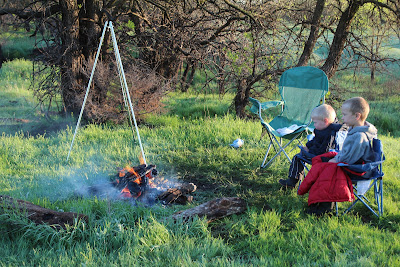
I m back from one of the best experiences a father can have a whole day with two happy boys. I took Jacob (5) and Oliver (2) camping with me out by our creek. This was the first time we d camped there, and also the first time I d taken the boys camping without Terah along. So there were some unknowns, but it worked out great. When we got out there, I started to get the tents set up. The boys were interested, but pretty soon invented some games. A large nearby tree with plenty of low branches on its trunk became their locomotive, and certain sticks made the train go forward or backward, whistle, or ding its bell. This was good for quite some entertainment. Another nearby tree, near the bank of the creek, had some erosion near it. Combined with its roots, this made some natural steps. Jacob named some the enter steps and others the exit steps , and I sure heard about it if I walked the wrong way on the exit steps. We then gathered up sticks and the things we needed to build a campfire. We cooked up brats and zucchini. Although it was later than usual for supper, they loved it just the same. After that, we made smores for dessert another thing they loved. Then, one of the big highlights: sleeping in tents and sleeping bags. I had showed them the sleeping bags earlier, and they were excited to try them out. Morning was beautiful when the sun came out, it was shining right on the heavy dew on the ground, making the grass shine brightly. It s not every day that they get to start their morning slowly waking up by a warm fire. They were content to sit for quite awhile while I got things going for breakfast. It was chilly outside, so I helped them change clothes by the fire where. I then cooked them some scrambled eggs which, despite the lack of salt and pepper, seemed so much better than normal to the boys and then we went exploring. I took them to some areas with erosion, which Jacob called the big holes in the ground. It s really quite beautiful in spring, which this cellphone photo completely fails to capture. The boys loved climbing up and down these areas, some of which were quite tall. They discovered different kinds of rock on the way up and down, and with my help avoided discovering too much of the mud at the bottom. We hiked back to our camping spot through grass almost as tall as Oliver much to his delight and then after warming up by the fire for a bit, went off in the other direction. There is a grove of trees by the creek over there, which surprise became another train. Here are the boys explaining how it works. <iframe allowfullscreen="allowfullscreen" frameborder="0" height="315" src="https://www.youtube.com/embed/43EcEK8F_ic?rel=0" width="560"></iframe> They helped pack things back up, too. Actually, it took some convincing to get Jacob to not pull up all the stakes for the tent before I was ready for them. Things didn t go perfectly, but then, they never do, and that was OK with everyone. Camping is an adventure, and it wouldn t be an adventure if you knew every detail beforehand. It is rare in life to be able to think that I have enough time to do anything the boys might want to do. Spend half an hour pretending a tree is a train sure, no problem. Today Oliver asked to go camping again, and was a bit disappointed when I didn t agree to go camping again right this minute, today. Jacob said, we had an EXCELLENT time and gave me hugs thinking about it. I have a lot of happy memories about the creek. We camped at the same spot where I went fishing or camped as a child. There have been family gatherings and even a birthday party out there. The boys and I have enjoyed a hike or a wagon ride to the area, but as I learned, nothing could possibly match the excitement of camping there. It is wonderful to add another happy memory of a time at the creek. And it s even better to see another generation of Goerzens discover that there s a lot of fun to be had down by the creek.

5 April 2012

Jon Dowland: Greg Bear Hull Zero Three

In (roughly) 2008 I read "Blood Music" my first Greg Bear novel and devoured it in a weekend, in only two or three reading sessions. That happens very rarely, and when it does I often wonder whether it's the quality of the writing or some combination of that and your personal moods and tastes at the time that is responsible. My next Bear was "Darwin's Radio" in mid-2010 which, whilst good, did not provoke the same feverish read. I might write short reviews for both at some point in the future, but right now I can't remember either well enough to do so. In the last few weeks I read "Hull Zero Three" which was quite a different beast. The novel first captured my attention due to the unusual way it was promoted: via a video, which was created using a modified Quake 2 engine. It wasn't a great video but the novelty made it interesting. The story begins with a first-person narrator waking up from a sort-of hyper sleep on a generation starship that has clearly had some serious problems. He has to run to escape danger before he has an opportunity to figure out exactly what has happened and what he is running from, or to. Something has gone horribly wrong on the ship: it's nowhere near where it should be going and nobody should be awake. The narrator's memory is fractured, fabricated and unreliable; the ship is hostile, and whilst it's mechanical, it cyclically changes and re-arranges it's hulls in an almost organic way. He is joined by a rotating cast of similarly confused refugees of varying shapes and sizes. Language and cultural barriers serve to further magnify the sense of alienation that you experience on behalf of the story teller. The troupe are persued through the corridors by a collection of lethally efficient killer "things", contrasting with the background by being organic in nature but mechanical in behaviour and appearance. The scale of the ship is necessarily massive, and Bear does an impressive job of capturing the awe you might feel when considering it. Three huge, cigar-shaped hulls, joined by "spars" to an enormous chunk of ice captured from the Oort cloud on exodus from the solar system. The ice serves as a mixture of "fuel" for the biological ship systems and as part of a shield system for the hulls from cosmic rays. However, in part due to the narrator's confusion, it was hard to follow the very abstract descriptions of the environment in the earlier stages of the story. I found myself re-reading passages to try and understand the comparisons being offered and scales presented. In common with the two earlier Bears I've read, 'body horror' features prominently in this story. It feels like a "Dead Space" or "Resident Evil" in space in a hard SF novel which seriously attempt to capture real speculative science. Like "Blood Music", I found myself compelled to read "Hull Zero Three" at every available opportunity. I finished it off in a very enjoyable reading session outdoors in the spring sunshine. It was an enjoyable read, well written but not beyond criticism, with some interesting takes on well-worn themes. Very reminiscent of the movie "Pandorum" (which was a surprisingly good movie).

24 March 2012

Jon Dowland: qtscrob

This week I uploaded QTScrobbler to Debian. If you have a music player running Rockbox, you can configure it to write a log of what you have listened to, and when, to a .scrobbler.log file in the root of your player's file system. QTScrobbler takes such a log file and submits the contents to the last.fm audio-scrobbler website. It then deletes the log file from the player. If that sounds useful to you, give it a go!

Alessio Treglia: LADI Tools: first stable release is out!

During the last month I worked as upstream maintainer of LADI Tools and now I m happy to introduce the first stable release! So, to answer the usual question What s new? , here is a short description of the changes introduced (taken from the NEWS file included in the release tarball): Laditools 1.0 Lady O Apart from wladi and g15ladi, most of ladi* tools have been renamed: Moreover, a new component has joined the LADI Tools suite: ladi-player. LADI Player is a convenient, graphical VLC-style application providing an all-in-one control interface to start, stop and monitor JACK as well as the session handler. It also provides basic controls for managing studios. Goodbye PyGTK! All the code was ported to GTK+ 3 and the new GObject Introspection mechanism. Code refactoring and cleanup The code has been reorganized in order to allow the use of Python objects by 3rd party applications. To start writing code using the classes provided by laditools, simply do the following: from laditools import * Two-in-one solution for LADI System Tray Formerly laditray was an implementation of GtkStatusIcon to put a nice right-clickable icon into the system tray to allow users access JACK controls easy way. It s been mostly rewritten and now it shows an AppIndicator icon (if the library is available), or fall back to the Freedesktop.org s old-fashioned System Tray Protocol Spec-compliant icon. Project s new homepage The project s homepage is now hosted by Launchpad.net, the code is hosted by repo.or.cz and it s available here for browsing.
Please use the following links to contact the development team: New up-to-date packages will hit both Debian and Ubuntu soon!

22 March 2012

Axel Beckert: Tools for CLI Road Warriors: Tunnels

Sometime the network you re connected to is either untrusted (e.g. wireless) or castrated in some way. In both cases you want a tunnel to your trusted home base. Following I ll show you three completely different tunneling tools which may helpful while travelling. sshuttle sshuttle is a tool somewhere in between of automatic port forward and VPN. It tunnels arbitrary TCP connections and DNS through an SSH tunnel without requiring root access on the remote end of the SSH connection. So it s perfect for redirecting most of your traffic through an SSH tunnel to your favourite SSH server, e.g. to ensure your local privacy when you are online via a public, unencrypted WLAN (i.e. easy to sniff for everyone). It runs on Linux and MacOS X and only needs a Python interpreter on the remote side. Requires root access (usually via sudo) on the client side, though. It s currently available at least in Debian Unstable and Testing (Wheezy) as well as in Ubuntu since 11.04 Natty. Miredo Miredo is an free and open-source implementation of Microsoft s NAT-traversing Teredo IPv6 tunneling protocol for at least Linux, FreeBSD, NetBSD and MacOS X. Miredo includes not only a Teredo client but also a Teredo server implementation. The developer of Miredo also runs a public Miredo server, so you don t even need to install a server somewhere. If you run Debian or Ubuntu you just need to do apt-get install miredo as root and you have IPv6 connectivity. It s that easy. So it s perfect to get a dynamic IPv6 tunnel for your laptop or mobile phone independently where you are and without the need to register any IPv6 tunnel or configure the Miredo client. I usually use Miredo on my netbooks to be able to access my boxes at home (which are behind an IPv4 NAT router which is also an SixXS IPv6 tunnel endpoint) from whereever I am. iodine iodine is likely the most undermining tool in this set. It tunnels IPv4 over DNS, allowing you to make arbitrary network connections if you are on a network where nothing but DNS requests is allowed (i.e. only DNS packets reach the internet). This is often the case on wireless LANs with landing page. They redirect all web traffic to the landing page. But the network s routers try to avoid poisoning the client s DNS cache with different DNS replies as they would get after the user is logged in. So DNS packets usually pass even the local network s DNS servers unchanged, just TCP and other UDP packets are redirected until logging in. With an iodine tunnel, it is possible get a network connection to the outside on such a network anyway. On startup iodine tries to automatically find the best parameters (MTU, request type, etc.) for the current environmenent. However that may fail if any DNS server in between imposes DNS request rate limits. To be able to start such a tunnel you need to set up an iodine daemon somewhere on the internet. Choose a server which is not already a DNS server. iodine is available in many distributions, e.g. in Debian and in Ubuntu.

Richard Hartmann: Lenovo service quality

As there has been a lot of feedback to my post regarding Lenovo's hardware quality, I thought it would only be fair to follow this up now that my laptop returned from Lenovo. After waiting about 15 minutes on the phone, I got to speak to an actual human. While I really do not have a problem with foreigners and love to talk to people from other cultures, I do firmly believe that someone working in a telephone support position should have at least basic language skills, both spoken and written. This was not the case and communicating my issues, and making sure that they would be written down correctly, took a long time and was generally frustrating. I put four things into the returns package: In said letter, I specified all my issues with the laptop, how removing the UMTS card will improve, but not fix the situation, and that the power brick will deliver power for a split second and then go off for a second; rinse repeat. Not having heard from them for a week, I decided to follow up on the status. As Lenovo's web interface claimed my ticket number did not exist, I spent a total of 1 hour 47 minutes in the waiting loop, not counting the menu selections. I never even managed to even reach a human. The day before I left for Open Source Days, the laptop arrived. The ticket number still did not exist according to the web interface and they never sent email even though they had my address, but at least my issue was fixed. Or so I thought. The repair slip claimed they switched out the mainboard, a claim I can not prove/disprove. It's OK not to find a bug in the first try, especially when it's not as simple as "display cracked". It's not quite as OK to not properly test a machine before sending it back. It's definitely not OK to not care in the least and just send back a machine which you obviously did not even try to debug. How they could not replace the power brick is beyond me. Thankfully, I ordered three separate ones and that was just my on-desk one so I have two others. Still. Overall, I am not impressed.

21 March 2012

Axel Beckert: Tools for CLI Road Warriors: Remote Shells

Most of my private online life happens on netbooks and besides the web browser, SSH is my most used program especially on netbooks. Accordingly I also have hosts on the net to which I connect via SSH. My most used program there is GNU Screen. So yes, for things like e-mail, IRC, and Jabber I connect to a running screen session on some host with a permanent internet connection. On those hosts there is usually one GNU Screen instance running permanently with either mutt or irssi (which is also my Jabber client via a Bitlbee gateway). But there are some other less well-known tools which I regard as useful in such a setup. The following two tools can both be seen as SSH for special occassions. autossh I already blogged about autossh, even twice, so I ll just recap the most important features here: autossh is a wrapper around SSH which regularily checks via two tunnels connect to each other on the remote side if the connection is still alive, and if not, it kills the ssh and starts a new one with the same parameters (i.e. tunnels, port forwardings, commands to call, etc.). It s quite obvious that this is perfect to be combined with screen s -R and -d options. I use autossh so often that I even adopted its Debian package. mosh Since last week there s a new kid in town^WDebian Unstable: mosh targets the same problems as autossh (unreliable networks, roaming, suspending the computer, etc.) just with a completely different approach which partially even obsoletes the usage of GNU Screen or tmux: While mosh uses plain SSH for authentication, authorization and key exchange the final connection is an AES-128 encrypted UDP connection on a random port and is independent of the client s IP address. This allows mosh to have the following advantages: The connection stays even if you re switching networks or suspending your netbook. So if you re just running a single text-mode application you don t even need GNU Screen or tmux. (You still do if you want the terminal multiplexing feature of GNU Screen or tmux.) Another nice feature, especially on unreliable WLAN connections or laggy GSM or UMTS connections is mosh s output prediction based on its input (i.e. what is typed). Per line it tries to guess which server reaction a key press would cause and if it detects a lagging connection, it shows the predicted result underlined until it gets the real result from the server. This eases writing mails in a remote mutt or chatting in a remote irssi, especially if you noticed that you made a typo, but can t remember how many backspaces you would have to type to fix it. Mosh needs to be installed on both, client and server, but the server is only activated via SSH, so it has no port open unless a connection is started. And despite that (in Debian) mosh is currently just available in Unstable, the package builds fine on Squeeze, too. There s also an PPA for Ubuntu and of course you can also get the source code, e.g. as git checkout from GitHub. mosh is still under heavy development and new features and bug fixes get added nearly every day. Thanks to Christine Spang for sponsoring and mentoring Keith s mosh package in Debian.

19 March 2012

Jan Wagner: Chemnitzer Linuxtage 2012

As announced 3 weeks ago, the Debian project was present at Chemnitzer Linuxtage. Several talks and workshops where held by people related to the Debian project. At the booth we had talks and discussions with exhibitors and visitors, unfortunately I didn t had much time to visit more than small parts of two lectures. Unfortunately (for the visitors) we didn t had any merchandising on board, while we received several requests. On Sunday Axel surprised us with some leftovers from fosdem of debian.ch merch. At the booth we had a demo machine running Babelbox and xpenguins, which attracted visitors very well. Booth Babelbox We received also more than one Just thank you by satisfied users. :) Four different talks and one workshop were held by Debian people, but they were not specific to the Debian. The workshop was about OpenStreetMap, lectures was about commandline helpers, grep everything, quality analyzing and team management in opensource projects and Conkeror and other keyboard based webbrowsers. Many thanks to Jan Dittberner, Andreas Tille, Christian Hoffmann, Florian Baumann, Christoph Egger, Axel Beckert, Adam Schmalhofer, Markus Schnalke, Sebastian Harl and Patrick Matth i for running the booth, answering a wide range of questions or just chatting with visitors . A special thank to TMT GmbH & Co. KG for providing the complete equipment and sponsoring it s transportation. At the end we have to send a big thank to the organizing team of the Chemnitzer Linuxtage. It was fun and a pleasure to find new friends and meet old ones of the Free Software community. A small sidenote was anybody aware that OpenSuSE Package search is using screenshots.debian.net?

13 March 2012

Joachim Breitner: ghc-heap-view: Complete referential opacity

During the last week, I created ghc-heap-view, a library to investigate the actual memory representation of Haskell values. It is inspired by vacuum and the GHCi debugger, but goes beyond them by allowing the user to look inside thunks and functions and see what other values they refer to. Let me demonstrate it by running the included demo: ghc-heap-view-demo Here are a four different lists, where the first three are already evaluated.
The first one, l, was defined as a top level constant as
> l = [1,2,3]
and is now found at 0x00000000006d1750/2 (where the /2 is the pointer tag information) and fully evaluated:
  ConsClosure  info = StgInfoTable  ptrs = 2, nptrs = 0, tipe = CONSTR_STATIC, srtlen = 1 , 
                 ptrArgs = [0x00000000006d16e0/1,0x00000000006d1730/2],
                 dataArgs = [], descr = "ghc-prim:GHC.Types.:" 
The second one, l2, is locally defined
> let l2 = 4:l
and now found at 0x00007fdce19fe4b0/2. See how the cons-cell references l!
  ConsClosure  info = StgInfoTable  ptrs = 2, nptrs = 0, tipe = CONSTR_2_0, srtlen = 1 ,
                 ptrArgs = [0x00000000006dca50/1,0x00000000006d1750/2],
                 dataArgs = [],
                 descr = "ghc-prim:GHC.Types.:" 
And the binding
> args <- map length  fmap  getArgs
evaluates to the one , global empty list at 0x00000000006db640/1:
  ConsClosure  info = StgInfoTable  ptrs = 0, nptrs = 0, tipe = CONSTR_NOCAF_STATIC, srtlen = 0 ,
                 ptrArgs = [],
                 dataArgs = [],
                 descr = "ghc-prim:GHC.Types.[]" 
And now we have, at 0x00007fdce19fe4c8, the concatenation of them, but unevaluated:
> let x = l ++ l2 ++ args
The thunk keeps a reference to l2 and args, but not l, as that is at a static address, unless you are running this in GHCi:
  ThunkClosure  info = StgInfoTable  ptrs = 2, nptrs = 0, tipe = THUNK_2_0, srtlen = 1 ,
                  ptrArgs = [0x00007fdce19fe4b0/2,0x00000000006db640/1],
                  dataArgs = [] 
Now to some more closure types. m and m' locally bound of type the unboxed type Int#, with values 42 resp. 23.
> let f = \x n -> take (I# m + I# x) n ++ args
  t = f m' l2
So here is (0x00007fdce1937d50/2), referencing its free variables args and 42:
  FunClosure  info = StgInfoTable  ptrs = 1, nptrs = 1, tipe = FUN_1_1, srtlen = 65553 ,
                ptrArgs = [0x00000000006db640/1],
                dataArgs = [42] 
And t is a thunk that applies f (also referenced here) to an unboxed value (23) and l2:
  ThunkClosure  info = StgInfoTable  ptrs = 2, nptrs = 1, tipe = THUNK, srtlen = 0 ,
                  ptrArgs = [0x00007fdce19fe4b0/2,0x00007fdce1937d50/2],
                  dataArgs = [23] 
Lastly, here is the standard example for self reference:
> let x = id (:) () x
This is what x (0x00007fdce1947940) looks like, at least without -O:
  ThunkClosure  info = StgInfoTable  ptrs = 0, nptrs = 0, tipe = THUNK, srtlen = 1 ,
                  ptrArgs = [],
                  dataArgs = [] 
So it is unevaluated. Let us evaluate it using seq. Now we have, still at 0x00007fdce1947940:
  IndClosure  info = StgInfoTable  ptrs = 1, nptrs = 0, tipe = BLACKHOLE, srtlen = 0 ,
                indirectee = 0x00007fdce194cc98/2 
The thunk was replaced by an indirection. If we look at the target, 0x00007fdce194cc98/2, we see that it is a newly created cons-cell referencing the original location of x:
  ConsClosure  info = StgInfoTable  ptrs = 2, nptrs = 0, tipe = CONSTR_2_0, srtlen = 1 ,
                 ptrArgs = [0x00000000006db620/1,0x00007fdce1947940],
                 dataArgs = [],
                 descr = "ghc-prim:GHC.Types.:" 
After running the garbage collector (performGC), we find that the address of x is now 0x00007fdce19f30d0/2 and that the self-reference is without indirections:
  ConsClosure  info = StgInfoTable  ptrs = 2, nptrs = 0, tipe = CONSTR_2_0, srtlen = 1 ,
                 ptrArgs = [0x00000000006db620/1,0x00007fdce19f30d0/2],
                 dataArgs = [],
                 descr = "ghc-prim:GHC.Types.:" 
Future plans The output of ghc-heap-view is not really pretty yet; even the indentation in this blog post was added manually by me, so this really needs a pretty printer providing a nicer, possibly more compact representation, including something like what vacuum provides. Maybe vacuum can be ported to use this library, and also include the thunk s and function s references in the output. Maybe also the GHCi debugger can be extended to show more information about unevaluated expressions using this. Internally, the library is not very polished yet either. It only handles those closures types that I have seen so far, and is likely to break horribly if run in a threaded or debugging enabled runtime. How it works Obviously, this is not standard Haskell 98 code, but rather deep trickery involving the GHC API and some C code. Initially I tried to use the API that vacuum and the GHCi debugger rely on, which is an operation
unpackClosure# :: a -> (# Addr#, Array# b, ByteArray# #)
which takes any Haskell value and returns the address to its info table, the pointers and the non-pointer-data in the closure. Unfortunately, it was not complete in that it was meant only for data closures and will for other closure types, e.g. thunks, return no data and no pointers (as can be seen in the code). So I implemented my own version of this operation:
foreign import prim "slurpClosurezh" slurpClosure# :: Any -> (# Addr#, ByteArray#, Array# b #)
where the returned ByteArray# contains the complete closure, including extra information fields such as the arity of a function. The Array# is again the list of pointers in the closure. At first glance, this is a duplication, as the pointers are of course also contained in the ByteArray#. But as soon as the GHC runtime reigns again, a garbage collector run can happen, the referenced values will move somewhere else, and the words that once were pointers in the ByteArray# become useless. But the corresponding entries in the Array# are updated by the garbage collector, as it knows that these are pointers, and not just words. This way, we get both a faithful copy of the closure on the heap and useful references to the contained data. Here is a demonstration of this effect:
$ ghci -XMagicHash -package ghc-heap-view
GHCi, version 7.4.1: http://www.haskell.org/ghc/  :? for help
Loading package ghc-prim ... linking ... done.
[..]
Loading package ghc-7.4.1 ... linking ... done.
Loading package ghc-heap-view-0.1 ... linking ... done.
Prelude> let  a = [1,2,3,4]; b = 5:a 
Prelude> :m + GHC.HeapView 
Prelude GHC.HeapView> rawHeapData <- getClosureRaw b
Prelude GHC.HeapView> rawHeapData 
(0x000000004080d658,[1082185320,140040739366568,140040739365928],[0x00007f5dc68626a8,0x00007f5dc6862428])
Prelude GHC.HeapView> System.Mem.performGC
Prelude GHC.HeapView> rawHeapData 
(0x000000004080d658,[1082185320,140040739366568,140040739365928],[0x00007f5dc41b3ad8,0x00007f5dc41b3b28]) 
The function rawHeapData is a thin wrapper around slurpClosure# which turns the primitive array in normal lists. Note that the second component of the triple is unchanged, but the third is updated by the garbage collector. Of course this means that the Show instance for the data type that ghc-heap-view uses to reference values is not referential transparent either. The foreign function import above is of type prim , i.e. does not call a C function but rather a Cmm function. Cmm is a reduced C that GHC uses internally to compile the Haskell code to, and most primitive operations are implemented in this language although I do quickly call regular C from my Cmm code to do the more complicated stuff, mainly figuring out what words of the closure are pointers. The knowledgeable reader might notice that I am passing a boxed value of type Any to the foreign function. This is currently not possible with foreign prim functions, and to actually use that code, you need the patch in GHC ticket #5931. But you can use ghc-heap-view without that as well (and the Cabal package will by default use that path), using the following hack to obtain the pointer to a Haskell value on the Heap as an unboxed type that can pass to the primitive operation:
foreign import prim "slurpClosurezh" slurpClosure'# :: Word#  -> (# Addr#, ByteArray#, Array# b #)
data Ptr' a = Ptr' a
aToWord# :: Any -> Word#
aToWord# a = case Ptr' a of mb@(Ptr' _) -> case unsafeCoerce# mb :: Word of W# addr -> addr
slurpClosure# :: Any -> (# Addr#, ByteArray#, Array# b #)
slurpClosure# a = slurpClosure'# (aToWord# a)
This works because a Word and a Ptr' have the same closure layout, only differing in the fact that one stores an a, and the other stores a Word#. Once we obtained the raw representation of the closure, we do the parsing in Haskell. Using the info table and the raw closure, we have enough information to tell which words have to be replaced by the appropriate pointer (which might already have been updated by the garbage collector) in the pointers list. This work was supported by a scholarship from the Deutsche Telekom Stiftung.

Flattr this post

9 March 2012

Jan Wagner: Monitoring dualstacked service with Icinga

Having monitoring for dualstack connectivity in place helps a lot. Unfortunately in most cases we are running also services we want to offer dualstacked. In the past we just monitored in those cases IPv4 only or created a separate check for the same service on IPv6. This is a bit messy and I was looking for something to check services via IPv4 and IPv6. Digging my most boring search engine doesn t help much here. So I was talking with some people more involved into the core Icinga/Nagios stuff. Seems there is actually the best solution to use check_multi. As we have the command definition for check_multi_icinga already in place, I created a check_smtp_dualstack.cmd for monitoring a dualstacked SMTP service

command[ IPv4 ] = check_smtp -4 -H $HOSTADDRESS$
command[ IPv6 ] = check_smtp -6 -H $HOSTADDRESS6$
state [ CRITICAL ] = COUNT(CRITICAL) > 1
state [ WARNING ] = COUNT(WARNING) > 0 COUNT(CRITICAL) > 0
state [ UNKNOWN ] = COUNT(UNKNOWN) > 1 A simple SMTP service definition does the trick (don t forget address6 in host definition)

define service
use generic-service ; Name of service template to use
host_name localhost
service_description SMTP
check_command check_multi_icinga! check_smtp_dualstack.cmd !'-r 1+2+4+8
Okay .. that looks nice, but only at the first view. Imagining what we are actually running as service checks, it seems we just need for every unique service check a new cmd-file for check_multi as I didn t found a way to generalize the whole stuff yet. Does anybody know a way to pass commands for check_multi via service definitions? Something like:

define service
[...]
check_command check_multi_icinga! check_general_dualstack.cmd !'check_smtp -p 666 ! -r 1+2+4+8
[...]

Next.

Previous.