Search Results: "hug"

28 November 2010

Biella Coleman: The Existential Philsophy of Procrastination

out of cous The New Yorker has a very nice piece about the follies and foibles of procrastination. I really identified with it, especially the ruminations of multiple/divided selves (I do feel more like Biella s instead of Biella especially during moments of extreme procrastination). The heart of the piece has to do with the existential face of procrastination, which the author nails with this quote by Mark Kingwell:
Procrastination most often arises from a sense that there is too much to do, and hence no single aspect of the to-do worth doing. . . . Underneath this rather antic form of action-as-inaction is the much more unsettling question whether anything is worth doing at all
This reminds me of another one of my favorite (and kinda distributing but also kinda liberating) quotes by Henry Miller:
Life has to be given a meaning because of the obvious fact that it has no meaning
Finally, the most humorous bit in the article had to do with Victor Hugo, who apparently, to stave off distraction, would write in the nude and then make what sounds like his man servant hide his clothes so he could not go outside. Reminds me that prior to the Internet, there were certainly other ways to squander time. For now, I encourage some procrastination: read it and you might get some insight as to this habit, which seems to afflict so many.

Andreas Metzler: hugin 2010.4.0 in experimental

Hugin 2010.4.0 beta1 is available in experimental (after the next mirror pulse). The major feature is inclusion of a (patent-free) control point detector (cpfind). No need for getting autopano-sift(-c) from third part repositories anymore. My first tests were pretty promising, cpfind is very fast and seems to find reasonable controlpoints. It does not seem to be possible to limit the number of control points anymore, though. Unofficial lenny backports are available here.

Christian Perrier: [life] a pique...

Yesterday night, we were at Stade de France to witness the debacle of the French national rugby team against Australia (16-59). 7 tries to 1. For someone who loves rugby and knows the high level of players we have in France (Top 14 is a collection of great games every week), it hurts. Maybe, next time, there will be a little more Toulouse players on the field and a little less people who have nothing to do there (should I name a few? Andreu, Huget, Porical...). The only good point of that game was (as usual) the scrum first row (at least during one hour...then even there we got crushed by the Australians). French winter was even here to help, but apparently the yellow/green folks didn't really care. Australia has a really impressive team, particularly their back line. We'll be having hard times in RWC in New Zealand next year. Big round of aplause at the end of the game for that team. For our team: a pique.....fort!

27 November 2010

Paul van Tilburg: 10 Years of Spacelabs

A few months ago I realised it has been 10 years already since Spacelabs 1 was founded. Today we will celebrate that with a reunion and probably reminisce about past projects, events and experiences. Therefore, I thought it would be nice to accompany this with a post. The past Spacelabs was founded to create something that sits in between research and consumer appliances. Since we are associated to the Electro-Optical Communication group these things often had to do with bandwidth. For example, showing the ease of use of plastic optical fiber or participate in GPRS/UMTS trials. However, due to the loose structure of Spacelabs, we ventured into many other projects of our own such a information system-enabled fridge with a barcode reader, a dynamic DNS system, etc. At some point we got our own Internet connection with an accompanying subnet. It has been fun and rewarding to learn how to setup and run a mini ISP. Spacelabs doesn t have any formal structure: when you are on the mailing list, you are a member. There are no regular meetings, no hierarchy, no obligations. So in some ways, we are a group that is much like a free/open source software community. I think that this approach has provided us the drive to work both on projects during our free time as well as our own ideas. I feel that Spacelabs has contributed so much to my life. It might not be the typical study association, but it was a big supplement to my studies, it was fun and it was completely ours. Not only did it teach me many, many technical things from networks to program languages to software design but it also gave me experiences on other levels, such as very attuned group work and responsibilities for key systems. Spacelabs in 2006 The future Soon, everyone connected to Spacelabs will have finished their Master s or PhD (in my case) and nobody will be left to continue the project. Although this is a bit sad, I think we can be proud of what we have accomplished, learnt and experienced. I will miss our location high in the Potentiaal/E-hoog building overlooking Eindhoven, and our being together as a group. We are however not gone yet, there is still a lot to plan and to work on if we want to rescue the huge amount of servers and services that we have accumulated over the years if we were to leave

1 Yes, the website is very much from the past.

25 November 2010

Raphaël Hertzog: People behind Debian: Colin Watson, the tireless man-db maintainer and a debian-installer developer

Colin Watson is not a high-profile Debian figure, you rarely see him on mailing lists but he cares a lot about Debian and you will see him on Debconf videos sharing many thoughtful comments. I have the pleasure to work with him on dpkg as he maintains the package in Ubuntu, but he does a lot of more interesting things. I also took the opportunity to ask some Ubuntu specific questions since he s worked for Canonical since the start. Read on. My questions are in bold, the rest is by Colin. Who are you? Hi. I m 32 years old, grew up in Belfast in Northern Ireland, but have been living in Cambridge, England, since I was 18. I m married with a stepson and a daughter. I became interested in Debian due to the critical mass of Debian work happening in Cambridge at the time (and perhaps more immediately because my roommate was running Debian: hey, what s that? ), started doing random bits of development in 2000, and joined as a developer in 2001 (a really exciting time, with lots of new people joining who became integral parts of the project). I d only really been intending to do QA work and various bits of packaging around the edges, and maybe some work on the BTS, but then Fabrizio Polacco died and I took over man-db from him, and it sort of snowballed from there. I graduated from university shortly before becoming a Debian developer. I worked for a web server company (Zeus), then a hardware cryptography company (nCipher), before moving to work for Canonical in 2004, since when I ve been working full-time on Ubuntu. By this point, I suspect that going back to work in an office every day would be pretty tough. What s your biggest achievement within Debian or Ubuntu? One thing I should say: I rarely start projects. Firstly I don t think I m very good at it, and secondly I much prefer coming on to an existing project and worrying away at all the broken bits, often after other people have got bored and wandered off to the next new and shiny thing. That s probably why I ended up in the GNU/Linux distribution world in the first place, rather than doing lots of upstream development from the start I like being able to polish things into a finished product that we can give to end users. So, I ve had my fingers in a lot of pies over the years, doing ongoing maintenance and fixing lots of bugs. I think the single project I m most proud of would have to be my work on the Debian installer. I joined that team in early 2004 (a few months before Canonical started up) partly because I was a release assistant at the time and it was an obvious hot-spot, and partly because I thought it d be a good idea to make sure it worked well on the shiny new G4 PowerBook I d just treated myself to. I ended up as one of the powerpc d-i port maintainers for a while (no longer, as that machine is dead), but I ve done a lot of core work as well: much of the work to put progress bars in front of absolutely everything that used to have piles of text output, rescue mode, the current kernel selection framework, a good deal of udev support, several significant debconf extensions, lots of os-prober work, and I think I can claim to be one of the few people who understands the partitioner almost top to bottom. :-) d-i is the very first thing many of our users see, and has a huge range of uses, from simple desktop installs to massive corporate deployments; it s unspeakably important that it works well, and it s a testament to its design that it s been able to trundle along without actually very much serious refactoring for the best part of five years now. I have a soft spot for man-db too. It was my first major project in Debian, starting out from an embarrassingly broken state, and is now nice and stable to the point where I recently had time to spawn a useful generic library out of it (libpipeline). What are your plans for Debian Wheezy? d-i has a lot of code to deal with disks and partitions. Of course a lot of it is in the partitioner, and for that we use libparted so we don t have to worry very much about the minutiae of device naming. But there are several other cases where we do need to care about naming, mainly before the partitioner when detecting disks, and after the partitioner when installing the boot loader. Back in etch, we introduced list-devices , which abstracted away the disk naming assumptions involved in hardware detection. In wheezy, I would like to take all the messy, duplicated, and error-prone code that handles disk naming in the boot loader installers, and design a simple interface to cover all of them. This has only got more important following the addition of the kFreeBSD and Hurd d-i ports in squeeze, but it bites us every time we notice that, say, CCISS arrays aren t handled consistently, and it s a pain to test all that duplicated code. I d also like to spread the use of libpipeline through C programs in the archive, which I think has potential to eliminate a class of security vulnerabilities in a much simpler way than was previously available. If you could spend all your time on Debian, what would you work on? I would love to systematically reduce the need for the current mass of boot loaders. There s a significant cost to having so much variation across architectures here: it s work that needs to be done in N different places, the wildly differing configuration means that d-i has to have huge piles of code to manage them all differently, and there are a bunch of strange arbitrary limitations on what you can do. The reason I m working on GRUB 2 is that, in my view, it s the project with the best chance of centralising all this duplicated work into a single place, and making it easier to bring up new hardware in future (in a way that doesn t compromise software freedom, as many proprietary boot loaders of the kind often found on phones do). Of course, with flexibility tends to come complexity, and some people have a natural objection to that and prefer something simpler. The things I don t quite have time to do here are to figure out a coherent way to address the specific over-complexity problems people have with the configuration framework while still keeping the flexibility we need, and to do enough QA and porting work to be able to roll out GRUB 2 at installation time to all the Debian architectures it theoretically supports. What s the biggest problem of Debian? Backbiting, and too much playing the man rather than the ball. With one or two honourable exceptions, I ve largely stopped reading most Debian mailing lists since it just never seems a productive way to spend time compared to writing code and fixing bugs; and yet I m conscious that they re one of the primary means of communication for the project and I m derelict in not taking part in them. I do find it a bit frustrating that people are seen primarily in terms of their affiliations. I suppose it s natural for people to see me as an Ubuntu guy , but I don t really see myself that way: I ve been working on Debian for nearly twice as long as I ve been working on Ubuntu, and, while I care a great deal about both projects, I ve put far more of my own personal time into Debian and I try to make sure that a decent number of the things I m involved with there aren t to do with work. Work/life separation is a good thing, not that I m very good at it. Generally speaking, when I m working on Debian, I m doing so as a Debian developer, because I want Debian to be better. When that s not the case, if it matters, I try to indicate it explicitly. You re working for Canonical since Ubuntu s inception. If you were Mark Shuttleworth, is there something that you would have done differently? We had many good intentions when we founded Ubuntu. We also had a huge amount of work to deliver, to the point where it wasn t at all clear whether it would be possible (the warty release was named based on the expectations of it, after all, and came out much more usable than we d dared to hope). In hindsight, it might have helped to be quieter about our good intentions, so that we could exceed expectations rather than in some cases failing to meet them. That might have set a very different tone early on. (Personally, I m happy I m not Mark. The decisions in my office are much easier to take.) It seems to me that the community part of Ubuntu is much more eager to cooperate with Debian than the corporate part. It s probably just that more and more Canonical employees are not former Debian contributors. Do you also have this feeling? Are there processes in place to ensure everybody at Canonical is trying to do the right thing towards Debian cooperation? Just to be clear, I m wearing my own hat here which, ironically, is a fedora rather than a company hat. It makes sense for Canonical to be taking on more non-Debian folks; after all, we can t simply hire from the Debian community forever, and a variety of backgrounds is healthy. As you say, it may well be natural that Ubuntu developers who don t work for Canonical are more likely to have a Debianish background, as it tends to take something significant to get people to switch to a very different family of GNU/Linux distributions, and changing jobs is one of the most obvious of those things. Certainly, there was a definite sense among the early developers that we were all part of the Debian family and cared about the success of Debian as well. As Ubuntu has developed its own identity, people involved in it now tend to care primarily about the success of Ubuntu. At the same time, pragmatically, it s still true that getting code changes into Debian is one of the most economical ways to land them; changes made in Debian or upstream land once and tend to stay in place, while changes made only in Ubuntu incur an ongoing merge overhead, which is not at all trivial. In many ways it s human nature to try to fulfil your immediate goals in the most direct way possible. If your goal is to deliver changes to Ubuntu users, then it s natural to concentrate on that rather than looking at the bigger picture (which takes experience). Debian developers often fail to send changes upstream for much the same reason, although there s more variation there because they re normally working on Debian of their own volition and thus tend to have wider goals; the economics are more or less parallel though. Thus, I think the best way to improve things is to make it the path of least resistance for Ubuntu developers to send changes to Debian. We re already seeing how this works with the Ubuntu MOTU group; if you send a patch for review, or work on merging a package from Debian, very often the response includes have you sent these changes to Debian? . We re working on both streamlining our code review through a regular patch pilot programme and requiring more code review for changes in general, so I think this will be a good opportunity to ask more people to work with Debian when they propose changes to Ubuntu. For myself, this may be obvious, but I notice that I m much better at getting changes into Debian when I already have commit access to the Debian package in question. All the work on improving collaborative maintenance in Debian can only help, for Ubuntu as well as for everyone else. It doesn t make so much difference for large changes that require extensive discussion, but there are lots of small changes too. Canonical is upstream of many software projects (unity, indicators infrastructure, etc.). Why aren t those software immediately packaged in Debian? Do you think we can get this to change? I m not sure what the right approach is here, particularly as I haven t been involved with much of that on the Ubuntu side. I suspect it would be helpful to look at this in a similar way to Ubuntu changes in general. It s understandable that those developers have getting changes into Ubuntu as their first goal. And yet, having code in Debian offers a wider, and often technically adept, audience, and most developers like having their code reach a wider audience even if it s not their first priority, particularly if that audience is likely to be able to help with finding problems and fixing bugs. It should be seen as something beneficial to both distributions. The hardest problems will be with things that aren t merely optional add-ons (which should generally be fairly non-controversial in Debian, given the breadth of the archive in general the existence of things like bzr and germinate as Debian packages was never a hard question), but which require changes in established packages. For example, gnome-power-manager in Ubuntu is built with application indicator support, and that s an important part of having a good indicator-based panel: a lot of the point of indicators is consistency. Since I do very little desktop work myself, I don t know exactly what would be involved in making it possible to choose this system based on a Debian desktop, but I think it s probably a bit more complicated than just making sure all the new packages exist in Debian too. Obviously you have to start somewhere. Is there someone in Debian that you admire for his contributions? Christian Perrier is absolutely tireless and has done superb things for the state of translations in Debian. And Russ Allbery, even aside from his fine ongoing work on policy, Lintian, and Kerberos, is a constant voice of sanity and calmness. Release management is incredibly hard work, as I know from my own experience, and anyone who can sustain involvement in it for a long period is somebody pretty special. Steve Langasek and I got involved at about the same time but he outlasted me by quite a few years. He deserves some kind of medal for everything he s done there.
Thank you to Colin for the time spent answering my questions. I hope you enjoyed reading his answers as I did. Subscribe to my newsletter to get my monthly summary of the Debian/Ubuntu news and to not miss further interviews. You can also follow along on Identi.ca, Twitter and Facebook.

11 comments Liked this article? Click here. My blog is Flattr-enabled.

23 November 2010

Mike Hommey: Improving libxul startup I/O by hacking the ELF format

If you have been following this blog during the past months, you might have gathered that I ve been focusing on I/O patterns on library initialization, more specifically libxul.so. The very patterns there s not much to do about, except enduring them, or hacking ld.so and/or the toolchain. The latter is not necessarily easy, and won t benefit everyone until all linux distros use an improved glibc and/or toolchain. This could take years before any actual result would reach end users. But with a little creativity, one can overcome these limitations and improve the situation today. Here is a summary of my recent hacks. Backwards static initializers As Taras showed in the past, static initializers are executed in reverse order. It turns out it is an unfortunate design choice in gcc, and it also turns out not to impact all ELF binary files. As far as I know there are currently two different implementations of the static initializers call loop, one provided by gcc, and one provided by ld.so. In the gcc case, the compiler creates a .ctors section, starting with 0xffffffff, ending with 0x00000000, and filled with pointers to the various static initializer functions, in ascending order. The compiler also injects an initializer function, called from .init, going through this .ctors section, starting from the end (__do_global_ctors_aux in crtend.o). A similar .dtors section is created for functions to run when the library is unloaded, and the pointers in it are called in ascending order. There is actually no importance in the order in which .ctors and .dtors are executed. All that matters is that they are executed in reverse order from each other, because that limits the risks of bad ordering. It is only unfortunate that .ctors was chosen to be the one backwards. In the ld.so case, the compiler creates a .init_array section, filled with pointers to the various static initializer functions, in ascending order. It also stores the location and the size of this section in the PT_DYNAMIC ELF header. At runtime, ld.so itself reads this information and executes the static initializers in ascending orders. A similar .fini_array section is created for functions to run when the library in unloaded, and ld.so goes through it in descending order. The .init_array section is newer, and for backwards compatibility reasons, is not used on systems that have been using the .ctors approach forever. On the other hand, some newer ABIs, such as arm EABI, uses the new facility, which means they are not victim of backwards static initialization. I however wonder if backwards compatibility is still needed, considering how long .init_array support has been around (more than 11 years, according to glibc git repository). While we could obviously bug the gcc maintainers to revert their .ctors execution order, or ditch .ctors support on glibc systems, which means we wouldn t get any immediate global benefit, we can also just revert the .ctors section content. Please note the source code out there doesn t take care of reverting the .dtors section accordingly, because it is currently empty in libxul.so. Relocations As I mentioned in an earlier post, relocations are what make it possible to load libraries at arbitrary locations. Unfortunately, a great number of relocations means awful I/O patterns: ld.so reads and applies them one by one, and while the kernel reads ahead by 128 KB chunks, when your relocation section exceeds that amount by more than an order of magnitude, it means I/O goes back and forth a lot between the relocation section and where the relocations take place. There are two classes of relocations: REL and RELA. In both cases, there are several types of relocations, some of which require an addend. The difference between both classes is in REL relocations, the addend is stored at the offset the relocation takes place, and in RELA relocations, the addend is stored in the relocation entry. It means that RELA relocations effectively waste space, as the addend ends up actually being stored twice: it is also stored at the offset the relocation takes place, like with REL relocations, though it could technically be nulled out, there ; in any case, the space is wasted. REL relocations thus take 2 words of storage, and RELA relocations, 3. On x86, the ELF ABI only uses REL relocations, and words are 32 bits, making each relocation take 8 bytes ; on x86-64, the ELF ABI only uses RELA relocations, and words are 64 bits, thus making each relocation take 24 bytes, 3 times that of x86 relocations. On ARM, both may be used, but apparently the compiler and the linker only use REL relocations. These words of storage are used to store 3 or 4 bits of informations: The linker splits relocations in two main categories: those for dynamic linking at startup and those for procedure linkage table (PLT) resolution at runtime. Here is what the repartition look like on libxul.so (taken from the mozilla-central nightly from Nov, the 22nd):
dynamic relocations PLT relocations
Architecture number size (bytes) number size (bytes)
x86 231,836 1,854,688 3,772 30,176
x86-64 235,893 5,661,432 3,773 90,528
So, PLT relocations are quite negligible, and dynamic relocations are just huge, especially on x86-64. Compared to the binary size, it s pretty scary:
Architecture libxul.so size relocations size %
x86 21,869,684 1,884,864 8.61%
x86-64 29,629,040 5,751,984 19.41%
Let me remind you that not only do we need to read these relocations at startup (at least the dynamic ones, but the PLT ones are just negligible), but we only read them by chunks, and need to read other data in between. Of the many existing types of relocations, only a few are actually used in dynamic libraries. Here is a summary of those in use in libxul.so:
x86 relocation type number x86-64 relocation type number
dynamic relocations
R_386_TLS_DTPMOD32 1 R_X86_64_DTPMOD64 1
R_386_GLOB_DAT 213 R_X86_64_GLOB_DAT 238
R_386_32 27,643 R_X86_64_64 27,611
R_386_RELATIVE 203,979 R_X86_64_RELATIVE 208,043
PLT relocations
R_386_JUMP_SLOT 3,772 R_X86_64_JUMP_SLOT 3,773
The above types can be separated in two distinct categories: In the second category, it means we are wasting all the bits for the symbol reference in each entry: 24 on x86 and 32 on x86-64. Unfortunately, the vast majority of the relocations in libxul.so are from that category. At this point, this is how much waste we identified:
description num. entries waste per entry (bytes) total % of relocation size
x86
Relocation without symbol ref. 203,980 3 611,937 32.46%
x86-64
Duplicated addend 239,666 8 1,917,328 33.33%
Relocation type encoded on 32 bits 239,666 3 718,998 12.49%
Relocation without symbol ref. 208,044 4 832,176 14.46%
Total 3,468,502 60.30%
On top of that, one could argue that we don t need 24 or 32 bits for symbol reference (which is the entry number in the symbol table), and that we re really far from requiring 64 bits for r_offset on 64 bits systems, as libxul.so is far from being bigger than 4GB. Anyways, that means we have room for improvement here, and it means that the ELF format, especially on 64 bits systems with RELA relocations, really doesn t help with big programs or libraries with a lot of relocations. (For that matter, the mach-o format used on OS-X has some kind of similar issues ; I don t know for the DLL format) Another interesting data point is looking at how relocations r_offset are following each other, once relocations are reordered (to avoid too much symbol resolution, they are actually grouped by symbol). It turns out 206,739 relocations r_offset are at 4 bytes from the previous one on x86 (i.e. strictly following it), and 210,364 at 8 bytes from the previous on x86-64. The main reason why this happens is that most relocations are happening in pointer tables, and libxul.so has lots of them: And when I say libxul.so has lots of them, that s not an understatement: there are 184,320 relocations due to vtables (function tables you get when using virtual methods in C++) on x86 and 184,098 on x86-64. That s respectively 78.23% and 76.81% of the total number of relocations. Interestingly, while most of these relocations are R_*_RELATIVE, 26,853 are R_386_32, and 26,829 are R_X86_64_64. Except for a very few, these non relative relocations are for the __cxa_pure_virtual symbol, which is a dummy function that does nothing, used for pure virtual methods, such as the following:
class Abstract
public:
virtual void pure_virtual() = 0;
;
As for the remaining relative relocations, there are a few pointer tables responsible for several thousand relocations, such as JSString::length2StringTable, gEntries, GkAtoms_info, Html5Atoms_info, kUnixCharsets, nsIDOMCSS2Properties_properties, etc. Packing relocations While they are not detrimental to most binaries, we saw that relocations can have a bad effect on startup I/O for big binaries. Reducing how much space they take would have a direct impact on these startup I/Os. One way to do so is obviously to reduce the number of relocations. But as we saw above, the vast majority are due to vtables. While reducing vtables would be a nice goal, it s a long way before this can have a significant impact on the relocations number. So another possible way is to try to avoid wasting so much space in relocations. The main problem is that relocations are applied by ld.so, and that, as mentioned in the introduction, while we can hack ld.so to do what we want, it won t work everywhere before a long time. Moreover, it s difficult to test various implementations, and binary compatibility needs to be guaranteed once something is applied in the upstream libc. The idea I started to test a few weeks ago, is to effectively apply relocations by hand instead of relying on ld.so doing it. Considering the first thing ld.so does with a library after applying relocations is to call its DT_INIT function, the idea was to replace the dynamic relocations we can with a new DT_INIT function we would inject that d apply those relocations, while storing them in a more efficient manner. The function would obviously need to call the original DT_INIT function once done. Some parts of the PT_DYNAMIC section also obviously need to be adjusted accordingly. The first iteration I tested a few weeks ago helped validating the idea, but didn t change much of the binary: the dynamic relocation section still was taking all the space it took before, though its content was mostly empty (we ll see further below how efficient even the current dumb format is). Once the theory that an injected DT_INIT function could apply the relocations without breaking everything, I went on to implement a program that would actually strip the ELF binary. I won t get too much into the gory details, but it required PT_LOAD splitting, thus program headers growth, which means moving the following sections, then removing a huge part of the relocations, shrinking the relocations section, injecting our code and the packed relocations as sections, and moving the remaining sections after these new sections, to avoid empty space, but still respecting the proper offsets for both PT_LOAD and the code itself. So far, I only took care of the R_*_RELATIVE relocations. Some but not all other relocations could be taken care of, too, but everything involving symbol resolution from other libraries would be really difficult to handle from the injected code. The relocations are currently stored with a quite dumb format: As we only take care of one type of relocations, we can skip any information about the type. Also, the addend already being stored at r_offset, we just strip it from RELA relocations ; the binary being far from 4GB big, 32 bits is enough on 64 bits systems too. We also saw that a lot of relocations were next to the following ones, so instead of storing r_offset for each one, storing some kind of range is more efficient. As I ve so far been focusing on getting something that actually works more than on getting something really efficient, I only tested this format, but the results are already nice:
x86 x86-64
before
dynamic relocations (bytes) 1,854,688 5,661,432
libxul.so size 21,869,684 29,629,040
after
dynamic relocations (bytes) 222,856 668,400
injected code size 129 84
packed relative relocations (bytes) 224,816 228,568
libxul.so size 20,464,836 (-6.42%) 24,865,520 (-16.07%)
Getting rid of the __cxa_pure_virtual relocations would help getting this even further down, and an even better storage format could be used, too. Gathering new startup coverage data should be interesting as well. The code is available via mercurial. Please note the Makefile deeply sucks, and that the code is in the middle of its third refactoring. Anyways, once you get the code to compile, you just need to run test-x86 or test-x64 depending on your architecture, from the build directory, and give it the libxul.so file as an argument. It will create a libxul.so.new file that you can use to replace libxul.so. You may successfully use the tool on other libraries, but chances are you ll bump into an assert(), or in the worst case, that the resulting library ends up broken. The tool might work on PIE executables, but most probably not on other executables. If you wonder, Chrome is not PIE. It s not even relocatable (which means ASLR won t work with it) ; or at least the x86-64 binaries I just got aren t. More possible ELF hacking The code I wrote to pack relocations allows to do various tricks on ELF files, and it opens various opportunities, such as: Some of the above could probably be done with linker scripts, but using linker scripts is unnecessarily over complicated: as soon as you start using a linker script to fiddle with sections, you need to reimplement the entire default linker script (the one you can see with ld --verbose). And it s not guaranteed to work (Taras told me he had a hard time failing to align the .bss section). And as far as I know, you can t use the same thing depending whether you use ld or gold (AIUI, gold doesn t support the whole ld linker script syntax).

Biella Coleman: An unlikely story about a pit bull attack, free software, and a New York Times reporter

If I told you that in the last two days, I have been caught in a vortex of coincidence, a vortex composed of pit bulls, free software, diaspora (the software), mold, and a New York Times reporter, I bet you would think not likely. So the story started on Jet Blue, which offers snacks, lots of them, and Direct TV. Since I don t have TV I kinda go on a binge, watching all sorts of shows as I make my way home. I watched a pretty distributing but interesting documentary on Jim Jones on CNN and a show on Animal Planet on pit bulls and parolees. When I rolled into my my current digs in northern Manhattan (I am currently banished from my downtown apt due to mold, but that is a whole other story), there was a dinner party well underway. At some point in the evening prompted by me, we talked pit bulls as my friends want to get one but their family has issued a threat of disavowal if they do. The next morning, I was scoping out the website for the Animal Planet show as I was intrigued by it and frankly I kinda like pit bulls (maybe less now although I think they are unfairly maligned). Five minutes into pursuing the site, I hear screeches from hell. It sounds like a woman is being attacked. And she is. A woman right outside of my window was being attacked by a pit bull. So I am staying with a friend, an open source developer, Karl Fogel and good soul that he is, he runs out to help the lady (since I have been subject to 5 weeks of sickness due to mold or so that is what we think it is was enough for me; I could not stomach the idea of getting bit so I played the role of concerned spectator). It took minutes upon minutes, really just too many minutes to get the pit bull off, even a brick pounded against his head failed (apparently, a cigarette or match held to the throat does the trick, which I found out later). Eventually, the dog was extracted, a huge team of cops showed up, the dog was whisked away, the victim taken to the hospital, and life returned to calm and quiet. So the next day, I was being interviewed by a New York Times reporter Jim Dwyer who wrote a story about Diaspora for the New York Times back in the summer, helping to propel it from relative obscurity to near insta-fame (one of the Diaspora developers, Max, was my student). We were running out of time (I had another appointment) so I asked him if he lived in northern Manhattan as that is what his bio page indicates. He confirmed, I explained I was up there and that we could meet up there later to finish up. He inquired what part, I told him roughly where I was, he remarked he was near there, and so naturally I told him about the crazy pit bull attack I witnessed from my window as I can t shut my trap when it comes to things like that. Well yes you know what is coming next next: he was there, helping Karl (and others) deal with the pit bull attack. He lives nearby and heard the shrieks of agony and came out to aid. All and all it was pretty horrific. He also met Karl in so far as Karl gave him his phone number and email just in case he was needed as a witness (Karl had to dash off to catch a plane). Well, the funny thing, or as you also might guess: Jim, who is doing some more writing on tech, free software etc, should really talk to Karl given his key role in the community, so they already met, although under odd and terrible circumstances. I am not sure if I am more wigged out by the fact that I was reading about pit bulls when the attack happened or whether the reporter I was interviewed by was there along side with a free software developer he really needs to interview. Whatever the case, I kinda hope the vortex of coincidence now leaves me to hit someone else (sans any horrible attack). Or else, as Karl noted in the blog comments, I will have to be very careful about what shows I watch:
Amen to that! Enough with the coincidence vortex. As I said to Biella in IRC later: Do us a favor don t watch any shows about nuclear attacks on New York, okay

21 November 2010

Gintautas Miliauskas: Laptop trouble

My trusty somewhat-old laptop has been under the weather lately. It will not boot when it's cold, and it's fairly picky. ~20 C seems too cold already; so I have to heat it up at little.
Now that winter is coming, this needs to be done almost every morning, and that is extremely annoying. Does anybody have an idea of what could be wrong? It seems that the problem is not just a loose connection, as the laptop goes up in stages:

1) when the power button is pressed the power LED will blink for a split-second and nothing will happen,
2) the LED will light up for slightly longer, but the laptop still will not boot,
3) the laptop starts booting but shuts off spontaneously after while on the BIOS screen,
4) the laptop goes through the BIOS screen, but shuts down before showing the boot menu.
Past that, apparently the CPU generates enough heat for stable operation.
This is fairly complicated behaviour for a hardware problem. I wonder, maybe the power supply is at fault? Any ideas, anyone? This is a good excuse to buy a new laptop, but I would rather not splurge right before Christmas season.

11 November 2010

Steve Kemp: The pain of a new IP address

Tonight I was having some connectivity issues, so after much diagnostic time and pain I decided to reboot my router. At the moment my home router came back my (external) IP address changed, and suddenly I found I could no longer login to my main site. Happily however I have serial console access, and I updated things such that my new IP address was included in the hosts.allow file. [*] The next step was to push that change round my other boxes, and happily I have my own tool slaughter which allows me to make such global changes in a client-pulled fashion. 60 minutes later cron did its magic and I was back. This reminds me that I let the slaughter tool stagnate. Mostly because I only use it to cover my three remote boxes and my desktop, and although I received one bug report (+fix!) I never heard of anybody else using it. I continue to use and like CFEngine at work. Puppet & Chef have been well argued against elsewhere, and I'm still to investigate BFG2 + FAI. Mostly I'm happy with slaughter. My policies are simple, readable, and intuitive. Learn perl? Learn the "CopyFile" and you're done. For example. By contrast the notion of state machines, functional operations, and similar seem over-engineered in other tools. Perhaps thats my bug, perhaps that's just the way things are - but the rants linked to above makes sense to me and I find myself agreeing 100%. Anyway; slaughter? What I want to do is rework it such that all policies are served via rsync and not via HTTP. Other changes, such as the addition of new primitives, don't actually seem necessary. But serving content via rsync just seems like the right way to go. (The main benefit is recursive copies of files become trivial.) I'd also add the ability to mandate GPG-signatures on policies, but that's possible even now. The only step backwards I see is that currently I can serve content over SSL, but that should be fixable even if via stunnel.
*
My /etc/hosts.allow file contains this:
ALL: 127.0.0.1
ALL: /etc/hosts.allow.trusted
ALL: /etc/hosts.allow.trusted.apache
Then hosts.allow.trusted contains:
# www.steve.org.uk
80.68.85.46
# www.debian-administration.org
80.68.80.176
# my home.
82.41.x.x
I've never seen anybody describe something similar, though to be fair it is documented. To me it just seems clean to limit the IPs in a single place. To conclude hosts.allow.trusted.apache is owned by root.www-data, and can be updated via a simple CGI script - which allows me to add a single IP address on the fly for the next 60 minutes. Neat.
ObQuote: Tony is a little boy that lives in my mouth. - The Shining

9 November 2010

John Goerzen: A Scary Day, and A Walking Miracle

I had been planning to write today about my great uncle Milt Goerzen. Milt passed away last Thursday after a long struggle with dementia, and his funeral was this morning. I was there, and was inspired by a few things I heard. But that will have to wait, because today brought one of those few moments in life that s a sense of an impending possible great loss. I can remember two others: one was when Terah passed out, and the other was when we heard that our place was on fire and our house had burned down (it turned out the house hadn t, but much of the rest had). I got a call during Milt s funeral. I didn t answer because I was, well, at a funeral, and the phone was on vibrate. When I had the chance to check the voicemail, it went something like this: I think we have an emergency with Jacob. He got run over by a tractor. He says he s OK, but I m taking him to the doctor right now. I tried to return the call, but cell phone reception wasn t cooperating. The most I got was he s OK . It s hard to describe how a moment like that feels. My mind jumped to telling Jacob I love you , and how lately when he hears that, he will snuggle in for a big hug, and say, Dad, I love you toooooooooo! On the one hand, I heard the he s OK part, and on the other hand I couldn t forget the tractor running over him part, and my mind leapt at the worst. It turns out that, while I was at the funeral, Jacob had been standing on his usual spot on the tractor, sort of to the side of the driver. He was enjoying himself like usual. The tractor hit a large hole that wasn t really visible. The combination of the jolt and the dip the tractor took towards Jacob s side knocked him off and he went directly under the big rear wheel before the tractor could be brought to a stop. I caught up with him and his grandpa after he had seen the doctor and just as he was being admitted to the hospital. He saw me and crawled over, making his sort of sad and scared sound he sometimes doesn t want to verbalize things when he s in that mood. I held him close and he seemed to appreciate it. He had to have blood drawn, and he was scared of that. I remembered his inquisitive mind, and reminded him how much he liked watching the tube fill up with blood last time he had a blood test (which he calls a blood shot ). That wasn t helping, until the actual blood test started. He cried when the needle went in, but then calmed down as the nurse, getting into the act, pointed out that there was blood filling up the tube. Hmmm! said Jacob. Then she gave him a band-aid. It has an airplane, said the nurse. Um-hmm! said Jacob. I pointed out that it looked like the airplane we were on when we flew home from New York. Jacob got a big smile and said, Yes, it IS that one! He got a sticker there too. Then it was off for an x-ray to check for broken bones and a CT scan to check for internal injuries the tractor had gone right over his abdomen. He had to get an IV at the CT scan, which he certainly didn t like. After it happened, however, he found it very interesting especially when the nurses explained that they would give him a drink through the hose attached to his hand. After that, we went to his room, with orders for him not to eat or drink anything until it was clear he didn t have digestive problems. While we waited at various steps along the way, Jacob wanted to sit on my lap and watch train videos on YouTube on my phone. He loves train videos, and brought my phone s battery nearly to depletion through the course of the afternoon. Jacob eventually seemed to get back to a bit of his usual self. At one point, while Terah had made a run home to pack an overnight bag and grandpa ran some errands of his own, Jacob wanted to leave the room. He had gone exploring in the hospital with me before: when Oliver was born, and when Terah had her thyroid surgery. So this was something he just associated with the hospital. That and lemonade, which is free any time of the day or night in the cafeteria. So we went exploring, even ventured outside into a courtyard for a bit. He was walking fast and seemed good. We had several visitors: grandparents and his aunt and uncle. Jacob got a stuffed rabbit and a colorful bug box with windows (for putting bugs inside for observation). Eventually the doctor came by and gave us the results: the x-rays showed no problems. The labs showed some elevated liver enzymes, which he expected, but no serious trouble. The CT showed contusions on his lung and bruising on his heart which would heal completely in time. He allowed Jacob to have a liquid supper (so I quickly got him the lemonade he had been wanting while the nurses got him some Jello). The doctor examined Jacob, pushing at various places, asking Does it hurt here? No. Does it hurt here? No. Here? No. Are you hungry? Yes. Does it hurt here? No. He gave me a look that said: really? It doesn t hurt ANYWHERE? What could I do but shrug my shoulders? Jacob has some abrasions on his face, arms, and back, which will probably eventually hurt (and sure enough, about 10 minutes later he started getting a little pain when he tried to move, which the doctor checked out) Then the doctor said, I hope you know you have a walking miracle today. This is just amazing. You have some thanking to whatever guardian angels you like tonight all I can say about this is that the Lord must have had some other plan for him. There s no way he could have survived that. Jacob s doctor is one that we really respect: he s scientific in his analysis, cites studies as a matter of routine, doesn t prescribe antibiotics for things that he knows they have a small chance of helping, is common-sense about not over-treating things and yet always engaged in an emergency. That little speech from him was something I d never expected to hear from him. He went on to add that I always visit my sickest patients first. You were my last visit this evening, so that should tell you something. Any other kid as healthy as he is, I might discharge already but I m just not justified doing that with a boy that s, well, been driven over by a tractor this morning. He also wanted to monitor Jacob s progress throughout the coming day, especially his digestive system. They wanted to measure his urine output, which he, predictably, found to be very interesting. Terah said I think it is about 150 ml. Jacob said, No mom, it is closer to the two hundred line. Me: Since when does Jacob know about the number 200? Terah: I don t know . he s 4, where would he have gotten it? Between that, and using every opportunity to tell people that there were not one but TWO red light switches in the x-ray room, Jacob s definitely himself in some ways already. So, that feeling of some impeding great loss is gone, replaced by being more than a bit overwhelmed by how fortunate we were today. We also appreciate all the help we ve had with Jacob and Oliver today.

5 November 2010

Vincent Sanders: Keeping kindling dry

I, along with a great number of people I know, now posses a 3rd generation Kindle. It seems Amazon have found a feature set and price point which makes this device a winning solution.

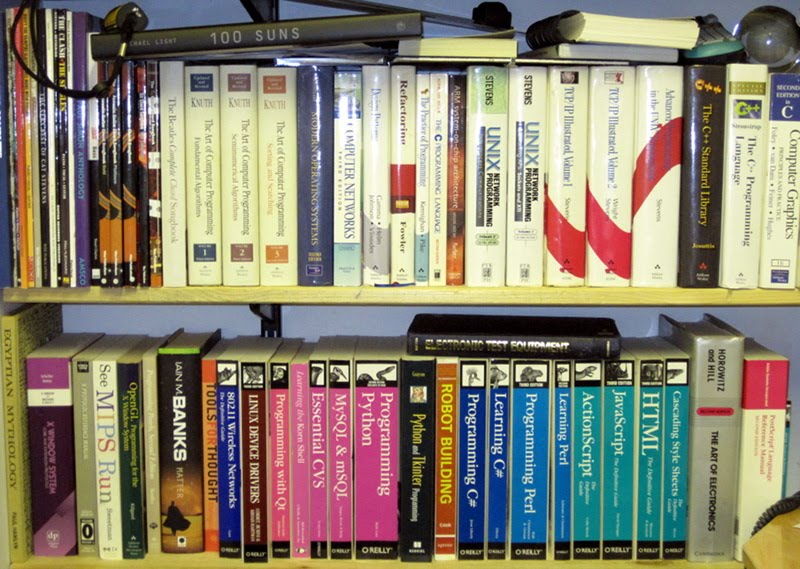
My bookshelf complete with covered kindle
I did look at a huge number of alternatives like the Sony PRS600 and others but they were all more expensive than the 110 for the Kindle and did not have enough features to make a compelling argument for spending more.

Yes it has DRM. Yes it "only" supports PDF, MOBI and mp3. Yes it will not win any style or usability awards. But I went into this eyes open the device is "good enough".

The device lets me read books from a reasonable display. The integration with amazon.com is so seamless it poses a serious danger to my bank account. I should expand on that last point :-) Amazon have got the whole spending money for a book thing executed so well that you do not think twice about a couple of pounds here and there, this soon adds up. I have set myself a rigid budget.

My main complaints are really just niggles:

  • Another different USB connector! Wahh, I thought everyone had agreed on mini USB? seems that I now have to have yet another lead for micro USB

  • The commercial book selection is a bit limited and missing a surprising number of popular titles. Some of this appears to be the publishers and authors simply clinging to their old business model. I fear some of them might not survive and early indications are they are behaving like the music industry did...Guys you are selling an infinite good a scarcity model is going to fail!

  • The price of some of the books is absurd...they are asking hardback prices for the electronic edition! Seriously? how on earth can that possibly be justified? I can see that a hardback book with its print run could cost 5 per physical item (going from hulu print on demand prices as a worst case) plus shipping and stocking fees. So how can you possibly justify charging the same price for a pile of bits where none of that applies? Also the pile of bits cannot be lent or sold, not impressed.

  • eBook formatting is generally dreadful. I do not know who is mastering these books but they need to do a better job. If they tried to pull this in the physical editions they would get a seriously large number of returns.

  • I still have to pay for whispernet delivery fees even though, because its the wi-fi model, I am providing the bandwidth myself. I can see that differentiating between 3G and wi-fi delivery is a bit hard for them though.
However my one and only real complaint with the offering as a whole is the astronomical asking price for the leather cover. The cover is currently 25% of the price of the kindle itself! ( 30 cover 110 kindle) which is just silly. It is a pretty nice cover and the clever clip attachment means it does offer an integrated solution to protecting your kindle, but not 30 nice.

Kindle in a sock cover
So my lovely wife (her kindle was bought with the cover) made me a sock for mine. This is great for casual round the house usage to stop me scuffing the screen but was a bit lightweight for protecting the kindle when out and about.

One day last week I had an idea. I would make my own protective cover by crafting something I had wanted to do for ages. And the (unoriginal I am sure) project of a hollowed out book for housing my kindle was implemented.


My hollowed out book kindle cover
A quick Google later and I had a set of plausible instructions to follow. I used possibly the most out of date book ever (published 1981) on electronic test equipment, partly because it was a ex library sell off book which cost 10pence back in 1995 but mainly because it was the right size to just enclose the kindle without adding to much size.

I learnt a couple of things doing this:
  • Do not let your pva (white) glue mix get too runny, you want it fluid enough to be easily absorbed but not watery - this is important because otherwise the paper absorbs too much water and crinkles
  • Do not use a book where the binding has gone bad already and select a "clean" book. The spine of this book was yellowed and cracking before I started. This means the book spine simply cracks open at the hollowed out bit and it is very obvious.
  • Work out where the "solid" part at the back is going to be and treat that separately so you get a nice solid base at the back of the hole. In mine its not all stuck together and is a bit wavy. Do be sure you left enough depth for the kindle though.
  • Take your time and be careful with the glue, it is amazing how obvious even a simple splash of glue in the wrong place is. Use a small brush for this a paint brush is fast but sloppy.
  • Measure carefully and cut only a few pages at a time, it takes a bit longer but looks much better. Also I did not drill the corners of my hole which means they are a little scruffy.
  • Use the sharpest thinnest knife you can, this really helps. I started with a small stanley knife but switching to my hobby scalpel gave much better results.
  • If you have some, use woodworking clamps to clamp a bit of timber (I had some offcuts of shelving) around the book to compress it while the glue dries. Do not clamp the spine if you can avoid it. This method ensures:
    1. Heavy things do not fall off the book while it dries.
    2. An even strong pressure is applied.
    3. The book does not warp or bend while the glue dries
All in all I kinda like the results and I think I will try again with a more modern book where the spine is not so broken to begin with.

4 November 2010

Jaldhar Vyas: All Hail Aqua Buddha!

My fellow Republicans and I got a nice early Diwali present on Tuesday. ~65 seats in the House ~6 in the senate, ~18 governorships and control of ~20 state legislatures. (Some races haven't been formally called yet.) A few disappointments though. no majority in the Senate and Harry Reid and Barney Frank were not defeated. Still overall its an election to celebrate. Here are a few thoughts. The Election System Is An Embarassment Once again there are several races where the outcome is in doubt because of technical problems with voting. Whatever politics we have, can we agree that it is damn stupid that we still can't get something as simple as counting ballots right? Prediction: The 2012 Republican presidential candidate will come from the Tea Party. While I may be a Republican, I am also a Cosmopolitan East Coast Elitist so the Tea Party didn't move me much. There were a couple of cases (NY and DE atleast) where their candidates were subpar and cost us victory but the best of the new Republicans also came out of this movement. I would rather vote for one of them than Romney, Huckabee, McCain, Gingrich etc. (With the exception of Sarah Palin who is just too polarizing I'm afraid.) The Tea Party itself will subside in a few years as all populist movements do. (Ask the Hope'n'changers.) Young People Are Dumb Part of leftist mythology is the idea that one day "the kids" are going to rise up against the mean old corporate overlords. It ain't going to happen. There was a huge upsurge in first time voters in 2008 but that was because Obama was a novelty act not because they had suddenly discovered the merits of Keynesianism. Now Obama is old and busted so they won't vote anymore. (Not until they have kids and a mortgage sometime in the future.) They'll spend time make cool ironic signs for the Rally to Promote Comedy Central but even the prospect of legalizing pot won't get them to the polling booths in sufficient numbers to defeat the oldies. Why? Because young people are dumb. Prediction: War With Iran If you're President Obama what do you do now? Bipartisanship? Yeah right. Look at what happened to Rep. Cao of Louisiana, the only Republican to vote for Obamacare and one of only two GOP congressmen to lose on Tuesday. Obama actively campaigned for his challenger. Any of the new Republicans who try and compromise with the President will end up under the bus sooner or later as they well know. The President could go full retard with the socialism (progressivism, liberalism whatever. It's all the same.) All his initiatives will be shot down but he can claim to be a martyr to the party of No. (Who will be joined in the Senate by Lieberman and whatever centrist Democrats who are up for reelection in 2012.) But this seems to be the path to a one-term presidency to me. Maybe that's what he wants. He could retire comfortably to the deanship of some Ivy League law school and make a lucrative killing on the rubber chicken circuit. But lets assume he wants to get back in the White House in 2012. One way to get back in touch with the voters is to start getting serious about foreign policy which has either been a joke (Remember the reset button?) a travesty or just copied from the Bush administration. In particular the Obama administration has completely failed in stopping Iran from gaining nuclear technology, sponsoring terrorism in Iraq, Afghanistan and Lebanon, and oppressing its own people. War with Iran would enhance his standing with Conservatives (hey it works for me!) most liberals would go along with it and the extreme Code Pink type loonies can safely be ignored. I say it happens before November 2012.

2 November 2010

Francois Marier: RAID1 alternative for SSD drives

I recently added a solid-state drive to my desktop computer to take advantage of the performance boost rumored to come with these drives. For reliability reasons, I've always tried to use software RAID1 to avoid having to reinstall my machine from backups should a hard drive fail. While this strategy is fairly cheap with regular hard drives, it's not really workable with SSD drives which are still an order of magnitude more expensive.

The strategy I settled on is this one:This setup has the benefit of using a very small SSD to speed up the main partition while keeping all important data on the larger mirrored drives.

Resetting the SSDThe first thing I did, given that I purchased a second-hand drive, was to completely erase the drive and mark all sectors as empty using an ATA secure erase. Because SSDs have a tendency to get slower as data is added to them, it is necessary to clear the drive in a way that will let the controller know that every byte is now free to be used again.

There is a lot of advice on the web on how to do this and many tutorials refer to an old piece of software called Secure Erase. There is a much better solution on Linux: issuing the commands directly using hdparm.

Partitioning the SSDOnce the drive is empty, it's time to create partitions on it. I'm not sure how important it is to align the partitions to the SSD erase block size on newer drives, but I decided to follow Ted Ts'o's instructions anyways.

Another thing I did is leave 20% of the drive unpartitioned. I've often read that SSDs are faster the more free space they have so I figured that limiting myself to 80% of the drive should help the drive maintain its peak performance over time. In fact, I've heard that extra unused unpartitionable space is one of the main differences between the value and extreme series of Intel SSDs. I'd love to see an official confirmation of this from Intel of course!

Keeping the RAID1 array in sync with the SSDOnce I added the solid-state drive to my computer and copied my root partition on it, I adjusted my fstab and grub settings to boot from that drive. I also setup the following cron job (running twice daily) to keep a copy of my root partition on the old RAID1 drives (mounted on /mnt):
nice ionice -c3 rsync -aHx --delete --exclude=/proc/* --exclude=/sys/* --exclude=/tmp/* --exclude=/home/* --exclude=/mnt/* --exclude=/lost+found/* --exclude=/data/* /* /mnt/

Tuning the SSDFinally, after reading this excellent LWN article, I decided to tune the SSD drive (/dev/sda) by adjusting three things:


Is there anything else I should be doing to make sure I get the most out of my SSD?

31 October 2010

Eddy Petrișor: HP All-in-one models - the way to extort money

Dear HP,

I bought a HP Photosmart C5380 All-inOne multifunctional unit. It is supposed to be a printer, a scanner and a copier, being able to print on paper, CDs, DVDs and photopaper.

First of all I dislike the way you force me to buy new ink cartridges even if there is still ink in the current cartride. I hope somebody reverse-engineers as soon as possible your 364/364XL cartridge chips so I can use my printer at a price lower than that necessary for a tank fill for my car!

Second, even if one of my cartridges is missing or defective , the previous one, the empty one which the current one replaced, is definetly OK, so fuck you and your money extrosion schemes.

Third, and the reason for this rant, is that even if ALL the cartridges are empty, I should be able TO USE THE FUCKING SCANNER FUNCTION, since it doesn't depend on the fucking supposedly missing ink! But I can't because you decided that scanning probably needs ink, otherwise I don't understand why would you block the functioning of the whole unit because of some presumed missing ink issue.

I should probably return this device and ask my money back because of this and when they deny this to make a huge scandal about it.

So, HP, FUCK YOU, you well dressed money extortionists!

27 October 2010

Joey Hess: three thousand lines of Haskell

Three thousand lines of code is not a huge program, but it is enough to get a pretty good feel for a language. Now that I've completed my first real Haskell program I feel that I've gotten over several of the humps in the learning curve and am starting to get a good feel for it. Actually, I've written closer to five thousand lines, since there were several big refactorings. One was when I stopped manually threading my program state around and added a StateT monad. I did know from the beginning I would need one, but it seemed easier and a better learning exercise to let the program start out with a vesigial tail and gills before growing up into a modern Haskell program. (I suppose it's still written in baby-Haskell, really..) Another refactoring came when I realized I needed to use a custom data type, not String, to represent keys. That was a great experience in type-based refactoring. Being able to keep typing ':make' and landing on the next bit of code that needed fixing was great, and simply adding that one type exposed several non-obvious bugs. I found myself writing code that is much more solid and reusable than normally comes easily. And yet it's also very malleable. Actually, pulling out better data types and abstractions can get a bit addictive. When I realized that I had a similar three-stage control flow being used for each of git-annex's subcommands, and factored that control flow out into a function that used the 3 data types below, I felt I'd gone down that rabbit hole perhaps far enough for now.

type SubCmdStart = String -> Annex (Maybe SubCmdPerform)
type SubCmdPerform = Annex (Maybe SubCmdCleanup)
type SubCmdCleanup = Annex Bool
(That will allow for some nice parallelism later though, and removed dozens of lines of code, so was worth it.) Since git-annex is a very Real World Haskell type program, there is a lot of impure code in it. I could probably do better at factoring out more pure code. I count 117 impure functions, and only 37 pure. Anyhow, from my perspective of a long-time perl programmer, some other random impressions..

26 October 2010

David Welton: Kindle?

I'm thinking about getting a Kindle, and I thought I'd write down some thoughts, even if they're a bit jumbled, and invite commentary. Good: One thing I really like, living here in Italy, is that I would be able to get English language books instantaniously, and not pay shipping or import duties on them. Whatever disadvantages there may be, that is a huge advantage. Closely tied to that: if we ever move back to the US, shipping all our books will be very expensive. Having some of them in an electronic format would lighten that load considerably. It's fairly cheap. At $180, it's not something I'd want to treat carelessly, but it's significantly less expensive than various existing tables. Long battery life means it's not something you have to worry much about. E-ink looks like it's easier on the eyes than LCD screens. I'm not sure, but also its slow update speed might be a "feature not a bug" in the sense that you're not so easily distracted by the internet being just one click away. Bad: I love having real, physical books in my house. I grew up in a house full of books, and I want the same thing for my daughter. I like being able ot look through them, pick one up, and read about something. Real books are very convenient, as long as you're not lugging around hundreds of them. I like not having to worry too much about dropping them, about getting a bit of water on one or that sort of thing. You can cart them around in a backpack with little worry, take them to the beach, and so on. As far as I can tell, Knuth's books are not available for, nor would appear like they do on paper. That's the golden standard for me: once "The Art of Computer Programming" looks good on an e-reader, it will be really and truly ready. We're not there yet. It's not general purpose. Like I said above, maybe this is good for reading, but there are also times when it'd be nice to have a general purpose device, with email, maps, applications, and so on. A while back, Amazon announced some sort of beta program for a kindle SDK. I haven't heard much of anything since. So it looks like it's not really possible to code for it, which is a bit disappointing. I like to have that option available, even if I don't always exercise it. Unknown: The pricing: sometimes Kindle versions are cheaper (especially, in my case, considering shipping, and, potentially, import duties), but sometimes they aren't, which seems a bit unfair, given that you cannot sell the book if you don't like it. I'm not sure how it would work out for me in the aggregate. Digital Rights Management, or DRM, means you can't, say, sell someone a "used" ebook. This is, in some ways, understandeable, because it's not like an e-book degrades with time as a physical one might. Were it possible to sell on your old books, that might radically change the market. I could see that having both good consequences (cheaper books), but also negative ones for authors (less money). I suppose this topic merits a post or two, or even an entire book of its own, because it's a complicated subject without, in my opinion, "easy" answers. Suffice it to say, though, that there are some drawbacks, but I suppose it's also nice that Amazon "knows" which books I have, so even if I switch to a different reader, I still have my books. And it's good that authors can get paid to work on a book. Not having actually bought it yet, I have no idea how it actually 'feels' to read a book with one. I love curling up with a good book, something I certainly can't do with my laptop. The Kindle looks light and small enough that it could work, but maybe it's just too high tech and sleek to provide that same comfortable coziness. Or maybe I'm just a luddite where books are concerned?
Do you have one? Do you use it? For all kinds of books or just certain kinds (technical books, cheap 'fun' reads, whatever...)? What's the experience like?

25 October 2010

Bastian Venthur: Google Summer of Code 2010 Mentor Summit Report

As requested by our beloved leader, here s my report on this year s Google Summer of Code 2010 Mentor Summit. The summit took place in Google s HQ in Mountain View, California and was what they call an unconference . In the beginning of the unconference the attendees had 10 minutes to write down proposals for a session and put them on a huge white board. After that, every attendee voted for the sessions in which he was interested by putting a small sticker on the proposal. This way we could evaluate the interest on a specific topic and schedule the sessions to the differently sized rooms according to their interest. Neat trick! The the rest of the summit was basically like a conference: we had 11 tracks filled with 5-6 sessions per day, which ran from 10:00 to 17:30. Google provided shuttle buses from our wonderful hotel to the googleplex in the morning and back to the hotel in the evening. The hotel was very nice, it was equipped a swimming pool and a hot tub (both outside), which was extensively used in the morning and of course during the night. Speaking of the night, Google sponsored Thai food in the first night and ye olde Pizza and Beer in the second. Some of the attendees brought their keyboard, guitar, bass and electric clarinet, and where playing some sweet ass Jazz and Pop (on special request ). The sessions itself where not quite what I expected. I expected some proper talks about specific topics, but it was more like and open discussion round where everyone was invited to participate. For some topics it worked pretty well, for others not. It was still totally worth coming, since you meet a lot of like minded people and there is plenty stuff to talk about. Of course I was very exited to see the googleplex. And the rumors are true: the googleplex seems to be a very nice place to work. They provide free breakfast, lunch and dinner for their employees. They have micro kitchens everywhere where you can grab free snacks and beverages. There are lot s of toys lying around, they have bicycles everywhere on the campus which you can just grab to move from one building to another. There is a dinosaur on the yard, a spaceship over the stairwell and lots of other things (testing on the toilet, anyone?), and we have probably only seen a small fraction, since we were not allowed to leave the restricted areas for the unconference. Despite the horrible yet lag (leaving Germany on Friday morning and leaving San Francisco on Sunday night), I m glad I was able to attend to the summit and can only recommend aspiring mentors and students to participate to the next summer of code!

Evgeni Golov: RC bugs 2010/42

gregoa writes he squashed only 5 bugs in two weeks, and I think he still deserves a huge kudos too, as he squashes them for a long time now :)
And while at it, kudos to everyone who does not post their stats to planet, actually find those bugs, etc etc. Thanks that we have such a community!Now to the usual list of (pseudo) squashed bugs:

Gunnar Wolf: Biking without a set destination: Bas lica de Guadalupe

Sunday. A good day to take some time to myself, and get some much needed excercise. And the pseudo-meditation that comes with it: That's one of the factors I love the most about cycling. It's possibly my favorite way of just idling, of allowing for the time to pass without me noticing, just watching the movie of life, watching the world go around me with very little effort. I just love cycling. I have posted here several mentions of the Ciclot n: Every month, the last Sunday, our city government closes a ~32Km circuit to make it for cycling (and skating, and walking, and jogging, and other human-powered locomotion) use. Whenever I am in the city and have the possibility, I do the Ciclot n. Two months ago, I even did it twice in a row, for a total of almost 70Km. But this Sunday was not the last Sunday of the month! So, why am I writing this? Well, because when I left home today at ~10AM, I thought it was. Only when I reached Circuito Interior and had a this is full of cars moment, I remembered October has 31 days. And next Sunday I'll very probably be in Oaxaca city (for the Hackmitin 04h4ck4 2010). And I didn't want to miss the fun of a nice Sunday ride! I don't care if streets are closed just for bikes I am used to riding in traffic. Of course, this meant I would not take the central lanes in Circuito Interior on the way back, taking the ~10 bridges (which are quite tiring, to be honest!). It also meant I was free to make my own route. So, I thought, a nice small ~20-30Km ride will do. I'll just get to Eje 2 Sur or so, and back by another route (i.e. Plutarco E. Calles or so). But as I got closer to Reforma, I realized that every Sunday (independent of a Ciclot n), Reforma is closed for the "Paseos Dominicales" - Shorter than a Ciclot n, but still a nice way to share the streets with other cyclists. So I headed for Reforma. Part of Reforma (from the ngel roundabout westward) was closed due to a precisely cyclist race. But from there eastwards we had the street for us. Good, lets head downtown. The surprise came when I saw that it was not only towards downtown, but passing Av. Ju rez, Reforma continued to be closed just for cyclist use northwards. Great! Lets see how far does it go. The first surprise there: A couple of days ago, it was the "Noche de los Alebrijes". The alebrijes are a beautiful and very elaborated Mexican typical handicraft, depicting psychodelic dragons or dragonic representations of animals. Of course, alebrijes are usually ~30cm long... But here we had huge ones! And verrrry elaborated! How much so? You tell me. And as I started off... A nice thing about cycling is that you get to meditate. My body continued cycling, taking care not to run over the kids that are not so proficient, stoping at each red light... At some point, my mind entered back the body, and I realized we were passing by Tlatelolco (ok, to be honest, the picture was taken when crossing southwards, on my way back), about to cross Circuito Interior on the North, in that symbolically very strange place where Paseo de la Reforma (a long, beautiful avenue named after the war that marked the complete separation between church and Mexican state, in 1860) becomes two streets... Calzada de los Misterios and Calzada de Guadalupe. And, yes, it is among the greatest peregrination routes in the world. On December 12, the Holiday of the Guadalupe Virgin, up to 7 million people go visit her temple. And also around here, when my mind was busy inside my body, I noticed a pair from the Un paseo a ciegas (roughly translated, a blind ride) program was riding just by me. I knew about this program, but had never seen them before So I took the opportunity to get to know this program. Basically: Two people ride a tandem bike. The one in front, as always, drives and steers. The one in the back is a blind person, who gets the amazing sensation of freedom and enjoyment that only a bike gives you. Un paseo a ciegas is held every Sunday at 9AM except for the last Sunday every month. And I definitively want to be part of it! They told me the program has been adopted as well in Puebla, and if I recall correctly, it will soon be started in Quer taro and Guadalajara. Anyway, by then I realized the ride was probably going to reach the Bas lica, a very impressive church I had just visited for the first time ever a couple of weeks ago. And yes we went all the way up Guadalupe until the place where the street gets impossible to bike on, then left along a small street, and back to the South by Misterios. Then, all the way along Reforma again, saying goodbye to Cuitlahuac, Jos de San Mart n, Sim n Bol var, El Caballito, Cristobal Col n, Cuauhtemoc, La Palmera, El ngel... And back home. Of course, not without the sight of some bizarre signs we enjoy so much to find, point at and laugh. Have I ever told you, my nameless reader, that I love this city? I love getting surprised with so many great things. I love the distances I can safely ride on my bike without ever being far from a bike repair shop (which are only needed when they are far away). I love being surrounded by people breathing their freedom to take the streets. I love the safety of our wide, long streets (and no, I'm not joking here Mexico City is among the safest places for cyclists I have been to). I love its weather, that allows me to go out and enjoy the street at any time of year. And I love biking in it, one of the best ways to get to know so many bits of the city I would have never ventured into otherwise.

19 October 2010

Mike Hommey: Huge rotational disk(s) + dpkg = disaster

Since a few versions now, dpkg has been made safer in that it makes sure everything is written to disk after unpacking a package. It does so with sync(), which means all kernel buffer caches are being flushed. Between every package install. All kernel buffer caches. Imagine what it does when you have two 2TB hard drives (though they are far from being full). Update: The use of btrfs might not be helping either. I have 2 concurrent pbuilder instances that have been installing iceweasel build dependencies for more than 40 minutes, and still not finished yet. I don t expect the builds themselves, including test suites, to take more than 20 minutes on that machine I should really start using eatmydata Update: with eatmydata, the package installation is almost instantaneous Update 2: It might just be btrfs. And the best part yet is that since sync() is global, even when running pbuilder over, say, tmpfs, it doesn t change a damn thing.

Next.

Previous.


