Search Results: "cts"

23 February 2022

Jonathan McDowell: Upgrading my home internet; a story of yak shaving

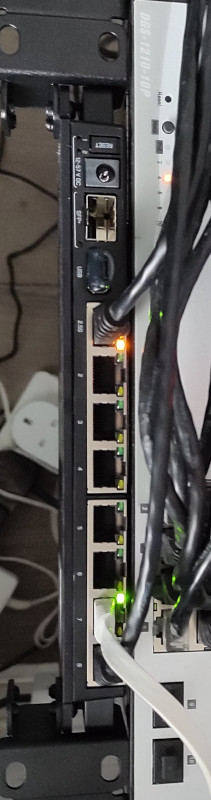
RB5009 This has ended up longer than I expected. I ll write up posts about some of the individual steps with some more details at some point, but this is an overview of the yak shaving I engaged in. The TL;DR is:

The desire for a faster connection When I migrated my home connection to FTTP I kept the same 80M/20M profile I d had on FTTC. I didn t have a pressing need for faster, and I saved money because I was no longer paying for the phone line portion. I wanted more, but at the time I think the only option was for a 160M/30M profile instead and I didn t need it and it wasn t enough better to convince me. Time passed and BT rolled out their GigE (really 900M) download option. And again, I didn t need it, but I wanted it. My provider, Aquiss, initially didn t offer this (I think they had up to 330M download options available by this point). So I stayed on 80M/20M. And the only time I really wanted it to be faster was when pushing off-site backups to rsync.net. Of course, we ve had the pandemic, and that s involved 2 adults working from home with plenty of video calls throughout the day. The 80M/20M connection has proved rock solid for this, so again, I didn t feel an upgrade was justified. We got a 4K capable TV last year and while the bandwidth usage for 4K streaming is noticeably higher, again the connection can handle it no problem. At some point last year I noticed Aquiss had added speed options all the way to 900M down. At the end of the year I accepted a new role, which is fully remote, so I had a bit of an acceptance about the fact that I wasn t going back into an office any time soon. The combination (and the desire for the increased upload speed) finally allowed me to justify the upgrade to myself.

Testing the current setup for bottlenecks The first thing to do was see whether my internal network could cope with an upgrade. I m mostly running Cat6 GigE so I wasn t worried about that side of things. However I m using an RB3011 as my core router, and while it has some coprocessors for routing acceleration they re not supported under mainline Linux (and unlikely to be any time soon). So I had to benchmark what it was capable of routing. I run a handful of VLANs within my home network, with stateful firewalling between them, so I felt that would be a good approximation of the maximum speed to the outside world I might be able to get if I had the external connection upgraded. I went for the easy approach and fired up iPerf3 on 2 hosts, both connected via ethernet but on separate networks, so routed through the RB3011. That resulted in slightly more than a 300Mb/s throughput. Ok. I confirmed that I could get 900Mb/s+ on 2 hosts both on the same network, just to be sure there wasn t some other issue I was missing. Nope, so unsurprisingly the router was the bottleneck. So. To upgrade my internet speed I need to upgrade my router. I could just buy something off the shelf, but I like being able to run Debian (or OpenWRT) on the router rather than some horrible vendor firmware. Lucky MikroTik launched the RB5009 towards the end of last year. RouterOS is probably more than capable, but what really interested me was the fact it s an ARM64 platform based on an Armada 7040, which is pretty well supported in mainline kernels already. There s a 10G connection from the internal switch to the CPU, as well as a 2.5Gb/s ethernet port and a 10G SFP+ cage. All good stuff. I ordered one just before the New Year. Thankfully the OpenWRT folk had done all of the hard work on getting a mainline kernel booting on the device; Sergey Sergeev and Robert Marko in particular fighting RouterBoot and producing a suitable device tree file to get everything up and running. I ended up soldering a serial console connection up to aid debugging, and lightly patching Rob s u-boot to fix the incorrect RAM size reported by RouterBoot. A few kernel tweaks were necessary to make the networking entirely happy and at that point it was time to think about actually doing a replacement.

Upgrading to Debian 11 (bullseye) My RB3011 is currently running Debian 10 (buster); an upgrade has been on my todo list, but with the impending replacement I decided I d hold off and create a new Debian 11 (bullseye) image for the RB5009. Additionally, I don t actually run off the internal NAND in the RB3011; I have a USB flash drive for the rootfs and just the kernel booting off internal NAND. Originally this was for ease of testing, then a combination of needing to figure out a good read-only root solution and a small enough image to fit in the 120M available. For the upgrade I decided to finally look at these pieces. I ve ended up with a script that will build me a squashfs image, and the initial rootfs takes care of mounting this and then a tmpfs as an overlay fs. That means I can easily see what pieces are being written to. The RB5009 has a total of 1G NAND so I m not as space constrained, but the squashfs ends up under 50M. I ve added some additional pieces to allow me to pre-populate the overlay fs with updates rather than always needing to rebuild the squashfs image. With that done I decided to try it out on the RB3011; I tweaked the build script to be able to build for armhf (the RB3011) or arm64 (the RB5009) and to deal with some slight differences in configuration between the two (e.g. interface naming). The idea here was to ensure I d got all the appropriate configuration sorted for the RB5009, in the known-good existing environment. Everything is still on a USB stick at this stage and the new device has an armhf busybox root meaning it can be used on either device, and the init script detects the architecture to select the appropriate squashfs to mount.

A problem with ESP8266 home automation devices Everything seemed to work fine - a few niggles with the watchdog, which is overly sensitive on the RB3011, but I got those sorted (and the build script updated) and the device came up and successfully did the PPPoE dance to bring up external connectivity. And then I noticed that my home automation devices were having problems connecting to the mosquitto MQTT server. It turned out it was only the ESP8266 based devices that were failing, and examining the serial debug output on one of my test devices revealed it was hitting an out of memory issue (displaying E:M 280) when establishing the TLS MQTT connection. I rolled back to the Debian 10 image and set about creating a test environment to look at the ESP8266 issues. My first action was to try and reduce my RAM footprint to try and ensure there was enough spare to establish the connection. I moved a few functions that were still sitting in IRAM into flash. I cleaned up a couple of buffers that are on the stack to be more correctly sized. I tried my new image, and I didn t get the memory issue. Instead I progressed a bit further and got a watchdog reset. Doh! It was obviously something related to the TLS connection, but I couldn t easily see what the difference was; the same x509 cert was in use, it looked like the initial handshake was the same (and trying with openssl s_client looked pretty similar too). I set about instrumenting the ancient Mbed TLS used in the Espressif SDK and discovered that whatever had changed between buster + bullseye meant the EPS8266 was now trying a TLS-DHE-RSA-WITH-AES-256-CBC-SHA256 handshake instead of a TLS-RSA-WITH-AES-256-CBC-SHA256 handshake and that was causing enough extra CPU usage that it couldn t complete in time and the watchdog kicked in. So I commented out MBEDTLS_KEY_EXCHANGE_DHE_RSA_ENABLED in the config_esp.h for mbedtls and rebuilt things. Hacky, but I ll go back to trying to improve this generally at some point.

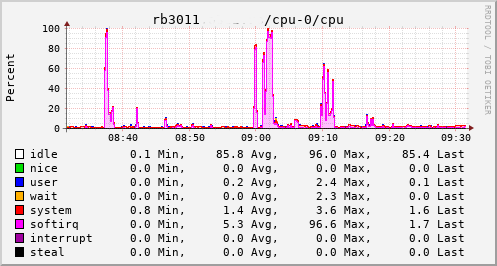
A detour into interrupt load Now, my testing of the RB3011 image is generally done at weekends, when I have enough time to tear down and rebuild the connection rather than doing it in the evening and having limited time to get things working again in time for work in the morning. So at the point I had an image ready to go I pulled the trigger on the line upgrade. I went with the 500M/75M option rather than the full 900M - I suspect I d have difficulty actually getting that most of the time and 75M of upload bandwidth seems fairly substantial for now. It only took a couple of days from the order to the point the line was regraded (which involved no real downtime - just a reconnection in the night). Of course this happened just after the weekend I d discovered the ESP8266 issue. collectd CPU usage for RB3011 This provided an opportunity to see just what the RB3011 could actually manage. In the configuration I had it turned out to be not much more than the 80Mb/s speeds I had previously seen. The upload jumped from a solid 20Mb/s to 75Mb/s, so I knew the regrade had actually happened. Looking at CPU utilisation clearly showed the problem; softirqs were using almost 100% of a CPU core. Now, the way the hardware is setup on the RB3011 is that there are two separate 5 port switches, each connected back to the CPU via a separate GigE interface. For various reasons I had everything on a single switch, which meant that all traffic was boomeranging in and out of the same CPU interface. The IPQ8064 has dual cores, so I thought I d try moving the external connection to the other switch. That puts it on its own GigE CPU interface, which then allows binding the interrupts to a different CPU core. That helps; throughput to the outside world hits 140Mb/s+. Still a long way from the expected max, but proof we just need more grunt.
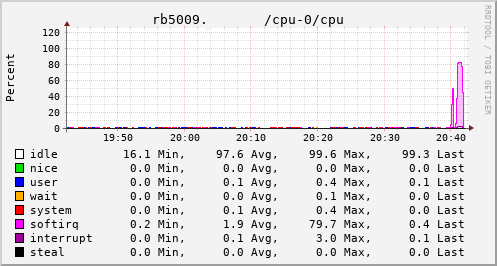
Success collectd CPU usage for RB5009 Which brings us to this past weekend, when, having worked out all the other bits, I tried the squashfs root image again on the RB3011. Success! The home automation bits connected to it, the link to the outside world came up, everything seemed happy. So I double checked my bootloader bits on the RB5009, brought it down to the comms room and plugged it in instead. And, modulo my failing to update the nftables config to allow it to do forwarding, it all came up ok. Some testing with iperf3 internally got a nice 912Mb/s sustained between subnets, and some less scientific testing with wget + speedtest-cli saw speeds of over 460Mb/s to the outside world. Time from ordering the router until it was in service? Just under 8 weeks
21 February 2022

Raphaël Hertzog: Freexian s report about Debian Long Term Support, January 2022

A Debian LTS logo
Every month we review the work funded by Freexian s Debian LTS offering. Please find the report for January below. Debian project funding We continue to looking forward to hearing about Debian project proposals from various Debian stakeholders. This month has seen work on a survey that will go out to Debian Developers to gather feedback on what they think should be the priorities for funding in the project. Learn more about the rationale behind this initiative in this article. Debian LTS contributors In January, 13 contributors were paid to work on Debian LTS, their reports are available below. If you re interested in participating in the LTS or ELTS teams, we welcome participation from the Debian community. Simply get in touch with Jeremiah or Rapha l. Evolution of the situation In January we released 34 DLAs. The security tracker currently lists 39 packages with a known CVE and the dla-needed.txt file has 20 packages still needing an update. Thanks to our sponsors Sponsors that joined recently are in bold.

19 February 2022

Shirish Agarwal: The King of Torts John Grisham

John Grisham The King of Torts Lots of things have been happening and I have been unable to be on top of things. There are so many things that happen and keep on happening and a lot of it is just not in control. For those who are watching Brexit, India is going through the same/similar phenomena just without Brexit. I would not like to delve much into Indian happenings as there is no sweet story to tell. Mum is in hospital (diabetic foot) so a lot of time to read books. So I have been making use of the time and at the same time learning or making connections from what I know of the history of the world which goes on enriching what I read all the time. For e.g. in this book, opens up with people who are on Crack. Now while the book is set in 2003, it is still relevant today for a lot of things. There have been rumors and whatnot that the President of the United States, Ronald Reagan supplied a lot of cocaine to black folks in the early 1980s. While that has never been proved, it has been proved somewhat that the CIA and even people in the state department were part of providing crack cocaine to African Americans (as they refer to blacks) in those days. Whether this was because of black power rising or non-profits like ACLU or other organizations is beyond me. I had also read that the GOP (Republicans/Grand Old Party) in the 1970s itself when computers became fast and could do a lot of processing, came to know if education would be as it is, then soon they would no voters. hence they decided to defund education in America, the end result being massive education loans to prospective students and perhaps partly the reason why China produces more than enough STEM graduates than the total number of Americans who become graduates. It is a shame nonetheless, that education in the U.S. is never top  . This is somewhat from a Republican perspective. That is also the reason they are much anti-science.

Tort Cases India doesn t have either class-action suits or tort cases. But before we go headlong, this is what tort means. The book however is not about general tort cases but medical tort cases. The idea is that medical companies often produce medicines claiming they solve x or y issues but more often than not they take short-cuts to get approval from FDA and other regulators. And sooner or later those medicines can and do have harmful effects on the body, sometimes resulting in death. One of the more interesting articles that I read and probably also shared is the work done by Mr. Rob Bilott. While it is a typical David and Goliath story once you read the book, you realize that there are and were many difficulties in Mr. Rob s path that are never fully appreciated or even worked out. The biggest issue is the 8 years that he paid out of his own pocket to get the hundreds and thousands of people tested. How many of us would do that? And this is before proving causation of any disease, illness or anything to a particular environment, pollution etc. is hard even then and even now. Whatever money the victims receive afterward and whatever went to Mr. Rob Bilott would never compensate for the stress faced by him. And lawyers have to be careful, if they ask too little, they are not hurting the company and there is no change in its behavior. If they ask too much, the company can declare Chapter 11, bankruptcy so they have to keep the balance. There is also a lot of greed shown by the tort lawyer and while at the end he does tell about a company s nefarious activities that he suspects he could share his opinion only after giving up his law career. There is and was talk of tort-reform in the book but as can be seen if you reform tort there is just no way to punish such companies but that is in the U.S. There is also some observations that I have shared over the years, for e.g. Europe bans far more drugs than the U.S. does. A major part of it is perhaps due to the fact that Europe has 26/27 independent medical regulators and one country bans medicine for one or the other reason, the rest of Europe also bans the same. In the U.S. it is only the FDA. I have read they have had both funding and staffing issues for years and this is from before the pandemic. The Indian regulators are much worse. One could follow Priyanka Pulla s articles in Mint and others where she has shared how the regulator is corrupt and lazy and a combo of both. And all of this is besides how doctors are corrupted in India by marketing executives of pharma companies. That would be a whole article in itself. In short, when you read this book, there are so many thoughts that come alive when you are reading the book. The sad part is the book doesn t offer any solutions at all. John Grisham s books are usually legal thrillers and courtroom exchanges, this one though is and was very different. This one sadly doesn t take one to any conclusion apart from the fact that we live in an imperfect world and there don t seem to be any solutions. This was even shared by Rep. Katie Porter in her pinned tweet. The Abbvie s of the world will continue to take common people like you and me for a ride.

18 February 2022

Dirk Eddelbuettel: RcppSimdJson 0.1.7 on CRAN: Maintenance

The RcppSimdJson package was updated to release 0.1.7 today. CRAN had sent a note overnight that it triggered LENGTH_1 error (where boolean comparisons happen with longer vectors). That may be debatable in the two cases flagged if one looks at the commit but life being too short to debate this so we just fixed it. The email came in at 04:50h-ish when I was sound asleep, but four hours later the fixed version was on CRAN thanks to the automated processing: RcppSimdJson wraps the fantastic and genuinely impressive simdjson library by Daniel Lemire and collaborators. Via very clever algorithmic engineering to obtain largely branch-free code, coupled with modern C++ and newer compiler instructions, it results in parsing gigabytes of JSON parsed per second which is quite mindboggling. The best-case performance is faster than CPU speed as use of parallel SIMD instructions and careful branch avoidance can lead to less than one cpu cycle per byte parsed; see the video of the talk by Daniel Lemire at QCon (also voted best talk). The very short NEWS entry for this release follows.

Changes in version 0.1.7 (2022-02-18)
  • Two URLs were updated in 'README.md', and Travis artifacts and badges have been removed (Dirk).
  • One unit test file was updated to not trigger a 'LENGTH_1' warning (Dirk closing #76).

Courtesy of my CRANberries, there is also a diffstat report for this release. For questions, suggestions, or issues please use the issue tracker at the GitHub repo. If you like this or other open-source work I do, you can now sponsor me at GitHub.

This post by Dirk Eddelbuettel originated on his Thinking inside the box blog. Please report excessive re-aggregation in third-party for-profit settings.

16 February 2022

Robert McQueen: Forward the Foundation

Earlier this week, Neil McGovern announced that he is due to be stepping down as the Executive Director as the GNOME Foundation later this year. As the President of the board and Neil s effective manager together with the Executive Committee, I wanted to take a moment to reflect on his achievements in the past 5 years and explain a little about what the next steps would be. Since joining in 2017, Neil has overseen a productive period of growth and maturity for the Foundation, increasing our influence both within the GNOME project and the wider Free and Open Source Software community. Here s a few highlights of what he s achieved together with the Foundation team and the community: Recognizing and appreciating the amazing progress that GNOME has made with Neil s support, the search for a new Executive Director provides the opportunity for the Foundation board to set the agenda and next high-level goals we d like to achieve together with our new Executive Director. In terms of the desktop, applications, technology, design and development processes, whilst there are always improvements to be made, the board s general feeling is that thanks to the work of our amazing community of contributors, GNOME is doing very well in terms of what we produce and publish. Recent desktop releases have looked great, highly polished and well-received, and the application ecosystem is growing and improving through new developers and applications bringing great energy at the moment. From here, our largest opportunity in terms of growing the community and our user base is being able to articulate the benefits of what we ve produced to a wider public audience, and deliver impact which allows us to secure and grow new and sustainable sources of funding. For individuals, we are able to offer an exceedingly high quality desktop experience and a broad range of powerful applications which are affordable to all, backed by a nonprofit which can be trusted to look after your data, digital security and your best interests as an individual. From the perspective of being a public charity in the US, we also have the opportunity to establish programs that draw upon our community, technology and products to deliver impact such as developing employable skills, incubating new Open Source contributors, learning to program and more. For our next Executive Director, we will be looking for an individual with existing experience in that nonprofit landscape, ideally with prior experience establishing and raising funds for programs that deliver impact through technology, and appreciation for the values that bring people to Free, Open Source and other Open Culture organizations. Working closely with the existing members, contributors, volunteers and whole GNOME community, and managing our relationships with the Advisory Board and other key partners, we hope to find a candidate that can build public awareness and help people learn about, use and benefit from what GNOME has built over the past two decades. Neil has agreed to stay in his position for a 6 month transition period, during which he will support the board in our search for a new Executive Director and support a smooth hand-over. Over the coming weeks we will publish the job description for the new ED, and establish a search committee who will be responsible for sourcing and interviewing candidates to make a recommendation to the board for Neil s successor a hard act to follow! I m confident the community will join me and the board in personally thanking Neil for his 5 years of dedicated service in support of GNOME and the Foundation. Should you have any queries regarding the process, or offers of assistance in the coming hiring process, please don t hesitate to join the discussion or reach out directly to the board.

13 February 2022

Gunnar Wolf: Got to boot a RPi Zero 2 W with Debian

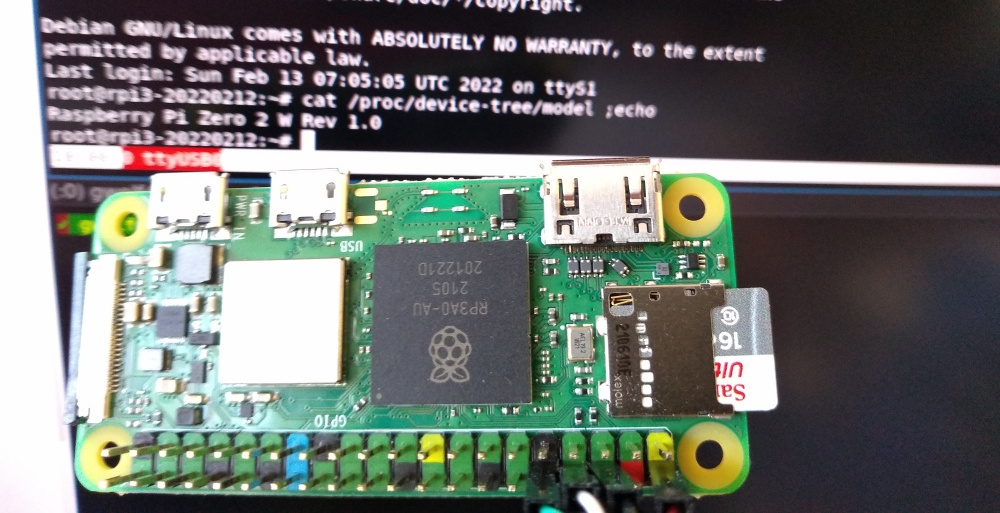
About a month ago, I got tired of waiting for the newest member of the Raspberry product lineup to be sold in Mexico, and I bought it from a Chinese reseller through a big online shopping platform. I paid quite a bit of premium (~US$85 instead of the advertised US$15), and got it delivered ten days later Anyway, it s known this machine does not yet boot mainline Linux. The vast majority of ARM systems require the bootloader to load a Device Tree file, presenting the hardware characteristics map. And while the RPi Zero 2 W (hey what an awful and confusing naming scheme they chose!) is mostly similar to a RPi3B+, it is not quite the same thing. A kernel with RPi3B+ s device tree will refuse to boot. Anyway, I started digging, and found that some days ago Stephan Wahren sent a patch to the linux-arm-kernel mailing list with a matching device tree. Read the patch! It s quite simple to read (what is harder is to know where each declaration should go, if you want to write your own, of course). It basically includes all basic details for the main chip in the RPi3 family (BCM2837), pulls in also the declarations from the BCM2836 present in the RPi2, and adds the necessary bits for the USB OTG connection and the WiFi and Bluetooth declarations. Registers the model name as Raspberry Pi Zero 2 W, which you can easily see in the following photo, informs the kernel it has 512MB RAM, and Well, really, it s an easy device tree to read, don t be shy! So, I booted my RPi 3B+ with a freshly downloaded Bookworm image, installed and unpacked linux-source-5.15, applied Stephan s patch, and added the following for the DTB to be generated in the arm64 tree as well:
--- /dev/null   2022-01-26 23:35:40.747999998 +0000
+++ arch/arm64/boot/dts/broadcom/bcm2837-rpi-zero-2-w.dts       2022-02-13 06:28:29.968429953 +0000
@@ -0,0 +1 @@
+#include "arm/bcm2837-rpi-zero-2-w.dts"
Then, ran a simple make dtbs, and Failed, because bcm283x-rpi-wifi-bt.dtsi is not yet in the kernel . OK, no worries: Getting wireless to work is a later step. I commented out the lines causing conflict (10, 33-35, 134-136), and:
root@rpi3-20220212:/usr/src/linux-source-5.15# make dtbs
  DTC     arch/arm64/boot/dts/broadcom/bcm2837-rpi-zero-2-w.dtb
Great! Just copied over that generated file to /boot/firmware/, moved the SD over to my RPiZ2W, and behold! It boots! When I bragged about it in #debian-raspberrypi, steev suggested me to pull in the WiFi patch, that has also been submitted (but not yet accepted) for kernel inclusion. I did so, uncommented the lines I modified, and built again. It builds correctly, and again copied the DTB over. It still does not find the WiFi; dmesg still complains about a missing bit of firmware (failed to load brcm/brcmfmac43430b0-sdio.raspberrypi,model-zero-2-w.bin). Steev pointed out it can be downloaded from RPi Distro s GitHub page, but I called it a night and didn t pursue it any further ;-) So I understand this post is still a far cry from saying our images properly boot under a RPi 0 2 W , but we will get there

7 February 2022

Russ Allbery: Review: Embers of War

Review: Embers of War, by Gareth L. Powell
Series: Embers of War #1
Publisher: Titan Books
Copyright: February 2018
ISBN: 1-78565-519-1
Format: Kindle
Pages: 312
The military leadership of the Outward faction of humanity was meeting on the forest world of Pelapatarn, creating an opportunity for the Conglomeration to win the war at a stroke. Resistance was supposed to be minimal, since the Outward had attempted to keep the conference secret rather than massing forces to protect it. But the Outward resistance was stronger than expected, and Captain Deal's forces would not be able to locate and assassinate the Outward leadership before they could escape. She therefore followed orders from above her and ordered the four incoming Carnivore heavy cruisers to jump past the space battle and bomb the planet. The entire planet. The Carnivores' nuclear and antimatter weaponry reduced the billion-year-old sentient jungle of Pelapatarn to ash. Three years later, Sal Konstanz is a ship captain for the House of Reclamation, a strictly neutral search and rescue force modeled after a long-vanished alien fleet that prioritizes preservation of life above all else. Anyone can join Reclamation, provided that they renounce their previous alliances and devote themselves to the Reclamation cause. Sal and her crew member Alva Clay were Outward. The ship medic was Conglomeration. So was the ship: the Trouble Dog, a sentient AI heavy cruiser built to carry an arsenal of weapons and three hundred crew, and now carrying three humans and a Druff mechanic. More precisely, the Trouble Dog was one of the four Carnivores that destroyed Pelapatarn. Meanwhile, Ona Sudak, a popular war poet, is a passenger on a luxury cruise on the liner Geest van Amsterdam, which is making an unscheduled stop in the star system known as the Gallery. The Gallery is the home of the Objects: seven planets that, ten thousand years earlier, were carved by unknown aliens into immense sculptures for unknown reasons. The Objects appear to be both harmless and mysterious, making them an irresistible tourist attraction for the liner passengers. The Gallery is in disputed space, but no one was expecting serious trouble. They certainly weren't expecting the Geest van Amsterdam to be attacked and brought down on the Object known as the Brain, killing nearly everyone aboard. The Trouble Dog is the closest rescue ship. This book was... fine. It's a perfectly serviceable science fiction novel that didn't stand out for me, which I think says more about the current excellent state of the science fiction field than about this book. When I was a teenager reading Asimov, Niven, and Heinlein, I would have devoured this. It compares favorably to minor Niven or Heinlein (The Integral Trees, for example, or Double Star), but the bar for excellent science fiction is just so much higher now. The best character in this book (and the reason why I read it) is the Trouble Dog. I love science fiction about intelligent space ships, and she did not disappoint. The AI ships in this book are partly made from human and dog neurons, so their viewpoint is mostly human but with some interesting minor variations. And the Trouble Dog would be a great character even if she weren't an intelligent ship: ethical, aggressive, daring, and introspective, with a nuanced relationship with her human crew. Unfortunately, Embers of War has four other viewpoint characters, and Powell chose to write them all in the first person. First person narration depends heavily on a memorable and interesting character because the reader is so thoroughly within their perspective. This works great for the Trouble Dog, and is fine for Nod, the Druff who serves as the ship mechanic. (Nod's perspective is intriguing, short, almost free-verse musings, rather than major story segments.) Sal, the ship captain, is a bit of a default character, but I didn't mind her much. Neither of the other two viewpoint characters are interesting enough to warrant the narrative attention. The Conglomerate agent Ashton Childe has such an uninteresting internal monologue that I would have liked the character better if he'd only been seen through other people's viewpoints, and although Powell needs some way to show Ona Sudak's view of events, I didn't think her thoughts added much to the story. The writing is adequate but a bit clunky: slightly flat descriptions, a bit too predictable at the sentence level, and rarely that memorable. There is a bit of fun world-building of the ancient artifact variety and a couple of decent set pieces (and one rather-too-obvious Matrix homage that I didn't think was as effective as the author did), but most of the story is focused on characters navigating their lives and processing trauma from the war. The story kept me turning the pages with interest, but I also doubt it will surprise anyone who has read much science fiction. I suspect a lot of it is setup for the following two books of the trilogy, and there are plenty of hooks for more stories in this universe. I really wanted a first-person story from the perspective of the Trouble Dog, possibly with some tight third-person interludes showing Ona Sudak's story. What I got instead was entertaining but not memorable enough to stand out in the current rich state of science fiction. I think I'm invested enough in this story to want to read the next book, though, so that's still a recommendation of sorts. Followed by Fleet of Knives. Rating: 6 out of 10

6 February 2022

Jonathan McDowell: Free Software Activities for 2021

About a month later than I probably should have posted it, here s a recap of my Free Software activities in 2021. For previous years see 2019 + 2020. Again, this year had fewer contributions than I d like thanks to continuing fatigue about the state of the world, and trying to work on separation between work and leisure while working from home. I ve made some effort to improve that balance but it s still a work in progress.

Conferences No surprise, I didn t attend any in-person conferences in 2021. I find virtual conferences don t do a lot for me (a combination of my not carving time out for them in the same way, because not being at the conference means other things will inevitably intrude, and the lack of the social side) but I did get to attend a few of the DebConf21 talks, which was nice. I m hoping to make it to DebConf22 this year in person.

Debian Most of my contributions to Free software continue to happen within Debian. As part of the Data Protection Team I responded to various inbound queries to that team. Some of this involved chasing up other project teams who had been slow to respond - folks, if you re running a service that stores personal data about people then you need to be responsive to requests about it. Some of this was dealing with what look like automated scraping tools which send no information about the person making the request, and in all the cases we ve seen so far there s been no indication of any data about that person on any systems we have access to. Further team time was wasted dealing with the Princeton-Radboud Study on Privacy Law Implementation (though Matthew did the majority of the work on this). The Debian Keyring was possibly my largest single point of contribution. We re in a roughly 3 month rotation of who handles the keyring updates, and I handled 2021.03.24, 2021.04.09, 2021.06.25, 2021.09.25 + 2021.12.24 For Debian New Members I m mostly inactive as an application manager - we generally seem to have enough available recently. If that changes I ll look at stepping in to help, but I don t see that happening. I continue to be involved in Front Desk, having various conversations throughout the year with the rest of the team, but there s no doubt Mattia and Pierre-Elliott are the real doers at present. I did take part in an NM Committee appeals process. In terms of package uploads I continued to work on gcc-xtensa-lx106, largely doing uploads to deal with updates to the GCC version or packaging (8 + 9). sigrok had a few minor updates, libsigkrok 0.5.2-3, pulseview 0.4.2-3 as well as a new upstream release of sigrok CLI 0.7.2-1. There was a last minute pre-release upload of libserialport 0.1.1-4 thanks to a kernel change in v5.10.37 which removed termiox support. Despite still not writing any VHDL these days I continue to keep an eye on ghdl, because I found it a useful tool in the past. Last year that was just a build fix for LLVM 11.1.0 - 1.0.0+dfsg+5. Andreas Bombe has largely taken over more proactive maintenance, which is nice to see. I uploaded OpenOCD 0.11.0~rc1-2, cleaning up some packaging / dependency issues. This was followed by 0.11.0~rc2-1 as a newer release candidate. Sadly 0.11.0 did not make it in time for bullseye, but rc2 was fairly close and I uploaded 0.11.0-1 once bullseye was released. Finally I did a drive-by upload for garmin-forerunner-tools 0.10repacked-12, cleaning up some packaging issues and uploading it to salsa. My Forerunner 305 has died (after 11 years of sterling service) and the Forerunner 45 I ve replaced it with uses a different set of tools, so I decided it didn t make sense to pick up longer term ownership of the package.

Linux My Linux contributions continued to revolve around pushing MikroTik RB3011 support upstream. There was a minor code change to Set FIFO sizes for ipq806x (which fixed up the allowed MTU for the internal switch + VLANs). The rest was DTS related - adding ADM DMA + NAND definitions now that the ADM driver was merged, adding tsens details, adding USB port info and adding the L2CC and RPM details for IPQ8064. Finally I was able to update the RB3011 DTS to enable NAND + USB. With all those in I m down to 4 local patches against a mainline kernel, all of which are hacks that aren t suitable for submission upstream. 2 are for patching in details of the root device and ethernet MAC addresses, one is dealing with the fact the IPQ8064 has some reserved memory that doesn t play well with AUTO_ZRELADDR (there keeps being efforts to add some support for this via devicetree, but unfortunately it gets shot down every time), and the final one is a hack to turn off the LCD backlight by treating it as an LED (actually supporting the LCD properly is on my TODO list).

Personal projects 2021 didn t see any releases of onak. It s not dead, just resting, but Sequoia PGP is probably where you should be looking for a modern OpenPGP implementation. I continued work on my Desk Viking project, which is an STM32F103 based debug tool inspired by the Bus Pirate. The main addtion was some CCLib support (forking it in the process to move to Python 3 and add some speed ups) to allow me to program my Zigbee dongles, but I also added some 1-Wire search logic and some support for Linux emulation mode with VCD output to allow for a faster development cycle. I really want to try and get OpenOCD JTAG mode supported at some point, and have vague plans for an STM32F4 based version that have suffered from a combination of a silicon shortage and a lack of time. That wraps up 2021. I d like to say I m hoping to make more Free Software contributions this year, but I don t have a concrete plan yet for how that might happen, so I ll have to wait and see.

5 February 2022

Reproducible Builds: Reproducible Builds in January 2022

Welcome to the January 2022 report from the Reproducible Builds project. In our reports, we try outline the most important things that have been happening in the past month. As ever, if you are interested in contributing to the project, please visit our Contribute page on our website.
An interesting blog post was published by Paragon Initiative Enterprises about Gossamer, a proposal for securing the PHP software supply-chain. Utilising code-signing and third-party attestations, Gossamer aims to mitigate the risks within the notorious PHP world via publishing attestations to a transparency log. Their post, titled Solving Open Source Supply Chain Security for the PHP Ecosystem goes into some detail regarding the design, scope and implementation of the system.
This month, the Linux Foundation announced SupplyChainSecurityCon, a conference focused on exploring the security threats affecting the software supply chain, sharing best practices and mitigation tactics. The conference is part of the Linux Foundation s Open Source Summit North America and will take place June 21st 24th 2022, both virtually and in Austin, Texas.

Debian There was a significant progress made in the Debian Linux distribution this month, including:

Other distributions kpcyrd reported on Twitter about the release of version 0.2.0 of pacman-bintrans, an experiment with binary transparency for the Arch Linux package manager, pacman. This new version is now able to query rebuilderd to check if a package was independently reproduced.
In the world of openSUSE, however, Bernhard M. Wiedemann posted his monthly reproducible builds status report.

diffoscope diffoscope is our in-depth and content-aware diff utility. Not only can it locate and diagnose reproducibility issues, it can provide human-readable diffs from many kinds of binary formats. This month, Chris Lamb prepared and uploaded versions 199, 200, 201 and 202 to Debian unstable (that were later backported to Debian bullseye-backports by Mattia Rizzolo), as well as made the following changes to the code itself:
  • New features:
    • First attempt at incremental output support with a timeout. Now passing, for example, --timeout=60 will mean that diffoscope will not recurse into any sub-archives after 60 seconds total execution time has elapsed. Note that this is not a fixed/strict timeout due to implementation issues. [ ][ ]
    • Support both variants of odt2txt, including the one provided by the unoconv package. [ ]
  • Bug fixes:
    • Do not return with a UNIX exit code of 0 if we encounter with a file whose human-readable metadata matches literal file contents. [ ]
    • Don t fail if comparing a nonexistent file with a .pyc file (and add test). [ ][ ]
    • If the debian.deb822 module raises any exception on import, re-raise it as an ImportError. This should fix diffoscope on some Fedora systems. [ ]
    • Even if a Sphinx .inv inventory file is labelled The remainder of this file is compressed using zlib, it might not actually be. In this case, don t traceback and simply return the original content. [ ]
  • Documentation:
    • Improve documentation for the new --timeout option due to a few misconceptions. [ ]
    • Drop reference in the manual page claiming the ability to compare non-existent files on the command-line. (This has not been possible since version 32 which was released in September 2015). [ ]
    • Update X has been modified after NT_GNU_BUILD_ID has been applied messages to, for example, not duplicating the full filename in the diffoscope output. [ ]
  • Codebase improvements:
    • Tidy some control flow. [ ]
    • Correct a recompile typo. [ ]
In addition, Alyssa Ross fixed the comparison of CBFS names that contain spaces [ ], Sergei Trofimovich fixed whitespace for compatibility with version 21.12 of the Black source code reformatter [ ] and Zbigniew J drzejewski-Szmek fixed JSON detection with a new version of file [ ].

Testing framework The Reproducible Builds project runs a significant testing framework at tests.reproducible-builds.org, to check packages and other artifacts for reproducibility. This month, the following changes were made:
  • Fr d ric Pierret (fepitre):
    • Add Debian bookworm to package set creation. [ ]
  • Holger Levsen:
    • Install the po4a package where appropriate, as it is needed for the Reproducible Builds website job [ ]. In addition, also run the i18n.sh and contributors.sh scripts [ ].
    • Correct some grammar in Debian live image build output. [ ]
    • Shell monitor improvements:
      • Only show the offline node section if there are offline nodes. [ ]
      • Colorise offline nodes. [ ]
      • Shrink screen usage. [ ][ ][ ]
    • Node health check improvements:
      • Detect if live package builds encounter incomplete snapshots. [ ][ ][ ]
      • Detect if a host is running with today s date (when it should be set artificially in the future). [ ]
    • Use the devscripts package from bullseye-backports on Debian nodes. [ ]
    • Use the Munin monitoring package bullseye-backports on Debian nodes too. [ ]
    • Update New Year handling, needed to be able to detect real and fake dates. [ ][ ]
    • Improve the error message of the script that powercycles the arm64 architecture nodes hosted by Codethink. [ ]
  • Mattia Rizzolo:
    • Use the new --timeout option added in diffoscope version 202. [ ]
  • Roland Clobus:
    • Update the build scripts now that the hooks for live builds are now maintained upstream in the live-build repository. [ ]
    • Show info lines in Jenkins when reproducible hooks have been active. [ ]
    • Use unique folders for the artifacts from each live Debian version. [ ]
  • Vagrant Cascadian:
    • Switch the Debian armhf architecture nodes to use new proxy. [ ]
    • Misc. node maintenance. [ ].

Upstream patches The Reproducible Builds project attempts to fix as many currently-unreproducible packages as possible. In January, we wrote a large number of such patches, including:

And finally If you are interested in contributing to the Reproducible Builds project, please visit our Contribute page on our website. However, you can get in touch with us via:

2 February 2022

Norbert Preining: Mechanical keyboards: Pulsar PCMK

Mechanical keyboards the big fat rabbit hole you can disappear I started using mechanical keyboards about a year ago, with a Drevo Blademaster Pro (review coming up), but recently got a Pulsar PCML TKL keyboard in a build-it-yourself order.
The Drevo Blademaster Pro I am using is great, but doesn t allow changing switches at all. So I was contemplating getting a mechanical keyboard that allows for arbitrary switches. My biggest problem here is that I am used to the Japanese JIS layout which gives you a lot more keys which come in extremely handy in Emacs or when typing various languages. Fortunately, APlusX a Korean company manufactures a lot of gear under the Pulsar name, and supports also JIS layout. In addition, they have a great web site to customize your keyboard (layout, color, switch, keycaps) and send you a build-yourself kit for a very reasonable prize at least in Japan. So I got my first keyboard to put together myself . how was I nervous getting all the stuff out! Despite being a DIY keyboard, it is very easy (and they offer also pre-assembly options, too!). You don t need to solder the PCB or similar, the steps are more or less: (i) put in the switches, and (ii) add the key caps. I started with the first, putting the switches (I went with Kailh Box Brown tactile ones) into the PCB board
Well, that was easy at least I thought until I started testing the keys and realized that about 20 of them didn t work!! Pulling out the switches again I saw that I twisted a pin on each of them. One by one I straightened the pins and reinserted them very carefully. Lesson learned! At the end all the switches were on the board and reacted to key presses. Next step was adding the key caps. Again, those are not really special key caps, but simply style and sufficient for me. Of course I messed up 0 and O (which have different heights) and at first were confused about different arrow options etc, but since plugging in and pulling out key caps is very easy, at the end all the caps were in place.
With the final keyboard assembled (see top photo), I connected it to my Linux system and started typing around. And first of all, the typing experience was nice. The Kailh Box Brown switches have a bit stronger actuation point then the switches I have in the Blademaster Pro (which are Cherry MX Brown ones), but above all the sound is a bit deeper and thumbier , which really gives a nice feeling. The keyboard also allows changing the RGB lightening via the keyboard (color, pattern, speed, brightness etc). There is a configuration software for macros etc, unfortunately it only works on Windows (and I couldn t get it to work with Wine, either), a sour point One more negative point is that the LED backlight doesn t have a timeout, that is, it stays on all the time. The Drevo I have turns off after a configured number of seconds, and turns completely black something I really like and miss on the Pulsar. Another difference to the Blademaster is connectivity: While the Blademaster offers cable, bluetooth, and wireless (with dongle), the Pulsar only offers cable (USB-C). Not a real deal-breaker for me, since I use it at my desktop and really don t need wireless/bluetooth capabilities, but still. I have been using the Pulsar now for a few days without even touching the Drevo (besides comparing typing sounds and actuation points), and really like the Pulsar. I think it is hard to get a fully configurable and changeable mechanical keyboard for a similar prize. There is one last thing that I really really miss an ergonomic mechanical keyboard. Of course there are some, like the ErgoDox EZ or the Kinesis Advantage 2, but they don t offer JIS layout (and are very expensive). Then there is the Truly Ergonomic CLEAVE keyboard, which is really great, but quite expensive. I guess I have to dive down the rabbit hole even more and make my own PCB and ergonomic keyboard!

Ben Hutchings: CI for the Debian kernel team

Starting just after Christmas, I have been working on CI for all the kernel team's packages on Salsa. The salsa-ci-team has done great work on producing a common pipeline that is usable for most packages with minimal configuration. However, for some packages a lot more work was required. Linux I started with the most important package, linux itself. This now has about 1.1 GiB of source spread over 76,000 source files. That turns out to be a problem for the pipeline which currently puts unpacked source in artifacts - it is far beyond the limits of what Salsa allows. I worked around this by using a modified version of the extract-source and build jobs that use packed source package as the artifacts. The output of the build job is compatible with the common test jobs. The linux package also takes a lot of resources to build; around 80 minutes on the fastest PC I have at home (if ccache is not primed). Salsa's shared CI runners seem to be about 10 times slower than that, so it is completely unfeasible to even one full build in CI. Instead I defined a new build profile that includes only the smallest kernel configuration, without debug info, and the user-space packages. This still takes over an hour with the Salsa CI runners, but I don't think we can improve this much without losing a lot of code coverage. Our Git repository for linux also does not contain the upstream source, so the extract-source job has to fetch that. The common extract-source job uses origtargz to do that, and in case the orig tarball is not already in the archive this will run uscan. That led me to a new problem: our debian/watch file could only find tarballs linked from the front of www.kernel.org, and we're sometimes working with different upstream versions. There is actually no single page listing all tarball releases of Linux, and tarballs for release candidates are dynamically generated by CGit and unsigned. So I changed debian/watch to fetch from Git, which is what we were already doing with our own genorig.py script. Unfortunately, running uscan against a Git upstream, with some files excluded (as there are still a few upstream files we consider non-free), is about twice as slow as it could be. Since I had to modify the extract-source job anyway, I've continued using genorig.py there. A full build log for linux is over 200 MiB, and even with the reduced build profile it would be much longer than Salsa's limit of 2 4 MiB. I therefore opted to use the 'terse' build option (which translates to V=0), but made the builds of user-space tools ignore this option so that blhc could still do its work. (The kernel itself cannot use the same hardening options, so blhc is not useful there.) Finally, with the CI pipeline running, blhc and lintian showed a lot of problems that we hadn't been attending to. I've fixed all the blhc errors (with some careful suppressions), all the lintian errors, and the most straightforward lintian warnings. firmware-nonfree The firmware-nonfree package also has huge "source" (about 560 MB) and needed some of the same modifications, but is quick to build so did not require a special build profile. Running lintian over firmware-nonfree reminded me that I needed to sort out the unsuual and inconistent handling of machine-readable copyright information in this source package. I had already done most of that work on a private branch in 2020, so this is mostly ready but I still need to resolve a licensing issue with AppStream metadata. Other packages For kernel-handbook, there was already a trivial "CI" pipeline used to push static pages to the web site. I've replaced this with the common pipeline plus a job that will push the pages from each build on the master branch. For everything else, it was straightforward to enable the common pipeline with a little bit of configuration.
1 February 2022

Russell Coker: First Flounder Meeting

Based on a comment from my previous post [1] I have named the new FOSS group for Australia and NZ Flounder. Here is the link to the agenda for the first meeting [2]. I am currently using a DNS name in my own domain for the group, but in the near future I ll move it to somewhere else under a zone I don t control. My aim is not to have personal control but to create an organisation for the community. But at the moment I m just doing things in the fastest way possible, I will setup HTTP redirects when I get a better DNS name.

31 January 2022

Ingo Juergensmann: XMPP and Mail Clients

I really like XMPP, but I m a little unhappy about the current general situation of XMPP. I think XMPP could do better if there were some benefits of having an XMPP address. For me one of those benefits is to have the option to have just one address I need to communicate to others. If everything is in place and well-configured, a user can be reached by mail, XMPP and SIP (voice/video calls) by just one address. To address this I would like to see XMPP support in mail clients (MUAs). So when you reply to a mail or write a new one, the client will do a lookup in your addressbook if the address has an XMPP field associated with it and (if not) do a DNS lookup for _xmpp-server._tcp.example.com (or the matching domain part of recipients address). If there is an XMPP address listed in mail header, that JID will be used. When the lookup is successful and an xmpp: protocol handler is configured in the system, the MUA offers an option to begin a chat with the recipient and/or displays the presence status of the recipients (depending on available web-presence or presence subscription). Basically a good candidate could be Thunderbird, because it already has XMPP support built in, albeit not a good implementation and lacking many modern features like OMEMO. But for basic functions (like presence status and such) it should be sufficient for a start. Other candidates could be Evolution, Kmail (as KDE MUA and Kaidan as a native KDE XMPP client) or even Apple Mail.app, because Apples addressbook supports XMPP fields for each contact. Basically the same could be done for SIP contacts: if a SIP SRV record for that domain does exist, the MUA could offer an option to call the recipient. I would be willing to give some money via Bountysource or similar platforms. Is anyone aware of such a project or willing to write some addons? Maybe within the GSoC? PS: there is RFC7259 about Jabber/XMPP JID in mail headers and there is also a page in the XMPP.org wiki.

27 January 2022

Russ Allbery: Review: I Didn't Do the Thing Today

Review: I Didn't Do the Thing Today, by Madeleine Dore
Publisher: Avery
Copyright: 2022
ISBN: 0-593-41914-6
Format: Kindle
Pages: 291
At least from my narrow view of it, the world of productivity self-help literature is a fascinating place right now. The pandemic overturned normal work patterns and exacerbated schedule inequality, creating vastly different experiences for the people whose work continued to be in-person and the people whose work could become mostly or entirely remote. Self-help literature, which is primarily aimed at the more affluent white-collar class, primarily tracked the latter disruption: newly-remote work, endless Zoom meetings, the impossibility of child care, the breakdown of boundaries between work and home, and the dawning realization that much of the mechanics of day-to-day office work are neither productive nor defensible. My primary exposure these days to the more traditional self-help productivity literature is via Cal Newport. The stereotype of the productivity self-help book is a collection of life hacks and list-making techniques that will help you become a more efficient capitalist cog, but Newport has been moving away from that dead end for as long as I've been reading him, and his recent work focuses more on structural issues with the organization of knowledge work. He also shares with the newer productivity writers a willingness to tell people to use the free time they recover via improved efficiency on some life goal other than improved job productivity. But he's still prickly and defensive about the importance of personal productivity and accomplishing things. He gives lip service on his podcast to the value of the critique of productivity, but then usually reverts to characterizing anti-productivity arguments as saying that productivity is a capitalist invention to control workers. (Someone has doubtless said this on Twitter, but I've never seen a serious critique of productivity make this simplistic of an argument.) On the anti-productivity side, as it's commonly called, I've seen a lot of new writing in the past couple of years that tries to break the connection between productivity and human worth so endemic to US society. This is not a new analysis; disabled writers have been making this point for decades, it's present in both Keynes and in Galbraith's The Affluent Society, and Kathi Weeks's The Problem with Work traces some of its history in Marxist thought. But what does feel new to me is its widespread mainstream appearance in newspaper articles, viral blog posts, and books such as Jenny Odell's How to Do Nothing and Devon Price's Laziness Does Not Exist. The pushback against defining life around productivity is having a moment. Entering this discussion is Madeleine Dore's I Didn't Do the Thing Today. Dore is the author of the Extraordinary Routines blog and host of the Routines and Ruts podcast. Extraordinary Routines began as a survey of how various people organize their daily lives. I Didn't Do the Thing Today is, according to the preface, a summary of the thoughts Dore has had about her own life and routines as a result of those interviews. As you might guess from the subtitle (Letting Go of Productivity Guilt), Dore's book is superficially on the anti-productivity side. Its chapters are organized around gentle critiques of productivity concepts, with titles like "The Hopeless Search for the Ideal Routine," "The Myth of Balance," or "The Harsh Rules of Discipline." But I think anti-productivity is a poor name for this critique; its writers are not opposed to being productive, only to its position as an all-consuming focus and guilt-generating measure of personal worth. Dore structures most chapters by naming an aspect, goal, or concern of a life defined by productivity, such as wasted time, ambition, busyness, distraction, comparison, or indecision. Each chapter sketches the impact of that idea and then attempts to gently dismantle the grip that it may have on the reader's life. All of these discussions are nuanced; it's rare for Dore to say that one of these aspects has no value, and she anticipates numerous objections. But her overarching goal is to help the reader be more comfortable with imperfection, more willing to live in the moment, and less frustrated with the limitations of life and the human brain. If striving for productivity is like lifting weights, Dore's diagnosis is that we've tried too hard for too long, and have overworked that muscle until it is cramping. This book is a gentle massage to induce the muscle to relax and let go. Whether this will work is, as with all self-help books, individual. I found it was best read in small quantities, perhaps a chapter per day, since it otherwise began feeling too much the same. I'm also not the ideal audience; Dore is a creative freelancer and primarily interviewed other creative people, which I think has a different sort of productivity rhythm than the work that I do. She's also not a planner to the degree that I am; more on that below. And yet, I found this book worked on me anyway. I can't say that I was captivated all the way through, but I found myself mentally relaxing while I was reading it, and I may re-read some chapters from time to time. How does this relate to the genre of productivity self-help? With less conflict than I think productivity writers believe, although there seems to be one foundational difference of perspective. Dore is not opposed to accomplishing things, or even to systems that help people accomplish things. She is more attuned than the typical productivity writer to the guilt and frustration that can accumulate when one has a day in which one does not do the thing, but her goal is not to talk you out of attempting things. It is, instead, to convince you to hold those attempts and goals more lightly, to allow them to move and shift and change, and to not treat a failure to do the thing today as a reason for guilt. This is wholly compatible with standard productivity advice. It's adding nuance at one level of abstraction higher: how tightly to cling to productivity goals, and what to do when they don't work out. Cramping muscles are not strong muscles capable of lifting heavy things. If one can massage out the cramp, one's productivity by even the strict economic definition may improve. Where I do see a conflict is that most productivity writers are planners, and Dore is not. This is, I think, a significant blind spot in productivity self-help writing. Cal Newport, for example, advocates time-block planning, where every hour of the working day has a job. David Allen advocates a complex set of comprehensive lists and well-defined next actions. Mark Forster builds a flurry of small systems for working through lists. The standard in productivity writing is to to add structure to your day and cultivate the self-discipline required to stick to that structure. For many people, including me, this largely works. I'm mostly a planner, and when my life gets chaotic, adding more structure and focusing on that structure helps me. But the productivity writers I've read are quite insistent that their style of structure will work for everyone, and on that point I am dubious. Newport, for example, advocates time-block planning for everyone without exception, insisting that it is the best way to structure a day. Dore, in contrast, describes spending years trying to perfect a routine before realizing that elastic possibilities work better for her than routines. For those who are more like Dore than Newport, I Didn't Do the Thing Today is more likely to be helpful than Newport's instructions. This doesn't make Newport's ideas wrong; it simply makes them not universal, something that the productivity self-help genre seems to have trouble acknowledging. Even for readers like myself who prefer structure, I Didn't Do the Thing Today is a valuable corrective to the emphasis on every-better systems. For those who never got along with too much structure, I think it may strike a chord. The standard self-help caveat still applies: Dore has the most to say to people who are in a similar social class and line of work as her. I'm not sure this book will be of much help to someone who has to juggle two jobs with shift work and child care, where the problem is more sharp external constraints than internalized productivity guilt. But for its target audience, I think it's a valuable, calming message. Dore doesn't have a recipe to sort out your life, but may help you feel better about the merits of life unsorted. Rating: 7 out of 10

26 January 2022

Gunnar Wolf: Progvis Now in Debian proper! (unstable)

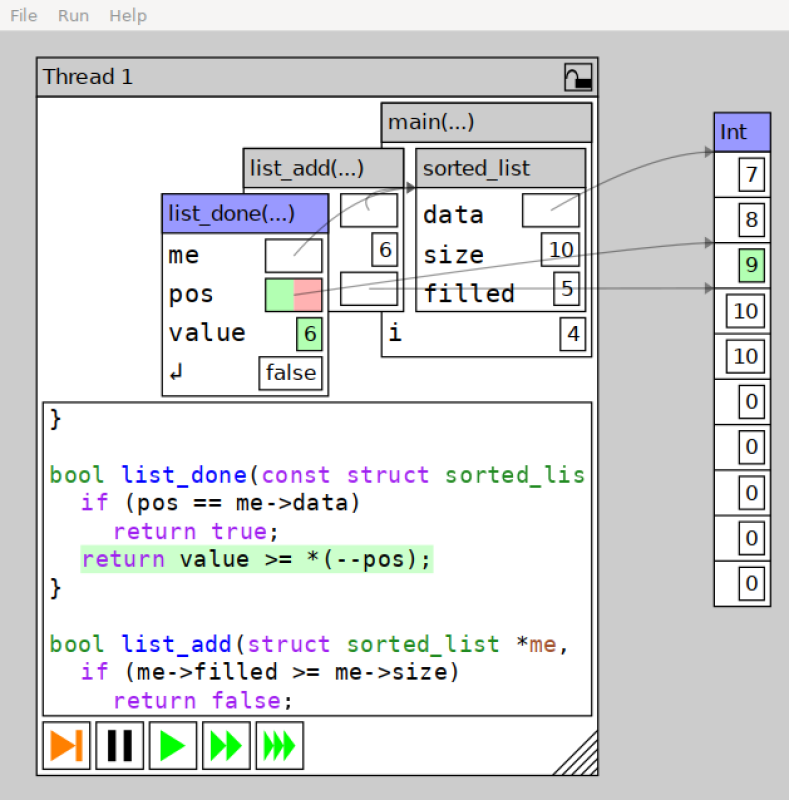
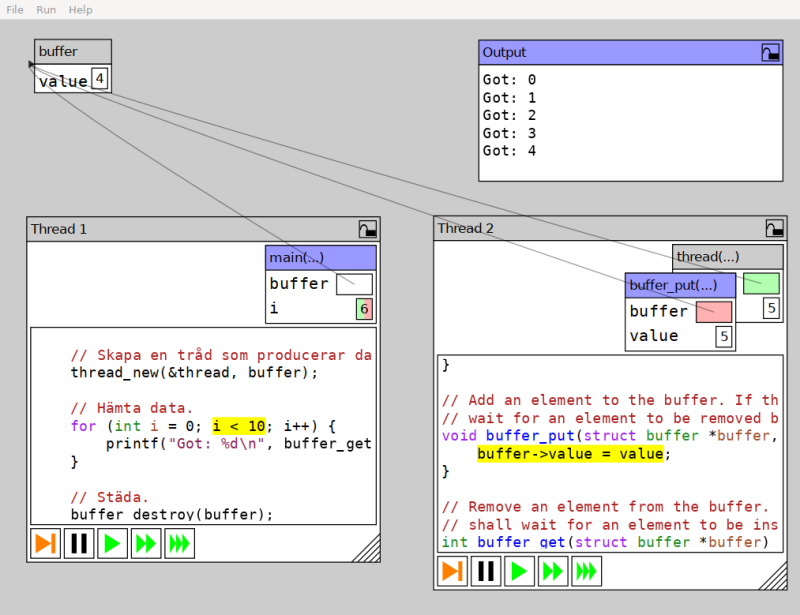
Progvis finally made it into Debian! What is it, you ask? It is a great tool to teach about memory management and concurrency. I first saw progvis in the poster presentation his author, Filip Str mb ck, did last year at the 52nd ACM Technical Sympossium on Computer Science Education (SIGCSE), immediately recognizing it as a tool I wanted to use at my classes, and being it free software, make it available for all interested Debian users. Quoting from Progvis Web page:
This is a program visualization tool aimed at concurrent programs and related issues. The tool itself is mostly language agnostic, and relies on Storm to compile the provided code and provide basic debug information. The generated code is then inspected and instrumented to provide an experience similar to a basic debugger. The tool emphasizes a visual representation of the object hierarchy that is manipulated by the executed program to make it easy to understand how it looks. In particular, a visual representation is beneficial over a text representation since it makes it easier to find shared data that might need to be synchronized in a concurrent program. As mentioned, the tool is aimed at concurrent programs. Therefore, it allows spawning multiple threads running the same program to see if that affects the program s execution (this is mostly interesting if global variables are used). Furthermore, any spawned threads also appear in the tool, and the user may control them independently to explore possible race conditions or other synchronization errors. If enabled from the menu bar, the tool keeps track of reads and writes to the data structure in order to highlight basic race conditions in addition to deadlocks.
So, what is this Storm thing? Filip promptly informed me that Progvis is not just a pedagogical tool Or rather, that it is part of something bigger. Progvis is a program built using the Storm programming language platform is more than a compiler; it presents as a framework for creating languages, designed to make easy to implement languages that can be extended with new syntax and semantics. Storm is much more than what I have explored, and can be used as an interactive compiler, a language server used as a service for highlighting and completing in IDEs. But I won t dig much more into Storm (which is, of course, now also available in Debian as well as the libraries built from the same source). Back to progvis: It implements a very-close-to-C++ language, with some details to better suit its purpose (i.e. instead of using the usual pthread implementation, an own thread model is used; i.e. thread creation is handled via int thread_id = thread_name(funcname, &params) instead of the more complex pthread_create() function (including details such as the thread object being passed as by reference as a parameter) All in all, while I have not yet taken full advantage of this tool in my teaching, it has helped me show somewhat hard to grasp concepts such as: All in all, a great tool. I hope you find it useful and enjoyable as well! PS- I suggest you to install the progvis-examples package to get started. You will find some dozens of sample programs in /usr/share/doc/progvis-examples/examples; playing with them will help you better understand the tool and be able to better write your own programs.

25 January 2022

Dirk Eddelbuettel: RcppArmadillo 0.10.8.1.0 on CRAN: Upstream Updates

armadillo image Armadillo is a powerful and expressive C++ template library for linear algebra aiming towards a good balance between speed and ease of use with a syntax deliberately close to a Matlab. RcppArmadillo integrates this library with the R environment and language and is widely used by (currently) 950 other packages on CRAN, downloaded over 22.9 million times (per the partial logs from the cloud mirrors of CRAN), and the CSDA paper (preprint/vignette) by Conrad and myself has been cited 451 times according to Google Scholar. This release brings another upstream update 10.8.0, and first bug fix release 10.8.1. As updates by Conrad can come a little quicker than the desired monthly cadence CRAN aims for, we skipped the 10.8.0 release for CRAN only but of course generally provide them via the Rcpp drat repo as well as via general updates to the repo, and full reverse dependency testing (for which results are always logged here). The full set of changes (since the last CRAN release 0.10.7.5.0) follows.

Changes in RcppArmadillo version 0.10.8.1.0 (2022-01-23)
  • Upgraded to Armadillo release 10.8.1 (Realm Raider)
    • fix interaction between OpenBLAS and LAPACK
    • emit warning if find() is incorrectly used to locate NaN elements

Changes in RcppArmadillo version 0.10.8.0.0 (2022-01-02)
  • Upgraded to Armadillo release 10.8 (Realm Raider)
    • faster handling of symmetric matrices by pinv() and rank()
    • faster handling of diagonal matrices by inv_sympd(), pinv(), rank()
    • expanded norm() to handle integer vectors and matrices
    • added datum::tau to replace 2

Courtesy of my CRANberries, there is a diffstat report relative to previous release. More detailed information is on the RcppArmadillo page. Questions, comments etc should go to the rcpp-devel mailing list off the R-Forge page. If you like this or other open-source work I do, you can sponsor me at GitHub.

This post by Dirk Eddelbuettel originated on his Thinking inside the box blog. Please report excessive re-aggregation in third-party for-profit settings.

23 January 2022

Matthieu Caneill: Debsources, python3, and funky file names

Rumors are running that python2 is not a thing anymore. Well, I'm certainly late to the party, but I'm happy to report that sources.debian.org is now running python3. Wait, it wasn't? Back when development started, python3 was very much a real language, but it was hard to adopt because it was not supported by many libraries. So python2 was chosen, meaning print-based debugging was used in lieu of print()-based debugging, and str were bytes, not unicode. And things were working just fine. One day python2 EOL was announced, with a date far in the future. Far enough to procrastinate for a long time. Combine this with a codebase that is stable enough to not see many commits, and the fact that Debsources is a volunteer-based project that happens at best on week-ends, and you end up with a dormant software and a missed deadline. But, as dormant as the codebase is, the instance hosted at sources.debian.org is very popular and gets 200k to 500k hits per day. Largely enough to be worth a proper maintenance and a transition to python3. Funky file names While transitioning to python3 and juggling left and right with str, bytes and unicode for internal objects, files, database entries and HTTP content, I stumbled upon a bug that has been there since day 1. Quick recap if you're unfamiliar with this tool: Debsources displays the content of the source packages in the Debian archive. In other words, it's a bit like GitHub, but for the Debian source code. And some pieces of software out there, that ended up in Debian packages, happen to contain files whose names can't be decoded to UTF-8. Interestingly enough, there's no such thing as a standard for file names: with a few exceptions that vary by operating system, any sequence of bytes can be a legit file name. And some sequences of bytes are not valid UTF-8. Of course those files are rare, and using ASCII characters to name a file is a much more common practice than using bytes in a non-UTF-8 character encoding. But when you deal with almost 100 million files on which you have no control (those files come from free software projects, and make their way into Debian without any renaming), it happens. Now back to the bug: when trying to display such a file through the web interface, it would crash because it can't convert the file name to UTF-8, which is needed for the HTML representation of the page. Bugfix An often valid approach when trying to represent invalid UTF-8 content is to ignore errors, and replace them with ? or . This is what Debsources actually does to display non-UTF-8 file content. Unfortunately, this best-effort approach is not suitable for file names, as file names are also identifiers in Debsources: among other places, they are part of URLs. If an URL were to use placeholder characters to replace those bytes, there would be no deterministic way to match it with a file on disk anymore. The representation of binary data into text is a known problem. Multiple lossless solutions exist, such as base64 and its variants, but URLs looking like https://sources.debian.org/src/Y293c2F5LzMuMDMtOS4yL2Nvd3NheS8= are not readable at all compared to https://sources.debian.org/src/cowsay/3.03-9.2/cowsay/. Plus, not backwards-compatible with all existing links. The solution I chose is to use double-percent encoding: this allows the representation of any byte in an URL, while keeping allowed characters unchanged - and preventing CGI gateways from trying to decode non-UTF-8 bytes. This is the best of both worlds: regular file names get to appear normally and are human-readable, and funky file names only have percent signs and hex numbers where needed. Here is an example of such an URL: https://sources.debian.org/src/aspell-is/0.51-0-4/%25EDslenska.alias/. Notice the %25ED to represent the percentage symbol itself (%25) followed by an invalid UTF-8 byte (%ED). Transitioning to this was quite a challenge, as those file names don't only appear in URLs, but also in web pages themselves, log files, database tables, etc. And everything was done with str: made sense in python2 when str were bytes, but not much in python3. What are those files? What's their network? I was wondering too. Let's list them!
import os
with open('non-utf-8-paths.bin', 'wb') as f:
    for root, folders, files in os.walk(b'/srv/sources.debian.org/sources/'):
        for path in folders + files:
            try:
                path.decode('utf-8')
            except UnicodeDecodeError:
                f.write(root + b'/' + path + b'\n')
Running this on the Debsources main instance, which hosts pretty much all Debian packages that were part of a Debian release, I could find 307 files (among a total of almost 100 million files). Without looking deep into them, they seem to fall into 2 categories: That last point hits home, as it was clearly lacking in Debsources. A funky file name is now part of its test suite. ;)

Antoine Beaupr : Switching from OpenNTPd to Chrony

A friend recently reminded me of the existence of chrony, a "versatile implementation of the Network Time Protocol (NTP)". The excellent introduction is worth quoting in full:
It can synchronise the system clock with NTP servers, reference clocks (e.g. GPS receiver), and manual input using wristwatch and keyboard. It can also operate as an NTPv4 (RFC 5905) server and peer to provide a time service to other computers in the network. It is designed to perform well in a wide range of conditions, including intermittent network connections, heavily congested networks, changing temperatures (ordinary computer clocks are sensitive to temperature), and systems that do not run continuosly, or run on a virtual machine. Typical accuracy between two machines synchronised over the Internet is within a few milliseconds; on a LAN, accuracy is typically in tens of microseconds. With hardware timestamping, or a hardware reference clock, sub-microsecond accuracy may be possible.
Now that's already great documentation right there. What it is, why it's good, and what to expect from it. I want more. They have a very handy comparison table between chrony, ntp and openntpd.

My problem with OpenNTPd Following concerns surrounding the security (and complexity) of the venerable ntp program, I have, a long time ago, switched to using openntpd on all my computers. I hadn't thought about it until I recently noticed a lot of noise on one of my servers:
jan 18 10:09:49 curie ntpd[1069]: adjusting local clock by -1.604366s
jan 18 10:08:18 curie ntpd[1069]: adjusting local clock by -1.577608s
jan 18 10:05:02 curie ntpd[1069]: adjusting local clock by -1.574683s
jan 18 10:04:00 curie ntpd[1069]: adjusting local clock by -1.573240s
jan 18 10:02:26 curie ntpd[1069]: adjusting local clock by -1.569592s
You read that right, openntpd was constantly rewinding the clock, sometimes in less than two minutes. The above log was taken while doing diagnostics, looking at the last 30 minutes of logs. So, on average, one 1.5 seconds rewind per 6 minutes! That might be due to a dying real time clock (RTC) or some other hardware problem. I know for a fact that the CMOS battery on that computer (curie) died and I wasn't able to replace it (!). So that's partly garbage-in, garbage-out here. But still, I was curious to see how chrony would behave... (Spoiler: much better.) But I also had trouble on another workstation, that one a much more recent machine (angela). First, it seems OpenNTPd would just fail at boot time:
anarcat@angela:~(main)$ sudo systemctl status openntpd
  openntpd.service - OpenNTPd Network Time Protocol
     Loaded: loaded (/lib/systemd/system/openntpd.service; enabled; vendor pres>
     Active: inactive (dead) since Sun 2022-01-23 09:54:03 EST; 6h ago
       Docs: man:openntpd(8)
    Process: 3291 ExecStartPre=/usr/sbin/ntpd -n $DAEMON_OPTS (code=exited, sta>
    Process: 3294 ExecStart=/usr/sbin/ntpd $DAEMON_OPTS (code=exited, status=0/>
   Main PID: 3298 (code=exited, status=0/SUCCESS)
        CPU: 34ms
jan 23 09:54:03 angela systemd[1]: Starting OpenNTPd Network Time Protocol...
jan 23 09:54:03 angela ntpd[3291]: configuration OK
jan 23 09:54:03 angela ntpd[3297]: ntp engine ready
jan 23 09:54:03 angela ntpd[3297]: ntp: recvfrom: Permission denied
jan 23 09:54:03 angela ntpd[3294]: Terminating
jan 23 09:54:03 angela systemd[1]: Started OpenNTPd Network Time Protocol.
jan 23 09:54:03 angela systemd[1]: openntpd.service: Succeeded.
After a restart, somehow it worked, but it took a long time to sync the clock. At first, it would just not consider any peer at all:
anarcat@angela:~(main)$ sudo ntpctl -s all
0/20 peers valid, clock unsynced
peer
   wt tl st  next  poll          offset       delay      jitter
159.203.8.72 from pool 0.debian.pool.ntp.org
    1  5  2    6s    6s             ---- peer not valid ----
138.197.135.239 from pool 0.debian.pool.ntp.org
    1  5  2    6s    7s             ---- peer not valid ----
216.197.156.83 from pool 0.debian.pool.ntp.org
    1  4  1    2s    9s             ---- peer not valid ----
142.114.187.107 from pool 0.debian.pool.ntp.org
    1  5  2    5s    6s             ---- peer not valid ----
216.6.2.70 from pool 1.debian.pool.ntp.org
    1  4  2    2s    8s             ---- peer not valid ----
207.34.49.172 from pool 1.debian.pool.ntp.org
    1  4  2    0s    5s             ---- peer not valid ----
198.27.76.102 from pool 1.debian.pool.ntp.org
    1  5  2    5s    5s             ---- peer not valid ----
158.69.254.196 from pool 1.debian.pool.ntp.org
    1  4  3    1s    6s             ---- peer not valid ----
149.56.121.16 from pool 2.debian.pool.ntp.org
    1  4  2    5s    9s             ---- peer not valid ----
162.159.200.123 from pool 2.debian.pool.ntp.org
    1  4  3    1s    6s             ---- peer not valid ----
206.108.0.131 from pool 2.debian.pool.ntp.org
    1  4  1    6s    9s             ---- peer not valid ----
205.206.70.40 from pool 2.debian.pool.ntp.org
    1  5  2    8s    9s             ---- peer not valid ----
2001:678:8::123 from pool 2.debian.pool.ntp.org
    1  4  2    5s    9s             ---- peer not valid ----
2606:4700:f1::1 from pool 2.debian.pool.ntp.org
    1  4  3    2s    6s             ---- peer not valid ----
2607:5300:205:200::1991 from pool 2.debian.pool.ntp.org
    1  4  2    5s    9s             ---- peer not valid ----
2607:5300:201:3100::345c from pool 2.debian.pool.ntp.org
    1  4  4    1s    6s             ---- peer not valid ----
209.115.181.110 from pool 3.debian.pool.ntp.org
    1  5  2    5s    6s             ---- peer not valid ----
205.206.70.42 from pool 3.debian.pool.ntp.org
    1  4  2    0s    6s             ---- peer not valid ----
68.69.221.61 from pool 3.debian.pool.ntp.org
    1  4  1    2s    9s             ---- peer not valid ----
162.159.200.1 from pool 3.debian.pool.ntp.org
    1  4  3    4s    7s             ---- peer not valid ----
Then it would accept them, but still wouldn't sync the clock:
anarcat@angela:~(main)$ sudo ntpctl -s all
20/20 peers valid, clock unsynced
peer
   wt tl st  next  poll          offset       delay      jitter
159.203.8.72 from pool 0.debian.pool.ntp.org
    1  8  2    5s    6s         0.672ms    13.507ms     0.442ms
138.197.135.239 from pool 0.debian.pool.ntp.org
    1  7  2    4s    8s         1.260ms    13.388ms     0.494ms
216.197.156.83 from pool 0.debian.pool.ntp.org
    1  7  1    3s    5s        -0.390ms    47.641ms     1.537ms
142.114.187.107 from pool 0.debian.pool.ntp.org
    1  7  2    1s    6s        -0.573ms    15.012ms     1.845ms
216.6.2.70 from pool 1.debian.pool.ntp.org
    1  7  2    3s    8s        -0.178ms    21.691ms     1.807ms
207.34.49.172 from pool 1.debian.pool.ntp.org
    1  7  2    4s    8s        -5.742ms    70.040ms     1.656ms
198.27.76.102 from pool 1.debian.pool.ntp.org
    1  7  2    0s    7s         0.170ms    21.035ms     1.914ms
158.69.254.196 from pool 1.debian.pool.ntp.org
    1  7  3    5s    8s        -2.626ms    20.862ms     2.032ms
149.56.121.16 from pool 2.debian.pool.ntp.org
    1  7  2    6s    8s         0.123ms    20.758ms     2.248ms
162.159.200.123 from pool 2.debian.pool.ntp.org
    1  8  3    4s    5s         2.043ms    14.138ms     1.675ms
206.108.0.131 from pool 2.debian.pool.ntp.org
    1  6  1    0s    7s        -0.027ms    14.189ms     2.206ms
205.206.70.40 from pool 2.debian.pool.ntp.org
    1  7  2    1s    5s        -1.777ms    53.459ms     1.865ms
2001:678:8::123 from pool 2.debian.pool.ntp.org
    1  6  2    1s    8s         0.195ms    14.572ms     2.624ms
2606:4700:f1::1 from pool 2.debian.pool.ntp.org
    1  7  3    6s    9s         2.068ms    14.102ms     1.767ms
2607:5300:205:200::1991 from pool 2.debian.pool.ntp.org
    1  6  2    4s    9s         0.254ms    21.471ms     2.120ms
2607:5300:201:3100::345c from pool 2.debian.pool.ntp.org
    1  7  4    5s    9s        -1.706ms    21.030ms     1.849ms
209.115.181.110 from pool 3.debian.pool.ntp.org
    1  7  2    0s    7s         8.907ms    75.070ms     2.095ms
205.206.70.42 from pool 3.debian.pool.ntp.org
    1  7  2    6s    9s        -1.729ms    53.823ms     2.193ms
68.69.221.61 from pool 3.debian.pool.ntp.org
    1  7  1    1s    7s        -1.265ms    46.355ms     4.171ms
162.159.200.1 from pool 3.debian.pool.ntp.org
    1  7  3    4s    8s         1.732ms    35.792ms     2.228ms
It took a solid five minutes to sync the clock, even though the peers were considered valid within a few seconds:
jan 23 15:58:41 angela systemd[1]: Started OpenNTPd Network Time Protocol.
jan 23 15:58:58 angela ntpd[84086]: peer 142.114.187.107 now valid
jan 23 15:58:58 angela ntpd[84086]: peer 198.27.76.102 now valid
jan 23 15:58:58 angela ntpd[84086]: peer 207.34.49.172 now valid
jan 23 15:58:58 angela ntpd[84086]: peer 209.115.181.110 now valid
jan 23 15:58:59 angela ntpd[84086]: peer 159.203.8.72 now valid
jan 23 15:58:59 angela ntpd[84086]: peer 138.197.135.239 now valid
jan 23 15:58:59 angela ntpd[84086]: peer 162.159.200.123 now valid
jan 23 15:58:59 angela ntpd[84086]: peer 2607:5300:201:3100::345c now valid
jan 23 15:59:00 angela ntpd[84086]: peer 2606:4700:f1::1 now valid
jan 23 15:59:00 angela ntpd[84086]: peer 158.69.254.196 now valid
jan 23 15:59:01 angela ntpd[84086]: peer 216.6.2.70 now valid
jan 23 15:59:01 angela ntpd[84086]: peer 68.69.221.61 now valid
jan 23 15:59:01 angela ntpd[84086]: peer 205.206.70.40 now valid
jan 23 15:59:01 angela ntpd[84086]: peer 205.206.70.42 now valid
jan 23 15:59:02 angela ntpd[84086]: peer 162.159.200.1 now valid
jan 23 15:59:04 angela ntpd[84086]: peer 216.197.156.83 now valid
jan 23 15:59:05 angela ntpd[84086]: peer 206.108.0.131 now valid
jan 23 15:59:05 angela ntpd[84086]: peer 2001:678:8::123 now valid
jan 23 15:59:05 angela ntpd[84086]: peer 149.56.121.16 now valid
jan 23 15:59:07 angela ntpd[84086]: peer 2607:5300:205:200::1991 now valid
jan 23 16:03:47 angela ntpd[84086]: clock is now synced
That seems kind of odd. It was also frustrating to have very little information from ntpctl about the state of the daemon. I understand it's designed to be minimal, but it could inform me on his known offset, for example. It does tell me about the offset with the different peers, but not as clearly as one would expect. It's also unclear how it disciplines the RTC at all.

Compared to chrony Now compare with chrony:
jan 23 16:07:16 angela systemd[1]: Starting chrony, an NTP client/server...
jan 23 16:07:16 angela chronyd[87765]: chronyd version 4.0 starting (+CMDMON +NTP +REFCLOCK +RTC +PRIVDROP +SCFILTER +SIGND +ASYNCDNS +NTS +SECHASH +IPV6 -DEBUG)
jan 23 16:07:16 angela chronyd[87765]: Initial frequency 3.814 ppm
jan 23 16:07:16 angela chronyd[87765]: Using right/UTC timezone to obtain leap second data
jan 23 16:07:16 angela chronyd[87765]: Loaded seccomp filter
jan 23 16:07:16 angela systemd[1]: Started chrony, an NTP client/server.
jan 23 16:07:21 angela chronyd[87765]: Selected source 206.108.0.131 (2.debian.pool.ntp.org)
jan 23 16:07:21 angela chronyd[87765]: System clock TAI offset set to 37 seconds
First, you'll notice there's none of that "clock synced" nonsense, it picks a source, and then... it's just done. Because the clock on this computer is not drifting that much, and openntpd had (presumably) just sync'd it anyways. And indeed, if we look at detailed stats from the powerful chronyc client:
anarcat@angela:~(main)$ sudo chronyc tracking
Reference ID    : CE6C0083 (ntp1.torix.ca)
Stratum         : 2
Ref time (UTC)  : Sun Jan 23 21:07:21 2022
System time     : 0.000000311 seconds slow of NTP time
Last offset     : +0.000807989 seconds
RMS offset      : 0.000807989 seconds
Frequency       : 3.814 ppm fast
Residual freq   : -24.434 ppm
Skew            : 1000000.000 ppm
Root delay      : 0.013200894 seconds
Root dispersion : 65.357254028 seconds
Update interval : 1.4 seconds
Leap status     : Normal
We see that we are nanoseconds away from NTP time. That was ran very quickly after starting the server (literally in the same second as chrony picked a source), so stats are a bit weird (e.g. the Skew is huge). After a minute or two, it looks more reasonable:
Reference ID    : CE6C0083 (ntp1.torix.ca)
Stratum         : 2
Ref time (UTC)  : Sun Jan 23 21:09:32 2022
System time     : 0.000487002 seconds slow of NTP time
Last offset     : -0.000332960 seconds
RMS offset      : 0.000751204 seconds
Frequency       : 3.536 ppm fast
Residual freq   : +0.016 ppm
Skew            : 3.707 ppm
Root delay      : 0.013363549 seconds
Root dispersion : 0.000324015 seconds
Update interval : 65.0 seconds
Leap status     : Normal
Now it's learning how good or bad the RTC clock is ("Frequency"), and is smoothly adjusting the System time to follow the average offset (RMS offset, more or less). You'll also notice the Update interval has risen, and will keep expanding as chrony learns more about the internal clock, so it doesn't need to constantly poll the NTP servers to sync the clock. In the above, we're 487 micro seconds (less than a milisecond!) away from NTP time. (People interested in the explanation of every single one of those fields can read the excellent chronyc manpage. That thing made me want to nerd out on NTP again!) On the machine with the bad clock, chrony also did a 1.5 second adjustment, but just once, at startup:
jan 18 11:54:33 curie chronyd[2148399]: Selected source 206.108.0.133 (2.debian.pool.ntp.org) 
jan 18 11:54:33 curie chronyd[2148399]: System clock wrong by -1.606546 seconds 
jan 18 11:54:31 curie chronyd[2148399]: System clock was stepped by -1.606546 seconds 
jan 18 11:54:31 curie chronyd[2148399]: System clock TAI offset set to 37 seconds 
Then it would still struggle to keep the clock in sync, but not as badly as openntpd. Here's the offset a few minutes after that above startup:
System time     : 0.000375352 seconds slow of NTP time
And again a few seconds later:
System time     : 0.001793046 seconds slow of NTP time
I don't currently have access to that machine, and will update this post with the latest status, but so far I've had a very good experience with chrony on that machine, which is a testament to its resilience, and it also just works on my other machines as well.

Extras On top of "just working" (as demonstrated above), I feel that chrony's feature set is so much superior... Here's an excerpt of the extras in chrony, taken from the comparison table:
  • source frequency tracking
  • source state restore from file
  • temperature compensation
  • ready for next NTP era (year 2036)
  • replace unreachable / falseticker servers
  • aware of jitter
  • RTC drift tracking
  • RTC trimming
  • Restore time from file w/o RTC
  • leap seconds correction, in slew mode
  • drops root privileges
I even understand some of that stuff. I think. So kudos to the chrony folks, I'm switching.

Caveats One thing to keep in mind in the above, however is that it's quite possible chrony does as bad of a job as openntpd on that old machine, and just doesn't tell me about it. For example, here's another log sample from another server (marcos):
jan 23 11:13:25 marcos ntpd[1976694]: adjusting clock frequency by 0.451035 to -16.420273ppm
I get those basically every day, which seems to show that it's at least trying to keep track of the hardware clock. In other words, it's quite possible I have no idea what I'm talking about and you definitely need to take this article with a grain of salt. I'm not an NTP expert. Update: I should also mentioned that I haven't evaluated systemd-timesyncd, for a few reasons:
  1. I have enough things running under systemd
  2. I wasn't aware of it when I started writing this
  3. I couldn't find good documentation on it... later I found the above manpage and of course the Arch Wiki but that is very minimal
  4. therefore I can't tell how it compares with chrony or (open)ntpd, so I don't see an enticing reason to switch
It has a few things going for it though:
  • it's likely shipped with your distribution already
  • it drops privileges (possibly like chrony, unclear if it also has seccomp filters)
  • it's minimalist: it only does SNTP so not the server side
  • the status command is good enough that you can tell the clock frequency, precision, and so on (especially when compared to openntpd's ntpctl)
So I'm reserving judgement over it, but I'd certainly note that I'm always a little weary in trusting systemd daemons with the network, and would prefer to keep that attack surface to a minimum. Diversity is a good thing, in general, so I'll keep chrony for now. It would certainly nice to see it added to chrony's comparison table.

Switching to chrony Because the default configuration in chrony (at least as shipped in Debian) is sane (good default peers, no open network by default), installing it is as simple as:
apt install chrony
And because it somehow conflicts with openntpd, that also takes care of removing that cruft as well.

Update: Debian defaults So it seems like I managed to write this entire blog post without putting it in relation with the original reason I had to think about this in the first place, which is odd and should be corrected. This conversation came about on an IRC channel that mentioned that the ntp package (and upstream) is in bad shape in Debian. In that discussion, chrony and ntpsec were discussed as possible replacements, but when we had the discussion on chat, I mentioned I was using openntpd, and promptly realized I was actually unhappy with it. A friend suggested chrony, I tried it, and it worked amazingly, I switched, wrote this blog post, end of story. Except today (2022-02-07, two weeks later), I actually read that thread and realized that something happened in Debian I wasn't actually aware of. In bookworm, systemd-timesyncd was not only shipped, but it was installed by default, as it was marked as a hard dependency of systemd. That was "fixed" in systemd-247.9-2 (see bug 986651), but only by making the dependency a Recommends and marking it as Priority: important. So in effect, systemd-timesyncd became the default NTP daemon in Debian in bookworm, which I find somewhat surprising. timesyncd has many things going for it (as mentioned above), but I do find it a bit annoying that systemd is replacing all those utilities in such a way. I also wonder what is going to happen on upgrades. This is all a little frustrating too because there is no good comparison between the other NTP daemons and timesyncd anywhere. The chrony comparison table doesn't mention it, and an audit by the Core Infrastructure Initiative from 2017 doesn't mention it either, even though timesyncd was announced in 2014. (Same with this blog post from Facebook.)

21 January 2022

Neil McGovern: Further investments in desktop Linux

This was originally posted on the GNOME Foundation news feed The GNOME Foundation was supported during 2020-2021 by a grant from Endless Network which funded the Community Engagement Challenge, strategy consultancy with the board, and a contribution towards our general running costs. At the end of last year we had a portion of this grant remaining, and after the success of our work in previous years directly funding developer and infrastructure work on GTK and Flathub, we wanted to see whether we could use these funds to invest in GNOME and the wider Linux desktop platform. We re very pleased to announce that we got approval to launch three parallel contractor engagements, which started over the past few weeks. These projects aim to improve our developer experience, make more applications available on the GNOME platform, and move towards equitable and sustainable revenue models for developers within our ecosystem. Thanks again to Endless Network for their support on these initiatives. Flathub Verified apps, donations and subscriptions (Codethink and James Westman) This project is described in detail on the Flathub Discourse but goal is to add a process to verify first-party apps on Flathub (ie uploaded by a developer or an authorised representative) and then make it possible for those developers to collect donations or subscriptions from users of their applications. We also plan to publish a separate repository that contains only these verified first-party uploads (without any of the community contributed applications), as well as providing a repository with only free and open source applications, allowing users to choose what they are comfortable installing and running on their system. Creating the user and developer login system to manage your apps will also set us up well for future enhancements, such managing tokens for direct binary uploads (eg from a CI/CD system hosted elsewhere, as is already done with Mozilla Firefox and OBS) and making it easier to publish apps from systems such as Electron which can be hard to use within a flatpak-builder sandbox. For updates on this project you can follow the Discourse thread, check out the work board on GitHub or join us on Matrix. PWAs Integrating Progressive Web Apps in GNOME (Phaedrus Leeds) While everyone agrees that native applications can provide the best experience on the GNOME desktop, the web platform, and particularly PWAs (Progressive Web Apps) which are designed to be downloadable as apps and offer offline functionality, makes it possible for us to offer equivalent experiences to other platforms for app publishers who have not specifically targeted GNOME. This allows us to attract and retain users by giving them the choice of using applications from a wider range of publishers than are currently directly targeting the Linux desktop. The first phase of the GNOME PWA project involves adding back support to Software for web apps backed by GNOME Web, and making this possible when Web is packaged as a Flatpak. So far some preparatory pull requests have been merged in Web and libportal to enable this work, and development is ongoing to get the feature branches ready for review. Discussions are also in progress with the Design team on how best to display the web apps in Software and on the user interface for web apps installed from a browser. There has also been discussion among various stakeholders about what web apps should be included as available with Software, and how they can provide supplemental value to users without taking priority over apps native to GNOME. Finally, technical discussion is ongoing in the portal issue tracker to ensure that the implementation of a new dynamic launcher portal meets all security and robustness requirements, and is potentially useful not just to GNOME Web but Chromium and any other app that may want to install desktop launchers. Adding support for the launcher portal in upstream Chromium, to facilitate Chromium-based browsers packaged as a Flatpak, and adding support for Chromium-based web apps in Software are stretch goals for the project should time permit. GTK4 / Adwaita To support the adoption of Gtk4 by the community (Emmanuele Bassi) With the release of GTK4 and renewed interest in GTK as a toolkit, we want to continue improving the developer experience and ease of use of GTK and ensure we have a complete and competitive offering for developers considering using our platform. This involves identifying missing functionality or UI elements that applications need to move to GTK4, as well as informing the community about the new widgets and functionality available. We have been working on documentation and bug fixes for GTK in preparation for the GNOME 42 release and have also started looking at the missing widgets and API in Libadwaita, in preparation for the next release. The next steps are to work with the Design team and the Libadwaita maintainers and identify and implement missing widgets that did not make the cut for the 1.0 release. In the meantime, we have also worked on writing a beginners tutorial for the GNOME developers documentation, including GTK and Libadwaita widgets so that newcomers to the platform can easily move between the Interface Guidelines and the API references of various libraries. To increase the outreach of the effort, Emmanuele has been streaming it on Twitch, and published the VOD on YouTube as well.

20 January 2022

Dirk Eddelbuettel: RQuantLib 0.4.15: Regular Update

A new release 0.4.15 of RQuantLib arrived at CRAN earlier today, and has been uploaded to Debian as well. QuantLib is a very comprehensice free/open-source library for quantitative finance; RQuantLib connects it to the R environment and language. The release of RQuantLib comes four months after the previous release, and brings a momitor update for the just-released QuantLib 1.2.5 version along with a few small cleanups to calendars and daycounters.

Changes in RQuantLib version 0.4.15 (2022-01-19)
  • Changes in RQuantLib code:
    • Calendar support has been updated and completed to current QuantLib standards (Dirk in #161)
    • More daycounters have been added (Kai Lin in #163 fixing #162, #164)
    • The bonds pricers were update to changes in QuantLib 1.25 (Dirk)
  • Changes in RQuantLib package and setup:
    • Some package metadata was removed from the README.md (Dirk)

Courtesy of my CRANberries, there is also a diffstat report for the this release. As always, more detailed information is on the RQuantLib page. Questions, comments etc should go to the new rquantlib-devel mailing list. Issue tickets can be filed at the GitHub repo. If you like this or other open-source work I do, you can now sponsor me at GitHub.

This post by Dirk Eddelbuettel originated on his Thinking inside the box blog. Please report excessive re-aggregation in third-party for-profit settings.

Next.

Previous.