Search Results: "ah"

13 September 2015

Norbert Preining: Gaming: The Talos Principle

Over the last weekends I finally managed to finish The Talos Principle, all of its endings. Compared to the actual play time I needed for Portal 2, namely about 12 hours, The Talos Principle challenged me much longer, about 36 hours. An enjoyable ride through many different and stunningly created worlds filled with many many puzzles that need to be solved.
Combined with three different endings the games offers great fun for those who love riddle games. Comparing it to my favorite riddle game (series), Myst, the graphics have of course developed and provide stunning views. I haven t played games in a landscape since the Myst series (Portal is indoors), so I was taken by surprise about all the details and love that has been put into the graphics. Maybe its only me because it was the first game of this quality I have played. And above all, I could actually play it on my normal Intel GPU laptop (but surprisingly only on Linux, the Windows version refused to play on my under-powered laptop).
There are only two slightly negative points I have to mention: Due to the nature of very restricted tool set, the riddles feel a bit repetitive. Some of them stand out, but after having played through the A and B worlds, you feel like you have seen that before when entering a new riddle. Still challenging, and that is what I was looking for, but a bit more variation would be nice. Here is a riddle that stood out due to its funny nature.
The game also has a long list of Easter Eggs, some of which I could find, some of which I surely missed. Most funny of those I found was the Developer World where funny characters lounge. Another I found was this money throwing guy called Fork Parker, who happens to be the financial officer of the developers team. Did they really make sooo much money from the game?
Something a bit uncommon or new to me was the fact that there are three (3!) endings, depending on what you choose to do. The first and easiest one is the ending of the good student you collect enough sigils, and follow Elohims words and ascent to eternity rather boring. Reminds me of an old Viennese song how boring it is to be an angel in heaven.
Bit more challenging is the bad student ending: You ignore Elohim s warnings and ascent the tower, solve several more riddles, and via a few more twists manage to escape to the real world. Nice graphics, great ending.
The most challenging ending is the enlighted student ending. To manage to reach this ending, one needs to collect each and everything that is to be found in the game, including all hidden stars and grey sigils. Here I have to mention the second slightly negative point: Finding the stars is rather luck then problem solving ability. Often one needs to guess a location of a reflector, or stumble over a hidden staircase, or press some arbitrary buttons. For my feeling the riddles for the stars were to arbitrary. So I managed to collect several of the stars by myself, but for many I needed hints on how to solve the riddles. Anyway, in case you managed to listen to all recordings, collect all texts, get all stars and collect all sigils from the extra worlds, you might ascend to the last floor of the tower and become a messenger yourself. Not sure if I want to become a messenger there, though.
Just in time with me finishing the game, the developers shipped out an extension called Road to Gehenna . Stunning graphics, even better, waiting ahead now I only need the time!
All in all a great piece of game, lovingly crafted graphics, interesting game play, lots of small levels, which helps people like me who cannot play for hours overnight, but need to do riddles one by one in short gaming sessions. So if you are in for riddle games, watch out for the next offer on Steam. Enjoy.

12 September 2015

Michal Čihař: Weblate for translating everything

Weblate is not only useful for translating software, it can help in translating any content. Let's look where our users are using it. Software translation is the most usual use case. This is actually where Weblate was used for first time and still provides great support for that. As an example (and oldest project hosted in Weblate) you can look at phpMyAdmin, where Weblate also helps to keep in sync translation for different maintenance branches. It can also help you in using same terminology in command line utility and graphical one like it is done in Gammu and Wammu translations. Weblate also supports localization of mobile application. Android support was originally implemented for OsmAnd project, but now they also translate iOS application using Weblate. Another use case is for translating documentation. You need to have some infrastructure to do, but there are several free software project to help here as well. For phpMyAdmin documentation or documentation for python module Odorik the Sphinx documentation generator is used, which has support for translation of the documentation. I've recently published quick howto for this setup. Another great tool for translating documentation is Publican, it is Docbook based tool and is used for translating The Debian Administrator's Handbook. Last but not least, you can use Weblate to translate your website. For example website for Weblate itself is translated this way. Did you miss your use case for Weblate? Please let me know. PS: I've heard that one Linux distribution will start using Weblate soon.

Filed under: English phpMyAdmin SUSE Weblate 0 comments

11 September 2015

Matthias Klumpp: Deploying Limba packages: Ideas & current status

LimbaHubThe Limba project does not only have the goal to allow developers to deploy their applications directly on multiple Linux distributions while reducing duplication of shared resources, it should also make it easy for developers to build software for Limba. Limba is worth nothing without good tooling to make it fun to use. That s why I am working on that too, and I want to share some ideas of how things could work in future and which services I would like to have running. I will also show what is working today already (and that s quite something!). This time I look at things from a developer s perspective (since the last posts on Limba were more end-user centric). If you read on, you will also find a nice video of the developer workflow  1. Creating metadata and building the software To make building Limba packages as simple as possible, Limba reuses already existing metadata, like AppStream metadata to find information about the software you want to create your package for. To ensure upstreams can build their software in a clean environment, Limba makes using one as simple as possible: The limba-build CLI tool creates a clean chroot environment quickly by using an environment created by debootstrap (or a comparable tool suitable for the Linux distribution), and then using OverlayFS to have all changes to the environment done during the build process land in a separate directory. To define build instructions, limba-build uses the same YAML format TravisCI uses as well for continuous integration. So there is a chance this data is already present as well (if not, it s trivial to write). In case upstream projects don t want to use these tools, e.g. because they have well-working CI already, then all commands needed to build a Limba package can be called individually as well (ideally, building a Limba package is just one call to lipkgen). I am currently planning DeveloperIPK packages containing resources needed to develop against another Limba package. With that in place and integrated with the automatic build-environment creation, upstream developers can be sure the application they just built is built against the right libraries as present in the package they depend on. The build tool could even fetch the build-dependencies automatically from a central repository. 2. Uploading the software to a repository While everyone can set up their own Limba repository, and the limba-build repo command will help with that, there are lots of benefits in having a central place where upstream developers can upload their software to. I am currently developing a service like that, called LimbaHub . LimbaHub will contain different repositories distributors can make available to their users by default, e.g. there will be one with only free software, and one for proprietary software. It will also later allow upstreams to create private repositories, e.g. for beta-releases. 3. Security in LimbaHub Every Limba package is signed with they key of its creator anyway, so in order to get a package into LimbaHub, one needs to get their OpenPGP key accepted by the service first. Additionally, the Hub service works with a per-package permission system. This means I can e.g. allow the Mozilla release team members to upload a package with the component-ID org.mozilla.firefox.desktop or even allow those user(s) to own the whole org.mozilla.* namespace. This should prevent people hijacking other people s uploads accidentally or on purpose. 4. QA with LimbaHub LimbaHub should also act as guardian over ABI stability and general quality of the software. We could for example warn upstreams that they broke ABI without declaring that in the package information, or even reject the package then. We could validate .desktop files and AppStream metadata, or even check if a package was built using hardening flags. This should help both developers to improve their software as well as users who benefit from that effort. In case something really bad gets submitted to LimbaHub, we always have the ability to remove the package from the repositories as a last resort (which might trigger Limba to issue a warning for the user that he won t receive updates anymore). What works Limba, LimbaHub and the tools around it are developing nicely, so far no big issues have been encountered yet. That s why I made a video showing how Limba and LimbaHub work together at time: Still, there is a lot of room for improvement Limba has not yet received enough testing, and LimbaHub is merely a proof-of-concept at time. Also, lots of high-priority features are not yet implemented. LimbaHub and Limba need help! At time I am developing LimbaHub and Limba alone with only occasional contributions from others (which are amazing and highly welcomed!). So, if you like Python and Flask, and want to help developing LimbaHub, please contact me the LimbaHub software could benefit from a more experienced Python web developer than I am  (and maybe having a designer look over the frontend later makes sense as well). If you are not afraid of C and GLib, and like to chase bugs or play with building Limba packages, consider helping Limba development :-)

10 September 2015

Antoine Beaupr : Switched to bootstrap theme

I finally gave up and drank the cool-aid of the Bootstrap theme. The main reason was that I noticed the site was basically unusable on any mobile device, including tablet computers like the iPad, which are unfortunately very, very common. Phones wouldn't render the site in a legible way either, unfortunately. The change is rather drastic, so I figured it was important to mention it here. I am not so satisfied pretty exctied with the result: the theme is very basic, if not absent. I actually like that purified form now, and it works across devices now much better. But I do feel I just made my blog look like everyone else that uses Bootstrap. We seem to enter an era where non-graphic designers (like me) are back to building web pages that all look the same, not very different, in a way, from the old days of plain HTML, like the default ikiwiki theme. I did some work to change the look at least minimally, but the top black navbar is really a killer giveaway this is a bootstrap theme. Bootstrap does a lot for the typography, at least when checking the presslabs checklist or the practical typography checklist, but I still had to change the main body width, which helped a lot I think. Anyways, the old Night City theme is still available for download and I could still flip it back on here if I need to.

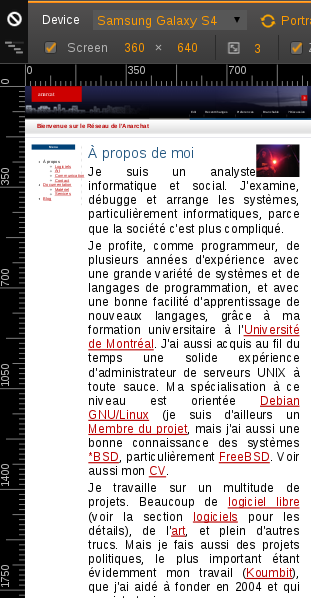
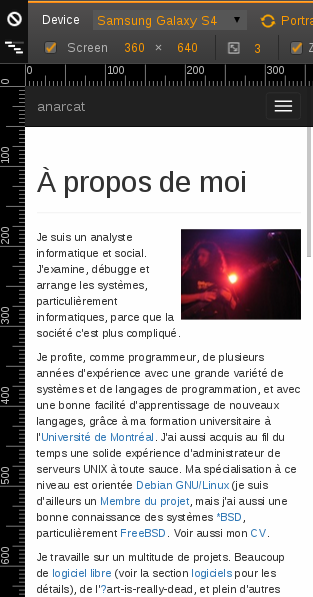
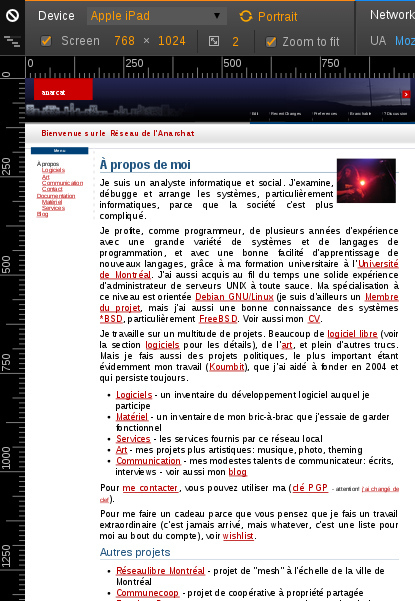
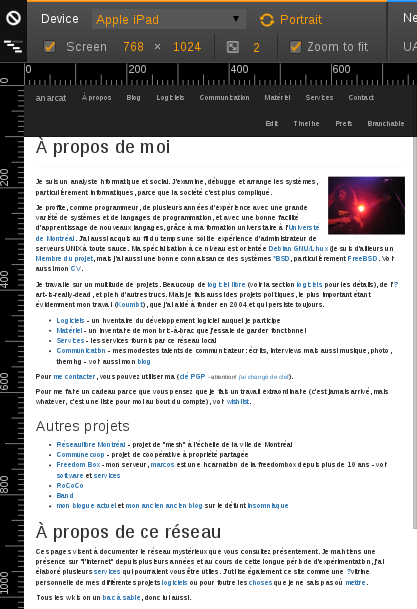
What changed The new theme keeps the distractions away, but ironically, it's slower than the previous theme even though there are no images and basically no colors at all. On my tests, it now loads in about 3.42 seconds on the "Regular 2G (250Kbps)" simulation of Chromium with 72KB in 12 requests. Whereas my tests with the previous theme were taking 3.25 seconds with 43.5KB in 17 requests. This is due to the Bootstrap CSS, which takes a whopping 19KB itself, but especially because I now load JQuery, which takes a whopping 32.8KB! And that is probably gzip-compressed, as the original is more around 90KB. But at least the thing is readable on phones and tablets now. Compare:

Samsung S3, before Screenshot of a fake rendering on the Samsung Galaxy S3 in night city

Samsung S3, after Screenshot of a fake rendering on the Samsung Galaxy S3 in bootstrap I like this: much simpler, purer version on smaller devices. And we see what counts: the freaking text. Of course, on tablets, it doesn't fare as well: the top menu gets wrapped around...

Apple iPad, before Screenshot of a fake rendering on the iPad in night city

Apple iPad, after Screenshot of a fake rendering on the iPad in bootstrap Apparently, the fix would be for me to "customize the @grid-float-breakpoint variable" in LESS (which I thought was a pager, but seems to be a CSS preprocessor, graaah). Still, I think it's better that way, more readable, and less crufty.

How it was done After doing a thorough evaluation of all the Bootstrap ikiwiki themes I could find (there are more than 4 at least!), I figured I prefered the Jak Linux one. It seemed to be better implemented than the others, cleaner, and I liked the mean black border on top. Black is cool. Oh, and I liked the subtle footer as well. Subtle is cool. Unfortunately, that theme originally required a custom plugin to have a menu on top, which i thought was silly. So I patched it to make it work with the sidebar plugin, which turned out to be trivially simple: just dump the sidebar content, and make the sidebar page have explicit HTML tags in it that match Bootstrap's required classes. I also added the regular action links in the top navbar, but that does overload it quite a bit. I also did some code cleanups and various other small changes, all of which are available in my personnal git repo.

What doesn't work So of course, there are always problems. The first problem is the extra bandwidth usage. Not sure that can be fixed, other than switching to the upcoming Bootstrap 4, which is smaller than Bootstrap 3, bizarrely. The more annoying problems are weird alignment issues. If the screen gets two narrow without kicking some collapse rules in place (the iPad bug above), the navbar rows overflow and look ugly. Even more bizarre, in some cases the right navbar can just completely disappear, in fact, that's the only fix I could find: to assign the hidden-xs and hidden-sm classes to the navbar-right <UL> element. But then it just goes away, which is pretty darn stupid. Still - I assigned the classes to a few actions that seemed low priority, both in the theme and in the sidebar page. Similarly, the search form at the bottom of the page doesn't seem to want to fit in the footer properly. No idea why and I can't bother to figure that one out. I ended up merging this with the backlinks, tags and trails navigation items. Oh, and amazingly enough: comments are simply not rendered at all right now. Oops. I seemed to have picked the single bootstrap Ikiwiki theme that does *not* have comments rendering... Aaaargh. For now I just copy-pasted stuff from the [ramseydsilva][] theme and it looks pretty ugly, but at least it works. I ended up theming comments the same way i did for Night City, which looks pretty good, but is not in sync with the LESS stuff in Bootstrap. I also add to add back trails, backlinks and favicon... looks like the Jak theme wasn't made for a blog after all... but that's now fixed! :) Another improvement would be to change the font from the canonical Helvetica to something prettier, like suggested in Practical Typography, in the font recommendations section, or the presslabs checklist. So far I have settled on Mozilla's Fira font (which means, yes, one set of objects is actually loading from the CDN, sorry). Feedback welcome.

6 September 2015

Lunar: Reproducible builds: week 19 in Stretch cycle

What happened in the reproducible builds effort this week: Toolchain fixes Dmitry Shachnev uploaded sphinx/1.3.1-6 with improved patches from Val Lorentz. Chris Lamb submitted a patch for ibus-table which makes the output of ibus-table-createdb deterministic. Niko Tyni wrote a patch to make libmodule-build-perl linking order deterministic. Santiago Vila has been leading discussions on the best way to fix timestamps coming from Gettext POT files. Packages fixed The following 35 packages became reproducible due to changes in their build dependencies: apache-log4j2, dctrl-tools, dms, gitit, gnubik, isrcsubmit, mailutils, normaliz, oaklisp, octave-fpl, octave-specfun, octave-vrml, opencolorio, openvdb, pescetti, php-guzzlehttp, proofgeneral, pyblosxom, pyopencl, pyqi, python-expyriment, python-flask-httpauth, python-mzml, python-simpy, python-tidylib, reactive-streams, scmxx, shared-mime-info, sikuli, siproxd, srtp, tachyon, tcltk-defaults, urjtag, velvet. The following packages became reproducible after getting fixed: The package is not in yet in unstable, but linux/4.2-1~exp1 is now reproducible! Kudos to Ben Hutchings, and most fixes are already merged upstream. Some uploads fixed some reproducibility issues but not all of them: Patches submitted which have not made their way to the archive yet: reproducible.debian.net Some bugs that prevented packages to build successfully in the remote builders have been fixed. (h01ger) Two more amd64 build jobs have been removed from the Jenkins host in favor of six more on the new remote nodes. (h01ger) The munin graphs currently looks fine, so more amd64 jobs will probably be added in the next week. diffoscope development Version 32 of diffoscope has been released on September 3rd with the following new features: It also fixes many bugs. Head over to the changelog for the full list. Version 33 was released the day after to fix a bug introduced in the packaging. Documentation update Chris Lamb blessed the SOURCE_DATE_EPOCH specification with the version number 1.0 . Lunar documented how the .file assembler directive can help with random filenames in debug symbols. Package reviews 235 reviews have been removed, 84 added and 277 updated this week. 29 new FTBFS bugs were filled by Chris Lamb, Chris West (Faux), Daniel Stender, and Niko Tyni. New issues identified this week: random_order_in_ibus_table_createdb_output, random_order_in_antlr_output, nondetermistic_link_order_in_module_build, and timestamps_in_tex_documents. Misc. Thanks to Dhole and Thomas Vincent, the talk held at DebConf15 now has subtitles! Void Linux started to merge changes to make packages produced by xbps reproducible.

1 September 2015

Bits from Debian: New Debian Developers and Maintainers (July and August 2015)

The following contributors got their Debian Developer accounts in the last two months: The following contributors were added as Debian Maintainers in the last two months: Congratulations!

31 August 2015

Matthew Garrett: Working with the kernel keyring

The Linux kernel keyring is effectively a mechanism to allow shoving blobs of data into the kernel and then setting access controls on them. It's convenient for a couple of reasons: the first is that these blobs are available to the kernel itself (so it can use them for things like NFSv4 authentication or module signing keys), and the second is that once they're locked down there's no way for even root to modify them.

But there's a corner case that can be somewhat confusing here, and it's one that I managed to crash into multiple times when I was implementing some code that works with this. Keys can be "possessed" by a process, and have permissions that are granted to the possessor orthogonally to any permissions granted to the user or group that owns the key. This is important because it allows for the creation of keyrings that are only visible to specific processes - if my userspace keyring manager is using the kernel keyring as a backing store for decrypted material, I don't want any arbitrary process running as me to be able to obtain those keys[1]. As described in keyrings(7), keyrings exist at the session, process and thread levels of granularity.

This is absolutely fine in the normal case, but gets confusing when you start using sudo. sudo by default doesn't create a new login session - when you're working with sudo, you're still working with key posession that's tied to the original user. This makes sense when you consider that you often want applications you run with sudo to have access to the keys that you own, but it becomes a pain when you're trying to work with keys that need to be accessible to a user no matter whether that user owns the login session or not.

I spent a while talking to David Howells about this and he explained the easiest way to handle this. If you do something like the following:
$ sudo keyctl add user testkey testdata @u
a new key will be created and added to UID 0's user keyring (indicated by @u). This is possible because the keyring defaults to 0x3f3f0000 permissions, giving both the possessor and the user read/write access to the keyring. But if you then try to do something like:
$ sudo keyctl setperm 678913344 0x3f3f0000
where 678913344 is the ID of the key we created in the previous command, you'll get permission denied. This is because the default permissions on a key are 0x3f010000, meaning that the possessor has permission to do anything to the key but the user only has permission to view its attributes. The cause of this confusion is that although we have permission to write to UID 0's keyring (because the permissions are 0x3f3f0000), we don't possess it - the only permissions we have for this key are the user ones, and the default state for user permissions on new keys only gives us permission to view the attributes, not change them.

But! There's a way around this. If we instead do:
$ sudo keyctl add user testkey testdata @s
then the key is added to the current session keyring (@s). Because the session keyring belongs to us, we possess any keys within it and so we have permission to modify the permissions further. We can then do:
$ sudo keyctl setperm 678913344 0x3f3f0000
and it works. Hurrah! Except that if we log in as root, we'll be part of another session and won't be able to see that key. Boo. So, after setting the permissions, we should:
$ sudo keyctl link 678913344 @u
which ties it to UID 0's user keyring. Someone who logs in as root will then be able to see the key, as will any processes running as root via sudo. But we probably also want to remove it from the unprivileged user's session keyring, because that's readable/writable by the unprivileged user - they'd be able to revoke the key from underneath us!
$ sudo keyctl unlink 678913344 @s
will achieve this, and now the key is configured appropriately - UID 0 can read, modify and delete the key, other users can't.

This is part of our ongoing work at CoreOS to make rkt more secure. Moving the signing keys into the kernel is the first step towards rkt no longer having to trust the local writable filesystem[2]. Once keys have been enrolled the keyring can be locked down - rkt will then refuse to run any images unless they're signed with one of these keys, and even root will be unable to alter them.

[1] (obviously it should also be impossible to ptrace() my userspace keyring manager)
[2] Part of our Secure Boot work has been the integration of dm-verity into CoreOS. Once deployed this will mean that the /usr partition is cryptographically verified by the kernel at runtime, making it impossible for anybody to modify it underneath the kernel. / remains writable in order to permit local configuration and to act as a data store, and right now rkt stores its trusted keys there.

comment count unavailable comments

30 August 2015

DebConf team: DebConf15: Farewell, and thanks for all the Fisch (Posted by DebConf Team)

A week ago, we concluded our biggest DebConf ever! It was a huge success. Handwritten feedback note We are overwhelmed by the positive feedback, for which we re very grateful. We want to thank you all for participating in the talks; speakers and audience alike, in person or live over the global Internet it wouldn t be the fantastic DebConf experience without you! Many of our events were recorded and streamed live, and are now available for viewing, as are the slides and photos. To share a sense of the scale of what all of us accomplished together, we ve compiled a few statistics: Our very own designer Valessio Brito made a lovely video of impressions and images of the conference.
We re collecting impressions from attendees as well as links to press articles, including Linux Weekly News coverage of specific sessions of DebConf. If you find something not yet included, please help us by adding links to the wiki.
DebConf15 group photo (by Aigars Mahinovs)
We tried a few new ideas this year, including a larger number of invited and featured speakers than ever before. On the Open Weekend, some of our sponsors presented their career opportunities at our job fair, which was very well attended. And a diverse selection of entertainment options provided the necessary breaks and ample opportunity for socialising. On the last Friday, the Oscar-winning documentary Citizenfour was screened, with some introductory remarks by Jacob Appelbaum and a remote address by its director, Laura Poitras, and followed by a long Q&A session by Jacob. DebConf15 was also the first DebConf with organised childcare (including a Teckids workshop for kids of age 8-16), which our DPL Neil McGovern standardised for the future: it s a thing now, he said. The participants used the week before the conference for intensive work, sprints and workshops, and throughout the main conference, significant progress was made on Debian and Free Software. Possibly the most visible was the endeavour to provide reproducible builds, but the planning of the next stable release stretch received no less attention. Groups like the Perl team, the diversity outreach programme and even DebConf organisation spent much time together discussing next steps and goals, and hundreds of commits were made to the archive, as well as bugs closed. DebConf15 was an amazing conference, it brought together hundreds of people, some oldtimers as well as plenty of new contributors, and we all had a great time, learning and collaborating with each other, says Margarita Manterola of the organiser team, and continues: The whole team worked really hard, and we are all very satisfied with the outcome. Another organiser, Martin Krafft adds: We mainly provided the infrastructure and space. A lot of what happened during the two weeks was thanks to our attendees. And that s what makes DebConf be DebConf. Photo of hostel staff wearing DebConf15 staff t-shirts (by Martin Krafft) Our organisation was greatly supported by the staff of the conference venue, the Jugendherberge Heidelberg International, who didn t take very long to identify with our diverse group, and who left no wishes untried. The venue itself was wonderfully spacious and never seemed too full as people spread naturally across the various conference rooms, the many open areas, the beergarden, the outside hacklabs and the lawn. The network installed specifically for our conference in collaboration with the nearby university, the neighbouring zoo, and the youth hostel provided us with a 1 Gbps upstream link, which we managed to almost saturate. The connection will stay in place, leaving the youth hostel as one with possibly the fastest Internet connection in the state. And the kitchen catered high-quality food to all attendees and their special requirements. Regional beer and wine, as well as local specialities, were provided at the bistro. DebConf exists to bring people together, which includes paying for travel, food and accomodation for people who could not otherwise attend. We would never have been able to achieve what we did without the support of our generous sponsors, especially our Platinum Sponsor Hewlett-Packard. Thank you very much. See you next year in Cape Town, South Africa!
The DebConf16 logo with white background

Ben Hutchings: Securing www.decadent.org.uk

Sven Hoexter replied to my previous entry to say that WoSign also provides free DV TLS certificates. What's more, they allow up to 10 alternate names, unlike StartSSL. So I've gone ahead with a new certificate for www.decadent.org.uk and other virtual servers including git.decadent.org.uk. WoSign sensibly mandates a key length of 2048 bits, and together with the default TLS configuration for Apache in Debian 'jessie' this resulted in a A- rating from Qualys SSL Server Test. I then disabled non-PFS and otherwise weak cipher suites in /etc/apache2/mods-enabled/ssl.conf:
SSLCipherSuite HIGH:!aNULL:!kRSA:!3DES
This resulted in an A rating. Finally, I added redirection of all plaintext HTTP connections to HTTP-S (which is easier than working out how to make the virtual server work with and without TLS, anyway). I enabled HSTS for each VirtualHost:
Header always set Strict-Transport-Security "max-age=31536000; includeSubDomains"
This resulted in an A+ rating. These web sites will now be inaccessible to Java 6 and IE on Windows XP, but that's no great loss (1 in 1500 hits over the past few weeks).

29 August 2015

Francois Marier: Letting someone ssh into your laptop using Pagekite

In order to investigate a bug I was running into, I recently had to give my colleague ssh access to my laptop behind a firewall. The easiest way I found to do this was to create an account for him on my laptop and setup a pagekite frontend on my Linode server and a pagekite backend on my laptop.

Frontend setup Setting up my Linode server in order to make the ssh service accessible and proxy the traffic to my laptop was fairly straightforward. First, I had to install the pagekite package (already in Debian and Ubuntu) and open up a port on my firewall by adding the following to both /etc/network/iptables.up.rules and /etc/network/ip6tables.up.rules:
-A INPUT -p tcp --dport 10022 -j ACCEPT
Then I created a new CNAME for my server in DNS:
pagekite.fmarier.org.   3600    IN  CNAME   fmarier.org.
With that in place, I started the pagekite frontend using this command:
pagekite --clean --isfrontend --rawports=virtual --ports=10022 --domain=raw:pagekite.fmarier.org:Password1

Backend setup After installing the pagekite and openssh-server packages on my laptop and creating a new user account:
adduser roc
I used this command to connect my laptop to the pagekite frontend:
pagekite --clean --frontend=pagekite.fmarier.org:10022 --service_on=raw/22:pagekite.fmarier.org:localhost:22:Password1

Client setup Finally, my colleague needed to add the folowing entry to ~/.ssh/config:
Host pagekite.fmarier.org
  CheckHostIP no
  ProxyCommand /bin/nc -X connect -x %h:10022 %h %p
and install the netcat-openbsd package since other versions of netcat don't work. On Fedora, we used netcat-openbsd-1.89 successfully, but this newer package may also work. He was then able to ssh into my laptop via ssh roc@pagekite.fmarier.org.

Making settings permanent I was quite happy settings things up temporarily on the command-line, but it's also possible to persist these settings and to make both the pagekite frontend and backend start up automatically at boot. See the documentation for how to do this on Debian and Fedora.

28 August 2015

Ben Hutchings: Securing my own blog

Yeah I know, a bit ironic that this isn't available over HTTP-S. I could reuse the mail server certificate to make https://decadent.org.uk/ work...

Ben Hutchings: Securing my own blog

Yeah I know, a bit ironic that this isn't available over HTTP-S. I could reuse the mail server certificate to make https://decadent.org.uk/ work...

Ben Hutchings: Securing my own blog

Yeah I know, a bit ironic that this isn't available over HTTP-S. I could reuse the mail server certificate to make https://decadent.org.uk/ work...

25 August 2015

Lunar: Reproducible builds: week 17 in Stretch cycle

A good amount of the Debian reproducible builds team had the chance to enjoy face-to-face interactions during DebConf15.
Names in red and blue were all present at DebConf15
Picture of the  reproducible builds  talk during DebConf15
Hugging people with whom one has been working tirelessly for months gives a lot of warm-fuzzy feelings. Several recorded and hallway discussions paved the way to solve the remaining issues to get reproducible builds part of Debian proper. Both talks from the Debian Project Leader and the release team mentioned the effort as important for the future of Debian. A forty-five minutes talk presented the state of the reproducible builds effort. It was then followed by an hour long roundtable to discuss current blockers regarding dpkg, .buildinfo and their integration in the archive. Picture of the  reproducible builds  roundtable during DebConf15 Toolchain fixes Reiner Herrmann submitted a patch to make rdfind sort the processed files before doing any operation. Chris Lamb proposed a new patch for wheel implementing support for SOURCE_DATE_EPOCH instead of the custom WHEEL_FORCE_TIMESTAMP. akira sent one making man2html SOURCE_DATE_EPOCH aware. St phane Glondu reported that dpkg-source would not respect tarball permissions when unpacking under a umask of 002. After hours of iterative testing during the DebConf workshop, Sandro Knau created a test case showing how pdflatex output can be non-deterministic with some PNG files. Packages fixed The following 65 packages became reproducible due to changes in their build dependencies: alacarte, arbtt, bullet, ccfits, commons-daemon, crack-attack, d-conf, ejabberd-contrib, erlang-bear, erlang-cherly, erlang-cowlib, erlang-folsom, erlang-goldrush, erlang-ibrowse, erlang-jiffy, erlang-lager, erlang-lhttpc, erlang-meck, erlang-p1-cache-tab, erlang-p1-iconv, erlang-p1-logger, erlang-p1-mysql, erlang-p1-pam, erlang-p1-pgsql, erlang-p1-sip, erlang-p1-stringprep, erlang-p1-stun, erlang-p1-tls, erlang-p1-utils, erlang-p1-xml, erlang-p1-yaml, erlang-p1-zlib, erlang-ranch, erlang-redis-client, erlang-uuid, freecontact, givaro, glade, gnome-shell, gupnp, gvfs, htseq, jags, jana, knot, libconfig, libkolab, libmatio, libvsqlitepp, mpmath, octave-zenity, openigtlink, paman, pisa, pynifti, qof, ruby-blankslate, ruby-xml-simple, timingframework, trace-cmd, tsung, wings3d, xdg-user-dirs, xz-utils, zpspell. The following packages became reproducible after getting fixed: Uploads that might have fixed reproducibility issues: Some uploads fixed some reproducibility issues but not all of them: Patches submitted which have not made their way to the archive yet: St phane Glondu reported two issues regarding embedded build date in omake and cduce. Aur lien Jarno submitted a fix for the breakage of make-dfsg test suite. As binutils now creates deterministic libraries by default, Aur lien's patch makes use of a wrapper to give the U flag to ar. Reiner Herrmann reported an issue with pound which embeds random dhparams in its code during the build. Better solutions are yet to be found. reproducible.debian.net Package pages on reproducible.debian.net now have a new layout improving readability designed by Mattia Rizzolo, h01ger, and Ulrike. The navigation is now on the left as vertical space is more valuable nowadays. armhf is now enabled on all pages except the dashboard. Actual tests on armhf are expected to start shortly. (Mattia Rizzolo, h01ger) The limit on how many packages people can schedule using the reschedule script on Alioth has been bumped to 200. (h01ger) mod_rewrite is now used instead of JavaScript for the form in the dashboard. (h01ger) Following the rename of the software, debbindiff has mostly been replaced by either diffoscope or differences in generated HTML and IRC notification output. Connections to UDD have been made more robust. (Mattia Rizzolo) diffoscope development diffoscope version 31 was released on August 21st. This version improves fuzzy-matching by using the tlsh algorithm instead of ssdeep. New command line options are available: --max-diff-input-lines and --max-diff-block-lines to override limits on diff input and output (Reiner Herrmann), --debugger to dump the user into pdb in case of crashes (Mattia Rizzolo). jar archives should now be detected properly (Reiner Herrman). Several general code cleanups were also done by Chris Lamb. strip-nondeterminism development Andrew Ayer released strip-nondeterminism version 0.010-1. Java properties file in jar should now be detected more accurately. A missing dependency spotted by St phane Glondu has been added. Testing directory ordering issues: disorderfs During the reproducible builds workshop at DebConf, participants identified that we were still short of a good way to test variations on filesystem behaviors (e.g. file ordering or disk usage). Andrew Ayer took a couple of hours to create disorderfs. Based on FUSE, disorderfs in an overlay filesystem that will mount the content of a directory at another location. For this first version, it will make the order in which files appear in a directory random. Documentation update Dhole documented how to implement support for SOURCE_DATE_EPOCH in Python, bash, Makefiles, CMake, and C. Chris Lamb started to convert the wiki page describing SOURCE_DATE_EPOCH into a Freedesktop-like specification in the hope that it will convince more upstream to adopt it. Package reviews 44 reviews have been removed, 192 added and 77 updated this week. New issues identified this week: locale_dependent_order_in_devlibs_depends, randomness_in_ocaml_startup_files, randomness_in_ocaml_packed_libraries, randomness_in_ocaml_custom_executables, undeterministic_symlinking_by_rdfind, random_build_path_by_golang_compiler, and images_in_pdf_generated_by_latex. 117 new FTBFS bugs have been reported by Chris Lamb, Chris West (Faux), and Niko Tyni. Misc. Some reproducibility issues might face us very late. Chris Lamb noticed that the test suite for python-pykmip was now failing because its test certificates have expired. Let's hope no packages are hiding a certificate valid for 10 years somewhere in their source! Pictures courtesy and copyright of Debian's own paparazzi: Aigars Mahinovs.

21 August 2015

Simon Kainz: DUCK challenge: Final week

Well, here are the stats for the final week of the DUCK challenge as well as DebConf15: So we had 21 packages fixed and uploaded by 14 different uploaders. People were really working hard on this during DebConf. A big "Thank You" to you!! Since the start of this challenge, a total of 89 packages, were fixed. Here is a quick overview:
Week 1 Week 2 Week 3 Week 4 Week 5 Week 6 Week 7
# Packages 10 15 10 14 10 9 21
Total 10 25 35 49 59 68 89
Thank you all for participating - either on purpose or "accidentially": Some people were really surprised as i sneaked up on them at DebConf15, confronting them with a green lighter! I just tried to put even more fun into Debian, i hope this worked out Pevious articles are here: Week 1, Week 2, Week 3, Week 4, Week 5,Week 6.

20 August 2015

Simon Kainz: vim in Heidelberg

Following the tradition of Love Locks, apparently there is someone really in love with vim in Heidelberg! Valerie Found at the Old Bridge in Heidelberg during DebConf15.

Norbert Preining: Introduction to CafeOBJ in English and Japanese

Thanks to Takahiro Seino we are now having a gentle introduction to CafeOBJ for beginners, in both English and Japanese, available. Please head over to the CafeOBJ web site for details, or jump directly to the English or Japanese version. cafeobj-logo We are also preparing for a new release with largely improved CITP support and better term inspection. Stay tuned.

19 August 2015

Aigars Mahinovs: Poetry night - Space

A bi-lingual poem created on inspiration from Debconf15 and in honor of Debconf Poetry Night by Rhonda
Du ... Du hast ... Du hast apt ... Du hast apt gebrochen! Reconsider your disk usage, And APT might work again.
(as usual - licenced as CC-BY V3+ or GPLv2+)

Russ Allbery: C TAP Harness 3.4

Nothing particularly exciting in this release of my C testing framework, but aherbert on Github found a segfault in the runtests driver with test lists that had only blank lines and comments. Since I'm releasing some other software anyway, that seemed to be worth a release. While preparing the release, I found that the test for spelling errors in the POD documentation had some bad assumptions about how to canonicalize paths, so you may want to grab a new copy of that if you're using it in your projects. You can get the latest release from the C TAP Harness distribution page.

18 August 2015

Aigars Mahinovs: Debconf 15 group photo

The long awaited group photo from Debconf15 is now available: here and here. Due to its spectacular glory, the Google Photos could not handle the massive 52 Mb, and 19283*8740=168.5Mpix of awesomness, so there is only a half-size version. Also I plan to have a lightning talk on Thursday on how exactly such things are made :)

Next.

Previous.