Search Results: "ag"

11 February 2025

Freexian Collaborators: Debian Contributions: Python 3.13 as the default Python 3 version, Fixing qtpaths6 for cross compilation, sbuild support for Salsa CI, Rails 7 transition, DebConf preparations and more! (by Anupa Ann Joseph)

Debian Contributions: 2025-01 Contributing to Debian is part of Freexian s mission. This article covers the latest achievements of Freexian and their collaborators. All of this is made possible by organizations subscribing to our Long Term Support contracts and consulting services.

Python 3.13 is now the default Python 3 version in Debian, by Stefano Rivera and Colin Watson The Python 3.13 as default transition has now completed. The next step is to remove Python 3.12 from the archive, which should be very straightforward, it just requires rebuilding C extension packages in no particular order. Stefano fixed some miscellaneous bugs blocking the completion of the 3.13 as default transition.

Fixing qtpaths6 for cross compilation, by Helmut Grohne While Qt5 used to use qmake to query installation properties, Qt6 is moving more and more to CMake and to ease that transition it relies on more qtpaths. Since this tool is not naturally aware of the architecture it is called for, it tends to produce results for the build architecture. Therefore, more than 100 packages were picking up a multiarch directory for the build architecture during cross builds. In collaboration with the Qt/KDE team and Sandro Knau in particular (none affiliated with Freexian), we added an architecture-specific wrapper script in the same way qmake has one for Qt5 and Qt6 already. The relevant CMake module has been updated to prefer the triplet-prefixed wrapper. As a result, most of the KDE packages now cross build on unstable ready in time for the trixie release.

/usr-move, by Helmut Grohne In December, Emil S dergren reported that a live-build was not working for him and in January, Colin Watson reported that the proposed mitigation for debian-installer-utils would practically fail. Both failures were to be attributed to a wrong understanding of implementation-defined behavior in dpkg-divert. As a result, all M18 mitigations had to be reviewed and many of them replaced. Many have been uploaded already and all instances have received updated patches. Even though dumat has been in operation for more than a year, it gained recent changes. For one thing, analysis of architectures other than amd64 was requested. Chris Hofstaedler (not affiliated with Freexian) kindly provided computing resources for repeatedly running it on the larger set. Doing so revealed various cross-architecture undeclared file conflicts in gcc, glibc, and binutils-z80, but it also revealed a previously unknown /usr-move issue in rpi.rpi-common. On top of that, dumat produced false positive diagnostics and wrongly associated Debian bugs in some cases, both of which have now been fixed. As a result, a supposedly fixed python3-sepolicy issue had to be reopened.

rebootstrap, by Helmut Grohne As much as we think of our base system as stable, it is changing a lot and the architecture cross bootstrap tooling is very sensitive to such changes requiring permanent maintenance. A problem that recently surfaced was that building a binutils cross toolchain would result in a binutils-for-host package that would not be practically installable as it would depend on a binutils-common package that was not built. This turned into an examination of binutils-common and noticing that it actually differed across architectures even though it should not. Johannes Schauer Marin Rodrigues (not affiliated with Freexian) and Colin Watson kindly helped brainstorm possible solutions. Eventually, Helmut provided a patch to move gprofng bits out of binutils-common. Independently, Matthias Klose (not affiliated with Freexian) split out binutils-gold into a separate source package. As a result, binutils-common is now equal across architectures and can be marked Multi-Arch: foreign resolving the initial problem.

Salsa CI, by Santiago Ruano Rinc n Santiago continued the work about the sbuild support for Salsa CI, that was mentioned in the previous month report. The !568 merge request that created the new build image was merged, making it easier to test !569 with external projects. Santiago used a fork of the debusine repo to try the draft !569, and some issues were spotted, and part of them fixed. This is the last debusine pipeline run with the current !569: https://salsa.debian.org/santiago/debusine/-/pipelines/794233. One of the last improvements relates to how to enable projects to customize the pipeline, in an equivalent way than they currently do in the extract-source and build jobs. While this is work-in-progress, the results are rather promising. Next steps include deciding on introducing schroot support for bookworm, bookworm-security, and older releases, as they are done in the official debian buildd.

DebConf preparations, by Stefano Rivera and Santiago Ruano Rinc n DebConf will be happening in Brest, France, in July. Santiago continued the DebConf 25 organization work, looking for catering providers. Both Stefano and Santiago have been reaching out to some potential sponsors. DebConf depends on sponsors to cover the organization cost, if your company depends on Debian, please consider sponsoring DebConf. Stefano has been winding up some of the finances from previous DebConfs. Finalizing reimbursements to team members from DebConf 23, and handling some outstanding issues from DebConf 24. Stefano and the rest of the DebConf committee have been reviewing bids for DebConf 26, to select the next venue.

Ruby 3.3 is now the default Ruby interpreter, by Lucas Kanashiro Ruby 3.3 is about to become the default Ruby interpreter for Trixie. Many bugs were fixed by Lucas and the Debian Ruby team during the sprint hold in Paris during Jan 27-31. The next step is to remove support of Ruby 3.1, which is the alternative Ruby interpreter for now. Thanks to the Debian Release team for all the support, especially Emilio Pozuelo Monfort.

Rails 7 transition, by Lucas Kanashiro Rails 6 has been shipped by Debian since Bullseye, and as a WEB framework, many issues (especially security related issues) have been encountered and the maintainability of it becomes harder and harder. With that in mind, during the Debian Ruby team sprint last month, the transition to Rack 3 (an important dependency of rails containing many breaking changes) was started in Debian unstable, it is ongoing. Once it is done, the Rails 7 transition will take place, and Rails 7 should be shipped in Debian Trixie.

Miscellaneous contributions
  • Stefano improved a poor ImportError for users of the turtle module on Python 3, who haven t installed the python3-tk package.
  • Stefano updated several packages to new upstream releases.
  • Stefano added the Python extension to the re2 package, allowing for the use of the Google RE2 regular expression library as a direct replacement for the standard library re module.
  • Stefano started provisioning a new physical server for the debian.social infrastructure.
  • Carles improved simplemonitor (documentation on systemd integration, worked with upstream for fixing a bug).
  • Carles upgraded packages to new upstream versions: python-ring-doorbell and python-asyncclick.
  • Carles did po-debconf translations to Catalan: reviewed 44 packages and submitted translations to 90 packages (via salsa merge requests or bugtracker bugs).
  • Carles maintained po-debconf-manager with small fixes.
  • Rapha l worked on some outstanding DEP-14 merge request and participated in the associated discussion. The discussions have been more contentious than anticipated, somewhat exacerbated by Otto s desire to conclude fast while the required tool support is not yet there.
  • Rapha l, with the help of Philipp Kern from the DSA team, upgraded tracker.debian.org to use Django 4.2 (from bookworm-backports) which in turn enabled him to configure authentication via salsa.debian.org. It s now possible to login to tracker.debian.org with your salsa credentials!
  • Rapha l updated zim a nice desktop wiki that is very handy to organize your day-to-day digital life to the latest upstream version (0.76).
  • Helmut sent patches for 10 cross build failures.
  • Helmut continued working on a tool for memory-based concurrency limit of builds.
  • Helmut NMUed libtool, opensysusers and virtualbox.
  • Enrico tried to support Helmut in working out tricky usrmerge situations
  • Thorsten Alteholz uploaded a new upstream version of brlaser.
  • Colin Watson upgraded 33 Python packages to new upstream versions, including fixes for CVE-2024-42353, CVE-2024-47532, and CVE-2025-22153.
  • Emilio Pozuelo managed various transitions, and fixed various RC bugs (telepathy-glib, xorg, xserver-xorg-video-vesa, apitrace, mesa).
  • Anupa attended the monthly team meeting for Debian publicity team and shared the social media stats.
  • Anupa assisted Jean-Pierre Giraud in the point release announcement for Debian 12.9 and published the Micronews.
  • Anupa took part in multiple Debian publicity team discussions regarding our presence in social media platforms.

10 February 2025

Petter Reinholdtsen: Some of my 2024 free software activities

It is a while since I posted a summary of the free software and open culture activities and projects I have worked on. Here is a quick summary of the major ones from last year. I guess the biggest project of the year has been migrating orphaned packages in Debian without a version control system to have a git repository on salsa.debian.org. When I started in April around 450 the orphaned packages needed git. I've since migrated around 250 of the packages to a salsa git repository, and around 40 packages were left when I took a break. Not sure who did the around 160 conversions I was not involved in, but I am very glad I got some help on the project. I stopped partly because some of the remaining packages needed more disk space to build than I have available on my development machine, and partly because some had a strange build setup I could not figure out. I had a time budget of 20 minutes per package, if the package proved problematic and likely to take longer, I moved to another package. Might continue later, if I manage to free up some disk space. Another rather big project was the translation to Norwegian Bokm l and publishing of the first book ever published by a S mi woman, the M ter vi liv eller d d? book by Elsa Laula, with a PD0 and CC-BY license. I released it during the summer, and to my surprise it has already sold several copies. As I suck at marketing, I did not expect to sell any. A smaller, but more long term project (for more than 10 years now), and related to orphaned packages in Debian, is my project to ensure a simple way to install hardware related packages in Debian when the relevant hardware is present in a machine. It made a fairly big advance forward last year, partly because I have been poking and begging package maintainers and upstream developers to include AppStream metadata XML in their packages. I've also released a few new versions of the isenkram system with some robustness improvements. Today 127 packages in Debian provide such information, allowing isenkram-lookup to propose them. Will keep pushing until the around 35 package names currently hard coded in the isenkram package are down to zero, so only information provided by individual packages are used for this feature. As part of the work on AppStream, I have sponsored several packages into Debian where the maintainer wanted to fix the issue but lacked direct upload rights. I've also sponsored a few other packages, when approached by the maintainer. I would also like to mention two hardware related packages in particular where I have been involved, the megactl and mfi-util packages. Both work with the hardware RAID systems in several Dell PowerEdge servers, and the first one is already available in Debian (and of course, proposed by isenkram when used on the appropriate Dell server), the other is waiting for NEW processing since this autumn. I manage several such Dell servers and would like the tools needed to monitor and configure these RAID controllers to be available from within Debian out of the box. Vaguely related to hardware support in Debian, I have also been trying to find ways to help out the Debian ROCm team, to improve the support in Debian for my artificial idiocy (AI) compute node. So far only uploaded one package, helped test the initial packaging of llama.cpp and tried to figure out how to get good speech recognition like Whisper into Debian. I am still involved in the LinuxCNC project, and organised a developer gathering in Norway last summer. A new one is planned the summer of 2025. I've also helped evaluate patches and uploaded new versions of LinuxCNC into Debian. After a 10 years long break, we managed to get a new and improved upstream version of lsdvd released just before Christmas. As I use it regularly to maintain my DVD archive, I was very happy to finally get out a version supporting DVDDiscID useful for uniquely identifying DVDs. I am dreaming of a Internet service mapping DVD IDs to IMDB movie IDs, to make life as a DVD collector easier. My involvement in Norwegian archive standardisation and the free software implementation of the vendor neutral Noark 5 API continued for the entire year. I've been pushing patches into both the API and the test code for the API, participated in several editorial meetings regarding the Noark 5 Tjenestegrensesnitt specification, submitted several proposals for improvements for the same. We also organised a small seminar for Noark 5 interested people, and is organising a new seminar in a month. Part of the year was spent working on and coordinating a Norwegian Bokm l translation of the marvellous children's book Ada and Zangemann , which focus on the right to repair and control your own property, and the value of controlling the software on the devices you own. The translation is mostly complete, and is now waiting for a transformation of the project and manuscript to use Docbook XML instead of a home made semi-text based format. Great progress is being made and the new book build process is almost complete. I have also been looking at how to companies in Norway can use free software to report their accounting summaries to the Norwegian government. Several new regulations make it very hard for companies to do use free software for accounting, and I would like to change this. Found a few drafts for opening up the reporting process, and have read up on some of the specifications, but nothing much is working yet. These were just the top of the iceberg, but I guess this blog post is long enough now. If you would like to help with any of these projects, please get in touch, either directly on the project mailing lists and forums, or with me via email, IRC or Signal. :) As usual, if you use Bitcoin and want to show your support of my activities, please send Bitcoin donations to my address 15oWEoG9dUPovwmUL9KWAnYRtNJEkP1u1b.

Russ Allbery: Review: The Scavenger Door

Review: The Scavenger Door, by Suzanne Palmer
Series: Finder Chronicles #3
Publisher: DAW
Copyright: 2021
ISBN: 0-7564-1516-0
Format: Kindle
Pages: 458
The Scavenger Door is a science fiction adventure and the third book of the Finder Chronicles. While each of the books of this series stand alone reasonably well, I would still read the series in order. Each book has some spoilers for the previous book. Fergus is back on Earth following the events of Driving the Deep, at loose ends and annoying his relatives. To get him out of their hair, his cousin sends him into the Scottish hills to find a friend's missing flock of sheep. Fergus finds things professionally, but usually not livestock. It's an easy enough job, though; the lead sheep was wearing a tracker and he just has to get close enough to pick it up. The unexpected twist is also finding a metal fragment buried in a hillside that has some strange resonance with the unwanted gift that Fergus got in Finder. Fergus's alien friend Ignatio is so alarmed by the metal fragment that he turns up in person in Fergus's cousin's bar in Scotland. Before he arrives, Fergus gets a mysteriously infuriating warning visit from alien acquaintances he does not consider friends. He has, as usual, stepped into something dangerous and complicated, and now somehow it's become his problem. So, first, we get lots of Ignatio, who is an enthusiastic large ball of green fuzz with five limbs who mostly speaks English but does so from an odd angle. This makes me happy because I love Ignatio and his tendency to take things just a bit too literally.
SANTO'S, the sign read. Under it, in smaller letters, was CURIOSITIES AND INCONVENIENCES FOR COMMENDABLE SUMS. "Inconveniences sound just like my thing," Fergus said. "You two want to wait in the car while I check it out?" "Oh, no, I am not missing this," Isla said, and got out of the podcar. "I am uncertain," Ignatio said. "I would like some curiouses, but not any inconveniences. Please proceed while I decide, and if there is also murdering or calamity or raisins, you will yell right away, yes?"
Also, if your story setup requires a partly-understood alien artifact that the protagonist can get some explanations for but not have the mystery neatly solved for them, Ignatio's explanations are perfect.
"It is a door. A doorbell. A... peephole? A key. A control light. A signal. A stop-and-go sign. A road. A bridge. A beacon. A call. A map. A channel. A way," Ignatio said. "It is a problem to explain. To say a doorkey is best, and also wrong. If put together, a path may be opened." "And then?" "And then the bad things on the other side, who we were trying to lock away, will be free to travel through."
Second, the thing about Palmer's writing that continues to impress me is her ability to take a standard science fiction plot, one whose variations I've read probably dozens of times before, and still make it utterly engrossing. This book is literally a fetch quest. There are a bunch of scattered fragments, Fergus has to find them and keep them from being assembled, various other people are after the same fragments, and Fergus either has to get there first or get the fragments back from them. If you haven't read this book before, you've played the video game or watched the movie. The threat is basically a Stargate SG-1 plot. And yet, this was so much fun. The characters are great. This book leans less on found family than the last one and a bit more on actual family. When I started reading this series, Fergus felt a bit bland in the way that adventure protagonists sometimes can, but he's fleshed out nicely as the series goes along. He's not someone who tends to indulge in big emotions, but now the reader can tell that's because he's the kind of person who finds things to do in order to keep from dwelling on things he doesn't want to think about. He's unflappable in a quietly competent way while still having a backstory and emotional baggage and a rich inner life that the reader sees in glancing fragments. We get more of Fergus's backstory, particularly around Mars, but I like that it's told in anecdotes and small pieces. The last thing Fergus wants to do is wallow in his past trauma, so he doesn't and finds something to do instead. There's just enough detail around the edges to deepen his character without turning the book into a story about Fergus's emotions and childhood. It's a tricky balancing act that Palmer handles well. There are also more sentient ships, and I am so in favor of more sentient ships.
"When I am adding a new skill, I import diagnostic and environmental information specific to my platform and topology, segregate the skill subroutines to a dedicated, protected logical space, run incremental testing on integration under all projected scenarios and variables, and then when I am persuaded the code is benevolent, an asset, and provides the functionality I was seeking, I roll it into my primary processing units," Whiro said. "You cannot do any of that, because if I may speak in purely objective terms you may incorrectly interpret as personal, you are made of squishy, unreliable goo."
We get the normal pieces of a well-done fetch quest: wildly varying locations, some great local characters (the US-based trauma surgeons on vacation in Australia were my favorites), and believable antagonists. There are two other groups looking for the fragments, and while one of them is the standard villain in this sort of story, the other is an apocalyptic cult whose members Fergus mostly feels sorry for and who add just the right amount of surreality to the story. The more we find out about them, the more believable they are, and the more they make this world feel like realistic messy chaos instead of the obvious (and boring) good versus evil patterns that a lot of adventure plots collapse into. There are things about this book that I feel like I should be criticizing, but I just can't. Fetch quests are usually synonymous with lazy plotting, and yet it worked for me. The way Fergus gets dumped into the middle of this problem starts out feeling as arbitrary and unmotivated as some video game fetch quest stories, but by the end of the book it starts to make sense. The story could arguably be described as episodic and cliched, and yet I was thoroughly invested. There are a few pacing problems at the very end, but I was too invested to care that much. This feels like a book that's better than the sum of its parts. Most of the story is future-Earth adventure with some heist elements. The ending goes in a rather different direction but stays at the center of the classic science fiction genre. The Scavenger Door reaches a satisfying conclusion, but there are a ton of unanswered questions that will send me on to the fourth (and reportedly final) novel in the series shortly. This is great stuff. It's not going to win literary awards, but if you're in the mood for some classic science fiction with fun aliens and neat ideas, but also benefiting from the massive improvements in characterization the genre has seen in the past forty years, this series is perfect. Highly recommended. Followed by Ghostdrift. Rating: 9 out of 10

9 February 2025

Philipp Kern: 20 years

20 years ago, I got my Debian Developer account. I was 18 at the time, it was Shrove Tuesday and - as is customary - I was drunk when I got the email. There was so much that I did not know - which is also why the process took 1.5 years from the time I applied. I mostly only maintained a package or two. I'm still amazed that Christian Perrier and Joerg Jaspert put sufficient trust in me at that time. Nevertheless now feels like a good time for a personal reflection of my involvement in Debian.
During my studies I took on more things. In January 2008 I joined the Release Team as an assistant, which taught me a lot of code review. I have been an Application Manager on the side.
Going to my first Debconf was really a turning point. My first one was Mar del Plata in Argentina in August 2008, when I was 21. That was quite an excitement, traveling that far from Germany for the first time. The personal connections I made there made quite the difference. It was also a big boost for motivation. I attended 8 (Argentina), 9 (Spain), 10 (New York), 11 (Bosnia and Herzegovina), 12 (Nicaragua), 13 (Switzerland), 14 (Portland), 15 (Germany), 16 (South Africa), and hopefully I'll make it to this year's in Brest. At all of them I did not see much of the countries as I prioritized all of my time focused on Debian, even skipping some of the day trips in favor of team meetings. Yet I am very grateful to the project (and to my employer) for shipping me there.I ended up as Stable Release Manager for a while, from August 2008 - when Martin Zobel-Helas moved into DSA - until I got dropped in March 2020. I think my biggest achievements were pushing for the creation of -updates in favor of a separate volatile archive and a change of the update policy to allow for more common sense updates in the main archive vs. the very strict "breakage or security" policy we had previously. I definitely need to call out Adam D. Barratt for being the partner in crime, holding up the fort for even longer.In 2009 I got too annoyed at the existing wanna-build team not being responsive anymore and pushed for the system to be given to a new team. I did not build it and significant contributions were done by other people (like Andreas Barth and Joachim Breitner, and later Aurelien Jarno). I mostly reworked the way the system was triggered, investigated when it broke and was around when people wanted things merged.
In the meantime I worked sys/netadmin jobs while at university, both paid and as a volunteer with the students' council. For a year or two I was the administrator of a System z mainframe IBM donated to my university. We had a mainframe course and I attended two related conferences. That's where my s390(x) interest came from, although credit for the port needs to go to Aurelien Jarno.
Since completing university in 2013 I have been working for a company for almost 12 years. Debian experience was very relevant to the job and I went on maintaining a Linux distro or two at work - before venturing off into security hardening. People in megacorps - in my humble opinion - disappear from the volunteer projects because a) they might previously have been studying and thus had a lot more time on their hands and b) the job is too similar to the volunteer work and thus the same brain cells used for work are exhausted and can't be easily reused for volunteer work. I kept maintaining a couple of things (buildds, some packages) - mostly because of a sense of commitment and responsibility, but otherwise kind of scaled down my involvement. I also felt less connected as I dropped off IRC.Last year I finally made it to Debian events again: MiniDebconf in Berlin, where we discussed the aftermath of the xz incident, and the Debian BSP in Salzburg. I rejoined IRC using the Matrix bridge. That also rekindled my involvement, with me guiding a new DD through NM and ending up in DSA. To be honest, only in the last two or three years I felt like a (more) mature old-timer.
I have a new gig at work lined up to start soon and next to that I have sysadmining for Debian. It is pretty motivating to me that I can just get things done - something that is much harder to achieve at work due to organizational complexities. It balances out some frustration I'd otherwise have. The work is different enough to be enjoyable and the people I work with are great.

The future
I still think the work we do in Debian is important, as much as I see a lack of appreciation in a world full of containers. We are reaping most of the benefits of standing on the shoulders of giants and of great decisions made in the past (e.g. the excellent Debian policy, but also the organizational model) that made Debian what it is today.Given the increase in size and complexity of what Debian ships - and the somewhat dwindling resource of developer time, it would benefit us to have better processes for large-scale changes across all packages. I greatly respect the horizontal effects that are currently being driven and that suck up a lot of energy.A lot of our infrastructure is also aging and not super well maintained. Many take it for granted that the services we have keep existing, but most are only maintained by a person or two, if even. Software stacks are aging and it is even a struggle to have all necessary packages in the next release.Hopefully I can contribute a bit or two to these efforts in the future.

Dave Hibberd: Radio Activity 10-16 Feb 2025

It s been quite the week of radio related nonsense for me, where I ve been channelling my time and brainspace for radio into activity on air and system refinements, not working on Debian.

POTA, Antennas and why do my toys not work? Having had my interest piqued by Ian at mastodon.radio, I looked online and spotted a couple of parks within stumbling distance of my house, that s good news! It looks like the list has been refactored and expanded since I last looked at it, so there are now more entities to activate and explore. My concerns about antennas noted last week rumbled on. There was a second strand to this concern too, my end fed 64:1 (or 49:1?!) transformer from MM0OPX sits in my mind as not having worked very well in Spain last year, and I want to get to the bottom of why. As with most things in my life, it s probably a me problem. I came up with a cunning plan - firstly, buy a new mast to replace the one I broke a few weeks back on Cat Law. Secondly, buy a couple of new connectors and some heatshrink to reterminate my cable that I m sure is broken. Spending more money on a problem never hurt anyone, right? Come Wednesday, the new toys arrived and I figured combining everything into one convenient night time walk and radio was a good plan. So I walk out to the nearest park with my LoRa APRS doofer going and see what happens: APRS-Map After circling a bit to find somewhere suitable (there appear to be construction works in the park!) I set up my gear in 2C with frost on the ground, called CQ, spotted and got nothing on either the end fed half wave or the cheap vertical. As it was too late for 20m, I tried 40 and a bit of 80 using the inbuilt tuner, but wasn t heard by stations I called or when calling independently. I packed everything up and lora-doofered my way home, mildly deflated.
Try it at home It still didn t sit with me that the end fed wasn t working, so come Friday night I set it up in the back garden/woods behind the house to try and diagnose why it wasn t working. Up it went, I worked some Irish stations pretty effortlessly, and down everything came. No complaints - the only things I did differently was have the feedpoint a little higher and check my power, limiting it to 10W. The G90 can do 20W, I wonder if running at that was saturating the core in the 64:1. At some point in the evening I stepped in some dog s shit too, and spent some time cleaning my boots outside to avoid further tramping the smell through the house. Win some, lose some.

Take it to the Hills On Friday, some of the other GM-ES Sota-ists had been out for an activity day. On account of me being busy in work, I couldn t go outside to play, but I figured a weekend of activity was on the books.

Saturday - A day above the clouds On Saturday I took myself up Tap O Noth, a favourite of mine for some reason, and Lord Arthur s Hill. Before I hit the hills, I took myself to the hackerspace and printed myself a K6ARK Winder and a guy ring for the mast, cut string, tied it together and wound the string on to the winder. I also took time to buzz out my wonky coax and it showed great continuity. Hmm, that can be continued later. I didn t quite get to crimping the radial network of the Aliexpress whip with a 12mm stud crimp, that can also be put on the TODO list.

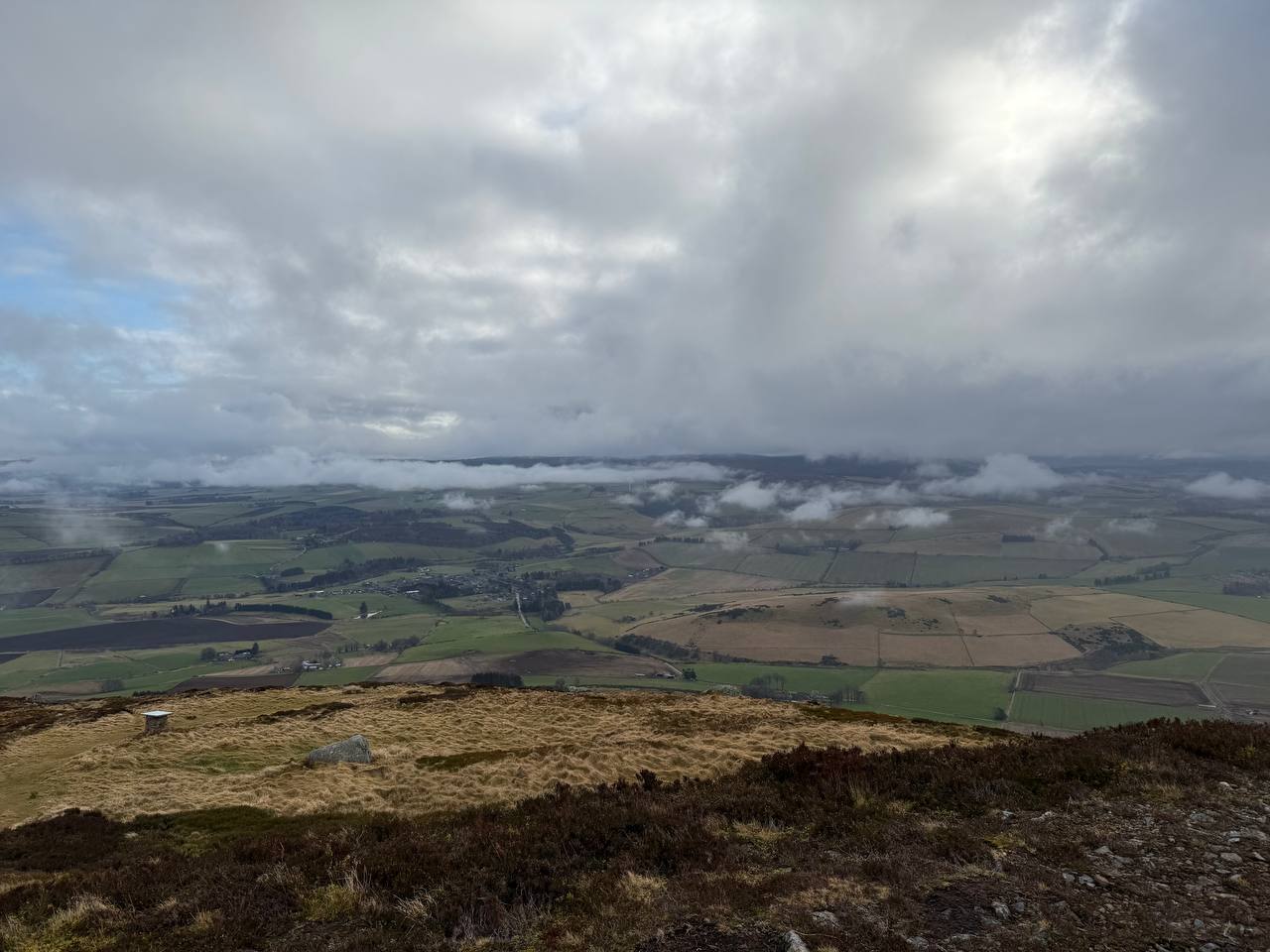
Tap O Noth Once finally out, the weather was a bit cloudy with passing snow showers, but in between the showers I was above the clouds and the air was clear: After a mild struggle on 2m, I set up the end fed the first hill and got to work from the old hill fort: The end fed worked flawlessly. Exactly as promised, switching between 7MHz, 14MHz, 21MHz and 28MHz without a tuner was perfect, I chased hills on all the bands, and had a great time. Apart from 40m, where there was absolutely no space due to a contest. That wasn t such a fun time! My fingers were bitterly cold, so on went the big gloves for the descent and I felt like I was warm by the time I made it back to the car. It worked so well, in fact, I took the 1/4 wave cheap vertical out my bag and decided to brave it on the next activation.
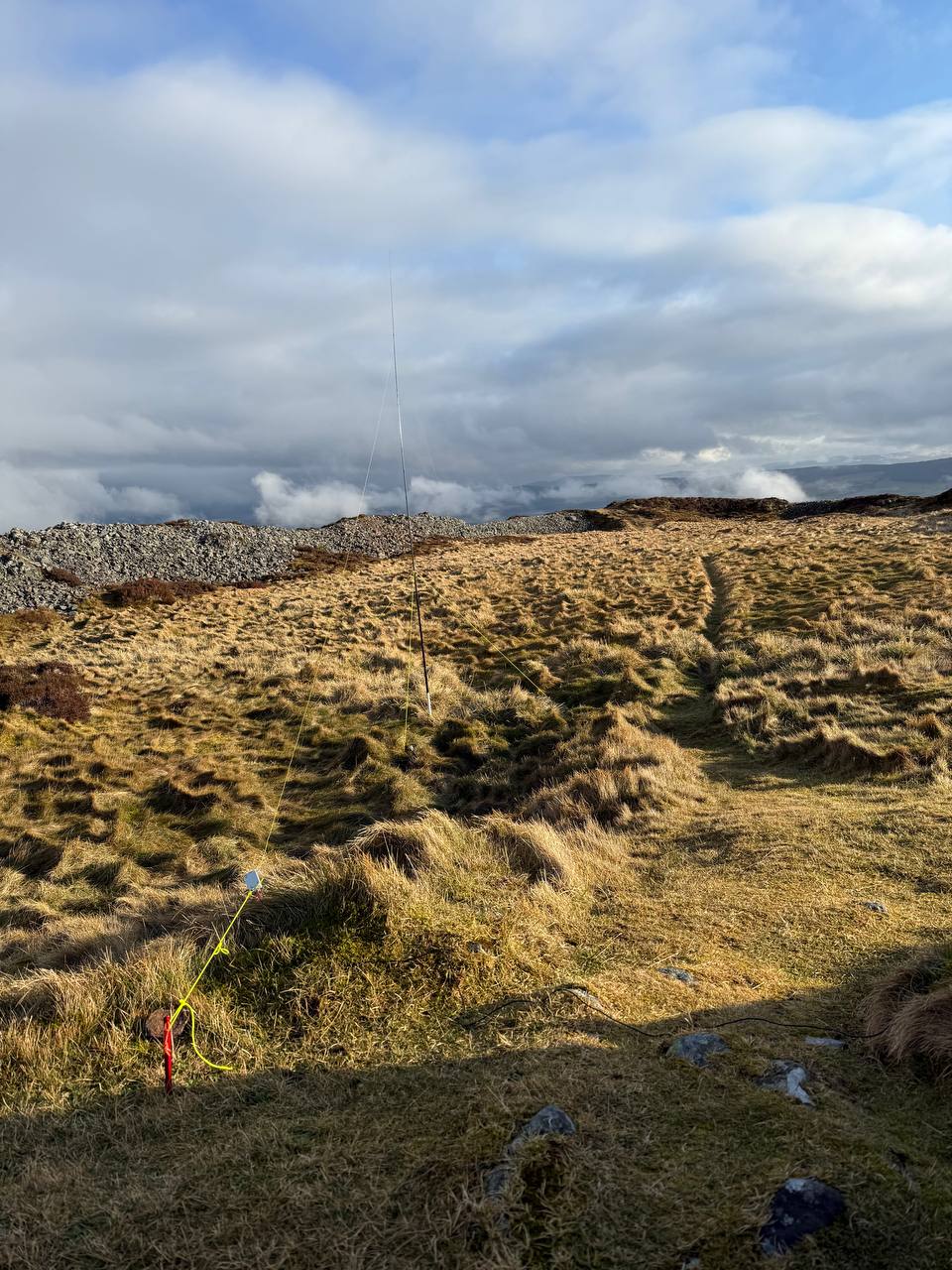
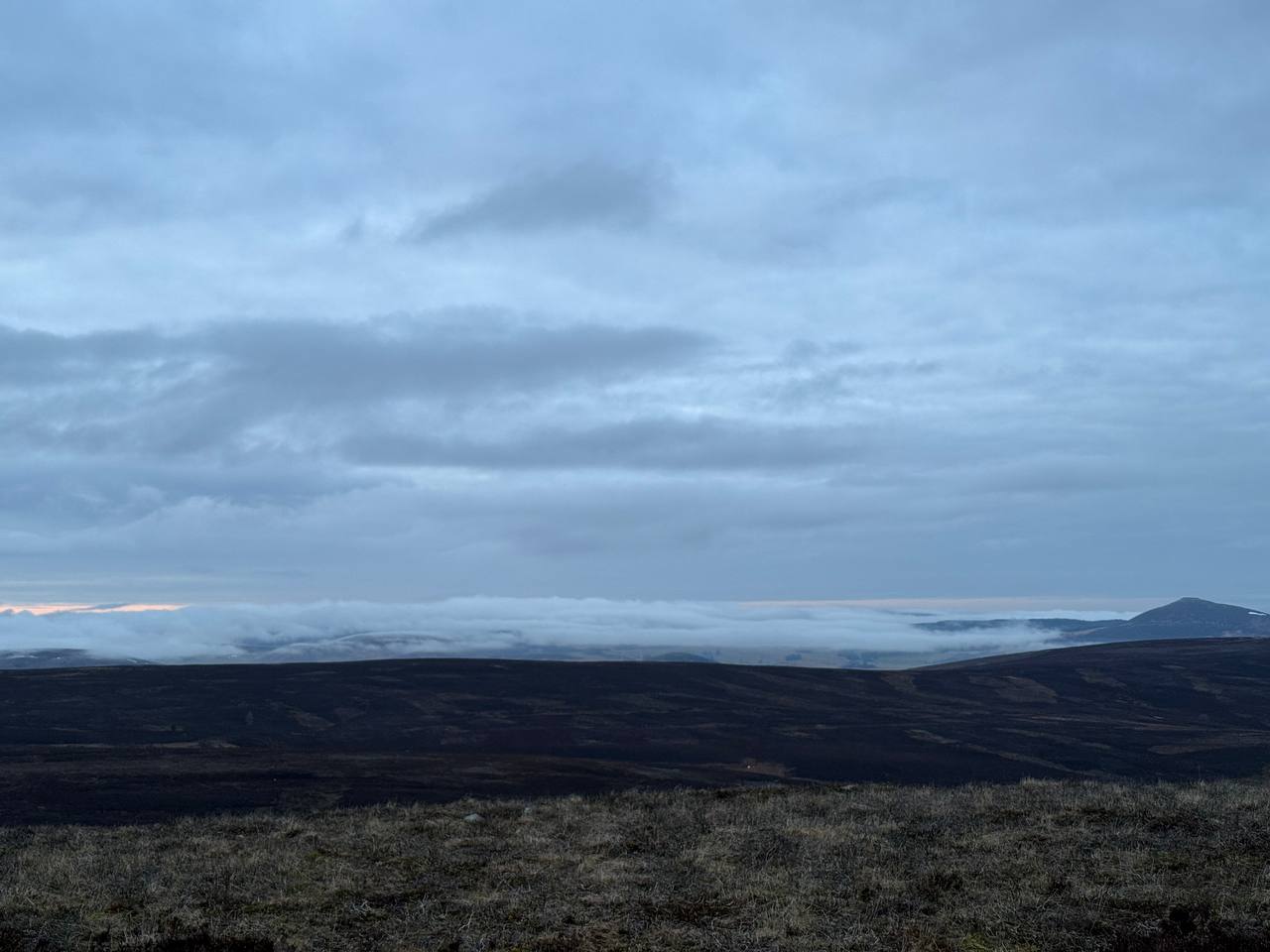
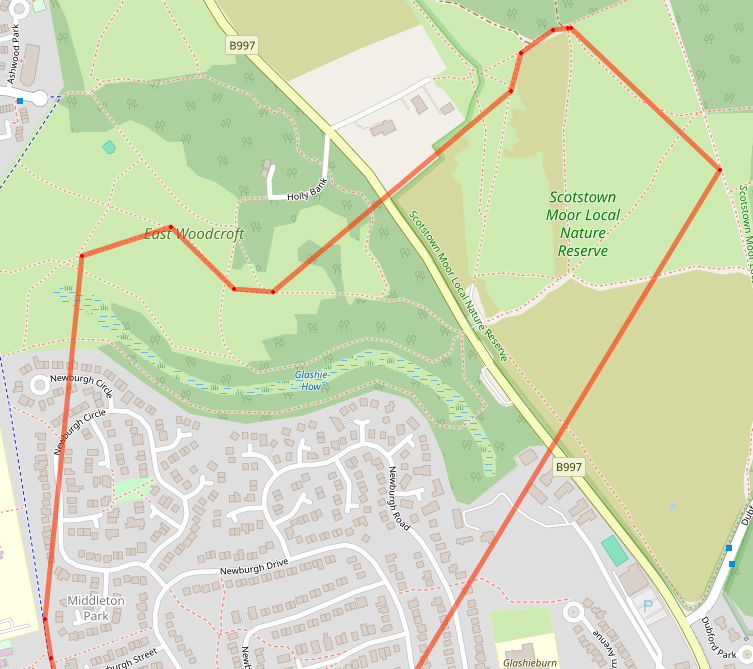
Lord Arthur s Hill GM5ALX has posted a .gpx to sotlas which is shorter than the other ascent, but much sharper - I figured this would be a fun new way to try up the hill! It takes you right through the heart of the Littlewood Park estate, and I felt a bit uncomfortable walking straight past the estate cottages, especially when there were vehicles moving and active work happening. Presumably this is where Lord Arthur lived, at the foot of his hill. I cut through the woods to the west of the cottages, disturbing some deer and many, many pheasants, but I met the path fairly quickly. From there it was a 2km walk, 300m vertical ascent. Short and sharp! At the top, I was treated to a view of the hill I had activated only an hour or so before, which is a view that always makes me smile: To get some height for the feedpoint, I wrapped the coax around my winder a couple of turns and trapped it with the elastic while draping the coax over the trig. This bought me some more height and I felt clever because of it. Maybe a pole would be easier? From here, I worked inter-G on 40m and had a wee pile up, eventually working 15 or so European stations on 20m. Pleased with that! I had been considering a third hill, but home was the call in the failing light. Back to the car I walked to find my key didn t have any battery, so out came the Audi App and I used the Internet of Things to unlock my car. The modern world is bizarre.
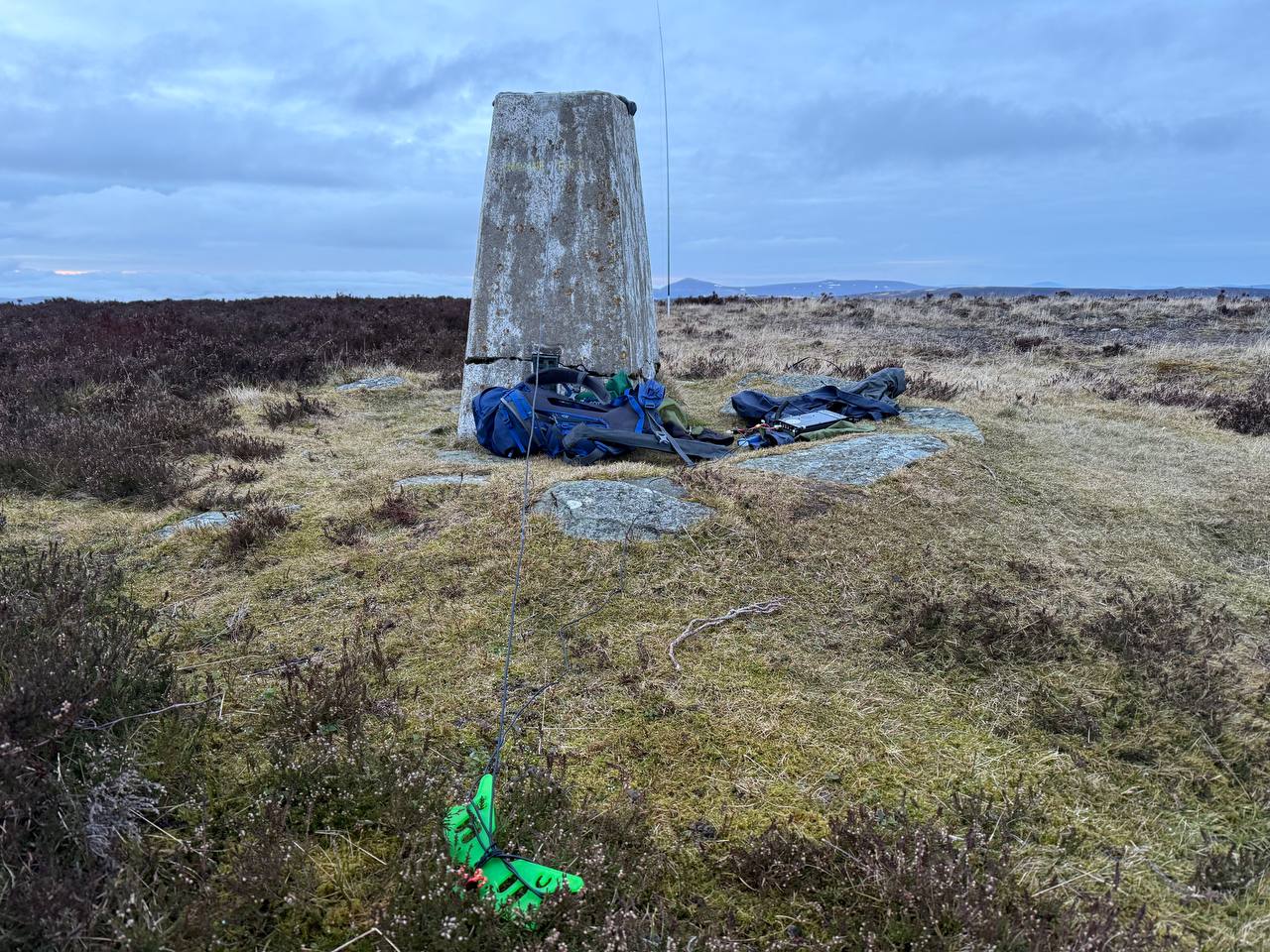
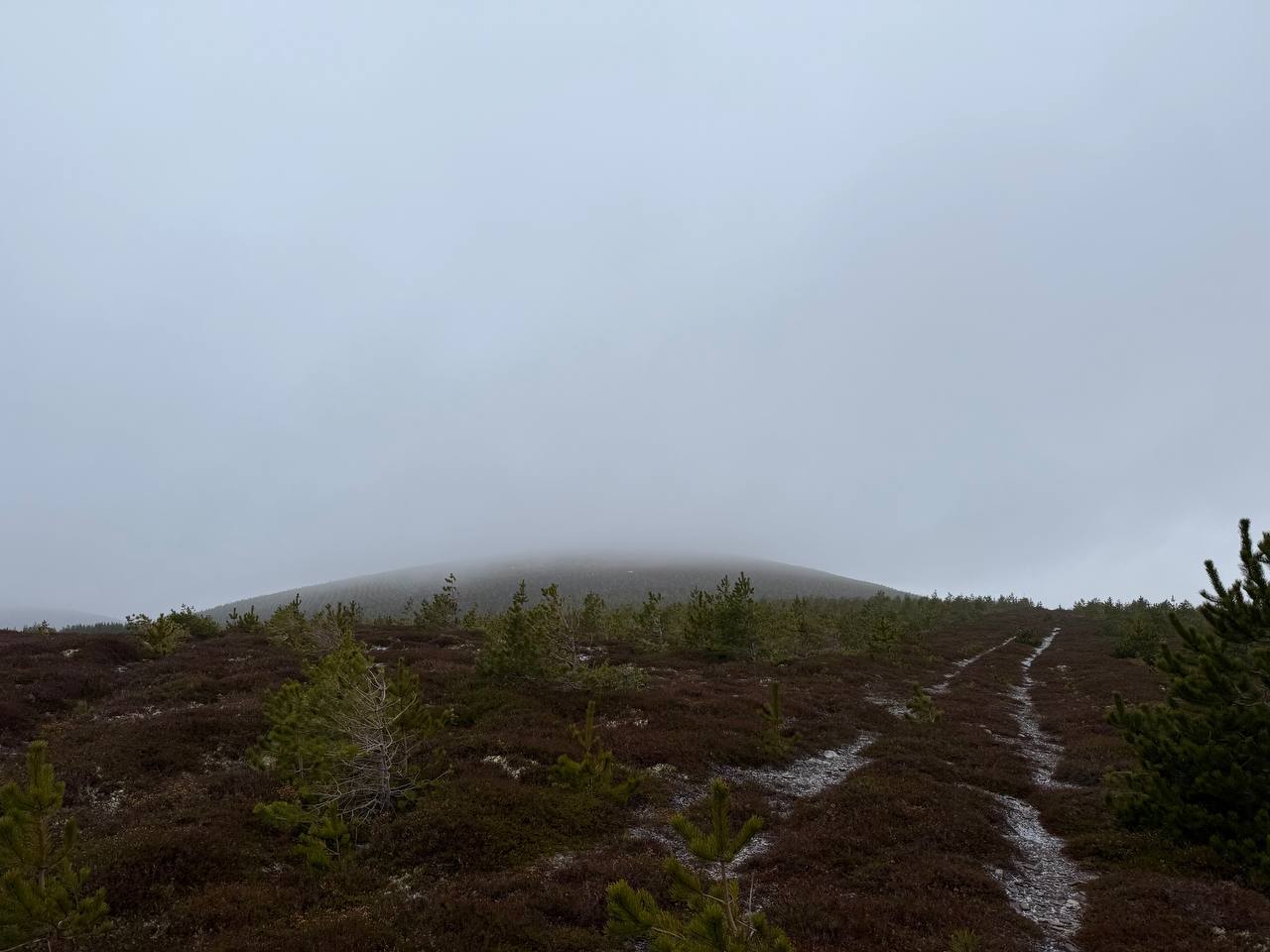
Sunday - Cloudy Head // Head in the Clouds Sunday started off migraney, so I stayed within the confines of my house until I felt safe driving! After some back and forth in my cloudy head, I opted for the easier option of Ladylea Hill as I wasn t feeling up for major physical exertion. It was a long drive, after which I felt more wonky, but I hit the path eventually - I run to Hibby Standard Time, a few hours to a few days behind the rest of GM/ES. I was ready to bail if my head didn t improve, but it turns out, fresh cold air, silence and bloodflow helped. Ladylea Hill was incredibly quiet, a feature I really appreciated. It feels incredibly remote, with a long winding drive down Glenbuchat, which still has ice on the surface of the lochs and standing water. A brooding summit crowned with grey cloud in fantastic scenery that only revealed itself upon the clouds blowing through: I set up at the cairn and picked up 30 contacts overall, split between 40m and 20m, with some inter-g on 40 and a couple of continental surprises. 20 had longer skip today, so I saw Spain, Finland, Slovenia, Poland. On teardown, I managed to snap the top segment of my brand new mast with my cold, clumsy fingers, but thankfully sotabeams stock replacements. More money at the problem, again. Back to the car, no app needed, and homeward bound as the light faded. At the end of the weekend, I find myself finally over 100 activator points and over 400 chaser points. Somehow I ve collected more points this year already than last year, the winter bonuses really do stack up!
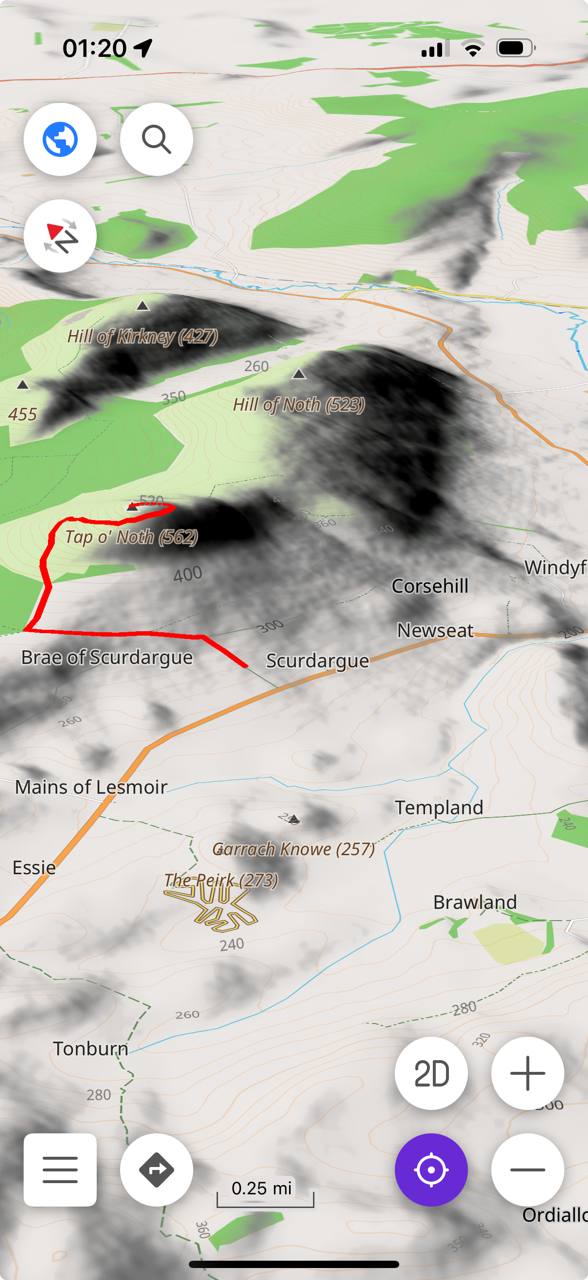
Addendum - OSMAnd & Open Street Map I ve been using OSMAnd on my iPhone quite extensively recently, I think offline mapping is super important if you re going out to get mildly lost in the hills. On more than one occasion, I have confidently set off in the wrong direction in the mist, and maps have saved my bacon! As you can download .gpx files, it s great to have them on the device and available for guidance in case you get lost, coupled with an offline map. Plus, as I drive around I love to have the dark red of a hill I ve walked appear on the map in my car dash or in my hand: This weekend I discovered it s possible to have height maps for nice 3d maps and contours marked on the map - you just need to download some additions for the maps. This is a really nice feature, it makes maps more pretty and more useful when you re in the middle of nowhere. Open Street Map also has designators for SOTA summits here and similar for POTA here GM5ALX has set to adding the summits around Scotland here. While the benefits aren t immediately obvious, it allows developers of mapping applications access to more data at no extra cost, really. It helps add depth to an already rich set of information, and allows us as radio amateurs to do more interesting things with maps and not be shackled to Apple/Google. Because it s open data, we can also fix things we find wrong as users. I like to fix road surfaces after I ve been cycling as that will feed forward to route planning through Komoot and data on my wahoo too, which can be modified with osm maps. In the future, it s possible to have an OSMAnd plugin highlighting local SOTA summits or mimicking features of sotl.as but offline. It s cool to be able to put open technologies to use like this in the field and really is the convergence point of all my favourite things!

Antoine Beaupr : A slow blogging year

Well, 2024 will be remembered, won't it? I guess 2025 already wants to make its mark too, but let's not worry about that right now, and instead let's talk about me. A little over a year ago, I was gloating over how I had such a great blogging year in 2022, and was considering 2023 to be average, then went on to gather more stats and traffic analysis... Then I said, and I quote:
I hope to write more next year. I've been thinking about a few posts I could write for work, about how things work behind the scenes at Tor, that could be informative for many people. We run a rather old setup, but things hold up pretty well for what we throw at it, and it's worth sharing that with the world...
What a load of bollocks.

A bad year for this blog 2024 was the second worst year ever in my blogging history, tied with 2009 at a measly 6 posts for the year:
anarcat@angela:anarc.at$ curl -sSL https://anarc.at/blog/   grep 'href="\./'   grep -o 20[0-9][0-9]   sort   uniq -c   sort -nr   grep -v 2025   tail -3
      6 2024
      6 2009
      3 2014
I did write about my work though, detailing the migration from Gitolite to GitLab we completed that year. But after August, total radio silence until now.

Loads of drafts It's not that I have nothing to say: I have no less than five drafts in my working tree here, not counting three actual drafts recorded in the Git repository here:
anarcat@angela:anarc.at$ git s blog
## main...origin/main
?? blog/bell-bot.md
?? blog/fish.md
?? blog/kensington.md
?? blog/nixos.md
?? blog/tmux.md
anarcat@angela:anarc.at$ git grep -l '\!tag draft'
blog/mobile-massive-gallery.md
blog/on-dying.mdwn
blog/secrets-recovery.md
I just don't have time to wrap those things up. I think part of me is disgusted by seeing my work stolen by large corporations to build proprietary large language models while my idols have been pushed to suicide for trying to share science with the world. Another part of me wants to make those things just right. The "tagged drafts" above are nothing more than a huge pile of chaotic links, far from being useful for anyone else than me, and even then. The on-dying article, in particular, is becoming my nemesis. I've been wanting to write that article for over 6 years now, I think. It's just too hard.

Writing elsewhere There's also the fact that I write for work already. A lot. Here are the top-10 contributors to our team's wiki:
anarcat@angela:help.torproject.org$ git shortlog --numbered --summary --group="format:%al"   head -10
  4272  anarcat
   423  jerome
   117  zen
   116  lelutin
   104  peter
    58  kez
    45  irl
    43  hiro
    18  gaba
    17  groente
... but that's a bit unfair, since I've been there half a decade. Here's the last year:
anarcat@angela:help.torproject.org$ git shortlog --since=2024-01-01 --numbered --summary --group="format:%al"   head -10
   827  anarcat
   117  zen
   116  lelutin
    91  jerome
    17  groente
    10  gaba
     8  micah
     7  kez
     5  jnewsome
     4  stephen.swift
So I still write the most commits! But to truly get a sense of the amount I wrote in there, we should count actual changes. Here it is by number of lines (from commandlinefu.com):
anarcat@angela:help.torproject.org$ git ls-files   xargs -n1 git blame --line-porcelain   sed -n 's/^author //p'   sort -f   uniq -ic   sort -nr   head -10
  99046 Antoine Beaupr 
   6900 Zen Fu
   4784 J r me Charaoui
   1446 Gabriel Filion
   1146 Jerome Charaoui
    837 groente
    705 kez
    569 Gaba
    381 Matt Traudt
    237 Stephen Swift
That, of course, is the entire history of the git repo, again. We should take only the last year into account, and probably ignore the tails directory, as sneaky Zen Fu imported the entire docs from another wiki there...
anarcat@angela:help.torproject.org$ find [d-s]* -type f -mtime -365   xargs -n1 git blame --line-porcelain 2>/dev/null   sed -n 's/^author //p'   sort -f   uniq -ic   sort -nr   head -10
  75037 Antoine Beaupr 
   2932 J r me Charaoui
   1442 Gabriel Filion
   1400 Zen Fu
    929 Jerome Charaoui
    837 groente
    702 kez
    569 Gaba
    381 Matt Traudt
    237 Stephen Swift
Pretty good! 75k lines. But those are the files that were modified in the last year. If we go a little more nuts, we find that:
anarcat@angela:help.torproject.org$ $ git-count-words-range.py    sort -k6 -nr   head -10
parsing commits for words changes from command: git log '--since=1 year ago' '--format=%H %al'
anarcat 126116 - 36932 = 89184
zen 31774 - 5749 = 26025
groente 9732 - 607 = 9125
lelutin 10768 - 2578 = 8190
jerome 6236 - 2586 = 3650
gaba 3164 - 491 = 2673
stephen.swift 2443 - 673 = 1770
kez 1034 - 74 = 960
micah 772 - 250 = 522
weasel 410 - 0 = 410
I wrote 126,116 words in that wiki, only in the last year. I also deleted 37k words, so the final total is more like 89k words, but still: that's about forty (40!) articles of the average size (~2k) I wrote in 2022. (And yes, I did go nuts and write a new log parser, essentially from scratch, to figure out those word diffs. I did get the courage only after asking GPT-4o for an example first, I must admit.) Let's celebrate that again: I wrote 90 thousand words in that wiki in 2024. According to Wikipedia, a "novella" is 17,500 to 40,000 words, which would mean I wrote about a novella and a novel, in the past year. But interestingly, if I look at the repository analytics. I certainly didn't write that much more in the past year. So that alone cannot explain the lull in my production here.

Arguments Another part of me is just tired of the bickering and arguing on the internet. I have at least two articles in there that I suspect is going to get me a lot of push-back (NixOS and Fish). I know how to deal with this: you need to write well, consider the controversy, spell it out, and defuse things before they happen. But that's hard work and, frankly, I don't really care that much about what people think anymore. I'm not writing here to convince people. I have stop evangelizing a long time ago. Now, I'm more into documenting, and teaching. And, while teaching, there's a two-way interaction: when you give out a speech or workshop, people can ask questions, or respond, and you all learn something. When you document, you quickly get told "where is this? I couldn't find it" or "I don't understand this" or "I tried that and it didn't work" or "wait, really? shouldn't we do X instead", and you learn. Here, it's static. It's my little soapbox where I scream in the void. The only thing people can do is scream back.

Collaboration So. Let's see if we can work together here. If you don't like something I say, disagree, or find something wrong or to be improved, instead of screaming on social media or ignoring me, try contributing back. This site here is backed by a git repository and I promise to read everything you send there, whether it is an issue or a merge request. I will, of course, still read comments sent by email or IRC or social media, but please, be kind. You can also, of course, follow the latest changes on the TPA wiki. If you want to catch up with the last year, some of the "novellas" I wrote include: (Well, no, you can't actually follow changes on a GitLab wiki. But we have a wiki-replica git repository where you can see the latest commits, and subscribe to the RSS feed.) See you there!

Antoine Beaupr : Qalculate hacks

This is going to be a controversial statement because some people are absolute nerds about this, but, I need to say it. Qalculate is the best calculator that has ever been made. I am not going to try to convince you of this, I just wanted to put out my bias out there before writing down those notes. I am a total fan. This page will collect my notes of cool hacks I do with Qalculate. Most examples are copy-pasted from the command-line interface (qalc(1)), but I typically use the graphical interface as it's slightly better at displaying complex formulas. Discoverability is obviously also better for the cornucopia of features this fantastic application ships.

Qalc commandline primer On Debian, Qalculate's CLI interface can be installed with:
apt install qalc
Then you start it with the qalc command, and end up on a prompt:
anarcat@angela:~$ qalc
> 
Then it's a normal calculator:
anarcat@angela:~$ qalc
> 1+1
  1 + 1 = 2
> 1/7
  1 / 7   0.1429
> pi
  pi   3.142
> 
There's a bunch of variables to control display, approximation, and so on:
> set precision 6
> 1/7
  1 / 7   0.142857
> set precision 20
> pi
  pi   3.1415926535897932385
When I need more, I typically browse around the menus. One big issue I have with Qalculate is there are a lot of menus and features. I had to fiddle quite a bit to figure out that set precision command above. I might add more examples here as I find them.

Bandwidth estimates I often use the data units to estimate bandwidths. For example, here's what 1 megabit per second is over a month ("about 300 GiB"):
> 1 megabit/s * 30 day to gibibyte 
  (1 megabit/second)   (30 days)   301.7 GiB
Or, "how long will it take to download X", in this case, 1GiB over a 100 mbps link:
> 1GiB/(100 megabit/s)
  (1 gibibyte) / (100 megabits/second)   1 min + 25.90 s

Password entropy To calculate how much entropy (in bits) a given password structure, you count the number of possibilities in each entry (say, [a-z] is 26 possibilities, "one word in a 8k dictionary" is 8000), extract the base-2 logarithm, multiplied by the number of entries. For example, an alphabetic 14-character password is:
> log2(26*2)*14
  log (26   2)   14   79.81
... 80 bits of entropy. To get the equivalent in a Diceware password with a 8000 word dictionary, you would need:
> log2(8k)*x = 80
  (log (8   000)   x) = 80  
  x   6.170
... about 6 words, which gives you:
> log2(8k)*6
  log (8   1000)   6   77.79
78 bits of entropy.

Exchange rates You can convert between currencies!
> 1 EUR to USD
  1 EUR   1.038 USD
Even fake ones!
> 1 BTC to USD
  1 BTC   96712 USD
This relies on a database pulled form the internet (typically the central european bank rates, see the source). It will prompt you if it's too old:
It has been 256 days since the exchange rates last were updated.
Do you wish to update the exchange rates now? y
As a reader pointed out, you can set the refresh rate for currencies, as some countries will require way more frequent exchange rates. The graphical version has a little graphical indicator that, when you mouse over, tells you where the rate comes from.

Other conversions Here are other neat conversions extracted from my history
> teaspoon to ml
  teaspoon = 5 mL
> tablespoon to ml
  tablespoon = 15 mL
> 1 cup to ml 
  1 cup   236.6 mL
> 6 L/100km to mpg
  (6 liters) / (100 kilometers)   39.20 mpg
> 100 kph to mph
  100 kph   62.14 mph
> (108km - 72km) / 110km/h
  ((108 kilometers)   (72 kilometers)) / (110 kilometers/hour)  
  19 min + 38.18 s

Completion time estimates This is a more involved example I often do.

Background Say you have started a long running copy job and you don't have the luxury of having a pipe you can insert pv(1) into to get a nice progress bar. For example, rsync or cp -R can have that problem (but not tar!). (Yes, you can use --info=progress2 in rsync, but that estimate is incremental and therefore inaccurate unless you disable the incremental mode with --no-inc-recursive, but then you pay a huge up-front wait cost while the entire directory gets crawled.)

Extracting a process start time First step is to gather data. Find the process start time. If you were unfortunate enough to forget to run date --iso-8601=seconds before starting, you can get a similar timestamp with stat(1) on the process tree in /proc with:
$ stat /proc/11232
  File: /proc/11232
  Size: 0               Blocks: 0          IO Block: 1024   directory
Device: 0,21    Inode: 57021       Links: 9
Access: (0555/dr-xr-xr-x)  Uid: (    0/    root)   Gid: (    0/    root)
Access: 2025-02-07 15:50:25.287220819 -0500
Modify: 2025-02-07 15:50:25.287220819 -0500
Change: 2025-02-07 15:50:25.287220819 -0500
 Birth: -
So our start time is 2025-02-07 15:50:25, we shave off the nanoseconds there, they're below our precision noise floor. If you're not dealing with an actual UNIX process, you need to figure out a start time: this can be a SQL query, a network request, whatever, exercise for the reader.

Saving a variable This is optional, but for the sake of demonstration, let's save this as a variable:
> start="2025-02-07 15:50:25"
  save("2025-02-07T15:50:25"; start; Temporary; ; 1) =
  "2025-02-07T15:50:25"

Estimating data size Next, estimate your data size. That will vary wildly with the job you're running: this can be anything: number of files, documents being processed, rows to be destroyed in a database, whatever. In this case, rsync tells me how many bytes it has transferred so far:
# rsync -ASHaXx --info=progress2 /srv/ /srv-zfs/
2.968.252.503.968  94%    7,63MB/s    6:04:58  xfr#464440, ir-chk=1000/982266) 
Strip off the weird dots in there, because that will confuse qalculate, which will count this as:
  2.968252503968 bytes   2.968 B
Or, essentially, three bytes. We actually transferred almost 3TB here:
  2968252503968 bytes   2.968 TB
So let's use that. If you had the misfortune of making rsync silent, but were lucky enough to transfer entire partitions, you can use df (without -h! we want to be more precise here), in my case:
Filesystem              1K-blocks       Used  Available Use% Mounted on
/dev/mapper/vg_hdd-srv 7512681384 7258298036  179205040  98% /srv
tank/srv               7667173248 2870444032 4796729216  38% /srv-zfs
(Otherwise, of course, you use du -sh $DIRECTORY.)

Digression over bytes Those are 1 K bytes which is actually (and rather unfortunately) Ki, or "kibibytes" (1024 bytes), not "kilobytes" (1000 bytes). Ugh.
> 2870444032 KiB
  2870444032 kibibytes   2.939 TB
> 2870444032 kB
  2870444032 kilobytes   2.870 TB
At this scale, those details matter quite a bit, we're talking about a 69GB (64GiB) difference here:
> 2870444032 KiB - 2870444032 kB
  (2870444032 kibibytes)   (2870444032 kilobytes)   68.89 GB
Anyways. Let's take 2968252503968 bytes as our current progress. Our entire dataset is 7258298064 KiB, as seen above.

Solving a cross-multiplication We have 3 out of four variables for our equation here, so we can already solve:
> (now-start)/x = (2996538438607 bytes)/(7258298064 KiB) to h
  ((actual   start) / x) = ((2996538438607 bytes) / (7258298064
  kibibytes))
  x   59.24 h
The entire transfer will take about 60 hours to complete! Note that's not the time left, that is the total time. To break this down step by step, we could calculate how long it has taken so far:
> now-start
  now   start   23 h + 53 min + 6.762 s
> now-start to s
  now   start   85987 s
... and do the cross-multiplication manually, it's basically:
x/(now-start) = (total/current)
so:
x = (total/current) * (now-start)
or, in Qalc:
> ((7258298064  kibibytes) / ( 2996538438607 bytes) ) *  85987 s
  ((7258298064 kibibytes) / (2996538438607 bytes))   (85987 secondes)  
  2 d + 11 h + 14 min + 38.81 s
It's interesting it gives us different units here! Not sure why.

Now and built-in variables The now here is actually a built-in variable:
> now
  now   "2025-02-08T22:25:25"
There is a bewildering list of such variables, for example:
> uptime
  uptime = 5 d + 6 h + 34 min + 12.11 s
> golden
  golden   1.618
> exact
  golden = ( (5) + 1) / 2

Computing dates In any case, yay! We know the transfer is going to take roughly 60 hours total, and we've already spent around 24h of that, so, we have 36h left. But I did that all in my head, we can ask more of Qalc yet! Let's make another variable, for that total estimated time:
> total=(now-start)/x = (2996538438607 bytes)/(7258298064 KiB)
  save(((now   start) / x) = ((2996538438607 bytes) / (7258298064
  kibibytes)); total; Temporary; ; 1)  
  2 d + 11 h + 14 min + 38.22 s
And we can plug that into another formula with our start time to figure out when we'll be done!
> start+total
  start + total   "2025-02-10T03:28:52"
> start+total-now
  start + total   now   1 d + 11 h + 34 min + 48.52 s
> start+total-now to h
  start + total   now   35 h + 34 min + 32.01 s
That transfer has ~1d left, or 35h24m32s, and should complete around 4 in the morning on February 10th. But that's icing on top. I typically only do the cross-multiplication and calculate the remaining time in my head. I mostly did the last bit to show Qalculate could compute dates and time differences, as long as you use ISO timestamps. Although it can also convert to and from UNIX timestamps, it cannot parse arbitrary date strings (yet?).

Other functionality Qalculate can:
  • Plot graphs;
  • Use RPN input;
  • Do all sorts of algebraic, calculus, matrix, statistics, trigonometry functions (and more!);
  • ... and so much more!
I have a hard time finding things it cannot do. When I get there, I typically need to resort to programming code in Python, use a spreadsheet, and others will turn to more complete engines like Maple, Mathematica or R. But for daily use, Qalculate is just fantastic. And it's pink! Use it!

Further reading and installation This is just scratching the surface, the fine manual has more information, including more examples. There is also of course a qalc(1) manual page which also ships an excellent EXAMPLES section. Qalculate is packaged for over 30 Linux distributions, but also ships packages for Windows and MacOS. There are third-party derivatives as well including a web version and an Android app.

Updates Colin Watson liked this blog post and was inspired to write his own hacks, similar to what's here, but with extras, check it out!

Petter Reinholdtsen: New oggz release 1.1.2 after 15 years

A little over a week ago, I noticed the liboggz package on my Debian dashboard had not had a new upstream release for a while. A closer look showed that its last release, version 1.1.1, happened in 2010. A few patches had accumulated in the Debian package, and I even noticed that I had passed on these patches to upstream five years ago. A handful crash bugs had been reported against the Debian package, and looking at the upstream repository I even found a few crash bugs reported there too. To add insult to injury, I discovered that upstream had accumulated several fixes in the years between 2010 and now, and many of them had not made their way into the Debian package. I decided enough was enough, and that a new upstream release was needed fixing these nasty crash bugs. Luckily I am also a member of the Xiph team, aka upstream, and could actually go to work immediately to fix it. I started by adding automatic build testing on the Xiph gitlab oggz instance, to get a better idea of the state of affairs with the code base. This exposed a few build problems, which I had to fix. In parallel to this, I sent an email announcing my wish for a new release to every person who had committed to the upstream code base since 2010, and asked for help doing a new release both on email and on the #xiph IRC channel. Sadly only a fraction of their email providers accepted my email. But Ralph Giles in the Xiph team came to the rescue and provided invaluable help to guide be through the release Xiph process. While this was going on, I spent a few days tracking down the crash bugs with good help from valgrind, and came up with patch proposals to get rid of at least these specific crash bugs. The open issues also had to be checked. Several of them proved to be fixed already, but a few I had to creat patches for. I also checked out the Debian, Arch, Fedora, Suse and Gentoo packages to see if there were patches applied in these Linux distributions that should be passed upstream. The end result was ready yesterday. A new liboggz release, version 1.1.2, was tagged, wrapped up and published on the project page. And today, the new release was uploaded into Debian. You are probably by now curious on what actually changed in the library. I guess the most interesting new feature was support for Opus and VP8. Almost all other changes were stability or documentation fixes. The rest were related to the gitlab continuous integration testing. All in all, this was really a minor update, hence the version bump only from 1.1.1 to to 1.1.2, but it was long overdue and I am very happy that it is out the door. One change proposed upstream was not included this time, as it extended the API and changed some of the existing library methods, and thus require a major SONAME bump and possibly code changes in every program using the library. As I am not that familiar with the code base, I am unsure if I am the right person to evaluate the change. Perhaps later. Since the release was tagged, a few minor fixes has been committed upstream already: automatic testing the cross building to Windows, and documentation updates linking to the correct project page. If a important issue is discovered with this release, I guess a new release might happen soon including the minor fixes. If not, perhaps they can wait fifteen years. :) I would like to send a big thank you to everyone that helped make this release happen, from the people adding fixes upstream over the course of fifteen years, to the ones reporting crash bugs, other bugs and those maintaining the package in various Linux distributions. Thank you very much for your time and interest. As usual, if you use Bitcoin and want to show your support of my activities, please send Bitcoin donations to my address 15oWEoG9dUPovwmUL9KWAnYRtNJEkP1u1b.

8 February 2025

Thorsten Alteholz: My Debian Activities in January 2025

Debian LTS This was my hundred-twenty-seventh month that I did some work for the Debian LTS initiative, started by Raphael Hertzog at Freexian. During my allocated time I uploaded or worked on: As new CVEs for ffmpeg appeared, I started to work again for an update of this package Last but not least I did a week of FD this month and attended the monthly LTS/ELTS meeting. Debian ELTS This month was the seventy-eighth ELTS month. During my allocated time I uploaded or worked on: As new CVEs for ffmpeg appeared, I started to work again for an update of this package Last but not least I did a week of FD this month and attended the monthly LTS/ELTS meeting. Debian Printing This month I uploaded new packages or new upstream or bugfix versions of: This work is generously funded by Freexian! Debian Matomo This month I uploaded new packages or new upstream or bugfix versions of: This work is generously funded by Freexian! Debian Astro This month I uploaded new packages or new upstream or bugfix versions of: Patrick, our Outreachy intern for the Debian Astro project, is doing very well and deals with task after task. He is working on automatic updates of the indi 3rd-party drivers and maybe the results of his work will already be part of Trixie. Debian IoT Unfortunately I didn t found any time to work on this topic. Debian Mobcom This month I uploaded new packages or new upstream or bugfix versions of: misc This month I uploaded new upstream or bugfix versions of: FTP master This month I accepted 385 and rejected 37 packages. The overall number of packages that got accepted was 402.

Erich Schubert: Azul s State-of-Java report is nonsense

Azul s State-of-Java report is full of nonsense, and no worth looking at. The report claims various stuff about the adoption of AI in the Java ecosystem. But its results do not make any sense when looked at in detail. For example (in the AI section): I can only guess that people picked some random plausible answer, but were not actually using any of that. Probably because of bad incentives:
Participants were offered token compensation for their participation.
Seems like Dimensional Research, the company who did that survey, screwed up badly.

7 February 2025

Dirk Eddelbuettel: zigg 0.0.2 on CRAN: Micromaintenance

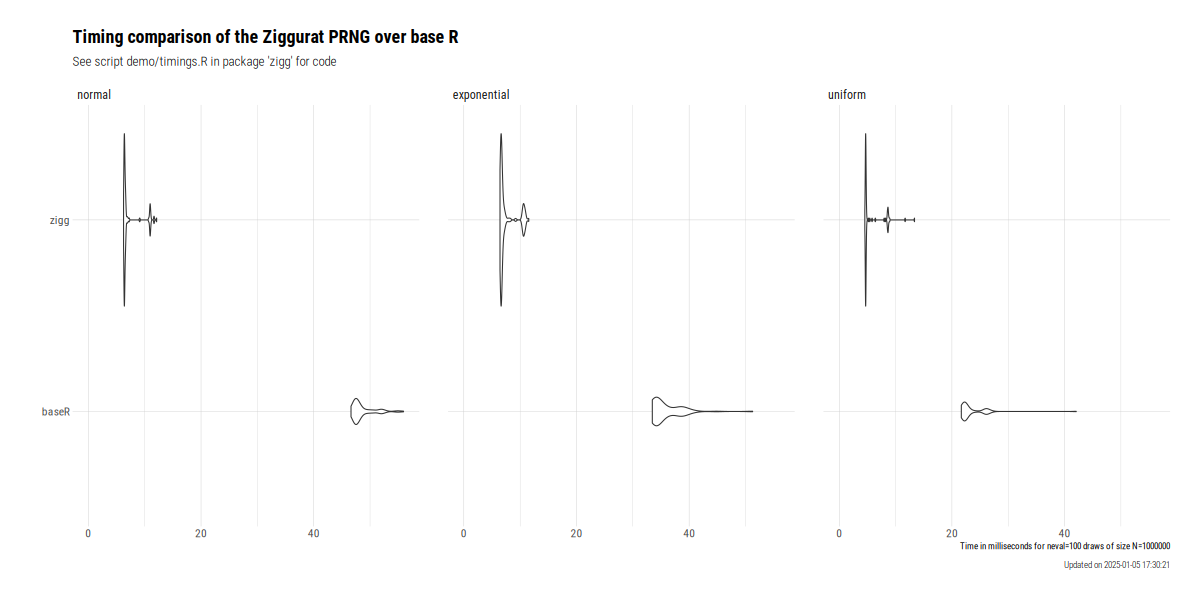
benchmark chart The still very new package zigg which arrived on CRAN a week ago just received a micro-update at CRAN. zigg provides the Ziggurat pseudo-random number generator (PRNG) for Normal, Exponential and Uniform draws proposed by Marsaglia and Tsang (JSS, 2000), and extended by Leong et al. (JSS, 2005). This PRNG is lightweight and very fast: on my machine speedups for the Normal, Exponential, and Uniform are on the order of 7.4, 5.2 and 4.7 times faster than the default generators in R as illustrated in the benchmark chart borrowed from the git repo. As wrote last week in the initial announcement, I had picked up their work in package RcppZiggurat and updated its code for the 64-buit world we now live in. That package alredy provided the Normal generator along with several competing implementations which it compared rigorously and timed them. As one of the generators was based on the GNU GSL via the implementation of Voss, we always ended up with a run-time dependency on the GSL too. No more: this new package is zero-depedency, zero-suggsts and hence very easy to deploy. Moreover, we also include a demonstration of four distinct ways of accessing the compiled code from another R package: pure and straight-up C, similarly pure C++, inclusion of the header in C++ as well as via Rcpp. The other advance is the resurrection of the second generator for the Exponential distribution. And following Burkardt we expose the Uniform too. The main upside of these generators is their excellent speed as can be seen in the comparison the default R generators generated by the example script timings.R: Needless to say, speed is not everything. This PRNG comes the time of 32-bit computing so the generator period is likely to be shorter than that of newer high-quality generators. If in doubt, forgo speed and stick with the high-quality default generators. This release essentially just completes the DESCRIPTION file and README.md now that this is a CRAN package. The short NEWS entry follows.

Changes in version 0.0.2 (2025-02-07)
  • Complete DESCRIPTION and README.md following initial CRAN upload

Courtesy of my CRANberries, there is a diffstat report relative to previous release. For more information, see the package page or the git repo.

This post by Dirk Eddelbuettel originated on his Thinking inside the box blog. If you like this or other open-source work I do, you can sponsor me at GitHub.

Reproducible Builds (diffoscope): diffoscope 288 released

The diffoscope maintainers are pleased to announce the release of diffoscope version 288. This version includes the following changes:
[ Chris Lamb ]
* Add 'asar' to DIFFOSCOPE_FAIL_TESTS_ON_MISSING_TOOLS. (Closes: #1095057)
* Update minimal 'black' version.
* Update copyright years.
You find out more by visiting the project homepage.

6 February 2025

Dirk Eddelbuettel: RcppArmadillo 14.2.3-1 on CRAN: Small Upstream Fix

armadillo image Armadillo is a powerful and expressive C++ template library for linear algebra and scientific computing. It aims towards a good balance between speed and ease of use, has a syntax deliberately close to Matlab, and is useful for algorithm development directly in C++, or quick conversion of research code into production environments. RcppArmadillo integrates this library with the R environment and language and is widely used by (currently) 1215 other packages on CRAN, downloaded 38.2 million times (per the partial logs from the cloud mirrors of CRAN), and the CSDA paper (preprint / vignette) by Conrad and myself has been cited 612 times according to Google Scholar. Conrad released a minor version 14.2.3 yesterday. As it has been two months since the last minor release, we prepared a new version for CRAN too which arrived there early this morning. The changes since the last CRAN release are summarised below.

Changes in RcppArmadillo version 14.2.3-1 (2025-02-05)
  • Upgraded to Armadillo release 14.2.3 (Smooth Caffeine)
    • Minor fix for declaration of xSYCON and xHECON functions in LAPACK
    • Fix for rare corner-case in reshape()

Courtesy of my CRANberries, there is a diffstat report relative to previous release. More detailed information is on the RcppArmadillo page. Questions, comments etc should go to the rcpp-devel mailing list off the Rcpp R-Forge page.

This post by Dirk Eddelbuettel originated on his Thinking inside the box blog. If you like this or other open-source work I do, you can sponsor me at GitHub.

Dominique Dumont: Drawbacks of using Cookiecutter with Cruft

Hi Cookiecutter is a tool for building coding project templates. It s often used to provide a scaffolding to build lots of similar project. I ve seen it used to create Symfony projects and several cloud infrastructures deployed with Terraform. This tool was useful to accelerate the creation of new projects.  Since these templates were bound to evolve, the teams providing these template relied on cruft to update the code provided by the template in their user s code. In other words, they wanted their users to apply a diff of the template modification to their code. At the beginning, all was fine. But problems began to appear during the lifetime of these projects. What went wrong ? In both cases, we had the following scenario: User team giving up on updates is a major problem because these update may bring security or compliance fixes.  Note that code conflicts seen with cruft are similar to git merge conflicts, but harder to resolve because, unlike with a git merge, there s no common ancestor, so 3-way merges are not possible. From an organisation point of view, the main problem is the ambiguous ownership of the functionalities brought by template code: who own this code ? The provider team who writes the template or the user team who owns the repository of the code generated from the template ? Conflicts are bound to happen. Possible solutions to get out of this tar pit: Of course your users won t be happy to be faced with a manual migration from the old big template to the new one with external dependencies. On the other hand, this may be easier to sell than updates based on cruft since the painful work will happen once. Further updates will be done by incrementing dependency versions (which can be automated with renovate). If many projects are to be created with this template, it may be more practical to provide use a CLI that will create a skeleton project. See for instance terragrunt scaffold command. My name is Dominique Dumont, I m a devops freelance. You can find the devops and audit services I propose on my website or reach out to me on LinkedIn. All the best

Bits from Debian: Proxmox Platinum Sponsor of DebConf25

proxmox-logo We are pleased to announce that Proxmox has committed to sponsor DebConf25 as a Platinum Sponsor. Proxmox develops powerful, yet easy-to-use Open Source server software. The product portfolio from Proxmox, including server virtualization, backup, and email security, helps companies of any size, sector, or industry to simplify their IT infrastructures. The Proxmox solutions are based on the great Debian platform, and we are happy that we can give back to the community by sponsoring DebConf25. With this commitment as Platinum Sponsor, Proxmox is contributing to the Debian annual Developers' conference, directly supporting the progress of Debian and Free Software. Proxmox contributes to strengthen the community that collaborates on Debian projects from all around the world throughout all of the year. Thank you very much, Proxmox, for your support of DebConf25! Become a sponsor too! DebConf25 will take place from 14 to 20 July 2025 in Brest, France, and will be preceded by DebCamp, from 7 to 13 July 2025. DebConf25 is accepting sponsors! Interested companies and organizations may contact the DebConf team through sponsors@debconf.org, and visit the DebConf25 website at https://debconf25.debconf.org/sponsors /become-a-sponsor/.

5 February 2025

Alberto Garc a: Keeping your system-wide configuration files intact after updating SteamOS

Introduction If you use SteamOS and you like to install third-party tools or modify the system-wide configuration some of your changes might be lost after an OS update. Read on for details on why this happens and what to do about it.
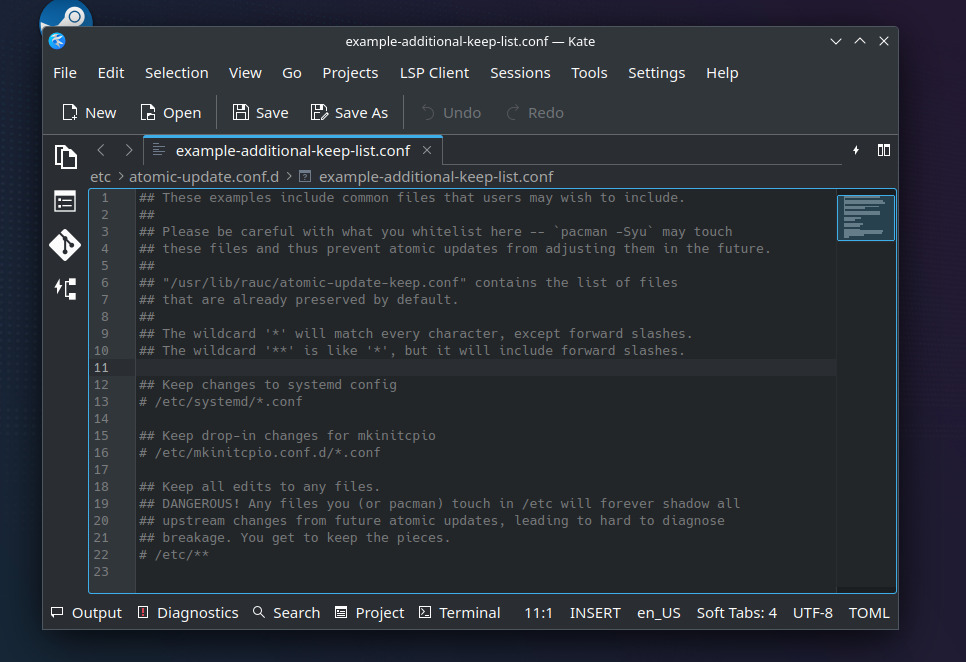
As you all know SteamOS uses an immutable root filesystem and users are not expected to modify it because all changes are lost after an OS update. However this does not include configuration files: the /etc directory is not part of the root filesystem itself. Instead, it s a writable overlay and all modifications are actually stored under /var (together with all the usual contents that go in that filesystem such as logs, cached data, etc). /etc contains important data that is specific to that particular machine like the configuration of known network connections, the password of the main user and the SSH keys. This configuration needs to be kept after an OS update so the system can keep working as expected. However the update process also needs to make sure that other changes to /etc don t conflict with whatever is available in the new version of the OS, and there have been issues due to some modifications unexpectedly persisting after a system update. SteamOS 3.6 introduced a new mechanism to decide what to to keep after an OS update, and the system now keeps a list of configuration files that are allowed to be kept in the new version. The idea is that only the modifications that are known to be important for the correct operation of the system are applied, and everything else is discarded1. However, many users want to be able to keep additional configuration files after an OS update, either because the changes are important for them or because those files are needed for some third-party tool that they have installed. Fortunately the system provides a way to do that, and users (or developers of third-party tools) can add a configuration file to /etc/atomic-update.conf.d, listing the additional files that need to be kept. There is an example in /etc/atomic-update.conf.d/example-additional-keep-list.conf that shows what this configuration looks like.
Sample configuration file for the SteamOS updater
Developers who are targeting SteamOS can also use this same method to make sure that their configuration files survive OS updates. As an example of an actual third-party project that makes use of this mechanism you can have a look at the DeterminateSystems Nix installer: https://github.com/DeterminateSystems/nix-installer/blob/v0.34.0/src/planner/steam_deck.rs#L273 As usual, if you encounter issues with this or any other part of the system you can check the SteamOS issue tracker. Enjoy!
  1. A copy is actually kept under /etc/previous to give the user the chance to recover files if necessary, and up to five previous snapshots are kept under /var/lib/steamos-atomupd/etc_backup

Reproducible Builds: Reproducible Builds in January 2025

Welcome to the first report in 2025 from the Reproducible Builds project! Our monthly reports outline what we ve been up to over the past month and highlight items of news from elsewhere in the world of software supply-chain security when relevant. As usual, though, if you are interested in contributing to the Reproducible Builds project, please visit our Contribute page on our website. Table of contents:
  1. reproduce.debian.net
  2. Two new academic papers
  3. Distribution work
  4. On our mailing list
  5. Upstream patches
  6. diffoscope
  7. Website updates
  8. Reproducibility testing framework

reproduce.debian.net The last few months saw the introduction of reproduce.debian.net. Announced at the recent Debian MiniDebConf in Toulouse, reproduce.debian.net is an instance of rebuilderd operated by the Reproducible Builds project. Powering that is rebuilderd, our server designed monitor the official package repositories of Linux distributions and attempt to reproduce the observed results there. This month, however, we are pleased to announce that in addition to the existing amd64.reproduce.debian.net and i386.reproduce.debian.net architecture-specific pages, we now build for a three more architectures (for a total of five) arm64 armhf and riscv64.

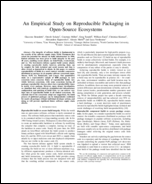
Two new academic papers Giacomo Benedetti, Oreofe Solarin, Courtney Miller, Greg Tystahl, William Enck, Christian K stner, Alexandros Kapravelos, Alessio Merlo and Luca Verderame published an interesting article recently. Titled An Empirical Study on Reproducible Packaging in Open-Source Ecosystem, the abstract outlines its optimistic findings:
[We] identified that with relatively straightforward infrastructure configuration and patching of build tools, we can achieve very high rates of reproducible builds in all studied ecosystems. We conclude that if the ecosystems adopt our suggestions, the build process of published packages can be independently confirmed for nearly all packages without individual developer actions, and doing so will prevent significant future software supply chain attacks.
The entire PDF is available online to view.
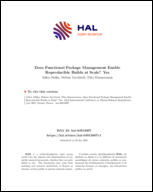
In addition, Julien Malka, Stefano Zacchiroli and Th o Zimmermann of T l com Paris in-house research laboratory, the Information Processing and Communications Laboratory (LTCI) published an article asking the question: Does Functional Package Management Enable Reproducible Builds at Scale?. Answering strongly in the affirmative, the article s abstract reads as follows:
In this work, we perform the first large-scale study of bitwise reproducibility, in the context of the Nix functional package manager, rebuilding 709,816 packages from historical snapshots of the nixpkgs repository[. We] obtain very high bitwise reproducibility rates, between 69 and 91% with an upward trend, and even higher rebuildability rates, over 99%. We investigate unreproducibility causes, showing that about 15% of failures are due to embedded build dates. We release a novel dataset with all build statuses, logs, as well as full diffoscopes: recursive diffs of where unreproducible build artifacts differ.
As above, the entire PDF of the article is available to view online.

Distribution work There as been the usual work in various distributions this month, such as:
  • 10+ reviews of Debian packages were added, 11 were updated and 10 were removed this month adding to our knowledge about identified issues. A number of issue types were updated also.
  • The FreeBSD Foundation announced that a planned project to deliver zero-trust builds has begun in January 2025 . Supported by the Sovereign Tech Agency, this project is centered on the various build processes, and that the primary goal of this work is to enable the entire release process to run without requiring root access, and that build artifacts build reproducibly that is, that a third party can build bit-for-bit identical artifacts. The full announcement can be found online, which includes an estimated schedule and other details.

On our mailing list On our mailing list this month:
  • Following-up to a substantial amount of previous work pertaining the Sphinx documentation generator, James Addison asked a question pertaining to the relationship between SOURCE_DATE_EPOCH environment variable and testing that generated a number of replies.
  • Adithya Balakumar of Toshiba asked a question about whether it is possible to make ext4 filesystem images reproducible. Adithya s issue is that even the smallest amount of post-processing of the filesystem results in the modification of the Last mount and Last write timestamps.
  • James Addison also investigated an interesting issue surrounding our disorderfs filesystem. In particular:
    FUSE (Filesystem in USErspace) filesystems such as disorderfs do not delete files from the underlying filesystem when they are deleted from the overlay. This can cause seemingly straightforward tests for example, cases that expect directory contents to be empty after deletion is requested for all files listed within them to fail.

Upstream patches The Reproducible Builds project detects, dissects and attempts to fix as many currently-unreproducible packages as possible. We endeavour to send all of our patches upstream where appropriate. This month, we wrote a large number of such patches, including:

diffoscope diffoscope is our in-depth and content-aware diff utility that can locate and diagnose reproducibility issues. This month, Chris Lamb made the following changes, including preparing and uploading versions 285, 286 and 287 to Debian:
  • Security fixes:
    • Validate the --css command-line argument to prevent a potential Cross-site scripting (XSS) attack. Thanks to Daniel Schmidt from SRLabs for the report. [ ]
    • Prevent XML entity expansion attacks. Thanks to Florian Wilkens from SRLabs for the report.. [ ][ ]
    • Print a warning if we have disabled XML comparisons due to a potentially vulnerable version of pyexpat. [ ]
  • Bug fixes:
    • Correctly identify changes to only the line-endings of files; don t mark them as Ordering differences only. [ ]
    • When passing files on the command line, don t call specialize( ) before we ve checked that the files are identical or not. [ ]
    • Do not exit with a traceback if paths are inaccessible, either directly, via symbolic links or within a directory. [ ]
    • Don t cause a traceback if cbfstool extraction failed.. [ ]
    • Use the surrogateescape mechanism to avoid a UnicodeDecodeError and crash when any decoding zipinfo output that is not UTF-8 compliant. [ ]
  • Testsuite improvements:
    • Don t mangle newlines when opening test fixtures; we want them untouched. [ ]
    • Move to assert_diff in test_text.py. [ ]
  • Misc improvements:
    • Drop unused subprocess imports. [ ][ ]
    • Drop an unused function in iso9600.py. [ ]
    • Inline a call and check of Config().force_details; no need for an additional variable in this particular method. [ ]
    • Remove an unnecessary return value from the Difference.check_for_ordering_differences method. [ ]
    • Remove unused logging facility from a few comparators. [ ]
    • Update copyright years. [ ][ ]
In addition, fridtjof added support for the ASAR .tar-like archive format. [ ][ ][ ][ ] and lastly, Vagrant Cascadian updated diffoscope in GNU Guix to version 285 [ ][ ] and 286 [ ][ ].
strip-nondeterminism is our sister tool to remove specific non-deterministic results from a completed build. This month version 1.14.1-1 was uploaded to Debian unstable by Chris Lamb, making the following the changes:
  • Clarify the --verbose and non --verbose output of bin/strip-nondeterminism so we don t imply we are normalizing files that we are not. [ ]
  • Bump Standards-Version to 4.7.0. [ ]

Website updates There were a large number of improvements made to our website this month, including:

Reproducibility testing framework The Reproducible Builds project operates a comprehensive testing framework running primarily at tests.reproducible-builds.org in order to check packages and other artifacts for reproducibility. In January, a number of changes were made by Holger Levsen, including:
  • reproduce.debian.net-related:
    • Add support for rebuilding the armhf architecture. [ ][ ]
    • Add support for rebuilding the arm64 architecture. [ ][ ][ ][ ]
    • Add support for rebuilding the riscv64 architecture. [ ][ ]
    • Move the i386 builder to the osuosl5 node. [ ][ ][ ][ ]
    • Don t run our rebuilders on a public port. [ ][ ]
    • Add database backups on all builders and add links. [ ][ ]
    • Rework and dramatically improve the statistics collection and generation. [ ][ ][ ][ ][ ][ ]
    • Add contact info to the main page [ ], thumbnails [ ] as well as the new, missing architectures. [ ]
    • Move the amd64 worker to the osuosl4 and node. [ ]
    • Run the underlying debrebuild script under nice. [ ]
    • Try to use TMPDIR when calling debrebuild. [ ][ ]
  • buildinfos.debian.net-related:
    • Stop creating buildinfo-pool_$ suite _$ arch .list files. [ ]
    • Temporarily disable automatic updates of pool links. [ ]
  • FreeBSD-related:
    • Fix the sudoers to actually permit builds. [ ]
    • Disable debug output for FreeBSD rebuilding jobs. [ ]
    • Upgrade to FreeBSD 14.2 [ ] and document that bmake was installed on the underlying FreeBSD virtual machine image [ ].
  • Misc:
    • Update the real year to 2025. [ ]
    • Don t try to install a Debian bookworm kernel from backports on the infom08 node which is running Debian trixie. [ ]
    • Don t warn about system updates for systems running Debian testing. [ ]
    • Fix a typo in the ZOMBIES definition. [ ][ ]
In addition:
  • Ed Maste modified the FreeBSD build system to the clean the object directory before commencing a build. [ ]
  • Gioele Barabucci updated the rebuilder stats to first add a category for network errors [ ] as well as to categorise failures without a diffoscope log [ ].
  • Jessica Clarke also made some FreeBSD-related changes, including:
    • Ensuring we clean up the object directory for second build as well. [ ][ ]
    • Updating the sudoers for the relevant rm -rf command. [ ]
    • Update the cleanup_tmpdirs method to to match other removals. [ ]
  • Jochen Sprickerhof:
  • Roland Clobus:
    • Update the reproducible_debstrap job to call Debian s debootstrap with the full path [ ] and to use eatmydata as well [ ][ ].
    • Make some changes to deduce the CPU load in the debian_live_build job. [ ]
Lastly, both Holger Levsen [ ] and Vagrant Cascadian [ ] performed some node maintenance.
If you are interested in contributing to the Reproducible Builds project, please visit our Contribute page on our website. However, you can get in touch with us via:

4 February 2025

Dominique Dumont: Azure API throttling strikes back

Hi In my last blog, I explained how we resolved a throttling issue involving Azure storage API. In the end, I mentioned that I was not sure of the root cause of the throttling issue. Even though we no longer had any problem in dev and preprod cluster, we still faced throttling issue with prod. The main difference between these 2 environments is that we have about 80 PVs in prod versus 15 in the other environments. Given that we manage 1500 pods in prod, 80 PVs does not look like a lot.  To continue the investigation, I ve modified k8s-scheduled-volume-snapshotter to limit the number of snaphots done in a single cron run (see add maxSnapshotCount parameter pull request). In prod, we used the modified snapshotter to trigger snapshots one by one. Even with all previous snapshots cleaned up, we could not trigger a single new snapshot without being throttled . I guess that, in the cron job, just checking the list of PV to snapshot was enough to exhaust our API quota.  Azure doc mention that a leaky bucket algorithm is used for throttling. A full bucket holds tokens for 250 API calls, and the bucket gets 25 new tokens per second. Looks like that not enough. I was puzzled  and out of ideas  . I looked for similar problems in AKS issues on GitHub where I found this comment that recommend using useDataPlaneAPI parameter in the CSI file driver. That was it!  I was flabbergasted  by this parameter: why is CSI file driver able to use 2 APIs ? Why is one on them so limited ? And more importantly, why is the limited API the default one ? Anyway, setting useDataPlaneAPI: "true" in our VolumeSnapshotClass manifest was the right solution. This indeed solved the throttling issue in our prod cluster.  But not the snaphot issue  . Amongst the 80 PV, I still had 2 snaphots failing. Fortunately, the error was mentioned in the description of the failed snapshots: we had too many (200) snapshots for these shared volumes. What ??  All these snapshots were cleaned up last week. I then tried to delete these snaphots through azure console. But the console failed to delete these snapshot due to API throttling. Looks like Azure console is not using the right API.  Anyway, I went back to the solution explained in my previous blog, I listed all snapshots with az command. I indeed has a lot of snaphots, a lot of them dated Jan 19 and 20. There was often a new bogus snaphot created every minute. These were created during the first attempt at fixing the throttling issue. I guess that even though CSI file driver was throttled, a snaphot was still created in the storage account, but the CSI driver did not see it and retried a minute later . What a mess. Anyway, I ve cleaned up again these bogus snapshot  , and now, snaphot creation is working fine  . For now. All the best.
Paul Wise: FLOSS Activities January 2025

Focus This month I didn't have any particular focus. I just worked on issues in my info bubble.

Changes

Sponsors All work was done on a volunteer basis.

Valhalla's Things: Conference Talk Timeout Ring, Part One

Posted on February 4, 2025
Tags: madeof:atoms, madeof:bits
low quality video of a ring of rgb LED in front of a computer: the LED light up one at a time in colours that go from yellow to red. A few ago I may have accidentally bought a ring of 12 RGB LEDs; I soldered temporary leads on it, connected it to a CircuitPython supported board and played around for a while. They we had a couple of friends come over to remote FOSDEM together, and I had talked with one of them about WS2812 / NeoPixels, so I brought them to the living room, in case there was a chance to show them in sort-of-use. Then I was dealing with playing the various streams as we moved from one room to the next, which lead to me being called video team , which lead to me wearing a video team shirt (from an old DebConf, not FOSDEM, but still video team), which lead to somebody asking me whether I also had the sheet with the countdown to the end of the talk, and the answer was sort-of-yes (I should have the ones we used to use for our Linux Day), but not handy. But I had a thing with twelve things in a clock-like circle. A bit of fiddling on the CircuitPython REPL resulted, if I remember correctly, in something like:
import board
import neopixel
import time
num_pixels = 12
pixels = neopixel.NeoPixel(board.GP0, num_pixels)
pixels.brightness = 0.1
def end(min):
    pixels.fill((0, 0, 0))
    for i in range(12):
        pixels[i] = (127 + 10 * i, 8 * (12 - i), 0)
        pixels[i-1] = (0, 0, 0)
        time.sleep(min * 5)  # min * 60 / 12
Now, I wasn t very consistent in running end, especially since I wasn t sure whether I wanted to run it at the beginning of the talk with the full duration or just in the last 5 - 10 minutes depending of the length of the slot, but I ve had at least one person agree that the general idea has potential, so I m taking these notes to be able to work on it in the future. One thing that needs to be fixed is the fact that with the ring just attached with temporary wires and left on the table it isn t clear which LED is number 0, so it will need a bit of a case or something, but that s something that can be dealt with before the next fosdem. And I should probably add some input interface, so that it is self-contained and not tethered to a computer and run from the REPL. (And then I may also have a vague idea for putting that ring into some wearable thing: good thing that I actually bought two :D )

Next.

Previous.