Search Results: "tar"

27 June 2008

John Goerzen: Troops

Back in 1997, long before the days of Youtube, there was a film short called Troops. Troops is about 10 minutes long, and an absolutely hilarious piece of work. It's done in the style of Cops, but set on Tatooine in the Star Wars universe. Many people today credit it with kickstarting the fan film genre and inspiring what has evolved into stars of Youtube.

I remember giving a talk at the Air Capitol Linux Users Group (Wichita, KS). I brought with me my laptop, and had downloaded Troops onto it. I played it for the group. This was at a time when being able to play video on a laptop was something new and interesting, and under Linux no less, even more so. Also, at a time when video of this size may have taken a day to download. Everyone there loved it. I think I used xanim to play it (remember that?)

Anyhow, you can still download that same original file from theforce.net. Or, for the less patient, just watch it here:

Wouter Verhelst: Passports...

Today, I went to the Ekeren district house[1] to get me a passport, in order to be able to fly to Argentina in about a month. As I was queueing at the desk, I realized that I'd forgotten some pictures of myself, so I left the queue, found the closest photo shop, and had them take some pictures of me. When I returned to the district house, gave them my new pictures and my identity card, with the request to furnish me a passport, the lady behind the desk told me that I apparently still had a passport. While no longer valid, I still need to hand that in before I can be given a new passport. Or, alternatively, I could go to the police office, tell them that I cannot find the passport anymore, and use the document they'd give me to get me a new passport. That, too, would work. So that's the option I decided to take. I quickly went to the police office, which is rather close to the district house; luckily nobody was queueing before me there. By the time I got back to the district house, it was about 14:50, while they close at 15:00. So I went ahead and started queueing again. Suddenly, I notice that my pictures were gone. For some reason, the idiots at the photo shop have deviced an "envelope" that does not hold the pictures -- they have three places where they can easily leave the "envelope". And that's exactly what had happened: no more pictures. So I ask the lady behind the desk whether she'd be willing to wait a few more minutes after their official closing time, so that I'd be able to go and look for them. She didn't mind. Unfortunately, I only found one picture. The other five were nowhere to be found... and with only one picture, the district office can't help me; they need two of them. So, now, I've not only lost an hour of my life, but I've also lost 8.00 for pictures that are now no longer useful to me. And I'll have to do all of this again, some time next week. Dammit. [1] although I don't live in Ekeren anymore, officially I do: the apartment where I live does not exist according to the Mechelen city administration. Before I can officially move there, the landlord needs to deal with that, which apparently involves quite some bureaucracy. For one thing, he needs 6—yes, six—copies of the building plans, along with a particular form with a particular number. Probably needs to jump through a number of hoops, too—I wouldn't be surprised.

Miriam Ruiz: Glass Ceiling

Katherine Lawrence and Marianne Schreiber, two women at Hewlett-Packard, used the term Glass Ceiling to to refer to invisible barriers that impede the career advancement of females. While on the surface there seems to be a clear path of promotion, in fact women seem to hit a point where there is no way to progress beyond. Carol Hymowitz and Timothy Schellhardt used the term again afterwards in the March 24, 1986 edition of the Wall Street Journal, which is considered by many people the starting point of the usage of that term. Even though the term Glass Ceiling was originally specifically applied to discrimination against women, its meaning has expanded to describe similar situations of other collectives. I was wondering whether there might be a Glass Ceiling in Debian too. I know some of you will be tempted to answer “no way!” or “yeah! of course!” without even thinking about it. Please don’t. Keep in mind that a Glass Ceiling situation is referred to as a “ceiling” as there is a limitation blocking upward advancement, and “glass” (transparent) because the limitation is not immediately apparent and is normally an unwritten and unofficial policy. Give a serious and deep thought about it before commenting. It’s quite likely that if you are too sure about what the answer might be, one way or the other, that you might be wrong. I just wanted to make us think a bit about it.

Jan Lübbe: Debian and the Beagle Board

After having read about the board a bit and getting courious, at LinuxTag 2008 i could try the real hardware for the first time. They had a demo running which showed a full Enlightenment desktop and everything seemed quite fast. I would guess the performance is similar to a P3 1GHz. The demo was based on OpenEmbedded, but with a system that is as fast as a few year old desktop system, i would of course prefer to run Debian. read more

26 June 2008

Robert Collins: 27 Jun 2008

Dear lazyweb number 3. So far, I've asked: high latency net simulations - great answers. python friendly back-end accessible search engines - many answers, none that fit the bill. So I wrote my own :). Today, I shall ask - is there a python-accessible persistent b+tree(or hashtable, or ...) module. Key considerations: - scaling: millions of nodes are needed with low latency access to a nodes value and to determine a nodes absence - indices are write once. (e.g. a group of indices are queried, and data is expired altered by some generational tactic such as combining existing indices into one larger one and discarding the old ones) - reading and writing is suitable for sharply memory constrained environments. ideally only a few 100KB of memory are needed to write a 100K node index, or to read those same 100K nodes back out of a million node index. temporary files during writing are fine. - backend access must either be via a well defined minimal api (e.g. 'needs read, readv, write, rename, delete') or customisable in python - easy installation - if C libraries etc are needed they must be already pervasively available to windows users and Ubuntu/Suse/Redhat/*BSD systems - ideally sorted iteration is available as well, though it could be layered on top - fast, did I mention fast? - stable formats - these indices may last for years unaltered after being written, so any libraries involved need to ensure that the format will be accessible for a long time. (e.g. python's dump/marshal facility fails) sqlite, bdb already fail at this requirements list. snakesql, gadfly, buzhug and rbtree fail too.

Decklin Foster: The data are

So I always knew that my ThinkPad's display sucked. But now I have scientific proof! (Long-winded post about my job follows.) I was running some timing tests at work on the code for a psychology experiment. This involves quickly presenting a stimulus to the subject, then measuring reaction time and synchronizing with EEG readings. Nothing very complicated, but accurate timing is essential; you don't want another variable confounding your results. So I have this photocell device that sends a signal to a Mac through the EEG hardware when there is really actually physical light coming off of the screen, not just when I told the computer to display something. Now CRTs, of course, are actually scanning (with an electron gun) the display at 75 or 85 Hz or something, not constantly pumping out light to the whole screen. This means 12 or 13 (or whatever) ms between refreshes. So if you want something to appear for 100 ms, you have to fudge a little, and make it so that you get maybe 8 or 9 scans. You can synchronize your presentation to the refresh so this is feasible. But how long the subject really perceives it ultimately depends on how "flickery" the monitor is at a given refresh rate. LCDs, on the other hand, do not have this problem. They actually do produce light constantly -- their refresh rate is pretty much always only 60 Hz or less, but you get the same(ish) output over the entire cycle, instead of in blips that give the illusion of a constant image (in fact, as Matthew points out, they can continue to hold the same image for even longer periods between refreshes. Can't wait to try out that patch). And luckily for us, 6 cycles are in theory exactly 100 ms (in practice, it's close enough). Or so I thought. I could not, no matter how many times I banged my head against it, get consistent results between our laptop (also a ThinkPad) and any external display. For reasons I do not entirely understand (probably scheduling issues), on CRTs I was getting one extra cycle, so I had to reduce the time by one to compensate. This was done for published studies years before I arrived at the lab, so (for the sake of not introducing additional variables) there is an extremely large disincentive to go back and fix it the Right Way, whatever that is. Our laptop's internal display was producing results that were skewed like those of a CRT. I thought for a minute I was going nuts from testing all day, but it kept happening. Curious, I swapped out the lab's T60 for my faster T61 and (to rule anything else out) killed all my other processes and wrote a fresh PyEPL script that did nothing but repeatedly blink some text for 100 ms. Here is, on the external VGA port, a cheap old 15" Dell LCD I pulled from the server room: http://www.rupamsunyata.org/~decklin/blogfiles/20080626/vga-lcd.png (These images are from the Mac, which is still using System 9.something. I had to remember Command-Shift-3 to take a screenshot and use StuffIt to get them off of it. Srsly. I can't remember the last time I used StuffIt.) And here is a CRT, showing the refreshes: (The DIN3 line is the actual signal, and the others are integrated over some number of milliseconds to compensate for scanning and attempt to get a usable number. Of course, this is done in hardware, not synchronized to anything else.) http://www.rupamsunyata.org/~decklin/blogfiles/20080626/vga-crt.png Now, this is the one that blew my mind. The ThinkPad's internal LCD: http://www.rupamsunyata.org/~decklin/blogfiles/20080626/lvds-lcd.png You can see that 60 Hz is spaced much farther apart, and that there are 6 cycles as intended, but. It's acting like a CRT! On the refresh, it puts out enough light to trigger the photocell, but inbetween, nothing. I ought to be noticing flicker and/or getting headaches all the time, if this is truly the case. (I guess I did get glasses for and because of staring at computer displays all the time. Should update my hackergotchi.) I have to admit I do not understand what is going on here at all. But it seems like making any assumptions about a display is (as the voice in my head was telling me all along) a very bad idea. Perhaps someone can email me some clue. But at least I have some hard data to validate my subjective opinion of the ThinkPad's internal LCD. Anyway: I still recommend the ThinkPad, even if the display is awful. I have a nice external monitor connected through DVI to the dock at home, and I mainly use a laptop so I can get out of the house and go hack outside or in a coffeeshop (not ideal lighting). The build quality, keyboard/trackpoint, performance, and the fact that Debian (testing or unstable, anyway) Just Works are all higher up on the list for me. I do wish I could afford the new lighter one, though.

Pierre Habouzit: About free software, UI and bad excuses

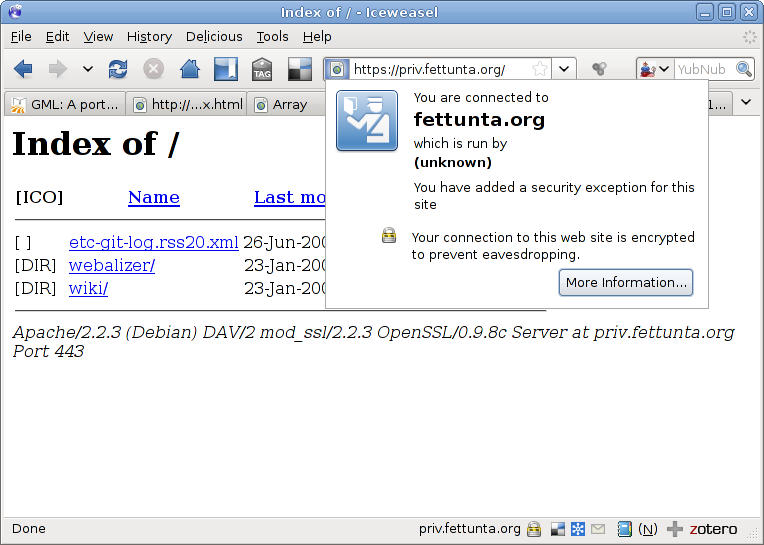
Okay, following my irritated post I received (sigh) complaints about me being too harsh. So to these people here is what I say, because I'm tired answering the same thing over and over. For starters, the SSL dialog in firefox is badly designed:
  1. My mom doesn't grok it, so it totally fails the "corridor testing" (see JoelOnSoftware if you don't know what it is), stop pretending otherwise;
  2. since it fails with the "average not very computer literate user", I, as an advanced user, believe to be representative of this kind of person, say and affirm that this UI is completely broken and horrible, not to mention counter-intuitive.
That said, I have other things to say on the form. Yeah I've been harsh, and I will continue to be about this issue: this has not been designed with the simplicity in mind, but by geeks (FSVO geek) that believe that it's important to educate people about how nice HTTPS is and that everyone should talk in S3kr3t because its 733t. And I'm sure they tried very hard to make it very painful for users to have to deal with HTTPS and not believe in it to be trusted for bad reasons. Why ? HELLLOOOO PEOPLE this is the wrong way to do it. People are already aware that it is https, because they did typed https in the URL. And again, my mom doesn't know what the s in https stands for and she doesn't care. What she cares about is to see the small lock when she logs on her bank website, not even when she goes on her webmail. You REALLY want to make a simple UI ? Well, please try to explain and justify (with real arguments) Why on earth is https with an untrusted certificate less secure than http ?. Okay I'll let you 3 seconds to think. 1
2
3 What is your answer ? OH see ? it isn't. So now second 1 question, why does it need to be more painful to use https with an untrusted certificate than plain http ?. Well, I don't have 3 seconds to give anymore, so let's jump to the answer: there is absolutely no reason. See, I'm far from an UI expert, and what I use every day for UIs would revulse 99% of the planet: vim as an editor, awesome as a tiling window manager, vimperator for a browser, and I live most of the time in a terminal. But it takes me like 10 minutes to design what I believe to be an excellent UI for https with untrusted certificate: just don't mind the certificate and show it like plain HTTP. YES I'M ANNOYED That brings me to the last point. I see in my comments, and have received the same by mail, that I should not be harsh with people writing such a brilliant piece of software. Well, the fact that firefox is or is not a good piece of software is totally irrelevant. When you claim no less than trying to reinvent the web, well, if you fuck up this big, you deserve it. No matter if it's a free piece of software or not. (or a piece of free software or not). When you request your users to click on FIVE completely counter-intuitive buttons/urls to finally be able to see a webpage they want to see (and my mom doesn't care about the webmail being insecurely hosted, really), with the first screen being almost the same than what you get when a serer timeouts or 404, well, you're just out of your mind. There is absolutely nothing that can excuse such a bad design, and the SSL thing is a failure. I mean everyone is laughing at the vista way of asking you if you really meant to go pee, well I see no difference here, it's as dumb and inefficient. No matter how much firefox did improved (and it did memory wise, believe me, I feel it, and I'm really glad about that), https is part of my everyday's life. Those five clicks are a real PAIN. When I'm reading documentation, browsing some sources, and so on, I go through this dialog about 3 to 10 times in a row. I'm totally unimpressed, and just because a couple of geeks believed that it was GOOD to educate me about how dangerous untrusted certificates are, I have to break my workflow to grab my mouse in the middle of my work. No sorry, I don't really want to be calm. In fact, what annoys me the most, is that I'm a programmer. And as a programmer, the worst thing to me, is regression. Regression is what happens when you're sloppy, and don't test your program enough. It's what happen when you aren't good enough to keep your concentration, and don't see the big picture, and constantly break your program invariants. So when I see a regression that people did on purpose, well, it shocks me beyond what I can explain with words, that's the worst thing you can do to a piece of software. I won't really mind a new feature that only partially works, I won't mind if a feature that is complicated to write isn't there after 5 years dreaming of it, but this ? I do mind. There is no way to consider that ruining a piece of software like that to the name of A Greater Good is excusable. Oh and last words: wanting to educate people this way is a way worst offense that what I will ever say on the subject. Such a condescending approach to what they think of their users reminds me of various journalists that I met, and that when I tried to rephrase some things so that they can write about it to their readers, answered to me oh you know, they're too dumb, they'll never understand. And as a result, articles or interview are always distorted, can't interest the readers that don't care about the subject a lot, because there's nothing captivating in the article, and is totally inexact and uninteresting to people interested in the matter, because it's void from its substance. Well, the SSL dialog gives me the very same impression: it's annoying to me who knows what a SSL certificate is, and my mom won't know a single bit more what an SSL certificate is and why she should care[1].
Notes [1] and actually the whole point guys, is that she should not

Andreas Barth: Binding with ldap to attributes

I wanted to be able to not only bind with the normal dn, but also to attributes. This means I e.g. have an attribute mail, and want the people to be able to login with their mailaddress as username. Stephen Gran gave me some valuable hints to using the rwm-rewriting engine. After some time, I ended up with this setup:
overlay rwm
rwm-rewriteEngine on
rwm-rewriteMap ldap attr2dn "ldap://127.0.0.1/ou=myorg?dn?sub"
rwm-rewriteContext bindDN
rwm-rewriteRule "^anyid=([^,]*@[^,]*)" "$ attr2dn(mail=$1) " ":"
rwm-rewriteRule "^anyid=([^,@]*)" "$ attr2dn(uid=$1) " ":"
rwm-rewriteRule "^(uid=[^,]*)" "$ attr2dn($1) " ":"
rwm-rewriteRule "^(mail=[^,]*)" "$ attr2dn($1) " ":"
The only thing that doesn't work is to make rwm using ldap version 3 to log into itself, so I had to allow read-only access to the relevant attributes from peername.ip=127.0.0.1 - but well, I can live with that. Update: Added anyid for not thinking in client code, and made sure only the start of entries is used.

Uwe Hermann: Configure Firefox/Iceweasel 3 to be more secure / usable / bearable

Today seems to be Firefox/Iceweasel 3 Bashing Day on Planet Debian, so let me join the fun :) I agree with most other people that the default Firefox/Iceweasel 3 config is not ideal, so here's what I did to fix it. Some of these items improve performance, some remove annoyances, some remove privacy issues, some remove security issues. Not everything here may be desirable for people other than me. General Preferences Select "Edit / Preferences". Main: Tabs: Content: Privacy: Security: Advanced:

Wouter Verhelst: Firefox sucks. No, really!

Warning: big rant ahead. I received some comments on my previous post, as expected. Most of them were helpful; e.g., the oldbar extension is very useful. One of them was silly.
It depends: If your application is "fullscreened", clicking on the link without having the focus could lead to interesting situation like "Hey, It does nothing?"
Just to make a point here, let me reiterate: There is no excuse whatsoever to steal the focus Sorry for the shouting, but seriously. I have the following in my icewm configuration:
ClickToFocus = 0
RaiseOnFocus = 0
FocusOnMap = 0
FocusOnAppRaise = 0
FocusOnMapTransient = 0
FocusOnMapTransientActive = 1
RaiseOnClickClient = 0
What this means is that I don't want anything to either get the focus or get on top of anything else all by itself, unless it happens to be a new dialog box created by an application that already has the focus. I also don't want windows to appear on top of anything else just because they received the focus. I also happen to prefer focus-follows-mouse, which you can get by way of the ClickToFocus thing. The reason I prefer it this way, is that often I have several applications open all at once. For instance, when I read RSS feeds, I have my RSS reader open on one virtual desktop, and read through the articles. Since my laptop's processor is much, much faster in certain things than is my network, I also make use of its multitasking abilities to have it preload links in the background (on another virtual desktop, preferably). Unfortunately, somehow, firefox manages to bypass all that configuration and shows up in front, stealing the focus; and in the process, it completely interferes with the way I work. No doubt they do this in order to help some hypothetical "grandma" or other stupid clueless person who's never used a computer before, but let me tell you something: software should be written for people who actually do use software, not for stupid nitwits who can't even read an error message that tells them "you cannot do A, please go ahead and do B instead". But I guess I'm too stupid or something to understand the usability "experts" who know it all best and say that software should be "intuitive" so that those who are 53 and see a computer for the first time in their live can sit right next to it and start emailing. Hah. As if the above wasn't enough, firefox 3 also is a crashing load of shit. I just spent the better part of an hour to try and make a payment using my bank's excellent online payment software which requires nothing more than javascript, SSL, and a digipass 810 that is provided by the bank as part of the online banking contract. Unfortunately firefox insisted on crashing halfway through entering the required information, for six times in a row. You'd think I'd be filing a bug now, but no, it managed to crash in a different location every time. I'd probably have to start debugging firefox to get this done, which is not something I'll do in this life. You know what the problem is? Webbrowser developers think they're developing the most important application for any computer. They're not. It's just a webbrowser, no more important than an xterm or a mail client: a tool to get a job done. Period. Grunt.

Edd Dumbill: My OSCON 2008 picks

In just under a month, the tenth O'Reilly Open Source Convention will get underway in Portland. Over ten years OSCON has developed—along with the world of open source—into an intense, exciting, informative, diverse and exhausting event. This year I've the privilege of being co-chair, along with Alison Randall. We've packed so much into the show, it's a difficult job even being able to comprehend it as a whole! Fortunately, there's a way to start making sense of things before you arrive there, thanks to the personal scheduler. Just mark the sessions you want to go to with a star, and you'll be able to plan out your time in advance. I wanted to list a few sessions from my own personal schedule that particularly piqued my interest. Then at the bottom of this post I'll share a discount code which can give readers of this blog 15% off OSCON registration. There's bribery for you. Practical Erlang Programming Largely thanks to XMPP enthusiasts and ejabberd, I've been hearing increasing amounts about Erlang, and I'd like to know enough about it to be dangerous. This three hour tutorial looks just the ticket. Open Source Virtualization Hacks This is one of several sessions we have on virtualization, something I'm particularly pleased about. Virtualization may be "done" at the kernel level, but I think we're only just starting out on its application. This session is by my friend and sometime co-author, Niel Bornstein, who works for Novell on just this sort of thing. Using Puppet: Real World Configuration Management Puppet is the piece of open source software that is most exciting to me at the moment. As a developer, it enables me to manage my machines like I'd manage my code libraries. A must-see if you've not used Puppet yet. These are just 3 out of the 300 or so confirmed sessions. Don't forget there's a large number of events and parties happening around OSCON too. And finally, the discount code. Use the code os08pgm when you're registering, and you'll get 15% off the ticket price. See you in Portland!Join the conversation about this post

Russell Coker: Dell PowerEdge T105

Today I received a Dell PowerEDGE T105 for use by a client. My client had some servers for development and testing hosted in a server room at significant expense. They also needed an offsite backup of critical data. So I suggested that they buy a cheap server-class machine, put it on a fast ADSL connection at their home, and use Xen DomU’s on that for development, testing, and backup. My client liked the concept but didn’t like the idea of having a server in his home. So I’m going to run the server from my home. I selected a Dell PowerEDGE tower system because it’s the cheapest server-class machine that can be purchased new. I have a slight preference for HP hardware but HP gear is probably more expensive and they are not a customer focussed company (they couldn’t even give me a price). So exactly a week after placing my order I received my shiny new Dell system, and it didn’t work. I booted a CentOS CD and ran “memtest” and the machine performed a hard reset. When it booted again it informed me that the event log had a message, and the message was “Uncorrectable ECC Error” with extra data of “DIMM 2,2“. While it sucks quite badly to receive a new machine that doesn’t work, that’s about the best result you can hope for when you have a serious error on the motherboard or the RAM. A machine without ECC memory would probably just randomly crash every so often and maybe lose data (see my previous post on the relative merits of ECC RAM and RAID [1]). So I phoned up Dell (it’s a pity that their “Packing Slip” was a low quality photocopy which didn’t allow me to read their phone number and that the shipping box also didn’t include the number so I had to look them up on the web) to get technical support. Once we had established that by removing the DIMMs and reinserting them I had proved that there was a hardware fault they agreed to send out a technician with a replacement motherboard and RAM. I’m now glad that I bought the RAM from Dell. Dell’s business model seems to revolve around low base prices for hardware and then extremely high prices for extras, for example Dell sells 1TB SATA disks for $818.40 while MSY [1] has them for $215 or $233 depending on brand. When I get the machine working I will buy two 1TB disks from MSY (or another company with similar prices). Not only does that save some money but it also means that I can get different brands of disk. I believe that having different brands of hard disk in a RAID-1 array will decrease the probability of having them both fail at the same time. One interesting thing about the PowerEdge T105 is that Dell will only sell two disks for it, but it has four SATA connectors on the motherboard, one is used for a SATA DVD player so it would be easy to support three disks. Four disks could be installed if a PCIe SATA controller was used (one in the space for a FDD and another in the space for a second CD/DVD drive), and if you were prepared to go without a CD/DVD drive then five internal disks could probably work. But without any special hardware the space for a second CD/DVD drive is just begging to be used for a third hard disk, most servers only use the primary CD/DVD drive for installing the OS and I expect that the demand for two CD/DVD drives in a server is extremely low. Personally I would prefer it if servers shipped with external USB DVD drives for installing the OS. Then when I install a server room I could leave one or two drives there in case a system recovery is needed and use the rest for desktop machines. One thing that they seem to have messed up is the lack of a filter for the air intake fan at the front of the case. The Opteron CPU has a fan that’s about 11cm wide which sucks in air from the front of the machine, in front of that fan there is a 4cm gap which would nicely fit a little sponge filter. Either they messed up the design or somehow my air filter got lost in transit. Incidentally if you want to buy from Dell in Australia then you need to configure your OS to not use ECN (Explicit Congestion Notification [2] as the Dell web servers used for sales rejects all connections from hosts with ECN enabled. It’s interesting that the web servers used for providing promotional information work fine with ECN and it’s only if you want to buy that it bites you. But in spite of these issues, I am still happy with Dell overall. Their machine was DOA, that happens sometimes and the next day service is good (NB I didn’t pay extra for better service). I expect that they will fix it tomorrow and I’ll buy more of their gear in future. Update: I forgot to mention that Dell shipped the machine with two power cables. While two power cables is a good thing for the more expensive servers that have redundant PSUs, for a machine with only one PSU it’s a bit of a waste. For some time I’ve been collecting computer power cables faster than I’ve been using them (due to machines dying and due to clients who want machines but already have spare power cables). So I’ve started giving them away at meetings of my local LUG. At the last meeting I gave away a bag of power cables and I plan to keep taking cables to the meetings until people stop accepting them.

Stefano Zacchiroli: firefox 3 un-ranting

Gunnar, have a look at this: iceweasel-ssl.png. So your example using the Penta website was just a bad one, and I personally agree with the "INVALID" resolution of your bug report. In fact, showing a partially encrypted connection as an insecure one is an overall advantage for (l)user securities, as with the browser interfaces we are used to use, we don't know which parts are actually sent encrypted and which are not. As you can see in the example above a fully encrypted connection is properly reported as such by Firefox 3.0. FWIW: I'm overall satisfied with Firefox 3.0, especially about the new URL bar Wouther is disliking. Yes it is a bit slower than before, but even on my 4-year old laptop it is perfectly usable. The HTML title shown there? Well, it is rather handy when I start typing bugs.debian.org and then I've to discriminate among tons of almost identical bug report URLs ... Is the about:config hand-holding dialog worst than the pop-up the first time you "have provided unencrypted information" in a random form? It is not, we have probably just forgot about the first time we unchecked the corresponding checkbox. All in all, the only "feature" of the new Firefox I found incredibly stupid is the SSL certificate exception mechanism. Installing the untrusted certificate is what? ... 5 click-away from the initial page? That is just dumb. (And as it is well-known that habits form anyhow, getting the habits harder to form is just a way to piss-off users.)

25 June 2008

Matthew Garrett: Hello people with Sony laptops

Could you lovely people with Sonys do a quick test for me? Download this file and stick it in /usr/share/hal/fdi/information/10freedesktop/ and restart hal. Make sure that you have the sony-laptop module loaded beforehand and let me know if your hotkeys don't do what's written on them. If they don't work at all, don't worry for now - there are various Sonys that are still broken and this won't fix them. I'm just interested to know whether the mapping used is correct.

Decklin Foster: Arrogance

Today, like any other day, I started Firefo^WIceweasel. I mapped it at the bottom of my window stack. It promptly raised itself. I closed everything and tried opening a new homepage. Nope, that's fine. I tried again with two tabs saved. It raised itself again. I have been watching variations of this bug regress for eight years now and I am tired of it. So I installed Conkeror. After a good three-year run of being able to sit down at someone else's random PC and say, "hey, a web browser that nearly works as well as mine" (since it is, you know, the same one), I look forward to being utterly fed up with how primitive the rest of the world is again. And what are we in this for, if not that?

Biella Coleman: The Cultural Significance of Free Software

When it comes to research and writing, anthropologists are notorious for being slow as molasses. It takes, on average, 9 years to finish grad school and then another 3-6 years before you write and publish your first book. Such is the sometimes frustrating pace of academia. But sometimes it is worth the wait as this new book, Two Bits, the Cultural Significance of Free Software by the anthropologist of science and technology Chris Kelty, makes clear. I am pretty intimate with the details of the book as ck was one of my dissertation committee members. I have read earlier versions and was fortunate enough to teach the final version to a small group of graduate students last spring. While there have been previous books on the subject of open source or peer-to-peer production more generally, this is the first book to delve deep, analytically and historically, into the cultural significance of free software. And the best part is that ck managed (I am not sure how but he did) to convince Duke University Press to release the whole book under a CC license. So download it to your heart’s delight and if you find it useful, do order a treeware copy (as you can’t beat that for easy and comfortable reading). For the developers out there, I would suggest starting with the introduction, which provides an initial overview of some of the main themes he develops and then I would dig into part two where the historical chapters reside and then loop back to the theoretical chapters in part one or continue to part three. Trust me, these will fascinate and surprise even those geeks with a relatively deep historical sense of this world. In fact, my very favorite academic piece on free software exists in these pages: and is the chapter on the history of the actual conflict between James Gosling and Richard Stallman that led to the creation of the GNU General Public License. Here is a small excerpt to whet your appetite:
In brief the controversy was this: in 1983 James Gosling decided to sell his version of EMACS a version written in C for UNIX called GOSMACS to a commercial software vendor called Unipress. GOSMACS, the second most famous implementation of EMACS (after Stallman s itself ), was written when Gosling was a graduate student at Carnegie Mellon University. For years, Gosling had distributed GOSMACS by himself and had run a mailing list on Usenet, on which he answered queries and discussed extensions. Gosling had explicitly asked people not to redistribute the program, but to come back to him (or send interested parties to him directly) for new versions, making GOSMACS more of a benevolent dictatorship than a commune. Gosling maintained his authority, but graciously accepted revisions and bug-fixes and extensions from users, incorporating them into new releases. Stallman s system, by contrast, allowed users to distribute their extensions themselves, as well as have them included in the official EMACS. By 1983, Gosling had decided he was unable to effectively maintain and support GOSMACS a task he considered the proper role of a corporation.
[ . . .]
Indeed, the general irony of this complicated situation was certainly not as evident as it might have been given the emotional tone of the debates: Stallman was using code from Gosling based on permission Gosling had given to Labalme, but Labalme had written code for Gosling which Gosling had commercialized without telling Labalme conceivably, but not likely, the same code. Furthermore, all of them were creating software that had been originally conceived in large part by Stallman (but based on ideas and work on TECO, an editor written twenty years before EMACS), who was now busy rewriting the very software Gosling had rewritten for UNIX. The once proud hacker ethic that Labalme mentions would thus amount not so much to an explicit belief in sharing so much as a fast-and-loose practice of making contributions and fixes without documenting them, giving oral permission to use and reuse, and losing records that may or may not have existed hardly a noble enterprise.
[. . .]
The story is a lively one, punctuated with some great e-mail “moments,” and gives you a play-by-play sense of how it is that free software become so entangled with the law and how the unwritten norms that guided sharing were violated to then become transformed, explicit, and written. The other chapter that will also fascinate those who want a deeper sense of this history is on UNIX and its role in creating the technical and collaborative conditions necessary to secure the explosion of free software years later. The story of the norms of sharing source code is, not by accident, writes Kelty, also the history of the UNIX operating system. This connection has been made by others but not shown in any historical detail as it is done in this book. For those interested in more anthropological issues, the first few chapters is where this type of more conceptual theorizing is at. Chris Kelty introduces the master trope of his book: the recursive public which is an idea that feeds into a longer academic debate, inaugurated by Jurgen Habermas, on the role of publicity, dialogue, and circulation of ideas and texts in cementing a democratic sphere. Many others, such as Charles Taylor, Michael Warner, and Nancy Fraser have since refigured and rehashed the meaning publics and public debate but there have been few ethnographies on the topic. It is here where Chris Kelty intervenes most forcefully to conceptualize publics in explicitly ethnographic terms and in an arena technology and the Internet which is often left undertheorized by cultural theorists. There is a lot more in the book (the third section examines some of the various political modulations of free software, such as Connexions and Creative Commons) but instead of saying any more, I will just leave you with his definition of a recursive public and again urge you to check out the book for yourself!
A recursive public is a public that is vitally concerned with the material and practical maintenance and modification of the technical, legal, practical, and conceptual means of its own existence as a public; it is a collective independent of other forms of constituted power and is capable of speaking to existing forms of power through the production of actually existing alternatives.

Clint Adams: Relaxation

I was misled. That much is probably true. I certainly had no idea what I was getting myself into. Enough of that though; there's narrative fading away. The part I should take responsibility for is the decision I made to stray off the map. Perhaps it was not so much a decision as a compulsion. I looked at the map. I saw the suspicious unmarked area at the edge, and concluded immediately that there was something good there, something the people wanted to keep hidden from me. I was correct, but I presumed far too much about the terrain. I thought I would make a quick exploration of the secret place, then backtrack to the more mapped area and get back with the program. Enough of that though; I've nearly forgotten the story. First I should point out that, had the map been to scale, it should have taken me an leisurely fifteen minutes to get to my first destination. It should have, assuming the land would be as flat as the map that represented it. Instead, it turned out to be something one could cover in fifteen minutes if one had, say, a jetpack and spring boots. I'm probably wrong; I'd probably injure myself in the process and take longer. Anyway, the average incline was close to 45 , and luckily was mostly uphill. Luckily. When I got to a resting place, I was able to conclude that my supply of fluids was almost certainly insufficient for me to continue. On the other hand, there was probably no way I would return if I went back for more drink. I told myself that there would likely be a beverage-selling shack out in the middle of nowhere around the next bend or so. Having solved this probability problem, I pressed on into the blazing sun. I came to a path leading down to the sea. It was unclear what was down there, but it was clear that it seemed to be a million miles down, and that that path might be the only way back. Given my current state of exhaustion and hydration, I decided to pass on this opportunity. After continuing for a while, the features at the bottom of that path became visible. A very pretty cove was down there, and almost certainly no shack o' drinks. I then came upon a fork. A wide path led downward: to what, I could not see. To its left, a narrow and rough path led straight. Knowing that a descent probably meant climbing four to eight times the altitude back somehow, and assuming the less pleasant-looking path led somewhere better, I went left. After a while, the land began to slope down, ever so slightly. Little clusters of bottles and newspapers were left on the rocks here and there. Then came a sofa under a tent. I began to wonder what hippies were traveling this path. The slope grew greater, and I passed a bench in a tent. Then I came to a giant staircase, almost straight down. It was covered in weeds and insects. Some were vegan, some wanted my flesh. As I got toward the bottom I thought about how glad I was that I had come that way from the top and not the other way around. Oh, I was very glad. At the bottom was something resembling a plastic bottle graveyard and barrels among barrels filled with water. Rubber hoses seemed to run randomly between certain barrels. A kitchen stood at the edge of some barrels. I suddenly got the feeling that I was not supposed to be here. After discovering that a couple of escape routes were actually dead ends, I proceeded to descend a small staircase to a terraced garden. Hoses lay about the rows, presumably for watering the plants. A cot under a tent lay empty, and I hurried past hoping I would not encounter the owner. Then I was at the ocean. The coast was lined with huge boulders, and a wooden bridge led me to the first one, and another wooden bridge took me to the second. Then the bridges stopped. In the distance, I could see that pretty little cove from before. I took stock. I could either return whence I came, up that horrifying staircase, or I could try to traverse the rocky coast over to the cove, then maybe do a faceplant on the beach and let the tide drown me rather than climbing back up. It seemed like a no-brainer, so I began making my way toward the cove. It got harder. Several times I became very afraid, either of falling and smashing my head against a rock or falling into the water below, or some sequential combination thereof. In the end I turned out to be more afraid of going back, at least until I got to what I judged the point of no return. I was reasonably close to where I imagined the sandy beach started, but there was a huge and impassable boulder in the way. Also, if I went further there was no way I would be able to climb back up in case I needed to retreat. I was thinking I would need to retreat, because unless there was some magical hidden toehold, I would be forced to jump into the water and swim around. I did not want to jump into the water. I wanted my phone to stay unfried in the event that I would need to use it to get rescued. I also did not want to call anyone to get rescued, especially since I didn't really know how to explain where I was. With a heavy sigh, I gave up, turned, and went back. This time I moved more quickly, though incurring more damage to my hands and feet. No humans were visible at the crazy farm/garden and makeshift reservoir, but plenty of bugs were visible on the staircase. I made the mistake of trying to lean against the railing to catch my breath. When I finally got to the bench in the tent, I understood exactly what it was for. I sat down, took a sip of my remaining water, ate an apple, and kept going up. When I got to the couch, I sat again. This time I sat and tried to figure out a plan. I still clung to the belief that once I got back to somewhere less wild I'd be able to buy a drink. I noted that I only had a little bit of water left, that I was dehydrated, that I was sunburned, that my pulse was about 180, and that there were no dogs or Russian people wandering past me. I ate a pear and drank my last few drops of water. I kept sitting until my pulse was down to around 150, then I figured I needed to keep moving. I was experiencing most of the effects of caffeine, and for free. Oddly, I passed a dog a few steps later. It was just standing by a rock, looking at me. I decided not to converse. When I had nearly reached the fork again, a couple came my way. I thought about begging them for water. I decided not to be rude. I have no idea what happened to them. I'm betting they wisely decided not to go down the steps. Resolving that the only sane option was to go back all the way to where I absolutely knew I could buy something potable, I headed in that direction. Still, I took two risks. Instead of going up the exact way I had come, or taking a well-travelled path down, I took a narrow and flat dirt path. It was actually a bit of a dilemma. I started down the latter two more than once each. Finally I saw that the down path was rather V shaped, and I concluded correctly that the straight path would bypass that angular-half-pipe-like construct. When I finally got to a point I recognized, it was smooth sailing the rest of the way down. I bought water and a snack, since I had had almost nothing to eat that day. At this point it would have been prudent to call it quits and go off and gorge myself on seafood or something, but no, I was now in the mapped area and surely it would all be roses and manna. Finishing one bottle, I bought two more. Five minutes later I bought another. I had now overcompensated, but I was playing it safe. I continued my explorations. Bicyclists kept nearly running into me, and, aside from the obvious, I viewed this as a good sign. Bicyclists, especially those that can't seem to steer straight for some reason, avoid difficult terrain. This is why they take their bikes on subways, trains, and buses. I don't like bike-riding, but if I had my druthers, I would always go downhill. No up, no flat, just down. Like downhill skiing, just down. It is a good thing I don't ride a bike. Once I got to the point where the bicycles thinned out to nonexistence, I was at an intersection. The way I wanted to go was up. The way I didn't want to go, but was a reasonable option, was only very slightly up. Additional factors complicated this decision point. [elision] This passage has been marked friends-only and you will not be able to view it without logging in. Moving hurriedly away from there, I headed upward. After a couple of turns, I ran into Catholics. First there were dead Catholics. Then there were Catholics pre-occupied with dead Catholics. Then there were Catholics waiting to die. Then there were seminarians. Then there were teens with prayer books. When I reached the next pinnacle, there were more teens with prayer books. There were benches, and there were no teens on them, for the teens were standing or sitting on the ground, quietly contemplating the Word. Unfortunately, they had decided that the benches were more suitable for holding all their bags, so there was nowhere for me to sit. I considered interrupting their reverie, but decided it wouldn't be very Christian of me to disturb them, so I just placed an ancient Drasnian curse on them and plodded down the hill toward a small beach. I really didn't need any more sun, but at least there probably wouldn't be anyone praying there. The water was tempting, but I'm always paranoid about my belongings when swimming alone, and if my phone were taken I wouldn't be able to call anybody to come rescue me at the next crisis point, sure to come. So I skirted the coastline and arrived at a much larger beach, one with facilities and services. Opting to save money but complicate things by using the public changing rooms and showers, I made a discovery. [elision] This passage has been marked friends-only and you will not be able to view it without logging in. Nonetheless, I changed into my swimming trunks, stuffed everything else but my towel, sunglasses, and a disgusting sugary drink I never should have bought into my bag, and went barefoot a few buildings down to rent a locker. The locker was ridiculously large for a single person, which is good to know should I ever want to kidnap a family and torture them at this place. The proprietor informed me that they were closing at some specific time, about an hour from then. I had no timekeeping device outside of the locker, so I had to wing it, and erring heavily on the side of caution, I had a short beach diversion. Given that large swathes of my epidermis were turning bright red, it's probably for the best. Handling the shower, locker, and changing in the other direction was slightly more complicated, but I did it and then I headed inland, figuring I should have a substantial meal for once that day. On my way to find dinner is when things got really crazy. [elision] This passage has been marked friends-only and you will not be able to view it without logging in. I wandered over to a bench to eat my newly-acquired snack, and did not exercise enough caution, because the flimsy paper bag ripped and I got sauce all over my pants and a little on my shirt. Unfortunately I had used my napkin in that earlier episode, and I'm not sure how much it would have helped anyway. Thus I continued on, looking like a slobby retard. Then I made an obviously-poor decision and ended up having a subpar dinner. What happened after that is a story for another time.

Kartik Mistry: Wait is not yet over!


* As I mentioned in my previous wait() post. I was waiting for laptop from reseller, thats done and my Macbook (White, 2GB RAM, 160 GB HDD etc) finally arrived! Yay!! Spent some time in getting familiar with Mac OS and reading docs for installing Debian on Macbook. I started installation today but due to removal of lilo from Lenny, it was halted :( Now, trying again with some more bravery ;) And, I am also waiting for FD to wake up from 2 months of AM report. No big issues in it though..

24 June 2008

William Pitcock: E-mail autoresponders suck. Please stop using them.

I find it particularly annoying, when I write a mail to a list, like say, the NANOG list, and get emails in reply like:
From: EMAIL ELIDED
To: William Pitcock <EMAIL ELIDED>
Subject: NAME ELIDED is out of the office.
Date: Tue, 24 Jun 2008 12:02:35 -0400 (11:02 CDT) I will be out of the office starting 06/23/2008 and will not return until 06/26/2008. If this matter is urgent please contact NAME ELIDED at XXX-XXX-XXXX or XXX-XXX-XXXX
This really sucks, for multiple reasons. Mostly, that: So please, for the good of all of the Internet, stop using autoresponders, because they are hideously lame. Or, at least, put something like AUTO-REPLY in your autoresponder so we can just delete the spam you insist on sending us. Thanks lazyweb.

Clint Adams: Eli and the wolves of Bristol

The West Virginian is huddled over his bong, swirling the ice cubes around his glass of cream sherry. There is a montage on the television, set to some factory-produced pop song sung by a no-talent teen who was thrust into major stardom with the help of comb filters and clever marketing. He is not watching the montage; he is thinking about Chris Wallace and nepotism. He will stand in the end.

Next.

Previous.