Search Results: "ag"

7 February 2013

Christoph Berg: PostgreSQL minor releases

We've just put the new PostgreSQL minor releases live on apt.postgresql.org. Building 5 major versions for 10 distributions produces quite a lot of stuff: Compiling took a bit more than 10 hours on a 2-cpu VM. Of course that includes running regression tests and the postgresql-common testsuite. Note: This will be the last update published on pgapt.debian.net. Please update your sources.list entries to point to apt.postgresql.org!

Ian Wienand: Shared libraries and execute permissions

In the few discussions you can find on the web about shared-libraries and execute-permissions, you can find a range of various opinions but not a lot about what goes when you execute a library. The first thing to consider is how the execute-permission interacts with the dynamic loader. When mapping a library, the dynamic-loader doesn't care about file-permissions; it cares about mapping specific internal parts of the .so. Specifically, it wants to map the PT_LOAD segments as-per the permissions specified by the program-header. A random example:
 $ readelf --segments /usr/lib/x86_64-linux-gnu/libcrypto.so.1.0.0
Elf file type is DYN (Shared object file)
Entry point 0x77c00
There are 7 program headers, starting at offset 64
Program Headers:
  Type           Offset             VirtAddr           PhysAddr
                 FileSiz            MemSiz              Flags  Align
  LOAD           0x0000000000000000 0x0000000000000000 0x0000000000000000
                 0x00000000001b5ea4 0x00000000001b5ea4  R E    200000
  LOAD           0x00000000001b6b60 0x00000000003b6b60 0x00000000003b6b60
                 0x0000000000028dc4 0x000000000002c998  RW     200000
The permissions to load the code and data segments are given the Flags output. Code has execute-permissions, and data has write-permissions. These flags are mapped into flags for the mmap call, which the loader then uses to map the various segments of the file into memory. So, do you actually need execute-permissions on the underlying file to mmap that segment as executable? No, because you can read it. If I can read it, then I can copy the segment to another area of memory I have already mapped with PROT_EXEC and execute it there anyway. Googling suggests that some systems do require execute-permissions on a file if you want to directly mmap pages from it with PROT_EXEC (and if you dig into the kernel source, there's an ancient system call uselib that looks like it comes from a.out days, given it talks about loading libraries at fixed addresses, that also wants this). This doesn't sound like a terrible hardening step; I wouldn't be surprised if some hardening patches require it. Maximum compatability and historical-features such as a.out also probably explains why gcc creates shared libraries with execute permissions by default. Thus, should you feel like it, you can run a shared-library. Something trivial will suffice:
int function(void)  
      return 100;
 
$ gcc -fPIC -shared -o libfoo.so foo.c
$ ./libfoo.so
Segmentation fault
This is a little more interesting (to me anyway) to dig into. At a first pass, why does this even vaguely work? That's easy -- an ELF file is an ELF file, and the kernel is happy to map those PT_LOAD segments in and jump to the entry point for you:
$ readelf --segments ./libfoo.so
Elf file type is DYN (Shared object file)
Entry point 0x570
There are 6 program headers, starting at offset 64
Program Headers:
  Type           Offset             VirtAddr           PhysAddr
                 FileSiz            MemSiz              Flags  Align
  LOAD           0x0000000000000000 0x0000000000000000 0x0000000000000000
                 0x000000000000070c 0x000000000000070c  R E    200000
  LOAD           0x0000000000000710 0x0000000000200710 0x0000000000200710
                 0x0000000000000238 0x0000000000000240  RW     200000
What's interesting here is that the shared-library has an entry point (e_entry) at all. ELF defines it as:
This member gives the virtual address to which the system first transfers control, thus starting the process. If the file has no associated entry point, this member holds zero.
First things first, where did that entry point come from? The ld manual tells us that the linker will set the entry point based upon the following hierarchy:
  • the -e entry command-line option;
  • the ENTRY(symbol) command in a linker script;
  • the value of a target specific symbol
  • the address of the first byte of the .text section, if present;
  • The address 0.
We know we're not specifying an entry point. The ENTRY command is interesting; we can check our default-link script to see if that is specified:
$ ld --verbose   grep ENTRY
ENTRY(_start)
Interesting. Obviously we didn't specify a _start; so do we have one? A bit of digging leads to the crt files, for C Run-Time. These are little object files automatically linked in by gcc that actually do the support-work to get a program to the point that main is ready to run. So, if we go and check out the crt files, one can find a definition of _start in crt1.o
$ nm /usr/lib/x86_64-linux-gnu/crt1.o
crt1.o:
0000000000000000 R _IO_stdin_used
0000000000000000 D __data_start
                 U __libc_csu_fini
                 U __libc_csu_init
                 U __libc_start_main
0000000000000000 T _start
0000000000000000 W data_start
                 U main
But do we have that for our little shared-library? We can get a feel for what gcc is linking in by examining the output of -dumpspecs. Remembering gcc is mostly just a driver that calls out to other things, a specs file is what gcc uses to determine which arguments pass around to various stages of a compile:
$ gcc -dumpspecs
...
*startfile:
% !shared: % pg p profile:gcrt1.o%s;pie:Scrt1.o%s;:crt1.o%s 
 crti.o%s % static:crtbeginT.o%s;shared pie:crtbeginS.o%s;:crtbegin.o%s 
The format isn't really important here (of course you can read about it); but the gist is that various flags, such as -static or -pie get passed different run-time initailisation helpers to link-in. But we can see that if we're creating a shared library we won't be getting crt1.o. We can double-confirm this by checking the output of gcc -v (cut down for clarity).
$ gcc -v -fPIC -shared -o libfoo.so foo.c
Using built-in specs.
 ...
/usr/lib/gcc/x86_64-linux-gnu/4.4.5/collect2 -shared -o libfoo.so
/usr/lib/gcc/x86_64-linux-gnu/4.4.5/../../../../lib/crti.o
/usr/lib/gcc/x86_64-linux-gnu/4.4.5/crtbeginS.o
/tmp/ccRpsQU3.o
/usr/lib/gcc/x86_64-linux-gnu/4.4.5/crtendS.o
/usr/lib/gcc/x86_64-linux-gnu/4.4.5/../../../../lib/crtn.o
So this takes us further down ld's entry-point logic to pointing to the first bytes of .text, which is where the entry-point comes from. So that solves the riddle of the entry point. There's one more weird thing you notice when you run the library, which is the faulting address in kern.log:
libfoo.so[8682]: segfault at 1 ip 0000000000000001 sp 00007fffcd63ec48 error 14 in libfoo.so[7f54c51fa000+1000]
The first thing is decoding error; 14 doesn't seem to have any relation to anything. Of course everyone has the Intel 64 Architecture Manual (or mm/fault.c that also mentions the flags) to decode this into 1110 which means "no page found for a user-mode write access with reserved-bits found to be set" (there's another post in all that someday!). So why did we segfault at 0x1, which is an odd address to turn up? Let's disassemble what actually happens when this starts.
00000000000004a0 <call_gmon_start>:
 4a0:   48 83 ec 08             sub    $0x8,%rsp
 4a4:   48 8b 05 2d 03 20 00    mov    0x20032d(%rip),%rax        # 2007d8 <_DYNAMIC+0x190>
 4ab:   48 85 c0                test   %rax,%rax
 4ae:   74 02                   je     4b2 <call_gmon_start+0x12>
 4b0:   ff d0                   callq  *%rax
 4b2:   48 83 c4 08             add    $0x8,%rsp
 4b6:   c3                      retq
We're moving something in rax and testing it; if true we call that value, otherwise skip and retq. In this case, objdump is getting a bit confused telling us that 2007d8 is related to _DYNAMIC; in fact we can check the relocations to see it's really the value of __gmon_start__:
$ readelf --relocs ./libfoo.so
Relocation section '.rela.dyn' at offset 0x3f0 contains 4 entries:
  Offset          Info           Type           Sym. Value    Sym. Name + Addend
000000200810  000000000008 R_X86_64_RELATIVE                    0000000000200810
0000002007d8  000200000006 R_X86_64_GLOB_DAT 0000000000000000 __gmon_start__ + 0
0000002007e0  000300000006 R_X86_64_GLOB_DAT 0000000000000000 _Jv_RegisterClasses + 0
0000002007e8  000400000006 R_X86_64_GLOB_DAT 0000000000000000 __cxa_finalize + 0
Relocation section '.rela.plt' at offset 0x450 contains 1 entries:
  Offset          Info           Type           Sym. Value    Sym. Name + Addend
000000200808  000400000007 R_X86_64_JUMP_SLO 0000000000000000 __cxa_finalize + 0
Thus call_gmon_start, rather unsurprisingly, checks the value of __gmon_start__ and calls it if it is set. Presumably this is set as part of profiling and called during library initialisation -- but it is clearly not an initialiser by itself. The retq ends up popping a value off the stack and jumping to it, which in this case just happens to be 0x1 -- which we can confirm with gdb by putting a breakpoint on the first text address and examining the stack-pointer:
(gdb) x/2g $rsp
0x7fffffffe7d8:        0x0000000000000000      0x0000000000000001
So that gives us our ultimate failure. Of course, if you're clever, you can get around this and initalise yourself correctly and actually make your shared-library do something when executed. The canonical example of this is libc.so itself:
$ /lib/x86_64-linux-gnu/libc-2.13.so
GNU C Library (Debian EGLIBC 2.13-37) stable release version 2.13, by Roland McGrath et al.
Copyright (C) 2011 Free Software Foundation, Inc.
This is free software; see the source for copying conditions.
...
You can trace through how this actually does work in the same way as we traced through why the trivial example doesn't work. If you wondering my opinion on executable-bits for shared-libraries; I would not give them execute permissions. I can't see it does anything but open the door to confusion. However, understanding exactly why the library segfaults the way it does actually ends up being a fun little tour around various parts of the toolchain!

MJ Ray: One of them, one of us

Interesting stuff is happening again and I m doing a bit of travelling where I m not driving much, so I can write some blog posts. If this train stops bouncing quite so much! I think most readers are interested in technology and collaborative work, so it makes sense to alternate those two themes most of the time. So that s what I ll aim for, probably a few posts each week for the next few weeks. Let me know in the comments or our co-op s contract form if there s anything in particular you d like us to cover, else I ll start with my recent experiences installing Debian 6 on a new laptop and the fun of running a business at tax return time.

6 February 2013

Aigars Mahinovs: Pensijas prognoze 18.43

Update: I apologise for spamming all the nice people on Planet Debian with this unrelated post in foreign language it got mis-tagged and (although I tried classifying it correctly and removing it from the separate Debian-only RSS feed going to the Debian Planet) Planet software just keeps it around until admins get a spare moment to remove it manually. The basic idea of the post is that there is a e-government service by the Latvian government that provides any citizen a way to check what their pension would be, but it is kinda useless, because it calculates what you pension would be if you decided to retire right now. So in the post below I provide a few simple steps on how to estimate what the real pension could be (in todays currency values) if a person kept paying into the system at the same rate until the normal retirement age. Latvija.lv ir r ks savas n kotnes pensijas prognoz anai, ta u tas ir, maigi izsakoties, bezj dz gs tiem, kas nepl no iet pensij tuv k gada laik . tri apskatoties atteic gos likumus un noteikumus es nonacu pie lietder g kas metodes. Vispirms m s varam dro i ignor t pensiju indeks ciju un visas ar to saist t s pensiju kapit la p rr in anas vai iemaksu palielin anos ir skaidrs, ka gadiem ejot uz priek u b s kaut k ds infl cijas procents, kura d palielin sies algas, palielin sies iemaksas pensiju kapit l un tiks p rr in tas vis das izmaksas, ta u t pati infl cija tie i ietekm s ar to cik v rt gs b s katrs gala pensijas lats taj br d , kad pensija tiks sa emta, l dz ar to infl cijas efekts tiek neitraliz ts, ja m s v rt jam gala ciparu br a cenu kontekst t.i. ja gal san ks, ka pensija b s 400Ls, tad to vai tas ir daudz vai maz j dom br a cen s, nevis m inot izdom t k das b cenas p c 30 gadiem. To visu emot v r pensijas apr ins stipri vienk r ojas:
  1. Pa emam atskaiti no t Latvija.lv pakalpojuma. Tas mums dos uz o br di uzkr to pensijas kapit lu (U) un aptuvenu ciparu par to k ds ir kapit la ikgad jais piaugums (P)
  2. Apr inam cik v l gadi ir paliku i l dz pension an s vecumam (t) t.i. l dz 62 gadiem. Es pat r in tos ar to, ka ap to laiku m r a vecums jau b s 65.
  3. Sar inam to cik b s aptuvenais pensijas kapit ls pension anas vecuma, ja m s turpinam iemaksas k tagad K = U + ( P * t )
  4. Apr inam k da san k ikm ne a pensija no da pensijas kapit la Pensija = K / G / 12, kur G ir emts no pension an s vecumam atbilsto s rindi as MK noteikumos, piem ram 62 gadiem tas ir 18.43
Piez me: G ir statisti u apr in ta prognoze par to cik vid ji gadus Latvijas iedz vot ji nodz vo ja vi i ir sasniegu i attiec go pension an s vecumu, t.i. t ir prognoze par to cik gadus vid ji jums b s tas prieks baud t pensiju. Ja rezult ts san k par k mazs, tad j em v r , ka summa neiek auj dividendes no 2 un 3 pensijas l me a, kas p ris gadu desmitu laik var b t t ri iespaid gs. Da as prognozes ir t das, ka 2ais un 3ais pensijas l menis kop var tu dod v l aptuveni t du pa u pensiju kl t k 1ais l menis. Ta u tas ir stipri atkar gs no fondu tirgus ilglaic gas dinamikas. Man to visu apr inot san k ap 400 Ls pensijas prognoze. Ja piepild s paredz jumi par 2o un 3o pensijas l meni, tad, ja es iedom jos sevi tagad k pension ru ar 600-800 Ls pensiju zin nav ne vainas. :)

Michael Stapelberg: RC bugs

I recently worked on the following RC bugs: By the way, in case anyone needs to reproduce an armhf bug and wants to do so in a chroot with qemu, here are the steps I used:
sudo qemu-debootstrap --arch=armhf --foreign wheezy armhf http://ftp.de.debian.org/debian
sudo LC_ALL=C chroot armhf /bin/bash
echo 'deb http://ftp.de.debian.org/debian wheezy main' > /etc/apt/sources.list
echo 'nameserver 8.8.8.8' > /etc/resolv.conf
apt-get update
apt-get install clang
Also, here are UDD queries which I prefer to those posted by RichiH. Note that they don t display all bugs, but ignore those which were created in the last 7 days.

Sylvestre Ledru: Rebuild of Debian using clang 3.2

After the studies of the rebuild of the Debian archive using clang 2.9 & 3.0 and 3.1, the results of the 3.2 rebuild have been published on http://clang.debian.net. The percentage of failure is the same as clang 3.1: 12.1% of failure. That means that on 18264 packages, 2204 failed to be built with clang (it was 17710/2137 with the version 3.1). The fact that the percentage is the same can be explained by at least two reasons:
First, some upstreams packages have been fixed to be built correctly with clang.
Second, the new warnings + -Werror (example: -Wsometimes-uninitialized) introduced in clang 3.2 triggered some new build failures. To conclude, I think that the 3.2 release confirms the turning point of the 3.1. In term of support of the C and C++ standard, clang has now reached an equivalent quality to gcc (with better detection of errors and an extended set of warnings in -Wall).
Now, from the perspective of the Debian rebuilds, the decrease of number of failures will come from the upstream developers improving their codes (exemple of the error non-void function should return a value) or the Debian Developer/maintainer fixing the programming errors.

Biella Coleman: Edward Tufte was a phreak

It has been so very long since I have left a trace here. I guess moving to two new countries (Canada and Quebec), starting a new job, working on Anonymous, and finishing my first book was a bit much. I miss this space, not so much because what I write here is any good. But it a handy way for me to keep track of time and what I do and even think. My life feels like a blur at times and hopefully here I can see its rhythms and changes a little more clearly if I occasionally jot things down here. So I thought it would nice to start with something that I found surprising: famed information designer, Edward Tufte, a professor emeritus at Yale was a phone phreak (and there is a stellar new book on the topic by former phreak Phil Lapsley. He spoke about his technological exploration during a sad event, a memorial service in NYC which I attended for the hacker and activist Aaron Swartz. I had my wonderful RA transcribe the speech, so here it is [we may not have the right spelling for some of the individuals so please let us know of any mistakes]:
Edward Tufte s Speech From Aaron Swartz s Memorial
Speech starts 41:00 [video cuts out in beginning]
We would then meet over the years for a long talk every now and then, and my responsibility was to provide him with a reading list, a reading list for life and then about two years ago Quinn had Aaron come to Connecticut and he told me about the four and a half million downloads of scholarly articles and my first question is, Why isn t MIT celebrating this? .
[Video cuts out again]
Obviously helpful in my career there, he then became president of the Mellon foundation, he then retired from the Mellon foundation, but he was asked by the Mellon foundation to handle the problem of JSTOR and Aaron. So I wrote Bill Bullen(sp?) an email about it, I said first that Aaron was a treasure and then I told a personal story about how I had done some illegal hacking and been caught at it and what happened. In 1962, my housemate and I invented the first blue box, that s a device that allows for free, undetectable, unbillable long distance telephone calls. And we got this up and played around with it and the end of our research came when we concluded what was the longest long distance call ever made, which was from Palo Alto to New York time-of-day via Hawaii, well during our experimentation, AT&T, on the second day it turned out, had tapped our phone and uh but it wasn t until about 6 months later when I got a call from the gentleman, AJ Dodge, senior security person at AT&T and I said, I know what you re calling about. and so we met and he said You what you are doing is a crime that would , you know all that. But I knew it wasn t serious because he actually cared about the kind of engineering stuff and complained that the tone signals we were generating were not the standard because they record them and play them back in the network to see what numbers they we were that you were trying to reach, but they couldn t break though the noise of our signal. The upshot of it was that uh oh and he asked why we went off the air after about 3 months, because this was to make long distance telephone calls for free and I said this was because we regarded it as an engineering problem and we made the longest long distance call and so that was it. So the deal was, as I explained in my email to Bill Bullen, that we wouldn t try to sell this and we were told, I was told that crime significance would pay a great deal for this, we wouldn t do any more of it and that we would turn our equipment over to AT&T, and so they got a complete vacuum tube isolator kit for making long distance phone calls. But I was grateful for AJ Dodge and I must say, AT&T that they decided not to wreck my life. And so I told Bill Bullen that he had a great opportunity here, to not wreck somebody s life, course he thankfully did the right thing.
Aaron s unique quality was that he was marvelously and vigorously different. There is a scarcity of that. Perhaps we can be all a little more different too.
Thank you very much.

Vincent Sanders: Two years of 3D printing

Almost two years ago my good friend Phil Hands invited me to attend a workshop at bath university to build a 3D printer. I had previously looked at the Reprap project and considered building the Darwin model, alas lack of time and funds had prevented me form proceeding.

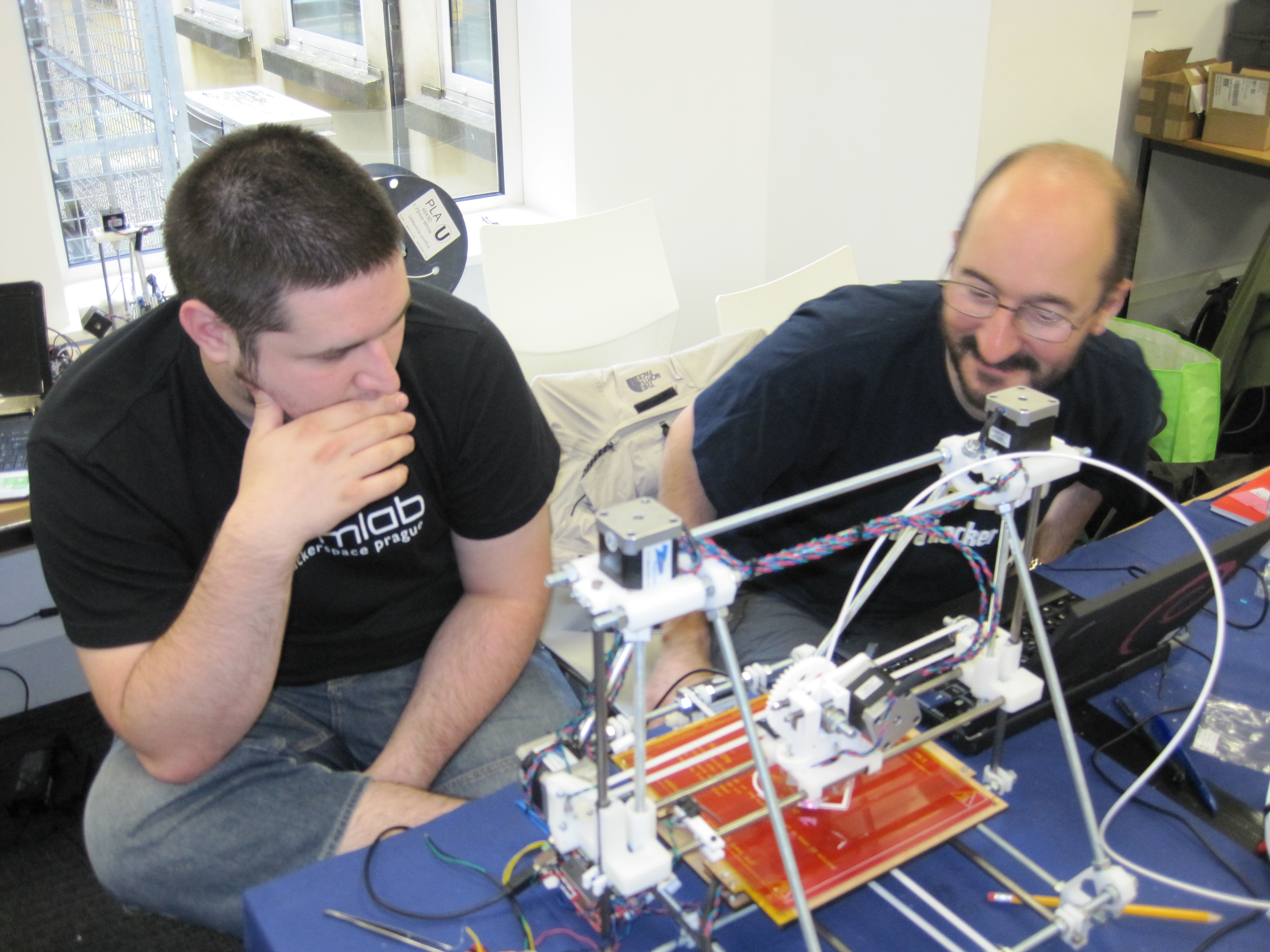
Jo Prusa and Phil Hands watching a heart print.
The workshop was to build a new, much simpler, design called the Prusa. Of course the workshop was booked and paid for well in advance which left me looking forwards to the event with anticipation. Of course I would not betaking the results of the workshop home as Phil had paid for it, so I started investigating what I would need for my own machine.

Of course at this point I muttered the age old phrase of "how hard can it be" and started acquiring parts for my own printer. By the time the workshop happened I already had my machine working as a plotter. I learned a lot from the Bath masterclass and a few days afterwards my own machine was complete.

First print
The results were underwhelming to say the least. There then came months and months of trial and error to fix various issues:
  • The filament feed bolt had to be replaced with a better one with sharper teeth.
  • The thermistor which reads the extruder temperature needed replacing (it still reads completely the wrong temperature even now).
  • The Y axis was completely inverted and needed re-wiring and the limit switches moving.
  • Endlessly replacing the printer firmware with new versions because every setting change requires a complete recompile and re-flash.
  • The bushings on the Y axis were simply not up to the job and the entire assembly needed replacing with ball bearings and a heated bed otherwise prints would be completely warped.
  • The Z axis couplings kept failing until I printed some alternates that worked much better
Once these issues had been fixed I started getting acceptable levels of output though the software in the workflow used to produce toolpaths (skeinforge) was exceptionally difficult to use and prone to producing poor results.

Alas the fundamental design issues of the Prusa remain. The A frame design provides exceptional rigidity in one plane...the other two? not so much. This coupled with an exceptionally challenging calibration to get the frame parallel and square means the printer is almost never true.

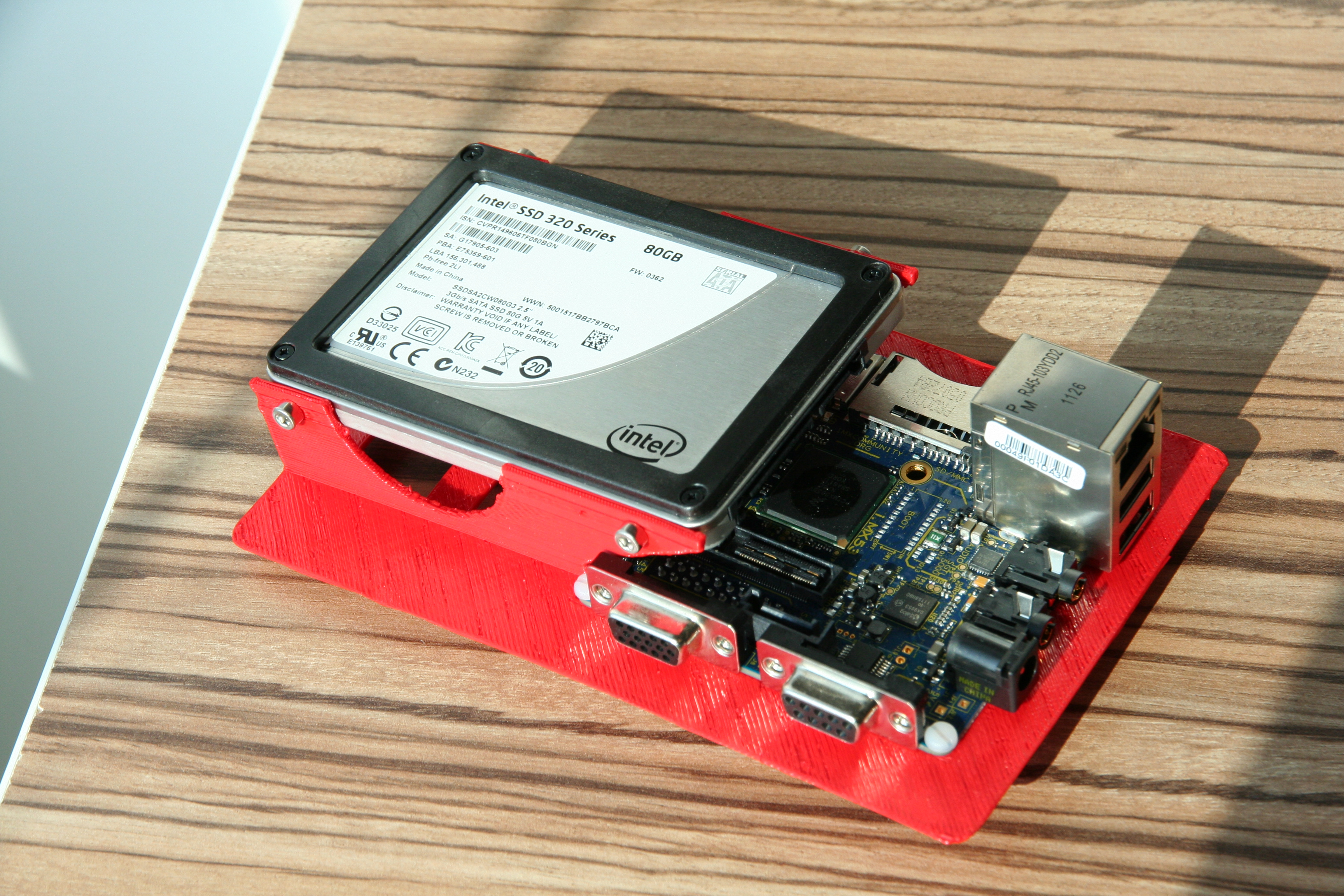
Prototype iMX53 dev board eurocard carrier printed on my printer
In operation the lack of rigidity in the x axis means the whole frame vibrates badly even with extra struts to try and improve its rigidity. I am not the first to notice these design flaws and indeed Chris has done something about it by creating a much superior design.

I do however have a working printer and have developed a workflow and understanding of what I can expect to work.

Improvements in the software means that slic3r has replaced skeinforge and gives superior results and the CAD software is continuously improving.

Currently I mainly use the printer to generate prototypes and simple profiles and then send the resulting designs to shapeways for final production though simpler designs are usable directly from the machine.

Because I am away from home a lot and moving the machine is simply not a workable option the printer does not get used for "fun" anywhere near as much as I had hoped and the workflow limitations mean I have not been able to make it available to my friends to use as a communal device.


Thomas Goirand: Openstack Folsom fully uploaded to Experimental

It s been a long time I wanted to blog about my recent work on the Openstack packaging. I finally can find a bit of time to do it. For those who don t know yet Openstack, it s a fairly recent (less than 3 years) cloud computing suite, which is becoming quite huge. If you plan on deploying a private cloud, you should definitively have a look into it. When the Openstack project started, I immediately was interested. I started packaging the Cactus release (that is, the 3rd version of Openstack), created the Alioth group (at the exact moment when Alioth was migrated to new hardware which added some fun so lucky I was!), and began to work on the Debian version (Openstack used to be an Ubuntu only project). After some success in integrating some Debian specific patches into the Ubuntu packages, I left it a bit aside, and skipped completely the Diablo release (which was never uploaded in Debian). Then, I worked a bit on the Essex release before the freeze of Wheezy last June, together with other DDs (big up to Julien, Loic, Ghe, Sileth!). I (re-)started serious packaging work for Openstack just right after Folsom (eg: version 2012.2) was released early last October. I literally worked days and nights on it, in order to provide more automation so that it could become more easy to install. Indeed, it used to be very complicated and painful, with lots of manual tasks to perform on the shell. It s hopefully a lot easier now, with most of the manual boring shell work replaced by debconf and scripts. But I m sure there s more that can be done still. After 4 months of effort, I finally pressed the red button and uploaded everything at once to Debian Experimental since Openstack Essex (version 2012.1) is in Wheezy, I can t of course upload to SID unless Wheezy is out -. This represent 32 sources packages in total (some of them are already uploaded and approved by the FTP masters: sorry to give you so much more work guys ), and 104 binary packages (and counting ). So this isn t exactly small And I already have some fixes for what s currently waiting in the NEW queue: CVE fixes, missing build-depends which we ve found using the Jenkins server of eNovance who sponsors the packaging work, etc. I probably will post again here to announce when Folsom is completely approved by the FTP masters and reaches Debian experimental. In the mean while, it s available on GPLHost non-official repositories (see the howto linked bellow). If you would like to test the latest Openstack release (called Folsom, or 2012.2, if you are following well ), you can read the quite verbose howto I wrote here: https://wiki.debian.org/OpenStackHowto/Folsom If you do test it (don t be afraid, it s not that hard ), I will be very happy to hear from you, and receive any feedback / critics you may have. Note that I would strongly recommend to use the Folsom release, rather than what is currently in Wheezy, for many reasons which would be too long to list in this blog post (let me still drop a few reasons here: less bugs, more automations and it s more easy to install). Now, Openstack is a constantly evolving software, with so many companies and developers involved. I don t think my work on this beast will ever be finished. But it doesn t mater, as it s been quite some fun, and I will enjoy to do more. The next release of Openstack is schedule for next April (they release at the same time as Ubuntu). I hope to be able to join the Portland summit, and see all the persons I have worked with over IRC and mailing list. This time, I hope to be able to release Openstack packages at the same time as the upstream source code is released (Debian packages have historically been lagging a few months behind). The pre-version is by the way already in Alioth. Last, a (private) message for our famous cheese-master: please wait until everything leaves the NEW queue before bugging everyone with translations. We probably should have a serious talk about how to make it less redundant, easier to translate, and probably find a way to avoid duplication of messages across all packages.
Vincent Sanders: Recommending a 3D printer

In a previous entry I wrote about the technology of additive manufacture and the use in printing three dimensional objects.

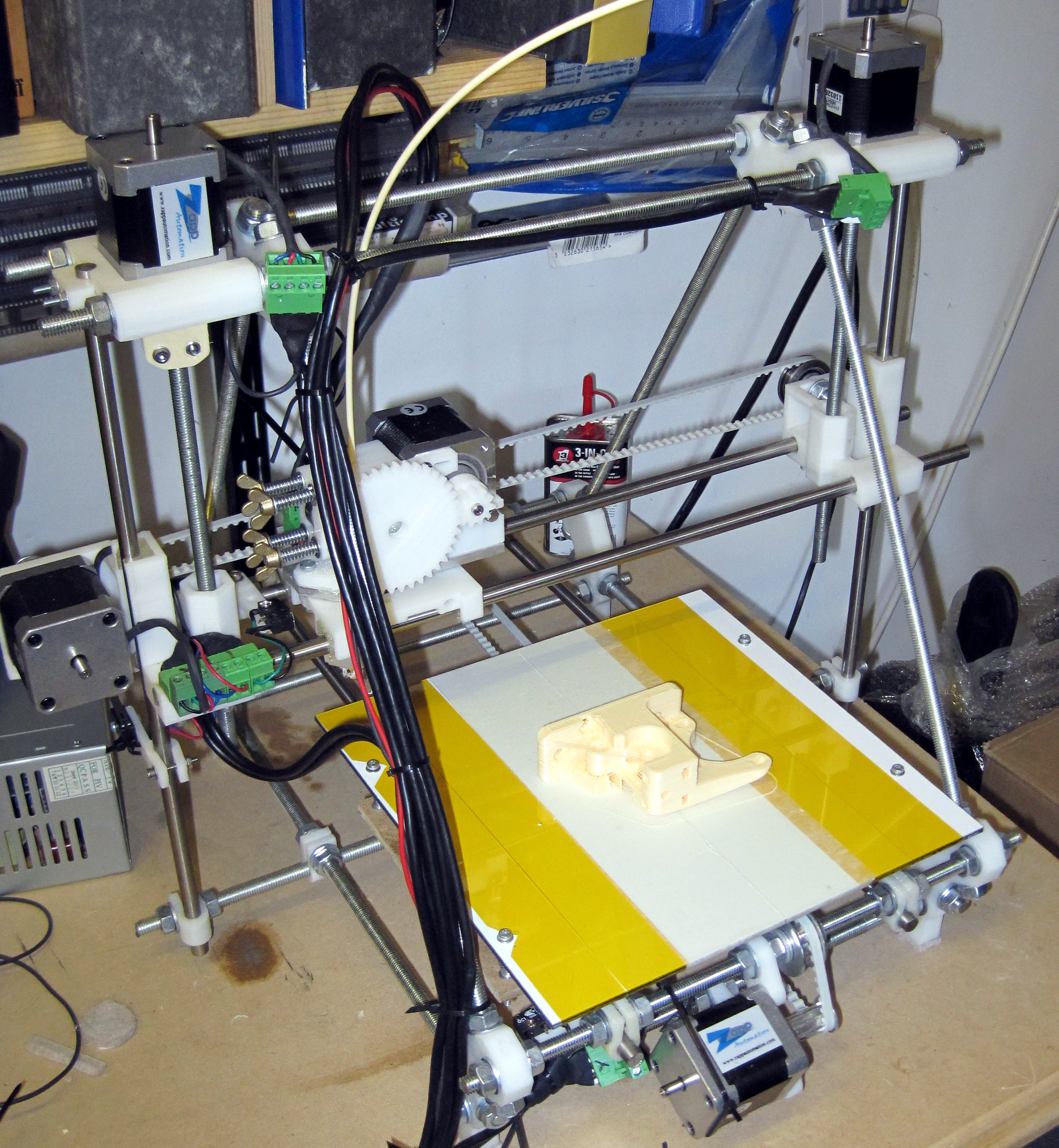
My Prusa Reprap printer, not recommended for new builds
It is now almost two years since I built my own 3D printer and I keep getting asked by colleagues and friends about the technology and often what printer to buy.

I will answer the purchase question first and then describe my experiences which have lead to the conclusion in another post. This may seem a bit backwards but the explanation is long and is not necessary if you are happy to learn from my mistakes.

Of all the options available right now, and there are many, I would choose a Mendal90 kit from Chris Palmer. The complete kit including everything to build the machine is 499 plus shipping. If I could afford it this is what I would buy myself to replace my current machine.

This is a Fused deposition modelling (FDM) printer similar to my Prusa Reprap but better engineered to produce repeatable results without the numerous issues of the other models. In Europe I would also recommend faberdashery as a materials source as their product is first rate every time.

Yes the kit requires some assembly but the commonly available commercial printers either cost many times more to deliver equivalent results, use an SLS or other print strategy requiring very expensive consumables or are from a company with dubious track record with the community.

If forced to recommend one, the 3DTouch from Bits From Bytes is not awful, but really do not be afraid of the kit, you will learn more about how it all fits together and save lots of money for your materials.

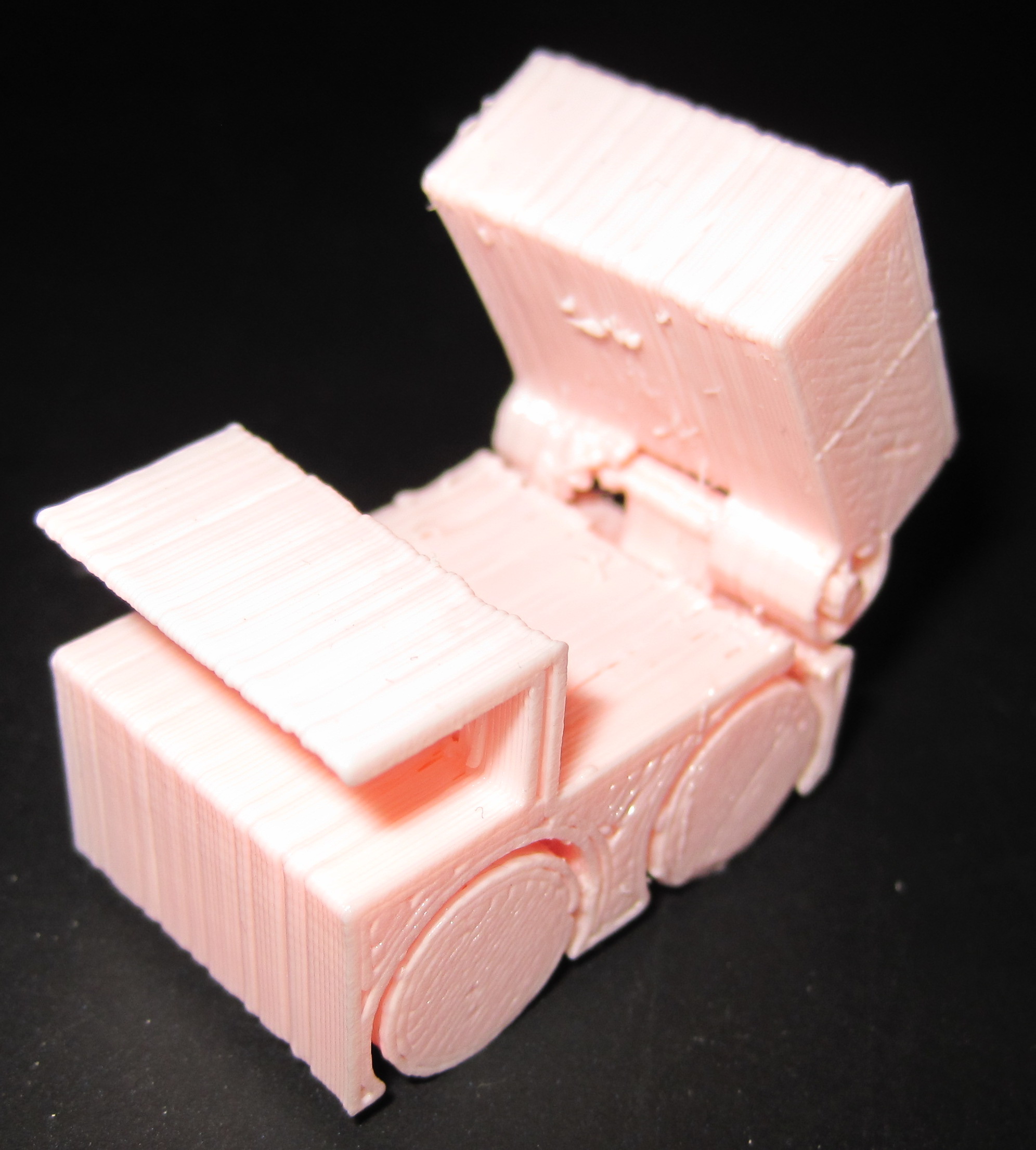
A 20mm high pink dump truck toy
One thing anyone buying a 3D printer right now should understand is that this technology is nowhere near as polished as the 2D equivalent. With the exception of the SLS systems like shapeways and the like use (and have price tags to match) The output will have clear "layering" and some objects simply cannot be created using the FDM process.

I guess what I am saying is do not expect a thousand pound machine to produce output that looks like that of a hundred thousand pound printer. To be clear you will not be printing complex moving machines on an FDM process more simple things that need assembly.

Having said that I have some pretty good results my favourite has to be the working recorder though, I might have said the whistles except my sons have them and they are way too loud.

You will spend a lot of time designing your things in 3D CAD packages and fair warning they all SUCK and I mean really, really badly. Add to that all the rest of the tools in the workflow are also iffy and I do wonder how anyone every gets anything printed.

My (open source) workflow is:


Which is probably a case of "least bad" tool selection though I warn you now that OpenSCAD is effectively a bad editor (I wish I could use emacs) for a 3D solid macro language with visualisation attached and definitely not a graphical tool.


Michal &#268;iha&#345;: phpMyAdmin translations status

Next round of phpMyAdmin 4.0 translation status report is coming. So let's look at which translations are at 100% right now (no change this week): There are also several languages which need just few strings to be complete: As you can see, there is still lot of languages missing, this might be your opportunity to contribute to phpMyAdmin. Also you are welcome to translate phpMyAdmin 4.0 using translation server. If your language is already fully translated and you want to help as well, you can translate our documentation as well.

Filed under: English Phpmyadmin 0 comments Flattr this!

Joachim Breitner: Evaluation-State Assertions in Haskell

I have just uploaded a new version of ghc-heap-view to Hackage that provides Evaluation state assertions in the module GHC.AssertNF. Imagine you are writing a web application in Haskell that sports a global number-of-visitors counter in an IORef Int. For every request, you call modifyIORef (+1). Eventually, you notice your very popular web site to hog more and more memory. So you browse to the internal page that shows the counter, and you have to wait for a long time until you eventually see the result (or get a stack overflow). The reason: The applications of (+1) were not performed until you looked at the number; instead, a long chain of such computation first filled your heap and then your stack. So you have learned the hard way that you might want to avoid space leaks, and want calculations to be done during the request that caused them, and want the IORef to always contain fully evaluated data. So you stumble about modifyIORef' in Data.IORef and indeed, this fixes your problem. Later, you notice that you want to count POST and GET requests separately. You change the type to IORef (Int, Int) and call modifyIORef' (first (+1)) or modifyIORef' (second (+1)). And suddenly, the space leak is back (which you only notice after the next push to the real site, because your local tests never caused enough requests to make it noticeable). So you not only want to fix it, you also want to ensure that it does not break again. In other words, you want to ensure the policy that values stored in an IORef are always in normal form. You achieve this with the following alternative to modifyIORef':
modifyIORef'Assert :: IORef a -> (a -> a) -> IO ()
modifyIORef'Assert ref f = do
    x <- readIORef ref
    let x' = f x
    x'  seq  return ()
    assertNF x'
    writeIORef ref x'
Using this instead of modifyIORef' will print this warning to standard error output right the first time you call modifyIORef'Assert (first (+1)):
Parameter not in normal form: 2 thunks found:
let x1 = (S# 1,S# 1)
in _bh (_thunk x1 (_bco (S# 1)),_sel x1)
(Otherwise, the program runs as usual.) So obviously, you need to use a strict variant of first (or strict pairs):
first' :: (a -> b) -> (a, c) -> (b, c)
first' f (x,y) = let   x' = f x; r = (x', y)   in x'  seq  r  seq  r
With this, the warning goes away. Whenever you now change the type of the IORef or modify it in a too-lazy-way, you can be sure that you ll be warned about it, before the space leak itself becomes noticeable. In the production code, you might want to disable the check. For that, simply put disableAssertNF somewhere in your main function. Why is this better than just calling deepseq in modifyIORef'Assert? Because this way, the code still creates unwanted thunks that are then evaluated before storing them in the IORef, whereas with assertNF you are told about the thunks and can prevent them from being created in the first place. Also, assertNF does not add a type class constraint. This is just one example application for assertNF (and its variants assertNFNamed, which includes a name in the warning to better spot the cause, and $assertNFHere, which uses Template Haskell to include the current source code position in the warning), and I hope that there are more. If you happen to make use of it, I d like to hear your story.

Dirk Eddelbuettel: A book about Rcpp

Some little birds had already been whispering about it, but I didn't want to jinx it and told myself I would wait with an announcement until the booksellers have (at least) placeholder pages. And as I learned from Duncan Murdoch via email earlier today, at least Chapters/Indigo had a page up, presumably scraped from the publisher page, so here it goes:
I have in fact handed a complete draft of my book about Seamless R and C++ Integration with Rcpp to Springer a few weeks ago. With a bit of luck on the production side, we could be seeing physical copies by May of a new title in their popular UseR! Series series.
And to the slowly growing new Rcpp site, I have added a a formal page about the Rcpp book where one can find information about it, including a link to the Springer page, links to a few bookseller's pages --- as well as a few wonderfully flattering endorsements. Eventually, errata and other support material should be available via this page too. Can't wait til I hold a physical copy in hand...

Lior Kaplan: RTL status for Libre Office 4.0.0

LibreOffice 4.0.0 will be released soon, and it s a good time to summarize its RTL status. Similar to 3.5.0, the RTL work started with LibreOffice conference in October, showing the current state (see LibreOffice RTL status 2012 presentation) and listing the top problems. The main goal of this talk is to raise awareness to RTL issues and recruit developer to help fix them. This was exactly what happened with fdo#44657 which is about Calc not having a scroll bar in RTL user interface. This way RTL bug #1 for almost a year. In total, version 4.0.0 has 8 bugs fixed (mainly Calc, Presenter Console and toolbars). In addition it has 5 language specific bugs fixed. Full lists are at https://wiki.documentfoundation.org/RTL_Bugs#4.0.0 and https://wiki.documentfoundation.org/RTL_Bugs#4.0.0_2. Beside working on fixing bugs for the 4.0.0, another focus was put on making sure the fixes are available for the 3.6.x users. This resulted with cherry picking 11 out of 13 bug fixes (part of 3.6.4 and 3.6.5 releases). More fixes are already underway in the master branch, and will also be part of 4.0.1 maintenance release (full list at https://wiki.documentfoundation.org/RTL_Bugs#4.0.1). Beside thanking the core developers for their help (patches, code review), I d like to thank the guys from The National Program for Free and Open Source Software Technologies (Motah) at King Abdulaziz City for Science and Technology (KACST) in Saudi Arabia, which have joined the RTL team during this release, and their effect is well noticed. Despite all the work done, we still have a share of RTL bugs for the next release, these are the 7 top priority RTL bugs, any help would be appreciated.
  1. fdo#33302 Brackets inverted in rtl text (mac only)
  2. fdo#53030 Calc deletes current sheet, not right-clicked on sheet when trying to delete opposite directionality sheets
  3. fdo#56403 RTL UI: with RTL locales presentations appear with text align to the right instead of to the left
  4. fdo#37128 Writer saves text alignment of RTL paragraph not according to the ODF specification
  5. fdo#44029 docx files with RTL paragraphs aren t compatible with Word
  6. fdo#43093 FILEOPEN: [docx] MS Office documents opens with wrong alignment and directionality
  7. fdo#56408 Brackets are not handled correctly with mixed English/Latin and Hebrew/Arabic texts

Filed under: i18n & l10n, LibreOffice

5 February 2013

Russ Allbery: WebAuth 4.4.2

When I was testing C code coverage analysis tools using WebAuth, I really should have investigated the segfault that I started getting in the test suite before releasing 4.4.1. But since valgrind didn't report any problems, I thought it was something specific to code coverage. Nope, uninitialized variable inside the WebKDC code. Which valgrind didn't catch at all for some reason. Now fixed, and I did check for similar issues, but it's sort of disturbing that valgrind completely missed it, particularly for a variable whose address is taken and therefore which I wouldn't think would be optimized away. Since I hate to release WebAuth to only fix one thing, I also tested out-of-tree builds for the first time in a while and fixed a pile of issues around how the Perl module builds work. There's got to be a better way. Maybe sometime I'll try to come up with some patches to teach Module::Build how to handle VPATH. I also imported some additional Autoconf glue that will hopefully help Hurd builds proceed farther, although I didn't promise anything in NEWS since WebAuth has not yet successfully built on Hurd. You can get the latest release from the official WebAuth distribution site or from my WebAuth distribution pages.

DebConf team: DebConf13 venue and dates (Posted by Moray Allan, Didier Raboud and the DebConf team)

This post is a quick status update on DebConf13, for those who aren t following the debconf-team mailing list. As you may know, this year s DebConf will be held at Le Camp, in Vaumarcus, Switzerland. Our concept for this DebConf is to hold it in a natural environment, away from distractions. We hope you will enjoy spending time together with other Debian collaborators in this beautiful part of Switzerland, on the shore of Lake Neuch tel. Dates DebConf13 will take place from Sunday 11. August 2013 to Sunday 18. August 2013. (We will use Saturday 10. August 2013 to prepare the venue for the conference.) You may notice that the dates don t cover two weeks like in the last few years (there is no separate DebCamp week). For budget reasons, current plans are to merge the two weeks activities into an 8 day period. If you think that s a pity, it s not too late to change it just join the fundraising team and start working quickly! Travel If you want to start arranging your travel to attend DebConf, some initial travel suggestions may be useful: The DebConf13 map shows the venue and the bus line (with some stops). Registration We expect to open registration around the start of March. Currently we are still evaluating some possible new conference management systems, which we hope might avoid the frustrations some attendees have had in the past with Pentabarf. Help welcome As always, the DebConf team is looking for volunteers. Some jobs need technical skills (e.g. testing conference management system setups, working on the website), but many DebConf tasks are about working to deadlines on non-technical issues (e.g. fundraising, budgeting, talk scheduling). You can see more information about some of the jobs to be done on the DebConf wiki. Please do think about getting involved and sharing your ideas with us, to help us make DebConf an even more useful event for Debian in the future. We look forward to welcoming you to Vaumarcus!

Michal &#268;iha&#345;: FOSDEM 2013 summary (Sunday)

FOSDEM 2013 is over and it's time to look what interesting I have seen there on Sunday. Sunday was supposed to start for me with L20N, but it was postponed to 13:00 as the presenters weren't on time. I could have used one more hour of sleep, but at least I spent some time on coding. Detect merge conflicts in realtime was quite interesting talk, though I was pretty surprised that the conflict detecting does not at all care about underlying version control system, but does purely file based guesses. The Hardening MySQL talk pretty much described why security in MySQL sucks and what you should do to make it secure. Quite good introduction to the topic, but not much new information for me. Introduction of Firefox OS, was quite nice demo showing they have something working, though it had some problems with flaky network on FOSDEM. Looking forward to see phone being sold, though it will probably not be something I'd buy. To add some fun, I've stayed on systemd, Two Years Later presentation, which gave some summary of what is currently in systemd and where it wants to go. Still it did not move systemd from category of "I don't care as long as it works". Now followed delayed L20N talk - it showed new Mozilla's effort for localization. Which is quite powerful and has nice features, on the other side it put's quite more load to translators - now they would have to understand some basics of programming as well to be able to use the new features (or not so new ones as plurals). Their motivation is to remove localization effort from developers, but I'm not really convinced it will work nicely. After some meetings and lunch, I went to LibreOffice: cleaning and re-factoring a giant code-base, which showed some challenges LibreOffice has to take and how they dealt with that. I think it's pretty great job done and I'm looking forward to new releases. Being GNOME user, I could not skip Has the GNOME community gone crazy?. It of course tried to tell that they did not :-). Last, but not least my friend Dieter from phpMyAdmin had talk Present and future of phpMyAdmin. He listed some of the new features, demoed 3.5 and 4.0 version (of course the demo of 4.0 version broke due to some caching). Even when the talk had quite unpleasant timing, it has attracted some people and they even asked few questions. This years FOSDEM was again great and looking forward to be there next year.

Filed under: Debian English Phpmyadmin Suse Weblate 2 comments Flattr this!

Dirk Eddelbuettel: New Rcpp page on upcoming events -- including Master Class in New York

Lots of exciting things are happening with and around Rcpp. I just added a new page about Upcoming Events to the recently-created Rcpp site. This events page has lots to cover: an upcoming talk at Columbia on March 8 (details still TBD), a day-long workshop in New York on March 9, a possible participation at a CERN / ROOT conference in Switzerland on May 11-14, an upcoming talk in May in Milwaukee, and last but not least the tutorial by Romain and Hadley at UseR! 2013 in Spain. Phew! With that, a few quick words about the upcoming master class in New York. It will be a full day, covering an introduction and motivation, details about the core data types, tools for working with and and extending Rcpp and of course applications galore, including RcppArmadillo and RInside. I have done the same one day class format a few times before, most recently (with Revolution Analytics) in San Francisco in late 2011, and also as a two-part seminar at UseR! 2012. This time, we plan on providing cloud-hosted RStudio instances for participants. Better still, RStudio's own JJ Allaire will be on deck as well for RStudio --- and Rcpp Attributes --- questions. Details and registration information for the New York class are at this page.

Wouter Verhelst: Transcoding videos

Since some people asked for it, and since it's (unfortunately) fairly nontrivial, here is the script that I'm using currently to transcode a .dv file into webm:
#!/bin/bash
set -e
newfile=$(basename $1 .dv).webm
wavfile=$(basename $1 .dv).wav
normalfile=$(basename $1 .dv)-normal.wav
normalfile=$(readlink -f $normalfile)
oldfile=$(readlink -f $1)
echo "Audio split"
gst-launch-0.10 uridecodebin uri=file://$oldfile ! progressreport ! audioconvert ! audiorate ! wavenc ! filesink location=$wavfile
echo "Audio normalize"
sox --norm $wavfile $normalfile
echo "Pass 1"
gst-launch-0.10 webmmux name=mux ! fakesink \
  uridecodebin uri=file://$oldfile name=demux \
  demux. ! ffmpegcolorspace ! deinterlace ! vp8enc multipass-cache-file=/tmp/vp8-multipass multipass-mode=1 threads=2 ! queue ! mux.video_0 \
  demux. ! progressreport ! audioconvert ! audiorate ! vorbisenc ! queue ! mux.audio_0
echo "Pass 2"
gst-launch-0.10 webmmux name=mux ! filesink location=$newfile \
  uridecodebin uri=file://$oldfile name=video \
  uridecodebin uri=file://$normalfile name=audio \
  video. ! ffmpegcolorspace ! deinterlace ! vp8enc multipass-cache-file=/tmp/vp8-multipass multipass-mode=2 threads=2 ! queue ! mux.video_0 \
  audio. ! progressreport ! audioconvert ! audiorate ! vorbisenc ! queue ! mux.audio_0
rm $wavfile $normalfile
It's fairly non-optimal, because many of these command-line A/V tools are either fairly badly documented, or have a horrific interface, or something similar. avconv is supposed to be able to do audio normalisation, but I haven't been able to figure out exactly how it's done. The options that are specified in the manpage seemingly have no effect. gstreamer has a 'ReplayGain' plugin which can do audio normalisation. Audio normalisation requires two passes; I could in theory just add the element in the gstreamer first-pass pipeline, add a '-t' to the gst-launch-0.10 invocation, and parse out the required gain value that I can then add to the second-pass pipeline. However, the elements that I can then pass that gain value to either have a different range for the gain (rgvolume's fallback-gain parameter) or expect a completely different unit of values with no obvious way to translate between the two (the 'volume' element's 'volume' parameter expects a multiplier, the replaygain plugin produces a dB value; a simple conversion seems wrong as it produces a value way out of range). The 'volume' element reportedly has an interface that takes a dB value, except you can't reach it from gst-launch-0.10. Bummer. So instead we split out the audio, do normalisation in sox, and mux that back in during the second pass of the video transcoding. Sox is good. Sox is easy. If all A/V command-line tools were like sox, I would be smiling now. What's missing from the above script is how to throw away the start or end of a file in case there's several minutes of uninterestingness there. This is easiest (in my experience) with avconv's -t and -ss options. I suspect gstreamer is capable of doing that, too; but I haven't figured out how, and this works. You may want to play with some of options of the vp8enc element. For instance, the threads= value can be increased (or decreased) depending on how many cores your transcoding machine has. You could probably also add a "target-bitrate" value if you find the quality is too low or the system uses too much diskspace. VP8 has several more options; the documentation lists them all. If you've done video recordings for a devroom at FOSDEM outside of the FOSDEM video team, note that FOSDEM is more than willing to host the videos. To do so, the easiest way is if the videos are online somewhere (this does not have to be a public system) that we can wget or scp them from; if you've done that, contact me with the location to the files and we'll put them on the FOSDEM video server.

Joey Hess: LCA2013 wrapup

After 27 hours of travel, I'm finally back from my first Linux.conf.au. This was a great conference! Some of my favorite highlights:
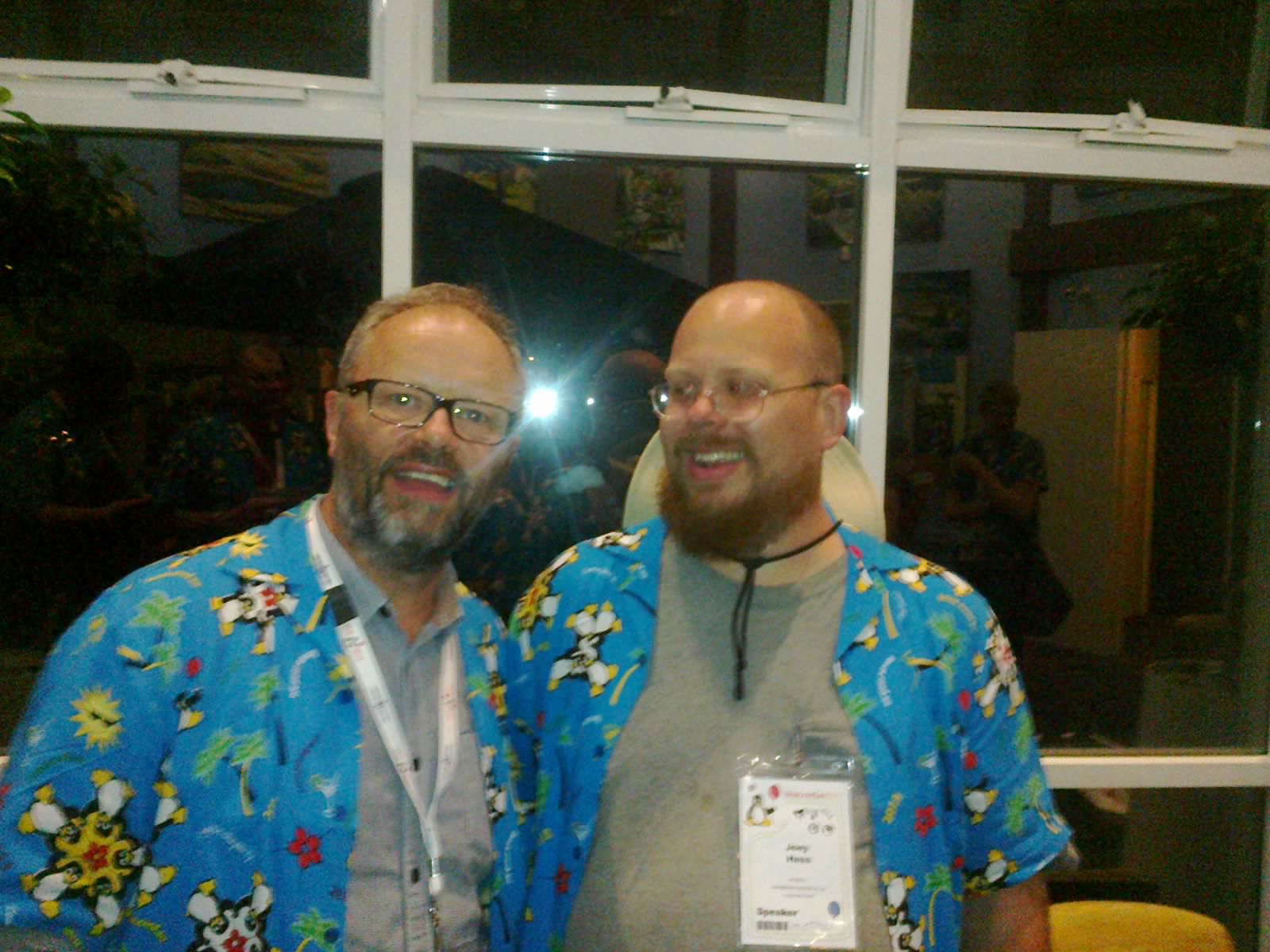
My git-annex talk went ok, despite technical problems with the video output, which the video team did a great job of working around. The first demo went well, and the Q&A was excellent. The demo of the git-annex assistant webapp was marred by, apparently, a bad build of the webapp -- which I ironically used rather than my usual development build because I assumed it'd be less likely to fail. At least I may have a way to reproduce that hang somewhat reliably now, so I can get on with debugging it. I will be redoing a demo of the webapp as a screencast.
Here are some of the best talks I attended. (I have quite a lot more queued up to watch still, and had to cut several due to space.) Click titles for videos, or browse all the videos.

Next.

Previous.