Search Results: "willi"

17 November 2006

MJ Ray: Want a Pint? Give us your prints!

As if the underhand registration of children wasn't bad enough, this NO2ID newsletter describes another way to encourage people to submit to scanning:
"The scheme which is backed by the Home Office was first trialled in Yeovil but plans are afoot to expand the system to Coventry, Hull, Sheffield, Leeds, Gwent, Nottingham, Taunton and possibly Swindon. Drinkers must have their thumbprints scanned and supply their name, address and date of birth to enrol onto the system before they are allowed to enter licensed premises taking part in the scheme." "If you are in any of the towns affected, especially Yeovil, and are willing to do something then send an e-mail to phil@no2id.net (please put "pub fingerprinting" in the Subject).Don't get depressed, don't give in and get a home-brew kit - get angry and do something!" "PS. If anyone knows a pub that would like to take NO2ID beer mats, Newcastle NO2ID has created some with our logo on the front and key counter-arguments on the back, ideal for starting the discussions of the scheme that we need."
Not even our beer is safe from the ID State!

Evan Prodromou: 26 Brumaire CCXV

I've been pretty interested in making Web sites WebSoftwareFriendly for a while, so I'm pretty psyched to see that Yahoo and Microsoft have embraced the Google Sitemaps format. They've started a site for the format, http://www.sitemaps.org/ , which lists out the protocol, which seems to be unmodified from the original Google version. Sitemaps have been a necessary part of Web sites for years. Netscape -- back when it was a browser -- had an RDF-based sitemap format that had a brief flare of popularity just before Netscape went into its weird late-90s spiral. Then RDF people got really abstract and academic, and decided that sitemaps weren't what RDF was all about, and RDF sitemaps were forgotten. So sitemaps went off the air, and we've had to wait for a standard on the idea until today. Yahoo lets you submit sitemaps today, as does Google; Microsoft Live supposedly will support it sometime in 2007. One thing that's interesting is a new "ping" protocol, for when the site is updated. I'm not sure how well it works or if it's even implemented, but it's interesting to see it working. I think the weak part of this whole thing is that site owners have to submit sitemaps to each search engine; it would be nice if there were some sort of discovery, like an HTML <link> element, so that other types of Web software besides the big search engines would benefit. tags:

Knowing when to hold 'em From O'Reilly's wrapup of the Web 2.0 Summit, I got a good link to some other Evan's Knowing When to Hold Em. It's a little discourse on the growth of Web 2.0 sites after they've been acquired. Evan Williams, the author and the guy who sold Blogger to Google, knows whereof he speaks. He has some graphs that show traffic for various Web 2.0 sites sloping precipitously upwards after their sale to some big company. The implication being, I guess, that the sites would have been more valuable to sell later. He also points out that few of the sites have benefited visibly from being acquired. I'm not sure the argument makes sense. Traffic is a cost centre as well as a potential source of revenue for companies. Keeping servers up, running, and cogent is hard work. Most small Web sites have been throwing labor and cash into their sites for a while, and the ability to keep such a site going into the Alexa top 100 is beyond most small companies. Paying for a lot of servers, developers, designers, sysadmins and bandwidth for another couple of years may make the site bigger and more desirable for acquisition, but it's a big risk to take. My favourite part of the discussion is that my friend Kevin Fox shows up at the end with some good points about when and how to invest. tags:

Free Software Java I've been programming in Java off and on since the first beta versions of the VM and JDK in 1995. The language has always had a certain cachet with the Open Source set -- the free-as-in-beer tools, good documentation, and cross-platform compatibility made it an Open Enough system, roughly equivalent to proprietary C compilers shipped with every Unix variant. Its release was roughly synchronous with the growth of the Web, and Java applet support in Netscape made the first round of rich client applications conceivable, if not exactly elegant. And then Java grew onto the Web server; and into other parts of the network; and then all of a sudden everything had to be Java. The system grew from this nifty little tool to The Enterprise Solution For Your Enterprise. Serious people worked on Java. I worked on Java when I needed to be serious. Java stopped being fun. Early efforts at getting Open Source Java VMs and development kits working were pretty successful, but they just couldn't catch up with the rapid pace of development on Sun's core product. But inclusion of the language in the Gnu Compiler Collection, the great JBoss J2EE system, the growth of Apache's Jakarta project, and the growing Java Community Process made Java less and less a regular product, built in a silo behind a corporate firewall, and more of an Open-Source-y project. So I guess it was inevitable that Sun would either Open Source its codebase, or end up irrelevant. They probably squeezed just about all they could out of it without going Free, so that's pretty impressive. I think Free Software advocates are supposed to be grateful about this; my main reaction is: why did you put everyone through all this crap for so long? You've wasted 12 years that could have gone into making Java really incredible. We'll see what happens. My main interface with the JVM for the last year or so has been through scripting languages like Rhino JavaScript engine (very fun) and Pnuts. Who's got time for Java programming any more? tags:

14 November 2006

Jeff Bailey: Equality on Campus

I'm pleased to see that the McGill Student Union is now refusing to allow blood drives until anti-homosexual discriminatory questions on the questionnaire can be dropped. The problem is one of stupid questions combined with discrimination. My friend Katy put it best about when she went to fill out the questionnaire: "No, I can't guarantee that I know my partner's sexual history. But I'm willing to bet my life on it."

According to an article on a recent Public Health Agency of Canada report:

The PHAC report reveals that 51 per cent of those infected with HIV continue to be men who engage in homosexual activity.


(Note that the lifesite.net is a Christian, pro-life, anti-gay website. I don't have time at the moment to dig out either a better source or the original report.)

Perhaps I'm doing my math wrong, but at the point when 49% are those who don't identify as homosexual (and 40% of those are women), then you've probably got a third to half a chance that someone in that line isn't a man who's had sex with a man and could be HIV infected.

I hope that the McGill protest puts enough pressure on Health Canada to review this policy and drop the discrimination completely.

8 November 2006

Matthew Garrett

The day that Bruce Perens gets to tell me that Novell is the new SCO is the day that I willingly accept an offer to be sodomised with a pneumatic drill.

Novell have contributed more code to Linux than pretty much any other single commercial entity other than Red Hat. Without the Novell kernel developers, Linux would be in a much worse state than it currently is. However, I'd expect that everyone in Novell knows that they're also entirely dependent upon the developers working for other distributions. Killing every other distribution isn't advantageous to Novell. And, perhaps more importantly, the death of Novell would be a (short-term?) disaster for every other distribution. Debian may have a larger market share than Novell, but if Novell dies then that's going to be a share of a very small market.

The Linux community doesn't need to eat its own. And one very basic fact does still remain - if Microsoft couldn't sue you before, they still can't sue you. If you're legal, nothing Novell can do will alter that.

(It's sort of touching that Bruce has time to comment on this sort of thing, but didn't seem to find time to make Linuxworldexpocontinentconferencecountymeeting last month. Thanks, Bruce. Thruce. But hey, you're in the credits for A Bug's Life and Toy Story II!)

3 November 2006

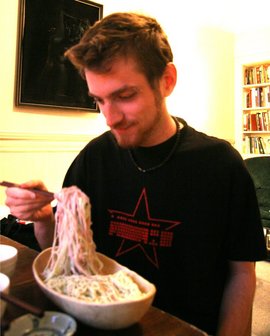
Benjamin Mako Hill: Noodles & News

/copyrighteous/images/someny_noodles-small.jpg

Someny noodles, so little time.

If you live in the bay area and you are still willing to talk to me after that pun, please get in contact with me. While it's been a while since I've been in San Francisco, I've got a flight out Saturday for the Ubuntu Developer Summit in Mountain View. I will have some time especially next weekend to hang out.

27 October 2006

Eric Dorland: A Big AOL to Mike Hommey

Dude, I could not agree with you more.

However, you seem unwilling to take Ubuntu to task over it's decision to use the trademarks. It's not clear to me under what circumstances you can even use the icon, since the copyright file doesn't list what the copying conditions are, in fact it doesn't mention the logo graphic copyrights at all. I think this is a big loss for distributions everywhere. While this would appear to be expedient and make users happy, but it creates more work for the derivers of Ubuntu and it also makes it harder for Ubuntu to derive from Debian. It also sends the message that this sort of thing is alright, that we should just accept upstreams doing this.

25 October 2006

Joachim Breitner: Giving up at SOSHGIC

Some of you might have followed my volounteer work at the SOS Hermann Gmeiner International College in Tema, Ghana, where I was invited to introduce Linux at the school. Being a free software advocate, I thought this a great opportunity to spread Free Software where it can make the most difference and helps bridging the Digital Divide: In a developing country.Judging from the offer (which was very nice, it included housing, flights, freight, money), I expected the school to be very eager to learn about Linux. I was expecting that I only had to guide existing momentum. What I found instead was that there was zero interest from the people who matter in this case. I got all freedoms to implement what I want (as long as I didn t break anything), and I created some things I think are quite nice: Automatic installations that keep the installed windows intact, neat integration in the Active Directory setup, network monitoring with nagios, a transparent firewall that let s the teachers turn the internet for the class room off and on. But it felt like working for nothing, and I can t push people to use Free Software who are unwilling.So today I drew the concequences and quit with effect to the end of December. The principal, who s project it was in the first place, was sorry, but understanding of my issues, and accepted my resignation. I will be on a trip to the Volta lake and other parts of Ghana with friends from Accra for the next 10 days anywasy, so she will take the time to think and discuss how the school can make the best out of the remaining two months.I have not giving up on spreading Free Software here completely. If I find another project where I can be of more use afterwards, I will consider that. But this time I m going to be very picky where I go, and only take a shorter, better defined project. If I can t find something, then that s it and I ll go back to Germany to continue my studies.

24 October 2006

Anthony Towns: Todo Lists

A while ago I read Steve Yegge’s rant about Agile development, though I’ve forgotten who linked to it. The thing that struck me as interesting was the bit about “work queues”:
With a priority queue, you have a dumping-ground for any and all ideas (and bugs) that people suggest as the project unfolds. No engineer is ever idle, unless the queue is empty, which by definition means the project has launched. Tasks can be suspended and resumed simply by putting them back in the queue with appropriate notes or documentation. You always know how much work is left, and if you like, you can make time estimates based on the remaining tasks. You can examine closed work items to infer anything from bug regression rates to (if you like) individual productivity. You can see which tasks are often passed over, which can help you discover root causes of pain in the organization. A work queue is completely transparent, so there is minimal risk of accidental duplication of work.
Sadly, googling for “work queue” doesn’t come up with any sort of todo list stuff, but rather a multiprocessing scheduling tool which is cool, but not immediately relevant for me. As far as I can see, whatever was actually being talked about either isn’t public, or is more of a concept than an actual tool. The only Google Todo thing I could find was an applet thing for the personalised google homepage, which just lets you make todo items and set them as high/medium/low priority. And while that might be all that Steve Yegge was talking about, it doesn’t really feel terribly inspiring to me. I guess what I’d really like is to have todo items get assigned to a project (so that I can ignore all the todos for projects I don’t want to worry about atm), and also to be able to give them a deadline (so I can treat them with a bit more urgency when necessary) and a priority (so that I can easily spot things I’m willing to defer or ignore completely when I find I don’t have time to do everything I’d like). I suspect I’ll probably just stick with writing notes in vi to keep track of things, though, same as I have been for years.

23 October 2006

David Moreno Garza: Joke

Found at the Mexico City House Hash Harriers mailing list :) A man and a woman who had never met before, but were both married to other people, found themselves assigned to the same sleeping room on a transcontinental train. Though initially embarrassed and uneasy over sharing a room, they were both very tired and fell asleep quickly… he in the upper bunk and she in the lower. At 1:00 AM, the man leaned over and gently woke the woman saying, “Ma’am, I’m sorry to bother you, but would you be willing to reach into the closet to get me a second blanket? I’m awfully cold.” “I have a better idea,” she replied. “Just for tonight, let’s pretend that we’re married.” “Wow! That’s a great idea!” he exclaimed. “Good,” she replied. “Get your own fucking blanket.” After a moment of silence, he farted.

Martin F. Krafft: Testing mdadm

The problem with being the mdadm maintainer is that it doesn't make any friends but potentially quite a lot of enemies. Even though it's actually very unlikely that a new mdadm version causes data loss (mdadm is only the remote control into the kernel), people seem to exhibit unexpected reactions when their 500Gb RAID5 array containing everything doesn't want to start anymore (Hi Lars!). In such a case, don't panic, don't do anything without understanding the implications, and consider asking for help. That said, I would appreciate if you guys helped me test the latest mdadm releases a bit more thoroughly before the package is frozen for good. I do extensive tests myself, but as Murphy would be able to predict, the problem only ever occur on other people's machines, and I'd much rather fix them before etch than after. The easiest way to help is by adding my package repository (i386/amd64) to your sources.list file, and configuring the APT pins appropriately:
# cat <<_eof >> /etc/apt/sources.list
deb http://debian.madduck.net/repo sid main
_eof
# cat <<_eof >> /etc/apt/preferences
Package: *
Pin: release a=sid, release o=madduck
Pin-Priority: 50
Package: mdadm
Pin: release a=sid, release o=madduck
Pin-Priority: 600
_eof
# apt-get update; apt-get upgrade
Alternatively, you can just download the package for i386 or amd64. If you're running sarge and are willing to test, that would be great! I've prepared backports, which you can use like so (note how you need backported debconf and lsb-base packages too, the latter of which is already on backports.org):
# cat <<_eof >> /etc/apt/sources.list
deb http://debian.madduck.net/repo sarge-backports main
## unless you have backports already enabled:
deb http://www.backports.org/debian sarge-backports main
_eof
# cat <<_eof >> /etc/apt/preferences
Package: *
Pin: release a=sarge-backports, release o=madduck
Pin-Priority: 50
Package: mdadm
Pin: release a=sarge-backports, release o=madduck
Pin-Priority: 600
Package: debconf
Pin: release a=sarge-backports, release o=madduck
Pin-Priority: 600
Package: lsb-base
Pin: release a=sarge-backports
Pin-Priority: 600
_eof
# apt-get update; apt-get upgrade
The mdadm backport can also be directly downloaded for i386 or amd64, the corresponding debconf package is here, and lsb-base is resides in the backports.org archive. Much appreciated! NP: Barclay James Harvest / Gone to Earth

21 October 2006

Jurij Smakov: Useful geek tips

For a while I’ve been looking for something to put under my laptop when using it on the couch or bed (it has vents on the bottom and runs pretty hot). I don’t have any large books, and the original idea to buy a cutting board for this purpose has failed spectacularly. All boards I could find in the nearby stores were either too small, or priced way higher than I was willing to pay. Determined to resolve this fundamental problem, I visited a local Home Depot today, and found an excellent solution: a 1′x1′ marble tile. It works beautifully, and is much more aesthetically pleasing than anything else I could come up with.

19 October 2006

Jordi Mallach: Silent home servers

The computer which hosts this host is a venerable Pentium 150Mhz, with 64Mb of physical memory and two decently sized disks. It has been running non-stop mostly without hiccups for several years, and I'm quite happy with it, even if the processing power is so scarce I've been having to tune down some services as Debian has gotten more resource hungry, dist-upgrade after dist-upgrade. Natura is my 2nd oldest Debian install, coming back from Ham, and after a while it became a home server when it was replaced by an Athlon 700Mhz at my father's house. The only hardware incidents are all related to blackouts or storms: two dead disks and one power supply. The CPU died years ago, but I discovered that many months later. I guess it wasn't so necessary. :) It is time to replace natura, though. The components are aging and they have become quite noisy, despite my attempts to cleanup the dust. Lately it is so loud that I can't understand how my dad can actually get work done with that persistent noise in the room. Besides, it'd be good to get just a little bit more of CPU power to do a few things that have been postponed for a while now. I have been looking for offerings in the embedded devices market. I am looking for a device with the following characteristics: I've found that the Thecus YES Box N2100 is one of the most interesting offerings: 2 Gigabit ethernet ports, two internal SATA HD bays, 3 USB ports... but is a bit too expensive: 350 (without disks). tbm also told me to look at some cheaper PowerPC devices, but I forgot the name right now. So, dear Lazyweb, what would you recommend as a natura replacement for a home server?

17 October 2006

Russell Coker: terrorist "weakest link"

In the game show The Weakest Link competitors get voted off, usually not on whether they are weak but on whether the other contestents consider them to be a threat. It's mildly amusing as a TV game show but not funny at all when carried out on an airline.

Recently a flight from Malaga to Manchester was delayed because two passengers were considered to be suspicious by other passengers (either 6 or 7 passengers refused to get on the plane because of this). The passengers were thought to be speaking Arabic (as if there was anyone on the plane who would recognise Arabic when they heard it) and because they were wearing coats and looking at their watches. The two men in question had been searched twice and found to be clean, but a bunch of idiots on a plane thought they knew better and demanded that the passengers in question be removed.

Lessons to be learned from this for travelling to/from coalition of the willing countries:
  1. Avoid the urge to check your watch when your flight is being delayed unless you are white. Non-white people who do what white people do in this situation are considered to be terrorists.
  2. When travelling to a cold place (such as Manchester) you want to have a coat to wear when getting off the plane. The airline staff won't allow you enough hand-luggage space to store a coat so you will want to wear it when getting on the plane. This is fine if you are white, but if not white just deal with the fact that you will shiver when disembarking.
  3. Learn to speak English for your travels. If you speak another language you will be considered to be a terrorist.
  4. Whatever country you visit, stick to major cities as much as possible. Smaller cities have more racists and nationalistically bigoted people, there probably wouldn't have been a problem on a flight to London.

Also just avoid the coalition of the willing countries in your travels as much as possible. There are much less problems in this regard when the government doesn't depend on terrorism hysteria to justify going to war on the basis of lies.

Russell Coker: more security foolishness

Dutch police arrested 12 people for acting suspiciously on a flight to India. A passenger said "They were not paying attention to what the flight attendents were saying", I don't pay attention to the flight attendents either. When you fly more than 10 times a year you learn how to do up your seat-belt and when it's appropriate to use your laptop, so once you know where the emergency exits are you can read a book ot talk to other passengers. The 12 people who were arrested were apparently exchanging mobile phones - strange, they have never asked people not to do that.

The 12 people have since been released. The cost of canceling flights due to security scares is significant for the airline companies. The fear that this induces in the public (both of terrorism and of stupid police) causes them to be less likely to fly which hurts the airline industry even more as well as also hurting the tourism industry.

The US is more dependent on air travel than any other country due to a severe lack of public transport. Australia is also very dependent on air travel due to large distances and no land connection to any other country. The UK also seems to have more of a need for air travel than other EU countries.

If exchanging mobile phones can interfere with air travel then people who dislike the US and the other countries in the coalition of the willing/stupid can cause serious economic damage by trivial things such as exchanging phones in-flight or writing BOB on a sick bag without any risk to themselves.

The war on terror is already as good as lost. William S. Lind's blog is a good source of information on some of the ways that the US is losing. It's a pity that the Australian and UK governments are determined to take their countries down with the US.

16 October 2006

Joey Hess: paraphrase

You might think that an organisation of over 1000 very smart people could do better. I certianly thought so -- until I sat through one of the Debian debates on -vote. Many of the participants acted the age they must have been when they first learned the mnemonic "Garbage In, Garbage Out." They argued, often quite belligerently, from their own narrow perspectives, unable (or unwilling) to see the situation from anybody else's point of view. [...] bureaucrats, not programmers.
Paraphrased from Rick Fienberg's editorial in November's Sky & Telescope, describing the IAU Pluto definition. The parallel seems amusing, especially since both cases involve silly votes.

15 October 2006

Lucas Nussbaum: Mozilla, Debian and Iceweasel: the Mozillian point of view

During the Journ es du Logiciel Libre 2006 (an excellent event, thanks to the organizers), I had long chats with people from Mozilla Europe (in a more constructive way than what others did). This is mostly second-hand information, since the well-informed guys from Mozilla Europe I talked with got their info from other Mozilla developers, so it might be slightly inaccurate, but still help to understand the issue. More details welcomed in comments. The Mozilla Foundation goal is to prevent the web from becoming a proprietary web, by ensuring that Firefox, their product, has a big-enough market-share. I find it a bit disturbing to hear free software people speak about product and market-share, but well, OK. Of course, it’s quite difficult to achieve >20% market-share only with GNU/Linux users. :-) They put a very high emphasis on the User experience. They want Firefox to look exactly the same on all platforms, even if some features (automatic plugin installation, automatic upgrades) do not fit well on a GNU/Linux system (such features don’t work with the Debian build). They want to enforce their trademark to prevent attempts to ruin their reputation to succeed. After a question asked by Dave Neary (GNOME) to Tristan Nitot (president of Mozilla Europe), Tristan gave the example of this hacker who said he found critical security bugs in Firefox before admitting it was a joke. He also gave the example of Microsoft indirectly founding SCO. Dave Neary remarked that some people could probably be trusted (like distro maintainers). But, if I remember correctly, Tristan said that it was difficult to allow some people to use the trademark without allowing everybody to do so. Also, allowing Debian to use the trademark without allowing derivatives to do so is not possible (DFSG#8). Iceweasel is considered a good thing inside Mozilla Europe (”It’s what we have asked them to do for a long time!“). However, some people are bitter about the fact that Debian seems to have chosen to use a gnu.org-hosted fork instead of just renaming the package to iceweasel. During Tristan Nitot’s conference, I asked a question about length of security support (only 18 months for the 1.0 branch). The answer was that distros were supposed to upgrade to newer Firefox releases even on their stable releases (!) or to come and help with security support for stable releases. Also, the fact that Debian chooses to package Firefox following the FHS is considered a source of problems. Somebody claimed that Debian was the only distribution to package Firefox this way (seems strange, but I did not checked this claim). I’m not sure how this fits with other Mozilla-based browsers such as epiphany. On a more technical side, they also claimed that Debian wasn’t properly collaborating with Mozilla, sending unusable 100000-lines patches for validation just before releases (haven’t checked this claim). It’s interesting to note that the same problem exists on the other side, with Mozilla releasing “security and stability” releases instead of just providing patches for the security bugs. My personal conclusion is that Iceweasel is really a good thing, and is quite unavoidable, even if it seems that the Debian/Mozilla collaboration could maybe have been better. Let’s advertise the use of Iceweasel, Epiphany, and other Web browsers! :-) Note : comments open for people willing to fix inaccuracies or provide references, not for a stupid childish flame-war like the one in the comment of this post. Please write your own blog entry and use a trackback if you want to provide a detailed answer! Updates:

12 October 2006

David Welton: Practical Agile?

At work, we've decided we need a little bit more process, so I'm going to attempt to lead our small group of programmers in that direction. We have a vague feeling that since there aren't many of us, we need to keep things as lightweight and practical as possible, and that something "agile" would probably be the best direction. Beyond having read a bit here and there, I've never had any direct contact with "agile" in the wild. We don't want a rigid methodology so much as a set of guidelines and, perhaps, tools that help us track time and projects. It all needs to impose very low overhead - because an imperfect tool that gets used is far better than something very fancy that gets ignored when people get in a rush. So... advice? I'm willing to get a book or two, but I have a sneaking suspicion that many of them are quite inflated with respect to their core concepts which could likely be summed up in a few pages. Anyone have any practical guides for small shops that want to try and reduce the chaos level just a bit?

9 October 2006

Martin-&#201;ric Racine: ALSA pitfalls ... and a bounty ... or two

Daniel Jacobowitz writes about problems he's having getting proper ALSA support for his desktop computer. Boy, does that sound familiar! I myself have three computers that are partially or totally unsupported on ALSA:
  • Apple iMac rev.D a.k.a. 333MHz G3 tray-loading iMac. Partially supported by snd-powermac, except that some controls are inverted and other controls just plain don't work. Probably something as simple as the wrong offset in the bitmap used to select the control on which to act. Bug filed in the ALSA BTS. No reaction. Anyhow, sound support for Apple products is being migrated to snd-aop, which was written from scratch using a modular architecture that enables easily adding support for new sound chips. Nice idea, except that no effort is being put towards supporting pre-G4 products... Back when Ubuntu appeared on the Linux scene, Mark Shuttleworth agreed to pay a 500$ bounty to whoever made ALSA work on all PowerMac variants. Nobody took it, as far as I know. Those who are interested in taking on this challenge might wanna check my wiki page for our summary of the ALSA PowerMac situation.
  • HP 9000 series model 712. Recently supported, thanks to someone on the PA-RISC Linux mailing list having a go at coding it. Never merged by upstream ALSA, though. It's been a while since I gave it a try but, last time, only output worked.
  • AMD Geode SCx200. There is no snd-scx200 driver at all. Bug filed in the ALSA BTS. The issue of sound support on early Geode products was also mentioned on the Linux kernel mailing list, during the big OSS cleanup discussion so, at least, some people are aware of the issue. It so happens that the Geode SC is used in a number of popular embedded boards, such as the Soekris and yet, nobody tried porting the old OSS drivers available on AMD's Geode driver source page. Odd.
As we can see, there's plenty of ALSA support remaining to be coded, ported or cleaned up, and some people are willing to pay for the results. Who's gonna grab it?

8 October 2006

Biella Coleman: My Reading

So people may be wondering, How does Biella pass her time in the vast, desolate Canadian north? Thankfully there are many things to do in Edmonton proper, but I have delved quite a bit into reading so I thought I would take a break and give small reviews of the books I have read or am reading as they are all quite good. I am trying to be more systematic about my reading habits so I am back to using citeulike. I am adding anything new I read and then as I go back to I have already read (for articles), I am adding them to the list also. I hope this pays off in the future! I started the reading bash with a book that was recommended to me over a year ago while I was still in Chicago: The Fugitive’s Property: Law and the Poetics of Personhood as it deals with the bread and butter of my own work, intellectual property, liberalism, market capitalism, and American history. I found the introduction enlivening and was sufficiently interested to continue on. I think there is not a lot of innovative work in the field of intellectual property (only because it has been covered very well) and to bring together slavery/the fugitive person and intellectual property under the same analytical lens, seems productive. Best looks at how the legal treatment of the slave and that of IP, hold striking parallels for their highly fugitive (formal) nature, driven and intensified by the legal/market framework that makes personhood into property. There is a lot of good stuff in there (including a fantastic discussion on legal positivism) but in the end, the labor it took to sift through some really obtuse prose was too much for me. I can’t remember the last time I languished under the heavy weight of language that was far too ornate and under sentences that just lacked clarity. This was compounded by the fact that he assumed you knew a fair bit about slave history, which I did not. My drive also escaped me and while I hope to return to it later, I took a break and turned to more readbale material. After such heavy linguistic ornateness, I needed an antidote, QUICK, and I knew exactly where to go: William Sewell and his book I had on my shelf also nearly for a year: The Logics of History. Along with being a first rate historian he is like that black instrument popularized in the 1980s by the likes of Herbie Hancock, and Brian Eno, he is a synthesizer with an amazing ability to write clearly. Being the synthesizer that he is, he is skilled at connecting the dots between various theoretical topics like event, structure, and agency, making the theoretical implications so crystal clear you feel happy to have entered into a field (the social sciences that is) that feels awfully arcane and pointless at times. I left Stehpen Best, which was like leaving a cluttered medieval castle and into a simply decorated room filled nothing with good theoretical feng shui (I think about writing in spatial terms more than ever). He just makes reading fun, even when the topics can be less than enthralling. Many of the essays were published previously and I had read a number of them, such as his famous essay on structure and agency. What I appreciated along with the great writing, was that he takes serious the question of plurality of social life within the net of various social, economic, political determinants. So while he assumes the existence of structure (and turns Marshall Sahlins to establish), he also is quick to show that structure, like a cultural system, can only act as partial (and unexpected determinants of social life) because of the existence and presence of events (which is really Sahlins great masterful point) but more importantly because of the plurality of structures… This was perhaps on the the central motifs in my dissertation; while I placed hacking within the cultural lineage of liberalism, in no way is this the only cultural system that hackers operate through and with; they move through a cultural domain more intrinsic to their own praxis, not to mention other systems of value that reverberate more widely among the digerati… And it is this movement between social positions that allows for forms of reflexivity and social change. I primarily used Bakhtin to make this point but now I got Sewell to add to this mix. Here is a nice passage from the book that makes this point:
I would argue that a multiple conception of structures would make subjects cultural creativity easier to explain. If the cultural structures by which subjectivities are formed are multiple, then so are the subjectivities… Because persons, symbols, and objects of cultural reference overlap between structural realms, structurally generated rules, emotions, categories, and senses of self can potentially be transposed from one situation to another. Indeed, if actors commonly have the experience of negotiating and renegotiating the relationships between noncongruent cultural structures, it follows they should have some intellectual distance on the structural categories themselves, that they should be able to view one set of cultural categories from the point of view of others that are differently organized, to compare and critizise categories and categorical logics, to work out ways of harmonization or odering the seemingly contradictory demands of different cultural schemes. A multiple conception of structure, consequently makes human creativity and reflection an integral element in the theory of history, not a philosophically prior metaphysical assumption. p. 213
And here is a more engaged review that is a little more critical than my very short comments. As part of a reading group organized by my tireless supervisor, I am also reading The Cultural Locations of Disability written by two of the most prolific scholars in the field, Sharon Snyder and David Mitchell. Since I am a novice in field it is hard for me to judge the two chapters we have so far read but it is a total total total treat reading a book slowly with a group of other folks from a vast range of departments. So far I appreciate the larger arguments presented in the introduction. For example, they point to two broad categories—capitalism and modernity/enlightenment– as driving forces in a new wave of obsession with the disabled. So while capitalism’s insistence on measuring the worth of humans through an abstract and actual ability to labor, marginalizes those who cannot offer their constant labor power (and makes them an “odd” cultural object), modernity–in its desire to march forward to the mysterious plane of progress, offers a technological promise to eradicate what it designates as deviant or primitive. As they nicely sum up: In a culture that endlessly assures itself that it is on the verge of conquering Nature once and for all, along with its own primitive instincts and the persistent domains of have-nots, disability is referenced with respect to these idealized visions. As a vector of human variability, disabled bodies both represent a throwback to human prehistory and serve as the barometer of a future without deviancy. p. 31 I, think, however, they should have also included some discussion of liberalism, which in many ways, was the legal and philosophical engine that helped to naturalize capitalism not to mention it also offered a vision of person, in which self-development, expression, and discrete autonomy was deeply cherished. Seen in this liberal light, disability becomes also a type of tragedy that can be resolved though new technological interventions they discuss under the guise of modernity. I have just started Michelle Murphy’s Sick Building Syndrome and the Problem of Uncertainty: Environmental Politics, Technoscience, and Women Workers, which promises to be quite a tour de force into the contentious politics of uncertainty and the play of perceptibility and imperceptibility that surround one of many many syndromes sick building syndrome that now are part and parcel of the medical and patient advocacy field. Along with this I read and finished Andrew Lakoff’s Pharmaceutical Reason: Knowledge and Value in Global Psychiatry, which will make for great teaching, and has one of the nicest discussions on the way in which psychiatry’s insecure status among the other medical science was one of the driving forces toward embracing the new scientism of the 1980s that coincided with new more general neoliberal trends. Another nice move about the ethnography is that he was able to clarify some of the trends and rationalities of American and European psychiatry by examining how it was received and resisted among more psychoanalytical Argentinian therapists. Very classicial anthropological lens in that sesne. Finally I am in the middle of Play Money: Or, How I Quit My Day Job and Made Millions Trading Virtual Loop and I will say more about it when I am done, which should be soon as I am tearing through it evern night. I have been waiting for this book for a long while now because Dibbell is part of that trinity (Steven Levy, Bruce Sterling, Julian Dibbell) that offers some of the best writing on hackers, the internet, and virtual worlds. And this book continues in that tradition of providing a fantastic read, a vivid ethnographic picture of the topic at hand, along with key insights into the nature of economies, money, and plau within (and outside of) virtual landscapes. What I respect about Julian Dibbell is that he took a long time to get this book out. He started the research in 2003 and then spent a few years writing up. I think there is a lot of pressure to get any material or book on “virtual whatever” out there as quick as possible but for the most part I think that is a mistake. You need to let these things brew a long while or else they won’t acquire that taste of a finished product.
Next.

Previous.