Search Results: "tach"

1 March 2008

Anthony Towns: Been a while...

So, sometime over the past few weeks I clocked up ten years as a Debian developer:
From: Anthony Towns <aj@humbug.org.au>
Subject: Wannabe maintainer.
Date: Sun, 8 Feb 1998 18:35:28 +1000 (EST)
To: new-maintainer@debian.org
Hello world,
I'd like to become a debian maintainer.
I'd like an account on master, and for it to be subscribed to the
debian-private list.
My preferred login on master would have been aj, but as that's taken
ajt or atowns would be great.
I've run a debian system at home for half a year, and a system at work
for about two months. I've run Linux for two and a half years at home,
two years at work. I've been active in my local linux users' group for
just over a year. I've written a few programs, and am part way through
packaging the distributed.net personal proxy for Debian (pending
approval for non-free distribution from distributed.net).
I've read the Debian Social Contract.
My PGP public key is attached, and also available as
<http://azure.humbug.org.au/~aj/aj_key.asc>.
If there's anything more you need to know, please email me.
Thanks in advance.
Cheers,
aj
-- 
Anthony Towns <aj@humbug.org.au> <http://azure.humbug.org.au/~aj/>
I don't speak for anyone save myself. PGP encrypted mail preferred.
On Netscape GPLing their browser:  How can you trust a browser that
ANYONE can hack? For the secure choice, choose Microsoft.''
        -- <oryx@pobox.com> in a comment on slashdot.org
Apparently that also means I’ve clocked up ten and a half years as a Debian user; I think my previous two years of Linux (mid-95 to mid-97) were split between Slackware and Red Hat, though I couldn’t say for sure at this point. There’s already been a few other grand ten-year reviews, such as Joey Hess’s twenty-part serial, or LWN’s week-by-week review, or ONLamp’s interview with Bruce Perens, Eric Raymond and Michael Tiemann on ten years of “open source”. I don’t think I’m going to try matching that sort of depth though, so here are some of my highlights (after the break).
Hrm, this is going on longer than I’d hoped. Oh well, to be continued!

27 February 2008

Russell Coker: Redirecting Output from a Running Process

Someone asked on a mailing list how to redirect output from a running process. They had a program which had been running for a long period of time without having stdout redirected to a file. They wanted to logout (to move the laptop that was used for the ssh session) but not kill the process (or lose output). Most responses were of the form “you should have used screen or nohup” which is all very well if you had planned to logout and leave it running (or even planned to have it run for a long time). Fortunately it is quite possible to redirect output of a running process. I will use cat as a trivial example but the same technique will work for most programs that do simple IO (of course programs that do terminal IO may be more tricky - but you could always redirect from the tty device of a ssh session to the tty device of a screen session). Firstly I run the command “cat > foo1” in one session and test that data from stdin is copied to the file. Then in another session I redirect the output: Firstly find the PID of the process:
$ ps aux grep cat
rjc 6760 0.0 0.0 1580 376 pts/5 S+ 15:31 0:00 cat Now check the file handles it has open:
$ ls -l /proc/6760/fd
total 3
lrwx—— 1 rjc rjc 64 Feb 27 15:32 0 -> /dev/pts/5
l-wx—— 1 rjc rjc 64 Feb 27 15:32 1 -> /tmp/foo1
lrwx—— 1 rjc rjc 64 Feb 27 15:32 2 -> /dev/pts/5 Now run GDB:
$ gdb -p 6760 /bin/cat
GNU gdb 6.4.90-debian
Copyright (C) 2006 Free Software Foundation, Inc
[lots more license stuff snipped]
Attaching to program: /bin/cat, process 6760
[snip other stuff that’s not interesting now]
(gdb) p close(1)
$1 = 0
(gdb) p creat(”/tmp/foo3″, 0600)
$2 = 1
(gdb) q
The program is running. Quit anyway (and detach it)? (y or n) y
Detaching from program: /bin/cat, process 6760 The “p” command in GDB will print the value of an expression, an expression can be a function to call, it can be a system call… So I execute a close() system call and pass file handle 1, then I execute a creat() system call to open a new file. The result of the creat() was 1 which means that it replaced the previous file handle. If I wanted to use the same file for stdout and stderr or if I wanted to replace a file handle with some other number then I would need to call the dup2() system call to achieve that result. For this example I chose to use creat() instead of open() because there are fewer parameter. The C macros for the flags are not usable from GDB (it doesn’t use C headers) so I would have to read header files to discover this - it’s not that hard to do so but would take more time. Note that 0600 is the octal permission for the owner having read/write access and the group and others having no access. It would also work to use 0 for that parameter and run chmod on the file later on. After that I verify the result:
ls -l /proc/6760/fd/
total 3
lrwx—— 1 rjc rjc 64 2008-02-27 15:32 0 -> /dev/pts/5
l-wx—— 1 rjc rjc 64 2008-02-27 15:32 1 -> /tmp/foo3 <====
lrwx—— 1 rjc rjc 64 2008-02-27 15:32 2 -> /dev/pts/5 Typing more data in to cat results in the file /tmp/foo3 being appended to. Update: If you want to close the original session you need to close all file handles for it, open a new device that can be the controlling tty, and then call setsid().

26 February 2008

John Goerzen: Experimenting with Git

I've been writing about Git a bit lately.

I've decided to switch some of my Debian work over to it to start with, as well as some of my other projects.

Although I was thoroughly frustrated with Git a year ago, now I am quite pleased with it. What's different? The documentation is a LOT better. So far I have only found one manpage (git-show) that omits lots of its options. The system is friendlier, keystroke-happier, and powerful.

Compared to Mercurial, I've found some nice things:

In-directory branching. I didn't expect to care about this, since both git and hg permit lightweight clones. But it turns out to be so easy to use that it is great. Especially since I don't have to setup multiple branch repos on the server. I really like this. Note that "hg branch" is not the same as a git branch, and see the discussion on the hg lists about renaming that before 1.0.0 for why.

Flexibility in getting things around. Plain HTTP works fine (no static-http:// hack). ssh. git daemon. rsync. Very slick.

Performance. Surprisingly, git actually feels faster than Mercurial, especially when pushing or pulling. I didn't expect that.

Tags. They seem smarter in git. No more merging of .hgtags all the time. Also I like that I can attach a message to a tag and sign it.

All that power. There is a *lot* that Git can do. I should have been taking notes about it all.

My main complaint is still that Git doesn't have something as nice as "darcs send". Mercurial doesn't either, but it's a bit closer. Git has moved closer, but still has room to improve on that.

So I have set up git.complete.org and am starting to publish my Debian stuff on Debian's alioth server as well.

Also, hg-fast-export in the fast-export project is *awesome*. Branch-aware and everything. It made a perfect Git version of my Mercurial work.

17 February 2008

Vincent Fourmond: Virgin Megastore France doesn't like Iceweasel

I wanted to have a look at the French Virgin Megastore website, and I got the attached image. It says: The version of your browser does not allow browsing this site under Linux. You must install Firefox. Well, I don't want to know how they are detecting the "correctness" of the browser (after all, this is Iceweasel, so it is Firefox), or why they are so stupid as to forbid browsing if the "correct" navigator is not used, but, well, they've just lost a customer.

16 February 2008

Russell Coker: Hot Plug and How to Defeat It

Finally I found the URL of a device I’ve been hearing rumours about. The HotPlug is a device to allow you to move a computer without turning it off [1]. It is described as being created for “Government/Forensic customers” but is also being advertised for moving servers without powering them down. The primary way that it works is by slightly unplugging the power plug and connecting wires to the active and neutral terminals, then when mains power is no longer connected it supplies power from a UPS. When mains power is re-connected the UPS is cut off. Modern electrical safety standards in most countries require that exposed pins of a power plug (other than the earth) be shielded to prevent metal objects or the fingers of young children from touching live conductors. The image above shows a recent Australian power plug which has the active and neutral pins protected with plastic such that if the plug is slightly removed there will be no access to live conductors. I have photographed it resting on a keyboard so that people who aren’t familiar with Australian plugs can see the approximate scale. I’m not sure exactly when the new safer plugs were introduced, a mobile phone I bought just over three years ago has the old-style plug (no shielding) while most things that I bought since then have it. In any case I expect that a good number of PCs being used by Australian companies have the old style as I expect that some machines with the older plugs haven’t reached their three year tax write-down period. For a device which has a plug with such shielding they sell kits for disassembling the power lead or taking the power point from the wall. I spoke to an an electrician who assured me that he could with a 100% success rate attach to wires within a power cord without any special tools (saving $149 of equipment that the HotPlug people offer). Any of these things will need to be implemented by a qualified electrician to be legal, and any electrician who has been doing the job for a while probably has a lot of experience working before the recent safety concerns about “working live“. The part of the web site which concerns moving servers seems a little weak. It seems to be based on the idea that someone might have servers which don’t have redundant PSUs (IE really cheap machines - maybe re-purposed desktop machines) which have to be moved without any down-time and for which spending $500US on a device to cut the power (plus extra money to pay an electrician to use it) is considered a good investment. The only customers I can imagine for such a device are criminals and cops. I also wonder whether you could get the same result with a simple switch that cuts from one power source to another. I find that it’s not uncommon for brief power fluctuations to cause the lights to flicker but for most desktop machines to not reboot. So obviously the capacitors in the PSU and on the motherboard can keep things running for a small amount of time without mains power. That should be enough for the power to be switched across to another source. It probably wouldn’t be as reliable but a “non-government” organisation which desires the use of such devices probably doesn’t want any evidence that they ever purchased one… Now given that such devices are out there, the question is how to work around them. One thing that they advertise is “mouse jigglers” to prevent screen-lock programs from activating. So an obvious first step is to not allow jiggling to prevent the screen-saver. Forcing people to re-authenticate periodically during their work is not going to impact productivity much (of course the down-side is that it offers more opportunities for shoulder-surfing authentication methods). Once a machine is taken the next step is to delay or prevent an attacker from reading the data. If an attacker has the resources of a major government behind them then they could read the bus of the machine to extract data and maybe isolate the CPU and send memory read commands to system memory to extract all data (including the keys for decrypting the hard drive). The only possible defence against that would be to have multiple machines exchanging encrypted heart-beat packets and configured to immediately shut themselves down if all other machines stop sending packets to them. But if defending against an attacker with more modest resources the shutdown period could be a lot longer (maybe a week without a successful login). Obviously an attacker who gets physical ownership of a running machine will try and crack it. This is where all the OS security features we know can be used to delay them long enough to allow an automated shut-down that will remove the encryption keys from memory.

15 February 2008

Stefano Zacchiroli: XQuery and XSLT 2.0 with Debian

XQuery 1.0 and XSLT 2.0: news and how to use them in Debian (long post about the second generation of the XSL family and how to use the related languages in Debian)
The 2nd generation of the XSL family At the beginning of 2007, W3C released a family of interrelated specification: XPath 2.0, XSLT 2.0, XQuery (1.0). The 3 specifications are based on the very same underlying data model which (finally!) supports typed values and exploits them to some extent, for example permitting some form of static type checking in XPath and XQuery. Types usually come from XML Schema, with both built-in and user-defined types supported. A brief overview of the 3 specifications and what they change in the state of the art follows. XPath 2.0 XPath 2.0 basically consists in XPath 1.0 + 3 new macro features. The first one is a revamp of those language features which are dealing with types, in order to better integrate them with the new typed data model. XPath now has operators to check whether a value belongs to a given type (so yes, type information are kept at run time), and to cast them from one type to another. The basic new type constructor is now the sequence, which replaces the old node-set solving many annoying issues, such as the impossibility of having a node ordering other than document order. The second feature is the improvement of standard library of functions which was ridiculously small in XPath 1.0; it is much better now. Additionally, 2nd generation languages (XSLT 2.0 and XQuery) now support the ability to define functions which will then be visible to inner (XPath) expressions, pushing yet forward the possibilities of plain old XPath. Functions can now also declare types in their signatures (for their arguments and return value) and untyped arguments will be automatically casted to them upon invocation. Hence, even if you are not using an implementation which assigns types to your XML trees, once you "enter" the typed world calling a typed function (almost all standard library functions are decently typed) you will be able to stay there avoiding annoying casts everywhere. Finally XPath 2.0 has turned into a powerful purely functional language and is now powered by constructs like conditionals, for-each loops, existential/universal quantifiers, and existentially-quantified comparison operators for sequences. Here is a complex expression to hwet your appetite (or scare you away ...), comments come as (: smiley faces :)
for $book in /bookshelf//books
return
  if ((every $author in $book/authors/author
       satisfies $author/nativeLang eq "it_IT")
      and $book/lang eq "it_IT")
  then $book
  else ()
(: think about the trouble of writing this in XSLT/XPath 1.0 ... :)

XSLT 2.0 XSLT 2.0 is what I would call a "bug fix release" of XSLT 1.0 + the routinary reworking of the language to deal with typed values, which is not sensibly different than what has been done for XPath 2.0. The fixed "bugs" are several, starting from the annoying issue of result tree fragments. They are basically tree snippets that in XSLT 1.0 you were able to generate for future use. Unfortunately they were not thaaat reusable, given that you were not even able to navigate them with XPath operators! Now the specification is much more clear and distinguishes final result trees from ordinary variables, which can now contain sequences of (navigable) tree nodes. Another important "bug" fixed is the new ability to output multiple documents with a single XSLT stylesheet: it marks the end of stupid extra post processing to be added in pipeline to a XSLT processor. Other minor "bugs" fixed are a limited amount of backtracking capabilities among imported templates, regular expression support directly in the language, and powerful grouping constructs on the lines of SQL's GROUP BY (but much more powerful). Here is a template snippet exploiting the latter feature:
<xsl:for-each-group select="*" group-starting-with="h1">
  <div>
    <xsl:apply-templates select="current-group()" />
  </div>
<xsl:for-each-group>

XQuery XQuery is the end of the chains imposed by XML-based syntaxes. Why the heck one has to use an XML syntax (as in the above snippet) only because she is manipulating XML tress is one of the mysteries of XML technologies which have always been floating around in my head. XQuery is the (supposedly) SQL equivalent for databases of XML documents, but is actually much more than that. I depict it in my head as the XML manipulation language with a syntax I can finally stand. Technically it is XPath 2.0 (say 80% of the whole language) + some extra ingredients (say 20%); so remember that every XPath 2.0 expression is also a XQuery expression. The main extra ingredient is the so called FLWOR expression (to be read: "flower expression", which in addition to the "smiley faces" used for comments gives a "back to 1968"-flavour to the language .... erm FLWOR/flower/flavour, no pun intended). A FLWOR expression is very similar to SQL's SELECT-FROM-WHERE: it lets you generate a tuple stream by iterating on sequences (F: for clauses), binding expression values to names (L: let clauses), filter out tuples which do not satisfy a required condition (W: where clause), order the survived tuples (O: order by clause), and finally return a sequence built using the residual tuple stream (R: return clause). The other interesting extra ingredient is the ability to build the XML snippets you want to manipulate. Within XQuery you do that using plain XML syntax (the only place where a sane-minded programmer actually wants to see it!) which also supports a classical interpolation mechanism to embed expressions which will be evaluated inside XML snippets, and also the other way around. A canonical XQuery example is:
for $t in doc("books.xml")//title,
    $e in doc("reviews.xml")//entry
where $t = $e/title
return <review>  $t, $e/remarks  </review>
(: braces denote the escaping context where XQuery expressions will
   be evaluated inside snippets; plain XML syntax is used for the
   other way around :)

But remember: XQuery for XML is much more than SQL for RDBMS, thanks to the implicit templating mechanism implemented by interpolation, and thanks to several language features fostering modularity (user-defined functions, library modules, XPath 2.0 standard library, ...) you can basically do with it any kind of XML manipulation you can imagine. I don't think I will ever write myself any other single line of XML output in DOM or XSLT ...
Cool, how can I use it in Debian? ... if only this stuff were decently supported in the open source world. Last time I checked, the author of most parts of the GNOME toolchain for dealing with XML (libxml2, libxslt, ...) was not intentioned to implement XSLT 2.0, not even mentioning XQuery. This comes as no surprise, the whole GNOME XML toolkit is written in C, and XSLT 2.0 / XQuery have reached a level of complexity and formal specification which usually entails a higher level approach. So on the GNOME side we are stuck. The other open source implementations of XSLT 2.0 / XQuery I'm aware of are Saxon and Galax. Saxon is an XSLT 2.0 and XQuery implementation written in Java, which is unfortunate per se. Additionally, it is also unfortunate that it is only partially open source. Indeed, Saxon is split into SaxonB (for "basic") which is open source under the Mozilla Public License and SaxonSA which is commercial. While SaxonSA is a fully conformant, XML Schema-aware processor, with support for static typing, SaxonB is a basic-conformant processor with no type-aware features and actually much less optimized than SaxonSA. This is annoying. (Much more annoying is the fact that SaxonSA's author is the only editor of the XSLT 2.0 specification and that instead of his mail address the specification includes an URL pointing to the website selling SaxonSA ...) Galax is an open source (IBM CPL / Lucent license) OCaml implementation of XQuery which is not fully conformant to the specification (though it gets quite close) which is type-aware and implements static typing. The only XQuery / XSLT 2.0 implementation available in Debian at the time of writing is SaxonB. The binary package is libsaxonb-java, kudos to Michael Koch and the Debian Java Maintainers for having packaged it (and to have stood some annoying pings of mine :-) bug #408842). To execute XQuery code you just have to aptitude install libsaxonb-java, prepare a query.xq file containing your query, and then execute something like:
CLASSPATH=/usr/share/java/saxonb.jar \
java net.sf.saxon.Query query.xq

note that the information in README.Debian are still referring to old Saxon versions, see bug #465894 which proposes a more up to date README.Debian. Similarly, to perform a XSLT 2.0 transformation you have to do something like:
CLASSPATH=/usr/share/java/saxonb.jar \
java net.sf.saxon.Transform -ext:off -s:input.xml -xsl:style.xsl -o:output.xml

Do not remove the -ext:off flag when processing untrusted stylesheets!, see bug #465885 for the reason. I've written some handier (1-liner) shell script helpers which remove the need of invoking java manually. They are attached to bug #465894 and I've proposed their addition to the saxonb package. Using them the above invocations become:
saxonb-xquery query.xq
saxonb-xslt -ext:off -s:input.xml -xsl:style.xsl -o:output.xml

Galax in Debian ... well, since long time I've been planning to package it (the ITP has been filed some months ago: bug #447984) and the authors sent me a newer version than what is available online to gather feedback before the long overdue final release. Unfortunately I've been lagging behind in finishing the packaging (which is tricky due to the need of binding libraries to several different languages: OCaml is native, but there is also Java for example). Hopefully this post will give me some renewed motivation for finishing the work ...
References
Acknowledgements Thanks to godog for his helpful comments.
Update: the helpers I've proposed have been accepted into the official package, I've also made available their manpages. Also the pending changes to README.Debian has been accepted. Kudos again to Michael Koch for his quick feedback on my patches!

4 February 2008

Jonathan McDowell: Sennheiser PXC 250 headphones

I was bought a pair of these for Christmas. For the past few years I've been using a pair of Hitachi TMP028s - cheap clip on headphones that I've found far better than the popular ear bud style, but nothing special. The Sennheisers are much better again. They have a neat little padded cup that means they make a good fit with your ears, the headband is reasonably adjustable (I've had issues with my glasses with other headphones) and they come with a carry case and fold flat which means throwing them in my bag for my train commute much easier. All in all I've been very impressed in my use over the past month. And then today I finally put some batteries in to power the noise cancellation function. Wow. Much more effective than I expected. I was able to knock the volume on my iAudio down a fair bit and still hear the music better than usual. The noise of the train was still present, but reduced significantly to the point where it wasn't an issue at all. Definitely recommended.

1 February 2008

Andrew Pollock: [life] Hi ho, hi ho, it's back to work I... went

I went back to work today after something like a total of 6 weeks off. (2 weeks vacation, 4 weeks unpaid leave). The month of January went pretty quickly really. The week in hospital with Sarah was a blur. The week and a half afterwards was also pretty much a blur. Then we had the week where things went a bit backwards, and then we had this week, a few days of which were spent up north at an inn in Little River, Mendocino County. Heck, let's just call the entire month a blur and be done with it. Sarah's doing pretty well now. Surgery on the 3rd, discharged on the 9th, back in the Emergency Room on the 21st with tachycardia. Concerns about the incision weeping on the 21st, and again on the 28th. General increase in pain on the 28th, along with a few sleepless nights preceding. But now, with a doubling of her beta blockers, some antibiotics, pain killers, anti-inflammatories and sleeping tablets, she's feeling a bit more human again, if not like a human pill bottle. The surgical folks want to see her again on Monday to follow up how the incision is going since they prescribed the antibiotics. The weeping has calmed down significantly, but hasn't gone away completely. A couple more months to go before we can call her "recovered".

29 January 2008

Christian Perrier: Want people to stop at your Debian booth?

...install a Babelbox, de-activate the "db_info babelbox/info" line in preseed_early and put the following in big capitals on a sheet of paper attached to the monitor:
BABELBOX CONTEST
Guess what language is used to install
that Debian system.
...and wait for the crowd to slowly gather around the box and start guessing. If you can offer stickers pins CDs to winners, that's even better. Hint: do not activate easy to guess languages. Good candidates (apart from all non Latin ones which are all *very* hard to recognize for the regular French geek, except maybe Japanese) are Hungarian, Basque, Slovenian. Arabic is too easy to recognize and so is Greek. Indic languages are a great success but Dzongkha is generally the winner. Hint 2: do not sort languages alphabetically by locales. Geeks are too smart and the geeks manning the booth will learn too quickly. Watch also people trying to switch to a console during the D-I runs and typing "cat /proc/cmdline". Hint 3: train yourself to recognize the languages before the contest so that you look clever... That worked pretty well during 1st day of Solutions Linux.

19 January 2008

Brice Goglin: Debian X.org notes - No, DisplaySize and DPI are not (always) broken

We are getting many bugs about wrong DPI configuration and DisplaySize not working. In most of the cases, it is actually caused by a confusion between Monitor sections in xorg.conf and RandR 1.2 outputs. With a default config, RandR 1.2 drivers will basically associate the unique Monitor section with their first output, even if not enabled. Bug #461501 is a good example of this issue. RandR 1.2 drivers (intel, ati, nv for G80, mga in experimental, radeonhd so far) require that you specify which output is attached to which monitor. If you have a Monitor section with identifier "Foo" connected on output "BAR", then you want the following in your Device section:
    Option "Monitor-BAR" "Foo"
Or (easier), just rename identifier "Foo" into "BAR". You need to add such a section for each output that you want to tweak (DisplaySize, ModeLine, PreferredMode). Then your tweaks will be applied to the right monitor/output. See the HowToRandR12 sections III.1 and III.3 for details.
(Permanent link) 

16 January 2008

Anand Kumria: We're back. And, we won.

Actually I never went away, yes 22 months is a long time between blog entries, I just got distracted by travelling and working at AwayPhone. I'm still there and we are looking for one or two developers, principally in the US (Washington state) — but as a global company, not necessarily — so let us know (ASCII only, spell-checked, coherent English, etc.) if you are interested. I've been on (technically) holidays for the past few weeks, but I find myself awake, reviewing code at 02:45 (now 03:30) and trying to catch up on emails. I'm reminded of a friend of mine who always used to shout “RELAX!” whenever we went bar-hopping. I've been trying to apply that to a broader area of life than just bars but it appears that it just isn't how I'm wired to operate; for better or worse. That means, that whilst in Australia, I'm also rebuilding my mothers' IT infrastructure at her publishing company. I want it all to survive without any intervention for at least 2 years. So, I've been evaluating various pieces of kit. My conclusions:
NetGear
Switches, Modems (ADSL) and Wireless access points
Western Digital
Linux NAS boxes (they have Samba, rsync and SSH on pre-installed. I'd expect a firmware update from the makers to incorporate iSCSI and allow you to join a domain shortly).
HP
Desktops and Servers. Although I wish Bdale has some influence within HP and I did not have to taint the kernel of my servers. Seriously, it is because of that I re-do a price/functionality check everything time I go to purchase a machine. HP only just get it right.
Linksys / Cisco - snom
VoIP handsets. To be honest, this category is still being evaluated; but I'm leaning towards snom.
I realise everyone has probably been burnt but some of the vendors mentioned above but this is my experience of them. You'll notice nothing about laptops. I'm looking around for a decent vendor, I'll let you know if I find one. If you have been following along, you will notice that the Netgear ADSL modems (DM111P) runs Linux. The WD MyBook World Editions II's, run Linux (and I'd expect that they could be coaxed very easily into running generic Debian). The HP stuff (mostly) runs Linux. As does the Linksys and snom handsets. We won. Now, I've got to figure out how to setup Clonezilla so that the desktop Windows machines can be replaced when they fail. And I have less than 144 hours to do so. There is nothing like a deadline to concentrate your mind. P.S. I do have some half-finished entries for the intervening 22 months, I will clean them up and post them under their original dates in the next few weeks

13 January 2008

Chris Lamb: GNOME applet for monitoring Debian bugs


Sometimes I don’t particulary want to follow a bug intimately and just want to be notified of the interesting changes; when it’s closed, when someone attaches a fix, etc. Take, for example, #454935. I didn’t subscribe to the bug at the time I noticed it, as it would have taken a couple of minutes to email 454935-subscribe (and send the confirmation back, wait on the fscking greylisting, delete the ACKs, etc.) and I could have always been overrun with annoying “severity wars”, merges with various duplicates, etc. In the event, this didn’t happen, but the perceived cost of subscribing to the bug was much greater than the benefit. Anyway, as I’m fairly certain I’m not alone in encountering bugs like this, my solution was to put together a GNOME panel applet for monitoring specific Debian bugs. It’s pretty fully-featured already: Perhaps something like this can lure some Debian users into following development a little closer and put them on the path to becoming a regular contributor, who knows.. Source (GPLv3) is available in Git:
% git-clone git://git.chris-lamb.co.uk/debian-bts-applet  # or
% git-clone http://git.chris-lamb.co.uk/repo/debian-bts-applet.git
It comes with a debian/ directory, which is highly recommended over configuring Bonobo manually. What would be really useful right now is testing. If you want to contribute, please run your eyes over the TODO and HACKING files as well as the (OMGWTFBBQ) unit tests. If no major issues are found in the next few days, I’ll file an ITP and make a call for translations.

Biella Coleman: On Losing a Mother, on Losing Memories

For the last four years, I have left my life and home to return to my mother’s far more precarious and fragile life in Puerto Rico. I do so to visit. But I also do so to give her caretaker, Milagro, a much needed break. I returned on December 18th and found my mother nearly in the same state as she was in October. Far worse than a year ago, but she still struck me as my mother, if nothing else because she knew I was her daughter. Over the course of a week, all of that changed. After a series of howling fits, by the end of my first week there, she no longer knew she was my mother. While I knew this would eventually happen, I was still caught off guard. You see, prior to my arrival, and since my last visit in late October, she asked me on the phone, and my sister and Milagro in PR, *nearly everyday,* when I was coming back. So even though she asked when her daughter, who she knew lived and worked in the city of New York, was coming back over and over again for 8 weeks, this seemingly hard-wired thought quickly vaporized thanks to what is a disease of the brain, but what strikes experientially as a cruel disease of the soul and personality. So while 2007 was overall a pretty good year, it is also the year when in certain respects my mother died, at least for me in so far she has morphed into someone remarkably different from the person I once knew. Now she only remembers small scraps of her life. She knows she is from Russia, she knows that she lives in the Casa de Vera (which she thinks is her bed), she knows she loves the dog, she knows that she had parents (and she would like to return to them but does not know where they are), she knows she has a good friend who is a painter (I think she had a massive crush on him if she still remembers him and not me ;-) but otherwise, everything is so twisted, so jumbled or so gone, it is beyond stunning. She certainly knew I was around and helping for she got upset when she knew I was leaving, often bursting in tears, asking me to take her to New York. But she just knew me as Gabriella from Nueva York who brought her novio bueno to PR and not as anyone else. It is certainly not easy to see this, to experience it day in and out but it is what it is and there is no running from it. Logistically it is also beyond hard to take care of my mom. To get her to eat, to calm down after one of her morning fits (she always, always, always had a raging fit in the morning, the afternoon and evenings being far more calm periods), to convince her to wear her dentures (which is the only remedy to stop her from spitting all over the place), to dress her, to deal with her in the middle of the night, often twice, are all extraordinarily challenging. Very quickly, your waking hours fill up with seemingly endless tasks and this I guess is, in some respects, a hidden blessing; there is just a lot less time to ruminate over how all of this, frankly, sucks. It is only later, late at night, early in the morning, or on the plane ride home where the darkness of her life would set deeply into my own. It may be obvious why this state and experience is tough but there are two parts that I find particularly rough. If my mother’s state is one of near total chaos and entropy, there is one thing that is utterly clear. She knows she is suffering and she wants out. On particularly bad days, she would mutter or sometimes yell loudly that she wants to die and would ask for the medicine that would accomplish this. She would even sometimes call me mala for not giving her this medicine. It is certainly not the case that everyone with Alzheimers goes through what my mother does. Apparently, some experience the illness quietly and peacefully. This is so not the case for my mother, who lived a particularly hard yet vibrant life. Donning a difficult personality, she lived lived as fully as she could and it is clear that as life leaves her, she would rather not be around to experience what is a cruel exorcism of self. Thankfully, she is not constantly or not even mostly in a suicidal state. I think she at times forgets how lousy she feels and rather enjoys the rather limited life she has. And at this point, I just hope that she continues to have calm or even happy moments. The second surprise concerns my own memories. My mother has had this rare form of Alzheimers, Posterior Cortical Atrophy, for at least 6, possible 7 years now, though we only received the official diagnosis 2003, which is the year when when I first started to write the occasional post about my experiences with her. In 2003 and 2004, she was pretty functionally in tact and it has only been the last 2.5 years when the persistent decline has set in, whittling her capacities and memories to what seems to be a bare minimum. But because her presence and reality is nothing short of totally enveloping and drowning, I am starting to lose my own memory of my mother prior to her illness. If Alzheimers robs people of their memories, I have come to realize, that if you are not careful, it is a thief that can also rob your own memories. I think it is for this reason that I have become so attached to my mother’s stuff her furniture, her paintings some of which I have taken back with me. They are material vehicles that transport me back to the past when my mother was in a different state and place. Now it is clear that if the challenge is to deal with the emotional toll this illness causes, it as much summoning the will and performing the labor to retain and recall my older memories of her.

9 January 2008

Simon Law: DemoCamp CUSEC 2


Audience
Originally uploaded by sfllaw.
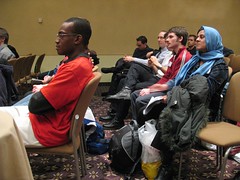
It s been a long time since I ve written about our local unconferences, but a neat one coming up is DemoCamp CUSEC 2. It s attached to the Canadian Undergraduate Software Engineering Conference, which is being held in Montr al again. Last year, I did a demonstration on how to cook an omelette, with it being a metaphor for software engineering. This year, I m going to do something more prosaic and run a round of Powerpoint karaoke, under the guise of getting people to practise their presentation skills. Or it will be a convincing argument against its use. Show up if you can! Present something you ve been working on! (There are still some slots left.) It ll be exciting. DemoCamp CUSEC 2
Thursday, 17 January 2008
19:00 21:00
Centre Mont-Royal
2200 rue Mansfield
Free admission
( Sign up Google Maps )

7 January 2008

Andrew Pollock: [life] Post-op, Day 4

Sarah slept better overnight, but still not great. She was certainly more lively this morning when I got in, than yesterday. She's resigned to the fact that you don't come to a hospital to get rest, which is kind of ironic. She did need to get put back on the oxygen overnight because her O2 saturation dropped. She was off it again by the time I got in. Today's big achievement was getting the external pacing wires removed. They were put in during the procedure as a precaution, I think because if her heart played up, they didn't want to have to use defibrillator paddles, and because they'd cracked her chest open, manual CPR wasn't an option. The wires could be attached to an external pacemaker if necessary (but it never was). I watched the removal quite closely, as I was pretty curious. Basically the physician's assistant just came in and yanked them out. Judging from the look on Sarah's face, it was an interesting sensation. We were both amazed at how long the wires were. There was probably 30 centimetres of wire under the skin. The last bit was loosely spiralled. I was just really surprised, because the PA's hand started off at Sarah's chest, and ended up at the PA's shoulder. It was just a lot longer than we both expected. All the extra length was because the wires wrap around the heart. The wires came out at about 2:30pm. Sarah had another chest x-ray and a CT scan today. The CT scan looked good. The x-ray showed some fluid in her lungs, and her lung capacity is still sub-par. It seems when she's fully horizontal, her breathing isn't so crash hot, but it's fine when she's sitting up or walking around. All Sarah's got left is one peripheral line now. There was some talk of her possibly going home on Wednesday. She has an echocardiogram tomorrow, and I guess it'll all hinge on how her lungs are going.

5 January 2008

Andrew Pollock: [life] Post-op, Day 2

"Day Two Downers" be damned, Sarah's powering along like a freight train. Neither of us had a terribly fantastic night's sleep. Her chest drain is attached to this big box thing that has some sort of water seal in it, and with the suction going through it, it bubbles and makes noise like a massive aquarium. But she did get some sleep, and said she felt better this morning for it. The doctor came by at 8am, and took the incision dressing off, and we got our first good look at it. It's big (i.e. long). It runs from about the top of her breastbone to the bottom of her sternum. 20cm at my estimation. She said that she thought the chest tube could come out today, and sure enough it came out at about 12:30pm. They also took her urinary catheter out at that time, so now all she's hooked up to is oxygen. Her blood sugar levels were acceptable at breakfast time. Oh, the reason the incision ran so high was because they elected to do the bypass attachment to an artery in her neck, rather than further around the aorta, because the tissue was fragile and they didn't want to risk a dissection. Not doing the bypass in the aorta also left them the option of removing some of the transcending arch if they determined it still ended up being necessary. Sarah got up and had breakfast in a chair again, and was generally feeling pretty mobile. She moved between the chair and a wheelchair (and back) when they came to get her for another x-ray, without requiring any assistance. She took her first walk around the ward at 11am. I'd popped home for a shower and to check on the cats, and so I missed it. Doctor Miller dropped in at around 12:30pm to see how she was doing, and that was good as Sarah got a chance to talk directly to him about how the procedure had gone. He was very positive and said she could put this whole thing behind her now. At 2pm, she went for another walk, this time sans two thirds of the tubes from her first walk, and got in and out of bed unassisted. She took her last walk of the day at 4pm. Apparently her blood sugar is still on the high side, but within the range that they don't feel the need to give her insulin. Her chest is apparently looking better on the x-ray they took this morning. They took a second one after they removed the chest drain, but we haven't heard anything about how that looks yet. She's continuing to do extremely well, most of this less than 48 hours out of surgery.

21 December 2007

Russell Coker: A Better Design for Child Seats

The current method of carrying young children (less than 4-6 years old) in cars is to have a special car seat fitted in the back seat. This has several significant problems:
Some car companies are offering child “booster seats” that are an optional attachment to the rear seat (I first noticed this when reviewing the specs of the latest version of the car I drive - the VW Passat [1]). This is a good idea, but it doesn’t go far enough. The best thing to do would be to provide a selection of back-seat assemblies as factory fitted options which have built-in baby and child seats. The combinations that would be most desired are:

  1. Standard car back-seat for three adults (or two adults for a small car).

  2. A regular seat (for an adult) at the road side of the car combined with a baby (backward facing) seat at the kerb side.

  3. A regular seat (for an adult) at the road side with a young child (forward facing) seat at the kerb side.

  4. A baby seat at the road side with a young child seat at the kerb side.

  5. Two young child seats.

It would be quite possible to have all five of these options available from the factory. Of course there are corner cases that this doesn’t cover such as twins or parents who have two children so close together that they need two baby seats. For those cases option 2 combined with one of the current off-the-shelf baby seats would do. The number of different supported options would need to be kept reasonably small to reduce manufacture cost and to allow a reasonable market for second-hand seats. One thing to note is that it’s recommended that the first forward-facing seat a child uses is smaller than the later one. Having options for three different built-in baby/child seats (rear-facing and two sizes of forward-facing) would significantly expand the number of combinations (and thus the expense). I suspect that the safety benefits of having an ideal method of securing a forward-facing child seat would compensate for the disadvantage of having it be too large for the child when they are first placed in it. Another possibility would be to replace the rear seat with a more solid bench with bolt holes for baby and child seats. Securing a child or baby seat to a hard surface with bolts would be a much less technically demanding task than using a seat belt (and thus could be done correctly without expert assistance). Child and baby seats would have to be redesigned for this (I suspect that the safety of them relies on being attached to a soft surface), but after that I expect that safety would improve. For this option the rear seat could bold on to a hard surface that’s suitable for attaching child/baby seats so it would simply be a matter of removing the rear seat and installing the child/baby seat(s). The most common car design in Australia includes a 60/40 split rear seat (meaning that if you have a large item to store in the boot/trunk then you can fold down 40% or 60% of the back of the rear seat to allow the luggage to extend into the passenger compartment). This split could be extended to allow removing the base of the rear seat for 60% or 40% to bolt on child/baby seats. Once a car model had been designed for replacing the rear seat there would be other options available. For example replacing the rear seat with luggage storage space. While almost all cars allow folding down the backs of the rear seats to store extra luggage the option of removing seats that you don’t need to give even more space is not common at all (I’ve only seen it advertised as a feature in vehicles with 6 or more seats). I expect that if this idea was implemented it would allow a small car such as a Toyota Corolla to give an equal or greater amount of usable space for children in the rear as a larger vehicle such as a Toyota Camry. While better options for luggage storage would allow people who don’t have children to use a small car while still being able to carry the luggage that they desire. This would allow considerable savings on car purchase prices and fuel use. I expect that a reduction in fuel use world-wide could be achieved by removing the pressure on parents to buy large cars! The poor support for child seats in cars is really surprising. One of the features that could be introduced is both top and bottom mounts for such seats. There is apparently a standard for this, some (not all) cars support it, but most baby seats apparently don’t. So baby and child seats are secured at the top (to a hook that’s bolted securely to the car frame and which was designed specifically for the purpose) and at the bottom to the seat-belt which was never designed for such things. It’s a pity that some of the money spent on supposedly protecting children from drugs couldn’t be spent on making cars safer for them. The government is in the best position to force car manufacturers to improve their safety features while parents are in the best position to teach children about the dangers of drugs.

Ross Burton: It's That Time Of The Year Again

It starts off just as you'd expect.
Yes, it s that time of year again. No sooner does an important traditional religious holiday roll around than the PC-brigade feel the need to strip-mine it of its original significance, just so s no-one s feeling get upset.
However, it doesn't quite continue as you were thinking.
It is the Christians who have the most gall of all, daring to attach the name of some first-century Palestinian to a once-proud British festival. Yule I can live with, despite its being a continental bastardisation of our British pronunciation Geola , but Christmas is just wrong. You even have to mispronounce Christ to say it.
An excellent piece of satire from Nathaniel Tapley on Liberal Conspiracy, which is well worth a read for a good laugh. NP: Giant Steps, John Coltrane

14 December 2007

Martin F. Krafft: Surveys on the console

As part of my research, I may have to conduct a survey among Debian contributors. The word "survey" usually elicits frowns because surveys are often misconducted. MJ has taken the time to draft up some advice to surveyors. Problems with surveys generally fall into one of two categories: content and presentation. I'll refrain from making statements about content (Wikipedia has some stuff on questionaire construction) and instead concentrate on presentation in the following. Commonly in the digital age, surveys are administered via a web page or e-mail. In my recent Ph.D. transfer report, I identified a number of shortcomings with these approaches: Asking Debian contributors to click radio buttons on a web page is a bit like expecting a mountain biking champion to ride a tricycle across a paddock: painful, if not offensive. Furthermore, web surveys can only be taken while on-line, when most of us have better things to do. E-mail surveys address some of these problems, but create new ones: answers cannot be constrained to a domain (think multiple-choice), character set and formatting issues make evaluation difficult, and it's impossible to prevent users from attaching comments or modifying responses. In thinking about the issue, I came up with a third means to administer a survey: a console tool. Think of a Debian package which provides a console application controlled by a study-specific data file. The data file specifies the questions and their answer domains, and the tool presents those to the participant. Since most of Debian happens on the console anyway, such an approach to surveys seems more appropriate. Interaction with the survey tool would be as easy as pressing the 2 or 4 keys to select one of the multiple choices, and the tool would immediately move on to the next question (and not wait for the user to hit enter). Obviously, n and p should allow navigation back and forth across the set, and c would spawn a text editor to give the user a chance to attach a comment to his/her current response, in which s/he might criticise the question or provide additional information. Finally, the tool should be able to pick up where it left off, should the user chose to exit/suspend the survey for now. Integration with debconf or another interface abstraction is also worth consideration. There is more to it: people change their minds and should thus be able to amend responses. With their consent, it might be valuable to track such changes and inquire about their motivations. As I was thinking about how to realise this, I suddenly arrived at version control: use Git as a backend storage. The set of cool features this would enable seems to be endless: it works off-line and can be used to track aforementioned changes, but also offers the possibility to create a squashed result in case the participant prefers to submit only the final result. Furthermore, it's a trivial change between anonymous submissions, and submissions authenticated by a GPG signature. In addition, the survey tool should be able to display questions according to previous responses (control flow). For instance, if the survey determines that a given user is a contributor to the bug tracking system, but not a project member, it wouldn't make sense to ask when s/he received his/her Debian account. Furthermore, questions could be dynamically creatable from context, so that the survey can drill into depth depending on previous responses, rather than asking the same questions to all participants. I am currently applying for funding to outsource the development of such a tool. If you are interested in coding it up and getting paid for it, speak to me. Here are some more specifications to keep in mind before jumping on: These are likely to be incomplete, but should convey the basic picture. Feedback is always welcome! NP: Oceansize: Frames Update: James Andrewartha pointed me to purity, which asks multiple-choice questions on the console. It has the kind of interface which I envision. Also, Chris Lamb suggested this personality survey as a base line. Well, actually he just suggested I look into it.

3 December 2007

Michael Prokop: git[-svn] in 30 minutes

… or something like that… I planned to write a short note about how to start with using git-svn so I can provide a pointer to some of my colleagues. It turned out that git has too many nice features that you should be aware of. :) Hopefully my notes (now being a reference for myself as well, thx to gebi for all the help and feedback) are useful anyway. If you think something (more or less essential, or at least something most of us should be aware of) is missing: please feel free to mention that in the comment section of my blog entry, thanks. Disclaimer: I’m still happy with mercurial for what I - and we at grml in general - use it: linear, but anyway distributed development. git on the other hand provides some really nice features. Rebasing and branching with git is really great - so non-linear development just works. As usual: use the right tool for the right job. git is a bit complicate to use. Not only but especially in the beginning. On the other hand I’m not such a big friend of subversion. If you wanthave to use subversion (Graz University of Technology for example provides a svn service to their students and employees) but prefer to work with git instead you should be aware of git-svn. git-svn gives you bidirectional operation between subversion and git. First of all make sure you have all you might need when working with git. Make sure to use a current version of git (I’m refering to version >=1.5.3). Just execute the following command line on your Debian system to install all relevant packages:
aptitude install \
git-buildpackage git-core git-cvs git-daemon-run \
git-doc git-email git-gui git-load-dirs git-svn \
gitk gitweb qgit
Now let’s start with some general and basic configuration:
# Remove directories from the SVN tree if there
# are no files left behind, configure it globaly:
git config --global svn.rmdir=true
# Want some more global, personal git configuration?
for line in  
  user.name=Michael Prokop 
  user.email=foo@example.invalid 
  color.diff=auto 
  color.diff.new=cyan 
  color.diff.old=magenta 
  color.diff.frag=yellow 
  color.diff.meta=green 
  color.diff.commit=normal 
do
  git config --global $line
done
Check out man git-config for much more details about configuration options. First tip: set ‘g’ as an alias for git so you don’t have to type that much. I’ll write the long version in the following examples so copy/paste works for everyone. Make sure to use the short options of git itself as well: use ‘git co’ for example instead of ‘git checkout’. You can define your own aliases inside git as well - either manually in ~/.gitconfig or running something like:
git config --global alias.st status
Enough pre-configuration for now. It’s time to checkout the SVN repository:
# Check out the SVN repository and set 'svn/' as
# prefix for the branches:
git svn clone -s --prefix=svn/ \
https://svn.tugraz.at/svn/$project foobar && 
cd foobar
# Adjust svn:ignore settings within git:
git svn show-ignore >> .git/info/exclude
# List all branches:
git branch -a
# List all remote branches:
git branch -r
# Rebase your local changes against the
# latest changes in SVN (kind of 'svn up'):
git svn rebase
# Checkout a specific branch:
git checkout $branch
Ok so far? But what do we have to do if we want to work on the upstream source and are allowed to commit/push directly to the repository? Let’s see how to work on that without using branches:
# Hack:
$EDITOR foobar
# Check status
git st[atus]
# List diff:
git diff [foobar]
# Commit it with a commit message using $EDITOR:
git commit -a
# Now commit your changes (that were committed
# previously using git) to SVN, as well as
# automatically updating your working HEAD:
git svn dcommit
But what should we do if we do not have commit rights? Let’s create our own branch and send a patch via mail to upstream:
# Make a new branch:
git checkout -b mikas_demo_patch
# and hack...
$EDITOR
# Commit all changes:
git ci -a -m 'Best patch but worst commit msg ever'
# ... and prepare patch[es]:
git format-patch -s -p -n master
# Now send mail(s) either use git-send-email:
git send-email --to foo@example.invalid *.patch
# ... or if you prefer mutt instead (short zsh syntax):
for f in *.patch ; mutt -H $f
You got a mail from someone else and would like to incorporate changes from the attached patch in your repository? Just store the mail in a seperate mailbox (use save-message in mutt for example, keybinding ’s’ by default), then execute:
# Apply a [series of] patch[es] from a mailbox
git am /path/to/mailbox
Want to work on a seperate branch and rebase your work with upstream?
# First of all make sure to use recent sources...
# So pull when using plain git:
git pull -u
# .. or when using git-svn use:
git svn rebase
# Then create a new branch:
git checkout -b mika
# Hack:
$EDITOR
# Commit:
git ci -a -m 'Best patch but worst commit msg ever'
# Switch to master branch:
git checkout master
# Pull again when using plain git:
git pull -u
# .. or when using git-svn use:
git svn rebase
# Finally switch back
git checkout mika
# Now rebase it with plain git using:
git rebase origin/master
# ... or when using git-svn:
git svn rebase
# Now check out the last 5 commits:
git log -n5
Another branch-session might look like:
git co -b foo
$EDITOR
git ci -a -m 'foo changes'
git co master
git co -b bar
$EDITOR
git ci -a -m 'bar changes''
git co foo
git rebase bar
git log -n5
git st
git branch
Pfuhhh? Right. :) Now it’s time to check out another cool feature: git stash, which is just great when pulling into a dirty tree or when suffering from interrupted workflow. Demo:
git stash
git pull / fetch+rebase
$EDITOR # fix conflicts
git commit -a -m "Fix in a hurry"
git stash apply
git stash clear # unless you want to keep the stash
git reset rocks as well:
# List all recent actions:
git reflog
# Now undo the last action:
git reset --hard HEAD@ 0 
How to get rid of branches?
# Delete a branch. The branch must be fully merged:
git branch -d remove_me_branch
# Delete a branch irrespective of its index status:
git branch -D remove_me_branch
# Delete a remote branch:
git push reponame :branch
Repack a git repository to minimize its disk usage:
git pack-refs --prune
git reflog expire --all
git repack -a -d -f -l
git prune
git rerere gc
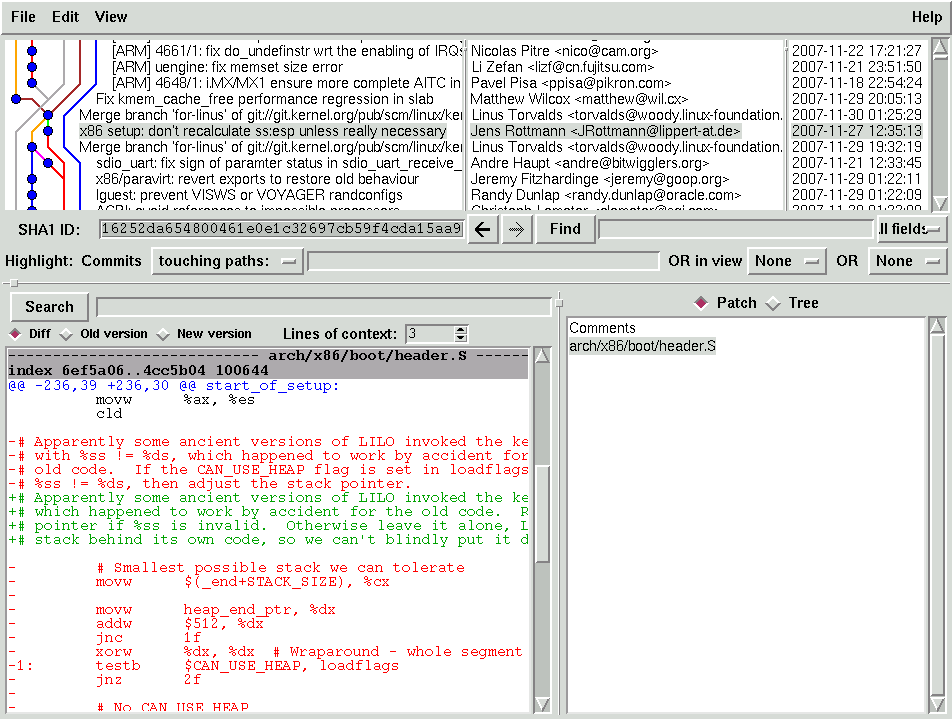
Use git cherry to find commits not merged upstream. Another really cool feature is the interactive rebasing: git rebase –interactive Make sure you are aware of gitk: Screenshot of gitk … and don’t forget to set readable fonts for gitk, like:
[ -r ~/.gitk ]   cat > ~/.gitk << EOF
set mainfont  Arial 10 
set textfont   Courier 10 
set uifont  Arial 10 bold 
EOF
If you prefer a Qt based interface check out qgit. Useful ressources:

Next.

Previous.