Search Results: "rul"

22 February 2014

Vasudev Kamath: First experience of driving in Bangalore

So finally I did it, I managed to ride the 2-wheeler in Bangalore roads!. Officially I've got a license to drive 2 and 4 wheelers back in 2011 but I was never confident enough to ride the vehicle on road and in traffic. Partially this is because I don't own a vehicle and I've never practiced driving, and partially because of road and traffic conditions in India I was bit afraid to do so. So today morning my roommate and me planned to go to temple in the early morning. We got up at 530 in the morning and we were ready to drive to Mahalaxmi Layout at 615. Since during this time traffic is very less I asked my roommate shall I drive and he agreed!. So I drove the bike from Malleshwaram to Mahalaxmi Layout and it was fun. I did had hick up in uphill driving as my mind was not co-ordinating well with breaks and gear. I did have hickups in first gear too but I guess this will be alright once I get hold of things. I'm still not having enough confidence to drive during the peak hours because people are not at all following traffic rules. They just change the lane without any hints or just come to middle of road from side roads without looking at other side to see if there is a vehicle is coming from other side of the road (yes they don't have courtesy to wait). And finally they can shout at persons who is actually following rules. In general very less people have traffic discipline in India. But I will adapt to this once I start driving so I'm now all set to get my 2 wheeler soon and ride on!

Steve Kemp: Changing my stack ..

For the past few years I've hosted all my websites in a "special" way: The webserver I chose initially was thttpd, which gained points because it was small, auditable, and simple to launch. Something like this was my recipe:
#!/bin/sh
exec thttpd -D -C /srv/steve.org.uk/thttpd.conf
Unfortunately thttpd suffers from a few omissions, most notably it doesn't support either "Keep-Alive", or "Compression" (i.e. gzip/deflate), so it would always be slower than I wanted. On the plus side it was simple to use, supported CGI scripts, and served me well once I'd patched it to support X-Forwarded-For for IPv6 connections. Recently I setup a server optimization site and was a little disappointed that the site itself scored poorly on Google's page-speed test. So I removed thttpd for that site, and replacing it with nginx. The end result was that the site scored 98/100 on Google's page-speed test. Progress. Unfortunately I couldn't do that globally because nginx doesn't support old-school plain CGI scripts. So last night I removed both nginx and thttpd, and now every site on my box is hosted using lighttpd. There weren't too many differences in the setup, though I had to add some rules to add caching for *.css, etc, and some of my code needed updating. Beyond that today I've setup a dedicated docker host - which allows me to easily spin up containers. Currently I've got graphite monitoring for my random hosts, and a wordpress guest for plugin development/testing. Now to go back to reading Off to be the wizard .. - not as good as Rick Cook's wizardry series (which got less good as time went on, but started off strongly), but still entertaining.

16 February 2014

Siri Reiter: Conference Communication Design Building Blocks

As an introvert I like - well, I need to - spend time alone. I get my best ideas on my own. But when I truly thrive is when I am connected with others, cocreating. For the last couple of weeks it's been difficult for me to work on the visual design for the MiniDebConf in Barcelona next month. There have been practical reasons, but the real reason was that I was feeling stuck and overwhelmed. Sharing my uncomfortable feelings with my boyfriend finally made me able to see that I have been feeling alone, and feeling that I had to prove myself with my work. I felt disconnected from the people in Debian I want to cooperate with. I'd really benefit from sharing my thoughts and ideas more with others. The unpleasant feeling of "stuckness" dissolved when I said out loud what they were about, and ideas for changing my state appeared. Now I've started hanging out on the irc-channel more, I've asked for help in finding stuff in the huge pile of info, rules and previous examples and experiences at debian.org and my decision to blog and share more is strengthened. Finally the work has begun. Conferences are about meeting up and getting connected. Listening to somebody trying to enlighten you on a subject. Getting inspired. And so my idea of using speech bubbles as a visual identity koncept for the conference has everything to do with my own experience of connection and disconnection. Release, early, release often, I cannot say that I have done that. We really need the peoposals to be ready now. Thankfully I'll have time in the following days to get feedback and finish. I really hope people will accept the idea, but I'm expecting a debate.

11 February 2014

Jonathan McDowell: Choosing a new laptop

Recently I've been thinking about getting a new laptop. I have this rule that a laptop should last me at least 3 years (ideally more) and my old laptop was bought in September 2010. So for the past few months I've been trying to work out if there's something suitable on the market that is a good replacement (last time I didn't manage to find something that ticked all the boxes, but did pretty well for the price I paid). To start with I decided to track my laptops over time - largely because one of my concerns was about the size of a replacement, because I have a significant leaning towards subnotebooks. In the end the reason I decided to upgrade was for some extra CPU grunt; my old machine had a tendency to get pretty hot under any sort of load.
DateModelCPUScreenRAMStorageW (mm)H (mm)D (mm)WeightCost
1991Amstrad PPC 640DNEC V30 8MHz9" 640x200 non-backlit green LCD640k2 x 3.5" FDD45023010010kg???
August 1997Compaq Aero 4/33c486sx337.8" 640x480 CSTN LCD4MB80MB260190431.6kg???
July 2002Compaq Evo N200P-III 700MHz10.4" 1024x768 TFT192MB20GB251198201.1kg 939.99
August 2005Toshiba Portege R200Pentium M 753 1.2GHz12.1" 1024x768 TFT1280MB60GB286229201.29kg 1313.58
September 2008Asus EEE 901Atom N270 1.6GHz8.9" 1024x600 TFT2GB4GB + 16GB SSD248175231.1kg 299.99
September 2010Acer Aspire 1830TCore-i5 470UM 1.33GHz11.6" 1366x768 TFT8GB500GB284203281.4kg$699.99 (~ 480)
The EEE didn't actually replace the Toshiba, but I mention it for completeness. It was actually the only machine I moved to the US with, but after about a month of it as my primary machine I realized it wasn't an option for day to day use - though it was fantastic as a machine to throw in an overnight bag, especially when coupled with a 3G dongle. I wasn't keen on significantly increasing the size of my laptop. There are a number of decent 13" Ultrabook options out there, and I looked at a few of them, but nothing grabbed me as being worth the increase in size. Also I wanted something better than the Acer - one of the major problems was finding something smaller than 13" that had 8G RAM, let alone more. There's a significant trend towards everything soldered in for the smaller/slimmer notebooks, which makes some sense but means that the base spec had better be right. Much to my surprise the Microsoft Surface Pro 2 looked like an option. It comes with an i5-4300U processor (at least since around Christmas 2013), and the 256/512G SSD models have 8G RAM. Screen resolution is an attractive true HD (1920x1080) and the 10" display means it's smaller than the Aspire. Unfortunately the keyboard lets it down. It's fine given a flat surface, but not great if you want to support the whole thing on your lap. Which is something I tend to do with my laptop, whether that's on the sofa, or in bed, or on a bus/train. Another option was the Sony Vaio Pro 11. This is a pretty sweet laptop (I managed to get to play with one at a Sony store in the US). Super slim and light. 8GB RAM. True HD screen. However I have bad memories of the build quality of the older Vaios and the fact that there was /no/ user replaceable parts put me off - it's a safe bet that a laptop battery is going to need replaced in a 3 year lifespan. What I managed to find, and purchase, was a Dell Latitude E7240. I admit that the Dell brand made me wary - while I've not had any issue with their desktops I didn't associated their laptops as being particularly high quality. Mind you, I could say the same for Acer and I've been very pleased with the Aspire (if they'd had a more up to date model I'd have bought it). I bought the E7240 with the Core-i5 4300U (so the same as the Surface Pro 2) and True HD touch screen. It has a replaceable battery, expandable RAM (up to 16G) and the storage is an mSATA SSD. It also came with a built in 3G card. At 12.5" it's a little bigger than my old machine, but I decided that was a reasonable idea given the higher resolution. I'm typing this article on it now, having finally completed the setup and migration of the data from the old laptop to it this evening. More details once I've been using it for a little bit I think.

Andrew Pollock: [life] Day 14, Kindergarten and a make up swim class

Zoe woke up pretty early today, at around 5:30am. I also officially became a Xoogler at some point overnight. I used this transition as the opportunity to move from my Nexus 4 to my Nexus 5, so I could have a clean start on a phone that had never had work credentials on it. I started that process before breakfast, and mostly had a usable phone by the time we biked to Kindergarten. Zoe was a bit more like her usual clingy self at drop off today, so I spent a bit longer getting her settled. I got home and pretty much spent the rest of the day sorting out my phone. I can say many good things about Android, but seamless device migration isn't one of them. I'll probably factory reset my Nexus 4 tomorrow. I biked back to Kindergarten to pick up Zoe, and sure enough, she was fast asleep again. It turned out that she'd gone down about 30 minutes later today, so she was deeply asleep, and didn't take too kindly to being woken up. She was very sad, and it took forever just to leave the Kindergarten. We were well and truly the last ones out. Then she saw Megan having a trial tennis lesson at the tennis courts on the way to the bike, and wanted to do that too, and we burned some more time, while I tried to talk her out of that. Zoe had a make up swim class today to cover the one she'd missed on Saturday when she went down to Canberra with Sarah. That was at 3:15pm. We were a tad late for it. Weekday swim classes are much quieter than the weekend ones, so I used the opportunity to talk to one of the swim school staff about progressing Zoe to the next level. They conducted an assessment on the spot, and graduated her! She's moving from "Platypus" to "Octopus", starting next week. The class time options were pretty crappy though, something like 11:45am on Saturday, or a late afternoon weekday. We've opted for a weekday class after Kindergarten for the rest of this quarter and will try and get an earlier Saturday class next quarter. There's a reasonable gap between the end of Kindergarten and the start of swim class, so I'll have to figure out how best to use that time. I might make our library visit in between, even though it means a bit of back and forth. The upside is Saturday mornings are now wide open. We had a celebratory ice cream when we got home from swim class, and went out for a babyccino after dinner. I think it's important to celebrate achievements. I managed to get Zoe to bed slightly early tonight in light of her reduced nap time, but she just woke up briefly at 10:30pm. She seems to be particularly sensitive to mosquitoes, and has a bite on her forehead, right at the hairline, and it was giving her some grief. I gave her some antihistamine and she's gone back to bed fairly easily. Fingers crossed she sleeps okay for the rest of the night.

8 February 2014

Enrico Zini: original-sin

Original sin I feel that I was somewhat born innocent, an animal with sound, primal instincts. But if I remained that way, I wouldn't be able to function in a complex society, so I got education. Education taught me what is expected from me in order to be accepted by my peers[1]. Education taught me more than that: it also taught me to enjoy what a complex society can give me: art, science, history, philosophy, adding depth of meaning and correlations to my perceptions and memories. Education wasn't perfect, though. Some of my educators obsessed about some of the expectations, and gave me rules to follow that aren't really needed to interact with a society. Sit down for hours in silence without complaining. Don't talk back to figures of authority, even when they are abusing me. Don't ever feel that my efforts in a task have been enough, because there is always something more that I could have done. Do what people expect me to do, regardless of what I wish to do. Do what I need to do, not what I want to do. So I grew up with a set of arbitrary expectations that weren't needed to function in a society, and weren't in any way meeting any of my needs, yet I still felt them as a part of me, putting every effort into meeting them that I would put in making myself happy. I like to call this set of learned arbitrary, unneeded expectations "neurosis". I like this as an interpretation of the "original sin" myth: in order to go from an innocent animal to a member of a complex society, I acquired a set of neuroses that make me behave in a meaningless way. Or, rephrased going along with the myth, that rob me of my innocence. In some environments like BDSM, many have a name for an unnegotiated practice forced on a person: they call it "abuse". It made sense to accept that I have been abused many times while being educated, because my educators also had their own baggage of parasite expectations, of neuroses. And since I don't currently know how I can ever be sure that I freed myself from all my neuroses, I feel like I should accept that it is possible that I do and will abuse others; by accepting it as a possibility, I hope at least to be able to realise as soon as possible that I am doing it, and try to stop. I have now realised that my life is far simpler and more rewarding when expectations are negotiated between all the parties involved. I have recently spent a substantial amount of my energy in recognising and renegotiating many of the expectations and the neuroses that I had learnt while growing up, and, who knows, perhaps this effort will continue throughout my life. So there you go, an agnostic atheist freeing himself of his original sin, and regaining his paradise lost one step at a time, alive, on earth. And enjoying every moment of it. [1] I suspect that is why people educated in a high class society tend to be accepted more easily by a high class society: they conform to the right set of expectations. But I digress.

Vasudev Kamath: Friendica instance on my VPS is down

I started running Friendica instance on my VPS. With help of Jonas Smedegaard I managed to run Friendica in a uWSGI container. The site was running at samsargika.copyninja.info and is no longer accessible. Since VPS itself was running Debian Wheezy I couldn't run uWSGI with PHP support on it. (support for PHP in uWSGI landed after Wheezy). But Jonas was kind enough for me to provide a backported version. Recently Wheezy got a security update for PHP and thats where all the problem started. The backported uwsgi-plugin-php was not recompiled to use security updated PHP and I couldn't upgrade the things. After few days I noticed first freeze on my VPS and I had to reboot the VPS to get it online again. The fact I noticed was uWSGI being killed due to a OOM in syslog but I didn't explore much and consulted Jonas to get a updated uWSGI. But that didn't happen as Jonas himself is facing some problem with uWSGI builds. While again checking with aptitude for upgrade I accidentally confirmed removal of uwsgi-plugin-php for getting security updates :-/. But nothing happened to my running service as upgrade of libs in Debian doesn't cause the restart of all services which are using that lib (desired effect is restart of service but I don't know the side affects involved). Second freeze happened yesterday and on the reboot uwsgi-plugin-php was missing there by taking my Friendica instance down. More closer investigation showed the same OOM but this time I noticed each OOM occurred just after cronjob was running poller.php a script which is actually causing all federation in Friendica. So it was clear there is something wrong either in poller.php or in my setup which was making it eat memory and freeze my VPS. But I also found some stupidity I did during configuration which Jonas also pointed me out.
  1. Installing cronjob inside crontab rather than cron.d
  2. Installing poller.php crontab for root user :-/
I basically violated the basic rule by running a unsafe script as root user, good that script didn't do some crazy stuff. So even though my instance went down I learnt my lessons
  1. Don't ever ever ever run a unsafe script as root that too through cron
  2. Sandbox the unsafe script so it can be killed on time rather than it taking the whole system down.
  3. PHP is not really secure, if it was secure there wouldn't be security updates and atleast my site would be still running :-D
So I now need to wait till Jonas get me new shiny backported uWSGI linked against new PHP on Wheezy and till that time I need to explore on how I can sandbox the poller.php script.

Sam Hartman: Debian: Init Interfaces Our Users *and* Free Software

Recently, I ve been watching the Debian Schadenfreude related to init systems. For those who do not know, Debian is trying to decide whether Systemd or Upstart will be used to start software on Debian. There are two other options, although I think Systemd and Upstart are the main contenders. Currently the Technical Committee is considering the issue, although there s some very real chance that the entire project will get dragged through this swamp with the general resolution process. This is one of those discussions that proves that Debian truly is a community: if we didn t have something really strong holding us together we d never put up with something this painful. Between the accusations that our users now know the persecution European pagans faced at the hands of Christians as the Systemd priests drive all before them, a heated discussion of how the Debian voting system interacts with this issue, two failed calls for votes, a discussion of conflicts of interests, and a last-minute discussion of whether the matter had been appropriately brought before the Technical committee (and if so, under what authority), there s certainly schadenfreude to go around if you re into that sort of thing. However, through all this, the Technical Committee has been doing great work understanding the issues; it has been a pleasure to watch their hard work from the side lines. I d like to focus on one key question they ve found: how tightly can other software depend on the init system. Each init system offers some nice features. Upstart has an event triggering model. Systemd manages login sessions and at least in my opinion has a really nice service file format. Can I take advantage of these in my software. If I do, then users of my software might need to use a particular init system. Ian Jackson argues that we should give our users the choice of what init system to run. He reminds us that Debian is a community that supports diversity and diverse goals. We support multiple desktop systems, web browsers, etc. Wherever we can, we support people working on their goals and give developers the opportunity to make it work. When developers succeed, we give our users the opportunity to choose from among the options that have been developed. I think of Ian s argument as an appeal to part of our Social Contract. Clause 4 of the social contract begins:
Our priorities are our users and free software.
We will be guided by the needs of our users and the free software community. We will place their interests first in our priorities. We will support the needs of our users for operation in many different kinds of computing environments.
Ian is right that our users will be served by choice in init systems. However, this trade off needs to be balanced against the needs of the free software community. Diversity is an important goal but it should not come at the price of stagnation and innovation. If I want to avoid using init scripts because they don t provide restart on failure, because they are hard to write correctly, and because they don t provide access to modern security isolation techniques, I should be able to do that. If Systemd service files provide a superior solution, I should be able to work toward using them. If the desire for init system diversity shuts down my ability to find like-minded people who want to take advantage of improvements in init systems and work towards that goal, then we ve significantly damaged Debian as a forum for technical cooperation. Early in my work as a Debian Developer, Anthony Towns taught me an interesting principle. Those who do the work get significant influence over how and what gets done. Ian s right that we need to enable people to work towards choice in init systems. Those like-minded people need to be given a chance to find each other and pursue their goal. However the cost of success should be on the shoulders of those who value choice in init systems. It should not come at the cost of preventing people from depending on improvements in init systems. The best proposal I ve seen for balancing this is to enumerate stable interfaces that people want to use. Things like the logind interface or my favorite the service file interface. It needs to be possible to make another implementation of the interface. The interface needs to be stable enough that a dedicated team could have a chance of catching up with an implementation. At some point during the release cycle such interfaces would need to be frozen. However, I don t think it is reasonable to mandate that there are multiple implementations of the interface, only that there could be. The point is to give people a chance to work towards diversity in init systems, not to force it down peoples throats kicking and screaming until they leave the project or ignore our processes. Steve Langasek and Colin Watson seem to be working towards this. It s possible there s another approach besides interfaces. My main concern is the same as Ian s: maintain Debian as a forum for people to pursue their goals and work together. I suspect we see the conflict in these goals differently. I hope that we as a project can explore this conflict and figure out where we have common ground. I commit to exploring how we can work towards init choice in my frameworks; I ask those who prioritize init choice to commit to explore how we can take advantage of new features in their framework.

3 February 2014

Craig Small: jffnms 0.9.4

JFFNMS version 0.9.4 was released today, this version fixes some bugs that have recently appeared in previous versions.
Alarmed Interfaces and Events

Alarmed Interfaces and Events

The triggers rules editor had a problem where some of the rules clicked off the triggers would not appear or could not be edited correctly. Most of the Admin screens have the ability to sort the rows. This, unfortunately, didn t sort but the functionality has been restored. Most users are probably unaware of this, but the database schema is first created for MySQL and is then converted for PostgreSQL. The conversi0n process is far from ideal and hasn t worked until this release. More testing is required for PostgreSQL support but it should be a lot better.

1 February 2014

Charles Plessy: European consultation on copyrights.

I eventually answered to the Public Consultation on the review of the EU copyright rules. As a coincidence, the radio was playing European Super State, from Killing Joke. One can see in the consultation the picture of an Internet shaped to better control the diffusion and copy of non-free works, and monitor for possible infractions. It is therefore important to answer and remind primacy of the presumption of innocence, and the importance of the respect of privacy. Nevertheless, I also asked for reducing exceptions of copyrights, because to give a temporary access to non-free works at zero cost has the consequence of reducing the incentive for creating alternatives that can be copied, modified and redistributed freely.

31 January 2014

Daniel Pocock: If you thought systemd proponents were bad....

Just imagine for a moment if something like the iPhone App Store approval process was applied to every application for a domain name. Delays and unexplained rejections killing many great ideas before they even get off the ground. In the worse cases, like that of Greg Hughes, the great firewall of the app store has been used to quash ideas that it appears Apple may have been planning to compete with or copy. If domain applicants had to go through such a process or if other core technologies fell into a rut like that then it would throw Charles Darwin's long established theory of evolution out the window and society would end up eating each other. Once companies had established their position and were happily making money they would do everything possible to stomp out any innovation that may undermine them. This is exactly the kind of non-evolution that has plagued the telecoms sector for many years now. You don't have to look past the price of a simple SMS to see the truth of this situation. Your 160 bytes can cost anywhere between $US0.10 - $US0.50 throughout the western world, even on a network that is otherwise charging maybe $10 per 1MiB (the equivalent of 6,000 text messages) when roaming. One of the compelling features of free software is that it empowers innovation and efficiency. Telecoms executives may argue that by charging you these extortionate fees, they are keeping spam out of your phone. Think again: technologies like XMPP and SIP are doing that even more effectively and without any price to pay. Software for managing buddy lists and algorithms for spam detection put those telecoms executives out of a job. If SIP, XMPP or both become dominant, evolution may succeed yet. Despite having these great technologies available for messaging and multimedia communications and despite having a range of free software success stories in products such as Firefox or whole distributions like Fedora, Debian and its derivatives like Ubuntu, non-free communications solutions like Skype and Viber continue to run rampant in the voice and video domain. As it turns out, this is a very dangerous area for the free software community to neglect. How many people know somebody who tried running Linux but went back to a proprietary solution so they could use a non-free softphone? In these cases, it is not the phone software itself that appeals to the user: it is the people that software lets them communicate with, their friends, family, professional community and beyond. For people who don't truly perceive the benefits of free software or those who don't have the confidence or experience to defend those benefits, the power of Metcalfe's law hits them like a tsunami and violently sweeps away all the rest of the free software they had started to use. While Skype is currently available for some distributions of Linux, it is not free software: amongst other things, there is no published source code and no independent review of the code has been possible. Leveraging the power of Metcalfe's law, the publisher of that software gains significant power over those who choose to install it. Any day now, they could even use it to offer users a one-click "free trial" upgrade to some "Windows Lite" or install other components that obstruct effective upgrades to newer versions of the free operating system. To make an analogy, the potential for dirty tricks in this area is far more scary than the things systemd proponents have been accused of. For those with an interest in solving these problems or at least giving free real-time communications software a try, On the init system issue itself Note: the reference to systemd is not itself an opinion for or against any particular init system in Debian nor is it a suggestion that any one side is badder than any other.

27 January 2014

Richard Hartmann: Public Consultation on the review of the EU copyright rules

You probably didn't know there's a Public Consultation on the review of the EU copyright rules under way as of right now. It states explicitly that "All stakeholders are welcome to contribute to this consultation." This means you. No matter where you live or what you do, this is your chance to potentially influence copyright reform. You have time until 2014-02-05. Don't wait that long, fill the survey out now. Else you will forget. And then lament the fact that legacy industries are upheld with artifical government-sanctioned monopolies. If you find the ~40 A4 pages of text scary, there's a handy guide as to what questions will interest you the most, but I suggest you fill it out on your own. Stop what you're doing, fill this out, and return. Thanks.

6 January 2014

Raphaël Hertzog: My Free Software Activities in December 2013

This is my monthly summary of my free software related activities. If you re among the people who made a donation to support my work (147.56 , thanks everybody!), then you can learn how I spent your money. Otherwise it s just an interesting status update on my various projects. The Debian Administrator s Handbook Cover of the Debian Administrator's Handbook (Wheezy edition)I spent a good chunk of December on the book. First finalizing the English version and getting it out (BTW, just for the launch, there s a 10% discount on the paperback that lasts only until January 9th!). Then working on updating the French translation. Eyrolles will publish a new edition of the French book based on this translation. Expect some further news about this during January! Debian France I contributed to many discussions within Debian France. Starting with a complaint that most events are organized in Paris, I proposed to map the location of Debian France members. We added new fields in the membership management page so that members can add their GPS coordinates and Fr d ric Decou made some experiments with Openstreetmap. Someone else (Kiriarat) volunteered to write the required glue code. A manual map is currently maintained on the website. Sample logo receivedIn the discussions about the setup of the Debian France shop, I suggested to update our logo with a nicer looking one. We got a few suggestions and after further discussions with Alexandre Delano and Sylvestre Ledru, we organized a small contest to entice designers to submit a logo proposal to us (the winner earns a set of Debian goodies). We got 46 proposals (see my favorite on the right)! The board is currently pre-selecting the logos and setting up the final vote for our members. The winner shall be announced at the end of the upcoming mini-debconf in Paris. I also continued the work to finalize new bylaws and new internal rules. They shall be adopted during the next general assembly which will happen during the mini-debconf. Misc Debian Work WordPress maintenance. I mentored Pablo Vasquez to do his first small contribution to the WordPress packaging. I really appreciate this but he s not yet ready to assume maintenance of a big package like WordPress on his own. I got multiple other offers of help and pinged them all while filing #733726 to coordinate the work on the new upstream version. But I got no reply :-( Handing over packages to new maintainers is hard Init system discussion. The technical committee has the hard task of picking the default init system that will replace the traditional System V init (see #727708). I followed this huge discussion closely and contributed a bit where I add something meaningful to say. Final decision is expected sometimes in January. FWIW, I share entirely Russ Allbery s point of view in those discussions. I have been running systemd on some of my computers for a few months already. Fixing lxc in stable. The lxc package in stable has a non-working debian template. I really dislike documenting that things are broken so instead of doing that in the Debian Administrator s Handbook, I opted to do something about it. I prepared a non maintainer upload for stable (see #680469 for the problem and #732358 for the stable update request). Misc stuff. I sponsored a tcpdf upload. I filed an enhancement request on Publican to have it keep processing instructions present in translations. I uploaded new versions of publican-librement and debian-handbook. I filed #732678 against git-buildpackage because it failed to properly call lintian when given the -A dpkg-buildpackage argument. Thanks See you next month for a new summary of my activities.

No comment Liked this article? Click here. My blog is Flattr-enabled.

1 January 2014

Debian Sysadmin Team: Martin Zobel-Helas: RFH: ferm integration into dsa-puppet.git

The Debian Project currently runs about 100 machines all over the world with different services. Those are mainly managed by the Debian System Administration team. For central configuration management we use Puppet. The Puppet config we use is publicly available here. Our next goal is to have a more or less central configuration of our iptables rules on all those machines. Some of the machines have home-brewed firewall scripts, some use ferm. Your mission, if you choose to accept it, is to provide us with a new dsa-puppet git branch with a module "ferm" that we can roll out to all our hosts. It might want to use information from the other puppet modules like "apache2_security_mirror" or "buildd" to decide which incoming traffic should be allowed. DSA will of course provide you with all necessary further information.

31 December 2013

Paul Tagliamonte: Hy 0.9.12 released

Good morning all my hungover friends. New Hy release - sounds like the perfect thing to do while you re waiting for your headaches to go away. Here s a short-list of the changes (from NEWS) - enjoy!
Changes from Hy 0.9.11
   tl;dr:
    0.9.12 comes with some massive changes,
    We finally took the time to implement gensym, as well as a few
    other bits that help macro writing. Check the changelog for
    what exactly was added. 
    
    The biggest feature, Reader Macros, landed later
    in the cycle, but were big enough to warrent a release on it's
    own. A huge thanks goes to Foxboron for implementing them
    and a massive hug goes out to olasd for providing ongoing
    reviews during the development.
    
    Welcome to the new Hy contributors, Henrique Carvalho Alves,
    Kevin Zita and Kenan B l kba . Thanks for your work so far,
    folks!
    
    Hope y'all enjoy the finest that 2013 has to offer,
      - Hy Society
    * Special thanks goes to Willyfrog, Foxboron and theanalyst for writing
      0.9.12's NEWS. Thanks, y'all! (PT)
    [ Language Changes ]
    * Translate foo? -> is_foo, for better Python interop. (PT)
    * Reader Macros!
    * Operators + and * now can work without arguments
    * Define kwapply as a macro
    * Added apply as a function
    * Instant symbol generation with gensym
    * Allow macros to return None
    * Add a method for casting into byte string or unicode depending on python version
    * flatten function added to language
    * Add a method for casting into byte string or unicode depending on python version
    * Added type coercing to the right integer for the platform
    [ Misc. Fixes ]
    * Added information about core team members
    * Documentation fixed and extended
    * Add astor to install_requires to fix hy --spy failing on hy 0.9.11.
    * Convert stdout and stderr to UTF-8 properly in the run_cmd helper.
    * Update requirements.txt and setup.py to use rply upstream.
    * tryhy link added in documentation and README
    * Command line options documented
    * Adding support for coverage tests at coveralls.io
    * Added info about tox, so people can use it prior to a PR
    * Added the start of hacking rules
    * Halting Problem removed from example as it was nonfree
    * Fixed PyPI is now behind a CDN. The --use-mirrors option is deprecated.
    * Badges for pypi version and downloads.
    [ Syntax Fixes ]
    * get allows multiple arguments
    [ Bug Fixes ]
    *  OSX: Fixes for readline Repl problem which caused HyREPL not allowing 'b'
    * Fix REPL completions on OSX
    *  Make HyObject.replace more resilient to prevent compiler breakage.
    [ Contrib changes ]
    * Anaphoric macros added to contrib
    * Modified eg/twisted to follow the newer hy syntax
    * Added (experimental) profile module

29 December 2013

Joachim Breitner: Sim Serim as a browser game

Recently, I gave the very elegant board game Sim Serim away as a present, without actually playing it, leaving me curious about the game. One can easily play it on paper (you just need a paper, and 4 tokens like coins for each player, BoardGameGeek has English rules the of game), but I took this as an opportunity to learn more about HTML5 canvas and nodejs, and so I created the browser game Sum Serum , implementing the game mechanics of Sim Serim . You can play it locally with two people, or over the network. Contributions are welcome! Especially slicker graphics...
In other news, given that in recent years I became one, I m on BoardGameGeek myself now, see my profile there.

Russ Allbery: Review: The Incrementalists

Review: The Incrementalists, by Steven Brust & Skyler White
Publisher: Tor
Copyright: September 2013
ISBN: 0-7653-3422-4
Format: Hardcover
Pages: 304
The Incrementalists are a secret society that has been in continuous existence for forty thousand years. The members are immortal... sort of (more on that in a moment). They are extremely good at determining what signals, triggers, and actions have the most impact on people, and adept at using those triggers to influence people's behavior. And they're making the world better. Not in any huge, noticeable way, just a little bit, here and there. Incrementally. Brust and White completely had me with this concept. There are several SF novels about immortals, but (apart from the vampire subgenre) they mostly stay underground and find ways to survive without trying to change the surrounding human society. I love the idea of small, incremental changes, and I was looking forward to reading a book about how that would work. How do they choose what to do? How do they find the right place to push? What long-term goals would such an organization pursue, and what governance structure would they use? I'm still wondering about most of those things, sadly, since that isn't what this novel is about at all. I should be fair: a few of those questions hover in the background. There are some political arguments (that parallel arguments on Brust's blog), and a tiny bit about governance. But mostly this is a sort of romance, a fight over identity, and an extensive exploration of the mental "garden" that the Incrementalists use and build to hold their memories and share information with each other. The story revolves around two Incrementalists: Phil, who is one of the leaders and has one of the longest continuous identities of any of the group, and Renee, a new recruit by Phil who picks up the memories and capabilities (sort of) of the recently-deceased Incrementalist Celeste. Phil is the long-term insider, although a fairly laid-back one. Renee is the outsider, the one to which the story is happening at the beginning, who is taught how the Incrementalists' system works. The Incrementalists is told in alternating first-person viewpoint sections by Phil and Renee (making me wonder if the characters were each written by one of the authors). Once I got past my disappointment over this book not being quite what I wanted, the identity puzzles that Brust and White play with here caught my attention. The underlying "magic" of the Incrementalists is based on the "memory palace" concept of storing memories via visualizations, but takes it into something akin to personal alternate worlds. Their immortality isn't through physical immortality, but rather the ability to store their memories and personality in their garden, which is their term for the memory palace, and then have it imposed on someone else: a combination of reincarnation, mental takeover, and mental merging. This makes for complex interpersonal relationships and complex interactions between memory, belief, and identity, not to mention some major ethical issues, which come to a head in Phil and Renee's relationship and Celeste's lingering meddling. I think Brust and White are digging into some interesting questions of character here. There's a lot of emphasis in The Incrementalists on the ease with which people can be manipulated, and the Incrementalists themselves are far from immune. Choice and personal definition are both questionable concepts given how much influence other people have, how many vulnerabilities everyone carries with them, and how much one's opinions are governed by one's life history. That makes identity complex, and raises the question of whether one can truly define oneself. But, while all these ideas are raised, I think The Incrementalists dances around them more than engages them directly. It's similar to the background hook: yes, these people are slowly improving the world, and we see a little bit of that (and a little bit of them manipulating people for their own convenience), but the story doesn't fully engage with the idea. There's a romance, a few arguments, some tension, some world-building, but I don't feel like this book ever fully committed to any of them. One of the occasional failure modes of Brust for me is insufficient explanation and insufficient clarity, and I hit that here. My final impression of The Incrementalists is interesting, enjoyable, but vaguely disappointing. It's still a good story with some interesting characters and nice use of the memory palace concept, and I liked Renee throughout (although I think the development of the love story is disturbingly easy and a little weird). But I can't strongly recommend it, and I'm not sure if it's worth seeking out. Rating: 7 out of 10

Gergely Nagy: Introducing the syslog-ng Incubator

When syslog-ng 3.5.1 was released, the existence of the syslog-ng Incubator project was already announced, but I did not go into detail as to why it exists, what is in there, how to build it, or how to use it. The documentation that exists on it is almost non-existent, and what does exist, is usually in the form of a commit message and some example files. But there's nothing on how the things in the Incubator can be used, and what problems they solve.With this post, I will try to ease the situation a little, and provide some insight on how I use some of the things in there, like the Riemann destination.About the IncubatorThe idea for the Incubator existed for a long time, the first incarnation of it was called syslog-ng module collection, and had a different scope: it was a playing field not only for new modules, but updates to existing ones too. The idea was to try out new, possibly experimental features separately from syslog-ng. That didn't work well: it was a nightmare to maintain, and even harder to use. So it never got anywhere, as the developments made there were quickly merged into syslog-ng itself anyway.Then, two years later, I had a need for a new destination, but there was no open development branch to base it against, and forking and maintaining a whole syslog-ng branch for the purpose of a single module sounded like an overkill. So the Incubator was born, from the ashes of the failed module collection.The purpose of the Incubator is to be a place of experimental modules, and an easier way to enter the world syslog-ng development. It's something with far less requirements than syslog-ng (I do not care all that much about portability when it comes to the Incubator, especially not to horrible abominations like HP-UX or AIX), less rules, and more freedom. It's meant to be more developer friendly than syslog-ng proper.It also serves as an example of developing modules completely external to syslog-ng, and parts of it will be used in future posts of mine, to demonstrate the development of new modules.Compiling & InstallationThe first thing we need to do, is to compile whatever we need from the Incubator, unless we happen to have pre-built binaries available (which are going to appear in your usual third-party syslog-ng repositories over the next few weeks). For this, at a minimum, one will need syslog-ng 3.5+ and ivykis installed, along with autotools (autoconf, automake and libtool), pkg-config, bison, and depending on which modules one needs, riemann-c-client and libmongo-client too. Most of these are available packaged in better distributions, but only in recent versions, so one may need to compile those too. They follow a very similar scheme, though.If everything is installed at the standard locations, getting the Incubator to compile is as simple as this:
$ git clone https://github.com/balabit/syslog-ng-incubator.git
$ cd syslog-ng-incubator
$ autoreconf -i
$ ./configure && make && sudo make install
If anything happens to be installed in a non-standard location, one will need to adjust PKG_CONFIG_PATH to help the configure script locate the needed libraries.Once installed (the configure script will figure out where syslog-ng modules are, and modules will be put there), syslog-ng will automatically recognise the new modules. One can make sure that this is the case by running the following command after installation:
$ syslog-ng --module-registry
The PluginsNow that we're over the hard part of compiling and installing the Incubator, lets see what is inside! I will start with the easier things, and move on to the more complicated features as we progress. That is, we'll start with some template functions, have a glance at the trigger source, then explore the rss destination, and finish off with the riemann destination.Template functionsThe Incubator gives us three new template functions, some less useful than the others, and one that's a huge, ugly hack for a problem that I ended up solving in a very different way - without the hack.These functions are the $(or) template function, which takes any number of arguments, and returns the first one that is not empty. The main use case here is that if you have, say, similarly named fields, but some messages have one, the others another, and you want to normalize it, $(or) is one way to do it:
$(or $ HOST  $ HOSTNAME  $ HOST_NAME  "<unknown>")
Another function is $(//), which does the same thing as the built-in $(/) template function: divide its arguments. Except this one works with floating-point numbers only, while the built-in one is for integers exclusively. Using it is simple, too:
$(// $ some_number  3.4)
The last template function provided by the Incubator is $(state), which can be used to maintain global state, that does not depend on log messages. You can set values in here, like counters, from within a template function. It is possible to count the total amount downloaded data when processing a HTTP server log, for example. But it's slow, and there are better ways to do the same thing, syslog-ng really isn't the best tool for this kind of job. If anyone happens to find a use-case for it, please let me know. As for using it, it has two modes: set (with two arguments) and get (with one):
$(state some-variable $ VALUE )
$(state some-variable)
Trigger sourceThe trigger source has many in common with the built-in mark feature: at given intervals, it sends a message. This is mostly a debugging aid, when you want to generate messages without an external tool. It only has two options: trigger-freq() and trigger-message(), which default to 10 and "Trigger source is trigger happy.", respectively. It also accepts a number of common source options such as program-override(), host-override() and tags().To use it, one just needs to set it up like any other source, and bind it to a destination with a log statement:
source s_trigger  
 trigger(
  program-override("trigger")
  tags("trigger-happy")
  trigger-freq(5)
  trigger-message("Beep.")
 );
 ;
Without a program-override() option, messages will be attributed to syslog-ng, which is likely not what you want, even while debugging. Internal messages are usually routed somewhere else.RSS destinationThe RSS destination is an interesting beast. It offers an Atom feed of the last hundred messages routed to the destination. I could very well imagine this being useful in a situation where one already has monitoring set up to listen on various RSS sources - this would be just another. It also works well with most RSS feed readers. The length of the feed is not configurable at this time, and the number of options is limited to port(), title(), entry-title() and entry-description().The first one specifies which port the destination should listen on (it serves one client at a time!); title() can be used to set the title of the feed itself, while entry-title() and entry-description() can be used with templates to fill in the per-message Atom entries.Once we have a suitable path we want to route to the RSS destination (such as critical error messages only), we can set it up like this:
destination d_rss  
 rss(
  port(8192)
  feed-title("Critical errors in the system")
  entry-title("Error from $ PROGRAM  @ $ HOST_FROM  at $ ISODATE ")
  entry-description("$ MESSAGE ")
 );
 ;
Riemann destinationBeing the original motivator for the Incubator, I left this last. This module is the interface between your logs and the Riemann monitoring system. With this, you can take all the legacy applications that are hard to monitor, but provide log files, use syslog-ng's extraordinary log processing power, and send clear and concise events over to Riemann.One can use it to monitor logins, downloads, uploads, exceptions - pretty much anything. Just extract some metric, or state, send it over to Riemann, and that will do the heavy lifting. What exactly can be done, will be worth a separate blog post, so for now, I will give just a very tiny example:
destination d_riemann  
 riemann(
  ttl("120")
  description("syslog-ng internal errors")
  metric(int("$ SEQNUM "))
 );
 ;
Hook it up to a path that collects syslog-ng internal messages, keeps only error messages, and routes it toward this destination:
log  
  source   internal();  ;
  filter   level(err..emerg);  ;
  destination(d_riemann);
 ;
The destination itself has the following options: Closing thoughtsThe Incubator contains one more tool, one which can be used to visualise logs in strange ways. But that's not strictly related to syslog-ng, isn't a module, either, so I will not describe it here right now. The above was quite a lot already, I believe.As a closing thought, I would just like to say that while the Incubator is home for experimental modules, some of them are used in production. Don't be afraid to use them, especially when packages start to arrive to your favourite GNU/Linux distribution!

27 December 2013

John Goerzen: Richly Blessed

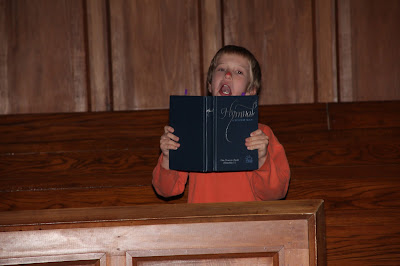
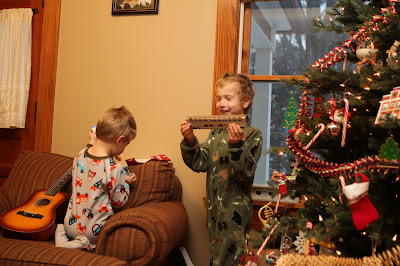
It s wedding week! Wedding week! Wedding week! Wedding week! Oh, also Christmas. Oh dad, it s wedding week! I can t believe it! It s finally here! Wedding week! Jacob, age 7, Sunday Oh dad, this is the best Christmas EVER! Jacob, Wednesday Dad, is the wedding TODAY? Oliver, age 4, every morning this week This has certainly been a Christmas like no other. I have never known something to upstage Christmas for Jacob, but apparently a wedding can! Laura and I got to celebrate our first Christmas together this year together, of course, with the boys. We enjoyed a wonderful day in the middle of a busy week, filled with play, family togetherness, warmth, and happiness. At one point, while I was helping the boys with their new model train components, Laura was enjoying playing Christmas tunes on the piano. Every time she d reach the end, Jacob paused, and said, That was awesome! , beating me to it. That s a few days before Christmas Jacob and Oliver demanding snow ice cream, and of course who am I to refuse? Cousins opening presents After his school Christmas program, Jacob has enjoyed singing. Here he is after the Christmas Eve program, where he excitedly ran up into the choir loft, picked up a hymnal, and pretended to sing. And, of course, opening of presents at home. Sometimes I think about how I didn t know life could get this good. Soon Laura and I will be married, and it will be even better. Truly we have been richly blessed.

21 December 2013

Daniel Kahn Gillmor: Kevin M. Igoe should step down from CFRG Co-chair

I've said recently that pervasive surveillance is wrong. I don't think anyone from the NSA should have a leadership position in the development or deployment of Internet communications, because their interests are at odds with the interest of the rest of the Internet. But someone at the NSA is in exactly such a position. They ought to step down. Here's the background: The Internet Research Task Force (IRTF) is a body tasked with research into underlying concepts, themes, and technologies related to the Internet as a whole. They act as a research organization that cooperates and complements the engineering and standards-setting activities of the Internet Engineering Task Force (IETF). The IRTF is divided into issue-specific research groups, each of which has a Chair or Co-Chairs who have "wide discretion in the conduct of Research Group business", and are tasked with organizing the research and discussion, ensuring that the group makes progress on the relevant issues, and communicating the general sense of the results back to the rest of the IRTF and the IETF. One of the IRTF's research groups specializes in cryptography: the Crypto Forum Research Group (CFRG). There are two current chairs of the CFRG: David McGrew <mcgrew@cisco.com> and Kevin M. Igoe <kmigoe@nsa.gov>. As you can see from his e-mail address, Kevin M. Igoe is affiliated with the National Security Agency (NSA). The NSA itself actively tries to weaken cryptography on the Internet so that they can improve their surveillance, and one of the ways they try to do so is to "influence policies, standards, and specifications". On the CFRG list yesterday, Trevor Perrin requested the removal of Kevin M. Igoe from his position as Co-chair of the CFRG. Trevor's specific arguments rest heavily on the technical merits of a proposed cryptographic mechanism called Dragonfly key exchange, but I think the focus on Dragonfly itself is the least of the concerns for the IRTF. I've seconded Trevor's proposal, and asked Kevin directly to step down and to provide us with information about any attempts by the NSA to interfere with or subvert recommendations coming from these standards bodies. Below is my letter in full:
From: Daniel Kahn Gillmor <dkg@fifthhorseman.net>
To: cfrg@ietf.org, Kevin M. Igoe <kmigoe@nsa.gov>
Date: Sat, 21 Dec 2013 16:29:13 -0500
Subject: Re: [Cfrg] Requesting removal of CFRG co-chair
On 12/20/2013 11:01 AM, Trevor Perrin wrote:
> I'd like to request the removal of Kevin Igoe from CFRG co-chair.
Regardless of the conclusions that anyone comes to about Dragonfly
itself, I agree with Trevor that Kevin M. Igoe, as an employee of the
NSA, should not remain in the role of CFRG co-chair.
While the NSA clearly has a wealth of cryptographic knowledge and
experience that would be useful for the CFRG, the NSA is apparently
engaged in a series of attempts to weaken cryptographic standards and
tools in ways that would facilitate pervasive surveillance of
communication on the Internet.
The IETF's public position in favor of privacy and security rightly
identifies pervasive surveillance on the Internet as a serious problem:
https://www.ietf.org/media/2013-11-07-internet-privacy-and-security.html
The documents Trevor points to (and others from similar stories)
indicate that the NSA is an organization at odds with the goals of the IETF.
While I want the IETF to continue welcoming technical insight and
discussion from everyone, I do not think it is appropriate for anyone
from the NSA to be in a position of coordination or leadership.
----
Kevin, the responsible action for anyone in your position is to
acknowledge the conflict of interest, and step down promptly from the
position of Co-Chair of the CFRG.
If you happen to also subscribe to the broad consensus described in the
IETF's recent announcement -- that is, if you care about privacy and
security on the Internet -- then you should also reveal any NSA activity
you know about that attempts to subvert or weaken the cryptographic
underpinnings of IETF protocols.
Regards,
	--dkg
I'm aware that an abdication by Kevin (or his removal by the IETF chair) would probably not end the NSA's attempts to subvert standards bodies or weaken encryption. They could continue to do so by subterfuge, for example, or by private influence on other public members. We may not be able to stop them from doing this in secret, and the knowledge that they may do so seems likely to cast a pall of suspicion over any IETF and IRTF proceedings in the future. This social damage is serious and troubling, and it marks yet another cost to the NSA's reckless institutional disregard for civil liberties and free communication. But even if we cannot rule out private NSA influence over standards bodies and discussion, we can certainly explicitly reject any public influence over these critical communications standards by members of an institution so at odds with the core principles of a free society. Kevin M. Igoe, please step down from the CFRG Co-chair position. And to anyone (including Kevin) who knows about specific attempts by the NSA to undermine the communications standards we all rely on: please blow the whistle on this kind of activity. Alert a friend, a colleague, or a journalist. Pervasive surveillance is an attack on all of us, and those who resist it are heroes.

Next.

Previous.