Search Results: "nic"

11 January 2023

Junichi Uekawa: Reading through intrusive-collections.

Reading through intrusive-collections. My eyes are not quite used to reading macro packages and they don't quite make sense to me yet. Error messages look strange too.

10 January 2023

Matthew Garrett: Integrating Linux with Okta Device Trust

I've written about bearer tokens and how much pain they cause me before, but sadly wishing for a better world doesn't make it happen so I'm making do with what's available. Okta has a feature called Device Trust which allows to you configure access control policies that prevent people obtaining tokens unless they're using a trusted device. This doesn't actually bind the tokens to the hardware in any way, so if a device is compromised or if a user is untrustworthy this doesn't prevent the token ending up on an unmonitored system with no security policies. But it's an incremental improvement, other than the fact that for desktop it's only supported on Windows and MacOS, which really doesn't line up well with my interests.

Obviously there's nothing fundamentally magic about these platforms, so it seemed fairly likely that it would be possible to make this work elsewhere. I spent a while staring at the implementation using Charles Proxy and the Chrome developer tools network tab and had worked out a lot, and then Okta published a paper describing a lot of what I'd just laboriously figured out. But it did also help clear up some points of confusion and clarified some design choices. I'm not going to give a full description of the details (with luck there'll be code shared for that before too long), but here's an outline of how all of this works. Also, to be clear, I'm only going to talk about the desktop support here - mobile is a bunch of related but distinct things that I haven't looked at in detail yet.

Okta's Device Trust (as officially supported) relies on Okta Verify, a local agent. When initially installed, Verify authenticates as the user, obtains a token with a scope that allows it to manage devices, and then registers the user's computer as an additional MFA factor. This involves it generating a JWT that embeds a number of custom claims about the device and its state, including things like the serial number. This JWT is signed with a locally generated (and hardware-backed, using a TPM or Secure Enclave) key, which allows Okta to determine that any future updates from a device claiming the same identity are genuinely from the same device (you could construct an update with a spoofed serial number, but you can't copy the key out of a TPM so you can't sign it appropriately). This is sufficient to get a device registered with Okta, at which point it can be used with Fastpass, Okta's hardware-backed MFA mechanism.

As outlined in the aforementioned deep dive paper, Fastpass is implemented via multiple mechanisms. I'm going to focus on the loopback one, since it's the one that has the strongest security properties. In this mode, Verify listens on one of a list of 10 or so ports on localhost. When you hit the Okta signin widget, choosing Fastpass triggers the widget into hitting each of these ports in turn until it finds one that speaks Fastpass and then submits a challenge to it (along with the URL that's making the request). Verify then constructs a response that includes the challenge and signs it with the hardware-backed key, along with information about whether this was done automatically or whether it included forcing the user to prove their presence. Verify then submits this back to Okta, and if that checks out Okta completes the authentication.

Doing this via loopback from the browser has a bunch of nice properties, primarily around the browser providing information about which site triggered the request. This means the Verify agent can make a decision about whether to submit something there (ie, if a fake login widget requests your creds, the agent will ignore it), and also allows the issued token to be cross-checked against the site that requested it (eg, if g1thub.com requests a token that's valid for github.com, that's a red flag). It's not quite at the same level as a hardware WebAuthn token, but it has many of the anti-phishing properties.

But none of this actually validates the device identity! The entire registration process is up to the client, and clients are in a position to lie. Someone could simply reimplement Verify to lie about, say, a device serial number when registering, and there'd be no proof to the contrary. Thankfully there's another level to this to provide stronger assurances. Okta allows you to provide a CA root[1]. When Okta issues a Fastpass challenge to a device the challenge includes a list of the trusted CAs. If a client has a certificate that chains back to that, it can embed an additional JWT in the auth JWT, this one containing the certificate and signed with the certificate's private key. This binds the CA-issued identity to the Fastpass validation, and causes the device to start appearing as "Managed" in the Okta device management UI. At that point you can configure policy to restrict various apps to managed devices, ensuring that users are only able to get tokens if they're using a device you've previously issued a certificate to.

I've managed to get Linux tooling working with this, though there's still a few drawbacks. The main issue is that the API only allows you to register devices that declare themselves as Windows or MacOS, followed by the login system sniffing browser user agent and only offering Fastpass if you're on one of the officially supported platforms. This can be worked around with an extension that spoofs user agent specifically on the login page, but that's still going to result in devices being logged as a non-Linux OS which makes interpreting the logs more difficult. There's also no ability to choose which bits of device state you log: there's a couple of existing integrations, and otherwise a fixed set of parameters that are reported. It'd be lovely to be able to log arbitrary material and make policy decisions based on that.

This also doesn't help with ChromeOS. There's no real way to automatically launch something that's bound to localhost (you could probably make this work using Crostini but there's no way to launch a Crostini app at login), and access to hardware-backed keys is kind of a complicated topic in ChromeOS for privacy reasons. I haven't tried this yet, but I think using an enterprise force-installed extension and the chrome.enterprise.platformKeys API to obtain a device identity cert and then intercepting requests to the appropriate port range on localhost ought to be enough to do that? But I've literally never written any Javascript so I don't know. Okta supports falling back from the loopback protocol to calling a custom URI scheme, but once you allow that you're also losing a bunch of the phishing protection, so I'd prefer not to take that approach.

Like I said, none of this prevents exfiltration of bearer tokens once they've been issued, and there's still a lot of ecosystem work to do there. But ensuring that tokens can't be issued to unmanaged machines in the first place is still a step forwards, and with luck we'll be able to make use of this on Linux systems without relying on proprietary client-side tooling.

(Time taken to code this implementation: about two days, and under 1000 lines of new code. Time taken to figure out what the fuck to write: rather a lot longer)

[1] There's also support for having Okta issue certificates, but then you're kind of back to the "How do I know this is my device" situation

comment count unavailable comments

9 January 2023

Junichi Uekawa: Uploaded Debian packages, since a long time.

Uploaded Debian packages, since a long time. enumn and remain are rust packages, and needed for crosvm. Working slowly through the dependency chain.

Russ Allbery: Review: Black Stars

Review: Black Stars, edited by Nisi Shawl & Latoya Peterson
Publisher: Amazon Original Stories
Copyright: August 2021
ISBN: 1-5420-3272-5
ISBN: 1-5420-3270-9
ISBN: 1-5420-3271-7
ISBN: 1-5420-3273-3
ISBN: 1-5420-3268-7
ISBN: 1-5420-3269-5
Format: Kindle
Pages: 168
This is a bit of an odd duck from a metadata standpoint. Black Stars is a series of short stories (maybe one creeps into novelette range) published by Amazon for Kindle and audiobook. Each one can be purchased separately (or "borrowed" with Amazon Prime), and they have separate ISBNs, so my normal practice would be to give each its own review. They're much too short for that, though, so I'm reviewing the whole group as an anthology. The cover in the sidebar is for the first story of the series. The other covers have similar designs. I think the one for "We Travel the Spaceways" was my favorite. Each story is by a Black author and most of them are science fiction. ("The Black Pages" is fantasy.) I would classify them as afrofuturism, although I don't have a firm grasp on its definition. This anthology included several authors I've been meaning to read and was conveniently available, so I gave it a try, even though I'm not much of a short fiction reader. That will be apparent in the forthcoming grumbling. "The Visit" by Chimamanda Ngozi Adichie: This is a me problem rather than a story problem, and I suspect it's partly because the story is not for me, but I am very done with gender-swapped sexism. I get the point of telling stories of our own society with enough alienation to force the reader to approach them from a fresh angle, but the problem with a story where women are sexist and condescending to men is that you're still reading a story of condescending sexism. That's particularly true when the analogies to our world are more obvious than the internal logic of the story world, as they are here. "The Visit" tells the story of a reunion between two college friends, one of whom is now a stay-at-home husband and the other of whom has stayed single. There's not much story beyond that, just obvious political metaphor (the Male Masturbatory Act to ensure no potential child is wasted, blatant harrassment of the two men by female cops) and depressing character studies. Everyone in this story is an ass except maybe Obinna's single friend Eze, which means there's nothing to focus on except the sexism. The writing is competent and effective, but I didn't care in the slightest about any of these people or anything that was happening in their awful, dreary world. (4) "The Black Pages" by Nnedi Okorafor: Issaka has been living in Chicago, but the story opens with him returning to Timbouctou where he grew up. His parents know he's coming for a visit, but he's a week early as a surprise. Unfortunately, he's arriving at the same time as an al-Qaeda attack on the library. They set it on fire, but most of the books they were trying to destroy were already saved by his father and are now in Issaka's childhood bedroom. Unbeknownst to al-Qaeda, one of the books they did burn was imprisoning a djinn. A djinn who is now free and resident in Issaka's iPad. This was a great first chapter of a novel. The combination of a modern setting and a djinn trapped in books with an instant affinity with technology was great. Issaka is an interesting character who is well-placed to introduce the reader to the setting, and I was fully invested in Issaka and Faro negotiating their relationship. Then the story just stopped. I didn't understand the ending, which was probably me being dim, but the real problem was that I was not at all ready for an ending. I would read the novel this was setting up, though. (6) "2043... (A Merman I Should Turn to Be)" by Nisi Shawl: This is another story that felt like the setup for a novel, although not as good of a novel. The premise is that the United States has developed biological engineering that allows humans to live underwater for extended periods (although they still have to surface occasionally for air, like whales). The use to which that technology is being put is a rerun of Liberia with less colonialism: Blacks are given the option to be modified into merpeople and live under the sea off the US coast as a solution. White supremacists are not happy, of course, and try to stop them from claiming their patch of ocean floor. This was fine, as far as it went, but I wasn't fond of the lead character and there wasn't much plot. There was some sort of semi-secret plan that the protagonist stumbles across and that never made much sense to me. The best parts of the story were the underwater setting and the semi-realistic details about the merman transformation. (6) "These Alien Skies" by C.T. Rwizi: In the far future, humans are expanding across the galaxy via automatically-constructed wormhole gates. Msizi's job is to be the first ship through a new wormhole to survey the system previously reached only by the AI construction ship. The wormhole is not supposed to explode shortly after he goes through, leaving him stranded in an alien system with only his companion Tariro, who is not who she seems to be. This was a classic SF plot, but I still hadn't guessed where it was going, or the relevance of some undiscussed bits of Tariro's past. Once the plot happens, it's a bit predictable, but I enjoyed it despite the depressed protagonist. (6) "Clap Back" by Nalo Hopkinson: Apart from "The Visit," this was the most directly political of the stories. It opens with Wenda, a protest artist, whose final class project uses nanotech to put racist tchotchkes to an unexpected use. This is intercut with news clippings about a (white and much richer) designer who has found a way to embed memories into clothing and is using this to spread quotes of rather pointed "forgiveness" from a Malawi quilt. This was one of the few entries in this anthology that fit the short story shape for me. Wenda's project and Burri's clothing interact fifty years later in a surprising way. This was the second-best story of the group. (7) "We Travel the Spaceways" by Victor LaValle: Grimace (so named because he wears a huge purple coat) is a homeless man in New York who talks to cans. Most of his life is about finding food, but the cans occasionally give him missions and provide minor assistance. Apart from his cans, he's very much alone, but when he comforts a woman in McDonalds (after getting caught thinking about stealing her cheeseburger), he hopes he may have found a partner. If, that is, she still likes him when she discovers the nature of the cans' missions. This was the best-written story of the six. Grimace is the first-person narrator, and LaValle's handling of characterization and voice is excellent. Grimace makes perfect sense from inside his head, but the reader can also see how unsettling he is to those around him. This could have been a disturbing, realistic story about a schitzophrenic man. As one may have guessed from the theme of the anthology, that's not what it is. I admired the craft of this story, but I found Grimace's missions too horrific to truly like it. There is an in-story justification for them; suffice it to say that I didn't find it believable. An expansion with considerably more detail and history might have bridged that gap, but alas, short fiction. (6) Rating: 6 out of 10

Gunnar Wolf: Back to Xochicalco

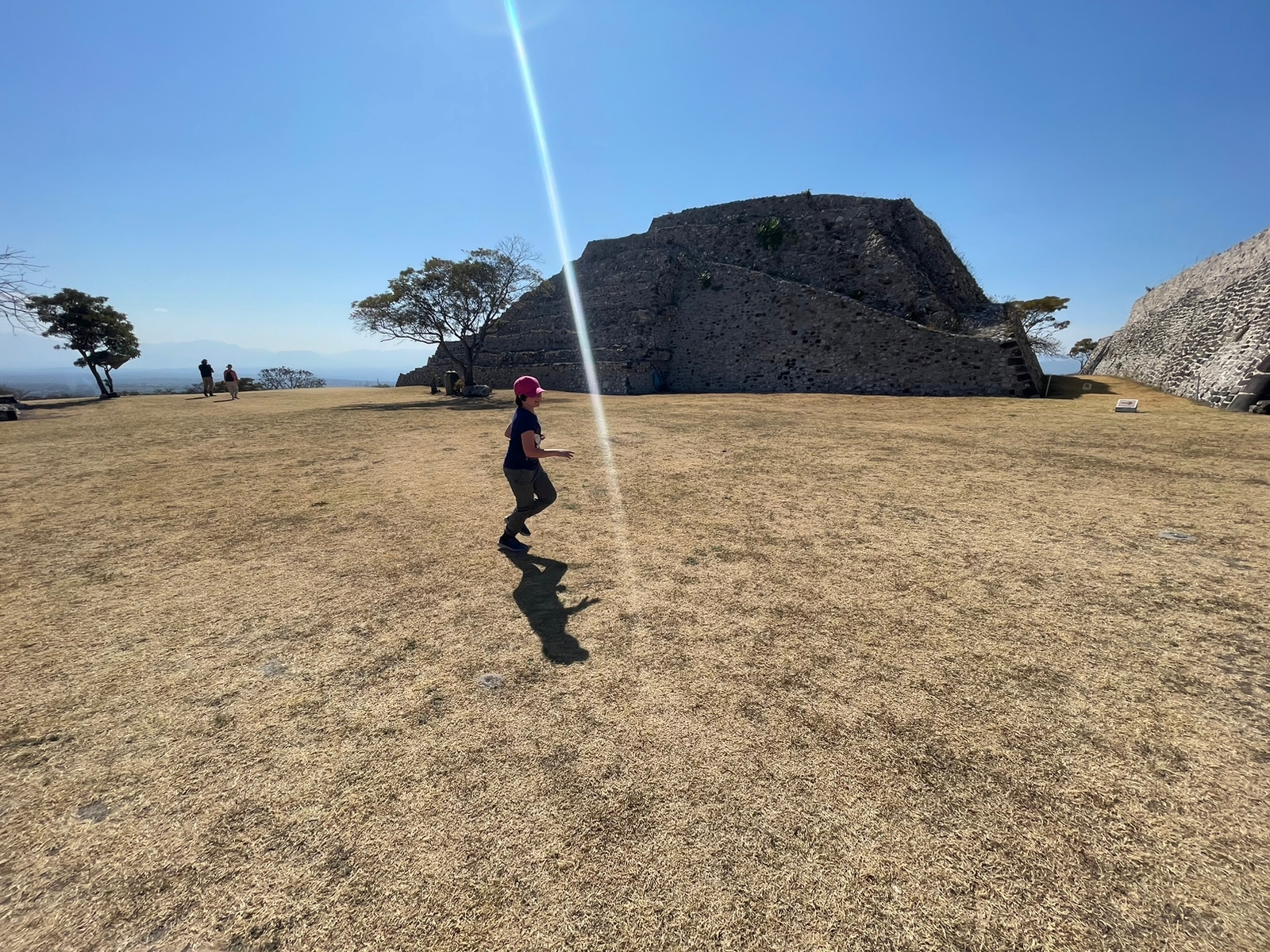
In Mexico, we have the great luck to live among vestiges of long-gone cultures, some that were conquered and in some way got adapted and survived into our modern, mostly-West-Europan-derived society, and some that thrived but disappeared many more centuries ago. And although not everybody feels the same way, in my family we have always enjoyed visiting archaeological sites when I was a child and today. Some of the regulars that follow this blog (or its syndicators) will remember Xochicalco, as it was the destination we chose for the daytrip back in the day, in DebConf6 (May 2006). This weekend, my mother suggested us to go there, as being Winter, the weather is quite pleasant we were at about 25 C, and by the hottest months of the year it can easily reach 10 more; the place lacks shadows, like most archaeological sites, and it does get quite tiring nevertheless! Xochicalco is quite unique among our archaeological sites, as it was built as a conference city: people came from cultures spanning all of Mesoamerica to debate and homogeneize the calendars used in the region. The first photo I shared here is by the Quetzalc atl temple, where each of the four sides shows people from different cultures (the styles in which they are depicted follow their local self-representations), encodes equivalent dates in the different calendaric systems, and are located along representationsof the God of knowledge, the feathered serpent, Quetzalc atl. It was a very nice day out. And, of course, it brought back memories of my favorite conference visiting the site of a very important conference
8 January 2023

Anuradha Weeraman: Parallelizing and running distributed builds with distcc

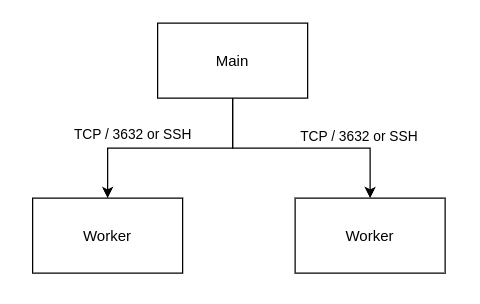
Parallelizing the compilation of a large codebase is a breeze with distcc, which allows you to spread the load across multiple nodes and speed up the compilation time.Here s a sample network topology for a distributed build:
Install distcc on the three Debian/Ubuntu-based nodes:
# apt install distcc
Edit /etc/default/distcc and set:
STARTDISTCC="true"

# Customize for your environment
ALLOWEDNETS="192.168.2.0/24"

# Specify your network device
LISTENER="192.168.2.146"
Additionally, the JOBS and NICE variables can be tweaked to suit the compute power that you have available.Start distcc:
# systemctl start distcc
Do the same all the nodes, and if you have a firewall enabled with ufw, you will need to open up the port 3632 to the master node.
# ufw allow 3632/tcp
Additionally, if you d like to use ssh over untrusted networks so code and communication with the worker nodes happen over a secure channel, ensure that SSH is running and is opened up to the master node in the same manner as above with the key of the master node in ~/.ssh/authorized_keys of the worker nodes. Opening port 3632 in this manner is a security hole, so take precautions over untrusted networks.Back in the master node, setup a DISTCC_HOSTS environment variable that lists the worker nodes, including the master node. Note the order of the hosts, as it is important. The first host will be more heavily used, and distcc has no way of knowing the capacity and capability of the hosts, so specify the most powerful host first.
export DISTCC_HOSTS='localhost 192.168.2.107 192.168.2.91'
At this point, you re ready to compile.Go to your codebase, in this case we use the Linux kernel source code for the purpose of example.
$ make tinyconfig
$ time make -j$(nproc) CC=distcc bzImage
On another terminal, you can monitor the status of the distributed compilation with distmoncc-text or tools such as top or bpytop.Network throughput and latency will be a big factor in how much distcc will help speed up your build process. Using ssh may additionally introduce overhead, so play with the variables to see how much distcc can help speed up or optimize the build for your specific scenario. You may want to additionally consider ccache to speed up the build process.There are some aspects of the build process that are not effectively parallizable in this manner, such as the final linking step of the executable, for which you will not see any performance improvement with distcc.Give distcc a spin, and put any spare compute you have lying around in your home lab to good use.

Antoine Beaupr : 20 years blogging

Many folks have woken up to the dangers of commercialization and centralisation of this very fine internet we have around here. For many of us, of course, it's one big "I told you so"... (To fair, I stopped "telling you so" because evangelism is pretty annoying. It's certainly dishonest coming from an atheist, so I preach by example now. I often wonder what works better. But I digress.) Colleagues have been posting about getting back into blogging. This post from gwolf, in particular, reviews his yearly blog output, and that made me wonder how that looked like from my end. The answer, of course, is simple to generate:
anarcat@angela:~$ cd anarc.at
/home/anarcat/wikis/anarc.at
anarcat@angela:anarc.at$ ls blog   grep '^[0-9][0-9][0-9][0-9]'   sed s/-.*//   sort   uniq -c    sort -n -k2
     62 2005
     49 2006
     26 2007
     25 2008
      8 2009
     16 2010
     24 2011
     19 2012
     17 2013
      7 2014
     19 2015
     32 2016
     43 2017
     40 2018
     27 2019
     33 2020
     22 2021
     45 2022
      1 2023
(I thought of drawing this as a sparkline but it looks like Sparklines are kind of dead. https://sparkline.org/ doesn't resolve and the canonical PHP package is gone from Debian. The plugin is broken in ikiwiki anyway...) So it seems like I've been doing this very blog for 18 years, and it's not even my first blog. I actually started in 2003, which makes this year my 20-year blogging anniversary. (And even if that sounds really old, note that I was not actually an early adopter. Jorn Barger having coined the term "weblog" in 1997. Yes, in another millenia.) Reading back some of the headlines in those older posts, I have definitely changed style. I used to write shorter, more random ideas, and more often. I somehow managed to write more than one article per week in 2005! Now, I take more time writing, a habit I picked up while writing for LWN (those articles), which started in 2016. But interestingly, it seems I started producing more articles then: I hit 43 articles per year in 2017, my fourth best year ever. The best years in terms of numbers are the first two years (2005 and 2006, I didn't check the numbers on earlier years), but I doubt they are the best in terms of content. Really, the best writing I have ever did was for LWN. I dare hope I have kept the quality I was encouraged (forced?) to produce, but I know I cannot come anywhere close to what the LWN editors were juicing out of me. You can also see that I immediately dropped to a more normal 27 article in 2019, once I stopped writing for LWN... Back when I started blogging, my writing was definitely more personal. I had less concerns about privacy back then; now, I would never write about my personal life like I did back then (e.g. "I have a cold"). I was also writing mostly in French back then, and it's sad to think that I am rarely writing in my native language here anymore. I guess that brings me an international audience, which is simultaneously challenging, gratifying, and terrifying. But it also means I reach out to people that do not speak English (or French, for that matter) as their first language. For me that is more valuable than catering to my little corner of culture, at least for now, and especially when writing technical topics, which is most of what I do now anyways. Interestingly, I wrote a lot in 2022. People sometimes ask me how I manage to write so much: I don't actually know. I don't have a lot of free time on my hand, and even less than before in the past two years, but somehow I keep feeding this blog. I guess I must have something to say. Can't quite figure out what yet, so maybe I should just keep trying. Or, if you're new to this Internet thing, Bring Back Blogging! Whee! PS: I wish I had time to do a review of my visitors like i did for 2021 but time is missing.

Russ Allbery: Review: Postwar

Review: Postwar, by Tony Judt
Publisher: Penguin Books
Copyright: 2005
ISBN: 1-4406-2476-3
Format: Kindle
Pages: 835
Tony Judt (1948 2010) was a British-American historian and Erich Maria Remarque Professor in European Studies at New York University. Postwar is his magnum opus, a history of Europe from 1945 to 2005. A book described as a history of Europe could be anything from a textbook to a political analysis, so the first useful question to ask is what sort of history. That's a somewhat difficult question to answer. Postwar mentions a great deal of conventional history, including important political movements and changes of government, but despite a stated topic that would suit a survey textbook, it doesn't provide that sort of list of facts and dates. Judt expects the reader to already be familiar with the broad outlines of modern European history. However, Postwar is also not a specialty history and avoids diving too deep into any one area. Trends in art, philosophy, and economics are all mentioned to set a broader context, but still only at the level of a general survey. My best description is that Postwar is a comprehensive social and political history that attempts to focus less on specific events and more on larger trends of thought. Judt grounds his narrative in concrete, factual events, but the emphasis is on how those living in Europe, at each point in history, thought of their society, their politics, and their place in both. Most of the space goes to exploring those nuances of thought and day-to-day life. In the US university context, I'd place this book as an intermediate-level course in modern European history, after the survey course that provides students with a basic framework but before graduate-level specializations in specific topics. If you have not had a solid basic education in European history (and my guess is that most people from the US have not), Judt will provide the necessary signposts, but you should expect to need to look up the signposts you don't recognize. I, as the dubious beneficiary of a US high school history education now many decades in the past, frequently resorted to Wikipedia for additional background. Postwar uses a simple chronological structure in four parts: the immediate post-war years and the beginning of the Cold War (1945 1953), the era of rapidly growing western European prosperity (1953 1971), the years of recession and increased turmoil leading up to the collapse of communism (1971 1989), and the aftermath of the collapse of communism and the rise of the European Union (1989 2005). Each part is divided into four to eight long chapters that trace a particular theme. Judt usually starts with the overview of a theme and then follows the local manifestations of it on a spiral through European countries in whatever order seems appropriate. For the bulk of the book that covers the era of the Cold War, when experiences were drastically different inside or outside the Soviet bloc, he usually separates western and eastern Europe into alternating chapters. Reviewing this sort of book is tricky because so much will depend on how well you already know the topic. My interest in history is strictly amateur and I tend to avoid modern history (usually I find it too depressing), so for me this book was remedial, filling in large knowledge gaps that I ideally shouldn't have had. Postwar was a runner up for the Pulitzer Prize for General Non-Fiction, so I think I'm safe saying you won't go far wrong reading it, but here's the necessary disclaimer that the rest of my reactions may not be useful if you're better versed in modern European history than I was. (This would not be difficult.) That said, I found Postwar invaluable because of its big-picture focus. The events and dates are easy enough to find on the Internet; what was missing for me in understanding Europe was the intent and social structures created by and causing those events. For example, from early in the book:
On one thing, however, all were agreed resisters and politicians alike: "planning". The disasters of the inter-war decades the missed opportunities after 1918, the great depression that followed the stock-market crash of 1929, the waste of unemployment, the inequalities, injustices and inefficiencies of laissez-faire capitalism that had led so many into authoritarian temptation, the brazen indifference of an arrogant ruling elite and the incompetence of an inadequate political class all seemed to be connected by the utter failure to organize society better. If democracy was to work, if it was to recover its appeal, it would have to be planned.
It's one thing to be familiar with the basic economic and political arguments between degrees of free market and planned economies. It's quite another to understand how the appeal of one approach or the discredit of another stems from recent historical experience, and that's what a good history can provide. Judt does not hesitate to draw these sorts of conclusions, and I'm sure some of them are controversial. But while he's opinionated, he's rarely ideological, and he offers no grand explanations. His discussion of the Yugoslav Wars stands out as an example: he mentions various theories of blame (a fraught local ethnic history, the decision by others to not intervene until the situation was truly dire), but largely discards them. Judt's offered explanation is that local politicians saw an opportunity to gain power by inflaming ethnic animosity, and a large portion of the population participated in this process, either passively or eagerly. Other explanations are both unnecessarily complex and too willing to deprive Yugoslavs of agency. I found this refreshingly blunt. When is more complex analysis a way to diffuse responsibility and cling to an ideological fantasy that the right foreign policy would have resolved a problem? A few personal grumblings do creep in, particularly in the chapters on the 1970s (and I think it's not a coincidence that this matches Judt's own young adulthood, a time when one is prone to forming a lot of opinions). There is a brief but stinging criticism of postmodernism in scholarship, which I thought was justified but probably incomplete, and a decidedly grumpy dismissal of punk music, which I thought was less fair. But these are brief asides that don't detract from the overall work. Indeed, they, along with the occasional wry asides ("respecting long-established European practice, no one asked the Poles for their views [on Poland's new frontiers]") add a lot of character. Insofar as this book has a thesis, it's in the implications of the title: Europe only exited the postwar period at the end of the 20th century. Political stability through exhaustion, the overwhelming urgency of economic recovery, and the degree to which the Iron Curtain and the Cold War froze eastern Europe in amber meant that full European recovery from World War II was drawn out and at times suspended. It's only after 1989 and its subsequent upheavals that European politics were able to move beyond postwar concerns. Some of that movement was a reemergence of earlier European politics of nations and ethnic conflict. But, new on the scene, was a sense of identity as Europeans, one that western Europe circled warily and eastern Europe saw as the only realistic path forward.
What binds Europeans together, even when they are deeply critical of some aspect or other of its practical workings, is what it has become conventional to call in disjunctive but revealing contrast with "the American way of life" the "European model of society".
Judt also gave me a new appreciation of how traumatic people find the assignment of fault, and how difficult it is to wrestle with guilt without providing open invitations to political backlash. People will go to great lengths to not feel guilty, and pressing the point runs a substantial risk of creating popular support for ideological movements that are willing to lie to their followers. The book's most memorable treatment of this observation is in the epilogue, which traces popular European attitudes towards the history of the Holocaust through the whole time period. The largest problem with this book is that it is dense and very long. I'm a fairly fast reader, but this was the only book I read through most of my holiday vacation and it still took a full week into the new year to finish it. By the end, I admit I was somewhat exhausted and ready to be finished with European history for a while (although the epilogue is very much worth waiting for). If you, unlike me, can read a book slowly among other things, that may be a good tactic. But despite feeling like this was a slog at times, I'm very glad that I read it. I'm not sure if someone with a firmer grounding in European history would have gotten as much out of it, but I, at least, needed something this comprehensive to wrap my mind around the timeline and fill in some embarrassing gaps. Judt is not the most entertaining writer (although he has his moments), and this is not the sort of popular history that goes out of its way to draw you in, but I found it approachable and clear. If you're looking for a solid survey of modern European history with this type of high-level focus, recommended. Rating: 8 out of 10

7 January 2023

Dirk Eddelbuettel: RcppSpdlog 0.0.12 on CRAN: Added Stopwatch

Version 0.0.12 of RcppSpdlog is now on CRAN and in Debian. RcppSpdlog bundles spdlog, a wonderful header-only C++ logging library with all the bells and whistles you would want that was written by Gabi Melman, and also includes fmt by Victor Zverovich. This release adds support for the stopwatch object, a simple container around a std::chrono object. It makes (simple) time measurements of routines and code segments trivially easy. Instantiate a stopwatch object, and formatting it in a logging string displays elapsed time. And given that the whole mojo of RcppSpdlog (and its sibbling package spdl) is to make use easy in both R and C++ we can do this nicely and consistently in both languages. The vignette has an added section with a concrete example. The NEWS entry for this release follows.

Changes in RcppSpdlog version 0.0.12 (2023-01-07)
  • Addeed support for 'stopwatch' object allowing for simple timing (from both C++ and R) via the logging framework.
  • The spdlog logging pattern is documented via a reference.

Courtesy of my CRANberries, there is also a diffstat report. More detailed information is on the RcppSpdlog page, or the package documention site. If you like this or other open-source work I do, you can sponsor me at GitHub.

This post by Dirk Eddelbuettel originated on his Thinking inside the box blog. Please report excessive re-aggregation in third-party for-profit settings.

Reproducible Builds: Reproducible Builds in December 2022

Welcome to the December 2022 report from the Reproducible Builds project.
We are extremely pleased to announce that the dates for the Reproducible Builds Summit in 2023 have been announced in 2022 already: We plan to spend three days continuing to the grow of the Reproducible Builds effort. As in previous events, the exact content of the meeting will be shaped by the participants. And, as mentioned in Holger Levsen s post to our mailing list, the dates have been booked and confirmed with the venue, so if you are considering attending, please reserve these dates in your calendar today.

R my Gr nblatt, an associate professor in the T l com Sud-Paris engineering school wrote up his pain points of using Nix and NixOS. Although some of the points do not touch on reproducible builds, R my touches on problems he has encountered with the different kinds of reproducibility that these distributions appear to promise including configuration files affecting the behaviour of systems, the fragility of upstream sources as well as the conventional idea of binary reproducibility.
Morten Linderud reported that he is quietly optimistic that if Go programming language resolves all of its issues with reproducible builds (tracking issue) then the Go binaries distributed from Google and by Arch Linux may be bit-for-bit identical. It s just a bit early to sorta figure out what roadblocks there are. [But] Go bootstraps itself every build, so in theory I think it should be possible.

On December 15th, Holger Levsen published an in-depth interview he performed with David A. Wheeler on supply-chain security and reproducible builds, but it also touches on the biggest challenges in computing as well. This is part of a larger series of posts featuring the projects, companies and individuals who support the Reproducible Builds project. Other instalments include an article featuring the Civil Infrastructure Platform project and followed this up with a post about the Ford Foundation as well as a recent ones about ARDC, the Google Open Source Security Team (GOSST), Jan Nieuwenhuizen on Bootstrappable Builds, GNU Mes and GNU Guix and Hans-Christoph Steiner of the F-Droid project.
A number of changes were made to the Reproducible Builds website and documentation this month, including FC Stegerman adding an F-Droid/apksigcopier example to our embedded signatures page [ ], Holger Levsen making a large number of changes related to the 2022 summit in Venice as well as 2023 s summit in Hamburg [ ][ ][ ][ ] and Simon Butler updated our publications page [ ][ ].

On our mailing list this month, James Addison asked a question about whether there has been any effort to trace the files used by a build system in order to identify the corresponding build-dependency packages. [ ] In addition, Bernhard M. Wiedemann then posed a thought-provoking question asking How to talk to skeptics? , which was occasioned by a colleague who had published a blog post in May 2021 skeptical of reproducible builds. The thread generated a number of replies.

Android news obfusk (FC Stegerman) performed a thought-provoking review of tools designed to determine the difference between two different .apk files shipped by a number of free-software instant messenger applications. These scripts are often necessary in the Android/APK ecosystem due to these files containing embedded signatures so the conventional bit-for-bit comparison cannot be used. After detailing a litany of issues with these tools, they come to the conclusion that:
It s quite possible these messengers actually have reproducible builds, but the verification scripts they use don t actually allow us to verify whether they do.
This reflects the consensus view within the Reproducible Builds project: pursuing a situation in language or package ecosystems where binaries are bit-for-bit identical (over requiring a bespoke ecosystem-specific tool) is not a luxury demanded by purist engineers, but rather the only practical way to demonstrate reproducibility. obfusk also announced the first release of their own set of tools on our mailing list. Related to this, obfusk also posted to an issue filed against Mastodon regarding the difficulties of creating bit-by-bit identical APKs, especially with respect to copying v2/v3 APK signatures created by different tools; they also reported that some APK ordering differences were not caused by building on macOS after all, but by using Android Studio [ ] and that F-Droid added 16 more apps published with Reproducible Builds in December.

Debian As mentioned in last months report, Vagrant Cascadian has been organising a series of online sprints in order to clear the huge backlog of reproducible builds patches submitted by performing NMUs (Non-Maintainer Uploads). During December, meetings were held on the 1st, 8th, 15th, 22nd and 29th, resulting in a large number of uploads and bugs being addressed: The next sprint is due to take place this coming Tuesday, January 10th at 16:00 UTC.

Upstream patches The Reproducible Builds project attempts to fix as many currently-unreproducible packages as possible. This month, we wrote a large number of such patches, including:

Testing framework The Reproducible Builds project operates a comprehensive testing framework at tests.reproducible-builds.org in order to check packages and other artifacts for reproducibility. In October, the following changes were made by Holger Levsen:
  • The osuosl167 machine is no longer a openqa-worker node anymore. [ ][ ]
  • Detect problems with APT repository signatures [ ] and update a repository signing key [ ].
  • reproducible Debian builtin-pho: improve job output. [ ]
  • Only install the foot-terminfo package on Debian systems. [ ]
In addition, Mattia Rizzolo added support for the version of diffoscope in Debian stretch which doesn t support the --timeout flag. [ ][ ]

diffoscope diffoscope is our in-depth and content-aware diff utility. Not only can it locate and diagnose reproducibility issues, it can provide human-readable diffs from many kinds of binary formats. This month, Chris Lamb made the following changes to diffoscope, including preparing and uploading versions 228, 229 and 230 to Debian:
  • Fix compatibility with file(1) version 5.43, with thanks to Christoph Biedl. [ ]
  • Skip the test_html.py::test_diff test if html2text is not installed. (#1026034)
  • Update copyright years. [ ]
In addition, Jelle van der Waa added support for Berkeley DB version 6. [ ] Orthogonal to this, Holger Levsen bumped the Debian Standards-Version on all of our packages, including diffoscope [ ], strip-nondeterminism [ ], disorderfs [ ] and reprotest [ ].
If you are interested in contributing to the Reproducible Builds project, please visit our Contribute page on our website. You can get in touch with us via:

4 January 2023

Junichi Uekawa: debcargo rust repository and some observations.

debcargo rust repository and some observations. It's been about a week since I first started looking at Debian rust packages and adding some packages in preparation for crosvm. Some things that don't work quite well right now yet. My local branches disappeared. I don't have access and everything is through a merge request, presumably that is not a generally supported workflow and the team members are using branches to manage pending works. ./release.sh is optimized for updates and for new packages, they only build source packages and then I need to rebuild a binary-full package for the NEW queue. Maybe I will figure out. I haven't quite gotten the right IRC client. I was using the web UI but that seemed to disconnect without any warnings, and didn't tell me even when it is disconnected, it just can't post more messages and doesn't receive messages. That's not very useful. I started using Emacs IRC (rcirc) client. Not sure how useful that is.

3 January 2023

Paul Wise: FLOSS Activities December 2022

Focus This month I didn't have any particular focus. I just worked on issues in my info bubble.

Changes

Issues

Review

Administration
  • Debian BTS: unarchive/reopen/triage bugs for reintroduced packages: gnome-shell-extension-no-annoyance
  • Debian servers: contact mail server blocking a Debian MX
  • Debian wiki: unblock IP addresses, approve accounts

Communication
  • Respond to queries from Debian users and contributors on the mailing lists and IRC

Sponsors The azure-functions-devops-build work was sponsored. All other work was done on a volunteer basis.

Jonathan Dowland: Tex Shinobi first impressions

Happy New Year!
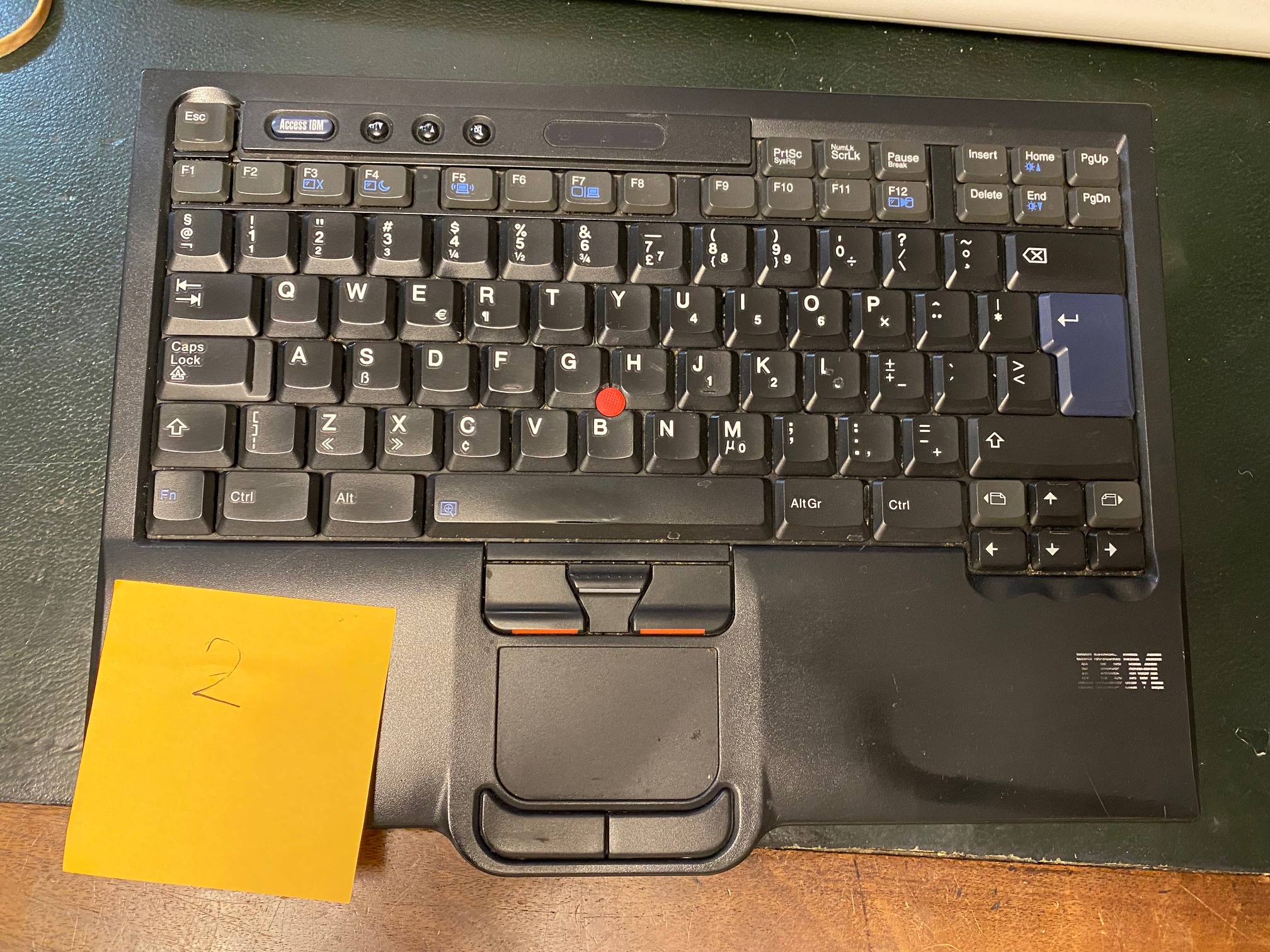
Older IBM Ultranav keyboard Older IBM Ultranav keyboard
For the last 13 years I've been using standalone versions of the Lenovo (formerly IBM) Thinkpad keyboard design with integrated trackpoint as my main computer input devices. My latest ("ThinkPad TrackPoint Keyboard II") was starting to fail so I decided to look into alternatives for a replacement. The sticking point was I really like the trackpoint as a mouse replacement, and very few other manufacturers offer that. I've thus far managed to avoid the money pit that are mechanical keyboards. I can see the attraction: in the 90s I used an IBM Model M PS/2 keyboard as my daily driver until one tea spillage too many finally killed it. A friend kindly gifted me another Model M more recently, but the buckled-spring technology it uses is too loud for use in a public office, and the resistance too strong for my modern fingers. The latter could perhaps be fixed with training. But still: no trackpoint. (less importantly, no Windows keys.) In anticipation of possibly getting a mechanical keyboard, I bought a passive 12 key "tester": 12 keyboard switches of different variants inside a perspex frame. This gives you a rough idea of the feel of each switch type, to try and narrow down what your personal preference might be. At the beginning I imagined I'd like something clicky and stiff, like the buckled springs (and the Cherry MX Green was closest to that), but I was gravitating more towards the more common MX Red (popular with gamers) and MX Brown (popular with typists).
Modern lenovo and sacrificial mech Modern lenovo and sacrificial mech
I wasn't totally sure yet so I decided to buy a sacrificial mechanical keyboard to test a switch type properly. I managed to find a second-hand one for 20 with brown switches. It was a bad layout (ANSI) which detracted from its use but was a useful exercise: I decided I didn't really like the Browns that much! It seems 13 years with scissor switches have softened me up so that I want very little resistance on my keys. So. most likely, MX Reds. Tex Shinobi
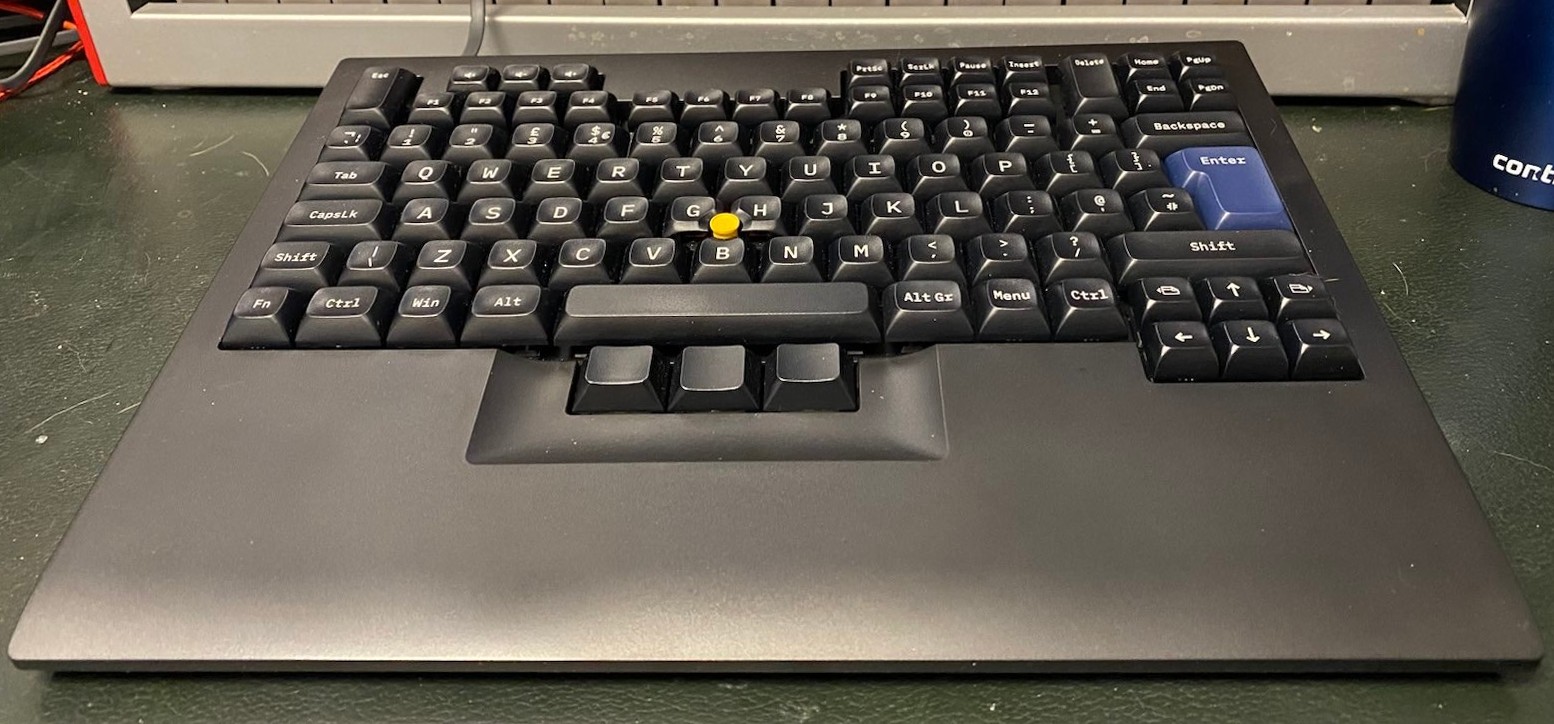
Shinobi, complete with cat hair Shinobi, complete with cat hair
A small Taiwanese company, Tex, produce a series of mechanical keyboards very openly inspired by the IBM/Lenovo trackpoint models that I've been using for so long, complete with trackpoints. I'd been eyeing up their Tex Yoda II keyboard for some time, which looks great, very minimalistic, but in practise I do use the keys it omits, and it's pricey. I decided to take the plunge and buy a more key-ful and reasonably priced Tex Shinobi ISO/UK layout, and I opted for Cherry MX Silent Red switches. Silent to give me the option of using in the Newcastle office, but also to reduce the risk of waking up the kids at home. The Silent Reds are a bit "squishier" than raw Reds which is a shame, but not enough of an obstacle to typing rapidly. The keyboard shape and layout is a close clone of the old IBM Ultranav keyboards I used to use so I was at home on it straight away. The real unknown quantity to me was how well the trackpoint works. I'd read mixed responses, but it's not clear that the people reviewing it were very familiar with the Lenovo ones. I am pleased to report that it's indistinguishable to the Lenovo one to me (and I used that a lot). The keyboard came in a funky replica Thinkpad box and with some keycap and trackpoint pointer options. I opted for a yellow "hat" shaped trackpoint cover (to appease my yellow-obsessed youngest daughter) and the blue IBM-style Enter keycap. Future I don't need any more keyboards! Unless I break this one. But in writing this I did notice that they are taking pre-orders on a new model Shura which seems to be halfway between the Yoda II and Shinobi. I imported the Shinobi from Tex direct (incurring the corresponding duty cost) but next time I might look for a UK distributor such as https://www.keyboardco.com/.

2 January 2023

Gunnar Wolf: Refueling the blog

So, it s this weird time of year where we make a balance and share with the world some ideas about the future. And yes, it s time to take care of this blog, as its activity has dropped once again. So maybe it d be nice to start this post by checking how much have I blogged over the years: (yes, this is an old blog) So yes, there is a clear downwards trend towards the last few years. And it does make sense, all in all: Not only have I managed to keep myself busier than before, but Blogging is a social endeavor. And as people have moved over to the different flavors of social networks, there is somewhat less fueling us to share our thoughts and experiences in this fashion. So this connects me to my first point: Staring at Noodles Emptiness, I got to a campaign to Bring Back Blogging. I stand by all of what they suggest: Blogs are a great invention, they allow the sharing of a great insight into a person s mind, ideas and worldview (and even more so if, like mine, it shows already a window of almost two decades of life! This year my blog will be old enough to vote!), they are completely decentralized, and can be easily grouped according to each readers preferences via the RSS format. Anyway I do want to write a post summing up 2022, as well as sharing some hopes and projects I have for 2023. But I don t want to make it too long to read. So That shall be the blog post for today! (post caption image by Walt Stoneburner on Flickr; CC BY 2.0)


1 January 2023

Jonathan McDowell: Free Software Activities for 2022

There is a move to Bring Back Blogging and having recently sorted out my own FreshRSS install I am completely in favour of such a thing. RSS feeds with complete posts, for preference, not just a teaser intro sentence/paragraph. It s also a reminder to me that I should blog more, and what better way to start 2023 than with my traditional recap of my Free Software activities in 2022. For previous years see 2019, 2020 + 2021

Conferences I attended DebConf22 in Prizen, Kosova this year, and finally hit the end of my luck in avoiding COVID. 0/10, would not recommend. Thankfully I didn t come down with symptoms until I got home (I felt fine and tested negative on arrival home, then started to feel terrible the next day and tested again), so I was able to enjoy the conference itself. I also made it to Linux Security Summit Europe 2022, which aligned with work related bits and was interesting. I suspect I would have been better going to LPC 2022 for the hallway track, though I did manage to get some overlap with folk being in town given that both were the same week.

Debian Most of my contributions to Free software continue to happen within Debian. We continue to operate a roughly 3 month rotation for Debian Keyring in terms of handling the regular updates, and I dealt with 2022.03.24, 2022.06.26, 2022.08.11, 2022.09.24, 2022.09.25 + 2022.12.24. There were a few out of cycle updates this year and I handled a couple of them. My other contributions are largely within the Debian Electronics Packaging Team. gcc-xtensa-lx106 saw a few updates, to GCC 11 + enabling D (10 + 11), then to GCC 12 (12). binutils-xtensa-lx106 got some minor packaging cleanups, which also served to force a rebuild with the current binutils source (5). libsigrokdecode got an upload to enable building with Python 3.10 (0.5.3-3). Related, I updated sdcc to a new upstream version (4.2.0+dfsg-1) - it s used for the sigrok-firmware-fx2lafw package and I do have a tendency to play with microcontrollers, so it s good to have a recent version available in the archive. I continue to pay attention to OpenOCD, with a minor set of updates to pull in some fixes from master (0.11.0-2). I was pleased to see the release process for 0.12.0 kick off and have been uploading RCs as they come out (0.12.0~rc1-1, 0.12.0~rc2-1 + 0.12.0~rc3-1). Upstream have been interested in the upcoming bookworm release cycle and I m hopeful we ll get 0.12.0 proper in before freeze. libjaylink also saw an upstream release (0.3.1-1). Package upload sponsorship isn t normally something I get involved with, because I find I have to spend a lot of time checking over things before I m comfortable doing the upload. However I did sponsor an initial upload for sugarjar and an update for mgba (0.10.0+dsfg-1, currently stuck in NEW). Credit to Michel for dealing swiftly with my review comments, and Ryan for producing a nicely reviewable set of changes. As part of the Data Protection Team I responded to various inbound queries to that team. There was also some discussion on debian-vote as part of the DPL election that I engaged with, as well as discussions at DebConf about how we can do things better. For Debian New Members I m mostly inactive as an application manager - we generally seem to have enough available recently. If that changes I ll look at stepping in to help, but I don t see that happening (it got close this year but several people had stood up before I got around to offering). I continue to be involved in Front Desk, having various conversations throughout the year with the rest of the team and occasionally approving some of the checks for new applicants. Towards the end of the year I got involved with the Debian Games Team, largely because I m keen to try and get my Kodi working with libretro based emulators - I d really like to be able to play old style games from the same interface as I can engage with locally stored movies, music and TV. It turns out there are a lot of moving pieces to make that happen, some missing from Debian and others in need of some TLC. I updated retroarch to current upstream (1.13.0+dfsg-1 + 1.13.0+dfsg-2) but while I was doing so upstream did another release. I plan on uploading 1.14.0 once 1.13.0 has migrated to testing. It turned out I also needed to update libretro-core-info (1.13.0-1) and retroarch-assets (1.7.6+git20221024+dfsg-1). In terms of actual emulators I pulled in new versions for genesisplusgx (1.7.4+git20221128-1) and libretro-bsnes-mercury (094+git20220807-1). On the Kodi side I haven t uploaded anything yet. I ve filed an ITP for rcheevos, which is a dependency for game.libretro and I have a fledgling package for game.libretro that I finally got working today. I m not sure if I can get it cleaned up enough in time to make the bookworm release, but I m hoping that at least the libretro piece is in a bit better shape now (though I m aware there are more emulator cores that could do with being updated).

Linux This year was a quiet year for personal Linux contributions. I submitted a minor fix for the qca8081 PHY with speeds lower than 2.5Gb/s that caused me issues on my RB5009.

Personal projects 2022 finally saw a minor releases of onak, 0.6.2, which resulted in a corresponding Debian upload (0.6.2-1). It has a couple of bug fixes but nothing major.. As I said last year it s not dead, just resting, but Sequoia PGP is probably where you should be looking for a modern OpenPGP implementation. I added some basic Debian packaging to mqtt-arp - I didn t bother uploading it as it s a fairly niche package, but I m using it locally.

Russ Allbery: 2022 Book Reading in Review

In 2022, much to my surprise, I finished and reviewed 51 books, a substantial increase over last year and once again the best year for reading since 2012. (I read 60 books that year, so it's a hard mark to equal.) Reading throughout the year was a bit uneven; I avoided the summer slump this year, but still slowed down in early spring and September. As always, the tail end of the year was prime reading time. The best book of the year was the third and concluding book of Naomi Novik's Scholomance series, The Golden Enclaves. I thought she nailed the ending of an already excellent series, propelling it to the top ranks of my favorite fantasy series of all time. I'm a primarily character-driven reader, and El's first-person perspective was my favorite narrative voice in a very long time. The supporting characters are also wonderful (Liesel!). Highly recommended. Fiction highlights of the year were plentiful. It started off strong with Natalie Zina Walschots's cynical and biting superhero novel Hench and continued in a much different vein with Guy Gavriel Kay's Children of Earth and Sky, which has a bit less plot focus than some of his other fantasies but makes up for it in memorable character relationships. Ryka Aoki's Light from Uncommon Stars is a moving story of what it means to truly support someone else and should have won the best novel Hugo. And, finally, Miles Cameron's Artifact Space was a delight; one of the best military SF novels I've read in a long time. There was no true stand-out non-fiction book this year, but the first book I finished in 2022, Adam Tooze's Crashed, is now my favorite story of the 2008 financial collapse, in large part because he extends the story to the subsequent European financial crisis. Jo Walton's collection of book discussion columns, What Makes This Book So Great, also deserves a mention and is guaranteed to add to your reading backlog. My large review project of the year was finally making substantial inroads into Terry Pratchett's long Discworld series. That accounted for eight of the books I read this year, and is likely to account for a similar number next year since I'm following the Tor.com Discworld re-read. I think my favorite of that bunch was Maskerade, but I also enjoyed all of the Watch novels in the group (Feet of Clay, Jingo, and The Fifth Elephant). My other hope for the year was to mix in older books from my reading backlog and not just focus on new (to me) acquisitions. A little bit of that happened, but not as much as I had been hoping for. This continues to be a goal in 2023. The full analysis includes some additional personal reading statistics, probably only of interest to me.

Junichi Uekawa: Challenges in getting a Debian package.

Challenges in getting a Debian package. Debian Rust packaging team has a great collection of scripts for maintaining Debian Rust packages, but that depended on schroot and other tools that I haven't used usually. Getting that working first was a challenging. I had to get out of my podman container running sid inside user namespace, because schroot didn't work due to not being able to create devices files. That was okay, and I went back to my old chroot script which was doing something similar to schroot. Had to fix up /etc/passwd and /etc/group to match inside and outside. I broke gpg on the way, I had to fix the chroot script not to break PTTY by keeping /dev/pts. This I could probably have ignored if I had used schroot myself as well. Anyway, some maintenance of old scripts to get back up to speed...

C.J. Adams-Collier: State of the racks, 20221231

Hi friends! I haven t written in a while. I ve been caught up in work. But between working, I ve put together some new equipment in a couple of new racks. I bought an audio dampened 15U rack a couple of years ago or so, and into it I ve placed the RAID array and an HP desktop form-factor ML110 server to drive the disks. The disk array controller is a two-port Broadcom / LSI SAS3008 PCI-Express Fusion-MPT SAS-3. I ve been thinking about getting the four-port variant, since I like this one and I ve got another 7 drive bays in the chassis that don t have disks in them. In the next rack over, which was gifted to me by one of my colleagues (Thank you Nahuel!), I have six qotom mini computers and a couple of 48-port Dell 6248 switches with two 6200-XGSF 10GE SFP+ modules. The mini computers are a sort of proto-cluster, and all have a whole bunch of network interfaces. The smallest of the group is a celeron with four gigabit ethernet ports, and the two fastest ones have i7 processors with 6x GE ports. Each of the mini computers is configured with all of their ethernet interfaces in a single LACP port-channel, thanks to the bonding Linux kernel module. On my desk, I have a Mikrotik CRS305. It is populated with three LR SMF transceivers. One attaches to my work desktop via a QLogic Corp. cLOM8214 PCIe card, one attaches via a thunderbolt 3 NIC to my work laptop, and the other is connected to the aforementioned Dell switch. My internet provider has installed a Optical Network Transceiver (ONT) device in my home which terminates the incoming Gigabit Passive Optical Network (GPON) services from the CO and delivers 940Mbit symmetric PPP over Ethernet via 8-pin copper out of the ONT. I connect the ONT to a Mikrotik CRS309-1G-8S+ router. That router is connected via LR SMF to the dell switch in the rack full of qotom hardware. This afternoon, I tested the throughput between my work desktop and my storage server and came up with these numbers:
$ iperf -c 100.64.79.102
------------------------------------------------------------
Client connecting to 100.64.79.102, TCP port 5001
TCP window size: 16.0 KByte (default)
------------------------------------------------------------
[  1] local 100.64.79.46 port 55216 connected with 100.64.79.102 port 5001 (icwnd/mss/irtt=14/1448/547)
[ ID] Interval       Transfer     Bandwidth
[  1] 0.0000-10.0129 sec  10.4 GBytes  8.95 Gbits/sec
That seems pretty good to me! The traffic hopped through my desk router and the dell switch to get to the Proliant server, and still nearly reached 9Gbit/s. That s a lot of blinkenlights.

Junichi Uekawa: 2023 started.

2023 started. I'm still stuck at home due to COVID-19 and therefore I have more than usual time on hacking on Debian stuff. I've learnt schroot does most of what I have been doing with my home grown tools.

31 December 2022

Chris Lamb: Favourite films of 2022

In my four most recent posts, I went over the memoirs and biographies, the non-fiction, the fiction and the 'classic' fiction I enjoyed reading in 2022. But in the very last of my roundup posts and in relatively less detail I'll be quickly sketching out the favourite movies that were new to me in 2022:

La Ronde (1950) An all-knowing narrator (Adolf Wohlbr ck) guides us through a series of vignettes in 1900s Vienna a soldier meets an eager young lady of the evening, and later he has an affair with a young lady who becomes a maid and who then does similarly with the young man of the house. On and on it goes, spinning on the carousel of life. A wonderfully beguiling movie, and a reminder that 'innocent' and 'charming' doesn't always imply 'childish'.

A Man Escaped (1956) A Man Escaped is the story of a WW2 resistance fighter who wishes to escape from a prison. Filmed in Robert Bresson's quasi-minimalistic style (and touching on his usual themes of Christian redemption), this deceptively simple-looking film rewards deeper analysis.

The Music Room (1958) In The Music Room, Satyajit Ray (best known for his Apu Trilogy) tells the story of a wealthy landlord who lives a decadent life with his wife and son. His passion is for music, however, and he spends a significant portion of his fortune on concerts held for the locals in his magnificent music room (or 'jalsaghar). However, his obsession for music (and its attendant quest for respect from his peers) is his eventual undoing, as he sacrifices both his family and wealth whilst trying to retain it. Indeed, The Music Room is less of an examination of a single rich man (or of the hypnotic sitar music by Vilayat Khan) than of the dying Bengali landowning class, which I read as symbolic of what was about to vanish from Indian culture in the post-Independence drive toward modernity. Still, this is a multi-layered and textured film, as this is also an intensely moving portrait of a highly-detached man as well.

The Hustler (1961) 'Fast Eddie' Felson is a small-time pool hustler with a lot of talent but a self-destructive attitude. His bravado causes him to challenge the legendary Minnesota Fats to a high-stakes match. The stakes are always much bigger than just money though, as Fast Eddie's ego is on the line. Despite not caring so much about the game, I was completely gripped by Paul Newman's superb performance. Almost certainly the best film about pool ever made, and probably the best sports film as well.

Picnic at Hanging Rock (1975) One Valentine's Day in early-1900s Australia, an upper-class school takes its girls on a field trip to a scenic volcanic formation in the middle of the brush. Despite all the rules against it, however, several of the girls venture off onto the rock, and it's not until the end of the day that the group realises some of the girls and one of the teachers have disappeared without a trace. A mesmerising film about colonialism, sexual repression and Antonioni-esque alienation, Picnic at Hanging Rock's dreamlike aesthetic is haunting.

Jeanne Dielman, 23, quai du Commerce, 1080 Bruxelles (1976) Jeanne Dielman is a three-and-a-half-hour film that shows a widowed housewife doing her daily chores and taking care of her apartment. Yet in its uncompromising nature, it raises the tedium of her life to the level of profundity. I watched this radically political film a few months before it was recently voted as the 'greatest of all time'), but despite its relentless rigorous nature (and long running time), the conclusion when it comes is shattering.

Raise the Red Lantern (1991) Set in China during the 1920s, Raise the Red Lantern tells the story of a young woman who has become the new concubine of a wealthy man. However, as he has three wives already (each living in a separate house within his castle) she becomes are engaged in an extremely complicated competition attention and the privileges that come with it. Richly colourful, both in its visuals and symbolism, this is film both specifically about China at the time and human universals.

Moonlight (2016) A heartbreaking story of a young man's struggle to find himself, told across three defining chapters in his life as he experiences the pain and beauty of falling in love, whilst grappling with his own sexuality within the ambient weather of race and class in the United States. Absolutely spellbinding and visually stunning.

Drive My Car (2021) Yusuke Kafuku is a stage director who is unable to cope with the loss of his wife, and has therefore accepted an invitation to direct Anton Chekhov's [Uncle Vanya][https://en.wikipedia.org/wiki/Uncle_Vanya] at a festival in Hiroshima, Japan. Yet whilst many reviewers have focused on the compelling relationship between Yusuke and Misaki (the introverted young woman who has been appointed to drive his car), what I found devastating was the embedded meditation on language, communication, understanding and empathy, especially concerning what happens when these break down or are no longer possible. Drive My Car touches on the limits of each of these phenomena connecting to the next: being able to speak the same language as another doesn't mean you can communicate with them; and being able to communicate doesn't mean you can understand someone, let alone empathise with them. All of this through the near-ungraspable emotion of grief as well, and the portion of this film where the actress was silently employing Korean Sign Language was the most moving thing I saw this year.

Next.

Previous.