Search Results: "ghe"

17 February 2008

Russell Coker: Laptop vs Book Weight

Matt Bottrell wrote an interesting and informative post about laptops for school kids [1]. His conclusion is that based on technical features the OLPC machine is best suited for primary school children and one of the ASUS EeePC, the Intel Classmate, and the Everex Cloudbook would be best suited for high-school students. The Asus EeePC [2] is a good option, it runs a variant of Debian and the Debian Eeepc Team are active in getting full Debian support for it [3]. The Intel Classmate [4] has a choice of Windows XP, Mandriva, and Metasys Classmate. The web page says that it’s designed “for primary students (ages 5-14)“, so I think that Matt made a mistake in listing this as a possibility for high-schools, of course when running Mandriva it could have software installed for any age group but the hardware design may be better suited to younger children. The Everex Cloudbook [5] runs the GOS Rocket [6] OS which seems to be an Ubuntu variant with an Enlightenment based GUI and a configuration aimed at using Google services (blogger, gmail, etc). Configuring Ubuntu to suit your needs is easy enough (it’s based on Debian). Note that Matt did not mention where one might purchase a Cloudbook in Australia and I don’t recall seeing one on any of my many window-shopping expeditions to Australian consumer electronics stores, while the EeePC is widely available (except when sold out). But I’m sure that if the government wanted to place an order for a couple of million units then Everex would ramp up production quickly enough. Matt made one statement that I strongly disagree with, he wrote “A traditional notebook is far too heavy for high-school kids to lug around“. To test this theory I searched for some high-school text books and a set of scales. A year 11 Maths A text book from ~1988 weighed 600g and the pair of year 12 Maths A and Maths B texts weighed 1.6Kg. When I was at high-school the day was divided into seven “periods”, some classes took two periods so four different classes which required text books (or other books) was typical. Carrying 3Kg of books to school would not be uncommon for year 12 students. The Lenovo T series (advertised as “premier performance” and the model I personally prefer) is listed as having a starting weight of 2.1Kg (which presumably doesn’t include the power pack). My Thinkpad T series (from about 2004) weighs about 2.4Kg according to my kitchen scales and has a battery weighing just over 400g. My practice for a long time was to own a spare power pack for my Thinkpad so that I could leave it at work (saving 400g when travelling to and from work). I have also had the practice of buying a spare battery when I buy a Thinkpad (you need a spare battery for a long trip). So if I had really wanted to save weight I could have left a battery at work and reduced by travel weight by another 400g (with the cost being that I couldn’t use it when on a train or bus). A spare power pack is not overly expensive. In the usual case students would only need a battery when at school (it’s a little known fact that Thinkpads work perfectly without a battery plugged in). So if a student had a power pack at home as well as one at school and if they left their battery at school and they owned one of the latest Thinkpad T series (listed with a starting weight of 2.1Kg) then their travel weight might be about 1.7Kg. If the majority of school texts could be stored on their laptop then the result of using a Thinkpad T series would be a significant weight reduction! If the students were using a Thinkpad X series (more expensive so maybe not a good option) then the list weight is 1.57Kg and the travel weight might be as low as 1.3Kg (at a rough estimate). The EeePC offers significant benefits for school use, it is light, cheap (children tend to break or lose things more frequently than adults so you should budget for buying two of anything that they use), and having no hard drive (flash storage) it should cope well with being dropped. The screen on the EeePC is unreasonably small buy Asus could release a new model with a bigger screen (they may do this in the future anyway or a government contract could encourage them to do it sooner). I agree that the EeePC or the Everex Cloudbook is probably the best option for high-school students, but I can’t agree with any claim about a traditional laptop being too heavy, the only reason for excluding a traditional laptop is that those new ultra-lights are better. Another reason that might be cited for not using laptops is the cost. While prices of $1000 or more for a traditional laptop are rather expensive, the $500 for an EeePC is not that expensive - and the government could surely negotiate a better deal, I would be surprised if they couldn’t get the price down to $350 by some bargaining and by removing the middle-man. A careful child could use the same laptop for the entire duration of high-school and their parents would incur less expense than they currently would spend on text books. As for the current lack of electronic text books. Currently when the education department selects a book it’s a license to print money for the author and publisher. All that the education department has to do is to declare that they will do a deal with the first company to release their books under a creative commons license. The idea would be that an author (or publishing company) would get paid a fixed sum of money for a CC release of a text book which would then be available for use by anyone anywhere in the world. World-wide free distribution would be no loss to the author (each country tends to have unique books anyway) but would be a good act of charity from our government to developing countries. Once books were available under a creative commons license (without the “no modifications” clause) they could be freely improved by anyone. Improving text books for younger students could be a good school project. Update: Thanks to Steve Walsh for pointing out that the Classmate can run Linux. It’s a pity that he didn’t link to my post so that his readers could see what he was referring to. I take it as a good sign of the quality of my posts that such small errors get pointed out.

15 February 2008

Stefano Zacchiroli: XQuery and XSLT 2.0 with Debian

XQuery 1.0 and XSLT 2.0: news and how to use them in Debian (long post about the second generation of the XSL family and how to use the related languages in Debian)
The 2nd generation of the XSL family At the beginning of 2007, W3C released a family of interrelated specification: XPath 2.0, XSLT 2.0, XQuery (1.0). The 3 specifications are based on the very same underlying data model which (finally!) supports typed values and exploits them to some extent, for example permitting some form of static type checking in XPath and XQuery. Types usually come from XML Schema, with both built-in and user-defined types supported. A brief overview of the 3 specifications and what they change in the state of the art follows. XPath 2.0 XPath 2.0 basically consists in XPath 1.0 + 3 new macro features. The first one is a revamp of those language features which are dealing with types, in order to better integrate them with the new typed data model. XPath now has operators to check whether a value belongs to a given type (so yes, type information are kept at run time), and to cast them from one type to another. The basic new type constructor is now the sequence, which replaces the old node-set solving many annoying issues, such as the impossibility of having a node ordering other than document order. The second feature is the improvement of standard library of functions which was ridiculously small in XPath 1.0; it is much better now. Additionally, 2nd generation languages (XSLT 2.0 and XQuery) now support the ability to define functions which will then be visible to inner (XPath) expressions, pushing yet forward the possibilities of plain old XPath. Functions can now also declare types in their signatures (for their arguments and return value) and untyped arguments will be automatically casted to them upon invocation. Hence, even if you are not using an implementation which assigns types to your XML trees, once you "enter" the typed world calling a typed function (almost all standard library functions are decently typed) you will be able to stay there avoiding annoying casts everywhere. Finally XPath 2.0 has turned into a powerful purely functional language and is now powered by constructs like conditionals, for-each loops, existential/universal quantifiers, and existentially-quantified comparison operators for sequences. Here is a complex expression to hwet your appetite (or scare you away ...), comments come as (: smiley faces :)
for $book in /bookshelf//books
return
  if ((every $author in $book/authors/author
       satisfies $author/nativeLang eq "it_IT")
      and $book/lang eq "it_IT")
  then $book
  else ()
(: think about the trouble of writing this in XSLT/XPath 1.0 ... :)

XSLT 2.0 XSLT 2.0 is what I would call a "bug fix release" of XSLT 1.0 + the routinary reworking of the language to deal with typed values, which is not sensibly different than what has been done for XPath 2.0. The fixed "bugs" are several, starting from the annoying issue of result tree fragments. They are basically tree snippets that in XSLT 1.0 you were able to generate for future use. Unfortunately they were not thaaat reusable, given that you were not even able to navigate them with XPath operators! Now the specification is much more clear and distinguishes final result trees from ordinary variables, which can now contain sequences of (navigable) tree nodes. Another important "bug" fixed is the new ability to output multiple documents with a single XSLT stylesheet: it marks the end of stupid extra post processing to be added in pipeline to a XSLT processor. Other minor "bugs" fixed are a limited amount of backtracking capabilities among imported templates, regular expression support directly in the language, and powerful grouping constructs on the lines of SQL's GROUP BY (but much more powerful). Here is a template snippet exploiting the latter feature:
<xsl:for-each-group select="*" group-starting-with="h1">
  <div>
    <xsl:apply-templates select="current-group()" />
  </div>
<xsl:for-each-group>

XQuery XQuery is the end of the chains imposed by XML-based syntaxes. Why the heck one has to use an XML syntax (as in the above snippet) only because she is manipulating XML tress is one of the mysteries of XML technologies which have always been floating around in my head. XQuery is the (supposedly) SQL equivalent for databases of XML documents, but is actually much more than that. I depict it in my head as the XML manipulation language with a syntax I can finally stand. Technically it is XPath 2.0 (say 80% of the whole language) + some extra ingredients (say 20%); so remember that every XPath 2.0 expression is also a XQuery expression. The main extra ingredient is the so called FLWOR expression (to be read: "flower expression", which in addition to the "smiley faces" used for comments gives a "back to 1968"-flavour to the language .... erm FLWOR/flower/flavour, no pun intended). A FLWOR expression is very similar to SQL's SELECT-FROM-WHERE: it lets you generate a tuple stream by iterating on sequences (F: for clauses), binding expression values to names (L: let clauses), filter out tuples which do not satisfy a required condition (W: where clause), order the survived tuples (O: order by clause), and finally return a sequence built using the residual tuple stream (R: return clause). The other interesting extra ingredient is the ability to build the XML snippets you want to manipulate. Within XQuery you do that using plain XML syntax (the only place where a sane-minded programmer actually wants to see it!) which also supports a classical interpolation mechanism to embed expressions which will be evaluated inside XML snippets, and also the other way around. A canonical XQuery example is:
for $t in doc("books.xml")//title,
    $e in doc("reviews.xml")//entry
where $t = $e/title
return <review>  $t, $e/remarks  </review>
(: braces denote the escaping context where XQuery expressions will
   be evaluated inside snippets; plain XML syntax is used for the
   other way around :)

But remember: XQuery for XML is much more than SQL for RDBMS, thanks to the implicit templating mechanism implemented by interpolation, and thanks to several language features fostering modularity (user-defined functions, library modules, XPath 2.0 standard library, ...) you can basically do with it any kind of XML manipulation you can imagine. I don't think I will ever write myself any other single line of XML output in DOM or XSLT ...
Cool, how can I use it in Debian? ... if only this stuff were decently supported in the open source world. Last time I checked, the author of most parts of the GNOME toolchain for dealing with XML (libxml2, libxslt, ...) was not intentioned to implement XSLT 2.0, not even mentioning XQuery. This comes as no surprise, the whole GNOME XML toolkit is written in C, and XSLT 2.0 / XQuery have reached a level of complexity and formal specification which usually entails a higher level approach. So on the GNOME side we are stuck. The other open source implementations of XSLT 2.0 / XQuery I'm aware of are Saxon and Galax. Saxon is an XSLT 2.0 and XQuery implementation written in Java, which is unfortunate per se. Additionally, it is also unfortunate that it is only partially open source. Indeed, Saxon is split into SaxonB (for "basic") which is open source under the Mozilla Public License and SaxonSA which is commercial. While SaxonSA is a fully conformant, XML Schema-aware processor, with support for static typing, SaxonB is a basic-conformant processor with no type-aware features and actually much less optimized than SaxonSA. This is annoying. (Much more annoying is the fact that SaxonSA's author is the only editor of the XSLT 2.0 specification and that instead of his mail address the specification includes an URL pointing to the website selling SaxonSA ...) Galax is an open source (IBM CPL / Lucent license) OCaml implementation of XQuery which is not fully conformant to the specification (though it gets quite close) which is type-aware and implements static typing. The only XQuery / XSLT 2.0 implementation available in Debian at the time of writing is SaxonB. The binary package is libsaxonb-java, kudos to Michael Koch and the Debian Java Maintainers for having packaged it (and to have stood some annoying pings of mine :-) bug #408842). To execute XQuery code you just have to aptitude install libsaxonb-java, prepare a query.xq file containing your query, and then execute something like:
CLASSPATH=/usr/share/java/saxonb.jar \
java net.sf.saxon.Query query.xq

note that the information in README.Debian are still referring to old Saxon versions, see bug #465894 which proposes a more up to date README.Debian. Similarly, to perform a XSLT 2.0 transformation you have to do something like:
CLASSPATH=/usr/share/java/saxonb.jar \
java net.sf.saxon.Transform -ext:off -s:input.xml -xsl:style.xsl -o:output.xml

Do not remove the -ext:off flag when processing untrusted stylesheets!, see bug #465885 for the reason. I've written some handier (1-liner) shell script helpers which remove the need of invoking java manually. They are attached to bug #465894 and I've proposed their addition to the saxonb package. Using them the above invocations become:
saxonb-xquery query.xq
saxonb-xslt -ext:off -s:input.xml -xsl:style.xsl -o:output.xml

Galax in Debian ... well, since long time I've been planning to package it (the ITP has been filed some months ago: bug #447984) and the authors sent me a newer version than what is available online to gather feedback before the long overdue final release. Unfortunately I've been lagging behind in finishing the packaging (which is tricky due to the need of binding libraries to several different languages: OCaml is native, but there is also Java for example). Hopefully this post will give me some renewed motivation for finishing the work ...
References
Acknowledgements Thanks to godog for his helpful comments.
Update: the helpers I've proposed have been accepted into the official package, I've also made available their manpages. Also the pending changes to README.Debian has been accepted. Kudos again to Michael Koch for his quick feedback on my patches!

MJ Ray: The Phone Coop: Annual Meeting

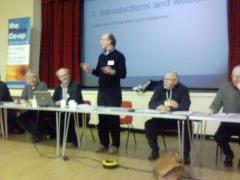
agmphoto Saturday 2 February 2008 was the annual meeting of the Phone Coop (agent link). I travelled to Chipping Norton for it and took a few abbreviated notes, which I've expanded slightly here. Ask questions if you want, but it's already fading in my memory:- Local Loop Unbundling workshop: 20 years of calls for it. 1999 ofcom announced 01 eu announced. 05 threat to breakup BT. 06 openreach split. By 2007-04 there were 2million unbundled. Distribution points and cabinets. Exchange may make even cheaper faster video. TPC LLU should launch this summer. Should take minutes to transfer. Equivalence problems - want evidence of when BT is preferred. Alarm lines: coop unable to take some. Broadband workshop: at year 2000 launch was a .5M service for GBP 40pcm. Now charge represents use. The coop has 4 ADSL specialists and it accounts for 15pc of income. Bought in three parts: tails are the links to the customers, bandwidth is then 155 or 622M fused 60m base plus extra. Home contention is 50:1, business is 20:1. Available in bundles. My.phone.coop offers a usage view with only a day's delay - might be a first for retail broadband. Ambassadors workshop: Harness cooperative difference. Customers can help to get more customers. Possibly give half our local adverts to our phone agency. Interaction with agent scheme unknown yet. Someone asked about running cinema ads. AGM: intros apologies evaluations mugs window stickers 1b 565m mins. Directors report record sales and growth. Profit again. Service progress: 2nd of 19 in Which surveys. Sven is new manager. Midcounties. Sustainability fund. Finances. Highest dividend. Sales mix changed kind rental growth. Costs down 200k. 9k postage saving. Record balance sheet. Recruiting membership manager and secretary. Currently 6735 members. Negotiating .5k sales acquisition - no info to members yet as commercially sensitive. Shortlisted for green business awards on 12 march. Questions: Mobiles? high volume only economic. What is cws? Cooperative Wholesale Society, part of the Cooperative Group. Member profile. Coop purchases. Diversity. Southern acquisitions? Regulator Dependent. Name. Biodiesel. Satisfaction, corp members, large corp custs. Miles travelled. Walking payments. Group promotion of AOL is annoying. Third party card discouraged? Member-account links. Larger affinity. Works bus. 1 against scrutineer. Directors spend on average 4 hours a week on the coop.

8 February 2008

MJ Ray: GP Costa degli Etruschi

RAI Sport Sat (free-to-air 13e) have highlights of GP Costa degli Etruschi at 18:00-18:30 CET today (Saturday 9th). The CyclingNews start list (beware, results will appear higher up on that page) suggests it’s the first time for most of us to see some of the big names on TV this season, including a fairly strong Milram squad supporting Alessandro Petacchi, who’s looking for his fourth win in a row at this event.

Lucas Nussbaum: dd + /dev/random fun

From Adrien Lebre, who seems to be having fun working on kDFS:
$ dd if=/dev/random of=file bs=1024 count=2
0+2 records in
0+2 records out
256 bytes (256 B) copied, 0.000705717 s, 363 kB/s
$ ls -l file
-rw-r--r-- 1 lucas lucas 256 2008-02-08 17:53 file
Can be easily explained using strace:
open("/dev/random", O_RDONLY O_LARGEFILE) = 0
[..]
open("file", O_WRONLY O_CREAT O_TRUNC O_LARGEFILE, 0666) = 1
[..]
read(0, "p(361241,360-330~M245y10=274U201c207v336a273"..., 1024) = 128
write(1, "p(361241,360-330~M245y10=274U201c207v336a273"..., 128) = 128
read(0, "362,LW5l.?2422225222320637510326335316374372"..., 1024) = 128
write(1, "362,LW5l.?2422225222320637510326335316374372"..., 128) = 128
close(0)                                = 0
close(1)                                = 0

Joachim Breitner: How to fork privately?

I am very fond of Jean-Yves Lefort s link-monitor-applet, which puts little bars in my panel that display the ping time to certain hosts. Very useful, especially since I m often using a shaky wireless connection.With the latest release, though, the author added an icon next to these bars. He argued that the small bars, if there are only few of them, are hard to hit with the mouse, and therefore added this icon as a usability improvement for less advanced users.But for me, this makes the applet almost unusable, as I just don t have the space left for a useless icon. Things are here proably worse because the icon is higher than wide, scales to the maximum size that fits the panel and my panel is vertical and slightly wider than the normal horizontal panel is wide.I asked the author to make this behaviour configurable or to hide the icon when there are more than three hosts to display (with patch included), but he wanted to stick to the icon. So what are my options? I could manually download and extract the source, apply the patch and build the package every time a new version is uploaded to Debian but shouldn t this be easier?If Debian were not 20 but 2 years old I assume that all sources would be in one big git/darcs/hg/whatever repository, with something like the SuSE build service, which would automatically build the packages, and I could make my system automatically track a branch of the real Debian with my patches added. But at the moment, this would be utopical.I could imagine creating something smilar that would track the uploads to debian and, if link-monior-applet is uploaded, tries to automatically build a package with my modification, providing this in an apt repository that has a high apt priority for me. Has anyone done that already, or tried it, or thought about that?

7 February 2008

Alastair McKinstry: Preprocessor abuse : chapter 2 of lots.

Those who program C are used to seeing function / subroutine definitions in header files. Not so in Fortran, there people use the C pre-processor to put Header files in subroutine definitions. Don't try this at home, folks. Again, names changed to protect the afflicted ...
subroutine  funmame( param1,
	      param2, param3,
#ifdef FOO32
	     foo, bar,
#endif
	      param7, param8, 
#include "basarg.h"
	     )
Remarkably, basarg.h included:
	C Comment.
	param5, param6,
#ifdef SOMETHING
        param10, param20,
#endif
There were in fact dozens of parameters in basarg.h.. And even a higher.h that included basarg.h but had more parameters ... Tags , , ,

Alastair McKinstry: The Curse of Oil

Jaldhar Vyas points to the rogues gallery of oil producing states and argues that Neoconservatism is good, well at least it gets rid of the dictators such as Saddam Hussein while it grabs the oil. As he ightly points out, we are researching new alternative energy sources, and just as importantly (or even more importantly) energy conservation. But we have been doing this for decades. Sooner or later we have to realize that the "Oil Crisis" isn't due to a shortage of energy sources: its due to deliberate politics to make us dependent on oil. Peak Oil is "only" a crisis for us consumers, dependent on oil to drive our cars, heat our houses, and supply our food. For oil companies, it means (1) they are shipping oil at a greater rate than ever before, (2) at higher demand than ever before, and (3) in circumstances where pesky politics like OPEC can't interfere and try and moderate the price down (I'm not arguing OPEC or cartels are good; its just that its long-term 'maximize the benefit for the oil producing nations' strategy interferes with oil companies shorter-term profit maximization). For the Oil Companies, its a good thing. In this context we have to see our current dependence on oil as the result of deliberate policy by the oil companies. The small filip that USanian governments have done towards alternative energy, such as funding Hydrogen fuel-cell research, nuclear power, etc. are so long-term, and so small in scale, that they have to be seen as deliberately not solving the problem. Thinking that research into alternative sources is good is gpoing to save us (disclaimer: as a scientist I think research is a good thing :-)) is missing the real problem. Its politics: the oil companies have simply been better at politics than the strugging alternatives; we need to recognize this, and fight for alternatives. When oil prices reach $100/barrel, and we struggle to pay rising food and energy bills, its because other have deliberately caused the crisis. Oil has often been called a Curse because of the effects 'Oil Wealth' have caused so many countries. They are not co-incidentally dictatorships; Saddam Hussein remained in power in Iraq for so long because it benefitted the West (see the weapons supplies to Iraq in the so-called "Iran-Contra" affair, for example). Ditto Saudi Arabia, remaining 'friends' of the USA despite its ties to 911. Overthrowing Saddam Hussein was about consolidating even more power in the Gulf than America had previously, not democracy. What was planned for Iraq was democracy in name only: all real power was already neutralised, with decisions to US benefit cemented in place before the parliament met: non-negotiable contracts already signed giving US companies control. This is straight imperialism, and cannot be considered democracy or a good thing. Tags , ,

Russell Coker: Linux Resource Controls

Using the “ulimit” controls over process resource use it is possible to limit RAM for processes and to limit the number of processes per UID. The problem is that this often is only good for accidental problems not dealing with malicious acts. For a multi-user machine each user needs to be allowed to have two processes to be able to do anything (IE the shell and a command that they execute). A more practical limit is five processes for a single shell session (one or two background jobs, a foreground job where one process pipes data to another, and the shell). But even five processes is rather small (a single Unix pipe can have more than that). A shell server probably needs a limit of 20 processes per user if each user will have the possibility of running multiple logins. For running the occasional memory intensive process such as GCC the per-process memory limit needs to be at least 20M, if the user was to compile big C++ programs then 100M may be needed (I’ve seen a G++ process use more than 90M of memory when compiling a KDE source file). This means that a single user who can launch 20 processes which can each use 20M of memory could use 400M of memory, if they have each process write to a pages in a random order then 400M of RAM would be essentially occupied by that user. If a shell server had 512M of RAM (which until quite recently was considered a lot of memory - the first multi-user Linux machine I ran on the net had 4M of RAM) then 400M of that could be consumed by a single hostile user. Leaving 100M for the real users might make the machine unusable. Note that the “hostile user” category also encompasses someone who gets fooled by the “here’s a cool program you should run” trick (which is common in universities). I put my first SE Linux Play Machine [1] on the net in the middle of 2002 and immediately faced problems with DOS attacks. I think that the machine had 128M of RAM and because the concept was new (and SE Linux itself was new and mysterious) many people wanted to login. Having 20 shell users logged in at one time was not uncommon, so a limit of 50 processes for users was minimal. Given that GCC was a necessary part of the service (users wanted to compile their own programs to test various aspects of SE Linux) the memory limit per process had to be high. The point of the Play Machine was to demonstrate that “root” was restricted by SE Linux such that even if all Unix access control methods failed then SE Linux would still control access (with the caveat that a kernel bug still makes you lose). So as all users logged into the same account (root) the process limit had to be adequate to handle all their needs, 50 processes was effectively the bare minimum. 50 processes with 5M of memory each is more than enough to cause a machine with 128M of RAM to swap to death. One thing to note is that root owned system processes count towards the ulimit for user processes as SE Linux does not have any resource usage controls. The aim of the SE Linux project is access control not protection against covert channels [2]. This makes it a little harder to restrict things as the number of processes run by daemons such as Postfix varies a little over time so the limits have to be a little higher to compensate, while Postfix is run with no limits the processes that it creates apply to the global limit when determining whether user processes can call fork(). So it was essentially impossible to implement any resource limits on my Play Machine that would prevent a DOS. I changed the MOTD (message of the day - displayed at login time) to inform people that a DOS attack is the wrong thing to do. I implemented some resource limits but didn’t seriously expect them to help much (the machine was DOSed daily). Recently I had a user of my Play Machine accidentally DOS it and ask whether I should install any resource limits. After considering the issue I realised that I can actually do so in a useful manner nowadays. My latest Play Machine is a Xen DomU which I have now assigned 300M of RAM, I have configured the limit for root processes to be 45, as the system and my login comprise about 30 processes that leaves 15 for unprivileged (user_r) logins. Of recent times my Play Machine hasn’t been getting a lot of interest, having two people logged in at the same time is unusual so 15 processes should be plenty. Each process is limited to 20M of memory so overflowing the 300M of RAM should take a moderate amount of effort. Recently I intentionally have not used swap space on that machine to save on noise when there’s a DOS attack (on the assumption that the DOS attack would succeed regardless of the amount of swap). Now that I have put resource limits in place I have installed 400M of swap space. A hostile user can easily prevent other unprivileged users from logging in by keeping enough long-running processes active - but they could achieve the same goal by having a program kill users shells as soon as they login (which a few people did in the early days). But it should not be trivial for them to prevent me from logging in via a simple memory or process DOS attack. Update: It was email discussion with Cam McKenzie that prompted this blog psot.

4 February 2008

Sune Vuorela: libqt3-compat-headers

libqt3-compat-headers is a debian package containing headers from qt3 to help migrating from qt2 to qt3.

This is long ago. Qt people laughed at me when I asked about how long ago that would have been. Apparantly, this package is still build-depended upon by 66 different debian packages. A big bunch of them are probably just leftovers from the past. The rest is probably a 5 minute job (+build time) pr package. For me, it kind of makes the packages look kind of unmaintained. grep-dctrl -sPackage -FBuild-Depends libqt3-compat-headers /var/lib/apt/lists/ftp.de.debian.org_debian_dists_unstable_main_source_Sources to see the full list. I just filed bugs with patches on 3 random of them.

3 February 2008

Jonathan McDowell: Inaugural all-Island Conference on Free and Open Source Software, Belfast

My. That's a mouthful of a title. I went to this event on Friday, which was run by OpenIsland. I don't really think I was the target audience; I'm already a convert and aware of the opportunities which Free Software offers. However, there were a few bits of interest to me. Brian Doran, director of the Southern Regional College talked about including discussion of Open Source in their computer related courses. He didn't commit to more use in the colleges' IT infrastructure (and indeed Netcraft reports the website as being hosted by a Win2k3/IIS combo), but it's still a significant step forward IMO - rather than just being spoon fed MS based product people will hopefully be encouraged to think about the options available and evaluate them on their merits. We'll see if it pans out in practice. Also notable was Reg Empey, NI Minister for Employment and Learning, giving a speech involving Open Source. It got hijacked into discussion about how they were going to invest in higher education in NI and fund more PHDs in a targeted manor, but I still think the fact that a member of the NI Assembly got up and used the words Open Source (or possibly Free and Open Source Software; I can't remember exactly which speaker used that once a sentence) is quite incredible. Whether or not he's fully aware of it, someone on his staff must have done some research, and decided that it was something government was prepared to think about, or at the very least not boycott. During the day I realised that I'm prejudiced towards Free Software. I'm not sure if this is a good thing or not. I will, in general, accept slightly less functionality as long as the Free option fulfils my primary needs. And I've got used to hanging around with people who also work this way, or at the very least consider Free Software on a level playing field with proprietary stuff. I was reminded that a lot of people work the other way; either they're not aware of the Free alternatives, or they view them with a natural suspicion. So it was really good to see people standing up and talking about how they'd built their businesses on Free Software, and even better, about how they were pushing back upstream fixes/features they'd needed as part of their business. I don't know if anyone in the audience was converted, but it's certainly the sort of thing I like to see - it's important to appreciate that as well as Free Software being a great resource, it's also often beneficial to share any changes you make from a business point of view, as it tends to make things easier for you in the long run. Hopefully the conference did some good in terms of making people aware of Free Software (well, mostly Open Source was talked about, but both got mentioned). I wasn't convinced that there was a need, but having talked to various people I think it's just that I have got used to being surrounded by converts and perhaps lost sight of the fact that there are still plenty of people out there who aren't yet giving Free Software a chance. There are plans for this to be an annual event, so I look forward to the next one (and I think there will be various more targeted meetings over the next year too; I know there was considerable interest in covering the use of Free Software in health).

28 January 2008

Martin F. Krafft: Consolidating packaging workflows across distros

I speculate that most of what we do for Debian squares with what others do for their respective distro. Thus, it should be possible to identify a conceptual workflow applicable to all distros, consolidate individual workflows on a per-package basis, and profit from each other. Jonathan let me have the after-afternoon-coffee slot of the Distro Summit for an impromptu discussion on the various workflows used by distros for packaging. The discussion round was very short-notice and despite the announcement sent to the conference mailing list, only ten people showed up: two people familiar with Fedora, and ( versus ) eight Debianites. Regardless, I think the discussion was success- and fruitful. We were able to identify a one-to-one mapping between the Fedora and Debian workflows, even though we use different techniques: Many Debian package maintainers use version control systems to maintain the ./debian directory, and if patch files are stored in ./debian/patches/, then Debian and Fedora both store patch files in a version control repository, which seems awful. Just as I am only one of many who are experimenting with VCS-based workflows for Debian packaging, the Fedora people are also considering the use of version control for packaging. Unlike Fedora, who seem to try to standardise on bzr, I try to cater for the plethora of version control systems in use in Debian, anticipating the impossibility of standardising/converging on a single tool across the entire project. It seems that our two projects are both at the start of a new phase in packaging, a paradigm shift . What better time could there be for us to listen to each other and come up with a workflow that works for both projects? My suggestion currently centres around a common repository for each package across all (participating) distros, and feature branches. Specifically, given an upstream source tree, modifications made during packaging for a given distro fall into four categories: Given a version control system with sufficient branching support, I imagine having different namespaces for branches: upstream-patches/*, distro/*, rpm/* or debian/*. Now, when building the Debian package, I d apply upstream-patches/*, distro/*, deb/* and debian/* in order, while my colleague from the Fedora project would apply upstream-patches/*, distro/*, rpm/* and fedora/*, before calling the build tools and uploading the package. There are surely problems to be overcome. Pascal Hakim mentioned patch dependencies, and I can t necessarily say with a clear conscience that my workflow isn t too complicated to be unleashed into the public yet. But if we find a conceptual workflow applicable to more than one distro, it should be possible to implement a higher-level tool to implement it. Also, the above is basically patch maintenance, not the entire workflow. Bug tracking system integration is going to play a role, as well as other aspects of daily distro packaging. I ll leave those for future time. For me, this is the start of a potentially fruitful cooperation and I hope that interested parties from other distros jump on. For now, I suggest my mailing list for discussion. You can also find some links on the Debian wiki.

Simon Richter: Building software II: now with more evil

As written earlier, I'm switching build system for one of my projects. In the end, I decided to roll my own. Yes, another build system out there. The general idea is to combine the strengths of automake and MSBuild, and take them to new extremes by not compromising where they have (that makes my build system a tad inflexible though). Automake's biggest strength is that it is descriptive, rather than imperative, and while it allows for rules to be entered directly to allow for some flexibility, this is usually the point where the Makefiles that are produced become unportable. But in general, the idea of having a tool deduce what exactly should be done to transform a set of input files into a set of output files is a good one, I think. From MSBuild, I stole the idea of making an explicit distinction between higher-level integration projects ("solutions" in their lingo) and actual build projects. Build projects only have one (main) output, which usually is a program or a library, and several auxiliary outputs (development files, translation templates, ...), while integration projects coordinate the build process (for example, if one of the build projects builds a tool, all projects using that need to be re-run if the tool is rebuilt, but only then. Automake's biggest downfall is stuff that is not explicitly supported. One of my projects uses IDL extensively, which leads to quite a lot of explicit rules supporting different ORBs. If I wanted to teach automake about that, I'd have to understand lots of perl code that emits code fragments that, when combined, will do the right thing. In a way, automake is a compiler, but based around the idea that since we start out from a Makefile compatible syntax, just adding things will magically work. Where it doesn't, special cases are invented, such as for libtool support, but stacking special cases is really difficult. MSBuild, on the other hand, leaves a lot to be desired when it comes to project-to-project integration. There is no way to tell it "publish these include files under the such-and-such directory for use by other projects", rather, you are expected to have the project using them explicitly reference your project in the include directories. If a project uses includes that reference includes from yet another project, it gets worse. Milestone 1 is going to be when the main binary can build itself on Windows and Linux.

25 January 2008

MJ Ray: Links for 2008-01-25

Nick Leeson: The financial storm is not over yet
Surreal to see his byline on an article the same day as a rogue trader comes to light... "Cutting interest rates has stemmed the flow for now, but 2008 will see higher energy costs, higher food costs and higher importing costs which will damage consumer confidence. Right now we can only look to Davos and hope that the global economic leaders can keep positive and stop the markets from spiralling further downwards"
SFinfo TV Schedule for Sunday
SFinfo is carrying some of the Davos meeting live again (where corporations tell governments how to direct their populations). Only interesting thing left in my opinion is the Climate Change forum on Sunday morning. Watch and see where our glorious overlords will be taking us.
How to block all Facebook application and message spam
Practical freedom from Matt Lee's Exploring Freedom.
Valuing Users by Allowing Comments : David Lee King
It makes sense - you know it does.
Internet Psychology: Podcasting? That's old-fashioned - video is the online future by Graham Jones, Internet Psychologist
Maybe I just forgot the obvious, or maybe we haven't really seen what people can do with podcasting yet.
Gaba en San Pancho Blog Archive what things to check when buying an used car
Worst used car I ever saw had a split hose leaking petrol from the carb feed onto the engine block - switching that one off when I asked was the fastest I ever saw a car salesman move!
Modern Communicator: Imarco Activ-Media have been acquired
Personally, I find one of the benefits of working in cooperatives is that it's very difficult for us to be acquired and good collaboration is much more common than merging.
sab39 ... O noes, somebody I don't like did something I agree with!
I feel the point about the bozo bit is well-made. Is one of the few features of my weak memory a low probability that I keep the bozo bit set in the long term?
How You Can Fine-Tune Your Blogger Personality Perception
How do you repair a broken perception? Can you repair it, or is it time to delete the blog and start again at a new address? Can you start again, or does web.archive mean past mistakes will hurt you forever?
robmyers - My Ogg Player
I never succeeded in accessing anything besides basic file upload/removal on my YP-U2 and Samsung Support broke promises they made to me.
another blog is possible Give cyclists a break
"Those of you drive should read this article and change your behavior towards cyclists. You may not like cyclists in the road, but they have every right to be there."

23 January 2008

Russell Coker: How I Partition Disks

Having had a number of hard drives fail over the years I use RAID whenever possible to reduce the probability of data loss caused by hardware failure. It’s unfortunate that some machines make it impractically difficult to install a second hard drive (my laptop and some small form factor desktop machines I have given to relatives). But when it’s possible I have two hard drives running software RAID-1. I use two partitions, one for /boot and one as a LVM physical volume (PV). When using RAID I make both /boot and the PV be software RAID-1 devices (the vast majority of machines that I install don’t have budget available for hardware RAID). /boot is a small partition, approximately 100M. For a machine with only one disk I make the second partition take all the available space as there is no benefit in doing otherwise (LVM allows me to create an arbitrary number of block devices out of the space at run-time). When using software RAID I often make the PV take less than the full capacity of the disks. When the disks are 40G or more I usually use less than half the capacity. For most machines that I install or run the full capacity of the disks is not required. One deficiency of Linux software RAID is that on a power failure the entire RAID device must be checked to ensure that all disks have matching data. Reading the entire contents of a pair of disks can take a large amount of time if the disks are large, and as the size of disks is increasing at a greater rate than the speed of disks this problem is getting worse. See my ZCAV benchmark results page for graphs of the contiguous IO performance of some disks I’ve owned [1]. It seems that with a 10G disk you may expect to be able to read it all in less than 1000 seconds, for a 46G disk it’ll be something greater than 1,500 seconds, and for 300G disks you are looking at something well in excess of 5,000 seconds. Almost all disks (and all IDE and SATA disks for which I’ve seen benchmark results) have the lower block numbers mapped to the outside tracks which are longer and give a higher contiguous IO speed. So by using the first half of the disk the RAID synchronisation time is reduced to less than half what it might be (in the absence of motherboard bottlenecks). When there is no need for more than about 10G of storage space there’s no benefit in making a large RAID device and wasting recovery time. While the system can operate while the RAID is synchronising the performance will be significantly lower than normal. If the usage pattern of the machine changes such that it needs more space it’s easy to create new partitions, make a new software RAID, and then add it to the LVM volume group (I’ve done this before). So the down-side to this is minimal. When creating LVM logical volumes (LVs) I create volumes for the root filesystem and swap space when doing the install. This should result in the swap space being near enough to the start of the disk to get reasonable performance (but I haven’t verified this). I make the root filesystem reasonably large (EG 6G) as disk space is plentiful and cheap nowadays and the root filesystem is the only one that you can’t easily extend when running LVM (trying to do so deadlocks the disk IO). After the base install is done I create other LVs.

Simon Richter: Building software

Automake seems to support Microsoft's C++ compiler, "cl.exe" to some extent when building simple applications; what it doesn't handle yet are static libraries (dynamic ones are handled by libtool anyway). I wonder whether it would be easier to add the necessary scripting, or if I should write wrapper programs. Or if I should switch build system, again. The code itself is actually rather portable, except for some low-level functionality and some of the interface code to higher levels, which can talk to my code either via sockets (anywhere) or using COM (on Windows). So a good build system would work on many platforms, but allow conditional compilation of objects on some.

Luca Bruno: Nemiver in experimental


A lot of new features were recently added to nemiver, a new and promising standalone graphical debugger for GNOME. Jonathan and Dodji announced a shiny new global variables watcher and an impressive hex memory viewer/editor, based on gtkhex widget. However, before being able to release the next stable version, they need a lot of testing and bug-hunting: so I’ve just uploaded a recent SVN version to experimental. Please test and report any bug not yet reported.Also, note that upstream contributors are always really welcome, and that there is also plenty of non-coding work to do, as documentation and translations are still in progress…

19 January 2008

Christian Perrier: How many known human languages are there?

Tricky question, isn't it? Indeed, according to the ISO 639-3 standard which finally became an official ISO standard in 2007, there are 7696 different languages, including extinct, ancient, historic, and constructed languages. Of course, this may become a very debated discussion about what constitues a "language". Let's give the guidelines used by SIL International, who was designated by ISO as the official maintenance agency for ISo-639: There is no one definition of "language" that is agreed upon by all and appropriate for all purposes. As a result, there can be disagreement, even among speakers or linguistic experts, as to whether two varieties represent dialects of a single language or two distinct languages. For this part of ISO 639, judgments regarding when two varieties are considered to be the same or different languages are based on a number of factors, including linguistic similarity, intelligibility, a common literature, the views of speakers concerning the relationship between language and identity, and other factors. The following basic criteria are followed: So, we (iso-codes package maintainers) now have to update that part of our package and buy a big bunch of aspirin to people who will work on translating this. Moreover, contrary to all other such standards (3166 for country names, old 639-2 for languages, 15924 for language script names), there is no bloody official *French* version, so even the French translator has to work. Gues who this was until now? :-) To end this blog entry, let's ask a funny question to the readers (no, comments not allowed on my blog, I'm lazy, so answers by mail or in your blogs): what is the country in the world which as the highest number of languages listed in ISO 639-3?

13 January 2008

Ross Burton: Sound Juicer "Now There's Emptiness In My Bed" 2.21.2

Sound Juicer "Now There's Emptiness In My Bed" 2.21.2 is available now. Tarballs are available on burtonini.com, or from the GNOME FTP servers. Again, the response from the gnome-love and GHOP tasks has been great, and there is a lot new in this release.

12 January 2008

David Welton: Why &quot;dying&quot; is an inappropriate term for programming languages

If you follow online discussions of programming languages, you'll occasionally see articles about language X "dying". It is, however, a bad metaphor, because the "life cycle" of a programming language is different from single biological units, of which you can definitely say at some point "He's not pining ... this is an ex-parrot!". Once a programming language is widely deployed, it simply won't up and disappear from one day to the next. Too many people and companies depend on it, and replacing it is difficult enough, that the "switching costs" will keep it in place for many years. The obvious example is Cobol. This effect works in favor of languages that are not "the new thing", and means they will probably not truly cease to be used for many, many years. On the other hand, it's also pretty easy to tell which way the wind is blowing and get an idea of what's hot and what's not. Java got hyped a lot in the past, now it's Ruby. Scala is beginning to get hyped some, so is Erlang. Careful observers can spot the rise of languages as they hit the early stages of the technology adoption lifecycle. By paying attention to what's going on in the wider world, it's also possible to see when languages are used less and less for new projects, and solely kept on for the legacy systems. I think this is what most people mean by "dying", but of course it creates confusion, because it's clear that the language is still utilized. In some cases, I think it may be possible that a language continues to be more widely adopted, yet still seems to lag behind, simply because other languages are being adopted at a significantly higher rate. So what it's really about is two factors: how widely deployed is the language in any given moment, and, perhaps more importantly, the rate of adoption - is it accelerating or slowing down? Are more people jumping on the bandwagon, or is the language being used less by innovators, early adopters, and new projects? You need both those coordinates to understand where a language is at - it may be huge but declining, small but on its way up, or a niche language that never achieved widespread usage that isn't catching on any more. The last one is the one you'd probably want to be wary of. The first two will probably be ok as long as you understand what you're getting, and the type of user or organization you are matches where the language is at in its lifecycle. I think that perhaps those interested in discussing these things seriously ought to find some good terms to use. "Forth's rate of adoption is declining" doesn't sound as exciting as "Java is dying!" though. "Fortran's diffusion is decelerating" doesn't have much of a ring to it. Any other ideas?

Next.

Previous.