Search Results: "edd"

20 July 2016

Daniel Pocock: How many mobile phone accounts will be hijacked this summer?

Summer vacations have been getting tougher in recent years. Airlines cut into your precious vacation time with their online check-in procedures and a dozen reminder messages, there is growing concern about airport security and Brexit has already put one large travel firm into liquidation leaving holidaymakers in limbo. If that wasn't all bad enough, now there is a new threat: while you are relaxing in the sun, scammers fool your phone company into issuing a replacement SIM card or transferring your mobile number to a new provider and then proceed to use it to take over all your email, social media, Paypal and bank accounts. The same scam has been appearing around the globe, from Britain to Australia and everywhere in between. Many of these scams were predicted in my earlier blog SMS logins: an illusion of security (April 2014) but they are only starting to get publicity now as more aspects of our lives are at risk, scammers are ramping up their exploits and phone companies are floundering under the onslaught. With the vast majority of Internet users struggling to keep their passwords out of the wrong hands, many organizations have started offering their customers the option of receiving two-factor authentication codes on their mobile phone during login. Rather than making people safer, this has simply given scammers an incentive to seize control of telephones, usually by tricking the phone company to issue a replacement SIM or port the number. It also provides a fresh incentive for criminals to steal phones while cybercriminals have been embedding code into many "free" apps to surreptitiously re-route the text messages and gather other data they need for an identity theft sting. Sadly, telephone networks were never designed for secure transactions. Telecoms experts have made this clear numerous times. Some of the largest scams in the history of financial services exploited phone verification protocols as the weakest link in the chain, including a $150 million heist reminiscent of Ocean's 11. For phone companies, SMS messaging came as a side-effect of digital communications for mobile handsets. It is less than one percent of their business. SMS authentication is less than one percent of that. Phone companies lose little or nothing when SMS messages are hijacked so there is little incentive for them to secure it. Nonetheless, like insects riding on an elephant, numerous companies have popped up with a business model that involves linking websites to the wholesale telephone network and dressing it up as a "security" solution. These companies are able to make eye-watering profits by "purchasing" text messages for $0.01 and selling them for $0.02 (one hundred percent gross profit), but they also have nothing to lose when SIM cards are hijacked and therefore minimal incentive to take any responsibility. Companies like Google, Facebook and Twitter have thrown more fuel on the fire by encouraging and sometimes even demanding users provide mobile phone numbers to "prove they are human" or "protect" their accounts. Through these antics, these high profile companies have given a vast percentage of the population a false sense of confidence in codes delivered by mobile phone, yet the real motivation for these companies does not appear to be security at all: they have worked out that the mobile phone number is the holy grail in cross-referencing vast databases of users and customers from different sources for all sorts of creepy purposes. As most of their services don't involve any financial activity, they have little to lose if accounts are compromised and everything to gain by accurately gathering mobile phone numbers from as many users as possible.



Can you escape your mobile phone while on vacation? Just how hard is it to get a replacement SIM card or transfer/port a user's phone number while they are on vacation? Many phone companies will accept instructions through a web form or a phone call. Scammers need little more than a user's full name, home address and date of birth: vast lists of these private details are circulating on the black market, sourced from social media, data breaches (99% of which are never detected or made public), marketing companies and even the web sites that encourage your friends to send you free online birthday cards. Every time a company has asked me to use mobile phone authentication so far, I've opted out and I'll continue to do so. Even if somebody does hijack my phone account while I'm on vacation, the consequences for me are minimal as it will not give them access to any other account or service, can you and your family members say the same thing? What can be done?
  • Opt-out of mobile phone authentication schemes.
  • Never give the mobile phone number to web sites unless there is a real and pressing need for them to call you.
  • Tell firms you don't have a mobile phone or that you share your phone with your family and can't use it for private authentication.
  • If you need to use two-factor authentication, only use technical solutions such as smart cards or security tokens that have been engineered exclusively for computer security. Leave them in a locked drawer or safe while on vacation. Be wary of anybody who insists on SMS and doesn't offer these other options.
  • Rather than seeking to "protect" accounts, simply close some or all social media accounts to reduce your exposure and eliminate the effort of keeping them "secure" and updating "privacy" settings.
  • If your bank provides a relationship manager or other personal contact, this
    can also provide a higher level of security as they get to know you.
Previous blogs on SMS messaging, security and two factor authentication, including my earlier blog SMS Logins: an illusion of security.

Shirish Agarwal: Debconf 16 and My Experience with Debian

It has been often said that you should continually try new things in life so that a. Unlike the fish you do not mistake the pond to be the sea. b. You see other people, other types and ways of living and being which you normally won t in your day-to-day existence. With both of those as mantras I decided to take a leap into the unknown. I was unsure both about the visa process as well as the travel bit as I was traveling to an unknown place and although I had done some research about the place I was unsure about the authenticity of whatever is/was shared on the web. During the whole journey both to and fro, I couldn t sleep a wink. The Doha airport is huge. There are 5 Concourses, A, B , C, D, E and around 30+ gates in each Concourse. The ambition of the small state is something to be reckoned with. Almost 95% of the blue workers in the entire airport were of Asian sub-continent. While the Qatari Rial is 19 times stronger to us, the workers I suspect are worse-off than people doing similar things back home. Add to that the sharia law, even for all the money in the world, I wouldn t want to settle therein. Anyways, during the journey, a small surprise awaited me, Ritesh Raj Saraff, a DD was also traveling to Debconf. We bumped into each other while going to see the Doha City, courtesy Al-Hamad International Airport. I would probably share a bit more about Doha and my experiences with the city in upcoming posts. Cut to Cape Town, South Africa, we landed in the city half an hour after our scheduled time and then we sped along to University of Cape Town (UCT) which was to become our home for the next 13 odd days. The first few days were a whirlwind as there were new people to meet, old people whom I knew only as an e-mail id or an IRC nickname turned out to be real people and you have to try to articulate yourself in English, which is not a native language of mine. During Debcamp I was fortunate to be able visit some of the places and the wiki page had a lot of places which I knew I wouldn t be able to complete unless I had 15 days unlimited time and money to go around so didn t even try. I had gone with few goals in mind :- a. Do some documentation of the event In this I failed completely as just the walk from the venue to where the talks were energy-draining for me. Apart from that, you get swept in meeting new people and talking about one of million topics in Debian which interest you or the other person and while they are fulfilling, it is and was both physically and emotionally draining for me (in a good way). Bernelle (one of the organizers) had warned us of this phenomenon but you disregard it as you know you have a limited time-frame in which to meet and greet people and it is all a over-whelming experience. b. Another goal was to meet my Indian brethren who had left the country around 60~100 years mostly as slaves of East India company In this I was partially successful. I met a couple of beautiful ladies who had either a father or a mother who was Indian while the other was of African heritage. It seemed in them a yearning to know the culture but from what little they had, only Bollywood and Indian cuisine was what they could make of Indian culture. One of the girls, ummm women to be more truer, shared a somewhat grim tale. She had both an African boyfriend as well as Indian boyfriend in her life and in both cases, she was rejected by the boy s parents because she wasn t pure enough. This was deja vu all over again as the same thing can be seen here happening in casteism so there wasn t any advice I could give but just nod in empathy. What was sort of relevation was when their parents or grandparents came, the name and surnames were thrown off and the surname was just the place from where they belong. From the discussions it emerged that there were also lot of cases of forced conversions to Christianity during that era as well as temptations of a better life. As shared, this goal succeeded partially, as I was actually interested in their parents or grand-parents to know the events that shaped the Indian diaspora over there. While the children know only of today, yester-years could only be known by those people who made the unwilling perilous journey to Africa. I had also wanted to know more about Gandhiji s role in that era but alas, that part of history would have to wait for another day as I guess, both those goals would only have met had I visited Durban but that was not to be. I had applied for one talk My Experience with Debian and one workshop for Installation of Debian on systems. The My Experience with Debian was aimed at newbies and I had thought of using show-and-tell to share the differences between proprietary Operating Systems and a FOSS distribution such as Debian. I was going to take simple things such as changelogs, apt-listbugs, real-time knowledge of updates and upgrades as well as /etc/apt/sources.list to share both the versatility of the Debian desktop and real improvements than what proprietary Operating Systems had to offer. But I found myself engaging with Debian Developers (DD s) rather than the newbies so had to change the orientation and fundamentals of the talk on the fly. I knew or suspected rather that the old idea would not work as it would just be repeating to the choir. With that in the back of mind, and the idea that perhaps they would not be so aware of the politics and events which happened in India over the last couple of decades, I tried to share what little I was able to recollect what little I was able to remember about those times. Apart from that, I was also highly conscious that I had been given just the before lunch slot aka You are in the way of my lunch slot. So I knew I had to speak my piece as quickly as possible being as clear as can be. Later, I did get feedback that I was fast and seeing it through couple of times, do agree that I could have done a better job. What s done is done and the only thing I could do to salvage it a bit is to make a presentation which I am sharing as below. my_experience_with_debian Would be nice if somebody could come up with a lighter template for presentations. For reference the template I have taken it from is shared at https://wiki.debian.org/Presentations . Some pictures from the presentation. vlcsnap-00004 me_sharing my_experience_with_debian You can find the video at http://meetings-archive.debian.net/pub/debian-meetings/2016/debconf16/My_Experience_with_Debian.webm This is by no means the end of the Debconf16 experience, but actually the starting. I hope to share more of my thoughts, ideas and get as much feedback from all the wonderful people I met during Debconf.
Filed under: Miscellenous Tagged: #Debconf16, Doha, My talk, Qatar

19 July 2016

Dirk Eddelbuettel: Rcpp 0.12.6: Rolling on

The sixth update in the 0.12.* series of Rcpp has arrived on the CRAN network for GNU R a few hours ago, and was just pushed to Debian. This 0.12.6 release follows the 0.12.0 release from late July, the 0.12.1 release in September, the 0.12.2 release in November, the 0.12.3 release in January, the 0.12.4 release in March, and the 0.12.5 release in May --- making it the tenth release at the steady bi-montly release frequency. Just like the previous release, this one is once again more of a refining maintenance release which addresses small bugs, nuisances or documentation issues without adding any major new features. That said, some nice features (such as caching support for sourceCpp() and friends) were added. Rcpp has become the most popular way of enhancing GNU R with C or C++ code. As of today, 703 packages on CRAN depend on Rcpp for making analytical code go faster and further. That is up by about fourty packages from the last release in May! Similar to the previous releases, we have contributions from first-time committers. Artem Klevtsov made na_omit run faster on vectors without NA values. Otherwise, we had many contributions from "regulars" like Kirill Mueller, James "coatless" Balamuta and Dan Dillon as well as from fellow Rcpp Core contributors. Some noteworthy highlights are encoding and string fixes, generally more robust builds, a new iterator-based approach for vectorized programming, the aforementioned caching for sourceCpp(), and several documentation enhancements. More details are below.
Changes in Rcpp version 0.12.6 (2016-07-18)
  • Changes in Rcpp API:
    • The long long data type is used only if it is available, to avoid compiler warnings (Kirill M ller in #488).
    • The compiler is made aware that stop() never returns, to improve code path analysis (Kirill M ller in #487 addressing issue #486).
    • String replacement was corrected (Qiang in #479 following mailing list bug report by Masaki Tsuda)
    • Allow for UTF-8 encoding in error messages via RCPP_USING_UTF8_ERROR_STRING macro (Qin Wenfeng in #493)
    • The R function Rf_warningcall is now provided as well (as usual without leading Rf_) (#497 fixing #495)
  • Changes in Rcpp Sugar:
    • Const-ness of min and max functions has been corrected. (Dan Dillon in PR #478 fixing issue #477).
    • Ambiguities for matrix/vector and scalar operations have been fixed (Dan Dillon in PR #476 fixing issue #475).
    • New algorithm header using iterator-based approach for vectorized functions (Dan in PR #481 revisiting PR #428 and addressing issue #426, with futher work by Kirill in PR #488 and Nathan in #503 fixing issue #502).
    • The na_omit() function is now faster for vectors without NA values (Artem Klevtsov in PR #492)
  • Changes in Rcpp Attributes:
    • Add cacheDir argument to sourceCpp() to enable caching of shared libraries across R sessions (JJ in #504).
    • Code generation now deals correctly which packages containing a dot in their name (Qiang in #501 fixing #500).
  • Changes in Rcpp Documentation:
    • A section on default parameters was added to the Rcpp FAQ vignette (James Balamuta in #505 fixing #418).
    • The Rcpp-attributes vignette is now mentioned more prominently in question one of the Rcpp FAQ vignette.
    • The Rcpp Quick Reference vignette received a facelift with new sections on Rcpp attributes and plugins begin added. (James Balamuta in #509 fixing #484).
    • The bib file was updated with respect to the recent JSS publication for RProtoBuf.
Thanks to CRANberries, you can also look at a diff to the previous release. As always, even fuller details are on the Rcpp Changelog page and the Rcpp page which also leads to the downloads page, the browseable doxygen docs and zip files of doxygen output for the standard formats. A local directory has source and documentation too. Questions, comments etc should go to the rcpp-devel mailing list off the R-Forge page.

This post by Dirk Eddelbuettel originated on his Thinking inside the box blog. Please report excessive re-aggregation in third-party for-profit settings.

18 July 2016

John Goerzen: Building a home firewall: review of pfsense

For some time now, I ve been running OpenWRT on an RT-N66U device. I initially set that because I had previously been using my Debian-based file/VM server as a firewall, and this had some downsides: every time I wanted to reboot that, Internet for the whole house was down; shorewall took a fair bit of care and feeding; etc. I ve been having indications that all is not well with OpenWRT or the N66U in the last few days, and some long-term annoyances prompted me to search out a different solution. I figured I could buy an embedded x86 device, slap Debian on it, and be set. The device I wound up purchasing happened to have pfsense preinstalled, so I thought I d give it a try. As expected, with hardware like that to work with, it was a lot more capable than OpenWRT and had more features. However, I encountered a number of surprising issues. The biggest annoyance was that the system wouldn t allow me to set up a static DHCP entry with the same IP for multiple MAC addresses. This is a very simple configuration in the underlying DHCP server, and OpenWRT permitted it without issue. It is quite useful so my laptop has the same IP whether connected by wifi or Ethernet, and I have used it for years with no issue. Googling it a bit turned up some rather arrogant pfsense people saying that this is broken and poor design, and that your wired and wireless networks should be on different VLANs anyhow. They also said just give it the same hostname for the different IPs but it rejects this too. Sigh. I discovered, however, that downloading the pfsense backup XML file, editing the IP within, and re-uploading it gets me what I want with no ill effects! So then I went to set up DNS. I tried to enable the DNS Forwarder , but it wouldn t let me do that while the DNS Resolver was still active. Digging in just a bit, it appears that the DNS Forwarder and DNS Resolver both provide forwarding and resolution features; they just have different underlying implementations. This is not clear at all in the interface. Next stop: traffic shaping. Since I use VOIP for work, this is vitally important for me. I dove in, and found a list of XML filenames for wizards: one for Dedicated Links and another for Multiple Lan/Wan . Hmmm. Some Googling again turned up that everyone suggests using the Multiple Lan/Wan wizard. Fine. I set it up, and notice that when I start an upload, my download performance absolutely tanks. Some investigation shows that outbound ACKs aren t being handled properly. The wizard had created a qACK queue, but neglected to create a packet match rule for it, so ACKs were not being dealt with appropriately. Fixed that with a rule of my own design, and now downloads are working better again. I also needed to boost the bandwidth allocated to qACK (setting it to 25% seemed to do the trick). Then there was the firewall rules. The interface section is first-match-wins, whereas the floating section is last-match-wins. This is rather non-obvious. Getting past all the interface glitches, however, the system looks powerful, solid, and well-engineered under the hood, and fairly easy to manage.

Reproducible builds folks: Preparing for the second release of reprotest

Author: ceridwen I now have working test environments set up for null (no container, build on the host system), schroot, and qemu. After fixing some bugs, null and qemu now pass all their tests! schroot still has a permission error related to disorderfs. Since the same code works for null and qemu and for schroot when disorderfs is disabled, it's something specific to disorderfs and/or its combination with schroot. The following is debug output that shows ls for the build directory on the testbed before and after the mock build, and stat for both the build directory and the mock build artifact itself. The first control run, without disorderfs, succeeds:
test.py: DBG: testbed command ['ls', '-l', '/tmp/autopkgtest.5oMipL/control/'], kind short, sout raw, serr raw, env []
total 20
drwxr-xr-x 2 user user 4096 Jul 15 23:43 __pycache__
-rwxr--r-- 1 user user 2340 Jun 28 18:43 mock_build.py
-rwxr--r-- 1 user user  175 Jun  3 15:42 mock_failure.py
-rw-r--r-- 1 user user  252 Jun 14 16:06 template.ini
-rwxr-xr-x 1 user user 1600 Jul 15 23:18 tests.py
test.py: DBG: testbed command exited with code 0
test.py: DBG: testbed command ['sh', '-ec', 'cd /tmp/autopkgtest.5oMipL/control/ ;\n python3 mock_build.py ;\n'], kind short, sout raw, serr pipe, env ['LANG=en_US.UTF-8', 'HOME=/nonexistent/first-build', 'VIRTUAL_ENV=~/code/reprotest/.tox/py35', 'PATH=~/code/reprotest/.tox/py35/bin:/usr/local/sbin:/usr/local/bin:/usr/sbin:/usr/bin:/sbin:/bin:/usr/games:/usr/local/games:/snap/bin', 'PYTHONHASHSEED=559200286', 'TZ=GMT+12']
test.py: DBG: testbed command exited with code 0
test.py: DBG: testbed command ['ls', '-l', '/tmp/autopkgtest.5oMipL/control/'], kind short, sout raw, serr raw, env []
total 20
drwxr-xr-x 2 user user 4096 Jul 15 23:43 __pycache__
-rw-r--r-- 1 root root    0 Jul 18 15:06 artifact
-rwxr--r-- 1 user user 2340 Jun 28 18:43 mock_build.py
-rwxr--r-- 1 user user  175 Jun  3 15:42 mock_failure.py
-rw-r--r-- 1 user user  252 Jun 14 16:06 template.ini
-rwxr-xr-x 1 user user 1600 Jul 15 23:18 tests.py
test.py: DBG: testbed command exited with code 0
test.py: DBG: testbed command ['stat', '/tmp/autopkgtest.5oMipL/control/'], kind short, sout raw, serr raw, env []
  File: '/tmp/autopkgtest.5oMipL/control/'
  Size: 4096        Blocks: 8          IO Block: 4096   directory
Device: 56h/86d Inode: 1351634     Links: 3
Access: (0755/drwxr-xr-x)  Uid: ( 1000/    user)   Gid: ( 1000/    user)
Access: 2016-07-18 15:06:31.105915342 -0400
Modify: 2016-07-18 15:06:31.089915352 -0400
Change: 2016-07-18 15:06:31.089915352 -0400
 Birth: -
test.py: DBG: testbed command exited with code 0
test.py: DBG: testbed command ['stat', '/tmp/autopkgtest.5oMipL/control/artifact'], kind short, sout raw, serr raw, env []
  File: '/tmp/autopkgtest.5oMipL/control/artifact'
  Size: 0           Blocks: 0          IO Block: 4096   regular empty file
Device: fc01h/64513d    Inode: 40767795    Links: 1
Access: (0644/-rw-r--r--)  Uid: (    0/    root)   Gid: (    0/    root)
Access: 2016-07-18 15:06:31.089915352 -0400
Modify: 2016-07-18 15:06:31.089915352 -0400
Change: 2016-07-18 15:06:31.089915352 -0400
 Birth: -
test.py: DBG: testbed command exited with code 0
test.py: DBG: sending command to testbed: copyup /tmp/autopkgtest.5oMipL/control/artifact /tmp/tmpw_mwks82/control_artifact
schroot: DBG: executing copyup /tmp/autopkgtest.5oMipL/control/artifact /tmp/tmpw_mwks82/control_artifact
schroot: DBG: copyup_shareddir: tb /tmp/autopkgtest.5oMipL/control/artifact host /tmp/tmpw_mwks82/control_artifact is_dir False downtmp_host /var/lib/schroot/mount/jessie-amd64-ac94881d-ae71-4f24-a004-1847889d5d52//tmp/autopkgtest.5oMipL
schroot: DBG: copyup_shareddir: tb(host) /var/lib/schroot/mount/jessie-amd64-ac94881d-ae71-4f24-a004-1847889d5d52/tmp/autopkgtest.5oMipL/control/artifact is not already at destination /tmp/tmpw_mwks82/control_artifact, copying
test.py: DBG: got reply from testbed: ok
That last bit indicates that copy command for the build artifact from the testbed to a temporary directory on the host succeeded. This is the debug output from the second run, with disorderfs enabled:
test.py: DBG: testbed command ['ls', '-l', '/tmp/autopkgtest.5oMipL/disorderfs/'], kind short, sout raw, serr raw, env []
total 20
drwxr-xr-x 2 user user 4096 Jul 15 23:43 __pycache__
-rwxr--r-- 1 user user 2340 Jun 28 18:43 mock_build.py
-rwxr--r-- 1 user user  175 Jun  3 15:42 mock_failure.py
-rw-r--r-- 1 user user  252 Jun 14 16:06 template.ini
-rwxr-xr-x 1 user user 1600 Jul 15 23:18 tests.py
test.py: DBG: testbed command exited with code 0
test.py: DBG: testbed command ['sh', '-ec', 'cd /tmp/autopkgtest.5oMipL/disorderfs/ ;\n umask 0002 ;\n linux64 --uname-2.6 python3 mock_build.py ;\n'], kind short, sout raw, serr pipe, env ['LC_ALL=fr_CH.UTF-8', 'CAPTURE_ENVIRONMENT=i_capture_the_environment', 'HOME=/nonexistent/second-build', 'VIRTUAL_ENV=~/code/reprotest/.tox/py35', 'PATH=~/code/reprotest/.tox/py35/bin:/usr/local/sbin:/usr/local/bin:/usr/sbin:/usr/bin:/sbin:/bin:/usr/games:/usr/local/games:/snap/bin/i_capture_the_path', 'LANG=fr_CH.UTF-8', 'PYTHONHASHSEED=559200286', 'TZ=GMT-14']
test.py: DBG: testbed command exited with code 0
test.py: DBG: testbed command ['ls', '-l', '/tmp/autopkgtest.5oMipL/disorderfs/'], kind short, sout raw, serr raw, env []
total 20
drwxr-xr-x 2 user user 4096 Jul 15 23:43 __pycache__
-rw-r--r-- 1 root root    0 Jul 18 15:06 artifact
-rwxr--r-- 1 user user 2340 Jun 28 18:43 mock_build.py
-rwxr--r-- 1 user user  175 Jun  3 15:42 mock_failure.py
-rw-r--r-- 1 user user  252 Jun 14 16:06 template.ini
-rwxr-xr-x 1 user user 1600 Jul 15 23:18 tests.py
test.py: DBG: testbed command exited with code 0
test.py: DBG: testbed command ['stat', '/tmp/autopkgtest.5oMipL/disorderfs/'], kind short, sout raw, serr raw, env []
  File: '/tmp/autopkgtest.5oMipL/disorderfs/'
  Size: 4096        Blocks: 8          IO Block: 4096   directory
Device: 58h/88d Inode: 1           Links: 3
Access: (0755/drwxr-xr-x)  Uid: ( 1000/    user)   Gid: ( 1000/    user)
Access: 2016-07-18 15:06:31.201915291 -0400
Modify: 2016-07-18 15:06:31.185915299 -0400
Change: 2016-07-18 15:06:31.185915299 -0400
 Birth: -
test.py: DBG: testbed command exited with code 0
test.py: DBG: testbed command ['stat', '/tmp/autopkgtest.5oMipL/disorderfs/artifact'], kind short, sout raw, serr raw, env []
  File: '/tmp/autopkgtest.5oMipL/disorderfs/artifact'
  Size: 0           Blocks: 0          IO Block: 4096   regular empty file
Device: 58h/88d Inode: 7           Links: 1
Access: (0644/-rw-r--r--)  Uid: (    0/    root)   Gid: (    0/    root)
Access: 2016-07-18 15:06:31.185915299 -0400
Modify: 2016-07-18 15:06:31.185915299 -0400
Change: 2016-07-18 15:06:31.185915299 -0400
 Birth: -
test.py: DBG: testbed command exited with code 0
test.py: DBG: sending command to testbed: copyup /tmp/autopkgtest.5oMipL/disorderfs/artifact /tmp/tmpw_mwks82/experiment_artifact
schroot: DBG: executing copyup /tmp/autopkgtest.5oMipL/disorderfs/artifact /tmp/tmpw_mwks82/experiment_artifact
schroot: DBG: copyup_shareddir: tb /tmp/autopkgtest.5oMipL/disorderfs/artifact host /tmp/tmpw_mwks82/experiment_artifact is_dir False downtmp_host /var/lib/schroot/mount/jessie-amd64-ac94881d-ae71-4f24-a004-1847889d5d52//tmp/autopkgtest.5oMipL
schroot: DBG: copyup_shareddir: tb(host) /var/lib/schroot/mount/jessie-amd64-ac94881d-ae71-4f24-a004-1847889d5d52/tmp/autopkgtest.5oMipL/disorderfs/artifact is not already at destination /tmp/tmpw_mwks82/experiment_artifact, copying
schroot: DBG: cleanup...
schroot: DBG: execute-timeout: schroot --run-session --quiet --directory=/ --chroot jessie-amd64-ac94881d-ae71-4f24-a004-1847889d5d52 --user=root -- rm -rf -- /tmp/autopkgtest.5oMipL
rm: cannot remove '/tmp/autopkgtest.5oMipL/disorderfs': Device or resource busy
schroot: DBG: execute-timeout: schroot --quiet --end-session --chroot jessie-amd64-ac94881d-ae71-4f24-a004-1847889d5d52
Unexpected error:
Traceback (most recent call last):
  File "~/code/reprotest/reprotest/lib/VirtSubproc.py", line 708, in mainloop
    command()
  File "~/code/reprotest/reprotest/lib/VirtSubproc.py", line 646, in command
    r = f(c, ce)
  File "~/code/reprotest/reprotest/lib/VirtSubproc.py", line 584, in cmd_copyup
    copyupdown(c, ce, True)
  File "~/code/reprotest/reprotest/lib/VirtSubproc.py", line 469, in copyupdown
    copyupdown_internal(ce[0], c[1:], upp)
  File "~/code/reprotest/reprotest/lib/VirtSubproc.py", line 494, in copyupdown_internal
    copyup_shareddir(sd[0], sd[1], dirsp, downtmp_host)
  File "~/code/reprotest/reprotest/lib/VirtSubproc.py", line 408, in copyup_shareddir
    shutil.copy(tb, host)
  File "/usr/lib/python3.5/shutil.py", line 235, in copy
    copyfile(src, dst, follow_symlinks=follow_symlinks)
  File "/usr/lib/python3.5/shutil.py", line 114, in copyfile
    with open(src, 'rb') as fsrc:
PermissionError: [Errno 13] Permission denied: '/var/lib/schroot/mount/jessie-amd64-ac94881d-ae71-4f24-a004-1847889d5d52/tmp/autopkgtest.5oMipL/disorderfs/artifact'
ls shows that the artifact is created in the right place. However, when reprotest tries to copy it from the testbed to the host, it gets a permission error. The traceback is coming from virt/schroot, and it's a Python open() call that's failing. Note that the permissions are wrong for the second run, but that's expected because my schroot is stable so the umask bug isn't fixed yet; and that the rm error from disorderfs not being unmounted early enough (see below). I expect to see the umask test fail, though, not a crash in every test where the build succeeds. After a great deal of effort, I isolated the bug that was causing the process to hang not to my code or autopkgtest's code, but to CPython and contextlib. It's supposed to be fixed in CPython 3.5.3, but for now I've worked around the problem by monkey-patching the patch provided in the latter issue onto contextlib. Here is my current to-do list: And here are the questions I'd like to resolve before the second release:

12 July 2016

Dirk Eddelbuettel: RProtoBuf 0.4.4, and new JSS paper

A new release 0.4.4 of RProtoBuf is now on CRAN, and corresponds to the source archive for the Journal of Statistical Software paper about RProtoBuf as JSS vol71 issue 02. The paper is also included as a pre-print in the updated package. RProtoBuf provides R bindings for the Google Protocol Buffers ("Protobuf") data encoding library used and released by Google, and deployed as a language and operating-system agnostic protocol by numerous projects. This release brings small cleanups as well as build-system updates for the updated R 3.3.0 infrastructure based on g++ 4.9.*.
Changes in RProtoBuf version 0.4.4 (2016-07-10)
  • New vignette based on our brand-new JSS publication (v71 i02)
  • Some documentation enhancements were made, as well as other minor cleanups to file modes and operations
  • Unit-test vignette no longer writes to /tmp per CRAN request
  • The new Windows toolchain (based on g++ 4.9.*) is supported
CRANberries also provides a diff to the previous release. The RProtoBuf page has an older package vignette, a 'quick' overview vignette, a unit test summary vignette, and the pre-print for the JSS paper. Questions, comments etc should go to the GitHub issue tracker off the GitHub repo.

This post by Dirk Eddelbuettel originated on his Thinking inside the box blog. Please report excessive re-aggregation in third-party for-profit settings.

11 July 2016

Dirk Eddelbuettel: Rcpp now used by over 700 CRAN packages

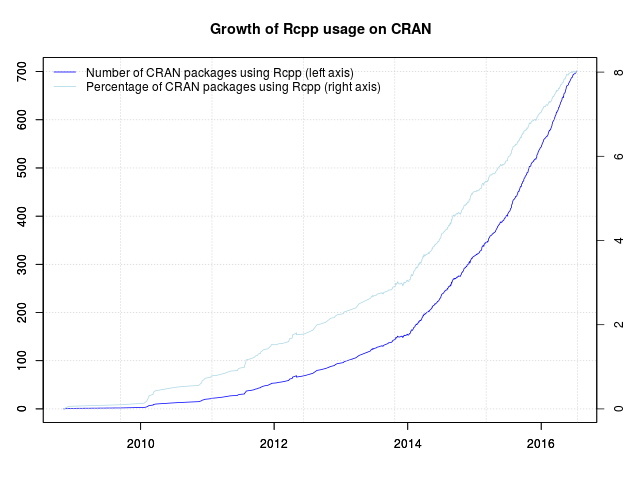
600 Rcpp packages Earlier this morning, Rcpp reached another milestone: 701 packages on CRAN now depend on it (as measured by Depends, Imports and LinkingTo declarations). The graph is on the left depicts the growth of Rcpp usage over time. Rcpp cleared 300 packages in November 2014. It passed 400 packages in June of last year (when I only tweeted about it), 500 packages in late October and 600 packages exactly four months ago in March. The chart extends to the very beginning via manually compiled data from CRANberries and checked with crandb. Then next part uses manually saved entries, and the final and largest part of the data set was generated semi-automatically via a short script appending updates to a small file-based backend. A list of packages using Rcpp is kept on this page. Also displayed in the graph is the relative proportion of CRAN packages using Rcpp. The four per-cent hurdle was cleared just before useR! 2014 where I showed a similar graph (as two distinct graphs) in my invited talk. We passed five percent in December of 2014, six percent last July, seven percent just before Christmas and now criss-crosses 8 eight percent, or a little less than one in twelve R packages. 700 user packages is a really large and humbling number. This places quite some responsibility on us in the Rcpp team as we continue to try our best try to keep Rcpp as performant and reliable as it has been. So with that a very big Thank You! to all users and contributors of Rcpp for help, suggestions, bug reports, documentation or, of course, code.

This post by Dirk Eddelbuettel originated on his Thinking inside the box blog. Please report excessive re-aggregation in third-party for-profit settings.

8 July 2016

Russell Coker: Nexus 6P and Galaxy S5 Mini

Just over a month ago I ordered a new Nexus 6P [1]. I ve had it for over a month now and it s time to review it and the Samsung Galaxy S5 Mini I also bought. Security The first noteworthy thing about this phone is the fingerprint scanner on the back. The recommended configuration is to use your fingerprint for unlocking the phone which allows a single touch on the scanner to unlock the screen without the need to press any other buttons. To unlock with a pattern or password you need to first press the power button to get the phone s attention. I have been considering registering a fingerprint from my non-dominant hand to reduce the incidence of accidentally unlocking it when carrying it or fiddling with it. The phone won t complete the boot process before being unlocked. This is a good security feature. Android version 6 doesn t assign permissions to apps at install time, they have to be enabled at run time (at least for apps that support Android 6). So you get lots of questions while running apps about what they are permitted to do. Unfortunately there s no allow for the duration of this session option. A new Android feature prevents changing security settings when there is an overlay running . The phone instructs you to disable overlay access for the app in question but that s not necessary. All that is necessary is for the app to stop using the overlay feature. I use the Twilight app [2] to dim the screen and use redder colors at night. When I want to change settings at night I just have to pause that app and there s no need to remove the access from it note that all the web pages and online documentation saying otherwise is wrong. Another new feature is to not require unlocking while at home. This can be a convenience feature but fingerprint unlocking is so easy that it doesn t provide much benefit. The downside of enabling this is that if someone stole your phone they could visit your home to get it unlocked. Also police who didn t have a warrant permitting search of a phone could do so anyway without needing to compel the owner to give up the password. Design This is one of the 2 most attractive phones I ve owned (the other being the sparkly Nexus 4). I think that the general impression of the appearance is positive as there are transparent cases on sale. My phone is white and reminds me of EVE from the movie Wall-E. Cables This phone uses the USB Type-C connector, which isn t news to anyone. What I didn t realise is that full USB-C requires that connector at both ends as it s not permitted to have a data cable with USB-C at the device and and USB-A at the host end. The Nexus 6P ships with a 1M long charging cable that has USB-C at both ends and a ~10cm charging cable with USB-C at one end and type A at the other (for the old batteries and the PCs that don t have USB-C). I bought some 2M long USB-C to USB-A cables for charging my new phone with my old chargers, but I haven t yet got a 1M long cable. Sometimes I need a cable that s longer than 10cm but shorter than 2M. The USB-C cables are all significantly thicker than older USB cables. Part of that would be due to having many more wires but presumably part of it would be due to having thicker power wires for delivering 3A. I haven t measured power draw but it does seem to charge faster than older phones. Overall the process of converting to USB-C is going to be a lot more inconvenient than USB SuperSpeed (which I could basically ignore as non-SuperSpeed connectors worked). It will be good when laptops with USB-C support become common, it should allow thinner laptops with more ports. One problem I initially had with my Samsung Galaxy Note 3 was the Micro-USB SuperSpeed socket on the phone being more fiddly for the Micro-USB charging plug I used. After a while I got used to that but it was still an annoyance. Having a symmetrical plug that can go into the phone either way is a significant convenience. Calendars and Contacts I share most phone contacts with my wife and also have another list that is separate. In the past I had used the Samsung contacts system for the contacts that were specific to my phone and a Google account for contacts that are shared between our phones. Now that I m using a non-Samsung phone I got another Gmail account for the purpose of storing contacts. Fortunately you can get as many Gmail accounts as you want. But it would be nice if Google supported multiple contact lists and multiple calendars on a single account. Samsung Galaxy S5 Mini Shortly after buying the Nexus 6P I decided that I spend enough time in pools and hot tubs that having a waterproof phone would be a good idea. Probably most people wouldn t consider reading email in a hot tub on a cruise ship to be an ideal holiday, but it works for me. The Galaxy S5 Mini seems to be the cheapest new phone that s waterproof. It is small and has a relatively low resolution screen, but it s more than adequate for a device that I ll use for an average of a few hours a week. I don t plan to get a SIM for it, I ll just use Wifi from my main phone. One noteworthy thing is the amount of bloatware on the Samsung. Usually when configuring a new phone I m so excited about fancy new hardware that I don t notice it much. But this time buying the new phone wasn t particularly exciting as I had just bought a phone that s much better. So I had more time to notice all the annoyances of having to download updates to Samsung apps that I ll never use. The Samsung device manager facility has been useful for me in the past and the Samsung contact list was useful for keeping a second address book until I got a Nexus phone. But most of the Samsung apps and 3d party apps aren t useful at all. It s bad enough having to install all the Google core apps. I ve never read mail from my Gmail account on my phone. I use Fetchmail to transfer it to an IMAP folder on my personal mail server and I d rather not have the Gmail app on my Android devices. Having any apps other than the bare minimum seems like a bad idea, more apps in the Android image means larger downloads for an over-the-air update and also more space used in the main partition for updates to apps that you don t use. Not So Exciting In recent times there hasn t been much potential for new features in phones. All phones have enough RAM and screen space for all common apps. While the S5 Mini has a small screen it s not that small, I spent many years with desktop PCs that had a similar resolution. So while the S5 Mini was released a couple of years ago that doesn t matter much for most common use. I wouldn t want it for my main phone but for a secondary phone it s quite good. The Nexus 6P is a very nice phone, but apart from USB-C, the fingerprint reader, and the lack of a stylus there s not much noticeable difference between that and the Samsung Galaxy Note 3 I was using before. I m generally happy with my Nexus 6P, but I think that anyone who chooses to buy a cheaper phone probably isn t going to be missing a lot.

6 July 2016

Mike Gabriel: [Arctica Project] Release of nx-libs (version 3.5.99.0)

Introduction NX is a software suite which implements very efficient compression of the X11 protocol. This increases performance when using X applications over a network, especially a slow one. NX (v3) has been originally developed by NoMachine and has been Free Software ever since. Since NoMachine obsoleted NX (v3) some time back in 2013/2014, the maintenance has been continued by a versatile group of developers. The work on NX (v3) is being continued under the project name "nx-libs". History Until January 2015, nx-libs was more mainly a redistribution approach of the original NX (v3) software. We (we as in mainly a group of X2Go developers) kept changes applied to the original NoMachine sources as minimal as possible. We also kept the original files and folders structure. Patches had been maintained via the quilt utility on top of a Git repository, the patches had always been kept separate. That was the 3.5.0.x series of nx-libs. In January 2015, the characteristics of nx-libs as maintained by the X2Go project between 2011 and 2015 changed. A decision was reached: This effort is now about to be released as "nx-libs 3.6.0.0". Contributors Since 2011, the nx-libs code base has to a great extent been maintained in the context of the X2Go Project [1]. Qindel Group joining in... In 2014, developers from the Qindel Group [2] joined the nx-libs maintenance. They found X2Go's work on nx-libs and suggested joining forces as best as possible on hacking nx-libs. The Arctica Project comming up... Starting in January 2015, the development on the 3.6.x branch of the project was moved into a new project called the Arctica Project [3]. Development Funding by Qindel In September 2015, a funding project was set up at Qindel. Since then, the Qindel group greatly supports the development of nx-libs 3.6.x monetarily and with provided man power. The funding project officially is a cooperation between Qindel and DAS-NETZWERKTEAM (business run by Mike Gabriel, long term maintainer of nx-libs). The funding is split into two subprojects and lasts until August 2017: The current nx-libs development effort is coordinated in the context of the Arctica Project (by Mike Gabriel), with use cases in Arctica, X2Go and TheQVD (VDI product worked on at Qindel) in mind. People involved There are various people involved in nx-libs 3.6.x maintenance and development, some of them shall be explicitly named here (in alphabetical order of surnames): Some other people have contributed, but have left the project already. Thanks for your work on nx-libs: A big thanks to everyone involved!!! Special thanks go to Stefan Baur for employing Mihai Moldovan and handling all the bureaucracy, so that Mihai can work on this project and get funded for his work. Achievements of nx-libs 3.5.99.0 We are very close to our self-defined release goal 3.6.0. The below tasks have already been (+/-) completed for version 3.5.99.0: In a previous blog post [4], the code reduction in nx-libs has already been discussed. With this announcement, we want to give a status update about our effort of shrinking the nx-libs code base:
    [mike@minobo nx-libs (3.6.x)]$ cloc --match-f '.*\.(c cpp h)' .
        1896 text files.
        1896 unique files.                                          
        7430 files ignored.
    http://cloc.sourceforge.net v 1.60  T=5.88 s (307.3 files/s, 143310.5 lines/s)
    -------------------------------------------------------------------------------
    Language                     files          blank        comment           code
    -------------------------------------------------------------------------------
    C                              958          68574          74891         419638
    C/C++ Header                   730          25683          33957         130418
    C++                            120          17007          11721          61292
    -------------------------------------------------------------------------------
    SUM:                          1808         111264         120569         611348
    -------------------------------------------------------------------------------
The previous statistics had these sums in the last line. First the nx-libs 3.5.0.x code tree (where we came from):
    -------------------------------------------------------------------------------
    SUM:                          5614         329279         382337        1757743
    -------------------------------------------------------------------------------
Then the nx-libs 3.6.x status as it was on May 9th 2016:
    -------------------------------------------------------------------------------
    SUM:                          1922         118581         126783         662635
    -------------------------------------------------------------------------------
Another 50.000 lines of code have been removed over the past two months. Work pending for the final 3.6.0 release goal Known Issues There are several open issues on the nx-libs Github project space, see https://github.com/ArcticaProject/nx-libs/issues. Testing the nx-libs 3.5.99.0 We are currently working on provisioning release builds and nightly builds of nx-libs for various recent Linux distributions. Please stay tuned and watch Mike Gabriel's blog [5]. We already have nightly builds of nx-libs for Debian and Ubuntu [6], but there are more to come soon. Until now, please use the build recipes provided in the README.md file of the nx-libs source tree [7]. References

3 July 2016

Reproducible builds folks: Reproducible builds: week 61 in Stretch cycle

What happened in the Reproducible Builds effort between June 19th and June 25th 2016. Media coverage GSoC and Outreachy updates Toolchain fixes Other upstream fixes Emil Velikov searched on IRC for hints on how to guarantee unique values during build to invalidate shader caches in Mesa, when also no VCS information is available. A possible solution is a timestamp, which is unique enough for local builds, but can still be reproducible by allowing it to be overwritten with SOURCE_DATE_EPOCH. Packages fixed The following 9 packages have become reproducible due to changes in their build dependencies: cclib librun-parts-perl llvm-toolchain-snapshot python-crypto python-openid r-bioc-shortread r-bioc-variantannotation ruby-hdfeos5 sqlparse The following packages have become reproducible after being fixed: Some uploads have fixed some reproducibility issues, but not all of them: Patches submitted that have not made their way to the archive yet: Package reviews 139 reviews have been added, 20 have been updated and 21 have been removed in this week. New issues found: 53 FTBFS bugs have been reported by Chris Lamb, Santiago Vila and Mateusz ukasik. diffoscope development Quote of the week "My builds are so reproducible, they fail exactly every second time." Johannes Ziemke (@discordianfish) Misc. This week's edition was written by Chris Lamb (lamby), Reiner Herrmann and Holger Levsen and reviewed by a bunch of Reproducible builds folks on IRC.

2 July 2016

Jonathan Carter: So, that was DebCamp16!

Picture: Adrian Frith

University of Cape Town, host location to DebConf 16. Picture: Adrian Frith

What an amazingly quick week that was Our bid to host DebConf in Cape Town was accepted nearly 15 months ago. And before that, the bid itself was a big collective effort from our team. So it s almost surreal that the first half of the two weeks of DebCamp/DebConf is now over. Things have been going really well. The few problems we ve had so far were too small to even mention. It s a few degrees colder than it usually is this time of the year and there s already snow on the mountains, so Cape Town is currently quite chilly.
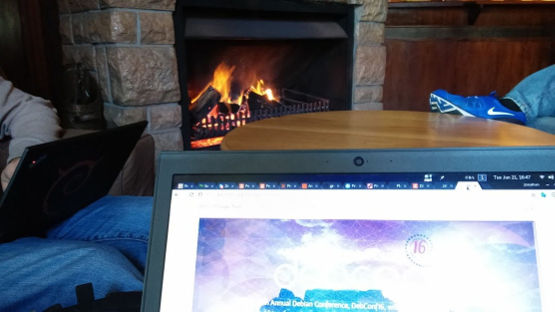
Hacking by the fire at the sports club

Gathering some heat by the fire at the sports club while catching up to the world the day before it all started.

All Kinds of Quality Time I really enjoyed working with the video team last year, but this year there was just 0 time for that. Working on the orga team means dealing with a constant torrent of small tasks, which is good in its own way because you get to deal with a wide variety of Debian people you might not usually get to interact with, but video team problems are more fun and interesting. Next year I hope to do a lot more video work again. If you re at DebConf over the next week, I can highly recommend that you get involved!
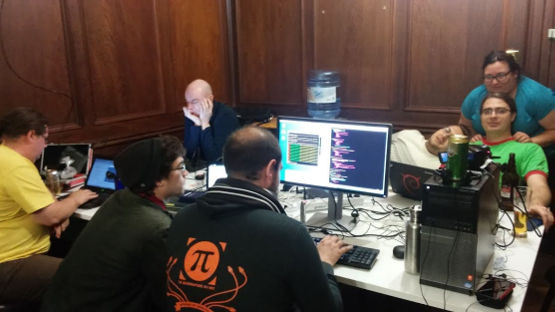
Video team hacking away at problems

Video team members hacking away at problems late at night during DebCamp

The first time I met Debian folk was early in 2004. I worked at the Shuttleworth Foundation as Open Source Technical Co-ordinator at the time, and Mark Shuttleworth had them over for one of the early Ubuntu sprints in Canonical s early days. I was so intimidated by them back then that I could hardly even manage to speak to them. I was already a big free software fan before working there, but little did I even dream to think that I would one day be involved in a project like Ubuntu or Debian. My manager back then encouraged me to go talk to them and get involved and become a Debian Developer and joked that I should become highvoltage@debian.org. I guess that was when the initial seeds got planted and since then I ve met many great people all over the world who have even became friends during UDS, DebConf, BTS and other hackfests where Debianites hang out. It gave me a really nice warm feeling to have all these amazing, talented and really friendly people from all over coming together in this little corner of the world to work together on projects that I think are really important.
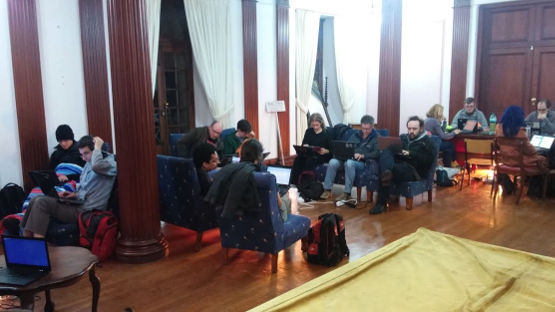
Finding a warm space to work in the Happy Feet hack lab

Finding a warm space to work in the Happy Feet hack lab

Oh the Chicken Back at DebConf12, someone (I don t remember the exact history) brought a rubber chicken to DebConf who was simply called Pollito ( chicken in Spanish). Since then the chicken has grown into somewhat of a mascot for DebConf. Back in 2012 I already imagined that if we would ever host a DebConf, I d make a little of picture book story about Pollito. Last year after DC15, when bringing Pollito over, I created a little story called Pollito s first trip to Africa . I was recovering from flu while putting that together and didn t spend much time on it, but it turned out to be somewhat of a hit. I was surprised to see it in the #debconf topic ever since I posted it :) We gave a tour of the campus on the first and second days and it was quite time consuming and there was no way we could do it every day for the rest of DebCamp, so on the 2nd day I smacked together a new rush job called Pollito s Guide to DC16 . The idea was that newcommers could use it as a visual guide and rely on others who have been there for a while if they get stuck. I wish I had the time to make it a lot nicer, but I think the general idea is good and next year we can have a much nicer one that might not be quite as Pollito focused.
Pollito's Guide to DC16

Pollito s Guide to DC16

Debian Maintainer After all these years, I finally sat down and applied to become a Debian Maintainer, and the application was successful (approved yesterday \o/). Now just for the wait until my key is uploaded to the keyring. I haven t yet had time to properly process this but I think once the DebConf dust settles and I had some time to recover, I will be ecstatic. Some actual DebCampy work Everywhere I go, I see people installing a bunch of GNOME extensions on their Debian GNOME desktops shortly after installation using http://extensions.gnome.org/ (I noticed this even at DebCamp!). A few months ago I thought that it s really about time someone package up some of the really popular ones. So I started to put together some basic packaging for AIMS Desktop around a month ago. During the last few days of DebCamp, things were going well enough with the organisational tasks that I had some time to do some actual packaging work and improve these so that they re ready for upload to the Debian archives. The little DebCamp time I had ended up being my very own little extension fest :) I worked on the following packages which are ready for upload: I worked on the following packages which still need minor work, might be able to get them in uploadable state by the end of DebConf: The actual packaging of GNOME extensions is actually pretty trivial. It s mostly source-only JavaScript with some CSS and translations and maybe some gsettings schemas and dialogs. Or at least, it would be pretty trivial, but many extensions are without licenses, contain embedded code (often JavaScript) from other projects, or have no usable form of upstream tarball, to name a few of the problems. So I ve been contacting the upstream authors of these packages where there have been problems, and for the most part they ve been friendly and pretty quick to address the problems. So that s it, for now. I couldn t possibly sum up the last week and everything that lead up to it in a single blog post. All I can really say is thank you for letting me be a part of this very special project!

30 June 2016

Dirk Eddelbuettel: RMarkdown and Metropolis/Mtheme

Nick Tierney asked on Twitter about rmarkdown and metropolis about whether folks had used RMarkdown-driven LaTeX Beamer presentations. And the answer is a firm hell yeah. I have been using mtheme (and/or a local variant I called 'm2') as well as the newer (renamed) release mtheme for the last year or two for all my RMarkdown-based presentations as you can see from my presentations page. And earlier this year back I cleaned this up and wrote myself local Ubuntu packages which are here on Launchpad. I also have two GitHub repos for the underlying .deb package code: - the pkg-latex-metropolis package for the LaTeX part (which is also in TeXlive in an older version) - the pkg-fonts-fira for the underlying (free) font (and this sadly cannot build on launchpad as it needs a download step). To round things up, I now also created a public 'sample' repo on GitHub. It is complete for all but the custom per-presenteation header.tex that modifies colours, add local definitions etc as needed for each presentation. With that, Happy Canada Day (tomorrow, though) -- never felt better to be part of something Glorious and Free, and also free of Brexit, Drumpf and other nonsense.

29 June 2016

Michal Čihař: PHP shapefile library

Since quite a long time phpMyAdmin had embedded the bfShapeFiles library for import of geospatial data. Over the time we had to apply fixes to it to stay compatible with newer PHP versions, but there was really no development. Unfortunately, as it seems to be only usable PHP library which can read and write ESRI shapefiles. With recent switch of phpMyAdmin to dependency handling using Composer I wondered if we should get rid of the last embedded PHP library, which was this one - bfShapeFiles. As I couldn't find alive library which would work well for us, I resisted that for quite long, until pull request to improve it came in. At that point I've realized that it's probably better to separate it and start to improve it outside our codebase. That's when phpmyadmin/shapefile was started. The code is based on bfShapeFiles, applies all fixes which were used in phpMyAdmin and adds improvements from the pull request. On top of that it has brand new testsuite (the coverage is still much lower than I'd like to have) and while writing the tests several parsing issues have been discovered and fixed. Anyway you can now get the source from GitHub or install using Composer from Packagist. PS: While fixing parser bugs I've looked at other parsers as well to see how they handle some situations unclear in the specs and I had to fix Python pyshp on the way as well :-).

Filed under: Debian English phpMyAdmin 0 comments

22 June 2016

Scarlett Clark: KDE: Debian: *ubuntu snappy: Reproducible builds, Randa! and much more

#Randa2016 KDE Sprint

#Randa2016 KDE Sprint

Debian: I am very late on post due to travel, Flu, jetlag sorry! choqok:
https://bugs.debian.org/cgi-bin/bugreport.cgi?bug=825322
For this I was able to come up with a patch for kconfig_compiler to encode generated files to utf-8.
Review request is here:
https://git.reviewboard.kde.org/r/128102/
This has been approved and I will be pushing it as soon as I patch the qt5 frameworks version.
Both kde4libs and kf5 kconfig has been pushed upstream kde. kxmlgui:
WIP this has been a steep learning curve, according to the notes it was an easy embedded kernel version, that was not the case! After grueling hours of
trying to sort out randomness in debug output I finally narrowed it down to cases where QStringLiteral was used and there were non letter characters eg. ( <") These were causing debug symbols to generate with ( lambda() ) which caused unreproducible symbol/debug files. It is now a case of fixing all of these in the code to use QString::fromUtf8 seems to fix this. I am working on a mega patch for upstream and it should be ready early in the week. This last week I spent a large portion making my through a mega patch for kxmlgui, when it was suggested to me to write a small qt app to test QStringLiteral isolated and sure enough two build were byte for byte identical. So this means that QStringLiteral may not be the issue at all. With some more assistance I am to expand my test app with several QStringLiterals of varying lengths, we have suspicion it is a padding issue, which complicates things.
I am still fighting with this one, will set aside to simmer for now, as I have no idea how to fix padding issues. extra-cmake-modules:
I am testing a patch to fix umask issues for anyone that uses the kapptemplate generation macro. Thank you Simon for pointing me to this.
known affected:
plasma-framework kdevplatform:
The kapptemplate generation users/groups and umask patch has been pushed upstream.
https://bugs.kde.org/show_bug.cgi?id=363615 KDE Randa!:
Despite managing to get a terrible Flu I accomplished more than I would have at home without awesome devs to help me out! CI TODO: Randa as usual was an amazing experience. Yes it is very hard work, but you have the beauty of the Swiss Alps at your fingertips! Not to mention all the
friendly faces and collaboration. A big thank you to all supporters and the Randa team! Please help make KDE better by supporting the very important Randa Sprint:
https://www.kde.org/fundraisers/randameetings2016/ Have a great day.

21 June 2016

Reproducible builds folks: Reproducible builds: week 60 in Stretch cycle

What happened in the Reproducible Builds effort between June 12th and June 18th 2016: Media coverage GSoC and Outreachy updates Weekly reports by our participants: Toolchain fixes With this upload of texlive-bin we decided to stop keeping our patched fork of as most of the patches for SOURCE_DATE_EPOCH support had been integrated upstream already, and the last one (making FORCE_SOURCE_DATE default to 1) had been refused. So, we are now going to let the archive be rebuilt against unstable's texlive-bin and see how many packages will become unreproducible with this change; once enough data will be collected we will ponder whether FORCE_SOURCE_DATE should be exported by helper tools (such as debhelper) or manually exported by every package that needs it. (For those wondering: we still recommend to follow SOURCE_DATE_EPOCH always and don't recommend other projects to implement FORCE_SOURCE_DATE ) With the drop of texlive-bin we now have only three modified packages in our experimental repository. Reproducible work in other projects Packages fixed The following 12 packages have become reproducible due to changes in their build dependencies: django-floppyforms flask-restful hy jets3t kombu llvm-toolchain-3.8 moap python-bottle python-debtcollector python-django-debug-toolbar python-osprofiler stevedore The following packages have become reproducible after being fixed: Some uploads have fixed some reproducibility issues, but not all of them: Uploads with reproducibility fixes that currently fail to build: Patches submitted that have not made their way to the archive yet: Package reviews 36 reviews have been added, 12 have been updated and 31 have been removed in this week. 17 FTBFS bugs have been reported by Chris Lamb, Santiago Vila and Dominic Hargreaves. diffoscope development Satyam worked on argument completion (#826711) for diffoscope. strip-nondeterminism development Mattia Rizzolo uploaded strip-nondeterminism 0.019-1~bpo8+1 to jessie-backports. reprotest development Ceridwen filed an Intent To Package (ITP) bug for reprotest as #827293. tests.reproducible-builds.org Misc. This week's edition was written by Mattia Rizzolo, Reiner Herrmann, Ed Maste and Holger Levsen and reviewed by a bunch of Reproducible builds folks on IRC.

20 June 2016

Simon McVittie: GTK Hackfest 2016

I'm back from the GTK hackfest in Toronto, Canada and mostly recovered from jetlag, so it's time to write up my notes on what we discussed there. Despite the hackfest's title, I was mainly there to talk about non-GUI parts of the stack, and technologies that fit more closely in what could be seen as the freedesktop.org platform than they do in GNOME. In particular, I'm interested in Flatpak as a way to deploy self-contained "apps" in a freedesktop-based, sandboxed runtime environment layered over the Universal Operating System and its many derivatives, with both binary and source compatibility with other GNU/Linux distributions. I'm mainly only writing about discussions I was directly involved in: lots of what sounded like good discussion about the actual graphics toolkit went over my head completely :-) More notes, mostly from Matthias Clasen, are available on the GNOME wiki. In no particular order: Thinking with portals We spent some time discussing Flatpak's portals, mostly on Tuesday. These are the components that expose a subset of desktop functionality as D-Bus services that can be used by contained applications: they are part of the security boundary between a contained app and the rest of the desktop session. Android's intents are a similar concept seen elsewhere. While the portals are primarily designed for Flatpak, there's no real reason why they couldn't be used by other app-containment solutions such as Canonical's Snap. One major topic of discussion was their overall design and layout. Most portals will consist of a UX-independent part in Flatpak itself, together with a UX-specific implementation of any user interaction the portal needs. For example, the portal for file selection has a D-Bus service in Flatpak, which interacts with some UX-specific service that will pop up a standard UX-specific "Open" dialog for GNOME and probably other GTK environments, that dialog is in (a branch of) GTK. A design principle that was reiterated in this discussion is that the UX-independent part should do as much as possible, with the UX-specific part only carrying out the user interactions that need to comply with a particular UX design (in the GTK case, GNOME's design). This minimizes the amount of work that needs to be redone for other desktop or embedded environments, while still ensuring that the other environments can have their chosen UX design. In particular, it's important that, as much as possible, the security- and performance-sensitive work (such as data transport and authentication) is shared between all environments. The aim is for portals to get the user's permission to carry out actions, while keeping it as implicit as possible, avoiding an "are you sure?" step where feasible. For example, if an application asks to open a file, the user's permission is implicitly given by them selecting the file in the file-chooser dialog and pressing OK: if they do not want this application to open a file at all, they can deny permission by cancelling. Similarly, if an application asks to stream webcam data, the UX we expect is for GNOME's Cheese app (or a similar non-GNOME app) to appear, open the webcam to provide a preview window so they can see what they are about to send, but not actually start sending the stream to the requesting app until the user has pressed a "Start" button. When defining the API "contracts" to be provided by applications in that situation, we will need to be clear about whether the provider is expected to obtain confirmation like this: in most cases I would anticipate that it is. One security trade-off here is that we have to have a small amount of trust in the providing app. For example, continuing the example of Cheese as a webcam provider, Cheese could (and perhaps should) be a contained app itself, whether via something like Flatpak, an LSM like AppArmor or both. If Cheese is compromised somehow, then whenever it is running, it would be technically possible for it to open the webcam, stream video and send it to a hostile third-party application. We concluded that this is an acceptable trade-off: each application needs to be trusted with the privileges that it needs to do its job, and we should not put up barriers that are easy to circumvent or otherwise serve no purpose. The main (only?) portal so far is the file chooser, in which the contained application asks the wider system to show an "Open..." dialog, and if the user selects a file, it is returned to the contained application through a FUSE filesystem, the document portal. The reference implementation of the UX for this is in GTK, and is basically a GtkFileChooserDialog. The intention is that other environments such as KDE will substitute their own equivalent. Other planned portals include: Environment variables GNOME on Wayland currently has a problem with environment variables: there are some traditional ways to set environment variables for X11 sessions or login shells using shell script fragments (/etc/X11/Xsession.d, /etc/X11/xinit/xinitrc.d, /etc/profile.d), but these do not apply to Wayland, or to noninteractive login environments like cron and systemd --user. We are also keen to avoid requiring a Turing-complete shell language during session startup, because it's difficult to reason about and potentially rather inefficient. Some uses of environment variables can be dismissed as unnecessary or even unwanted, similar to the statement in Debian Policy 9.9: "A program must not depend on environment variables to get reasonable defaults." However, there are two common situations where environment variables can be necessary for proper OS integration: search-paths like $PATH, $XDG_DATA_DIRS and $PYTHONPATH (particularly necessary for things like Flatpak), and optionally-loaded modules like $GTK_MODULES and $QT_ACCESSIBILITY where a package influences the configuration of another package. There is a stopgap solution in GNOME's gdm display manager, /usr/share/gdm/env.d, but this is gdm-specific and insufficiently expressive to provide the functionality needed by Flatpak: "set XDG_DATA_DIRS to its specified default value if unset, then add a couple of extra paths". pam_env comes closer PAM is run at every transition from "no user logged in" to "user can execute arbitrary code as themselves" but it doesn't support .d fragments, which are required if we want distribution packages to be able to extend search paths. pam_env also turns off per-user configuration by default, citing security concerns. I'll write more about this when I have a concrete proposal for how to solve it. I think the best solution is probably a PAM module similar to pam_env but supporting .d directories, either by modifying pam_env directly or out-of-tree, combined with clarifying what the security concerns for per-user configuration are and how they can be avoided. Relocatable binary packages On Windows and OS X, various GLib APIs automatically discover where the application binary is located and use search paths relative to that; for example, if C:\myprefix\bin\app.exe is running, GLib might put C:\myprefix\share into the result of g_get_system_data_dirs(), so that the application can ask to load app/data.xml from the data directories and get C:\myprefix\share\app\data.xml. We would like to be able to do the same on Linux, for example so that the apps in a Flatpak or Snap package can be constructed from RPM or dpkg packages without needing to be recompiled for a different --prefix, and so that other third-party software packages like the games on Steam and gog.com can easily locate their own resources. Relatedly, there are currently no well-defined semantics for what happens when a .desktop file or a D-Bus .service file has Exec=./bin/foo. The meaning of Exec=foo is well-defined (it searches $PATH) and the meaning of Exec=/opt/whatever/bin/foo is obvious. When this came up in D-Bus previously, my assertion was that the meaning should be the same as in .desktop files, whatever that is. We agreed to propose that the meaning of a non-absolute path in a .desktop or .service file should be interpreted relative to the directory where the .desktop or .service file was found: for example, if /opt/whatever/share/applications/foo.desktop says Exec=../../bin/foo, then /opt/whatever/bin/foo would be the right thing to execute. While preparing a mail to the freedesktop and D-Bus mailing lists proposing this, I found that I had proposed the same thing almost 2 years ago... this time I hope I can actually make it happen! Flatpak and OSTree bug fixing On the way to the hackfest, and while the discussion moved to topics that I didn't have useful input on, I spent some time fixing up the Debian packaging for Flatpak and its dependencies. In particular, I did my first upload as a co-maintainer of bubblewrap, uploaded ostree to unstable (with the known limitation that the grub, dracut and systemd integration is missing for now since I haven't been able to test it yet), got most of the way through packaging Flatpak 0.6.5 (which I'll upload soon), cherry-picked the right patches to make ostree compile on Debian 8 in an effort to make backports trivial, and spent some time disentangling a flatpak test failure which was breaking the Debian package's installed-tests. I'm still looking into ostree test failures on little-endian MIPS, which I was able to reproduce on a Debian porterbox just before the end of the hackfest. OSTree + Debian I also had some useful conversations with developers from Endless, who recently opened up a version of their OSTree build scripts for public access. Hopefully that information brings me a bit closer to being able to publish a walkthrough for how to deploy a simple Debian derivative using OSTree (help with that is very welcome of course!). GTK life-cycle and versioning The life-cycle of GTK releases has already been mentioned here and elsewhere, and there are some interesting responses in the comments on my earlier blog post. It's important to note that what we discussed at the hackfest is only a proposal: a hackfest discussion between a subset of the GTK maintainers and a small number of other GTK users (I am in the latter category) doesn't, and shouldn't, set policy for all of GTK or for all of GNOME. I believe the intention is that the GTK maintainers will discuss the proposals further at GUADEC, and make a decision after that. As I said before, I hope that being more realistic about API and ABI guarantees can avoid GTK going too far towards either of the possible extremes: either becoming unable to advance because it's too constrained by compatibility, or breaking applications because it isn't constrained enough. The current situation, where it is meant to be compatible within the GTK 3 branch but in practice applications still sometimes break, doesn't seem ideal for anyone, and I hope we can do better in future. Acknowledgements Thanks to everyone involved, particularly:

Daniel Pocock: WebRTC and communications projects in GSoC 2016

This year a significant number of students are working on RTC-related projects as part of Google Summer of Code, under the umbrella of the Debian Project. You may have already encountered some of them blogging on Planet or participating in mailing lists and IRC. WebRTC plugins for popular CMS and web frameworks There are already a range of pseudo-WebRTC plugins available for CMS and blogging platforms like WordPress, unfortunately, many of them are either not releasing all their source code, locking users into their own servers or requiring the users to download potentially untrustworthy browser plugins (also without any source code) to use them. Mesut is making plugins for genuinely free WebRTC with open standards like SIP. He has recently created the WPCall plugin for WordPress, based on the highly successful DruCall plugin for WebRTC in Drupal. Keerthana has started creating a similar plugin for MediaWiki. What is great about these plugins is that they don't require any browser plugins and they work with any server-side SIP infrastructure that you choose. Whether you are routing calls into a call center or simply using them on a personal blog, they are quick and convenient to install. Hopefully they will be made available as packages, like the DruCall packages for Debian and Ubuntu, enabling even faster installation with all dependencies. Would you like to try running these plugins yourself and provide feedback to the students? Would you like to help deploy them for online communities using Drupal, WordPress or MediaWiki to power their web sites? Please come and discuss them with us in the Free-RTC mailing list. You can read more about how to run your own SIP proxy for WebRTC in the RTC Quick Start Guide. Finding all the phone numbers and ham radio callsigns in old emails Do you have phone numbers and other contact details such as ham radio callsigns in old emails? Would you like a quick way to data-mine your inbox to find them and help migrate them to your address book? Jaminy is working on Python scripts to do just that. Her project takes some inspiration from the Telify plugin for Firefox, which detects phone numbers in web pages and converts them to hyperlinks for click-to-dial. The popular libphonenumber from Google, used to format numbers on Android phones, is being used to help normalize any numbers found. If you would like to test the code against your own mailbox and address book, please make contact in the #debian-data channel on IRC. A truly peer-to-peer alternative to SIP, XMPP and WebRTC The team at Savoir Faire Linux has been busy building the Ring softphone, a truly peer-to-peer solution based on the OpenDHT distribution hash table technology. Several students (Simon, Olivier, Nicolas and Alok) are actively collaborating on this project, some of them have been fortunate enough to participate at SFL's offices in Montreal, Canada. These GSoC projects have also provided a great opportunity to raise Debian's profile in Montreal ahead of DebConf17 next year. Linux Desktop Telepathy framework and reSIProcate Another group of students, Mateus, Udit and Balram have been busy working on C++ projects involving the Telepathy framework and the reSIProcate SIP stack. Telepathy is the framework behind popular softphones such as GNOME Empathy that are installed by default on the GNU/Linux desktop. I previously wrote about starting a new SIP-based connection manager for Telepathy based on reSIProcate. Using reSIProcate means more comprehensive support for all the features of SIP, better NAT traversal, IPv6 support, NAPTR support and TLS support. The combined impact of all these features is much greater connectivity and much greater convenience. The students are extending that work, completing the buddy list functionality, improving error handling and looking at interaction with XMPP. Streamlining provisioning of SIP accounts Currently there is some manual effort for each user to take the SIP account settings from their Internet Telephony Service Provider (ITSP) and transpose these into the account settings required by their softphone. Pranav has been working to close that gap, creating a JAR that can be embedded in Java softphones such as Jitsi, Lumicall and CSipSimple to automate as much of the provisioning process as possible. ITSPs are encouraged to test this client against their services and will be able to add details specific to their service through Github pull requests. The project also hopes to provide streamlined provisioning mechanisms for privately operated SIP PBXes, such as the Asterisk and FreeSWITCH servers used in small businesses. Improving SIP support in Apache Camel and the Jitsi softphone Apache Camel's SIP component and the widely known Jitsi softphone both use the JAIN SIP library for Java. Nik has been looking at issues faced by SIP users in both projects, adding support for the MESSAGE method in camel-sip and looking at why users sometimes see multiple password prompts for SIP accounts in Jitsi. If you are trying either of these projects, you are very welcome to come and discuss them on the mailing lists, Camel users and Jitsi users. GSoC students at DebConf16 and DebConf17 and other events Many of us have been lucky to meet GSoC students attending DebConf, FOSDEM and other events in the past. From this year, Google now expects the students to complete GSoC before they become eligible for any travel assistance. Some of the students will still be at DebConf16 next month, assisted by the regular travel budget and the diversity funding initiative. Nik and Mesut were already able to travel to Vienna for the recent MiniDebConf / LinuxWochen.at As mentioned earlier, several of the students and the mentors at Savoir Faire Linux are based in Montreal, Canada, the destination for DebConf17 next year and it is great to see the momentum already building for an event that promises to be very big. Explore the world of Free Real-Time Communications (RTC) If you are interesting in knowing more about the Free RTC topic, you may find the following resources helpful: RTC mentoring team 2016 We have been very fortunate to build a large team of mentors around the RTC-themed projects for 2016. Many of them are first time GSoC mentors and/or new to the Debian community. Some have successfully completed GSoC as students in the past. Each of them brings unique experience and leadership in their domain. Helping GSoC projects in 2016 and beyond Not everybody wants to commit to being a dedicated mentor for a GSoC student. In fact, there are many ways to help without being a mentor and many benefits of doing so. Simply looking out for potential applicants for future rounds of GSoC and referring them to the debian-outreach mailing list or an existing mentor helps ensure we can identify talented students early and design projects around their capabilities and interests. Testing the projects on an ad-hoc basis, greeting the students at DebConf and reading over the student wikis to find out where they are and introduce them to other developers in their area are all possible ways to help the projects succeed and foster long term engagement. Google gives Debian a USD $500 grant for each student who completes a project successfully this year. If all 2016 students pass, that is over $10,000 to support Debian's mission.

17 June 2016

Shirish Agarwal: Medical awareness, terrorism, racism and Debconf

Hi to all the souls on planet.debian.org:) . I hope to meet many of you in Debconf16 which is being held at UCT (University of Cape Town), Rhondenbosch, South Africa and am excited to be part of it. I pushed a blog post about my journey to debconf till date. I express my sympathy and condolences to all the people who died in the cowardly shooting spree done by a madman in Orlando . I have been upset about this development but as what s done is done, it s best to just keep moving. Closer to my own reality, I was shocked to discover during my whole visa experience that nowhere there is any knowledge about vaccinations that people should have when they are traveling internationally. I was kinda rudely awakened by this mail which prompted me to take Hep A shot and also start a thread on the mailing list. The more comprehensive info. I got was at the CDC site . It seems to be a go-to site to find about what is recommended. While I will not be taking any shots now as it s nearing to the date of travel, if I had known before, it would have been a valuable resource in itself. Definitely something to be bookmarked if you are going overseas and are worried or have health concerns. On another note, About few days back, there was a discussion as recently, travel advisories have been issued about possible terror action in South Africa by various embassies due to the holy month of Ramadan.
And the recent attack just proves that it takes just one twisted personality with a perverse sense of justice or whatever s/he/ thinks as just to do what s/he did and guns and more security and not the answer.
My take on it some would describe as simplistic, there are things which you can control, there are things beyond your control. No security agency, no country can guarantee it. By being either home or away, you can t wish you will not get bitten. Got images of Final Destination invoked when I was sharing that, for as an Indian, do believe a bit on fate and karma. Also, me being single also plays a part, perhaps I would have been more cautious or have different motivations if I had a family so I do understand some of the concerns which have been raised by people in that thread. At the end of it, it really is a non-choice in my book. If you don t take part due to fear,uncertainty of a possible attack, you have already given in to fear and uncertainty and I believe this goes against the very philosophy of what Debian stands for, being bold, taking chances and having trust in your fellow men. If we haven t allowed proprietary, commercial software to win over us, how can we allow less than 0.1% radically motivated people to scare us ? And the recent attack just proves that it takes just one twisted personality with a perverse sense of justice or whatever s/he/ thinks as just to do what s/he did. More guns and more security are certainly not the answer here. A more troubling part is not terrorism but caste-ism and racism which have been also making news (not in a good way) in India. Now while I cannot claim to have any knowledge about Africans apart from 2-3 conversations which didn t go anywhere, two-three preconceived notions about them can easily be countered. As far as drugs are concerned, IF some Africans are doing drugs smuggling, it would be wrong to pin all of it onto them. India has been fighting drugs smuggling from the 70 s itself. From what we know and have learnt over the years from consuming media, India shares porous borders with almost all our neighbors. Of those, Pakistan is supposed to be the largest grower and supplier and then Nepal where young boys are used as Traffickers. The recent film Rocky Handsome and the recent upcoming controversial movie Udta Punjab are trying to explore these issues. As far as drinking in open is concerned, I have seen and been part of Punjabi parties where both men and women drink without abandon in farm parties. Russians, Germans and Israelis can also out-drink a person on their day/mood. As far as sexuality is concerned, we are the second most populous country in the world, so the less said the better:) . I believe though that underneath this racism is money, greed, phobia, language barriers and just maybe some lifestyle choices as well. I have seen North-Eastern, Chinese, Buddhist people being colored with the same brush. The more interesting case is with the Buddhist as can be seen in Himachal Pradesh, where locals feel they are deprived as Europeans come and indulge Buddhists for their monasteries and their way of life while locals don t get much money from them. This is partly true, but also due to our own short-comings in dealing with westerners. I have never seen my own countrymen going out of their way to make westerners or any tourists for that matter feel welcome in a genuine way. More often, the behavior is between hostility, jealousy and a perverted sense of hero-worship due to the color of skin. As far as being racist and bigoted are concerned, it seems we are not alone, just day before came across this news from Malaysia which is interesting in the sense that how people from different communities frame their own history and people around them, forget that is false and misleading to what we in India know to be the truth, it probably is/would be interesting for somebody who does comparative history, myth and folklore analysis. I was actually planning to talk about some of the talks I am looking forward to hearing and seeing on Debconf but guess that will have to wait for few more days. Hope to publish one more before actually flying to Debconf. Till later.
Filed under: Miscellenous Tagged: #Debconf16, #racism, #terrorism, #vaccinations

15 June 2016

Reproducible builds folks: Reproducible builds: week 59 in Stretch cycle

What happened in the Reproducible Builds effort between June 5th and June 11th 2016: Media coverage Ed Maste gave a talk at BSDCan 2016 on reproducible builds (slides, video). GSoC and Outreachy updates Weekly reports by our participants: Documentation update - Ximin Luo proposed a modification to our SOURCE_DATE_EPOCH spec explaining FORCE_SOURCE_DATE. Some upstream build tools (e.g. TeX, see below) have expressed a desire to control which cases of embedded timestamps should obey SOURCE_DATE_EPOCH. They were not convinced by our arguments on why this is a bad idea, so we agreed on an environment variable FORCE_SOURCE_DATE for them to implement their desired behaviour - named generically, so that at least we can set it centrally. For more details, see the text just linked. However, we strongly urge most build tools not to use this, and instead obey SOURCE_DATE_EPOCH unconditionally in all cases. Toolchain fixes Packages fixed The following 16 packages have become reproducible due to changes in their build-dependencies: apertium-dan-nor apertium-swe-nor asterisk-prompt-fr-armelle blktrace canl-c code-saturne coinor-symphony dsc-statistics frobby libphp-jpgraph paje.app proxycheck pybit spip tircd xbs The following 5 packages are new in Debian and appear to be reproducible so far: golang-github-bowery-prompt golang-github-pkg-errors golang-gopkg-dancannon-gorethink.v2 libtask-kensho-perl sspace The following packages had older versions which were reproducible, and their latest versions are now reproducible again after being fixed: The following packages have become reproducible after being fixed: Some uploads have fixed some reproducibility issues, but not all of them: Patches submitted that have not made their way to the archive yet: Package reviews 68 reviews have been added, 19 have been updated and 28 have been removed in this week. New and updated issues: 26 FTBFS bugs have been reported by Chris Lamb, 1 by Santiago Vila and 1 by Sascha Steinbiss. diffoscope development strip-nondeterminism development disorderfs development tests.reproducible-builds.org Misc. Steven Chamberlain submitted a patch to FreeBSD's makefs to allow reproducible builds of the kfreebsd installer. Ed Maste committed a patch to FreeBSD's binutils to enable determinstic archives by default in GNU ar. Helmut Grohne experimented with cross+native reproductions of dash with some success, using rebootstrap. This week's edition was written by Ximin Luo, Chris Lamb, Holger Levsen, Mattia Rizzolo and reviewed by a bunch of Reproducible builds folks on IRC.

Russ Allbery: Review: Matter

Review: Matter, by Iain M. Banks
Publisher: Orbit
Copyright: February 2008
ISBN: 0-316-00536-3
Format: Hardcover
Pages: 593
Sursamen is an Arithmetic, Mottled, Disputed, Multiply Inhabited, Multi-million Year Safe, and Godded Shellworld. It's a constructed world with multiple inhabitable levels, each lit by thermonuclear "suns" on tracks, each level supported above the last by giant pillars. Before the recorded history of the current Involved Species, a culture called the Veil created the shellworlds with still-obscure technology for some unknown purpose, and then disappeared. Now, they're inhabited by various transplants and watched over by a hierarchy of mentor and client species. In the case of Sursamen, both the Aultridia and the Oct claim jurisdiction (hence "Disputed"), and are forced into an uneasy truce by the Nariscene, a more sophisticated species that oversees them both. On Sursamen, on level eight to be precise, are the Sarl, a culture with an early industrial level of technology in the middle of a war of conquest to unite their level (and, they hope, the next level down). Their mentors are the Oct, who claim descendance from the mysterious Veil. The Deldeyn, the next level down, are mentored by the Aultridia, a species that evolved from a parasite on Xinthian Tensile Aranothaurs. Since a Xinthian, treated by the Sarl as a god, lives in the heart of Sursamen (hence "Godded"), tensions between the Sarl and the Aultridians run understandably high. The ruler of the Sarl had three sons and a daughter. The oldest was killed by the people he is conquering as Matter starts. The middle son is a womanizer and a fop who, as the book opens, watches a betrayal that he's entirely unprepared to deal with. The youngest is a thoughtful, bookish youth pressed into a position that he also is not well-prepared for. His daughter left the Sarl, and Sursamen itself, fifteen years previously. Now, she's a Special Circumstances agent for the Culture. Matter is the eighth Culture novel, although (like most of the series) there's little need to read the books in any particular order. The introduction to the Culture here is a bit scanty, so you'll have more background and understanding if you've read the previous novels, but it doesn't matter a great deal for the story. Sharp differences in technology levels have turned up in previous Culture novels (although the most notable example is a minor spoiler), but this is the first Culture novel I recall where those technological differences were given a structure. Usually, Culture novels have Special Circumstances meddling in, from their perspective, "inferior" cultures. But Sursamen is not in Culture space or directly the Culture's business. The Involved Species that governs Sursamen space is the Morthanveld: an aquatic species roughly on a technology level with the Culture themselves. The Nariscene are their client species; the Oct and Aultridia are, in turn, client species (well, mostly) of the Nariscene, while meddling with the Sarl and Deldeyn. That part of this book reminded me of Brin's Uplift universe. Banks's Involved Species aren't the obnoxious tyrants of Brin's universe, and mentoring doesn't involve the slavery of the Uplift universe. But some of the politics are a bit similar. And, as with Uplift, all the characters are aware, at least vaguely, of the larger shape of galactic politics. Even the Sarl, who themselves have no more than early industrial technology. When Ferbin flees the betrayal to try to get help, he ascends out of the shellworld to try to get assistance from an Involved species, or perhaps his sister (which turns out to be the same thing). Banks spends some time here, mostly through Ferbin and his servant (who is one of the better characters in this book), trying to imagine what it would be like to live in a society that just invented railroads while being aware of interstellar powers that can do practically anything. The plot, like the world on which it's set, proceeds on multiple levels. There is court intrigue within the Sarl, war on their level and the level below, and Ferbin's search for support and then justice. But the Sarl live in an artifact with some very mysterious places, including the best set piece in the book: an enormous waterfall that's gradually uncovering a lost city on the level below the Sarl, and an archaeological dig that proceeds under the Deldeyn and Sarl alike. Djan Seriy decides to return home when she learns of events in Sarl, originally for reasons of family loyalty and obligation, but she's a bit more in touch with the broader affairs of the galaxy, including the fact that the Oct are acting very strangely. There's something much greater at stake on Sursamen than tedious infighting between non-Involved cultures. As always with Banks, the set pieces and world building are amazing, the scenery is jaw-dropping, and I have some trouble warming to the characters. Dramatic flights across tower-studded landscapes seeking access to forbidden world-spanning towers largely, but don't entirely, make up for not caring about most of the characters for most of the book. This did change, though: although I never particularly warmed to Ferbin, I started to like his younger brother, and I really liked his sister and his servant by the end of the book. Unfortunately, the end of Matter is, if not awful, at least exceedingly abrupt. As is typical of Banks, we get a lot of sense of wonder but not much actual explanation, and the denouement is essentially nonexistent. (There is a coy epilogue hiding after the appendices, but it mostly annoyed me and provides only material for extrapolation about the characters.) Another SF author would have written a book about the Xinthian, the Veil, the purpose of the shellworlds, and the deep history of the galaxy. I should have known going in that Banks isn't that sort of SF author, but it was still frustrating. Still, Banks is an excellent writer and this is a meaty, complex, enjoyable story with some amazing moments of wonder and awe. If you like Culture novels in general, you will like this. If you like set-piece-heavy SF on a grand scale, such as Alastair Reynolds or Kim Stanley Robinson, you probably like this. Recommended. Rating: 8 out of 10

Next.

Previous.