Sylvain Beucler: Practical basics of reproducible builds
As GNU FreeDink upstream, I'd very much like to offer pre-built binaries: one (1) official, tested, current, distro-agnostic version of the game with its dependencies.
I'm actually already doing that for the Windows version.
One issue though: people have to trust me -- and my computer's integrity.
Reproducible builds could address that.
My release process is tightly controlled, but is my project reproducible? If not, what do I need? Let's check! I quickly see that documentation is getting better, namely https://reproducible-builds.org/ :)
(The first docs I read on reproducibility looked more like a crazed date-o-phobic rant than actual solution - plus now we have SOURCE_DATE_EPOCH implemented in gcc ;)) However I was left unsatisfied by the very high-level viewpoint and the lack of concrete examples.
The document points to various issues but is very vague about what tools are impacted. So let's do some tests!
Let's start with a trivial program:
OK, first does GCC compile this reproducibly?
I'm not sure because I heard of randomness in identifiers and such in the compilation process...
Cool, ELF compiler output is stable through time!
Now do 2 versions of GCC compile a hello world identically?
Well let's not get our hopes too high ;)
Trivial build options change?
OK, let's be very careful with build options then.
What about 2 different build paths?
Basic compilation is stable across directories.
Now I tried recompiling identically FreeDink on 2 different git clones.
Disappointment:
Hmm, what about stripped versions?
OK, what's happening? diffoscope to the rescue:
What on earth is Build ID and how it is computed?
After much digging, I find it's a 2008 plan with application in selecting matching detached debugging symbols.
https://fedoraproject.org/wiki/RolandMcGrath/BuildID is the most detailed overview/rationale I found.
It is supposed to be computed from parts of the binary. It's actually pretty resistant to changes, e.g. I could add the missing "return 0;" in my hello source and get the exact same Build ID!
On the other hand my FreeDink binaries do match except for the Build ID so there must be a catch. Let's try our basic example with default ./configure CFLAGS:
Bummer. So the build ID must be computed also from the debug symbols, even if I strip them afterwards :(
OK, so when https://reproducible-builds.org/docs/build-path/ says "Some tools will record the path of the source files in their output", that means the compiler, and more importantly the stripped executable. Conclusion: apparently to achieve reproducible builds I need identical full build paths and to keep track of them. What about Windows/MinGW btw?
PE compiler output is not stable through time.
(any clue?) OK, there's still a long road ahead of us...
There are lots of other questions.
Is autoconf output reproducible?
Does it actually matter if autoconf is reproducible if upstream is providing a pre-generated ./configure?
If not what about all the documentation on making tarballs reproducible, along with the strip-nondeterminism tool?
Where do we draw the line between build and build environment?
What are the legal issues of distributing a docker-based build environment without every single matching distro source packages? That was my modest contribution to practical reproducible builds documentation for developers, I'd very much like to hear about more of it.
Who knows, maybe in the near future we'll get reproducible official builds for Eclipse, ZAP, JetBrains, Krita, Android SDK/NDK...
I'm actually already doing that for the Windows version.
One issue though: people have to trust me -- and my computer's integrity.
Reproducible builds could address that.
My release process is tightly controlled, but is my project reproducible? If not, what do I need? Let's check! I quickly see that documentation is getting better, namely https://reproducible-builds.org/ :)
(The first docs I read on reproducibility looked more like a crazed date-o-phobic rant than actual solution - plus now we have SOURCE_DATE_EPOCH implemented in gcc ;)) However I was left unsatisfied by the very high-level viewpoint and the lack of concrete examples.
The document points to various issues but is very vague about what tools are impacted. So let's do some tests!
Let's start with a trivial program:
$ cat > hello.c
#include <stdio.h>
int main(void)
    printf("Hello, world!\n");
I'm not sure because I heard of randomness in identifiers and such in the compilation process...
$ gcc-5 hello.c -o hello-5
$ md5sum hello-5
a00416d7392442321bad4afc5a461321  hello-5
$ gcc-5 hello.c -o hello-5
$ md5sum hello-5
a00416d7392442321bad4afc5a461321  hello-5
Now do 2 versions of GCC compile a hello world identically?
$ gcc-6 hello.c -o hello-6
$ md5sum hello-6
f7f52c2f5f82fe2a95061a771a6c5acd  hello-6
$ hexcompare hello-5 hello-6
[lots of red]
...
Trivial build options change?
$ gcc-6 hello.c -lc -o hello-6
$ gcc-6 -lc hello.c -o hello-6b
$ md5sum hello-6 hello-6b
f7f52c2f5f82fe2a95061a771a6c5acd  hello-6
f73ee6d8c3789fd8f899f5762025420e  hello-6b
$ hexcompare hello-6 hello-6b
[lots of red]
...
$ cd ..
$ cp -a repro/ repro2/
$ cd repro2/
$ gcc-6 hello.c -o hello-6
$ md5sum hello-6
f7f52c2f5f82fe2a95061a771a6c5acd  hello-6
Now I tried recompiling identically FreeDink on 2 different git clones.
Disappointment:
$ md5sum freedink/native/src/freedink freedink2/native/src/freedink
839ccd9180c72343e23e5d9e2e65e237  freedink/native/src/freedink
6d5dc6aab321fab01b424ac44c568dcf  freedink2/native/src/freedink
$ hexcompare freedink2/native/src/freedink freedink/native/src/freedink
[lots of red]
$ strip freedink/native/src/freedink freedink2/native/src/freedink
$ md5sum freedink/native/src/freedink freedink2/native/src/freedink
415e96bb54456f3f2a759f404f18c711  freedink/native/src/freedink
e0702d798807c83d21f728106c9261ad  freedink2/native/src/freedink
$ hexcompare freedink/native/src/freedink freedink2/native/src/freedink
[1 single red spot]
$ diffoscope freedink/native/src/freedink freedink2/native/src/freedink
--- freedink/native/src/freedink
+++ freedink2/native/src/freedink
  readelf --wide --notes
  @@ -3,8 +3,8 @@
     Owner                 Data size  Description
     GNU                  0x00000010  NT_GNU_ABI_TAG (ABI version tag)
       OS: Linux, ABI: 2.6.32

   Displaying notes found in: .note.gnu.build-id
     Owner                 Data size  Description
     GNU                  0x00000014  NT_GNU_BUILD_ID (unique build ID bitstring)
  -    Build ID: a689574d69072bb64b28ffb82547e126284713fa
  +    Build ID: d7be191a61e84648a58c18e9c108b3f3ce500302
After much digging, I find it's a 2008 plan with application in selecting matching detached debugging symbols.
https://fedoraproject.org/wiki/RolandMcGrath/BuildID is the most detailed overview/rationale I found.
It is supposed to be computed from parts of the binary. It's actually pretty resistant to changes, e.g. I could add the missing "return 0;" in my hello source and get the exact same Build ID!
On the other hand my FreeDink binaries do match except for the Build ID so there must be a catch. Let's try our basic example with default ./configure CFLAGS:
$ (cd repro/ && gcc -g -O2 hello.c -o hello)
$ (cd repro/ && gcc -g -O2 hello.c -o hello-b)
$ md5sum repro/hello repro/hello-b
6b2cd79947d7c5ed2e505ddfce167116  repro/hello
6b2cd79947d7c5ed2e505ddfce167116  repro/hello-b
# => OK for now
$ (cd repro2/ && gcc -g -O2 hello.c -o hello)
$ md5sum repro2/hello
20b4d09d94de5840400be05bc76e4172  repro2/hello
$ strip repro/hello repro2/hello
$ diffoscope repro/hello repro2/hello
--- repro/hello
+++ repro2/hello2
  readelf --wide --notes
  @@ -3,8 +3,8 @@
     Owner                 Data size  Description
     GNU                  0x00000010  NT_GNU_ABI_TAG (ABI version tag)
       OS: Linux, ABI: 2.6.32

   Displaying notes found in: .note.gnu.build-id
     Owner                 Data size  Description
     GNU                  0x00000014  NT_GNU_BUILD_ID (unique build ID bitstring)
  -    Build ID: 462a3c613537bb57f20bd3ccbe6b7f6d2bdc72ba
  +    Build ID: b4b448cf93e7b541ad995075d2b688ef296bd88b
# => issue reproduced with -g -O2 and different build directories
$ (cd repro/ && gcc -O2 hello.c -o hello)
$ (cd repro2/ && gcc -O2 hello.c -o hello)
$ md5sum repro/hello repro2/hello
1571d45eb5807f7a074210be17caa87b  repro/hello
1571d45eb5807f7a074210be17caa87b  repro2/hello
# => culprit is not -O2, so culprit is -g
OK, so when https://reproducible-builds.org/docs/build-path/ says "Some tools will record the path of the source files in their output", that means the compiler, and more importantly the stripped executable. Conclusion: apparently to achieve reproducible builds I need identical full build paths and to keep track of them. What about Windows/MinGW btw?
$ /opt/mxe/usr/bin/i686-w64-mingw32.static-gcc hello.c -o hello.exe
$ md5sum hello.exe
e0fa685f6866029b8e03f9f2837dc263  hello.exe
$ /opt/mxe/usr/bin/i686-w64-mingw32.static-gcc hello.c -o hello.exe
$ md5sum hello.exe
df7566c0ac93ea4a0b53f4af83d7fbc9  hello.exe
$ /opt/mxe/usr/bin/i686-w64-mingw32.static-gcc hello.c -o hello.exe
$ md5sum hello.exe
bbf4ab22cbe2df1ddc21d6203e506eb5  hello.exe
(any clue?) OK, there's still a long road ahead of us...
There are lots of other questions.
Is autoconf output reproducible?
Does it actually matter if autoconf is reproducible if upstream is providing a pre-generated ./configure?
If not what about all the documentation on making tarballs reproducible, along with the strip-nondeterminism tool?
Where do we draw the line between build and build environment?
What are the legal issues of distributing a docker-based build environment without every single matching distro source packages? That was my modest contribution to practical reproducible builds documentation for developers, I'd very much like to hear about more of it.
Who knows, maybe in the near future we'll get reproducible official builds for Eclipse, ZAP, JetBrains, Krita, Android SDK/NDK...
 At the
 Today I ended reading an interesting article by the 4th spanish ISP
regarding IPv6 and
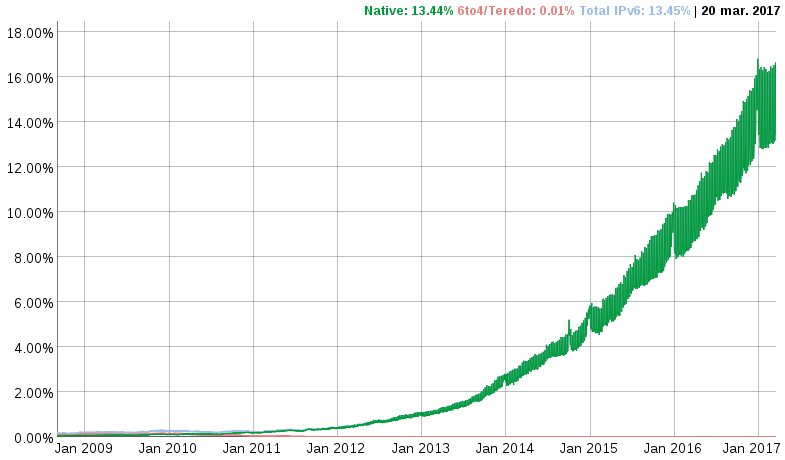 Others ISP operators are giving IPv6 strong precedence over IPv4, that s the case
of Verizon in USA:
 DebConf17 will take place in Montreal, Canada in August 2017. We are working hard
to provide fuel for hearts and minds, to make this conference once again a
fertile soil for the Debian Project flourishing. Please join us and support
this landmark in the Free Software calendar.
Eighteen companies have already committed to sponsor DebConf17! With a warm
welcome, we'd like to introduce them to you.
Our first Platinum sponsor is

 Like
 During last week I've noticed several interesting posts about challenges being free software maintainer. After being active in open source for 16 years I can share much of the feelings I've read and I can also share my dealings with the things.
First of all let me link some of the other posts on the topic:
 I ve been playing in a 5e campaign for around two months now. In the
past ten days or so I ve been reading various source books and
Internet threads regarding the design of 5th edition. I d like to
draw some comparisons and contrasts between 5th edition, and the 3rd
edition family of games (DnD 3.5e and Paizo s Pathfinder, which may be
thought of as 3.75e).
The first thing I d like to discuss is that wizards and clerics are no
longer

 For people who are visually differently-abled, the above reads
To learn who rules over you, simply find out who you are not allowed to criticize Voltaire wrote this either in late 16th century or early 17th century and those words were as apt in those times, as it is in these turbulent times as well.
Update 05/03 According to @bla these words are attributable to a neo-nazi and apparently a child abuser. While I don t know the context in which it was shared, it describes the environment in which we are perfectly. Please see his comment for a link and better understanding.
The below topic requires a bit of maturity, so if you are easily offended, feel free not to read further.
While this week-end I was supposed to share about the recent Science Day celebrations that we did last week
 Would explore it probably next week.
This week the attempt is to share thoughts which had been simmering at the back of my mind for more than 2 weeks or more and whose answers are not clear to me.
My buttons were pressed when Martin f. Kraft
 From the little sharings and interactions I have been part of, I find people take offence at the most innocuous things. For instance, one of the easy routes of not offending anyone is to use self-deprecating humour (or so I thought) either of my race, caste, class or even my issues with weight and each of the above would offend somebody. Charlie Chaplin didn t have those problems. If somebody is from my caste, I m portraying the caste in a certain light, a certain slant. If I m talking about weight issues, then anybody who is like me (fat) feels that the world is laughing at them rather than at me or they will be discriminated against. While I find the last point a bit valid, it leaves with me no tools and no humour. I neither have the observational powers or the skills that


 The first step is to download a Replicant 6.0 image, currently they are available from
 Welcome to gambaru.de. Here is my monthly report that covers what I have been doing for Debian. If you re interested in Java, Games and LTS topics, this might be interesting for you.
We have reached the end of Stretch s development cycle, a phase called
 I woke this morning to