Russ Allbery: Review: A Song for a New Day
| Publisher: | Berkley |
| Copyright: | September 2019 |
| ISBN: | 1-9848-0259-3 |
| Format: | Kindle |
| Pages: | 372 |
| Publisher: | Berkley |
| Copyright: | September 2019 |
| ISBN: | 1-9848-0259-3 |
| Format: | Kindle |
| Pages: | 372 |
credmp who wrote
packages, sent patches, and got name dropping from other
developers. My experience is just struggling to keep up with
everything, in general, but also in Emacs.
lsp-mode. The
main reason for choosing it over eglot is that it's in Debian (and
eglot is not). (Apparently, eglot has more chance of being
upstreamed, "when it's done", but I guess I'll cross that bridge
when I get there.) lsp-mode feels slower than elpy but I
haven't done any of the performance tuning and this will
improve even more with native compilation (see below).
I already had lsp-mode partially setup in Emacs so I only had to
do this small tweak to switch and change the prefix key
(because s-l or mod is used by my window
manager). I also had to pin LSP packages to bookworm here and
here..emacs hacks that is constantly
changing. Because a lot is in third-party packages, there are often
many different options and it's hard to tell which one we should be
using.
top(1)
regardless of how you look at it. It's using 97MB of resident memory
and close to 400MB of virtual memory, which does sound like an awful
lot compared to my first computer... But it's absolutely nothing
compared to things like Signal-desktop, which somehow manages to
map a whopping 20.5GB virtual memory. (That's twenty Gigabytes of
memory for old timers or time travelers from the past, and yes, that
is now a thing.) I'm not exactly sure how much resident memory it uses
(because it forks multiple processes), probably somewhere around 300MB
of resident memory. Firefox also uses gigabytes of that good stuff,
also spread around the multiple processes, per tab.
Emacs "feels" super fast. Typing latency is noticeably better in Emacs
than my web browser, and even beats most terminal
emulators. It gets a little
worse when font-locking is enabled, unfortunately, but it's still
feels much better.
And all my old stuff still works in Emacs, amazingly. (Good luck with
your old Netscape or ICQ configuration from 2000.)
I feel like an oldie, using Emacs, but I'm really happy to see younger
people using it, and learning it, and especially improving it. If
anything, one direction I would like to see it go is closer to what
web browsers are doing (yes, I know how bad that sounds) and get
better isolation between tasks.
An attack on my email client shouldn't be able to edit my Puppet code,
and/or all files on my system, for example. And I know, fundamentally,
that's a really hard challenge in Emacs. But if you're going to treat
your editor as your operating system (or vice versa, I lost track of
where we are now that there's an Emacs Window Manager, which I do
not use), at least we should get that kind of security.
Otherwise I'll have to find a new mail client, and that's really
something I try to limit to once a decade or so.
I'm happy to announce the Debian Clojure Team will hold a remote sprint from
May 13th to May 14th 2022.
The goal of this sprint is to improve various aspects of the Clojure ecosystem
in Debian. As such, everyone is welcome to participate!
Here are a few items we are planning to work on, in no particular order:
leiningen to the latest upstream version, to let some libraries in
experimental migrate to unstable.clj clojure-cli.clojure to the latest upstream version.puppetlabs-*
libraries.
So, LibrePlanet, the FSF s conference, is coming!
I much enjoyed attending this conference in person in March 2018. This
year I submitted a talk again, and it got accepted of course, given
the conference is still 100% online, I doubt I will be able to go 100%
conference-mode (I hope to catch a couple of other talks, but well,
we are all eager to go back to how things were before 2020!)
Many free projects use OpenPGP encryption or signatures for various important tasks, like defining membership, authenticating participation, asserting identity over a vote, etc. The Web-of-Trust upon which its operation is based is a model many of us hold dear, allowing for a decentralized way to assign trust to the identity of a given person. But both the Web-of-Trust model and the software that serves as a basis for the above mentioned uses are at risk due to attacks on the key distribution protocol (not on the software itself!) With this talk, I will try to bring awareness to this situation, to some possible mitigations, and present some proposals to allow for the decentralized model to continue to thrive towards the future.I am on the third semester of my PhD, trying to somehow keep a decentralized infrastructure for the OpenPGP Web of Trust viable and usable for the future. While this is still in the early stages of my PhD work (and I still don t have a solution to present), I will talk about what the main problems are and will sketch out the path I intend to develop. What is the relevance? Mainly, I think, that many free software projects use the OpenPGP Web of Trust for their identity definitions Are we anachronistic? Are we using tools unfit for this century? I don t think so. I think we are in time to fix the main sore spots for this great example of a decentralized infrastructure.
An even newer hot-fix release 1.0.8.3 of Rcpp follows the 1.0.8.2 release of a few days ago and got to CRAN this morning. A Debian upload will follow shortly, and Windows and macOS binaries will appear at CRAN in the next few days. This release again breaks with the six-months cycle started with release 1.0.5 in July 2020. When we addressed the CRAN request in 1.0.8.2 we forgot to dial testing down to their desired level (as three-part release numbers do automagically for us, whereas four-part do not). This is now taken care of, along with the hot-fix that was in 1.0.8.2 already.
Rcpp has become the most popular way of enhancing R with C or C++ code. Right now, around 2522 packages on CRAN depend on Rcpp for making analytical code go faster and further, along with 239 in BioConductor.
The full list of details for these two interim releases (and hence all changes accumulated since the last regular release, 1.0.8 in January) follows.
Thanks to my CRANberries, you can also look at a diff to the previous release. Questions, comments etc should go to the rcpp-devel mailing list off the R-Forge page. Bugs reports are welcome at the GitHub issue tracker as well (where one can also search among open or closed issues); questions are also welcome underChanges in Rcpp hotfix release version 1.0.8.3 (2022-03-14)
- Changes in Rcpp API:
- Changes in Rcpp Documentation:
- Changes in Rcpp Deployment:
- Accomodate four digit version numbers in unit test (Dirk)
- Do not run complete test suite to limit test time to CRAN preference (Dirk)
rcpp tag at StackOverflow which also allows searching among the (currently) 2843 previous questions.
If you like this or other open-source work I do, you can sponsor me at GitHub.
This post by Dirk Eddelbuettel originated on his Thinking inside the box blog. Please report excessive re-aggregation in third-party for-profit settings.

A new hot-fix release 1.0.8.2 of Rcpp just got to CRAN. It will also be uploaded to Debian shortly, and Windows and macOS binaries will appear at CRAN in the next few days. This release breaks with the six-months cycle started with release 1.0.5 in July 2020 as CRAN desired an update to silence nags from the newest clang version which turned a little loud over a feature deprecated in C++11 (namely std::unary_function() and std::binary_function()). This was easy to replace with std::function() which we did. The release also contains a minor bugfix relative to 1.0.8 and C++98 builds, and minor correction to one pdf vignette. The release was fully tested by us and CRAN as usual against all reverse dependencies.
Rcpp has become the most popular way of enhancing R with C or C++ code. Right now, around 2519 packages on CRAN depend on Rcpp for making analytical code go faster and further, along with 239 in BioConductor.
The full list of details for this interim release follows.
Thanks to my CRANberries, you can also look at a diff to the previous release. Questions, comments etc should go to the rcpp-devel mailing list off the R-Forge page. Bugs reports are welcome at the GitHub issue tracker as well (where one can also search among open or closed issues); questions are also welcome underChanges in Rcpp hotfix release version 1.0.8.2 (2022-03-10)
- Changes in Rcpp API:
- Changes in Rcpp Documentation:
- Changes in Rcpp Deployment:
- Accomodate four digit version numbers in unit test (Dirk)
rcpp tag at StackOverflow which also allows searching among the (currently) 2843 previous questions.
If you like this or other open-source work I do, you can sponsor me at GitHub.
This post by Dirk Eddelbuettel originated on his Thinking inside the box blog. Please report excessive re-aggregation in third-party for-profit settings.
Leonardo and I are pleased to another update to our nanotime package bringing it to version 0.3.6 which landed on CRAN earlier today.
nanotime relies on the RcppCCTZ package (as well as the RcppDate package for additional C++ operations) and offers efficient high(er) resolution time parsing and formatting up to nanosecond resolution, and the bit64 package for the actual integer64 arithmetic. Initially implemented using the S3 system, it has benefitted greatly from a rigorous refactoring by Leonardo who not only rejigged nanotime internals in S4 but also added new S4 types for periods, intervals and durations.
This release corrects subsetting with %in% operator, integrates it better fit in the mixed S3/S4 setup, fixes a negative period parse, and updates class comparisons to rely on inherits(). The NEWS snippet has the full more details.
Thanks to my CRANberries there is also a diff to the previous version. More details and examples are at the nanotime page; code, issue tickets etc at the GitHub repository and all documentation is provided at the nanotime documentation site. If you like this or other open-source work I do, you can now sponsor me at GitHub.Changes in version 0.3.6 (2022-03-06)
This post by Dirk Eddelbuettel originated on his Thinking inside the box blog. Please report excessive re-aggregation in third-party for-profit settings.
Welcome to the February 2022 report from the Reproducible Builds project. In these reports, we try to round-up the important things we and others have been up to over the past month. As ever, if you are interested in contributing to the project, please visit our Contribute page on our website.
Jiawen Xiong, Yong Shi, Boyuan Chen, Filipe R. Cogo and Zhen Ming Jiang have published a new paper titled Towards Build Verifiability for Java-based Systems (PDF). The abstract of the paper contains the following:
Various efforts towards build verifiability have been made to C/C++-based systems, yet the techniques for Java-based systems are not systematic and are often specific to a particular build tool (eg. Maven). In this study, we present a systematic approach towards build verifiability on Java-based systems.
GitBOM is a flexible scheme to track the source code used to generate build artifacts via Git-like unique identifiers. Although the project has been active for a while, the community around GitBOM has now started running weekly community meetings.
The paper Chris Lamb and Stefano Zacchiroli is now available in the March/April 2022 issue of IEEE Software. Titled Reproducible Builds: Increasing the Integrity of Software Supply Chains (PDF), the abstract of the paper contains the following:
We first define the problem, and then provide insight into the challenges of making real-world software build in a reproducible manner-this is, when every build generates bit-for-bit identical results. Through the experience of the Reproducible Builds project making the Debian Linux distribution reproducible, we also describe the affinity between reproducibility and quality assurance (QA).
In openSUSE, Bernhard M. Wiedemann posted his monthly reproducible builds status report.
SOURCE_DATE_EPOCH specification related to formats that cannot help embedding potentially timezone-specific timestamp. (Full thread index.)
The Yocto Project is pleased to report that it s core metadata (OpenEmbedded-Core) is now reproducible for all recipes (100% coverage) after issues with newer languages such as Golang were resolved. This was announced in their recent Year in Review publication. It is of particular interest for security updates so that systems can have specific components updated but reducing the risk of other unintended changes and making the sections of the system changing very clear for audit.
The project is now also making heavy use of equivalence of build output to determine whether further items in builds need to be rebuilt or whether cached previously built items can be used. As mentioned in the article above, there are now public servers sharing this equivalence information. Reproducibility is key in making this possible and effective to reduce build times/costs/resource usage.
203, 204, 205 and 206 to Debian unstable, as well as made the following changes to the code itself:
file(1)-related regression where Debian .changes files that contained non-ASCII text were not identified as such, therefore resulting in seemingly arbitrary packages not actually comparing the nested files themselves. The non-ASCII parts were typically in the Maintainer or in the changelog text. [ ][ ]binwalk, return False from BinwalkFile.recognizes. [ ]binwalk, don t report that we are missing the Python rpm module! [ ]diffoscope and diffoscope-minimal packages have the same version. [ ]
Vagrant Cascadian wrote to the debian-devel mailing list after noticing that the binutils source package contained unreproducible logs in one of its binary packages. Vagrant expanded the discussion to one about all kinds of build metadata in packages and outlines a number of potential solutions that support reproducible builds and arbitrary metadata.
Vagrant also started a discussion on debian-devel after identifying a large number of packages that embed build paths via RPATH when building with CMake, including a list of packages (grouped by Debian maintainer) affected by this issue. Maintainers were requested to check whether their package still builds correctly when passing the -DCMAKE_BUILD_RPATH_USE_ORIGIN=ON directive.
On our mailing list this month, kpcyrd announced the release of rebuilderd-debian-buildinfo-crawler a tool to parse the Packages.xz Debian package index file, attempts to discover the right .buildinfo file from buildinfos.debian.net and outputs it in a format that can be understood by rebuilderd. The tool, which is available on GitHub, solves a problem regarding correlating Debian version numbers with their builds.
bauen1 provided two patches for debian-cd, the software used to make Debian installer images. This involved passing --invariant and -i deb00001 to mkfs.msdos(8) and avoided embedding timestamps into the gzipped Packages and Translations files. After some discussion, the patches in question were merged and will be included in debian-cd version 3.1.36.
Roland Clobus wrote another in-depth status update about status of live Debian images, summarising the current situation that all major desktops build reproducibly with bullseye, bookworm and sid .
The python3.10 package was uploaded to Debian by doko, fixing an issue where [.pyc files were not reproducible because the elements in frozenset data structures were not ordered reproducibly. This meant that to creating a bit-for-bit reproducible Debian chroot which included .pyc files was not reproducible. As of writing, the only remaining unreproducible parts of a standard chroot is man-db, but Guillem Jover has a patch for update-alternatives which will likely be part of the next release of dpkg.
Elsewhere in Debian, 139 reviews of Debian packages were added, 29 were updated and 17 were removed this month adding to our knowledge about identified issues. A large number of issue types have been updated too, including the addition of captures_kernel_variant, erlang_escript_file, captures_build_path_in_r_rdb_rds_databases, captures_build_path_in_vo_files_generated_by_coq and build_path_in_vo_files_generated_by_coq.
There were quite a few changes to the Reproducible Builds website and documentation this month as well, including:
contributors.sh Bash/shell script into a Python script. [ ][ ][ ]btop (sort-related issue)complexity (date)giac (update the version with upstreamed date patch)htcondor (use CMake timestamp)libint (readdir system call related)libnet (date-related issue)librime-lua (sort filesystem ordering)linux_logo (sort-related issue)micro-editor (date-related issue)openvas-smb (date-related issue)ovmf (sort-related issue)paperjam (date-related issue)python-PyQRCode (date-related issue)quimb (single-CPU build failure)radare2 (Meson date/time-related issue)radare2 (Rework SOURCE_DATE_EPOCH usage to be portable)siproxd (date, with Sebastian Kemper + follow-upxonsh (Address Space Layout Randomisation-related issue)xsnow (date & tar(1)-related issue)zip (toolchain issue related to filesystem ordering)ltsp (forwarded upstream).pcmemtest.hatchling.mpl-sphinx-theme (forwarded upstream)gap-hapcryst.tree-puzzle.jcabi-aspects.paper-icon-theme.wcwidth.xir.xir.ruby-github-markup.ruby-tioga.btop.libadwaita-1.snibbetracker.cctbx.mdnsd.gmerlin.beav.krita.qt6-base.onevpl-intel-gpu.ruby3.0.nix.foma.ruby3.0.
The Reproducible Builds project runs a significant testing framework at tests.reproducible-builds.org, to check packages and other artifacts for reproducibility. This month, the following changes were made:
openwrt.git repository the next day.
useradd warnings when building packages. [ ]armhf architecture nodes to add a hint to where nodes named virt-*. [ ]logrotate and man-db services. [ ]#reproducible-builds on irc.oftc.net.
rb-general@lists.reproducible-builds.org
I bought myself a new keyboard last November, a Logitech G213. True keyboard fans will tell me it s not a real mechanical keyboard, but it was a lot cheaper and met my requirements of having some backlighting and a few media keys (really all I use are the volume control keys). Oh, and being a proper UK layout.
While the G213 isn t fully independent RGB per key it does have a set of zones that can be controlled. Also this has been reverse engineered, so there are tools to do this under Linux. All I really wanted was some basic backlighting to make things a bit nicer in the evenings, but with the ability to control colour I felt I should put it to good use.
As previously mentioned I have a personal desktop / work laptop setup combined with a UGREEN USB 3.0 Sharing Switch Box, so the keyboard is shared between both machines. So I configured up both machines to set the keyboard colour when the USB device is plugged in, and told them to use different colours. Instant visual indication of which machine I m currently typing on!
Running the script on USB detection is easy, a file in /etc/udev/rules.d/. I called it 99-keyboard-colour.rules:
# Change the keyboard colour when we see it
ACTION=="add", SUBSYSTEM=="usb", ATTR idVendor =="046d", ATTR idProduct =="c336", \
RUN+="/usr/local/sbin/g213-set"
g213-set is a simple bit of Python:
#!/usr/bin/python3
import sys
found = False
devnum = 0
while not found:
try:
with open("/sys/class/hidraw/hidraw" + str(devnum) + "/device/uevent") as f:
for line in f:
line = line.rstrip()
if line == 'HID_NAME=Logitech Gaming Keyboard G213':
found = True
except:
break
if not found:
devnum += 1
if not found:
print("Could not find keyboard device")
sys.exit(1)
eventfile = "/dev/hidraw" + str(devnum)
# z r g b
command = [ 0x11, 0xff, 0x0c, 0x3a, 0, 1, 0xff, 0xff, 0x00, 2, 0, 0, 0, 0, 0, 0, 0, 0, 0, 0 ]
with open(eventfile, "wb") as f:
f.write(bytes(command))
debian/changelog at least:
procmail (3.22-1) unstable; urgency=low
* New upstream release, which uses the standard' format for Maildir
filenames and retries on name collision. It also contains some
bug fixes from the 3.23pre snapshot dated 2001-09-13.
* Removed sendmail' from the Recommends field, since we already
have exim' (the default Debian MTA) and mail-transport-agent'.
* Removed suidmanager support. Conflicts: suidmanager (<< 0.50).
* Added support for DEB_BUILD_OPTIONS in the source package.
* README.Maildir: Do not use locking on the example recipe,
since it's wrong to do so in this case.
-- Santiago Vila <sanvila@debian.org> Wed, 21 Nov 2001 09:40:20 +0100
All Debian suites from buster onwards ship the 3.22-26 release,
although the maintainer just pushed a 3.22-27 release to fix a seven
year old null pointer dereference, after this article was drafted.
Procmail is also shipped in all major distributions: Fedora
and its derivatives, Debian derivatives, Gentoo, Arch,
FreeBSD, OpenBSD. We all seem to be ignoring this problem.
The upstream website (http://procmail.org/) has been down since
about 2015, according to Debian bug #805864, with no change
since.
In effect, every distribution is currently maintaining its fork of
this dead program.
Note that, after filing a bug to keep Debian from shipping
procmail in a stable release again, I was told that the
Debian maintainer is apparently in contact with the upstream. And,
surprise! they still plan to release that fabled 3.23 release, which
has been now in "pre-release" for all those twenty years.
In fact, it turns out that 3.23 is considered released already, and
that the procmail author actually pushed a 3.24 release, codenamed
"Two decades of fixes". That amounts to 25 commits since 3.23pre
some of which address serious security issues, but none of which
address fundamental issues with the code base.
root:mail in
Debian. There's no debconf or pre-seed setting that can change
this. There has been two bug reports against the Debian to make this
configurable (298058, 264011), but both were closed to say
that, basically, you should use dpkg-statoverride to change the
permissions on the binary.
So if anything, you should immediately run this command on any host
that you have procmail installed on:
dpkg-statoverride --update --add root root 0755 /usr/bin/procmail
Note that this might break email delivery. It might also not work at
all, thanks to usrmerge. Not sure. Yes, everything is on
fire. This is fine.
In my opinion, even assuming we keep procmail in Debian, that default
should be reversed. It should be up to people installing procmail to
assign it those dangerous permissions, after careful consideration of
the risk involved.
The last maintainer of procmail explicitly advised us (in that null
pointer dereference bug) and other projects (e.g. OpenBSD, in [2])
to stop shipping it, back in 2014. Quote:
Executive summary: delete the procmail port; the code is not safe and should not be used as a basis for any further work.I just read some of the code again this morning, after the original author claimed that procmail was active again. It's still littered with bizarre macros like:
#define bit_set(name,which,value) \
(value?(name[bit_index(which)] =bit_mask(which)):\
(name[bit_index(which)]&=~bit_mask(which)))
... from regexp.c, line 66 (yes, that's a custom regex
engine). Or this one:
#define jj (aleps.au.sopc)
It uses insecure functions like strcpy extensively. malloc()
is thrown around gotos like it's 1984 all over again. (To be fair,
it has been feeling like 1984 a lot lately, but that's another matter
entirely.)
That null pointer deref bug? It's fixed upstream now, in this
commit merged a few hours ago, which I presume might be in response
to my request to remove procmail from Debian.
So while that's nice, this is the just tip of the iceberg. I speculate
that one could easily find an exploitable crash in procmail if only by
running it through a fuzzer. But I don't need to speculate: procmail
had, for years, serious security issues that could possibly lead to
root privilege escalation, remotely exploitable if procmail is (as
it's designed to do) exposed to the network.
Maybe I'm overreacting. Maybe the procmail author will go through the
code base and do a proper rewrite. But I don't think that's what is in
the cards right now. What I expect will happen next is that people
will start fuzzing procmail, throw an uncountable number of bug
reports at it which will get fixed in a trickle while never fixing the
underlying, serious design flaws behind procmail.
procmail(1) itself are typically part of mail
servers. For example, Dovecot has its own LDA which implements
the standard Sieve language (RFC 5228). (Interestingly, Sieve
was published as RFC 3028 in 2001, before procmail was formally
abandoned.)
Courier also has "maildrop" which has its own filtering mechanism,
and there is fdm (2007) which is a fetchmail and procmail
replacement. Update: there's also mailprocessing, which is not
an LDA, but processing an existing folder. It was, however,
specifically designed to replace complex Procmail rules.
But procmail, of course, doesn't just ship procmail; that would just
be too easy. It ships mailstat(1) which we could probably ignore
because it only parses procmail log files. But more importantly, it
also ships:
lockfile(1) - conditional semaphore-file creatorformail(1) - mail (re)formatterlockfile(1) already has a somewhat acceptable replacement in the form of
flock(1), part of util-linux (which is Essential, so installed on
any normal Debian system). It might not be a direct drop-in
replacement, but it should be close enough.
formail(1) is similar: the courier maildrop package ships
reformail(1) which is, presumably, a rewrite of formail. It's
unclear if it's a drop-in replacement, but it should probably possible
to port uses of formail to it easily.
Update: theThe real challenge is, of course, migrating those oldmaildroppackage ships a SUID root binary (two, even). So if you want onlyreformail(1), you might want to disable that with:It would be perhaps better to havedpkg-statoverride --update --add root root 0755 /usr/bin/lockmail.maildrop dpkg-statoverride --update --add root root 0755 /usr/bin/maildropreformail(1)as a separate package, see bug 1006903 for that discussion.
.procmailrc
recipes to Sieve (basically). I added a few examples in the appendix
below. You might notice the Sieve examples are easier to read, which
is a nice added bonus.
procmail
installed everywhere, possibly because userdir-ldap was using
it for lockfile until 2019. I sent a patch to fix that and scrambled
to remove get rid of procmail everywhere. That took about a day.
But many other sites are now in that situation, possibly not imagining
they have this glaring security hole in their infrastructure.
~/.dovecot.sieve.
user+foo@example.com to the folder
foo. You might write something like this in procmail:
MAILDIR=$HOME/Maildir/
DEFAULT=$MAILDIR
LOGFILE=$HOME/.procmail.log
VERBOSE=off
EXTENSION=$1 # Need to rename it - ?? does not like $1 nor 1
:0
* EXTENSION ?? [a-zA-Z0-9]+
.$EXTENSION/
That, in sieve language, would be:
require ["variables", "envelope", "fileinto", "subaddress"];
########################################################################
# wildcard +extension
# https://doc.dovecot.org/configuration_manual/sieve/examples/#plus-addressed-mail-filtering
if envelope :matches :detail "to" "*"
# Save name in $ name in all lowercase
set :lower "name" "$ 1 ";
fileinto "$ name ";
stop;
Subject: line having FreshPorts
in it into the freshports folder, and mails from alternc.org
mailing lists into the alternc folder:
:0
## mailing list freshports
* ^Subject.*FreshPorts.*
.freshports/
:0
## mailing list alternc
* ^List-Post.*mailto:.*@alternc.org.*
.alternc/
Equivalent Sieve:
if header :contains "subject" "FreshPorts"
fileinto "freshports";
elsif header :contains "List-Id" "alternc.org"
fileinto "alternc";
:0
* ^Subject: Cron
* ^From: .*root@
.rapports/
Would look something like this in Sieve:
if header :comparator "i;octet" :contains "Subject" "Cron"
if header :regex :comparator "i;octet" "From" ".*root@"
fileinto "rapports";
Note that this is what the automated converted does (below). It's not
very readable, but it works.
if header :contains "Precedence" "bulk"
fileinto "bulk";
if exists "List-Id"
fileinto "lists";
if anyof (header :contains "from" "example.com",
header :contains ["to", "cc"] "anarcat@example.com")
fileinto "example";
You can even pile up a bunch of options together to have one big rule
with multiple patterns:
if anyof (exists "X-Cron-Env",
header :contains ["subject"] ["security run output",
"monthly run output",
"daily run output",
"weekly run output",
"Debian Package Updates",
"Debian package update",
"daily mail stats",
"Anacron job",
"nagios",
"changes report",
"run output",
"[Systraq]",
"Undelivered mail",
"Postfix SMTP server: errors from",
"backupninja",
"DenyHosts report",
"Debian security status",
"apt-listchanges"
],
header :contains "Auto-Submitted" "auto-generated",
envelope :contains "from" ["nagios@",
"logcheck@",
"root@"])
fileinto "rapports";
localhost and friends
127.0.0.1 is the first address that comes to mind when thinking of the
local machine. localhost is typically aliased to that address (via
/etc/hosts), though that convention is not mandatory. The IPv6 equivalent
is [::1].
127.0.0.1 in octal)127.0.0.1 in hex)127.0.0.1 in decimal)[::1])0.0.0.0
0.0.0.0 is not a routable address, but that's what's used to tell a
service to bind (listen) on all network interfaces. In Chromium, it resolves
to the local machine, just like 127.0.0.1. The IPv6 equivalent is [::].
0.0.0.0 in octal)0.0.0.0 in hex)0.0.0.0 in decimal)[::])A /
AAAA records for them under a domain you control. I've done this under my
personal domain:
127.0.0.1)[::1])0.0.0.0)[::])[::ffff:7f00:1])[::ffff:0000:0000])nameserver 8.8.8.8 in /etc/resolv.conf since you need a DNS server
that will not filter these localhost domains. (For example,
Unbound will do that
if you use private-address: 127.0.0.0/8 in the server config.)chrome://settings/security and disable Always use secure
connections to make sure the OS resolver is used.chrome://flags/#block-insecure-private-network-requests
flag since that security feature
(CORS-RFC1918) is
designed to protect against these kinds of requests.127.0.0.0/8 subnet
Technically, the entire 127.0.0.0/8 subnet can used to refer to the local
machine. However, it's not a reliable way to portscan a machine from a web
browser because it only catches the services that listen on all interfaces
(i.e. 0.0.0.0).
For example, on my machine, if I nmap 127.0.0.1, I get:
PORT STATE SERVICE VERSION
22/tcp open ssh OpenSSH 8.2p1
25/tcp open smtp Postfix smtpd
whereas if I nmap 127.0.1.25, I only get:
PORT STATE SERVICE VERSION
22/tcp open ssh OpenSSH 8.2p1
That's because I've got the following in /etc/postfix/main.cf:
inet_interfaces = loopback-only
which I assume is explicitly binding 127.0.0.1.
Nevertheless, it would be good to get that fixed in
Brave too.
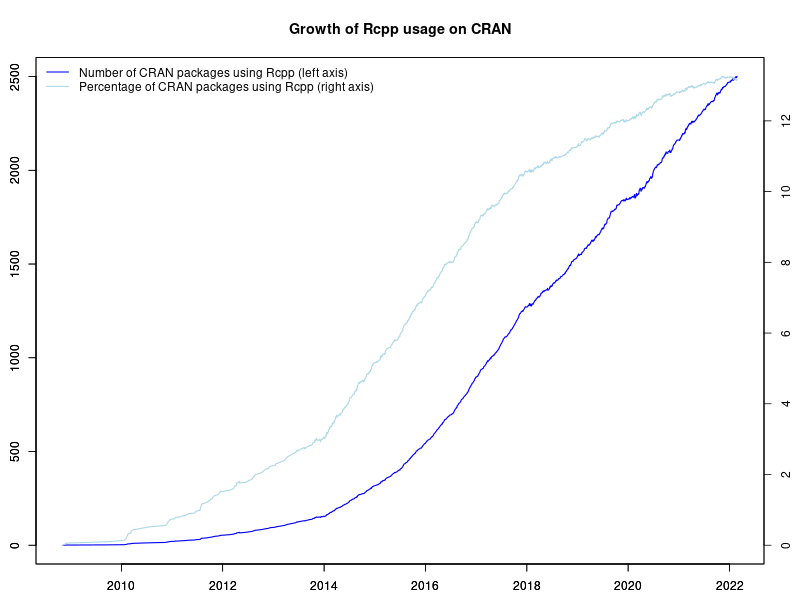
As of this morning, Rcpp stands at 2501 reverse-dependencies on CRAN. The graph on the left depicts the growth of Rcpp usage (as measured by Depends, Imports and LinkingTo, but excluding Suggests) over time.
Rcpp was first released in November 2008. It probably cleared 50 packages around three years later in December 2011, 100 packages in January 2013, 200 packages in April 2014, and 300 packages in November 2014. It passed 400 packages in June 2015 (when I tweeted about it), 500 packages in late October 2015, 600 packages in March 2016, 700 packages in July 2016, 800 packages in October 2016, 900 packages early January 2017, 1000 packages in April 2017, 1250 packages in November 2017, 1500 packages in November 2018, 1750 packages in August 2019, 2000 packages in July 2020, and 2250 package in March of last year. The chart extends to the very beginning via manually compiled data from CRANberries and checked with crandb. The next part uses manually saved entries. The core (and by far largest) part of the data set was generated semi-automatically via a short script appending updates to a small file-based backend. A (manually curated) list of packages using Rcpp is available too.
Also displayed in the graph is the relative proportion of CRAN packages using Rcpp. The four per-cent hurdle was cleared just before useR! 2014 where I showed a similar graph (as two distinct graphs) in my invited talk. We passed five percent in December of 2014, six percent July of 2015, seven percent just before Christmas 2015, eight percent in the summer of 2016, nine percent mid-December 2016, cracked ten percent in the summer of 2017, eleven percent in 2018 and passed 12.5 percent or one in every eight CRAN packages dependens on Rcpp along with the 2000 packages mark. Truly stunning. As before, there is more detail in the chart: how CRAN seems to be pushing back more and removing more aggressively (which my CRANberries tracks but not in as much detail as it could), how the growth of Rcpp seems to be slowing somewhat outright and even more so as a proportion of CRAN as one would expect a growth curve to.
The Rcpp team continues to aim for keeping Rcpp as performant and reliable as it has been (and see e.g. here for some more details). A really big shoutout and Thank You! to all users and contributors of Rcpp for help, suggestions, bug reports, documentation or, of course, code.
If you like this or other open-source work I do, you can now sponsor me at GitHub. For the first year, GitHub will match your contributions.
This post by Dirk Eddelbuettel originated on his Thinking inside the box blog. Please report excessive re-aggregation in third-party for-profit settings.
Welcome to the 36th post of the really randomly reverberating R, or R4 for short, write-ups. Today s post is about using Redis, and especially RcppRedis, for live or (near) real-time monitoring with R.
There is an saying that you can take the boy out of the valley, but you cannot the valley out of the boy so for those of us who spent a decade or two in finance and on trading floors, having some market price information available becomes second nature. And/or sometimes it is just good fun to program this.
A good while back Josh posted a gist on a simple-yet-robust while loop. It (very cleverly) uses his quantmod package to access the SP500 in real-time . (I use quotes here because at the end of retail broadband one is not at the same market action as someone co-located in a New Jersey data center. It is however not delayed: as an index, it is not immediately tradeable as a stock, etf, or derivative may be all of which are only disseminated as delayed price information, usually by ten minutes.) I quite enjoyed the gist and used it and started tinkering with it. For example, it collects data but only saves (i.e. persists ) it after market close. If for whatever reason one needs to restart recent history is gone. In any event, I used his code and generalized it a little and published this about a year ago as function intradayMarketMonitor() in my dang package. (See this blog post announcing it.) The chart of the left shows this in action, the chart is a snapshot from a couple of days ago when the vignettes (more on them below) were written.
As lovely as intradayMarketMonitor() is, it also limits itself to market hours. And sometimes you want to see, say, how the market opens on Sunday (futures usually restart at 17h Chicago time), or how news dissipates during the night, or where markets are pre-open, or . So I both wanted to complement this with futures, and also cache it locally so that, say, one machine might collect data and one (or several others) can visualize. For such tasks, Redis is unparalleled.
(Yet I also always felt Redis could do with another, simple, short and sweet introduction stressing the key features of i) being multi-lingual: write in one language, consume in another and ii) loose coupling: no linking as one talks to Redis via standard tcp/ip networking. So I wrote a new intro vignette that is now in RcppRedis. I hope this comes in handy. Comments welcome!)
Our RcppRedis package had long been used for such tasks, and it was easy to set it up. Standard use is to loop, fetch some data, push it to Redis, sleep, and start over. Clients do the same: fetch most recent data, plot or report it, sleep, start over. That works, but it has a dual delay as the client sleeping may miss the data update!
The standard answer to this is called publish/pubscribe, or pub/sub. Libraries such as 0mq or zeromq specialise in this. But it turns out Redis already has it. I had some initial difficulty adding it to RcppRedis so for a trial I tested the marvellous rredis package by Bryan and simply instantiated two Redis clients. Now the data getter simply publishes a new data point in a given channel, by convention named after the security it tracks. Clients register with the Redis server which does all the actual work of keeping track of who listens to what. The clients now simply listen (which is a blocking operation) and as soon as data comes in receive it.
This is quite mesmerizing when you just run two command-line clients (in a byobu session, say). As sone as the data is written (as shown on console log) it is consumed. No measruable overhead. Just lovely.
Bryan and I then talked a litte as he may or may not retire rredis. Having implemented the pub/sub logic for both sides once, he took a good hard look at RcppRedis and just like that added it there. With some really clever wrinkles for (optional) per-symbol callback as closure attached to the instance. Truly amazeballs And once we had it in there, generalizing from publishing or subscribing to just one symbol easily generalizes to having one listener collect and publish for multiple symbols, and having one or more clients subscribe and listen one, more or even all symbol. All with ease thanks tp Redis. The second chart, also from a few days ago, shows four symbols for four (front-contract) futures for Bitcoin, Crude Oil, SP500, and Gold.
As all this can get a little technical, I wrote a second vignette for RcppRedis on just this: market monitoring. Give this a read, if interested, feedback on this one is most welcome too! But all the code you need is included in the package just run a local Redis instance.
Before closing, one sour note. I uploaded all this in a new and much improved updated RcppRedis 0.2.0 to CRAN on March 13 ten days ago. Not only is it still not there , but CRAN in their most delightful way also refuses to answer any emails of mine. Just lovely. The package exhibited just one compiler warning: a C++ compiler objected to the (embedded) C library hiredis (included as a fallback) for using a C language construct. Yes. A C++ compiler complaining about C. It s a non-issue. Yet it s been ten days and we still have nothing. So irritating and demotivating. Anyway, you can get the package off its GitHub repo.
If you like this or other open-source work I do, you can sponsor me at GitHub.
This post by Dirk Eddelbuettel originated on his Thinking inside the box blog. Please report excessive re-aggregation in third-party for-profit settings.
Next.