Search Results: "tar"

10 July 2008

Joey Hess: rshouldersurfd

Have you ever chewed over a problem a user was having on IRC or mail for hours, trying to narrow it down? And then, finally figured out how to reproduce it locally, and solved the bug in minutes? I hate that. Sometimes getting to the reproduction point can require getting a ssh account on a machine with the problem, with all the pain of dealing with an account, and passwords or keys, and etc. So I was thinking, it would be nice if there were a way you could ask, "Hey, can I type into your console for a few minutes?" All it would take is a program that they can run, that generates a one-time password, that lets you into a screen -x session. So they can see what you're doing, and hit the panic button ("screen -D") if you start typing "rm .." :-) Well, I guess I have a project for this evening. Though many people might be reluctant to install it.

Robert McQueen: GUADEC, Telepathy and a Party on a Boat

For everyone at GUADEC, there’s a boat party sponsored by Collabora this evening. Our sponsorship was confirmed after the program was printed so it’s listed anonymously, but it’s mostly sponsored by Collabora, of course with huge thanks to Baris and his team for the organisation, and local sponsors for food and discounted beer. The boat leaves from Kabatas at 9pm today (Thursday). It’s actually pretty close to the 3rd anniversary of Collabora’s incorporation, so I think we could call this our birthday party. :D I gave my presentation earlier today about using Telepathy to make collaborative applications. My slides are available, as well as the apps I demoed, which are the python VNC demo based on telepathy-python’s examples, Elliot’s Tic Tac Tube game, and Guillaume and Alban’s quick hack to Empathy and Vinagre to share your desktop over a stream tube. I was followed up by Senko’s presentation (slides also available) which had an overview of the libraries and APIs currently available to embed Telepathy functionality in applications on the desktop. The talks were all recorded so hopefully some videos will turn up on-line too. Speaking about collaborative stuff with Telepathy, we’re really keen to hear from the authors of applications like Abiword, Inkscape, Vinagre, Jokosher, Tomboy, Gobby, etc, to find out how we can help you integrate with Telepathy, what features you need before you can get started, or just try and convince you that it’s a good idea. :) If you’re at GUADEC, come and grab one of the Collaborans or drop by on #telepathy on FreeNode and tell us what you’d like to do and how we can help. Yesterday after the talks on Soylent and the People project, Travis and I met up with the guys behind the People project (Ali Sabil and Johann Prieur) and some of the Online Desktop team (Owen Taylor and Marina Zhurakhinskaya). We sketched out a way of plugging together Telepathy, People, Soylent and the Online Desktop to deal a lot better with meta-contacts on the desktop, providing “first-class” people objects. It all looks pretty promising and hopefully we’ll all find some time to make moves towards our vision. This afternoon at 3:30pm, Olivier is also presenting our work on Farsight 2, which is really cool stuff and should include some exciting demos of the multi-person video conferencing stuff we’ve been doing. More generally, GUADEC is awesome. I’m having a great time in Istanbul (despite it being pretty hot for a pale-faced Brit like me), and enjoying the sights and sounds of such an interesting city and culture. I’ve caught up with many of the usual suspects (like Lennart, who never turns down the chance to turn up at a conference and sample the local bars and clubs), and had some great discussions.

Robert Collins: 10 Jul 2008

I keep running into folk whom I knew of, that use bzr, but I did not know that they use bzr. Right now there is a lot of discussion going on about DVCS in various projects. While I imagine most bzr users just want to get on with their coding (after all thats what bzr is good at :))... it would be fantastic if you could blog that you use it, and folk at GUADEC wear the T-shirt! Also, I'm at GUADEC, and I'm extremely happy to answer questions from anyone, bzr user, git user, or even svn user :)

9 July 2008

Obey Arthur Liu: State of the Aptitude (week 7)

New status update! Here’s what Aptitude looks like: aptitude-20080709-9 (more screenshots after the break) I’ve been exploring how the APT libraries work and how to interact with the aptitude back-end and here’s what it can do now: What’s missing: Basic functions of a package manager are already covered. We’re still at the APT API exploration phase although we’re almost done with it. I will soon start working on the final user interface and the real code design. The current code is about 2000 lines of hastily hacked together C++ and XML. I’ll have to restart the coding with a more elaborate Object design. Something that will be easier to work with in the future. The code is on http://dev.graffit.net/aptitude/trac. You can try to compile it and play with it. On the other hand I’m going to scrape most of the code soon for the restart so if you’re bored.. A walkthrough and more screenshots after the break. Here’s a walkthrough of what you can do right now: aptitude-20080709-2 aptitude-20080709-3 aptitude-20080709-4 aptitude-20080709-5 aptitude-20080709-6 aptitude-20080709-7 aptitude-20080709-8 aptitude-20080709-9

8 July 2008

Jonny Lamb: debexpo

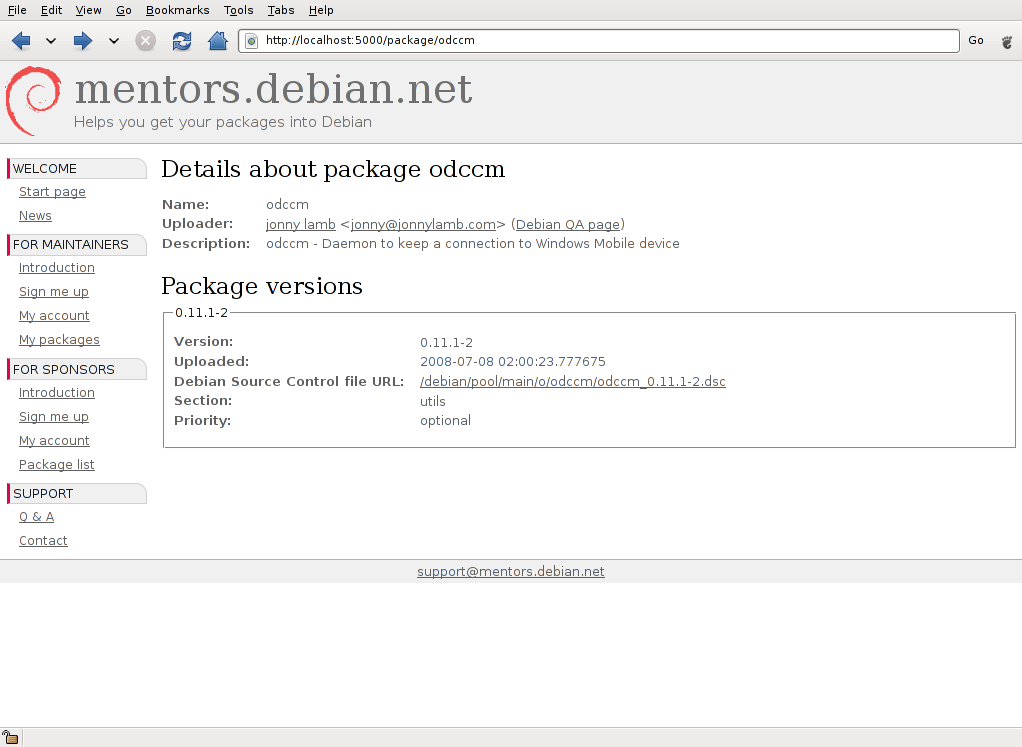
debexpo (Debian package exposition) is a web application that allows one to run a user-friendly public Debian package repository with social interaction that one may be used to from social networking sites. debexpo will be the basis for the mentors.debian.net site but will be useful for others as well. debexpo is the project I am working on for this year’s Summer of Code for Debian under the watch of Christoph Haas debexpo is more than just a web application though. It was based on suggestions by you, and therefore it has some nifty features: Development can be tracked through its Trac instance: http://debexpo.workaround.org/, where I invite you to submit tickets or even submit patches! Its Git repository is public: http://debexpo.workaround.org/debexpo.git (and mirrored here). Last but not least, the there is also a low-traffic mailing list. I invite you to try it out, and report bugs. Posting to the list is a great way to get in contact. There is little visible eye-candy in your browser to show for the work so far as nearly all the work so far has gone into the backend. A sneak peek at what it looks like at the moment is available though: As you can see, the theme is somewhat familiar. Hopefully, as the SoC program nears an end, this will be fixed. Oh, and hello: this is my first post to Planet Debian.

Ingo Juergensmann: Font-Rendering: to file or not to fle!

When I just started to read planet.debian.org today, I realized that Russel Coker was speaking of an unknown tool to print the UUID, but that Debian version doesn't seem to do that.
broken font rendering

It's called fle apparently.
Sadly, an apt-cache showed that there's no package named fle. Then I realized that he was actually speaking of the good old tool called file - with an I between F and L!
Really, I wish the font rendering will improve in Lenny as this was on Etch... sigh

Russell Coker: Label vs UUID vs Device

Someone asked on a mailing list about the issues related to whether to use a label, UUID, or device name for /etc/fstab. The first thing to consider is where the names come from. The UUID is assigned automatically by mkfs or mkswap, so you have to discover it after the filesystem or swap space has been made (or note it during the mkfs/mkswap process). For the ext2/3 filesystems the command “tune2fs -l DEVICE” will display the UUID and label (strangely mke2fs uses the term “label” while the output of tune2fs uses the term “volume name“). For a swap space I don’t know of any tool that can extract the UUID and name. On Debian (Etch and Unstable) the file command does not display the UUID for swap spaces or ext2/3 filesystems and does not display the label for ext2/3 filesystems. After I complete this blog post I will file a bug report. If you are using a version of Debian earlier than Lenny (or a version of Unstable with this bug fixed) then you will be able to easily determine the label and UUID of a filesystem or swap space. Other than that the inconvenience of determining the UUID and label will be a reason for not using them in /etc/fstab (keep in mind that sys-admin work sometimes needs to be done at 3AM). One problem with mounting by UUID or label is that it doesn’t work well with snapshots and block device backups. If you have a live filesystem on /dev/sdc and an image from a backup on /dev/sdd then there is a lot of potential for excitement when mounting by UUID or label. Snapshots can be made by a volume manager (such as LVM), a SAN, or an iSCSI server. Another problem is that if a file-based backup is made (IE tar or cpio) then you lose the UUID and label. tune2fs allows setting the UUID, but that seems like a potential recipe for disaster. So this means that if mounting by UUID then you would potentially need to change /etc/fstab after doing a full filesystem restore from a file-based backup, this is not impossible but might not be what you desire. Setting the label is not difficult, but it may be inconvenient. When using old-style IDE disks the device names were of the form /dev/hda for the first disk on the first controller (cable) and /dev/hdd for the second disk on the second controller. This was quite unambiguous, adding an extra disk was never going to change the naming. With SCSI disks the naming issue has always been more complex, and which device gets the name /dev/sda was determined by the order in which the SCSI HAs were discovered. So if a SCSI HA which had no disks attached suddenly had a disk installed then the naming of all the other disks would change on the next boot! To make things more exciting Fedora 9 is using the same naming scheme for IDE devices as for SCSI devices, I expect that other distributions will follow soon and then even with IDE disks permanent names will not be available. In this situation the use of UUIDs or LABELS is required for the use of partitions. However a common trend is towards using LVM for all storage, in this case LVM manages labels and UUIDs internally (with some excitement if you do a block device backup of an LVM PV). So LV names such as /dev/vg0/root then become persistent and there is no need for mounting via UUID or label. The most difficult problem then becomes the situation where a FC SAN has the ability to create snapshots and make them visible to the same machine. UUID or label based mounting won’t work unless you can change them when creating the snapshot (which is not impossible but is rather difficult when you use a Windows GUI to create snapshots on a FC SAN for use by Linux systems). I have had some interesting challenges with this in the past when using a FC based SAN with Linux blade servers, and I never devised a good solution. When using iSCSI I expect that it would be possible to force an association between SCSI disk naming and names on the server, but I’ve never had time to test it out. Update: I have submitted Debian bug #489865 with a suggested change to the magic database. Below are /etc/magic entries for displaying the UUID and label on swap spaces and ext2/3 filesystems:
The following magic entry will display the UUID of a swap space as well as displaying the label in the same manner as the mkswap program:
# according to man page of mkswap (8) March 1999
# volume label and UUID Russell Coker
# http://etbe.coker.com.au/2008/07/08/label-vs-uuid-vs-device/
4086 string SWAPSPACE2 Linux/i386 swap file (new style),
>0×400 long x version %d (4K pages),
>0×404 long x size %d pages,
>1052 string \0 no label,
>1052 string >\0 LABEL=%s,
>0×40c belong x UUID=%x
>0×410 beshort x \b-%x
>0×412 beshort x \b-%x
>0×414 beshort x \b-%x
>0×416 belong x \b-%x
>0×41a beshort x \b%x The following magic entry will display the UUID and label (AKA volume name) of an ext2/3/4 filesystem:
# ext2/ext3 filesystems - Andreas Dilger <adilger@dilger.ca>
# ext4 filesystem - Eric Sandeen <sandeen@sandeen.net>
# volume label and UUID Russell Coker
# http://etbe.coker.com.au/2008/07/08/label-vs-uuid-vs-device/
0×438 leshort 0xEF53 Linux
>0×44c lelong x rev %d
>0×43e leshort x \b.%d
# No journal? ext2
>0×45c lelong ^0×0000004 ext2 filesystem data
>>0×43a leshort ^0×0000001 (mounted or unclean)
# Has a journal? ext3 or ext4
>0×45c lelong &0×0000004
# and small INCOMPAT?
>>0×460 lelong <0×0000040
# and small RO_COMPAT?
>>>0×464 lelong <0×0000008 ext3 filesystem data
# else large RO_COMPAT?
>>>0×464 lelong >0×0000007 ext4 filesystem data
# else large INCOMPAT?
>>0×460 lelong >0×000003f ext4 filesystem data
>0×468 belong x \b, UUID=%x
>0×46c beshort x \b-%x
>0×46e beshort x \b-%x
>0×470 beshort x \b-%x
>0×472 belong x \b-%x
>0×476 beshort x \b%x
>0×478 string >0 \b, volume name "%s"
# General flags for any ext* fs
>0×460 lelong &0×0000004 (needs journal recovery)
>0×43a leshort &0×0000002 (errors)
# INCOMPAT flags
>0×460 lelong &0×0000001 (compressed)
#>0×460 lelong &0×0000002 (filetype)
#>0×460 lelong &0×0000010 (meta bg)
>0×460 lelong &0×0000040 (extents)
>0×460 lelong &0×0000080 (64bit)
#>0×460 lelong &0×0000100 (mmp)
#>0×460 lelong &0×0000200 (flex bg)
# RO_INCOMPAT flags
#>0×464 lelong &0×0000001 (sparse super)
>0×464 lelong &0×0000002 (large files)
>0×464 lelong &0×0000008 (huge files)
#>0×464 lelong &0×0000010 (gdt checksum)
#>0×464 lelong &0×0000020 (many subdirs)
#>0×463 lelong &0×0000040 (extra isize)

7 July 2008

Steve Kemp: What, you want a cookie?

I made a tarball release of the repository creation tool I mentioned previously, because I got a couple of mails about it. Mostly it seems to be working out OK, to the extent that I've noticed using it at home and work. Anyway there is a tarball available from the rapt site. ObQuote: Hancock

Neil Williams: At LAST!

My first go at getting Emdebian to run a GUI:


Yes, yes, there are no icons and the touchscreen library doesn't work so
the apps can't start (at least via the screen) but it's a start!

Silver USB cable on the left if ethernet-over-usb (which works fine), on the right is a USB key from which the root filesystem, kernel and modules were installed (not needed for subsequent operation but used for debugging by copying log files to the key etc.).

Stats:
Still too large at over 80Mb installed for a full GUI but that is still
100Mb smaller than a minimal Debian system without any GUI stuff.
Available only for ARM
Tested only on Balloon3 : http://balloonboard.org/index.html
Not installing cleanly at this stage - some fettling is required.

192 packages used.
Linux balloon 2.6.25.2-pxa270 #1 Sun May 18 22:38:11 BST 2008 armv5tel
unknown

ii dpkg 1.14.20em1
ii libgpewidget1 0.115-5em1
ii libgtk2.0-0 2.12.3-2em1

Access:
Ethernet over USB (static IP only at the moment)
USB storage / keyboard
Serial connection
SSH pending

Lots to do to make it simple but at least it works.

Bastian Venthur: Segfaults Everywhere

Dear Lazyweb, A few weeks ago rng started to show some segfaulty behavior. I’ve absolutely no idea what’s going on, since Python code usually doesn’t segfault. I guess the problem lies in the qt3-bindings rng uses — does someone know how to verify this? There is a backtrace which seems to show that the problem lies somewhere in /usr/lib/python2.5/site-packages/qt.so but I’m not entirely sure how to interpret that.

Joey Hess: d-i firmware loading

I spent a week recently working on the nonfree firmware problem in debian-installer. The problem of course, is that nasty nonfree firmware is needed to use many wireless cards, some other NICs, and some disk controllers, but cannot be included in d-i images. The fix/workaround landed in unstable today. d-i will detect if a driver needs firmware that is not available. It'll then prompt the user to put the firmware on removable media (such as a USB stick, or floppy, or really anything you can plug into a machine without drawing blood). The debian-cd team will be building some zip files and tarballs containing all the firmware that debian ships in non-free. (images here) Extract one of those onto a USB stick (vfat formatted), and you're good to go. The installer will also tell you the names of the firmware files it needs, so if they're some of the ones that Debian cannot even legally distribute (such as the ipw2200 firmware), you can go hunt them down, and dump them onto your USB stick too. The installer can find firmware files loose on the USB stick, or packaged up in a .deb (or .udeb). The firmware will be used during the installation, and also installed into the finished system. So providing it in .debs is cleanest. (BTW, if you package a firmware deb for debian, please avoid putting anything but firmware and documentation in it. These firmware debs are also installed into the d-i environment now.) This could be considered a little clumsy, needing to manually find the bits and put them on a USB stick. I think that people who install Debian frequently will probably end up gravitating toward the "hd-media" installer that boots from USB stick. The firmware can then be put on the same USB stick that contains the installer, and only one thing be needed to install. Still to do: Use discover's capabilities to scan for firmware that is needed by other devices on the machine, that are not needed to install, but can be used later, and install that firmware too. (This will also support installing non-free kernel modules and other such evil.)

6 July 2008

Russell Coker: Awful Computers for Kids

I have just observed demonstration units of the V-Smile system [1]. They have “educational games” aimed at ages 3-5, 4-7, and some similar ranges. The first thing I noticed was that children who were able to correctly play the games were a lot older than the designated ages. For example 10yo children were playing the Scooby-Doo addition game (supposedly teaching children to add single-digit numbers) and apparently finding the non-addition part of the game challenging (I tried it myself and found catching flying hamburgers while dodging birds to be challenging enough that it was difficult to find numbers). For children who were in the suggested age-range (and a suitable age for learning the basic lessons contained in the games) the only ones who actually managed to achieve the goals were the ones who were heavily directed by their father. So my observation is that the games will either be used by children who are too old for the basic lessons or be entirely directed by parents (I didn’t observe any mother giving the amount of assistance necessary for a 5yo to complete the games but assume that it happens sometimes). I doubt that there are many children who have the coordination needed for a platform game who have not yet learned to recognise printed letters (as supposedly taught in the Winnie the Pooh game). The Thomas the Tank Engine spelling game had a UI that was strange to say the least (using a joystick not to indicate which direction to go but instead to move a cursor between possible tracks) and I doubt that it does any good at teaching letter recognition. There was also a game that involved using a stylus for tracing the outline of a letter, as I had great difficulty in doing this (due to the poor interface and the low resolution of the touch-pad) it seems very unlikely that a young child who is just learning to write letters would gain anything from it. Strangely there was a game that involved using the touch-pad to indicate matching colors. Recognising matching colors is even easier than recognising letters and I don’t think that a child who can’t recognise the colors would be able to manage the touch-pad. The V-Smile system seems to primarily consist of a console designed for connection to a TV but also has hand-held units that take the same cartridges. The same company produces “laptops” which sell for $50 and have a very low resolution screen and only the most basic functionality (and presumably other useless games). Sometimes the old-fashioned methods are best. It seems that crayons are among the best tools for teaching letter recognition and writing. But if there is a desire to use a computer for teaching, then a regular PC or laptop should do. Letter recognition can be taught by reading the text menus needed to launch games. The variety of computer poker games can be used for recognising matching colors and numbers as can the Mahjong series of games. Counting can be taught through the patience games, and the GIMP can be used for teaching computer graphics and general control of the mouse and the GUI. NB I’m not advocating that all education be done on a computer, merely noting the fact that it can be done better with free software on an open platform than on the proprietary systems which are supposedly designed for education. Finally with a PC children can take it apart! I believe that an important part of learning comes from disassembling and re-building toys. While it’s obvious that a PC is not going to compare with a Lego set, I think it’s good for children (and adults) to know that a computer is not a magic box, it’s a machine that they can understand (to a limited extent) and which is comprised of a number of parts that they could also understand if they wanted to learn the details. This idea is advocated by Gever Tulley advocates such disassembly of household items in his TED talk “5 dangerous things you should let your kids do” [2]. Gever runs The Tinkering School [3] which teaches young children how to make and break things. Finally I just checked some auction sites and noticed that I can get reasonably new second-hand laptops for less than $300. A laptop for $250 running Linux should not be much more expensive than a proprietary laptop that starts at $50 once you include the price of all the extra games. For an older laptop (P3) the price is as low as $100 on an auction with an hour to go. Then of course for really cheap laptops you would buy from a company that is getting new machines for their staff. It’s not uncommon for companies to sell old laptops to employees for $50 each. At a recent LUG meeting I gave away a Thinkpad with a 233MHz Pentium-MMX CPU, 96M of RAM, and a 800*600 color display - by most objective criteria such a machine would be much more capable than one of those kids computers (either V-Smile or a competitor). Of course the OLPC [4] is the ideal solution to such problems. It’s a pity that they are not generally available. I have previously written about the planned design for future OLPC machines [5] which makes it a desirable machine for my own personal use.

John Goerzen: Look out Nebraska, Here Comes Jacob!

img_5195.jpg

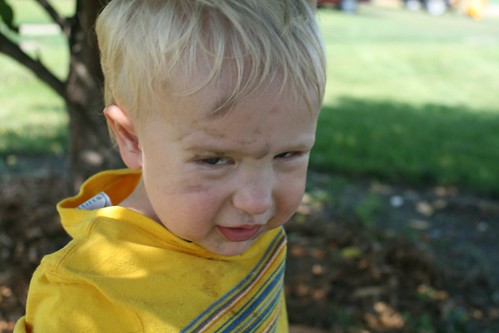
This weekend, the three of us got in the car and drove up to Tekamah, NE for Blogstock 08 at Cliff's. That's Jacob when we were stopped at a park halfway there. Sure looks like he's about to do something ornery, doesn't it? I think he looks even more ornery than the photo of Cliff. That's saying something.

We all really enjoyed Blogstock. Ralph, Cliff, and the rest of the Morrows sure know how to have an event. Ralph said that Cliff's BBQ smoked chicken is the best we'll ever have, and he may just have been right.

I'm going to include a few of my photos in this post; you can see all of my 200+ Blogstock photos on Flickr. (In case anyone else uploads Blogstock photos, you might tag them blogstock08).

Jacob had a blast, and I think he took special pleasure in keeping Terah and me busy. I recall saying something like this, all strung together:

"Jacob, please stop throwing dirt at the cat. That cat doesn't like to have dirt thrown on it. Jacob, stop throwing grass on the cat. Jacob, stop hitting the cat. The cat doesn't like to be hit. Can you pet the cat gently like this? Good job! Jacob, stop sitting on the cat. That hurts the cat. Stop throwing dirt at the cat. Would you like to go play in the corn?"

The Morrow cat was the most tolerant cat I've ever seen, and didn't really seem to mind having a toddler sit on its head. However, we noticed this morning that Jacob's legs mysteriously have some scratches that look very much like cat scratches. We didn't see anything happen, and Jacob didn't come crying to us or anything. I suspect the cat found a way to communicate that it doesn't very much like to have someone sit on it. I also suspect that Jacob understood the message.

img_4996.jpg

As for corn -- Jacob loves corn. He first noticed it within the past week or two, and always gets excited when we drove past some. He calls it "koh!", and particularly tall corn is "koh-koh" or "ah-koh". Cliff has tall corn, and when I first asked Jacob if he wanted to see it, he immediately stopped pestering the cat, yelled "KOOHHHHH!!! KOH KOH KOH KOH!!!" and started running towards it. He started by carefully inspecting the corn from the edge of the field. (I can't help but thinking he looks a bit like is great-grandpa Yoder in this picture.) I can almost hear him saying "yep, this corn looks pretty good" in a couple of years.

img_5051.jpg

The real fun begins when you get into the corn, apparently. With a little bit of holding my hand to balance while walking over the rows of dirt, he'd get between the rows of corn and have a blast. That means mainly picking up a full handful of dirt, running to another random corn plant somewhere, throwing the dirt in the general direction of the corn, and cackling like this was the best thing ever. I had to watch out with the camera, because I didn't really care for it to be hit by dirt, and well, I was in the general direction of corn, too.

img_5062.jpg

And, in case you didn't know, having fun in the corn is serious business.

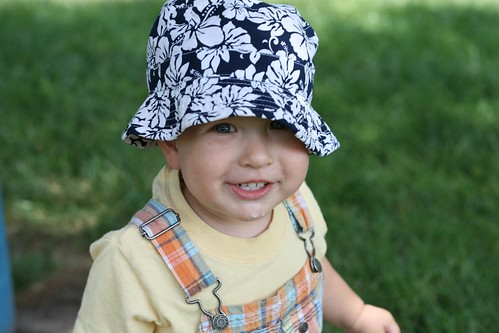
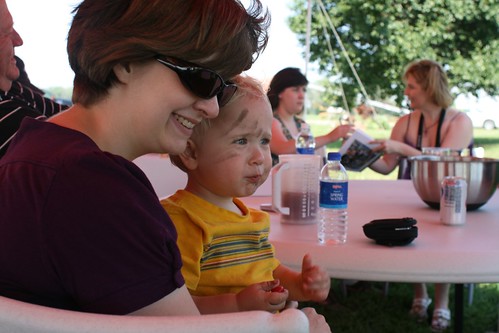
Now, what can a toddler possibly do after playing in the corn, eating some cherries off a tree, and smearing some dirt on his face with cherry juice?
img_5088.jpg

Well, plan his next activity, of course! From the look on his face, it will be another one to keep Terah and me busy.

Jacob seemed to get along really well with everyone. But Ralph said that everytime he came close, Jacob would give him a nasty glare. Here's Ralph holding Jacob. Was this the look, Ralph?
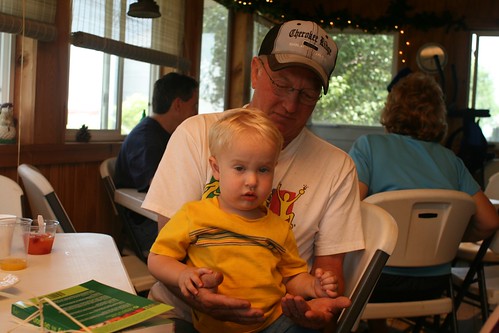
img_5078.jpg

Or maybe it was this:

img_5116.jpg

Friday evening, Cliff and Ralph made up some great hamburgers, hot dogs, and sausages. We all ate under the big tent, and had a nice time visiting. It was sort of an unusual thing -- meeting people you already know for the first time -- but very nice. We left somewhere around 8. Jacob enjoyed the hotel room, too.
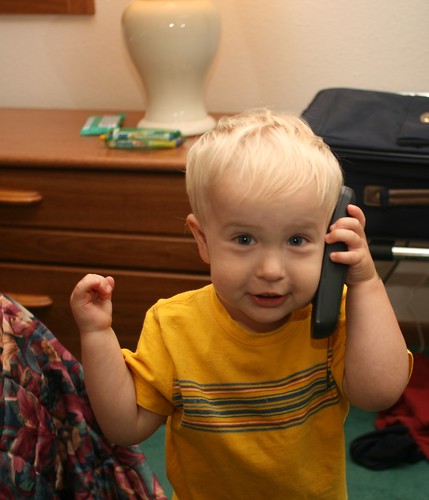
img_5027r.jpg

That's Jacob talking on the telephone. Well, I would normally use it as a TV remote, but to Jacob it looks like a phone, so a phone it is. (I can see his point.) This is Jacob answering the phone by saying Hi! Jacob's word for a phone, by the way, is "hi." He'll find a remote by the TV in the room, point to it, and yell "hi!"

Jacob's usual bedtime is 6:30PM. He normally falls asleep fairly easily and sleeps soundly until 6:30AM. Well, we got him in bed well after 6:30PM. Then he made the discovery that the hotel crib/playpen has a mattress that is not attached to the bottom like our mattresses at home are. This was good for at least an hour of excited playing. As Terah and I were trying to sleep, we'd hear these cackles from Jacob's crib, and the noises of a very active boy. I'd peek around and see him using the mattress as a tent, as a peek-a-boo toy, or just as something to throw. I think he fell asleep at about 11.

And woke up promptly at 6:30 on Saturday, just like clockwork, ready to make some phone calls and start the day.

Now, just a tidbit for anyone that doesn't have kids: a toddler, low on sleep, and endless excitement all combine to make for busy parents. Jacob did pretty well, and got in a good long nap in the afternoon. We did take several trips to the corn field.

For most of us, Saturday was a day for brunch, for sitting around and visiting under the tent, for horse rides, and maybe a massage for those that wanted it. Terah got to ride a horse, and Jacob got to ride a pony, too.

For Jacob, it was a day to make new friends, too.
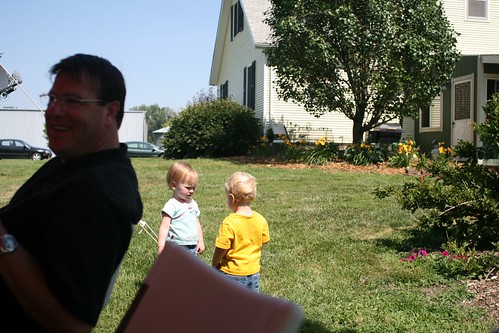
img_5095.jpg

I took this picture just a second after she had given him a hug. I was just a little too slow whipping out the camera.

But when it comes to cherry picking, it's all serious business once again.
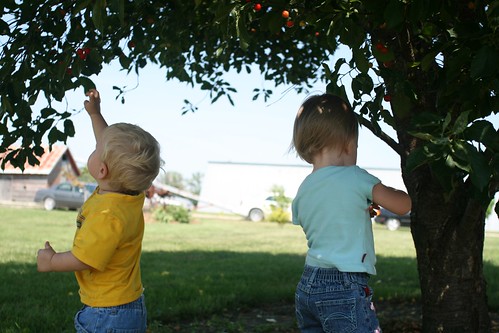
img_5098.jpg

Jacob loved eating these sour cherries. At first, he would pick one cherry off the tree, run over to the tent, give it to Terah for her to get the pit out, eat it, then go back to the tree for another one. He must have decided this was inefficient not long after I did. After a few roundtrips, he started trying to get the closest adult, whoever that might be, to pit the cherry for him. When he found one that would do it, he'd keep bringing cherries back to that person.

And then he was under the tree for a long time. Terah and I noticed, and had a conversation about just how many cherry pits it's OK to swallow. But when I checked it out, I found out that Jacob had figured out how to pit cherries himself. He did lose about half a cherry each time he did it, but I guess that was more efficient than pestering adults to do it for him. Though it may have also worked to carry two cherries to the tent at a time.
img_5123.jpg

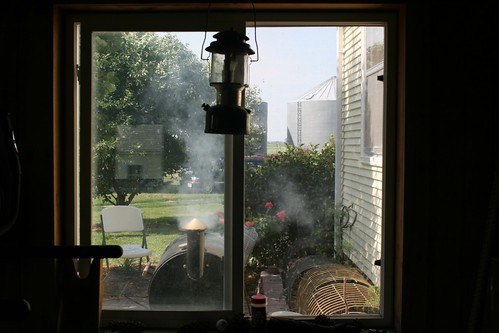
Late in the afternoon, Cliff started up the smoker for the chicken. He had rented a big smoker for the occasion, but it wasn't working, so he made do with his regular smoker, ovens for the corn, and an array of dutch ovens or side grills for everything else. I couldn't keep track of it all, and I was just watching, but somehow it all turned out perfect.
img_5140.jpg

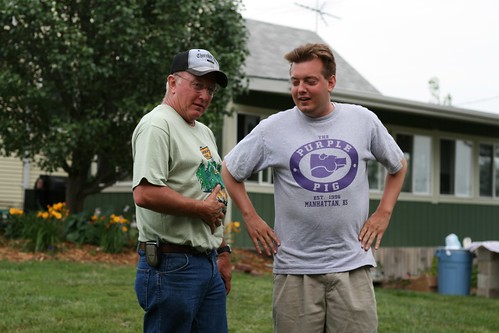
While the chicken was cooking, Ralph and son-of-Ralph (SOR) were having a conversation and patting their bellies. I couldn't hear, and didn't ask questions, so I'm choosing to believe that they were discussing how many pieces of chicken they could eat. When they heard my camera click, Ralph said, "He didn't just take a photo, did he?" Thereby guaranteeing a spot on my blog.

I had the distinction, I think, of being the least-read blogger at Blogstock. I can't quite remember how many times I'd meet someone, and they'd say, "Oh, you're the computer guy, right? I tried reading your blog, but I didn't understand it, sorry!" Completely understandable, I assure you!

After dinner Saturday, we talked about how we got started blogging (hi, Marty and Andy if you're reading), why we were there. Cliff said some very kind things about Terah and me, which really meant a lot.

Later, Cliff told me how Terah showed up in the kitchen with her tray of deviled eggs. Cliff saw them, and said, "Terah, I love you." Later, Cliff said "I love you" to someone else. From the next room, Terah piped up, "What food did she bring?"

Saturday evening, Terah took her horse ride. Jacob was quite tired by that point, and threw a tantrum about not being able to go with mom and ride a horse, too. We were talking about it when Rachel came over. Jacob asked her to pick him up, she did, and he instantly stopped fussing. Maybe it was a "so there" to me, since I had been holding him a minute before, and he took the opportunity to scream in my ear. But in any case, Jacob loved Rachel. She let him sit on a pony, carried him all around the yard, and he managed to hold it together until Terah came back at 9:30.

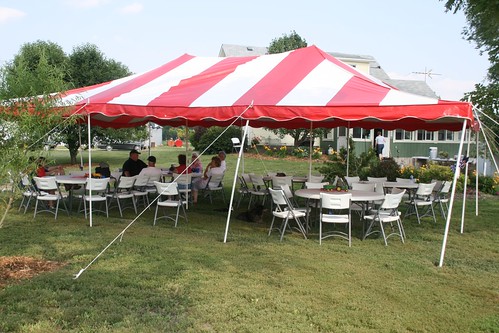
Saturday evening it was time for goodbyes. We all had a blast and I'm sure we'll do this again. If you weren't there, here's what Blogstock looks like:
img_4991.jpg

A bunch of friends sitting around chatting under a tent pretty well sums it up.

(There was a full tent of people; some were just elsewhere when this particular photo was taken.)

Jacob shared his thoughts on the whole trip on the way home, too. Well put, Jacob.

img_5202.jpg

Uwe Hermann: Underhanded C Contest 2008: Leaky Redaction

This year's Underhanded C Contest has been announced. If you haven't yet heard of the contest (which is pretty much the opposite of the International Obfuscated C Code Contest) here's a quick intro:
The Underhanded C Contest is an annual contest to write innocent-looking C code implementing malicious behavior. In this contest you must write C code that is as readable, clear, innocent and straightforward as possible, and yet it must fail to perform at its apparent function. To be more specific, it should do something subtly evil.
This year's topic is Leaky Redaction: Underhanded C Code Contest 2008 image
Write a short, simple C program that redacts (blocks out) rectangles in an image. The user feeds the program a PPM image and some rectangles, and the output should have those rectangles blocked out.
[...]
Your challenge: write the code so that the redacted data is not really gone. Ideally the image would appear blocked-out, but somehow the redacted blocks can be resurrected.
The deadline for submissions is September 30th, 2008. Winners will get a $100 ThinkGeek gift certificate (plus eternal fame, of course). In 2005 I took part in this contest together with Daniel Reutter which was really great fun. See underhanded2005.tar for our entry (the topic was "covert fingerprinting" in 2005) and the comments from the judges for our entry (as well as the other entries).

Bastian Venthur: Tab Completion in Python s Interactive Mode

While browsing the python docs, I accidentally stumbled upon this today. It describes how to get Tab completion in Python’s interactive shell:
  1. Create a ~/.pythonrc file with the following content:
    try:
        import readline
    except ImportError:
        print "Module readline not available."
    else:
        import rlcompleter
        readline.parse_and_bind("tab: complete")
    
  2. Put this somewhere in your ~/.bashrc
    export PYTHONSTARTUP=~/.pythonrc
The .pythonrc will be executed every time the Python interpreter is started but not when it executes a script. How does it look like?
$ python
Python 2.5.2 (r252:60911, Jun 25 2008, 17:58:32)
[GCC 4.3.1] on linux2
Type "help", "copyright", "credits" or "license" for more information.
>>> l = []
>>> l.
l.__add__           l.__getslice__      l.__ne__            l.append
l.__class__         l.__gt__            l.__new__           l.count
l.__contains__      l.__hash__          l.__reduce__        l.extend
l.__delattr__       l.__iadd__          l.__reduce_ex__     l.index
l.__delitem__       l.__imul__          l.__repr__          l.insert
l.__delslice__      l.__init__          l.__reversed__      l.pop
l.__doc__           l.__iter__          l.__rmul__          l.remove
l.__eq__            l.__le__            l.__setattr__       l.reverse
l.__ge__            l.__len__           l.__setitem__       l.sort
l.__getattribute__  l.__lt__            l.__setslice__
l.__getitem__       l.__mul__           l.__str__
>>> l.
Very cool! Why is this hidden so deep in the docs and not enabled by default?

Kartik Mistry: Misc Life Updates


* Personal: - I am almost settled after one month at Ahmedabad and now early looking for new rented house (ie home), 1 or 2BHK. - Kavin got minor electric shock while playing with switch and socket. Fortunately, my wife was holding him and doctor told that there is nothing to worry. He is difficult to handle and long examination of my fatherhood will start soon when they will be here at Ahmedabad. - Work is going great. I have very good team now! * Debian: - Sandro Tosi will be co-maintainer or probably take over sitecopy package from me and will put it under collab-maint repository. Since, I mentioned that I am bit busy with settling down here and it will not be great if such useful package requires time to fix bugs with patches available already. - D-I translation of Level 1 and 2 for Gujarati language are again 100%. Hunting Level 3 now. - I am not still able to install Debian properly on my macbook! Only useful source for this is, http://wiki.debian.org/MacBook Any other pointers/docs will be :)

Clint Adams: Never thought love had a rainbow on it see the girl dance

A sound caught my ear, tickling my consciousness until I was impelled to locate its source. It was not that I wanted any ice cream from the ice cream truck I was sure was the culprit; it was because it sounded suspiciously like it was playing Come Dancing by the Kinks. When I saw that it was a large garbage truck, I was still more bothered by the calliope-like riffs coming from it than the fact that the garbage truck was playing a song. Naturally, I whirled around and goosestepped away. After having dinner with what was probably a contracted companion, I was escorted to a massage parlor. While I was being serviced, I stared at the TV while a news program started. Its theme song was a muzak version of Yanni. Shortly thereafter I made the mistake of getting into a conversation about lavender: the flower, not the color. The musical accompaniment was Elvis Costello. This is not notable. Then, before I was fondled unpleasantly by an 8-year-old with Down's Syndrome, whose mother was entirely unsympathetic to my plight, I encountered a much smaller garbage truck. It was playing F r Elise. What a contrast! I only want to encounter garbage trucks playing classic rock from now on. Come dancing; it's only natural, unless you get molested by a mongoloid.

5 July 2008

Raphael Geissert: debconf8


Just received the ticketing notification, so I can finally post it:


:) Many thanks to the person who decided to sponsor my travel to Argentina, without whom I would would stay at home instead of being at Debconf :cheers:

P.S. travel data can be found via penta.

Steve Kemp: To read makes our speaking English good.

I've setup several repositories for apt-get in the past, usually using reprepro as the backend. Each time I've come up with a different scheme to maintain them. Time to make things consistent with a helper tool:
skx@gold:~/hg/rapt$ ls input/
spambayes-threaded_0.1-1_all.deb        spambayes-threaded_0.1-1.dsc
spambayes-threaded_0.1-1_amd64.build    spambayes-threaded_0.1-1.dsc.asc
spambayes-threaded_0.1-1_amd64.changes  spambayes-threaded_0.1-1.tar.gz
So we have an input directory containing just the package(s) we want to be in the repository. We have an (empty) output directory:
skx@gold:~/hg/rapt$ ls output/
skx@gold:~/hg/rapt$
Now lets run the magic:
skx@gold:~/hg/rapt$ ./bin/rapt --input=./input/ --output=./output/
Data seems not to be signed trying to use directly...
Exporting indices...
What do we have now?
skx@gold:~/hg/rapt$ tree output/
output/
 -- dists
     -- etch
         -- Release
         -- main
             -- binary-amd64
                 -- Packages
                 -- Packages.bz2
                 -- Packages.gz
                 -- Release
             -- source
                 -- Release
                 -- Sources
                 -- Sources.bz2
                 -- Sources.gz
 -- index.html
 -- pool
     -- main
         -- s
             -- spambayes-threaded
                 -- spambayes-threaded_0.1-1.dsc
                 -- spambayes-threaded_0.1-1.tar.gz
                 -- spambayes-threaded_0.1-1_all.deb
neat. Every time you run the rapt tool the output pool and dists directories are removed and then rebuilt to contain only the packages located in the incoming/ directory. (More correctly only *.changes are processed. Not *.deb.) This mode of operation might strike some people as odd - but I guess it depends on whether you view "incoming" to mean "packages to be added to the exiting pool", or "packages to take as the incoming input to the pool generation process". Anyway if it is useful to others feel free to clone it from the mercurial repository. There is no homepage yet, but it should be readable code and there is a minimum of supplied documentation in the script itself .. ObQuote: Buffy. Again.

4 July 2008

Gunnar Wolf: Wordle

Via Planetalinux.mx, I read this post by C sar Espino refering to Wordle.
Quoting from Wordle's main page:
Wordle is a toy for generating word clouds from text that you provide. The clouds give greater prominence to words that appear more frequently in the source text. You can tweak your clouds with different fonts, layouts, and color schemes. The images you create with Wordle are yours to use however you like. You can print them out, or save them to the Wordle gallery to share with your friends.
I could not resist it. I even went to a computer with a Java runtime installed.

The application is very nice and usable, although its startup time is frankly irritating (specially as there is no feedback on why it's not loading). Anyway, the results are quite beautiful!

Next.

Previous.