Jan Wagner: Learning Git Branching

 If you are comming from an old SCM like subversion, you may have difficulties to internalize the new workflow.
Peter Cottle created Learn Git Branching which is really nice.
If you are comming from an old SCM like subversion, you may have difficulties to internalize the new workflow.
Peter Cottle created Learn Git Branching which is really nice.
 There are actually lots of people I admire in Debian. I tried to name a few
without thinking, but I wasn't thinking so I lost count as soon as I ran out of
fingers. I know however that many enjoy to stay out of the spotlight and keep
their fun focused on a few specific things. I am one of those myself.
Oh dear, FOSDEM was too short, can I have
DebConf soon?
In the meantime, let's have some fun with the DPL campaign.

 A new minor release RQuantLib 0.3.10
is now on CRAN and
in Debian.
RQuantLib
combines (some of) the quantitative analytics of
QuantLib with the
R statistical computing environment and language.
The discount curve building code in QuantLib has shown some
overly large numerical instabilities. We have used the same example parameters (taken from the Swap example in
QuantLib) for years; it currently fails to solve for a rate at some
term further out the curve. So I made the decistion to disable this just in the examples in order to not upset the
CRAN testing framework. The examples now use a flat curve instead.
I also updated one function to silence some new warnings from R-devel about symbols from another packages's namespace (in this case
rgl, and it is just for surface plots, a purely cosmetic function).
Thanks to
CRANberries, there is
also a
diff to the previous release 0.3.9.
Full changelog details, examples and more details about this package are at
my RQuantLib page.
 Linux is a great platform for dealing with all kinds of different file systems, partition tables etc. But one of the few annoying situations when working in IT forensics are Microsoft Windows dynamic disks, AKA LDM (Logical Disk Manager).
Thanks to libldm s ldmtool this is no longer true. A short demonstration from a real-life IT forensics investigation (actual IDs/data randomized for obvious reasons):
# ldmtool
ldm> scan /dev/sdc*
[
  "1bad5bbc-a4b5-42e1-8823-001014b00003"
]
ldm> show diskgroup 1bad5bbc-a4b5-42e1-8823-001014b00003

  "name" : "FOOBAR-Dg0",
  "guid" : "1bad5bbc-a4b5-42e1-8823-001014b00003",
  "volumes" : [
    "Volume1"
  ],
  "disks" : [
    "Disk1",
    "Disk2"
  ]

ldm> show volume 1bad5bbc-a4b5-42e1-8823-001014b00003 Volume1

  "name" : "Volume1",
  "type" : "striped",
  "size" : 3907039232,
  "chunk-size" : 128,
  "hint" : "D:",
  "partitions" : [
    "Disk1-01",
    "Disk2-01"
  ]

ldm> show partition 1bad5bbc-a4b5-42e1-8823-001014b00003 Disk1-01

  "name" : "Disk1-01",
  "start" : 1985,
  "size" : 1953519616,
  "disk" : "Disk1"

ldm> create all
Unable to create volume Volume1 in disk group 1bad5bbc-a4b5-42e1-8823-001014b00003: Disk Disk2 required by striped volume Volume1 is missing
[
]
ldm> scan /dev/sdd*
[
  "1bad5bbc-a4b5-42e1-8823-001014b00003"
]
ldm> create all
[
  "ldm_vol_FOOBAR-Dg0_Volume1"
]
ldm>
The just created device mapper device then can be handled as usual:
# dmsetup ls   grep ldm
ldm_vol_FOOBAR-Dg0_Volume1        (254:4)
# mount /dev/mapper/ldm_vol_FOOBAR-Dg0_Volume1 /mnt/whatever
ldmtool just hit Debian unstable (and I intend to ship the tool with the upcoming version of Grml-Forensic).
 Weblate recently got another new feature - charting of translation project activity.
It counts and charts daily contributions in last month and weekly contributions in last year and draws nicely looking charts out of that:
Filed under: English Weblate 0 comments Flattr this!
Server management on daily basis in a growing environment could be a challenge. Most of the tasks is here done with ClusterSSH in help with a homebrew mail notification.
 Unfortunately this workflow is not scaling well for 200+ systems. I had a look into apt-dater but this seems not to fit our workflow. FAI looks a bit overengineered at the first glance.
Maybe Puppet is an option? There seems to be many extensions for it, unfortunately ruby is needed on every single node. Is there a CTO-compatible overview about puppet, any other alternatives? ;)
Update: Many thanks for the hints from Andr Lu s Lopes, Stig Sandbeck Mathisen, Phil Miller, Steve Kemp, Andrew Latham, Bob Proulx and Natxo Asenjo
 So, the price of heating my apartment has gone up significantly since last year and a lot of people have noticed the same trend. As a geek, I want not just any solutions, but geekiest solutions possible to that enter a Smart Home system. The heating in my apartment is separated from all other apartments with a separate heat meter that measures both heating water flow and the temperature difference on the incoming and outgoing pipes, so if I reduce the heating consumption I will immediately see that in lower heating bills. This particular smart home system is very simple and made in Latvia and also relatively cheap, so I decided to give this a try.
The start was very simple I filled out a form on their home page and got a call the next day to verify the specifics. They already knew my building and had experience installing there, so they offered me two options: I could have two thermal sensors and a radiator controller on each of the 3 radiators in my apartment or (seeing how my apartment is relatively small and well ventilated thus reducing the efficiency of per-room control) one thermal sensor and one radiator controller installed on a new valve that they would build into the heating pipe just outside my apartment. I chose the second option as that was cheaper, simpler and involved less installation for me. Also they offered a nice discount.
A plumber of my building installed the valve at some point during the day, I did not even have to be there or arrange anything special, it was all included in the main bill. Then the next day a friendly guy came by to my office and gave me three very cute boxes. The packaging was very, very Apple-like. The three devices were named mother , spy and puller basically that is a base station, a temperature sensor and a radiator regulator a wireless stepper motor.
The installation was straight forward I connected the base station (something very similar to this thin in size and looks) to Ethernet and power, went to the web address specified on the sticker on the base station, completed a registration process there, entered a code from the base of the base station into the website and it just found it. After that I pressed a button on the temperature sensor (a Zippo lighter sized box with a built-in Li-Ion battery rechargeable via microUSB once a year or so) and put that on a shelf. I secured it with some double-sided tape after the cat got to it once and played some hockey while I was away. The temperature sensor immediately showed up in the Web UI and I could assign it to a room.
The regulator installation was the most complex bit, but it was trivial as well all I had to do was insert some AA batteries (helpfully included in the box, should last a couple years by their estimates), then go outside to the newly installed inlet valve, put this thing on, screw the thread with my hands and then push and hold a button for 10 seconds. After that the controller came to life, connected with the base station and started spinning the valve, testing its operational range I presume. The range is very good you can see 13% signal in the screenshots that is across the whole of the apartment, trough 3 solid walls and another 5 meters out in the hallway inside another wall.
As soon as that was done, the Web UI showed the controller and asked my to assign it to a room. So now I have 1 room defined with 1 temperature sensor and one controller. That is all that is needed.
 From the charts I have already found out that at current inside/outside temperatures my apartment cools down at around 0.3 degrees C per hour and with current radiator settings it heats up by around 1 degree C per hour. I should turn the radiators up a bit thus increasing the rate at which the system is able to heat things up. Also I should try to re-inspect all possible cold spots to see why the cooldown speed is so high. I expected it to be lower. At least now I have real data to compare things.
 At this point you can either fire up your web browser or a Android/iOS client on you mobile device to monitor and control the temperature of the apartment. But that was not enough for me I opted for the PRO upgrade which includes the ability to program a weekly cycle of desired temperatures. The programming is limited and thus simple to do there are three temperature modes: day, night and eco. The idea is that you have the night mode every night, then at some time during the day, you have the day mode (to wake up), then you switch to eco mode (when noone is home) and then in the evening you go back to day mode and later to night mode. There are separate sliders for each day of the week and temperature settings for each of the modes for every programmed room.


 Total investment so far 210 Ls (or around 3 months worth of just heating bills). The experience of other users tells of 30-50% heating bill reduction, so this should pay for itself in 2-3 years. In addition I get a more stable and predictable temperature at home and some more geeky stuff to brag about yay!
These guys have their work cut out for them I have no idea how/of they do international orders, I would definately like to see more information in the web site about how my system is working (more temperature history, valve state history, wireless signal and battery history, mobile apps are a bit wonky it feels like the mobile app does not respect the temperature set over the web and tries to reassert itself when opened and it often shows out-of-date temperature data with no indication that it is out-of-date + the mobile apps are missing charts.
All in all this is a great start: easy, quite cheap and stylish home heating automation. Good work!
P.S. I am pretty sure they use Linux, but it is so packaged, that there is basically no way to confirm or deny that.
P.P.S. Also check out this overnight chart, there is definitely some mode switch anticipation going on


grub-install we ve been having for a while, now diagnosed, and
hopefully fixed for the next release candidate).
According to Arwen s sleepy attitude, it s officially time for a nap!
 Server management on daily basis in a growing environment could be a challenge. Most of the tasks is here done with ClusterSSH in help with a homebrew mail notification.
Unfortunately this workflow is not scaling well for 200+ systems. I had a look into apt-dater but this seems not to fit our workflow. FAI looks a bit overengineered at the first glance.
Maybe Puppet is an option? There seems to be many extensions for it. Is there a CTO-compatible overview about puppet, any other alternatives? ;)
Hints, rants and comments could be send to 'blog - at - waja - dot - info'.
 Following up on using Debian on the WeTab with GNOME Shell I've
put together a bit of GTK+3 CSS to make it more touch friendly. It's
in the same git repo as the OSK extension. If you put the gtk.css
into ~/.config/gtk-3.0/gtk.css scrollbars will be a bit larger and
the padding between widgets will be increased over the default theme:
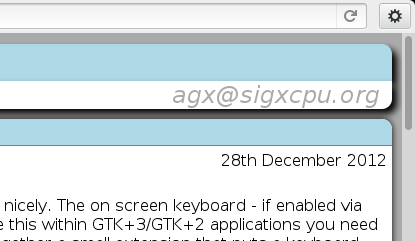
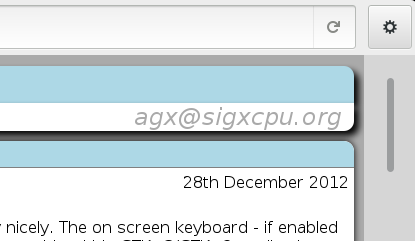 This will need more work since some of the sliders look a bit a awkward
now so any enhancements will be greatly appreciated. The docs for GTK3's
CSS are here.
This blog is flattr enabled.
 In fact, I like DPLs who don't like the idea of being a leader


wanna-build statistics - Sat Feb 16 22:52:37 CET 2013Considering from where we came we're doing well. Especially given the fact that still some buildds are not working properly because of the missing SCSI driver for NCR53C9XF (espfast) chips. Having that driver working would result in 4 additional buildds and at least one that is currently using slower IDE interface. Oh, even Kullervo is working again! Now it just needs to get relocated to the datacenter again... :-)
----------------------------------------------------- Distribution unstable:
---------------------
Installed : 6425 (buildd_m68k-ara5: 1011, buildd_m68k-arrakis: 86,
buildd_m68k-elgar: 217, buildd_m68k-kullervo: 52,
buildd_m68k-vivaldi: 123, tg: 3234, unknown: 1701,
wouter: 1)
Needs-Build : 1375
Building : 35 (buildd_m68k-ara5: 1, buildd_m68k-arrakis: 1,
buildd_m68k-elgar: 1, buildd_m68k-kullervo: 1,
buildd_m68k-vivaldi: 1, tg: 30)
Built : 3 (buildd_m68k-arrakis: 3)
Uploaded : 14 (tg: 14)
Failed : 80 (buildd_m68k-ara5: 31, tg: 49)
Dep-Wait : 3 (tg: 3)
Reupload-Wait : 0
Install-Wait : 0
Failed-Removed : 0
Dep-Wait-Removed: 0
BD-Uninstallable: 1750
Auto-Not-For-Us : 187
Not-For-Us : 21
total : 9978 64.39% (6425) up-to-date, 64.53% (6439) including uploaded
13.78% (1375) need building
0.35% ( 35) currently building
0.03% ( 3) already built, but not uploaded
0.83% ( 83) failed/dep-wait
0.00% ( 0) old failed/dep-wait
17.54% (1750) not installable, because of missing build-dep
1.87% (187) need porting or cause the buildd serious grief (Auto)
0.21% ( 21) need porting or cause the buildd serious grief
 Currently the petition already reached its goal of 1 Million signers, but unfortunately the rules are somewhat more complex: A certain quorum must be reached in every member country of the EU. At the moment the most signers came from Germany, so the quorum for Germany was reached. But according to a statistic posted on Twitter the quorum needs to be reached at least in 7 countries. Only Germany, Belgium and Austria did so. So please sign the petition on right2water.eu and spread the word in your country!
But why is privatization a bad idea? Especially when it is done in a Public Private Partnership (PPP)? As said, water and sanitation is a human right and must not be object for profit. What happens when water supply is done by a private corporation can be seen in the documentary "Water Makes Money" which was aired on French-German TV station "Arte" last week. You can watch it online in German and French.
The petition is running until September. There's enough time to sign it and - even more important - to contact your Members of European Parliament and request a "No!" to privatization of water and sanitation!
 I am in some way flattered (en_FR?) that some people think that I should stand
as DPL candidate (here, or there,
or there). Thank you, ladies and gentlemen, for your
confidence, it's appreciated.
Still, I won't stand and I feel like I should explain why.
Yes, I now have some experience in the Debian Project after more than
11 years as DD. Yes, I like to represent the project and I think I
don't do that so badly when I do it (which is not as often as one
might imagine).
Yes, I feel like I have some experience in acting as a "leader" though
I often have doubts about this, probably just like many people who
have management duties in their professional life.
Yes, I often define myself as a non-technical person which helps in
dealing with problems and projects with different perspectives. Still,
this is often not so true and that extends to my professionnal
activity. I *am* indeed a technical person but I'm more a "specialist
of everything and nothing" in this aspect. That's probably good for a DPL.
But, still I won't stand. There are indeed many reasons for this and
I'll try to give them here.
First of all, Debian has always been a hobby for me. A hobby that
sometimes ate several hours a day and still eats part of my time. But
still a hobby. It can't become the major part of my life. And I think
that someone spending one year as DPL "has" to do it as the major part
of her his life.
I can't free time from my work schedule. My work, though being in IT,
has few to relate with Free Software, and I can't divert part of it
with Debian duties...or merge it with Debian duties. For about 3
years, I compensate the loss of two people in my team by working
hard and VERY fast, in a constant stress....connecting with Onera
nearly all time long and maintaining the level of services our users
deserve as high as I can. And I like it.
I can't free time from my family schedule. Of course, my children
don't request much attention right now, they all live their own
lives. Jean-Baptiste is now having a full-time paid job and does great
things in a geeky style I recognize very well. Sophie will soon be a
great graduated social worker and will start working in next
Summer. And Magali is studying physical therapy so that she can later
help me recovering after too hard running races..:-). However, last and
definitely not least, I have a wonderful wife who I want to share as
much as I can with. And I can't share Debian with her. Indeed,
Elizabeth is the very first reason for my reasoning.....because she is
the center of my life for more than 30 years now.
You also know that I happen to run a little bit..:-)...and that
requires time too. Something I won't sacrifice as it brought more
equilibrium in my life (and a great health, at an age where one has to
care about one's health, now).
All this doesn't leave much room. And I indeed noticed that my
involvement in Debian has reduced noticeably in the past months. That
is indeed the most important point: I'm "slowing down" in Debian...or,
at least, I'm trying to find an equilibrium where it represents only a
part of my hobbies....and not an ever-growing one.
Last...maybe not least, I'm somehow pessimistic about the future of
the project. You may have read that subtly in my writings, here or
there. I feel like we are slowing down in innovation and are slowly
feeling short of resources. Renewal in project members doesn't come as
fast as it used to. You are free to disagree with me and I hope you'll
be right to. But, still, that won't remove my pessimism. And, well,
it's hard to lead a project when you're partly pessimistic about it,
isn't it?
In short, all in all, I'm currently "fighting" in some way to keep
motivation for something I deeply love being involved in. And that's
really important. And that's why I can't stand: it wouldn't be a good
service to the project. It would be good for my ego, certainly (yes, I
have one....and sometimes not a small one)....but it wouldn't be a
good service to the project, and I also feel it could very well lead
me to burnout.
And, if you "nominated" me...or think I would candidate for DPL, you
don't want me to burnout and vanish from Debian, right? So, this is
why I won't stand.
And this is why you'll continue to have great Cheese and Wine parties
at Debconfs....or boring l10n reports....or, here or there, some
broken uploads in the archive..:-)....but not another French DPL, at
least not /me.
PS: by the way, I have my own list of preferred candidates. Not sure I
want it to be public, though...:-)...you'll see soon if I change my
mind!
 Soile, my beloved, is running a second Kickstarter campaign to
fund her first feature-length movie, Maria Eveliina.
This time, she and her producer are seeking funding to pay an
editor to do the final, professional cut of the movie. They've
found a professional editor who'd like to work on the project,
but need some payment.
The Kickstarter page explains more. It also has a "Back
this project" button if you feel so inclined.
digest version
0.6.3 is now on CRAN, and I'll upload
the Debian package in a minute.
This is a minor bug release regarding just the recently-added sha512
support. Turns out the wrong initial buffer size was
used on the R side. Hannes fixed that within
hours after we got the bug report; but I was a little swamped with multiple
deadlines and failed to upload this right away.
CRANberries
provides the usual summary of changes to version
0.6.2.
Our package is available via
the R-Forge page
leading to svn and tarball access, my digest page, the
local directory here
as well as via Debian and its mirrors.


Next.
 Playing the

