Search Results: "ag"

21 February 2013

Daniel Pocock: US military may need Lumicall

In a remarkable report in Wired Magazine, it has been revealed that US stealth bombers have to communicate with their British allies using conventional radio. What that means in practice is that it would be child's play for the enemy to use basic techniques like triangulation to locate these otherwise invisible aircraft. While the thought of an ineffective multi-billion-dollar stealth bomber program seems preposterous, some may argue that the military has bigger problems maintaining discretion when even the CIA director is busted having an affair via Gmail. After all, it costs nothing to download GnuPG So what could the Americans and British do to put the stealth back into stealth bomber? Maybe it is time that pilots were issued with smartphones running Lumicall - with the built-in encryption features, could it make all their worries go away? At the very least, this issue demonstrates in a remarkable manner the reasons to stick with open standards like XMPP and SIP for building interoperable communications systems. If they missed our talk on Free, open, secure and convenient communications at FOSDEM, that may also be an interesting place to start searching for answers, as the idea of federated real-time communications is just as valuable in the air as it is for business or private purposes on the ground. The video is available now for those who missed it, and my earlier FOSDEM wrap-up provides more food for thought about the relevance of private communications for maintaining individual freedom (with or without the help of airborne supremecy). FOSDEM video: <video controls="controls" preload="none">
<source src="http://video.fosdem.org/2013/maintracks/Janson/Free,_open,_secure_and_convenient_communications.webm" type="video/webm; codecs="vp8, vorbis""></source></video> <object data="http://releases.flowplayer.org/swf/flowplayer-3.2.15.swf" type="application/x-shockwave-flash"> <param name="movie" value="http://releases.flowplayer.org/swf/flowplayer-3.2.15.swf"><param name="allowfullscreen" value="true"><param name="flashvars" value="config= 'clip': 'url': 'http://video.fosdem.org/2013/maintracks/Janson/Free,_open,_secure_and_convenient_communications.webm', 'autoPlay':false, 'autoBuffering':false ">Video tag not supported. Download the video here. </object>


Tanguy Ortolo: One archiver to rule them all: bsdtar

Package icon Sometimes, you have to use ZIP archives, or worse, RAR archives (curse them!), with one significant annoyance: zip, unzip, rar and unrar use a rather uncommon command line convention, compared to the usual tar, cpio and pax.This is where bsdtar and bsdcpio come handy: these two equivalent tools from FreeBSD do not directly implement any archive format, relying on libarchive to do that instead. That allows you to do thinks like:
% bsdtar -tf crap.rar
% bsdtar -xf crap.rar
% bsdtar --format zip -cf stuff.zip stuff
Too bad it does not have a -a option to automatically select the archive format as GNU tar does.

Dirk Eddelbuettel: RcppArmadillo 0.3.6.3

A new Armadillo version 3.6.3 came out this morning, and the corresponding RcppArmadillo version is now on CRAN. Changes are incremental:
Changes in RcppArmadillo version 0.3.6.3 (2013-02-20)
  • Upgraded to Armadillo release Version 3.6.3
    • faster find()
    • minor fix for non-contiguous submatrix views to handle empty vectors of indices
    • reduction of pedantic compiler warnings
Courtesy of CRANberries, there is also a diffstat report for the most recent release As always, more detailed information is on the RcppArmadillo page. Questions, comments etc should go to the rcpp-devel mailing list off the R-Forge page.

Joey Hess: Kickstarter rewards wrap-up

I finished delivering all my Kickstarter rewards at the end of the year. This is an overview of how that went, both financially and in general.
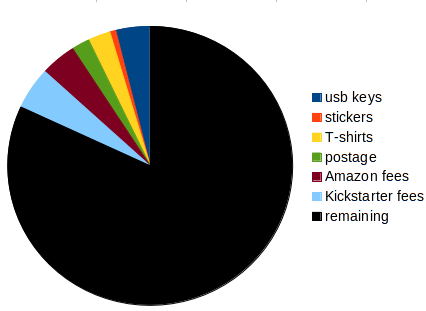
my Kickstarter pie (not including taxes)
While the Kickstarter was under way, several friends warned me that I might end up spending a lot of the money for rewards, or even shipping, and come out a loser. It's happened to some people, but I avoided it. Most of the pie went to its intended purpose.
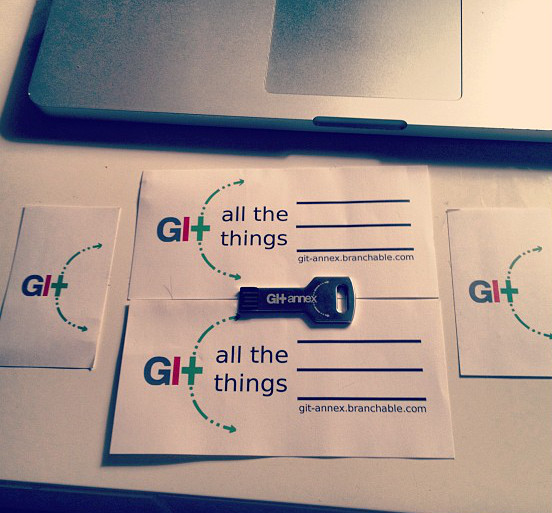
USB key arrives in Amsterdam
I kept shipping cost low by shipping everything by US postal service, including Air Mail for international shipping. This was particularly important for the stickers (which cost $1.05 to ship internationally). But I also shipped USB keys in regular mail envelopes, protected by bubble wrap, which worked very well and avoided the bother of shipping packages. The USPS will be annoyed at you for a rigid letter and add a non-machinable surcharge, but it's still a nice savings.
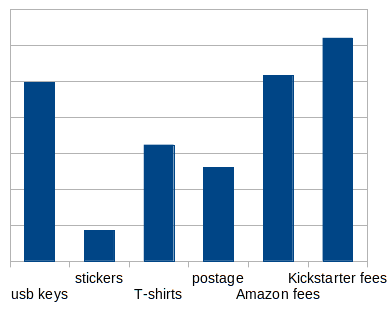
expenses
I spent more on rewards than on transaction fees, but the fees are still pretty large. Being dinged a second time by Amazon is the worst part. I have not been able to work out exactly what formula Kickstarter uses to determine its fee per pledge. It does not seem to be a simple percentage of the pledge. For example, they seem to have charged $0.25 per $10 pledge, but $25 for a $500 pledge. I wanted to solve this, but I'd have to match up all the pledges and fees manually to do it.
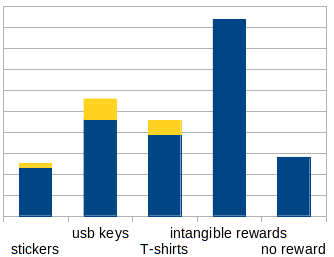
gross income by reward type
This chart is slightly innacurrate, because it puts any money pledged, beyond the amount needed to get a reward, into the "intangibles" category, despite the reward being probably responsible for that money being pledged. (The intangibles also includes people who did not ask for a reward, and several categories of rewards not involving shipping matter around.) But, the surprise for me is how large a peice the T-shirts are responsible for. It was my least favorite reward, and a low volume one, but I made out pretty well on it. However, I'd still try to avoid putting T-shirts on Kickstarter again. It's hard to do a good design (I didn't, really); they're expensive, and were by far the most annoying thing to ship. Also, I was not happy with the countries Cafe Press sourced their shirts from; I've been to Honduras and talked with people who have relatives in las machinas.
gross and net income by reward type (excluding shipping)
In contrast, the stickers had an amazing margin; they're so inexpensive to print that I printed up two kinds and included multiple with every other reward I mailed. I still have hundreds left over, too.. All the online print shops I tried have very annoying interfaces to upload artwork though. I had to do quite a bit of math to render TIFF files with appropriate DPI and margins. The USB keys were my favorite reward. I got them from USB Memory Direct, who gave me quite a nice deal. I was very happy that I was able to send them a SVG file of my artwork, so I didn't need to worry about lacking resolution for the laser engraving. And it came out looking great. The best part was when their sales guy Mike actually did a minor alteration of the artwork, to better fit on the key, when I, being overloaded with Kickstarter stuff asked him too. A bit above and beyond. There was an issue with their Chinese manufacturer's quality control of the 16 gb drives, but they were willing to send me replacement for all the ones I found problems with.
All told I spent probably 3 full days stuffing and shipping envelopes, and probably spent a week working on Kickstarter reward fullfillment. As work-related overhead goes, that's not bad. Maybe someone considering a Kickstarter will find this information useful somehow. Oh well, back to work. :)

20 February 2013

Daniel Pocock: Automatically mirroring SVN repositories to git and github

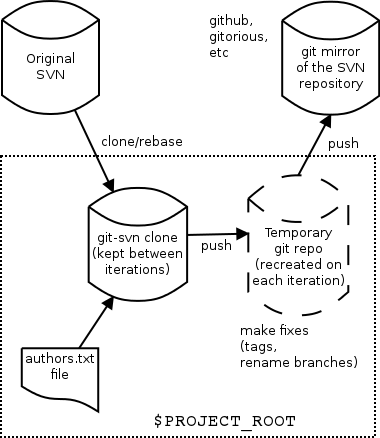
Updated 21 February 2013: the scripts below have now been adapted to run conveniently from cron and mirror multiple repositories. You can find full scripts and documentation on github There are a number of scripts around, including an earlier blog post of my own, for making a once-off conversion of an SVN repository to a Git repository. However, what if the project team is not yet ready for a full move to git? You may want to start benefiting from git (e.g. using the project as a submodule of another git project, or using Travis-CI.org for automated builds) while development officially continues to take place in SVN. If you don't need to make commits into git just now, you can set up a mirror and refresh it periodically from SVN. This process can be used with various SVN repositories, including Sourceforge and Google Code SVN repositories. Process overview
  • An authors.txt file is created manually before the first run.
  • A git-svn clone of the SVN repository is created. This clone needs to be retained between replication runs.
  • On each run, a temporary git repository is created. The svn-clone is rebased and pushed to the fresh git repository.
  • Fixes (e.g. branch renames and tagging) are made in the temporary git repository.
  • The final results are then pushed from the temporary repository to the real git mirror that is being maintained.
  • Finally, the temporary git repository is deleted, but the svn-clone is kept.
Here is a diagram of the workflow: Config file Here is a sample config file for the script, it mirrors the rather complicated reSIProcate repository with 10,000 commits:
PROJECT_ROOT=/home/daniel/svn-mirror/resiprocate
AUTHORS_FILE=$ PROJECT_ROOT /authors.txt
SVN_REPO=https://svn.resiprocate.org/rep/resiprocate
SVN_LAYOUT="--trunk=main --branches=branches --tags=tags"
GIT_REPO=git@github.com:resiprocate/resiprocate.git
Of particular note here:
  • The $PROJECT_ROOT is where the svn-clone and the temporary repositories will be created
  • $GIT_REPO is the final destination repository. For testing, it could just be a local directory initialised with git init --bare .
  • In this repository, our trunk is actually called main, hence we have the layout argument --trunk=main. Many projects would just use --trunk=trunk
The script The script itself is below. I'd suggest running it manually a few times first and observing how it behaves, disk space requirements, etc.
#!/bin/bash
set -e
if [ ! $# -eq 1 ];
then
  echo "Usage:"
  echo "$0 <config-file>"
  exit 1
fi
CONFIG_FILE="$1"
. "$ CONFIG_FILE "   exit 1
SVN_CLONE="$ PROJECT_ROOT /svn-clone"
GIT_BARE="$ PROJECT_ROOT /git-bare-tmp"
if [ ! -d "$ PROJECT_ROOT " ];
then
  mkdir -p "$ PROJECT_ROOT "
fi
cd "$ PROJECT_ROOT "
if [ ! -d "$ SVN_CLONE " ];
then
  git svn clone \
    "$ SVN_REPO " \
    -A "$ AUTHORS_FILE " \
    $ SVN_LAYOUT  \
    "$ SVN_CLONE "
  cd "$ SVN_CLONE "
else
  cd "$ SVN_CLONE "
  git remote rm bare   echo "failed to delete remote:bare, proceeding anyway"
  git svn rebase \
    --fetch-all \
    -A "$ AUTHORS_FILE "
fi
git remote add bare "$ GIT_BARE "
git config remote.bare.push 'refs/remotes/*:refs/heads/*'
if [ -d "$ GIT_BARE " ];
then
  rm -rf "$ GIT_BARE "
fi
mkdir -p "$ GIT_BARE "
cd "$ GIT_BARE "
git init --bare .
git symbolic-ref HEAD refs/heads/trunk
cd "$ SVN_CLONE "
git push bare
cd "$ GIT_BARE "
git branch -m trunk master
git for-each-ref --format='%(refname)' refs/heads/tags   \
   cut -d / -f 4   \
   while read ref;
   do
      git tag "$ref" "refs/heads/tags/$ref"
      git branch -D "tags/$ref"
   done
git remote add origin "$ GIT_REPO "
git config branch.master.remote origin
git config branch.master.merge refs/heads/master
git push --tags origin master
git push --all
rm -rf "$ GIT_BARE "
</config-file>
AttachmentSize
svn-mirror.png32.65 KB

Daniel Pocock: Automatically mirroring SVN repositories to git and github

Updated 21 February 2013: the scripts below have now been adapted to run conveniently from cron and mirror multiple repositories. You can find full scripts and documentation on github There are a number of scripts around, including an earlier blog post of my own, for making a once-off conversion of an SVN repository to a Git repository. However, what if the project team is not yet ready for a full move to git? You may want to start benefiting from git (e.g. using the project as a submodule of another git project, or using Travis-CI.org for automated builds) while development officially continues to take place in SVN. If you don't need to make commits into git just now, you can set up a mirror and refresh it periodically from SVN. This process can be used with various SVN repositories, including Sourceforge and Google Code SVN repositories. Process overview
  • An authors.txt file is created manually before the first run - see my other blog entry for convenient scripts to help generate authors.txt
  • A git-svn clone of the SVN repository is created. This clone needs to be retained between replication runs.
  • On each run, a temporary git repository is created. The svn-clone is rebased and pushed to the fresh git repository.
  • Fixes (e.g. branch renames and tagging) are made in the temporary git repository.
  • The final results are then pushed from the temporary repository to the real git mirror that is being maintained.
  • Finally, the temporary git repository is deleted, but the svn-clone is kept.
Here is a diagram of the workflow: Config file Here is a sample config file for the script, it mirrors the rather complicated reSIProcate repository with 10,000 commits:
PROJECT_ROOT=/home/daniel/svn-mirror/resiprocate
AUTHORS_FILE=$ PROJECT_ROOT /authors.txt
SVN_REPO=https://svn.resiprocate.org/rep/resiprocate
SVN_LAYOUT="--trunk=main --branches=branches --tags=tags"
GIT_REPO=git@github.com:resiprocate/resiprocate.git
Of particular note here:
  • The $PROJECT_ROOT is where the svn-clone and the temporary repositories will be created
  • $GIT_REPO is the final destination repository. For testing, it could just be a local directory initialised with git init --bare .
  • In this repository, our trunk is actually called main, hence we have the layout argument --trunk=main. Many projects would just use --trunk=trunk
The script The script itself is below. I'd suggest running it manually a few times first and observing how it behaves, disk space requirements, etc.
#!/bin/bash
set -e
if [ ! $# -eq 1 ];
then
  echo "Usage:"
  echo "$0 <config-file>"
  exit 1
fi
CONFIG_FILE="$1"
. "$ CONFIG_FILE "   exit 1
SVN_CLONE="$ PROJECT_ROOT /svn-clone"
GIT_BARE="$ PROJECT_ROOT /git-bare-tmp"
if [ ! -d "$ PROJECT_ROOT " ];
then
  mkdir -p "$ PROJECT_ROOT "
fi
cd "$ PROJECT_ROOT "
if [ ! -d "$ SVN_CLONE " ];
then
  git svn clone \
    "$ SVN_REPO " \
    -A "$ AUTHORS_FILE " \
    $ SVN_LAYOUT  \
    "$ SVN_CLONE "
  cd "$ SVN_CLONE "
else
  cd "$ SVN_CLONE "
  git remote rm bare   echo "failed to delete remote:bare, proceeding anyway"
  git svn rebase \
    --fetch-all \
    -A "$ AUTHORS_FILE "
fi
git remote add bare "$ GIT_BARE "
git config remote.bare.push 'refs/remotes/*:refs/heads/*'
if [ -d "$ GIT_BARE " ];
then
  rm -rf "$ GIT_BARE "
fi
mkdir -p "$ GIT_BARE "
cd "$ GIT_BARE "
git init --bare .
git symbolic-ref HEAD refs/heads/trunk
cd "$ SVN_CLONE "
git push bare
cd "$ GIT_BARE "
git branch -m trunk master
git for-each-ref --format='%(refname)' refs/heads/tags   \
   cut -d / -f 4   \
   while read ref;
   do
      git tag "$ref" "refs/heads/tags/$ref"
      git branch -D "tags/$ref"
   done
git remote add origin "$ GIT_REPO "
git config branch.master.remote origin
git config branch.master.merge refs/heads/master
git push --tags origin master
git push --all
rm -rf "$ GIT_BARE "
</config-file>
AttachmentSize
svn-mirror.png32.65 KB

Ryan Kavanagh: Search RCS and CVS ",v" files with rcsgrep

A few years ago I was doing research comparing how large software distributions handled shared object libraries, and studied Debian, FreeBSD, and Ubuntu. Extracting data about Debian packages was easy thanks to Peter Palfrader s snapshot.debian.org service, which provides a machine-usable interface to Debian s package history. FreeBSD s data is equally accessible, albeit in a less pleasant format: their ports tree was stored in CVS until July 2012. One could easily rsync a copy of the ports tree s CVS repository to a local machine to analyze the data. This left you with a local tree full of ,v files, each corresponding to the history of a given file with at that location. I needed to extract all kinds of data from a tree full of these files, such as what revisions contained lines matching a regex, when these revisions were checked in, any tags associated with it, etc. To make things easier, it also helped to know the line numbers of the matching lines. Hence the birth of rcsgrep. rcsgrep is a Python script that makes use of Paul McGuire s fabulous pyparsing library. It allows you to search a RCS file (the ,v file format used by RCS and CVS to store revision history) using a Python regex, and the output format is customizable to allow printing only certain kinds of information, such as the revision number, the line number, the matching line, the line s author, the date it appeared, any tags associated with the line, and (useful when running over a large number of files) the file name. To make machine parsing (using AWK of course) easier, you can also specify the column separator. For example, I entered the lines The quick brown , fox jumped over , the lazy dog. Woof! into the file abc, checking in the changes after each line. The invocation ./rcsgrep -s ' ' -f rlLda '.*' abc,v, with spaces for column separation, and format options r is for revision, l for line number, L for line contents, d for date, and a for author, outputs:
1.3    1    The quick brown    2013.02.20.14.24.09    ryan
1.3    2    jumped over the    2013.02.20.14.24.09    ryan
1.3    3    lazy dog. Woof!    2013.02.20.14.24.09    ryan
1.2    1    The quick brown    2013.02.20.14.23.48    ryan
1.2    2    jumped over the    2013.02.20.14.23.48    ryan
1.1    1    The quick brown    2013.02.20.14.23.25    ryan
I m particularly proud about my grep() function in rcsfile.py, which goes through each revision, tracking additions and deletions, but only keeping the lines matching the regex in memory. In any case, rcsgrep is licensed under the ISC license and can be found on github. Addendum: I learned after the fact that O Reilly s UNIX Power Tools offers something similar by the same name, except that it is runs several processes, such as co, grep and sed, as opposed to a single Python script.

Martin Pitt: umockdev 0.2: record/replay input devices

I just released umockdev 0.2. The big new feature of this release is support for evdev ioctls. I. e. you can now record what e. g. X.org is doing to touchpads, touch screens, etc.:
  $ umockdev-record /dev/input/event15 > /tmp/touchpad.umockdev
  # umockdev-record -i /tmp/touchpad.ioctl /dev/input/event15 -- Xorg -logfile /dev/null
and load that back into a testbed with X.org using the dummy driver:
  cat <<EOF > xorg-dummy.conf
  Section "Device"
        Identifier "test"
        Driver "dummy"
  EndSection
  EOF
  $ umockdev-run -l /tmp/touchpad.umockdev -i /dev/input/event15=/tmp/touchpad.ioctl -- \
       Xorg -config xorg-dummy.conf -logfile /tmp/X.log :5
Then e. g. DISPLAY=:5 xinput will recognize the simulated device. Note that Xvfb won t work as that does not use udev for device discovery, but only adds the XTest virtual devices and nothing else, so you need to use the real X.org with the dummy driver to run this as a normal user. This enables easier debugging of new kinds of input devices, as well as writing tests for handling multiple touchscreens/monitors, integration tests of Wacom devices, and so on. This release now also works with older automakes and Vala 0.16, so that you can use this from Ubuntu 12.04 LTS. The daily PPA now also has packages for that. Attention: This version does not work any more with recorded ioctl files from version 0.1. More detailled list of changes:

Thorsten Glaser: GNU autotools generated files

On Planet Debian, Vincent Bernat wrote:

The drawback of this approach is that if you rebuild configure from the released tarball, you don t have the git tree and the version will be a date. Just don t do that.

Excuse me This is totally inacceptable. Regenerating files like aclocal.m4 and Makefile.in (for automake), configure (for autoconf), and the likes is one of the absolute duties of a software package. Things will break sooner or later if people do not do that. Additionally, generated files must be remakable from the distfile, so do not break this! May I suggest, constructively, an alternative? (People rightfully, I must admit complain I m just ranting too much.)
When making a release from git, write the git describe output into a file. Then, use that file instead of trying to run the git executable if .git/. is not a directory ( test -d .git/. ). Do not call git, because, in packages, it s either not installed or/and also undesired. Couldn t comment on your blog, but felt strongly enough about this I took the effort of writing a full post of my own. (But thanks for the book recommendation.)

Vincent Bernat: lldpd 0.7.1

A few weeks ago, a new version of lldpd, a 802.1AB (aka LLDP) implementation for various Unices, has been released. LLDP is an industry standard protocol designed to supplant proprietary Link-Layer protocols such as EDP or CDP. The goal of LLDP is to provide an inter-vendor compatible mechanism to deliver Link-Layer notifications to adjacent network devices. In short, LLDP allows you to know exactly on which port is a server (and reciprocally). To illustrate its use, I have made a xkcd-like strip: xkcd-like strip for the use of LLDP If you would like more information about lldpd, please have a look at its new dedicated website. This blog post is an insight of various technical changes that have affected lldpd since its latest major release one year ago. Lots of C stuff ahead!

Version & changelog UPDATED: Guillem Jover told me how he met the same goals for libbsd :
  1. Save the version from git into .dist-version and use this file if it exists. This allows one to rebuild ./configure from the published tarball without losing the version. This also handles Thorsten Glaser s critic.
  2. Include CHANGELOG in DISTCLEANFILES variable.
Since this is a better solution, I have adopted the appropriate line of codes from libbsd. The two following sections are partly technically outdated.

Automated version In configure.ac, I was previously using a static version number that I had to increase when releasing:
AC_INIT([lldpd], [0.5.7], [bernat@luffy.cx])
Since the information is present in the git tree, this seems a bit redundant (and easy to forget). Taking the version from the git tree is easy:
AC_INIT([lldpd],
        [m4_esyscmd_s([git describe --tags --always --match [0-9]* 2> /dev/null   date +%F])],
        [bernat@luffy.cx])
If the head of the git tree is tagged, you get the exact tag (0.7.1 for example). If it is not, you get the nearest one, the number of commits since it and part of the current hash (0.7.1-29-g2909519 for example). The drawback of this approach is that if you rebuild configure from the released tarball, you don t have the git tree and the version will be a date. Just don t do that.

Automated changelog Generating the changelog from git is a common practice. I had some difficulties to make it right. Here is my attempt (I am using automake):
dist_doc_DATA = README.md NEWS ChangeLog
.PHONY: $(distdir)/ChangeLog
dist-hook: $(distdir)/ChangeLog
$(distdir)/ChangeLog:
        $(AM_V_GEN)if test -d $(top_srcdir)/.git; then \
          prev=$$(git describe --tags --always --match [0-9]* 2> /dev/null) ; \
          for tag in $$(git tag   grep -E '^[0-9]+(\.[0-9]+) 1, $$'   sort -rn); do \
            if [ x"$$prev" = x ]; then prev=$$tag ; fi ; \
            if [ x"$$prev" = x"$$tag" ]; then continue; fi ; \
            echo "$$prev [$$(git log $$prev -1 --pretty=format:'%ai')]:" ; \
            echo "" ; \
            git log --pretty=' - [%h] %s (%an)' $$tag..$$prev ; \
            echo "" ; \
            prev=$$tag ; \
          done > $@ ; \
        else \
          touch $@ ; \
        fi
ChangeLog:
        touch $@
Changelog entries are grouped by version. Since it is a bit verbose, I still maintain a NEWS file with important changes.

Core

C99 I have recently read 21st Century C which has some good bits and also handles the ecosystem around C. I have definitively adopted designated initializers in my coding style. Being a GCC extension since a long time, this is not a major compatibility problem. Without designated initializers:
struct netlink_req req;
struct iovec iov;
struct sockaddr_nl peer;
struct msghdr rtnl_msg;
memset(&req, 0, sizeof(req));
memset(&iov, 0, sizeof(iov));
memset(&peer, 0, sizeof(peer));
memset(&rtnl_msg, 0, sizeof(rtnl_msg));
req.hdr.nlmsg_len = NLMSG_LENGTH(sizeof(struct rtgenmsg));
req.hdr.nlmsg_type = RTM_GETLINK;
req.hdr.nlmsg_flags = NLM_F_REQUEST   NLM_F_DUMP;
req.hdr.nlmsg_seq = 1;
req.hdr.nlmsg_pid = getpid();
req.gen.rtgen_family = AF_PACKET;
iov.iov_base = &req;
iov.iov_len = req.hdr.nlmsg_len;
peer.nl_family = AF_NETLINK;
rtnl_msg.msg_iov = &iov;
rtnl_msg.msg_iovlen = 1;
rtnl_msg.msg_name = &peer;
rtnl_msg.msg_namelen = sizeof(struct sockaddr_nl);
With designated initializers:
struct netlink_req req =  
    .hdr =  
        .nlmsg_len = NLMSG_LENGTH(sizeof(struct rtgenmsg)),
        .nlmsg_type = RTM_GETLINK,
        .nlmsg_flags = NLM_F_REQUEST   NLM_F_DUMP,
        .nlmsg_seq = 1,
        .nlmsg_pid = getpid()  ,
    .gen =   .rtgen_family = AF_PACKET  
 ;
struct iovec iov =  
    .iov_base = &req,
    .iov_len = req.hdr.nlmsg_len
 ;
struct sockaddr_nl peer =   .nl_family = AF_NETLINK  ;
struct msghdr rtnl_msg =  
    .msg_iov = &iov,
    .msg_iovlen = 1,
    .msg_name = &peer,
    .msg_namelen = sizeof(struct sockaddr_nl)
 ;

Logging Logging in lldpd was not extensive. Usually, when receiving a bug report, I asked the reporter to add some additional printf() calls to determine where the problem was. This was clearly suboptimal. Therefore, I have added many log_debug() calls with the ability to filter out some of them. For example, to debug interface discovery, one can run lldpd with lldpd -ddd -D interface. Moreover, I have added colors when logging to a terminal. This may seem pointless but it is now far easier to spot warning messages from debug ones. logging output of lldpd

libevent In lldpd 0.5.7, I was using my own select()-based event loop. It worked but I didn t want to grow a full-featured event loop inside lldpd. Therefore, I switched to libevent. The minimal required version of libevent is 2.0.5. A convenient way to check the changes in API is to use Upstream Tracker, a website tracking API and ABI changes for various libraries. This version of libevent is not available in many stable distributions. For example, Debian Squeeze or Ubuntu Lucid only have 1.4.13. I am also trying to keep compatibility with very old distributions, like RHEL 2, which does not have a packaged libevent at all. For some users, it may be a burden to compile additional libraries. Therefore, I have included libevent source code in lldpd source tree (as a git submodule) and I am only using it if no suitable system libevent is available. Have a look at m4/libevent.m4 and src/daemon/Makefile.am to see how this is done.

Client

Serialization lldpctl is a client querying lldpd to display discovered neighbors. The communication is done through an Unix socket. Each structure to be serialized over this socket should be described with a string. For example:
#define STRUCT_LLDPD_DOT3_MACPHY "(bbww)"
struct lldpd_dot3_macphy  
        u_int8_t                 autoneg_support;
        u_int8_t                 autoneg_enabled;
        u_int16_t                autoneg_advertised;
        u_int16_t                mau_type;
 ;
I did not want to use stuff like Protocol Buffers because I didn t want to copy the existing structures to other structures before serialization (and the other way after deserialization). However, the serializer in lldpd did not allow to handle reference to other structures, lists or circular references. I have written another one which works by annotating a structure with some macros:
struct lldpd_chassis  
    TAILQ_ENTRY(lldpd_chassis) c_entries;
    u_int16_t        c_index;
    u_int8_t         c_protocol;
    u_int8_t         c_id_subtype;
    char            *c_id;
    int              c_id_len;
    char            *c_name;
    char            *c_descr;
    u_int16_t        c_cap_available;
    u_int16_t        c_cap_enabled;
    u_int16_t        c_ttl;
    TAILQ_HEAD(, lldpd_mgmt) c_mgmt;
 ;
MARSHAL_BEGIN(lldpd_chassis)
MARSHAL_TQE  (lldpd_chassis, c_entries)
MARSHAL_FSTR (lldpd_chassis, c_id, c_id_len)
MARSHAL_STR  (lldpd_chassis, c_name)
MARSHAL_STR  (lldpd_chassis, c_descr)
MARSHAL_SUBTQ(lldpd_chassis, lldpd_mgmt, c_mgmt)
MARSHAL_END;
Only pointers need to be annotated. The remaining of the structure can be serialized with just memcpy()1. I think there is still room for improvement. It should be possible to add annotations inside the structure and avoid some duplication. Or maybe, using a C parser? Or using the AST output from LLVM?

Library In lldpd 0.5.7, there are two possible entry points to interact with the daemon:
  1. Through SNMP support. Only information available in LLDP-MIB are exported. Therefore, implementation-specific values are not available. Moreover, SNMP support is currently read-only.
  2. Through lldpctl. Thanks to a contribution from Andreas Hofmeister, the output can be requested to be formatted as an XML document.
Integration of lldpd into a network stack was therefore limited to one of those two channels. As an exemple, you can have a look at how Vyatta made the integration using the second solution. To provide a more robust solution, I have added a shared library, liblldpctl, with a stable and well-defined API. lldpctl is now using it. I have followed those directions2:
  • Consistent naming (all exported symbols are prefixed by lldpctl_). No pollution of the global namespace.
  • Consistent return codes (on errors, all functions returning pointers are returning NULL, all functions returning integers are returning -1).
  • Reentrant and thread-safe. No global variables.
  • One well-documented include file.
  • Reduce the use of boilerplate code. Don t segfault on NULL, accept integer input as string, provide easy iterators,
  • Asynchronous API for input/output. The library delegates reading and writing by calling user-provided functions. Those functions can yield their effects. In this case, the user has to callback the library when data is available for reading or writing. It is therefore possible to integrate the library with any existing event-loop. A thin synchronous layer is provided on top of this API.
  • Opaque types with accessor functions.
Accessing bits of information is done through atoms which are opaque containers of type lldpctl_atom_t. From an atom, you can extract some properties as integers, strings, buffers or other atoms. The list of ports is an atom. A port in this list is also an atom. The list of VLAN present on this port is an atom, as well as each VLAN in this list. The VLAN name is a NULL-terminated string living in the scope of an atom. Accessing a property is done by a handful of functions, like lldpctl_atom_get_str(), using a specific key. For example, here is how to display the list of VLAN assuming you have one port as an atom:
vlans = lldpctl_atom_get(port, lldpctl_k_port_vlans);
lldpctl_atom_foreach(vlans, vlan)  
    vid = lldpctl_atom_get_int(vlan,
                               lldpctl_k_vlan_id));
    name = lldpctl_atom_get_str(vlan,
                                lldpctl_k_vlan_name));
    if (vid && name)
        printf("VLAN %d: %s\n", vid, name);
 
lldpctl_atom_dec_ref(vlans);
Internally, an atom is typed and reference counted. The size of the API is greatly limited thanks to this concept. There are currently more than one hundred pieces of information that can be retrieved from lldpd. Ultimately, the library will also enable the full configuration of lldpd. Currently, many aspects can only be configured through command-line flags. The use of the library does not replace lldpctl which will still be available and be the primary client of the library.

CLI Having a configuration file was requested since a long time. I didn t want to include a parser in lldpd: I am trying to keep it small. It was already possible to configure lldpd through lldpctl. Locations, network policies and power policies were the three items that could be configured this way. So, the next step was to enable lldpctl to read a configuration file, parse it and send the result to lldpd. As a bonus, why not provide a full CLI accepting the same statements with inline help and completion?

Parsing & completion Because of completion, it is difficult to use a YACC generated parser. Instead, I define a tree where each node accepts a word. A node is defined with this function:
struct cmd_node *commands_new(
    struct cmd_node *,
    const char *,
    const char *,
    int(*validate)(struct cmd_env*, void *),
    int(*execute)(struct lldpctl_conn_t*, struct writer*,
        struct cmd_env*, void *),
    void *);
A node is defined by:
  • its parent,
  • an optional accepted static token,
  • an help string,
  • an optional validation function and
  • an optional function to execute if the current token is accepted.
When walking the tree, we maintain an environment which is both a key-value store and a stack of positions in the tree. The validation function can check the environment to see if we are in the right context (we want to accept the keyword foo only once, for example). The execution function can add the current token as a value in the environment but it can also pop the current position in the tree to resume walk from a previous node. As an example, see how nodes for configuration of a coordinate-based location are registered:
/* Our root node */
struct cmd_node *configure_medloc_coord = commands_new(
    configure_medlocation,
    "coordinate", "MED location coordinate configuration",
    NULL, NULL, NULL);
/* The exit node.
   The validate function will check if we have both
   latitude and longitude. */
commands_new(configure_medloc_coord,
    NEWLINE, "Configure MED location coordinates",
    cmd_check_env, cmd_medlocation_coordinate,
    "latitude,longitude");
/* Store latitude. Once stored, we pop two positions
   to go back to the "root" node. The user can only
   enter latitude once. */
commands_new(
    commands_new(
        configure_medloc_coord,
        "latitude", "Specify latitude",
        cmd_check_no_env, NULL, "latitude"),
    NULL, "Latitude as xx.yyyyN or xx.yyyyS",
    NULL, cmd_store_env_value_and_pop2, "latitude");
/* Same thing for longitude */
commands_new(
    commands_new(
        configure_medloc_coord,
        "longitude", "Specify longitude",
        cmd_check_no_env, NULL, "longitude"),
    NULL, "Longitude as xx.yyyyE or xx.yyyyW",
    NULL, cmd_store_env_value_and_pop2, "longitude");
The definition of all commands is still a bit verbose but the system is simple enough yet powerful enough to cover all needed cases.

Readline When faced with a CLI, we usually expect some perks like completion, history handling and help. The most used library to provide such features is the GNU Readline Library. Because this is a GPL library, I have first searched an alternative. There are several of them: From an API point of view, the first three libraries support the GNU Readline API. They also have a common native API. Moreover, this native API also handles tokenization. Therefore, I have developed the first version of the CLI with this API3. Unfortunately, I noticed later this library is not very common in the Linux world and is not available in RHEL. Since I have used the native API, it was not possible to fallback to the GNU Readline library. So, let s switch! Thanks to the appropriate macro from the Autoconf Archive (with small modifications), the compilation and linking differences between the libraries are taken care of. Because GNU Readline library does not come with a tokenizer, I had to write one myself. The API is also badly documented and it is difficult to know which symbol is available in which version. I have limited myself to:
  • readline(), addhistory(),
  • rl_insert_text(),
  • rl_forced_update_display(),
  • rl_bind_key()
  • rl_line_buffer and rl_point.
Unfortunately, the various libedit libraries have a noop for rl_bind_key(). Therefore, completion and online help is not available with them. I have noticed that most BSD come with GNU Readline library preinstalled, so it could be considered as a system library. Nonetheless, linking with libedit to avoid licensing issues is possible and help can be obtained by prefixing the command with help.

OS specific support

BSD support Until version 0.7, lldpd was Linux-only. The rewrite to use Netlink was the occasion to abstract interfaces and to port to other OS. The first port was for Debian GNU/kFreeBSD, then for FreeBSD, OpenBSD and NetBSD. They all share the same source code:
  • getifaddrs() to get the list of interfaces,
  • bpf(4) to attach to an interface to receive and send packets,
  • PF_ROUTE socket to be notified when a change happens.
Each BSD has its own ioctl() to retrieve VLAN, bridging and bonding bits but they are quite similar. The code was usually adapted from ifconfig.c. The BSD ports have the same functionalities than the Linux port, except for NetBSD which lacks support for LLDP-MED inventory since I didn t find a simple way to retrieve DMI related information. They also offer greater security by filtering packets sent. Moreover, OpenBSD allows to lock the filters set on the socket:
/* Install write filter (optional) */
if (ioctl(fd, BIOCSETWF, (caddr_t)&fprog) < 0)  
    rc = errno;
    log_info("privsep", "unable to setup write BPF filter for %s",
        name);
    goto end;
 
/* Lock interface */
if (ioctl(fd, BIOCLOCK, (caddr_t)&enable) < 0)  
    rc = errno;
    log_info("privsep", "unable to lock BPF interface %s",
        name);
    goto end;
 
This is a very nice feature. lldpd is using a privileged process to open the raw socket. The socket is then transmitted to an unprivileged process. Without this feature, the unprivileged process can remove the BPF filters. I have ported the ability to lock a socket filter program to Linux. However, I still have to add a write filter.

OS X support Once FreeBSD was supported, supporting OS X seemed easy. I got sponsored by xcloud.me which provided a virtual Mac server. Making lldpd work with OS X took only two days, including a full hour to guess how to get Apple Xcode without providing a credit card. To help people installing lldpd on OS X, I have also written a lldpd formula for Homebrew which seems to be the most popular package manager for OS X.

Upstart and systemd support Many distributions propose upstart and systemd as a replacement or an alternative for the classic SysV init. Like most daemons, lldpd detaches itself from the terminal and run in the background, by forking twice, once it is ready (for lldpd, this just means we have setup the control socket). While both upstart and systemd can accommodate daemons that behave like this, it is recommended to not fork. How to advertise readiness in this case? With upstart, lldpd will send itself the SIGSTOP signal. upstart will detect this, resume lldpd with SIGCONT and assume it is ready. The code to support upstart is therefore quite simple. Instead of calling daemon(), do this:
const char *upstartjob = getenv("UPSTART_JOB");
if (!(upstartjob && !strcmp(upstartjob, "lldpd")))
    return 0;
log_debug("main", "running with upstart, don't fork but stop");
raise(SIGSTOP);
The job configuration file looks like this:
# lldpd - LLDP daemon
description "LLDP daemon"
start on net-device-up IFACE=lo
stop on runlevel [06]
expect stop
respawn
script
  . /etc/default/lldpd
  exec lldpd $DAEMON_ARGS
end script
systemd provides a socket to achieve the same goal. An application is expected to write READY=1 to the socket when it is ready. With the provided library, this is just a matter of calling sd_notify("READY=1\n"). Since sd_notify() has less than 30 lines of code, I have rewritten it to avoid an external dependency. The appropriate unit file is:
[Unit]
Description=LLDP daemon
Documentation=man:lldpd(8)
[Service]
Type=notify
NotifyAccess=main
EnvironmentFile=-/etc/default/lldpd
ExecStart=/usr/sbin/lldpd $DAEMON_ARGS
Restart=on-failure
[Install]
WantedBy=multi-user.target

OS include files Linux-specific include files were a major pain in previous versions of lldpd. The problems range from missing header files (like linux/if_bonding.h) to the use of kernel-only types. Those headers have a difficult history. They were first shipped with the C library but were rarely synced and almost always outdated. They were then extracted from kernel version with almost no change and lagged behind the kernel version used by the released distribution4. Today, the problem is acknowledged and is being solved by both the distributions which extract the headers from the packaged kernel and by kernel developers with a separation of kernel-only headers from user-space API headers. However, we still need to handle legacy. A good case is linux/ethtool.h:
  • It can just be absent.
  • It can use u8, u16 types which are kernel-only types. To work around this issue, type munging can be setup.
  • It can miss some definition, like SPEED_10000. In this case, you either define the missing bits and find yourself with a long copy of the original header interleaved with #ifdef or conditionally use each symbol. The latest solution is a burden by itself but it also hinders some functionalities that can be available in the running kernel.
The easy solution to all this mess is to just include the appropriate kernel headers into the source tree of the project. Thanks to Google ripping them for its Bionic C library, we know that copying kernel headers into a program does not create a derivative work.

  1. Therefore, the use of u_int16_t and u_int8_t types is a left-over of the previous serializer where the size of all members was important.
  2. For more comprehensive guidelines, be sure to check Writing a C library.
  3. Tokenization is not the only advantage of libedit native API. The API is also cleaner, does not have a global state and has a better documentation. All the implementations are also BSD licensed.
  4. For example, in Debian Sarge, the Linux kernel was a 2.6.8 (2004) while the kernel headers were extracted from some pre-2.6 kernel.

Gunnar Wolf: "No al voto electr nico", Triple W, W Radio

Title"No al voto electr nico", Triple W, W Radio
Publication TypeBroadcast
Year of Publication2013
AuthorsWolf G, Ruiz O
Refereed DesignationNon-Refereed
Keywordse-vote
URLhttp://www.wradio.com.mx/escucha/programas/voto-electronico-octavio-ruiz-y-kunar-wolf-analistas-190213/20130219/programa/1789792.aspx?au=1845636
Full TextIn yet another episode where we push for the population to be aware of the perils that electronic voting represents, Octavio Ruiz (@tacvbo) and me were invited to (briefly) talk about the topic in W Radio, one of the largest radio networks in Mexico.
The interview was short-ish, but we managed to get several points accross. And, of course, one of the best ways to do so is via a radio show with tens of thousands of listeners. So, we were quite happy to be there!
Here is the audio of the segment we presented in Fernanda Tapia's radio show "Triple W", in W Radio, Mexico.
AttachmentSize
Tripe W - Entrevista: no al voto electronico9.97 MB

19 February 2013

Daniel Pocock: dynalogin 1.0.0 released

dynalogin 1.0.0 has finally been released. It is available now from the dynalogin web site Packages for Debian GNU/Linux are already in the experimental catalog. It will be made available in Debian unstable and backports as soon as the freeze is lifted for the wheezy release. dynalogin is a distributed solution for one-time-password/token based two-factor authentication on Linux/UNIX based operating systems. It supports PAM (pam_dynalogin) and also has native client code for C/C++ and PHP applications. It is free, open source software, so users can ascertain for themselves that it is genuinely secure and reliable for their needs. dynalogin is licensed under GPL terms. dynalogin works with various soft-tokens, including the dynalogin token for Android and the Google Authenticator for various mobile devices. HOTP and TOTP-based hardware tokens can also be used. Many thanks to Simon Josefsson and the OATH toolkit project which provides the underlying authentication algorithms for dynalogin dynalogin can be integrated with the SimpleID OpenID provider to provide a turn-key solution for web-based single-sign-on, intranets and extranets. All the necessary components are conveniently packaged in Debian and Ubuntu.

Daniel Pocock: dynalogin 1.0.0 released

dynalogin 1.0.0 has finally been released. It is available now from the dynalogin web site Packages for Debian GNU/Linux are already in the experimental catalog. It will be made available in Debian unstable and backports as soon as the freeze is lifted for the wheezy release. dynalogin is a distributed solution for one-time-password/token based two-factor authentication on Linux/UNIX based operating systems. It supports PAM (pam_dynalogin) and also has native client code for C/C++ and PHP applications. It is free, open source software, so users can ascertain for themselves that it is genuinely secure and reliable for their needs. dynalogin is licensed under GPL terms. dynalogin works with various soft-tokens, including the dynalogin token for Android and the Google Authenticator for various mobile devices. HOTP and TOTP-based hardware tokens can also be used. Many thanks to Simon Josefsson and the OATH toolkit project which provides the underlying authentication algorithms for dynalogin dynalogin can be integrated with the SimpleID OpenID provider to provide a turn-key solution for web-based single-sign-on, intranets and extranets. All the necessary components are conveniently packaged in Debian and Ubuntu.

Mike Hommey: Ten years

Ten years ago, this very day, my first Debian package entered the Debian unstable repository. It was an addon for Mozilla Composer, Daniel Glazman s Cascades. On the same day, my second Debian package entered the Debian unstable repository as well. It was an addon for Mozilla Browser, Checky. A few days later, my third Debian package entered Debian unstable. It was an addon for Mozilla Browser, Diggler. Do you see a pattern? They are now abandoned software, although I made Checky and Diggler live a little longer (and I m actually considering reviving Diggler) but they had their importance in my journey, and are part of the reason why I am where I am now. My journey on the web started with NCSA Mosaic on VAX/VMS, then continued with Netscape Navigator, Netscape Communicator and Mozilla Suite on Linux. That s where I was ten years ago, sailing between Galeon (a browser using the Mozilla engine) and Mozilla Suite, and filing some layout bugs. Ten years ago, there was a new kid on the block. It used to be called Phoenix, it had just changed its name to Firebird. Eventually, it changed again for Firefox. You may have heard about it. Because Firebird was so much nicer than the browser in the Mozilla Suite, I started using its Debian package, and wanted my packaged addons to work with it. So I contacted Eric Dorland, Phoenix/Firebird package maintainer at the time, and got the addons working. I then ended up fixing a bunch of packaging issues. This is how I got involved in Firefox packaging for Debian, and what eventually led me to work for Mozilla.

Robert Collins: First experience implementing StreamResult

My last two blog posts were largely about the needs of subunit, but a key result of any protocol is how easy working with it in a high level language is. In the weekend and evenings I ve done an implementation of a new set of classes StreamResult and friends that provides: So far the code has been uniformly simple to write. I started with an API that included an estimate function, which I ve since removed I don t believe the complexity is justified; enumeration is not significantly more expensive than counting, and runners that want to be efficient can either not enumerate or remember the enumeration from prior runs. The documentation in the linked pull request is a good place to start to get a handle on the API; I d love feedback. Next steps for me are to do a subunit protocol revision that maps to the Python API, both parser and generator and see how it feels. One wrinkle there is that the reason for doing this is to fix intrinsic limits in the existing protocol so doing forward and backward wire protocol compatibility would defeat the point. However we can make the output side explicitly choose a protocol version, and if we can autodetect the protocol version in the parser, even if we cannot handle mixed streams we can get the benefits of the new protocol once data has been detected. That said, I think we can start without autodetection during prototyping, and add it later. Without autodetection, programs like TestRepository will need configuration options to control what protocol variant to expect. This could be done by requiring this new protocol and providing a stream filter that can be deployed when needed.

Ingo Juergensmann: LVM on RAID5 broken - how to fix?

Some time ago one of my disks in my Software RAID5 failed. No big problem as I had two spare A08U-C2412 available to replace that single 1 TB SATA disk. I can't remember any details but somewhat went wrong and I ended up with a non-booting system. I think I tried to add the HW-RAID as a physical volume to the LVM and thought of migrating the SW-RAID to the HW-RAID or do mirroring or such. Anyway: I booted into my rescue system that was on a RAID1 partition on those disks, but LVM didn't came up anymore, because the SW-RAID5 wasn't recognized during boot. So I re-created the md device and discovered that my PV was gone as well. =:-0 No, big deal, I thought, because I have a backup of that machine on another host. I restored /etc/lvm and tried to do a vgcfgrestore after I re-created the PV with pvcreate. First I didn't use the old UUID, so vgcfgrestore complained. After creating the proper PV with UUID LVM did recognize the PV, VG and LVs. Unfortunately I can't mount any of the LVs. Something seems to be broken:
hahn-rescue:~# mount /dev/vg/sys /mnt
mount: you must specify the filesystem type
Feb 19 07:50:02 hahn-rescue kernel: [748288.740949] XFS (dm-0): bad magic number
Feb 19 07:50:02 hahn-rescue kernel: [748288.741009] XFS (dm-0): SB validate failed
Running a gpart scan on my SW-RAID5 did gave me some results:
hahn-rescue:~# gpart /dev/md3
Begin scan...
Possible partition(SGI XFS filesystem), size(20470mb), offset(5120mb)
Possible partition(SGI XFS filesystem), size(51175mb), offset(28160mb)
Possible partition(SGI XFS filesystem), size(1048476mb), offset(117760mb)
Possible partition(SGI XFS filesystem), size(204787mb), offset(1168640mb)
Possible partition(SGI XFS filesystem), size(204787mb), offset(1418240mb)
Possible partition(SGI XFS filesystem), size(1048476mb), offset(1626112mb)
*** Fatal error: dev(/dev/md3): seek failure.
These is not the complete lists of VM as a comparison to the output of lvs shows:
hahn-rescue:~# lvs
  LV                 VG   Attr     LSize   Pool Origin Data%  Move Log Copy%  Convert
  storage1           lv   -wi-ao--   1.00t                                          
  AmigaSeagateElite3 vg   -wi-a---   3.00g                                          
  audio              vg   -wi-a---  70.00g                                          
  backup             vg   -wi-a---   1.00t                                          
  data               vg   -wi-a---  50.00g                                          
  hochzeit           vg   -wi-a---  40.00g                                          
  home               vg   -wi-a---   5.00g                                          
  pics               vg   -wi-a--- 200.00g                                          
  sys                vg   -wi-a---  20.00g                                          
  video              vg   -wi-a--- 100.00g                                          
  windata            vg   -wi-a--- 100.00g   
Please notice that /dev/lv/storage1 is my HW-RAID where I stored the images of /dev/vg/-LVs to run xfs_repair and such on. Anyway, the sizes of the recognized XFS partitions by gpart is mostly correct, but some a missing and xfs_repair can not do anything good on the backup images on storage1. Everything ends up in /lost+found, because the blocks seem to be mixed up somehow. What I figured out is, that my old RAID5 device was in metaformat=1.2 whereas the new one is in format 0.9. My best guess is now to recreate the RAID5 device with format 1.2, do a vgcfgrestore on that and have (hopefully!) a working LVM with working LVs back that I can then mount again. If there's anything else I might be able to try, dear Lazyweb, please tell me. Please see the attached config files/tarballs for a complete overview. Side note: except for AmigaSeagateElite3, which is a dd image of an old Amiga SCSI disk, I should have a fairly complete backup on my second backup location, so there's not much lost, but I would be a real timesaver when I would be able to recover the lost LVs. Both systems are behind DSL/cable and have a limit of 10 Mbps upstream. It would take weeks to transfer the data and sending an USB disk would be faster.
AttachmentSize
mdadm.conf_.txt954 bytes
hahn-lvm-restore.tar.gz14.7 KB
Kategorie:

18 February 2013

Dirk Eddelbuettel: New Rcpp master class scheduled for New York

A new Rcpp master class is scheduled for March 9 in New York. The format will an updated version of the one-day workshops I have given at the University of Rochester in 2010, in San Franciso in 2011 (organised by Revolution Analytics) and at the UseR! conference in 2012. The style will be hands-on, with numerous concrete examples and solid coverage of most aspects of Rcpp and related packages. As before, about six hours of instruction, split into four sessions of around ninety minutes focussing (loosely) on motivation/intro, core parts, extensions and applications. This should leave ample time for informal discussions and Q+A---as well as for lunch and coffee breaks---for a total of eight hours in the classroom. This is being put together in New York with the help of Jared Lander, and we will have some technical assistance from RStudio in order to use their EC2 farm for exercises with Rcpp. Registrations details are available here; information about other Rcpp events is also available. Feel free to contact me or Jared at our usual email addresses with questions.

Steve McIntyre: Ladies. And Fire Engines. And all for Charity!

My lovely wife Jo has signed up for a charity event in May this year. To help support the UK Fire Fighters Charity, she has committed to a sponsored driving challenge. If she can raise enough funds in sponsorship, she'll get to drive a fire engine, a tractor and (it's rumoured) maybe even a combine harvester too! I've chipped in some money towards the total already; I'm sure Jo would love it if some other nice people pledged on her JustGiving page too. Go on, it's for a good cause! :-)

Jan Wagner: Airprint support broken in Debian wheezy?

Some of our customers are using central CUPS systems for managing their printer infrastructure. In the last years the demand for support printing (called Airprint) from mobile apple products increased. This worked well for us on Debian squeeze as documented here (updated scrips). I tried this on a fresh installed Debian wheezy amd64, but no printer was found on any IOS device. Hmm .... let's see if the printer is announces via avahi:
$ avahi-browse -a   grep -i print
+   eth0 IPv6 Kyocera FS-1020D @ service                    Internet Printer     local
+   eth0 IPv6 AirPrint Kyocera @ service                    Internet Printer     local
+   eth0 IPv4 Kyocera FS-1020D @ service                    Internet Printer     local
+   eth0 IPv4 AirPrint Kyocera @ service                    Internet Printer     local
WTF?!? Fortunately we have an Ubuntu 12.04 running in our office and printing from IOS devices works without problems (without copying any files to /etc/avahi/services/):
$ avahi-browse -a   grep -i print
+   eth2 IPv6 Ricoh Aficio MP C2800 @ printing              Internet Printer     local
+   eth2 IPv6 Ricoh Aficio MP 171 @ printing                Internet Printer     local
+   eth2 IPv4 Ricoh Aficio MP 171 @ printing                Internet Printer     local
+   eth2 IPv4 Ricoh Aficio MP C2800 @ printing              Internet Printer     local
I just copied the whole configuration over to my wheezy system, but it didn't worked out. I tried this all on a kfreebsd-i386 system again without success. Sorry, but I don't understand the source of this issue. Cups on wheezy has the same upstream version as on precise. Avahi-daemon on wheezy is just one minor version ahead off precise. Is this a bug/incompatibility in cups and/or avahi? A missing patch compared to the packages of precise? Is this a configuration problem? Update: Looking into LP #1054495 and the debdiff of cups 1.5.3-0ubuntu6 indicates, that there seems modifications beside simple changes of mime configurations files. Update: The fix for LP #1054495 does really fix the problem on wheezy too. With the help of Didier Raboud I was able test a binary package with this fixapplied on our test setup. The good news is, there are no extra modifications needed beside just configuring cups to export it's printers for enabling support for iOS devices. I opened #700961 and hopefully release managment will accept this fix for wheezy. Hints, rants and comments could be send to 'blog - at - waja - dot - info' or via @blogwajainfo.

Paul Tagliamonte: GSoC Project Idea: Debian Android app

Hello, World! There are details coming out soon with regards to GSoC:2013, so all this is without any official hat of any sort on. However, I had an idea, and I was wondering if there were people interested in mentoring it. For a long time, I ve wanted a Debian android application one that will use API calls to fetch PTS info, BTS info, and intercept bug URLs to display Debian related information on the native interface. It d also be neat to set a profile (e.g. my emails) and get notifications when things happen that I care about. Anyone know how to code for android and interested in GSoC?
Next.

Previous.