Search Results: "ed"

14 October 2013

Charles Plessy: Update of EMBOSS explorer in Wheezy.

EMBOSS explorer was broken in Debian 7 (Wheezy) because of an incompatibly with EMBOSS 6.4. The package was repaired with the second update (7.2). The development and maintenance of EMBOSS explorer have stopped for many years. If a new serious bug surfaces, we may need to remove the package rather than repair it. In consequence, do not hesitate to suggest us an alternative, or if you are developer and need EMBOSS explorer, to see how you can reinvigorate this project (currently on SourceForge).

Gunnar Wolf: C sar Y ez (@caesarcomptus) in the classroom: Process scheduling

I try to have some guests every now and then to my Operating Systems class. The class is not as practical/interactive as I'd like, and having some people show the students how the subjects I teach are reflected in the real world is, I feel, very useful for them to understand the topics' importance. The past semester (the first one for me) I had three guests: Chema Serralde, talking about process scheduling and in particular on the importance of real time, from his perspective as a musician, Rolando Cedillo, talking about the early stages of the boot process, and C sar Y ez, giving a review of file systems. This semester, there have been two guests so far: Felipe Esquivel, who spoke about parallelism, and used renders with Blender to illustrate the speed gains and limitations (i.e. Amdahl's law), and this last Thursday, I invited again C sar Y ez. C sar spoke about process scheduling, first giving a quite thorough review of what had taken me at least three sessions to go through, and second, giving some in-depth review based on his experience with Haiku OS. What else was different this time? I told our coordinator in the faculty, and she invited the other teachers of the subject (and attended herself). So, instead of the usual ~25 students, we have ~40 people in the classroom. And one of them, Adolfo, recorded most of C sar's explanation. Yay! Of course, I asked Adolfo for a copy of his recording, and recoded it in a format more suitable for Web viewing. Here it is (almost 300MB, Ogg Video, ~95 minutes). I still have the original video file given to me, in an Apple-generated badly-compressed .mov, but at over 1.5GB, it's too much for a Web download. I will try to record future sessions, as they will surely be useful!

13 October 2013

Dirk Eddelbuettel: Chicago Marathon 2013

A gorgeous day in Chicago for the 37th annual Chicago Marathon. Today was the seventh time I ran this race. I had sat out last fall, and ran a smaller local race (well enough for a BQ). But the last time I ran Chicago I mused that maybe next time I'd train more. I tried, but it didn't quite work with a minor injury dragging on a little. Just like in 2010. And so it continues: it is my home course, and the course I have run the most and know the best. Yet it is the one where I have the greatest difficulty coming in with a time that is good enough for Boston. I knew that today wasn't going to be that day, so I aimed lower to just run even splits (ie running about equal halfs). But even that failed: After 1:44 for the first half I lost a good ten minutes to finish at 3:40:42. Oh well. There is always next year... But it was a simply sunningly fabulous day, and the race was once again very, very well put together. We were worried about extra security: not a real issue. The streets were lined with people and even Lisa and Julia managed to cheer me on at mile 13 (still smiles), mile 19 (grimacing, about to fall apart) and 25 (hanging in). And Anna was working the mile 18 water stop. The worst where miles 20 to 22 when I walked a fair bit. The race results have details; maybe I'll update the chart I made in prior years. One minor FAIL was a wait at the end for gear check. That was pathetic. I guess the folks manning the stand didn't keep bags sorted well enough so lines were long, and slow. Oh well -- the rest was fine, and it remains one of the nicest marathon races. Oh, and the other FAIL was that my Nexus 4 phone couldn't hold a charge til I was done. What's up with that? The running tracker traced me til around mile 20, and then the phone shut down for lack of juice. Disappointing too. But hey, it spares you, dear reader, the look of some bad post-race selfies...

Dominique Dumont: Released Perl ptkdb debugger to experimental

Hello Following Gabor s post, I ve updated the Debian package for libdevel-ptkdb-perl. This new package is now available in experimental repository. Why not in unstable ? This new version of ptkdb (or is it a fork ?) was heavily changed and needs to be tested more before being released to unstable. I will use it during my regular Perl activities. Nevertheless, I would welcome feedback on this new version to help decide when to upload to unstable. All the best
Tagged: debian, Perl

Francesca Ciceri: MissRepresentation: discussing gender stereotypes in Moldova

Recently, I've been attending a training course in Moldova about the representation of gender in the media and the influence on society of gender stereotypes.
The course was organized by Inesa Lupu, of Invento and financed by the UE as part of the Youth in Action program. It was the first time, for me, in this kind of international project and it was, in a word, fantastic.
Among the participants, there were people from Azerbaijan, Georgia, Italy, Latvia, Moldova and Slovenia.
That meant a great mix of cultures, languages and experiences.
And that was the key, in my opinion, of the success: coming from different countries and different social and cultural contexts meant that we were able to have a very broad and diverse point of view on the problem of gender stereotypes. So, here's some highlights on what we discussed. The media representation of gender (aka: gender issues are not only women issues) Tough Guise by Jackson Katz is a interesting documentary about the way the modern society - particularly in the US - defines masculinity as intrinsically tied to violence, aggressivity and "toughness" and on the consequences of this on the society as a whole. The author's theory is "that male violence, misogyny, and homophobia are inextricably linked to how we define manhood as a culture. The film gives special attention to how American media have glamorized increasingly regressive and violence masculine ideals in the face of mounting social and economic threats to traditional white male heterosexual authority". It then results clear that we cannot avoid to think about gender issues as women and men issues, because after all is the cultural definition of both femininity and masculinity that heavily influences the behaviour of men and women and their interaction.
In particular, I liked Katz's analysis of media's use of victim blaming speech while reporting of violences against women which tend to shift the focus from the violence perpetrated by men as part of definition of masculinity. Another documentary we watched, more focused on women representation, is MissRepresentation by Jennifer Siebel Newsom.
The film analyses the under representation of women in position of power, and the issue of women and leadership, especially in politics, in the US. Nothing too new, if you are interested in gender issues, as it is a widely discussed and studied topic, but still worth watching. After watching them, we formed little groups of three-four persons from different countries to discuss them, and it was even more interesting to listen the opinion of the guys (we had four male participants). The guys talking about Tough Guise Photography and Phototherapy As a workshop on media representation of gender, photography and advertisement were two of the main argument we spoke about. We focused on it for two days: our trainer, Lietta Granato - photographer and phototherapist - first gave us a lesson on photography, making us experimenting a bit with exposure times and diaphragm's aperture. a lesson on photography Then she presented the evolution in the last 50 year or so, of the depiction of women in the ads.
And that, to be honest, was a bit upsetting.
I've already had seen one of the most important and widely known films on this theme, the Killing Us Softly series by Jean Kilbourne, but some of the ads Lietta showed to us were really really horrible. Actually, most of them were horrible. Commenting and deconstructing these ads would take a separate blogpost, probably, and there are many people more competent than me on the topic, so I've decided to simply share some of the worst ads in a collage, without much commenting. These are vintage, from the fifties to the seventies. a collage of vintage sexist ads Do you think we got better? Pff. a collage of recent sexist ads They go from promoting violence and rape to heavily objectifying women. Special mention for the Compaq ad: as a geek woman I feel particularly insulted by the idea that I'm supposed to use a "pocket pc" as "pocket mirror". Because I wouldn't be able, obviously, to use it as a computer. Lietta also introduced us to photographic therapy and particularly the work of Jo Spence and Rosy Martin. If you browse Jo Spence's site, please be aware that there is a series of pics documenting all the stages of her illness (she died of breast cancer) and they are pretty intense. "In 1984, alongside Rosy Martin, Spence developed Photo-Therapy , adopting techniques from co-counselling. The considerable achievement of Photo-Therapy was to invert the traditional relationship between the photographer and the subject. If historically the subject had little control over their own representation, Photo-Therapy shifts this dynamic. The subject was able to act out personal narratives and claim agency for their own biography." (source: http://www.jospence.org/biography.html)
I love this concept and I really really love Spence's photos. To close on a happier note, I really suggest you to allocate 20 minutes of your time to watch this great talk by Nigerian novelist Chimamanda Ngozi Adichie, about the role of "single story" in shaping stereotypes and misunderstandings.

Matthew Palmer: RACK_ENV: It's not *for* you

(With apologies to Penny Arcade I m probably the last person on earth to realise this, but the RACK_ENV environment variable (and the -E option to rackup) isn t intended for consumption by anything other than Rack itself. If you want to indicate what sort of environment your application should run in, you re going to have to do it via some other means. Why is this? Because the interpretation that Rack applies to the value of RACK_ENV that you set makes no sense whatsoever outside of Rack. Valid options are development , deployment , and none . If you follow the usual Rails convention of naming your environments development , test , and production (and maybe staging if you re feeling adventurous), then in any environment other than development , you re not going to be telling Rack anything it understands. As I said, I may be the last person on earth to have worked this out, but I doubt it. There are plenty of bug reports and WTF? blog posts and Stack Overflow questions that appear to stem from people misunderstanding the purpose of RACK_ENV. Sadly, the Rack documentation is very quiet on the whole topic, and the only place that mentions how the environment is interpreted is in the comments for Rack::Server.new and that doesn t tie that environment to the -E option or RACK_ENV environment variable. At any rate, the take away is simple: unless you want Rack to pre-configure a bundle of middleware for you, RACK_ENV or rackup -E is not the configuration variable you re looking for. Use something else to tell your app how it s supposed to work.

John Goerzen: Why are we still backing up to hardlink farms?

A person can find all sorts of implementations of backups using hardlink trees to save space for incrementals. Some of them are fairly rudimentary, using rsync --link-dest. Others, like BackupPC, are more sophisticated, doing file-level dedup to a storage pool indexed by a hash. While these are fairly space-efficient, they are really inefficient in other ways, because they create tons of directory entries. It would not be surprising to find millions of directory entries consumed very quickly. And while any given backup set can be deleted without impact on the others, the act of doing so can be very time-intensive, since often a full directory tree is populated with every day s backup. Much better is possible on modern filesystems. ZFS has been around for quite awhile now, and is stable on Solaris, FreeBSD and derivatives, and Linux. btrfs is also being used for real workloads and is considered stable on Linux. Both have cheap copy-on-write snapshot operations that would work well with a simple rsync --inplace to achieve the same effect ad hardlink farms, but without all the performance penalties. When creating and destroying snapshots is a virtually instantaneous operation, and the snapshots work at a file block level instead of an entire file level, and preserve changing permissions and such as well (which rsync --link-dest can have issues with), why are we not using it more? BackupPC has a very nice scheduler, a helpful web interface, and a backend that doesn t have a mode to take advantage of these more modern filesystems. The only tool I see like this is dirvish, which someone made patches for btrfs snapshots three years ago that never, as far as I can tell, got integrated. A lot of folks are rolling a homegrown solution involving rsync and snapshots. Some are using zfs send / btrfs send, but those mechanisms require the same kind of FS on the machine being backed up as on the destination, and do not permit excluding files from the backup set. Is this an area that needs work, or am I overlooking something? Incidentally, hats off to liw s obnam. It doesn t exactly do this, but sort of implements its own filesystem with CoW semantics.

Robert Collins: key transition time

I ve transitioned to a new key announcement here or below. If you ve signed my key in the past please consider signing my new key to get it integrated into the web of trust. Thanks!
-----BEGIN PGP SIGNED MESSAGE-----
Hash: SHA1,SHA256
Sun, 2013-10-13
Time for me to migrate to a new key (shockingly late - sorry!).
My old key is set to expire early next year. Please use my new key effective
immediately. If you have signed my old key then please sign my key - this
message is signed by both keys (and the new key is signed by my old key).
old key:
pub 1024D/FBD3EB8E 2002-07-20
Key fingerprint = 9222 8732 859D 25CC 2560 B617 867B F9A9 FBD3 EB8E
new key:
pub 4096R/AAC0E286 2013-10-13
Key fingerprint = 8244 0CEA B440 83C7 9431 D2CC 298E 9A19 AAC0 E286
The new key is up on the keyservers, so you can just pull it from there.
- -Rob
-----BEGIN PGP SIGNATURE-----
Version: GnuPG v2.0.19 (GNU/Linux)
iEYEARECAAYFAlJZ8FEACgkQhnv5qfvT644WxACfWBoKdVW+YDrMR1H9IY6iJUk8
ZC8AoIMRc55CTXsyn3S7GWCfOR1QONVhiQEcBAEBCAAGBQJSWfBRAAoJEInv1Yjp
ddbfbvgIAKDsvPLQil/94l7A3Y4h4CME95qVT+m9C+/mR642u8gERJ1NhpqGzR8z
fNo8X3TChWyFOaH/rYV+bOyaytC95k13omjR9HmLJPi/l4lnDiy/vopMuJaDrqF4
4IS7DTQsb8dAkCVMb7vgSaAbh+tGmnHphLNnuJngJ2McOs6gCrg3Rb89DzVywFtC
Hu9t6Sv9b0UAgfc66ftqpK71FSo9bLQ4vGrDPsAhJpXb83kOQHLXuwUuWs9vtJ62
Mikb0kzAjlQYPwNx6UNpQaILZ1MYLa3JXjataAsTqcKtbxcyKgLQOrZy55ZYoZO5
+qdZ1+wiD3+usr/GFDUX9KiM/f6N+Xo=
=EVi2
-----END PGP SIGNATURE-----

12 October 2013

Vincent Fourmond: 8 months with a macbook pro retina 15''

Back in February, I wanted a new laptop for my work, so I bought a fancy Dell Latitude E6540 laptop. Bad luck, it was giving my sore eyes and horrible headaches, to the point I couldn't work more than a dozen minutes with it. As in my work, we were not allowed to buy PC laptops with any other vendor, my boss convinced me to get a 15'' macbook pro retina (yes that's about as expensive a laptop as you can get). Although quite reluctant at first, I did need a new laptop, so I gave in. Of course, I had to install debian on it. I booted once or twice on macos to leave enough space for Debian and install rEFIt so that I could boot into it. I had to use version 3.9 of linux else it wouldn't boot.After about 8 month, I must say I'm quite pleased with the beast. The retina display is very neat (a 2880x1800 resolution!), and it is pretty fast. There are two annoyances though:Another point is the update of GRUB: Debian's post-install scripts don't play nice with the EFI setup, so here is what I have to do to update to a newer version of grub, (and it's also what I had to do initially to install GRUB):
# mount /dev/sda1 /mnt
# grub-install --efi-directory=/mnt
The /dev/sda1 partition is the so-called EFI partition. I think it is created by rEFIt and it is essentially empty.

Michael Vogt: apt 0.9.12

The recently released apt 0.9.12 contains a bunch of good stuff, bugfixes and cleanups. But there are two new feature I particularly like. The first is the new parameter with-new-pkgs for the upgrade
command:
# apt-get upgrade --with-new-pkgs
that will install new dependencies on the upgrade but never remove
packages. A typical use-case is a stable system that gets a kernel
with a new kernel ABI package. The second is show-progress for
install/remove/upgrade/dist-upgrade which will show inline progress
when dpkg is running to indicate the global progress.
# apt-get install --show-progress tea
...
Selecting previously unselected package tea-data.
(Reading database ... 380116 files and directories currently installed.)
Unpacking tea-data (from .../tea-data_33.1.0-1_all.deb) ...
Progress: [ 10%]
Progress: [ 20%]
Progress: [ 30%]
Selecting previously unselected package tea.
Unpacking tea (from .../tea_33.1.0-1_amd64.deb) ...
Progress: [ 40%]
Progress: [ 50%]
Progress: [ 60%]
Processing triggers for doc-base ...
Processing 2 added doc-base files...
Registering documents with scrollkeeper...
...
Processing triggers for man-db ...
Setting up tea-data (33.1.0-1) ...
Progress: [ 70%]
Progress: [ 80%]
Setting up tea (33.1.0-1) ...
Progress: [ 90%]
Progress: [100%]
For the install progress, there is also a new experimental option
Dpkg::Progress-Fancy . It will display a persistent progress status bar in the last terminal line. This works like this:
# apt-get -o Dpkg::Progress-Fancy=true install tea
apt-install-fancy-progress This kind of information is obviously most useful on complex operations like big installs or (release) upgrades.

Thomas Goirand: Jenkins remote build trigger (eg: from git push) tokens

After upgrading my Sid virtual machine hosting my Jenkins, build after git push stopped working. This is because version 1.503 and above require an auth token for triggering the build. Since it took me some time to search the web, I ve decided to blog about it to save time to other Jenkins users. Under each project configuration screen, in the Build Triggers section, tick the Trigger builds remotely (e.g., from scripts) option. Then enter a random token (I used a password generator for it). Then in your post-receive hook, use what s below:
wget -q --no-check-certificate https://<jenkins-url>/job/heat/build?token=<your-token> -O -

11 October 2013

Michal &#268;iha&#345;: Hackweek is over

10th hackweek is over and I think it has been again great chance to hack on something. This year we even had better food supplies so interruptions from hacking were even less frequent. As you've might have already noticed, I was working on Weblate whole week and I think it worked pretty well and I've implemented all what I wanted. First of all, Weblate now supports login using lot of third party services (like GitHub, Facebook, Google, ...). This was achieved by using python-social-auth for that. It is quite new module for this, so hopefully it's API will stay stable enough to be usable in the long term. It was surprisingly easy to implement, though I've spent quite a lot of tweaking of the login and registration process to make it work according to my expectations. After doing this quite big change, I thought it's about time to restructure the documentation and document new features in it. I think it now covers all important things, but if you can't find something or some parts are hard to understand, just let me know, I'll fix it. Another quite big feature (though it won't be much visible in upcoming 1.8 release) is source string tracking. This is prerequisite for many features people have requested in Weblate's issue tracker, but these will have to wait for next releases. If you want to see some feature earlier, you can support it by money on Bountysource :-). Weblate can now also search in all strings, which might become handy if grepping over dozen of Git repositories is not your favorite game. And last but not least, I've implemented simple Captcha protection for new registrations as the demo server is full of bots who register there and do nothing afterward. Basically I think this makes Weblate 1.8 feature complete and I'd like to stabilize it in upcoming weeks to release. Right now it is deployed on the demo server, where you can play with it and discover bugs :-). Also it's now time to work on Weblate translations!

Filed under: English SUSE Weblate 0 comments Flattr this!

Petter Reinholdtsen: Oslo community mesh network - with NUUG and Hackeriet at Hausmania

Wireless mesh networks are self organising and self healing networks that can be used to connect computers across small and large areas, depending on the radio technology used. Normal wifi equipment can be used to create home made radio networks, and there are several successful examples like Freifunk and Athens Wireless Metropolitan Network (see wikipedia for a large list) around the globe. To give you an idea how it work, check out the nice overview of the Kiel Freifunk community which can be seen from their dynamically updated node graph and map, where one can see how the mesh nodes automatically handle routing and recover from nodes disappearing. There is also a small community mesh network group in Oslo, Norway, and that is the main topic of this blog post. I've wanted to check out mesh networks for a while now, and hoped to do it as part of my involvement with the NUUG member organisation community, and my recent involvement in the Freedombox project finally lead me to give mesh networks some priority, as I suspect a Freedombox should use mesh networks to connect neighbours and family when possible, given that most communication between people are between those nearby (as shown for example by research on Facebook communication patterns). It also allow people to communicate without any central hub to tap into for those that want to listen in on the private communication of citizens, which have become more and more important over the years. So far I have only been able to find one group of people in Oslo working on community mesh networks, over at the hack space Hackeriet at Husmania. They seem to have started with some Freifunk based effort using OLSR, called the Oslo Freifunk project, but that effort is now dead and the people behind it have moved on to a batman-adv based system called meshfx. Unfortunately the wiki site for the Oslo Freifunk project is no longer possible to update to reflect this fact, so the old project page can't be updated to point to the new project. A while back, the people at Hackeriet invited people from the Freifunk community to Oslo to talk about mesh networks. I came across this video where Hans J rgen Lysglimt interview the speakers about this talk (from youtube): I mentioned OLSR and batman-adv, which are mesh routing protocols. There are heaps of different protocols, and I am still struggling to figure out which one would be "best" for some definitions of best, but given that the community mesh group in Oslo is so small, I believe it is best to hook up with the existing one instead of trying to create a completely different setup, and thus I have decided to focus on batman-adv for now. It sure help me to know that the very cool Serval project in Australia is using batman-adv as their meshing technology when it create a self organizing and self healing telephony system for disaster areas and less industrialized communities. Check out this cool video presenting that project (from youtube): According to the wikipedia page on Wireless mesh network there are around 70 competing schemes for routing packets across mesh networks, and OLSR, B.A.T.M.A.N. and B.A.T.M.A.N. advanced are protocols used by several free software based community mesh networks. The batman-adv protocol is a bit special, as it provide layer 2 (as in ethernet ) routing, allowing ipv4 and ipv6 to work on the same network. One way to think about it is that it provide a mesh based vlan you can bridge to or handle like any other vlan connected to your computer. The required drivers are already in the Linux kernel at least since Debian Wheezy, and it is fairly easy to set up. A good introduction is available from the Open Mesh project. These are the key settings needed to join the Oslo meshfx network:
SettingValue
Protocol / kernel modulebatman-adv
ESSIDmeshfx@hackeriet
Channel / Frequency11 / 2462
Cell ID02:BA:00:00:00:01
The reason for setting ad-hoc wifi Cell ID is to work around bugs in firmware used in wifi card and wifi drivers. (See a nice post from VillageTelco about "Information about cell-id splitting, stuck beacons, and failed IBSS merges! for details.) When these settings are activated and you have some other mesh node nearby, your computer will be connected to the mesh network and can communicate with any mesh node that is connected to any of the nodes in your network of nodes. :) My initial plan was to reuse my old Linksys WRT54GL as a mesh node, but that seem to be very hard, as I have not been able to locate a firmware supporting batman-adv. If anyone know how to use that old wifi access point with batman-adv these days, please let me know. If you find this project interesting and want to join, please join us on IRC, either channel #oslohackerspace or #nuug on irc.freenode.net. While investigating mesh networks in Oslo, I came across an old research paper from the university of Stavanger and Telenor Research and Innovation called The reliability of wireless backhaul mesh networks and elsewhere learned that Telenor have been experimenting with mesh networks at Gr nerl kka in Oslo. So mesh networks are also interesting for commercial companies, even though Telenor discovered that it was hard to figure out a good business plan for mesh networking and as far as I know have closed down the experiment. Perhaps Telenor or others would be interested in a cooperation? Update 2013-10-12: I was just told by the Serval project developers that they no longer use batman-adv (but are compatible with it), but their own crypto based mesh system.

Russ Allbery: kadmin-remctl 3.5

No, I still haven't written the generic Perl bindings for Kerberos that I really want to write (although I have made a bit more forward progress in writing the beginnings of some of the add-ons to Config::AutoConf that I would need in order to do so). This is just another bug-fix release for our remctl backend for doing kadmin actions. Most of the fixes this time are around password changes. kadmin-remctl does password changes by running kpasswd under Expect, but its timeouts weren't long enough for our production environment under some conditions (particularly when propagating passwords into Active Directory). This release both fixes that and clears up some Perl warnings if we still hit timeouts. It also recognizes the new form of Heimdal kpasswd prompts in the upcoming 1.6 release and stops mapping password quality errors to more generic error messages. (I'm fixing that problem in krb5-strength instead.) Also in this release, the Heimdal backend has been improved to use get rather than list to check whether a principal exists (not sure why it was ever using list), and to check the existence of a principal before enabling or disabling so that it can produce better error messages. You can get the latest release from the kadmin-remctl distribution page.

Russ Allbery: krb5-strength 2.1

This is a quick bug-fix release, since of course there was a significant bug in the recent 2.0 release. In this case, it was a problem with the build: if you configured the package without CDB support, it didn't build. Apparently I didn't retest that after doing some refactoring. I have good test suite techniques for reasonable code coverage, but not for testing various variant configurations at the Autoconf level. This is what a continuous build infrastructure would be good for, I know. We even have one sitting around; someday, I should invest in hooking my projects up to it. Anyway, also in this release is the start of an Autoconf fix so that --with-tinycdb without an argument works correctly, but I have more Autoconf work to do (also affecting rra-c-util). I also tweaked the error messages returned by the non-CrackLib portions of krb5-strength so that they would hopefully be more comprehensible to users while still being technically accurate. You can get the latest release from the krb5-strength distribution page.

10 October 2013

Russ Allbery: Review: 2312

Review: 2312, by Kim Stanley Robinson
Publisher: Orbit
Copyright: 2012
ISBN: 0-316-19280-5
Format: Kindle
Pages: 563
Swan Er Hong is a native of Mercury, granddaughter of one of the most influential women in the solar system. Alex, known as the Lion of Mercury, has just died as the story opens, and Swan is mourning. But she's also discovering that something else has been going on, something that Alex had not confided in her. Something that involves an inspector from the asteroids, a scientist from Titan, and a message Alex left in the event of her death, asking Swan to convey something personally to another scientist on Io. And then Mercury is attacked and the situation becomes much more complicated. 2312 is, like most Robinson novels, built on top of monumental world-building. The date is given away by the title; the setting is a solar system full of terraforming, habitats, and explosive human colonization. There are human settlements on every world that could possibly sustain them, including a terraformed Mars and a vast in-progress terraforming project on Venus. Mercury, Song's home, supports the city known as Terminator, a shielded habitat that travels around the planet on rails, pushed forward by the thermal expansion of metal at sunrise. Humans have scattered across the solar system and changed everything they've touched, even the asteroids. Many of those have been repurposed as long-haul shuttles: self-contained habitats on carefully-designed routes on which people live for months or years until they get to their destinations. Parts of this book are gorgeous. One of Robinson's strengths is creating images of the vastness of space, science, and human endeavor that feel plausible and inspiring at the same time. The setting of 2312 frees him to go wild with mega construction projects, and he takes full advantage. Parts of the book inspire the same sense of awe as the Hoover Dam or the Great Wall of China, transplanted into space and backed with neat scientific ideas to ponder. (Even if the more skeptical will note certain human habitation hazards, such as prolonged weightlessness and radiation, are mostly hand-waved away.) Unusually for a Robinson novel, 2312 also features an interesting and vibrant protagonist. Usually I can barely remember Robinson's protagonists five minutes after I finish the book, but Swan is so impulsive, erratic, and emotionally intense that I doubt I'll forget her. Her past is stuffed with outrageous risks and intense creativity: having songbird neurons transplanted into her brain, ingesting extraterrestrial bacteria, designing habitats in the asteroid belt, and creating art on the plains of Mercury. As the story gets underway, she meets the oversized and mellow Wahram; at first, she finds him boring, but then they're thrown together by one of the best set pieces of the book, and both they and the reader discover they work well together. Wahram serves as a straight man and as a stand-in for the reader's opinion, showing Swan all the more clearly in contrast. All this sounds quite promising. Unfortunately, what makes 2312 an ambitious failure rather than an excellent story is the story part. Robinson has built an amazing world, but he doesn't seem to know what to do with it. His economy, at least outside of Earth (and more on that in a moment), is essentially post-scarcity. Few of the characters we meet seem to have any concept of fiscal or practical limitation. They head across the solar system on a moment's notice, take vacations in habitats, or head to favorite spots for the view. It felt like Robinson was trying to write a Culture story. Unlike Banks, however, he struggles with generating a plot. 2312 is, in structure, a murder mystery. The characters witness a crime, survive it, and then intend to investigate it, and the crime appears to grow and link to fault lines in their society. This could have worked, but it has two problems: their society is only barely coherent enough for the reader to perceive the potential fault lines, and Robinson seems to have no idea how to construct a mystery plot. There is no sense of coherence to Swan and Wahram's approach, no sense of a gathering of clues, and very little sense of drama. All of the plot revelations are either dropped in Swan's lap by another character at a convenient moment or generated by Swan refusing to take the plot of the book seriously. The characters do essentially no meaningful investigation on-camera and show almost no investment in the outcome of the plot. When the climax comes, it's all weirdly forgettable. There are also large sections of the book that appear to have nothing to do with the rest of the plot, and that's where the unfortunate interval on Earth comes in. Robinson takes advantage of the scenes on Earth to do a bit of alienation and shows how foreign and strange and stifling Earth feels to someone who grew up outside of its atmosphere. Parts of this work, but he puts the plot on hold to do it. And parts of it do not work at all. The most glaring example is Swan and Wahram's bizarre bit of attempted charity in Africa, which comes across as stunningly high-handed and arrogant. This could be in character, particularly for Swan (who is not long on empathy), but, if so, the book doesn't signal to the reader that it should be read that way. Instead, there are some side (or snide) comments that seem to indicate Robinson knows nothing about the economic arc of Africa from the past twenty years. And when their absurd, botched, condescending charity plan fails for all the obvious reasons, the characters, and apparently the novel, throw up their hands and write Earth off as a stagnant lost cause that can't accept the imposition of a good idea and go back to the plot, never apparently caring about Earth again. Almost as frustrating is the way that these interludes are tied back into the story, which is usually through Swan getting ridiculously lucky on her random encounter rolls. It felt like whenever Robinson needed to make progress in the plot, Swan would just accidentally run into exactly the right person or situation to bring up the next plot point or to have some investigation make sense. (Not that Swan usually figured this out. Normally, the inspector explains it to her.) The author's finger was planted so firmly on the scales that it destroyed my suspension of disbelief and made a mockery of the idea that the characters were actually investigating anything. 2312 is built around a skeleton of a plot, but the lack of engagement with it, the lack of tension and emotion, the way the next developments are generally narrated to the protagonists and the reader, and the repeated use of random encounters to steer it left me without much reason to care. Robinson tries a few twists, but since the story never felt committed to its plot anyway, those twists feel less like planned complications and more like another random veer in the road. It didn't help that the final outcome was more prosaic and forgettable than the book had been implying it would be. There is a lot to like here. I'm very pleased to see Robinson finally write a memorable protagonist, and he's very good at both world-building and set pieces. But it needed a plot, and it needed a more coherent and complete cultural backdrop for its characters. Without both, it fell back into the typical Robinson trap: gorgeous moments separated by a whole lot of boring, and an overall impression of a construction tour rather than a story. There are bits of it I loved and still remember, particularly Song and Wahram in the tunnels of Mercury (which is possibly the best extended characterization Robinson has ever written). But the book as a whole is a mess, and I can't recommend wading through it for the good parts. Rating: 5 out of 10

Matthew Palmer: How *not* to respond to interview feedback

Seen at $DAYJOB, from a candidate we rejected due to a pretty poor showing in a phone interview:
May I suggest that your company puts in place a more effective way of interviewing potential candidates. Please pass this to comment to your senior management so they may look at improving this process.
I m not sure I ve ever seen such a clear confirmation that our interviewing process is working as intended. While we hire for smart people who don t meekly accept the status quo, we d prefer it if our staff don t mouth off when things don t go their way. Customers tend to frown on such outbursts.

Russ Allbery: One more haul

Just a few more recently-released books that I had to pick up. Sheila Bair Bull by the Horns (non-fiction)
Elizabeth Bear Book of Iron (sff)
Steven Brust & Skyler White The Incrementalists (sff)
J.M. Coetzee The Childhood of Jesus (mainstream)
Elizabeth Wein Rose Under Fire (mainstream)
Walter Jon Williams Knight Moves (sff) Time to get back into the reading habit. That's the plan for the next couple of weeks.

9 October 2013

John Goerzen: Two Kittens

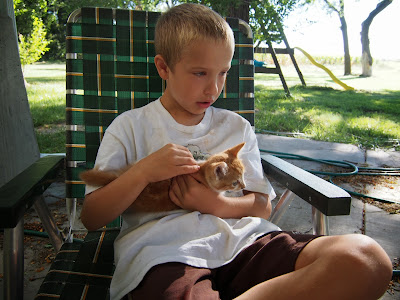
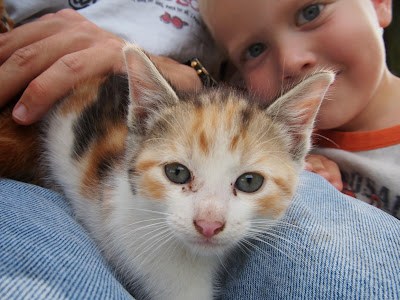
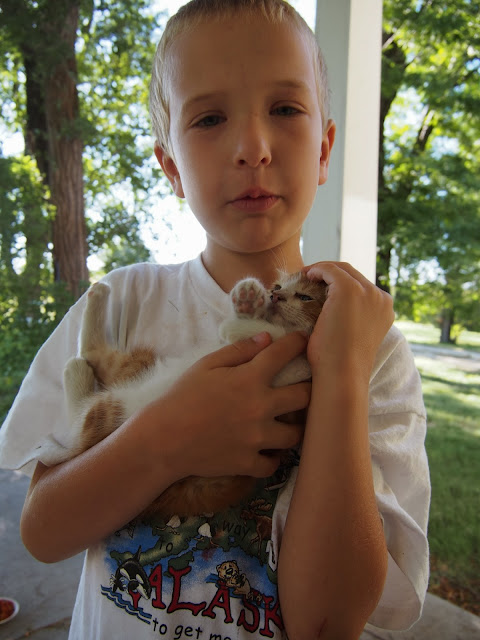
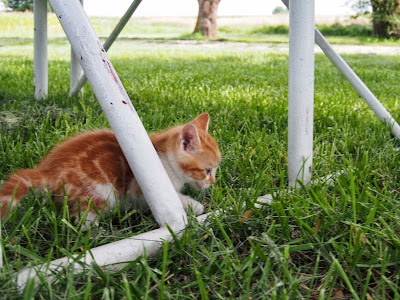
Almost every time he got off the bus for the past month and a half, Jacob started his afternoon in the same way. Before toys, before his trains and his toy bus, before anything indoors, he went for our cats. Here he is, cradling his favorite, Tigger: Laura and I both grew up around cats. We had been talking about kittens, and shortly after we got engaged, one of my relatives offered us some free kittens. We went to his place one evening and selected two of them one calico and one tiger-colored. Since what is now my place will soon be our place, they came to live with me. Our cats were one of the first things we did to prepare for our lives together. Oliver wanted to name them some rather impractical sentence-long names ( The Cat Who Always Likes To Run ), so Laura and I suggested some names from one of their favorite books: Tigger and Roo. They both liked the names, but Oliver thought they should be called Tigger the Digger and Roo the Runner . Never mind that they were just 6 weeks old at the time, and not really old enough to either dig or run. Here s Oliver with Roo, the day after the kittens arrived here. I have always had outside cats, both because I m allergic to cats so I need them to be outside, and because they sometimes literally quiver with joy of being outdoors. Tigger and Roo often chased insects, wrestled with each other, ran up (and slowly came back down) trees, and just loved the outside. Sometimes, I have taken my laptop and wireless headset and work from the back porch. The kittens climb up my jeans, inspect the laptop, and once Roo even fell asleep on my lap at one of those times. Jacob has been particularly attached to Tigger, calling him my very best friend. When Jacob picks him up after school, Tigger often purrs while cradled in Jacob s arms, and Jacob comments that Tigger loves me. Oh dad, he knows I am his friend! The kittens have been growing, and becoming more and more comfortable with their home in the country. Whenever I go outside, it isn t long before there are two energetic kittens near my feet, running back and forth, sometimes being very difficult to avoid stepping on. I call and I see little heads looking at me, from up in a tree, or peeking out from the grain elevator door, or from under the grill. They stare for just a second, and then start running, sometimes comically crashing into something in their haste. Yesterday when I went to give them food, I called and no cats came. I was concerned, and walked around the yard, but at some point either they come or they don t. Yesterday afternoon, just after the bus dropped off Jacob, I discovered Tigger on the ground, motionless. Once Jacob was in the house, I went to investigate, and found Tigger was dead. As I was moving his body, I saw Roo was dead, too. Both apparently from some sort of sudden physical injury a bit mysterious, because neither of them were at a place where they had ever gone before. While all this was happening, I had to also think about how I was going to tell the boys about this. I tried to minimize what he could see, Jacob had caught an unavoidable glimpse of Tigger as we were walking back from the bus, but didn t know exactly what had happened. He waited in the house, and when I came back, asked me if Tigger was dead. I said he was. Jacob started crying, saying, Oh Dad, I am so sad , and reached up for a hug. I picked him up and held him, then sat down on the couch and let him curl up on my lap. I could quite honestly let him know he wasn t alone, telling him I am sad, too. Oliver arrived not long after, and he too was sad, though not as much as Jacob. Both boys pretty soon wanted to see them. I decided this was important for them for closure, and to understand, so while they waited in the house, I went back out to arrange the kittens to hide their faces, the part that looks most unnatural after they die. The boys and I walked out to where I put them, then I carried both of them the last few feet. We stood a little ways back close enough to see who was there, far enough to not get too much detail and they were both sniffling. I tried to put voice to the occasion, saying, Goodbye, Tigger and Roo. We love you. Oliver asked if they could hear us. I said No, but I told them what I felt like anyway. Jacob, through tears, said, Dad, maybe they are in heaven now. We went back inside. Jacob said, Oh dad, I am so sad. This is the saddest day of my life. My heart is breaking. Hearing a 7-year-old say that isn t exactly easy for a dad. Pretty soon he was thinking of sort of comfort activities to do, saying I think I would feel better if we did So they decided to watch a favorite TV program. Jacob asked if Laura knew yet, and when I said no, he got his take-charge voice and said, Dad, you will start the TV show for us. While we are watching, you will send Laura an email to tell her about Tigger and Roo. OK? What could I say, it wasn t a bad idea. Pretty soon both boys were talking and laughing. It was Big Truck Night last night, at a town about half an hour away. It s an annual event we were already planning to attend, where all sorts of Big Trucks firetrucks, school bus, combine, bucket truck, cement truck, etc show up and are open for kids to climb in and explore. It s always a highlight for them. They played and sang happily as we drove, excitedly opened and closed the big door on the school bus and yelled All Aboard! from the top of the combine. We ate dinner, and drove back home. When we got home, Jacob mentioned the cats again, in a sort of matter-of-fact way, and also wanted to make sure he knew Laura had got the message. A person never wakes up expecting to have to dump a bowl of un-eaten cat food, or to give an impromptu cat funeral for little boys. As it was happening, I wished they hadn t been around right then. But in retrospect, I am glad they were. They had been part of life for those kittens, and it is only right that they could be included in being part of death. They got visual closure this way, and will never wonder if the cats are coming back someday. They had a chance to say goodbye. Here is how I remember the kittens.

Raphael Geissert: A bashism a week: maths

You've probably already done some basic maths in shell scripts, but do you know what else you can actually do?

Pick at least 4 operations that you can do in bashisms-free shell scripts:

$((n+1))
$((n>8))
$((n^4))
$((--n))
$((n*=5))
$((n++))
$((n==1?2:3))

The POSIX:2001 standard defines the arithmetic expansion requirements, which leads us to selecting all of the above operations except two:

$((--n))
$((n++))

"--" and "++" are not required to be implemented, and in some cases they may lead to unexpected results, such as the following:


$ bash -c 'n=1; echo $((++n))'
2
$ dash -c 'n=1; echo $((++n))'
1


Remember, if you rely on any non-standard behaviour or feature make sure you document it and, if feasible, check for it at run-time.

Next.

Previous.