Search Results: "ag"

8 March 2013

Michael Stapelberg: Replying to Debian BTS messages in notmuch

Previously, my workflow regarding replying to bugreports outside my own packages was very uncomfortable: I first downloaded the mbox archive from the BTS, then imported that in claws-mail, hit reply all, remove submit@, add bugnumber@, then send the email. Therefore, I decided to hack up a little elisp function to automate this process for notmuch. It first downloads the message from the BTS, adds it to the notmuch database, then calls notmuch-mua-reply on the message and fixes the To: header:
;; Removes submit@bugs.debian.org from the recipients of a reply-all message.
(defun debian-remove-submit (recipients)
  (delq nil
	(mapcar (lambda (recipient)
		  (and (not (string-equal (nth 1 recipient) "submit@bugs.debian.org"))
		       recipient))
		recipients)))
(defun debian-add-bugrecipient (recipients bugnumber)
  (let* ((bugaddress (concat bugnumber "@bugs.debian.org"))
	 (addresses (mapcar (lambda (x) (nth 1 x)) recipients))
	 (exists (member bugaddress addresses)))
    (if exists
	recipients
      (append (list (list (concat "Bug " bugnumber) bugaddress)) recipients))))
;; TODO: msg should be made optional and it should default to the latest message in the bugreport.
;; NB: bugnumber and msg are both strings.
(defun debian-bts-reply (bugnumber msg)
  ;; Download the message to ~/mail-copy-fs/imported.
  (let ((msgpath (format "~/mail-copy-fs/imported/bts_%s_msg_%s.msg" bugnumber msg)))
    (let* ((url (format "http://bugs.debian.org/cgi-bin/bugreport.cgi?msg=%s;mbox=yes;bug=%s" msg bugnumber))
	   (download-buffer (url-retrieve-synchronously url)))
      (save-excursion
	(set-buffer download-buffer)
	(goto-char (point-min)) ; just to be safe
	(if (not (string-equal
		  (buffer-substring (point) (line-end-position))
		  "HTTP/1.1 200 OK"))
	    (error "Could not download the message from the Debian BTS"))
	;; Delete the HTTP headers and the first "From" line (in order to
	;; make this a message, not an mbox).
	(re-search-forward "^$" nil 'move)
	(forward-char)
	(forward-line 1)
	(delete-region (point-min) (point))
	;; Store the message on disk.
	(write-file msgpath)
	(kill-buffer)))
    ;; Import the mail into the notmuch database.
    (let ((msgid (with-temp-buffer
		   (call-process "~/.local/bin/notmuch-import.py" nil t nil (expand-file-name msgpath))
		   (buffer-string))))
      (notmuch-mua-reply (concat "id:" msgid) "Michael Stapelberg <stapelberg@debian.org>" t)
      ;; Remove submit@bugs.debian.org, add <bugnumber>@bugs.debian.org.
      (let* ((to (message-fetch-field "To"))
	     (recipients (mail-extract-address-components to t))
	     (recipients (debian-remove-submit recipients))
	     (recipients (debian-add-bugrecipient recipients bugnumber))
	     (recipients-str (mapconcat (lambda (x) (concat (nth 0 x) " <" (nth 1 x) ">")) recipients ", ")))
	(save-excursion
	  (message-goto-to)
	  (message-delete-line)
	  (insert "To: " recipients-str "\n")))
      ;; Our modifications don t count as modifications.
      (set-buffer-modified-p nil))))
In case you want to get updates, you can find the latest version of this code in my configfiles git repository. To add a single message to the notmuch database and get its message ID, I have written this simple python script (using python-notmuch), located in ~/.local/bin/python-import.py:
#!/usr/bin/env python
# vim:ts=4:sw=4:et
import notmuch
import sys
if len(sys.argv) < 2:
    print "Syntax: notmuch-import.py <filename>"
    sys.exit(0)
db = notmuch.Database(mode=notmuch.Database.MODE.READ_WRITE)
(msg, status) = db.add_message(sys.argv[1])
print msg.get_message_id()
If you have any improvements, I d love to hear about it. If it s useful for you, enjoy.

Vasudev Kamath: Multi-Arch lintian check for font packages

I've provided a new patch #701061 for lintian to warn about font packages that are not marked as Multi-Arch foreign or allowed. Its already included in the lintian by Neils Thykier and will be part of version 2.5.12. The following tag has been implemented
font-package-not-multi-arch-foreign
A Bit of History for this implementation is as follows: We got a bug report on one of the fonts in pkg-fonts team that its not been installed in i386 architecture on a amd64 multi-arch system #694864. We were first confused but Daniel Kahn Gillmor pointed that we indeed need to mark all font packages as Multi-Arch foreign. He proposed that we should write a lintian check for this which I volunteered to do and then forgot!. Recently I was checking my QA page and landed into Ubuntu's page of my package where I saw they were patching imported font package and marking them as Multi-Arch: foreign and I suddenly remembered my promise! and this patch was the result of same enlightenment :-). Since there is huge number of font packages maintained by pkg-fonts devel we targeted this for Jessie release.
Here by I request all font package maintainers to consider marking their packages as Multi-Arch foreign. I also request people to join us on pkg-fonts-devel and help us doing this for all font packages maintained by the team, we really lack people in the team.

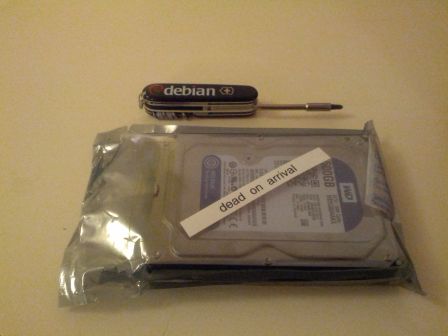
Sylvain Le Gall: Always test your HD first

I just received a WD 500GB Blue, to replace the hard drive of my wife's computer. First thing after unpacking: start to test. And I was right to do it... there are bad blocks on it. WD 500GB DOA The story: I tend to do proactive replacement of hard drive, to avoid losing too much data or be in hurry when the current one fails. There are two ways to monitor a hard drive: Logcheck is pretty straightforward to install. It scans your log every two hours and send you a report of what is happening. It is not a very precise tool and you have to tune it a little bit to just send you what is relevant (install extra rules to ignore what you know is not of interest). Whenever you start to see log entry like that:
Jan 24 18:16:08 foo kernel: [ 1965.343980] ata5.00: exception Emask 0x50 SAct 0x39 SErr 0x800 action 0x6 frozen
Jan 24 18:16:08 foo kernel: [ 1965.343991] ata5.00: irq_stat 0x08000000, interface fatal error
Jan 24 18:16:08 foo kernel: [ 1965.344001] ata5: SError:   HostInt  
Jan 24 18:16:08 foo kernel: [ 1965.344036] ata5.00: failed command: READ FPDMA QUEUED
Jan 24 18:16:08 foo kernel: [ 1965.344055] ata5.00: cmd 60/08:00:18:31:44/00:00:1a:00:00/40 tag 0 ncq 4096 in
Jan 24 18:16:08 foo kernel: [ 1965.344059]          res 40/00:2c:e6:c2:fd/00:00:26:00:00/40 Emask 0x50 (ATA bus error)
Jan 24 18:16:08 foo kernel: [ 1965.344071] ata5.00: status:   DRDY  
Jan 24 18:16:08 foo kernel: [ 1965.344081] ata5.00: failed command: WRITE FPDMA QUEUED
It is a good time to think about changing your hardrive -- but it is maybe too late. Smartmontools (aka smartd) is dedicated tool to monitor hard drives and do a good job. I think it is not installed by default in Debian, but it should be. It scans your hard drive for SMART capabilities and monitor the health of the HD using internal tools. In the case of bad blocks, you will start to see entry like that:
Feb 17 14:05:17 bar smartd[1268]: Device: /dev/sda [SAT], 1 Currently unreadable (pending) sectors
Feb 17 14:35:17 bar smartd[1268]: Device: /dev/sda [SAT], 1 Currently unreadable (pending) sectors
Obviously when you see this log, it is also a good time to change your hard drive. In the case of my wife's HD, I just got data from logcheck. It means that the error is not that important (transient failure, something is wrong but the HD can cope with it). But I still decided to get a new one for my wife. Whenever, I receive a new drive, the first thing I do is to check it for errors. You can do that using the program badblocks in write mode. It takes ages to test (count up to 1 day for 1TB on USB), but at the end you know that you have a good candidate -- where it is worth install your data. You just have to follow this procedure
  1. dmesg grep sd
  2. try to find what drive is the one you want to test in the output of 1.
  3. cfdisk /dev/sdX, sdX being the drive you want to test
  4. check that what you see in cfdisk is what you expect to test: right name and capacity for the drive
  5. sudo badblocks -wvs /dev/sdX
  6. run sudo tail -f /var/log/syslog in parallel just in case
  7. wait
If some errors appears in /var/log/syslog, you know something bad is happening. Whenever you have a single failing block, don't think it is ok. It is NOT ok for a HD to start its life with failing blocks. In this case, repack the drive and send it for replacement ASAP. In the case of my hard drive: smartd mail:
The following warning/error was logged by the smartd daemon:
Device: /dev/sda [SAT], 15 Currently unreadable (pending) sectors
syslog entries:
Mar  2 20:52:57 foo kernel: [ 8317.419715] ata4.00: exception Emask 0x0 SAct 0x1 SErr 0x0 action 0x0
Mar  2 20:52:57 foo kernel: [ 8317.419724] ata4.00: irq_stat 0x40000008
Mar  2 20:52:57 foo kernel: [ 8317.419732] ata4.00: failed command: READ FPDMA QUEUED
Mar  2 20:52:57 foo kernel: [ 8317.419747] ata4.00: cmd 60/80:00:00:af:08/00:00:28:00:00/40 tag 0 ncq 65536 in
Mar  2 20:52:57 foo kernel: [ 8317.419750]          res 41/40:00:65:af:08/00:00:28:00:00/40 Emask 0x409 (media error) <F>
Mar  2 20:52:57 foo kernel: [ 8317.419758] ata4.00: status:   DRDY ERR  
Mar  2 20:52:57 foo kernel: [ 8317.419764] ata4.00: error:   UNC  
Mar  2 20:52:57 foo kernel: [ 8317.423959] ata4.00: configured for UDMA/133
I am not blaming any particular brand (like Western Digital), all computer parts I have ever bought had to follow the same procedure and it is a known fact that computer parts as a non-zero percentage of chance to be DOA (dead on arrival) or after a few weeks. But as a consumer you should be aware of that and take action to avoid spending 10h configuring your computer to see it failing after a week... The waste of time to test is a win on the long term.

Petter Reinholdtsen: First Skolelinux / Debian Edu Squeeze update released

Last Sunday, 2013-03-03,, Holger Levsen announced the first update of Skolelinux / Debian Edu based on Debian Squeeze. This is the first update since the initial release 2012-03-11. This is the release announcement email from Holger:
Hi, it's my pleasure to announce the immediate availability of Debian Edu 6.0.7+r1 ("Debian Edu Squeeze"). Debian Edu 6.0.7+r1 is an incremental update to Debian Edu 6.0.4+r0, containing all the changes between Debian 6.0.4 and 6.0.7 as well Debian Edu specific bugfixes and enhancements. See below (in this mail) for the full list of (edu) changes. Please see http://www.debian.org/News/2012/20120311 for more information on "Debian Edu Squeeze". Images are available for download at http://ftp.skolelinux.org/skolelinux-cd/ md5sums:
1fe79eb4f0f9ae1c58fc318e26cc1e2e debian-edu-6.0.7+r1-CD.iso
a6ddd924a8bd9a1b5ca122e8fe1c34ec debian-edu-6.0.7+r1-DVD.iso
ac6c72cd7925ccec51bfbf58e2a7c69c debian-edu-6.0.7+r1-source-DVD.iso sha1sums:
a4b58233b672a99c7df8dc24fb6de3327654a5c3 debian-edu-6.0.7+r1-CD.iso
9b524915e0ff2aa793f13d93123e5bd2bab2dbaa debian-edu-6.0.7+r1-DVD.iso
43997614893fc5e9e59ad6ce066b05d07fd836fa debian-edu-6.0.7+r1-source-DVD.iso These images are suitable for amd64+i386. Changes for Debian Edu 6.0.7+r1 Codename "Squeeze", released 2013-03-03:
  • sitesummary was updated from 0.1.3 to 0.1.8
    • Make Nagios configuration more robust and efficient
    • Comply with 3.X kernel
  • debian-edu-doc from 1.4~20120310~6.0.4+r0 to 1.4~20130228~6.0.7+r1
    • Minor updates from the wiki
    • Danish translation now complete
  • debian-edu-config from 1.453 to 1.455
    • Fix /etc/hosts for LTSP diskless workstations. Closes: #699880
    • Make ltsp_local_mount script work for multiple devices.
    • Correct Kerberos user policy: don't expire password after 2 days. Closes: #664596
    • Handle '#' characters in the root or first users password. Closes: #664976
    • Fixes for gosa-sync:
      • Don't fail if password contains "
      • Don't disclose new password string in syslog
    • Fixes for gosa-create:
      • Invalidate libnss cache before applying changes
      • Multiple failures during mass user import into GOsa
      • gosa-netgroups plugin: don't erase entries of attribute type "memberNisNetgroup". Closes: #687256
      • First user now uses the same Kerberos policy as all other users
    • Add Danish web page
  • debian-edu-install from 1.528 to 1.530
    • Improve preseeding support and documentation
End-user documentation in English is available at http://wiki.debian.org/DebianEdu/Documentation/Squeeze/ - translations to French, Italian, Danish and German are available in the debian-edu-doc package. (Other languages could use your help!) If you want to contribute to Debian Edu, please join our mailinglist debian-edu@lists.debian.org!
I am very happy to see the fruits of a year of hard work. :)

Hideki Yamane: Re: checking package with clang

As I wrote before, I've posted a patch to BTS that add an option use clang compiler to pbuilder. However, pbuilder maintainer Junichi wasn't satisfied with it because he thought it seems to be overhead, introduce complexity and also hook script is enough.

I didn't agree with his opinion since I thought every time we need to add and remove its script, but Thorsten Glaser shows just specifying environment variables can solve it, and moreover, he points other compiler can be supported via hook, too. Sounds good, right? :)

Then I post a new hook script, it works with gcc-4. 4-8 and clang (gcc-4.8 needs experimental apt line for pbuilder). Please test it if you'd be interested.

Paul Tagliamonte: Ubuntu: The Community

Alas. The blogosphere has been slammed with discontent. Count me as one of them. It s been a long time since the last position (I ve held) of significance in Ubuntu, a LoCo Council Member, which I left with a heavy heart. I felt, at the time, that Ubuntu, The Community was no longer in control of Ubuntu The Distro . Technical opinions of Ubuntu community members started to get disregarded (starting with the gawd-awful Yahoo search switch), and it continued to get worse as Canonical stopped becoming a contributor to Ubuntu and started becoming it s sole guiding force. In comes the mess called Ubuntu One which, for the record, is a wrong name, it s not Ubuntu in any sense, it s not Community driven, it just uses Ubuntu as one of it s platforms. Trading on Ubuntu s good name started this mess. Slowly, like the ship of theseus, Canonical started to swap out bit by bit until nothing was left without Canonical assignment. I always assumed it was so that selling the code for another company to use the code for non-free purpose was the reason. Oh well. Look at us now: Starting off on an ill-thought out path because others are unwilling to say they just didn t understand the whole problem. This is a long way of saying: Ex-Ubuntu ers: You re welcome in Debian. I ve set up #ubuntu-expats on oftc. Please join us. You re welcome there. Working in Debian has been an absolute dream; it feels like contributing to Ubuntu in the early days. Come. Have a say. Re-join a Community that isn t just Like us on Facebook . I still consider myself an Ubuntu Community Member, but I don t think there s any community left.

7 March 2013

Pau Garcia i Quiles: Mark s divisive leadership

Mark Shuttleworth recently critized Jonathan Riddell for proposing Xubuntu and others join the Kubuntu community. I thought I could make a few amendments to Mark s writing:
Jonathan Mark says that Canonical Kubuntu is not taking care of the Ubuntu community.

Consider for a minute, Jonathan Mark, the difference between our actions.

Canonical Kubuntu, as one stakeholder in the Ubuntu community, is spending a large amount of energy to evaluate how its actions might impact on all the other stakeholders, and offering to do chunks of work in support of those other stakeholder needs.

You, as one stakeholder in the Ubuntu community, are inviting people to contribute less to the broader project [all the X and Wayland -based desktops], and more to one stakeholder [Unity and Mir].

Hmm. Just because you may not get what you want is no basis for divisive leadership.

Yes, you should figure out what s important to Kubuntu Ubuntu Unity and Mir, and yes, you should motivate folks to help you achieve those goals. But it s simply wrong to suggest that Canonical Kubuntu isn t hugely accommodating to the needs of others, or that it s not possible to contribute or participate in the parts of Ubuntu which Canonical Kubuntu has a particularly strong interest in. Witness the fantastic work being done on both the system and the apps to bring Ubuntu Plasma to the phone and tablet. That may not be your cup of tea, but it s tremendously motivating and exciting and energetic. See Mark? I only needed to do a little search and replace on your words and suddenly, meaning is completely reversed! Canonical started looking only after its own a couple of years ago and totally dumped the community. Many people have noticed this and written about this in the past two years. How dare you say Jonathan or anyone from Kubuntu is proposing contributing less to the broader community? The broader community uses X and/or Wayland. Canonical recently came with Mir, a replacement for X and Wayland, out of thin air. Incompatible with X and Wayland. No mention of it at all to anyone from X or Wayland. No mention of it at FOSDEM one month ago, even though I, as the organizer of the Cross Desktop DevRoom, had been stalking your guy for months because we wanted diversity (and we got it: Gnome, KDE, Razor, XFCE, Enlightenment, etc, we even invided OpenBox, FVWM, CDE and others!). I even wrote a mail to you personally warning you Unity was going to lose its opportunity to be on the stand at FOSDEM. You never answered, of course. Don t you think Mir, a whole new replacement for X and Wayland, which has been in development for 8 months, deserved a mention at the largest open source event in Europe? Come on, man. It is perfectly fine to say yes, Canonical is not so interested in the community. It s our way or the highway . But do not pretend it s anything else or someone else is a bad guy. In fact, is there any bad guy in this story at all!? I think there is not, it s just people with different visions and chosen paths to achieve them. Maybe Mir and Unity are great ideas, much better than X and Wayland. But that s not what we are talking about. We are talking about community, and Canonical has been steadily destroying it for a long time already. If you cannot or do not want to see that, you ve got a huge problem going on.

Daniel Pocock: This blog has upgraded to XCP, IPv6 and Debian 7.0 (wheezy)

If you noticed I hadn't updated the blog for a few days, you may have already anticipated that I've been up to something.... and you would be right. The virtualisation platform that powers this blog (and a lot more, including Lumicall and DruCall) has just been updated to Xen Cloud Platform (XCP) on Debian 7.0 (Wheezy, release candidate 1) The former platform was regular Xen with the xm toolstack on Debian 6.0 (squeeze) (and before that, lenny). The dom0 base system had been running uninterrupted for 720 days at the point I shut it down earlier this week - that is the typical timeframe between two major Debian releases, and it is also a firm endorsement of Debian's stability. Furthermore, the new setup is on new hardware with a new hosting provider, Init7 who offer native IPv6 in a secure Swiss data center. So I've taken the opportunity to add some AAAA records to my DNS, restart Apache and you can now access this blog with pure IPv6 As well as thanking Init7 for making the transition go very smoothly, I'd also like to point out a couple of other things that helped: using provider-independent (PI) IP addresses, and the sheer convenience of using tinc to securely bridge the VLANs in the old and new data centers for a week allowed this change to happen with hardly any downtime at all.

Vincent Sanders: Man cannot discover new oceans unless he has the courage to lose sight of the shore

Continuing with my whirlwind introduction to NetSurf Development now is the time to start examining the code, how its arranged and how to interact with the existing developers.

The way the NetSurf source is structured is around the idea of the frontends each being a native browser. While this implies that there are nine separate browsers that happen to share a common code base the separation is not quite that well defined.

Each frontend provides the OS entry point (the main() function in a c program) and calls out to standard browser initialisation entry function netsurf_init() and then starts running the browsers main dispatch loop with netsurf_main_loop() when that exits the frontend cleans up with netsurf_exit().

The frontends provide a large selection of functions which are called from the core code. These routines run from running the event scheduler through to rendering graphics and text.
Finding your way aroundThe browsers directory layout is fairly shallow consisting of some Makefiles, the nine frontend directories and eleven others.

The Makefiles are GNU make and represent a pretty straightforward linear build system. We do not use recursive make or autotools. There are plans to use the core buildsystem that all the other components use.

The frontend directories contain the code for the frontend and the makefile fragments to build them which are included by the top level Makefile.

In addition there is:
desktop
This contains the non frontend specific code that actually behaves like a browser. For example desktop/netsurf.c contains the three primary functions we outlined in the introduction. You will also find much of the function and data structures interfaces the frontend must provide. It is unlikely someone new to the project will need to change anything in here (there be dragons) but is an important set of routines.
utils
Here you will find the utility and compatibility interfaces, things like url handling, logging, user messages, base64 handling. These are utility interfaces that do not justify splitting out their functionality to a separate library but are useful everywhere. Changing an interface in here would likely result in a major refactor.
For example one quirk is the logging macro was created before varadic C preprocessor macros were universal so it must be called as LOG(("hello %s world", world_type)) e.g. with double brackets. Fixing this and perhaps improving the logging functionality would be "nice" but the changes would be massive and potentially conflict with ongoing work.
content
This contains all the core code to handle contents i.e. html, css, javascript, images. The handling includes retrieval of the resources from URI , correct caching of the received objects and managing the objects state. It should be explicitly stated that the content handlers are separate and use this core functionality. The actual content handlers to deal with object contents such as the routines to decode image files or render html are elsewhere.
image
This is where the content handlers for the various image types are kept. The majority of these image types (jpeg, png, webp, gif, bmp) use a standard library to perform the actual decode (libjpeg, libpng etc.). One special feature used by most image handlers is that of a decoded image cache which is distinct and separate from the content cache.
The decoded image cache manages decoding of the source images (the jpegs and pngs) into frontend specific "render" bitmaps. For example the gtk frontend keeps the decoded images as a cairo surface ready for immediate plotting.
The cache uses a demand based (when the browser actually displays the image) just in time strategy which has been carefully balanced, with real world input, to reduce the overhead of unnecessary image decoding and processing against memory usage for the render bitmaps.
css
The css content handlers provide for the processing of css source text and use the NetSurf libcss library to process into a bytecode suitable for applying style selection at render time.
javascript
The javascript handlers (strictly speaking this should be named the "script" directory as all types of script are handled here) provide basic functionality to bind a javascript engine to the rest of the browser, principally the Document Object Model (DOM) accessed with libdom. The only engine that currently has bindings is Spidermonkey from the Mozilla foundation.
render
This is the heart of the browser containing the content handler for html (and plain text). This handler deals with:
  • Acquiring the html.
  • Running the base parser as data arrives which generates the DOM and hence DOM events from which additional resource (stylesheets etc.) fetches are started.
  • Deal with script loading
  • Constructing the box model used for layout
  • Performing the Layout and rendering of the document.
Because this module has so many jobs to do it has inevitably become very complex and involved, it is also the principle area of core development . Currently NetSurf lacks a dynamic renderer so changes made by scripts post document load event are not visible. This also has the side effect that the render is only started after the DOM has finished construction and all the resources on a page have completed their fetch which can lead to undesirable display latency.
Docs
Documentation about building and using NetSurf. If anyone wants a place to start improving NetSurf, this is it, it is very incomplete. It must be noted this is not where dynamically generated documentation is found. For the current Doxygen output the best place to look is the most recent build on the Continuous Integration system.
resources
These are runtime resources which are common to all frontends. To be strictly correct they may be the sources which get converted into runtime resources e.g. The FatMessages file which is teh message text for all frontends in all languages, this gets processed at build time into separate files ready.
!NetSurf
This is another resources directory and technically the resources for the riscos frontend. The naming and reliance on this directory are historical. To allow the RISC OS frontend to be run directly from the source directory and an inability of RISC OS to process symbolic links most common runtime resources end up in here and linked to from elsewhere.
test
These are some basic canned test programs and files, principally to test elements of the utils and perform specific exercise of various javascript components.
Getting started
Once a developer has a checked out working build environment and can run the executable for their chosen frontend (and maybe done some web browsing :-) it is time to look at contributing.

If a developer does not have a feature or bug in mind when they begin the best way to get started is often to go bug hunting. The NetSurf bugtacker has lots to choose from unfortunately. Do remember to talk to us (IRC is the best bet if you are bug hunting) about what you are up to but do not be impatient. Some of those bugs are dirty great Shelob types and are not being fixed because even the core developers are stumped!

When first getting going I cannot recommend reading the code enough, this seems to be a skill that many inexperienced open source developers have yet to acquire, especially if they are from a predominately proprietary development background. One wonderful feature of open source software is you get to see all of it, all the elegant nice code and all the "what the hell were they thinking" code too.

One important point is to use your tools well the source is in git, if you learn how to use git well you will gain a skill that is readily portable, not just for NetSurf. And not just revision control tools, learn to use your debugger well and tools like valgrind. Those skills will replay the time spent learning them themselves many times over.

When using git one thing to remember is commit early and often, it does not matter if you have lots of junk commits and dead ends, once you have something viable you can use
git rebase --interactive
and rewrite it all into a single sensible set of commits. Also please do remember to develop on a branch, or if you did not
git pull --rebase
is your friend to avoid unnecessary merges.
Playing nicely with othersThe NetSurf community is a small band of unpaid volunteers. On average we manage to collectively put in, perhaps, ten hours a week with the occasional developer weekend where we often manage over twenty hours each.

The result is that developer time is exceptionally valuable, add in a mature codebase with its fair share of technical debt and you get a group who, when they get to work on NetSurf, are incredibly busy. To be fair we are just like every other small open source project in that respect.

What this means to a new contributor is that they should try and do their homework before asking the obvious questions. The documentation is there for a reason and in spite of its obvious shortcomings please read it!

When asking questions it should be noted that currently the majority of active contributors are in the Europe so if you visit the IRC channel or post questions to lists the time difference is something to keep in mind.

I carefully said contributor above and not developer, users trying the CI builds and reporting results are welcome...as long as they report useful bugs to the bug tracker. Simon Tatham has produced an excellent resource on this subject.

Also we are always happy to receive translations to new languages (diff against the FatMessages file would be outstandingly useful but anything is welcome), artwork, documentation. Just recall what I mentioned about busy developers. Surest way to get us to see something is the development mailing list, you will probably get a reply, though I will not promise how fast!

Some of the more common mistakes when interacting with the community are:
In conclusion
Hopefully this has been of some use although I had hoped to cover more and provide deeper insights and advice on the codebase but there is only so much generalisation to be done before it is just easier for the developer to go read the code for themselves.

I look forward to lots of new contributions :-) though I fear this may all end up as more of a crib sheet for next time we do GSOC, time will tell.

Vincent Sanders: The way to get started is to quit talking and begin doing

When Walt Disney said that he almost certainly did not have software developers in mind. However it is still good advice, especially if you have no experience with a piece of software you want to change.

Others have written extensively on the topic of software as more than engineering and the creative aspects, comparing it to a craft, which is a description I am personally most comfortable with. As with any craft though you have to understand the material you have to work with and an existing codebase is often a huge amount of material.

While developing NetSurf we get a lot of people who talk a lot about what we "ought" or "should" do to improve the browser but few who actually get off their collective posteriors and contribute. In fact according to the ohloh analysis of the revision control system there are roughly six of us who contribute significantly on a regular basis and of those only four who have interests beyond a specific frontend.

It has been mentioned by a couple of new people who have recently compiled the browser from source that it is somewhat challenging to get started. To address this criticism I intend to give a whirlwind introduction to getting started with the NetSurf codebase, perhaps we can even get some more contributors!

This first post will cover the mechanics of acquiring and building the source and the next will look at working with the codebase and the Netsurf community.

This is my personal blog, the other developers might disagree with my approach, which is why this is in my blog and not on the NetSurf website. That being said comments are enabled and I am sure they will correct anything I get wrong.
ResourcesNetSurf has a selection of resources which are useful to a new developer:
Build environmentThe first thing a new developer has to consider is their build environment. NetSurf supports nine frontends on several Operating Systems (OS) but is limited on the build environment that can be used.

The developer will require a Unix like system but let's be honest, we have not tried with anything other than Linux distributions in some time or MAC OS X for the cocoa frontend because its a special snowflake.

Traditionally at this point in this kind of introduction it would be traditional to provide the command line for various packaging systems to install the build environment and external libraries. We do have documentation that does this but no one reads it, or at least it feels like that. Instead we have chosen to provide a shell fragment that encodes all the bootstrap knowledge in one place, its kept in the revision control system so it can be updated.

To use: download it, read it (hey running random shell code is always a bad idea), source it into your environment and run ns-apt-get-install on a Debain based system or ns-yum-install on Fedora. The rest of this posting will assume the functionality of this script is available, if you want to do it the hard way please refer to the script for the relevant commands and locations.

For Example:
$ wget http://git.netsurf-browser.org/netsurf.git/plain/Docs/env.sh
$ less env.sh
$ source env.sh
$ ns-apt-get-install

Historically NetSurf built on more platforms natively but the effort to keep these build environments working was extensive and no one was prepared to do the necessary maintenance work. This is strictly a build setup decision and does not impact the supported platforms.

Since the last release NetSurf has moved to the git version control system from SVN. This has greatly improved our development process and allows for proper branching and merging we previously struggled to implement.

In addition to the core requirements external libraries NetSurf depends on will need to be installed. Native frontends where the compiled output is run on the same system it was built on are pretty straightforward in that the native package management system can be used to install the libraries for that system.

For cross building to the less common frontends we provide a toolchain repository which will build the entire cross toolchain and library set (we call this the SDK) direct from source. This is what the CI system uses to generate its output so is well tested.
External LibrariesNetSurf depends upon several external development libraries for image handling, network fetching etc. The libraries for the GTK frontend are installed by default if using the development script previously mentioned.

Generally a minimum of libcurl, libjpeg and libpng are necessary along with whatever libraries are required for the toolkit.
Project Source and Internal Libraries
One important feature of NetSurf is that a lot of functionality is split out into libraries. These are internal libraries and although technically separate projects, releases bundle them all together and for development we assume they will all be built together.

The development script provides the ns-clone function which clones all the project sources directly from their various git repositories. Once cloned the ns-make script can be used to build and install all the internal libraries into a local target ready for building the browser.

For Example:

$ source env.sh
$ ns-clone
$ ns-make-libs install
Frontend selectionAs I have mentioned NetSurf supports several windowing environments (toolkits if you like) however on some OS there is only one toolkit so the two get conflated together.

NetSurf currently has nine frontends to consider:
Building and running NetSurfFor a developer new to the project I recommend that the gtk version be built natively which is what I describe here.

Once the internal libraries have been installed, building NetSurf itself is as simple as running make.

For Example:
$ source env.sh
$ ns-make -C $ TARGET_WORKSPACE /$ NS_BROWSER TARGET=gtk

Though generally most developers would change into the netsurf source directory and run make there. The target (frontend) selection defaults to gtk on Linux systems so that can also be omitted Once the browser is built it can be run from the source tree to test.

For Example:
$ source env.sh
$ cd $ TARGET_WORKSPACE /$ NS_BROWSER
$ ns-make
$ ./nsgtk

The build can be configured by editing a Makefile.config file. An example Makefile.config.example can be copied into place and the configuration settings overridden as required. The default values can be found in Makefile.defaults which should not be edited directly.

Logging is enabled with the command line switch -v and user options can be specified on the command line, options on the command line will override those sourced from a users personal configuration, generally found in ~/.netsurf/Choices although this can be compile time configured.

6 March 2013

Keith Packard: composite-swap

Composite and Swap Getting it Right Where the author tries to make sure DRI3000 is going to do what we want now and in the future DRI3000 The basic DRI3000 plan seems pretty straightforward:
  1. Have applications allocate buffers full of new window contents, attach pixmap IDs to those buffers and pass them to the X server to get them onto the screen.
  2. Provide a mechanism to let applications know when those pixmaps are idle so that they can reuse them instead of creating new ones for every frame.
  3. Finally, allow the actual presentation of the contents to be scheduled for a suitable time in the future, generally synchronized with the monitor. Let the client know when this has happened in case they want to synchronize themselves to vblank.
The DRI3 extension provides a way to associate pixmap IDs and buffers, and given the MIT-SHM prototype I ve already implemented, I think we can safely mark this part as demonstrably implementable. That leaves us with a smaller problem, that of taking pixmap contents and presenting them on the screen at a suitable time and telling applications about the progress of that activity. In the absence of compositing, I m pretty sure the initial Swap extension design would do this job just fine, and should resolve some of the known DRI2 limitations related to buffer management. And, I think that goal is sufficient motivation to go and implement that. However, I wanted to write up some further ideas to see if the DRI3000 plan can be made to do precisely what we want in a composited world. The Composited Goal To make sure we re all on the same page, here s what I expect from the Swap extension in a composited world:
  1. Application calls Swap with new window pixmap
  2. Compositor hears about the new pixmap and uses that to construct a new screen pixmap
  3. Compositor calls Swap with new screen pixmap
  4. Vertical retrace happens, executing the pending swap operation
  5. Compositor hears about the swap completion for the screen
  6. Application hears about the swap completion for its window
In particular, applications should not hear that their swap operations are complete until the contents appear on the screen. This allows for applications to throttle themselves to the screen rate, either doing double or triple buffering as they choose. I didn t add steps here indicating buffers going idle or being allocated, because I think that should all happen behind the scenes from the application s perspective. Many applications won t care about the swap completion notification either, but some will and so that needs to be visible. Redirected Swaps? Owen Taylor suggested that one way of getting the compositor involved would be to have it somehow redirect Swap operations, much like we do with window management operations today. I think that idea may be a good direction to try:
  1. Application calls Swap with new window pixmap
  2. Swap is redirected to compositor, passing along the new window pixmap
  3. Compositor constructs a new screen pixmap using the new window pixmap
  4. Compositor calls Swap on the screen and the window, passing the new screen pixmap and the new window pixmap. When the screen update occurs, the screen and the window both receive swap completion events.
This has the added benefit that the X server knows when the compositor is expecting window pixmaps to change like this the compositor has to explicitly request Swap redirection. Window Pixmap Names and GEM Buffer Handles One issue that swapping window pixmaps around like this brings up is how to manage existing names for the window pixmap. Right now, applications expect that window pixmaps will only change when the window is resized. If the Swap extension is going to actually replace the window pixmap when running with a suitable compositor, then we need to figure out what the old names will reference. Are there non-compositor applications using NameWindowPixmap that matter to us? How about non-compositor applications using TextureFromPixmap to get a GEM handle for a window pixmap? For now, I m very tempted to just break stuff and see who complains, but knowing what we re breaking might be nice beforehand. Idling Pixmaps When an application is done drawing to a window pixmap and has passed it off to the X server for presentation, we d like for that pixmap to be automatically marked as discardable as soon as possible. This way, when memory is tight, the kernel can come steal those pages for something critical. Of course, applications may not want to let the server mark the pixmap as idle after being used, so a flag to the Swap call would be needed. Ideally, the pixmap would become idle immediately after the pixmap contents have been extracted. In the absence of a compositor, that would probably be when the Swap operation completes. With a compositor running, we d need explicit instruction from the compositor telling us that the window pixmap was now idle :
 
    SwapIdle
    drawable: Drawable
    pixmap: Pixmap
       
 
Furthermore, the application needs to know that the pixmap is in fact idle. I think that we ll need a synchronous X request that marks a buffer as no longer idle and have that return whether the buffer was discarded while idle. It doesn t seem sufficient to use events here as the application will need to completely reconstruct the pixmap contents in this case. This reply could also contain information about precisely what contents the pixmap does contain.
 
    SwapReuse
    drawable: Drawable
    pixmap: Pixmap
       
    valid: BOOL
    swap-hi: CARD32
    swap-lo: CARD32
 
Pixmap Lifetimes and Triple Buffered Applications If we redirect the Swap operation and send the original application window pixmap ID to the compositor, what happens when the application frees that pixmap before the compositor gets around to using the contents? Surely the Compositor must handle such cases, and not just crash. However, I m fine with requiring that the application not free the pixmap until told by the compositor.

5 March 2013

Michal &#268;iha&#345;: phpMyAdmin translations status

Next round of phpMyAdmin 4.0 translation status report is coming. So let's look at which translations are at 100% right now (some changes this week due to new strings to translate): Almost complete: As you can see, there is still lot of languages missing, this might be your opportunity to contribute to phpMyAdmin. Also you are welcome to translate phpMyAdmin 4.0 using translation server. If your language is already fully translated and you want to help as well, you can translate our documentation as well.

Filed under: English Phpmyadmin 0 comments Flattr this!

Debian Med: Debian Med sprint report (by Andreas Tille)

This is the report about my work at Debian Med sprint ten days ago in Sch nberger Strand. If you are interested in Sprints in general you might be interested in work item 2. below.
  1. Wrote draft article for Indian health care magazin. If you might like to proofread the article I'd be very happy (it is not yet to late for changes.) There is also a PDF version.
  2. I have given a short talk proving the importance of sprints. The slides are basically graphs and I try to prove that sprints are a really good idea. The background knowledge is that the Debian Med team is doing sprints since 2011 and looking at all graphs you can see that this has a really positive effect. Thanks to Debian and its sponsors for supporting this kind of sprints.
  3. Packaging
    • Worked with T. Travis on flexbar and uploaded the package to new queue
    • Worked with Ch. Gille on strap-base and uploaded the package to new queue
    • Discussed strategy how to strip glam2 source from meme upstream with T. Booth. Meme upstream agreed to keep the original license of Glam2 and backport the changes from Meme source archive
    • Discussed igv packaging issues with O. Sallou who updated the package and documented some issues about its dependency goby
    • Worked together with I. Maintz on cellprofiler
    • Worked together with I. Maintz on a couple of R packages which are mostly predependencies but also one Debian Med primary target (r-cran-boolnet) was uploaded to new
  4. Discussing / chatting
    • Some chat with Ch. Steigies (Debian Games, Debian m68k, Debian Science)
    • Discussion with M. Banck about DebiChem
  5. Little bit of MoM mentoring
  6. Maintain Debian Med tasks files about newly commited packages of other sprint participants
  7. General infrastucture issues
    • Issues with machine-readable files importer into UDD
    • Try to revive PET data in UDD
    • Work on installation of future blends.debian.net host (install needed packages, create UDD clone)
Thanks to all participants of the sprint and specifically to Steffen M ller who took over the work of organising. It was fun to meet you all and I'm even looking right now forward to the next sprint hopefully beeing able to continue the graphing of positive results of sprints in our team metrics.
We had some nice food, not so nice weather and from my perspective the only drawback was that at home there would have been perfect conditions for skiing ... but finally there are preferences. ;-)
See you at next sprint!

Tanguy Ortolo: Suspend your computer from a non-mainstream desktop environment

Battery icon UPower for regular users Major desktop environments usually provide a user-friendly menu to suspend your computer. Internally, if seems to use something called UPower, which uses something called PolicyKit, which in turn may or may not use another piece called ConsoleKit (do not ask me what all these pieces are and how they relate to each other, I do not know and I do not want to know). For the regular user, the result is the following: when they click on that button, it suspends their computer.UPower for command line users However, if you are using a more unusual desktop environment, for instance a simple, light window manager, you will not have such a button. And no, UPower does not provide a simple command line tool to suspend your computer (they probably consider that command line is out of fashion ). Well, in case you need it, here is a way to suspend your computer from a command line or whatever: just alias it or bind it to a key shortcut. It uses some dark DBus magic:
$ dbus-send --system --print-reply --dest='org.freedesktop.UPower' \
    /org/freedesktop/UPower org.freedesktop.UPower.Suspend
If you prefer to hibernate your computer, that is, to suspend it, not to RAM but to disk:
$ dbus-send --system --print-reply --dest='org.freedesktop.UPower' \
    /org/freedesktop/UPower org.freedesktop.UPower.Hibernate
As you can see, for some reason it requires some duplication of information: the name org.freedesktop.UPower appears three times in that command line: in the destination , object path and interface member , whatever that could mean. Again, do not ask me why, I know nothing about that and I do not want to. Notes
  1. Actually, UPower does provide a command line tool called upower, but the only thing it does (monitoring power sources) is not really useful for that matter.

Martin Pitt: Automatically generating documentation from GIR files

Many libraries build a GObject introspection repository (*.gir) these days which allows the library to be used from many scripting (Python, JavaScript, Perl, etc.) and other (e. g. Vala) languages without the need for manually writing bindings for each of those. One issue that I hear surprisingly often is there is zero documentation for those bindings . Tools for building documentation out of a .gir have existed for a long time already, just far too many people seem to not know about them. For example, to build Yelp XML documentation out of the libnotify bindings for Python:
  $ g-ir-doc-tool --language=Python -o /tmp/notify-doc /usr/share/gir-1.0/Notify-0.7.gir
Then you can call yelp /tmp/notify-doc to browse the documentation. You can of course also use the standard Mallard tools to convert them to HTML for sticking them on a website:
  $ cd /tmp/notify-doc
  $ yelp-build html .
Admittedly they are far from pretty, and there are still lots of refinements that should be done for the documentation itself (like adding language specific examples) and also for the generated result (prettification, dynamic search, and what not), but it s certainly far from nothign , and a good start. If you are interested in working on this, please show up in #introspection or discuss it on bugzilla, desktop-devel-list@, or the library specific lists/bug trackers.

Lisandro Dami&aacute;n Nicanor P&eacute;rez Meyer: My Debian freeze experience (so far)

This is the first freeze in which I'm involved with upload rights. And it turned out to be a quite interesting ride so far, so I thought it would be nice to write about it.

As some of you may know, I'm a part of the Qt/KDE team. Before the freeze I was mostly involved in leaf packages, with some patch here or there, nothing fancy. And then the freeze came...

Bugs in Qt

...and bugs appeared in Qt. But they didn't get solved, even if the patches were there. Due to personal reasons, the manpower in Qt/KDE land decreased below normal levels (which were already low).

I took the time to review them, apply them in a local branch, build and test the fixes. I did a Qt upload before, but it was a team-consented one. This time there was not much reaction in our IRC channel as it used to be, so I was doubting if going ahead or not. I asked Ana, my great friend and former sponsor, for an opinion on the subject, and she gave me a really important advice: the patches were looking good and there is one really big true: if something get's broken, it can be fixed with a later upload.

You might be asking yourself why I was that afraid of doing the upload. Well, when one maintains such a medular package for many users one has to be careful And I also got used that those "big ones" like Qt where normally handled by hand skilled people. Do not take me wrong here, it's not that those people where keeping them for themselves, it's knowing that one does not has the same skills nor experience as them.

But again, no one was able to upload and I had the chance and will to do another upload if needed, so off it went. That was Qt 4:4.8.2-2.

Then new experiences followed: asking a buildd maintainer for a giveback, asking the Release Team for an unblock (more on this later), etc. While sponsoring me, Ana gave me another excellent advice which I always keep in my mind:

You can't know **everything** about Debian.

And that also includes a not so technical skill: communicating with other teams. But finally we got this new version of Qt in testing. Cool :-)

Of course, new bugs appeared, and my lack of skills (and sometimes, time) where replaced by team work: Pino looking at patches and Sune contacting upstream. The eleven uploads that followed are a nice example of team work, even if I was the one who signed and did the uploads. Whoever uses Qt must know that these wonderful people (including those who are not so active nowadays like Modestas or Fathi) have done lots to bring the better to their users.Thank you guys!

Be careful, they might bite you back!

Coming back to the non-technical skills, sometimes you have to communicate with other teams in Debian. And each team is (naturally) a separate world: possibly different people, different goals, etc. Of course, we share the goal to make Debian the best experience we can, but we do not necessarily agree on the paths to achieve so.

During the freeze, there is a team that gets lots of pressure, and not by chance: the Release Team. They handle a very important task, which is to ride the freeze to get to a release. OK, that's what everyone knows. Now, one thing is knowing that and another is really understanding what does that means.

Of course I was in the first group. From the outside, communicating with the RT was a kind of "special art", and not an easy one. I have even been advised to not ask for more than one or two unblocks per weekend, as they might "bite me back". So I put on my flamesuit on and... launched reportbug release.debian.org.

Now I'm really happy to say that my experience was far from what I described above. And yes, I had the chance to even disagree on some stuff. But remember: non-technical skills, a.k.a. social skills. Once I started to know what was going on inside the RT (joining #debian-release was a big help for that) I learnt some nice tips to approach them. Please allow me to list some of them:

  • Remember: you are the maintainer of the package, they are like gatekeepers that are there to help us coordinate to do a release. But they don't maintain the code, you do that. So try to be verbose when needed, explain the changes and don't forget a nice diff. They need to understand what is going on: they can't read your mind.
  • They are human beings too: not everyday might be their best day (the same goes for you too!). And they are under the pressure of a release. Be patient, that finally pays off.
  • Does your changes seem not so clear? try to improve them.
  • The package has a lot of changes but you really feel they are needed? Try to explain that as good as you can.
  • Try to put yourself in their position: do we really want this? If in doubt, there is a nice way to know what they think: a pre-approval bug.
I want to make a stop in this last point. A pre-approval bug it's an unblock bug in which you edit the subject to add "pre-approval" in it. Easy, isn't it? It gives you the opportunity to know what the RT thinks before doing the upload. In other words: it gives you the chance to communicate and do things in the best possible way for all the parts involved.

I've have also seen pre-approval bugs that were really not needed. But to learn where the threshold of what can be directly uploaded and what deserves a pre-approval bug is you need to know the guidelines the RT gives you. Do you still have doubts? fire a pre-approval bug and try to be clear.

Of course, this are all fruits of my experience with the RT during this time. If the RT thinks different from what I'm writing here, please stand up: we are hear to listen to you and learn :-)

As a side note, I think I should file a wishlist bug to include the pre-approval bug option in reportbug. Yes, I'm lazy :-)

Summing up

Overall this was a very nice and positive experience. We are not done yet. Are we really done at some point? Let's hope not, because this is where the fun comes from :-)

Russell Coker: Kogan Mobile

Kogan Mobile is the newest virtual telco in Australia [1]. They resell Telstra 3G (not NextG or LTE) and while their coverage isn t as good as the full Telstra service it s more than adequate for my needs as they provide 3G coverage to 97% of the population and 2G+3G coverage to 98.5%. Their coverage is probably a lot better than Three who had the worst record of network coverage in Australia yet managed to always provide coverage where I wanted it I was a happy Three customer for more than 6 years. Kogan s main selling point is that they offer unlimited calls to Australian mobile phones and land-lines and unlimited SMS for a pre-paid fee of only $300 per annum ($25 per month on average). My parents have been getting unpleasantly large phone bills which have considerably more than $25 of calls to mobile phones every month so an obvious solution for them is to sign up for a Kogan mobile phone and use it for all such calls. There are other ways my parents could save money on calls (such as VOIP) but a mobile phone is easiest and offers other benefits such as running Android apps (when compared to using a non-smart phone). 6G of Data! Kogan also offers 6G of data per month, the down-side to this is that they bill in 1MB increments per session . I was worried that this might be per TCP connection or something else silly but I decided to sign my parents up for it as they aren t going to use a lot of data (they claim that they don t want to use the Internet on their phone but I know better). I ve done some tests on the SIM I got for my parents. For testing purposes I installed the Kogan SIM in my wife s new Nexus 4 and had it provide Wifi net access to my phone while we were playing Ingress. So far after 2 days which involved a reasonable amount of Ingress (I reached level 7) as well as all the usual stuff that happens in the background for two phones (checking email, news, weather, etc) Kogan considers that 177MB have been used out of the 6144MB for the month, which means that even with what is an unusual amount of traffic for us the account in question still isn t going to use half the quota for the month. Now that 10 days have elapsed with less intense usage Kogan considers that a total of 1373MB have been used.
days received sent Kogan
2 127.24 41.54 177
10 959.39 299.6 1373
Kogan also don t seem to mention whether they bill for transmitted data. I used the 3G Watchdog app to measure the amount data transferred, the above table has the amounts of data that 3G Watchdog considers were sent and received along with the amount that is listed by the Kogan Android app. My past experience with 3G Watchdog and Virgin Mobile is that it s usually quite accurate but has been over-reporting the data transfers recently (I think that Virgin is only billing me for downloads while 3G Watchdog counts uploads). So the relatively small difference between the 3G Watchdog report and what Kogan thinks I ve done means that either rounding the session up to the nearest meg doesn t make any significant difference (which would imply that a session can be a long time) or that Kogan isn t counting uploaded data and the session rounding up only adds about 40% to the total recorded transfer. My current plan with Virgin Mobile gives me 1.5G per month of quota, so as long as Kogan s rounding doesn t increase the recorded data transfer by a factor of 4 I will still be able to transfer more data with Kogan while paying less. One disadvantage of using Kogan is that I might have to tweak programs like my email program to poll less frequently to avoid excessive session charges (a program polling every 5 minutes would use up the 6G quota in 21 days if each poll counted as a session) although current tests indicate that this won t be necessary. But the up-side is that there are no extra fees with Kogan, they merely restrict data access for my use and that of most people I know it s better to have data access cut off than to receive a large bill. The Kogan Android App Kogan has an Android app that will give the status of your account and allow you to change the plan etc. This is quite nice but one major disadvantage is that it s also a sales app for the Kogan online store. This is bad for the user as some aspects of what I consider the core functionality are limited (for example there s no way to force a poll of the data usage count or determine how current the data is). But there s an obvious advantage to Kogan in providing a way to sell their goods that is going to be used by every customer of Kogan Mobile. The sales part of the app isn t very functional IMHO, it doesn t seem to have basic functionality such as sorting a list of items by price. Benefits of Kogan 6G of data is a lot! $300 per annum is quite cheap, anyone who makes any serious use of phones will be paying more than that in Australia. Lack of extra fees means that there is little need to restrict net access. I can risk getting cut off near the end of the month but I can t risk the potential for hundreds of dollars in excess fees. The Kogan app shows me the data used so I will probably uninstall 3G Watchdog, having one less program running is a good thing. You get a free SIM (value $5) when you buy a phone from Kogan. Disadvantages of Kogan They are new to the Telco business and admit that their customer service is lacking due to unexpected demand. If you order a SIM now they state that it will arrive in April. Apparently they are deliberately delaying orders because they can t cope with demand. The included call quota doesn t include international calls. While unlimited free calls in Australia is great if you make many international calls then this could end up costing you more. Other mobile telcos such as Lebara offer good deals for International calls, it could be an option to use a Lebara SIM with an old non-smart phone while using Kogan for your smart phone. I am concerned about the lack of detail about how data is accounted. If the definition of a session changes then 6G could turn out not to be enough. As Kogan is reselling a Telstra service it is possible that Telstra could change the deal without Kogan being able to stop them. Conclusion I will move my phone and my wife s phone to Kogan ASAP. My general idea is to sign us up for Kogan about 2 weeks apart, so if one phone runs out of the 6G data quota then the other phone can be used as a Wifi access point for 2 weeks. If the phones don t both have their quota end at the same time then there is less chance of both phones running out during a high traffic month.

4 March 2013

Bastian Blank: Using SECCOMP to filter sync operations

Linux includes a syscall filter since a long time. It was restricted to a pre-defined set of syscalls. Since some versions Linux got a more generic filter. Linux can use a BPF-filter to define actions for syscalls. This allows a fine granular specification on which syscalls to act. Also it supports different outcomes assigned to the filter. This filter can be used to filter out sync operations. Debian already got a tool to do this called eatmydata. It is pretty limited as it uses a shared library to drop the library functions. It needs to be available at all times, or it will not do anything. I wrote a small tool that asks the kernel to filter out sync operations for all children. It sets a filter with all currently supported sync-like operations and makes them return success. However it can't filter the O_SYNC-flag from the open-syscall, so it just makes it return an error. It executes the command given on the command-line after that. This is just a proof of concept, but lets see.
/*
 * Copyright (C) 2013 Bastian Blank <waldi@debian.org>
 *
 * Redistribution and use in source and binary forms, with or without
 * modification, are permitted provided that the following conditions are met:
 *
 * 1. Redistributions of source code must retain the above copyright notice, this
 *    list of conditions and the following disclaimer.
 * 2. Redistributions in binary form must reproduce the above copyright notice,
 *    this list of conditions and the following disclaimer in the documentation
 *    and/or other materials provided with the distribution.
 *
 * THIS SOFTWARE IS PROVIDED BY THE COPYRIGHT HOLDERS AND CONTRIBUTORS "AS IS" AND
 * ANY EXPRESS OR IMPLIED WARRANTIES, INCLUDING, BUT NOT LIMITED TO, THE IMPLIED
 * WARRANTIES OF MERCHANTABILITY AND FITNESS FOR A PARTICULAR PURPOSE ARE
 * DISCLAIMED. IN NO EVENT SHALL THE COPYRIGHT OWNER OR CONTRIBUTORS BE LIABLE FOR
 * ANY DIRECT, INDIRECT, INCIDENTAL, SPECIAL, EXEMPLARY, OR CONSEQUENTIAL DAMAGES
 * (INCLUDING, BUT NOT LIMITED TO, PROCUREMENT OF SUBSTITUTE GOODS OR SERVICES;
 * LOSS OF USE, DATA, OR PROFITS; OR BUSINESS INTERRUPTION) HOWEVER CAUSED AND
 * ON ANY THEORY OF LIABILITY, WHETHER IN CONTRACT, STRICT LIABILITY, OR TORT
 * (INCLUDING NEGLIGENCE OR OTHERWISE) ARISING IN ANY WAY OUT OF THE USE OF THIS
 * SOFTWARE, EVEN IF ADVISED OF THE POSSIBILITY OF SUCH DAMAGE.
 */
#define _GNU_SOURCE 1
#include <errno.h>
#include <fcntl.h>
#include <seccomp.h>
#include <stdio.h>
#include <stdlib.h>
#include <string.h>
#include <unistd.h>
#define filter_rule_add(action, syscall, count, ...) \
  if (seccomp_rule_add(filter, action, syscall, count, ##__VA_ARGS__)) abort();
static int filter_init(void)
 
  scmp_filter_ctx filter;
  if (!(filter = seccomp_init(SCMP_ACT_ALLOW))) abort();
  if (seccomp_attr_set(filter, SCMP_FLTATR_CTL_NNP, 1)) abort();
  filter_rule_add(SCMP_ACT_ERRNO(EINVAL), SCMP_SYS(open), 1, SCMP_A1(SCMP_CMP_MASKED_EQ, O_SYNC, O_SYNC));
  filter_rule_add(SCMP_ACT_ERRNO(0), SCMP_SYS(fsync), 0);
  filter_rule_add(SCMP_ACT_ERRNO(0), SCMP_SYS(fdatasync), 0);
  filter_rule_add(SCMP_ACT_ERRNO(0), SCMP_SYS(msync), 0);
  filter_rule_add(SCMP_ACT_ERRNO(0), SCMP_SYS(sync), 0);
  filter_rule_add(SCMP_ACT_ERRNO(0), SCMP_SYS(syncfs), 0);
  filter_rule_add(SCMP_ACT_ERRNO(0), SCMP_SYS(sync_file_range), 0);
  return seccomp_load(filter);
 
int main(__attribute__((unused)) int argc, char *argv[])
 
  if (argc <= 1)
   
    fprintf(stderr, "usage: %s COMMAND [ARG]...\n", argv[0]);
    return 2;
   
  if (filter_init())
   
    fprintf(stderr, "%s: can't initialize seccomp filter\n", argv[0]);
    return 1;
   
  execvp(argv[1], &argv[1]);
  if (errno == ENOENT)
   
    fprintf(stderr, "%s: command not found: %s\n", argv[0], argv[1]);
    return 127;
   
  fprintf(stderr, "%s: failed to execute: %s: %s\n", argv[0], argv[1], strerror(errno));
  return 1;
 

Michal &#268;iha&#345;: Nice OpenStreetMap project

For quite some time, I'm contributing to OpenStreetMap. Mostly covering areas where I live or I know well, but sometime I randomly update areas where I travel as well. The one important bit was always missing for me - nice frontend to render many of hidden features. Now this space seems to be slowly filled in by map1.eu. This quite new project (first announcement has been two weeks ago) renders quite nice maps for Europe. The map is primarily intended for hiking or cycling, so it includes things like hiking routes or cycle routes. In Czech republic we have quite great maps on mapy.cz, but I don't know anything what covers whole Europe. The project still has some issues, but is progressing nicely as you can see in today's announcement of 0.2 release (in Czech). Of course you can help, either by code or by money, which is needed to run rendering servers.

Filed under: English Maps 0 comments Flattr this!

Lucas Nussbaum: Debian is (still) changing

(Looking for those graphs online, I realized that I never properly published them, besides that old post) I ve been playing with snapshot.d.o, which is a fantastic resource if you want to look at Debian from an historical perspective (well, since 2005 at least). Team maintenance comaint
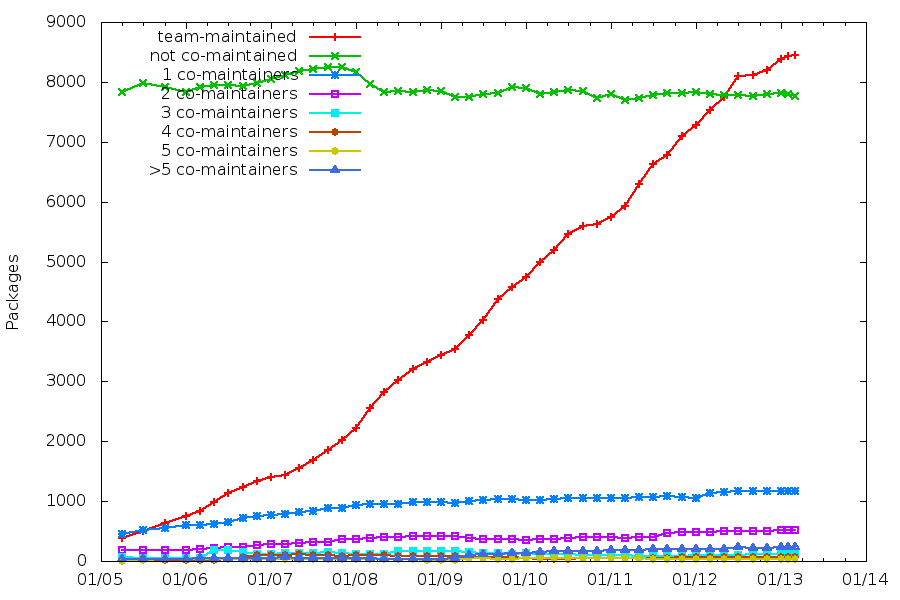
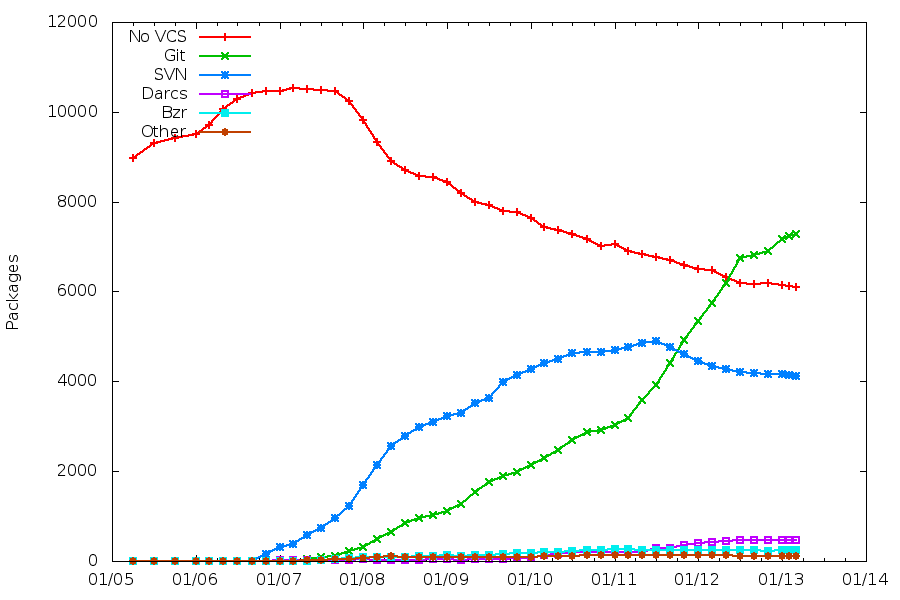
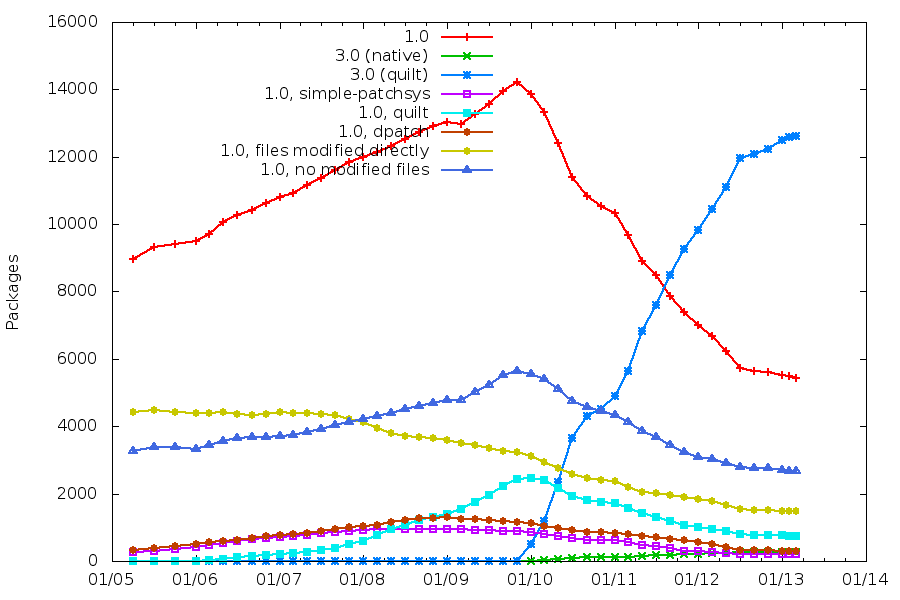
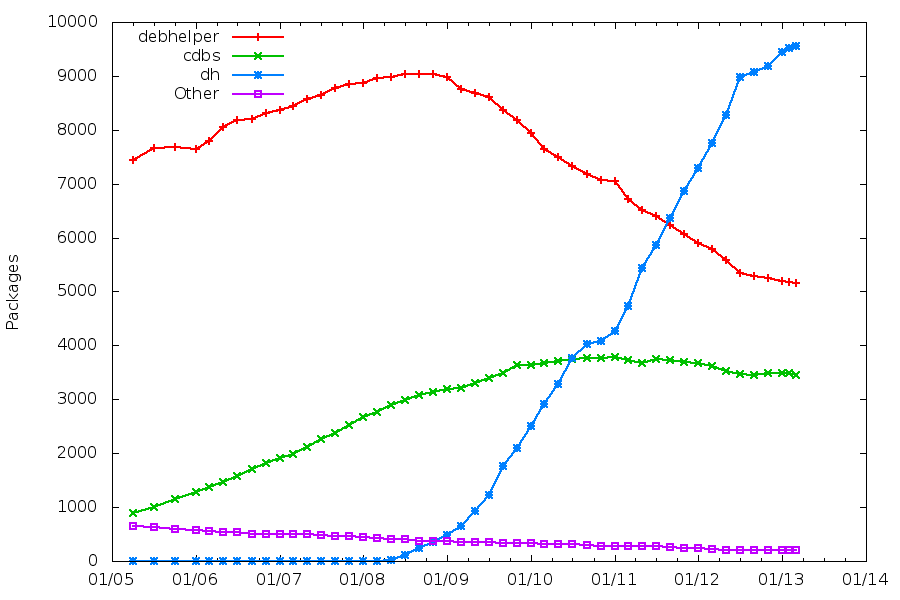
We now have more team-maintained packages than packages maintained by someone alone. Interestingly, the small, ad-hoc group of developers model does not really take off. Maintenance using a VCS vcs A large majority of our packages are maintained in a VCS repository, with Git being the clear winner now. Possible goal for Jessie: standardize on a Git workflow, since every team tends to design its own? Packaging helpers helpers Again, we have a clear winner here, with dh. It s interesting to note that, while dh was designed as a CDBS killer, it kind-of fails in that role. Possible goal for Jessie: deprecate at least pure-debhelper packaging? Patch systems and packaging formats formats-patches Again, clear winner with 3.0 (quilt). The (dirty) scripts that generate those graphs are available in Git (but you need to connect to stabile to execute them, and it s rather time consuming hours/days).
Next.

Previous.