Search Results: "sf"

17 October 2017

Antoine Beaupr : A comparison of cryptographic keycards

An earlier article showed that private key storage is an important problem to solve in any cryptographic system and established keycards as a good way to store private key material offline. But which keycard should we use? This article examines the form factor, openness, and performance of four keycards to try to help readers choose the one that will fit their needs. I have personally been using a YubiKey NEO, since a 2015 announcement on GitHub promoting two-factor authentication. I was also able to hook up my SSH authentication key into the YubiKey's 2048 bit RSA slot. It seemed natural to move the other subkeys onto the keycard, provided that performance was sufficient. The mail client that I use, (Notmuch), blocks when decrypting messages, which could be a serious problems on large email threads from encrypted mailing lists. So I built a test harness and got access to some more keycards: I bought a FST-01 from its creator, Yutaka Niibe, at the last DebConf and Nitrokey donated a Nitrokey Pro. I also bought a YubiKey 4 when I got the NEO. There are of course other keycards out there, but those are the ones I could get my hands on. You'll notice none of those keycards have a physical keypad to enter passwords, so they are all vulnerable to keyloggers that could extract the key's PIN. Keep in mind, however, that even with the PIN, an attacker could only ask the keycard to decrypt or sign material but not extract the key that is protected by the card's firmware.

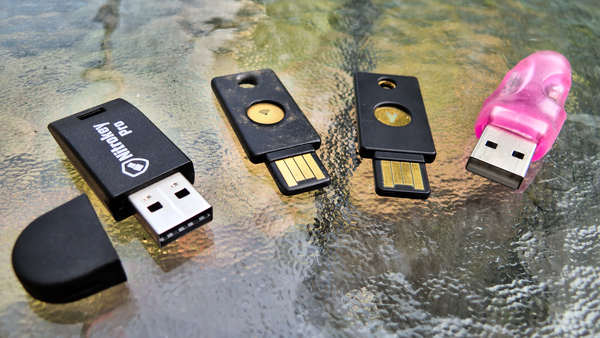
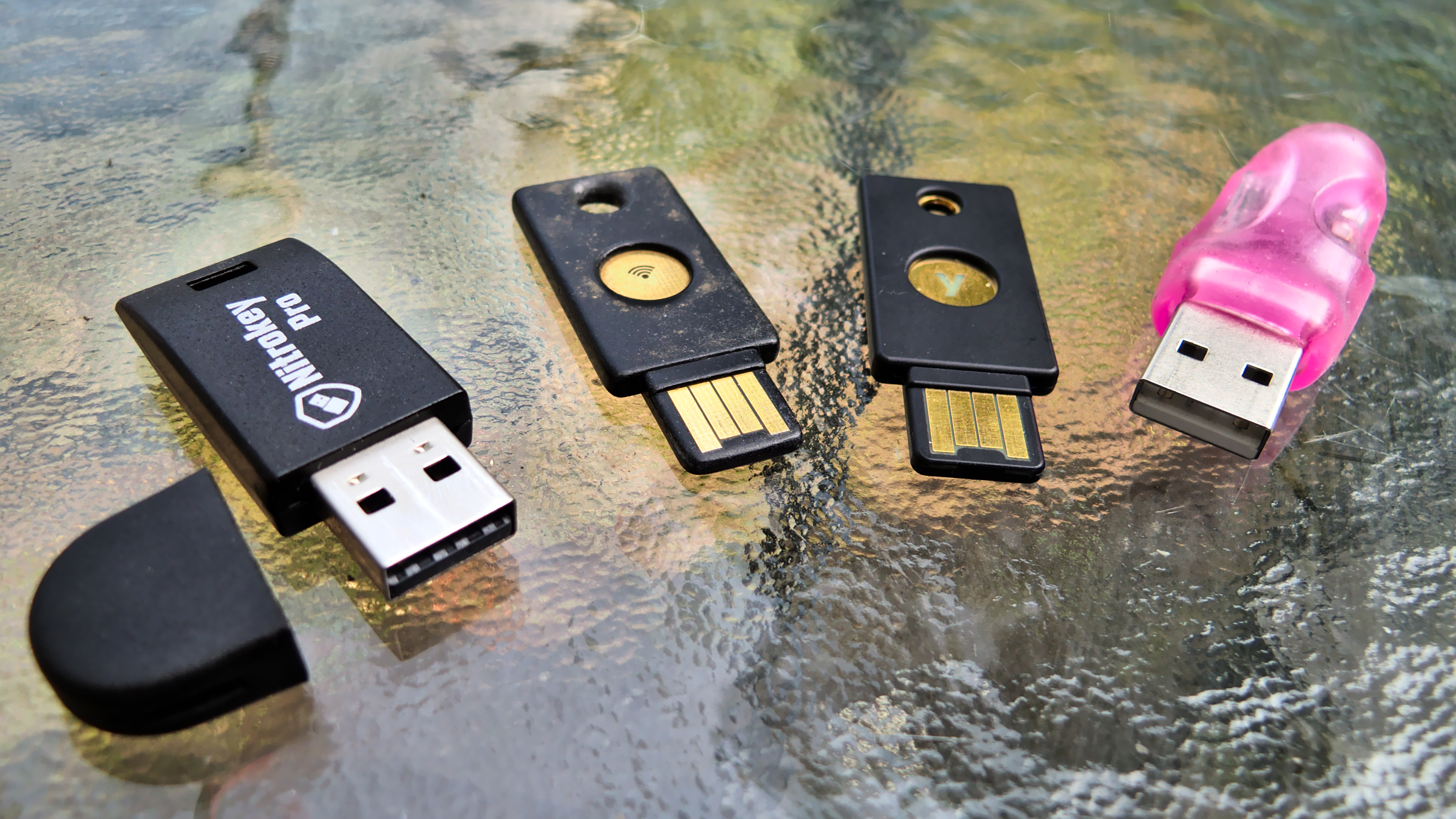
Form factor The Nitrokey Pro, YubiKey NEO (worn out), YubiKey 4, and FST-01 The four keycards have similar form factors: they all connect to a standard USB port, although both YubiKey keycards have a capacitive button by which the user triggers two-factor authentication and the YubiKey 4 can also require a button press to confirm private key use. The YubiKeys feel sturdier than the other two. The NEO has withstood two years of punishment in my pockets along with the rest of my "real" keyring and there is only minimal wear on the keycard in the picture. It's also thinner so it fits well on the keyring. The FST-01 stands out from the other two with its minimal design. Out of the box, the FST-01 comes without a case, so the circuitry is exposed. This is deliberate: one of its goals is to be as transparent as possible, both in terms of software and hardware design and you definitely get that feeling at the physical level. Unfortunately, that does mean it feels more brittle than other models: I wouldn't carry it in my pocket all the time, although there is a case that may protect the key a little better, but it does not provide an easy way to hook it into a keyring. In the group picture above, the FST-01 is the pink plastic thing, which is a rubbery casing I received along with the device when I got it. Notice how the USB connectors of the YubiKeys differ from the other two: while the FST-01 and the Nitrokey have standard USB connectors, the YubiKey has only a "half-connector", which is what makes it thinner than the other two. The "Nano" form factor takes this even further and almost disappears in the USB port. Unfortunately, this arrangement means the YubiKey NEO often comes loose and falls out of the USB port, especially when connected to a laptop. On my workstation, however, it usually stays put even with my whole keyring hanging off of it. I suspect this adds more strain to the host's USB port but that's a tradeoff I've lived with without any noticeable wear so far. Finally, the NEO has this peculiar feature of supporting NFC for certain operations, as LWN previously covered, but I haven't used that feature yet. The Nitrokey Pro looks like a normal USB key, in contrast with the other two devices. It does feel a little brittle when compared with the YubiKey, although only time will tell how much of a beating it can take. It has a small ring in the case so it is possible to carry it directly on your keyring, but I would be worried the cap would come off eventually. Nitrokey devices are also two times thicker than the Yubico models which makes them less convenient to carry around on keyrings.

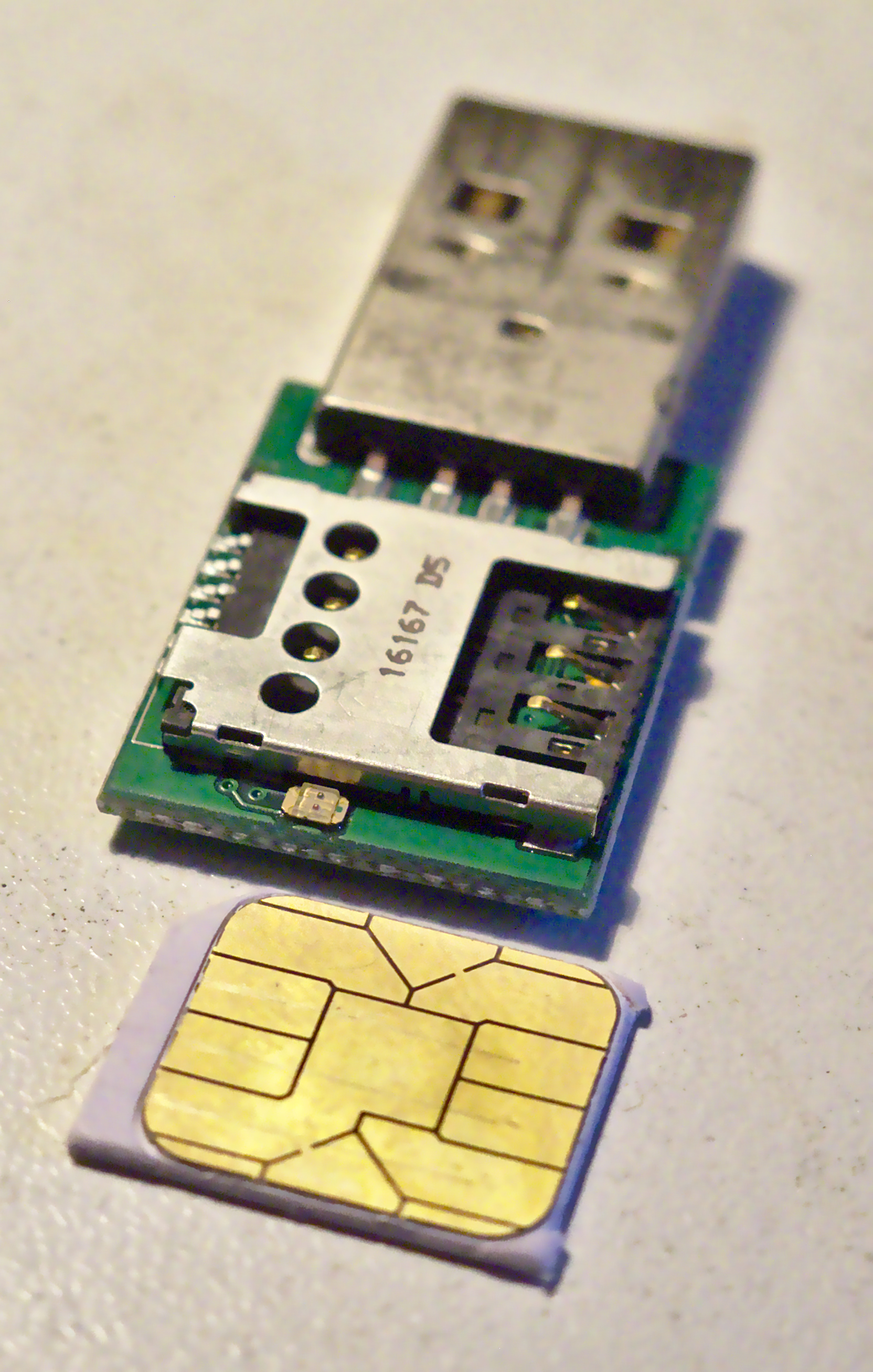
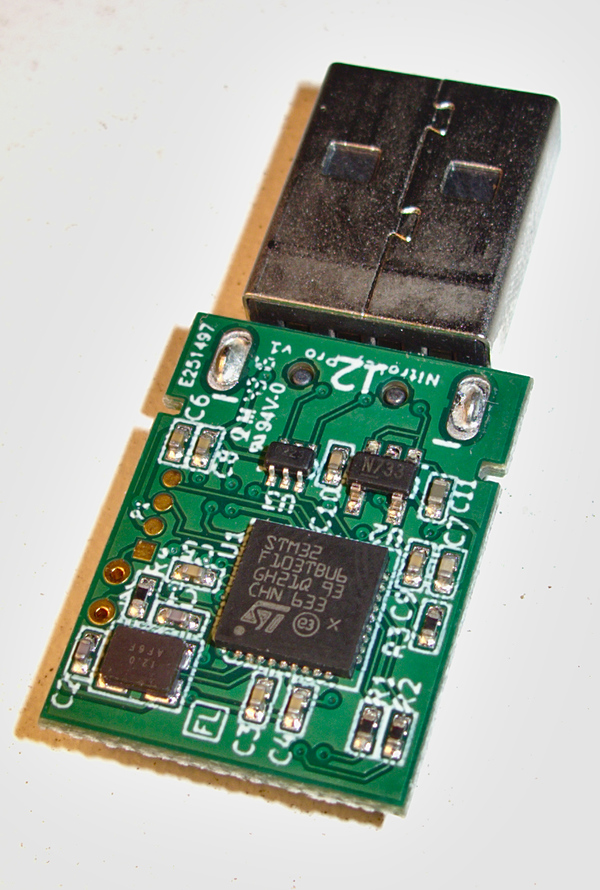
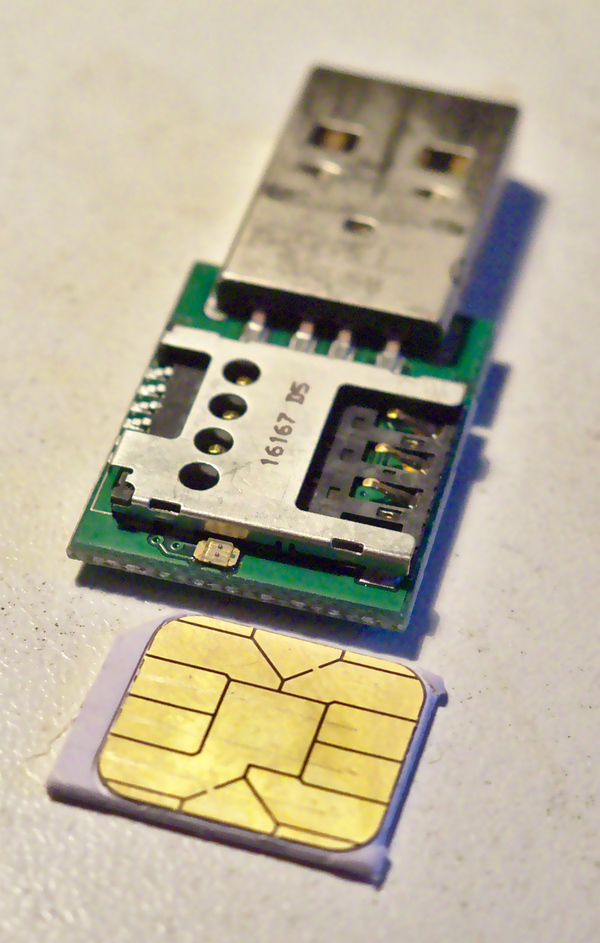
Open and closed designs The FST-01 is as open as hardware comes, down to the PCB design available as KiCad files in this Git repository. The software running on the card is the Gnuk firmware that implements the OpenPGP card protocol, but you can also get it with firmware implementing a true random number generator (TRNG) called NeuG (pronounced "noisy"); the device is programmable through a standard Serial Wire Debug (SWD) port. The Nitrokey Start model also runs the Gnuk firmware. However, the Nitrokey website announces only ECC and RSA 2048-bit support for the Start, while the FST-01 also supports RSA-4096. Nitrokey's founder Jan Suhr, in a private email, explained that this is because "Gnuk doesn't support RSA-3072 or larger at a reasonable speed". Its devices (the Pro, Start, and HSM models) use a similar chip to the FST-01: the STM32F103 microcontroller. Nitrokey Pro with STM32F103TBU6 MCU Nitrokey also publishes its hardware designs, on GitHub, which shows the Pro is basically a fork of the FST-01, according to the ChangeLog. I opened the case to confirm it was using the STM MCU, something I should warn you against; I broke one of the pins holding it together when opening it so now it's even more fragile. But at least, I was able to confirm it was built using the STM32F103TBU6 MCU, like the FST-01. Nitrokey back side But this is where the comparison ends: on the back side, we find a SIM card reader that holds the OpenPGP card that, in turn, holds the private key material and does the cryptographic operations. So, in effect, the Nitrokey Pro is really a evolution of the original OpenPGP card readers. Nitrokey confirmed the OpenPGP card featured in the Pro is the same as the one shipped by the Free Software Foundation Europe (FSFE): the BasicCard built by ZeitControl. Those cards, however, are covered by NDAs and the firmware is only partially open source. This makes the Nitrokey Pro less open than the FST-01, but that's an inevitable tradeoff when choosing a design based on the OpenPGP cards, which Suhr described to me as "pretty proprietary". There are other keycards out there, however, for example the SLJ52GDL150-150k smartcard suggested by Debian developer Yves-Alexis Perez, which he prefers as it is certified by French and German authorities. In that blog post, he also said he was experimenting with the GPL-licensed OpenPGP applet implemented by the French ANSSI. But the YubiKey devices are even further away in the closed-design direction. Both the hardware designs and firmware are proprietary. The YubiKey NEO, for example, cannot be upgraded at all, even though it is based on an open firmware. According to Yubico's FAQ, this is due to "best security practices": "There is a 'no upgrade' policy for our devices since nothing, including malware, can write to the firmware." I find this decision questionable in a context where security updates are often more important than trying to design a bulletproof design, which may simply be impossible. And the YubiKey NEO did suffer from critical security issue that allowed attackers to bypass the PIN protection on the card, which raises the question of the actual protection of the private key material on those cards. According to Niibe, "some OpenPGP cards store the private key unencrypted. It is a common attitude for many smartcard implementations", which was confirmed by Suhr: "the private key is protected by hardware mechanisms which prevent its extraction and misuse". He is referring to the use of tamper resistance. After that security issue, there was no other option for YubiKey NEO users than to get a new keycard (for free, thankfully) from Yubico, which also meant discarding the private key material on the key. For OpenPGP keys, this may mean having to bootstrap the web of trust from scratch if the keycard was responsible for the main certification key. But at least the NEO is running free software based on the OpenPGP card applet and the source is still available on GitHub. The YubiKey 4, on the other hand, is now closed source, which was controversial when the new model was announced last year. It led the main Linux Foundation system administrator, Konstantin Ryabitsev, to withdraw his endorsement of Yubico products. In response, Yubico argued that this approach was essential to the security of its devices, which are now based on "a secure chip, which has built-in countermeasures to mitigate a long list of attacks". In particular, it claims that:
A commercial-grade AVR or ARM controller is unfit to be used in a security product. In most cases, these controllers are easy to attack, from breaking in via a debug/JTAG/TAP port to probing memory contents. Various forms of fault injection and side-channel analysis are possible, sometimes allowing for a complete key recovery in a shockingly short period of time.
While I understand those concerns, they eventually come down to the trust you have in an organization. Not only do we have to trust Yubico, but also hardware manufacturers and designs they have chosen. Every step in the hidden supply chain is then trusted to make correct technical decisions and not introduce any backdoors. History, unfortunately, is not on Yubico's side: Snowden revealed the example of RSA security accepting what renowned cryptographer Bruce Schneier described as a "bribe" from the NSA to weaken its ECC implementation, by using the presumably backdoored Dual_EC_DRBG algorithm. What makes Yubico or its suppliers so different from RSA Security? Remember that RSA Security used to be an adamant opponent to the degradation of encryption standards, campaigning against the Clipper chip in the first crypto wars. Even if we trust the Yubico supply chain, how can we trust a closed design using what basically amounts to security through obscurity? Publicly auditable designs are an important tradition in cryptography, and that principle shouldn't stop when software is frozen into silicon. In fact, a critical vulnerability called ROCA disclosed recently affects closed "smartcards" like the YubiKey 4 and allows full private key recovery from the public key if the key was generated on a vulnerable keycard. When speaking with Ars Technica, the researchers outlined the importance of open designs and questioned the reliability of certification:
Our work highlights the dangers of keeping the design secret and the implementation closed-source, even if both are thoroughly analyzed and certified by experts. The lack of public information causes a delay in the discovery of flaws (and hinders the process of checking for them), thereby increasing the number of already deployed and affected devices at the time of detection.
This issue with open hardware designs seems to be recurring topic of conversation on the Gnuk mailing list. For example, there was a discussion in September 2017 regarding possible hardware vulnerabilities in the STM MCU that would allow extraction of encrypted key material from the key. Niibe referred to a talk presented at the WOOT 17 workshop, where Johannes Obermaier and Stefan Tatschner, from the Fraunhofer Institute, demonstrated attacks against the STMF0 family MCUs. It is still unclear if those attacks also apply to the older STMF1 design used in the FST-01, however. Furthermore, extracted private key material is still protected by user passphrase, but the Gnuk uses a weak key derivation function, so brute-forcing attacks may be possible. Fortunately, there is work in progress to make GnuPG hash the passphrase before sending it to the keycard, which should make such attacks harder if not completely pointless. When asked about the Yubico claims in a private email, Niibe did recognize that "it is true that there are more weak points in general purpose implementations than special implementations". During the last DebConf in Montreal, Niibe explained:
If you don't trust me, you should not buy from me. Source code availability is only a single factor: someone can maliciously replace the firmware to enable advanced attacks.
Niibe recommends to "build the firmware yourself", also saying the design of the FST-01 uses normal hardware that "everyone can replicate". Those advantages are hard to deny for a cryptographic system: using more generic components makes it harder for hostile parties to mount targeted attacks. A counter-argument here is that it can be difficult for a regular user to audit such designs, let alone physically build the device from scratch but, in a mailing list discussion, Debian developer Ian Jackson explained that:
You don't need to be able to validate it personally. The thing spooks most hate is discovery. Backdooring supposedly-free hardware is harder (more costly) because it comes with greater risk of discovery. To put it concretely: if they backdoor all of them, someone (not necessarily you) might notice. (Backdooring only yours involves messing with the shipping arrangements and so on, and supposes that you specifically are of interest.)
Since that, as far as we know, the STM microcontrollers are not backdoored, I would tend to favor those devices instead of proprietary ones, as such a backdoor would be more easily detectable than in a closed design. Even though physical attacks may be possible against those microcontrollers, in the end, if an attacker has physical access to a keycard, I consider the key compromised, even if it has the best chip on the market. In our email exchange, Niibe argued that "when a token is lost, it is better to revoke keys, even if the token is considered secure enough". So like any other device, physical compromise of tokens may mean compromise of the key and should trigger key-revocation procedures.

Algorithms and performance To establish reliable performance results, I wrote a benchmark program naively called crypto-bench that could produce comparable results between the different keys. The program takes each algorithm/keycard combination and runs 1000 decryptions of a 16-byte file (one AES-128 block) using GnuPG, after priming it to get the password cached. I assume the overhead of GnuPG calls to be negligible, as it should be the same across all tokens, so comparisons are possible. AES encryption is constant across all tests as it is always performed on the host and fast enough to be irrelevant in the tests. I used the following:
  • Intel(R) Core(TM) i3-6100U CPU @ 2.30GHz running Debian 9 ("stretch"/stable amd64), using GnuPG 2.1.18-6 (from the stable Debian package)
  • Nitrokey Pro 0.8 (latest firmware)
  • FST-01, running Gnuk version 1.2.5 (latest firmware)
  • YubiKey NEO OpenPGP applet 1.0.10 (not upgradable)
  • YubiKey 4 4.2.6 (not upgradable)
I ran crypto-bench for each keycard, which resulted in the following:
Algorithm Device Mean time (s)
ECDH-Curve25519 CPU 0.036
FST-01 0.135
RSA-2048 CPU 0.016
YubiKey-4 0.162
Nitrokey-Pro 0.610
YubiKey-NEO 0.736
FST-01 1.265
RSA-4096 CPU 0.043
YubiKey-4 0.875
Nitrokey-Pro 3.150
FST-01 8.218
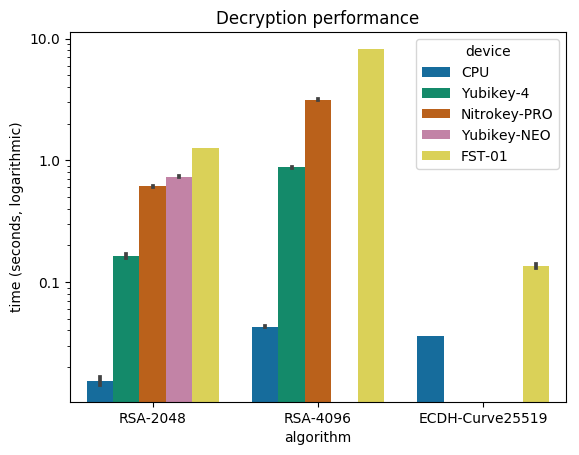
Decryption graph There we see the performance of the four keycards I tested, compared with the same operations done without a keycard: the "CPU" device. That provides the baseline time of GnuPG decrypting the file. The first obvious observation is that using a keycard is slower: in the best scenario (FST-01 + ECC) we see a four-fold slowdown, but in the worst case (also FST-01, but RSA-4096), we see a catastrophic 200-fold slowdown. When I presented the results on the Gnuk mailing list, GnuPG developer Werner Koch confirmed those "numbers are as expected":
With a crypto chip RSA is much faster. By design the Gnuk can't be as fast - it is just a simple MCU. However, using Curve25519 Gnuk is really fast.
And yes, the FST-01 is really fast at doing ECC, but it's also the only keycard that handles ECC in my tests; the Nitrokey Start and Nitrokey HSM should support it as well, but I haven't been able to test those devices. Also note that the YubiKey NEO doesn't support RSA-4096 at all, so we can only compare RSA-2048 across keycards. We should note, however, that ECC is slower than RSA on the CPU, which suggests the Gnuk ECC implementation used by the FST-01 is exceptionally fast. In discussions about improving the performance of the FST-01, Niibe estimated the user tolerance threshold to be "2 seconds decryption time". In a new design using the STM32L432 microcontroller, Aurelien Jarno was able to bring the numbers for RSA-2048 decryption from 1.27s down to 0.65s, and for RSA-4096, from 8.22s down to 3.87s seconds. RSA-4096 is still beyond the two-second threshold, but at least it brings the FST-01 close to the YubiKey NEO and Nitrokey Pro performance levels. We should also underline the superior performance of the YubiKey 4: whatever that thing is doing, it's doing it faster than anyone else. It does RSA-4096 faster than the FST-01 does RSA-2048, and almost as fast as the Nitrokey Pro does RSA-2048. We should also note that the Nitrokey Pro also fails to cross the two-second threshold for RSA-4096 decryption. For me, the FST-01's stellar performance with ECC outshines the other devices. Maybe it says more about the efficiency of the algorithm than the FST-01 or Gnuk's design, but it's definitely an interesting avenue for people who want to deploy those modern algorithms. So, in terms of performance, it is clear that both the YubiKey 4 and the FST-01 take the prize in their own areas (RSA and ECC, respectively).

Conclusion In the above presentation, I have evaluated four cryptographic keycards for use with various OpenPGP operations. What the results show is that the only efficient way of storing a 4096-bit encryption key on a keycard would be to use the YubiKey 4. Unfortunately, I do not feel we should put our trust in such closed designs so I would argue you should either stick with 2048-bit encryption subkeys or keep the keys on disk. Considering that losing such a key would be catastrophic, this might be a good approach anyway. You should also consider switching to ECC encryption: even though it may not be supported everywhere, GnuPG supports having multiple encryption subkeys on a keyring: if one algorithm is unsupported (e.g. GnuPG 1.4 doesn't support ECC), it will fall back to a supported algorithm (e.g. RSA). Do not forget your previously encrypted material doesn't magically re-encrypt itself using your new encryption subkey, however. For authentication and signing keys, speed is not such an issue, so I would warmly recommend either the Nitrokey Pro or Start, or the FST-01, depending on whether you want to start experimenting with ECC algorithms. Availability also seems to be an issue for the FST-01. While you can generally get the device when you meet Niibe in person for a few bucks (I bought mine for around \$30 Canadian), the Seeed online shop says the device is out of stock at the time of this writing, even though Jonathan McDowell said that may be inaccurate in a debian-project discussion. Nevertheless, this issue may make the Nitrokey devices more attractive. When deciding on using the Pro or Start, Suhr offered the following advice:
In practice smart card security has been proven to work well (at least if you use a decent smart card). Therefore the Nitrokey Pro should be used for high security cases. If you don't trust the smart card or if Nitrokey Start is just sufficient for you, you can choose that one. This is why we offer both models.
So far, I have created a signing subkey and moved that and my authentication key to the YubiKey NEO, because it's a device I physically trust to keep itself together in my pockets and I was already using it. It has served me well so far, especially with its extra features like U2F and HOTP support, which I use frequently. Those features are also available on the Nitrokey Pro, so that may be an alternative if I lose the YubiKey. I will probably move my main certification key to the FST-01 and a LUKS-encrypted USB disk, to keep that certification key offline but backed up on two different devices. As for the encryption key, I'll wait for keycard performance to improve, or simply switch my whole keyring to ECC and use the FST-01 or Nitrokey Start for that purpose.
[The author would like to thank Nitrokey for providing hardware for testing.] This article first appeared in the Linux Weekly News.
16 October 2017

Russ Allbery: Free software log (September 2017)

I said that I was going to start writing these regularly, so I'm going to stick to it, even when the results are rather underwhelming. One of the goals is to make the time for more free software work, and I do better at doing things that I record. The only piece of free software work for September was that I made rra-c-util compile cleanly with the Clang static analyzer. This was fairly tedious work that mostly involved unconfusing the compiler or converting (semi-intentional) crashes into explicit asserts, but it unblocks using the Clang static analyzer as part of the automated test suite of my other projects that are downstream of rra-c-util. One of the semantic changes I made was that the vector utilities in rra-c-util (which maintain a resizable array of strings) now always allocate room for at least one string pointer. This wastes a small amount of memory for empty vectors that are never used, but ensures that the strings struct member is always valid. This isn't, strictly speaking, a correctness fix, since all the checks were correct, but after some thought, I decided that humans might have the same problem that the static analyzer had. It's a lot easier to reason about a field that's never NULL. Similarly, the replacement function for a missing reallocarray now does an allocation of size 1 if given a size of 0, just to avoid edge case behavior. (I'm sure the behavior of a realloc with size 0 is defined somewhere in the C standard, but if I have to look it up, I'd rather not make a human reason about it.) I started on, but didn't finish, making rra-c-util compile without Clang warnings (at least for a chosen set of warnings). By far the hardest problem here are the Clang warnings for comparisons between unsigned and signed integers. In theory, I like this warning, since it's the cause of a lot of very obscure bugs. In practice, gah does C ever do this all over the place, and it's incredibly painful to avoid. (One of the biggest offenders is write, which returns a ssize_t that you almost always want to compare against a size_t.) I did a bunch of mechanical work, but I now have a lot of bits of code like:
     if (status < 0)
         return;
    written = (size_t) status;
    if (written < avail)
        buffer->left += written;
which is ugly and unsatisfying. And I also have a ton of casts, such as with:
    buffer_resize(buffer, (size_t) st.st_size + used);
since st.st_size is an off_t, which may be signed. This is all deeply unsatisfying and ugly, and I think it makes the code moderately harder to read, but I do think the warning will potentially catch bugs and even security issues. I'm still torn. Maybe I can find some nice macros or programming styles to avoid the worst of this problem. It definitely requires more thought, rather than just committing this huge mechanical change with lots of ugly code. Mostly, this kind of nonsense makes me want to stop working on C code and go finish learning Rust.... Anyway, apart from work, the biggest thing I managed to do last month that was vaguely related to free software was upgrading my personal servers to stretch (finally). That mostly went okay; only a few things made it unnecessarily exciting. The first was that one of my systems had a very tiny / partition that was too small to hold the downloaded debs for the upgrade, so I had to resize it (VM disk, partition, and file system), and that was a bit exciting because it has an old-style DOS partition table that isn't aligned (hmmm, which is probably why disk I/O is so slow on those VMs), so I had to use the obsolete fdisk -c=dos mode because I wasn't up for replacing the partition right then. The second was that my first try at an upgrade died with a segfault during the libc6 postinst and then every executable segfaulted. A mild panic and a rescue disk later (and thirty minutes and a lot of swearing), I tracked the problem down to libc6-xen. Nothing in the dependency structure between jessie and stretch forces libc6-xen to be upgraded in lockstep or removed, but it's earlier in the search path. So ld.so gets upgraded, and then finds the old libc6 from the libc6-xen package, and the mismatch causes immediate segfaults. A chroot dpkg --purge from the rescue disk solved the problem as soon as I knew what was going on, but that was a stressful half-hour. The third problem was something I should have known was going to be an issue: an old Perl program that does some internal stuff for one of the services I ran had a defined @array test that has been warning for eons and that I never fixed. That became a full syntax error with the most recent Perl, and then I fixed it incorrectly the first time and had a bunch of trouble tracking down what I'd broken. All sorted out now, and everything is happily running stretch. (ejabberd, which other folks had mentioned was a problem, went completely smoothly, although I suspect I now have too many of the plugin packages installed and should do a purging.)

13 October 2017

Shirish Agarwal: I need to speak up now X Economics

Dear all, This would be a longish blog post (as most of mine are) compiled over days but as there is so short a time and so much to share. I had previously thought to share beautiful photographs of Ganesh mandals taking out the procession at time of immersion of the idol or the last day of Durga Puja recent events around do not make my mood to share photos at this point in time. I may share some of them in a future blog post or two . Before going further, I would like to offer my sympathies and condolences to people hurt and dislocated in Hurricane Irma , the 2017 Central Mexico Earthquake and lastly the most recent Las Vegas shooting as well as Hurricane Maria in Puerto Rico . I am somewhat nonplussed as to why Americans always want to name, especially hurricanes which destroy people s lives and livelihood built over generations and why most of the hurricanes are named after women. A look at weather.com site unveiled the answer to the mystery. Ironically (or not) I saw some of the best science coverage about Earthquakes or anything scientific reporting and analysis after a long time in mainstream newspapers in India. On another note, I don t understand or even expect to understand why the gunman did what he did 2 days back. Country music AFAIK is one of the most chilled-out kind of music, in some ways very similar to classical Indian singing although they are worlds apart in style of singing, renditions, artists, the way they emote etc. I seriously wish that the gunman had not been shot but caught and reasons were sought about what he did, he did. While this is certainly armchair thinking as was not at the scene of crime, but if a Mumbai Police constable could do it around a decade ago armed only with a lathi could do it, why couldn t the American cops who probably are trained in innumerable ways to subdue people without killing them, did. While investigations are on, I suspect if he were caught just like Ajmal Kasab was caught then lot of revelations might have come up. From what is known, the gentleman was upwardly mobile i.e. he was white, rich and apparently had no reason to have beef with anybody especially a crowd swaying to some nice music, all of which makes absolutely no sense. Indian Economy Slowdown Anyways, back to one of the main reasons of writing this blog post. Few days back, an ex-finance Minister of India Yashwant Sinha wrote what was felt by probably millions of Indians, an Indian Express article called I need to speak up now While there have been many, many arguments made since then by various people. A simple search of I need to speak up would lead to lead to many a result besides the one I have shared above. The only exception I have with the article is the line Forty leading companies of the country are already facing bankruptcy proceedings. Many more are likely to follow suit. I would not bore you but you ask any entrepreneur trying to set up shop in India i.e. ones who actually go through the processes of getting all the licenses for setting up even a small businesses as to the numerous hurdles they have to overcome and laid-back corrupt bureaucracy which they have to overcome. I could have interviewed some of my friends who had the conviction and the courage to set up shop and spent more than half a decade getting all the necessary licenses and approval to set up but it probably would be too specific for one industry or the other and would lead to the same result. Co-incidentally, a new restaurant, leaf opened in my vicinity few weeks before. From the looks it looked like a high-brow, high-priced restaurant hence like many others I did not venture in. After a few days, they introduced south-Indian delicacies like Masala Dosa, Uttapam at prices similar to other restaurants around. So I ventured in and bought some south Indian food to consume between mum and me. Few days later, I became friends with the owner/franchisee and I suggested (in a friendly tone) that why he doesn t make it like a CCD play where many people including yours truly use the service to share, strategize and meet with clients. The CCD joints usually serve coffee and snacks (which are over-priced but still run out pretty fast) but people come as they have chilled-out atmosphere and Wi-Fi access which people need for their smartphones, although the Wi-Fi part may soon become redundant With Reliance Jio making a big play. I also shared why he doesn t add more variety and time (the south Indian items are time-limited) as I see/saw many empty chairs there. Anyways, the shop-owner/franchisee shared his gross costs including salary, stocking, electricity, rent and it doesn t pan out to be serving Rs.80/- dish (roughly a 1US dollar and 25 cents) then serving INR Rs. 400/- a dish (around 6 $USD). One round of INR 400/- + dishes make his costs for the day, around 12 tables were there. It s when they have two full rounds of dishes costing INR 400/- or more that he actually has profits and he is predicting loss for at least 6 months to a year before he makes a rebound. He needs steady customers rather than just walk-ins that will make his business work/click. Currently his family is bearing the costs. He didn t mention the taxes although I know apart from GST there are still some local body taxes that they will have to pay and comply with. There are a multitude of problems for shutting a shop legally as well as they have to again renavigate the bureaucracy for the same. I have seen more than a few retailers downing their shutters for 6-8 months and then either sell it to new management, let go of the lease or simply sell the property to a competitor. The Insolvency and Bankruptcy Code is probably the first proper exit policy for large companies. So the 40 odd companies that Mr. Sinha were talking about were probably sick for a long time. In India, there is also an additional shame of being a failed entrepreneur unlike in the west where Entrepreneurs start on their next venture. As seen from Retailing In India only 3.3% of the population or at the most 4% of the population is directly or indirectly linked with the retail trade. Most of the economy still derives its wealth from the agrarian sector which is still reeling under the pressure from demonetization which happened last year. Al jazeera surprisingly portrayed a truer picture of the effects demonetization had on common citizen than many Indian newspapers did at the time. Because of the South African Debconf, I had to resort to debit cards and hence was able to escape standing in long lines in which many an old and women perished. It is only yesterday that the Government has acknowledged which many prominent Indians have been saying for months now, that we are in a slowdown . Be aware of the terms being used for effect by the Prime Minister. There are two articles which outlines the troubles India is in atm. The only bright spot has been e-commerce which so far has eluded GST although the Govt. has claimed regulations to put it in check. Indian Education System Interestingly, Ravish Kumar has started a series on NDTV where he is showcasing how Indian education sector, especially public colleges have been left to teachers on contract basis, see the first four episodes on NDTV channel starting with the first one I have shared as a hyperlink. I apologize as the series is in Hindi as the channel is meant for Indians and is mostly limited to Northern areas of the Country (mostly) although he has been honest that it is because they lack resources to tackle the amount of information flowing to them. Ravish started the series with sharing information about the U.S. where the things are similar with some teachers needing to sleep in cars because of high-cost of living to some needing to turn to sex-work . I was shocked when I read the guardian article, that is no way to treat our teachers.I went on to read How the American University was Killed following the breadcrumbs along the way. Reading that it seems Indians have been following the American system playbook from the 1980 s itself. The article talks about HMO as well and that seems to have followed here as well with my own experience of hospital fees and drugs which I had to entail a few weeks/month ago. Few years ago, when me and some of my friends had the teaching bug and we started teaching in a nearby municipal school, couple of teachers had shared that they were doing 2-3 jobs to make ends meet. I don t know about others in my group, at least I was cynical because I thought all the teachers were permanent and they make good money only to realize now that the person was probably speaking the truth. When you have to do three jobs to make ends meet from where do you bring the passion to teach young people and that too outside the syllabus ? Also, with this new knowledge in hindsight, I take back all my comments I made last year and the year before for the pathetic education being put up by the State. With teachers being paid pathetically/underpaid and almost 60% teachers being ad-hoc/adjunct teachers they have to find ways to have some sense of security. Most teachers are bachelors as they are poor and cannot offer any security (either male or female) and for women, after marriage it actually makes no sense for them to continue in this profession. I salute all the professors who are ad-hoc in nature and probably will never get a permanent position in their life. I think in some way, thanx to him, that the government has chosen to give 7th pay commisson salary to teachers. While the numbers may appear be large, there are a lot of questions as to how many people will actually get paid. There needs to be lot of vacancies which need to be filled quickly but don t see any solution in the next 2-3 years as well. The Government has taken a position to use/re-hire retired teachers rather than have new young teachers as an unwritten policy. In this Digital India context how are retired teachers supposed to understand and then pass on digital concepts is beyond me when at few teacher trainings I have seen they lack even the most basic knowledge that I learnt at least a decade or two ago, the difference is that vast. I just don t know what to say to that. My own experience with my own mother who had pretty good education in her time and probably would have made a fine business-woman if she knew that she will have a child that she would have to raise by herself alone (along with maternal grand-parents) is testimonial to the fact how hard it is for older people to grasp technology and here I m talking just using the interface as a consumer rather than a producer or someone in-between who has the idea of how companies and governments profit from whatever data is shared one way or the other. After watching the series/episodes and discussing the issue with my mother it was revealed that both her and my late maternal grandfather were on casual/ad-hoc basis till 20-25 years in their service in the defense sector. If Ravish were to do a series on the defense sector he probably would find the same thing there. To add to that, the defense sector is a vital component to a country s security. If 60% of the defense staff in all defense establishments have temporary staff how do you ensure the loyalty of the people working therein. That brings to my mind Ignorance is bliss . Software development and deployment There is another worry that all are skirting around, the present dispensation/government s mantra is minimum government-maximum governance with digital technologies having all solutions which is leading to massive unemployment. Also from most of the stories/incidents I read in the newspapers, mainstream media and elsewhere it seems most software deployments done in India are done without having any system of internal checks and balances. There is no lintian for software to be implemented. Contracts seem to be given to big companies and there is no mention of what prerequisites or conditions were laid down by the Government for software development and deployment and if any checks were done to ensure that the software being developed was in according to government specifications or not. Ideally this should all be in public domain so that questions can be asked and responsibility fixed if things go haywire, as currently they do not. Software issues As my health been not that great, I have been taking a bit more time and depth while filing bugs. #877638 is a good example. I suspect though that part of the problem might be that mate has moved to gtk3 while guake still has gtk-2 bindings. I also reported the issue upstream both in mate-panel as well as guake . I haven t received any response from either or/and upstreams . I also have been fiddling around with gdb to better understand the tool so I can exploit/use this tool in a better way. There are some commands within the gdb interface which seem to be interesting and hopefully I ll try how the commands perform over days, weeks to a month. I hope we see more action on the mate-panel/guake bug as well as move of guake to gtk+3 but that what seemingly seemed like wait for eternity seems to have done by somebody in last couple of days. As shared in the ticket there are lots of things still to do but it seems the heavy lifting has been done but seems merging will be tricky as two developers have been trying to update to gtk+3 although aichingm seems to have a leg up with his 3! branch. Another interesting thing I saw is the below picture. Firefox is out of date on wordpress.com The firefox version I was using to test the site/wordpress-wp-admin was Mozilla Firefox 52.4.0 which AFAIK is a pretty recentish one and people using Debian stretch would probably be using the same version (firefox stable/LTS) rather than the more recent versions. I went to the link it linked to and it gave no indication as to why it thought my browser is out-of-date and what functionality was/is missing. I have found that wordpress support has declined quite a bit and people don t seem to use the forums as much as they used to before. I also filed a few bugs for qalculate. #877716 where a supposedly transitional package removes the actual application, #877717 as the software has moved its repo. to github.com as well as tickets and other things in process and lastly #877733. I had been searching for a calculator which can do currency calculations on the fly (say for e.g. doing personal budgeting for Taiwan debconf) without needing to manually enter the conversion rates and losing something in the middle. While the current version has support for some limited currencies, the new versions promise more as other people probably have more diverse needs for currency conversions (people who do long or short on oil, stocks overseas is just one example, I am sure there are many others) than simplistic mine.
Filed under: Miscellenous Tagged: #American Education System, #bug-filing, #Climate change, #Dignity, #e-commerce, #gtk+3, #gtk2, #Indian Economy 'Slowdown', #Indian Education System, #Insolvency and Bankruptcy Code, #Las Vegas shooting, #Modern Retail in India, #planet-debian, #qalculate, Ad-hoc and Adjunct Professors, wordpress.com

Norbert Preining: Scala: parse JSON into nested case classes

I was playing around with parsing JSON in Scala, and got spray-json as recommendation from my Senpai. My aim was parsing some nested structure like:
  
  "key1" : "value1",
  "key2" :   "subkey1" : "subval1", "subkey2" : "subval2"  
 
into a nested Scala case class:
case class SubClass(subkey1: String, subkey2: String)
case class MainClass(key1: String, key2: SubClass)

To achieve this one needs to define one s own JsonProtocol that describes the parsing:
import spray.json._
object MyJsonProtocol extends DefaultJsonProtocol  
  implicit val subclassFormat = jsonFormat2(SubClass)
  implicit val mainclassFormat = jsonFormat2(MainClass)
 
import MyJsonProtocol._
Using this parsing can be done in the usual way:
val jsonstr = """
      
      "key1" : "value1",
      "key2" :   "subkey1" : "subval1", "subkey2" : "subval2"  
     
    """
val jsonAst = jsonstr.parseJson
val gotit = jsonAst.convertTo[MainClass]
If the input is from a JSON array of the above arrays:
[
    
    "key1" : "value1",
    "key2" :   "subkey1" : "subval1", "subkey2" : "subval2"  
   ,
    
    "key1" : "value10",
    "key2" :   "subkey1" : "subval10", "subkey2" : "subval20"  
   
]
the only change necessary is to call
val gotit = jsonAst.convertTo[List[MainClass]]

12 October 2017

Joachim Breitner: Isabelle functions: Always total, sometimes undefined

Often, when I mention how things work in the interactive theorem prover [Isabelle/HOL] (in the following just Isabelle 1) to people with a strong background in functional programming (whether that means Haskell or Coq or something else), I cause confusion, especially around the issue of what is a function, are function total and what is the business with undefined. In this blog post, I want to explain some these issues, aimed at functional programmers or type theoreticians. Note that this is not meant to be a tutorial; I will not explain how to do these things, and will focus on what they mean.

HOL is a logic of total functions If I have a Isabelle function f :: a b between two types a and b (the function arrow in Isabelle is , not ), then by definition of what it means to be a function in HOL whenever I have a value x :: a, then the expression f x (i.e. f applied to x) is a value of type b. Therefore, and without exception, every Isabelle function is total. In particular, it cannot be that f x does not exist for some x :: a. This is a first difference from Haskell, which does have partial functions like
spin :: Maybe Integer -> Bool
spin (Just n) = spin (Just (n+1))
Here, neither the expression spin Nothing nor the expression spin (Just 42) produce a value of type Bool: The former raises an exception ( incomplete pattern match ), the latter does not terminate. Confusingly, though, both expressions have type Bool. Because every function is total, this confusion cannot arise in Isabelle: If an expression e has type t, then it is a value of type t. This trait is shared with other total systems, including Coq. Did you notice the emphasis I put on the word is here, and how I deliberately did not write evaluates to or returns ? This is because of another big source for confusion:

Isabelle functions do not compute We (i.e., functional programmers) stole the word function from mathematics and repurposed it2. But the word function , in the context of Isabelle, refers to the mathematical concept of a function, and it helps to keep that in mind. What is the difference?
  • A function a b in functional programming is an algorithm that, given a value of type a, calculates (returns, evaluates to) a value of type b.
  • A function a b in math (or Isabelle) associates with each value of type a a value of type b.
For example, the following is a perfectly valid function definition in math (and HOL), but could not be a function in the programming sense:
definition foo :: "(nat   real)   real" where
  "foo seq = (if convergent seq then lim seq else 0)"
This assigns a real number to every sequence, but it does not compute it in any useful sense. From this it follows that

Isabelle functions are specified, not defined Consider this function definition:
fun plus :: "nat   nat   nat"  where
   "plus 0       m = m"
   "plus (Suc n) m = Suc (plus n m)"
To a functional programmer, this reads
plus is a function that analyses its first argument. If that is 0, then it returns the second argument. Otherwise, it calls itself with the predecessor of the first argument and increases the result by one.
which is clearly a description of a computation. But to Isabelle, the above reads
plus is a binary function on natural numbers, and it satisfies the following two equations:
And in fact, it is not so much Isabelle that reads it this way, but rather the fun command, which is external to the Isabelle logic. The fun command analyses the given equations, constructs a non-recursive definition of plus under the hood, passes that to Isabelle and then proves that the given equations hold for plus. One interesting consequence of this is that different specifications can lead to the same functions. In fact, if we would define plus' by recursing on the second argument, we d obtain the the same function (i.e. plus = plus' is a theorem, and there would be no way of telling the two apart).

Termination is a property of specifications, not functions Because a function does not evaluate, it does not make sense to ask if it terminates. The question of termination arises before the function is defined: The fun command can only construct plus in a way that the equations hold if it passes a termination check very much like Fixpoint in Coq. But while the termination check of Fixpoint in Coq is a deep part of the basic logic, in Isabelle it is simply something that this particular command requires for its internal machinery to go through. At no point does a termination proof of the function exist as a theorem inside the logic. And other commands may have other means of defining a function that do not even require such a termination argument! For example, a function specification that is tail-recursive can be turned in to a function, even without a termination proof: The following definition describes a higher-order function that iterates its first argument f on the second argument x until it finds a fixpoint. It is completely polymorphic (the single quote in 'a indicates that this is a type variable):
partial_function (tailrec)
  fixpoint :: "('a   'a)   'a   'a"
where
  "fixpoint f x = (if f x = x then x else fixpoint f (f x))"
We can work with this definition just fine. For example, if we instantiate f with ( x. x-1), we can prove that it will always return 0:
lemma "fixpoint (  n . n - 1) (n::nat) = 0"
  by (induction n) (auto simp add: fixpoint.simps)
Similarly, if we have a function that works within the option monad (i.e. Maybe in Haskell), its specification can always be turned into a function without an explicit termination proof here one that calculates the Collatz sequence:
partial_function (option) collatz :: "nat   nat list option"
 where "collatz n =
        (if n = 1 then Some [n]
         else if even n
           then do   ns <- collatz (n div 2);    Some (n # ns)  
           else do   ns <- collatz (3 * n + 1);  Some (n # ns) )"
Note that lists in Isabelle are finite (like in Coq, unlike in Haskell), so this function returns a list only if the collatz sequence eventually reaches 1. I expect these definitions to make a Coq user very uneasy. How can fixpoint be a total function? What is fixpoint ( n. n+1)? What if we run collatz n for a n where the Collatz sequence does not reach 1?3 We will come back to that question after a little detour

HOL is a logic of non-empty types Another big difference between Isabelle and Coq is that in Isabelle, every type is inhabited. Just like the totality of functions, this is a very fundamental fact about what HOL defines to be a type. Isabelle gets away with that design because in Isabelle, we do not use types for propositions (like we do in Coq), so we do not need empty types to denote false propositions. This design has an important consequence: It allows the existence of a polymorphic expression that inhabits any type, namely
undefined :: 'a
The naming of this term alone has caused a great deal of confusion for Isabelle beginners, or in communication with users of different systems, so I implore you to not read too much into the name. In fact, you will have a better time if you think of it as arbitrary or, even better, unknown. Since undefined can be instantiated at any type, we can instantiate it for example at bool, and we can observe an important fact: undefined is not an extra value besides the usual ones . It is simply some value of that type, which is demonstrated in the following lemma:
lemma "undefined = True   undefined = False" by auto
In fact, if the type has only one value (such as the unit type), then we know the value of undefined for sure:
lemma "undefined = ()" by auto
It is very handy to be able to produce an expression of any type, as we will see as follows

Partial functions are just underspecified functions For example, it allows us to translate incomplete function specifications. Consider this definition, Isabelle s equivalent of Haskell s partial fromJust function:
fun fromSome :: "'a option   'a" where
  "fromSome (Some x) = x"
This definition is accepted by fun (albeit with a warning), and the generated function fromSome behaves exactly as specified: when applied to Some x, it is x. The term fromSome None is also a value of type 'a, we just do not know which one it is, as the specification does not address that. So fromSome None behaves just like undefined above, i.e. we can prove
lemma "fromSome None = False   fromSome None = True" by auto
Here is a small exercise for you: Can you come up with an explanation for the following lemma:
fun constOrId :: "bool   bool" where
  "constOrId True = True"
lemma "constOrId = ( _.True)   constOrId = ( x. x)"
  by (metis (full_types) constOrId.simps)
Overall, this behavior makes sense if we remember that function definitions in Isabelle are not really definitions, but rather specifications. And a partial function definition is simply a underspecification. The resulting function is simply any function hat fulfills the specification, and the two lemmas above underline that observation.

Nonterminating functions are also just underspecified Let us return to the puzzle posed by fixpoint above. Clearly, the function seen as a functional program is not total: When passed the argument ( n. n + 1) or ( b. b) it will loop forever trying to find a fixed point. But Isabelle functions are not functional programs, and the definitions are just specifications. What does the specification say about the case when f has no fixed-point? It states that the equation fixpoint f x = fixpoint f (f x) holds. And this equation has a solution, for example fixpoint f _ = undefined. Or more concretely: The specification of the fixpoint function states that fixpoint ( b. b) True = fixpoint ( b. b) False has to hold, but it does not specify which particular value (True or False) it should denote any is fine.

Not all function specifications are ok At this point you might wonder: Can I just specify any equations for a function f and get a function out of that? But rest assured: That is not the case. For example, no Isabelle command allows you define a function bogus :: () nat with the equation bogus () = Suc (bogus ()), because this equation does not have a solution. We can actually prove that such a function cannot exist:
lemma no_bogus: "  bogus. bogus () = Suc (bogus ())" by simp
(Of course, not_bogus () = not_bogus () is just fine )

You cannot reason about partiality in Isabelle We have seen that there are many ways to define functions that one might consider partial . Given a function, can we prove that it is not partial in that sense? Unfortunately, but unavoidably, no: Since undefined is not a separate, recognizable value, but rather simply an unknown one, there is no way of stating that A function result is not specified . Here is an example that demonstrates this: Two partial functions (one with not all cases specified, the other one with a self-referential specification) are indistinguishable from the total variant:
fun partial1 :: "bool   unit" where
  "partial1 True = ()"
partial_function (tailrec) partial2 :: "bool   unit" where
  "partial2 b = partial2 b"
fun total :: "bool   unit" where
  "total True = ()"
  "total False = ()"
lemma "partial1 = total   partial2 = total" by auto
If you really do want to reason about partiality of functional programs in Isabelle, you should consider implementing them not as plain HOL functions, but rather use HOLCF, where you can give equational specifications of functional programs and obtain continuous functions between domains. In that setting, () and partial2 = total. We have done that to verify some of HLint s equations.

You can still compute with Isabelle functions I hope by this point, I have not scared away anyone who wants to use Isabelle for functional programming, and in fact, you can use it for that. If the equations that you pass to fun are a reasonable definition for a function (in the programming sense), then these equations, used as rewriting rules, will allow you to compute that function quite like you would in Coq or Haskell. Moreover, Isabelle supports code extraction: You can take the equations of your Isabelle functions and have them expored into Ocaml, Haskell, Scala or Standard ML. See Concon for a conference management system with confidentially verified in Isabelle. While these usually are the equations you defined the function with, they don't have to: You can declare other proved equations to be used for code extraction, e.g. to refine your elegant definitions to performant ones. Like with code extraction from Coq to, say, Haskell, the adequacy of the translations rests on a moral reasoning foundation. Unlike extraction from Coq, where you have an (unformalized) guarantee that the resulting Haskell code is terminating, you do not get that guarantee from Isabelle. Conversely, this allows you do reason about and extract non-terminating programs, like fixpoint, which is not possible in Coq. There is currently ongoing work about verified code generation, where the code equations are reflected into a deep embedding of HOL in Isabelle that would allow explicit termination proofs.

Conclusion We have seen how in Isabelle, every function is total. Function declarations have equations, but these do not define the function in an computational sense, but rather specify them. Because in HOL, there are no empty types, many specifications that appear partial (incomplete patterns, non-terminating recursion) have solutions in the space of total functions. Partiality in the specification is no longer visible in the final product.

PS: Axiom undefined in Coq This section is speculative, and an invitation for discussion. Coq already distinguishes between types used in programs (Set) and types used in proofs Prop. Could Coq ensure that every t : Set is non-empty? I imagine this would require additional checks in the Inductive command, similar to the checks that the Isabelle command datatype has to perform4, and it would disallow Empty_set. If so, then it would be sound to add the following axiom
Axiom undefined : forall (a : Set), a.
wouldn't it? This axiom does not have any computational meaning, but that seems to be ok for optional Coq axioms, like classical reasoning or function extensionality. With this in place, how much of what I describe above about function definitions in Isabelle could now be done soundly in Coq. Certainly pattern matches would not have to be complete and could sport an implicit case _ undefined. Would it help with non-obviously terminating functions? Would it allow a Coq command Tailrecursive that accepts any tailrecursive function without a termination check?

  1. Isabelle is a metalogical framework, and other logics, e.g. Isabelle/ZF, behave differently. For the purpose of this blog post, I always mean Isabelle/HOL.
  2. Isabelle is a metalogical framework, and other logics, e.g. Isabelle/ZF, behave differently. For the purpose of this blog post, I always mean Isabelle/HOL.
  3. Let me know if you find such an n. Besides n = 0.
  4. Like fun, the constructions by datatype are not part of the logic, but create a type definition from more primitive notions that is isomorphic to the specified data type.

Dirk Eddelbuettel: RcppArmadillo 0.8.100.1.0

armadillo image We are thrilled to announce a new big RcppArmadillo release! Conrad recently moved Armadillo to the 8.* series, with significant improvements and speed ups for sparse matrix operations, and more. See below for a brief summary. This also required some changes at our end which Binxiang Ni provided, and Serguei Sokol improved some instantiations. We now show the new vignette Binxiang Ni wrote for his GSoC contribution, and I converted it (and the other main vignette) to using the pinp package for sleeker pdf vignettes. This release resumes our bi-monthly CRAN release cycle. I may make interim updates available at GitHub "as needed". And this time I managed to mess up the reverse depends testing, and missed one sync() call on the way back to R---but all that is now taken care of. Armadillo is a powerful and expressive C++ template library for linear algebra aiming towards a good balance between speed and ease of use with a syntax deliberately close to a Matlab. RcppArmadillo integrates this library with the R environment and language--and is widely used by (currently) 405 other packages on CRAN. A high-level summary of changes follows.

Changes in RcppArmadillo version 0.8.100.1.0 (2017-10-05)
  • Upgraded to Armadillo release 8.100.1 (Feral Pursuits)
    • faster incremental construction of sparse matrices via element access operators
    • faster diagonal views in sparse matrices
    • expanded SpMat to save/load sparse matrices in coord format
    • expanded .save(),.load() to allow specification of datasets within HDF5 files
    • added affmul() to simplify application of affine transformations
    • warnings and errors are now printed by default to the std::cerr stream
    • added set_cerr_stream() and get_cerr_stream() to replace set_stream_err1(), set_stream_err2(), get_stream_err1(), get_stream_err2()
    • new configuration options ARMA_COUT_STREAM and ARMA_CERR_STREAM
  • Constructors for sparse matrices of types dgt, dtt amd dst now use Armadillo code for improved performance (Serguei Sokol in #175 addressing #173)
  • Sparse matrices call .sync() before accessing internal arrays (Binxiang Ni in #171)
  • The sparse matrix vignette has been converted to Rmarkdown using the pinp package, and is now correctly indexed. (#176)

Courtesy of CRANberries, there is a diffstat report. More detailed information is on the RcppArmadillo page. Questions, comments etc should go to the rcpp-devel mailing list off the R-Forge page.

This post by Dirk Eddelbuettel originated on his Thinking inside the box blog. Please report excessive re-aggregation in third-party for-profit settings.

11 October 2017

Steve Kemp: A busy week or two

It feels like the past week or two has been very busy, and so I'm looking forward to my "holiday" next month. I'm not really having a holiday of course, my wife is slowly returning to work, so I'll be taking a month of paternity leave, taking sole care of Oiva for the month of November. He's still a little angel, and now that he's reached 10 months old he's starting to get much more mobile - he's on the verge of walking, but not quite there yet. Mostly that means he wants you to hold his hands so that he can stand up, swaying back and forth before the inevitable collapse. Beyond spending most of my evenings taking care of him, from the moment I return from work to his bedtime (around 7:30PM), I've made the Debian Administration website both read-only and much simpler. In the past that site was powered by a lot of servers, I think around 11. Now it has only a small number of machines, which should slowly decrease. I've ripped out the database host, the redis host, the events-server, the planet-machine, the email-box, etc. Now we have a much simpler setup: Finally although I'm slowly making progress with "radio stuff" I've knocked up a simple hack which uses an ultrasonic sensor to determine whether I'm sat in front of my (home) PC. If I am everything is good. If I'm absent the music is stopped and the screen locked. Kinda neat. (Simple ESP8266 device wired to the sensor. When the state changes a message is posted to Mosquitto, where a listener reacts to the change(s).) Oh, not final. I've also transfered my mobile phone from DNA.fi to MoiMobile. Which should complete soon, right now my phone is in limbo, active on niether service. Oops.

10 October 2017

Reproducible builds folks: Reproducible Builds: Weekly report #128

Here's what happened in the Reproducible Builds effort between Sunday October 1 and Saturday October 7 2017: Media coverage Documentation updates Packages reviewed and fixed, and bugs filed Reviews of unreproducible packages 32 package reviews have been added, 46 have been updated and 62 have been removed in this week, adding to our knowledge about identified issues. Weekly QA work During our reproducibility testing, FTBFS bugs have been detected and reported by: diffoscope development strip-nondeterminism development Rob Browning noticed that strip-nondeterminism was causing serious performance regressions in the Clojure programming language within Debian. After some discussion, Chris Lamb also posted a query to debian-devel in case there were any other programming languages that might be suffering from the same problem. reprotest development Versions 0.7.1 and 0.7.2 were uploaded to unstable by Ximin Luo: It included contributions already covered by posts of the previous weeks, as well as new ones from: tests.reproducible-builds.org Misc. This week's edition was written by Bernhard M. Wiedemann, Chris Lamb, Holger Levsen, Mattia Rizzolo & reviewed by a bunch of Reproducible Builds folks on IRC & the mailing lists.

9 October 2017

Markus Koschany: My Free Software Activities in September 2017

Welcome to gambaru.de. Here is my monthly report that covers what I have been doing for Debian. If you re interested in Java, Games and LTS topics, this might be interesting for you. Debian Games Debian Java Debian LTS This was my nineteenth month as a paid contributor and I have been paid to work 15,75 hours on Debian LTS, a project started by Rapha l Hertzog. In that time I did the following: Misc QA upload Thanks for reading and see you next time.

5 October 2017

Ross Gammon: My FOSS activities for August & September 2017

I am writing this from my hotel room in Bologna, Italy before going out for a pizza. After a successful Factory Acceptance Test today, I might also allow myself to celebrate with a beer. But anyway, here is what I have been up to in the FLOSS world for the last month and a bit. Debian
  • Uploaded gramps (4.2.6) to stretch-backports & jessie-backports-sloppy.
  • Started working on the latest release of node-tmp. It needs further work due to new documentation being included etc.
  • Started working on packaging the latest goocanvas-2.0 package. Everything is ready except for producing some autopkgtests.
  • Moved node-coffeeify experimental to unstable.
  • Updated the Multimedia Blends Tasks with all the latest ITPs etc.
  • Reviewed doris for Antonio Valentino, and sponsored it for him.
  • Reviewed pyresample for Antonio Valentino, and sponsored it for him.
  • Reviewed a new parlatype package for Gabor Karsay, and sponsored it for him.
Ubuntu
  • Successfully did my first merge using git-ubuntu for the Qjackctl package. Thanks to Nish for patiently answering my questions, reviewing my work, and sponsoring the upload.
  • Refreshed the gramps backport request to 4.2.6. Still no willing sponsor.
  • Tested Len s rewrite of ubuntustudio-controls, adding a CPU governor option in particular. There are a couple of minor things to tidy up, but we have probably missed the chance to get it finalised for Artful.
  • Tested the First Beta release of Ubuntu Studio 17.10 Artful and wrote the release notes. Also drafted my first release announcement on the Ubunti Studio website which Eylul reviewed and published.
  • Refreshed the ubuntustudio-meta package and requested sponsorship. This was done by Steve Langasek. Thanks Steve.
  • Tested the Final Beta release of Ubuntu Studio 17.10 Artful and wrote the release notes.
  • Started working on a new Carla package, starting from where V ctor Cuadrado Juan left it (ITP in Debian).

3 October 2017

Reproducible builds folks: Reproducible Builds: Weekly report #127

Here's what happened in the Reproducible Builds effort between Sunday September 24 and Saturday September 30 2017: Development and fixes in key packages Kai Harries did an initial packaging of the Nix package manager for Debian. You can track his progress in #877019. Uploads in Debian: Packages reviewed and fixed, and bugs filed Patches sent upstream: Reproducible bugs (with patches) filed in Debian: QA bugs filed in Debian: Reviews of unreproducible packages 103 package reviews have been added, 153 have been updated and 78 have been removed in this week, adding to our knowledge about identified issues. Weekly QA work During our reproducibility testing, FTBFS bugs have been detected and reported by: diffoscope development Mattia Rizzolo uploaded version 87 to stretch-backports. strip-nondeterminism development reprotest development tests.reproducible-builds.org reproducible-website development Misc. This week's edition was written by Ximin Luo, Bernhard M. Wiedemann, Holger Levsen and Chris Lamb & reviewed by a bunch of Reproducible Builds folks on IRC & the mailing lists.

2 October 2017

Antoine Beaupr : My free software activities, September 2017

Debian Long Term Support (LTS) This is my monthly Debian LTS report. I mostly worked on the git, git-annex and ruby packages this month but didn't have time to completely use my allocated hours because I started too late in the month.

Ruby I was hoping someone would pick up the Ruby work I submitted in August, but it seems no one wanted to touch that mess, understandably. Since then, new issues came up, and not only did I have to work on the rubygems and ruby1.9 package, but now the ruby1.8 package also had to get security updates. Yes: it's bad enough that the rubygems code is duplicated in one other package, but wheezy had the misfortune of having two Ruby versions supported. The Ruby 1.9 also failed to build from source because of test suite issues, which I haven't found a clean and easy fix for, so I ended up making test suite failures non-fatal in 1.9, which they were already in 1.8. I did keep a close eye on changes in the test suite output to make sure tests introduced in the security fixes would pass and that I wouldn't introduce new regressions as well. So I published the following advisories:
  • ruby 1.8: DLA-1113-1, fixing CVE-2017-0898 and CVE-2017-10784. 1.8 doesn't seem affected by CVE-2017-14033 as the provided test does not fail (but it does fail in 1.9.1). test suite was, before patch:
    2199 tests, 1672513 assertions, 18 failures, 51 errors
    
    and after patch:
    2200 tests, 1672514 assertions, 18 failures, 51 errors
    
  • rubygems: uploaded the package prepared in August as is in DLA-1112-1, fixing CVE-2017-0899, CVE-2017-0900, CVE-2017-0901. here the test suite passed normally.
  • ruby 1.9: here I used the used 2.2.8 release tarball to generate a patch that would cover all issues and published DLA-1114-1 that fixes the CVEs of the two packages above. the test suite was, before patches:
    10179 tests, 2232711 assertions, 26 failures, 23 errors, 51 skips
    
    and after patches:
    1.9 after patches (B): 10184 tests, 2232771 assertions, 26 failures, 23 errors, 53 skips
    

Git I also quickly issued an advisory (DLA-1120-1) for CVE-2017-14867, an odd issue affecting git in wheezy. The backport was tricky because it wouldn't apply cleanly and the git package had a custom patching system which made it tricky to work on.

Git-annex I did a quick stint on git-annex as well: I was able to reproduce the issue and confirm an approach to fixing the issue in wheezy, although I didn't have time to complete the work before the end of the month.

Other free software work

New project: feed2exec I should probably make a separate blog post about this, but ironically, I don't want to spend too much time writing those reports, so this will be quick. I wrote a new program, called feed2exec. It's basically a combination of feed2imap, rss2email and feed2tweet: it allows you to fetch RSS feeds and send them in a mailbox, but what's special about it, compared to the other programs above, is that it is more generic: you can basically make it do whatever you want on new feed items. I have, for example, replaced my feed2tweet instance with it, using this simple configuration:
[anarcat]
url = https://anarc.at/blog/index.rss
output = feed2exec.plugins.exec
args = tweet "%(title)0.70s %(link)0.70s"
The sample configuration file also has examples to talk with Mastodon, Pump.io and, why not, a torrent server to download torrent files available over RSS feeds. A trivial configuration can also make it work as a crude podcast client. My main motivation to work on this was that it was difficult to extend feed2imap to do what I needed (which was to talk to transmission to download torrent files) and rss2email didn't support my workflow (which is delivering to feed-specific mail folders). Because both projects also seemed abandoned, it seemed like a good idea at the time to start a new one, although the rss2email community has now restarted the project and may produce interesting results. As an experiment, I tracked my time working on this project. It turns out it took about 45 hours to write that software. Considering feed2exec is about 1400 SLOC, that's 30 lines of code per hour. I don't know if that's slow or fast, but it's an interesting metric for future projects. It sure seems slow to me, but we need to keep in mind those 30 lines of code don't include documentation and repeated head banging on the keyboard. For example, I found two issues with the upstream feedparser package which I use to parse feeds which also seems unmaintained, unfortunately. Feed2exec is beta software at this point, but it's working well enough for me and the design is much simpler than the other programs of the kind. The main issue people can expect from it at this point is formatting issues or parse errors on exotic feeds, and noisy error messages on network errors, all of which should be fairly easy to fix in the test suite. I hope it will be useful for the community and, as usual, I welcome contributions, help and suggestions on how to improve the software.

More Python templates As part of the work on feed2exec, I did cleanup a few things in the ecdysis project, mostly to hook tests up in the CI, improve on the advancedConfig logger and cleanup more stuff. While I was there, it turns out that I built a pretty decent basic CI configuration for Python on GitLab. Whereas the previous templates only had a non-working Django example, you should now be able to chose a Python template when you configure CI on GitLab 10 and above, which should hook you up with normal Python setup procedures like setup.py install and setup.py test.

Selfspy I mentioned working on a monitoring tool in my last post, because it was a feature from Workrave missing in SafeEyes. It turns out there is already such a tool called selfspy. I did an extensive review of the software to make sure it wouldn't leak out confidential information out before using it, and it looks, well... kind of okay. It crashed on me at least once so far, which is too bad because then it loses track of the precious activity. I have used it at least once to figure out what the heck I worked on during the day, so it's pretty useful. I particularly used it to backtrack my work on feed2exec as I didn't originally track my time on the project. Unfortunately, selfspy seems unmaintained. I have proposed a maintenance team and hopefully the project maintainer will respond and at least share access so we don't end up in a situation like linkchecker. I also sent a bunch of pull requests to fix some issues like being secure by default and fixing the build. Apart from the crash, the main issue I have found with the software is that it doesn't detect idle time which means certain apps are disproportionatly represented in statistics. There are also some weaknesses in the crypto that should be adressed for people that encrypt their database. Next step is to package selfspy in Debian which should hopefully be simple enough...

Restic documentation security As part of a documentation patch on the Restic backup software, I have improved on my previous Perl script to snoop on process commandline arguments. A common flaw in shell scripts and cron jobs is to pass secret material in the environment (usually safe) but often through commandline arguments (definitely not safe). The challenge, in this peculiar case, was the env binary, but the last time I encountered such an issue was with the Drush commandline tool, which was passing database credentials in clear to the mysql binary. Using my Perl sniffer, I could get to 60 checks per second (or 60Hz). After reimplementing it in Python, this number went up to 160Hz, which still wasn't enough to catch the elusive env command, which is much faster at hiding arguments than MySQL, in large part because it simply does an execve() once the environment is setup. Eventually, I just went crazy and rewrote the whole thing in C which was able to get 700-900Hz and did catch the env command about 10-20% of the time. I could probably have rewritten this by simply walking /proc myself (since this is what all those libraries do in the end) to get better result, but then my point was made. I was able to prove to the restic author the security issues that warranted the warning. It's too bad I need to repeat this again and again, but then my tools are getting better at proving that issue... I suspect it's not the last time I have to deal with this issue and I am happy to think that I can come up with an even more efficient proof of concept tool the next time around.

Ansible 101 After working on documentation last month, I ended up writing my first Ansible playbook this month, converting my tasksel list to a working Ansible configuration. This was a useful exercise: it allow me to find a bunch of packages which have been removed from Debian and provides much better usability than tasksel. For example, it provides a --diff argument that shows which packages are missing from a given setup. I am still unsure about Ansible. Manifests do seem really verbose and I still can't get used to the YAML DSL. I could probably have done the same thing with Puppet and just run puppet apply on the resulting config. But I must admit my bias towards Python is showing here: I can't help but think Puppet is going to be way less accessible with its rewrite in Clojure and C (!)... But then again, I really like Puppet's approach of having generic types like package or service rather than Ansible's clunky apt/yum/dnf/package/win_package types...

Pat and Ham radio After responding (too late) to a request for volunteers to help in Puerto Rico, I realized that my amateur radio skills were somewhat lacking in the "packet" (data transmission in ham jargon) domain, as I wasn't used to operate a Winlink node. Such a node can receive and transmit actual emails over the airwaves, for free, without direct access to the internet, which is very useful in disaster relief efforts. Through summary research, I stumbled upon the new and very promising Pat project which provides one of the first user-friendly Linux-compatible Winlink programs. I provided improvements on the documentation and some questions regarding compatibility issues which are still pending. But my pet issue is the establishment of pat as a normal internet citizen by using standard protocols for receiving and sending email. Not sure how that can be implemented, but we'll see. I am also hoping to upload an official Debian package and hopefully write more about this soon. Stay tuned!

Random stuff I ended up fixing my Kodi issue by starting it as a standalone systemd service, instead of gdm3, which is now completely disabled on the media box. I simply used the following /etc/systemd/service/kodi.service file:
[Unit]
Description=Kodi Media Center
After=systemd-user-sessions.service network.target sound.target
[Service]
User=xbmc
Group=video
Type=simple
TTYPath=/dev/tty7
StandardInput=tty
ExecStart=/usr/bin/xinit /usr/bin/dbus-launch --exit-with-session /usr/bin/kodi-standalone -- :1 -nolisten tcp vt7
Restart=on-abort
RestartSec=5
[Install]
WantedBy=multi-user.target
The downside of this is that it needs Xorg to run as root, whereas modern Xorg can now run rootless. Not sure how to fix this or where... But if I put needs_root_rights=no in Xwrapper.config, I get the following error in .local/share/xorg/Xorg.1.log:
[  2502.533] (EE) modeset(0): drmSetMaster failed: Permission denied
After fooling around with iPython, I ended up trying the xonsh shell, which is supposed to provide a bash-compatible Python shell environment. Unfortunately, I found it pretty unusable as a shell: it works fine to do Python stuff, but then all my environment and legacy bash configuration files were basically ignored so I couldn't get working quickly. This is too bad because the project looked very promising... Finally, one of my TLS hosts using a Let's Encrypt certificate wasn't renewing properly, and I figured out why. It turns out the ProxyPass command was passing everything to the backend, including the /.well-known requests, which obviously broke ACME verification. The solution was simple enough, disable the proxy for that directory:
ProxyPass /.well-known/ !

Antoine Beaupr : Strategies for offline PGP key storage

While the adoption of OpenPGP by the general population is marginal at best, it is a critical component for the security community and particularly for Linux distributions. For example, every package uploaded into Debian is verified by the central repository using the maintainer's OpenPGP keys and the repository itself is, in turn, signed using a separate key. If upstream packages also use such signatures, this creates a complete trust path from the original upstream developer to users. Beyond that, pull requests for the Linux kernel are verified using signatures as well. Therefore, the stakes are high: a compromise of the release key, or even of a single maintainer's key, could enable devastating attacks against many machines. That has led the Debian community to develop a good grasp of best practices for cryptographic signatures (which are typically handled using GNU Privacy Guard, also known as GnuPG or GPG). For example, weak (less than 2048 bits) and vulnerable PGPv3 keys were removed from the keyring in 2015, and there is a strong culture of cross-signing keys between Debian members at in-person meetings. Yet even Debian developers (DDs) do not seem to have established practices on how to actually store critical private key material, as we can see in this discussion on the debian-project mailing list. That email boiled down to a simple request: can I have a "key dongles for dummies" tutorial? Key dongles, or keycards as we'll call them here, are small devices that allow users to store keys on an offline device and provide one possible solution for protecting private key material. In this article, I hope to use my experience in this domain to clarify the issue of how to store those precious private keys that, if compromised, could enable arbitrary code execution on millions of machines all over the world.

Why store keys offline? Before we go into details about storing keys offline, it may be useful to do a small reminder of how the OpenPGP standard works. OpenPGP keys are made of a main public/private key pair, the certification key, used to sign user identifiers and subkeys. My public key, shown below, has the usual main certification/signature key (marked SC) but also an encryption subkey (marked E), a separate signature key (S), and two authentication keys (marked A) which I use as RSA keys to log into servers using SSH, thanks to the Monkeysphere project.
    pub   rsa4096/792152527B75921E 2009-05-29 [SC] [expires: 2018-04-19]
      8DC901CE64146C048AD50FBB792152527B75921E
    uid                 [ultimate] Antoine Beaupr  <anarcat@anarc.at>
    uid                 [ultimate] Antoine Beaupr  <anarcat@koumbit.org>
    uid                 [ultimate] Antoine Beaupr  <anarcat@orangeseeds.org>
    uid                 [ultimate] Antoine Beaupr  <anarcat@debian.org>
    sub   rsa2048/B7F648FED2DF2587 2012-07-18 [A]
    sub   rsa2048/604E4B3EEE02855A 2012-07-20 [A]
    sub   rsa4096/A51D5B109C5A5581 2009-05-29 [E]
    sub   rsa2048/3EA1DDDDB261D97B 2017-08-23 [S]
All the subkeys (sub) and identities (uid) are bound by the main certification key using cryptographic self-signatures. So while an attacker stealing a private subkey can spoof signatures in my name or authenticate to other servers, that key can always be revoked by the main certification key. But if the certification key gets stolen, all bets are off: the attacker can create or revoke identities or subkeys as they wish. In a catastrophic scenario, an attacker could even steal the key and remove your copies, taking complete control of the key, without any possibility of recovery. Incidentally, this is why it is so important to generate a revocation certificate and store it offline. So by moving the certification key offline, we reduce the attack surface on the OpenPGP trust chain: day-to-day keys (e.g. email encryption or signature) can stay online but if they get stolen, the certification key can revoke those keys without having to revoke the main certification key as well. Note that a stolen encryption key is a different problem: even if we revoke the encryption subkey, this will only affect future encrypted messages. Previous messages will be readable by the attacker with the stolen subkey even if that subkey gets revoked, so the benefits of revoking encryption certificates are more limited.

Common strategies for offline key storage Considering the security tradeoffs, some propose storing those critical keys offline to reduce those threats. But where exactly? In an attempt to answer that question, Jonathan McDowell, a member of the Debian keyring maintenance team, said that there are three options: use an external LUKS-encrypted volume, an air-gapped system, or a keycard. Full-disk encryption like LUKS adds an extra layer of security by hiding the content of the key from an attacker. Even though private keyrings are usually protected by a passphrase, they are easily identifiable as a keyring. But when a volume is fully encrypted, it's not immediately obvious to an attacker there is private key material on the device. According to Sean Whitton, another advantage of LUKS over plain GnuPG keyring encryption is that you can pass the --iter-time argument when creating a LUKS partition to increase key-derivation delay, which makes brute-forcing much harder. Indeed, GnuPG 2.x doesn't have a run-time option to configure the key-derivation algorithm, although a patch was introduced recently to make the delay configurable at compile time in gpg-agent, which is now responsible for all secret key operations. The downside of external volumes is complexity: GnuPG makes it difficult to extract secrets out of its keyring, which makes the first setup tricky and error-prone. This is easier in the 2.x series thanks to the new storage system and the associated keygrip files, but it still requires arcane knowledge of GPG internals. It is also inconvenient to use secret keys stored outside your main keyring when you actually do need to use them, as GPG doesn't know where to find those keys anymore. Another option is to set up a separate air-gapped system to perform certification operations. An example is the PGP clean room project, which is a live system based on Debian and designed by DD Daniel Pocock to operate an OpenPGP and X.509 certificate authority using commodity hardware. The basic principle is to store the secrets on a different machine that is never connected to the network and, therefore, not exposed to attacks, at least in theory. I have personally discarded that approach because I feel air-gapped systems provide a false sense of security: data eventually does need to come in and out of the system, somehow, even if only to propagate signatures out of the system, which exposes the system to attacks. System updates are similarly problematic: to keep the system secure, timely security updates need to be deployed to the air-gapped system. A common use pattern is to share data through USB keys, which introduce a vulnerability where attacks like BadUSB can infect the air-gapped system. From there, there is a multitude of exotic ways of exfiltrating the data using LEDs, infrared cameras, or the good old TEMPEST attack. I therefore concluded the complexity tradeoffs of an air-gapped system are not worth it. Furthermore, the workflow for air-gapped systems is complex: even though PGP clean room went a long way, it's still lacking even simple scripts that allow signing or transferring keys, which is a problem shared by the external LUKS storage approach.

Keycard advantages The approach I have chosen is to use a cryptographic keycard: an external device, usually connected through the USB port, that stores the private key material and performs critical cryptographic operations on the behalf of the host. For example, the FST-01 keycard can perform RSA and ECC public-key decryption without ever exposing the private key material to the host. In effect, a keycard is a miniature computer that performs restricted computations for another host. Keycards usually support multiple "slots" to store subkeys. The OpenPGP standard specifies there are three subkeys available by default: for signature, authentication, and encryption. Finally, keycards can have an actual physical keypad to enter passwords so a potential keylogger cannot capture them, although the keycards I have access to do not feature such a keypad. We could easily draw a parallel between keycards and an air-gapped system; in effect, a keycard is a miniaturized air-gapped computer and suffers from similar problems. An attacker can intercept data on the host system and attack the device in the same way, if not more easily, because a keycard is actually "online" (i.e. clearly not air-gapped) when connected. The advantage over a fully-fledged air-gapped computer, however, is that the keycard implements only a restricted set of operations. So it is easier to create an open hardware and software design that is audited and verified, which is much harder to accomplish for a general-purpose computer. Like air-gapped systems, keycards address the scenario where an attacker wants to get the private key material. While an attacker could fool the keycard into signing or decrypting some data, this is possible only while the key is physically connected, and the keycard software will prompt the user for a password before doing the operation, though the keycard can cache the password for some time. In effect, it thwarts offline attacks: to brute-force the key's password, the attacker needs to be on the target system and try to guess the keycard's password, which will lock itself after a limited number of tries. It also provides for a clean and standard interface to store keys offline: a single GnuPG command moves private key material to a keycard (the keytocard command in the --edit-key interface), whereas moving private key material to a LUKS-encrypted device or air-gapped computer is more complex. Keycards are also useful if you operate on multiple computers. A common problem when using GnuPG on multiple machines is how to safely copy and synchronize private key material among different devices, which introduces new security problems. Indeed, a "good rule of thumb in a forensics lab", according to Robert J. Hansen on the GnuPG mailing list, is to "store the minimum personal data possible on your systems". Keycards provide the best of both worlds here: you can use your private key on multiple computers without actually storing it in multiple places. In fact, Mike Gerwitz went as far as saying:
For users that need their GPG key on multiple boxes, I consider a smartcard to be essential. Otherwise, the user is just furthering her risk of compromise.

Keycard tradeoffs As Gerwitz hinted, there are multiple downsides to using a keycard, however. Another DD, Wouter Verhelst clearly expressed the tradeoffs:
Smartcards are useful. They ensure that the private half of your key is never on any hard disk or other general storage device, and therefore that it cannot possibly be stolen (because there's only one possible copy of it). Smartcards are a pain in the ass. They ensure that the private half of your key is never on any hard disk or other general storage device but instead sits in your wallet, so whenever you need to access it, you need to grab your wallet to be able to do so, which takes more effort than just firing up GnuPG. If your laptop doesn't have a builtin cardreader, you also need to fish the reader from your backpack or wherever, etc.
"Smartcards" here refer to older OpenPGP cards that relied on the IEC 7816 smartcard connectors and therefore needed a specially-built smartcard reader. Newer keycards simply use a standard USB connector. In any case, it's true that having an external device introduces new issues: attackers can steal your keycard, you can simply lose it, or wash it with your dirty laundry. A laptop or a computer can also be lost, of course, but it is much easier to lose a small USB keycard than a full laptop and I have yet to hear of someone shoving a full laptop into a washing machine. When you lose your keycard, unless a separate revocation certificate is available somewhere, you lose complete control of the key, which is catastrophic. But, even if you revoke the lost key, you need to create a new one, which involves rebuilding the web of trust for the key a rather expensive operation as it usually requires meeting other OpenPGP users in person to exchange fingerprints. You should therefore think about how to back up the certification key, which is a problem that already exists for online keys; of course, everyone has a revocation certificates and backups of their OpenPGP keys... right? In the keycard scenario, backups may be multiple keycards distributed geographically. Note that, contrary to an air-gapped system, a key generated on a keycard cannot be backed up, by design. For subkeys, this is not a problem as they do not need to be backed up (except encryption keys). But, for a certification key, this means users need to generate the key on the host and transfer it to the keycard, which means the host is expected to have enough entropy to generate cryptographic-strength random numbers, for example. Also consider the possibility of combining different approaches: you could, for example, use a keycard for day-to-day operation, but keep a backup of the certification key on a LUKS-encrypted offline volume. Keycards introduce a new element into the trust chain: you need to trust the keycard manufacturer to not have any hostile code in the key's firmware or hardware. In addition, you need to trust that the implementation is correct. Keycards are harder to update: the firmware may be deliberately inaccessible to the host for security reasons or may require special software to manipulate. Keycards may be slower than the CPU in performing certain operations because they are small embedded microcontrollers with limited computing power. Finally, keycards may encourage users to trust multiple machines with their secrets, which works against the "minimum personal data" principle. A completely different approach called the trusted physical console (TPC) does the opposite: instead of trying to get private key material onto all of those machines, just have them on a single machine that is used for everything. Unlike a keycard, the TPC is an actual computer, say a laptop, which has the advantage of needing no special procedure to manage keys. The downside is, of course, that you actually need to carry that laptop everywhere you go, which may be problematic, especially in some corporate environments that restrict bringing your own devices.

Quick keycard "howto" Getting keys onto a keycard is easy enough:
  1. Start with a temporary key to test the procedure:
        export GNUPGHOME=$(mktemp -d)
        gpg --generate-key
    
  2. Edit the key using its user ID (UID):
        gpg --edit-key UID
    
  3. Use the key command to select the first subkey, then copy it to the keycard (you can also use the addcardkey command to just generate a new subkey directly on the keycard):
        gpg> key 1
        gpg> keytocard
    
  4. If you want to move the subkey, use the save command, which will remove the local copy of the private key, so the keycard will be the only copy of the secret key. Otherwise use the quit command to save the key on the keycard, but keep the secret key in your normal keyring; answer "n" to "save changes?" and "y" to "quit without saving?" . This way the keycard is a backup of your secret key.
  5. Once you are satisfied with the results, repeat steps 1 through 4 with your normal keyring (unset $GNUPGHOME)
When a key is moved to a keycard, --list-secret-keys will show it as sec> (or ssb> for subkeys) instead of the usual sec keyword. If the key is completely missing (for example, if you moved it to a LUKS container), the # sign is used instead. If you need to use a key from a keycard backup, you simply do gpg --card-edit with the key plugged in, then type the fetch command at the prompt to fetch the public key that corresponds to the private key on the keycard (which stays on the keycard). This is the same procedure as the one to use the secret key on another computer.

Conclusion There are already informal OpenPGP best-practices guides out there and some recommend storing keys offline, but they rarely explain what exactly that means. Storing your primary secret key offline is important in dealing with possible compromises and we examined the main ways of doing so: either with an air-gapped system, LUKS-encrypted keyring, or by using keycards. Each approach has its own tradeoffs, but I recommend getting familiar with keycards if you use multiple computers and want a standardized interface with minimal configuration trouble. And of course, those approaches can be combined. This tutorial, for example, uses a keycard on an air-gapped computer, which neatly resolves the question of how to transmit signatures between the air-gapped system and the world. It is definitely not for the faint of heart, however. Once one has decided to use a keycard, the next order of business is to choose a specific device. That choice will be addressed in a followup article, where I will look at performance, physical design, and other considerations.
This article first appeared in the Linux Weekly News.

Lars Wirzenius: Attracting contributors to a new project

How do you attract contributors to a new free software project? I'm in the very early stages of a new personal project. It is irrelevant for this blog post what the new project actually is. Instead, I am thinking about the following question:

Do I want the project to be mainly for myself, and maybe a handful of others, or do I want to try to make it a more generally useful, possibly even a well-known, popular project? In other words, do I want to just solve a specific problem I have or try to solve it for a large group of people?
If it's a personal project, I'm all set. I can just start writing code. (In fact, I have.) If it's the latter, I'll need to attract contributions from others, and how do I do that? I asked that question on Twitter and Mastodon and got several suggestions. This is a summary of those, with some editorialising from me. I don't know if these things are all correct, or that they're enough to grow a successful, popular project. Karl Foger'l seminal book Producing Open Source Software should also be mentioned.

1 October 2017

Paul Wise: FLOSS Activities September 2017

Changes

Issues

Review

Administration
  • icns: merged patches
  • Debian: help guest user with access, investigate/escalate broken network, restart broken stunnels, investigate static.d.o storage, investigate weird RAID mails, ask hoster to investigate power issue,
  • Debian mentors: lintian/security updates & reboot
  • Debian wiki: merged & deployed patch, redirect DDTSS translator, redirect user support requests, whitelist email addresses, update email for accounts with bouncing email,
  • Debian derivatives census: merged/deployed patches
  • Debian PTS: debugged cron mails, deployed changes, reran scripts, fixed configuration file
  • Openmoko: debug reboot issue, debug load issues

Communication

Sponsors The samba bug was sponsored by my employer. All other work was done on a volunteer basis.

30 September 2017

Chris Lamb: Free software activities in September 2017

Here is my monthly update covering what I have been doing in the free software world in September 2017 (previous month):
Reproducible builds

Whilst anyone can inspect the source code of free software for malicious flaws, most software is distributed pre-compiled to end users. The motivation behind the Reproducible Builds effort is to allow verification that no flaws have been introduced either maliciously or accidentally during this compilation process by promising identical results are always generated from a given source, thus allowing multiple third-parties to come to a consensus on whether a build was compromised. I have generously been awarded a grant from the Core Infrastructure Initiative to fund my work in this area. This month I:
  • Published a short blog post about how to determine which packages on your system are reproducible. [...]
  • Submitted a pull request for Numpy to make the generated config.py files reproducible. [...]
  • Provided a patch to GTK upstream to ensure the immodules.cache files are reproducible. [...]
  • Within Debian:
    • Updated isdebianreproducibleyet.com, moving it to HTTPS, adding cachebusting as well as keeping the number up-to-date.
    • Submitted the following patches to fix reproducibility-related toolchain issues:
      • gdk-pixbuf: Make the output of gdk-pixbuf-query-loaders reproducible. (#875704)
      • texlive-bin: Make PDF IDs reproducible. (#874102)
    • Submitted a patch to fix a reproducibility issue in doit.
  • Categorised a large number of packages and issues in the Reproducible Builds "notes" repository.
  • Chaired our monthly IRC meeting. [...]
  • Worked on publishing our weekly reports. (#123, #124, #125, #126 & #127)


I also made the following changes to our tooling:
reproducible-check

reproducible-check is our script to determine which packages actually installed on your system are reproducible or not.

  • Handle multi-architecture systems correctly. (#875887)
  • Use the "restricted" data file to mask transient issues. (#875861)
  • Expire the cache file after one day and base the local cache filename on the remote name. [...] [...]
I also blogged about this utility. [...]
diffoscope

diffoscope is our in-depth and content-aware diff utility that can locate and diagnose reproducibility issues.

  • Filed an issue attempting to identify the causes behind an increased number of timeouts visible in our CI infrastructure, including running a number of benchmarks of recent versions. (#875324)
  • New features:
    • Add "binwalking" support to analyse concatenated CPIO archives such as initramfs images. (#820631).
    • Print a message if we are reading data from standard input. [...]
  • Bug fixes:
    • Loosen matching of file(1)'s output to ensure we correctly also match TTF files under file version 5.32. [...]
    • Correct references to path_apparent_size in comparators.utils.file and self.buf in diffoscope.diff. [...] [...]
  • Testing:
    • Make failing some critical flake8 tests result in a failed build. [...]
    • Check we identify all CPIO fixtures. [...]
  • Misc:
    • No need for try-assert-except block in setup.py. [...]
    • Compare types with identity not equality. [...] [...]
    • Use logging.py's lazy argument interpolation. [...]
    • Remove unused imports. [...]
    • Numerous PEP8, flake8, whitespace, other cosmetic tidy-ups.

strip-nondeterminism

strip-nondeterminism is our tool to remove specific non-deterministic results from a completed build.

  • Log which handler processed a file. (#876140). [...]

disorderfs

disorderfs is our FUSE-based filesystem that deliberately introduces non-determinism into directory system calls in order to flush out reproducibility issues.


Debian My activities as the current Debian Project Leader are covered in my monthly "Bits from the DPL" email to the debian-devel-announce mailing list.
Lintian I made a large number of changes to Lintian, the static analysis tool for Debian packages. It reports on various errors, omissions and general quality-assurance issues to maintainers: I also blogged specifically about the Lintian 2.5.54 release.

Patches contributed
  • debconf: Please add a context manager to debconf.py. (#877096)
  • nm.debian.org: Add pronouns to ALL_STATUS_DESC. (#875128)
  • user-setup: Please drop set_special_users hack added for "the convenience of heavy testers". (#875909)
  • postgresql-common: Please update README.Debian for PostgreSQL 10. (#876438)
  • django-sitetree: Should not mask test failures. (#877321)
  • charmtimetracker:
    • Missing binary dependency on libqt5sql5-sqlite. (#873918)
    • Please drop "Cross-Platform" from package description. (#873917)
I also submitted 5 patches for packages with incorrect calls to find(1) in debian/rules against hamster-applet, libkml, pyferret, python-gssapi & roundcube.

Debian LTS

This month I have been paid to work 15 hours on Debian Long Term Support (LTS). In that time I did the following:
  • "Frontdesk" duties, triaging CVEs, etc.
  • Documented an example usage of autopkgtests to test security changes.
  • Issued DLA 1084-1 and DLA 1085-1 for libidn and libidn2-0 to fix an integer overflow vulnerabilities in Punycode handling.
  • Issued DLA 1091-1 for unrar-free to prevent a directory traversal vulnerability from a specially-crafted .rar archive. This update introduces an regression test.
  • Issued DLA 1092-1 for libarchive to prevent malicious .xar archives causing a denial of service via a heap-based buffer over-read.
  • Issued DLA 1096-1 for wordpress-shibboleth, correcting an cross-site scripting vulnerability in the Shibboleth identity provider module.

Uploads
  • python-django:
    • 1.11.5-1 New upstream security release. (#874415)
    • 1.11.5-2 Apply upstream patch to fix QuerySet.defer() with "super" and "subclass" fields. (#876816)
    • 2.0~alpha1-2 New upstream alpha release of Django 2.0, dropping support for Python 2.x.
  • redis:
    • 4.0.2-1 New upstream release.
    • 4.0.2-2 Update 0004-redis-check-rdb autopkgtest test to ensure that the redis.rdb file exists before testing against it.
    • 4.0.2-2~bpo9+1 Upload to stretch-backports.
  • aptfs (0.11.0-1) New upstream release, moving away from using /var/lib/apt/lists internals. Thanks to Julian Andres Klode for a helpful bug report. (#874765)
  • lintian (2.5.53, 2.5.54) New upstream releases. (Documented in more detail above.)
  • bfs (1.1.2-1) New upstream release.
  • docbook-to-man (1:2.0.0-39) Tighten autopkgtests and enable testing via travis.debian.net.
  • python-daiquiri (1.3.0-1) New upstream release.

I also made the following non-maintainer uploads (NMUs):

Debian bugs filed
  • clipit: Please choose a sensible startup default in "live" mode. (#875903)
  • git-buildpackage: Please add a --reset option to gbp pull. (#875852)
  • bluez: Please default Device "friendly name" to hostname without domain. (#874094)
  • bugs.debian.org: Please explicitly link to packages,tracker .debian.org. (#876746)
  • Requests for packaging:
    • selfspy log everything you do on the computer. (#873955)
    • shoogle use the Google API from the shell. (#873916)

FTP Team

As a Debian FTP assistant I ACCEPTed 86 packages: bgw-replstatus, build-essential, caja-admin, caja-rename, calamares, cdiff, cockpit, colorized-logs, comptext, comptty, copyq, django-allauth, django-paintstore, django-q, django-test-without-migrations, docker-runc, emacs-db, emacs-uuid, esxml, fast5, flake8-docstrings, gcc-6-doc, gcc-7-doc, gcc-8, golang-github-go-logfmt-logfmt, golang-github-google-go-cmp, golang-github-nightlyone-lockfile, golang-github-oklog-ulid, golang-pault-go-macchanger, h2o, inhomog, ip4r, ldc, libayatana-appindicator, libbson-perl, libencoding-fixlatin-perl, libfile-monitor-lite-perl, libhtml-restrict-perl, libmojo-rabbitmq-client-perl, libmoosex-types-laxnum-perl, libparse-mime-perl, libplack-test-agent-perl, libpod-projectdocs-perl, libregexp-pattern-license-perl, libstring-trim-perl, libtext-simpletable-autowidth-perl, libvirt, linux, mac-fdisk, myspell-sq, node-coveralls, node-module-deps, nov-el, owncloud-client, pantomime-clojure, pg-dirtyread, pgfincore, pgpool2, pgsql-asn1oid, phpliteadmin, powerlevel9k, pyjokes, python-evdev, python-oslo.db, python-pygal, python-wsaccel, python3.7, r-cran-bindrcpp, r-cran-dotcall64, r-cran-glue, r-cran-gtable, r-cran-pkgconfig, r-cran-rlang, r-cran-spatstat.utils, resolvconf-admin, retro-gtk, ring-ssl-clojure, robot-detection, rpy2-2.8, ruby-hocon, sass-stylesheets-compass, selinux-dbus, selinux-python, statsmodels, webkit2-sharp & weston. I additionally filed 4 RC bugs against packages that had incomplete debian/copyright files against: comptext, comptext, ldc & python-oslo.concurrency.

29 September 2017

Petter Reinholdtsen: Visualizing GSM radio chatter using gr-gsm and Hopglass

Every mobile phone announce its existence over radio to the nearby mobile cell towers. And this radio chatter is available for anyone with a radio receiver capable of receiving them. Details about the mobile phones with very good accuracy is of course collected by the phone companies, but this is not the topic of this blog post. The mobile phone radio chatter make it possible to figure out when a cell phone is nearby, as it include the SIM card ID (IMSI). By paying attention over time, one can see when a phone arrive and when it leave an area. I believe it would be nice to make this information more available to the general public, to make more people aware of how their phones are announcing their whereabouts to anyone that care to listen. I am very happy to report that we managed to get something visualizing this information up and running for Oslo Skaperfestival 2017 (Oslo Makers Festival) taking place today and tomorrow at Deichmanske library. The solution is based on the simple recipe for listening to GSM chatter I posted a few days ago, and will show up at the stand of pen Sone from the Computer Science department of the University of Oslo. The presentation will show the nearby mobile phones (aka IMSIs) as dots in a web browser graph, with lines to the dot representing mobile base station it is talking to. It was working in the lab yesterday, and was moved into place this morning. We set up a fairly powerful desktop machine using Debian Buster/Testing with several (five, I believe) RTL2838 DVB-T receivers connected and visualize the visible cell phone towers using an English version of Hopglass. A fairly powerfull machine is needed as the grgsm_livemon_headless processes from gr-gsm converting the radio signal to data packages is quite CPU intensive. The frequencies to listen to, are identified using a slightly patched scan-and-livemon (to set the --args values for each receiver), and the Hopglass data is generated using the patches in my meshviewer-output branch. For some reason we could not get more than four SDRs working. There is also a geographical map trying to show the location of the base stations, but I believe their coordinates are hardcoded to some random location in Germany, I believe. The code should be replaced with code to look up location in a text file, a sqlite database or one of the online databases mentioned in the github issue for the topic. If this sound interesting, visit the stand at the festival!

28 September 2017

Matthias Klumpp: Adding fonts to software centers

Last year, the AppStream specification gained proper support for adding metadata for fonts, after Richard Hughes did some work on it years ago. We weren t happy with how fonts were handled at that time, so we searched for better solutions, which is why this took a bit longer to be done. Last year, I was implementing the final support for fonts in both appstream-generator (the metadata extractor used by Debian and a few others) as well as the AppStream specification. This blogpost was sitting on my todo list as a draft for a long time now, and I only just now managed to finish it, so sorry for announcing this so late. Fonts are already available via AppStream for a year, and this post just sums up the status quo and some neat tricks if you want to write metainfo files for fonts. If you are following AppStream (or the Debian fonts list), you know everything already  . Both Richard and I first tried to extract all the metadata to display fonts in a proper way to the users from the font files directly. This turned out to be very difficult, since font metadata is often wrong or incomplete, and certain desirable bits of metadata (like a longer description) are missing entirely. After messing around with different ways to solve this for days (afterall, by extracting the data from font files directly we would have hundreds of fonts directly available in software centers), I also came to the same conclusion as Richard: The best and easiest solution here is to mandate the availability of metainfo files per font. Which brings me to the second issue: What is a font? For any person knowing about fonts, they will understand one font as one font face, e.g. Lato Regular Italic or Lato Bold . A user however will see the font family as a font, e.g. just Lato instead of all the font faces separated out. Since AppStream data is used primarily by software centers, we want something that is easy for users to understand. Hence, an AppStream font components really describes a font family or collection of fonts, instead of individual font faces. We do also want AppStream data to be useful for system components looking for a specific font, which is why font components will advertise the individual font face names they contain via a
<provides/>
-tag. Naming fonts and making them identifiable is a whole other issue, I used a document from Adobe on font naming issues as a rough guideline while working on this. How to write a good metainfo file for a font is best shown with an example. Lato is a well-looking font family that we want displayed in a software center. So, we write a metainfo file for it an place it in
/usr/share/metainfo/com.latofonts.Lato.metainfo.xml
for the AppStream metadata generator to pick up:
<?xml version="1.0" encoding="UTF-8"?>
<component type="font">
  <id>com.latofonts.Lato</id>
  <metadata_license>FSFAP</metadata_license>
  <project_license>OFL-1.1</project_license>
  <name>Lato</name>
  <summary>A sanserif type face fam ily</summary>
  <description>
    <p>
      Lato is a sanserif type face fam ily designed in the Sum mer 2010 by Warsaw-based designer
       ukasz Dziedzic ( Lato  means  Sum mer  in Pol ish). In Decem ber 2010 the Lato fam ily
      was pub lished under the open-source Open Font License by his foundry tyPoland, with
      sup port from Google.
    </p>
  </description>
  <url type="homepage">http://www.latofonts.com/</url>
  <provides>
    <font>Lato Regular</font>
    <font>Lato Black Italic</font>
    <font>Lato Black</font>
    <font>Lato Bold Italic</font>
    <font>Lato Bold</font>
    <font>Lato Hairline Italic</font>
    ...
  </provides>
</component>
When the file is processed, we know that we need to look for fonts in the package it is contained in. So, the appstream-generator will load all the fonts in the package and render example texts for them as an image, so we can show users a preview of the font. It will also use heuristics to render an icon for the respective font component using its regular typeface. Of course that is not ideal what if there are multiple font faces in a package? What if the heuristics fail to detect the right font face to display? This behavior can be influenced by adding
<font/>
tags to a
<provides/>
tag in the metainfo file. The font-provides tags should contain the fullnames of the font faces you want to associate with this font component. If the font file does not define a fullname, the family and style are used instead. That way, someone writing the metainfo file can control which fonts belong to the described component. The metadata generator will also pick the first mentioned font name in the
<provides/>
list as the one to render the example icon for. It will also sort the example text images in the same order as the fonts are listed in the provides-tag. The example lines of text are written in a language matching the font using Pango. But what about symbolic fonts? Or fonts where any heuristic fails? At the moment, we see ugly tofu characters or boxes instead of an actual, useful representation of the font. This brings me to an inofficial extension to font metainfo files, that, as far as I know, only appstream-generator supports at the moment. I am not happy enough with this solution to add it to the real specification, but it serves as a good method to fix up the edge cases where we can not render good example images for fonts. AppStream-Generator supports the FontIconText and FontSampleText custom AppStream properties to allow metainfo file authors to override the default texts and autodetected values. FontIconText will override the characters used to render the icon, while FontSampleText can be a line of text used to render the example images. This is especially useful for symbolic fonts, where the heuristics usually fail and we do not know which glyphs would be representative for a font. For example, a font with mathematical symbols might want to add the following to its metainfo file:
<custom>
  <value key="FontIconText"> </value>
  <value key="FontSampleText">       ...         </value>
</custom>
Any unicode glyphs are allowed, but asgen will but some length restrictions on the texts. So, In summary:

Next.

Previous.