Search Results: "rra"

9 November 2013

Russ Allbery: Review: Fantasy & Science Fiction, July/August 2011

Review: Fantasy & Science Fiction, July/August 2011
Editor: Gordon van Gelder
Issue: Volume 121, No. 1 & 2
ISSN: 1095-8258
Pages: 258
Nothing of particular interest in the book reviews in this issue, although I was entertained to see Charles de Lint review a collection of the Prince Valiant strip. I have memories of that strip being one of the most boring works of art created by mankind. De Lint, of course, quite likes it. Our tastes seem to be very disjoint, although I have to admit that I've not read it collected and it may be more coherent and more interesting in that format. The science column in this issue, by Paul Doherty and Pat Murphy, deserves special mention. It's on roshambo (rock-paper-scissors), human difficulties with randomness, and strategy in roshambo competitions. It's also the first essay I've read that clearly explains how there can be strategy to roshambo, and why that strategy is worth studying. Even though the primary topic of the column is randomness, it's worth reading from the perspective of strategy in competitive human vs. human games. "Bronsky's Dates with Death" by Peter David: Anyone familiar with PAD's body of work will immediately expect a humorous story with some deeper thoughtful bits, and that's exactly what this is. Bronsky, the title character, is a man almost incapable of saying exactly what's on his mind, and what's on his mind is his eventual death. Not that it bothers him that much; he's just thinking a lot about it. But his incessant discussion of it certainly bothers the people around him. This leads to a few entertaining exchanges with his family, and then to more entertaining exchanges with Death. Or Deaths, as there appear to be several different kinds. I found the exact metaphysics a bit confused, but the ending was still touching and a bit funny. (7) "The Way It Works Out and All" by Peter S. Beagle: This is a reprint of a special fund-raising story about Avram Davidson, so a lot of it was lost on me given that I know almost nothing about Davidson and have yet to get to any of his novels I own. But even without that background, it's a diverting story of hidden and parallel worlds and unexpected explorations. There isn't all that much in the way of a plot, but it's a nice bit of characterization set against a fun SF twist. (6) "Less Stately Mansions" by Rob Chilson: This is a story about conservatism in life, about a farmer staying on his farm and resisting change, and about nostalgia, but I liked it much better than I normally like stories with those themes. It's set against a future world in which climate change is making life increasingly untenable. Humans are migrating into space colonies of various types, but Jacob refuses. This frustrates some parts of the family who want a piece of the substantial cash-out he's being offered for his farm, which of course makes Jacob even more stubborn. It's more of an elegy than a story, but I think it captures a particular stubborn mood, and a conscious decision to go with what one knows even if it doesn't have a long future, quite well. (7) "The Ants of Flanders" by Robert Reed: This is the novella of the issue, and, as you might expect from the author, it's thoughtful, meaty, and satisfying. At the start of the book, the planet is visited by an extraterrestrial ship (or ships it's not entirely clear at first). One of the people near one landing is Bloch, a huge teenager who has an odd lack of natural fear. He stays near the center of the story as Reed slowly develops a cosmology and a galactic political background that makes it clear humans may be incidental to everything that's happening. I liked this. It's a touch depressing in spots, and Bloch is a strange protagonist, but the cosmology is not the normal SF background and sparks some thoughts about how a status quo would be maintained by powers that don't care much about individual lives. The interlude with the leopard is nicely done, even if its significance is inobvious at first. (7) "Hair" by Joan Aiken: This is one of those weird Gothic horror stories about creepy families and half-explained supernatural events that some people love and that do nothing for me. (3) "The Witch of Corinth" by Steven Saylor: This is straight historical fantasy, featuring a Roman and his Greek tutor (heroes, apparently, of a series of historical mysteries) visiting the ruins of Corinth and encountering some bloody and dangerous local conflicts. It's slow and atmospheric, carried along by good characterization and description of ruins. It's not that much of a mystery the characters don't figure things out as much as stick around until the answer becomes obvious but it kept me entertained throughout a sizable story. Numerous elements of the story appear to be fantasy and then get other explanations, but there is a fantasy twist to the ending. (6) "Sir Morgravain Speaks of Night Dragons and Other Things" by Richard Bowes: This odd story is set among the knights of King Arthur on Avalon, where they sleep (mostly), awaiting their call to aid Britain again. Most of the story is told as one-sided dialogue from Morgravain, interspersed with some italic narration. Again, not much of a plot; the story, as such, is figuring out what Morgravain is doing and the point of his interactions with the other knights. I thought it was slight and oddly pointless, but I may have just missed the point. (4) "Someone Like You" by Michael Alexander: A time travel story, but one that's less about time travel per se than about examining and speculating about the alternate paths childhood could take and whether those changes produce different people. It takes some time to figure out what's going on, during which Alexander fills in the protagonist's past and the murder mystery that drives the tale. The time travel mechanism is blatantly hand-waved, making this more of a fantasy than an SF story, which matches the emphasis on emotion and psychology. It's not a bad story, and I think I see where the author was going with the slowly-constructed central conflict, but I still found it hard to take the conflict that seriously. One of the problems with time travel is that undermining of causality also undermines finality of decisions and consequences in ways that can rob stories of their punch. (6) "The Ramshead Algorithm" by KJ Kabza: The first-person protagonist is a well-respected and experienced fixer in a world of chaos and dimensional connection, a world with physics and inhabitants very much unlike ours. But the story doesn't spend much time there; his connection to his home earth is threatened, and he returns to try to stabilize it, which leads to the reader discovering that his family considers him a worthless appendage on a wealthy business family whose sole purpose in life is to stay out of their way. And his portal is rooted in a hedge maze that his father intends to demolish. This is one of those stories that gets more interestingly complex the deeper one gets into it. Ramshead's family is badly screwed up along multiple axes, but not without some hope of redemption. He's desperate and ineffective in his home universe, but more confident and capable when it comes to dealing with dimensional portal problems (although he still seems very young and relies on tools given to him by others). And there's always more going on than it first appears, and not as few obvious villains as it first appears. Good stuff, although I would have liked to understand more about Ramshead's world. (7) Rating: 7 out of 10

7 November 2013

Russ Allbery: Review: Muse of Fire

Review: Muse of Fire, by John Scalzi
Publisher: Subterranean
Copyright: 2012
Printing: 2013
ISBN: 1-59606-639-3
Format: Kindle
Pages: 28
This is another separately-published short work by Scalzi probably a novelette, although I didn't do a word count. Since it's separately published and has its own ISBN, it gets its own separate review page. At present, it's $1 on the Kindle (and probably elsewhere). I've read a variety of these now, and while the quality of Scalzi's short works varies (as with everyone), I've generally enjoyed them. This is the first one I've read that I really didn't like. The premise is promising enough. Ben Patton is a scientist or engineer of some sort (I don't recall if the story is specific) working on plasma physics for a corporation. He has a nervous tic involving playing with a lighter and an obsession with fire, which his co-workers tolerate (and his boss does not tolerate). The reason for that tic is something he keeps secret: he sees a beautiful woman named Hestia in any flames that he's looking at. For him, she's his muse, and his untouchable obsession. He's mangled one hand trying to touch her. But she appears in fire because she's trapped in hell. There are all sorts of great places Scalzi could have gone with this. Musae and inspiration by themselves are fodder for many stories. The woman's name is Hestia, which is immediately recognizable as the Greek goddess of the hearth and who is extremely important to Greek religious life (although she's definitely not a muse, but I'd even let that pass). That raises more story possibilities around the transition of religion and the effect on worshiped gods, including the way Christian missionaries called "pagan" gods and goddesses devils and indeed did claim they were from hell. There are interesting science and magic crossover possibilities between plasma physics and a muse of fire. And there is, of course, the whole rescue from hell angle, which has generated many a story going back to ancient Greek drama. As you might have guessed from this catalog and my disappointment, Scalzi didn't go any of those directions. He provides some good characterization of the passions and discomfort of Ben's life, shows us the practicalities of his relationship with Hestia, and sets up dramatic tension, all well and good. And then takes the most obvious, least interesting, and least satisfying twist possible. I was getting nervous as I got closer and closer to the end of the story and Scalzi had yet to develop any of the interesting possible directions, but even then I didn't expect the train wreck ending. Even a simplistic "happily ever after" ending would have been preferable. He did catch me by surprise, but only because I wouldn't have expected any author to take that easy of a way out of the story. I can't build up a proper rant while avoiding spoilers, but I will say that Scalzi even manages to walk straight into a rather nasty stereotype in the process. I'm not sure what happened here, but it didn't work, and it's far below the normal standards of Scalzi's work. Such a shame, too, since the setting had so much potential. Avoid. Rating: 4 out of 10

5 November 2013

Russ Allbery: Review: Asimov's, August 2011

Review: Asimov's Science Fiction, August 2011
Editor: Sheila Williams
Issue: Volume 35, No. 8
ISSN: 1065-2698
Pages: 112
The editorial this issue is about the Dell Magazines Award, so newsy without a lot of content (particularly since we don't get to read the winners). Silverberg's column is much more interesting, focusing on the complex rules of the honor code of the Albanian highlands and pointing out that there's more complexity and strangeness in things we can find on Earth than in a lot of science fiction. Even within the rules of real human cultures. James Patrick Kelly's column this issue is an interesting summary of what graduates of the Clarion writing workshop learned, in their own words. It's a nice barrage of quick writing tips, and an interesting view of what people take away from a writing workshop. The book review column this issue is Peter Heck's normal workman-like job. "The End of the Line" by Robert Silverberg: Someday, I really should read Lord Valentine's Castle. As you might guess from this comment, this is another Majipoor story. This one follows an official who is part of an advance party for the Coronal Lord, the ruler (of sorts). He's decided, as part of those duties, to take the opportunity to learn more about the aboriginal people of Majipoor: the somewhat mysterious metamorphs, or Piurivar. I'm not that familiar with the history of Majipoor, since all I've read is this story and one other, none of the novels. Apparently, knowing that the official in question is named Stiamot will place this story for more familiar readers. For the unfamiliar, such as myself, there's a lot of politics here and what's clearly background for a major event in the world, but as a standalone story it's a bit unsatisfying (and grim). It's not that clear why things had to turn out the way they did, and the characters seem largely without agency. It's well-written, but mostly a story for fans of the series, I think. (6) "Corn Teeth" by Melanie Tem: This is a tight third-person story about a human child raised by alien foster parents, and it's deeply disturbing. Not because of the fostering, which appears wonderful and loving, but because it's a train wreck sort of story: the reader can see the horrible coming and can't do anything about it (and it turns out even worse than one might expect). It's also a story built around failure of communication and failure of empathy, and has a monumentally depressing ending, the kind that leaves scars. I'm sure all of this is entirely intentional; it seems very well-written. But I really didn't want this much horrible misunderstanding and depressing hopelessness in my reading. (2) "Watch Bees" by Philip Brewer: I rather liked this story even if the protagonist is an awful person. The story is set in a future of bioengineered insects and hard economic times, and it features a man who is supposedly working his way from farm to farm to get back home. What he's actually after is more complicated and is closely related to the defense systems that keep intruders off of farms. You might guess some of the rest from the title. It's a story about understanding layered defense systems, and about economic warfare. I didn't care much for any of the characters, but the story is well-plotted and kept me interested in seeing what would happen next. (6) "For I Have Lain Me Down on the Stones of Loneliness and I'll Not Be Back Again" by Michael Swanwick: By Swanwick, so it's a little odd, but I found this story surprisingly moving and ambiguous. It's about an American of Irish descent, a trip to Ireland, and a love affair with a fierce Irish nationalist, all set against an SF background of an Earth conquered by benevolent aliens. It's angry, uncertain, fanatical, and realistic by turns, and left me with profound mixed feelings. I think it does a good job capturing in a brief story the emotional complexities of what it means to give onself to a cause. (7) "We Were Wonder Scouts" by Will Ludwigsen: This is a short and odd story about a variant of the Boy Scouts founded by a man who is a little too obsessed with the paranormal, and an outing in the woods that turns rather creepy. It's a type of story that I'm not very fond of: one that twists the delight of discovery into something dark and mundane. I suppose you could call it horror; it's more horror than fantasy, at least. Anyway, not my thing. (3) "Pairs" by Zachary Jernigan: This story, on the other hand, isn't as dark as it seems like it should be from the setup. Humans have been conquered and enslaved by more powerful alien races, and now human souls are a profitable business. The protagonist is a person who has been embodied in a spaceship, and who works with (and monitors) another largely insane embodied person as they work as couriers, carrying souls to their buyers. But neither of them are as fully under control as they might appear, which is the point of the story. There is no grand tale of redemption, and the price is high, but I found the psychological portrayal oddly satisfying and faintly hopeful, and I was intrigued by the world background. (7) "Paradise is a Walled Garden" by Lisa Goldstein: The cover story, this is by far the best story of the issue. It's steampunk, set in a world where Muslim civilization was not pressed back by Christianity and continues to thrive into the reign of Queen Elizabeth as, among other things, makers of automata. A girl has managed to get herself a job in a British factory by posing as a boy and is the first to sound the alarm when the automata that do most of the work go strangely (and violently) haywire. That leads to her being assigned to the subsequent delegation to Al-Andulus (Muslim Spain, if you're not familiar with that name from history). The protagonist is the best part of this story. She's thoughtful, resourceful, and delights in learning things, something that she's rarely had the opportunity to do. She's also utterly unintimidated. In Al-Andulus, she thrives, despite the contempt of the leader of the expedition and some dangerous intrigues around the source of the anomalous behavior. I won't spoil the ending, but it's a delight, leaving the reader with a lot of hope for her future. I also liked the portrayal of the Muslim world, which is engrossed in its own business and has its own advantages and disadvantages, but is at least open to and focused on learning and technological development. The contrast with the superstitious British delegation is both pointed and historically grounded in Muslim relations with Europe around the point of divergence of Goldstein's world. (8) Rating: 7 out of 10

4 November 2013

Martín Ferrari: Living in Buenos Aires: first week

Continuing my nomadic experiment, I have just arrived in Buenos Aires. My plan is to live here for 3 months, working and enjoying the city like I never did before: I always lived in the suburbs and only came to the city to work or study. After a few days seeing my immediate family and some close friends, today I finally went out, taking advantage of a beautiful spring day. And my first stop is the National Library. Biblioteca Nacional -   Dan DeLuca, downloaded from Wikipedia, licenced as Creative Commons Attribution 2.0 Generic I came with the intention of working a bit on some projects, but arriving as a visitor forbade me to enter the most interesting places of the library (now I have registered so next time they will not treat me as a tourist :)). It is an imposing building, I have seen it a few times before, but never entered it. I only learned today that in these grounds there used to be the presidential residence, back in Per n days, and then it was thoroughly demolished by the barbarians of the '55 coup. I also learned this new building was only opened in 1992, which is surprising, as I don't remember the fact at all, and I was already 14.

2 November 2013

Erich Schubert: Numerical precision and "Big Data"

Everybody is trying (or pretending) to be "big data" these days. Yet, I have the impression that there are very few true success stories. People fight with the technology to scale, and have not even arrived at the point of doing detailed analysis - or even meta-analysis, i.e. whether the new solutions actuall perform better than the old "small data" approaches.
In fact, a lot of the "big data" approaches just reason "you can't do it with the existing solutions, so we cannot compare". Which is not exactly true.

In my experiments with large data (not big; it still fits into main memory) is that you have to be quite careful with your methods. Just scaling up existing methods does not always yield the expected results. The larger your data set, the more tiny problem surface that can ruin your computations.
"Big data" is often based on the assumption that just by throwing more data at your problem, your results will automatically become more precise. This is not true. On contrary: the larger your data, the more likely you have some contamination that can ruin everything.
We tend to assume that numerics and such issues have long been resolved. But while there are some solutions, it should be noted that they come at a price: they are slower, have some limitations, and are harder to implement.
Unforunately, they are just about everywhere in data analysis. I'll demonstrate it with a very basic example. Assume we want to compute the mean of the following series: [1e20, 3, -1e20]. Computing the mean, everybody should be able to do this, right? Well, let's agree that the true solution is 1, as the first and last term cancel out. Now let's try some variants:
  • Python, naive: sum([1e10, 3, -1e20])/3 yields 0.0
  • Python, NumPy sum: numpy.sum([1e10, 3, -1e20])/3 yields 0.0
  • Python, NumPy mean: numpy.mean([1e10, 3, -1e20]) yields 0.0
  • Python, less-known function: numpy.fsum([1e10, 3, -1e20])/3 yields 1.0
  • Java, naive: System.out.println( (1e20+3-1e20)/3 ); yields 0.0
  • R, mean: mean( c(1e20,3,-1e20) ) yields 0
  • R, sum: sum( c(1e20,3,-1e20) )/3 yields 0
  • Octave, mean: mean([1e20,3,-1e20]) yields 0
  • Octave, sum: sum([1e20,3,-1e20])/3 yields 0
So what is happening here? All of these functions (except pythons less known math.fsum) use double precision. With double precision, 1e20 + 3 = 1e20, as double can only retain 15-16 digits of precision. To actually get the correct result, you need to keep track of your error using additional doubles.
Now you may argue, this would only happen when having large differences in magnitude. Unfortunately, this is not true. It also surfaces when you have a large number of observations! Again, I'm using python to exemplify (because math.fsum is accurate).
> a = array(range(-1000000,1000001)) * 0.000001
> min(a), max(a), numpy.sum(a), math.fsum(a)
(-1.0, 1.0, -2.3807511517759394e-11, 0.0)
As it can be seen from the math.fsum function, solutions exist. For example Shewchuk's algorithm (which is probably what powers math.fsum). For many cases, Kahan summation will also be sufficient, which essentially gives you twice the precision of doubles.
Note that these issues become even worse once you use subtraction, such as when computing variance. never use the famous E[X^2]-E[X]^2 formula. It's mathematically correct, but when your data is not central (i.e. E[X] is not close to 0, and much smaller than your standard deviation) then you will see all kinds of odd errors, including negative variance; which may then yield NaN standard deviation:
> b = a + 1e15
> numpy.var(a), numpy.var(b)
(0.33333366666666647, 0.33594164452917774)
> mean(a**2)-mean(a)**2, mean(b**2)-mean(b)**2
(0.33333366666666647, -21532835718365184.0)
(as you can see, numpy.var does not use the naive single-pass formula; probably they use the classic straight forward two-pass approach)
So why do we not always use the accurate computations? Well, we use floating point with fixed precision because it is fast. And most of the time, when dealing with well conditioned numbers, it is easily accurate enough. To show the performance difference:
> import timeit
> for f in ["sum(a)", "math.fsum(a)"]:
>     print timeit.timeit(f, setup="import math; a=range(0,1000)")
30.6121790409
202.994441986
So unless we need that extra precision (e.g. because we have messy data with outliers of large magnitude) we might prefer the simpler approach which is roughly 3-6x faster (at least as long as pure CPU performance is concerned. Once I/O gets into play, the difference might just disappear altogether). Which is probably why all but the fsum function show the same inaccuracy: performance. In particular, as in 99% of situations the problems won't arise.

Long story. Short takeaway: When dealing with large data, pay extra attention to the quality of your results. In fact, even do so when handling small data that is dirty and contains outliers and different magnitudes. Don't assume that computer math is exact, floating point arithmetic is not.
Don't just blindly scale up approaches that seemed to work on small data. Analyze them carefully. And last but not least, consider if adding more data will actually give you extra precision.

Robert Collins: Learning is hard

I feel like I m taking a big personal risk writing this, even though I know the internet is large and probably no-one will read this :-) . So, dear reader, please be gentle. As we grow as people, as developers, as professionals some lessons are are hard to learn (e.g. you have to keep trying and trying to learn the task), and some are hard to experience (they might still be hard to learn, but just being there is hard itself ) I want to talk about a particular lesson I started learning in late 2008/early 2009 while I was at Canonical sadly one of those that was hard to experience. At the time I was one of the core developers on Bazaar, and I was feeling pretty happy about our progress, how bzr was developing, features, community etc. There was a bunch of pressure on to succeed in the marketplace, but that was ok, challenges bring out the stubborn in me :) . There was one glitch though we d been having a bunch of contentious code reviews, and my manager (Martin Pool) was chatting to me about them. I was as far as I could tell doing precisely the right thing from a peer review perspective: I was safeguarding the project, preventing changes that didn t fit properly, or that reduced key aspects- performance, usability from landing until they were fixed. However, the folk on the other side of the review were feeling frustrated, that nothing they could do would fix it, and generally very unhappy. Reviews and design discussions would grind to a halt, and they felt I was the cause. [They were right]. And here was the thing I simply couldn t understand the issue. I was doing my job; I wasn t angry at the people submitting code; I wasn t hostile; I wasn t attacking them (but I was being shall we say frank about the work being submitted). I remember saying to Martin one day look, I just don t get it can you show me what I said wrong? and he couldn t. Canonical has a 360 review system every 6 months / year (it changed over time) you review your peers, subordinate(s) and manager(s), and they review you. Imagine my surprise I was used to getting very positive reports with some constructive suggestions when I scored low on a bunch of the inter-personal metrics in the review. Martin explained that it was the reviews thing folk were genuinely unhappy, even as they commended me on my technical merits. Further to that, he said that I really needed to stop worrying about technical improvement and focus on this inter-personal stuff. Two really important things happened around this time. Firstly, Steve Alexander, who was one of my managers-once-removed at the time, reached out to me and suggested I read a book Getting out of the box and that we might have a chat about the issue after I had read it. I did so, and we chatted. That book gave me a language and viewpoint for thinking about the problem. It didn t solve it, but it meant that I got it , which I hadn t before. So then the second thing happened we had a company all hands and I got to chat with Claire Davis (head of HR at Canonical at the time) about what was going on. To this day the sheer embarrassment I felt when she told me that the broad perception of me amongst other teams managers was and I paraphrase a longer, more nuance conversation here technically fantastic but very scary to have on the team will disrupt and cause trouble . So, at this point about 6 months had passed, I knew what I wanted I wanted folk to want to work with me, to find my presence beneficial and positive on both technical and team aspects. I already knew then that what I seek is technical challenges: I crave novelty, new challenges, new problems. Once things become easy, it call all too easily slip into tedium. So at that time my reasoning was somewhat selfish: how was I to get challenges if no-one wanted to work with me except in extremis? I spent the next year working on myself as much as specific projects: learning more and more about how to play well with others. In June 2010 I got a performance review I could be proud of again I was in no way perfect, but I d made massive strides. This journey had also made huge improvements to my personal life a lot of stress between Lynne and I had gone away. Shortly after that I was invited to apply for a new role within Canonical as Technical Architect for Launchpad and Francis Lacoste told me that it was only due to my improved ability to play well with others that I was even considered. I literally could not have done the job 18 months before. I got the job, and I think I did pretty well in fact I was awarded an internal Spotlight on Success award for what we (it was a whole Launchpad team team effort) achieved while I was in that role. So, what did I change/learn? There s just a couple of key changes I needed to make in myself, but a) they aren t sticky: if I get overly tired, ye old terrible Robert can leak out, and b) there s actually a /lot/ of learnable skills in this area, much of which is derived lots of practice and critical self review is a good thing. The main thing I learnt was that I was Selfish. Yes capital S. For instance, in a discussion about adding working tree filter to bzr, I would focus on the impact/risk on me-and-things-I-directly-care-about: would it make my life harder, would it make bzr slower, was there anything that could go wrong. And I would spend only a little time thinking about what the proposer needed: they needed support and assistance making their idea reach the standards the bzr community had agreed on. The net effect of my behaviours was that I was a class A asshole when it came to getting proposals into a code base. The key things I had to change were:
  1. I need to think about the needs of the person I m speaking to *and not my own*. [Thats not to say you should ignore your needs, but you shouldn't dwell on them: if they are critical, your brain will prompt you].
  2. There s always a reason people do things: if it doesn t make sense, ask them! [The crucial conversations books have some useful modelling here on how and why people do things, and on how-and-why conversations and confrontations go bad and how to fix them.]
Ok so this is all interesting and so forth, but why the blog post? Firstly, I want to thank four folk who were particularly instrumental in helping me learn this lesson: Martin, Steve, Claire and of course my wife Lynne I owe you all an unmeasurable debt for your support and assistance. Secondly, I realised today that while I ve apologised one on one to particular folk who I knew I d made life hard for, I d never really made a widespread apology. So here it is: I spent many years as an ass, and while I didn t mean to be one, intent doesn t actually count here actions do. I m sorry for making your life hell in the past, and I hope I m doing better now. Lastly, if I m an ass to you now, I m sorry, I m probably regressing to old habits because I m too tired something I try to avoid, but it s not always possible. Please tell me, and I will go get some sleep then come and apologise to you, and try to do better in future. Less-assily-yrs,
Rob

Russ Allbery: Review: Fantasy & Science Fiction, May/June 2011

Review: Fantasy & Science Fiction, May/June 2011
Editor: Gordon van Gelder
Issue: Volume 120, No. 5 & 6
ISSN: 1095-8258
Pages: 258
The editorial in this issue is about the investigation into the troubling death of long-time contributor F. Gwynplain MacIntyre (which was not his real name). It's disturbing, but to me it underscores one of the things that I love about the Internet: people for whom life isn't working very well can still find an outlet, make friendships, and control how they choose to present themselves to the world on-line. That's something quite valuable, and part of why the pushes for "real names" always gives me pause. Somewhat thematically related, this issue also features a non-fiction essay by Maria E. Alonzo about her investigation of Jesse Francis McComas, her great-uncle but better known to the SF community as one of the founding editors of F&SF and co-editor of the famous classic anthology Adventures in Time and Space. This is mostly a curiosity, but it's fun to read about the sense of triumph in tracking down lost family history. This issue also features a Chris Moriarty book review column, always a plus, as well as a few positive reviews of obscure superhero movies by Kathi Maio (plus the required grumbling about a more mainstream film). "The Final Verse" by Chet Williamson: This is more of a horror story than I would normally like, but I got pulled into the investigation of an old bluegrass song and the guesswork and footwork required to track down where it came from. Williamson does a good job with the tone and first-person narration, and the degree to which the protagonist cares about the song to the exclusion of the horrific happenings of the story blunts the horror. Not quite my thing, but I thought it was well-done and played well with the possible meanings of song lyrics. (6) "Stock Photos" by Robert Reed: This is well-written, like nearly all Reed stories, but it lacked enough clues for the reader for me. It's a very short story about a man who's out mowing his lawn when approached by two strangers who apparently want to take photographs of him for stock image collections. Then things get rather weird, but without any explanation, and the ending lost me completely. Frustrating. (It is partially explained by the later "The Road Ahead" story in this same issue.) (4) "The Black Mountain" by Albert E. Cowdrey: From one of F&SF's most reliable story-tellers to another, and this is a more typical story. Cowdrey offers an abandoned and very strange cathedral for an obscure religion, a conflict over a development project, and some rather creepy results, all told in Cowdrey's entertaining fashion. Some places you just don't mess with. (6) "Agent of Change" by Steven Popkes: Told Dos-Passos-style with news excerpts, web sites, and the transcript of an emergency committee, this story shows the discovery of Godzilla, or something akin to Godzilla, in the Pacific, where it's destroying whaling vessels. I do like this style of storytelling, and here it mixes well with humor and a bit of parody as Popkes shows how each different news outlet puts its own recognizable spin on the story. The story isn't particularly memorable, and it doesn't end so much as just stop, but it was fun. (7) "Fine Green Dust" by Don Webb: This story is dedicated to Neal Barrett, which will give SFF short story readers a warning of weirdness to come. In a near future where global warming as continued to make summers even more miserable, the protagonist happens across a naked woman painted green. The green turns out to be a sun block that claims to assist humans in metamorphosis into animals. Most of the story is the protagonist trying to decide what to think of that, interspersed with staring at his neighbor's naked daughter. It's mildly amusing if you don't think about it too much and don't mind the rather prominent male gaze. (5) "Rampion" by Alexandra Duncan: The novella of the story, this is set in Muslim Spain some time during the long fights between Muslims and Christians in the north. It's told as two parallel stories: one telling the protagonist's first meeting with his love, and the second following him as a blind man, some time later, deciding whether, and how, to re-engage with the world. The style feels like fantasy, but there's very little overt fantasy here, and the story could be read as historical adventure. It's good adventure, though; conventional in construction, but with some romance and some drama and a good ending. (7) "Signs of Life" by Carter Scholz: This is to science fiction what "Rampion" is to fantasy: not really SF in the classic sense, but fiction about the process of science. The protagonist works on gene sequencing and is mildly obsessed with a visualization of junk DNA in an attempt to find patterns in it. Like a lot of fiction about science, it's primarily concerned with office politics, grant funding, and an awful boss. There is a faint touch of the supernatural, but that strand of the story doesn't amount to much. There's a happy ending of sorts, but the story left me with a bad taste in my mouth, and I'd completely forgotten it by the time I sat down to write this review. (4) "Starship Dazzle" by Scott Bradfield: I've never seen much in Bradfield's ongoing series of stories about Dazzle, the talking dog. In this one, he's sent via rocket on a one-way trip into outer space and ends up making a bizarre sort of first contact. Like the other Dazzle stories, it's full of attempts at humor that don't really work for me, even though you'd think I'd be sympathetic to the mocking of our commercialization of everything. The ending is just silly, and not in a good way. (3) "The Old Terrologist's Tale" by S.L. Gilbow: I love the setup for this story. It's set in some sort of far future in which terraforming has become routine, and a group of people are telling each other stories over drinks. The first-person protagonist is a terrologist, someone who designs planets (and the technology is available to do this almost from scratch). The conversation is taking a turn towards the humiliating, with a politician belittling the work of terrologists, when an old terrologist who has been listening quietly starts telling a story about designing worlds, both mundane and dangerously beautiful. Gilbow does a great job here capturing blithe self-importance, the habit of belittling other people's technical work, and revenge via storytelling with a nasty barb. This was my favorite story of the issue. (7) "Altogether Elsewhere, Vast Herds of Reindeer" by Ken Liu: This is a rather odd but quite touching story about mothers, daughters, nature, connection, and uploading. It's set after a singularity, in a time when all humans are uploaded into computers and exploring higher dimensions, digital natives in a much deeper sense than is meant today. But Rene 's mother is an Ancient, from before the singularity and still three-dimensional, and she wants to spend some time with her daughter. That leads to a memorable moment of connection, without pulling Rene entirely out of her father's world. Well done. (7) "The Road Ahead" by Robert Reed: Two Reed stories in one issue! And this one is a sequel to "Stock Photos" from earlier, since apparently I wasn't the only one who found it hopelessly confusing. It provides some backstory and makes a bit more sense of the first story, and that also makes it a more interesting story in its own right. The stock photo concept wasn't entirely a lie, as I had thought it was after the first story. There is analysis, anticipation, and trends behind who the pair take pictures of. But this story explores some internal tension, some conflict between them and some knowledge that the woman has that the man doesn't. And in the process it makes everything creepier, but also more interesting, and provides a hint at a really dark way of viewing the news media. I would say that this salvages "Stock Photos," except that I don't think "Stock Photos" is necessary now that one can read this story. (7) "Music Makers" by Kate Wilhelm: This is another story about investigation of the history of music, mingled with the supernatural, but unlike the story that opened this issue, it's not horror. Rather, it's a gentle and sweet fantasy about the power of music and benevolent ghosts and a community coming together. It's a positive and happy note on which to end the issue. (6) Rating: 6 out of 10

24 October 2013

Daniel Pocock: Final report on GSoC 2013 projects

Google Summer of Code finished recently. This is the first year that I have participated as a mentor for the Debian Project. Its a big responsibility to be part of the Debian team and to be one of the Debian team members representing Debian at the GSoC Mentor Summit. Birthdays all round This has been a particularly important year for the Debian Project, as the project celebrated our 20th birthday recently, on 16 August 2013, one of the final days of DebConf13 in Switzerland. GSoC celebrates its 10th year in 2014, with a generous 10% boost in the student stipend to mark the occasion. Google: don't be evil Google's "Don't be evil" approach to business has always been an interesting point for discussion. In my view, there are few cases of absolute good or absolute evil that we can universally classify and agree on. At a more pragmatic level, various people have commented that GSoC is a recruiting program for Google: some have even cited this as a reason not to participate. This is a more interesting point for discussion. The results of the program are not exclusive to the headhunters at Google. Anybody can browse through the Debian GSoC weekly student reports from each student to find out exactly what the students were up to and try to recruit them. Mentors and the projects they belong to have not been forced to sign any wide-ranging non-disclosure agreements or non-compete agreements with Google. In one recent example, the xWiki open source project even went as far as setting up a new office in Romania and employing some former GSoC students on a permanent basis.
Assorted images from Iasi, Romania, where xWiki set up an office employing former GSoC students How does Google benefit then? Well, there appear to be several possibilities:
  • Generating a huge amount of goodwill and recognition for the value that they place on the development of the next generation of software engineers
  • Stimulating the expansion of high quality free software projects, many of which they use directly or indirectly for their internal projects
  • Access to private evaluations prepared by the mentors. These evaluations don't take more than an hour for the mentors to complete but they do serve to give Google's headhunters a slight headstart over anybody else who is scouring the web for the names of graduates who completed GSoC
Overall, it appears to fit the definition of a "win-win" scenario: yes, Google gets stuff out of it, but the benefit is not exclusive to Google and projects like Debian are winners too. My initial approach I started by reviewing some of these materials: One particular concept that I took note of was the need to give students some opportunity to be innovative and original in their project proposals. In other words, it has been suggested that students should not be given a precise specification: rather, they should be given some very general concepts or goals and asked to suggest some funky, innovative new idea. The wisdom of this approach varies. If your free software project has some very specific gap that you need to fill, you may only be interested in taking a student who can fill that gap and you may not want to waste the time of other applicants. On the other hand, if you do precisely document this gap you want filled, you may get a bunch of very similar proposals from students and it may be more difficult to distinguish which of them is the most desirable candidate. Furthermore, if your expectations are too rigid, you may not benefit from a top-gun coming in and contributing some really exciting piece of work that you hadn't even thought of. In the end, I opted for providing more generic project briefs and looking at how students responded. The briefs that I published are available here. Coding tasks during the selection process There is no doubt about it, coding tasks are an important part of ensuring students are capable of development work before they are selected. They are also very important for us as mentors. It is not uncommon for some of us to be completely out of touch with the capabilities of other developers. The coding tasks completed by the students during the selection phase allow us to get a feel for their capabilities and set reasonable expectations for how much they can achieve during the course of the project. To simplify the management of coding tasks and engage the students in the Debian community at large, I decided to create tasks as wishlist items in the Debian bug tracking system, such as this dynalogin bug report. The prospective GSoC students were asked to put their name in the bug tracker to take ownership of the task they would complete. Student project proposals For the real-time communications project, I felt all the students slightly underestimated the complexity of this field and would have to be extremely lucky to complete everything they hoped to. After all, this is a field that the free software movement has been wrestling with for years without gaining the upper hand. For somebody with good knowledge of the projects in this space, it is possible to guide the students towards meaningful and achievable subprojects. Nonetheless, the proposals were useful for me in understanding which part of the topics were most attractive to the students. For the other project areas, the student proposals were slightly more specific. Fabian's appeared to be the most specific and well considered proposal for the one-time-password project, in fact, it appeared very much like a project that he could work through from start to finish. Debian teamwork Anybody looking at the GSoC web site will notice that there is a certain amount of overhead in joining the program, promotion, payment administration and optional participation in the GSoC Mentor Summit. As a large organisation, Debian established a dedicated SoC administration team who looked after the GSoC and Outreach Program for Women administrivia. As a developer and mentor, I found this arrangement was highly effective and allowed me to focus over 99% of my efforts on the front-line work, selecting students and supporting them through their projects. Project results One of the more controversial issues during the Debian 7 (wheezy) release cycle was the inclusion of the Mumble voice conferencing software. Although the software has some serious issues, it was eventually escalated to the technical committee and allowed to remain in Debian, partly due to lack of any alternative. One of the first results from Catalin's project was the creation of an alternative, the new reConServer project, based on the librecon conversation manager API from the reSIProcate SIP stack. reConServer is a significantly more generic solution than Mumble, as it allows any SIP peer to participate in an audio conference. It supports TURN for NAT traversal too. Catalin then went on to make the first working implementation of a scheme for passing context information from a web site to SIP WebRTC call as described in the IETF draft. All work has been integrated into release tarballs and packaging. Fabian worked through the latest standards for one-time passwords, extending the oath-toolkit and dynalogin projects to implement mutual two-factor authentication with just about any arbitrary crypto suite using one-time passwords. This work is yet to be merged into an official release of dynalogin as it requires co-ordination with the oath-toolkit release and package updates. However, there is a compelling demonstration in his video from DebConf13 and the source is available under Fabian's github account. In the post-Snowden world, the work from both of these student projects will be hugely valuable to people wanting to tighten up their computer security and communication security practices. The development process Deciding to mentor more than one project turned out to be a worthwhile decision. At first, this might seem like a big risk but it is manageable with support from co-mentors. The upside is that different students work at different speeds, they have different code styles, they even work at different times of the day or week and mentoring more than one student/project allows the mentor to gain a better appreciation of how the students differ than if mentoring only a single project. For Catalin's project, it became obvious at an early stage that he would benefit from having a dedicated server to run the VoIP applications on public IP addresses and low-latency networks while testing them. I spun up a virtual machine with IPv4 and IPv6 in my Xen Cloud Platform and this was extremely helpful for both of us. Throughout the project, I took a hands-off approach and often left the students to their own devices. I gave some suggestions to Catalin about the object-oriented design and this was enough for him to fill in the gaps and write all the code by himself. Fabian's project had fewer ambiguities and he was able to use existing code as a model more frequently than Catalin. It is possible that the students may have produced more code if I had thought through the designs myself and given them definite blue-prints. However, I feel that this would have made it harder for me to appreciate their own abilities and test the limits of their design skills. DebConf13 participation One of the highlights for the students was their participation in DebConf13. Both students presented a session at the conference showcasing some of their work. The DebConf video team produces high quality videos of all sessions at the conference and this in turn provides some great evidence of the students' capabilities and what GSoC adds to Debian and the wider free software universe. I would encourage other mentors to actively contemplate ways to involve their students in conferences during or shortly after the completion of their project work. Looking ahead Google has recently confirmed that Google Summer of Code will be repeated in 2014. It is the 10th anniversary of the program and to celebrate, students will get 10% extra pay. Thank you There are many people to thank for the success of these projects and the wider success of the Debian GSoC team:
  • The Debian GSoC and OPW organisation admin team
  • Google and the Google Open Source Programs Office
  • All the co-mentors who assisted on these projects with me: Simon Josefsson, Luke Faraone, Sylvain Berfini, Eloy Coto and Jes s P rez Rubio
  • The students themselves, C t lin Constantin U urelu and Fabian Gr nbichler
  • All the other very capable and motivated students who applied, submitted code samples but were not selected to participate: many of these students could have also completed a successful project and turning them away is one of the most difficult tasks for mentors in a volunteer organisation like Debian

16 October 2013

Matthew Garrett: Standing for the Linux Foundation Technical Advisory Board

According to its charter, the Linux Foundation Technical Advisory Board exists "to advise The Linux Foundation Board of Directors (Board) and the management of The Linux Foundation (Management) on matters related to supporting the technical agenda of The Linux Foundation". It consists of 10 members, with 5 seats up for election each year. Elections take place at an event at Kernel Summit, but are also open to attendees of whichever conference is colocated with the Kernel Summit that year. The election announcement is emailed to the Linux kernel list and tech-board-discuss, a mostly moribund list that springs into life once a year for election announcements.

This arrangement seemed odd to me even back in 2007. Back then the Linux Foundation was already sponsoring development of certain non-kernel components, and now that list is even larger. While nominally open to all, nominations for the TAB tend to end up being people actively involved in the kernel community. That's probably better than people limited to any other single technical community (kernel developers tend to end up dealing with bugs from a fairly wide range of projects, so they're not entirely unaware of what other people have to deal with), but it still seems suboptimal. The current membership is mostly limited to people who spend little to no time working with userspace developers, let alone anyone active in other Linux Foundation projects. I don't think this is a good thing

So, after several years of considering it, I'm finally standing for the TAB. I've been an active developer at most levels of the Linux stack, from the kernel through to desktop environments. I've worked closely with distributions. I've even worked closely with firmware developers. I'm not intimately involved in any of the other Linux Foundation projects, but I have experience that allows me to better understand their needs and motivations than I'd have from having spent my entire life living in the kernel. Being on the TAB would make it easier to ensure that these projects are represented in a meaningful way.

Of the other people who I know are standing (and this list may well grow longer), I'm inclined to vote for:
The election is currently scheduled to be National Museum in Edinburgh on the evening of the 23rd of October. If you're attending Linuxcon or one of the colocated events, please do come along and vote.

(Updated to correct a typo)

comment count unavailable comments

15 October 2013

Francois Marier: The Perils of RAID and Full Disk Encryption on Ubuntu 12.04

I've been using disk encryption (via LUKS and cryptsetup) on Debian and Ubuntu for quite some time and it has worked well for me. However, while setting up full disk encryption for a new computer on a RAID1 partition, I discovered that there are a few major problems with RAID on Ubuntu.

My Setup: RAID and LUKS Since I was setting up a new machine on Ubuntu 12.04 LTS (Precise Pangolin), I used the alternate CD (I burned ubuntu-12.04.3-alternate-amd64+mac.iso to a blank DVD) to get access to the full disk encryption options. First, I created a RAID1 array to mirror the data on the two hard disks. Then, I used the partition manager built into the installer to setup an unencrypted boot partition (/dev/md0 mounted as /boot) and an encrypted root partition (/dev/md1 mounted as /) on the RAID1 array. While I had done full disk encryption and mirrored drives before, I had never done them at the same time on Ubuntu or Debian.

The problem: cannot boot an encrypted degraded RAID After setting up the RAID, I decided to test it by booting from each drive with the other one unplugged. The first step was to ensure that the system is configured (via dpkg-reconfigure mdadm) to boot in "degraded mode". When I rebooted with a single disk though, I received a evms_activate is not available error message instead of the usual cryptsetup password prompt. The exact problem I ran into is best described in this comment (see this bug for context). It turns out that booting degraded RAID arrays has been plagued with several problems.

My solution: an extra initramfs boot script to start the RAID array The underlying problem is that the RAID1 array is not started automatically when it's missing a disk and so cryptsetup cannot find the UUID of the drive to decrypt (as configured in /etc/crypttab). My fix, based on a script I was lucky enough to stumble on, lives in /etc/initramfs-tools/scripts/local-top/cryptraid:
#!/bin/sh
PREREQ="mdadm"
prereqs()
 
     echo "$PREREQ"
 
case $1 in
prereqs)
     prereqs
     exit 0
     ;;
esac
cat /proc/mdstat
mdadm --run /dev/md1
cat /proc/mdstat
After creating that file, remember to:
  1. make the script executable (using chmod a+x) and
  2. regenerate the initramfs (using dpkg-reconfigure linux-image-KERNELVERSION).
To make sure that the script is doing the right thing:
  1. press "Shift" while booting to bring up the Grub menu
  2. then press "e" to edit the default boot line
  3. remove the "quiet" and "splash" options from the kernel arguments
  4. press F10 to boot with maximum console output
You should see the RAID array stopped (look for the output of the first cat /proc/mdstat call) and then you should see output from a running degraded RAID array.

Backing up the old initramfs If you want to be extra safe while testing this new initramfs, make sure you only reconfigure one kernel at a time (no update-initramfs -u -k all) and make a copy of the initramfs before you reconfigure the kernel:
cp /boot/initrd.img-KERNELVERSION-generic /boot/initrd.img-KERNELVERSION-generic.original
Then if you run into problems, you can go into the Grub menu, edit the default boot option and make it load the .original initramfs.

Matthew Garrett: Hacker News is a social echo chamber

Hacker News is a fairly influential link aggregation site, with stories submitted and voted on by users. As explained in the FAQ, the ranking of stories is roughly determined by the number of votes divided by a function of the time since submission. It's not a huge traffic driver (my personal experience of stories on the front page is on the order of 30,000 hits), but it's notable because the demographic tends to include a more technically literate and influential set of readers than most other sites. The discussion that ensues from technical posts often includes meaningful feedback from domain experts. Stories that appear there are likely to be noted by technology workers, especially in the Silicon Valley startup field[1].

That rather specific demographic appears to correlate with other traits. There's a rather more techno-libertarian bias on Hacker News than on most general discussion forums, which is consistent with the startup-oriented culture that it springs from - the desire to provide disruptive solutions to real world problems tends to collide with existing regulatory frameworks, so it's unsurprising that a belief in individual rights and small government would overlap with US startup culture. There's a leaning towards the use of web technologies rather than traditional client applications, which matches what people are doing in the rest of the world. And there's more enthusiasm for liberal open-source licenses over Copyleft licenses, which makes sense in a web-focused environment (as I wrote about here).

Now, personally I'm a big-government, client-app, Copyleft kind of person, but for the most part I don't think the above is actively dangerous. It's inevitable that political views will vary, we'll probably continue to cycle between thick and thin clients for generations and nobody's ever going to demonstrably prove that one licensing model deserves to win over another. But what is important is that the ongoing debates between these opinions be driven by facts, and that it remain obvious that these disagreements exist. As far as technical (and even political) discussion goes, Hacker News doesn't seem to
have a problem with that. Disagreeing with the orthodoxy is tolerated.


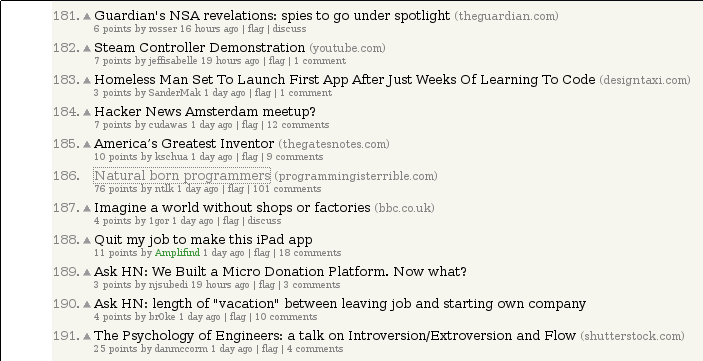
This seems less true when it comes to social issues. When a posting discussing the myth of the natural born programmer[2] hit the front page, the top rated comment is Paul Graham[3] off-handedly discounting the conclusions drawn. The original story linked to a review of peer-reviewed scientific research. Graham simply discounts it on the basis of his preconceptions. Shortly afterwards, the story plummeted off the front page, now surrounded by stories posted around the same time but with much lower scores.

How does this happen? There's two publicised methods which can result in stories dropping down the order. Users with high karma scores (either via submitting popular stories or writing popular comments) are able to flag submissions, and if enough do so then a negative weighting is applied to the story. There's also a flamewar detector, a heuristic that attempts to detect contentious subjects and pushes them off the front page.

The effect of both is to enforce the status quo of social beliefs. Stories that appear to challenge the narrative that good programmers are just naturally talented tend to vanish. Stories that discuss the difficulties faced by minorities in our field are summarily disappeared. There are no social problems in the technology industry. We have always been at war with Eastasia.

This isn't healthy. We don't improve the state of the software industry by hiding stories that expose conflicts. Flamewars don't solve problems, but without them we'd be entirely unaware of how much of a victim blaming mentality exists amongst our peers. It's true that conflict may reinforce preconceptions, causing people to dig in as they defend their beliefs. However, the absence of conflict does nothing to counteract that. If you're never exposed to opinions you disagree with, you'll never question your existing beliefs.

Hacker News is a privately run site and nobody's under any obligation to change how they choose to run it. But the focus on avoiding conflict to such an extent that controversial stories receive less exposure than ones that fit people's existing beliefs doesn't enhance our community. If we want to be able to use technology as an instrument of beneficial change to society as a whole, we benefit from building a diverse and welcoming community and questioning our preconceptions. Building a social echo chamber risks marginalising us from the rest of society, gradually becoming ignored and irrelevant as our self-reinforcing opinions drift ever further away from the mainstream. It doesn't help anybody.

[1] During the batch of interviews I did last year, two separate interviewers both mentioned a story they'd read on Hacker News that turned out to have been written by me. I'm not saying that that's what determined a hire/don't hire decision, but it seems likely that it helped.
[2] The article in question discusses the pervasive idea that some people are inherently good programmers. It turns out that perpetuating the idea that some people are just born good at a particular skill actually discourages others from even trying to learn it, even those who are just as capable.
[3] One of the co-founders of Y-Combinator and creator of Hacker News.

(Edited to fix a footnote reference)

comment count unavailable comments

14 October 2013

Gunnar Wolf: C sar Y ez (@caesarcomptus) in the classroom: Process scheduling

I try to have some guests every now and then to my Operating Systems class. The class is not as practical/interactive as I'd like, and having some people show the students how the subjects I teach are reflected in the real world is, I feel, very useful for them to understand the topics' importance. The past semester (the first one for me) I had three guests: Chema Serralde, talking about process scheduling and in particular on the importance of real time, from his perspective as a musician, Rolando Cedillo, talking about the early stages of the boot process, and C sar Y ez, giving a review of file systems. This semester, there have been two guests so far: Felipe Esquivel, who spoke about parallelism, and used renders with Blender to illustrate the speed gains and limitations (i.e. Amdahl's law), and this last Thursday, I invited again C sar Y ez. C sar spoke about process scheduling, first giving a quite thorough review of what had taken me at least three sessions to go through, and second, giving some in-depth review based on his experience with Haiku OS. What else was different this time? I told our coordinator in the faculty, and she invited the other teachers of the subject (and attended herself). So, instead of the usual ~25 students, we have ~40 people in the classroom. And one of them, Adolfo, recorded most of C sar's explanation. Yay! Of course, I asked Adolfo for a copy of his recording, and recoded it in a format more suitable for Web viewing. Here it is (almost 300MB, Ogg Video, ~95 minutes). I still have the original video file given to me, in an Apple-generated badly-compressed .mov, but at over 1.5GB, it's too much for a Web download. I will try to record future sessions, as they will surely be useful!

13 October 2013

Francesca Ciceri: MissRepresentation: discussing gender stereotypes in Moldova

Recently, I've been attending a training course in Moldova about the representation of gender in the media and the influence on society of gender stereotypes.
The course was organized by Inesa Lupu, of Invento and financed by the UE as part of the Youth in Action program. It was the first time, for me, in this kind of international project and it was, in a word, fantastic.
Among the participants, there were people from Azerbaijan, Georgia, Italy, Latvia, Moldova and Slovenia.
That meant a great mix of cultures, languages and experiences.
And that was the key, in my opinion, of the success: coming from different countries and different social and cultural contexts meant that we were able to have a very broad and diverse point of view on the problem of gender stereotypes. So, here's some highlights on what we discussed. The media representation of gender (aka: gender issues are not only women issues) Tough Guise by Jackson Katz is a interesting documentary about the way the modern society - particularly in the US - defines masculinity as intrinsically tied to violence, aggressivity and "toughness" and on the consequences of this on the society as a whole. The author's theory is "that male violence, misogyny, and homophobia are inextricably linked to how we define manhood as a culture. The film gives special attention to how American media have glamorized increasingly regressive and violence masculine ideals in the face of mounting social and economic threats to traditional white male heterosexual authority". It then results clear that we cannot avoid to think about gender issues as women and men issues, because after all is the cultural definition of both femininity and masculinity that heavily influences the behaviour of men and women and their interaction.
In particular, I liked Katz's analysis of media's use of victim blaming speech while reporting of violences against women which tend to shift the focus from the violence perpetrated by men as part of definition of masculinity. Another documentary we watched, more focused on women representation, is MissRepresentation by Jennifer Siebel Newsom.
The film analyses the under representation of women in position of power, and the issue of women and leadership, especially in politics, in the US. Nothing too new, if you are interested in gender issues, as it is a widely discussed and studied topic, but still worth watching. After watching them, we formed little groups of three-four persons from different countries to discuss them, and it was even more interesting to listen the opinion of the guys (we had four male participants). The guys talking about Tough Guise Photography and Phototherapy As a workshop on media representation of gender, photography and advertisement were two of the main argument we spoke about. We focused on it for two days: our trainer, Lietta Granato - photographer and phototherapist - first gave us a lesson on photography, making us experimenting a bit with exposure times and diaphragm's aperture. a lesson on photography Then she presented the evolution in the last 50 year or so, of the depiction of women in the ads.
And that, to be honest, was a bit upsetting.
I've already had seen one of the most important and widely known films on this theme, the Killing Us Softly series by Jean Kilbourne, but some of the ads Lietta showed to us were really really horrible. Actually, most of them were horrible. Commenting and deconstructing these ads would take a separate blogpost, probably, and there are many people more competent than me on the topic, so I've decided to simply share some of the worst ads in a collage, without much commenting. These are vintage, from the fifties to the seventies. a collage of vintage sexist ads Do you think we got better? Pff. a collage of recent sexist ads They go from promoting violence and rape to heavily objectifying women. Special mention for the Compaq ad: as a geek woman I feel particularly insulted by the idea that I'm supposed to use a "pocket pc" as "pocket mirror". Because I wouldn't be able, obviously, to use it as a computer. Lietta also introduced us to photographic therapy and particularly the work of Jo Spence and Rosy Martin. If you browse Jo Spence's site, please be aware that there is a series of pics documenting all the stages of her illness (she died of breast cancer) and they are pretty intense. "In 1984, alongside Rosy Martin, Spence developed Photo-Therapy , adopting techniques from co-counselling. The considerable achievement of Photo-Therapy was to invert the traditional relationship between the photographer and the subject. If historically the subject had little control over their own representation, Photo-Therapy shifts this dynamic. The subject was able to act out personal narratives and claim agency for their own biography." (source: http://www.jospence.org/biography.html)
I love this concept and I really really love Spence's photos. To close on a happier note, I really suggest you to allocate 20 minutes of your time to watch this great talk by Nigerian novelist Chimamanda Ngozi Adichie, about the role of "single story" in shaping stereotypes and misunderstandings.

11 October 2013

Russ Allbery: krb5-strength 2.1

This is a quick bug-fix release, since of course there was a significant bug in the recent 2.0 release. In this case, it was a problem with the build: if you configured the package without CDB support, it didn't build. Apparently I didn't retest that after doing some refactoring. I have good test suite techniques for reasonable code coverage, but not for testing various variant configurations at the Autoconf level. This is what a continuous build infrastructure would be good for, I know. We even have one sitting around; someday, I should invest in hooking my projects up to it. Anyway, also in this release is the start of an Autoconf fix so that --with-tinycdb without an argument works correctly, but I have more Autoconf work to do (also affecting rra-c-util). I also tweaked the error messages returned by the non-CrackLib portions of krb5-strength so that they would hopefully be more comprehensible to users while still being technically accurate. You can get the latest release from the krb5-strength distribution page.

10 October 2013

Russ Allbery: Review: 2312

Review: 2312, by Kim Stanley Robinson
Publisher: Orbit
Copyright: 2012
ISBN: 0-316-19280-5
Format: Kindle
Pages: 563
Swan Er Hong is a native of Mercury, granddaughter of one of the most influential women in the solar system. Alex, known as the Lion of Mercury, has just died as the story opens, and Swan is mourning. But she's also discovering that something else has been going on, something that Alex had not confided in her. Something that involves an inspector from the asteroids, a scientist from Titan, and a message Alex left in the event of her death, asking Swan to convey something personally to another scientist on Io. And then Mercury is attacked and the situation becomes much more complicated. 2312 is, like most Robinson novels, built on top of monumental world-building. The date is given away by the title; the setting is a solar system full of terraforming, habitats, and explosive human colonization. There are human settlements on every world that could possibly sustain them, including a terraformed Mars and a vast in-progress terraforming project on Venus. Mercury, Song's home, supports the city known as Terminator, a shielded habitat that travels around the planet on rails, pushed forward by the thermal expansion of metal at sunrise. Humans have scattered across the solar system and changed everything they've touched, even the asteroids. Many of those have been repurposed as long-haul shuttles: self-contained habitats on carefully-designed routes on which people live for months or years until they get to their destinations. Parts of this book are gorgeous. One of Robinson's strengths is creating images of the vastness of space, science, and human endeavor that feel plausible and inspiring at the same time. The setting of 2312 frees him to go wild with mega construction projects, and he takes full advantage. Parts of the book inspire the same sense of awe as the Hoover Dam or the Great Wall of China, transplanted into space and backed with neat scientific ideas to ponder. (Even if the more skeptical will note certain human habitation hazards, such as prolonged weightlessness and radiation, are mostly hand-waved away.) Unusually for a Robinson novel, 2312 also features an interesting and vibrant protagonist. Usually I can barely remember Robinson's protagonists five minutes after I finish the book, but Swan is so impulsive, erratic, and emotionally intense that I doubt I'll forget her. Her past is stuffed with outrageous risks and intense creativity: having songbird neurons transplanted into her brain, ingesting extraterrestrial bacteria, designing habitats in the asteroid belt, and creating art on the plains of Mercury. As the story gets underway, she meets the oversized and mellow Wahram; at first, she finds him boring, but then they're thrown together by one of the best set pieces of the book, and both they and the reader discover they work well together. Wahram serves as a straight man and as a stand-in for the reader's opinion, showing Swan all the more clearly in contrast. All this sounds quite promising. Unfortunately, what makes 2312 an ambitious failure rather than an excellent story is the story part. Robinson has built an amazing world, but he doesn't seem to know what to do with it. His economy, at least outside of Earth (and more on that in a moment), is essentially post-scarcity. Few of the characters we meet seem to have any concept of fiscal or practical limitation. They head across the solar system on a moment's notice, take vacations in habitats, or head to favorite spots for the view. It felt like Robinson was trying to write a Culture story. Unlike Banks, however, he struggles with generating a plot. 2312 is, in structure, a murder mystery. The characters witness a crime, survive it, and then intend to investigate it, and the crime appears to grow and link to fault lines in their society. This could have worked, but it has two problems: their society is only barely coherent enough for the reader to perceive the potential fault lines, and Robinson seems to have no idea how to construct a mystery plot. There is no sense of coherence to Swan and Wahram's approach, no sense of a gathering of clues, and very little sense of drama. All of the plot revelations are either dropped in Swan's lap by another character at a convenient moment or generated by Swan refusing to take the plot of the book seriously. The characters do essentially no meaningful investigation on-camera and show almost no investment in the outcome of the plot. When the climax comes, it's all weirdly forgettable. There are also large sections of the book that appear to have nothing to do with the rest of the plot, and that's where the unfortunate interval on Earth comes in. Robinson takes advantage of the scenes on Earth to do a bit of alienation and shows how foreign and strange and stifling Earth feels to someone who grew up outside of its atmosphere. Parts of this work, but he puts the plot on hold to do it. And parts of it do not work at all. The most glaring example is Swan and Wahram's bizarre bit of attempted charity in Africa, which comes across as stunningly high-handed and arrogant. This could be in character, particularly for Swan (who is not long on empathy), but, if so, the book doesn't signal to the reader that it should be read that way. Instead, there are some side (or snide) comments that seem to indicate Robinson knows nothing about the economic arc of Africa from the past twenty years. And when their absurd, botched, condescending charity plan fails for all the obvious reasons, the characters, and apparently the novel, throw up their hands and write Earth off as a stagnant lost cause that can't accept the imposition of a good idea and go back to the plot, never apparently caring about Earth again. Almost as frustrating is the way that these interludes are tied back into the story, which is usually through Swan getting ridiculously lucky on her random encounter rolls. It felt like whenever Robinson needed to make progress in the plot, Swan would just accidentally run into exactly the right person or situation to bring up the next plot point or to have some investigation make sense. (Not that Swan usually figured this out. Normally, the inspector explains it to her.) The author's finger was planted so firmly on the scales that it destroyed my suspension of disbelief and made a mockery of the idea that the characters were actually investigating anything. 2312 is built around a skeleton of a plot, but the lack of engagement with it, the lack of tension and emotion, the way the next developments are generally narrated to the protagonists and the reader, and the repeated use of random encounters to steer it left me without much reason to care. Robinson tries a few twists, but since the story never felt committed to its plot anyway, those twists feel less like planned complications and more like another random veer in the road. It didn't help that the final outcome was more prosaic and forgettable than the book had been implying it would be. There is a lot to like here. I'm very pleased to see Robinson finally write a memorable protagonist, and he's very good at both world-building and set pieces. But it needed a plot, and it needed a more coherent and complete cultural backdrop for its characters. Without both, it fell back into the typical Robinson trap: gorgeous moments separated by a whole lot of boring, and an overall impression of a construction tour rather than a story. There are bits of it I loved and still remember, particularly Song and Wahram in the tunnels of Mercury (which is possibly the best extended characterization Robinson has ever written). But the book as a whole is a mess, and I can't recommend wading through it for the good parts. Rating: 5 out of 10

9 October 2013

John Goerzen: Two Kittens

Almost every time he got off the bus for the past month and a half, Jacob started his afternoon in the same way. Before toys, before his trains and his toy bus, before anything indoors, he went for our cats. Here he is, cradling his favorite, Tigger: Laura and I both grew up around cats. We had been talking about kittens, and shortly after we got engaged, one of my relatives offered us some free kittens. We went to his place one evening and selected two of them one calico and one tiger-colored. Since what is now my place will soon be our place, they came to live with me. Our cats were one of the first things we did to prepare for our lives together. Oliver wanted to name them some rather impractical sentence-long names ( The Cat Who Always Likes To Run ), so Laura and I suggested some names from one of their favorite books: Tigger and Roo. They both liked the names, but Oliver thought they should be called Tigger the Digger and Roo the Runner . Never mind that they were just 6 weeks old at the time, and not really old enough to either dig or run. Here s Oliver with Roo, the day after the kittens arrived here. I have always had outside cats, both because I m allergic to cats so I need them to be outside, and because they sometimes literally quiver with joy of being outdoors. Tigger and Roo often chased insects, wrestled with each other, ran up (and slowly came back down) trees, and just loved the outside. Sometimes, I have taken my laptop and wireless headset and work from the back porch. The kittens climb up my jeans, inspect the laptop, and once Roo even fell asleep on my lap at one of those times. Jacob has been particularly attached to Tigger, calling him my very best friend. When Jacob picks him up after school, Tigger often purrs while cradled in Jacob s arms, and Jacob comments that Tigger loves me. Oh dad, he knows I am his friend! The kittens have been growing, and becoming more and more comfortable with their home in the country. Whenever I go outside, it isn t long before there are two energetic kittens near my feet, running back and forth, sometimes being very difficult to avoid stepping on. I call and I see little heads looking at me, from up in a tree, or peeking out from the grain elevator door, or from under the grill. They stare for just a second, and then start running, sometimes comically crashing into something in their haste. Yesterday when I went to give them food, I called and no cats came. I was concerned, and walked around the yard, but at some point either they come or they don t. Yesterday afternoon, just after the bus dropped off Jacob, I discovered Tigger on the ground, motionless. Once Jacob was in the house, I went to investigate, and found Tigger was dead. As I was moving his body, I saw Roo was dead, too. Both apparently from some sort of sudden physical injury a bit mysterious, because neither of them were at a place where they had ever gone before. While all this was happening, I had to also think about how I was going to tell the boys about this. I tried to minimize what he could see, Jacob had caught an unavoidable glimpse of Tigger as we were walking back from the bus, but didn t know exactly what had happened. He waited in the house, and when I came back, asked me if Tigger was dead. I said he was. Jacob started crying, saying, Oh Dad, I am so sad , and reached up for a hug. I picked him up and held him, then sat down on the couch and let him curl up on my lap. I could quite honestly let him know he wasn t alone, telling him I am sad, too. Oliver arrived not long after, and he too was sad, though not as much as Jacob. Both boys pretty soon wanted to see them. I decided this was important for them for closure, and to understand, so while they waited in the house, I went back out to arrange the kittens to hide their faces, the part that looks most unnatural after they die. The boys and I walked out to where I put them, then I carried both of them the last few feet. We stood a little ways back close enough to see who was there, far enough to not get too much detail and they were both sniffling. I tried to put voice to the occasion, saying, Goodbye, Tigger and Roo. We love you. Oliver asked if they could hear us. I said No, but I told them what I felt like anyway. Jacob, through tears, said, Dad, maybe they are in heaven now. We went back inside. Jacob said, Oh dad, I am so sad. This is the saddest day of my life. My heart is breaking. Hearing a 7-year-old say that isn t exactly easy for a dad. Pretty soon he was thinking of sort of comfort activities to do, saying I think I would feel better if we did So they decided to watch a favorite TV program. Jacob asked if Laura knew yet, and when I said no, he got his take-charge voice and said, Dad, you will start the TV show for us. While we are watching, you will send Laura an email to tell her about Tigger and Roo. OK? What could I say, it wasn t a bad idea. Pretty soon both boys were talking and laughing. It was Big Truck Night last night, at a town about half an hour away. It s an annual event we were already planning to attend, where all sorts of Big Trucks firetrucks, school bus, combine, bucket truck, cement truck, etc show up and are open for kids to climb in and explore. It s always a highlight for them. They played and sang happily as we drove, excitedly opened and closed the big door on the school bus and yelled All Aboard! from the top of the combine. We ate dinner, and drove back home. When we got home, Jacob mentioned the cats again, in a sort of matter-of-fact way, and also wanted to make sure he knew Laura had got the message. A person never wakes up expecting to have to dump a bowl of un-eaten cat food, or to give an impromptu cat funeral for little boys. As it was happening, I wished they hadn t been around right then. But in retrospect, I am glad they were. They had been part of life for those kittens, and it is only right that they could be included in being part of death. They got visual closure this way, and will never wonder if the cats are coming back someday. They had a chance to say goodbye. Here is how I remember the kittens.

8 October 2013

Daniel Kahn Gillmor: Unaccountable surveillance is wrong

As I mentioned earlier, the information in the documents released by Edward Snowden show a clear pattern of corporate and government abuse of the information networks that are now deeply intertwined with the lives of many people all over the world. Surveillance is a power dynamic where the party doing the spying has power over the party being surveilled. The surveillance state that results when one party has "Global Cryptologic Dominance" is a seriously bad outcome. The old saw goes "power corrupts, and absolute power corrupts absolutely". In this case, the stated goal of my government appears to be absolute power in this domain, with no constraint on the inevitable corruption. If you are a supporter of any sort of a just social contract (e.g. International Principles on the Application of Human Rights to Communications Surveillance), the situation should be deeply disturbing. One of the major sub-threads in this discussion is how the NSA and their allies have actively tampered with and weakened the cryptographic infrastructure that everyone relies on for authenticated and confidential communications on the 'net. This kind of malicious work puts everyone's communication at risk, not only those people who the NSA counts among their "targets" (and the NSA's "target" selection methods are themselves fraught with serious problems). The US government is supposed to take pride in the checks and balances that keep absolute power out of any one particular branch. One of the latest attempts to simulate "checks and balances" was the President's creation of a "Review Group" to oversee the current malefactors. The review group then asked for public comment. A group of technologists (including myself) submitted a comment demanding that the review group provide concrete technical details to independent technologists. Without knowing the specifics of how the various surveillance mechanisms operate, the public in general can't make informed assessments about what they should consider to be personally safe. And lack of detailed technical knowledge also makes it much harder to mount an effective political or legal opposition to the global surveillance state (e.g. consider the terrible Clapper v. Amnesty International decision, where plaintiffs were denied standing to sue the Director of National Intelligence because they could not demonstrate that they were being surveilled). It's also worth noting that the advocates for global surveillance do not themselves want to be surveilled, and that (for example) the NSA has tried to obscure as much of their operations as possible, by over-classifying documents, and making spurious claims of "national security". This is where the surveillance power dynamic is most baldly in play, and many parts of the US government intelligence and military apparatus has a long history of acting in bad faith to obscure its activities. The people who have been operating these surveillance systems should be ashamed of their work, and those who have been overseeing the operation of these systems should be ashamed of themselves. We need to better understand the scope of the damage done to our global infrastructure so we can repair it if we have any hope of avoiding a complete surveillance state in the future. Getting the technical details of these compromises in the hands of the public is one step on the path toward a healthier society. PostscriptLest I be accused of optimism, let me make clear that fixing the technical harms is necessary, but not sufficient; even if our technical infrastructure had not been deliberately damaged, or if we manage to repair it and stop people from damaging it again, far too many people still regularly accept ubiquitous private (corporate) surveillance. Private surveillance organizations (like Facebook and Google) are too often in a position where their business interests are at odds with their users' interests, and powerful adversaries can use a surveillance organization as a lever against weaker parties. But helping people to improve their own data sovereignty and to avoid subjecting their friends and allies to private surveillance is a discussion for a separate post, i think.Tags: cryptography, nsa

6 October 2013

Russ Allbery: Review: Captain Vorpatril's Alliance

Review: Captain Vorpatril's Alliance, by Lois McMaster Bujold
Series: Vorkosigan #14
Publisher: Baen
Copyright: November 2012
ISBN: 1-4516-3845-0
Format: Kindle
Pages: 432
This is the fourteenth book in the long-running Vorkosigan series (not counting a few side works). It shifts viewpoint characters, following Ivan Vorpatril instead of either Miles or Cordelia, and could be read on its own since the necessary background is at least briefly explained. But it's probably best read in its proper context in the larger series, since otherwise many of the prior events mentioned here won't have much resonance. Ivan Vorpatril, Miles's cousin, has appeared in multiple previous books along with the rest of Miles's extended family, but he's stayed out of the center of the plot. And he clearly likes it that way. Ivan is not at all ambitious, tries to avoid politics, and just wants to live a quiet life (insofar as that's possible in the Barrayan military), sleep with a few women, and stay out of trouble. But given his relations and his job as aide-de-camp to an admiral this doesn't always work. In this book, the not working comes in the form of Byerly, ImpSec (Imperial Security, the Barrayan equivalent of the CIA), and a request to find out more about a woman who seems to be the target of a bounty. Fairly quickly, Ivan finds himself hopelessly entangled in both politics and in someone else's complex life, and is not entirely sure what to do about either. It's been months since I read this book and I'm only now writing a review, in part because I find it hard to know what to say about it. While Ivan doesn't have Miles's manic energy, the tone of this book is very similar to the rest of the Vorkosigan series, as is the plot and most of the characters. Ivan tries a more laid-back approach and doesn't actively seek danger the way that Miles does, but his persistent efforts to do the right thing in the face of unexpected events lead mostly to the same places. There's a bit of humor, a bit of danger, some galactic politics, some scheming, and a slow process of understanding other people better in short, Captain Vorpatril's Alliance is very similar to the thirteen books that proceeded it. This is obviously not a bad thing. If you've read this far in the series, more of the same is probably just fine. I enjoyed the book. Bujold is great at telling stories, the plot mostly moved right along, and I quite liked the two women Ivan meets over the course of the story. But there wasn't much about the story that grabbed me or, I suspect, that I will find particularly memorable. One reason for my somewhat "meh" reaction is that the core of this story is a romance, and while much of that romance is well-done, there is a large segment in the middle of the book where the suspense of the plot derives mostly from one of the two characters refusing to confide in the other. This is Bujold, so this isn't as much of a train wreck as it might be in the hands of another author, and it is for valid plot reasons. But even with those justifications, I never like that plot element. There were about a hundred pages where I wanted to grab Tej and shake some sense into her, which doesn't endear a character to me. And the leads in a romance, at least this sort of romance, should be endearing. I think one reason why Bujold went for that approach to building tension is that there weren't a lot of options available. The basic outlines of what's going to happen are obvious from early in the book and essentially forced by the structure of the series. We know from past books that Ivan is both trustworthy and related to a staggering variety of powerful people, almost all of whom are highly competent and honorable. It's fairly obvious that, as soon as the necessary people trust Ivan and let him and his family solve their problems, all the problems will be solved. It's also fairly obvious how the romances will play out, and that all the new characters will end up a little in awe of how competent and trustworthy all the Barrayans are (a few misdirections aside). Therefore, much of the book, for a long-time reader of the series, involves waiting until those things happen, and meanwhile getting increasingly annoyed at characters who refuse to trust obviously trustworthy people. All that said, I still quite liked the beginning of the book, because Tej and Rish are a wonderful pair and have a great interpersonal dynamic, and the very end of the book once everyone gets past the communication problems and the plot can deliver on its promises. Both together make up for some noticeable sagging in the middle section of the book. Captain Vorpatril's Alliance is not up to the standards of the most memorable books of the series, but it's a solid dose of "more of the same" and provides its money's worth of entertainment. I'm still hoping for more Ekaterin and more fireworks in the next book, though. Rating: 7 out of 10

4 October 2013

Russ Allbery: rra-c-util 4.10

This release rolls up various changes made as part of current work on other packages. I have several releases coming up, hopefully soon, but I've had a lot of other things going on, so neither review writing nor software releasing is going quite as fast as I'd like. In this release is a refactoring of the OpenSSL library probes to change the names of the macros and variables and to add a macro when the libraries are optional. Also added are Autoconf macros to probe for the TinyCDB library. In the standard Perl tests, Test::RRA now supports module version numbers containing an underscore and reports the required version of a module if a test is skipped. The standard Perl strictness tests now support a configurable ignore list for Perl scripts that shouldn't be tested. In Kerberos portability, krb5_free_default_realm is now replaced with krb5_xfree instead of free on Heimdal, and portable/kadmin.h handles portability for kadmin error codes. Finally, the portability library now avoids leaking a dummy symbol when built with GCC and incorporated into a shared object. You can get the latest version from the rra-c-util distribution page.

27 September 2013

Erich Schubert: Big Data madness and reality

"Big Data" has been hyped a lot, and due to this now is burning down to get some reality checking. It's been already overdue, but it is now happening.
I have seen a lot of people be very excited about NoSQL databases; and these databases do have their use cases. However, you just cannot put everything into NoSQL mode and expect it to just work. That is why we have recently seen NewSQL databases, query languages for NoSQL databases etc. - and in fact, they all move towards relational database management again.
Sound new database systems seem to be mostly made up of three aspects: in-memory optimization instead of optimizing for on-disk operation (memory just has become a lot cheaper the last 10 years), the execution of queries on the servers that store the actual data (you may want to call this "stored procedures" if you like SQL, or "map-reduce" if you like buzzwords), and optimized memory layouts (many of the benefits of "colum store" databases come from having a single, often primitive, datatype for the full column to scan, instead of alternating datatypes in records.

However, here is one point you need to consider:
is your data actually this "big"? Big as in: Google scale.
I see people use big data and Hadoop a lot when they just shouldn't. I see a lot of people run Hadoop in a VM on their laptop. Ouch.
The big data technologies are not a one-size-fits-all solution. They are the supersize-me solution, and supersize just does not fit every task.
When you look at the cases where Hadoop is really successful, it is mostly in keeping the original raw data, and enabling people to re-scan the full data again when e.g. their requirements changed. This is where Hadoop is really good at: managing 100 TB of data, and allowing you to quickly filter out the few GB that you really need for your current task.
For the actual analysis - or when you don't have 100 TB, and a large cluster anyway - then just don't try to hadoopify everything.
Here is a raw number from a current experiment. I have a student work on indexing image data; he is implementing some state of the art techniques. For these, a large number of image features are extracted, and then clustering is used to find "typical" features to improve image search.
The benchmarking image set is 56 GB (I have others with 2 TB to use next). The subset the student is currently processing is 13 GB. Extracting 2.3 million 128 dimensional feature vectors reduces this to about 1.4 GB. As you can see, the numbers drop quickly.
State of the art seems to be to load the data into Hadoop, and run clustering (actually, this is more of a vector quantization than clustering) into 1000 groups. Mahout is the obvious candidate to run this on Hadoop.
However, as I've put a lot of effort into the data mining software ELKI, I considered also to try processing it in ELKI.
By cutting the data into 10 MB blocks, Mahout/Hadoop can run the clustering in 52x parallel mappers. k-Means is an iterative algorithm, so it needs multiple processes. I have fixed the number of iterations to 10, which should produce a good enough approximation for my use cases.
K-means is embarrassingly parallel, so one would expect the cluster to really shine at this task. Well, here are some numbers:

So what is happening? Why is ELKI beating Mahout by a factor of 10x?
It's (as always) a mixture of a number of things:
Let me emphasize this: I'm not saying, Hadoop/Mahout is bad. I'm saying: this data set is not big enough to make Mahout beneficial.

Conclusions: As long as your data fits into your main memory and takes just a few hours to compute, don't go for Hadoop.
It will likely be faster on a single node by avoiding the overhead associated with (current) distributed implementations.
Sometimes, it may also be a solution to use the cluster only for preparing the data, then get it to a powerful workstation, and analyze it there. We did do this with the images: for extracting the image features, we used a distributed implementation (not on Hadoop, but on a dozen PCs).
I'm not saying it will stay that way. I have plans for starting "Project HELKI", aka "ELKI on Hadoop". Because I do sometimes hit the barrier of what I can compute on my 8 core CPU in an "reasonable" amount of time. And of course, Mahout will improve over time, and hopefully lose some of its "Java boxing" weight.
But before trying to run everything on a cluster, always try to run it on a single node first. You can still figure out how to scale up later, once you really know what you need.
And last but not least, consider whether scaling up really makes sense. K-means results don't really get better with a larger data set. They are averages, and adding more data will likely only change the last few digits. Now if you have an implementation that doesn't pay attention to numerical issues, you might end up with more numerical error than you gained from that extra data.
In fact, k-means can effectively be accelerated by processing a sample first, and only refining this on the full data set then. And: sampling is the most important "big data" approach. In particular when using statistical methods, consider whether more data can really be expected to improve your quality.
Better algorithms: K-means is a very crude heuristic. It optimizes the sum of squared deviations, which may be not too meaningful for your problem. It is not very noise tolerant, either. And there are thousands of variants. For example bisecting k-means, which no longer is embarrassingly parallel (i.e. it is not as easy to implement on MapReduce), but took just 7 minutes doing 20 iterations for each split. The algorithm can be summarized as starting with k=2, then always splitting the largest cluster in two until you have the desired k. For many use cases, this result will be just as good as the full k-means result.
Don't get me wrong. There are true big data problems. Web scale search, for example. Or product and friend recommendations at Facebook scale. But chances are that you don't have this amount of data. Google probably doesn't employ k-means at that scale either. (actually, Google runs k-means on 5 mio keypoints for vector quantization; which, judging my experience here, can still be done one a single host; in particular with hierarchical approaches such as bisecting k-means)
Don't choose the wrong tool for the wrong problem!

Next.

Previous.