Search Results: "ron"

9 February 2023

Sam Hartman: Building Carthage with Carthage

This is the second in a series of blog posts introducing Carthage, an Infrastructure as Code framework I ve been working on the last four years. In this post we ll talk about how we use Carthage to build the Carthage container images. We absolutely could have just used a Containerfile to do this; in fact I recently removed a hybrid solution that produced an artifact and then used a Containerfile to turn it into an OCI image. The biggest reason we don t use a Containerfile is that we want to be able to reuse the same infrastructure (installed software and configuration) across multiple environments. For example CarthageServerRole, a reusable Carthage component that install Carthage itself is used in several places:
  1. on raw hardware when we re using Carthage to drive a hypervisor
  2. As part of image building pipelines to build AMIs for Amazon Web Services
  3. Installed onto AWS instances built from the Debian AMI where we cannot use custom AMIs
  4. Installed onto KVM VMs
  5. As part of building the Carthage container images
So the biggest thing Carthage gives us is uniformity in how we set up infrastructure. We ve found a number of disadvantages of Containerfiles as well:
  1. Containerfiles mix the disadvantages of imperative and declarative formats. Like a declarative format they have no explicit control logic. It seems like that would be good for introspecting and reasoning about Containers. But all you get is the base image and a set of commands to build a container. For reasoning about common things like whether a container has a particular vulnerability or can be distributed under a particular license, that s not very useful. So we don t get much valuable introspection out of the declarative aspects, and all too often we see Containerfiles generated by Makefiles or other multi-level build-systems to get more logic or control flow.
  2. Containerfiles have limited facility for doing things outside the container. The disadvantage of this is that you end up installing all the software you need to build the container into the container itself (or having a multi-level build system). But for example if I want to use Ansible to configure a container, the easiest way to do that is to actually install Ansible into the container itself, even though Ansible has a large dependency chain most of which we won t need in the container. Yes, Ansible does have a number of connection methods including one for Buildah, but by the point you re using that, you re already using a multi-level build system and aren t really just using a Containerfile.
Okay, so since we re not going to just use a Containerfile, what do we do instead? We produce a CarthageLayout. A CarthageLayout is an object in the Carthage modeling language. The modeling language looks a lot like Python in fact it s even implemented using Python metaclasses and uses the Python parser. However, there are some key semantic differences and it may help to think of the modeling language as its own thing. Carthage layouts are typically contained in Carthage plugins. For example, the oci_images plugin is our focus today. Most of the work in that plugin is in layout.py, and the layout begins here:
class layout(CarthageLayout):
    add_provider(ConfigLayout)
    add_provider(carthage.ansible.ansible_log, str(_dir/"ansible.log"))
The add_provider calls are special, and we ll discuss them in a future post. For now, think of them as assignments in a more complex namespace than simple identifiers. But the heart of this layout is the CarthageImage class:
    class CarthageImage(PodmanImageModel, carthage_base.CarthageServerRole):
        base_image = injector_access('from_scratch_debian')
        oci_image_tag = 'localhost/carthage:latest'
        oci_image_command = ['/bin/systemd']
Most of the work of our image is done by inheritance. We inherit from the CarthageServerRole from the carthage_base plugin collection. A role is a reusable set of infrastructure that can be attached directly to a MachineModel. By inheriting from this role, we request the installation of the Carthage software. The role also supports copying in various dependencies; for example when Carthage is used to manage a cluster of machines, the layout corresponding to the cluster can automatically be copied to all nodes in the cluster. We do not need this feature to build the container image. The CarthageImage class sets its base image. Currently we are using our own base Debian image that we build with debootstrap and then import as a container image. In the fairly near future, we ll change that to:
        base_image =  debian:bookworm 
That will simply use the Debian image from Dockerhub. We are building our own base image for historical reasons and need to confirm that everything works before switching over. By setting oci_image_tag we specify where in the local images the resulting image will be stored. We also specify that this image boots systemd. We actually do want to do a bit of work on top of CarthageServerRole specific to the container image. To do that we use a Carthage feature called a Customization. There are various types of customization. For example MachineCustomization runs a set of tasks on a Machine that is booted and on the network. When building images, the most common type of customization is a FilesystemCustomization. For these, we have access to the filesystem, and we have some way of running a command in the context of the filesystem. We don t boot the filesystem as a machine unless we need to. (We might if the filesystem is a kvm VM or AWS instance for example). Carthage collects all the customizations in a role or image model. In the case of container image classes like PodmanImageModel, each customization is applied as an individual layer in the resulting container image. Roles and customizations are both reusable infrastructure. Roles typically contain customizations. Roles operate at the modeling layer; you might introspect a machine s model or an image s model to see what functionality (roles) it provides. In contrast, customizations operate at the implementation layer. They do specific things like move files around, apply Ansible roles or similar. Let s take a look at the customization applied for the Carthage container image (full code):

        class customize_for_oci(FilesystemCustomization):

            @setup_task("Remove Software")
            async def remove_software(self):
                await self.run_command("apt", "-y", "purge",
                                       "exim4-base",
                                       )

            @setup_task("Install service")
            async def install_service(self):
               # installs and activates a systemd unit
Then to pull it all together, we simply run the layout:
sudo PYTHONPATH=$(pwd) python3 ./bin/carthage-runner ./oci_images build
In the next post, we will dig more into how to make infrastructure reusable.

comment count unavailable comments

8 February 2023

Chris Lamb: Most anticipated films of 2023

Very few highly-anticipated movies appear in January and February, as the bigger releases are timed so they can be considered for the Golden Globes in January and the Oscars in late February or early March, so film fans have the advantage of a few weeks after the New Year to collect their thoughts on the year ahead. In other words, I'm not actually late in outlining below the films I'm most looking forward to in 2023...

Barbie No, seriously! If anyone can make a good film about a doll franchise, it's probably Greta Gerwig. Not only was Little Women (2019) more than admirable, the same could be definitely said for Lady Bird (2017). More importantly, I can't help feel she was the real 'Driver' behind Frances Ha (2012), one of the better modern takes on Claudia Weill's revelatory Girlfriends (1978). Still, whenever I remember that Barbie will be a film about a billion-dollar toy and media franchise with a nettlesome history, I recall I rubbished the "Facebook film" that turned into The Social Network (2010). Anyway, the trailer for Barbie is worth watching, if only because it seems like a parody of itself.

Blitz It's difficult to overstate just how important the aerial bombing of London during World War II is crucial to understanding the British psyche, despite it being a constructed phenomenon from the outset. Without wishing to underplay the deaths of over 40,000 civilian deaths, Angus Calder pointed out in the 1990s that the modern mythology surrounding the event "did not evolve spontaneously; it was a propaganda construct directed as much at [then neutral] American opinion as at British." It will therefore be interesting to see how British Grenadian Trinidadian director Steve McQueen addresses a topic so essential to the British self-conception. (Remember the controversy in right-wing circles about the sole Indian soldier in Christopher Nolan's Dunkirk (2017)?) McQueen is perhaps best known for his 12 Years a Slave (2013), but he recently directed a six-part film anthology for the BBC which addressed the realities of post-Empire immigration to Britain, and this leads me to suspect he sees the Blitz and its surrounding mythology with a more critical perspective. But any attempt to complicate the story of World War II will be vigorously opposed in a way that will make the recent hullabaloo surrounding The Crown seem tame. All this is to say that the discourse surrounding this release may be as interesting as the film itself.

Dune, Part II Coming out of the cinema after the first part of Denis Vileneve's adaptation of Dune (2021), I was struck by the conception that it was less of a fresh adaptation of the 1965 novel by Frank Herbert than an attempt to rehabilitate David Lynch's 1984 version and in a broader sense, it was also an attempt to reestablish the primacy of cinema over streaming TV and the myriad of other distractions in our lives. I must admit I'm not a huge fan of the original novel, finding within it a certain prurience regarding hereditary military regimes and writing about them with a certain sense of glee that belies a secret admiration for them... not to mention an eyebrow-raising allegory for the Middle East. Still, Dune, Part II is going to be a fantastic spectacle.

Ferrari It'll be curious to see how this differs substantially from the recent Ford v Ferrari (2019), but given that Michael Mann's Heat (1995) so effectively re-energised the gangster/heist genre, I'm more than willing to kick the tires of this about the founder of the eponymous car manufacturer. I'm in the minority for preferring Mann's Thief (1981) over Heat, in part because the former deals in more abstract themes, so I'd have perhaps prefered to look forward to a more conceptual film from Mann over a story about one specific guy.

How Do You Live There are a few directors one can look forward to watching almost without qualification, and Hayao Miyazaki (My Neighbor Totoro, Kiki's Delivery Service, Princess Mononoke Howl's Moving Castle, etc.) is one of them. And this is especially so given that The Wind Rises (2013) was meant to be the last collaboration between Miyazaki and Studio Ghibli. Let's hope he is able to come out of retirement in another ten years.

Indiana Jones and the Dial of Destiny Given I had a strong dislike of Indiana Jones and the Kingdom of the Crystal Skull (2008), I seriously doubt I will enjoy anything this film has to show me, but with 1981's Raiders of the Lost Ark remaining one of my most treasured films (read my brief homage), I still feel a strong sense of obligation towards the Indiana Jones name, despite it feeling like the copper is being pulled out of the walls of this franchise today.

Kafka I only know Polish filmmaker Agnieszka Holland through her Spoor (2017), an adaptation of Olga Tokarczuk's 2009 eco-crime novel Drive Your Plow Over the Bones of the Dead. I wasn't an unqualified fan of Spoor (nor the book on which it is based), but I am interested in Holland's take on the life of Czech author Franz Kafka, an author enmeshed with twentieth-century art and philosophy, especially that of central Europe. Holland has mentioned she intends to tell the story "as a kind of collage," and I can hope that it is an adventurous take on the over-furrowed biopic genre. Or perhaps Gregor Samsa will awake from uneasy dreams to find himself transformed in his bed into a huge verminous biopic.

The Killer It'll be interesting to see what path David Fincher is taking today, especially after his puzzling and strangely cold Mank (2020) portraying the writing process behind Orson Welles' Citizen Kane (1941). The Killer is said to be a straight-to-Netflix thriller based on the graphic novel about a hired assassin, which makes me think of Fincher's Zodiac (2007), and, of course, Se7en (1995). I'm not as entranced by Fincher as I used to be, but any film with Michael Fassbender and Tilda Swinton (with a score by Trent Reznor) is always going to get my attention.

Killers of the Flower Moon In Killers of the Flower Moon, Martin Scorsese directs an adaptation of a book about the FBI's investigation into a conspiracy to murder Osage tribe members in the early years of the twentieth century in order to deprive them of their oil-rich land. (The only thing more quintessentially American than apple pie is a conspiracy combined with a genocide.) Separate from learning more about this disquieting chapter of American history, I'd love to discover what attracted Scorsese to this particular story: he's one of the few top-level directors who have the ability to lucidly articulate their intentions and motivations.

Napoleon It often strikes me that, despite all of his achievements and fame, it's somehow still possible to claim that Ridley Scott is relatively underrated compared to other directors working at the top level today. Besides that, though, I'm especially interested in this film, not least of all because I just read Tolstoy's War and Peace (read my recent review) and am working my way through the mind-boggling 431-minute Soviet TV adaptation, but also because several auteur filmmakers (including Stanley Kubrick) have tried to make a Napoleon epic and failed.

Oppenheimer In a way, a biopic about the scientist responsible for the atomic bomb and the Manhattan Project seems almost perfect material for Christopher Nolan. He can certainly rely on stars to queue up to be in his movies (Robert Downey Jr., Matt Damon, Kenneth Branagh, etc.), but whilst I'm certain it will be entertaining on many fronts, I fear it will fall into the well-established Nolan mould of yet another single man struggling with obsession, deception and guilt who is trying in vain to balance order and chaos in the world.

The Way of the Wind Marked by philosophical and spiritual overtones, all of Terrence Malick's films are perfumed with themes of transcendence, nature and the inevitable conflict between instinct and reason. My particular favourite is his stunning Days of Heaven (1978), but The Thin Red Line (1998) and A Hidden Life (2019) also touched me ways difficult to relate, and are one of the few films about the Second World War that don't touch off my sensitivity about them (see my remarks about Blitz above). It is therefore somewhat Malickian that his next film will be a biblical drama about the life of Jesus. Given Malick's filmography, I suspect this will be far more subdued than William Wyler's 1959 Ben-Hur and significantly more equivocal in its conviction compared to Paolo Pasolini's ardently progressive The Gospel According to St. Matthew (1964). However, little beyond that can be guessed, and the film may not even appear until 2024 or even 2025.

Zone of Interest I was mesmerised by Jonathan Glazer's Under the Skin (2013), and there is much to admire in his borderline 'revisionist gangster' film Sexy Beast (2000), so I will definitely be on the lookout for this one. The only thing making me hesitate is that Zone of Interest is based on a book by Martin Amis about a romance set inside the Auschwitz concentration camp. I haven't read the book, but Amis has something of a history in his grappling with the history of the twentieth century, and he seems to do it in a way that never sits right with me. But if Paul Verhoeven's Starship Troopers (1997) proves anything at all, it's all in the adaption.

Thorsten Alteholz: My Debian Activities in January 2023

FTP master This month I accepted 419 and rejected 46 packages. The overall number of packages that got accepted was 429. Looking at these numbers and comparing them to the previous month, one can see: the freeze is near. Everybody wants to get some packages into the archive and I hope nobody is disappointed. Debian LTS This was my hundred-third month that I did some work for the Debian LTS initiative, started by Raphael Hertzog at Freexian. This month my all in all workload has been 14h. During that time I uploaded: I also attended the monthly LTS meeting and did some days of frontdesk duties. Debian ELTS This month was the fifty fourth ELTS month. Last but not least I did some days of frontdesk duties. Debian Astro This month I uploaded improved packages or new versions of: I also uploaded new packages: Debian IoT This month I uploaded improved packages of: Debian Printing This month I uploaded new versions or improved packages of: I also uploaded new packages:

Antoine Beaupr : Major outage with Oricom uplink

The server that normally serves this page, all my email, and many more services was unavailable for about 24 hours. This post explains how and why.

What happened? Starting February 2nd, I started seeing intermittent packet loss on the network. Every hour or so, the link would go down for one or two minutes, then come back up. At first, I didn't think much of it because I was away and could blame the crappy wifi or the uplink I using. But when I came in the office on Monday, the service was indeed seriously degraded. I could barely do videoconferencing calls as they would cut out after about half an hour. I opened a ticket with my uplink, Oricom. They replied that it was an issue they couldn't fix on their end and would need someone on site to fix. So, the next day (Tuesday, at around 10EST) I called Oricom again, and they made me do a full modem reset, which involves plugging a pin in a hole for 15 seconds on the Technicolor TC4400 cable modem. Then the link went down, and it didn't come back up at all. Boom. Oricom then escalated this to their upstream (Oricom is a reseller of Videotron, who has basically the monopoly on cable in Qu bec) which dispatched a tech. This tech, in turn, arrived some time after lunch and said the link worked fine and it was a hardware issue. At this point, Oricom put a new modem in the mail and I started mitigation.

Mitigation

Website The first thing I did, weirdly, was trying to rebuild this blog. I figured it should be pretty simple: install ikiwiki and hit rebuild. I knew I had some patches on ikiwiki to deploy, but surely those are not a deal breaker, right? Nope. Turns out I wrote many plugins and those still don't ship with ikiwiki, despite having been sent upstream a while back, some years ago. So I deployed the plugins inside the .ikiwiki directory of the site in the hope of making things a little more "standalone". Unfortunately, that didn't work either because the theme must be shipped in the system-wide location: I couldn't figure out how to put it to have it bundled with the main repository. At that point I mostly gave up because I had spent too much time on this and I had to do something about email otherwise it would start to bounce.

Email So I made a new VM at Linode (thanks 2.5admins for the credits) to build a new mail server. This wasn't the best idea, in retrospect, because it was really overkill: I started rebuilding the whole mail server from scratch. Ideally, this would be in Puppet and I would just deploy the right profile and the server would be rebuilt. Unfortunately, that part of my infrastructure is not Puppetized and even if it would, well the Puppet server was also down so I would have had to bring that up first. At first, I figured I would just make a secondary mail exchanger (MX), to spool mail for longer so that I wouldn't lose it. But I decided against that: I thought it was too hard to make a "proper" MX as it needs to also filter mail while avoiding backscatter. Might as well just build a whole new server! I had a copy of my full mail spool on my laptop, so I figured that was possible. I mostly got this right: added a DKIM key, installed Postfix, Dovecot, OpenDKIM, OpenDMARC, glue it all together, and voil , I had a mail server. Oh, and spampd. Oh, and I need the training data, oh, and this and... I wasn't done and it was time to sleep. The mail server went online this morning, and started accepting mail. I tried syncing my laptop mail spool against it, but that failed because Dovecot generated new UIDs for the emails, and isync correctly failed to sync. I tried to copy the UIDs from the server in the office (which I had still access to locally), but that somehow didn't work either. But at least the mail was getting delivered and stored properly. I even had the Sieve rules setup so it would get sorted properly too. Unfortunately, I didn't hook that up properly, so those didn't actually get sorted. Thankfully, Dovecot can re-filter emails with the sieve-filter command, so that was fixed later. At this point, I started looking for other things to fix.

Web, again I figured I was almost done with the website, might as well publish it. So I installed the Nginx Debian package, got a cert with certbot, and added the certs to the default configuration. I rsync'd my build in /var/www/html and boom, I had a website. The Goatcounter analytics were timing out, but that was easy to turn off.

Resolution Almost at that exact moment, a bang on the door told me mail was here and I had the modem. I plugged it in and a few minutes later, marcos was back online. So this was a lot (a lot!) of work for basically nothing. I could have just taken the day off and wait for the package to be delivered. It would definitely have been better to make a simpler mail exchanger to spool the mail to avoid losing it. And in fact, that's what I eventually ended up doing: I converted the linode server in a mail relay to continue accepting mail with DNS propagates, but without having to sort the mail out of there... Right now I have about 200 mails in a mailbox that I need to move back into marcos. Normally, this would just be a simple rsync, but because both servers have accepted mail simultaneously, it's going to be simpler to just move those exact mails on there. Because dovecot helpfully names delivered files with the hostname it's running on, it's easy to find those files and transfer them, basically:
rsync -v -n --files-from=<(ssh colette.anarc.at find Maildir -name '*colette*' ) colette.anarc.at: colette/
rsync -v -n --files-from=<(ssh colette.anarc.at find Maildir -name '*colette*' ) colette/ marcos.anarc.at:
Overall, the outage lasted about 24 hours, from 11:00EST (16:00UTC) on 2023-02-07 to the same time today.

Future work I'll probably keep a mail relay to make those situations more manageable in the future. At first I thought that mail filtering would be a problem, but that happens post queue anyways and I don't bounce mail based on Spamassassin, so back-scatter shouldn't be an issue. I basically need Postfix, OpenDMARC, and Postgrey. I'm not even sure I need OpenDKIM as the server won't process outgoing mail, so it doesn't need to sign anything, just check incoming signatures, which OpenDMARC can (probably?) do. Thanks to everyone who supported me through this ordeal, you know who you are (and I'm happy to give credit here if you want to be deanonymized)!

7 February 2023

Stephan Lachnit: Installing Debian on F2FS rootfs with deboostrap and systemd-boot

I recently got a new NVME drive. My plan was to create a fresh Debian install on an F2FS root partition with compression for maximum performance. As it turns out, this is not entirely trivil to accomplish. For one, the Debian installer does not support F2FS (here is my attempt to add it from 2021). And even if it did, grub does not support F2FS with the extra_attr flag that is required for compression support (at least as of grub 2.06). Luckily, we can install Debian anyway with all these these shiny new features when we go the manual road with debootstrap and using systemd-boot as bootloader. We can break down the process into several steps:
  1. Creating the partition table
  2. Creating and mounting the root partition
  3. Bootstrapping with debootstrap
  4. Chrooting into the system
  5. Configure the base system
  6. Define static file system information
  7. Installing the kernel and bootloader
  8. Finishing touches
Warning: Playing around with partitions can easily result in data if you mess up! Make sure to double check your commands and create a data backup if you don t feel confident about the process.

Creating the partition partble The first step is to create the GPT partition table on the new drive. There are several tools to do this, I recommend the ArchWiki page on this topic for details. For simplicity I just went with the GParted since it has an easy GUI, but feel free to use any other tool. The layout should look like this:
Type         Partition        Suggested size
 
EFI          /dev/nvme0n1p1           512MiB
Linux swap   /dev/nvme0n1p2             1GiB
Linux fs     /dev/nvme0n1p3        remainder
Notes:
  • The disk names are just an example and have to be adjusted for your system.
  • Don t set disk labels, they don t appear on the new install anyway and some UEFIs might not like it on your boot partition.
  • The size of the EFI partition can be smaller, in practive it s unlikely that you need more than 300 MiB. However some UEFIs might be buggy and if you ever want to install an additional kernel or something like memtest86+ you will be happy to have the extra space.
  • The swap partition can be omitted, it is not strictly needed. If you need more swap for some reason you can also add more using a swap file later (see ArchWiki page). If you know you want to use suspend-to-RAM, you want to increase the size to something more than the size of your memory.
  • If you used GParted, create the EFI partition as FAT32 and set the esp flag. For the root partition use ext4 or F2FS if available.

Creating and mounting the root partition To create the root partition, we need to install the f2fs-tools first:
sudo apt install f2fs-tools
Now we can create the file system with the correct flags:
mkfs.f2fs -O extra_attr,inode_checksum,sb_checksum,compression,encrypt /dev/nvme0n1p3
For details on the flags visit the ArchWiki page. Next, we need to mount the partition with the correct flags. First, create a working directory:
mkdir boostrap
cd boostrap
mkdir root
export DFS=$(pwd)/root
Then we can mount the partition:
sudo mount -o compress_algorithm=zstd:6,compress_chksum,atgc,gc_merge,lazytime /dev/nvme0n1p3 $DFS
Again, for details on the mount options visit the above mentioned ArchWiki page.

Bootstrapping with debootstrap First we need to install the debootstrap package:
sudo apt install debootstrap
Now we can do the bootstrapping:
debootstrap --arch=amd64 --components=main,contrib,non-free,non-free-firmware unstable $DFS http://deb.debian.org/debian
Notes:
  • --arch sets the CPU architecture (see Debian Wiki).
  • --components sets the archive components, if you don t want non-free pacakges you might want to remove some entries here.
  • unstable is the Debian release, you might want to change that to testing or bookworm.
  • $DFS points to the mounting point of the root partition.
  • http://deb.debian.org/debian is the Debian mirror, you might want to set that to http://ftp.de.debian.org/debian or similar if you have a fast mirror in you area.

Chrooting into the system Before we can chroot into the newly created system, we need to prepare and mount virtual kernel file systems. First create the directories:
sudo mkdir -p $DFS/dev $DFS/dev/pts $DFS/proc $DFS/sys $DFS/run $DFS/sys/firmware/efi/efivars $DFS/boot/efi
Then bind-mount the directories from your system to the mount point of the new system:
sudo mount -v -B /dev $DFS/dev
sudo mount -v -B /dev/pts $DFS/dev/pts
sudo mount -v -B /proc $DFS/proc
sudo mount -v -B /sys $DFS/sys
sudo mount -v -B /run $DFS/run
sudo mount -v -B /sys/firmware/efi/efivars $DFS/sys/firmware/efi/efivars
As a last step, we need to mount the EFI partition:
sudo mount -v -B /dev/nvme0n1p1 $DFS/boot/efi
Now we can chroot into new system:
sudo chroot $DFS /bin/bash

Configure the base system The first step in the chroot is setting the locales. We need this since we might leak the locales from our base system into the chroot and if this happens we get a lot of annoying warnings.
export LC_ALL=C.UTF-8 LANG=C.UTF-8
apt install locales console-setup
Set your locales:
dpkg-reconfigure locales
Set your keyboard layout:
dpkg-reconfigure keyboard-configuration
Set your timezone:
dpkg-reconfigure tzdata
Now you have a fully functional Debian chroot! However, it is not bootable yet, so let s fix that.

Define static file system information The first step is to make sure the system mounts all partitions on startup with the correct mount flags. This is done in /etc/fstab (see ArchWiki page). Open the file and change its content to:
# file system                               mount point   type   options                                                            dump   pass
# NVME efi partition
UUID=XXXX-XXXX                              /boot/efi     vfat   umask=0077                                                         0      0
# NVME swap
UUID=XXXXXXXX-XXXX-XXXX-XXXX-XXXXXXXXXXXX   none          swap   sw                                                                 0      0
# NVME main partition
UUID=XXXXXXXX-XXXX-XXXX-XXXX-XXXXXXXXXXXX   /             f2fs   compress_algorithm=zstd:6,compress_chksum,atgc,gc_merge,lazytime   0      1
You need to fill in the UUIDs for the partitions. You can use
ls -lAph /dev/disk/by-uuid/
to match the UUIDs to the more readable disk name under /dev.

Installing the kernel and bootloader First install the systemd-boot and efibootmgr packages:
apt install systemd-boot efibootmgr
Now we can install the bootloader:
bootctl install --path=/boot/efi
You can verify the procedure worked with
efibootmgr -v
The next step is to install the kernel, you can find a fitting image with:
apt search linux-image-*
In my case:
apt install linux-image-amd64
After the installation of the kernel, apt will add an entry for systemd-boot automatically. Neat! However, since we are in a chroot the current settings are not bootable. The first reason is the boot partition, which will likely be the one from your current system. To change that, navigate to /boot/efi/loader/entries, it should contain one config file. When you open this file, it should look something like this:
title      Debian GNU/Linux bookworm/sid
version    6.1.0-3-amd64
machine-id 2967cafb6420ce7a2b99030163e2ee6a
sort-key   debian
options    root=PARTUUID=f81d4fae-7dec-11d0-a765-00a0c91e6bf6 ro systemd.machine_id=2967cafb6420ce7a2b99030163e2ee6a
linux      /2967cafb6420ce7a2b99030163e2ee6a/6.1.0-3-amd64/linux
initrd     /2967cafb6420ce7a2b99030163e2ee6a/6.1.0-3-amd64/initrd.img-6.1.0-3-amd64
The PARTUUID needs to point to the partition equivalent to /dev/nvme0n1p3 on your system. You can use
ls -lAph /dev/disk/by-partuuid/
to match the PARTUUIDs to the more readable disk name under /dev. The second problem is the ro flag in options which tell the kernel to boot in read-only mode. The default is rw, so you can just remove the ro flag. Once this is fixed, the new system should be bootable. You can change the boot order with:
efibootmgr --bootorder
However, before we reboot we might add well add a user and install some basic software.

Finishing touches Add a user:
useradd -m -G sudo -s /usr/bin/bash -c 'Full Name' username
Debian provides a TUI to install Desktop Environment. To open it, run:
tasksel
Now you can finally reboot into your new system:
reboot

Resources for further reading https://ivanb.neocities.org/blogs/y2022/debootstrap
https://www.debian.org/releases/stable/amd64/apds03.en.html
https://www.addictivetips.com/ubuntu-linux-tips/set-up-systemd-boot-on-arch-linux/
https://p5r.uk/blog/2020/using-systemd-boot-on-debian-bullseye.html
https://www.linuxfromscratch.org/lfs/view/stable/chapter07/kernfs.html
Thanks for reading!

6 February 2023

Vincent Bernat: Fast and dynamic encoding of Protocol Buffers in Go

Protocol Buffers are a popular choice for serializing structured data due to their compact size, fast processing speed, language independence, and compatibility. There exist other alternatives, including Cap n Proto, CBOR, and Avro. Usually, data structures are described in a proto definition file (.proto). The protoc compiler and a language-specific plugin convert it into code:
$ head flow-4.proto
syntax = "proto3";
package decoder;
option go_package = "akvorado/inlet/flow/decoder";
message FlowMessagev4  
  uint64 TimeReceived = 2;
  uint32 SequenceNum = 3;
  uint64 SamplingRate = 4;
  uint32 FlowDirection = 5;
$ protoc -I=. --plugin=protoc-gen-go --go_out=module=akvorado:. flow-4.proto
$ head inlet/flow/decoder/flow-4.pb.go
// Code generated by protoc-gen-go. DO NOT EDIT.
// versions:
//      protoc-gen-go v1.28.0
//      protoc        v3.21.12
// source: inlet/flow/data/schemas/flow-4.proto
package decoder
import (
        protoreflect "google.golang.org/protobuf/reflect/protoreflect"
Akvorado collects network flows using IPFIX or sFlow, decodes them with GoFlow2, encodes them to Protocol Buffers, and sends them to Kafka to be stored in a ClickHouse database. Collecting a new field, such as source and destination MAC addresses, requires modifications in multiple places, including the proto definition file and the ClickHouse migration code. Moreover, the cost is paid by all users.1 It would be nice to have an application-wide schema and let users enable or disable the fields they need. While the main goal is flexibility, we do not want to sacrifice performance. On this front, this is quite a success: when upgrading from 1.6.4 to 1.7.1, the decoding and encoding performance almost doubled!
goos: linux
goarch: amd64
pkg: akvorado/inlet/flow
cpu: AMD Ryzen 5 5600X 6-Core Processor
                              initial.txt                 final.txt               
                                 sec/op        sec/op     vs base                 
Netflow/with_encoding-12      12.963    2%   7.836    1%  -39.55% (p=0.000 n=10)
Sflow/with_encoding-12         19.37    1%   10.15    2%  -47.63% (p=0.000 n=10)

Faster Protocol Buffers encoding I use the following code to benchmark both the decoding and encoding process. Initially, the Decode() method is a thin layer above GoFlow2 producer and stores the decoded data into the in-memory structure generated by protoc. Later, some of the data will be encoded directly during flow decoding. This is why we measure both the decoding and the encoding.2
func BenchmarkDecodeEncodeSflow(b *testing.B)  
    r := reporter.NewMock(b)
    sdecoder := sflow.New(r)
    data := helpers.ReadPcapPayload(b,
        filepath.Join("decoder", "sflow", "testdata", "data-1140.pcap"))
    for _, withEncoding := range []bool true, false   
        title := map[bool]string 
            true:  "with encoding",
            false: "without encoding",
         [withEncoding]
        var got []*decoder.FlowMessage
        b.Run(title, func(b *testing.B)  
            for i := 0; i < b.N; i++  
                got = sdecoder.Decode(decoder.RawFlow 
                    Payload: data,
                    Source: net.ParseIP("127.0.0.1"),
                 )
                if withEncoding  
                    for _, flow := range got  
                        buf := []byte 
                        buf = protowire.AppendVarint(buf, uint64(proto.Size(flow)))
                        proto.MarshalOptions .MarshalAppend(buf, flow)


         )
     
 
The canonical Go implementation for Protocol Buffers, google.golang.org/protobuf is not the most efficient one. For a long time, people were relying on gogoprotobuf. However, the project is now deprecated. A good replacement is vtprotobuf.3
goos: linux
goarch: amd64
pkg: akvorado/inlet/flow
cpu: AMD Ryzen 5 5600X 6-Core Processor
                              initial.txt               bench-2.txt              
                                sec/op        sec/op     vs base                 
Netflow/with_encoding-12      12.96    2%   10.28    2%  -20.67% (p=0.000 n=10)
Netflow/without_encoding-12   8.935    2%   8.975    2%        ~ (p=0.143 n=10)
Sflow/with_encoding-12        19.37    1%   16.67    2%  -13.93% (p=0.000 n=10)
Sflow/without_encoding-12     14.62    3%   14.87    1%   +1.66% (p=0.007 n=10)

Dynamic Protocol Buffers encoding We have our baseline. Let s see how to encode our Protocol Buffers without a .proto file. The wire format is simple and rely a lot on variable-width integers. Variable-width integers, or varints, are an efficient way of encoding unsigned integers using a variable number of bytes, from one to ten, with small values using fewer bytes. They work by splitting integers into 7-bit payloads and using the 8th bit as a continuation indicator, set to 1 for all payloads except the last.
Variable-width integers encoding in Protocol Buffers: conversion of 150 to a varint
Variable-width integers encoding in Protocol Buffers
For our usage, we only need two types: variable-width integers and byte sequences. A byte sequence is encoded by prefixing it by its length as a varint. When a message is encoded, each key-value pair is turned into a record consisting of a field number, a wire type, and a payload. The field number and the wire type are encoded as a single variable-width integer called a tag.
Message encoded with Protocol Buffers: three varints, two sequences of bytes
Message encoded with Protocol Buffers
We use the following low-level functions to build the output buffer: Our schema abstraction contains the appropriate information to encode a message (ProtobufIndex) and to generate a proto definition file (fields starting with Protobuf):
type Column struct  
    Key       ColumnKey
    Name      string
    Disabled  bool
    // [ ]
    // For protobuf.
    ProtobufIndex    protowire.Number
    ProtobufType     protoreflect.Kind // Uint64Kind, Uint32Kind,  
    ProtobufEnum     map[int]string
    ProtobufEnumName string
    ProtobufRepeated bool
 
We have a few helper methods around the protowire functions to directly encode the fields while decoding the flows. They skip disabled fields or non-repeated fields already encoded. Here is an excerpt of the sFlow decoder:
sch.ProtobufAppendVarint(bf, schema.ColumnBytes, uint64(recordData.Base.Length))
sch.ProtobufAppendVarint(bf, schema.ColumnProto, uint64(recordData.Base.Protocol))
sch.ProtobufAppendVarint(bf, schema.ColumnSrcPort, uint64(recordData.Base.SrcPort))
sch.ProtobufAppendVarint(bf, schema.ColumnDstPort, uint64(recordData.Base.DstPort))
sch.ProtobufAppendVarint(bf, schema.ColumnEType, helpers.ETypeIPv4)
For fields that are required later in the pipeline, like source and destination addresses, they are stored unencoded in a separate structure:
type FlowMessage struct  
    TimeReceived uint64
    SamplingRate uint32
    // For exporter classifier
    ExporterAddress netip.Addr
    // For interface classifier
    InIf  uint32
    OutIf uint32
    // For geolocation or BMP
    SrcAddr netip.Addr
    DstAddr netip.Addr
    NextHop netip.Addr
    // Core component may override them
    SrcAS     uint32
    DstAS     uint32
    GotASPath bool
    // protobuf is the protobuf representation for the information not contained above.
    protobuf      []byte
    protobufSet   bitset.BitSet
 
The protobuf slice holds encoded data. It is initialized with a capacity of 500 bytes to avoid resizing during encoding. There is also some reserved room at the beginning to be able to encode the total size as a variable-width integer. Upon finalizing encoding, the remaining fields are added and the message length is prefixed:
func (schema *Schema) ProtobufMarshal(bf *FlowMessage) []byte  
    schema.ProtobufAppendVarint(bf, ColumnTimeReceived, bf.TimeReceived)
    schema.ProtobufAppendVarint(bf, ColumnSamplingRate, uint64(bf.SamplingRate))
    schema.ProtobufAppendIP(bf, ColumnExporterAddress, bf.ExporterAddress)
    schema.ProtobufAppendVarint(bf, ColumnSrcAS, uint64(bf.SrcAS))
    schema.ProtobufAppendVarint(bf, ColumnDstAS, uint64(bf.DstAS))
    schema.ProtobufAppendIP(bf, ColumnSrcAddr, bf.SrcAddr)
    schema.ProtobufAppendIP(bf, ColumnDstAddr, bf.DstAddr)
    // Add length and move it as a prefix
    end := len(bf.protobuf)
    payloadLen := end - maxSizeVarint
    bf.protobuf = protowire.AppendVarint(bf.protobuf, uint64(payloadLen))
    sizeLen := len(bf.protobuf) - end
    result := bf.protobuf[maxSizeVarint-sizeLen : end]
    copy(result, bf.protobuf[end:end+sizeLen])
    return result
 
Minimizing allocations is critical for maintaining encoding performance. The benchmark tests should be run with the -benchmem flag to monitor allocation numbers. Each allocation incurs an additional cost to the garbage collector. The Go profiler is a valuable tool for identifying areas of code that can be optimized:
$ go test -run=__nothing__ -bench=Netflow/with_encoding \
>         -benchmem -cpuprofile profile.out \
>         akvorado/inlet/flow
goos: linux
goarch: amd64
pkg: akvorado/inlet/flow
cpu: AMD Ryzen 5 5600X 6-Core Processor
Netflow/with_encoding-12             143953              7955 ns/op            8256 B/op        134 allocs/op
PASS
ok      akvorado/inlet/flow     1.418s
$ go tool pprof profile.out
File: flow.test
Type: cpu
Time: Feb 4, 2023 at 8:12pm (CET)
Duration: 1.41s, Total samples = 2.08s (147.96%)
Entering interactive mode (type "help" for commands, "o" for options)
(pprof) web
After using the internal schema instead of code generated from the proto definition file, the performance improved. However, this comparison is not entirely fair as less information is being decoded and previously GoFlow2 was decoding to its own structure, which was then copied to our own version.
goos: linux
goarch: amd64
pkg: akvorado/inlet/flow
cpu: AMD Ryzen 5 5600X 6-Core Processor
                              bench-2.txt                bench-3.txt              
                                 sec/op        sec/op     vs base                 
Netflow/with_encoding-12      10.284    2%   7.758    3%  -24.56% (p=0.000 n=10)
Netflow/without_encoding-12    8.975    2%   7.304    2%  -18.61% (p=0.000 n=10)
Sflow/with_encoding-12         16.67    2%   14.26    1%  -14.50% (p=0.000 n=10)
Sflow/without_encoding-12      14.87    1%   13.56    2%   -8.80% (p=0.000 n=10)
As for testing, we use github.com/jhump/protoreflect: the protoparse package parses the proto definition file we generate and the dynamic package decodes the messages. Check the ProtobufDecode() method for more details.4 To get the final figures, I have also optimized the decoding in GoFlow2. It was relying heavily on binary.Read(). This function may use reflection in certain cases and each call allocates a byte array to read data. Replacing it with a more efficient version provides the following improvement:
goos: linux
goarch: amd64
pkg: akvorado/inlet/flow
cpu: AMD Ryzen 5 5600X 6-Core Processor
                              bench-3.txt                bench-4.txt              
                                 sec/op        sec/op     vs base                 
Netflow/with_encoding-12       7.758    3%   7.365    2%   -5.07% (p=0.000 n=10)
Netflow/without_encoding-12    7.304    2%   6.931    3%   -5.11% (p=0.000 n=10)
Sflow/with_encoding-12        14.256    1%   9.834    2%  -31.02% (p=0.000 n=10)
Sflow/without_encoding-12     13.559    2%   9.353    2%  -31.02% (p=0.000 n=10)
It is now easier to collect new data and the inlet component is faster!

Notice Some paragraphs were editorialized by ChatGPT, using editorialize and keep it short as a prompt. The result was proofread by a human for correctness. The main idea is that ChatGPT should be better at English than me.


  1. While empty fields are not serialized to Protocol Buffers, empty columns in ClickHouse take some space, even if they compress well. Moreover, unused fields are still decoded and they may clutter the interface.
  2. There is a similar function using NetFlow. NetFlow and IPFIX protocols are less complex to decode than sFlow as they are using a simpler TLV structure.
  3. vtprotobuf generates more optimized Go code by removing an abstraction layer. It directly generates the code encoding each field to bytes:
    if m.OutIfSpeed != 0  
        i = encodeVarint(dAtA, i, uint64(m.OutIfSpeed))
        i--
        dAtA[i] = 0x6
        i--
        dAtA[i] = 0xd8
     
    
  4. There is also a protoprint package to generate proto definition file. I did not use it.

Reproducible Builds: Reproducible Builds in January 2023

Welcome to the first report for 2023 from the Reproducible Builds project! In these reports we try and outline the most important things that we have been up to over the past month, as well as the most important things in/around the community. As a quick recap, the motivation behind the reproducible builds effort is to ensure no malicious flaws can be deliberately introduced during compilation and distribution of the software that we run on our devices. As ever, if you are interested in contributing to the project, please visit our Contribute page on our website.


News In a curious turn of events, GitHub first announced this month that the checksums of various Git archives may be subject to change, specifically that because:
the default compression for Git archives has recently changed. As result, archives downloaded from GitHub may have different checksums even though the contents are completely unchanged.
This change (which was brought up on our mailing list last October) would have had quite wide-ranging implications for anyone wishing to validate and verify downloaded archives using cryptographic signatures. However, GitHub reversed this decision, updating their original announcement with a message that We are reverting this change for now. More details to follow. It appears that this was informed in part by an in-depth discussion in the GitHub Community issue tracker.
The Bundesamt f r Sicherheit in der Informationstechnik (BSI) (trans: The Federal Office for Information Security ) is the agency in charge of managing computer and communication security for the German federal government. They recently produced a report that touches on attacks on software supply-chains (Supply-Chain-Angriff). (German PDF)
Contributor Seb35 updated our website to fix broken links to Tails Git repository [ ][ ], and Holger updated a large number of pages around our recent summit in Venice [ ][ ][ ][ ].
Noak J nsson has written an interesting paper entitled The State of Software Diversity in the Software Supply Chain of Ethereum Clients. As the paper outlines:
In this report, the software supply chains of the most popular Ethereum clients are cataloged and analyzed. The dependency graphs of Ethereum clients developed in Go, Rust, and Java, are studied. These client are Geth, Prysm, OpenEthereum, Lighthouse, Besu, and Teku. To do so, their dependency graphs are transformed into a unified format. Quantitative metrics are used to depict the software supply chain of the blockchain. The results show a clear difference in the size of the software supply chain required for the execution layer and consensus layer of Ethereum.

Yongkui Han posted to our mailing list discussing making reproducible builds & GitBOM work together without gitBOM-ID embedding. GitBOM (now renamed to OmniBOR) is a project to enable automatic, verifiable artifact resolution across today s diverse software supply-chains [ ]. In addition, Fabian Keil wrote to us asking whether anyone in the community would be at Chemnitz Linux Days 2023, which is due to take place on 11th and 12th March (event info). Separate to this, Akihiro Suda posted to our mailing list just after the end of the month with a status report of bit-for-bit reproducible Docker/OCI images. As Akihiro mentions in their post, they will be giving a talk at FOSDEM in the Containers devroom titled Bit-for-bit reproducible builds with Dockerfile and that my talk will also mention how to pin the apt/dnf/apk/pacman packages with my repro-get tool.
The extremely popular Signal messenger app added upstream support for the SOURCE_DATE_EPOCH environment variable this month. This means that release tarballs of the Signal desktop client do not embed nondeterministic release information. [ ][ ]

Distribution work

F-Droid & Android There was a very large number of changes in the F-Droid and wider Android ecosystem this month: On January 15th, a blog post entitled Towards a reproducible F-Droid was published on the F-Droid website, outlining the reasons why F-Droid signs published APKs with its own keys and how reproducible builds allow using upstream developers keys instead. In particular:
In response to [ ] criticisms, we started encouraging new apps to enable reproducible builds. It turns out that reproducible builds are not so difficult to achieve for many apps. In the past few months we ve gotten many more reproducible apps in F-Droid than before. Currently we can t highlight which apps are reproducible in the client, so maybe you haven t noticed that there are many new apps signed with upstream developers keys.
(There was a discussion about this post on Hacker News.) In addition:
  • F-Droid added 13 apps published with reproducible builds this month. [ ]
  • FC Stegerman outlined a bug where baseline.profm files are nondeterministic, developed a workaround, and provided all the details required for a fix. As they note, this issue has now been fixed but the fix is not yet part of an official Android Gradle plugin release.
  • GitLab user Parwor discovered that the number of CPU cores can affect the reproducibility of .dex files. [ ]
  • FC Stegerman also announced the 0.2.0 and 0.2.1 releases of reproducible-apk-tools, a suite of tools to help make .apk files reproducible. Several new subcommands and scripts were added, and a number of bugs were fixed as well [ ][ ]. They also updated the F-Droid website to improve the reproducibility-related documentation. [ ][ ]
  • On the F-Droid issue tracker, FC Stegerman discussed reproducible builds with one of the developers of the Threema messenger app and reported that Android SDK build-tools 31.0.0 and 32.0.0 (unlike earlier and later versions) have a zipalign command that produces incorrect padding.
  • A number of bugs related to reproducibility were discovered in Android itself. Firstly, the non-deterministic order of .zip entries in .apk files [ ] and then newline differences between building on Windows versus Linux that can make builds not reproducible as well. [ ] (Note that these links may require a Google account to view.)
  • And just before the end of the month, FC Stegerman started a thread on our mailing list on the topic of hiding data/code in APK embedded signatures which has been made possible by the Android APK Signature Scheme v2/v3. As part of this, they made an Android app that reads the APK Signing block of its own APK and extracts a payload in order to alter its behaviour called sigblock-code-poc.

Debian As mentioned in last month s report, Vagrant Cascadian has been organising a series of online sprints in order to clear the huge backlog of reproducible builds patches submitted by performing NMUs (Non-Maintainer Uploads). During January, a sprint took place on the 10th, resulting in the following uploads: During this sprint, Holger Levsen filed Debian bug #1028615 to request that the tracker.debian.org service display results of reproducible rebuilds, not just reproducible CI results. Elsewhere in Debian, strip-nondeterminism is our tool to remove specific non-deterministic results from a completed build. This month, version 1.13.1-1 was uploaded to Debian unstable by Holger Levsen, including a fix by FC Stegerman (obfusk) to update a regular expression for the latest version of file(1) [ ]. (#1028892) Lastly, 65 reviews of Debian packages were added, 21 were updated and 35 were removed this month adding to our knowledge about identified issues.

Other distributions In other distributions:

diffoscope diffoscope is our in-depth and content-aware diff utility. Not only can it locate and diagnose reproducibility issues, it can provide human-readable diffs from many kinds of binary formats. This month, Chris Lamb made the following changes to diffoscope, including preparing and uploading versions 231, 232, 233 and 234 to Debian:
  • No need for from __future__ import print_function import anymore. [ ]
  • Comment and tidy the extras_require.json handling. [ ]
  • Split inline Python code to generate test Recommends into a separate Python script. [ ]
  • Update debian/tests/control after merging support for PyPDF support. [ ]
  • Correctly catch segfaulting cd-iccdump binary. [ ]
  • Drop some old debugging code. [ ]
  • Allow ICC tests to (temporarily) fail. [ ]
In addition, FC Stegerman (obfusk) made a number of changes, including:
  • Updating the test_text_proper_indentation test to support the latest version(s) of file(1). [ ]
  • Use an extras_require.json file to store some build/release metadata, instead of accessing the internet. [ ]
  • Updating an APK-related file(1) regular expression. [ ]
  • On the diffoscope.org website, de-duplicate contributors by e-mail. [ ]
Lastly, Sam James added support for PyPDF version 3 [ ] and Vagrant Cascadian updated a handful of tool references for GNU Guix. [ ][ ]

Upstream patches The Reproducible Builds project attempts to fix as many currently-unreproducible packages as possible. This month, we wrote a large number of such patches, including:

Testing framework The Reproducible Builds project operates a comprehensive testing framework at tests.reproducible-builds.org in order to check packages and other artifacts for reproducibility. In January, the following changes were made by Holger Levsen:
  • Node changes:
  • Debian-related changes:
    • Only keep diffoscope s HTML output (ie. no .json or .txt) for LTS suites and older in order to save diskspace on the Jenkins host. [ ]
    • Re-create pbuilder base less frequently for the stretch, bookworm and experimental suites. [ ]
  • OpenWrt-related changes:
    • Add gcc-multilib to OPENWRT_HOST_PACKAGES and install it on the nodes that need it. [ ]
    • Detect more problems in the health check when failing to build OpenWrt. [ ]
  • Misc changes:
    • Update the chroot-run script to correctly manage /dev and /dev/pts. [ ][ ][ ]
    • Update the Jenkins shell monitor script to collect disk stats less frequently [ ] and to include various directory stats. [ ][ ]
    • Update the real year in the configuration in order to be able to detect whether a node is running in the future or not. [ ]
    • Bump copyright years in the default page footer. [ ]
In addition, Christian Marangi submitted a patch to build OpenWrt packages with the V=s flag to enable debugging. [ ]
If you are interested in contributing to the Reproducible Builds project, please visit the Contribute page on our website. You can get in touch with us via:

5 February 2023

C.J. Collier: IPv6 with CenturyLink Fiber

In case you want to know how to configure IPv6 using CenturyLink s 6rd tunneling service. There are four files to update with my script: There are a couple of environment variables in /etc/default/centurylink-6rd that you will want to set. Mine looks like this:
LAN_IFACE="ens18,ens21,ens22"
HEADER_FILE=/etc/radvd.conf.header
The script will configure radvd to advertise v6 routes to a /64 of clients on each of the interfaces delimited by a comma in LAN_IFACE. Current interface limit is 9. I can patch something to go up to 0xff, but I don t want to at this time. If you have some static configuration that you want to preserve, place them into the file pointed to by $ HEADER_FILE and it will be prepended to the generated /etc/radvd.conf file. The up script will remove the file and re-create it every time your ppp link comes up, so keep that in mind and don t manually modify the file and expect it to perist. You ve been warned :-) So here s the script. It s also linked above if you want to curl it.
#!/bin/bash
#
# Copyright 2023 Collier Technologies LLC
# https://wp.c9h.org/cj/?p=1844
#
# # These variables are for the use of the scripts run by run-parts
# PPP_IFACE="$1"
# PPP_TTY="$2"
# PPP_SPEED="$3"
# PPP_LOCAL="$4"
# PPP_REMOTE="$5"
# PPP_IPPARAM="$6"
$ PPP_IFACE:="ppp0" 
if [[ -z $ PPP_LOCAL  ]]; then
    PPP_LOCAL=$(curl -s https://icanhazip.com/)
fi
6rd_prefix="2602::/24"
#printf "%x%x:%x%x\n" $(echo $PPP_LOCAL   tr . ' ')
# This configuration option came from CenturyLink:
# https://www.centurylink.com/home/help/internet/modems-and-routers/advanced-setup/enable-ipv6.html
border_router=205.171.2.64
TUNIFACE=6rdif
first_ipv6_network=$(printf "2602:%02x:%02x%02x:%02x00::" $(echo $ PPP_LOCAL    tr . ' '))
ip tunnel del $ TUNIFACE  2>/dev/null
ip -l 5 -6 addr flush scope global dev $ IFACE 
ip tunnel add $ TUNIFACE  mode sit local $ PPP_LOCAL  remote $ border_router 
ip tunnel 6rd dev $ TUNIFACE  6rd-prefix "$ first_ipv6_network 0/64" 6rd-relay_prefix $ border_router /32
ip link set up dev $ TUNIFACE 
ip -6 route add default dev $ TUNIFACE 
ip addr add $ first_ipv6_network 1/64 dev $ TUNIFACE 
rm /etc/radvd.conf
i=1
DEFAULT_FILE="/etc/default/centurylink-6rd"
if [[ -f $ DEFAULT_FILE  ]]; then
    source $ DEFAULT_FILE 
    if [[ -f $ HEADER_FILE  ]]; then
	cp $ HEADER_FILE  /etc/radvd.conf
    fi
else
    LAN_IFACE="setThis"
fi
   
for IFACE in $( echo $ LAN_IFACE    tr , ' ' ) ; do
    ipv6_network=$(printf "2602:%02x:%02x%02x:%02x0$ i ::" $(echo $ PPP_LOCAL    tr . ' '))
    ip addr add $ ipv6_network 1/64 dev $ TUNIFACE 
    ip -6 route replace "$ ipv6_network /64" dev $ IFACE  metric 1
    echo "
interface $ IFACE   
   AdvSendAdvert on;
   MinRtrAdvInterval 3;
   MaxRtrAdvInterval 10;
   AdvLinkMTU 1280;
   prefix $ ipv6_network /64  
     AdvOnLink on;
     AdvAutonomous on;
     AdvRouterAddr on;
     AdvValidLifetime 86400;
     AdvPreferredLifetime 86400;
    ;
 ;
" >> /etc/radvd.conf
    let "i=i+1"
done
systemctl restart radvd

4 February 2023

Jonathan Dowland: The Horror Show!

the boy from the chemist is here to see you, Kerry Stuart, 1993
I was passing through London on Friday and I had time to get to The Horror Show! Exhibit at Somerset House, over by Victoria embankment. I learned about the exhibition from Gazelle Twin s website: she wrote music for the final part of the exhibit, with Maxine Peake delivering a monologue over the top. I loved it. It was almost like David Keenan s book England s Hidden Reverse had been made into an exhibition. It s divided into three themes: Monster, Ghost and Witch, although the themes are loose with lots of cross over and threads running throughout.
Thatcher (right) Thatcher (right)
Derek Jarman's Blue Derek Jarman's Blue
The show is littered with artefacts from culturally significant works from a recently-bygone age. There s a strong theme of hauntology. The artefacts that stuck out to me include some of Leigh Bowery s costumes; the spitting image doll of Thatcher; the cover of a Radio Times featuring the cult BBC drama Threads; Nigel Kneale s the stone tape VHS alongside more recent artefacts from Inside Number 9 and a MR James adaptation by Mark Gatiss (a clear thread of inspiration there); various bits relating to Derek Jarman including the complete Blue screening in a separate room; Mica Levi s eerie score to under the skin playing in the Witch section, and various artefacts and references to the underground music group Coil. Too much to mention! Having said that, the things which left the most lasting impression are the some of the stand-alone works of art: the charity box boy model staring fractured and refracted through a glass door (above); the glossy drip of blood running down a wall; the performance piece on a Betamax tape; the self portrait of a drowned man; the final piece, "The Neon Heiroglyph". Jonathan Jones at the Guardian liked it. The show runs until the 19th February and is worth a visit if you can.

2 February 2023

Matt Brown: 2023 Writing Plan

To achieve my goal of publishing one high-quality piece of writing per week this year, I ve put together a draft writing plan and a few organisational notes. Please let me know what you think - what s missing? what would you like to read more/less of from me? I aim for each piece of writing to generate discussion, inspire further writing, and raise my visibility and profile with potential customers and peers. Some of the writing will be opinion, but I expect a majority of it will take a learning by teaching approach - aiming to explain and present useful information to the reader while helping me learn more!

Topic Backlog The majority of my writing is going to fit into 4 series, allowing me to plan out a set of posts and narrative rather than having to come up with something novel to write about every week. To start with for Feb, my aim is to get an initial post in each series out the door. Long-term, it s likely that the order of posts will reflect my work focus (e.g. if I m spending a few weeks deep-diving into a particular product idea then expect more writing on that), but I will try and maintain some variety across the different series as well. This backlog will be maintained as a living page at https://www.mattb.nz/w/queue. Thoughts on SRE This series of posts will be pitched primarily at potential consulting customers who want to understand how I approach the development and operations of distributed software systems. Initial topics to cover include:
  • What is SRE? My philosophy on how it relates to DevOps, Platform Engineering and various other hot terms.
  • How SRE scales up and down in size.
  • My approach to managing oncall responsibilities, toil and operational work.
  • How to grow an SRE team, including the common futility of SRE transformations .
  • Learning from incidents, postmortems, incident response, etc.
Business plan drafts I have an ever-growing list of potential software opportunities and products which I think would be fun to build, but which generally don t ever leave my head due to lack of time to develop the idea, or being unable to convince myself that there s a viable business case or market for it. I d like to start sharing some very rudimentary business plan sketches for some of these ideas as a way of getting some feedback on my assessment of their potential. Whether that s confirmation that it s not worth pursuing, an expression of interest in the product, or potential partnership/collaboration opportunities - anything is better than the idea just sitting in my head. Initial ideas include:
  • Business oriented Mastodon hosting.
  • PDF E-signing - e.g. A Docusign competitor, but with a local twist through RealMe or drivers license validation.
  • A framework to enable simple, performant per-tenant at-rest encryption for SaaS products - stop the data leaks.
Product development updates For any product ideas that show merit and develop into a project, and particularly for the existing product ideas I ve already committed to exploring, I plan to document my product investigation and market research findings as a way of structuring and driving my learning in the space. To start with this will involve:
  • A series of explanatory posts diving into how NZ s electricity system works with a particular focus on how operational data that will be critical to managing a more dynamic grid flows (or doesn t flow!) today, and what opportunities or needs exist for generating, managing or distributing data that might be solvable with a software system I could build.
  • A series of product reviews and deep dives into existing farm management software and platforms in use by NZ farmers today, looking at the functionality they provide, how they integrate and generally testing the anecdotal feedback I have to date that they re clunky, hard to use and not well integrated.
  • For co2mon.nz the focus will be less on market research and more on exploring potential distribution channels (e.g. direct advertising vs partnership with air conditioning suppliers) and pricing models (e.g. buy vs rent).
Debugging walk-throughs Being able to debug and fix a system that you re not intimately familiar with is valuable skill and something that I ve always enjoyed, but it s also a skill that I observe many engineers are uncomfortable with. There s a set of techniques and processes that I ve honed and developed over the years for doing this which I think make the task of debugging an unfamiliar system more approachable. The idea, is that each post will take a problem or situation I ve encountered, from the initial symptom or problem report and walk through the process of how to narrow down and identify the trigger or root cause of the behaviour. Along the way, discussing techniques used, their pros and cons. In addition to learning about the process of debugging itself, the aim is to illustrate lessons that can be applied when designing and building software systems that facilitate and improve our experiences in the operational stage of a systems lifecycle where debugging takes place. Miscellaneous topics In addition the regular series above, stand-alone posts on the other topics may include:
  • The pros/cons I see of bootstrapping a business vs taking VC or other funding.
  • Thoughts on remote work and hiring staff.
  • AI - a confessional on how I didn t think it would progress in my lifetime, but maybe I was wrong.
  • Reflections on 15 years at Google and thoughts on subsequent events since my departure.
  • AWS vs GCP. Fight! Or with less click-bait, a level-headed comparison of the pros/cons I see in each platform.

Logistics

Discussion and comments A large part of my motivation for writing regularly is to seek feedback and generate discussion on these topics. Typically this is done by including comment functionality within the website itself. I ve decided not to do this - on-site commenting creates extra infrastructure to maintain, and limits the visibility and breadth of discussion to existing readers and followers. To provide opportunities for comment and feedback I plan to share and post notification and summarised snippets of selected posts to various social media platforms. Links to these social media posts will be added to each piece of writing to provide a path for readers to engage and discuss further while enabling the discussion and visibility of the post to grow and extend beyond my direct followers and subscribers. My current thinking is that I ll distribute via the following platforms:
  • Mastodon @matt@mastodon.nz - every post.
  • Twitter @xleem - selected posts. I m trying to reduce Twitter usage in favour of Mastodon, but there s no denying that it s still where a significant number of people and discussions are happening.
  • LinkedIn - probably primarily for posts in the business plan series, and notable milestones in the product development process.
In all cases, my aim will be to post a short teaser or summary paragraph that poses an question or relays an interesting fact to give some immediate value and signal to readers as to whether they want to click through rather than simply spamming links into the feed.

Feedback In addition to social media discussion I also plan to add a direct feedback path, particularly for readers who don t have time or inclination to participate in written discussion, by providing a simple thumbs up/thumbs down feedback widget to the bottom of each post, including those delivered via RSS and email.

Organisation To enable subscription to subsets of my writing (particularly for places like Planet Debian, etc where the more business focused content is likely to be off-topic), I plan to place each post into a set of categories:
  • Business
  • Technology
  • General
In addition to the categories, I ll also use more free-form tags to group writing with linked themes or that falls within one of the series described above.

1 February 2023

Simon Josefsson: Apt Archive Transparency: debdistdiff & apt-canary

I ve always found the operation of apt software package repositories to be a mystery. There appears to be a lack of transparency into which people have access to important apt package repositories out there, how the automatic non-human update mechanism is implemented, and what changes are published. I m thinking of big distributions like Ubuntu and Debian, but also the free GNU/Linux distributions like Trisquel and PureOS that are derived from the more well-known distributions. As far as I can tell, anyone who has the OpenPGP private key trusted by a apt-based GNU/Linux distribution can sign a modified Release/InRelease file and if my machine somehow downloads that version of the release file, my machine could be made to download and install packages that the distribution didn t intend me to install. Further, it seems that anyone who has access to the main HTTP server, or any of its mirrors, or is anywhere on the network between them and my machine (when plaintext HTTP is used), can either stall security updates on my machine (on a per-IP basis), or use it to send my machine (again, on a per-IP basis to avoid detection) a modified Release/InRelease file if they had been able to obtain the private signing key for the archive. These are mighty powers that warrant overview. I ve always put off learning about the processes to protect the apt infrastructure, mentally filing it under so many people rely on this infrastructure that enough people are likely to have invested time reviewing and improving these processes . Simultaneous, I ve always followed the more free-software friendly Debian-derived distributions such as gNewSense and have run it on some machines. I ve never put them into serious production use, because the trust issues with their apt package repositories has been a big question mark for me. The enough people part of my rationale for deferring this is not convincing. Even the simple question of is someone updating the apt repository is not easy to understand on a running gNewSense system. At some point in time the gNewSense cron job to pull in security updates from Debian must have stopped working, and I wouldn t have had any good mechanism to notice that. Most likely it happened without any public announcement. I ve recently switched to Trisquel on production machines, and these questions has come back to haunt me. The situation is unsatisfying and I looked into what could be done to improve it. I could try to understand who are the key people involved in each project, and may even learn what hardware component is used, or what software is involved to update and sign apt repositories. Is the server running non-free software? Proprietary BIOS or NIC firmware? Are the GnuPG private keys on disk? Smartcard? TPM? YubiKey? HSM? Where is the server co-located, and who has access to it? I tried to do a bit of this, and discovered things like Trisquel having a DSA1024 key in its default apt trust store (although for fairness, it seems that apt by default does not trust such signatures). However, I m not certain understanding this more would scale to securing my machines against attacks on this infrastructure. Even people with the best intentions, and the state of the art hardware and software, will have problems. To increase my trust in Trisquel I set out to understand how it worked. To make it easier to sort out what the interesting parts of the Trisquel archive to audit further were, I created debdistdiff to produce human readable text output comparing one apt archive with another apt archive. There is a GitLab CI/CD cron job that runs this every day, producing output comparing Trisquel vs Ubuntu and PureOS vs Debian. Working with these output files has made me learn more about how the process works, and I even stumbled upon something that is likely a bug where Trisquel aramo was imported from Ubuntu jammy while it contained a couple of package (e.g., gcc-8, python3.9) that were removed for the final Ubuntu jammy release. After working on auditing the Trisquel archive manually that way, I realized that whatever I could tell from comparing Trisquel with Ubuntu, it would only be something based on a current snapshot of the archives. Tomorrow it may look completely different. What felt necessary was to audit the differences of the Trisquel archive continously. I was quite happy to have developed debdistdiff for one purpose (comparing two different archives like Trisquel and Ubuntu) and discovered that the tool could be used for another purpose (comparing the Trisquel archive at two different points in time). At this time I realized that I needed a log of all different apt archive metadata to be able to produce an audit log of the differences in time for the archive. I create manually curated git-repositories with the Release/InRelease and the Packages files for each architecture/component of the well-known distributions Trisquel, Ubuntu, Debian and PureOS. Eventually I wrote scripts to automate this, which are now published in the debdistget project. At this point, one of the early question about per-IP substitution of Release files were lingering in my mind. However with the tooling I now had available, coming up with a way to resolve this was simple! Merely have apt compute a SHA256 checksum of the just downloaded InRelease file, and see if my git repository had the same file. At this point I started reading the Apt source code, and now I had more doubts about the security of my systems than I ever had before. Oh boy how the name Apt has never before felt more Apt?! Oh well, we must leave some exercises for the students. Eventually I realized I wanted to touch as little of apt code basis as possible, and noticed the SigVerify::CopyAndVerify function called ExecGPGV which called apt-key verify which called GnuPG s gpgv. By setting Apt::Key::gpgvcommand I could get apt-key verify to call another tool than gpgv. See where I m going? I thought wrapping this up would now be trivial but for some reason the hash checksum I computed locally never matched what was on my server. I gave up and started working on other things instead. Today I came back to this idea, and started to debug exactly how the local files looked that I got from apt and how they differed from what I had in my git repositories, that came straight from the apt archives. Eventually I traced this back to SplitClearSignedFile which takes an InRelease file and splits it into two files, probably mimicking the (old?) way of distributing both Release and Release.gpg. So the clearsigned InRelease file is split into one cleartext file (similar to the Release file) and one OpenPGP signature file (similar to the Release.gpg file). But why didn t the cleartext variant of the InRelease file hash to the same value as the hash of the Release file? Sadly they differ by the final newline. Having solved this technicality, wrapping the pieces up was easy, and I came up with a project apt-canary that provides a script apt-canary-gpgv that verify the local apt release files against something I call a apt canary witness file stored at a URL somewhere. I m now running apt-canary on my Trisquel aramo laptop, a Trisquel nabia server, and Talos II ppc64el Debian machine. This means I have solved the per-IP substitution worries (or at least made them less likely to occur, having to send the same malicious release files to both GitLab and my system), and allow me to have an audit log of all release files that I actually use for installing and downloading packages. What do you think? There are clearly a lot of work and improvements to be made. This is a proof-of-concept implementation of an idea, but instead of refining it until perfection and delaying feedback, I wanted to publish this to get others to think about the problems and various ways to resolve them. Btw, I m going to be at FOSDEM 23 this weekend, helping to manage the Security Devroom. Catch me if you want to chat about this or other things. Happy Hacking!

31 January 2023

Jonathan McDowell: Enabling retrogaming with Kodi on Debian

For some reason my son has started to be really into watching playthroughs of Mario and similar games on Youtube. I don t understand the appeal, but it s less distracting as background than Paw Patrol, so I m not complaining. He s not quite at the stage he s ready to play the games himself, but it s coming. So I figured it would be neat to sort out some retrogaming bits ready for when that happens. I already have a Kodi box underneath the TV; it doesn t get as much use these days as a lot of our viewing is through commercial streaming services, but it s got all of our DVDs ripped so is still useful. Recent version of Kodi have support for games as well, so I decided it would be perfect if I could tie in to that. However. The normal ways of doing this seems to be to download someone s pre-rolled setup, and I d much rather be able to get the bits I need from Debian, as that s what the machine is running (it does a few minor things other than Kodi). The best retrogaming environment out there seems to be RetroArch. It s available for Linux/OS X/Windows and RetroPie provides a nice easy standalone setup if you re not interested in the Kodi side. If you are then game.libretro provides a wrapper for libretro cores under Kodi. This seemed like the right track. Unfortunately RetroArch and related packages were in need of some love in Debian. So I ended up engaging in some yak shaving to try and get to where I wanted to be. First up was RetroArch itself, which was over 4 years out of date, at 1.7.3. It turned out that wanted an updated assets package which contains the necessary icons etc for the interface. RetroArch is only a frontend. To actually play games you need a suitable core. The first one I tried was genesisplusgx (I have fond memories of Sonic from the Master System era), which again was several years out of date. I pulled recent git (I wish folk would tag releases at least every now and then) and updated things. And successfully managed to play Sonic (badly, I am way out of practice). genesisplusgx is in non-free, due to a prohibition on commercial distribution. So it s not actually part of Debian. I switched my attention to libretro-bsnes-mercury, which would then allow SNES emulation and is part of main. Again, not to hard to update, some packaging cleanups, and I was playing Super Mario. Again, badly. That meant I knew I had working emulation with libretro cores. It was time to integrate with Kodi. That meant taking game.libretro, filing an ITP and doing a bunch of bits to get it ready to upload (including introducing a retroarch-dev binary package that contains the appropriate include files as part of retroarch). It sat in NEW for a while (including an initial reject because I d missed an attribution in the debian/copyright), and was accepted yesterday. There s a final piece of the puzzle, and that s the Kodi config that ties together the libretro core with game.libretro and presents the emulator to Kodi as a fully fledged add-on. The kodi-game folk have a neat tool, kodi-game-scripting which automates the heavy lifting of producing this config. I ve done some local modifications that make it bit more useful for producing config that can be embedded in the Debian libretro-* packages directly, which I should upload somewhere but it s all a bit rough n ready at present. It was enough to allow me to produce some kodi-game-libretro-bsnes-* packages as part of libretro-bsnes-mercury. With that complete, all the packages needed for playing SNES games under Kodi are now present in Debian. I need to upload libretro-bsnes-mercury to unstable (it went to experimental while waiting for kodi-game-libretro to be accepted), and kodi-game-libretro needs another source-only upload, but once that s done both should be in good shape to migrate to testing and be part of the upcoming bookworm release. What else is there to do? I d like to get Kodi config included in the other libretro packages that are already part of Debian. That s going to need the Controller Topology Project to be packaged so that the controller details are available (I was lucky in that the SNES controller is already part of the Kodi package). I need to work out if I can turn kodi-game-scripting into some sort of dh helper to help automate things. But I ve done some local testing with genesisplusgx and it works fine as expected. The other thing is that games are not yet first class citizens in Kodi; the normal browser interface you get for movies, music and TV shows is not available for games. Currently I ve been trying out the ROM Collection Browser though I find its automated scraping isn t as good as I d like. A friend has recommended the Advanced Emulator Launcher but I haven t taken a look at it. Either way I d like to ultimately get one of them packaged up as well, though not in time for bookworm. Anyway. My hope is that these updated and new packages prove useful to someone else. You can tell I m biased towards 90s era consoles, but if you ve enough CPU grunt there are a bunch of more recent cores available too. Big thanks to the Debian FTP Master team for letting these through NEW so close to release. And all the upstream devs - RetroArch is a great framework from my perspective as a user, and the Kodi Game folk have done massive amounts of work that made my life much easier when preparing things for Debian.

Dirk Eddelbuettel: #39: Faster Feedback Systems A Continuous Integration Example

Welcome to the 39th post in the relatively randomly recurring rants, or R4 for short. Today s post picks up where the previous post #38: Faster Feedback Systems started. As we argued in #38, the need for fast feedback loops is fairly universal and widespread. Fairly shortly after we posted #38, useR! 2022 happened and one presentation had the key line
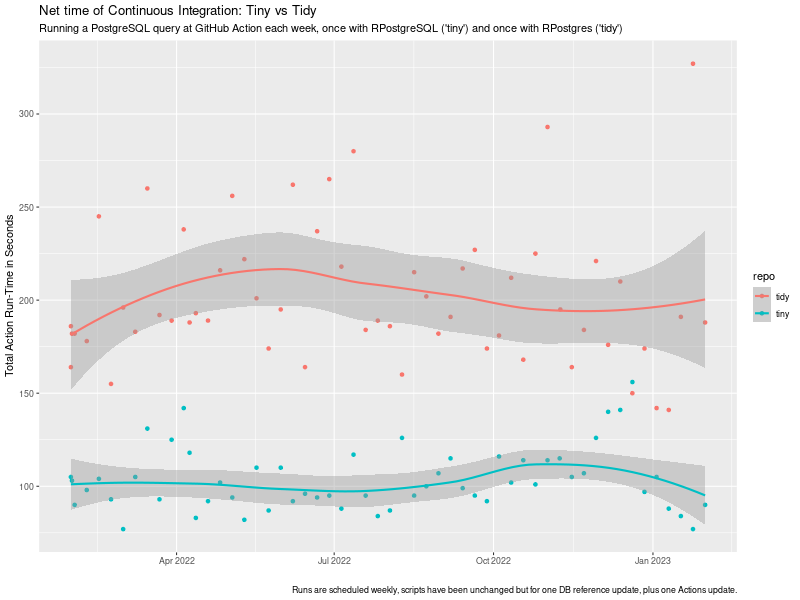
Waiting 1-24 minutes for a build to finish can be a massive time suck.
which we would like to come back to today. Furthermore, the unimitable @b0rk had a fabulous tweet just weeks later stating the same point debugging strategy: shorten your feedback loop as a key in a successful debugging strategy. So in sum: shorter is better. Nobody likes to wait. And shorter i.e. faster is a key and recurrent theme in the R4 series. Today we have a fairly nice illustration of two aspects we have stressed before: The combined effects can be staggering as we show below. The example is motivated by a truly surprising (we are being generous here) comment we received as an aside when discussing the eternal topic of whether R users do, or do not, have a choice when picking packages, or approaches, or verses. To our surprise, we were told that packages are not substitutable . Which is both demonstrably false (see below) and astonishing as it came from an academic. I.e. someone trained and paid to abstract superfluous detail away and recognise and compare core features of items under investigation. Truly stunning. But I digress. CRAN by now has many packages, slowly moving in on 20,000 in total, and is a unique success we commented-on time and time before. By now many packages shadow or duplicate each other, reinvent one another, or revise/review. One example is the pair of packages accessing PostgreSQL databases. There are several, but two are key. The older one is RPostgreSQL which has been around since Sameer Kumar Prayaga wrote it as a Google Summer of Code student in 2008 under my mentorship. The package has now been maintained well (if quietly) for many years by Tomoaki Nishiyama. The other entrant is more recent, though not new, and is RPostgres by Kirill M ller and others. We will for the remainder of this post refer to these two as the tiny and the tidy version as either can been as being a representative of a certain verse . The aforementioned comment on non-substitutability struck us as eminently silly, so we set out to prove just how absurd it really is. So about a year ago we set up pair of GitHub repos with minimal code in a pair we called lim-tiny and lim-tidy. Our conjecture was (and is!) that less is more just as post #34 titled Less Is More argued with respect to package dependencies. Each of the repos just does one thing: a query to a (freely accessible but remote) PostgreSQL database. The tiny version just retrieves a data frame using only the dependencies needed for RPostgreSQL namely DBI and nothing else. The tidy version retrieves a tibble and has access to everything else that comes when installing RPostgres: DBI, dplyr, and magrittr plus of course their respective dependencies. We were able to let the code run in (very default) GitHub Actions on a weekly schedule without intervention apart from one change to the SQL query when the remote server (providing public bioinformatics data) changed its schema slighly, plus one update to the action yaml code version. No other changes. We measure the time a standard continuous integration run takes in total using the default GitHub Action setup in the tidy case (which relies on RSPM/PPM binaries, caching, , and does not rebuild from source each time), and our own r-ci script (introduced in #32 for CI with R. It switched to using r2u during the course of this experiment but already had access to binaries via c2d4u so it is always binaries-based (see e.g. #37 or #13 for more). The chart shows the evolution of these run-times over the course of the year with one weekly run each.
tiny vs tidy ci timing impact chart tiny vs tidy ci timing impact chart
This study reveals a few things: The key point there is that while the net-time to fire off a single PostgreSQL is likely (near-)identical, the net cost of continuous integration is not. In this setup, it is about twice the run-time simply because Less Is More which (in this setup) comes out to about being twice as fast. And that is a valid (and concrete, and verifiable) illustration of the overall implicit cost of adding dependencies to creating and using development, test, or run-time environments. Faster feedback loops make for faster builds and faster debugging. Consider using fewer dependencies, and/or using binaries as provided by r2u.

This post by Dirk Eddelbuettel originated on his Thinking inside the box blog. Please report excessive re-aggregation in third-party for-profit settings.

30 January 2023

Arturo Borrero Gonz lez: Debian and the adventure of the screen resolution

Post logo I read somewhere a nice meme about Linux: Do you want an operating system or do you want an adventure? I love it, because it is so true. What you are about to read is my adventure to set a usable screen resolution in a fresh Debian testing installation. The context is that I have two different Lenovo Thinkpad laptops with 16 screen and nvidia graphic cards. They are both installed with the latest Debian testing. I use the closed-source nvidia drivers (they seem to work better than the nouveau module). The desktop manager and environment that I use is lightdm + XFCE4. The monitor native resolution in both machines is very high: 3840x2160 (or 4K UHD if you will). The thing is that both laptops show an identical problem: when freshly installed with the Debian default config, the native resolution is in use. For a 16 screen laptop, this high resolution means that the font is tiny. Therefore, the raw native resolution renders the machine almost unusable. This is a picture of what you get by running htop in the console (tty1, the terminal you would get by hitting CTRL+ALT+F1) with the default install: Linux tty console with high resolution and tiny fonts Everything in the system is affected by this:
  1. the grub menu is unreadable. Thanksfully the right option is selected by default.
  2. the tty console, with the boot splash by systemd is unreadable as well. There are some colors, so you at least see some systemd stuff happening in green .
  3. when lightdm starts, the resolution keeps being very high. Can barely click the login button.
  4. when XFCE4 starts, it is a pain to navigate the menu and click the right buttons to set a more reasonable resolution.
The adventure begins after installing the system. Each of these four points must be fixed by hand by the user. XFCE4 Point #4 is the easiest. Navigate with the mouse pointer to the tiny Applications menu, then Settings, then Displays. This is more or less the same in every other desktop operating system. There are no further actions required to persist this setting. Thanks you XFCE4. lightdm Point #3, about lightdm, is more tricky to solve. It involves running xrandr when lightdm sets up the display. Nobody will tell you this trick. You have to search for it on the internet. Thankfully is a common problem, and a person who knows what to search for can find good results. The file /etc/lightdm/lightdm.conf needs to contain something like this:
[LightDM]
[Seat:*]
# set up correct display resolution
display-setup-script=sh -c -- "xrandr -s 1920x1080"
By the way, depending on your system hardware setup, you may also need an additional call to xrandr here. If you want to plug in an HDMI monitor, chances are you require something like xrandr --setprovideroutputsource NVIDIA-G0 modesetting && xrandr --auto to instruct the NVIDIA graphic card to work will with the kernel graphic system. In my case, one of my laptops require it, so I have:
[LightDM]
[Seat:*]
# don't ask me to type my username
greeter-hide-users=false
# set up correct display resolution, and prepare NVIDIA card for HDMI output
display-setup-script=sh -c "xrandr -s 1920x1080 && xrandr --setprovideroutputsource NVIDIA-G0 modesetting && xrandr --auto"
grub Point #1 about the grub menu is also not trivial to solve, but also widely known on the internet. Grub allows you to set arbitrary graphical modes. In Debian systems, adding something like GRUB_GFXMODE=1024x768 to /etc/default/grub and then running sudo update-grub should do the magic. console So we get to point #2 about the tty1 console. For months, I ve been investing my scarce personal time into trying to solve this annoyance. There are a lot of conflicting information about this on the internet. Plenty of misleading solutions, essays about framebuffer, kernel modeset, and other stuff I don t want to read just to get my tty1 in a readable status. People point in different directions, like using GRUB_GFXPAYLOAD_LINUX=keep in /etc/default/grub. Which is a good solution, but won t work: my best bet is that the kernel indeed keeps the resolution as told by grub, but the moment systemd loads the nvidia driver, it enables 4K in the display and the console gets the high resolution. Actually, for a few weeks, I blamed plymouth. Because the plymouth service is loaded early by systemd, it could be responsible for setting some of the display settings. It actually contains some (undocummented) DeviceScale configuration option that is seemingly aimed to integrate into high resolution scenarios. I played with it to no avail. Some folks from IRC suggested reconfiguring the console-font package. Back-then unknown to me. Running sudo dpkg-reconfigure console-font would indeed show a menu to select some preferences for the console, including font size. But apparently, a freshly installed system already uses the biggest possible, so this was a dead end. Other option I evaluted for a few days was touching the kernel framebuffer setting. I honestly don t understand this, and all the solutions pointing to use fbset didn t work for me anyways. This is the default framebuffer configuration in one of the laptops:
user@debian:~$ fbset -i

mode "3840x2160"
    geometry 3840 2160 3840 2160 32
    timings 0 0 0 0 0 0 0
    accel true
    rgba 8/16,8/8,8/0,0/0
endmode
Frame buffer device information:
    Name        : i915drmfb
    Address     : 0
    Size        : 33177600
    Type        : PACKED PIXELS
    Visual      : TRUECOLOR
    XPanStep    : 1
    YPanStep    : 1
    YWrapStep   : 0
    LineLength  : 15360
    Accelerator : No
Playing with these numbers, I was able to modify the geometry of the console, only to reduce the panel to a tiny square in the console display (with equally small fonts anyway). If it was possible to scale or resize the panel in other way, I was unable to understand how to do so by reading the associated docs. One day, out of despair, I tried disabling kernel modesetting (or KMS). It indeed got me a more readable tty1, only to prevent the whole graphic stack from starting, with Xorg complaining about the lack of kernel modeset. After lots of wasted time, I decided to blame the NVIDIA graphic card. Because why not: a closed source module in my system looks fishy. I registered in their official forum and wrote a message about my suspicion on the module, asking for advice on how to modify the driver default resolution. I was hoping that something like modprobe nvidia my_desired_resolution=1920x1080 could exist. Apparently not :-( I was about to give up. I had walked every corner of the known internet. I even tried summoning the ancient gods, I used ChatGPT. I asked the AI god for mercy, for a working solution to no avail. Then I decided to change the kind of queries I was issuing the search engines (don t ask me, I no longer remember). Eventually I landed in this askubuntu.com page. The question described the exact same problem I was experiencing. Finally, that was encouraging! I was not alone in my adventure after all! The solution section included a font size I hadn t seen before in my previous tests: 16x32. More excitement! I did all the steps. I installed the xfonts-terminus package, and in the file /etc/default/console-setup I put:
ACTIVE_CONSOLES="/dev/tty[1-6]"
CHARMAP="ISO-8859-15"
CODESET="guess"
FONTFACE="Terminus"
FONTSIZE="16x32"
VIDEOMODE=
Then I run setupcon from a tty, and the miracle happened! I finally got a bigger font in the tty1 console! Turned out a potential solution was about playing with console-setup, which I had tried wihtout success before. I m not even sure if the additional package was required. This is how my console looks now: Linux tty console with high resolution but not so tiny fonts The truth is the solution is satisfying only to a degree. I m a person with good eyesight and can work with these bit larger fonts. I m not sure if I can get larger fonts using this method, honestly. After some search, I discovered that some folks already managed to describe the problem in detail and filed a proper bug report in Debian, see #595696 opened more than 10 years ago. 2023 is the year of linux on the desktop Nope. I honestly don t see how this disconnected pile of settings can be all reconciled together. Can we please have a systemd-whatever that homogeinizes all of this mess? I m referring to grub + kernel drivers + console + lightdm + XFCE4. Next adventure When I lock the desktop (with CTRL+ALT+L) and close the laptop lid to suspend it, then reopen it, type the login info into the lightdm greeter, then the desktop environment never loads, black screen. I have already tried the first few search results without luck. Perhaps the nvidia card is to blame this time? Perhaps poorly coupled power management by the different system software pieces? Who knows what s going on here. This will probably be my next Debian desktop adventure.

Russell Coker: Links January 2023

The Intercept has an amusing and interesting article about senior Facebook employees testifying that they don t know where Facebook stores all it s data on users [1]. One lesson all programmers can learn from this is to document all these things in an orderly manner. Cory Doctorow wrote a short informative article about inflation from a modern monetary theory perspective [2]. Russ Allbery wrote an insightful blog post about effecive altruism and respect for disadvantaged people [3]. GiveDirectly sounds good. The Conversation has an interesting article about the Google and Apple app stores providing different versions of apps for users in different regions [4]. Apparently there are specific versions to comply with GDPR and versions that differ in adverts. The hope that GDPR would affect enough people to become essentially a world-wide standard was apparently overly optimistic. We need political lobbying in all countries for laws like the GDPR to force the app stores to give us the better versions of apps. Arya Voronova wrote an informative article about USB-C and extension or data blocker cables [5]. USB just keeps getting more horrible in technology while getting more useful in functionality. Laptops and phones catching fire will probably become more common in future. John McBride wrote an insightful article about the problems in the security of the software supply chain [6]. His main suggestion for addressing problems is If you are on a team that relies on some piece of open source software, allocate real engineering time to contributing , the problem with this is that real engineering time means real money and companies don t want to do that. Maybe having companies contribute moderate amounts of money to a foundation that hires people would be a viable option. Toms Guide has an interesting article describing problems with the Tesla [7]. It doesn t cover things like autopilot driving over children and bikers but instead covers issues of the user interface that make it less pleasant to drive and also remove concentration from the road. The BBC has an interesting article about the way mathematical skill is correlated with the way language is used to express numbers [8]. Every country with a lesser way of expressing numbers should switch to some variation of the East-Asian way. Science 2.0 has an interesting blog post about the JP Aerospace plans to use airships to get most of the way through the atmosphere and then a plane to get to orbit [9]. It s a wild idea but seems plausible. The idea of going to space in balloons seems considerably scarier to me than the current space craft. Interesting list of red team and physical entry gear with links to YouTube videos showing how to use them [10]. The Verge has an informative summary of the way Elon mismanaged Twitter after taking it over [11].

29 January 2023

Dirk Eddelbuettel: RcppTOML 0.2.2 on CRAN: Now with macOS-on-Intel Builds

Just days after a build-fix release (for aarch64) and still only a few weeks after the 0.2.0 release of RcppTOML and its switch to toml++, we have another bugfix release 0.2.2 on CRAN also bringing release 3.3.0 of toml++ (even if we had large chunks of 3.3.0 already incorporated). TOML is a file format that is most suitable for configurations, as it is meant to be edited by humans but read by computers. It emphasizes strong readability for humans while at the same time supporting strong typing as well as immediate and clear error reports. On small typos you get parse errors, rather than silently corrupted garbage. Much preferable to any and all of XML, JSON or YAML though sadly these may be too ubiquitous now. TOML is frequently being used with the projects such as the Hugo static blog compiler, or the Cargo system of Crates (aka packages ) for the Rust language. The package was building fine on Intel-based macOS provided the versions were recent enough. CRAN, however, aims for the broadest possibly reach of binaries and builds on a fairly ancient macOS 10.13 with clang version 10. This confused toml++ into (wrongly) concluding it could not build when it in fact can. After a hint from Simon that Apple in their infinite wisdom redefines clang version ids, this has been reflected in version 3.3.0 of toml++ by Mark so we should now build everywhere. Big thanks to everybody for the help. The short summary of changes follows.

Changes in version 0.2.2 (2023-01-29)
  • New toml++ version 3.3.0 with fix to permit compilation on ancient macOS systems as used by CRAN for the Intel-based builds.

Courtesy of my CRANberries, there is a diffstat report for this release. More information is on the RcppTOML page page. Please use the GitHub issue tracker for issues and bugreports. If you like this or other open-source work I do, you can sponsor me at GitHub.

This post by Dirk Eddelbuettel originated on his Thinking inside the box blog. Please report excessive re-aggregation in third-party for-profit settings.

Petter Reinholdtsen: Is the desktop recommending your program for opening its files?

Linux desktop systems have standardized how programs present themselves to the desktop system. If a package include a .desktop file in /usr/share/applications/, Gnome, KDE, LXDE, Xfce and the other desktop environments will pick up the file and use its content to generate the menu of available programs in the system. A lesser known fact is that a package can also explain to the desktop system how to recognize the files created by the program in question, and use it to open these files on request, for example via a GUI file browser. A while back I ran into a package that did not tell the desktop system how to recognize its files and was not used to open its files in the file browser and fixed it. In the process I wrote a simple debian/tests/ script to ensure the setup keep working. It might be useful for other packages too, to ensure any future version of the package keep handling its own files. For this to work the file format need a useful MIME type that can be used to identify the format. If the file format do not yet have a MIME type, it should define one and preferably also register it with IANA to ensure the MIME type string is reserved. The script uses the xdg-mime program from xdg-utils to query the database of standardized package information and ensure it return sensible values. It also need the location of an example file for xdg-mime to guess the format of.
#!/bin/sh
#
# Author: Petter Reinholdtsen
# License: GPL v2 or later at your choice.
#
# Validate the MIME setup, making sure motor types have
# application/vnd.openmotor+yaml associated with them and is connected
# to the openmotor desktop file.
retval=0
mimetype="application/vnd.openmotor+yaml"
testfile="test/data/real/o3100/motor.ric"
mydesktopfile="openmotor.desktop"
filemime="$(xdg-mime query filetype "$testfile")"
if [ "$mimetype" != "$filemime" ] ; then
    retval=1
    echo "error: xdg-mime claim motor file MIME type is $filemine, not $mimetype"
else
    echo "success: xdg-mime report correct mime type $mimetype for motor file"
fi
desktop=$(xdg-mime query default "$mimetype")
if [ "$mydesktopfile" != "$desktop" ]; then
    retval=1
    echo "error: xdg-mime claim motor file should be handled by $desktop, not $mydesktopfile"
else
    echo "success: xdg-mime agree motor file should be handled by $mydesktopfile"
fi
exit $retval
It is a simple way to ensure your users are not very surprised when they try to open one of your file formats in their file browser. As usual, if you use Bitcoin and want to show your support of my activities, please send Bitcoin donations to my address 15oWEoG9dUPovwmUL9KWAnYRtNJEkP1u1b.

Valhalla's Things: Hello World!

Posted on January 29, 2023
Welcome to my new blog! Or rather, strictly speaking, welcome to my first blog! Back when everybody had a blog, I had an old-fashioned personal website where pages were organized by topic rather than by date, so now that blogs are dead (or so they say), I guess it s time for me to have one :) . The old website is still online, but updating it is getting harder, both for organizational reasons and because the static generator I ve used is no longer supported and requires python 2; lately I ve started publish some specific categories of material such as sewing patterns into their own website (you can find a list in the about page), but I was missing a place to post about the history and experiences of the things I publish elsewhere, as well as more uncategorized things. Of course I ve chosen to use a static site generator, but since I m picky I ve discarded most of the common ones mostly because they enforce assumptions I don t agree with. On the other hand, one day I wouldn t mind learning a bit of Haskell, so I decided to look for trouble and use Hakyll, hoping that nobody will add a level 20 wandering monster to it. Right now I m using mostly the default theme, because I know that if I start fiddling with it I m not going to start posting content ever; maybe one day I ll decide to completely change the look. As for contents, on the bits side of things you can expect me to talk about Debian, the Fediverse, Python, my inventory manging program and a bit of arduino-level electronics; on the atom side you should definitely expect sewing, modern and mostly historically inspired, some fiber crafts (spinning, knitting, crochet), maybe some bad attempts at painting (watercolours and acrilics), printing (screen and linocut), things that are written on paper and, well, any other craft I will happen to collect. Before the blog gets too full I plan to add tag management to help people who are only interested in some of these contents. This being a blog, of course it has an atom feed you can add to your favourite (and ideally self-hosted) rss reader, and since this is a personal blog there will be no periodicity, posts will happen when I ll have something to say on some topic. Until next time

28 January 2023

Russ Allbery: Review: The Library of the Dead

Review: The Library of the Dead, by T.L. Huchu
Series: Edinburgh Nights #1
Publisher: Tor
Copyright: 2021
Printing: 2022
ISBN: 1-250-76777-6
Format: Kindle
Pages: 329
The Library of the Dead is the first book in a post-apocalyptic (sort of) urban fantasy series set in Edinburgh, written by Zimbabwean author (and current Scotland resident) T.L. Huchu. Ropa is a ghosttalker. This means she can see people who have died but are still lingering because they have unfinished business. She can stabilize them and understand what they're saying with the help of her mbira. At the age of fourteen, she's the sole source of income for her small family. She lives with her grandmother and younger sister in a caravan (people in the US call it an RV), paying rent to an enterprising farmer turned landlord. Ropa's Edinburgh is much worse off than ours. Everything is poorer, more run-down, and more tenuous, but other than a few hints about global warming, we never learn the history. It reminded me a bit of the world in Octavia Butler's Parable of the Sower in the feel of civilization crumbling without a specific cause. Unlike that series, The Library of the Dead is not about the collapse or responses to it. The partial ruin of the city is the mostly unremarked backdrop of Ropa's life. Much of the book follows Ropa's daily life carrying messages for ghosts and taking care of her family. She does discover the titular library when a wealthier friend who got a job there shows it off to her, but it has no significant role in the plot. (That was disappointing.) The core plot, once Ropa is convinced by her grandmother to focus on it, is the missing son of a dead woman, who turns out to not be the only missing child. This is urban fantasy with the standard first-person perspective, so Ropa is the narrator. This style of book needs a memorable protagonist, and Ropa is certainly that. She's a talker who takes obvious delight in narrating her own story alongside a constant patter of opinions, observations, and Scottish dialect. Ropa is also poor. That last may not sound that notable; a lot of urban fantasy protagonists are not well-off. But most of them feel culturally middle-class in a way that Ropa does not. Money may be a story constraint in other books, but it rarely feels like a life constraint and experience the way it does here. It's hard to describe the difference in tone succinctly, since it's a lot of small things: the constant presence of money concerns, the frustration of possessions that are stolen or missing and can't be replaced, the tedious chores one has to do when there's no money, even the language and vulgarity Ropa uses. This is rare in fantasy and excellent characterization work. Given that, I am still frustrated with myself over how much I struggled with Ropa as a narrator. She's happy to talk about what is happening to her and what she's learning about (she listens voraciously to non-fiction while running messages), but she deflects, minimizes, or rushes past any mention of what she's feeling. If you don't like the angst that's common from urban fantasy protagonists, this may be the book for you. I have complained about that angst before, and therefore feel like this should have been the book for me, but apparently I need a minimum level of emotional processing and introspection from the narrator. Ropa is utterly unwilling to do any of that. It's possible to piece together what she's feeling and worrying about, but the reader has to rely on hints and oblique comments that she passes over quickly. It didn't help that Ropa is not interested in the same things in her world that I was interested in. She's not an unreliable narrator in the conventional sense; she doesn't lie to the reader or intentionally hide information. And yet, the experience of reading this book was, for me, similar to reading a book with an unreliable narrator. Ropa consistently refused to look at what I wanted her to look at or think about what I wanted her to think about. For example, when she has an opportunity to learn magic through books from the titular library, her initial enthusiasm is infectious. Huchu does a great job showing the excitement of someone who likes new ideas and likes telling other people about the neat things she just learned. But when things don't work the way she expected from the books, she doesn't follow up, experiment, or try to understand why. When her grandmother tries to explain something to her from a different angle, she blows her off and refuses to pay attention. And when she does get magic to work, she never tries to connect that to her previous understanding. I kept waiting for Ropa to try to build her own mental model of magic, but she would only toy with an idea for a few pages and then put it down and never mention it again. This is not a fault in the book, just a mismatch between the book and what I wanted to read. All of this is consistent with Ropa's defensive strategies, emotional resiliency, and approach to understanding the world. (I strongly suspect Huchu was giving Ropa some ADHD characteristics, and if so, I think he got it spot on.) Given that, I tried to pivot to appreciating the characterization and the world, but that ran into another mismatch I had with this book, and the reason why I passed on it when it initially came out. I tend to avoid fantasy novels about ghosts. This is not because I mind ghosts themselves, but I've learned from experience that authors who write about ghosts usually also write about other things that I don't want to read about. That unfortunately was the case here; The Library of the Dead was too far into horror for me. There's child abuse, drugs, body horror, and similar nastiness here, more than I wanted in my head. Ropa's full-speed-ahead attitude and refusal to dwell on anything made it a bit easier to read, but it was still too much for me. Ropa is a great character who is refreshingly different than the typical urban fantasy protagonist, and the few hints of the magical library and world background we get were intriguing. This book was not for me, but I can see why other people will love it. Followed by Our Lady of Mysterious Ailments. Rating: 6 out of 10

Craig Small: Fixing iCalendar feeds

The local government here has all the schools use an iCalendar feed for things like when school terms start and stop and other school events occur. The department s website also has events like public holidays. The issue is that all of them don t make it an all-day event but one that happens at midnight, or one past midnight. The events synchronise fine, though Google s calendar is known for synchronising when it feels like it, not at any particular time you would like it to.
Screenshot of Android Calendar showing a tiny bar at midnight which is the event.
Even though a public holiday is all day, they are sent as appointments for midnight. That means on my phone all the events are these tiny bars that appear right up the top of the screen and are easily missed, especially when the focus of the calendar is during the day. On the phone, you can see the tiny purple bar at midnight. This is how the events appear. It s not the calendar s fault, as far as it knows the school events are happening at midnight. You can also see Lunar New Year and Australia Day appear in the all-day part of the calendar and don t scroll away. That s where these events should be.
Why are all the events appearing at midnight? The reason is the feed is incorrectly set up and has the time. The events are sent in an iCalendar format and a typical event looks like this:
BEGIN:VEVENT
DTSTART;TZID=Australia/Sydney:20230206T000000
DTEND;TZID=Australia/Sydney:20230206T000000
SUMMARY:School Term starts
END:VEVENT
The event starting and stopping date and time are the DTSTART and DTEND lines. Both of them have the date of 2023/02/06 or 6th February 2023 and a time of 00:00:00 or midnight. So the calendar is doing the right thing, we need to fix the feed! The Fix I wrote a quick and dirty PHP script to download the feed from the real site, change the DTSTART and DTEND lines to all-day events and leave the rest of it alone.
<?php
$site = $_GET['s'];
if ($site == 'site1')  
    $REMOTE_URL='https://site1.example.net/ical_feed';
  elseif ($site == 'site2')  
    $REMOTE_URL='https://site2.example.net/ical_feed';
  else  
    http_response_code(400);
    die();
 
$fp = fopen($REMOTE_URL, "r");
if (!$fp)  
    die("fopen");
 
header('Content-Type: text/calendar');
while (( $line = fgets($fp, 1024)) !== false)  
    $line = preg_replace(
        '/^(DTSTART DTEND);[^:]+:([0-9] 8 )T000[01]00/',
        '$ 1 ;VALUE=DATE:$ 2 ',
        $line);
    echo $line;
 
?>
It s pretty quick and nasty but gets the job done. So what is it doing? You need to save the script on your web server somewhere, possibly with an alias command. The whole point of this is to change the type from a date/time to a date-only event and only print the date part of it for the start and end of it. The resulting iCalendar event looks like this:
BEGIN:VEVENT
DTSTART;VALUE=DATE:20230206
DTEND;VALUE=DATE:20230206
SUMMARY:School Term starts
END:VEVENT
The calendar then shows it properly as an all-day event. I would check the script works before doing the next step. You can use things like curl or wget to download it. If you use a normal browser, it will probably just download the translated file. If you re not seeing the right thing then it s probably the PCRE failing. You can check it online with a regex checker such as https://regex101.com. The site has saved my PCRE and match so you got something to start with. Calendar settings The last thing to do is to change the URL in your calendar settings. Each calendar system has a different way of doing it. For Google Calendar they provide instructions and you want to follow the section titled Use a link to add a public Calendar . The URL here is not the actual site s URL (which you would have put into the REMOTE_URL variable before) but the URL of your script plus the ?s=site1 part. So if you put your script aliased to /myical.php and the site ID was site1 and your website is www.example.com the URL would be https://www.example.com/myical.php?s=site1 . You should then see the events appear as all-day events on your calendar.

Next.

Previous.