Search Results: "jan"

31 January 2011

Michael Banck: 31 Jan 2011

Debian Med Bioinformatics Sprint Last weekend, I was at the Debian Med Meeting in Travem nde near L beck, thanks to an invitation by Steffen M ller and Andreas Tille. It was a great opportunity to finally meet Steffen and some of the other bioinformatics people in Debian like Manuel Prinz face-to-face for the first time. Also, lots of upstream and related bioinformatics packagers from e.g. Biolinux were present as well, many of them from the UK. I discussed with and helped some people about Debian packaging. There is a big push to get Debian packages done and integrated in Debian and Ubuntu, but often enough people are not exactly sure what the requirements are and what needs to be done. Hopefully, the sprint was successful to clear things up and move forward. I also managed to finalize the initial Jmol packaging and uploaded it to Debian towards the end of the sprint. I plan to update the other bioinformatics related packages in debichem like pymol and openbabel as soon as squeeze is released. Overall, it was a great weekend, many thanks to NERC and Debian for making it possible, and to Steffen M ller for organizing it!

29 January 2011

Russell Coker: Egypt

Gunnar Wolf has written an interesting post about the current situation in Egypt, which includes references to Israel (where he lived for a few years) and Mexico (where he has spent most of his life) [1].Gunnar included a copy of Mohammed Sameer s blog post on the topic [2], which is a good idea as we can t rely on Mohammed s post remaining online.The Reid Report has an interesting summary of various news sources [3].I hope that the end result of this is a democratically elected government that respects human rights and offers fair trials to people accused of crimes and humane punishments those found guilty. It would be ideal if the transition could happen in a way that involves little violence and no interruptions to the food supply etc.Update: Chris Samuel provided some information on free PPP access in other countries for people in Egypt [4]. This will probably be of short-term use as the Egypten regime will probably cut International phone access too.Update2: Lars has written some interesting comments including links to articles about the US government wanting the power to cut off Internet access in the same way as the Egyptian government [5].

28 January 2011

Gunnar Wolf: Echoing Mohammed

For those of you who follow me through anything other than Planet Debian (who will surely tolerate this repetition): Interesting but frightful things are happening in North African countries. We saw what happened in Tunisia some days ago. Now, Egypt is a way larger, way more populous... And, dare I say, way more important country. Also, it is a country which borders Israel, where I lived in for ~18 months, and to which although I am today unaffiliated is very important for me. And what happens in Egypt will surely shape the whole mid-East. So, here goes a copy of Mohammed Sameer's post Not just a link to it, as he might have to take it down. Of course, Mohammed, if you in any way think I should delete this, please please tell me, and I will comply immediately.
Egypt has been fighting for freedom already for 3 days now. The whole country has experienced a large number of street demonstrations and protests within the last 3 days to be continued also on Friday, the 28th of January and afterwards. The protests' main goal is to oust dictator Hosni Mubarak's regime, which has been in power for almost 30 years. We want him out. A massacre has happened in Suez. Police used live ammunition and tear gas. There are unconfirmed rumors that the army might interfere. Even a bigger protest is supposed to take place a few hours from now. After the Prayer on Friday. The internet has been shutdown completely. Egypt is no longer online since Friday, the 28th of January 00:45 AM. Text messages to cell phones have been cut off too and all cell phones services will be following. No one knows exactly the intentions of the regime but it doesn't sound good. Please help us.
Please blog about it in English and in all languages.
Please spread the news everywhere.
Please talk to media.
Please petition your government if that will help. If there's anything that you can do, please do it and help us save the country and the people. More news from twitter #jan25.
...From what I read from Israeli sources, what worries them and many people around the world is that, although Egypt is formally a democratic country, the ruling party has seen towards having basically no oposition Besides the stubborn Islamic Brotherhood (very akin to Hamas). Now, the Islamic Brotherhood (as well as Hamas, and as well as most other Islamic regimes I know off, although I might be way mistaken) have got huge popular support because... They are true to their beliefs. In short, they are not corrupt Something that cannot be said about many political organizations around the globe. They are true to their word. And although many of us shiver at thinking of their word getting more power... It is only the Egyptians who should have a say on who rules Egypt. I honestly hope the Egyptian people get their long-owed self-determination. Of course, I hope Tunisians also get it, and not just a mirage of it. And every people, including us poor Mexicans who have neither had a chance to rule our destiny. And I hope it is a change for good, for tolerance, for peaceful coexistance with the neighbours, even if they are in many ways the rivals. [Update] I just found out that, as expected, the news have reached Slashdot: Egypt shuts off all Internet access. I'm sure you will find lots of more information there.

27 January 2011

Mohammed Sameer: Egypt, Internet cut off. A massacre will follow. Please help.

Egypt has been fighting for freedom already for 3 days now.

The whole country has experienced a large number of street demonstrations and protests within the last 3 days to be continued also on Friday, the 28th of January and afterwards.

The protests' main goal is to oust dictator Hosni Mubarak's regime, which has been in power for almost 30 years.

We want him out.

A massacre has happened in Suez. Police used live ammunition and tear gas. There are unconfirmed rumors that the army might interfere.

Even a bigger protest is supposed to take place a few hours from now. After the Prayer on Friday.

The internet has been shutdown completely. Egypt is no longer online since Friday, the 28th of January 00:45 AM.

Text messages to cell phones have been cut off too and all cell phones services will be following. No one knows exactly the intentions of the regime but it doesn't sound good.

Please help us.
Please blog about it in English and in all languages.
Please spread the news everywhere.
Please talk to media.
Please petition your government if that will help.

If there's anything that you can do, please do it and help us save the country and the people.

More news from twitter #jan25. read more

26 January 2011

Martin Pitt: Na zdrav PyGI!

(Update: Link to Tomeu s blog post, repost for planet.gnome.org) Last week I was in Prague to attend the GNOME/Python 2011 Hackfest for gobject-introspection, to which Tomeu Vizoso kindly invited me after I started working with PyGI some months ago. It happened at a place called brmlab which was quite the right environment for a bunch of 9 hackers: Some comfy couches and chairs, soldering irons, lots of old TV tubes, chips, and other electronics, a big Pirate flag, really good Wifi, plenty of Club Mate and Coke supplies, and not putting unnecessary effort into mundane things like wallpapers. It was really nice to get to know the upstream experts John (J5) Palmieri and Tomeu Vizoso (check out Tomeu s blog post for his summary and some really nice photos). When sitting together in a room, fully focussing on this area for a full week, it s so much easier to just ask them about something and getting things done and into upstream than on IRC or bugzilla, where you don t know each other personally. I certainly learned a lot this week (and not only how great Czech beer tastes :-) )! So what did I do? Application porting After already having ported four Ubuntu PyGTK applications to GI before (apport, jockey, aptdaemon, and language-selector),
my main goal and occupation during this week was to start porting a bigger PyGTK application. I picked system-config-printer, as it s two magnitudes bigger than the previous projects, exercises quite a lot more of the GTK GI bindings, and thus also exposes a lot more GTK annotation and pygobject bugs. This resulted in a new pygi s-c-p branch which has the first 100 rounds of test, break, fix iterations. It now at least starts, and you can do a number of things with it, but a lot of functionality is still broken. As a kind of finger exercise and also to check for how well pygi-convert works for small projects now, I also ported computer-janitor. This went really well (I had it working after about 30 minutes), and also led me to finally fixing the unicode vs. str mess for GtkTreeView that you got so far with Python 2.x. pygobject and GTK fixes Porting system-config-printer and computer-janitor uncovered a lot of opportunities to improve pygi-convert.sh, a big perl -e kind of script to do the mechanical grunt work of the porting process. It doesn t fix up changed signatures (such as adding missing arguments which were default arguments in PyGTK, or the ubiquitous user_data argument for signal handlers), but at least it gets a lot of namespaces, method, and constant names right. I also fixed three annotation fixes in GTK+. We also collaboratively reviewed and tested Pavel s annotation branch which helped to fix tons of problems, especially after Steve Fr cinaux s excellent reference leak fix, so if you play around with current pygobject git head, you really also have to use the current GTK+ git head. Speaking of which, if you want to port applications and always stay on top of the pygobject/GTK development without having to clutter your package system with make install s of those, it works very well to have this in your ~/.bashrc:
export GI_TYPELIB_PATH=$HOME/projects/gtk/gtk:$HOME/projects/gtk/gdk
export PYTHONPATH=$HOME/projects/pygobject
Better GVariant/GDBus support The GNOME world is moving from the old dbus-glib python bindings to GDBus, which is integrated into GLib. However, dbus-python exposed a really nice and convenient way of doing D-Bus calls, while using GDBus from Python was hideously complicated, especially for nontrivial arguments with empty or nested arrays:
from gi.repository import Gio, GLib
from gi._gi import variant_type_from_string
d = Gio.bus_get_sync(Gio.BusType.SESSION, None)
notify = Gio.DBusProxy.new_sync(d, 0, None, 'org.freedesktop.Notifications',
    '/org/freedesktop/Notifications', 'org.freedesktop.Notifications', None)
vb = GLib.VariantBuilder()
vb.init(variant_type_from_string('r'))
vb.add_value(GLib.Variant('s', 'test'))
vb.add_value(GLib.Variant('u', 1))
vb.add_value(GLib.Variant('s', 'gtk-ok'))
vb.add_value(GLib.Variant('s', 'Hello World!'))
vb.add_value(GLib.Variant('s', 'Subtext'))
# add an empty array
eavb = GLib.VariantBuilder()
eavb.init(variant_type_from_string('as'))
vb.add_value(eavb.end())
# add an empty dict
eavb = GLib.VariantBuilder()
eavb.init(variant_type_from_string('a sv '))
vb.add_value(eavb.end())
vb.add_value(GLib.Variant('i', 10000))
args = vb.end()
result = notify.call_sync('Notify', args, 0, -1, None)
id = result.get_child_value(0).get_uint32()
print id
So I went to making the GLib.Variant constructor work properly with nested types and boxed variants, adding Pythonic GVariant iterators and indexing (so that you can treat GVariant dictionaries/arrays/tuples just like their Python equivalents), and finally a Variant.unpack() method for converting the return value of a D-Bus call back into a native Python data type. This looks a lot friendlier now:
from gi.repository import Gio, GLib
d = Gio.bus_get_sync(Gio.BusType.SESSION, None)
notify = Gio.DBusProxy.new_sync(d, 0, None, 'org.freedesktop.Notifications',
    '/org/freedesktop/Notifications', 'org.freedesktop.Notifications', None)
args = GLib.Variant('(susssasa sv i)', ('test', 1, 'gtk-ok', 'Hello World!',
    'Subtext', [],  , 10000))
result = notify.call_sync('Notify', args, 0, -1, None)
id = result.unpack()[0]
print id
I also prepared another patch in GNOME#640181 which will provide the icing on the cake, i. e. handle the variant building/unpacking transparently and make the explicit call_sync() unnecessary:
from gi.repository import Gio, GLib
d = Gio.bus_get_sync(Gio.BusType.SESSION, None)
notify = Gio.DBusProxy.new_sync(d, 0, None, 'org.freedesktop.Notifications',
    '/org/freedesktop/Notifications', 'org.freedesktop.Notifications', None)
result = notify.Notify('(susssasa sv i)', 'test', 1, 'gtk-ok', 'Hello World!',
            'Subtext', [],  , 10000)
print result[0]
I hope that I can get this reviewed and land this soon. Thanks to our sponsors! Many thanks to the GNOME Foundation and Collabora for sponsoring this event!

25 January 2011

Maximilian Attems: klibc 1.5.21 release

This release is "slightly" delayed due to lots of physics calculations for my final PhD year at the TU Vienna with all fixes that piled up since last summer: Support for newer GNU make 3.82, x86_32 signal fun, the self explantory KBUILD_REPRODUCIBLE and various cleanups: For details see klibc 1.5.21 release announcements or klibc git.

23 January 2011

Julien Danjou: OrgCamp Paris 2011 review

Yesterday afternoon, I was at the first OrgCamp in Paris. It was my first attendance to a BarCamp, and I really liked it. It's basically the first geek event I do not find boring nor useless. There was about 18-20 persons participating, which was quite high, since we all initially though we would have been only 5. We had several presentations of various features and personal usages of Org-mode. For my part, I've quickly presented the agenda, and my BBDB replacement named org-contacts (I'll probably talk about it on this blog in another post later). The only downside was that Bastien (the new Org-mode maintainer) was not able to come and join us. On the other side, there were so much to tell for a first time, I did not have so much time to code. I only have been able to fix one bug reported during my agenda presentation. In the end, the overall atmosphere was very enthusiastic and friendly, which was extremely pleasant. The #org-mode-fr IRC channel has been created on Freenode, following this event. Feel free to join us. Since people liked it so badly, it seems there should be another barcamp in the next months. Stay tuned. Flattr this

22 January 2011

Lars Wirzenius: Obnam and btree journal dump

For some years now I have kept a private journal, sort of a private blog. It is mainly related to my work and hobby development activities, though some private life gets poured into it as well. It's a private journal. It is not meant for others to read. It has a dual purpose in life: I find this journalling activity to be beneficial to software development. Since I mainly work alone, at home, it is a bit like having someone to talk to across the desk. However, since it is recorded, it is more practical to grep things for useful stuff later on. Re-reading entries also gives me a wonderful sense of how fast or slow things happen. For example, on January 23 last year, exactly one year ago tomorrow, I wrote:
That concludes my list of next actions that should be done before obnam is theoretically able to do normal backups.
I then spent most of last year actually making Obnam be capable of doing backups for real. Recently, I thought that it might be interesting for some to read another programmer's thought processes when designing, writing, and debugging code. For this reason, I've collected some of my journal entries from the past year or so, those related to Obnam and my Python B-tree library (which Obnam uses). I have lightly sanitized them, to protect other people's privacy. Other than that, it's me as raw as you could wish. The dump is on my website. Please be gentle and laugh at me behind my back.

Tim Retout: Grandma

My paternal grandmother died a month ago today - I may have been quieter than usual since December. The most vivid memory I have of her is helping to collect runner beans from her garden - apparently this had been going on since the World War II "dig for victory" campaign. Her funeral was in Hastings on 10th January, and she was buried in Fairlight, in the Roman Catholic area of St. Andrew's - it was a very peaceful setting.

Enrico Zini: Match package names across distributions

Match package names across distributions What would happen if we had a quick and reliable way to match package names across distributions? These ideas came up at the appinstaller2011 meeting: We thought they were good ideas, so we started hacking. To try it, you need to get the code and build the index first:
git clone git://git.debian.org/users/enrico/distromatch.git
cd distromatch
# Careful: 90Mb
wget http://people.debian.org/~enrico/dist-info.tar.gz
tar zxf dist-info.tar.gz
# Takes a long time to do the indexing
./distromatch --reindex --verbose
Then you can query it this way:
./distromatch $DISTRO $PKGNAME [$PKGNAME1 ...]
This would give you, for the package $PKGNAME in $DISTRO, the corresponding package names in all other distros for which we have data. If you do not provide package names, it automatically shows output for all packages in $DISTRO. For example:
$ time ./distromatch debian libdigest-sha1-perl
debian:libdigest-sha1-perl fedora:perl-Digest-SHA1
debian:libdigest-sha1-perl mandriva:perl-Digest-SHA1
debian:libdigest-sha1-perl suse:perl-Digest-SHA1
real    0m0.073s
user    0m0.056s
sys 0m0.016s
Yes it's quick. It builds a Xapian index with the information it needs, and then it reuses it. As soon as I find a moment, I intend to deploy an instance of it on DDE. It is using a range of different heuristics: This list may get obsolete soon as more heuristics get implemented. Euristics will never cover all corner cases we surely have, but the idea is that if we can match a sizable amout of packages, the rest can be somehow fixed by hand as needed. The data it requires for a distribution should be rather straightforward to generate:
  1. a file which maps binary package names to source package names
  2. a file with the list of files in all the packages
For example:
$ ls -l dist-debian/
total 39688
-rw-r--r--  1 enrico enrico  1688249 Jan 20 17:37 binsrc
drwxr-xr-x  2 enrico enrico     4096 Jan 21 19:12 db
-rw-r--r--  1 enrico enrico 29960406 Jan 21 10:02 files.gz
-rw-r--r--  1 enrico enrico  8914771 Jan 21 18:39 interesting-files
$ head dist-debian/binsrc 
openoffice.org-dev openoffice.org
ext4-modules-2.6.32-5-4kc-malta-di linux-kernel-di-mipsel-2.6
linux-headers-2.6.30-2-common linux-2.6
libnspr4 nspr
ipfm ipfm
libforks-perl libforks-perl
med-physics debian-med
libntfs-3g-dev ntfs-3g
libguppi16 guppi
selinux selinux
$ zcat dist-debian/files.gz   head
memstat etc/memstat.conf
memstat usr/bin/memstat
memstat usr/share/doc/memstat/changelog.gz
memstat usr/share/doc/memstat/copyright
memstat usr/share/doc/memstat/memstat-tutorial.txt.gz
memstat usr/share/man/man1/memstat.1.gz
libdirectfb-dev usr/bin/directfb-config
libdirectfb-dev usr/bin/directfb-csource
libdirectfb-dev usr/include/directfb-internal/core/clipboard.h
libdirectfb-dev usr/include/directfb-internal/core/colorhash.h
interesting-files and db are generated when indexing. To prove the usefulness of the idea (but does it need proving?), you can find in the same git repo a little example app (it took me 10 minutes to write it), that uses the distromatch engine to export Debtags tags to other distributions:
$ ./exportdebtags fedora   head
memstat: admin::benchmarking, interface::commandline, role::program, use::monitor
libdirectfb-dev: devel::lang:c, devel::library, implemented-in::c, interface::framebuffer, role::devel-lib
libkonqsidebarplugin4a: implemented-in::c++, role::shared-lib, suite::kde, uitoolkit::qt
libemail-simple-perl: devel::lang:perl, devel::library, implemented-in::perl, role::devel-lib, role::shared-lib, works-with::mail
libpoe-component-pluggable-perl: devel::lang:perl, devel::library, implemented-in::perl, role::shared-lib
manpages-ja: culture::japanese, made-of::man, role::documentation
libhippocanvas-dev: devel::library, qa::low-popcon, role::devel-lib
libexpat-ocaml-dev: devel::lang:ocaml, devel::library, implemented-in::c, implemented-in::ocaml, role::devel-lib, works-with-format::xml
libgnutls-dev: devel::library, role::devel-lib, suite::gnu
Just in case this made you itch to play with Debtags in a non-Debian distribution, I've generated the full datasets for Fedora, Mandriva and OpenSUSE. Others have been working on the same matching problem. After we started writing code we started to become aware of existing work: I'd like to make use of those efforts, maybe to cross-validate results, maybe even better as yet another heuristics.

21 January 2011

Richard Darst: DebConf organization/volunteer meeting

As I just announced, the DebConf team will have an "organizational meeting". Every year, many teams need new people, since it is such a intense job for a few months. This year, I'm trying to get people who have not previously been involved in DebConf organization to help with these jobs.The meeting will be held on #debconf-team on irc.debian.org at 20:00 UTC on 25th January 2011. The main point of the meeting is to go through and fill out the teams list. This doesn't mean talking about how jobs should be done this year, just figuring out who is interested, sign a team up, and let the team start thinking about the details. The team can discuss details among themselves, and with the larger DebConf team on the lists and in future meetings.In past years, this meeting has helped to kickstart the teams and really began the DebConf cycle. This year, I am hoping to also make it a volunteer recruitment meeting. The DebConf team works hard, often to the point of burn-out, and thus would love new people. We need new people.In the next few days, I'll try to make more posts in my DebConf series to help make people familiar with the way DebConf works. You could consider this meeting to be the ultimate goal of the DebConf article series: helping to recruit new people at this meeting.Of course, if you want to join the DebConf team any other time, just drop by and offer a hand.

20 January 2011

Alexander Reichle-Schmehl: Myths and Facts about Firmwares and their non-removal from Debian

Debian's announcement to release Squeeze with a completely free Linux kernel caused quite some attention, which is actually a good thing. However, it also seems to have caused quite some uncertainty and was often partially misunderstood and miss quoted. I'll try to summarize and answer some of them in this blog post: So, one question remains: What is to bad about non-free firmware files? Aren't they just some tiny programs executed in the CPU of the device? Why care about them Good question! Let's take possible legal issues aside, and just look the practical side. The core problem is: Without source (and tool chain to use the source) firmware files are just some random numbers for us. We don't know what they are doing, we can't analyse and improve them. We can't change them, we can't support them. Maybe you already followed the link above to comment of the Fedora developer. I cite him here again, because I think he summarized the problem so well:
Updated qlogic 2400 and 2500 firmware to 5.03.13. What does 5.03.13 do? No one knows, except for QLogic, and they're not telling. I asked, and they told me that information was only available under NDA. So, I encourage you to imagine what this firmware does, and the bugs it fixes. While you're at it, imagine a world where vendors release source code for their firmware.
So, now that we established the fact, that we can't support firmware files, one could wonder, if we actually need to do so. What harm can a simple, tiny program in a peripheral device do to your computer? Well, scientist already managed to created trojaned firmwares for some network cards. So it is a problem, and can even under some circumstanced lead to security problems! So, to summarise: Yes, Debian changed something in the Kernels. No, it will continue to work as well as usual. Some users might need to enable the non-free repository in their sources list, but those who won't, don't have to. Firmware files needed during installation are also available, and can be loaded by the installation system. So, what's all the fuss about? BTW: Those of you, who can't remember links very well, but fear, they still might need the links to the non-free images and tarballs. just remember two things: wiki and Firmware, as you'll find all you need on the Firmware page of Debian's wiki.

19 January 2011

Dirk Eddelbuettel: RcppBDT 0.1.0

The family of Rcpp packages just grew by one: the first 0.1.0 release of RcppBDT is now on CRAN. RcppBDT stands for Rcpp Boost Date_Time. It employs what we call Rcpp modules: a mechanism which provides easier ways to expose C++ functions and classes to R (and which bears some resemblance to Boost.Python---see this vignette about Rcpp modules for more details). And thus RcppBDT provides R users with access to (some) Boost Date.Time functionality. I used Boost Date.Time because it is widely known, useful and well tested. It can also be used in pure template mode not requiring linking (if one foregoes string parsing and formatting which is fine here as we get this from R already; it can be added via a #define in the header file). With that, the package is rather portable as it only needs to find the Boost headers. (And no, I have not yet added a configure option for that.) Basic usage follows Rcpp modules and provides the C++ class via a Reference Class in R. That means using a new constructor and assessing functions via the $ operator. Here is an example:
R> library(RcppBDT)
Creating a new generic function for "print" in "RcppBDT"
Creating a new generic function for "format" in "RcppBDT"
R> d <- new(bdtMod$date, 2011, 1, 18)
R> format(d)
[1] "2011-01-18"
R>
Not very exiting yet: we create a date, using explicit year, months and date arguments and then format it. Something more useful follows:
R> d$getDayOfWeek()
[1] 2
R> d$getModJulian()
[1] 55579
R> d$getFirstOfNextMonth()
[1] "2011-02-01"
R>
We can use accessors to extracts parts of the date, or use functions to convert the date to different representations such as a modified Julian date. Moreover, given a date, we can apply helper functions such as get me the date of the beginning of the next month. More interesting still are helper functions such as the ones below. Note that this also shows the alternate access method using wrapper functions I added for the package, this may be more familiar to most R users:
R> getNthDayOfWeek(third, Wed, Dec, 2010)
[1] "2010-12-15"
R> getLastDayOfWeekInMonth(Sat, Dec, 2010)
[1] "2010-12-25"
R> getFirstDayOfWeekInMonth(Sat, Dec, 2010)
[1] "2010-12-04"
R> getFirstDayOfWeekAfter(Wed, as.Date("2010-12-31"))
[1] "2011-01-05"
R>
This uses some of the constants Jan, Feb, ... , Dec; Sun, Mon, ..., Sat and first ... fifth defined in the package; normal integers can also be used. The third Wednesday in a month is also known as the IMM Date to Finance-heads; the example was borrowed from Whit's earlier rboostdatetime code on github. More examples are in the demo available with the package and accessible via demo(RcppBDT) once you install the package. As always, feedback would be welcome, both on the usefulness (or lack thereof) of the Boost Date.Time functionality as well as on the Rcpp modules wrapping. Additional Boost Date.Time functionality (durations, times, ...) may be added; contributions would be welcome. The rcpp-devel mailing list off the R-Forge page for Rcpp is the best place to start a discussion.

18 January 2011

Matthew Garrett: LCA 2011 has moved

I haven't seen this widely publicised yet, so just to help make sure people know: Linux Conf AU 2011 is going ahead in Brisbane next week, but due to the flooding it's been moved to the QUT Kelvin Grove campus about 4KM north of the original venue. There are good bus links between it and the CBD. More details here.

17 January 2011

Julien Danjou: OrgCamp 2011

I'll be at the OrgCamp 2011 in Paris next Saturday. Flattr this

16 January 2011

Richard Darst: DebianNYC Novice Night

The next DebianNYC Novice Night is this Tuesday, January 18th from 18:30 -- ??. Last time was a great success, with a wide variety of people attending. This one should be even better.If you want to come, all information is at that link. Come to get help installing Debian, using it, or even just to talk. Everyone who comes will help teach and learn things. If you are a current user, come out to give us a hand!

Russell Coker: Links January 2011

Halla Tomasdottir gave an interesting TED talk about her financial services company which uses feminine values and thus survived the Icelandic financial crash [1]. She also has a lot of other interesting ideas about how to run a corporation or a country.Hillary Clinton gave an interesting TED talk about national security and women s rights [2]. The US State Department is now making women s rights a priority due to the fact that places where women are mistreated tend to pose a security threat to the US. Unfortunately this talk can t be viewed without flash.Richard Dawkins reads some of his hate-mail while sitting by the fire [3], it s interesting to know that a loving God wants his minions to send hate-mail to scientists. There are a few cheap laughs here.Emily Pilloton gave an interesting TED talk about fixing some of the problems with the education system in rural USA by incorporating design [4]. Instead of having useless projects in shop class the students will complete real projects for their community which have to be designed, planned, and made. The students who end up going to university will learn some generally useful skills through this and the ones who don t go to university will probably have an immediate opportunity to apply the skills that they learn.Elizabeth Pisani gave an interesting TED talk about rational behavior and HIV [5]. She explains why certain behavior that carries great risk can be rational for the people who do it. One of her interesting points is the fact that the poor health system in the US makes it economically viable for the government to refrain from providing free needles to junkies as they don t pay to treat them when they get sick. She makes a good case for political change.Tony Porter gave an inspiring TED talk titled A Call to Men about the way the macho culture socialises men towards violence against women [6].Fraud Magazine has an interesting Interview with Dr. Robert D. Hare and Dr. Paul Babiak about psychopathic fraudsters [7]. Most of the interview is generally about psychopaths and the cases of psychopaths in business, there isn t much that is specific to financial fraud. It has a good summary of what some psychopaths are like.Barbara Fister wrote a Liberation Bibliography a call for knowledge to be free [8]. Currently universities pay researchers who then pay for corporations to accept copyright for their work and then resell it back to the universities. This is sucking money from the university system and denying access to knowledge to the people who can t pay.Charles Limb gave an interesting TED talk about using an MRI to study the brains of Jazz musicians doing Improv and Rappers doing Freestyle [9].Deborah Rhodes gave an interesting TED talk about her new method of screening for breast cancer for women with dense breast tissue [10].Cory Doctorow wrote an interesting article about Net Neutrality and it s importance in helping the less famous writers (the majority of writers) earn money [11]. He also makes some interesting points about Google and about the corporate welfare given to telephone companies.Beyond Zero Emissions has an interesting summary of the current situation regarding Carbon Capture and Sequestration (CCS), among other things the only system that s currently operational is leaking CO2 and killing plants and animals [12].The Brisbane council knew that the flood risks were greater than suggested by published information, they kept this news to themselves to assist property developers in selling low-lying land, and this led to increased problems now that the predicted floods have occurred [13]. Sounds like corruption, we could probably do with a Royal Commission into this.Psychology Today has an interesting article titled Wise Words From Fellow Introverts which is a collection of blog comments from introverts [14].

15 January 2011

Jordi Mallach: Smoke

Last night was the last time I came back from a pub with my clothes stinking due to tobacco smoke. The Spanish congress has finally approved a real anti-smoking law which will ban smoking on public areas, with no exceptions or ways to workaround the ban. Starting on January 2nd, the Spanish state will be a smoke-free region (or mostly, it seems it'll be permitted in open-air events like football stadiums or bullrings, and I don't think that will be a great problem for me, specially the latter). For years, my intolerance to smoke has been increasing and I'm really expectant to see the benefits of this law in my habits. After more than 30 years dealing with smoke around us, it's our turn now. I've been speaking to a few barmans. In general they seem worried this will affect their business, but I can't see how it will. Spain has a big culture for having mid-morning almuerzos in bars, and people are not going to give that up due to not being able to smoke. They will just do it after they get out, not during the coffee, and that's it. The barmans of the two bars I visit most are non-smokers, but have to breath the smoke of hundreds of cigarretes every day, and can't do anything about it. Until tomorrow, when this will end and everyone will have a right to breath better air. I hope this kind of legislation continues to be adopted throughout Europe, because the FOSDEM welcome party is probably the next smoke horror I'll have to face soonish. :)
Jordi Mallach: Hiking through the Pyrenean GR 11

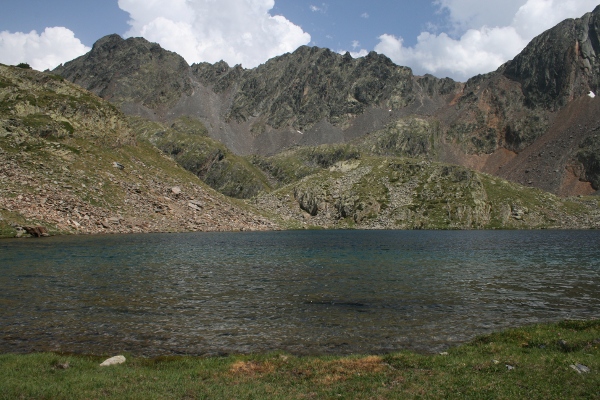
Tomorrow, at this time, I'll probably be unsuccessfully trying to find a comfortable position on a seat of the Bilmanbus to Irun. Very early on Saturday, as soon as we get off the bus, Maria and I will quickly head to Hondarribia's beach in Cape Higer to symbolically wet our feet in the waters of the Cantabrian Sea. We won't have much time to enjoy the cold waters of the ocean, though. Soon after that, we'll have to take a deep breath, look East, and start walking if we want to achieve our utmost objective: take a bath in the beautiful beaches of the Cap de Creus, in the Mediterranean sea. In between, 30 days and 840 kilometres of thick woods, deep valleys, high peaks and cold waters, all of which shape incredible landscapes.


The Portella de Baiau, during our 2008 trip For a whole month, we'll be mostly disconnected from everything else that isn't our knee ache, our blisters, the Sun over our heads or where to get food. It's the first time I leave on a hiking trip as long and tough as this one, and I feel both uncertainty and eagerness. We've been so busy during the last few months that we've been unable to train at all for this, and I'm probably in the worst physical condition in a decade. It's too late to take care of that now, so we'll try to take good care of our legs and spine. In order to get back home in the Mediterranean, we'll have to be fast, some days joining two stages and skipping a few that we know are not that interesting (sections over asphalt, etc.). It's hard to make it in just one month, but we'll try our best. The plan is going to sleep not long after sunset, getting up at dawn, to be able to walk for a decent time before the heat starts being a handicap and just resting at midday, when the Sun is strongest. Of course, this means that I'm missing, yet again, this year's edition of DebConf in New York City, which is really sad because I was looking forward hanging around with Mako, Mika, Biella, micah, Clint and the rest of the NYC/ Boston gang, but when the idea of doing a long trip this summer popped up around January, it was clear DebConf seemed unlikely this year. I hope all of you have a lot of fun, and see you in a few weeks!

John Goerzen: Jacob & Dad & Trains

Back in July, our family took a train trip from Kansas to New York for Debconf10. And then in September, we went to Indiana. The only train service from here leaves at about 3AM in both directions. So starting about November, Jacob started asking me, Dad, will you wake me up in the middle of the night to go to the train station TODAY? He didn t seem to get it through his head that we didn t have another trip planned, although we surely would at some point. It just couldn t possibly be, right? So around Christmas, I booked a round trip from here to Galesburg, IL for just Jacob and me. We ll get on the train at 3AM Saturday morning, get to Galesburg about noon, and then head back home at 5PM, getting home again at, well, 3:30AM. Jacob is super excited about this. When the tickets arrived, he didn t yet know about the trip. I thought he d be excited then, but the ticket sleeve had a picture of a toy train that he didn t own, so he was somewhat sad. But starting the next day he was very excited. We wrote Amtrak on the Jan. 15 spot on his pharmacy calendar (a local pharmacy gives them away free each year). He carefully checked off each day as it went past. And he s been getting increasingly excited all week. Tonight he couldn t really think, couldn t really play, couldn t really calm down. He jabbered about how he would sit by the window, how precisely I would wake him up, and his eyes would open up right away and we ll go straight there. He talked about how he will look out the window at the dark night, and was extra excited when I told him he d see snow out the window like one of the Amtrak videos he likes to watch on Youtube. He already placed his order for breakfast in the dining car: French toast with syrup on top. He ran past the computer while I was looking at things to do in Galesburg, and saw I had a map up, and immediately noticed the train tracks. Then he pointed to the station, and said, Dad, that says Galesburg Amtrak . A rather stunned dad replied, Yes indeed it does, Jacob. I guess it was some combination of pre-reading and detective skills, but that surprised me. Anyhow, this is the first trip with just Jacob and me. We re going to have a blast, I m sure. I may, however, wind up going 24 hours without sleep if his adrenaline level is any guide

Next.

Previous.