Search Results: "hug"

17 February 2011

Raphaël Hertzog: People behind Debian: Maximilian Attems, member of the kernel team


Maximilian, along with the other members of the Debian kernel team, has the overwhelming job of maintaining the Linux kernel in Debian. It s one of the largest package and certainly one where dealing with bug reports is really difficult as most of them are hardware-specific, and thus difficult to reproduce. He s very enthusiastic and energetic, and does not fear criticizing when something doesn t please him. You ll see. My questions are in bold, the rest is by Maximilian. Who are you? My name is Maximilian Attems. I am a theoretical physicist in my last year of PhD at the Technical University of Vienna. My main research area is the early phase of a Quark-Gluon Plasma as produced in heavy ion collisions at the LHC at CERN. I am developing simulations that take weeks on the Vienna Scientific Cluster (in the TOP 500 list). The rest of the lab is much less fancy and boils down to straight intel boxes without any binary blobs or external drivers (although lately we add radeon graphics for decent free 3D). Mathematica and Maple are the rare exceptions to the many dev tools of Debian (LaTeX, editors, git, IDE s, Open MPI, ..) found at the institute, as those are unfortunately yet unmatched in Free Software for symbolic computations. The lab mostly runs a combination of Debian stable (testing starting from freeze) for desktops and oldstable/stable for servers. Debian is in use for more than 10 years. So people in the institute know some ups and downs of the project. Newcomers like my room neighbors are always surprised how functional a free Debian Desktop is. :) What s your biggest achievement within Debian? Building lots and lots of kernels together with an growing uptake of the officially released linux images. I joined the Debian kernel team shortly after Herbert Xu departed. I had been upstream Maintainer of the linux-2.6 janitor project for almost a year brewing hundreds of small cleanups with quilt in a tree named kjt for early linux-2.6. In Debian we had lots of fun in sorting out the troubles that the long 2.5 freeze had imposed: Meaning we were sitting on a huge diverging monolithic semi-good patchset. It was great fun to prepare 2.6.8 for Sarge with a huge team enthusiastic in shipping something real close to mainline (You have to imagine that back then you had no stable or longterm release nor any useful free tools like git. This involved passing patches around, hand editing them and seeing what the result does.) From the Sarge install reports a common pattern emerged that the current Debian early userspace was causing lots of boot failures. This motivated me to develop an alternative using the new upstream initramfs features. So I got involved in early userspace. Thanks to large and active development team initramfs-tools got a nice ecosystem. It still tries to be as generic and flexible as possible and thus gains many nice features. Also H. Peter Anvin (hpa) gave me the official co-maintenance of klibc. klibc saw uptake and good patches from Google in the last 2 years. I am proud that the early userspace is working out fairly well these days, meaning you can shuffle discs around and see your box boot. Later on we focused on 2.6.18 for Etch, which turned out to a be good release and picked up by several other distributions. Only very much later we would see such a sync again. With 2.6.26 for Lenny we got somehow unlucky as we just missed the new longterm release by one release. We also pushed for another update very late (during freeze) in the release cycle, which turned out to semi-work as too much things depend on linux-2.6. For Squeeze 2.6.32 got picked thanks to discussions at Portland Linux Plumbers and it turned out to be a good release picked up by many distributions and external patchsets. The long-term support is going very well. Greg KH is doing a great job in collecting various needed fixes for it. Somehow we had hoped that the Squeeze freeze would start sooner and that the freeze duration would be shorter, since we were ready for a release starting from the actual freeze on. The only real big bastard on the cool 2.6.32 sync is Red Hat. Red Hat Enterprise 6.0 is shipping the linux-2.6 2.6.32 in obfuscated form. They released their linux-2.6 as one big tarball clashing with the spirit of the GPL. One can only mildly guess from the changelog which patches get applied. This is in sharp contrast to any previous Red Hat release and has not yet generated the sharp and snide comments in press it deserves. Red Hat should really step back and not make such stupid management moves. Next to them even the semi-maintained Oracle Unbreakable 2.6.32 branch looks better: It is git fetchable. What are your plans and those of the kernel team for Debian Wheezy? Since 2.6.32 many of the used patches landed upstream or are on the way (speakup, Kbuild Debian specific targets, ..). The proper vfs based unionfs is something we d be looking forward. We haven t yet picked the next upstream release we will base Wheezy on, so currently we can happily jump to the most recent ones. There are plans for better interaction with Debian Installer thanks to generating our udebs properly in linux-2.6 source itself. Also we are looking forward to using git as tool of maintenance. We d hope that this will also allow for even better cross distribution collaboration. Concerning early userspace I plan to release an initramfs-tools with more generic userspace for the default case and finally also a klibc only for embedded or tuning cases. What do you like most in Debian? For one thing I do like the 2 year release cycle. It is not too long to have completely outdated software and on the other hand it gives enough time to really see huge progress from release to release. Also at my institute the software is is recent enough without too much admin overhead. For servers the three years support are a bit short, but on the manageable side. I do enjoy a lot the testing distribution. For my personal use it is very stable and thus I mainly run testing on my desktop and work boxes. (Occasionally mixing in things from sid for unbreaking transition or newer security fixes). Debian is independent and not a commercial entity. I think this is its main force and even more important these days. I enjoy using the Debian platform a lot at work thus in return this motivates me to contribute to Debian itself. I also like the fact that we strive for technical correctness. Is there some recurrent problem that hinders the progress of Debian? The New Maintainer process is a strange way to discourage people to contribute to Debian. It is particularly bureaucratic and a huge waste of time both for the applicant and his manager. It should be completely thrown overboard. One needs a more scalable approach for trust and credibility that also enhances the technical knowledge for coding and packaging of the applicant. NM is currently set in stone as any outside critics is automatically rejected. Young and energetic people are crucial for Debian and the long-term viability of the project, this is the reason why I d consider the New Maintainer process as Debian s biggest problem. Note from Rapha l Hertzog: I must say I do not share this point of view on the New Maintainer process, I have witnessed lots of improvements lately thanks to the addition of the Debian Maintainer status, and to the fact that a good history of contribution can easily subsume the annoying Tasks & Skills questionnaire. Another thing I miss is professional graphics input both for the desktop theme and the website. I know that effort has been done there lately and it is good to see movement there, but the end result is still lacking. Another trouble of Debian is its marketing capabilities. It should learn to better sell itself. It is the distribution users want to run and use not the rebranded copies of itself with lock-in sugar . Debian is about choice and it offers plenty of it: it is a great default Desktop. Linus Torvalds doesn t find Debian (and/or Ubuntu) a good platform to hack on the kernel. Do you know why and what can we do about this? The Fedora linux-2.6 receives contributions from several Red Hat employed upstream sub-Maintainers. Thus it typically carries huge patches which are not yet upstream. As a consequence eventual userland troubles get revealed quite quickly and are often seen there first. The cutting edge nature of Fedora rawhide is appealing for many developers. The usual Debian package division of library development files and the library itself is traditionally an entry barrier for dev on Debian. Debian got pretty easily usable these days, although we could and should again improve a lot more in this sector. Personally I think that Linus hasn t tried Debian for years. I have the feeling that the implication of the Debian Kernel team in LKML has been on the rise. Is that true and how do you explain this? Ben Hutchings is the Nr.1 contributor for 2.6.33. He also is top listed as author of patches on stable 2.6.32. Debian is not listed as organization as many send their linux-2.6 patches from their corporate or personal email address and thus it won t be attributed to Debian. There is currently no means to see how many patches get forwarded for the stable tree, but I certainly forwarded more then fifty patches. I was very happy when Greg KH personally thanked me in the 2.6.32.12 release. In the Squeeze kernel, the firmwares have been stripped and moved into separate packages in the non-free section. What should a user do to ensure his system keeps working? There is a debconf warning on linux-2.6 installation. It is quite clear that the free linux-2.6 can t depend on the firmware of the non-free archive (also there is no strict dependency there technically). On the terminal you d also see warnings by update-initramfs on the initramfs generation for drivers included in the initramfs. The debconf warning lists the filename(s) of the missing firmware(s). One can then apt-cache search for the firmware package name and install it via the non-free repository. The check runs against the current loaded modules. The match is not 100% accurate for special cases as the one where the device might be handled well by this driver without firmware, but is accurate enough to warrant the warning. The set of virtualization technologies that the official Debian kernel supports seems to change regularly. Which of the currently available options would you recommend to users who want to build on something that will last? KVM has been a smooth ride from day zero. It almost got included instantly upstream. The uptake it has is great as it sees both dev from Intel and AMD. Together with libvirt it s management is easy. Also the performance of virtio is very good. The linux containers are the thing we are looking forward for enhanced chroots in the Wheezy schedule. They are also manageable by libvirt. Xen being the bad outside boy has an incredible shrinking patchset, thus is fair to expect to see it for Wheezy and beyond. For many it may come a bit late, but for old hardware without relevant CPU it is there. Many tend to overstate the importance of the virtualization tech. I d be much more looking forward to the better Desktop support in newer linux-2.6. The Desktop is important for linux and something that is in heavy use. The much better graphics support of the radeon and nouveau drivers: The performance optimizations thanks to dcache scalability work and the neat automatic task-grouping for the CPU scheduler are very promising features for the usability of the linux desktop. Another nice to have feature is the online defrag of ext4 and its faster mkfs. Even cooler would be better scalability in ext4 (This side seems to have seen not enough effort lately). Is there someone in Debian that you admire for their contributions? Hans Peter Anvin and Ted Tso are a huge source of deep linux-2.6 knowledge and personal wisdom. I do enjoy all sorts of interactions with them. Christoph Hellwig with Matthew Wilcox and also William Irwin for setting up the Debian kernel Team. Several Debian leaders including the previous and the current one for their engagement, which very often happens behind the scene. The Debian Gnome Team work is great, also the interactions have always been always easy and a pleasure. Martin Michlmayr and previously Thiemo Seufer do an incredible job in porting Debian on funny and interesting ARM and MIPS boxes. Debian has a lot of upcoming potential on this area. I m looking forward to other young enthusiastic people in that area. Colin Watson is bridging Debian and Ubuntu, which is an immense task. Michael Prokop bases on Debian an excellent recovery boot CD: http://www.grml.org. I d be happy if any Debian Developer would work as carefully coding and working.
Thank you to Maximilian for the time spent answering my questions. I hope you enjoyed reading his answers as I did. Subscribe to my newsletter to get my monthly summary of the Debian/Ubuntu news and to not miss further interviews. You can also follow along on Identi.ca, Twitter and Facebook.

One comment Liked this article? Click here. My blog is Flattr-enabled.

14 February 2011

Gunnar Wolf: Subsidizing private education?

Hrmh... I am listening to a local news radio station. Of course, what I am about to write lacks information and insight but it follows a conversation I have had with several groups of friends. Our de-facto president has decreed that the tuition for private schools will be deducted from the Impuesto sobre la renta (revenue/profit tax) up to a given tuition level (IIRC up to MX$2000 a month per child per school). The interviewed subsecretary said they expect this deduction will reach MX$13,000 million, around US$1,000 million. This is, about a third of what is assigned to the National University (UNAM). At a first sight, this sounds good. However, I just thought about a discussion I have had with many friends. This money the government will hand back to the taxpayers has to be cut from somewhere (after all, we are not in a country with huge superavit or anything like that). Why does this sound unfair ot me? Because it benefits the few in perjudice of the many. I did a quick search, and found this work based on numbers published by INEGI ten years ago: According to the last table, the money spent on private education was between 5% and 10% of that spent on public education Of course, it is almost impossible to infer the number of students from this alone. I know I could find authoritative data on this regard by searching a bit more, but after all I don't want to spend all (work!) evening on a blog post unless it creates some discussion. Lets say, just for the sake of the exercise, that this means that ~3% of the country's students learn in a private school. In Mexico, the quality of the basic public education (primary/secondary, ages 6 to 18) has fallen hugely in the last decades. Even when I was to school (but not when my parents), the first subjective sign that a family had broken the low-income barrier is that they were finally able to send their children to private schools. Because, no matter how bad they are, public schools are perceived to be worse. Of course, I was among the "lucky" ones to be in a private school. Higher education (universitary level) is still way better ranged. Anyway... I want to get this post over with. Why do I oppose this subsidies/tax devolution? Because it will lead to widen the difference between private and public education. And because it will be benefical only for medium-high and high classes People who are formaly employed (as I am) do not present a tax declaration, so we won't get any deductions. Between and of the country's economically active population work informally (from selling in the street to covering up huge transactions in large locals). Most of the population don't (directly) pay "impuesto sobre la renta", and will not get the benefit of this subsidy. This money has to be taken from other sources in order to be given to private education. If the government wants to improve the education for everybody, why not assign it to the public sector? To specific areas in the public sector, if they don't want to hand it over to the (yes, very, incredibly) corrupt SNTE (National Union of Education Workers)?
John Goerzen: Lots of Snow, Being Stuck, and Fun

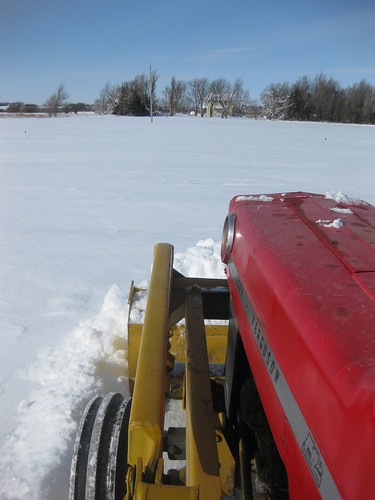
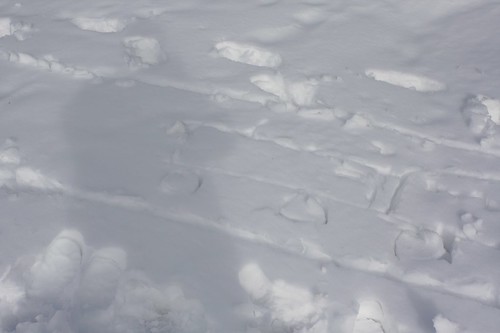
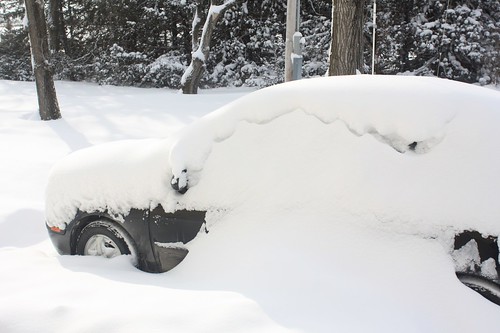
Those of you that watch my twitter know that we got dumped on with snow recently. The final estimate reported by local papers is 17 to 19 inches. IMG_5301.JPG That s my car. You might understand why I went home at 1PM Tuesday and worked from home the rest of the afternoon. The county didn t get the roads opened until 5:30PM Wednesday, so we were stuck. Terah s dad kindly opened the driveway for us though. Without that, we wouldn t have even known where it was. marla-IMG_4180.JPG Jacob and Oliver loved playing in the snow. It was a HUGE hit for them. Both of them hated to go back inside when it was time. Oliver had trouble walking, or even standing up, but that didn t stop him from begging for more every chance he got. IMG_5345.JPG On Saturday, I took Jacob outside to play. We had in mind building a snow tunnel. We went to one of the big piles of snow left by the tractor after our driveway was cleared, and I dug out a space underneath it that Jacob could crawl through. He got a little scoop (he insisted on calling it my shovel ) and helped dig too. He had a great time with it. He was very anxious to go inside, and it probably didn t help his eagerness that the cats could freely walk through it long before he could. They were around and taking a great interest in the proceedings. One of then stretched out on my back while I was stretched out pulling snow out from the pile. Finally Jacob got to go through. He had a little trouble because it wasn t tall enough for him to crawl like he usually does (though still plenty big for him to get through with lots of room to spare), but he came out beaming. I then went and got the camera and got some photos of his second trip through. IMG_5424.JPG You d think that this might be the highlight of a 4-year-old s snow excursion. And given his excitement, you might be very convinced of that. But you d be wrong. What Jacob really wanted was a snow train. So I drew some train track-sized lines in the snow with my shovel. Then I was supposed to draw a train engine. He had been planning this for hours before we even went outside, and I knew very well what was supposed to go on the engine: a snowball for a headlight. We then added passenger cars and a coal car, because apparently that s what you do with snow trains. And the result: IMG_5445.JPG When we went inside, Terah asked Jacob about his snow experience. Jacob was very happy, until she asked him if his snow train was a real train or a drawing of a train. Then he became very sad when he said it was a drawing of a train, and decided it was not what he wanted AT ALL. So today we went out again. This time I built a snow train that stands up, complete with snowballs for wheels. I asked him if it was right, and he kept saying, No, I want a REAL train. Finally I asked him what the difference between a real snow train and this one was. Apparently a real train would be on tracks, move around, make noise, and take us places. Fortunately he didn t dwell too long when I explained I couldn t build one of those. And then today s highlight was writing JACOB in the snow. He had started by drawing larger and larger J letters with his arm, and finally asked me to make one. I made footprints in the shape of a very large J, which he loved. He had me make another one, and then the rest of the letters in his name.

8 February 2011

Michal Čihař: phpMyAdmin translation status

As we're slowly heading towards phpMyAdmin 3.4, it is good time to look at current translations state. There are few which are already at 100%, so they are in best possible shape: Some languages really miss just few messages, so they will hopefully get to 100% soon: And there is huge progress in Russian, which will at this pace get to 100% this week. Was your language not listed? You can help it being better!

Filed under: English Phpmyadmin 0 comments Flattr this!

6 February 2011

Kees Cook: fun with game memory

So, I was testing a (closed source) single-player offline game recently and thought this exercise might be fun to document. I didn t want to spend any time actually earning in-game money since I d played it before and I wanted to just skip ahead to other aspects of the game. I was curious how straight-forward adjusting my cash might be. So, noting the in-game bank account number of 219393 and account balance of 3000, I dived right in. First up, what s the memory layout of the heap look like? I looked at the brk and the mmap regions without a mapped library or file, marked with w in the permissions column, from /proc/PID/maps:

0827e000-08282000 rw-p 00000000 00:00 0
0a22e000-0b08a000 rw-p 00000000 00:00 0 [heap]
efa59000-efd00000 rw-p 00000000 00:00 0
efd00000-efd21000 rw-p 00000000 00:00 0
Knowing these, I could use gdb s find command, after attaching to the process:
$ gdb /some/cool/game

(gdb) attach PID

(gdb) find /w 0 0827e000, 0 08282000, 219393
(gdb) find /w 0 0a22e000, 0 0b08a000, 219393
0xaf03d08
0xaf06ca8
No hits in the first region, but I see two hits for the account number value in the second region. Let s start there and see what s near them
(gdb) x/8x 0xaf03d08
0xaf03d08: 0 00035901 0 00000000 0 00000000 0 0af06ce0
0xaf03d18: 0 0af06be0 0 00000059 0 0af03d98 0 0af041e8
(gdb) x/8x 0xaf06ca8
0xaf06ca8: 0 00035901 0 00000bb8 0 00000bb8 0 0820b148
0xaf06cb8: 0 00000001 0 00000000 0 00000000 0 00000000
In that second hit, I see the value 0xBB8, which is 3000, and matches our account balance. Let s see what happens if we just change both of those to add a bit a few orders of magnitude above the current value
(gdb) set var *0xaf06cac = 0 00100bb8
(gdb) set var *0xaf06cb0 = 0 00100bb8
(gdb) x/32x 0xaf06cac
0xaf06cac: 0 00100bb8 0 00100bb8 0 0820b148 0 00000001
(gdb) continue
And presto, clicking on the bank account details in-game shows a huge account balance of 1051576 now. No need to reverse-engineer any saved games, whew.

3 February 2011

Raphaël Hertzog: People behind Debian: Mike Hommey, Firefox/Iceweasel maintainer

Mike Hommey, our Iceweasel maintainer

For as long as I have known Mike, he s been maintaining one of the largest (and most widely used) package: Iceweasel, Debian s default web browser. It s effectively Mozilla s Firefox although it has been renamed to avoid some rules enforced by Mozilla s trademark policy. But we might see Firefox back in Debian read on to know Mike s plans. His story is also very interesting in that he went from simple user to Iceweasel maintainer, and now he s working for Mozilla Corporation. But you already knew that contributing to free software is a good way to grow skills and gain experience that are valuable on the job market, right? ;-) My questions are in bold, the rest is by Mike. Who are you? I am Mike Hommey. I am French, even if my name doesn t sound so. I have been a GNU/Linux user since 1995, using Debian since 1999, and started packaging in 2003. After a long time in the NM queue, I became a DD in 2005. The main reason I started being actively involved is quite selfish: I wanted some things done, and I just did them. My first packages were extensions for the Mozilla Suite, the old one that directly inherited from Netscape Communicator. Later on, I wanted some of these extensions to work with the new kid on the block: Phoenix; or maybe it was already Firebird. By then, integrating extensions was a hassle, and the mozilla-browser maintainer had come up with a script that would make it easier for extension packages. So I ported that script for use with Phoenix/Firebird and sent it to the BTS. Then Phoenix/Firebird became Firefox, and it grew a real extension manager. Except that is was entirely not suited for extensions installed by the packaging system. So I made it work better. And made a few more changes to make Firefox work better. All through patches or NMUs. Then I became co-maintainer, then Firefox couldn t keep its name and became Iceweasel, and, fast-forward until today, I m now taking care of Iceweasel/Xulrunner and Iceape in stable, unstable, experimental and an external repository. This 8 years-long story (wow, I hadn t even realized it had been that long until I wrote it) tells you something: newcomers shouldn t be afraid to stick their hands anywhere, even in big packages. I was only a Mozilla and Phoenix end-user when I started. Apart from Mozilla-related packaging, I also happen to (co-)maintain some other packages in Debian, most notably webkit, though I haven t been very active in the pkg-webkit team recently. There are several reasons for that, the main one being that there are other team members getting the job done. And I can t say that much about the pkg-mozilla team, since there are effectively no other team members. What s your biggest achievement within Debian? I am quite proud that Squeeze will be the first Debian release where Iceweasel works on all supported architectures. Previously, we only knew the package compiled on all these architectures. Starting with Squeeze, we know it passes several of the test suites coming with the source code. This ensures most of the browser is functional. It was actually far from being the case before, as it appeared when the test suites were first enabled. I think it is very important to have properly working packages on all our supported architectures. The current evolution of hardware shows how important it still is. Who would have thought a few years back that we would see ARM or MIPS based netbooks today ? What are your plans for Debian Wheezy? For Debian Wheezy, I would like to improve Iceweasel/Icedove/Iceape integration with the packaging system. Something that would allow to use the apt database to find extensions or plugins, on top of the current behaviour. I also want to improve desktop integration, most notably for KDE. Another thing I d like to see happen is to package google breakpad independently (its source code is currently embedded in chromium and iceweasel, though not built, as far as I know), and have our Mozilla products builds be able to send their crash reports upstream. It is very important that upstream gets direct visibility over what crashes on GNU/Linux systems. It helps making them aware of issues that would otherwise probably remain unnoticed, as there are much more users using distributions packages than upstream tarballs. And not all Debian users report crashes to the BTS. I know at least Fedora and SuSE are already doing it. More importantly, I want to avoid the sad situation we got with Squeeze, where we re going to release a 18 months old Iceweasel. We got there for a combination of reasons, one being that I was preparing for a freeze in December 2009 and focusing on getting 3.5 in shape instead of the then upcoming 3.6. The result was that we didn t get 3.6 packages before upstream released 3.6.3 in April 2010. By then it was too late, considering the uncertainty of the release schedule, to update reverse dependencies and get 3.6 ready for Squeeze. Things are different for 4.0. I m already getting ahead of things, and while reverse dependencies haven t been taken care of, all beta releases have been made available through http://mozilla.debian.net/, usually within hours after upstream release (sometimes even a few hours before official announcement, but always after availability on ftp.mozilla.org). A great share of our patches were also pushed upstream. Several things made that possible: There will be a couple major upstream releases until Wheezy comes along, and I want to make them available early in unstable, even if that means breaking reverse dependencies until they are fixed. Finally, I would like to get other people involved, starting with the Icedove maintainer. Volunteers are very much welcome, for any kind of involvement: bug triaging, documentation (which we are deeply lacking), testing, code People interested can contact the pkg-mozilla team list. As the Debian packaging gets less time consuming, I should be able to spend more time mentoring, which should help. If you could spend all your time on Debian, what would you work on? I actually have been working almost full time on Debian for a few months during a more-or-less purposeful unemployment period. That s when I attempted to add an alert popup when Iceweasel or extensions are upgraded (which was eventually removed because not working very effectively). That s when I worked on Iceweasel 3.6 and the first 4.0 betas. That s when I pushed more than 70 patches upstream, and got upstream commit access. I know for a fact that keeping up with upstream and answering bug reports is already time consuming, and time comes in finite quantity. Working full time on Debian allows to do more than that, as I ve been able to experience first hand. Unfortunately, that doesn t help pay the bills, so it would be best if time could be shared with other persons. Like, actual members in the pkg-mozilla team. ;) Anyways, if I were to work full time on Debian again, I d like to do more than packaging, and help improve some of our infrastructure, most notably the buildd network, to grow some automated way to get packages built on all or some of our architectures. Call that PPA if you want, though I don t think we need something exactly like PPA. We sure do have porter boxes, but there is a huge overhead to get packages built there: you need to first try, then see you lack build dependencies, then wait for admins to install them, then come back and launch your build, and finally come back again much later to see how it went. And that s when it goes smoothly. Repeat for each architecture. It s already cumbersome when it s a small package, so imagine when it s Iceweasel. I d like to be able to push a (signed) .dsc somewhere, say I want it built on that and that architecture, and get binary packages and logs back. It could then be up to developers to distribute them, or not. Sometimes, you re just interested in test suite results. Another related wish would be a way to access build trees of failed builds, possibly on the buildd where it failed. What s the biggest problem of Debian? Lack of contributors, lack of contributors, and lack of contributors. It can sound weird to say that in a community of 1000+ people. But the sad reality is that we ve seen, repeatedly, calls for help in various places from various understaffed teams (most often of effectively one member) for years. So there is obviously a problem getting people to invest time in these teams either on the long term, or at all. I know this is not a very significant metric, but it already should say a lot: I wouldn t be surprised if more than 2/3 of the number of source lines of code in Debian come from less than 5% of the number of packages in the archive, and see less than 5% of the DD/DM population involved. If someone feels like doing the actual math, I m curious to know how far I m from reality, and in what direction. We also lack manpower to be able to make our release development smoother. In a perfect world where manpower is not a scarce resource, we should work on $release+1 when $release is being frozen. Said otherwise, we should have been able to start working on Wheezy in August 2010, or even earlier. You ve been working for Mozilla Corporation for a few months. How does the work look like and what are you working on? I am actually not working full time for MoCo; I am only contracting for 4 days a week. That was a request I made to keep having enough spare time for Debian or other activities. I am working from home, and am pretty much free about when I work, as long as I work long enough. I take advantage of this freedom and the saved commuting time to live a healthier life by doing some sports in the daytime (which also happens to be cheaper). I mostly work with Taras Glek and other people on various aspects of Firefox startup performance. This involves pretty interesting low-level stuff, in which I actually got involved before being contracted. This work has nothing to do with packaging Iceweasel, though I can have a few opportunities to do things somehow related. You told in your blog that you were discussing with Mozilla how Debian could use the Firefox trademark. Can you tell us a bit about the progress you made? I have got an informal approval of the patches we are applying to the Iceweasel 4.0 beta packages. There are a few concerns about using the system cairo library, and the embedded copy of libpng needs to be used to have support for the animated PNGs that are used in the user interface and that are required in Firefox feature-set. Other than that, there are pretty much no objection on the technical side. We managed to get to some common ground as to how to manage stable updates and more generally, changes to our packages, but I m still waiting for an actual agreement draft. While I, as the maintainer, am fine with the way it should look according to my discussions with the people involved at Mozilla, I ll seek review from my fellow Debian Developers when I ll have something to show. I haven t decided yet how this will reflect on the Debian packages, though. For example, would Iceweasel stay? But I do hope Wheezy will get Firefox back. Is there someone in Debian that you admire for their contributions? Not someone, but all past, present and future release team members. This is a team that receives a lot of critics (and I indirectly gave one a few paragraphs ago), yet manages to keep doing an amazing job and its members are very committed to their task. I admire their dedication.

Thank you to Mike for the time spent answering my questions. I hope you enjoyed reading his answers as I did. Subscribe to my newsletter to get my monthly summary of the Debian/Ubuntu news and to not miss further interviews. You can also follow along on Identi.ca, Twitter and Facebook.

8 comments Liked this article? Click here. My blog is Flattr-enabled.

31 January 2011

Stefano Zacchiroli: who the bloody hell cares about Debian

A down-under talk on the role of Debian, A.D. 2011 I'm back from LCA 2011, which I've attended to share some thoughts about the role that Debian plays in the Free Software ecosystem, 18 years after its inception (yes, we are that old^Welder). The talk title---Who the bloody hell cares about Debian? [1]---was meant to be rather provocative. The idea was indeed to challenge the meme that, in the era of distributions that release every 6 months, a distribution with a release cycle of circa 2 years (like Debian, considering the past 5 years) is not a project that deserves your attention anymore. Is it really the case? In the talk I (obviously) claim it is not, using two main arguments. The first argument is based on the observation that Debian offers a set of pretty rare, if not unique, features among mainstream FOSS distributions. Those features consist of a mix of technical and "political" aspects: (1) a focus on package quality, with no distinction among first and second class packages; (2) a strong culture of software freedom, which refuses to offer non-free software (or firmware) by default to users and distribution developers (as parts of the infrastructure used to make Debian); (3) independence from commercial interests, with no single company or entity that could claim to babysit Debian; and (4) a decision making model based on a weighted sum of do-ocracy and democracy, which implies that by doing (rather than talking) everyone has a chance to have an impact on Debian. Considering all that and looking at the most popular FOSS distributions, one can easily identify Debian as one of the few remaining players who both care about Free Software and can be trusted in making choices not driven by profit. Mind you, I've nothing against companies in general and I'm very well aware that many FOSS companies carry a good deal of the burden of developing and promoting Free Software. Nonetheless, in days in which it is striking how quickly FOSS-friendly companies can become very much FOSS-unfriendly, I can't help putting my trust and efforts into community-driven projects, better if with no attached company label whatsoever. Furthermore, having distributions like Debian around can encourage other company-backed distributions to demand more and more independence and clarifications about the relationships between the community and the backing company. The second argument about the relevance of Debian is more pragmatic and rather straightforward: Debian is the root of a huge tree of derived-distribution (AKA "derivatives"), more than 120 according to popular distribution indexing sites. Each Debian derivative focuses its attention on, and directs its people power to, customizing Debian for a specific target and build entierly upon Debian work for all parts that do not need customization. That possibility is one key advantage of Free Software, after all. A well-known derivative example is Ubuntu, which is probably the most popular Debian derivative, enjoying a user base way larger than that of Debian itself. Ubuntu is heavily customized with respect to Debian and still had only about (at the time of Natty) 25% of packages which either differed from their Debian counterparts or that did not exist in Debian at all. Other Debian derivatives tend to be way less customized than that. Either way, if you are running a Debian derivative, chances are that you heavily depend on Debian and on its well-being. (Yes, it is so also if you didn't know about that, sorry.) Let's now fast-forward to the end of the talk, skipping my usual comments on how to keep the whole tree of Debian derivatives sustainable and beneficial for Free Software as a whole (i.e. by reducing as much as possible the viscosity of patch flow along the derivatives tree). Feedback People's reaction to such a provocative talk has been positive and we have enjoyed a fairly long Q&A session discussing the topics mentioned above as well as other Debian-related topics. A (commented) summary of the obtained feedback is reported below. Judging from the recurrent questions and suggestions I've received doing Debian talks in the past 8 months, I dare to say that LCA feedback is fairly representative of the feelings of many Debian users. Slides of the talk are available, while a video will eventually be posted at http://linuxconfau.blip.tv.
[1] Kudos to Francois Marier for suggesting the title. If the title doesn't ring a bell for you (it didn't for me in the beginning), you might want to check out the story of this ad. Update: minor rephrasing in the 4th paragraph

28 January 2011

Amaya Rodrigo: Indignez Vous!

If There is any sort of food for thought worth reading, this is it.
INDIGNEZ-VOUS! GET ANGRY! CRY OUT by St phane Hessel


St phane Hessel, author of Indignez-vous!
After 93 years, it is almost the final act. The end for me is not very far off any more. But it still leaves me a chance to be able to remind others of what acted as the basis of my political engagement. It was the years of resistance to the Nazi occupation -- and the program of social rights worked out 66 years ago by the National Council of the Resistance!

It is to Jean Moulin [murdered founder of the Council] that we owe, as part of this Council, the uniting of all elements of occupied France -- the movements, the parties, the labor unions -- to proclaim their membership in Fighting France, and we owe this to the only leader that it acknowledged, General de Gaulle. From London, where I had joined de Gaulle in March 1941, I learned that this Council had completed a program and adopted it on March 15th, 1944, that offered for liberated France a group of principles and values on which would rest the modern democracy of our country.

These principles and these values, we need today more than ever. It is up to us to see to it, all together, that our society becomes a society of which we are proud, not this society of immigrants without papers -- expulsions, suspicion regarding the immigrants. Not this society where they call into question social security and national retirement and health plans. Not this society where mass media are in the hands of the rich. These are things that we would have refused to give in to if we had been the true heirs of the National Council of the Resistance.


From 1945, after a dreadful drama [WWII], it was an ambitious
resurrection of society to which the remaining contingent of the Council
of the Resistance devoted itself. Let us remember them while creating
national health and pensions plans such as the Resistance wished, as its
program stipulated, "a full plan of French national health and social
security, aimed at assuring all citizens the means of existence whenever
they are unable to obtain them by a job; a retirement allowing the old
workers to finish their days with dignity."

The sources of energy, electricity, and gas, mines, the big banks, were
nationalized. Now this was as the program recommended: "... the return
to the nation of big monopolized means of production, fruits of common
labor, sources of energy, wealth from the mines, from insurance
companies and from big banks; the institution of a true economic and
social democracy involving the ousting of the big economic and financial
fiefdoms from the direction of the economy."

General interest must dominate over special interest. The just man
believes that wealth created in the realm of labor should dominate over
the power of money.

The Resistance proposed, "a rational organization of the economy
assuring the subordination of special interests to general interest, and
the emancipation of 'slaves' of the professional dictatorship that was
instituted just as in the fascist states," which had used the interim
[for two years after the war] government of the Republic as an agent.

A true democracy needs an independent press, and the Resistance
acknowledged it, demanded it, by defending "the freedom of the press,
its honor, and its independence from the State, the power of money and
foreign influence." This is what relieved restrictions on the press from
1944 on. And press freedom is definitely what is in danger today.

The Resistance called for a "real possibility for all French children to
benefit from the most advanced education," without discrimination.
Reforms offered in 2008 go contrary to this plan. Young teachers, whose
actions I support, went so far as refusing to apply them, and they saw
their salaries cut by way of punishment. They were indignant,
"disobeyed," judging these reforms too far from the ideal of the
democratic school, too much in the service of a society of commerce and
not developing the inventive and critical mind enough. 2

All the foundations of the social conquests of the Resistance are
threatened today.

The motive of the Resistance: indignation (Indignez-vous!)

Some dare to say to us that the State cannot afford the expenses of
these measures for citizens any more. But how can there be today a lack
of money to support and extend these conquests while the production of
wealth has been considerably augmented since the Liberation period when
Europe was in ruins? On the contrary, the problem is the power of money,
so much opposed by the Resistance, and of the big, boldfaced, selfish
man, with his own servants in the highest spheres of the State.

Banks, since privatized again, have proved to be concerned foremost for
their dividends and for the very high salaries of their leaders, not the
general interest. The disparity between the poorest and the richest has
never been so great, and amassing money, competition, so encouraged.

The basic motive of the Resistance was indignation!

We, the veterans of the resistance movements and combat forces of Free
France, we call on the young generation to live by, to transmit, the
legacy of the Resistance and its ideals. We say to them: Take our place,
"Indignez-vous!" [Get angry! or Cry out!].

The political, economic, intellectual leaders, and the whole society do
not have to give in, nor allow oppression by an actual international
dictatorship of the financial markets, which threatens peace and
democracy.

I wish for you all, each of you, to have your own motive for
indignation. It is precious. When something outrages you as I was
outraged by Nazism, then people become militant, strong, and engaged.
They join this current of history, and the great current of history must
continue thanks to each individual. And this current goes towards more
justice, more freedom, but not this unbridled freedom of the fox in the
henhouse. The rights contained in the UN Universal Declaration of Human
Rights of 1948 are just that, universal.

If you meet somebody who does not benefit from it, feel sorry for them
but help them to win their rights.

Two visions of history

When I try to understand what caused fascism, what made it so we were
overcome by Hitler and the Vichy [French government that collaborated
with Hitler], I tell myself that the propertied, with their selfishness,
were terrifically afraid of Bolshevik revolution. They were allowed to
lead with their fear.

But if, today as then, an active minority stands up, it will be enough;
we shall be the leavening that makes the bread rise. Certainly, the
experience of a very old person like me, born in 1917, is different from
the experience of the today's young persons. I often ask professors for
the opportunity to interact with their students, and I say to them: You
don't have the same obvious reasons to engage you. For us, to resist was
not to accept German occupation, defeat. It was comparatively simple.
Simple as what followed, decolonization. Then the war in Algeria.

It was necessary that Algeria become independent, it was obvious. As for
Stalin, we all applauded the victory of the Red Army against the Nazis
in 1943. But already we had known about the big Stalinist trials of
1935, and even if it was necessary to keep an ear open towards communism
to compensate against American capitalism, the necessity to oppose this
unbearable form of totalitarianism had established itself as an
obviousness. My long life presented a succession of reasons to outrage
me.

These reasons were born less from an emotion than a deliberate
commitment. As a young student at normal school [teachers college] I was
very influenced by Sartre, a fellow student. His "Nausea" [a novel],
"The Wall," [play], and "The Being and Nothingness" [essay] were very
important in the training of my thought. Sartre taught us, "You are
responsible as individuals." It was a libertarian message. The
responsibility of a person can not be assigned by a power or an
authority. On the contrary, it is necessary to get involved in the name
of one's responsibility as a human being.

When I entered the French Ecole Normale Superieure, Ulm Street, in Paris
in 1939, I entered it as a fervent adherent of the philosopher Hegel,
and I adhered to the thought of Maurice Merleau-Ponty. His teaching
explored concrete experience, that of the body and of its relations with
the senses, one big singular sense faced with a plurality of senses. But
my natural optimism, which wants all that is desirable to be possible,
carried me rather towards Hegel. Hegelism interprets the long history of
humanity as having a meaning: It is the freedom of man progressing step
by step. History is made of successive shocks, and the taking into
account of challenges. The history of societies thus advances; and in
the end, man having attained his full freedom, we have the democratic
state in its ideal form.

There is certainly another understanding of history. It says progress is
made by "freedom" of competition, striving for "always more"; it can be
as if living in a devastating hurricane. That's what it represented to a
friend of my father, the man who shared with him an effort to translate
into German "The Search for Time Lost" [novel] by Marcel Proust.

That was the German philosopher Walter Benjamin. He had drawn a
pessimistic view from a painting by the Swiss painter Paul Klee,
"Angelus Novus," where the face of the angel opens arms as if to contain
and push back a tempest, which he identifies with progress. For
Benjamin, who would commit suicide in September 1940 to escape Nazism,
the sense of history is the overpowering progression of disaster upon
disaster.

Indifference: the worst of attitudes

It is true the reasons to be indignant can seem today less clearly
related or the world too complex. Who's doing the ordering, who decides?
It is not always easy to differentiate between all the currents that
govern us. We are not any more dealing with a small elite whose joint
activities can be clearly seen. It is a vast world, of which we have a
feeling of interdependence.

We live in an interconnectivity as never before. But in this world there
still are intolerable things. To see them, it is well and necessary to
look, to search. I say to the young people, Search little, and that is
what you are going to find. The worst of attitudes is indifference, to
say "I can do nothing there, I'll just manage to get by." By including
yourself in that, you lose one of the essential elements that makes the
human being: the faculty of indignation and the commitment that is a
consequence of it.

They [young people] can already identify two big new challenges:

1. The huge gap which exists between the very poor and the very rich and
that does not cease increasing. It is an innovation of the 20th and 21st
centuries. The very poor in the today's world earn barely two dollars a
day. The new generation cannot let this gap become even greater. The
official reports alone should provoke a commitment.

2. Human rights and state of the planet: I had the chance after the
Liberation to join in the writing of the Universal Declaration of Human
Rights, adopted by the United Nations organization, on December 10th,
1948, in Paris at the palace of Chaillot. It was as principal private
secretary of Henry Laugier, the adjunct general-secretary of the UN, and
as and secretary of the Commission on Human Rights that I with others
was led to participate in the writing of this statement. I wouldn't know
how to forget the role in its elaboration of Ren Cassin, who was
national commissioner of justice and education in the government of Free
France in London in 1941 and won the Nobel peace prize in 1968, nor that
of Pierre Mend s-France in the Economic and Social Council, to whom the
text drafts we worked out were submitted before being considered by the
Third Committee (Social, Humanitarian and Cultural) of the General
Assembly. It was ratified by the 54 member states in session of the
United Nations, and I certified it as secretary.

It is to Ren Cassin that we owe the term "universal rights" instead of
"international rights" as offered by our American and British friends.
This [universal versus international] was key because, at the end of the
Second World War, what was at stake was to becomeereignty," which a
nation can emphasize while it devotes itself to crimes against humanity
on its own soil. Such was the case of Hitler, who felt himself supreme
and authorized to carry out a genocide. This universal statement owed
much to universal revulsion towards Nazism, fascism, and totalitarianism
-- and owes a lot, in our minds, to the spirit of the Resistance.

I had a feeling that it was necessary to move quickly so as not to be
dupes of the hypocrisy that there was in the UN membership, some whom
claimed these values already won but had no intention at all to promote
them faithfully -- claimed that we were trying to impose values on them.

I can not resist the desire to quote Article 15 of the Universal
Declaration of Human Rights (1948): "Everyone has the right to a
nationality." Article 22 says, "Everyone, as a member of society, has
the right to social security and is entitled to realization, through
national effort and international cooperation and in accordance with the
organization and resources of each State, of the economic, social and
cultural rights indispensable for his dignity and the free development
of his personality." And if this statement has a declarative scope, and
not statutory, the Declaration nevertheless has played a powerful role
since 1948. It saw colonized people take it up in their fight for
independence; it sowed minds in a battle for freedom.

I note with pleasure that in the course of last decades there has been
an increase in nongovernmental organizations (NGOs) and social movements
such as ATTAC (Association for the Taxation of Financial Transactions);

also FIDH (International Federation for Human Rights) and Amnesty
International, which are active and competitive. It is obvious that to
be effective today it is necessary to act in a network, to use all
modern means of communication.

To the young people, I say: Look around you, you will find topics that
justify your indignation facts about treatment of immigrants, of
"illegal" immigrants, of the Roma [aka Gypsies]. You will find concrete
situations that lead you to strong citizen action. Search and you shall
find!

My indignation regarding Palestine outrages by Israel [Indignez-vous!]

Today, my main indignation concerns Palestine, the Gaza Strip, and the
West Bank of Jordan. This conflict is outrageous. It is absolutely
essential to read the report by Richard Goldstone, of September 2009, on
Gaza, in which this South African, Jewish judge, who claims even to be a
Zionist, accuses the Israeli army of having committed "acts comparable
to war crimes and perhaps, in certain circumstances, crimes against
humanity" during its "Operation Cast Lead," which lasted three weeks.

I went back to Gaza in 2009 myself, when I was able to enter with my
wife thanks to our diplomatic passports, to study first-hand what this
report said. People who accompanied us were not authorized to enter the
Gaza Strip. There and in the West Bank of Jordan. We also visited the
Palestinian refugee camps set up from 1948 by the United Nations agency
UNRWA, where more than three million Palestinians expelled off their
lands by Israel wait even yet for a more and more problematical return.

As for Gaza, it is a roofless prison for one and a half million
Palestinians. A prison where people get organized just to survive.
Despite material destruction such as that of the Red Crescent hospital
by Operation Cast Lead, it is the behavior of the Gazans, their
patriotism, their love of the sea and beaches, their constant
preoccupation for the welfare of their children, who are innumerable and
cheerful, that haunt our memory. We were impressed by how ingeniously
they face up to all the scarcities that are imposed on them. We saw them
making bricks, for lack of cement, to rebuild the thousands of houses
destroyed by tanks. They confirmed to us that there had been 1400 deaths
including women, children, and oldsters in the Palestinian camp
during this Operation Cast Lead led by the Israeli army, compared to
only 50 injured men on the Israeli side. I share conclusions of the
South African judge. That Jews can, themselves, perpetrate war crimes is
unbearable. Alas, history does not give enough examples of people who
draw lessons from their own history. [The author, St phane Hessel, had
a Jewish father.]

Terrorism, or exasperation?

I know that Hamas [party of Palestine freedom fighters], which had won
the last legislative elections, could not help it that rockets were
launched on Israeli cities in response to the situation of isolation and
blockade in which Gazans exist. I think, naturally, that terrorism is
unacceptable; but it is necessary to acknowledge (from experience in
France) that when people are occupied by forces immensely superior to
their own, popular reaction cannot be altogether bloodless.

Does it serve Hamas to send rockets onto the town of Sd rot [Israeli
town across the border from Gaza]?

The answer is no. This does not serve their purpose, but they can
explain this gesture by the exasperation of Gazans. In the notion of
exasperation, it is necessary to understand violence as the regrettable
conclusion of situations not acceptable to those who are subjected them.

Thus, they can tell themselves, terrorism is a form of exasperation. And
that this "terrorism" is a misnomer. One should not have to resort to
this exasperation, but it is necessary to have hope. Exasperation is a
denial of hope. It is comprehensible, I would say almost natural, but it
still is not acceptable. Because it does not allow one to acquire
results that hope can possibly, eventually produce.

Nonviolence: the way we must learn to follow

I am persuaded that the future belongs to nonviolence, to reconciliation
of different cultures. It is by this way that humanity will have to
enter its next stage. But on this I agree with Sartre: We cannot excuse
the terrorists who throw bombs, but we can understand them. Sartre wrote
in 1947: "I recognize that violence in whatever form it may manifest
itself is a setback. But it is an inevitable setback because we are in a
world of violence. And if it is true that recourse to violence risks
perpetuating it, it is also true it is the sure means to make it stop."

To that I would add that nonviolence is a surer means of making violence
stop. One can not condone the terrorism, using Sartre or in the name of
this principle, during the war of Algeria, nor during the Munich Games
of 1972 the murder attempt made against Israeli athletes. Terrorism is
not productive, and Sartre himself would end up wondering at the end of
his life about the sense of violence and doubt its reason for being.

However, to proclaim "violence is not effective" is more important than
to know whether one must condemn or not those who devote themselves to
it. Terrorism is not effective. In the notion of effectiveness, a
bloodless hope is needed. If there is a violent hope, it is in the poem
of William Apollinaire "that hope is violent," and not in policy.

Sartre, in March 1980, within three weeks of his death, declared: "It is
necessary to try to explain why the world of today, which is horrible,
is only an instant in a long historical development, that hope always
has been one of the dominant forces in revolutions and insurrections,
and how I still feel hope as my conception of the future." [Note 5]

It is necessary to understand that violence turns its back on hope. It
is necessary to prefer to it hope, hope over violence. Nonviolence is
the way that we must learn to follow. So must the oppressors.
10

It is necessary to arrive at negotiations to remove oppression; it is
what will allow you to have no more terrorist violence. That's why you
should not let too much hate pile up.

The message of Mandela and Martin Luther King finds all its pertinence
in the world that overcame the confrontation of ideologies [e.g.,
Nazism] and conquered totalitarianism [e.g.,Hitler]. It is also a
message of hope in the capacity of modern societies to overcome
conflicts by a mutual understanding and a vigilant patience. To reach
that point is necessarily based on rights, against es, such as the
military intervention in Iraq.

We had this economic crisis, but we still did not initiate a new policy
of development. Also, the summit of Copenhagen against climatic warming
did not bring about a true policy for the preservation of the planet.

We are on a threshold between the terror of the first decade and the
possibilities of following decades. But it is necessary to hope, it is
always necessary to hope. The previous decade, that of 1990s, had been a
time of great progress. The United Nations had enough wisdom to call
conferences such as those of Rio on environment, in 1992, and that of
Beijing on women, in 1995. In September 2000, on the initiative of the
general secretary of United Nations, Kofi Annan, the 191 member
countries adopted a statement on the "eight objectives of the millennium
for development," by which they notably promised to reduce poverty in
the world by half before 2015.

My big regret is that neither Obama nor the European Union has yet
committed themselves to what should be the provision for a useful forum
bearing on the fundamental values.

Conclusion

How to conclude this call to be indignant? By saying still what, on the
occasion of the sixtieth anniversary of the program of the National
Council of the Resistance, we said on March 8th, 2004 -- we veterans of
the resistance movements and combat forces of Free France (1940-1945) --
that certainly "Nazism was conquered, thanks to the sacrifice of our
brothers and sisters of the Resistance and United Nations against
fascist barbarism. But this threat did not completely disappear, and our
anger against injustice is ever intact." [Note 6] Also, let us always be
called in "a truly peaceful insurrection against means of mass
communication that offer as a vista for our youth only the consumption
of mass trivia, contempt of the weakest and the culture, a generalized
amnesia, and the hard competition of all against all."

To those who will make the 21st century, we say with our affection:

TO CREATE IS TO RESIST; TO RESIST IS TO CREATE.

Gunnar Wolf: Echoing Mohammed

For those of you who follow me through anything other than Planet Debian (who will surely tolerate this repetition): Interesting but frightful things are happening in North African countries. We saw what happened in Tunisia some days ago. Now, Egypt is a way larger, way more populous... And, dare I say, way more important country. Also, it is a country which borders Israel, where I lived in for ~18 months, and to which although I am today unaffiliated is very important for me. And what happens in Egypt will surely shape the whole mid-East. So, here goes a copy of Mohammed Sameer's post Not just a link to it, as he might have to take it down. Of course, Mohammed, if you in any way think I should delete this, please please tell me, and I will comply immediately.
Egypt has been fighting for freedom already for 3 days now. The whole country has experienced a large number of street demonstrations and protests within the last 3 days to be continued also on Friday, the 28th of January and afterwards. The protests' main goal is to oust dictator Hosni Mubarak's regime, which has been in power for almost 30 years. We want him out. A massacre has happened in Suez. Police used live ammunition and tear gas. There are unconfirmed rumors that the army might interfere. Even a bigger protest is supposed to take place a few hours from now. After the Prayer on Friday. The internet has been shutdown completely. Egypt is no longer online since Friday, the 28th of January 00:45 AM. Text messages to cell phones have been cut off too and all cell phones services will be following. No one knows exactly the intentions of the regime but it doesn't sound good. Please help us.
Please blog about it in English and in all languages.
Please spread the news everywhere.
Please talk to media.
Please petition your government if that will help. If there's anything that you can do, please do it and help us save the country and the people. More news from twitter #jan25.
...From what I read from Israeli sources, what worries them and many people around the world is that, although Egypt is formally a democratic country, the ruling party has seen towards having basically no oposition Besides the stubborn Islamic Brotherhood (very akin to Hamas). Now, the Islamic Brotherhood (as well as Hamas, and as well as most other Islamic regimes I know off, although I might be way mistaken) have got huge popular support because... They are true to their beliefs. In short, they are not corrupt Something that cannot be said about many political organizations around the globe. They are true to their word. And although many of us shiver at thinking of their word getting more power... It is only the Egyptians who should have a say on who rules Egypt. I honestly hope the Egyptian people get their long-owed self-determination. Of course, I hope Tunisians also get it, and not just a mirage of it. And every people, including us poor Mexicans who have neither had a chance to rule our destiny. And I hope it is a change for good, for tolerance, for peaceful coexistance with the neighbours, even if they are in many ways the rivals. [Update] I just found out that, as expected, the news have reached Slashdot: Egypt shuts off all Internet access. I'm sure you will find lots of more information there.

25 January 2011

Paul van Tilburg: Also Giving up on Ruby Packaging

I have just sent a mail to the Debian/Ruby Extras mailing list stating that I will also give up most of my Ruby packaging efforts and reduce my involvement in the team. I am following Lucas Nussbaum in his decision. Although our reasons are slightly different, I subscribe most of what he says in his blog post. Besides that, I haven t done much Ruby programming in the past years, making me lose the motivation for the huge load of packages I am responsible for and thus subconsciously perceive that as a burden, as I feel guilty not having/making time to work on them. So, what does this mean? I will handover (co)maintainership of over 50 libraries. Many of which have dead upstream, unfortunately. Also will I be looking for someone to take over the administrative tasks of heading the team such as mailing list moderation and Alioth repository access. I will keep maintaining some programs that I still use, such as Camping, and am approachable for (mentor) uploads. Meanwhile I will continue my work on my PhD thesis, which is progressing well and should lead to my defence (hopefully) somewhere around September this year. That said, I will try to keep tinkering with Ruby and other F/OSS projects. Oh, and also to get more motivated and some inspiration

Benjamin Mako Hill: Annual Free Software Foundation Fundraiser

<script type="text/javascript"> var fsf_widget_text = "Help protect your freedom!"; var fsf_widget_d_btn = "Donate"; var fsf_widget_share = "Share this widget."; var fsf_widget_size = "normal"; var fsf_associate_id = "3427"; </script> <script src="http://gplv3.fsf.org/static/widget/widget.js" type="text/javascript"></script>
The Free Software Foundation is in the last week of its annual fundraiser and has still has a bit of ground to make up. The FSF needs members and donations to merely sustain its basic activity protecting free software and engaging in minimal outreach. So as I've done in the last couple years, I've written a fundraising appeal for the organization. That why today my face is plastered, Jimmy Wales style, all over the FSF website. (For the record, the last bit was not my idea and I find it a little embarrassing.) My appeal this year begins with my feeling that as our lives become increasingly mediated by technology, the question of who controls technology becomes another way of asking "Who controls us?" Read the appeal for more. That statement, like much of the FSF's work, is not going to get very far with most users today. Most people don't think of technology as the source of control, power, or autonomy. They don't understand why software should be free or even what that might mean. Making this argument widely is something the FSF works hard to do. But supporting this work is a bit of a chicken-egg problem. The users we most need to reach have never heard our message and it can take some time to turn even the most receptive into supporters. For those of us that do care about technology and the power it has over its users, it's hugely important that we take action to support software freedom and organizations like the FSF that play a key place in this struggle. If we don't, nobody else will. The pool of people who might support the FSF today is small -- there are currently about 3,000 members -- but the stakes are huge: A choice between a world of DRM, locked down mobile phones, and non-free network services on one hand, and the possibility of a world where there are free alternatives on the other. The FSF won't win this fight alone, but it plays a critical role in it. The FSF is a small, humble, and responsible non-profit and a little money can have a big impact. If you are not an FSF associate member, now would be a great time to join. Membership is $120 per year ($60 for students) and payable monthly. In preparing this appeal, I realized that my membership had lapsed a couple months ago and that my partner Mika was still donating at the reduced student price. We've personally fixed both these things and made an addition donation. If you are a member, you can check your status or make a donation. If you are not yet, Please consider joining us.

20 January 2011

John Goerzen: Research on deduplicating disk-based and cloud backups

Yesterday, I wrote about backing up to the cloud. I specifically was looking at cloud backup services. I ve been looking into various options there, but also various options for disk-based backups. I d like to have both onsite and offsite backups, so both types of backup are needed. Also, it is useful to think about how the two types of backups can be combined with minimal overhead. For the onsite backups, I d want to see:
  1. Preservation of ownership, permissions, etc.
  2. Preservation of symlinks and hardlinks
  3. Space-efficient representation of changes ideally binary deltas or block-level deduplication
  4. Ease of restoring
  5. Support for backing up Linux and Windows machines
Deduplicating Filesystems for Local Storage Although I initially thought of block-level deduplicating file systems as something to use for offsite backups, they could also make an excellent choice for onsite disk-based backups. rsync-based dedup backups One way to use them would be to simply rsync data to them each night. Since copies are essentially free, we could do (or use some optimized version of) cp -r current snapshot/2011-01-20 or some such to save off historic backups. Moreover, we d get dedup both across and within machines. And, many of these can use filesystem-level compression. The real upshot of this is that the entire history of the backups can be browsed as a mounted filesystem. It would be fast and easy to find files, especially when users call about that file that they deleted at some point in the past but they don t remember when, exactly what it was called, or exactly where it was stored. We can do a lot more with find and grep to locate these things than we could do with tools in Bacula (or any other backup program) restore console. Since it is a real mounted filesystem, we could also do fun things like make tarballs of it at will, zip parts up, scp them back to the file server, whatever. We could potentially even give users direct access to their files to restore things they need for themselves. The downside of this approach is that rsync can t store all the permissions unless it s running as root on the system. Wrappers such as rdup around rsync could help with that. Another downside is that there isn t a central scheduling/statistics service. We wouldn t want the backup system to be hammered by 20 servers trying to send it data at once. So there d be an element of rolling our own scripts, though not too bad. I d have preferred not to authorize a backup server with root-level access to dozens of machines, but may be inescapable in this instance. Bacula and dedup The other alternative I thought of system such as Bacula with disk-based volumes . A Bacula volume is normally a tape, but Bacula can just write them to disk files. This lets us use the powerful Bacula scheduling engine, logging service, pre-backup and post-backup jobs, etc. Normally this would be an egregious waste of disk space. Bacula, like most tape-heritage programs, will write out an entire new copy of a file if even one byte changes. I had thought that I could let block-level dedupe reduce the storage size of Bacula volumes, but after looking at the Bacula block format spec, this won t be possible as each block will have timestamps and such in it. The good things about this setup revolve around using the central Bacula director. We need only install bacula-fd on each server to be backed up, and it has a fairly limited set of things it can do. Bacula already has built-in support for defining simple or complicated retention policies. Its director will email us if there is a problem with anything. And its logs and catalog are already extensive and enable us to easily find out things such as how long backups take, how much space they consume, etc. And it backs up Windows machines intelligently and comprehensively in addition to POSIX ones. The downsides are, of course, that we don t have all the features we d get from having the entire history on the filesystem all at once, and far less efficient use of space. Not only that, but recovering from a disaster would require a more extensive bootstrapping process. A hybrid option may be possible: automatically unpacking bacula backups after they ve run onto the local filesystem. Dedupe should ensure this doesn t take additional space if the Bacula blocksize aligns with the filesystem blocksize. This is certainly not a given however. It may also make sense to use Bacula for Windows and rsync/rdup for Linux systems. This seems, however, rather wasteful and useless. Evaluation of deduplicating filesystems I set up and tested three deduplicating filesystems available for Linux: S3QL, SDFS, and zfs-fuse. I did not examine lessfs. I ran a similar set of tests for each:
  1. Copy /usr/bin into the fs with tar -cpf - /usr/bin tar -xvpf - -C /mnt/testfs
  2. Run commands to sync/flush the disk cache. Evaluate time and disk used at this point.
  3. Rerun the tar command, putting the contents into a slightly different path in the test filesystem. This should consume very little additional space since the files will have already been there. This will validate that dedupe works as expected, and provide a hint about its efficiency.
  4. Make a tarball of both directories from the dedup filesystem, writing it to /dev/zero (to test read performance)
I did not attempt to flush read caches during this, but I did flush write caches. The test system has 8GB RAM, 5GB of which was free or in use by a cache. The CPU is a Core2 6420 at 2.13GHz. The filesystems which created files atop an existing filesystem had ext4 mounted noatime beneath them. ZFS was mounted on an LVM LV. I also benchmarked native performance on ext4 as a baseline. The data set consists of 3232 files and 516MB. It contains hardlinks and symlinks. Here are my results. Please note the comments below as SDFS could not accurately complete the test.
Test ext4 S3QL SDFS zfs-fuse
First copy 1.59s 6m20s 2m2s 0m25s
Sync/Flush 8.0s 1m1s 0s 0s
Second copy+sync N/A 0m48s 1m48s 0m24s
Disk usage after 1st copy 516MB 156MB 791MB 201MB
Disk usage after 2nd copy N/A 157MB 823MB 208MB
Make tarball 0.2s 1m1s 2m22s 0m54s
Max RAM usage N/A 150MB 350MB 153MB
Compression none lzma none gzip-2
It should be mentioned that these tests pretty much ruled out SDFS. SDFS doesn t appear to support local compression, and it severely bloated the data store, which was much larger than the original data. Moreover, it permitted any user to create and modify files, even if the permissions bits said that the user couldn t. tar gave many errors unpacking symlinks onto the SDFS filesystem, and du -s on the result threw up errors as well. Besides that, I noted that find found 10 fewer files than in my source data. Between the huge memory consumption, the data integrity concerns, and inefficient disk storage, SDFS is out of the running for this project. S3QL is optimized for storage to S3, though it can also store its files locally or on an sftp server a nice touch. I suspect part of its performance problem stems from being designed for network backends, and using slow compression algorithms. S3QL worked fine, however, and produced no problems. Creating a checkpoint using s3qlcp (faster than cp since it doesn t have to read the data from the store) took 16s. zfs-fuse appears to be the most-used ZFS implementation on Linux at the moment. I set up a 2GB ZFS pool for this test, and set dedupe=on and compress=gzip-2. When I evaluated compression in the past, I hadn t looked at lzjb. I found a blog post comparing lzjb to the gzip options supported by zfs and wound up using gzip-2 for this test. ZFS really shone here. Compared to S3QL, it took 25s instead of over 6 minutes to copy the data over and took only 28% more space. I suspect that if I selected gzip -9 compression it would have been closer both in time and space to S3QL. But creating a ZFS snapshot was nearly instantaneous. Although ZFS-fuse probably doesn t have as many users as ZFS on Solaris, still it is available in Debian, and has a good backing behind it. I feel safer using it than I do using S3QL. So I think ZFS wins this comparison. I spent quite some time testing ZFS snapshots, which are instantaneous. (Incidentally, ZFS-fuse can t mount them directly as documented, so you create a clone of the snapshot and mount that.) They worked out as well as could be hoped. Due to dedupe, even deleting and recreating the entire content of the original filesystem resulted in less than 1MB additional storage used. I also tested creating multiple filesystems in the zpool, and confirmed that dedupe even works between filesystems. Incidentally wow, ZFS has a ton of awesome features. I see why you OpenSolaris people kept looking at us Linux folks with a sneer now. Only our project hasn t been killed by a new corporate overlord, so guess that maybe didn t work out so well for you <grin>. The Cloud Tie-In This discussion leaves another discussion: what to do about offsite backups? Assuming for the moment that I want to back them up over the Internet to some sort of cloud storage facility, there are about 3 options:
  1. Get an Amazon EC2 instance with EBS storage and rsync files to it. Perhaps run ZFS on that thing.
  2. Use a filesystem that can efficiently store data in S3 or Cloud Files (S3QL is the only contender here)
  3. Use a third-party backup product (JungleDisk appears to be the leading option)
There is something to be said for using a different tool for offsite backups if there is some tool-level issue, that could be helpful. One of the nice things about JungleDisk is that bandwidth is free, and disk is the same $0.15/GB-mo that RackSpace normally charges. JungleDisk also does block-level dedup, and has a central management interface. This all spells nice for us. The only remaining question would be whether to just use JungleDisk to back up the backup server, or to put it on each individual machine as well. If it just backs up the backup server, then administrative burdens are lower; we can back everything there up by default and just not worry about it. On the other hand, if there is a problem with our main backups, we could be really stuck. So I d say I m leaning towards ZFS plus some sort of rsync solution and JungleDisk for offsite. I had two people suggest CrashPlan Pro on my blog. It looks interesting, but is a very closed product which makes me nervous. I like using standard tools and formats gives me more peace of mind, control, and recovery options. CrashPlan Pro supports multiple destinations and says that they do cloud hosting, but don t list pricing anywhere. So I ll probably not mess with it. I m still very interested in what comments people may have on all this. Let me know!

19 January 2011

Gunnar Wolf: Mandate for what?

I lived in Israel between 1994 and 1996 This was just after the signature of the Oslo agreements, the Rabin-Arafat signature. 1994-95 was a beautiful time to be in Israel; there was the excitement of a prospect of real peace with the Palestinians, something that had been just seen as unattainable for the past 50 years. But we also saw the buildup of a huge tension, of real hatred. And the dream of the end of the conflict, of two people living in peace side by side was heavily shattered on November 4 1995, when prime minister Rabin was assassinated. But for the sake of where I'm trying to get to (this post is meant to be about current Mexico, not of Israel 15 years ago), lets go a couple of months back. The Israeli society is a deeply democratic one (although I understand many people feel it is losing that trait). Lots of political propaganda of all sorts, many of it very creative, are posted on the streets And not by the government or by political parties, but by citizen movements. I tried to follow it... I remember a particular sticker that I started seeing very often: Rabin has no mandate over the Golan . At first, I understod that the Golan residents rejected Rabin's authority (but, why was it posted all over the country? And what specifically was it about?), until a friend explained to me that it meant that it rather meant that the right wing all over the country felt that Rabin had no right to push for negotiations involving in any way the Golan heights return to Syria because that was not his electoral platform. So, fast-forward in time, and 12500Km to the west. If you have followed my ramblings for the past ~five years, you are aware of what I think about Mexico's government It is an illegitimate government, which got the power thanks to a dirty and illegal (as per Mexico's legal system) campaign and to voting fraud. And, according to what I have read, around 30% of the population still believe firmly the elections were stolen. But even if they were legal, valid and legitimate What has happened since 2006 should not be seen as valid. In Mexico, we don't have such a democratic culture. The society is not used to demanding anything from the politicians. We often see, as an example, that when talking about political organs, there is a divide everybody understands although makes no sense: We talk about citizens as people unaffiliated to political parties (v.gr. the 1996 Federal Electoral Institute was very well regarded as it was "el IFE ciudadano", and has since then been overtaken by the parties). Why are the parties' members not seen as citizens? Well, maybe because of the same distortion field that makes us believe our de-facto president when he stated that, from the (then) over 28000 people killed in the war campaign against crime (he oficially declared he never used the term war... Of course, he was proved wrong), only ~10% were civilians. In my book, that would mean that ~25000 soldiers have been killed But no, he means mostly drug trafficants. So, as they are not innocent bystanders, they somehow stopped being civilians? But again, I'm straying off the topic. Let us assume for a minute that the 2006 elections were clean legal, and that the campaigns were not diffamatory, and all that. And tha we had a modern government, with the stated separation between the three powers and all that. By today, the Legislative power would have surely called for the government's disolution. Why? Again, we Mexicans are not used to what a democratic system means. We can see over and over examples of people who have been voted to power and forgot/betrayed everything they campaigned for. And we are used to that being... Normal. But, who did we vote for? Given the suposition of this last paragraphs (clean elections led to our current government), did the majority of the population vote for Felipe Calder n, the person? Or did it vote for Partido Acci n Nacional, the abstract entity organized as a party? No. The vote was (should have been) for the political campaign, for the things he promised he would work for, the priorities in the direction he would give the nation. Not too long ago, we took pride of living in a peaceful country. Yes, everybody feared the crime rate in the streets, everybody knew big cities such as the one I live in (and love living in) have deep problems. But the country had good relations and good respect from the international players, and it was mostly safe. And, I don't think any of the few readers that have read this far (regardless of where they live or how much they know me) has that opinion of Mexico anymore. What is now heard inside and outside is that we have a huge organized crime (mostly due to drug traffic), and that it's taking over the country. Why did this happen? The fact is, Calder n lacked legitimacy when he reached the presidency in December 2006. And although his campaign was centered on pushing work generation (his slogan was El presidente del empleo, The president of the jobs), lifting restrictions to entreprises, opening borders, getting more money in our economy... He knew he had to please the people that would protect him from any (then, probable) insurrection: Military and police. Our army has always been more a joke than an army... But they still have their guns. So, contrary to everything he promised, the first things he signed was a salary increase to all order-keeping forces in the country, and an all-out attack against drug traffic cartels. He had to make the order-keeping forces protagonist, useful and loyal. Now, fast-forward again to 2011. The country is living the worst violence since the end of the 1910-1920 revolution. Over 30,000 people have been killed. Economy has fallen as it had not for many years (this was the worst-performing country in America in 2009). Work generation was said to be high, but then corrected to indicate it was mediocre (just about the baseline of population growth). So, the balance so far of four years of... Government? Economic disaster. Social disaster. Promises unachieved. Starting actions he had no mandate to do. Felipe Calder n has no mandate to get us in this war. Even if he had been democratically elected, he would have to step down.

15 January 2011

Jordi Mallach: De mar a mar, hiking across the Pyrenees

Two weeks ago, Maria and I completed one of our dreams when we arrived in Cap de Creus, where the Pyrenean range sinks in the Mediterranean. To get there, we walked hundreds of kilometres during a month, crossed dozens of steep valleys and enjoyed one of the richest experiences of our lives.
We managed to complete this challenge without facing major problems or pains, and after the first five our six days, our legs seemed to have gotten used to the daily effort and it started to be easier and easier. Our morale kept growing as days passed and we advanced east. When I started walking on a cold and rainy morning in Hondarribia, after barely no rest in the night bus to Ir n, I thought for myself that it was improbable that we'd manage to get anywhere near Catalunya, that one of us would get injuried way before, or we'd just give up and go for the easy beach vacation in the Basque Country.

Biad s refuge, under Posets But we didn't, and after a somewhat painful start, with our boots soaking wet during the stages that crossed the enchanting Selva de Irati which ended up with me getting the biggest blister I've ever seen, we started to walk farther every day, extending the stages when we felt strong after reaching their official end. When we crossed from Nafarroa to Aragonese territory, the mental wall that I had built over the toughest stages in our quest started to fall apart. Days later, we found ourselves climbing down to Pineta, leaving Ordesa behind and enjoying a feeling that our adventure could not go better. The weather had been perfect for over a week and our legs and back were strong to go all over the way to the sea.


Ca n de A isclo, on our way to Pineta When we finally saw that huge blue stain on the horizon, the day before getting to the last mark, we got really excited. We had made it, but as we walked towards the cape, happiness slowly got mixed with melancholy. An unforgettable adventure was about to end, and we didn't want to face our return to the city and our routines. It had been many days surrounded only by awesome landscapes, and living without watches, with only sunlight and weariness marking the time to get in our sleeping bags.


At the very last red and white mark of our journey We've had plenty of time to meet great people. Starting with the Navarrian brothers we met in the early stage, which provided us with a good pace to follow while our leg muscles were still building up; or Kike and Ana, who drove from Pamplona to visit us during the first Aragonese stages (thanks for the supplies!). Tom s and Roger, young hikers from Matar , surprised us with their maturity and experience as mountaineers; we had the pleasure to join forces during four days, walking a really cool variant through the Infiernos and Collado del Letrero which avoided going through the ghost city of Panticosa. Roger and Tom s, we really hope to meet you soon! Andreu, Manel, Ghandi and Ga la visited us at the Vall de N ria and were unlucky to suffer a frightening hail and thunder storm when they left our shelter on their way back to their car. Thanks! All of you have been a very special part of our experience!

This adventure through GR 11 has been incredibly positive for us for several reasons. We've learned a lot about ourselves and strengthened our relation, and now I know how powerful drive can be; to get somewhere, no matter how far, it's really easy if you just believe you can do it and desire to get there. Maria and I are proud of what we've done, and no wonder we're looking for new challenges. An obvious one would be repeating this experience, going through the French side of the Pyrenees, but for now, the Corsican GR 20 seems the most appealing. We'll see, next summer!

Matthew Garrett: In other news

I'm thrilled to discover that GNU-Darwin, which carried the bold claim that "GNU-Darwin aims to be the most free software distribution", distributes copies of the XNU source code with Apple's additional license rider of "The rights granted to you under the License may not be used to create, or enable the creation or redistribution of, unlawful or unlicensed copies of an Apple operating system, or to circumvent, violate, or enable the circumvention or violation of, any terms of an Apple operating system software license agreement", which certainly sounds like a restriction of use to me.

Free software's awfully like sausages - wonderfully tasty, but sometimes you suddenly discover that you've been eating sheep nostrils for the past 15 years of your life. The typical direction is realising that you've build your entire business model on something that you're actually legally obliged to give to your customers and now they're actually trying to assert their rights, but sometimes people make assumptions about freedom that don't hold. Apple last released a free version of their kernel source in 2006. Everything since then has been encumbered by additional use restrictions.

Still, much better than Microsoft - huge portions of the OS source code are available for anyone to download, examine, modify and rebuild. Apple's to be commended for dropping so much code to the community despite it having bought them almost nothing in return. But if anyone from Apple's reading, I'd love to fix up the thermal handling on your hardware under Linux. I suspect we're doing something horrible to your machines, but I don't really know what yet.

13 January 2011

Dominique Dumont: Debian copyright DEP5 parser/editor/validator/migrator is released

Hello The new version of libconfig-model-perl 1.229 is now available in Debian/Sid. This new version provides a model of Debian s DEP-5 copyright file specification updated according to the CANDIDATE version. (Among other features, like editor/validator for debian/control). The DEP-5 editor must be run in the source package directory (I ll provide an example below) with the following command:
config-edit -application dpkg-copyright
Features: Known issues: Example: The copyright file of libconfig-model-backend-augeas-perl needs to be updated: Here s the original copyright file (slightly edited to protect my mail box and save electrons) :
$ cat debian/copyright
Format-Specification: http://wiki.debian.org/Proposals/CopyrightFormat?action=recall&rev=196 Upstream-Maintainer: Dominique Dumont (ddumont at cpan.org)
Upstream-Source: http://search.cpan.org/dist/Config-Model-Backend-Augeas/
Upstream-Name: Config-Model-Backend-Augeas Copyright: 2008-2009, Dominique Dumont (ddumont at cpan.org)
License: LGPL-2+ Files: debian/*
Copyright: 2009, Dominique Dumont
License: LGPL-2+ License: LGPL-2+
This program is free software; you can redistribute it and/or
[snip]
First, let s just check issues:
$ config-edit -application dpkg-copyright -ui none
Element Upstream-Maintainer of node Debian::Dpkg::Copyright is deprecated
Element Upstream-Source of node Debian::Dpkg::Copyright is deprecated
Element Upstream-Name of node Debian::Dpkg::Copyright is deprecated
Missing Files: specification at top of section number 2. Adding Files: * spec
Then, let s see what s config-edit can fix all by itself:
$ config-edit -application dpkg-copyright -ui none -save
[ same warnings displayed ]
Let s check the result of the migration:
$ config-edit -application dpkg-copyright -ui none
[ good: no more warnings ]
And here s the content of the upgraded file (drum rolls, please):
$ cat debian/copyright
Format: http://dep.debian.net/deps/dep5/
Upstream-Name: Config-Model-Backend-Augeas
Upstream-Contact: Dominique Dumont (ddumont at cpan.org)
Source: http://search.cpan.org/dist/Config-Model-Backend-Augeas/ Files: *
Copyright: 2008-2009, Dominique Dumont (ddumont at cpan.org)
License: LGPL-2+ Files: debian/*
Copyright: 2009, Dominique Dumont
License: LGPL-2+ License: LGPL-2+
This program is free software; you can redistribute it and/or
[snip]
You can see that: Please provide feedback! If you have problem migrating DEP5 files, yell, and we ll fix them. If this migration works fine, don t be shy, please say so. Under the hood:

Most of the migration work is specified in DEP-5 model [2]. Using config-model s GUI [3] to update DEP-5 model, about one hour was spent to: This shows one important feature of Config::Model: maintenance and evolution of a model is not a huge task. Even though copyright files are not configuration files, the same approach can be used to specify model and migration of other configuration files. Now comes the question of the migration as seen by the user. Well, it s your turn now. Try it and tell us how it works! Hopefully, encouraged by your feedback, other people will apply config-model to other specifications or other configuration. All the best (*) E.g, in the text format produced by the model editor GUI: 'Upstream-Contact',

'value_type' => 'string',
'migrate_from' =>
'formula' => '$old_maintainer',
'variables' =>
'old_maintainer' => '- Maintainer'

,
'type' => 'leaf',
'description' => '* Syntax: line based list [snip]'
,

9 January 2011

Ana Beatriz Guerrero Lopez: KOffice 2.3.0 and future

It took a bit of time due to the holidays, but KOffice 2.3.0 is finally available from Debian experimental (give some hours to your mirror to sync!). If you are unstable user don t be afraid to fetch it from experimental, it is there only because the Squeeze freeze. Squeeze will ship with KOffice 2.2.1, while not all the applications are so polished as it would be desirable, it clearly offers huge improvements over old KOffice 1.6.3. I do not know if there will be a KOffice 2.3.1 upload but I know for sure the future is with Calligra :)

7 January 2011

Paul Wise: Another year, another log entry

It has been almost a full year since my last log entry. It has been a busy work year, I attended some nice conferences and did minimal FLOSS stuff. On the work side of things I was a third of an Australian VoIP startup that came and went. I setup Debian servers, installed OpenSIPS and associated software, wrote OpenSIPS scripts, wrote peripheral software and did customer support. We had a good thing going there for a while, some fans on the Whirlpool forums but in the end there wasn't enough money for the requisite marketing and local market circumstances were squeezing Australian VoIP providers anyway. On the conference side of things I went to LCA 2010, the Thai Mini-DebCamp 2010, DebConf10 and FOSSASIA 2010. Had a great time at all of them. At LCA 2010 in windy Wellington, New Zealand the distributions summit organised by Martin Krafft was one of the highlights. It was dominated by Debian/Ubuntu talks but there were some other interesting ones, especially the one on GoboLinux's integration of domain-specific package managers. Also excellent were the keynotes given by Gabriella Coleman (Best & worst of times), Mako Hill (Antifeatures) and others, which I felt gave LCA an improved and very welcome focus on software freedom. There were quite a few Debian folks at LCA, it was great to hang out with them during the week and afterwards. Monopedal sumo with mako and others was hilarious fun. At the Thailand Mini-DebCamp 2010 in Khon Kaen, I was glad to see Andrew Lee (Taiwan) and Christian Perrier (France) again and meet Yukiharu YABUKI (Japan) and Daiki Ueno (Japan). In addition to the five international folks, there were quite a few locals, including Thailand's currently sole Debian member, Theppitak Karoonboonyanan. The event was hosted at Khon Kaen University and opened with my talk about the Debian Social Contract and the Debian Free Software Guidelines. This was followed by a number of talks about Debian package building, a 3-day BSP where we touched 57 bugs, a great day of sightseeing and talks about i18n, derivative distros, keysigning, mirrors, contribution and a discussion about DebConf. During the week there was also the usual beersigning, combined with eating of unfamiliar and "interesting" Thai snacks. After the conference Andrew and I roamed some markets in Bangkok and got Thai massages. Beforehand I also visited a friend from my travels on the RV Heraclitus in Chiang Mai, once again experiencing the awesomeness of trains in Asia, unfortunately during the dry season this time. I took a lot of photos during my time in Thailand and ate a lot of great and spicy food. As a vegetarian I especially appreciated the organiser's efforts to accommodate this during the conference. At DebConf10 in New York City, by far the highlight was Eben Moglen's vision of the FreedomBox. Negotiating the hot rickety subways was fun, the party at the NYC Resistor space was most excellent, Coney Island was hot and the water a bit yuck, zack threw a ball, the food and campus was really nice. Really enjoyed the lintian BoF, ARM discussions, shy folks, GPLv3 question time, paulproteus' comments & insights, wiki BoF, puppet BoF, derivatives BoF, Sita, astronomy rooftop, cheese, virt BoF, Libravatar, DebConf11, Brave new Multimedia World, bagels for breakfast, CUT, OpenStreetMap & lightning talks. Having my power supply die was not fun at all. Afterwards I hung out with a couple of the exhausted organisers, ate awesome vegan food and fell asleep watching a movie about dreams. One weird thing about DebConf10 was that relatively few folks used the DebConf gallery to host their photos, months later only myself and Aigars Mahinovs posted any photos there. At FOSSASIA 2010 in H Ch Minh City (HCMC) was a mini-DebConf. I arrived at the HCMC airport and was greeted by Huyen (thanks!!), one of FOSSASIA's numerous volunteers, who bundled me into a taxi bound for the speakers accommodation and pre-event meetup at The Spotted Cow Bar. The next day the conference opened at the Raffles International College and after looking at the schedule I noticed that I was to give a talk about Debian that day. Since I didn't volunteer for such a talk and had nothing prepared, the schedule took me by surprise. So shortly after an awesome lunch of Vietnamese pancakes we gathered some Debian folks and a random Fedora dude and prepared a short intro to Debian. The rest of the day the highlights were the intro, video greetings and the fonts, YaCy and HTML5 talks. The next day the Debian MiniConf began with Arne Goetje and everyone trying to get Debian Live LXDE USB keys booted on as many machines in the classroom as possible (many didn't boot). Once people started showing up we kicked off with Thomas Goirand's introduction to the breadth of Debian. Others talked about Debian pure blends, Gnuk and building community and packages. The second last session was about showing the Vietnamese folks in the room how to do l10n and translation since Debian had only one Vietnamese translator (Clytie Siddall). After manually switching keyboard layouts (seems LXDE doesn't have a GUI for that) on the English LXDE installs, the two Cambodian folks were able to do some Khmer translation too. This was a great session and it resulted in two extra Vietnamese translators joining Debian. It went over time so I didn't end up doing my presentation about package reviewing. We rushed off to a university where the random Fedora ch^Wambassador was hosting a Fedora 14 release party in a huge packed classroom. There were a lot of excited faces, interesting and advanced questions and it was in general a success. Afterwards we had some food, joined up with some other speakers and ended up in a bar in the gross tourist zone. On the final day we hung around in the Debian room, went downstairs for the group photo and final goodbyes. Later we found a place with baked goods, coffee and juices and navigated the crazy traffic to a nice local restaurant. The next morning Arne & I went to the airport, others went on a Mekong Delta tour and Jonas hung out with the organisers. I took less photos than at other events but got a few interesting ones. I avoided doing a lot of FLOSS stuff over the last year, I hope to work on some things in the coming months; I'm also planning some interesting travel and acquiring some new technological goods, more on those in some later posts.

6 January 2011

Michal &#268;iha&#345;: Impressed by xz compression

I knew that xz (or lzma) provides better compression ratio than bz2 or others, but I never thought the difference might be so huge. Simply I was impressed after I've enabled xz compressed snapshots for Gammu - the bz2 compressed tarball has 5.4M while xz compressed on only 1.6M. Wow.

Filed under: English Gammu 3 comments Flattr this!

5 January 2011

Christian Perrier: Becoming Libre

After reading about noise made around Ubuntu switching to LibreOffice, I just decided to look at what we have in Debian. And, of course, with no surprise, I found the work of our tireless Ren Engelhard, who built Debian packages for LibreOffice, in experimental (as, currently, unstable is targeted to the squeese release). I hope that Debian and Ubuntu efforts to get LibreOffice packages are synced...though the announcement pointed by Simon Phipps leaves me with huge doubts about this really happening. Hopefully, Ubuntu zealots or Canonical employees will prove me wrong. And, in the meantime...no more OpenOffice.org packages on my system. LibreOffice packages are here and meant to stay here.

Next.

Previous.