Search Results: "he"

8 May 2025

Thorsten Alteholz: My Debian Activities in April 2025

Debian LTS This was my hundred-thirtieth month that I did some work for the Debian LTS initiative, started by Raphael Hertzog at Freexian. During my allocated time I uploaded or worked on: This month I did a week of FD duties. I also started to work on libxmltok. Adrian suggested to also check the CVEs that might affect the embedded version of expat. Unfortunately these are a bunch of CVEs to check and the month ended before the upload. I hope to finish this in May. Last but not least I continued to work on the second batch of fixes for suricata CVEs. Debian ELTS This month was the eighty-first ELTS month. During my allocated time I uploaded or worked on: This month I did a week of FD duties.
I also started to work on libxmltok. Normally I work on machines running Bullseye or Bookworm. As the Stretch version of libxmltok needs a debhelper version of 5, which is no longer supported on Bullseye, I had to create a separate Buster VM. Yes, Stretch is becoming old. As well as with LTS I need to also check the CVEs that might affect the embedded version of expat.
Last but not least I started to work on the second batch of fixes for suricata CVEs. Debian Printing This month I uploaded new packages or new upstream or bugfix versions of: This work is generously funded by Freexian! misc This month I uploaded new packages or new upstream or bugfix versions of: bottlerocket was my first upload via debusine. It is a really cool tool and I can only recommend everybody to give it at least a try.
I finally filed an RM bug for siggen. I don t think that fixing all the gcc-14 issues is really worth the hassle. I finally filed an RM bug for siggen. I don t think that fixing all the gcc-14 issues is really worth the hassle. FTP master This month I accepted 307 and rejected 55 packages. The overall number of packages that got accepted was 308.

7 May 2025

Jonathan Dowland: procmail versus exim filters

I ve been using Procmail to filter mail for a long time. Reading Antoine s blog post procmail considered harmful, I felt motivated (and shamed) into migrating to something else. Luckily, Enrico's shared a detailed roadmap for moving to Sieve, in particular Dovecot's Sieve implementation (which provides "pipe" and "filter" extensions). My MTA is Exim, and for my first foray into this, I didn't want to change that1. Exim provides two filtering languages for users: an implementation of Sieve, and its own filter language. Requirements A good first step is to look at what I'm using Procmail for:

  1. I invoke external mail filters: processes which read the mail and emit a possibly altered mail (headers added, etc.). In particular, crm114 (which has worked remarkably well for me) to classify mail as spam or not, and dsafilter, to mark up Debian Security Advisories
  2. I file messages into different folders depending on the outcome of the above filters
  3. I drop mail ("killfile") some sender addresses (persistent pests on mailing lists); and mails containing certain hosts in the References header (as an imperfect way of dropping mailing list threads which are replies to someone I've killfiled); and mail encoded in a character set for a language I can't read (Russian, Korean, etc.), and several other simple static rules
  4. I move mailing list mail into folders, semi-automatically (see list filtering)
  5. I strip "tagged" subjects for some mailing lists: i.e., incoming mail has subjects like "[cs-historic-committee] help moving several tons of IBM360", and I don't want the "[cs-historic-committee]" bit.
  6. I file a copy of some messages, the name of which is partly derived from the current calendar year
Exim Filters I want to continue to do (1), which rules out Exim's implementation of Sieve, which does not support invoking external programs. Exim's own filter language has a pipe function that might do what I need, so let's look at how to achieve the above with Exim Filters. autolists Here's an autolist recipe for Debian's mailing lists, in Exim filter language. Contrast with the Procmail in list filtering:
if $header_list-id matches "(debian.*)\.lists\.debian\.org"
then
  save Maildir/l/$1/
  finish
endif
Hands down, the exim filter is nicer (although some of the rules on escape characters in exim filters, not demonstrated here, are byzantine). killfile An ideal chunk of configuration for kill-filing a list of addresses is light on boiler plate, and easy to add more addresses to in the future. This is the best I could come up with:
if foranyaddress "someone@example.org,\
                  another@example.net,\
                  especially-bad.example.com,\
                 "
   ($reply_address contains $thisaddress
    or $header_references contains $thisaddress)
then finish endif
I won't bother sharing the equivalent Procmail but it's pretty comparable: the exim filter is no great improvement. It would be lovely if the list of addresses could be stored elsewhere, such as a simple text file, one line per address, or even a database. Exim's own configuration language (distinct from this filter language) has some nice mechanisms for reading lists of things like addresses from files or databases. Sadly it seems the filter language lacks anything similar. external filters With Procmail, I pass the mail to an external program, and then read the output of that program back, as the new content of the mail, which continues to be filtered: subsequent filter rules inspect the headers to see what the outcome of the filter was (is it spam?) and to decide what to do accordingly. Crucially, we also check the return status of the filter, to handle the case when it fails. With Exim filters, we can use pipe to invoke an external program:
pipe "$home/mail/mailreaver.crm -u $home/mail/"
However, this is not a filter: the mail is sent to the external program, and the exim filter's job is complete. We can't write further filter rules to continue to process the mail: the external program would have to do that; and we have no way of handling errors. Here's Exim's documentation on what happens when the external command fails:
Most non-zero codes are treated by Exim as indicating a failure of the pipe. This is treated as a delivery failure, causing the message to be returned to its sender.
That is definitely not what I want: if the filter broke (even temporarily), Exim would seemingly generate a bounce to the sender address, which could be anything, and I wouldn't have a copy of the message. The documentation goes on to say that some shell return codes (defaulting to 73 and 75) cause Exim to treat it as a temporary error, spool the mail and retry later on. That's a much better behaviour for my use-case. Having said that, on the rare occasions I've broken the filter, the thing which made me notice most quickly was spam hitting my inbox, which my Procmail recipe achieves. removing subject tagging Here, Exim's filter language gets unstuck. There is no way to add or alter headers for a message in a user filter. Exim uses the same filter language for system-wide message filtering, and in that context, it has some extra functions: headers add <string>, headers remove <string>, but (for reasons I don't know) these are not available for user filters. copy mail to archive folder I can't see a way to derive a folder name from the calendar year. next steps Exim Sieve implementation and its filter language are ruled out as Procmail replacements because they can't do at least two of the things I need to do. However, based on Enrico's write-up, it looks like Dovecot's Sieve implementation probably can. I was also recommended maildrop, which I might look at if Dovecot Sieve doesn't pan out.

  1. I should revisit this requirement because I could probably reconfigure exim to run my spam classifier at the system level, obviating the need to do it in a user filter, and also raising the opportunity to do smtp-time rejection based on the outcome

6 May 2025

Enrico Zini: Python-like abspath for c++

Python's os.path.abspath or Path.absolute are great: you give them a path, which might not exist, and you get a path you can use regardless of the current directory. os.path.abspath will also normalize it, while Path will not by default because with Paths a normal form is less needed. This is great to normalize input, regardless of if it's an existing file you're needing to open, or a new file you're needing to create. In C++17, there is a filesystem library with methods with enticingly similar names, but which are almost, but not quite, totally unlike Python's abspath. Because in my C++ code I need to normalize input, regardless of if it's an existing file I'm needing to open or a new file I'm needing to create, here's an apparently working Python-like abspath for C++ implemented on top of the std::filesystem library:
std::filesystem::path abspath(const std::filesystem::path& path)
 
    // weakly_canonical is defined as "the result of calling canonical() with a
    // path argument composed of the leading elements of p that exist (as
    // determined by status(p) or status(p, ec)), if any, followed by the
    // elements of p that do not exist."
    //
    // This means that if no lead components of the path exist then the
    // resulting path is not made absolute, and we need to work around that.
    if (!path.is_absolute())
        return abspath(std::filesystem::current_path() / path);
    // This is further and needlessly complicated because we need to work
    // around https://gcc.gnu.org/bugzilla/show_bug.cgi?id=118733
    unsigned retry = 0;
    while (true)
     
        std::error_code code;
        auto result = std::filesystem::weakly_canonical(path, code);
        if (!code)
         
            // fprintf(stderr, "%s: ok in %u tries\n", path.c_str(), retry+1);
            return result;
         
        if (code == std::errc::no_such_file_or_directory)
         
            ++retry;
            if (retry > 50)
                throw std::system_error(code);
         
        else
            throw std::system_error(code);
     
    // Alternative implementation that however may not work on all platforms
    // since, formally, "[std::filesystem::absolute] Implementations are
    // encouraged to not consider p not existing to be an error", but they do
    // not mandate it, and if they did, they might still be affected by the
    // undefined behaviour outlined in https://gcc.gnu.org/bugzilla/show_bug.cgi?id=118733
    //
    // return std::filesystem::absolute(path).lexically_normal();
 
I added it to my wobble code repository, which is the thin repository of components I use to ease my C++ systems programming.

5 May 2025

Ravi Dwivedi: A visit to Paris

After attending the 2024 LibreOffice conference in Luxembourg, I visited Paris in October 2024. If you are wondering whether I needed another visa to cross the border into France I didn t! Further, they are both also EU members, which means you don t need to go through customs either. Thus, crossing the Luxembourg-France border is no different from crossing Indian state borders - like going from Rajasthan to Uttar Pradesh. I took a TGV train from Luxembourg Central Station, which was within walking distance from my hostel. The train took only 2 hours and 20 minutes to cover the 300 km distance to Paris. It departed from Luxembourg at 10:00 AM and reached Paris at 12:20 PM. The ride was smooth and comfortable, arriving on time. It gave me an opportunity to see the countryside of France. I booked the train ticket online a couple of days prior through the Omio website.
A train standing on a platform TGV train I rode from Luxembourg to Paris

I planned the first day with my friend Joenio, whom I met upon arriving in Paris Gare de l Est station, along with his wife Mari. We went to my hostel (which was within walking distance from the station) to store my luggage, but we were informed that we needed to wait for a couple of hours before I could check in. Consequently, we went to an Italian restaurant nearby for lunch, where I ordered pasta. My hostel was unbelievably cheap by French standards (25 euros per night) that Joenio was shocked when he learned about it.
Pasta on a plate topped with Ricotta cheese Pasta I had in Paris
Walking in the city, I noticed it had separate cycling tracks and wide footpaths, just like Luxembourg. The traffic was also organized. For instance, there were traffic lights even for pedestrian crossings, unlike India, where crossing roads can be a nightmare. Car drivers stopping for pedestrians is a big improvement over what I am used to in India. The weather was also pleasant. It was a bit on the cooler side - around 15 degrees Celsius - and I had to wear a jacket.
A cycling track in Paris A cycling track in Paris
After lunch, we returned to my hostel for my check-in at around 3 o clock. Then, we went to the Luxembourg Museum (Mus e du Luxembourg in French) as Joenio had booked tickets for an exhibition of paintings by the Brazilian painter Tarsila do Amaral. To reach there, we took a subway train from Gare du Nord station. The Paris subway charges 2.15 euros irrespective of the distance (or number of stations) traveled, as opposed to other metro systems I have used. We reached the museum at around 4 o clock. I found the paintings beautiful, but I would have appreciated them much more if the descriptions were in English.
A building wit trees on the left and right side of it and sky in the background. People can be seen in front of the building. Luxembourg Museum
Afterward, we went to a beautiful garden just behind the museum. It served as a great spot to relax and take pictures. Following this, we walked to the Pantheon - a well-known attraction in the city. It is a church built a couple of centuries ago. It has a dome-shaped structure at the top, recognizable from far away.
A building with a garden in front it and people sitting closer to us. Sky can be seen in the background. A shot of the park near to the Luxembourg Museum

A building with a dome shaped structure on top. Closer to camera, roads can be seen. In the background is blue colored cloudy sky. Pantheon, one of the attractions of Paris.

Then we went to Notre Dame after having evening snacks and coffee at a nearby bakery. The Notre Dame was just over a kilometer from the Pantheon, so we took a walk. We also crossed the beautiful Seine river. On the way, I sampled a cr pe, a signature dish of France. The shop was named Cr perie and had many varieties of Cr pe. I took the one with eggs and Emmental cheese. It was savory and delicious.
Photo with Joenio and Mari Photo with Joenio and Mari
Notre Dame, another tourist attraction of Paris. Notre Dame, another tourist attraction of Paris.

By the time we reached Notre Dame, it was 07:30 PM. I learned from Joenio that Notre Dame was closed and being renovated due to a fire a couple of years ago, so we just sat around and clicked photos. It is a catholic cathedral built in French Gothic architecture (I read that on Wikipedia ;)). I read on Wikipedia that it is located on an island named le de la Cit and I didn t even realize we are on an island. At night, we visited the most well-known attraction of Paris, The Eiffel Tower. We again took the subway, alighting at the Bir-Hakeim station, followed by a short walk. We reached the Eiffel Tower at 9 o clock. It was lit bright yellow. There was not much to do there, so we just clicked photos and hung out. After that, I came back to my hostel.
The Eiffel Tower lit with bright yellow My photo with Eiffel Tower in the background

Next day, I roamed around the city by walking mostly. France is known for its bakeries, so I checked out a couple of local bakeries. I had espresso a couple of times and sampled croissant, pain au chocolat and lemon meringue tartlet.
Items from left to right are: Chocolate Twist, Sugar briochette, Pain au Chocolat, Croissant with almonds, Croissant, Croissant with chocolate hazlenut filling.Items at a bakery in Paris Items at a bakery in Paris. Items from left to right are: Chocolate Twist, Sugar briochette, Pain au Chocolat, Croissant with almonds, Croissant, Croissant with chocolate hazlenut filling.

Here are some random shots:
The Paris subway The Paris subway
Inside a Paris metro train Inside a Paris subway
A random building and road in Paris A random building and road in Paris

A shot near Seine river A shot near Seine river

A view of Seine river A view of Seine river
On the third day, I had my flight for India. Thus, I checked out of the hostel early in the morning, took an RR train from Gare du Nord station to reach the airport. It costs 11.8 euros. I heard some of my friends had bad experiences in France. Thus, I had the impression that I would not feel welcomed. Furthermore, I have encountered language problems in my previous Europe trip to Albania and Kosovo. Likewise, I learned a couple of French words, like how to say thank you and good morning, which went a long way. However, I didn t have bad experiences in Paris, except for one instance in which I asked my hostel s reception about my misplaced watch and the person at the reception asked me to be polite by being rude. She said, Excuse me! You don t know how to say Good Morning? Overall, I enjoyed my time in Paris and would like to thank Joenio and Mari for joining me. I would also like to thank Sophie, who gave me a map of Paris. Let s end this post here. I ll meet you in the next one! Credits: Thanks to contrapunctus for reviewing this post before publishing

Daniel Lange: Make apt shut up about "modernize-sources" in Trixie

Apt in Trixie (Debian 13) has the annoying function to tell you "Notice: Some sources can be modernized. Run 'apt modernize-sources' to do so." ... every single time you run apt update. Not cool for logs and log monitoring. And - of course - if you had the option to do this, you ... would have run the indicated apt modernize-sources command to convert your sources.list to "deb822 .sources format" files already. So an information message once or twice would have done. Well, luckily you can help yourself: apt -o APT::Get::Update::SourceListWarnings=false will keep apt shut up. This could go into an alias or your systems management tool / update script. Alternatively add
# Keep apt shut about preferring the "deb822" sources file format
APT::Get::Update::SourceListWarnings "false";
to /etc/apt/apt.conf.d/10quellsourceformatwarnings . This silences the notices about sources file formats (not only the deb822 one) system-wide. That way you can decide when you can / want to migrate to the new, more verbose, apt sources format yourself.

Sergio Talens-Oliag: Argo CD Usage Examples

As a followup of my post about the use of argocd-autopilot I m going to deploy various applications to the cluster using Argo CD from the same repository we used on the previous post. For our examples we are going to test a solution to the problem we had when we updated a ConfigMap used by the argocd-server (the resource was updated but the application Pod was not because there was no change on the argocd-server deployment); our original fix was to kill the pod manually, but the manual operation is something we want to avoid. The proposed solution to this kind of issues on the helm documentation is to add annotations to the Deployments with values that are a hash of the ConfigMaps or Secrets used by them, this way if a file is updated the annotation is also updated and when the Deployment changes are applied a roll out of the pods is triggered. On this post we will install a couple of controllers and an application to show how we can handle Secrets with argocd and solve the issue with updates on ConfigMaps and Secrets, to do it we will execute the following tasks:
  1. Deploy the Reloader controller to our cluster. It is a tool that watches changes in ConfigMaps and Secrets and does rolling upgrades on the Pods that use them from Deployment, StatefulSet, DaemonSet or DeploymentConfig objects when they are updated (by default we have to add some annotations to the objects to make things work).
  2. Deploy a simple application that can use ConfigMaps and Secrets and test that the Reloader controller does its job when we add or update a ConfigMap.
  3. Install the Sealed Secrets controller to manage secrets inside our cluster, use it to add a secret to our sample application and see that the application is reloaded automatically.

Creating the test project for argocd-autopilotAs we did our installation using argocd-autopilot we will use its structure to manage the applications. The first thing to do is to create a project (we will name it test) as follows:
  argocd-autopilot project create test
INFO cloning git repository: https://forgejo.mixinet.net/blogops/argocd.git
Enumerating objects: 18, done.
Counting objects: 100% (18/18), done.
Compressing objects: 100% (16/16), done.
Total 18 (delta 1), reused 0 (delta 0), pack-reused 0
INFO using revision: "", installation path: "/"
INFO pushing new project manifest to repo
INFO project created: 'test'
Now that the test project is available we will use it on our argocd-autopilot invocations when creating applications.

Installing the reloader controllerTo add the reloader application to the test project as a kustomize application and deploy it on the tools namespace with argocd-autopilot we do the following:
  argocd-autopilot app create reloader \
    --app 'github.com/stakater/Reloader/deployments/kubernetes/?ref=v1.4.2' \
    --project test --type kustomize --dest-namespace tools
INFO cloning git repository: https://forgejo.mixinet.net/blogops/argocd.git
Enumerating objects: 19, done.
Counting objects: 100% (19/19), done.
Compressing objects: 100% (18/18), done.
Total 19 (delta 2), reused 0 (delta 0), pack-reused 0
INFO using revision: "", installation path: "/"
INFO created 'application namespace' file at '/bootstrap/cluster-resources/in-cluster/tools-ns.yaml'
INFO committing changes to gitops repo...
INFO installed application: reloader
That command creates four files on the argocd repository:
  1. One to create the tools namespace:
    bootstrap/cluster-resources/in-cluster/tools-ns.yaml
    apiVersion: v1
    kind: Namespace
    metadata:
      annotations:
        argocd.argoproj.io/sync-options: Prune=false
      creationTimestamp: null
      name: tools
    spec:  
    status:  
  2. Another to include the reloader base application from the upstream repository:
    apps/reloader/base/kustomization.yaml
    apiVersion: kustomize.config.k8s.io/v1beta1
    kind: Kustomization
    resources:
    - github.com/stakater/Reloader/deployments/kubernetes/?ref=v1.4.2
  3. The kustomization.yaml file for the test project (by default it includes the same configuration used on the base definition, but we could make other changes if needed):
    apps/reloader/overlays/test/kustomization.yaml
    apiVersion: kustomize.config.k8s.io/v1beta1
    kind: Kustomization
    namespace: tools
    resources:
    - ../../base
  4. The config.json file used to define the application on argocd for the test project (it points to the folder that includes the previous kustomization.yaml file):
    apps/reloader/overlays/test/config.json
     
      "appName": "reloader",
      "userGivenName": "reloader",
      "destNamespace": "tools",
      "destServer": "https://kubernetes.default.svc",
      "srcPath": "apps/reloader/overlays/test",
      "srcRepoURL": "https://forgejo.mixinet.net/blogops/argocd.git",
      "srcTargetRevision": "",
      "labels": null,
      "annotations": null
     
We can check that the application is working using the argocd command line application:
  argocd app get argocd/test-reloader -o tree
Name:               argocd/test-reloader
Project:            test
Server:             https://kubernetes.default.svc
Namespace:          tools
URL:                https://argocd.lo.mixinet.net:8443/applications/test-reloader
Source:
- Repo:             https://forgejo.mixinet.net/blogops/argocd.git
  Target:
  Path:             apps/reloader/overlays/test
SyncWindow:         Sync Allowed
Sync Policy:        Automated (Prune)
Sync Status:        Synced to  (2893b56)
Health Status:      Healthy
KIND/NAME                                          STATUS  HEALTH   MESSAGE
ClusterRole/reloader-reloader-role                 Synced
ClusterRoleBinding/reloader-reloader-role-binding  Synced
ServiceAccount/reloader-reloader                   Synced           serviceaccount/reloader-reloader created
Deployment/reloader-reloader                       Synced  Healthy  deployment.apps/reloader-reloader created
 ReplicaSet/reloader-reloader-5b6dcc7b6f                  Healthy
   Pod/reloader-reloader-5b6dcc7b6f-vwjcx                 Healthy

Adding flags to the reloader serverThe runtime configuration flags for the reloader server are described on the project README.md file, in our case we want to adjust three values:
  • We want to enable the option to reload a workload when a ConfigMap or Secret is created,
  • We want to enable the option to reload a workload when a ConfigMap or Secret is deleted,
  • We want to use the annotations strategy for reloads, as it is the recommended mode of operation when using argocd.
To pass them we edit the apps/reloader/overlays/test/kustomization.yaml file to patch the pod container template, the text added is the following:
patches:
# Add flags to reload workloads when ConfigMaps or Secrets are created or deleted
- target:
    kind: Deployment
    name: reloader-reloader
  patch:  -
    - op: add
      path: /spec/template/spec/containers/0/args
      value:
        - '--reload-on-create=true'
        - '--reload-on-delete=true'
        - '--reload-strategy=annotations'
After committing and pushing the updated file the system launches the application with the new options.

The dummyhttp applicationTo do a quick test we are going to deploy the dummyhttp web server using an image generated using the following Dockerfile:
# Image to run the dummyhttp application <https://github.com/svenstaro/dummyhttp>
# This arg could be passed by the container build command (used with mirrors)
ARG OCI_REGISTRY_PREFIX
# Latest tested version of alpine
FROM $ OCI_REGISTRY_PREFIX alpine:3.21.3
# Tool versions
ARG DUMMYHTTP_VERS=1.1.1
# Download binary
RUN ARCH="$(apk --print-arch)" && \
  VERS="$DUMMYHTTP_VERS" && \
  URL="https://github.com/svenstaro/dummyhttp/releases/download/v$VERS/dummyhttp-$VERS-$ARCH-unknown-linux-musl" && \
  wget "$URL" -O "/tmp/dummyhttp" && \
  install /tmp/dummyhttp /usr/local/bin && \
  rm -f /tmp/dummyhttp
# Set the entrypoint to /usr/local/bin/dummyhttp
ENTRYPOINT [ "/usr/local/bin/dummyhttp" ]
The kustomize base application is available on a monorepo that contains the following files:
  1. A Deployment definition that uses the previous image but uses /bin/sh -c as its entrypoint (command in the k8s Pod terminology) and passes as its argument a string that runs the eval command to be able to expand environment variables passed to the pod (the definition includes two optional variables, one taken from a ConfigMap and another one from a Secret):
    apiVersion: apps/v1
    kind: Deployment
    metadata:
      name: dummyhttp
      labels:
        app: dummyhttp
    spec:
      selector:
        matchLabels:
          app: dummyhttp
      template:
        metadata:
          labels:
            app: dummyhttp
        spec:
          containers:
          - name: dummyhttp
            image: forgejo.mixinet.net/oci/dummyhttp:1.0.0
            command: [ "/bin/sh", "-c" ]
            args:
            - 'eval dummyhttp -b \" \\\"c\\\": \\\"$CM_VAR\\\", \\\"s\\\": \\\"$SECRET_VAR\\\" \"'
            ports:
            - containerPort: 8080
            env:
            - name: CM_VAR
              valueFrom:
                configMapKeyRef:
                  name: dummyhttp-configmap
                  key: CM_VAR
                  optional: true
            - name: SECRET_VAR
              valueFrom:
                secretKeyRef:
                  name: dummyhttp-secret
                  key: SECRET_VAR
                  optional: true
  2. A Service that publishes the previous Deployment (the only relevant thing to mention is that the web server uses the port 8080 by default):
    apiVersion: v1
    kind: Service
    metadata:
      name: dummyhttp
    spec:
      selector:
        app: dummyhttp
      ports:
      - name: http
        port: 80
        targetPort: 8080
  3. An Ingress definition to allow access to the application from the outside:
    apiVersion: networking.k8s.io/v1
    kind: Ingress
    metadata:
      name: dummyhttp
      annotations:
        traefik.ingress.kubernetes.io/router.tls: "true"
    spec:
      rules:
        - host: dummyhttp.localhost.mixinet.net
          http:
            paths:
              - path: /
                pathType: Prefix
                backend:
                  service:
                    name: dummyhttp
                    port:
                      number: 80
  4. And the kustomization.yaml file that includes the previous files:
    apiVersion: kustomize.config.k8s.io/v1beta1
    kind: Kustomization
    resources:
    - deployment.yaml
    - service.yaml
    - ingress.yaml

Deploying the dummyhttp application from argocdWe could create the dummyhttp application using the argocd-autopilot command as we ve done on the reloader case, but we are going to do it manually to show how simple it is. First we ve created the apps/dummyhttp/base/kustomization.yaml file to include the application from the previous repository:
apiVersion: kustomize.config.k8s.io/v1beta1
kind: Kustomization
resources:
  - https://forgejo.mixinet.net/blogops/argocd-applications.git//dummyhttp/?ref=dummyhttp-v1.0.0
As a second step we create the apps/dummyhttp/overlays/test/kustomization.yaml file to include the previous file:
apiVersion: kustomize.config.k8s.io/v1beta1
kind: Kustomization
resources:
- ../../base
And finally we add the apps/dummyhttp/overlays/test/config.json file to configure the application as the ApplicationSet defined by argocd-autopilot expects:
 
  "appName": "dummyhttp",
  "userGivenName": "dummyhttp",
  "destNamespace": "default",
  "destServer": "https://kubernetes.default.svc",
  "srcPath": "apps/dummyhttp/overlays/test",
  "srcRepoURL": "https://forgejo.mixinet.net/blogops/argocd.git",
  "srcTargetRevision": "",
  "labels": null,
  "annotations": null
 
Once we have the three files we commit and push the changes and argocd deploys the application; we can check that things are working using curl:
  curl -s https://dummyhttp.lo.mixinet.net:8443/   jq -M .
 
  "c": "",
  "s": ""
 

Patching the applicationNow we will add patches to the apps/dummyhttp/overlays/test/kustomization.yaml file:
  • One to add annotations for reloader (one to enable it and another one to set the roll out strategy to restart to avoid touching the deployments, as that can generate issues with argocd).
  • Another to change the ingress hostname (not really needed, but something quite reasonable for a specific project).
The file diff is as follows:
--- a/apps/dummyhttp/overlays/test/kustomization.yaml
+++ b/apps/dummyhttp/overlays/test/kustomization.yaml
@@ -2,3 +2,22 @@ apiVersion: kustomize.config.k8s.io/v1beta1
 kind: Kustomization
 resources:
 - ../../base
+patches:
+# Add reloader annotations
+- target:
+    kind: Deployment
+    name: dummyhttp
+  patch:  -
+    - op: add
+      path: /metadata/annotations
+      value:
+        reloader.stakater.com/auto: "true"
+        reloader.stakater.com/rollout-strategy: "restart"
+# Change the ingress host name
+- target:
+    kind: Ingress
+    name: dummyhttp
+  patch:  -
+    - op: replace
+      path: /spec/rules/0/host
+      value: test-dummyhttp.lo.mixinet.net
After committing and pushing the changes we can use the argocd cli to check the status of the application:
  argocd app get argocd/test-dummyhttp -o tree
Name:               argocd/test-dummyhttp
Project:            test
Server:             https://kubernetes.default.svc
Namespace:          default
URL:                https://argocd.lo.mixinet.net:8443/applications/test-dummyhttp
Source:
- Repo:             https://forgejo.mixinet.net/blogops/argocd.git
  Target:
  Path:             apps/dummyhttp/overlays/test
SyncWindow:         Sync Allowed
Sync Policy:        Automated (Prune)
Sync Status:        Synced to  (fbc6031)
Health Status:      Healthy
KIND/NAME                           STATUS  HEALTH   MESSAGE
Deployment/dummyhttp                Synced  Healthy  deployment.apps/dummyhttp configured
 ReplicaSet/dummyhttp-55569589bc           Healthy
   Pod/dummyhttp-55569589bc-qhnfk          Healthy
Ingress/dummyhttp                   Synced  Healthy  ingress.networking.k8s.io/dummyhttp configured
Service/dummyhttp                   Synced  Healthy  service/dummyhttp unchanged
 Endpoints/dummyhttp
 EndpointSlice/dummyhttp-x57bl
As we can see, the Deployment and Ingress where updated, but the Service is unchanged. To validate that the ingress is using the new hostname we can use curl:
  curl -s https://dummyhttp.lo.mixinet.net:8443/
404 page not found
  curl -s https://test-dummyhttp.lo.mixinet.net:8443/
 "c": "", "s": "" 

Adding a ConfigMapNow that the system is adjusted to reload the application when the ConfigMap or Secret is created, deleted or updated we are ready to add one file and see how the system reacts. We modify the apps/dummyhttp/overlays/test/kustomization.yaml file to create the ConfigMap using the configMapGenerator as follows:
--- a/apps/dummyhttp/overlays/test/kustomization.yaml
+++ b/apps/dummyhttp/overlays/test/kustomization.yaml
@@ -2,6 +2,14 @@ apiVersion: kustomize.config.k8s.io/v1beta1
 kind: Kustomization
 resources:
 - ../../base
+# Add the config map
+configMapGenerator:
+- name: dummyhttp-configmap
+  literals:
+  - CM_VAR="Default Test Value"
+  behavior: create
+  options:
+    disableNameSuffixHash: true
 patches:
 # Add reloader annotations
 - target:
After committing and pushing the changes we can see that the ConfigMap is available, the pod has been deleted and started again and the curl output includes the new value:
  kubectl get configmaps,pods
NAME                             READY   STATUS        RESTARTS   AGE
configmap/dummyhttp-configmap   1      11s
configmap/kube-root-ca.crt      1      4d7h
NAME                            DATA   AGE
pod/dummyhttp-779c96c44b-pjq4d   1/1     Running       0          11s
pod/dummyhttp-fc964557f-jvpkx    1/1     Terminating   0          2m42s
  curl -s https://test-dummyhttp.lo.mixinet.net:8443   jq -M .
 
  "c": "Default Test Value",
  "s": ""
 

Using helm with argocd-autopilotRight now there is no direct support in argocd-autopilot to manage applications using helm (see the issue #38 on the project), but we want to use a chart in our next example. There are multiple ways to add the support, but the simplest one that allows us to keep using argocd-autopilot is to use kustomize applications that call helm as described here. The only thing needed before being able to use the approach is to add the kustomize.buildOptions flag to the argocd-cm on the bootstrap/argo-cd/kustomization.yaml file, its contents now are follows:
bootstrap/argo-cd/kustomization.yaml
apiVersion: kustomize.config.k8s.io/v1beta1
configMapGenerator:
- behavior: merge
  literals:
  # Enable helm usage from kustomize (see https://github.com/argoproj/argo-cd/issues/2789#issuecomment-960271294)
  - kustomize.buildOptions="--enable-helm"
  -  
    repository.credentials=- passwordSecret:
        key: git_token
        name: autopilot-secret
      url: https://forgejo.mixinet.net/
      usernameSecret:
        key: git_username
        name: autopilot-secret
  name: argocd-cm
  # Disable TLS for the Argo Server (see https://argo-cd.readthedocs.io/en/stable/operator-manual/ingress/#traefik-v30)
- behavior: merge
  literals:
  - "server.insecure=true"
  name: argocd-cmd-params-cm
kind: Kustomization
namespace: argocd
resources:
- github.com/argoproj-labs/argocd-autopilot/manifests/base?ref=v0.4.19
- ingress_route.yaml
On the following section we will explain how the application is defined to make things work.

Installing the sealed-secrets controllerTo manage secrets in our cluster we are going to use the sealed-secrets controller and to install it we are going to use its chart. As we mentioned on the previous section, the idea is to create a kustomize application and use that to deploy the chart, but we are going to create the files manually, as we are not going import the base kustomization files from a remote repository. As there is no clear way to override helm Chart values using overlays we are going to use a generator to create the helm configuration from an external resource and include it from our overlays (the idea has been taken from this repository, which was referenced from a comment on the kustomize issue #38 mentioned earlier).

The sealed-secrets applicationWe have created the following files and folders manually:
apps/sealed-secrets/
  helm
    chart.yaml
    kustomization.yaml
  overlays
      test
          config.json
          kustomization.yaml
          values.yaml
The helm folder contains the generator template that will be included from our overlays. The kustomization.yaml includes the chart.yaml as a resource:
apps/sealed-secrets/helm/kustomization.yaml
apiVersion: kustomize.config.k8s.io/v1beta1
kind: Kustomization
resources:
- chart.yaml
And the chart.yaml file defines the HelmChartInflationGenerator:
apps/sealed-secrets/helm/chart.yaml
apiVersion: builtin
kind: HelmChartInflationGenerator
metadata:
  name: sealed-secrets
releaseName: sealed-secrets
name: sealed-secrets
namespace: kube-system
repo: https://bitnami-labs.github.io/sealed-secrets
version: 2.17.2
includeCRDs: true
# Add common values to all argo-cd projects inline
valuesInline:
  fullnameOverride: sealed-secrets-controller
# Load a values.yaml file from the same directory that uses this generator
valuesFile: values.yaml
For this chart the template adjusts the namespace to kube-system and adds the fullnameOverride on the valuesInline key because we want to use those settings on all the projects (they are the values expected by the kubeseal command line application, so we adjust them to avoid the need to add additional parameters to it). We adjust global values as inline to be able to use a the valuesFile from our overlays; as we are using a generator the path is relative to the folder that contains the kustomization.yaml file that calls it, in our case we will need to have a values.yaml file on each overlay folder (if we don t want to overwrite any values for a project we can create an empty file, but it has to exist). Finally, our overlay folder contains three files, a kustomization.yaml file that includes the generator from the helm folder, the values.yaml file needed by the chart and the config.json file used by argocd-autopilot to install the application. The kustomization.yaml file contents are:
apps/sealed-secrets/overlays/test/kustomization.yaml
apiVersion: kustomize.config.k8s.io/v1beta1
kind: Kustomization
# Uncomment if you want to add additional resources using kustomize
#resources:
#- ../../base
generators:
- ../../helm
The values.yaml file enables the ingress for the application and adjusts its hostname:
apps/sealed-secrets/overlays/test/values.yaml
ingress:
  enabled: true
  hostname: test-sealed-secrets.lo.mixinet.net
And the config.json file is similar to the ones used with the other applications we have installed:
apps/sealed-secrets/overlays/test/config.json
 
  "appName": "sealed-secrets",
  "userGivenName": "sealed-secrets",
  "destNamespace": "kube-system",
  "destServer": "https://kubernetes.default.svc",
  "srcPath": "apps/sealed-secrets/overlays/test",
  "srcRepoURL": "https://forgejo.mixinet.net/blogops/argocd.git",
  "srcTargetRevision": "",
  "labels": null,
  "annotations": null
 
Once we commit and push the files the sealed-secrets application is installed in our cluster, we can check it using curl to get the public certificate used by it:
  curl -s https://test-sealed-secrets.lo.mixinet.net:8443/v1/cert.pem
-----BEGIN CERTIFICATE-----
[...]
-----END CERTIFICATE-----

The dummyhttp-secretTo create sealed secrets we need to install the kubeseal tool:
  arkade get kubeseal
Now we create a local version of the dummyhttp-secret that contains some value on the SECRET_VAR key (the easiest way for doing it is to use kubectl):
  echo -n "Boo"   kubectl create secret generic dummyhttp-secret \
    --dry-run=client --from-file=SECRET_VAR=/dev/stdin -o yaml \
    >/tmp/dummyhttp-secret.yaml
The secret definition in yaml format is:
apiVersion: v1
data:
  SECRET_VAR: Qm9v
kind: Secret
metadata:
  creationTimestamp: null
  name: dummyhttp-secret
To create a sealed version using the kubeseal tool we can do the following:
  kubeseal -f /tmp/dummyhttp-secret.yaml -w /tmp/dummyhttp-sealed-secret.yaml
That invocation needs to have access to the cluster to do its job and in our case it works because we modified the chart to use the kube-system namespace and set the controller name to sealed-secrets-controller as the tool expects. If we need to create the secrets without credentials we can connect to the ingress address we added to retrieve the public key:
  kubeseal -f /tmp/dummyhttp-secret.yaml -w /tmp/dummyhttp-sealed-secret.yaml \
    --cert https://test-sealed-secrets.lo.mixinet.net:8443/v1/cert.pem
Or, if we don t have access to the ingress address, we can save the certificate on a file and use it instead of the URL. The sealed version of the secret looks like this:
apiVersion: bitnami.com/v1alpha1
kind: SealedSecret
metadata:
  creationTimestamp: null
  name: dummyhttp-secret
  namespace: default
spec:
  encryptedData:
    SECRET_VAR: [...]
  template:
    metadata:
      creationTimestamp: null
      name: dummyhttp-secret
      namespace: default
This file can be deployed to the cluster to create the secret (in our case we will add it to the argocd application), but before doing that we are going to check the output of our dummyhttp service and get the list of Secrets and SealedSecrets in the default namespace:
  curl -s https://test-dummyhttp.lo.mixinet.net:8443   jq -M .
 
  "c": "Default Test Value",
  "s": ""
 
  kubectl get sealedsecrets,secrets
No resources found in default namespace.
Now we add the SealedSecret to the dummyapp copying the file and adding it to the kustomization.yaml file:
--- a/apps/dummyhttp/overlays/test/kustomization.yaml
+++ b/apps/dummyhttp/overlays/test/kustomization.yaml
@@ -2,6 +2,7 @@ apiVersion: kustomize.config.k8s.io/v1beta1
 kind: Kustomization
 resources:
 - ../../base
+- dummyhttp-sealed-secret.yaml
 # Create the config map value
 configMapGenerator:
 - name: dummyhttp-configmap
Once we commit and push the files Argo CD creates the SealedSecret and the controller generates the Secret:
  kubectl apply -f /tmp/dummyhttp-sealed-secret.yaml
sealedsecret.bitnami.com/dummyhttp-secret created
  kubectl get sealedsecrets,secrets
NAME                                        STATUS   SYNCED   AGE
sealedsecret.bitnami.com/dummyhttp-secret            True     3s
NAME                      TYPE     DATA   AGE
secret/dummyhttp-secret   Opaque   1      3s
If we check the command output we can see the new value of the secret:
  curl -s https://test-dummyhttp.lo.mixinet.net:8443   jq -M .
 
  "c": "Default Test Value",
  "s": "Boo"
 

Using sealed-secrets in production clustersIf you plan to use sealed-secrets look into its documentation to understand how it manages the private keys, how to backup things and keep in mind that, as the documentation explains, you can rotate your sealed version of the secrets, but that doesn t change the actual secrets. If you want to rotate your secrets you have to update them and commit the sealed version of the updates (as the controller also rotates the encryption keys your new sealed version will also be using a newer key, so you will be doing both things at the same time).

Final remarksOn this post we have seen how to deploy applications using the argocd-autopilot model, including the use of helm charts inside kustomize applications and how to install and use the sealed-secrets controller. It has been interesting and I ve learnt a lot about argocd in the process, but I believe that if I ever want to use it in production I will also review the native helm support in argocd using a separate repository to manage the applications, at least to be able to compare it to the model explained here.

4 May 2025

Dirk Eddelbuettel: #47: r2u at its Third Birthday

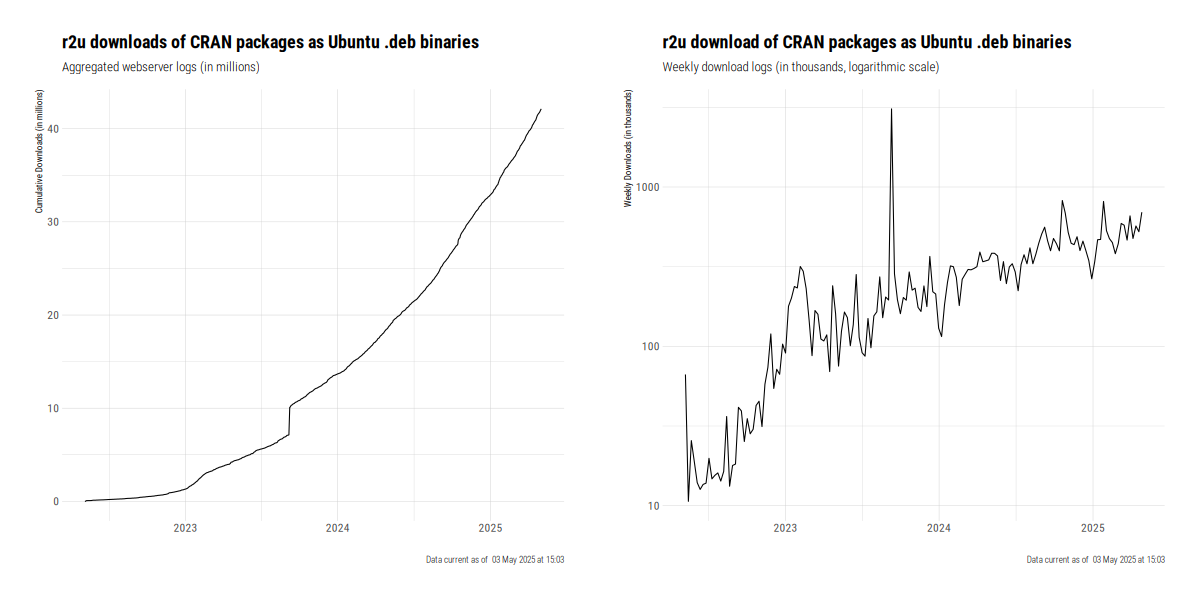
Welcome to post 47 in the $R^4 series! r2u provides Ubuntu binaries for all CRAN packages for the R system. It started three years ago, and offers for Linux users on Ubuntu what windows and macOS users already experience: fast, easy and reliable installation of binary packages. But by integrating with the system package manager (which is something that cannot be done on those other operating systems) we can fully and completely integrate it with underlying system. External libraries are resolved as shared libraries and handled by the system package manager. This offers fully automatic installation both at the initial installation and all subsequent upgrades. R users just say, e.g., install.packages("sf") and spatial libraries proj, gdal, geotiff (as well as several others) are automatically installed as dependencies in the correct versions. And they remain installed along with sf as the system manager now knows of the dependency. Work on r2u began as a quick weekend experiment in March 2022, and by May 4 a first release was marked in the NEWS file after a few brave alpha testers kicked tires quite happily. This makes today the third anniversary of that first release, and marks a good time to review where we are. This short post does this, and stresses three aspects: overall usage, current versions, and new developments.

Steadily Growing Usage at 42 Million Packages Shipped r2u ships from two sites. Its main repository is at the University of Illinois campus providing ample and heavily redundant bandwidth. We remain very grateful for the sponsorship from Atlas. It also still ships from my own server though that may be discontinued or could be spotty as it is on retail fiber connectivity. As we have access to the both sets of server logs, we can tabulate and chart usage. As of yesterday, total downloads were north of 42 million with current weekly averages around 500 thousand. These are quite staggering numbers for what started as a small hobby project, and are quite humbling. Usage is driven by deployment in continuous integration (as for example the Ubuntu-use at GitHub makes this both an easy and obvious choice), cloud computing (as it is easy to spin up Ubuntu instances, it is as easy to add r2u via four simple commands or one short script), explorative use (for example on Google Colab) or of course in general laptop, desktop, or server settings.

Current Versions Since r2u began, we added two Ubuntu LTS releases, three annual R releases as well as multiple BioConductor releases. BioConductor support is on a best-efforts basis motivated primarily to support the CRAN packages having dependencies. It has grown to around 500 packages and includes the top-250 by usage. Right now, current versions R 4.5.0 and BioConductor 3.21, both released last month, are supported.

New Development: arm64 A recent change is the support of the arm64 platform. As discussed in the introductory post, it is a popular and increasingly common CPU choice seen anywhere from the Raspberry Pi 5 and it Cortex CPU to in-house cloud computing platforms (called, respectively, Graviton at AWS and Axiom at GCS), general server use via Ampere CPUs, Cortex-based laptops that start to appears and last but not least on the popular M1 to M4-based macOS machines. (For macOS, one key appeal is in use of lighterweight Docker use as these M1 to M4 cpus can run arm64-based containers without a translation layer making it an attractive choice.) This is currently supported only for the noble aka 24.04 release. GitHub Actions, where we compile these packages, now also supports jammy aka 22.04 but it may not be worth it to expand there as the current latest release is available. We have not yet added BioConductor support but may do so. Drop us a line (maybe via an issue) if this of interest. With the provision of arm64 binaries, we also started to make heavier use of GitHub Actions. The BioConductor 3.21 release binaries were also created there. This makes the provision more transparent as well as the configuration repo as well as the two builder repos (arm64, bioc) are public, as is of course the main r2u repo.

Summing Up This short post summarised the current state of r2u along with some recent news. If you are curious, head over to the r2u site and try it, for example in a rocker/r2u container.

This post by Dirk Eddelbuettel originated on his Thinking inside the box blog. If you like this or other open-source work I do, you can now sponsor me at GitHub.

Colin Watson: Free software activity in April 2025

About 90% of my Debian contributions this month were sponsored by Freexian. You can also support my work directly via Liberapay. Request for OpenSSH debugging help Following the OpenSSH work described below, I have an open report about the sshd server sometimes crashing when clients try to connect to it. I can t reproduce this myself, and arm s-length debugging is very difficult, but three different users have reported it. For the time being I can t pass it upstream, as it s entirely possible it s due to a Debian patch. Is there anyone reading this who can reproduce this bug and is capable of doing some independent debugging work, most likely involving bisecting changes to OpenSSH? I d suggest first seeing whether a build of the unmodified upstream 10.0p2 release exhibits the same bug. If it does, then bisect between 9.9p2 and 10.0p2; if not, then bisect the list of Debian patches. This would be extremely helpful, since at the moment it s a bit like trying to look for a needle in a haystack from the next field over by sending instructions to somebody with a magnifying glass. OpenSSH I upgraded the Debian packaging to OpenSSH 10.0p1 (now designated 10.0p2 by upstream due to a mistake in the release process, but they re the same thing), fixing CVE-2025-32728. This also involved a diffoscope bug report due to the version number change. I enabled the new --with-linux-memlock-onfault configure option to protect sshd against being swapped out, but this turned out to cause test failures on riscv64, so I disabled it again there. Debugging this took some time since I needed to do it under emulation, and in the process of setting up a testbed I added riscv64 support to vmdb2. In coordination with the wtmpdb maintainer, I enabled the new Y2038-safe native wtmpdb support in OpenSSH, so wtmpdb last now reports the correct tty. I fixed a couple of packaging bugs: I reviewed and merged several packaging contributions from others: dput-ng Since we added dput-ng integration to Debusine recently, I wanted to make sure that it was in good condition in trixie, so I fixed dput-ng: will FTBFS during trixie support period. Previously a similar bug had been fixed by just using different Ubuntu release names in tests; this time I made the tests independent of the current supported release data returned by distro_info, so this shouldn t come up again. We also ran into dput-ng: override doesn t override profile parameters, which needed somewhat more extensive changes since it turned out that that option had never worked. I fixed this after some discussion with Paul Tagliamonte to make sure I understood the background properly. man-db I released man-db 2.13.1. This just included various small fixes and a number of translation updates, but I wanted to get it into trixie in order to include a contribution to increase the MAX_NAME constant, since that was now causing problems for some pathological cases of manual pages in the wild that documented a very large number of terms. debmirror I fixed one security bug: debmirror prints credentials with progress. Python team I upgraded these packages to new upstream versions: In bookworm-backports, I updated these packages: I dropped a stale build-dependency from python-aiohttp-security that kept it out of testing (though unfortunately too late for the trixie freeze). I fixed or helped to fix various other build/test failures: I packaged python-typing-inspection, needed for a new upstream version of pydantic. I documented the architecture field in debian/tests/autopkgtest-pkg-pybuild.conf files. I fixed other odds and ends of bugs: Science team I fixed various build/test failures:

Russ Allbery: Review: The Book That Held Her Heart

Review: The Book That Held Her Heart, by Mark Lawrence
Series: Library Trilogy #3
Publisher: ACE
Copyright: 2025
ISBN: 0-593-43799-3
Format: Kindle
Pages: 367
The Book That Held Her Heart is the third and final book of the Library fantasy trilogy and a direct sequel to The Book That Broke the World. Lawrence provides a much-needed summary of the previous volumes at the start of this book (thank you to every author who does this!), but I was still struggling a bit with the blizzard of character names. I recommend reading this series entry in relatively close proximity to the other two. At the end of the previous book, and following some rather horrific violence, the cast split into four groups. Three of those are pursuing different resolutions to the moral problem of the Library's existence. The fourth group opens the book still stuck with the series villains, who were responsible for the over-the-top morality that undermined my enjoyment of The Book That Broke the World. Lawrence follows all four groups in interwoven chapters, maintaining that complex structure through most of this book. I thought this was a questionable structural decision that made this book feel choppy, disconnected, and unnecessarily confusing. The larger problem, though, is that this is the payoff book, the book where we find out if Lawrence is equal to the tricky ethical questions he's raised and the world-building masterpiece that The Book That Wouldn't Burn kicked off. The answer, unfortunately, is "not really." This is not a total failure; there are some excellent set pieces and world-building twists, and the characters remain likable and enjoyable to read about (although the regrettable sidelining of Livira continues). But the grand finale is weirdly conservative and not particularly grand, and Lawrence's answer to the moral questions he raised is cliched and wholly unsatisfying. I was really hoping Lawrence was going somewhere more interesting than "Nazis bad." I am entirely sympathetic to this moral position, but so is every other likely reader of this series, and we all know how that story goes. What a waste of a compelling setup. Sadly, "Nazis bad" isn't even a metaphor for the black-and-white morality that Lawrence first introduced at the end of the previous book. It's a literal description of the main moral thrust of this book. Lawrence introduces yet another new character and timeline so that he can write about thinly-disguised Nazis persecuting even more thinly-disguised Jews, and this conflict is roughly half this book. It's also integral to the ending, which uses obvious, stock secular sainthood as a sort of trump card to resolve ideological conflicts at the heart of the series. This is one of the things I was worried about after I read the short stories that Lawrence published between the volumes of this series. All of them were thuddingly trite, which did not make me optimistic that Lawrence would find a sufficiently interesting answer to his moral trilemma to satisfy the high expectations created by the build-up. That is, I am sad to report, precisely the failure mode of this book. The resolution of the moral question of the series is arguably radical within the context of the prior world-building, but in a way that effectively reduces it to the boring, small-c conservative bromides of everyday reality. This is precisely the opposite of why I read fantasy, and I did not find Lawrence's arguments for it at all convincing. Neither, I think, did Lawrence, given that the critical debate takes place off camera so that he could avoid having to present the argument. This is, unfortunately, another series where the author's reach exceeded their grasp. The world-building of The Book That Wouldn't Burn is a masterpiece that created one of the most original and compelling settings that I have read in fantasy for a long time, but unfortunately Lawrence did not have an equally original plan for how to use the setting. This is a common problem and I'm not going to judge it too harshly; it's much harder to end a series than it is to start one. I thought the occasional flashes of brilliance was worth the journey, and they continue into this book with some elaborations on the Library's mythic structure that are going to stick in my mind. You can sense the story slipping away from the hoped-for conclusion as you read, though. The story shifts more and more away from the setting and the world-building and towards character stories, and while Lawrence's characters are fine, they're not that novel. I am happy to read about Clovis and Arpix, but I can read variations of that story in a lot of places. Livira never recovers her dynamism and drive from the first book, and there is much less beneath Yute's thoughtful calm than I was hoping to find. I think Lawrence knows that the story was not entirely working because the narrative voice becomes more strident as the morality becomes less interesting. I know of only one fantasy author who can make this type of overbearing and freighted narrative style work, and Lawrence is sadly not Guy Gavriel Kay. This is not a bad book. It is an enjoyable adventure story on its own terms, with some moments of real beauty and awe and a handful of memorable characters, somewhat undermined by a painfully obvious and unoriginal moral frame. It's only a disappointment in the context of what came before it, and it is far from the first series conclusion that doesn't quite live up to the earlier volumes. I'm glad that I read it, and the series as a whole, and I do appreciate that Lawrence brought the whole series to a firm and at least somewhat satisfying conclusion in the promised number of volumes. But I do wish the series as a whole had been as special as the first book. Rating: 6 out of 10

3 May 2025

Russell Coker: Silly Job Titles

Many years ago I was on a programming project porting code from OS/2 1.x to NT. When I was there they suddenly decided to make a database of all people and get job titles for everyone apparently the position description used when advertising the jobs wasn t sufficient. When I got given a clipboard with a form to write my details I looked at what everyone else had done, It was a heap of ridiculous propaganda with everyone trying to put in synonyms for senior or skillful and listing things that they were allegedly in charge of. There were even some people trying to create impressive titles for their managers to try and suck up. I chose the job title coder as the shortest and most accurate description of what I was doing. I had to confirm that yes I really did want to put a one word title and not a paragraph of frippery. Part of my intent was to mock the ridiculously long job titles used by others but I don t think anyone realised that. I was reminded of that company when watching a video of a Trump cabinet meeting where everyone had to tell Trump how great he is. I think that a programmer who wants to be known as a Principal Solutions Architect of Advanced Algorithmic Systems and Digital Innovation Strategy (suggested by ChatGPT because I can t write such ridiculous things) is showing a Trump level of lack of self esteem. When job titles are discussed there s always someone who will say what if my title isn t impressive enough and I don t get a pay rise . If a company bases salaries on how impressive job titles are and not on whether people actually do good work then it s a very dysfunctional workplace. But dysfunctional companies aren t uncommon so it s something you might reasonably have to do. In the company in question I could have described my work as lead debugger as I ended up doing most of the debugging on that project (as on many programming projects). The title lead debugger accurately described a significant part of my work and it s work that is essential to project completion. What do you think are the worst job titles?

Russ Allbery: Review: Paper Soldiers

Review: Paper Soldiers, by Saleha Mohsin
Publisher: Portfolio
Copyright: 2024
ISBN: 0-593-53912-5
Format: Kindle
Pages: 250
The subtitle of Paper Soldiers is "How the Weaponization of the Dollar Changed the World Order," which may give you the impression that this book is about US use of the dollar system for political purposes such as sanctions. Do not be fooled like I was; this subtitle is, at best, deceptive. Coverage of the weaponization of the dollar is superficial and limited to a few chapters. This book is, instead, a history of the strong dollar policy told via a collection of hagiographies of US Treasury Secretaries and written with all of the skeptical cynicism of a poleaxed fawn. There is going to be some grumbling about the state of journalism in this review. Per the author's note, Saleha Mohsin is the Bloomberg News beat reporter for the US Department of the Treasury. That is, sadly, exactly what this book reads like: routine beat reporting. Mohsin asked current and former Treasury officials what they were thinking at various points in history and then wrote down their answers without, so far as I can tell, considering any contradictory evidence or wondering whether they were telling the truth. Paper Soldiers does contain extensive notes (those plus the index fill about forty pages), so I guess you could do the cross-checking yourself, although apparently most of the interviews for this book were "on background" and are therefore unattributed. (Is this weird? I feel like this is weird.) Mohsin adds a bit of utterly conventional and uncritical economic framing and casts the whole project in the sort of slightly breathless and dramatized prose style that infests routine news stories in the US. I find this style of book unbelievably frustrating because it represents such a wasted opportunity. To me, the point of book-length journalism is precisely to not write in this style. When you're trying to crank out two or three articles a week covering current events, I understand why there isn't always space or time to go deep into background, skepticism, and contrary opinions. But when you expand that material into a book, surely the whole point is to take the time to do some real reporting. Dig into what people told you, see if they're lying, talk to the people who disagree with them, question the conventional assumptions, and show your work on the page so that the reader is smarter after finishing your book than they were before they started. International political economics is not a sequence of objective facts. It's a set of decisions made in pursuit of economic and political theories that are disputed and arguable, and I think you owe the reader some sense of the argument and, ideally, some defensible position on the merits that is more than a transcription of your interviews. This is... not that.
It's a power loop that the United States still enjoys today: trust in America's dollar (and its democratic government) allows for cheap debt financing, which buys health care built on the most advanced research and development and inventions like airplanes and the iPhone. All of this is propelled by free market innovation and the superpowered strength to keep the nation safe from foreign threats. That investment boosts the nation's economic, military, and technological prowess, making its economy (and the dollar) even more attractive.
Let me be precise about my criticism. I am not saying that every contention in the above excerpt is wrong. Some of them are probably correct; more of them are at least arguable. This book is strictly about the era after Bretton Woods, so using airplanes as an example invention is a bizarre choice, but sure, whatever, I get the point. My criticism is that paragraphs like this, as written in this book, are not introductions to deeper discussions that question or defend that model of economic and political power. They are simple assertions that stand entirely unsupported. Mohsin routinely writes paragraphs like the above as if they are self-evident, and then immediately moves on to the next anecdote about Treasury dollar policy. Take, for example, the role of the US dollar as the world's reserve currency, which roughly means that most international transactions are conducted in dollars and numerous countries and organizations around the world hold large deposits in dollars instead of in their native currency. The conventional wisdom holds that this is a great boon to the US economy, but there are also substantive critiques and questions about that conventional wisdom. You would never know that from this book; Mohsin asserts the conventional wisdom about reserve currencies without so much as a hint that anyone might disagree. For example, one common argument, repeated several times by Mohsin, is that the US can only get away with the amount of deficit spending and cheap borrowing that it does because the dollar is the world's reserve currency. Consider two other countries whose currencies are clearly not the international reserve currency: Japan and the United Kingdom. The current US debt to GDP ratio is about 125% and the current interest rate on US 10-year bonds is about 4.2%. The current Japanese debt to GDP ratio is about 260% and the current interest rate on Japanese 10-year bonds is about 1.2%. The current UK debt to GDP ratio is 160% and the current interest rate on UK 10-year bonds is 4.5%. Are you seeing the dramatic effects of the role of the dollar as reserve currency? Me either. Again, I am not saying that this is a decisive counter-argument. I am not an economist; I'm just some random guy on the Internet who finds macroeconomics interesting and reads a few newsletters. I know the Japanese bond market is unusual in ways I'm not accounting for. There may well be compelling arguments for why reserve currency status matters immensely for US borrowing capacity. My point is not that Mohsin is wrong; my point is that you have to convince me and she doesn't even try. Nowhere in this book is a serious effort to view conventional wisdom with skepticism or confront it with opposing arguments. Instead, this book is full of blithe assertions that happen to support the narrative the author was fed by a bunch of former Treasury officials and does not appear to question in any way. I want books like this to increase my understanding of the world. To do that, they need to show me multiple sides of debates and teach me how to evaluate evidence, not simply reinforce a superficial conventional wisdom. It doesn't help that whatever fact-checking process this book went through left some glaring errors. For example, on the Plaza Accord:
With their central banks working in concert, enough dollars were purchased on the open market to weaken the currency, making American goods more affordable for foreign buyers.
I don't know what happened after the Plaza Accord (I read books like this to find out!), but clearly it wasn't that. This is utter nonsense. Buying dollars on the open market would increase the value of the dollar, not weaken it; this is basic supply and demand that you learn in the first week of a college economics class. This is the type of error that makes me question all the other claims in the book that I can't easily check. Mohsin does offer a more credible explanation of the importance of a reserve currency late in the book, although it's not clear to me that she realizes it: The widespread use of the US dollar gives US government sanctions vast international reach, allowing the US to punish and coerce its enemies through the threat of denying them access to the international financial system. Now we're getting somewhere! This is a more believable argument than a small and possibly imaginary effect on government borrowing costs. It is clear why a bellicose US government, particularly one led by advocates of a unitary executive theory that elevates the US president to a status of near-emperor, want to turn the dollar into a weapon of international control. It's much less obvious how comfortable the rest of the world should be with that concentration of power. This would be a fascinating topic for a journalistic non-fiction book. Some reporter should dive deep into the mechanics of sanctions and ask serious questions about the moral, practical, and diplomatic consequences of this aggressive wielding of US power. One could give it a title like Paper Soldiers that reflected the use of banks and paper currency as foot soldiers enforcing imperious dictates on the rest of the world. Alas, apart from a brief section in which the US scared other countries away from questioning the dollar, Mohsin does not tug at this thread. Maybe someone should write that book someday. As you will have gathered by now, I think this is a bad book and I do not recommend that you read it. Its worst flaw is one that it shares with far too much mainstream US print and TV journalism: the utter credulity of the author. I have the old-fashioned belief that a journalist should be more than a transcriptionist for powerful people. They should be skeptical, they should assume public figures may be lying, they should look for ulterior motives, and they should try to bring the reader closer to some objective truths about the world, wherever they may lie. I have no solution for this degradation of journalism. I'm not even sure that it's a change. There were always reporters eager to transcribe the voice of power into the newspaper, and if we remember the history of journalism differently, that may be because we have elevated the rare exceptions and forgotten the average. But after watching too many journalists I once respected start parroting every piece of nonsense someone tells them, from NFTs to UFOs to the existential threat of AI, I've concluded that the least I can do as a reader is to stop rewarding reporters who cannot approach powerful subjects with skepticism, suspicion, and critical research. I failed in this case, but perhaps I can serve as a warning to others. Rating: 3 out of 10

2 May 2025

Jonathan Dowland: Korg Minilogue XD

I didn't buy the Arturia Microfreak or the Behringer Model-D; I bought a Korg Minilogue XD.
Korg Minilogue XD, and Zoom R8 Korg Minilogue XD, and Zoom R8
I wanted an all-in-one unit which meant a built-in keyboard. I was keen on analogue oscillators, partly for the sound, but mostly to ensure that most of the controls were immediately accessible. The Minilogue-XD has two analogue oscillators and an analogue filter. It also has some useful, pure digital stuff: post-effects (chorus, flanger, echo, etc.); and a third, digital oscillator. The digital oscillator is programmable. There's an SDK, shared between the Minilogue-XD and some other Korg synths (at least the Prologue and NTS-1). There's a cottage industry of independent musicians writing and selling digital patches, e.g. STRING User Oscillator. Here's an example of a drone programmed using the SDK for the NTS-1:
Eventually I expect to have fun exploring the SDK, but for now I'm keeping it firmly away from computers (hence the Zoom R8 multitrack recorder in the above image: more on that in a future blog post). The Korg has been gathering dust whilst I was writing up, but now I hope to find some time to play.

Daniel Lange: Compiling and installing the Gentoo Linux kernel on emerge without genkernel (part 2)

The first install of a Gentoo kernel needs to be somewhat manual if you want to optimize the kernel for the (virtual) system it boots on. In part 1 I laid out how to improve the subsequent emerges of sys-kernel/gentoo-sources with a small drop in script to build the kernel as part of the ebuild. Since end of last year Gentoo also supports a less manual way of emerging a kernel: The following kernel blends are available: So a quick walk-through for the gentoo-kernel variant: 1. Set up the correct package USE flags We do not want an initrd and we want our own config to be re-used so:
echo "sys-kernel/gentoo-kernel -initramfs savedconfig" >> /etc/portage/package.use/gentoo-kernel
2. Preseed the saved config The current kernel config needs to be saved as the initial savedconfig so it is found and applied for our emerge below:
mkdir -p /etc/portage/savedconfig/sys-kernel
cp -n "/usr/src/linux-$(uname -r)/.config" /etc/portage/savedconfig/sys-kernel/gentoo-kernel
3. Emerge the new kernel
emerge sys-kernel/gentoo-kernel
4. Update grub and reboot Unfortunately this ebuild does not update grub, so we have to run grub-mkconfig manually. This can again be automated via a post_pkg_postinst() script. See the step 7 below. But for now, let's do it manually:
grub-mkconfig -o /boot/grub/grub.cfg
# All fine? Time to reboot the machine:
reboot
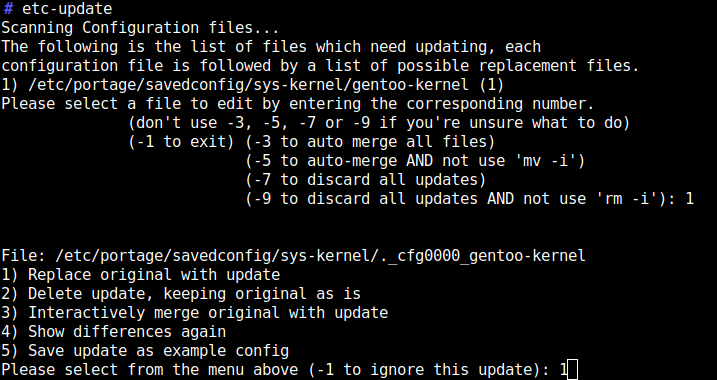
5. (Optional) Prepare for the next kernel build Run etc-update and merge the new kernel config entries into your savedconfig. Screenshot of etc-update The kernel should auto-build once new versions become available via portage. Again the etc-update can be automated if you feel that is sufficiently safe to do in your environment. See step 7 below for details. 6. (Optional) Remove the old kernel sources If you want to switch from the method based on gentoo-sources to the gentoo-kernel one, you can remove the kernel sources:
emerge -C "=sys-kernel/gentoo-sources-5*"
Be sure to update the /usr/src/linux symlink to the new kernel sources directory from gentoo-kernel, e.g.:
rm /usr/src/linux; ln -s "/usr/src/$(uname -r)" /usr/src/linux
This may be a good time for a bit more house-keeping: Clean up a bit in /usr/src/ to remove old build artefacts, /boot/ to remove old kernels and /lib/modules/ to get rid of old kernel modules. 7. (Optional) Further automate the ebuild In part 1 we automated the kernel compile, install and a bit more via a helper function for post_pkg_postinst(). We can do the similarly for what is (currently) missing from the gentoo-kernel ebuilds: Create /etc/portage/env/sys-kernel/gentoo-kernel with the following:
post_pkg_postinst()
etc-update --automode -5 /etc/portage/savedconfig/sys-kernel
grub-mkconfig -o /boot/grub/grub.cfg
The upside of gentoo-kernel over gentoo-sources is that you can put "config override files" in /etc/kernel/config.d/. That way you theoretically profit from config improvements made by the upstream developers. See the Gentoo distribution kernel documentation for a sample snippet. I am fine with savedconfig for now but it is nice that Gentoo provides the flexibility to support both approaches.

Daniel Lange: Netatalk 3.1.9 .debs for Debian Jessie available (Apple Timemachine backup to Linux servers)

Netatalk 3.1.9 has been released with two interesting fixes / amendments: Here are the full release notes for 3.1.9 for your reading pleasure. Due to upstream now differentiating between SysVinit and systemd packages I've followed that for simplicity's sake and built libgcrypt-only builds. If you need the openssl-based tools continue to use the 3.1.8 openssl build until you have finished your migration to a safer password storage.
Warning: Read the original blog post before installing for the first time. Be sure to read the original blog post if you are new to Netatalk3 on Debian Jessie!
You'll get nowhere if you install the .debs below and don't know about the upgrade path. So RTFA.
Now with that out of the way: Continue reading "Netatalk 3.1.9 .debs for Debian Jessie available (Apple Timemachine backup to Linux servers)"

Daniel Lange: Creating iPhone/iPod/iPad notes from the shell

I found a very nice script to create Notes on the iPhone from the command line by hossman over at Perlmonks. For some weird reason Perlmonks does not allow me to reply with amendments even after I created an account. I can "preview" a reply at Perlmonks but after "create" I get "Permission Denied". Duh. vroom, if you want screenshots, contact me on IRC :-). As I wrote everything up for the Perlmonks reply anyways, I'll post it here instead. Against hossman's version 32 from 2011-02-22 I changed the following: I /msg'd hossman the URL of this blog entry. Continue reading "Creating iPhone/iPod/iPad notes from the shell"

Daniel Lange: The Stallman wars

So, 2021 isn't bad enough yet, but don't despair, people are working to fix that:

Welcome to the Stallman wars Team Cancel: https://rms-open-letter.github.io/ (repo) Team Support: https://rms-support-letter.github.io/ (repo) Current Final stats are:

Team Cancel:  3019 signers from 1415 individual commit authors
Team Support: 6853 signers from 5418 individual commit authors
Git shortlog (Top 10):
rms_cancel.git (Last update: 2021-08-16 00:11:15 (UTC))
  1230  Neil McGovern
   251  Joan Touzet
    99  Elana Hashman
    73  Molly de Blanc
    36  Shauna
    19  Juke
    18  Stefano Zacchiroli
    17  Alexey Mirages
    16  Devin Halladay
    14  Nader Jafari
rms_support.git (Last update: 2021-09-29 07:14:39 (UTC))
  1821  shenlebantongying
  1585  nukeop
  1560  Ivanq
  1057  Victor
   880  Job Bautista
   123  nekonee
   101  Victor Gridnevsky
    41  Patrick Spek
    25  Borys Kabakov
    17  KIM Taeyeob
(data as of 2021-10-01) Technical info:
Signers are counted from their "Signed / Individuals" sections. Commits are counted with git shortlog -s.
Team Cancel also has organizational signatures with Mozilla, Suse and X.Org being among the notable signatories. The 16 original signers of the Cancel petition are added in their count. Neil McGovern, Juke and shenlebantongying need .mailmap support as they have committed with different names. Further reading: 12.04.2021 Statements from the accused 18.04.2021 Debian General Resolution The Debian General Resolution (GR) vote of the developers has concluded to not issue a public statement at all, see https://www.debian.org/vote/2021/vote_002#outcome for the results.
It is better to keep quiet and seem ignorant than to speak up and remove all doubt.
See Quote Investigator for the many people that rephrased these words over the centuries. They still need to be recalled more often as too many people in the FLOSS community have forgotten about that wisdom... 01.10.2021 Final stats It seems enough dust has settled on this unfortunate episode of mob activity now. Hence I stopped the cronjob that updated the stats above regularly. Team Support has kept adding signature all the time while Team Cancel gave up very soon after the FSF decided to stand with Mr. Stallman. So this battle was decided within two months. The stamina of the accused and determined support from some dissenting web devs trumped the orchestrated outrage of well known community figures and their publicity power this time. But history teaches us that does not mean the war is over. There will a the next opportunity to call for arms. And people will call. Unfortunately. 01.11.2024 Team Cancel is opening a new round; Team Support responds with exposing the author of "The Stallman report" I hate to be right. Three years later than the above: An anonymous member of team Cancel has published https://stallman-report.org/ [local pdf mirror, 504kB] to "justify our unqualified condemnation of Richard Stallman". It contains a detailed collection of quotes that are used to allege supporting (sexual) misconduct. The demand is again that Mr. Stallman "step[s] down from all positions at the FSF and the GNU project". Addressing him: "the scope and extent of your misconduct disqualifies you from formal positions of power within our community indefinitely". Team Support has not issues a rebuttal (yet?) but has instead identified the anonymous author as Drew "sircmpwn" DeVault, a gifted software developer, but also a vocal and controversial figure in the Open Source / Free Software space. Ironically quite similar to Richard "rms" Stallman. Their piece is published at https://dmpwn.info/ [local pdf mirror, 929kB]. They also allege a proximity of Mr. DeVault to questionable "Lolita" anime preferences and societal positions to disqualify him.

Ben Hutchings: FOSS activity in April 2025

I also co-organised a Debian BSP (Bug-Squashing Party) last weekend, for which I will post a separate report later.

Daniel Lange: Cleaning a broken GnuPG (gpg) key

I've long said that the main tools in the Open Source security space, OpenSSL and GnuPG (gpg), are broken and only a complete re-write will solve this. And that is still pending as nobody came forward with the funding. It's not a sexy topic, so it has to get really bad before it'll get better. Gpg has a UI that is close to useless. That won't substantially change with more bolted-on improvements. Now Robert J. Hansen and Daniel Kahn Gillmor had somebody add ~50k signatures (read 1, 2, 3, 4 for the g l ory details) to their keys and - oops - they say that breaks gpg. But does it? I downloaded Robert J. Hansen's key off the SKS-Keyserver network. It's a nice 45MB file when de-ascii-armored (gpg --dearmor broken_key.asc ; mv broken_key.asc.gpg broken_key.gpg). Now a friendly:
$ /usr/bin/time -v gpg --no-default-keyring --keyring ./broken_key.gpg --batch --quiet --edit-key 0x1DCBDC01B44427C7 clean save quit

pub rsa3072/0x1DCBDC01B44427C7
erzeugt: 2015-07-16 verf llt: niemals Nutzung: SC
Vertrauen: unbekannt G ltigkeit: unbekannt
sub ed25519/0xA83CAE94D3DC3873
erzeugt: 2017-04-05 verf llt: niemals Nutzung: S
sub cv25519/0xAA24CC81B8AED08B
erzeugt: 2017-04-05 verf llt: niemals Nutzung: E
sub rsa3072/0xDC0F82625FA6AADE
erzeugt: 2015-07-16 verf llt: niemals Nutzung: E
[ unbekannt ] (1). Robert J. Hansen <rjh@sixdemonbag.org>
[ unbekannt ] (2) Robert J. Hansen <rob@enigmail.net>
[ unbekannt ] (3) Robert J. Hansen <rob@hansen.engineering>

User-ID "Robert J. Hansen <rjh@sixdemonbag.org>": 49705 Signaturen entfernt
User-ID "Robert J. Hansen <rob@enigmail.net>": 49704 Signaturen entfernt
User-ID "Robert J. Hansen <rob@hansen.engineering>": 49701 Signaturen entfernt

pub rsa3072/0x1DCBDC01B44427C7
erzeugt: 2015-07-16 verf llt: niemals Nutzung: SC
Vertrauen: unbekannt G ltigkeit: unbekannt
sub ed25519/0xA83CAE94D3DC3873
erzeugt: 2017-04-05 verf llt: niemals Nutzung: S
sub cv25519/0xAA24CC81B8AED08B
erzeugt: 2017-04-05 verf llt: niemals Nutzung: E
sub rsa3072/0xDC0F82625FA6AADE
erzeugt: 2015-07-16 verf llt: niemals Nutzung: E
[ unbekannt ] (1). Robert J. Hansen <rjh@sixdemonbag.org>
[ unbekannt ] (2) Robert J. Hansen <rob@enigmail.net>
[ unbekannt ] (3) Robert J. Hansen <rob@hansen.engineering>

Command being timed: "gpg --no-default-keyring --keyring ./broken_key.gpg --batch --quiet --edit-key 0x1DCBDC01B44427C7 clean save quit"
User time (seconds): 3911.14
System time (seconds): 2442.87
Percent of CPU this job got: 99%
Elapsed (wall clock) time (h:mm:ss or m:ss): 1:45:56
Average shared text size (kbytes): 0
Average unshared data size (kbytes): 0
Average stack size (kbytes): 0
Average total size (kbytes): 0
Maximum resident set size (kbytes): 107660
Average resident set size (kbytes): 0
Major (requiring I/O) page faults: 1
Minor (reclaiming a frame) page faults: 26630
Voluntary context switches: 43
Involuntary context switches: 59439
Swaps: 0
File system inputs: 112
File system outputs: 48
Socket messages sent: 0
Socket messages received: 0
Signals delivered: 0
Page size (bytes): 4096
Exit status: 0
And the result is a nicely useable 3835 byte file of the clean public key. If you supply a keyring instead of --no-default-keyring it will also keep the non-self signatures that are useful for you (as you apparently know the signing party). So it does not break gpg. It does break things that call gpg at runtime and not asynchronously. I heard Enigmail is affected, quelle surprise. Now the main problem here is the runtime. 1h45min is just ridiculous. As Filippo Valsorda puts it:
Someone added a few thousand entries to a list that lets anyone append to it. GnuPG, software supposed to defeat state actors, suddenly takes minutes to process entries. How big is that list you ask? 17 MiB. Not GiB, 17 MiB. Like a large picture. https://dev.gnupg.org/T4592
If I were a gpg / SKS keyserver developer, I'd That way another key can only be added to the keyserver network if it contains at least one signature from a previously known strong-set key. Attacking the keyserver network would become at least non-trivial. And the web-of-trust thing may make sense again. Updates 09.07.2019 GnuPG 2.2.17 has been released with another set of quickly bolted together fixes:
   gpg: Ignore all key-signatures received from keyservers.  This
    change is required to mitigate a DoS due to keys flooded with
    faked key-signatures.  The old behaviour can be achieved by adding
    keyserver-options no-self-sigs-only,no-import-clean
    to your gpg.conf.  [#4607]
   gpg: If an imported keyblocks is too large to be stored in the
    keybox (pubring.kbx) do not error out but fallback to an import
    using the options "self-sigs-only,import-clean".  [#4591]
   gpg: New command --locate-external-key which can be used to
    refresh keys from the Web Key Directory or via other methods
    configured with --auto-key-locate.
   gpg: New import option "self-sigs-only".
   gpg: In --auto-key-retrieve prefer WKD over keyservers.  [#4595]
   dirmngr: Support the "openpgpkey" subdomain feature from
    draft-koch-openpgp-webkey-service-07. [#4590].
   dirmngr: Add an exception for the "openpgpkey" subdomain to the
    CSRF protection.  [#4603]
   dirmngr: Fix endless loop due to http errors 503 and 504.  [#4600]
   dirmngr: Fix TLS bug during redirection of HKP requests.  [#4566]
   gpgconf: Fix a race condition when killing components.  [#4577]
Bug T4607 shows that these changes are all but well thought-out. They introduce artificial limits, like 64kB for WKD-distributed keys or 5MB for local signature imports (Bug T4591) which weaken the web-of-trust further. I recommend to not run gpg 2.2.17 in production environments without extensive testing as these limits and the unverified network traffic may bite you. Do validate your upgrade with valid and broken keys that have segments (packet groups) surpassing the above mentioned limits. You may be surprised what gpg does. On the upside: you can now refresh keys (sans signatures) via WKD. So if your buddies still believe in limiting their subkey validities, you can more easily update them bypassing the SKS keyserver network. NB: I have not tested that functionality. So test before deploying. 10.08.2019 Christopher Wellons (skeeto) has released his pgp-poisoner tool. It is a go program that can add thousands of malicious signatures to a GNUpg key per second. He comments "[pgp-poisoner is] proof that such attacks are very easy to pull off. It doesn't take a nation-state actor to break the PGP ecosystem, just one person and couple evenings studying RFC 4880. This system is not robust." He also hints at the next likely attack vector, public subkeys can be bound to a primary key of choice.

Russ Allbery: Review: Sixteen Ways to Defend a Walled City

Review: Sixteen Ways to Defend a Walled City, by K.J. Parker
Series: Siege #1
Publisher: Orbit
Copyright: April 2019
ISBN: 0-316-27080-6
Format: Kindle
Pages: 349
Sixteen Ways to Defend a Walled City is... hm, honestly, I'm not sure what the genre of this novel is. It is a story about medieval engineering and siege weapons in a Rome-inspired secondary world that so far as I can tell is not meant to match ours. There is not a hint of magic. It's not technically a fantasy, but it's marketed like a fantasy, and it's not historical fiction nor is it attempting to be alternate history. The most common description is a fantasy of logistics, so I guess I'll go with that, as long as you understand that the fantasy here is of the non-magical sort. K.J. Parker is a pen name for Tom Holt. Orhan is Colonel-in-Chief of the Engineers for the Robur empire, even though he's a milkface, not a blueskin like a proper Robur. (Both of those racial terms are quite offensive.) He started out as a slave, learned a trade, joined the navy as a shipwright, and worked his way up the ranks through luck and enemy action. He's canny, practical, highly respected by his men, happy to cheat and steal to get material for his projects and wages for his people, and just wants to build literal bridges. Nice, sturdy bridges that let people get from one place to another the short way. When this book opens, Orhan is in Classis trying to requisition some rope. He is saved from discovery of his forged paperwork by pirates burning down the warehouse that held all of the rope, and then saved from the pirates by the sorts of coincidences that seem to happen to Orhan all the time. A few subsequent discoveries about what the pirates were after, and news of another unexpected attack on the empire, make Orhan nervous enough that he takes his men to do a job as far away from the City at the heart of the empire as possible. It's just his luck to return in time to find slaughtered troops and to have to sneak his men into a City already under siege. Sixteen Ways to Defend a Walled City is told in the first person by Orhan, with an internal justification that the reader only discovers at the end of the book. That means your enjoyment of this book is going to depend a lot on how much you like Orhan's voice. This mostly worked for me; his voice is an odd combination of chatty, self-deprecating, and brusque, and it took a bit for me to get used to it, but I came around. This book is clearly competence porn nearly all the fun of this book is seeing what desperate plan Orhan will come up with next so it helps that Orhan does indeed come across as competent. The part that did not work for me was the morality. You would think from the title that would be straightforward: The City is under siege, people want to capture it and kill everyone, Orhan is on the inside, and his job is to keep them out. That would have been the morality of simplistic military fiction, but most of the appeal was in watching the problem-solving anyway. That's how the story starts, but then Parker started dropping hints of more complexity. Orhan is a disfavored minority and the Robur who run the empire are racist assholes, even though Orhan mostly gets along with the ones who work with him closely. Orhan says a few things that make the reader wonder whether the City warrants defending, and it becomes less clear whether Orhan's loyalties were as solid as they appeared to be. Parker then offers a few moral dilemmas and has Orhan not follow them in the expected directions, making me wonder where Parker was going with the morality of this story. And then we find out that the answer is nowhere. Parker is going nowhere. None of that setup has a payoff, and the ending is deeply unsatisfying and arguably pointless. I am not sure this is an objective analysis. This is one of those books where I would not be surprised to see someone else praise its realism. Orhan is in some ways a more likely figure than the typical hero of a book. He likes accomplishing things, he's a cheat and a liar when that serves his purposes, he's loyal to the people he considers friends in a way that often doesn't involve consulting them about what they want, and he makes decisions mostly on vibes and stubbornness. Both his cynicism and his idealism are different types of masks; beneath both, he's an incoherent muddle. You could argue that we're all that sort of muddle, deep down, and the consistent idealists are the unrealistic (and frightening) ones, and I think Parker may be attempting exactly that argument. I know some readers like this sort of fallibly human incoherence. But wow did I ever loathe this ending because I was not reading this book for a realistic psychological profile of an average guy. I was here for the competence porn, for the fantasy of logistics, for the experience of watching someone have a plan and get shit done. Apparently that extends to needing him to be competent at morality as well, or at least think about it as hard as he thinks about siege weapons. One of the reasons why I am primarily a genre reader is that I don't read books for depressing psychological profiles. There are enough of those in the news. I read books to spend some time in a world better than mine, where things work out the way that they are supposed to, or at least in a way that's satisfying. The other place where this book interfered with my vibes is that it's about a war, and a lot of Orhan's projects are finding more efficient ways to kill people. Parker takes a "war is hell" perspective, and Orhan gets deeply upset at the graphic sights of mangled human bodies that are the frequent results of his plans. I feel weird complaining about this because yes, it's good to be aware of the horrific things that we do to other people in wars, but man, I just wanted to watch some effective project management. I want to enjoy unexpected lateral thinking, appreciate the friendly psychological manipulation involved in getting a project to deliver on deadline, and watch someone solve logistical problems. Battlefields provide an endless supply of interesting challenges, but then Parker feels compelled to linger on the brutal consequences of Orhan's ideas and now I'm depressed and sickened rather than enjoying myself. I really wanted to like this book, and for a lot of the book I did, but that ending was a bottomless pit that sucked away all my enjoyment and retroactively made the rest of the book feel worse. I so wanted Parker to be going somewhere clever and surprising, and the disappointment when none of that happened was intense. This is probably an excessively negative reaction, and I will not be surprised when other people get along with this book better than I did, but not only will I not be recommending it, I'm now rather dubious about reading any more Parker. Followed by How to Rule an Empire and Get Away With It. Rating: 5 out of 10

Junichi Uekawa: Spending my Golden Week in boredom.

Spending my Golden Week in boredom. That's nice.

Next.

Previous.