Search Results: "don"

23 October 2023

Russell Coker: Bluetooth Versions and PineTime

I ve done some tests with the PineTime [1] on different Android phones. On a Huawei Mate 10 Pro (from 2017 with Bluetooth 4.2) it has very slow transfer speeds for updating the firmware (less than 1KB/s) and unreliable connection to the phone. On a Huawei Nova 7i (from 2020 with Bluetooth 4.2) it has slow transfer speeds (about 2KB/s) and a more reliable connection to the phone. On a Pixel 4 XL (from 2019 with Bluetooth 5.0) it has very fast speeds for updating the firmware and also a reliable link. Version 5 of the Bluetooth standard [2] was released in 2016 so it s a little disappointing that the Mate 10 Pro doesn t support it and very disappointing that the Nova 7i doesn t support it either. Bluetooth 5 adds higher speeds and longer range for LE (Low Energy) modes which are used for things like smart watches. It s extremely disappointing that the PinePhonePro [3] only supports Bluetooth 4.1. It s a phone released in 2021 that doesn t even have Bluetooth 4.2 which was released in 2014.

Russell Coker: Bluetooth Versions and PineTime

I ve done some tests with the PineTime [1] on different Android phones. On a Huawei Mate 10 Pro (from 2017 with Bluetooth 4.2) it has very slow transfer speeds for updating the firmware (less than 1KB/s) and unreliable connection to the phone. On a Huawei Nova 7i (from 2020 with Bluetooth 4.2) it has slow transfer speeds (about 2KB/s) and a more reliable connection to the phone. On a Pixel 4 XL (from 2019 with Bluetooth 5.0) it has very fast speeds for updating the firmware and also a reliable link. Version 5 of the Bluetooth standard [2] was released in 2016 so it s a little disappointing that the Mate 10 Pro doesn t support it and very disappointing that the Nova 7i doesn t support it either. Bluetooth 5 adds higher speeds and longer range for LE (Low Energy) modes which are used for things like smart watches. It s extremely disappointing that the PinePhonePro [3] only supports Bluetooth 4.1. It s a phone released in 2021 that doesn t even have Bluetooth 4.2 which was released in 2014. For laptops the Thinkpad X1 Carbon 7th Gen release in 2019 [4] was the first in the X1 Carbon series to have Bluetooth 5. So I will probably be limited in my ability to use my personal laptop or PinePhone for testing Linux software that talks to the PineTime and I ll have to use a laptop borrowed from work.

Russ Allbery: Review: Going Postal

Review: Going Postal, by Terry Pratchett
Series: Discworld #33
Publisher: Harper
Copyright: October 2004
Printing: November 2014
ISBN: 0-06-233497-2
Format: Mass market
Pages: 471
Going Postal is the 33rd Discworld novel. You could probably start here if you wanted to; there are relatively few references to previous books, and the primary connection (to Feet of Clay) is fully re-explained. I suspect that's why Going Postal garnered another round of award nominations. There are arguable spoilers for Feet of Clay, however. Moist von Lipwig is a con artist. Under a wide variety of names, he's swindled and forged his way around the Disc, always confident that he can run away from or talk his way out of any trouble. As Going Postal begins, however, it appears his luck has run out. He's about to be hanged. Much to his surprise, he wakes up after his carefully performed hanging in Lord Vetinari's office, where he's offered a choice. He can either take over the Ankh-Morpork post office, or he can die. Moist, of course, immediately agrees to run the post office, and then leaves town at the earliest opportunity, only to be carried back into Vetinari's office by a relentlessly persistent golem named Mr. Pump. He apparently has a parole officer. The clacks, Discworld's telegraph system first seen in The Fifth Elephant, has taken over most communications. The city is now dotted with towers, and the Grand Trunk can take them at unprecedented speed to even far-distant cities like Genua. The post office, meanwhile, is essentially defunct, as Moist quickly discovers. There are two remaining employees, the highly eccentric Junior Postman Groat who is still Junior because no postmaster has lasted long enough to promote him, and the disturbingly intense Apprentice Postman Stanley, who collects pins. Other than them, the contents of the massive post office headquarters are a disturbing mail sorting machine designed by Bloody Stupid Johnson that is not picky about which dimension or timeline the sorted mail comes from, and undelivered mail. A lot of undelivered mail. Enough undelivered mail that there may be magical consequences. All Moist has to do is get the postal system running again. Somehow. And not die in mysterious accidents like the previous five postmasters. Going Postal is a con artist story, but it's also a startup and capitalism story. Vetinari is, as always, solving a specific problem in his inimitable indirect way. The clacks were created by engineers obsessed with machinery and encodings and maintenance, but it's been acquired by... well, let's say private equity, because that's who they are, although Discworld doesn't have that term. They immediately did what private equity always did: cut out everything that didn't extract profit, without regard for either the service or the employees. Since the clacks are an effective monopoly and the new owners are ruthless about eliminating any possible competition, there isn't much to stop them. Vetinari's chosen tool is Moist. There are some parts of this setup that I love and one part that I'm grumbly about. A lot of the fun of this book is seeing Moist pulled into the mission of resurrecting the post office despite himself. He starts out trying to wriggle out of his assigned task, but, after a few early successes and a supernatural encounter with the mail, he can't help but start to care. Reformed con men often make good protagonists because one can enjoy the charisma without disliking the ethics. Pratchett adds the delightfully sharp-witted and cynical Adora Belle Dearheart as a partial reader stand-in, which makes the process of Moist becoming worthy of his protagonist role even more fun. I think that a properly functioning postal service is one of the truly monumental achievements of human society and doesn't get nearly enough celebration (or support, or pay, or good working conditions). Give me a story about reviving a postal service by someone who appreciates the tradition and social role as much as Pratchett clearly does and I'm there. The only frustration is that Going Postal is focused more on an immediate plot, so we don't get to see the larger infrastructure recovery that is clearly needed. (Maybe in later books?) That leads to my grumble, though. Going Postal and specifically the takeover of the clacks is obviously inspired by corporate structures in the later Industrial Revolution, but this book was written in 2004, so it's also a book about private equity and startups. When Vetinari puts a con man in charge of the post office, he runs it like a startup: do lots of splashy things to draw attention, promise big and then promise even bigger, stumble across a revenue source that may or may not be sustainable, hire like mad, and hope it all works out. This makes for a great story in the same way that watching trapeze artists or tightrope walkers is entertaining. You know it's going to work because that's the sort of book you're reading, so you can enjoy the audacity and wonder how Moist will manage to stay ahead of his promises. But it is still a con game applied to a public service, and the part of me that loves the concept of the postal service couldn't stop feeling like this is part of the problem. The dilemma that Vetinari is solving is a bit too realistic, down to the requirement that the post office be self-funding and not depend on city funds and, well, this is repugnant to me. Public services aren't businesses. Societies spend money to build things that they need to maintain society, and postal service is just as much one of those things as roads are. The ability of anyone to send a letter to anyone else, no matter how rural the address is, provides infrastructure on which a lot of important societal structure is built. Pratchett made me care a great deal about Ankh-Morpork's post office (not hard to do), and now I want to see it rebuilt properly, on firm foundations, without splashy promises and without a requirement that it pay for itself. Which I realize is not the point of Discworld at all, but the concept of running a postal service like a startup hits maybe a bit too close to home. Apart from that grumble, this is a great book if you're in the mood for a reformed con man story. I thought the gold suit was a bit over the top, but I otherwise thought Moist's slow conversion to truly caring about his job was deeply satisfying. The descriptions of the clacks are full of askew Discworld parodies of computer networking and encoding that I enjoyed more than I thought I would. This is also the book that introduced the now-famous (among Pratchett fans at least) GNU instruction for the clacks, and I think that scene is the most emotionally moving bit of Pratchett outside of Night Watch. Going Postal is one of the better books in the Discworld series to this point (and I'm sadly getting near the end). If you have less strongly held opinions about management and funding models for public services, or at least are better at putting them aside when reading fantasy novels, you're likely to like it even more than I did. Recommended. Followed by Thud!. The thematic sequel is Making Money. Rating: 8 out of 10

22 October 2023

Ravi Dwivedi: Software Freedom Day at sflc.in

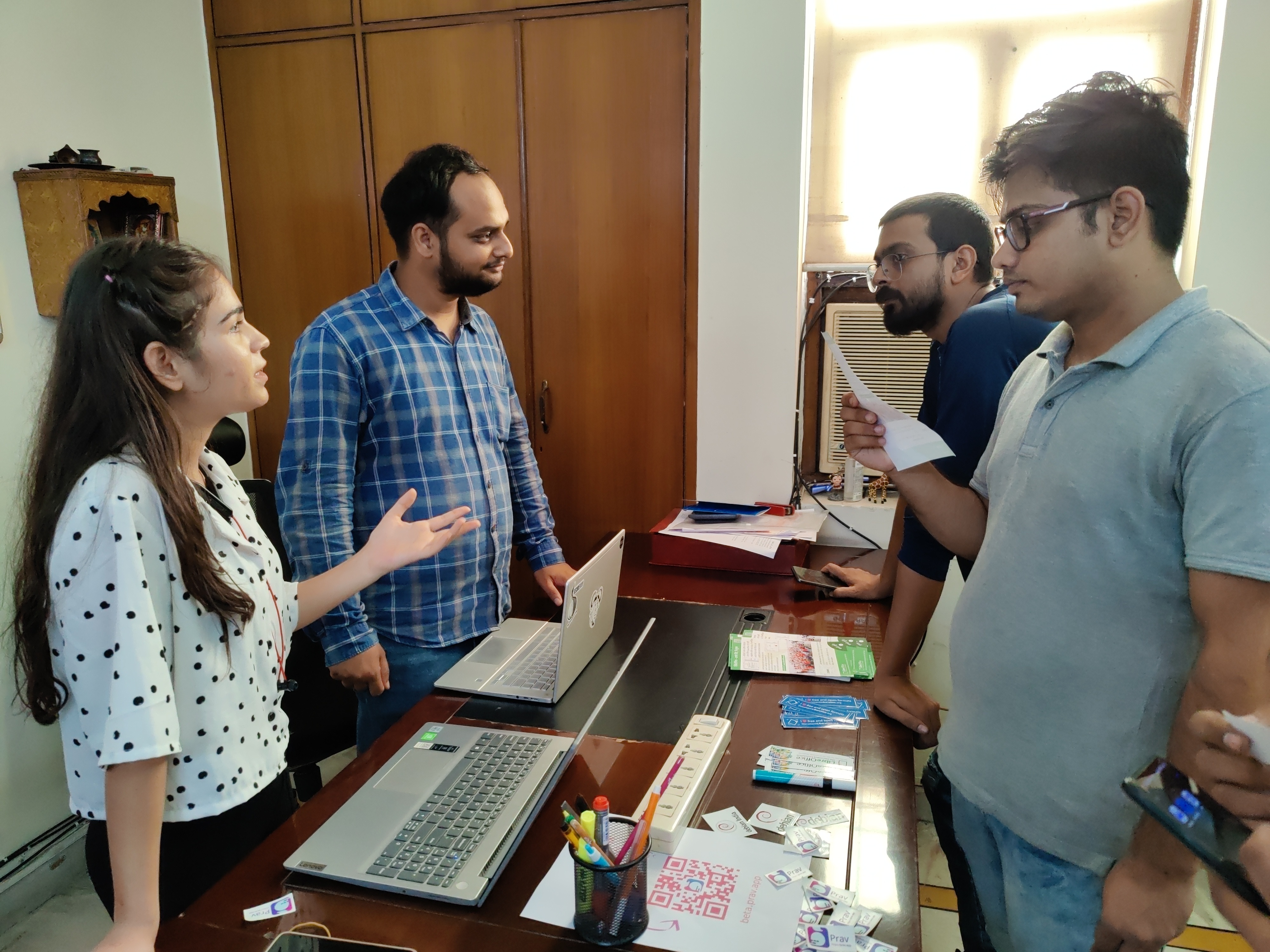
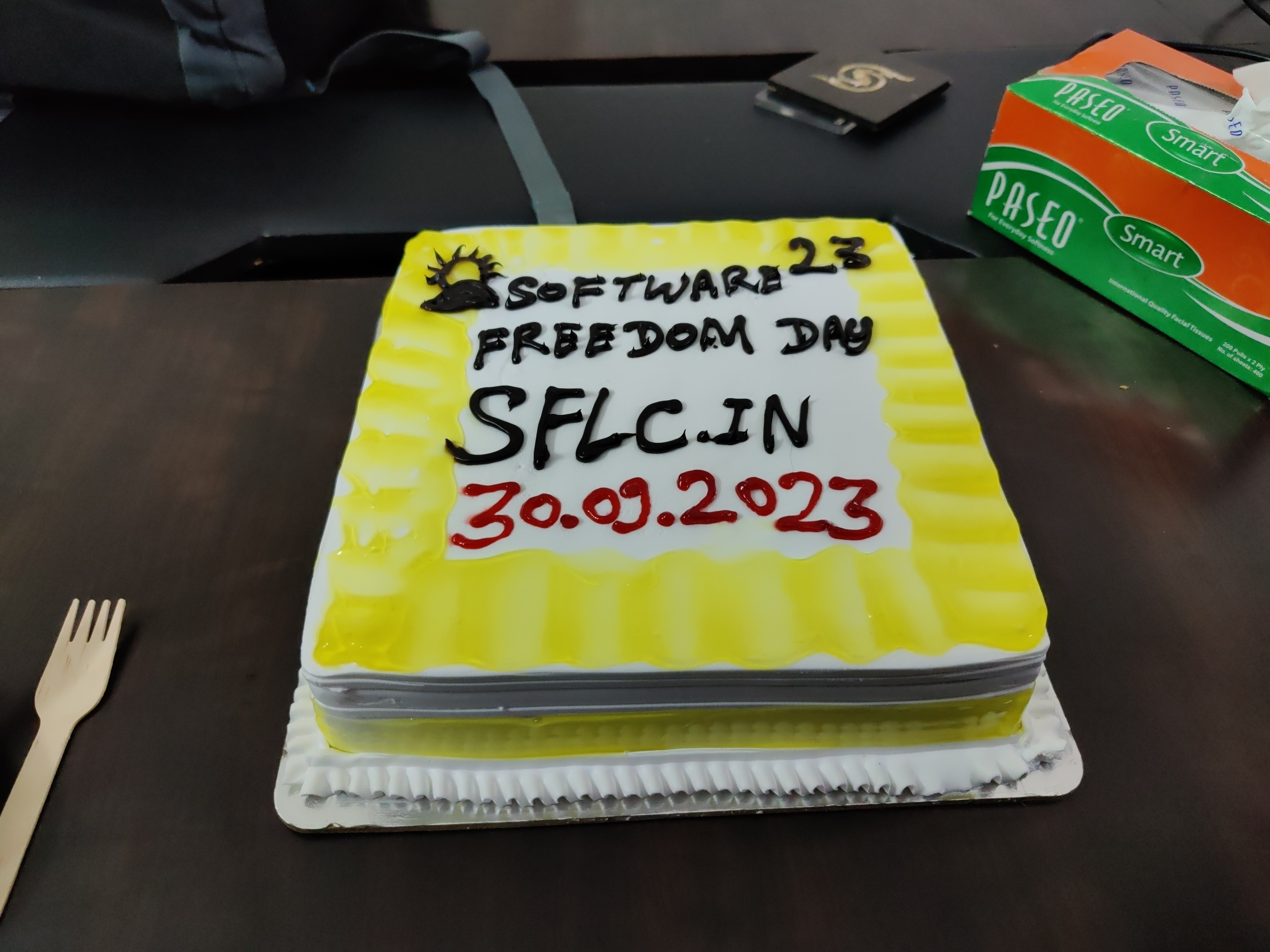
Software Freedom Law Center, India, also known as sflc.in, organized an event to celebrate the Software Freedom Day on 30th September 2023. Me, Sahil, Contrapunctus and Suresh joined. The venue was at the SFLC India office in Delhi. The sflc.in office was on the second floor of what looked like someone s apartment:). I also met Chirag, Orendra, Surbhi and others. My plan was to have a stall on LibreOffice and Prav app to raise awareness about these projects. I didn t have QR code for downloading prav app printed already, so I asked the people at sflc.in if they can get it printed for me. They were very kind and helped me in getting a color printout for me. So, I got a stall in their main room. Surbhi was having an Inkscape stall next to mine and gave me company. People came and asked about the prav project and then I realized I was still too tired to explain the idea behind the prav project and about LibreOffice (after a long Kerala trip). We got a few prav app installs during the event, which is cool.
My stall. Photo credits: Tejaswini.
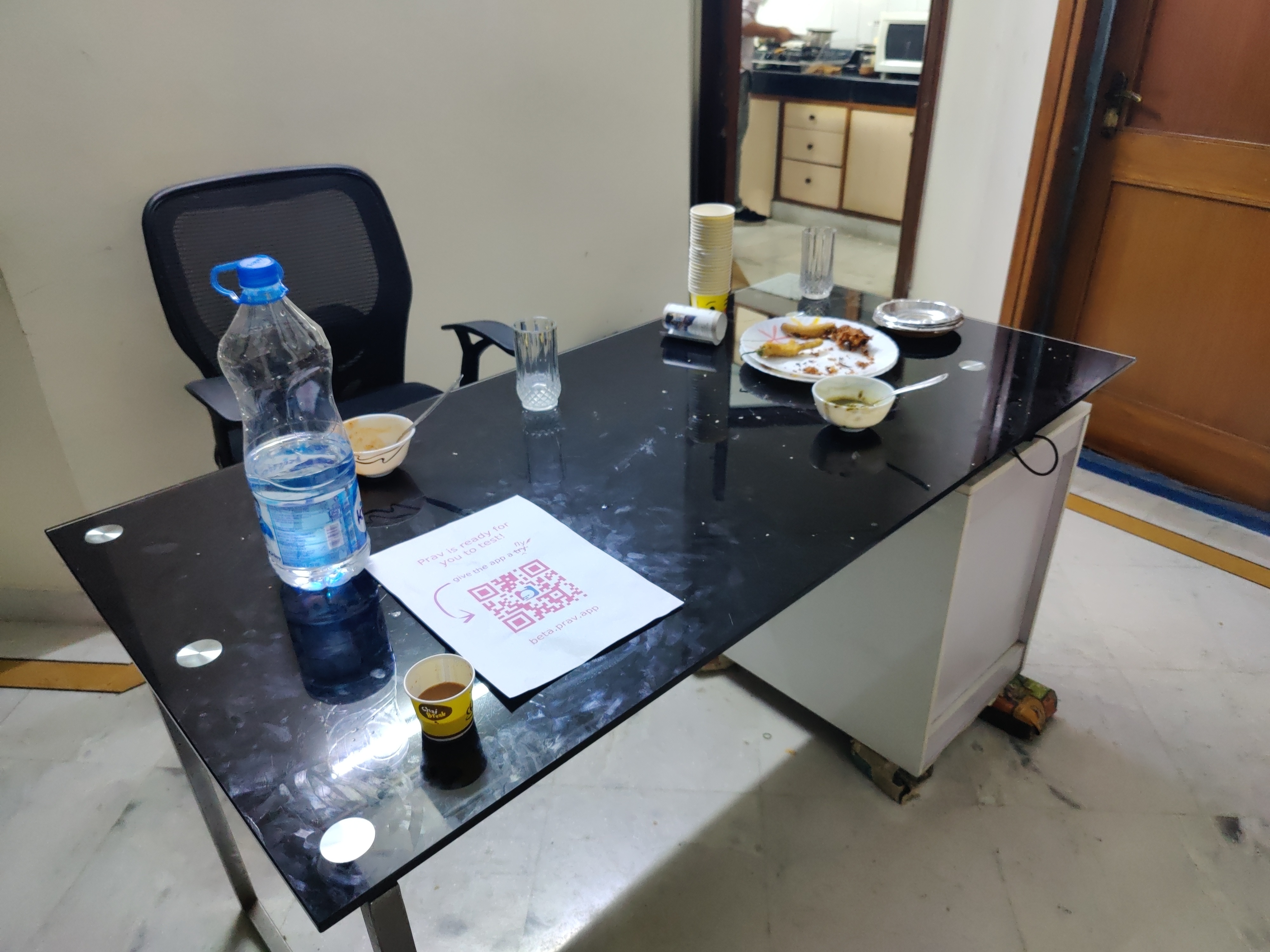
Sahil had Debian stall and contrapunctus had OpenStreetMap stall. After about an hour, Revolution OS was screened for all of us to watch, along with popcorn. The documentary gave an overview of history of Free Software Movement. The office had a kitchen where fresh chai was being made and served to us. The organizers ordered a lot of good snacks for us.
Snacks and tea at the front desk. CC-BY-SA 4.0 by Ravi Dwivedi.
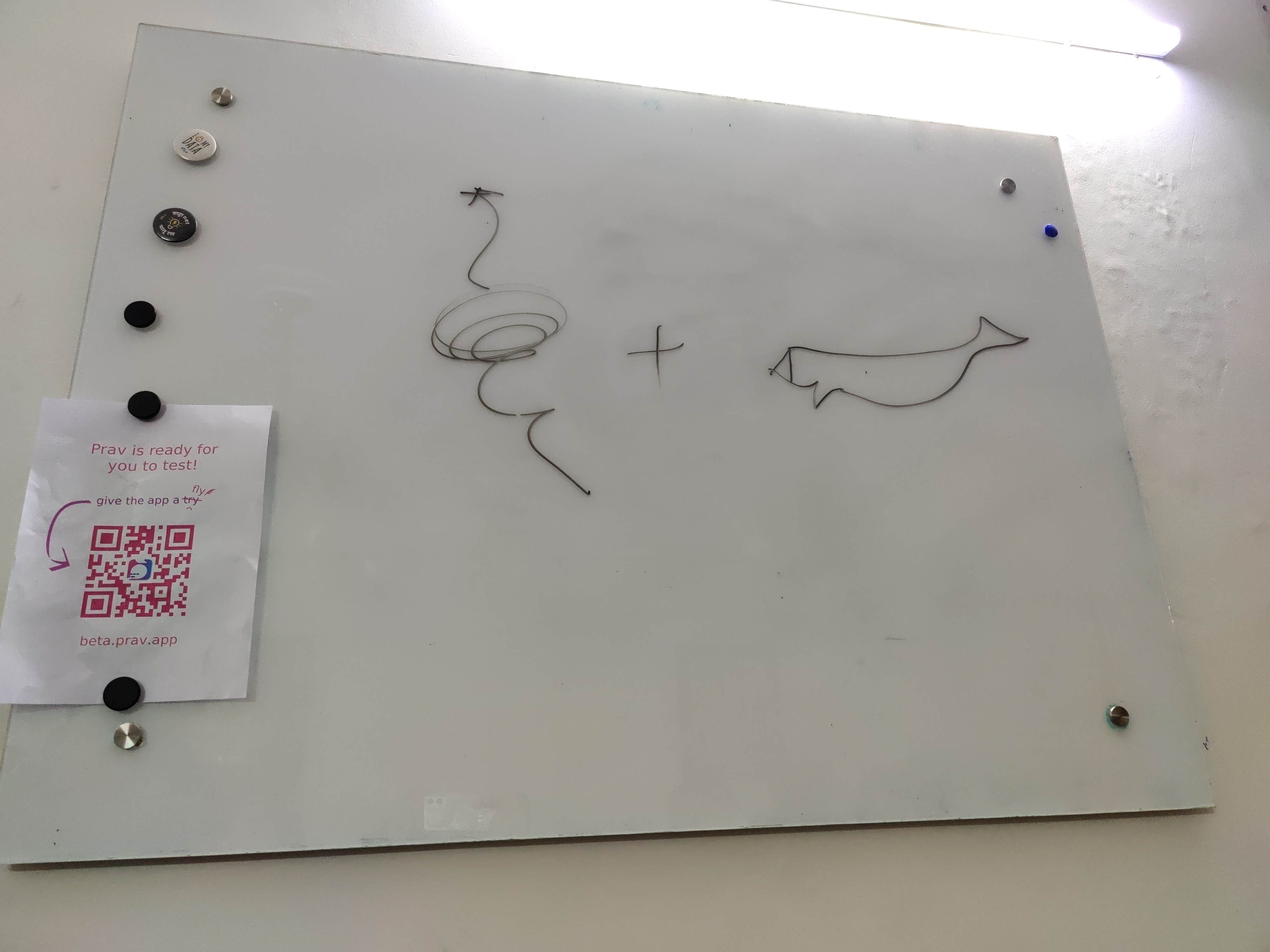
I came out of the movie hall to take more tea and snacks from the front desk. I saw a beautiful painting was hanging at the wall opposite to the front desk and Tejaswini (from sflc.in) revealed that she had made it. The tea was really good as it was freshly made in the kitchen. After the movie, we played a game of pictionary. We were divided into two teams. The game goes as follows: A person from a team is selected and given a term related to freedom respecting software written on a piece of paper, but concealed from other participants. Then that person draws something on the board (no logo, no alphabets) without speaking. If the team from which the person belongs correctly guesses the term, the team gets one step ahead on the leader board. The team who reaches the finish line wins. I recall some fun pictionaries. Like, the one in the picture below seems far from the word Wireguard and even then someone from the team guessed that word. Our team won in the end \o/.
Pictionary drawing nowhere close to the intended word Wireguard :), which was guessed. Photo by Ravi Dwivedi, CC-BY-SA 4.0.
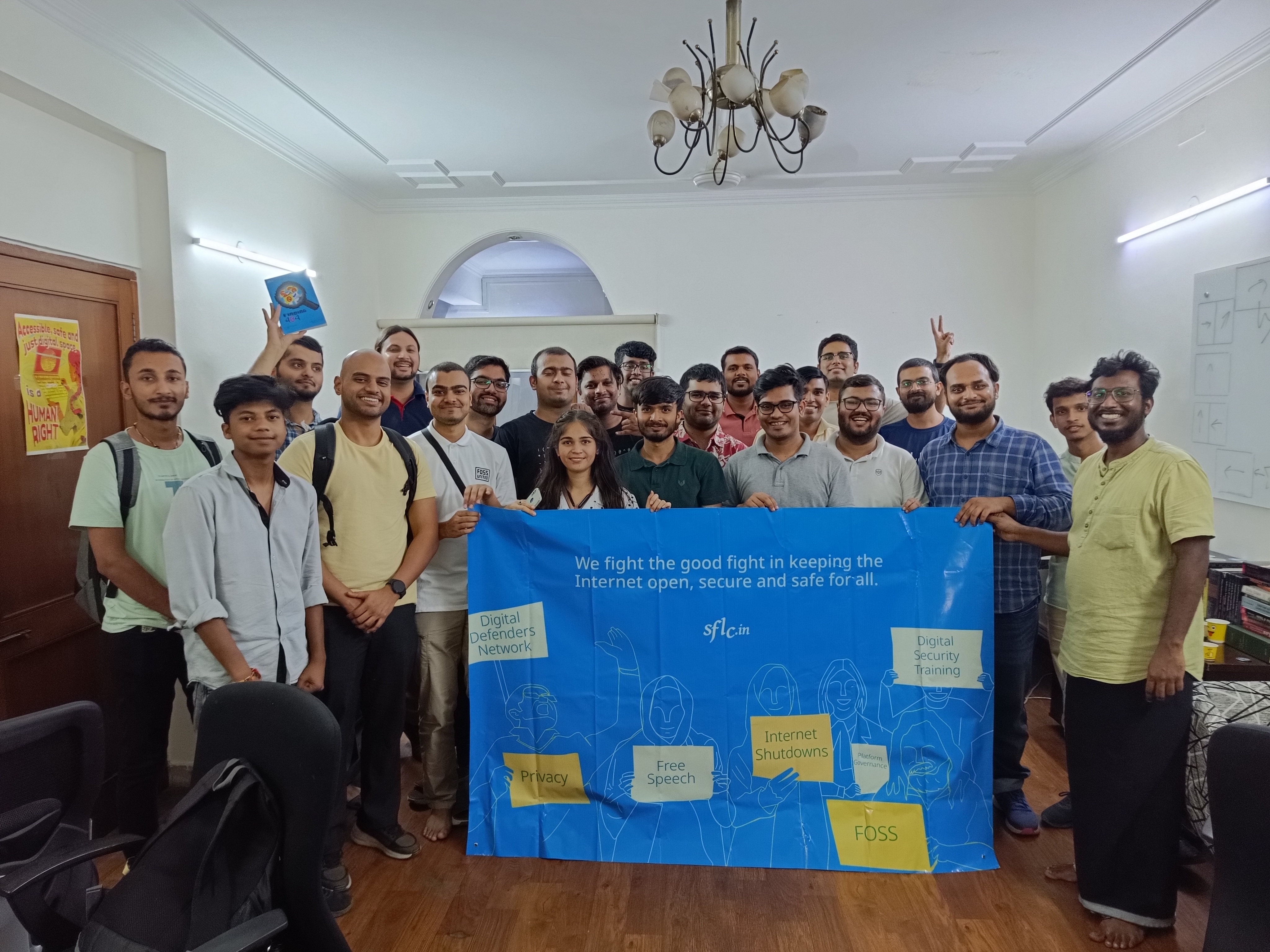
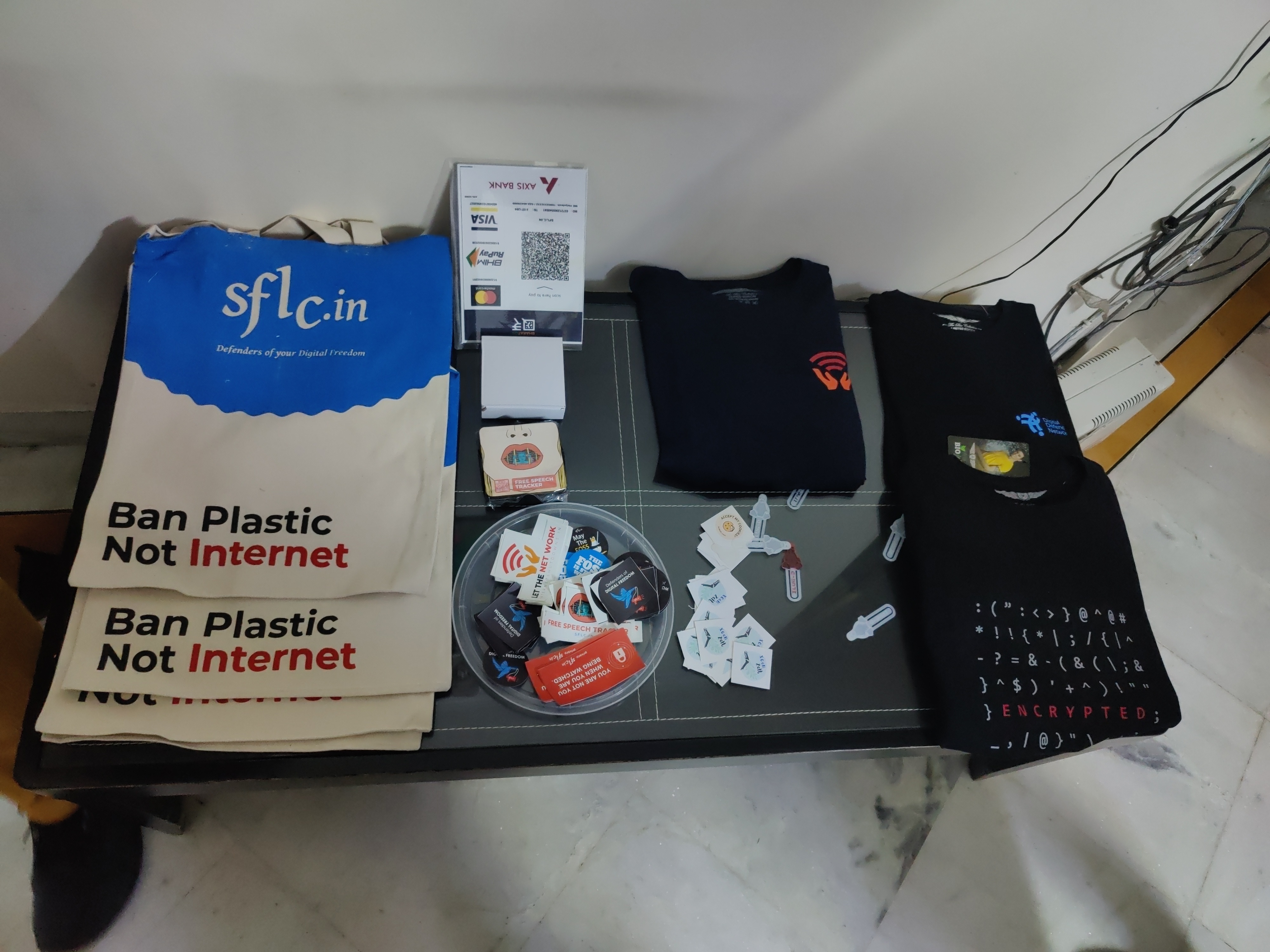
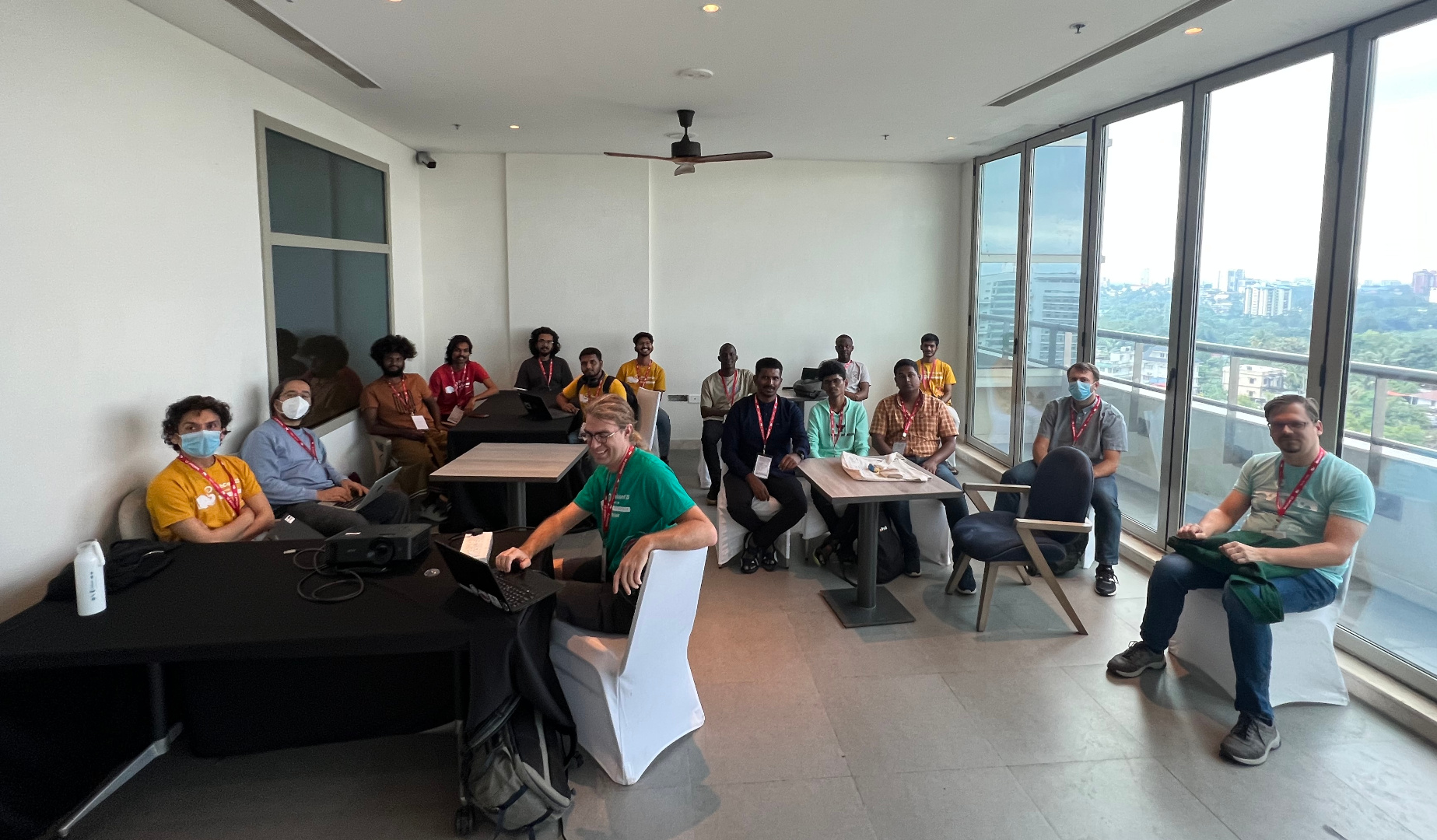
Then, we posed for a group picture. At the end, SFLC.in had a delicious cake in store for us. They had some merchandise - handbags, T-shirts, etc. which we could take if we donate some amount to SFLC.in. I bought a handbag with Ban Plastic, not Internet written on it in exchange for donation. I hope that gives people around me a powerful message :) .
Group photo. Photo credits: Tejaswini.
Tasty cake. CC-BY-SA 4.0 by Ravi Dwivedi.
Merchandise by sflc.in. CC-BY-SA 4.0 by Ravi Dwivedi.
All in all, a nice event by sflc.in :)

Aigars Mahinovs: Figuring out finances part 3

So now that I have something that looks very much like a budgeting setup going, I am going to .. delete it! Why? Well, at the end of the last part of this, the Firefly III instance was running on a tiny Debian server in a Docker container right next to another Docker container that is running the main user of this server - a Home Assistant instance that has been managing my home for several years already. So why change that? See, there is one bit of knowledge that is very crucial to your Home Assistant experience, which is not really emphasised enough in the Home Assistant documentation. In fact back when I was getting into the Home Assistant both the main documentation and basically all the guides around were just coming off the hype of Docker disrupting everything and that is a big reason why everyone suggested to install and use Home Assistant as a Docker container on top of any kind of stable OS. In fact I used to run it for years on my TerraMaster NAS, just so that I don't have a separate home server running 24/7 at home and just have everything inside the very compact NAS case. So here is the thing you NEED to know - Home Assistant Container is DEMO version of Home Assistant! If you want to have a full Home Assistant experience and use the knowledge of the huge community around the HA space, you have to use the Home Assistant OS. Ideally on dedicated hardware. Ideally on HA Green box, but any tiny PC would also work great. Raspberry Pi 4+ is common, but quite weak as the network size grows and especially the SD card for storage gets old very fast. Get a real small x86 PC with at least 4Gb RAM and a NVME SSD (eMMC is fine too). You want to have an Ethernet port and a few free USB ports. I would also suggest immediately getting HA SkyConnect adapter that can do Zigbee networking and will do Matter soon (tm). I am making do with a SonOff Zigbee gateway, but it is quite hacky to get working and your whole Zigbee communication breaks down if the WiFi goes down - suboptimal. So I took a backup of the Home Assistant instance using it's build-in tools. I took an export of my fully configured Firefly III instance and proceeded to wipe the drive of the NUC. That was not a smart idea. :D On the Home Assitant side I was really frustrated by the documentation that was really focused on users that are (likely) using Windows and are using an SD card in something like Raspberry Pi to get Home Assistant OS running. It recommended downloading Etcher to write the image to the boot medium. That is a really weird piece of software that managed to actually crash consistently when I was trying to run it from Debian Live or Ubuntu Live on my NUC. It took me way too long to give up and try something much simpler - dd. xzcat haos_generic-x86-64-11.0.img.xz dd of=/dev/mmcblk0 bs=1M That just worked, prefectly and really fast. If you want to use a GUI in a live environment, then just using the gnome-disk-utility ("Disks" in Gnome menu) and using the "Restore Disk Image ..." on a partition would work just as well. It even supports decompressing the XZ images directly while writing. But that image is small, will it not have a ton of unused disk space behind the fixed install partition? Yes, it will ... until first boot. The HA OS takes over the empty space after its install partition on the first boot-up and just grows its main partition to take up all the remaining space. Smart. After first boot is completed, the first boot wizard can be accessed via your web browser and one of the prominent buttons there is restoring from backup. So you just give it the backup file and wait. Sadly the restore does not actually give any kind of progress, so your only way to figure out when it is done is opening the same web adress in another browser tab and refresh periodically - after restoring from backup it just boots into the same config at it had before - all the settings, all the devices, all the history is preserved. Even authentification tokens are preserved so if yu had a Home Assitant Mobile installed on your phone (both for remote access and to send location info and phone state, like charging, to HA to trigger automations) then it will just suddenly start working again without further actions needed from your side. That is an almost perfect backup/restore experience. The first thing you get for using the OS version of HA is easy automatic update that also automatically takes a backup before upgrade, so if anything breaks you can roll back with one click. There is also a command-line tool that allows to upgrade, but also downgrade ha-core and other modules. I had to use it today as HA version 23.10.4 actually broke support for the Sonoff bridge that I am using to control Zigbee devices, which are like 90% of all smart devices in my home. Really helpful stuff, but not a must have. What is a must have and that you can (really) only get with Home Assistant Operating System are Addons. Some addons are just normal servers you can run alongside HA on the same HA OS server, like MariaDB or Plex or a file server. That is not the most important bit, but even there the software comes pre-configured to use in a home server configuration and has a very simple config UI to pre-configure key settings, like users, passwords and database accesses for MariaDB - you can litereally in a few clicks and few strings make serveral users each with its own access to its own database. Couple more clicks and the DB is running and will be kept restarted in case of failures. But the real gems in the Home Assistant Addon Store are modules that extend Home Assitant core functionality in way that would be really hard or near impossible to configure in Home Assitant Container manually, especially because no documentation has ever existed for such manual config - everyone just tells you to install the addon from HA Addon store or from HACS. Or you can read the addon metadata in various repos and figure out what containers it actually runs with what settings and configs and what hooks it puts into the HA Core to make them cooperate. And then do it all over again when a new version breaks everything 6 months later when you have already forgotten everything. In the Addons that show up immediately after installation are addons to install the new Matter server, a MariaDB and MQTT server (that other addons can use for data storage and message exchange), Z-Wave support and ESPHome integration and very handy File manager that includes editors to edit Home Assitant configs directly in brower and SSH/Terminal addon that boht allows SSH connection and also a web based terminal that gives access to the OS itself and also to a comand line interface, for example, to do package downgrades if needed or see detailed logs. And also there is where you can get the features that are the focus this year for HA developers - voice enablers. However that is only a beginning. Like in Debian you can add additional repositories to expand your list of available addons. Unlike Debian most of the amazing software that is available for Home Assistant is outside the main, official addon store. For now I have added the most popular addon repository - HACS (Home Assistant Community Store) and repository maintained by Alexbelgium. The first includes things like NodeRED (a workflow based automation programming UI), Tailscale/Wirescale for VPN servers, motionEye for CCTV control, Plex for home streaming. HACS also includes a lot of HA UI enhacement modules, like themes, custom UI control panels like Mushroom or mini-graph-card and integrations that provide more advanced functions, but also require more knowledge to use, like Local Tuya - that is harder to set up, but allows fully local control of (normally) cloud-based devices. And it has AppDaemon - basically a Python based automation framework where you put in Python scrips that get run in a special environment where they get fed events from Home Assistant and can trigger back events that can control everything HA can and also do anything Python can do. This I will need to explore later. And the repository by Alex includes the thing that is actually the focus of this blog post (I know :D) - Firefly III addon and Firefly Importer addon that you can then add to your Home Assistant OS with a few clicks. It also has all kinds of addons for NAS management, photo/video server, book servers and Portainer that lets us setup and run any Docker container inside the HA OS structure. HA OS will detect this and warn you about unsupported processes running on your HA OS instance (nice security feature!), but you can just dismiss that. This will be very helpful very soon. This whole environment of OS and containers and apps really made me think - what was missing in Debian that made the talented developers behind all of that to spend the immense time and effor to setup a completely new OS and app infrastructure and develop a completel paraller developer community for Home Assistant apps, interfaces and configurations. Is there anything that can still be done to make HA community and the general open source and Debian community closer together? HA devs are not doing anything wrong: they are using the best open source can provide, they bring it to people whould could not install and use it otherwise, they are contributing fixes and improvements as well. But there must be some way to do this better, together. So I installed MariaDB, create a user and database for Firefly. I installed Firefly III and configured it to use the MariaDB with the web config UI. When I went into the Firefly III web UI I was confronted with the normal wizard to setup a new instance. And no reference to any backup restore. Hmm, ok. Maybe that goes via the Importer? So I make an access token again, configured the Importer to use that, configured the Nordlinger bank connection settings. Then I tried to import the export that I downloaded from Firefly III before. The importer did not auto-recognose the format. Turns out it is just a list of transactions ... It can only be barely useful if you first manually create all the asset accounts with the same names as before and even then you'll again have to deal with resolving the problem of transfers showing up twice. And all of your categories (that have not been used yet) are gone, your automation rules and bills are gone, your budgets and piggy banks are gone. Boooo. It will be easier for me to recreate my account data from bank exports again than to resolve data in that transaction export. Turns out that Firefly III documenation explicitly recommends making a mysqldump of your own and not rely on anything in the app itself for backup purposes. Kind of sad this was not mentioned in the export page that sure looked a lot like a backup :D After doing all that work all over again I needed to make something new not to feel like I wasted days of work for no real gain. So I started solving a problem I had for a while already - how do I add cash transations to the system when I am out of the house with just my phone in the hand? So far my workaround has been just sending myself messages in WhatsApp with the amount and description of any cash expenses. Two solutions are possible: app and bot. There are actually multiple Android-based phone apps that work with Firefly III API to do full financial management from the phone. However, after trying it out, that is not what I will be using most of the time. First of all this requires your Firefly III instance to be accessible from the Internet. Either via direct API access using some port forwarding and secured with HTTPS and good access tokens, or via a VPN server redirect that is installed on both HA and your phone. Tailscale was really easy to get working. But the power has its drawbacks - adding a new cash transaction requires opening the app, choosing new transaction view, entering descriptio, amount, choosing "Cash" as source account and optionally choosing destination expense account, choosing category and budget and then submitting the form to the server. Sadly none of that really works if you have no Internet or bad Internet at the place where you are using cash. And it's just too many steps. Annoying. An easier alternative is setting up a Telegram bot - it is running in a custom Docker container right next to your Firefly (via Portainer) and you talk to it via a custom Telegram chat channel that you create very easily and quickly. And then you can just tell it "Coffee 5" and it will create a transaction from the (default) cash account in 5 amount with description "Coffee". This part also works if you are offline at the moment - the bot will receive the message once you get back online. You can use Telegram bot menu system to edit the transaction to add categories or expense accounts, but this part only work if you are online. And the Firefly instance does not have to be online at all. Really nifty. So next week I will need to write up all the regular payments as bills in Firefly (again) and then I can start writing a Python script to predict my (financial) future!

Ian Jackson: DigiSpark (ATTiny85) - Arduino, C, Rust, build systems

Recently I completed a small project, including an embedded microcontroller. For me, using the popular Arduino IDE, and C, was a mistake. The experience with Rust was better, but still very exciting, and not in a good way. Here follows the rant. Introduction In a recent project (I ll write about the purpose, and the hardware in another post) I chose to use a DigiSpark board. This is a small board with a USB-A tongue (but not a proper plug), and an ATTiny85 microcontroller, This chip has 8 pins and is quite small really, but it was plenty for my application. By choosing something popular, I hoped for convenient hardware, and an uncomplicated experience. Convenient hardware, I got. Arduino IDE The usual way to program these boards is via an IDE. I thought I d go with the flow and try that. I knew these were closely related to actual Arduinos and saw that the IDE package arduino was in Debian. But it turns out that the Debian package s version doesn t support the DigiSpark. (AFAICT from the list it offered me, I m not sure it supports any ATTiny85 board.) Also, disturbingly, its board manager seemed to be offering to install board support, suggesting it would download stuff from the internet and run it. That wouldn t be acceptable for my main laptop. I didn t expect to be doing much programming or debugging, and the project didn t have significant security requirements: the chip, in my circuit, has only a very narrow ability do anything to the real world, and no network connection of any kind. So I thought it would be tolerable to do the project on my low-security video laptop . That s the machine where I m prepared to say yes to installing random software off the internet. So I went to the upstream Arduino site and downloaded a tarball containing the Arduino IDE. After unpacking that in /opt it ran and produced a pointy-clicky IDE, as expected. I had already found a 3rd-party tutorial saying I needed to add a magic URL (from the DigiSpark s vendor) in the preferences. That indeed allowed it to download a whole pile of stuff. Compilers, bootloader clients, god knows what. However, my tiny test program didn t make it to the board. Half-buried in a too-small window was an error message about the board s bootloader ( Micronucleus ) being too new. The boards I had came pre-flashed with micronucleus 2.2. Which is hardly new, But even so the official Arduino IDE (or maybe the DigiSpark s board package?) still contains an old version. So now we have all the downsides of curl bash-ware, but we re lacking the it s up to date and it just works upsides. Further digging found some random forum posts which suggested simply downloading a newer micronucleus and manually stuffing it into the right place: one overwrites a specific file, in the middle the heaps of stuff that the Arduino IDE s board support downloader squirrels away in your home directory. (In my case, the home directory of the untrusted shared user on the video laptop,) So, whatever . I did that. And it worked! Having demo d my ability to run code on the board, I set about writing my program. Writing C again The programming language offered via the Arduino IDE is C. It s been a little while since I started a new thing in C. After having spent so much of the last several years writing Rust. C s primitiveness quickly started to grate, and the program couldn t easily be as DRY as I wanted (Don t Repeat Yourself, see Wilson et al, 2012, 4, p.6). But, I carried on; after all, this was going to be quite a small job. Soon enough I had a program that looked right and compiled. Before testing it in circuit, I wanted to do some QA. So I wrote a simulator harness that #included my Arduino source file, and provided imitations of the few Arduino library calls my program used. As an side advantage, I could build and run the simulation on my main machine, in my normal development environment (Emacs, make, etc.). The simulator runs confirmed the correct behaviour. (Perhaps there would have been some more faithful simulation tool, but the Arduino IDE didn t seem to offer it, and I wasn t inclined to go further down that kind of path.) So I got the video laptop out, and used the Arduino IDE to flash the program. It didn t run properly. It hung almost immediately. Some very ad-hoc debugging via led-blinking (like printf debugging, only much worse) convinced me that my problem was as follows: Arduino C has 16-bit ints. My test harness was on my 64-bit Linux machine. C was autoconverting things (when building for the micrcocontroller). The way the Arduino IDE ran the compiler didn t pass the warning options necessary to spot narrowing implicit conversions. Those warnings aren t the default in C in general because C compilers hate us all for compatibility reasons. I don t know why those warnings are not the default in the Arduino IDE, but my guess is that they didn t want to bother poor novice programmers with messages from the compiler explaining how their program is quite possibly wrong. After all, users don t like error messages so we shouldn t report errors. And novice programmers are especially fazed by error messages so it s better to just let them struggle themselves with the arcane mysteries of undefined behaviour in C? The Arduino IDE does offer a dropdown for compiler warnings . The default is None. Setting it to All didn t produce anything about my integer overflow bugs. And, the output was very hard to find anyway because the log window has a constant stream of strange messages from javax.jmdns, with hex DNS packet dumps. WTF. Other things that were vexing about the Arduino IDE: it has fairly fixed notions (which don t seem to be documented) about how your files and directories ought to be laid out, and magical machinery for finding things you put nearby its sketch (as it calls them) and sticking them in its ear, causing lossage. It has a tendency to become confused if you edit files under its feet (e.g. with git checkout). It wasn t really very suited to a workflow where principal development occurs elsewhere. And, important settings such as the project s clock speed, or even the target board, or the compiler warning settings to use weren t stored in the project directory along with the actual code. I didn t look too hard, but I presume they must be in a dotfile somewhere. This is madness. Apparently there is an Arduino CLI too. But I was already quite exasperated, and I didn t like the idea of going so far off the beaten path, when the whole point of using all this was to stay with popular tooling and share fate with others. (How do these others cope? I have no idea.) As for the integer overflow bug: I didn t seriously consider trying to figure out how to control in detail the C compiler options passed by the Arduino IDE. (Perhaps this is possible, but not really documented?) I did consider trying to run a cross-compiler myself from the command line, with appropriate warning options, but that would have involved providing (or stubbing, again) the Arduino/DigiSpark libraries (and bugs could easily lurk at that interface). Instead, I thought, if only I had written the thing in Rust . But that wasn t possible, was it? Does Rust even support this board? Rust on the DigiSpark I did a cursory web search and found a very useful blog post by Dylan Garrett. This encouraged me to think it might be a workable strategy. I looked at the instructions there. It seemed like I could run them via the privsep arrangement I use to protect myself when developing using upstream cargo packages from crates.io. I got surprisingly far surprisingly quickly. It did, rather startlingly, cause my rustup to download a random recent Nightly Rust, but I have six of those already for other Reasons. Very quickly I got the trinket LED blink example, referenced by Dylan s blog post, to compile. Manually copying the file to the video laptop allowed me to run the previously-downloaded micronucleus executable and successfully run the blink example on my board! I thought a more principled approach to the bootloader client might allow a more convenient workflow. I found the upstream Micronucleus git releases and tags, and had a look over its source code, release dates, etc. It seemed plausible, so I compiled v2.6 from source. That was a success: now I could build and install a Rust program onto my board, from the command line, on my main machine. No more pratting about with the video laptop. I had got further, more quickly, with Rust, than with the Arduino IDE, and the outcome and workflow was superior. So, basking in my success, I copied the directory containing the example into my own project, renamed it, and adjusted the path references. That didn t work. Now it didn t build. Even after I copied about .cargo/config.toml and rust-toolchain.toml it didn t build, producing a variety of exciting messages, depending what precisely I tried. I don t have detailed logs of my flailing: the instructions say to build it by cd ing to the subdirectory, and, given that what I was trying to do was to not follow those instructions, it didn t seem sensible to try to prepare a proper repro so I could file a ticket. I wasn t optimistic about investigating it more deeply myself: I have some experience of fighting cargo, and it s not usually fun. Looking at some of the build control files, things seemed quite complicated. Additionally, not all of the crates are on crates.io. I have no idea why not. So, I would need to supply local copies of them anyway. I decided to just git subtree add the avr-hal git tree. (That seemed better than the approach taken by the avr-hal project s cargo template, since that template involve a cargo dependency on a foreign git repository. Perhaps it would be possible to turn them into path dependencies, but given that I had evidence of file-location-sensitive behaviour, which I didn t feel like I wanted to spend time investigating, using that seems like it would possibly have invited more trouble. Also, I don t like package templates very much. They re a form of clone-and-hack: you end up stuck with whatever bugs or oddities exist in the version of the template which was current when you started.) Since I couldn t get things to build outside avr-hal, I edited the example, within avr-hal, to refer to my (one) program.rs file outside avr-hal, with a #[path] instruction. That s not pretty, but it worked. I also had to write a nasty shell script to work around the lack of good support in my nailing-cargo privsep tool for builds where cargo must be invoked in a deep subdirectory, and/or Cargo.lock isn t where it expects, and/or the target directory containing build products is in a weird place. It also has to filter the output from cargo to adjust the pathnames in the error messages. Otherwise, running both cd A; cargo build and cd B; cargo build from a Makefile produces confusing sets of error messages, some of which contain filenames relative to A and some relative to B, making it impossible for my Emacs to reliably find the right file. RIIR (Rewrite It In Rust) Having got my build tooling sorted out I could go back to my actual program. I translated the main program, and the simulator, from C to Rust, more or less line-by-line. I made the Rust version of the simulator produce the same output format as the C one. That let me check that the two programs had the same (simulated) behaviour. Which they did (after fixing a few glitches in the simulator log formatting). Emboldened, I flashed the Rust version of my program to the DigiSpark. It worked right away! RIIR had caused the bug to vanish. Of course, to rewrite the program in Rust, and get it to compile, it was necessary to be careful about the types of all the various integers, so that s not so surprising. Indeed, it was the point. I was then able to refactor the program to be a bit more natural and DRY, and improve some internal interfaces. Rust s greater power, compared to C, made those cleanups easier, so making them worthwhile. However, when doing real-world testing I found a weird problem: my timings were off. Measured, the real program was too fast by a factor of slightly more than 2. A bit of searching (and searching my memory) revealed the cause: I was using a board template for an Adafruit Trinket. The Trinket has a clock speed of 8MHz. But the DigiSpark runs at 16.5MHz. (This is discussed in a ticket against one of the C/C++ libraries supporting the ATTiny85 chip.) The Arduino IDE had offered me a choice of clock speeds. I have no idea how that dropdown menu took effect; I suspect it was adding prelude code to adjust the clock prescaler. But my attempts to mess with the CPU clock prescaler register by hand at the start of my Rust program didn t bear fruit. So instead, I adopted a bodge: since my code has (for code structure reasons, amongst others) only one place where it dealt with the underlying hardware s notion of time, I simply changed my delay function to adjust the passed-in delay values, compensating for the wrong clock speed. There was probably a more principled way. For example I could have (re)based my work on either of the two unmerged open MRs which added proper support for the DigiSpark board, rather than abusing the Adafruit Trinket definition. But, having a nearly-working setup, and an explanation for the behaviour, I preferred the narrower fix to reopening any cans of worms. An offer of help As will be obvious from this posting, I m not an expert in dev tools for embedded systems. Far from it. This area seems like quite a deep swamp, and I m probably not the person to help drain it. (Frankly, much of the improvement work ought to be done, and paid for, by hardware vendors.) But, as a full Member of the Debian Project, I have considerable gatekeeping authority there. I also have much experience of software packaging, build systems, and release management. If anyone wants to try to improve the situation with embedded tooling in Debian, and is willing to do the actual packaging work. I would be happy to advise, and to review and sponsor your contributions. An obvious candidate: it seems to me that micronucleus could easily be in Debian. Possibly a DigiSpark board definition could be provided to go with the arduino package. Unfortunately, IMO Debian s Rust packaging tooling and workflows are very poor, and the first of my suggestions for improvement wasn t well received. So if you need help with improving Rust packages in Debian, please talk to the Debian Rust Team yourself. Conclusions Embedded programming is still rather a mess and probably always will be. Embedded build systems can be bizarre. Documentation is scant. You re often expected to download board support packages full of mystery binaries, from the board vendor (or others). Dev tooling is maddening, especially if aimed at novice programmers. You want version control? Hermetic tracking of your project s build and install configuration? Actually to be told by the compiler when you write obvious bugs? You re way off the beaten track. As ever, Free Software is under-resourced and the maintainers are often busy, or (reasonably) have other things to do with their lives. All is not lost Rust can be a significantly better bet than C for embedded software: The Rust compiler will catch a good proportion of programming errors, and an experienced Rust programmer can arrange (by suitable internal architecture) to catch nearly all of them. When writing for a chip in the middle of some circuit, where debugging involves staring an LED or a multimeter, that s precisely what you want. Rust embedded dev tooling was, in this case, considerably better. Still quite chaotic and strange, and less mature, perhaps. But: significantly fewer mystery downloads, and significantly less crazy deviations from the language s normal build system. Overall, less bad software supply chain integrity. The ATTiny85 chip, and the DigiSpark board, served my hardware needs very well. (More about the hardware aspects of this project in a future posting.)

comment count unavailable comments

Russell Coker: Brother MFC-J4440DW Printer

I just had to setup a Brother MFC-J4440DW for a relative. They were replacing an old HP laser printer that mysteriously stopped printing as dark as it should, I don t know whether the HP printer had worn out or if the HP firmware decided to hobble it to make them buy a new printer. In either case HP is well known for shady behaviour with their printer firmware and should be avoided. The new Brother printer has problems when using wifi and auto DNS. I don t know how much of that was due to the printer itself and how much was due to the wifi AP provided by Foxtel. Anyway it works better with Ethernet and a fixed address (the wifi AP didn t allow me to set a fixed address). I think the main thing was configuring CUPS to connect via the IP address and not use Avahi etc. One problem I had with printing was that programs like Chrome and LibreOffice would hang for about a minute before printing, that turned out to be due to /etc/cups/lpoptions having the old printer (which had been removed) listed as the default. It would be nice if the web configuration for cups would change that when I set the default printer. CUPS doesn t seem to support USB printing. If it is possible to get this printer to print via USB then I welcome a comment describing how to do it. Scanning only seems to work on Ethernet not on USB, the command for scanning that I ended up with was scanimage -d escl:http://10.0.0.3:80 . Again I welcome comments from anyone who has had success in scanning via USB. There are probably some Linux users who would find it really inconvenient to setup a network interface specifically for printing. It s easy for me as I have a pile of spare ethernet cards and a box of cables but some people would have to buy this. Also it s disappointing that Brother didn t include an Ethernet cable or a USB cable in the box. But if that makes it cheaper I can deal with that. The resolution for scanning is only 832*1163 and it s black and white, I think that generally scanning in printers is a bad idea, taking a photo with a phone is a better way of scanning documents. Generally this printer works well and is cheap at only $299, a price for disposable hardware by today s standards. There are Debian packages from Brother for the printer. The scanner package looks like it just configures scanimage, and I m not sure whether the stock version of CUPS in Debian will do it without the Brother package. One thing I found interesting is that the package mfcj4440dwpdrv has the following shell code in the postinst to label for SE Linux:
if [ "$(which semanage 2> /dev/null)" != '' ];then
semanage fcontext -a -t cupsd_rw_etc_t '/opt/brother/Printers/mfcj4440dw/inf(/.*)?'
semanage fcontext -a -t bin_t          '/opt/brother/Printers/mfcj4440dw/lpd(/.*)?'
semanage fcontext -a -t bin_t          '/opt/brother/Printers/mfcj4440dw/cupswrapper(/.*)?'
if [ "$(which restorecon 2> /dev/null)" != '' ];then
restorecon -R /opt/brother/Printers/mfcj4440dw
fi
fi
This is the first time I ve seen a Debian package from a hardware vendor with SE Linux specific code. I can t just add those rules to the Debian policy as that would make the semanage commands fail to add an identical context spec will break the postinst. In the latest policy I m uploading to Debian/Unstable (version 2.20231010-1) there are the following 3 lines to deal with this, the first was already there for some time and the other 2 I just added:
/opt/brother/Printers/([^/]+/)?inf(/.*)?        gen_context(system_u:object_r:cupsd_rw_etc_t,s0)
/opt/brother/Printers/[^/]+/lpd(/.*)?   gen_context(system_u:object_r:bin_t,s0)
/opt/brother/Printers/[^/]+/cupswrapper(/.*)?   gen_context(system_u:object_r:bin_t,s0)
The Brother employee(s) who added the SE Linux code to their package are welcome to connect to me on LinkedIn.

21 October 2023

Russell Coker: More About the PineTime

Since my initial review of the PineTime 10 days ago [1] I ve used it in more situations. My initial tests were done connecting to a Huawei Nova 7i [2], I am now using it with a Huawei Mate 10 Pro. I ve also upgraded the PineTime from version 1.11 (from memory) of the Infinitime software that runs on the watch to version 1.13 [3]. To upgrade it I had to download the file pinetime-mcuboot-app-dfu-1.13.0.zip to the Android phone and then use the File Installer option of the GadgetBridge Android app to upload it. The zip file does NOT need to be extracted first, I don t know if GadgetBridge extracts it before upload or if the PineTime firmware has a copy of unzip, but it just works. Version 1.13 is purported to take less battery, I haven t directly verified this as I turned on the new feature of measuring my pulse 24*7 which significantly increases battery use. The end result is that the battery is being used up at about the same rate as before, overall adding a new battery-hungry feature while reducing battery use for other things to compensate is a good thing and strongly suggests that battery use has decreased overall. I have noticed that now with a different phone and different version of the firmware it doesn t reconnect as reliably. Sometimes I need to turn bluetooth on the watch off and on before it works (which indicates an issue with the firmware) and sometimes I need to turn bluetooth off and on on the phone which indicates a phone issue. Also I often unlock my phone to find the GadgetBridge notification saying that it s disconnected and it usually connects fine, but I get the impression it s often disconnected. Does the Mate 10 Pro have a problem that triggers a bug in the PineTime? Does the 1.13 version of InfiniTime have a problem that triggers a bug in the Mate 10 Pro? Are they both independently buggy? Is the new version of InfiniTime just disconnecting when it s not doing stuff to save battery and triggering bugs that weren t obvious before? I ve tested the media control which basically works, sometimes it gets out of sync and displays the name of the previous track which is annoying. The PineTime is IP67 rated and there are reports on Reddit of people wearing it in the shower and swimming pool. I wouldn t recommend those things although it should work OK. It might be an option for controlling music when in the bath or when having a pool party. When the watch is running normally and displays a new notification it s not possible to swipe it away. You have to go to the notifications menu afterwards to swipe them which I find annoying. Also the notification of an inbound call remains in the notification list indefinitely while I think a more appropriate action is to have it disappear in an amount of time where it s already been answered or gone to voicemail. Voicemail timeouts are as low as 15 seconds so having the notification disappear after 1 minute would be reasonable. I have configured my PineTime to take 2 taps on the screen to wake up. I previously had it set to 1 tap and had problems with accidentally doing something it registered as a tap while in bed and waking me up. Also I found that if I want to turn the screen on when my hands are dirty so I don t want to touch it with a finger then tapping it on my nose works well. Apparently it is programmed to ignore taps on large areas so I can t wake it with my elbow. I ve setup a PineTime for an elderly relative who is greatly enjoying it. I don t expect them to flash new firmware or do any other complex things, but they are doing well with using the device. They are considering getting a different band as they don t like rubber. I m sure their local jeweler has some leather and metal bands that could fit. There is a design on Thiniverse for a PineTime case [4], this could be used for making an adaptor to fit a PineTime to a greatly different type of band, an instrument console, etc. Generally I think the PineTime is an OK smart watch for someone who s not into FOSS for it s own sake. My relative could have been happy with a slightly cheaper watch, but it s still significantly cheaper than the Samsung and Apple options so it s not particularly expensive. A benefit for them is that having the same type of SmartWatch as me they will get better tech support.

20 October 2023

Iustin Pop: How to set a per-app locale in MacOS

After spending ~20+ years with a Linux desktop, I m trying to expand my desktop setup to include MacOS (well, desktop/laptop, I mean end user in general). And to my surprise, there s no clear repository of MacOS info. Man pages yes, some StackOverflow, some Apple forums, but no canonical version. Or, I didn t find it, please enlighten me Another issue is that Apple apparently changes behaviour without clearly documenting it. In this specific case, the region part of the locale went through significant churn lately. So, my goal: In Linux, this would simply mean running the app with the correct environment variables. But MacOS deprecated this a while back (it used to work). After reading what I could, the solution is quite easy, just not obvious:
% defaults read .GlobalPreferences grep en_
    AKLastLocale = "en_CH";
    AppleLocale = "en_CH";
% defaults read -app FooBar
(has no AppleLocale key)
% defaults write -app FooBar AppleLocale en_US
And that s it. Now, the defaults man page says the global-global is NSGlobalDomain, I don t know where I got the .GlobalPreferences. But I only needed to know the key name (in this case, AppleLocale - of course it couldn t be LC_ALL/LANG). One day I ll know MacOS better, but I try to learn more for 2+ years now, and it s not a smooth ride. Old dog new tricks, right?

Freexian Collaborators: Debian Contributions: Freexian meetup, debusine updates, lpr/lpd in Debian, and more! (by Utkarsh Gupta, Stefano Rivera)

Contributing to Debian is part of Freexian s mission. This article covers the latest achievements of Freexian and their collaborators. All of this is made possible by organizations subscribing to our Long Term Support contracts and consulting services.

Freexian Meetup, by Stefano Rivera, Utkarsh Gupta, et al. During DebConf, Freexian organized a meetup for its collaborators and those interested in learning more about Freexian and its services. It was well received and many people interested in Freexian showed up. Some developers who were interested in contributing to LTS came to get more details about joining the project. And some prospective customers came to get to know us and ask questions. Sadly, the tragic loss of Abraham shook DebConf, both individually and structurally. The meetup got rescheduled to a small room without video coverage. With that, we still had a wholesome interaction and here s a quick picture from the meetup taken by Utkarsh (which is also why he s missing!).

Debusine, by Rapha l Hertzog, et al. Freexian has been investing into debusine for a while, but development speed is about to increase dramatically thanks to funding from SovereignTechFund.de. Rapha l laid out the 5 milestones of the funding contract, and filed the issues for the first milestone. Together with Enrico and Stefano, they established a workflow for the expanded team. Among the first steps of this milestone, Enrico started to work on a developer-friendly description of debusine that we can use when we reach out to the many Debian contributors that we will have to interact with. And Rapha l started the design work of the autopkgtest and lintian tasks, i.e. what s the interface to schedule such tasks, what behavior and what associated options do we support? At this point you might wonder what debusine is supposed to be let us try to answer this: Debusine manages scheduling and distribution of Debian-related build and QA tasks to a network of worker machines. It also manages the resulting artifacts and provides the results in an easy to consume way. We want to make it easy for Debian contributors to leverage all the great QA tools that Debian provides. We want to build the next generation of Debian s build infrastructure, one that will continue to reliably do what it already does, but that will also enable distribution-wide experiments, custom package repositories and custom workflows with advanced package reviews. If this all sounds interesting to you, don t hesitate to watch the project on salsa.debian.org and to contribute.

lpr/lpd in Debian, by Thorsten Alteholz During Debconf23, Till Kamppeter presented CPDB (Common Print Dialog Backend), a new way to handle print queues. After this talk it was discussed whether the old lpr/lpd based printing system could be abandoned in Debian or whether there is still demand for it. So Thorsten asked on the debian-devel email list whether anybody uses it. Oddly enough, these old packages are still useful:
  • Within a small network it is easier to distribute a printcap file, than to properly configure cups clients.
  • One of the biggest manufacturers of WLAN router and DSL boxes only supports raw queues when attaching an USB printer to their hardware. Admittedly the CPDB still has problems with such raw queues.
  • The Pharos printing system at MIT is still lpd-based.
As a result, the lpr/lpd stuff is not yet ready to be abandoned and Thorsten will adopt the relevant packages (or rather move them under the umbrella of the debian-printing team). Though it is not planned to develop new features, those packages should at least have a maintainer. This month Thorsten adopted rlpr, an utility for lpd printing without using /etc/printcap. The next one he is working on is lprng, a lpr/lpd printer spooling system. If you know of any other package that is also needed and still maintained by the QA team, please tell Thorsten.

/usr-merge, by Helmut Grohne Discussion about lifting the file move moratorium has been initiated with the CTTE and the release team. A formal lift is dependent on updating debootstrap in older suites though. A significant number of packages can automatically move their systemd unit files if dh_installsystemd and systemd.pc change their installation targets. Unfortunately, doing so makes some packages FTBFS and therefore patches have been filed. The analysis tool, dumat, has been enhanced to better understand which upgrade scenarios are considered supported to reduce false positive bug filings and gained a mode for local operation on a .changes file meant for inclusion in salsa-ci. The filing of bugs from dumat is still manual to improve the quality of reports. Since September, the moratorium has been lifted.

Miscellaneous contributions
  • Rapha l updated Django s backport in bullseye-backports to match the latest security release that was published in bookworm. Tracker.debian.org is still using that backport.
  • Helmut Grohne sent 13 patches for cross build failures.
  • Helmut Grohne performed a maintenance upload of debvm enabling its use in autopkgtests.
  • Helmut Grohne wrote an API-compatible reimplementation of autopkgtest-build-qemu. It is powered by mmdebstrap, therefore unprivileged, EFI-only and will soon be included in mmdebstrap.
  • Santiago continued the work regarding how to make it easier to (automatically) test reverse dependencies. An example of the ongoing work was presented during the Salsa CI BoF at DebConf 23.
    In fact, omniorb-dfsg test pipelines as the above were used for the omniorb-dfsg 4.3.0 transition, verifying how the reverse dependencies (tango, pytango and omnievents) were built and how their autopkgtest jobs run with the to-be-uploaded omniorb-dfsg new release.
  • Utkarsh and Stefano attended and helped run DebConf 23. Also continued winding up DebConf 22 accounting.
  • Anton Gladky did some science team uploads to fix RC bugs.

19 October 2023

Russ Allbery: Review: The Cassini Division

Review: The Cassini Division, by Ken MacLeod
Series: Fall Revolution #3
Publisher: Tor
Copyright: 1998
Printing: August 2000
ISBN: 0-8125-6858-3
Format: Mass market
Pages: 305
The Cassini Division is the third book in the Fall Revolution series and a fairly direct sequel (albeit with different protagonists) to The Stone Canal. This is not a good place to start the series. It's impossible to talk about the plot of this book without discussing the future history of this series, which arguably includes some spoilers for The Star Fraction and The Stone Canal. I don't think the direction of history matters that much in enjoying the previous books, but read the first two books of the series before this review if you want to avoid all spoilers. When the Outwarders uploaded themselves and went fast, they did a lot of strange things: an interstellar probe contrary to all known laws of physics, the disassembly of Ganymede, and the Malley Mile, which plays a significant role in The Stone Canal. They also crashed the Earth. This was not entirely their fault. There were a lot of politics, religious fundamentalism, and plagues in play as well. But the storm of viruses broadcast from their transformed Jupiter shut down essentially all computing equipment on Earth, which set off much of the chaos. The results were catastrophic, and also politically transformative. Now, the Solar Union is a nearly unified anarchosocialist society, with only scattered enclaves of non-cooperators left outside that structure. Ellen May Ngewthu is a leader of the Cassini Division, the bulwark that stands between humans and the Outwarders. The Division ruthlessly destroys any remnant or probe that dares rise out of Jupiter's atmosphere, ensuring that the Outwarders, whatever they have become after untold generations of fast evolution, stay isolated to the one planet they have absorbed. The Division is very good at what they do. But there is a potential gap in that line of defense: there are fast folk in storage at the other end of the Malley Mile, on New Mars, and who knows what the deranged capitalists there will do or what forces they might unleash. The one person who knows a path through the Malley Mile isn't talking, so Ellen goes in search of the next best thing: the non-cooperator scientist Isambard Kingdom Malley. I am now thoroughly annoyed at how politics are handled in this series, and much less confused by the frequency with which MacLeod won Prometheus Awards from the Libertarian Futurist Society. Some of this is my own fault for having too high of hopes for political SF, but nothing in this series so far has convinced me that MacLeod is seriously engaging with political systems. Instead, the world-building to date makes the classic libertarian mistake of thinking societies will happily abandon stability and predictability in favor of their strange definition of freedom. The Solar Union is based on what Ellen calls the true knowledge, which is worth quoting in full so that you know what kind of politics we're talking about:
Life is a process of breaking down and using other matter, and if need be, other life. Therefore, life is aggression, and successful life is successful aggression. Life is the scum of matter, and people are the scum of life. There is nothing but matter, forces, space and time, which together make power. Nothing matters, except what matters to you. Might makes right, and power makes freedom. You are free to do whatever is in your power, and if you want to survive and thrive you had better do whatever is in your interests. If your interests conflict with those of others, let the others pit their power against yours, everyone for theirselves. If your interests coincide with those of others, let them work together with you, and against the rest. We are what we eat, and we eat everything. All that you really value, and the goodness and truth and beauty of life, have their roots in this apparently barren soil. This is the true knowledge. We had founded our idealism on the most nihilistic implications of science, our socialism on crass self-interest, our peace on our capacity for mutual destruction, and our liberty on determinism. We had replaced morality with convention, bravery with safety, frugality with plenty, philosophy with science, stoicism with anaesthetics and piety with immortality. The universal acid of the true knowledge had burned away a world of words, and exposed a universe of things. Things we could use.
This is certainly something that some people will believe, particularly cynical college students who love political theory, feeling smarter than other people, and calling their pet theories things like "the true knowledge." It is not even remotely believable as the governing philosophy of a solar confederation. The point of government for the average person in human society is to create and enforce predictable mutual rules that one can use as a basis for planning and habits, allowing you to not think about politics all the time. People who adore thinking about politics have great difficulty understanding how important it is to everyone else to have ignorable government. Constantly testing your power against other coalitions is a sport, not a governing philosophy. Given the implication that this testing is through violence or the threat of violence, it beggars belief that any large number of people would tolerate that type of instability for an extended period of time. Ellen is fully committed to the true knowledge. MacLeod likely is not; I don't think this represents the philosophy of the author. But the primary political conflict in this novel famous for being political science fiction is between the above variation of anarchy and an anarchocapitalist society, neither of which are believable as stable political systems for large numbers of people. This is a bit like seeking out a series because you were told it was about a great clash of European monarchies and discovering it was about a fight between Liberland and Sealand. It becomes hard to take the rest of the book seriously. I do realize that one point of political science fiction is to play with strange political ideas, similar to how science fiction plays with often-implausible science ideas. But those ideas need some contact with human nature. If you're going to tell me that the key to clawing society back from a world-wide catastrophic descent into chaos is to discard literally every social system used to create predictability and order, you had better be describing aliens, because that's not how humans work. The rest of the book is better. I am untangling a lot of backstory for the above synopsis, which in the book comes in dribs and drabs, but piecing that together is good fun. The plot is far more straightforward than the previous two books in the series: there is a clear enemy, a clear goal, and Ellen goes from point A to point B in a comprehensible way with enough twists to keep it interesting. The core moral conflict of the book is that Ellen is an anti-AI fanatic to the point that she considers anyone other than non-uploaded humans to be an existential threat. MacLeod gives the reader both reasons to believe Ellen is right and reasons to believe she's wrong, which maintains an interesting moral tension. One thing that MacLeod is very good at is what Bob Shaw called "wee thinky bits." I think my favorite in this book is the computer technology used by the Cassini Division, who have spent a century in close combat with inimical AI capable of infecting any digital computer system with tailored viruses. As a result, their computers are mechanical non-Von-Neumann machines, but mechanical with all the technology of a highly-advanced 24th century civilization with nanometer-scale manufacturing technology. It's a great mental image and a lot of fun to think about. This is the only science fiction novel that I can think of that has a hard-takeoff singularity that nonetheless is successfully resisted and fought to a stand-still by unmodified humanity. Most writers who were interested in the singularity idea treated it as either a near-total transformation leaving only remnants or as something that had to be stopped before it started. MacLeod realizes that there's no reason to believe a post-singularity form of life would be either uniform in intent or free from its own baffling sudden collapses and reversals, which can be exploited by humans. It makes for a much better story. The sociology of this book is difficult to swallow, but the characterization is significantly better than the previous books of the series and the plot is much tighter. I was too annoyed by the political science to fully enjoy it, but that may be partly the fault of my expectations coming in. If you like chewy, idea-filled science fiction with a lot of unexplained world-building that you have to puzzle out as you go, you may enjoy this, although unfortunately I think you need to read at least The Stone Canal first. The ending was a bit unsatisfying, but even that includes some neat science fiction ideas. Followed by The Sky Road, although I understand it is not a straightforward sequel. Rating: 6 out of 10

18 October 2023

Scarlett Gately Moore: KDE: Snap transition complete, 23.08.2 released!

KDE MascotKDE Mascot
I have completed the the Big move ! There are still a few lingering MR s, but I am sure they will be approved so I can merge soon. With the move I was also able to release 23.08.2 for most release service applications. Enjoy! You can find them all here: https://snapcraft.io/search?q=KDE I still need to raise a bit more to pay the Internet bill. If you can spare some change please consider a donation. Thank you! <script src= https://liberapay.com/sgmoore/widgets/button.js ></script> <noscript><a href= https://liberapay.com/sgmoore/donate ><img alt= Donate using Liberapay src= https://liberapay.com/assets/widgets/donate.svg ></a></noscript> Donate https://gofund.me/b8b69e54

Russ Allbery: Review: Wolf Country

Review: Wolf Country, by Mar Delaney
Publisher: Kalikoi
Copyright: September 2021
ASIN: B09H55TGXK
Format: Kindle
Pages: 144
Wolf Country is a short lesbian shifter romance by Mar Delaney, a pen name for Layla Lawlor (who is also one of the writers behind the shared pen name Zoe Chant). Dasha Volkova is a werewolf, a member of a tribe of werewolves who keep to themselves deep in the wilds of Alaska. She's just become an adult and is wandering, curious and exploring, seeing what's in the world outside of her sheltered childhood. A wild chase after a hare, purely for the fun of it, is sufficiently distracting that she doesn't notice the snare before she steps in it going full speed. Laney Rosen is not a werewolf. She's a landscape painter who lives a quiet and self-contained life in an isolated cabin in the wilderness. She only stumbles across Dasha because she got lost on the snowmobile tracks taking photographs. Laney assumes Dasha is a dog caught in a poacher's trap, and is quite surprised when the pain of getting her out of the snare causes Dasha to shapeshift into a naked woman. This short book is precisely what it sounds like, which I appreciate in a romance novel. Woman meets wolf and discovers her secret accidentally, woman is of course entirely trustworthy although wolf can't know that, attraction at first sight, they have to pitch a tent in the wilderness and there's only one sleeping bag, etc. Nothing here is going to surprise you, but it's gentle and kind and fulfills the romance contract of a happy ending. It's not particularly steamy; the focus is on the relationship and the mutual attraction rather than on the sex. The best part of this book is probably the backdrop. Delaney lives in Alaska, and it shows in both the attention to the details of survival and heat and in the landscape descriptions (and the descriptions of Laney's landscapes). Dasha's love of Laney's paintings is one of the most heart-warming parts of the book. Laney has retinitis pigmentosa and is slowly losing her vision, which I thought was handled gracefully and well in the story. It creates real problems and limitations for her, but it also doesn't define her or become central to her character. Both Dasha and Laney are viewpoint characters and roughly alternate tight third-person viewpoint chapters. There are a few twists: potential parental disapproval on Dasha's part and some real physical danger from the person who set the trap, but most of the story is the two woman getting to know each other and getting past the early hesitancy to name what they're feeling. Laney feels a bit older than Dasha just because she's out on her own and Dasha was homeschooled and very sheltered, but both of them feel very young. This is Dasha's first serious relationship. Delaney does use the fated lover trope, which seems worth a warning in case you're not in the mood for that. Werewolves apparently know when they've found their fated mate and don't have a lot of choice in the matter. This is a common paranormal and fantasy romance trope that I find disturbing if I think about it too hard. Thankfully, here it's not much of a distraction. Dasha is such an impulsive, think-with-her-heart sort of character that the immediate conclusion that Laney is her fated mate felt in character even without the werewolf lore. I read this based on a random recommendation from Yoon Ha Lee when I was in the mood for something light and kind and uncomplicated, and I got exactly what I expected and was in the mood for. The writing isn't the best, but the landscape descriptions aren't bad and the characterization is reasonably good if you're in the mood for brightly curious but not particularly wise. Recommended if you're looking for this sort of thing. Rating: 7 out of 10

17 October 2023

Russ Allbery: Review: A Hat Full of Sky

Review: A Hat Full of Sky, by Terry Pratchett
Series: Discworld #32
Publisher: HarperTrophy
Copyright: 2004
Printing: 2005
ISBN: 0-06-058662-1
Format: Mass market
Pages: 407
A Hat Full of Sky is the 32nd Discworld novel and the second Tiffany Aching young adult novel. You should not start here, but you could start with The Wee Free Men. As with that book, some parts of the story carry more weight if you are already familiar with Granny Weatherwax. Tiffany is a witch, but she needs to be trained. This is normally done by apprenticeship, and in Tiffany's case it seemed wise to give her exposure to more types of witching. Thus, Tiffany, complete with new boots and a going-away present from the still-somewhat-annoying Roland, is off on an apprenticeship to the sensible Miss Level. (The new boots feel wrong and get swapped out for her concealed old boots at the first opportunity.) Unbeknownst to Tiffany, her precocious experiments with leaving her body as a convenient substitute for a mirror have attracted something very bad, something none of the witches are expecting. The Nac Mac Feegle know a hiver as soon as they feel it, but they have a new kelda now, and she's not sure she wants them racing off after their old kelda. Terry Pratchett is very good at a lot of things, but I don't think villains are one of his strengths. He manages an occasional memorable one (the Auditors, for example, at least before the whole chocolate thing), but I find most of them a bit boring. The hiver is one of the boring ones. It serves mostly as a concretized metaphor about the temptations of magical power, but those temptations felt so unlike the tendencies of Tiffany's personality that I didn't think the metaphor worked in the story. The interesting heart of this book to me is the conflict between Tiffany's impatience with nonsense and Miss Level's arguably excessive willingness to help everyone regardless of how demanding they get. There's something deeper in here about female socialization and how that interacts with Pratchett's conception of witches that got me thinking, although I don't think Pratchett landed the point with full force. Miss Level is clearly a good witch to her village and seems comfortable with how she lives her life, so perhaps they're not taking advantage of her, but she thoroughly slots herself into the helper role. If Tiffany attempted the same role, people would be taking advantage of her, because the role doesn't fit her. And yet, there's a lesson here she needs to learn about seeing other people as people, even if it wouldn't be healthy for her to move all the way to Miss Level's mindset. Tiffany is a precocious kid who is used to being underestimated, and who has reacted by becoming independent and somewhat judgmental. She's also had a taste of real magical power, which creates a risk of her getting too far into her own head. Miss Level is a fount of empathy and understanding for the normal people around her, which Tiffany resists and needed to learn. I think Granny Weatherwax is too much like Tiffany to teach her that. She also has no patience for fools, but she's older and wiser and knows Tiffany needs a push in that direction. Miss Level isn't a destination, but more of a counterbalance. That emotional journey, a conclusion that again focuses on the role of witches in questions of life and death, and Tiffany's fascinatingly spiky mutual respect with Granny Weatherwax were the best parts of this book for me. The middle section with the hiver was rather tedious and forgettable, and the Nac Mac Feegle were entertaining but not more than that. It felt like the story went in a few different directions and only some of them worked, in part because the villain intended to tie those pieces together was more of a force of nature than a piece of Tiffany's emotional puzzle. If the hiver had resonated with the darker parts of Tiffany's natural personality, the plot would have worked better. Pratchett was gesturing in that direction, but he never convinced me it was consistent with what we'd already seen of her. Like a lot of the Discworld novels, the good moments in A Hat Full of Sky are astonishing, but the plot is somewhat forgettable. It's still solidly entertaining, though, and if you enjoyed The Wee Free Men, I think this is slightly better. Followed by Going Postal in publication order. The next Tiffany Aching novel is Wintersmith. Rating: 8 out of 10

16 October 2023

Wouter Verhelst: New toy: ASUS ZenScreen Go MB16AHP

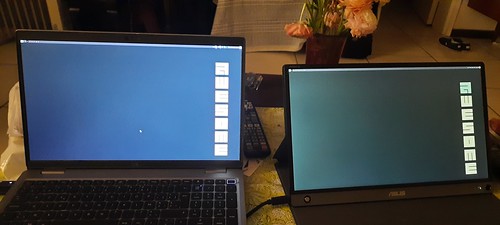
A while ago, I saw Stefano's portable monitor, and thought it was very useful. Personally, I rent a desk at an office space where I have a 27" Dell monitor; but I do sometimes use my laptop away from that desk, and then I do sometimes miss the external monitor. So a few weeks before DebConf, I bought me one myself. The one I got is about a mid-range model; there are models that are less than half the price of the one that I bought, and there are models that are more than double its price, too. ASUS has a very wide range of these monitors; the cheapest model that I could find locally is a 720p monitor that only does USB-C and requires power from the connected device, which presumably if I were to connect it to my laptop with no power connected would half its battery life. More expensive models have features such as wifi connectivity and miracast support, builtin batteries, more connection options, and touchscreen fancyness. While I think some of these features are not worth the money, I do think that a builtin battery has its uses, and that I would want a decent resolution, so I got a FullHD model with builtin battery. 20231016_215332 The device comes with a number of useful accessories: a USB-C to USB-C cable for the USB-C connectivity as well as to charge the battery; an HDMI-to-microHDMI cable for HDMI connectivity; a magnetic sleeve that doubles as a back stand; a beefy USB-A charger and USB-A-to-USB-C convertor (yes, I know); and a... pen. No, really, a pen. You can write with it. Yes, on paper. No, not a stylus. It's really a pen. Sigh, OK. This one: 20231016_222024 OK, believe me now? Good. Don't worry, I was as confused about this as you just were when I first found that pen. Why would anyone do that, I thought. So I read the manual. Not something I usually do with new hardware, but here you go. It turns out that the pen doubles as a kickstand. If you look closely at the picture of the laptop and the monitor above, you may see a little hole at the bottom right of the monitor, just to the right of the power button/LED. The pen fits right there. Now I don't know what the exact thought process was here, but I imagine it went something like this: It's an interesting concept, especially given the fact that the magnetic sleeve works very well as a stand. But hey. Anyway, the monitor is very nice; the battery lives longer than the battery of my laptop usually does, so that's good, and it allows me to have a dual-monitor setup when I'm on the road. And when I'm at the office? Well, now I have a triple-monitor setup. That works well, too.

15 October 2023

Aigars Mahinovs: Figuring out finances part 2

A week ago I started to migrate my financial planning from a closed source system to a new system based on an open source, self-hosted solution. Main candidate is Firefly III - a relatively simple financial planner with a rather rich feature set and a solid user base and developer support. Starting it up with a Docker-Compose file was quite easy, following the official documentation. The same Compose file also managed the MySQL database, the importer app and a cron container for regular imports. The separate importer app allows both imports from CSV files and also from external bank account connection services. For whatever weird reason both of those services support exporting data from my regular bank accounts, but not from my credit cards for exactly the same bank. So for those cards I would need to periodically download CVS transaction exports and feed them into the importer. The combination of the cron container and the importer app allows for both of these functions. To do this you first do the import via the Web UI first and configure all the mappings - configure file and date formats, map account names in the bank output to account names that you added in Firefly, configure what otehr columns mean and what is the mapping of other values, like expense and income accounts. At the end of the process you can download a json file representing all the settings of the import you just did. Putting such a json config file in the input folder of the cron container and telling it to do an import (weekly, for example) would do such import periodically. Putting a credit card CSV file along with a config file for credit card import would also auto-import that. So far so good. However, when I tried importing exports from MoneyWiz or even when I tried re-creating account history directly from the bank data, I hit a very annoying problem. Transfers. Thing is detecting transfers between the real (asset) accounts that you are managing is really essential. For one those are not real expenses and incomes, so failing to mark them as transfers would show weird income/expense numbers. But if you do detect them as transfers and correctly map the destination account, but fail to match the transations between another you get a double-transaction. This becomes really hard when transactions happen on different dates and have different descriptions. So you get both a +1000 transaction "Credit card reset" on 14.09.2023 in the credit card account and a -1000$ transaction "Repayment of own credit card" on 24.09.2023 in the main account of the bank. Matching them to recognise that it is just one transfer and not two is ... non-trivial. The best solution I could come up with so far is to always map the "Opposing account name" for such transfers to a virtual "Transfers" asset account. That has the benefit of being actually able to correctly represent transfers that take several days to move between accounts and showing you how much money is still in transit at any point in time. So after I figured this out, finally the account balances started matching up with reality. Setting up spending categories required another change - the author of the Firefly III does not like complexity so it does not support nesting categories. Categories can only be in a single, flat list. It is suggested that if you do need to track multiple categories and also their combination, then category groups might help you. I will survive for now by simplifying the categories that I do actually use. Might actually make the reports more usable. A new feature for me will be the ability to use automation rules to assign transactions to categories based on their contents, like expense accounts of keywords in descriptions. Setting up regular bills (with matching rules to assign incoming transactions to those bills) is another feature that is very important to me. The feature itself works just fine in Firefly III, but it has two restrictions that the author of the software does not actually want to be changed. For one it can not be used to track prodictable incomes (like salary), presumably because it is only there for bills (subscriptions in v3 UI). And for other, there is nothing in the base software that actually uses the data from bills to look forward. The author does not like to try to predict the future. Which for me is basically the one of two reasons to use this kind of software at all. I want to know - given all manually entered regular and 100% predictable expenses and incomes, what will be the state of my accounts at particular date? It seems that to get at that I will need to write my own oracle script using the rich Firefly III API. The last question I had for this week was - how will I enter a new cash puchace of potatoes on a farmers market into the system that sits in a private server in my home network? Turns out there are actually multiple Android apps for Firefly III that can be easily used for this using a robust OAuth or shared token authentification. Except the web UI needs to be exposed online for this to work (and ideally protected by HTTPS). Other users have also created Telegram bots that allow using chat messages to create transaction entries. This is a bit harder to use and more narrow scope, but should be easier to setup. Will have to try both apporaches. But before I really get going on this, I need to fix another thing that I have been postponing for a while: I will need to migrate my Home Assistant installation from a Docker container installation to a Home Assistant OS installation so that I can install Addons, including Firefly III, MySQL and Portainer to have a bit more organised and less hand-knitted home server setup. Let's see how that goes next week :D

Russ Allbery: Review: A Killing Frost

Review: A Killing Frost, by Seanan McGuire
Series: October Daye #14
Publisher: DAW
Copyright: 2020
ISBN: 0-7564-1253-6
Format: Kindle
Pages: 351
A Killing Frost is the 14th book in the October Daye urban fantasy series and a direct plot sequel to the events of The Brightest Fell. You definitely cannot start here. This review has some relationship spoilers here for things that you would be expecting after the first five or six books, but which you wouldn't know when reading the first few books of the series. If you haven't started the series yet but plan to, consider skipping this review; if you haven't started reading this series, it will probably be meaningless anyway. Finally, events seem to have slowed, enough trauma has been healed, and Toby is able to seriously consider getting married. However, no sooner is the thought voiced than fae politics injects itself yet again. In order to get married without creating potentially substantial future problems for herself and her family, Toby will have to tie up some loose ends. Since one of those loose ends is a price from the Luidaeg that has been haunting her family for decades, this is easier said than done. The Brightest Fell had a very unsatisfying ending. This, after a two book interlude, is the proper end to that story. I picked this up when I had a bunch of stressful things going on and I wanted to be entertained without having to do much work as a reader. Once again, this series delivered exactly that. The writing is repetitive and a bit clunky, McGuire hammers the same emotional points into the ground, and one does wonder about Toby's tendency to emulate a half-human battering ram, but every book has me engrossed and turning the pages. Everyone should have at least one book series on the go that offers reliable, low-effort entertainment. The initial lever that McGuire uses to push Toby into this plot (fae marriage requirements that had never previously been mentioned) felt rather strained and arbitrary, and I spent the first part of the book grumbling a bit about it. However, there is a better reason for this complication that is revealed with time, and which implies some interesting things about how the fae see heroes and how they use them to solve problems. Now I'm wondering if McGuire will explore that some more in later books. This is the "all is revealed" book about Simon Torquill. As we get later into the series, these "all is revealed" books are coming more frequently. So far, I'm finding the revelations satisfying, which is a lot harder than it looks with a series this long and with this many hidden details. There are a few directions the series is taking that aren't my favorite (the Daoine Sidhe obsession with being the Best Fae is getting a bit boring, for example), but none of them seem egregiously off, and I'm deeply invested in the answers to the remaining questions. Toby hits a personal record here for not explaining the dangerous things she's doing because people might talk her out of it. It makes for a tense and gripping climax, but wow I felt for her friends and family, and substantial parts of that risk seemed unnecessary. This is pointed out to her in no uncertain terms, and I'm wondering if it will finally stick. Toby's tendency to solve complicated problems by bleeding on them is part of what gives this series its charm, but I wouldn't mind her giving other people more of a chance to come up with better plans. I did not like this one as well as the previous two books, mostly because I prefer the Luidaeg-centric stories to the Daoine-Sidhe-centric stories, but if you're enjoying the series to this point, this won't be an exception. It's a substantial improvement on The Brightest Fell and did a lot to salvage that story for me, although there are still some aspects of it that need better explanations. Followed by When Sorrows Come. As usual, there is a novella included in at least the Kindle edition. "Shine in Pearl": I was again hoping for more Gillian, but alas. Instead, and breaking with the tendency for the novellas to be side stories unrelated to the main novel, this fleshes out Simon's past and the other primary relationship driving the novel's plot. It's... fine? The best parts by far are the scenes from Dianda's viewpoint, which are just as refreshingly blunt as Dianda is elsewhere. Neither of the other two characters are favorites of mine, and since the point of the story is to describe the tragedy that is resolved in the plot of the main novel, it's somewhat depressing. Not my favorite of the novellas; not the worst of them. (6) Rating: 7 out of 10

Michael Ablassmeier: Testing system updates using libvirts checkpoint feature

If you want to test upgrades on virtual machines (running on libvit/qemu/kvm) these are usually the most common steps: As with recent versions, both libvirt and qemu have full support for dirty bitmaps (so called checkpoints). These checkpoints, once existent, will track changes to the block level layer and can be exported via NBD protocol. Usually one can create these checkpoints using virsh checkpoint-create[-as], with a proper xml description. Using the pull based model, the following is possible: The overlay image will only use the disk space for the blocks changed during upgrade: no need to create a full clone which may waste a lot of disk space. In order to simplify the first step, its possible to use virtnbdbackup for creating the required consistent checkpoint and export its data using a unix domain socket. Update: As alternative, ive just created a small utility called vircpt to create and export checkpoints. In my example im using a debian11 virtual machine with qemu guest agent configured:
# virsh list --all
 Id Name State 
 ------------------------------------------ 
 1 debian11_default running
Now let virtnbdbackup create an checkpoint, freeze the filesystems during creation and tell libvirt to provide us with a usable NBD server listening on an unix socket:
# virtnbdbackup -d debian11_default -o /tmp/foo -s
INFO lib common - printVersion [MainThread]: Version: 1.9.45 Arguments: ./virtnbdbackup -d debian11_default -o /tmp/foo -s
[..] 
INFO root virtnbdbackup - main [MainThread]: Local NBD Endpoint socket: [/var/tmp/virtnbdbackup.5727] 
INFO root virtnbdbackup - startBackupJob [MainThread]: Starting backup job.
INFO fs fs - freeze [MainThread]: Freezed [2] filesystems. 
INFO fs fs - thaw [MainThread]: Thawed [2] filesystems. 
INFO root virtnbdbackup - main [MainThread]: Started backup job for debugging, exiting.
We can now use nbdinfo to display some information about the NBD export:
# nbdinfo "nbd+unix:///vda?socket=/var/tmp/virtnbdbackup.5727" 
    protocol: newstyle-fixed without TLS, using structured packets 
    export="vda": 
    export-size: 137438953472 (128G) 
    content: 
        DOS/MBR boot sector uri: nbd+unix:///vda?socket=/var/tmp/virtnbdbackup.5727
And create a backing image that we can use to test an in-place upgrade:
# qemu-img create -F raw -b nbd+unix:///vda?socket=/var/tmp/virtnbdbackup.5727 -f qcow2 upgrade.qcow2
Now we have various ways for booting the image:
# qemu-system-x86_64 -hda upgrade.qcow2 -m 2500 --enable-kvm
image After performing the required tests within the virtual machine we can simply kill the active NBD backup job :
# virtnbdbackup -d debian11_default -o /tmp/foo -k
INFO lib common - printVersion [MainThread]: Version: 1.9.45 Arguments: ./virtnbdbackup -d debian11_default -o /tmp/foo -k 
[..]
INFO root virtnbdbackup - main [MainThread]: Stopping backup job
And remove the created qcow image:
# rm -f upgrade.qcow2

14 October 2023

Ravi Dwivedi: Kochi - Wayanad Trip in August-September 2023

A trip full of hitchhiking, beautiful places and welcoming locals.

Day 1: Arrival in Kochi Kochi is a city in the state of Kerala, India. This year s DebConf was to be held in Kochi from 3rd September to 17th of September, which I was planning to attend. My friend Suresh, who was planning to join, told me that 29th August 2023 will be Onam, a major festival of the state of Kerala. So, we planned a Kerala trip before the DebConf. We booked early morning flights for Kochi from Delhi and reached Kochi on 28th August. We had booked a hostel named Zostel in Ernakulam. During check-in, they asked me to fill a form which required signing in using a Google account. I told them I don t have a Google account and I don t want to create one either. The people at the front desk seemed receptive, so I went ahead with telling them the problems of such a sign-in being mandatory for check-in. Anyways, they only took a photo of my passport and let me check-in without a Google account. We stayed in a ten room dormitory, which allowed travellers of any gender. The dormitory room was air-conditioned, spacious, clean and beds were also comfortable. There were two bathrooms in the dormitory and they were clean. Plus, there was a separate dormitory room in the hostel exclusive for females. I noticed that that Zostel was not added in the OpenStreetMap and so, I added it :) . The hostel had a small canteen for tea and snacks, a common sitting area outside the dormitories, which had beds too. There was a separate silent room, suitable for people who want to work.
Dormitory room in Zostel Ernakulam, Kochi.
Beds in Zostel Ernakulam, Kochi.
We had lunch at a nearby restaurant and it was hard to find anything vegetarian for me. I bought some freshly made banana chips from the street and they were tasty. As far as I remember, I had a big glass of pineapple juice for lunch. Then I went to the Broadway market and bought some cardamom and cinnamon for home. I also went to a nearby supermarket and bought Matta brown rice for home. Then, I looked for a courier shop to send the things home but all of them were closed due to Onam festival. After returning to the Zostel, I overslept till 9 PM and in the meanwhile, Suresh planned with Saidut and Shwetank (who met us during our stay in Zostel) to go to a place in Fort Kochi for dinner. I suspected I will be disappointed by lack of vegetarian options as they were planning to have fish. I already had a restaurant in mind - Brindhavan restaurant (suggested by Anupa), which was a pure vegetarian restaurant. To reach there, I got off at Palarivattom metro station and started looking for an auto-rickshaw to get to the restaurant. I didn t get any for more than 5 minutes. Since that restaurant was not added to the OpenStreetMap, I didn t even know how far that was and which direction to go to. Then, I saw a Zomato delivery person on a motorcycle and asked him where the restaurant was. It was already 10 PM and the restaurant closes at 10:30. So, I asked him whether he can drop me off. He agreed and dropped me off at that restaurant. It was 4-5 km from that metro station. I tipped him and expressed my gratefulness for the help. He refused to take the tip, but I insisted and he accepted. I entered the restaurant and it was coming to a close, so many items were not available. I ordered some Kadhai Paneer (only item left) with naan. It tasted fine. Since the next day was Thiruvonam, I asked the restaurant about the Sadya thali menu and prices for the next day. I planned to eat Sadya thali at that restaurant, but my plans got changed later.
Onam sadya menu from Brindhavan restaurant.
Day 2: Onam celebrations Next day, on 29th of August 2023, we had plan to leave for Wayanad. Wayanad is a hill station in Kerala and a famous tourist spot. Praveen suggested to visit Munnar as it is far closer to Kochi than Wayanad (80 km vs 250 km). But I had already visited Munnar in my previous trips, so we chose Wayanad. We had a train late night from Ernakulam Junction (at 23:30 hours) to Kozhikode, which is the nearest railway station from Wayanad. So, we checked out in the morning as we had plans to roam around in Kochi before taking the train. Zostel was celebrating Onam on that day. To opt-in, we had to pay 400 rupees, which included a Sadya Thali and a mundu. Me and Suresh paid the amount and opted in for the celebrations. Sadya thali had Rice, Sambhar, Rasam, Avial, Banana Chips, Pineapple Pachadi, Pappadam, many types of pickels and chutneys, Pal Ada Payasam and Coconut jaggery Pasam. And, there was water too :). Those payasams were really great and I had one more round of them. Later, I had a lot of variety of payasams during the DebConf.
Sadya lined up for serving
Sadya thali served on banana leaf.

So, we hung out in the common room and put our luggage there. We played UNO and had conversations with other travellers in the hostel. I had a fun time there and I still think it is one of the best hostel experiences I had. We made good friends with Saiduth (Telangana) and Shwetank (Uttarakhand). They were already aware about the software like debian, and we had some detailed conversations about the Free Software movement. I remember explaining the difference between the terms Open Source and Free Software . I also told them about the Streetcomplete app, a beginner friendly app to edit OpenStreetMap. We had dinner at a place nearby (named Palaraam), but again, the vegetarian options were very limited! After dinner, we came back to the Zostel and me and Suresh left for Ernakulam Junction to catch our train Maveli Express (16604).

Day 3: Going to Wayanad Maveli Express was scheduled to reach Kozhikode at 03:25 (morning). I had set alarms from 03:00 to 03:30, with the gap of 10 minutes. Every time I woke up, I turned off the alarm. Then I woke up and saw train reaching the Kozhikode station and woke up Suresh for deboarding. But then I noticed that the train is actually leaving the station, not arriving! This means we missed our stop. Now we looked at the next stops and whether we can deboard there. I was very sleepy and wanted to take a retiring room at some station before continuing our journey to Wayanad. The next stop was Quilandi and we checked online that it didn t have a retiring room. So, we skipped this stop. We got off at the next stop named Vadakara and found out no retiring room was available. So, we asked about information regarding bus for Wayanad and they said that there is a bus to Wayanad around 07:00 hours from bus station which was a few kilometres from the railway station. We took a bus for Kalpetta (in Wayanad) at around 07:00. The destination of the buses were written in Malayalam, which we could not read. Once again, the locals helped us to get on to the bus to Kalpetta. Vadakara is not a big city and it can be hard to find people who know good Hindi or English, unlike Kochi. Despite language issues, I had no problem there in navigation, thanks to locals. I mostly spent time sleeping during the bus journey. A few hours later, the bus dropped us at Kalpetta. We had a booking at a hostel in Rippon village. It was 16 km from Kalpetta. On the way, we were treated with beautiful views of nature, which was present everywhere in Wayanad. The place was covered with tea gardens and our eyes were treated with beautiful scenery at every corner.
We were treated with such views during the Wayanad trip.
Rippon village was a very quiet place and I liked the calm atmosphere. This place is blessed by nature and has stunning scenery. I found English was more common than Hindi in Wayanad. Locals were very nice and helped me, even if they didn t know my language.
A road in Rippon.
After catching some sleep at the hostel, I went out in the afternoon. I hitchhiked to reach the main road from the hostel. I bought more spices from a nearby shop and realized that I should have waited for my visit to Wayanad to buy cardamom, which I already bought from Kochi. Then, I was looking for post office to send spices home. The people at the spices shop told me that the nearby Rippon post office was closed by that time, but the post office at Meppadi was open, which was 5 km from there. I went to Meppadi and saw the post office closes at 15:00, but I reached five minutes late. My packing was not very good and they asked me to pack it tighter. There was a shop near the post office and the people there gave me a cardboard and tapes, and helped pack my stuff for the post. By the time I went to the post office again, it was 15:30. But they accepted my parcel for post.

Day 4: Kanthanpara Falls, Zostel Wayanad and Karapuzha Dam Kanthanpara waterfalls were 2 km from the hostel. I hitchhiked to the place from the hostel on a scooty. Entry ticket was worth Rs 40. There were good views inside and nothing much to see except the waterfalls.
Entry to Kanthanpara Falls.
Kanthanpara Falls.
We had a booking at Zostel Wayanad for this day and so we shifted there. Again, as with their Ernakulam branch, they asked me to fill a form which required signing in using Google, but when I said I don t have a Google account they checked me in without that. There were tea gardens inside the Zostel boundaries and the property was beautiful.
A view of Zostel Wayanad.
A map of Wayanad showing tourist places.

A view from inside the Zostel Wayanad property.
Later in the evening, I went to Karapuzha Dam. I witnessed a beautiful sunset during the journey. Karapuzha dam had many activites, like ziplining, and was nice to roam around. Chembra Peak is near to the Zostel Wayanad. So, I was planning to trek to the heart shaped lake. It was suggested by Praveen and looking online, this trek seemed worth doing. There was an issue however. The charges for trek were Rs 1770 for upto five people. So, if I go alone I will have to spend Rs 1770 for the trek. If I go with another person, we split Rs 1770 into two, and so on. The optimal way to do it is to go in a group of five (you included :D). I asked front desk at Zostel if they can connect me with people going to Chembra peak the next day, and they told me about a group of four people planning to go to Chembra peak the next day. I got lucky! All four of them were from Kerala and worked in Qatar.

Day 5: Chembra peak trek The date was 1st September 2023. I woke up early (05:30 in the morning) for the Chembra peak trek. I had bought hiking shoes especially for trekking, which turned out to be a very good idea. The ticket counter opens at 07:00. The group of four with which I planned to trek met me around 06:00 in the Zostel. We went to the ticket counter around 06:30. We had breakfast at shops selling Maggi noodles and bread omlette near the ticket counter. It was a hot day and the trek was difficult for an inexperienced person like me. The scenery was green and beautiful throughout.
Terrain during trekking towards the Chembra peak.

Heart-shaped lake at the Chembra peak.
Me at the heart-shaped lake.

Views from the top of the Chembra peak.

View of another peak from the heart-shaped lake.
While returning from the trek, I found out a shop selling bamboo rice, which I bought and will make bamboo rice payasam out of it at home (I have some coconut milk from Kerala too ;)). We returned to Zostel in the afternoon. I had muscle pain after the trek and it has still not completely disappeared. At night, we took a bus from Kalpetta to Kozhikode in order to return to Kochi.

Day 6: Return to Kochi At midnight of 2nd of September, we reached Kozhikode bus stand. Then we roamed around for something to eat. I didn t find anything vegetarian to eat. No surprises there! Then we went to Kozhikode railway station and looked for retiring rooms, but no luck there. We waited at the station and took the next train to Kochi at 03:30 and reached Ernakulam Junction at 07:30 (half hours before train s scheduled time!). From there, we went to Zostel Fort Kochi and stayed one night there and checked out next morning.

Day 7: Roaming around in Fort Kochi On 3rd of September, we roamed around in Fort Kochi. We visited the usual places - St Francis Church, Dutch Palace, Jew Town, Pardesi Synagogue. I also visited some homestays and the owners were very happy to show their place even when I made it clear that I was not looking for a stay. In the evening, we went to Kakkanad to attend DebConf. The story continues in my DebConf23 blog post.

13 October 2023

Scarlett Gately Moore: KDE: Snaps move, KDE neon unstable broken OMG! Fixed, and Debian updates

Kitties keeping warm!
It s that time of year already! We have hit our first freeze of the year. While the kitties keep warm by the wood burning stove, I have been busy with many updates and fixes in a variety of projects. KDE neon: It s true, Neon unstable has been very unstable. Due to a few factors including a builder being out of space, timed with a new Qt release. There is a cost with living in unstable land with bleeding edge releases. It takes time and finesse to get everything happy, especially with major transitions such as Qt. The drive issue was just bad timing. We worked night and day ( quite literally with people spanning from the US, Europe and Australia ) to get everything happy again. I know it s frustrating when things are broken, but please keep in mind, most of us are volunteers. I am happy to report, it is once again stable. If you continue to experience issues please report them on https://bugs.kde.org there have been a few cases where there were rogue apt sources lists creating issues. We also have the User edition which is much more stable!
KDE Snaps: The big move to snapcraft files per repo continues. With that comes a new version 23.08.2. This big win this week was Audiotube! I have finally got this snap working. With a combination of snappy-debug and snap run gdb audiotube I was able to find all the hidden dependencies such as yt-dlp needed to be built with ffmpeg support and it needed a newer ytmusicapi as the version it called for was broken with gettext translations. I also had to fix the dbus name as it was not the standard org.kde.app. The final fix was it required the alsa plug and layouts adjusted to point to the snap alsa libraries ( which fixed the very important sound feature ). Who says you can t teach an old dog new tricks. Unfortunately, it still requires devmode to run, as it has one last network issue even with all the network plugs. I have to set it aside for now, as I have many more snaps to migrate. However, if you want to enjoy youtube music with this super awesome app you can, just append devmode when installing. Enjoy! The following apps have now migrated to their respective KDE repos and have the snap recipes in launchpad for automated builds: A new content pack with the latest Frameworks 5.110 and Qt 5.15.11 is complete and the neon extension update will follow after the required global autoconnect is approved from the store. Debian: I have caught up on my dashboard with new releases, fixed test failures, and FTBFS on the more obscure arches. The following debian packages have been uploaded to unstable:
description
umbrello
squashfuse
golang-github-muesli-mango
golang-github-muesli-roff
speechpy-fast
lingua-franca
If you have made it this far, thank you! As you can see I am quite busy and there is still much to do. If you can possibly spare a donation so I can continue my efforts in KDE neon / KDE Snaps / and Debian, it would be so appreciated. I enjoy doing this work and I hope it benefits someone out there. Have a lovely day and thanks for stopping by. Donate https://gofund.me/b8b69e54

Next.

Previous.