Search Results: "dom"

13 April 2017

Francois Marier: Automatically renewing Let's Encrypt TLS certificates on Debian using Certbot

I use Let's Encrypt TLS certificates on my Debian servers along with the Certbot tool. Since I use the "temporary webserver" method of proving domain ownership via the ACME protocol, I cannot use the cert renewal cronjob built into Certbot. Instead, this is the script I put in /etc/cron.daily/certbot-renew:
#!/bin/bash
/usr/bin/certbot renew --quiet --pre-hook "/bin/systemctl stop apache2.service" --post-hook "/bin/systemctl start apache2.service"
pushd /etc/ > /dev/null
/usr/bin/git add letsencrypt
DIFFSTAT="$(/usr/bin/git diff --cached --stat)"
if [ -n "$DIFFSTAT" ] ; then
    /usr/bin/git commit --quiet -m "Renewed letsencrypt certs"
    echo "$DIFFSTAT"
fi
popd > /dev/null
It temporarily disables my Apache webserver while it renews the certificates and then only outputs something to STDOUT (since my cronjob will email me any output) if certs have been renewed. Since I'm using etckeeper to keep track of config changes on my servers, my renewal script also commits to the repository if any certs have changed.

External Monitoring In order to catch mistakes or oversights, I use ssl-cert-check to monitor my domains once a day:
ssl-cert-check -s fmarier.org -p 443 -q -a -e francois@fmarier.org
I also signed up with Cert Spotter which watches the Certificate Transparency log and notifies me of any newly-issued certificates for my domains. In other words, I get notified:
  • if my cronjob fails and a cert is about to expire, or
  • as soon as a new cert is issued.
The whole thing seems to work well, but if there's anything I could be doing better, feel free to leave a comment!

Michal Čihař: Weblate 2.13.1

Weblate 2.13.1 has been released quickly after 2.13. It fixes few minor issues and possible upgrade problem. Full list of changes: If you are upgrading from older version, please follow our upgrading instructions. You can find more information about Weblate on https://weblate.org, the code is hosted on Github. If you are curious how it looks, you can try it out on demo server. You can login there with demo account using demo password or register your own user. Weblate is also being used on https://hosted.weblate.org/ as official translating service for phpMyAdmin, OsmAnd, Aptoide, FreedomBox, Weblate itself and many other projects. Should you be looking for hosting of translations for your project, I'm happy to host them for you or help with setting it up on your infrastructure. Further development of Weblate would not be possible without people providing donations, thanks to everybody who have helped so far! The roadmap for next release is just being prepared, you can influence this by expressing support for individual issues either by comments or by providing bounty for them.

Filed under: Debian English SUSE Weblate 0 comments

12 April 2017

Vincent Bernat: Proper isolation of a Linux bridge

TL;DR: when configuring a Linux bridge, use the following commands to enforce isolation:
# bridge vlan del dev br0 vid 1 self
# echo 1 > /sys/class/net/br0/bridge/vlan_filtering

A network bridge (also commonly called a switch ) brings several Ethernet segments together. It is a common element in most infrastructures. Linux provides its own implementation. A typical use of a Linux bridge is shown below. The hypervisor is running three virtual hosts. Each virtual host is attached to the br0 bridge (represented by the horizontal segment). The hypervisor has two physical network interfaces: Typical use of Linux bridging with virtual machines The main expectation of such a setup is that while the virtual hosts should be able to use resources from the public network, they should not be able to access resources from the infrastructure network (including resources hosted on the hypervisor itself, like a SSH server). In other words, we expect a total isolation between the green domain and the purple one. That s not the case. From any virtual host:
# ip route add 192.168.14.3/32 dev eth0
# ping -c 3 192.168.14.3
PING 192.168.14.3 (192.168.14.3) 56(84) bytes of data.
64 bytes from 192.168.14.3: icmp_seq=1 ttl=59 time=0.644 ms
64 bytes from 192.168.14.3: icmp_seq=2 ttl=59 time=0.829 ms
64 bytes from 192.168.14.3: icmp_seq=3 ttl=59 time=0.894 ms
--- 192.168.14.3 ping statistics ---
3 packets transmitted, 3 received, 0% packet loss, time 2033ms
rtt min/avg/max/mdev = 0.644/0.789/0.894/0.105 ms

Why? There are two main factors of this behavior:
  1. A bridge can accept IP traffic. This is a useful feature if you want Linux to act as a bridge and provide some IP services to bridge users (a DHCP relay or a default gateway). This is usually done by configuring the IP address on the bridge device: ip addr add 192.0.2.2/25 dev br0.
  2. An interface doesn t need an IP address to process incoming IP traffic. Additionally, by default, Linux accepts to answer ARP requests independently from the incoming interface.

Bridge processing After turning an incoming Ethernet frame into a socket buffer, the network driver transfers the buffer to the netif_receive_skb() function. The following actions are executed:
  1. copy the frame to any registered global or per-device taps (e.g. tcpdump),
  2. evaluate the ingress policy (configured with tc),
  3. hand over the frame to the device-specific receive handler, if any,
  4. hand over the frame to a global or device-specific protocol handler (e.g. IPv4, ARP, IPv6).
For a bridged interface, the kernel has configured a device-specific receive handler, br_handle_frame(). This function won t allow any additional processing in the context of the incoming interface, except for STP and LLDP frames or if brouting is enabled1. Therefore, the protocol handlers are never executed in this case. After a few additional checks, Linux will decide if the frame has to be locally delivered:
  • the entry for the target MAC in the FDB is marked for local delivery, or
  • the target MAC is a broadcast or a multicast address.
In this case, the frame is passed to the br_pass_frame_up() function. A VLAN-related check is optionally performed. The socket buffer is attached to the bridge interface (br0) instead of the physical interface (eth0), is evaluated by Netfilter and sent back to netif_receive_skb(). It will go through the four steps a second time.

IPv4 processing When a device doesn t have a protocol-independent receive handler, a protocol-specific handler will be used:
# cat /proc/net/ptype
Type Device      Function
0800          ip_rcv
0011          llc_rcv [llc]
0004          llc_rcv [llc]
0806          arp_rcv
86dd          ipv6_rcv
Therefore, if the Ethernet type of the incoming frame is 0x800, the socket buffer is handled by ip_rcv(). Among other things, the three following steps will happen:
  • If the frame destination address is not the MAC address of the incoming interface, not a multicast one and not a broadcast one, the frame is dropped ( not for us ).
  • Netfilter gets a chance to evaluate the packet (in a PREROUTING chain).
  • The routing subsystem will decide the destination of the packet in ip_route_input_slow(): is it a local packet, should it be forwarded, should it be dropped, should it be encapsulated? Notably, the reverse-path filtering is done during this evaluation in fib_validate_source().
Reverse-path filtering (also known as uRPF, or unicast reverse-path forwarding, RFC 3704) enables Linux to reject traffic on interfaces which it should never have originated: the source address is looked up in the routing tables and if the outgoing interface is different from the current incoming one, the packet is rejected.

ARP processing When the Ethernet type of the incoming frame is 0x806, the socket buffer is handled by arp_rcv().
  • Like for IPv4, if the frame is not for us, it is dropped.
  • If the incoming device has the NOARP flag, the frame is dropped.
  • Netfilter gets a chance to evaluate the packet (configuration is done with arptables).
  • For an ARP request, the values of arp_ignore and arp_filter may trigger a drop of the packet.

IPv6 processing When the Ethernet type of the incoming frame is 0x86dd, the socket buffer is handled by ipv6_rcv().
  • Like for IPv4, if the frame is not for us, it is dropped.
  • If IPv6 is disabled on the interface, the packet is dropped.
  • Netfilter gets a chance to evaluate the packet (in a PREROUTING chain).
  • The routing subsystem will decide the destination of the packet. However, unlike IPv4, there is no reverse-path filtering2.

Workarounds There are various methods to fix the situation. We can completely ignore the bridged interfaces: as long as they are attached to the bridge, they cannot process any upper layer protocol (IPv4, IPv6, ARP). Therefore, we can focus on filtering incoming traffic from br0. It should be noted that for IPv4, IPv6 and ARP protocols, the MAC address check can be circumvented by using the broadcast MAC address.

Protocol-independent workarounds The four following fixes will indistinctly drop IPv4, ARP and IPv6 packets.

Using VLAN-aware bridge Linux 3.9 introduced the ability to use VLAN filtering on bridge ports. This can be used to prevent any local traffic:
# echo 1 > /sys/class/net/br0/bridge/vlan_filtering
# bridge vlan del dev br0 vid 1 self
# bridge vlan show
port    vlan ids
eth0     1 PVID Egress Untagged
eth2     1 PVID Egress Untagged
eth3     1 PVID Egress Untagged
eth4     1 PVID Egress Untagged
br0     None
This is the most efficient method since the frame is dropped directly in br_pass_frame_up().

Using ingress policy It s also possible to drop the bridged frame early after it has been re-delivered to netif_receive_skb() by br_pass_frame_up(). The ingress policy of an interface is evaluated before any handler. Therefore, the following commands will ensure no local delivery (the source interface of the packet is the bridge interface) happens:
# tc qdisc add dev br0 handle ffff: ingress
# tc filter add dev br0 parent ffff: u32 match u8 0 0 action drop
In my opinion, this is the second most efficient method.

Using ebtables Just before re-delivering the frame to netif_receive_skb(), Netfilter gets a chance to issue a decision. It s easy to configure it to drop the frame:
# ebtables -A INPUT --logical-in br0 -j DROP
However, to the best of my knowledge, this part of Netfilter is known to be inefficient.

Using namespaces Isolation can also be obtained by moving all the bridged interfaces into a dedicated network namespace and configure the bridge inside this namespace:
# ip netns add bridge0
# ip link set netns bridge0 eth0
# ip link set netns bridge0 eth2
# ip link set netns bridge0 eth3
# ip link set netns bridge0 eth4
# ip link del dev br0
# ip netns exec bridge0 brctl addbr br0
# for i in 0 2 3 4; do
>    ip netns exec bridge0 brctl addif br0 eth$i
>    ip netns exec bridge0 ip link set up dev eth$i
> done
# ip netns exec bridge0 ip link set up dev br0
The frame will still wander a bit inside the IP stack, wasting some CPU cycles and increasing the possible attack surface. But ultimately, it will be dropped.

Protocol-dependent workarounds Unless you require multiple layers of security, if one of the previous workarounds is already applied, there is no need to apply one of the protocol-dependent fix below. It s still interesting to know them because it is not uncommon to already have them in place.

ARP The easiest way to disable ARP processing on a bridge is to set the NOARP flag on the device. The ARP packet will be dropped as the very first step of the ARP handler.
# ip link set arp off dev br0
# ip l l dev br0
8: br0: <BROADCAST,MULTICAST,NOARP,UP,LOWER_UP> mtu 1500 qdisc noqueue state UP mode DEFAULT group default qlen 1000
    link/ether 50:54:33:00:00:04 brd ff:ff:ff:ff:ff:ff
arptables can also drop the packet quite early:
# arptables -A INPUT -i br0 -j DROP
Another way is to set arp_ignore to 2 for the given interface. The kernel will only answer to ARP requests whose target IP address is configured on the incoming interface. Since the bridge interface doesn t have any IP address, no ARP requests will be answered.
# sysctl -qw net.ipv4.conf.br0.arp_ignore=2
Disabling ARP processing is not a sufficient workaround for IPv4. A user can still insert the appropriate entry in its neighbor cache:
# ip neigh replace 192.168.14.3 lladdr 50:54:33:00:00:04 dev eth0
# ping -c 1 192.168.14.3
PING 192.168.14.3 (192.168.14.3) 56(84) bytes of data.
64 bytes from 192.168.14.3: icmp_seq=1 ttl=49 time=1.30 ms
--- 192.168.14.3 ping statistics ---
1 packets transmitted, 1 received, 0% packet loss, time 0ms
rtt min/avg/max/mdev = 1.309/1.309/1.309/0.000 ms
As the check on the target MAC address is quite loose, they don t even need to guess the MAC address:
# ip neigh replace 192.168.14.3 lladdr ff:ff:ff:ff:ff:ff dev eth0
# ping -c 1 192.168.14.3
PING 192.168.14.3 (192.168.14.3) 56(84) bytes of data.
64 bytes from 192.168.14.3: icmp_seq=1 ttl=49 time=1.12 ms
--- 192.168.14.3 ping statistics ---
1 packets transmitted, 1 received, 0% packet loss, time 0ms
rtt min/avg/max/mdev = 1.129/1.129/1.129/0.000 ms

IPv4 The earliest place to drop an IPv4 packet is with Netfilter3:
# iptables -t raw -I PREROUTING -i br0 -j DROP
If Netfilter is disabled, another possibility is to enable strict reverse-path filtering for the interface. In this case, since there is no IP address configured on the interface, the packet will be dropped during the route lookup:
# sysctl -qw net.ipv4.conf.br0.rp_filter=1
Another option is the use of a dedicated routing rule. Compared to the reverse-path filtering option, the packet will be dropped a bit earlier, still during the route lookup.
# ip rule add iif br0 blackhole

IPv6 Linux provides a way to completely disable IPv6 on a given interface. The packet will be dropped as the very first step of the IPv6 handler:
# sysctl -qw net.ipv6.conf.br0.disable_ipv6=1
Like for IPv4, it s possible to use Netfilter or a dedicated routing rule.

About the example In the above example, the virtual host get ICMP replies because they are routed through the infrastructure network to Internet (e.g. the hypervisor has a default gateway which also acts as a NAT router to Internet). This may not be the case. If you want to check if you are vulnerable despite not getting an ICMP reply, look at the guest neighbor table to check if you got an ARP reply from the host:
# ip route add 192.168.14.3/32 dev eth0
# ip neigh show dev eth0
192.168.14.3 lladdr 50:54:33:00:00:04 REACHABLE
If you didn t get a reply, you could still have issues with IP processing. Add a static neighbor entry before checking the next step:
# ip neigh replace 192.168.14.3 lladdr ff:ff:ff:ff:ff:ff dev eth0
To check if IP processing is enabled, check the bridge host s network statistics:
# netstat -s   grep "ICMP messages"
    15 ICMP messages received
    15 ICMP messages sent
    0 ICMP messages failed
If the counters are increasing, it is processing incoming IP packets. One-way communication still allows a lot of bad things, like DoS attacks. Additionally, if the hypervisor happens to also act as a router, the reach is extended to the whole infrastructure network, potentially exposing weak devices (e.g. PDU) exposing an SNMP agent. If one-way communication is all that s needed, the attacker can also spoof its source IP address, bypassing IP-based authentication.

  1. A frame can be forcibly routed (L3) instead of bridged (L2) by brouting the packet. This action can be triggered using ebtables.
  2. For IPv6, reverse-path filtering needs to be implemented with Netfilter, using the rpfilter match.
  3. If the br_netfilter module is loaded, net.bridge.bridge-nf-call-ipatbles sysctl has to be set to 0. Otherwise, you also need to use the physdev match to not drop IPv4 packets going through the bridge.

Daniel Pocock: What is the risk of using proprietary software for people who prefer not to?

Jonas berg has recently blogged about Using Proprietary Software for Freedom. He argues that it can be acceptable to use proprietary software to further free and open source software ambitions if that is indeed the purpose. Jonas' blog suggests that each time proprietary software is used, the relative risk and reward should be considered and there may be situations where the reward is big enough and the risk low enough that proprietary software can be used. A question of leadership Many of the free software users and developers I've spoken to express frustration about how difficult it is to communicate to their family and friends about the risks of proprietary software. A typical example is explaining to family members why you would never install Skype. Imagine a doctor who gives a talk to school children about the dangers of smoking and is then spotted having a fag at the bus stop. After a month, if you ask the children what they remember about that doctor, is it more likely to be what he said or what he did? When contemplating Jonas' words, it is important to consider this leadership factor as a significant risk every time proprietary software or services are used. Getting busted with just one piece of proprietary software undermines your own credibility and posture now and well into the future. Research has shown that when communicating with people, what they see and how you communicate is ninety three percent of the impression you make. What you actually say to them is only seven percent. When giving a talk at a conference or a demo to a client, or communicating with family members in our everyday lives, using a proprietary application or a product or service that is obviously proprietary like an iPhone or Facebook will have far more impact than the words you say. It is not only a question of what you are seen doing in public: somebody who lives happily and comfortably without using proprietary software sounds a lot more credible than somebody who tries to explain freedom without living it. The many faces of proprietary software One of the first things to consider is that even for those developers who have a completely free operating system, there may well be some proprietary code lurking in their BIOS or other parts of their hardware. Their mobile phone, their car, their oven and even their alarm clock are all likely to contain some proprietary code too. The risks associated with these technologies may well be quite minimal, at least until that alarm clock becomes part of the Internet of Things and can be hacked by the bored teenager next door. Accessing most web sites these days inevitably involves some interaction with proprietary software, even if it is not running on your own computer. There is no need to give up Some people may consider this state of affairs and simply give up, using whatever appears to be the easiest solution for each problem at hand without thinking too much about whether it is proprietary or not. I don't think Jonas' blog intended to sanction this level of complacency. Every time you come across a piece of software, it is worth considering whether a free alternative exists and whether the software is really needed at all. An orderly migration to free software In our professional context, most software developers come across proprietary software every day in the networks operated by our employers and their clients. Sometimes we have the opportunity to influence the future of these systems. There are many cases where telling the client to go cold-turkey on their proprietary software would simply lead to the client choosing to get advice from somebody else. The free software engineer who looks at the situation strategically may find that it is possible to continue using the proprietary software as part of a staged migration, gradually helping the user to reduce their exposure over a period of months or even a few years. This may be one of the scenarios where Jonas is sanctioning the use of proprietary software. On a technical level, it may be possible to show the client that we are concerned about the dangers but that we also want to ensure the continuity of their business. We may propose a solution that involves sandboxing the proprietary software in a virtual machine or a DMZ to prevent it from compromising other systems or "calling home" to the vendor. As well as technical concerns about a sudden migration, promoters of free software frequently encounter political issues as well. For example, the IT manager in a company may be five years from retirement and is not concerned about his employer's long term ability to extricate itself from a web of Microsoft licenses after he or she has the freedom to go fishing every day. The free software professional may need to invest significant time winning the trust of senior management before he is able to work around a belligerant IT manager like this. No deal is better than a bad deal People in the UK have probably encountered the expression "No deal is better than a bad deal" many times already in the last few weeks. Please excuse me for borrowing it. If there is no free software alternative to a particular piece of proprietary software, maybe it is better to simply do without it. Facebook is a great example of this principle: life without social media is great and rather than trying to find or create a free alternative, why not just do something in the real world, like riding motorcycles, reading books or getting a cat or dog? Burning bridges behind you For those who are keen to be the visionaries and leaders in a world where free software is the dominant paradigm, would you really feel satisfied if you got there on the back of proprietary solutions? Or are you concerned that taking such shortcuts is only going to put that vision further out of reach? Each time you solve a problem with free software, whether it is small or large, in your personal life or in your business, the process you went through strengthens you to solve bigger problems the same way. Each time you solve a problem using a proprietary solution, not only do you miss out on that process of discovery but you also risk conditioning yourself to be dependent in future. For those who hope to build a successful startup company or be part of one, how would you feel if you reach your goal and then the rug is pulled out underneath you when a proprietary software vendor or cloud service you depend on changes the rules? Personally, in my own life, I prefer to avoid and weed out proprietary solutions wherever I can and force myself to either make free solutions work or do without them. Using proprietary software and services is living your life like a rat in a maze, where the oligarchs in Silicon Valley can move the walls around as they see fit.

Michal &#268;iha&#345;: Weblate 2.13

Weblate 2.13 has been released today pretty much on the schedule. The most important change being more fine grained access control and some smaller UI improvements. There are other new features and bug fixes as well. Full list of changes: If you are upgrading from older version, please follow our upgrading instructions. You can find more information about Weblate on https://weblate.org, the code is hosted on Github. If you are curious how it looks, you can try it out on demo server. You can login there with demo account using demo password or register your own user. Weblate is also being used on https://hosted.weblate.org/ as official translating service for phpMyAdmin, OsmAnd, Aptoide, FreedomBox, Weblate itself and many other projects. Should you be looking for hosting of translations for your project, I'm happy to host them for you or help with setting it up on your infrastructure. Further development of Weblate would not be possible without people providing donations, thanks to everybody who have helped so far! The roadmap for next release is just being prepared, you can influence this by expressing support for individual issues either by comments or by providing bounty for them.

Filed under: Debian English Gammu phpMyAdmin SUSE Weblate 0 comments

8 April 2017

Dirk Eddelbuettel: #4: Simpler shoulders()

Welcome to the fourth post in the repulsively random R ramblings series, or R4 for short. My twitter feed was buzzing about a nice (and as yet unpublished, ie not-on-CRAN) package thankr by Dirk Schumacher which compiles a list of packages (ordered by maintainer count) for your current session (or installation or ...) with a view towards saying thank you to those whose packages we rely upon. Very nice indeed. I had a quick look and run it twice ... and had a reaction of ewwww, really? as running it twice gave different results as on the second instance a boatload of tibblyverse packages appeared. Because apparently kids these day can only slice data that has been tidied or something. So I had another quick look ... and put together an alternative version using just base R (as there was only one subfunction that needed reworking):
source(file="https://raw.githubusercontent.com/dirkschumacher/thankr/master/R/shoulders.R")
format_pkg_df <- function(df)   # non-tibblyverse variant
    tb <- table(df[,2])
    od <- order(tb, decreasing=TRUE)
    ndf <- data.frame(maint=names(tb)[od], npkgs=as.integer(tb[od]))
    colpkgs <- function(m, df)   paste(df[ df$maintainer == m, "pkg_name"], collapse=",")  
    ndf[, "pkg"] <- sapply(ndf$maint, colpkgs, df)
    ndf
 
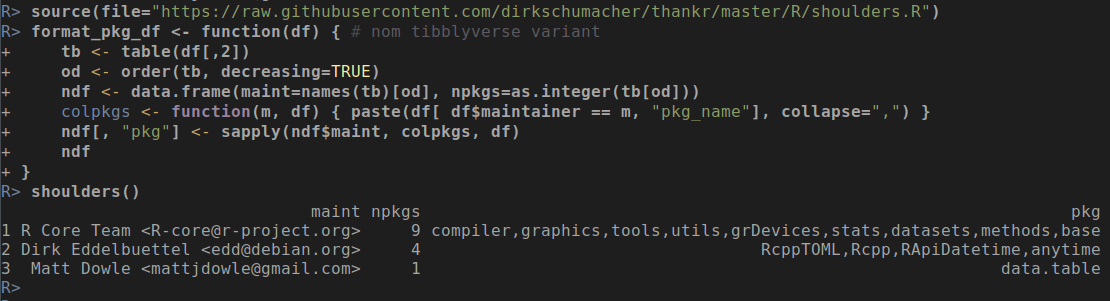
A nice side benefit is that the function is now free of external dependencies (besides, of course, base R). Running this in the ESS session I had open gives:
R> shoulders()  ## by Dirk Schumacher, with small modifications
                               maint npkgs                                                                 pkg
1 R Core Team <R-core@r-project.org>     9 compiler,graphics,tools,utils,grDevices,stats,datasets,methods,base
2 Dirk Eddelbuettel <edd@debian.org>     4                                  RcppTOML,Rcpp,RApiDatetime,anytime
3  Matt Dowle <mattjdowle@gmail.com>     1                                                          data.table
R> 
and for good measure a screenshot is below:
I think we need a catchy moniker for R work using good old base R. SoberVerse? GrumbyOldFolksR? PlainOldR? Better suggestions welcome. Edit on 2017-04-09: And by now Dirk Schumacher fixed that little bug in thankr which was at the start of this. His shoulders() function is now free of side effects, and thankr is now a clean micropackage free of external depends from any verse, be it tiddly or grumpy. I look forward to seeing it on CRAN soon!

This post by Dirk Eddelbuettel originated on his Thinking inside the box blog. Please report excessive re-aggregation in third-party for-profit settings.

6 April 2017

Reproducible builds folks: Reproducible Builds: week 101 in Stretch cycle

Here's what happened in the Reproducible Builds effort between Sunday March 26 and Saturday April 1 2017: Media coverage Sylvain Beucler wrote a follow-up post Practical basics of reproducible builds 2, which like last weeks article is about his experiences making software build reproducibly. Reproducible work in other projects Colin Watson started writing a patch to make launchpad store .buildinfo files. (It's not yet deployed.) Toolchain development and fixes Ximin Luo continued to work on BUILD_PATH_PREFIX_MAP patches for GCC 6 and dpkg. Packages reviewed and fixed, and bugs filed Chris Lamb: Mattia Rizzolo: Reviews of unreproducible packages 49 package reviews have been added, 25 have been updated and 42 have been removed in this week, adding to our knowledge about identified issues. 1 issue type has been updated: Weekly QA work During our reproducibility testing, FTBFS bugs have been detected and reported by: diffoscope development diffoscope 81 was uploaded to experimental by Chris Lamb. It included contributions from: reprotest development reprotest development continued in git, including contributions from: buildinfo.debian.net development buildinfo.debian.net development continued in git, including contributions from: reproducible-website development Holger switched reproducible-builds.org and www.reproducible-builds.org to letsencrypt certificates. Misc. This week's edition was written by Ximin Luo and Holger Levsen & reviewed by a bunch of Reproducible Builds folks on IRC & the mailing lists.

4 April 2017

Ritesh Raj Sarraf: Fixing Hardware Bugs

Bugs can be annoying. Especially the ones that crash or hang and do not have a root cause. A good example of such annoyance can be kernel bugs, where a faulty hardware/device driver hinders the kernel's suspend/resume process. Because, as a user, while in the middle of your work, you suspend your machine hoping to resume your work, back when at your destination. But, during suspend, or during resume, randomly the bug triggers leaving you with no choice but a hardware reset. Ultimately, resulting in you losing the entire work state you were in. Such is a situation I encountered with my 2 year old, Lenovo Yoga 2 13. For 2 years, I had been living with this bug with all the side-effects mentioned.
Mar 01 18:43:28 learner kernel: usb 2-4: new high-speed USB device number 38 using xhci_hcd
Mar 01 18:43:54 learner kernel: usb 2-4: new high-speed USB device number 123 using xhci_hcd
Mar 01 18:44:00 learner kernel: usb 2-4: new high-speed USB device number 125 using xhci_hcd
Mar 01 18:44:11 learner kernel: usb 2-4: new high-speed USB device number 25 using xhci_hcd
Mar 01 18:44:16 learner kernel: usb 2-4: new high-speed USB device number 26 using xhci_hcd
Mar 01 18:44:22 learner kernel: usb 2-4: new high-speed USB device number 27 using xhci_hcd
Mar 01 18:44:22 learner kernel: usb 2-4: device descriptor read/64, error -71
Mar 01 18:44:22 learner kernel: usb 2-4: new high-speed USB device number 28 using xhci_hcd
Mar 01 18:44:23 learner kernel: usb 2-4: device descriptor read/64, error -71
Mar 01 18:44:23 learner kernel: usb 2-4: new high-speed USB device number 29 using xhci_hcd
Mar 01 18:44:23 learner kernel: usb 2-4: Device not responding to setup address.
Mar 01 18:44:23 learner kernel: usb 2-4: device not accepting address 29, error -71
Mar 01 18:44:24 learner kernel: usb 2-4: new high-speed USB device number 30 using xhci_hcd
Mar 01 18:44:24 learner kernel: usb 2-4: Device not responding to setup address.
Mar 01 18:44:24 learner kernel: usb 2-4: device not accepting address 30, error -71
Mar 01 18:44:24 learner kernel: usb usb2-port4: unable to enumerate USB device
Mar 01 18:44:24 learner kernel: usb 2-4: new high-speed USB device number 31 using xhci_hcd
Mar 01 18:44:24 learner kernel: usb 2-4: device descriptor read/64, error -71
Mar 01 18:44:25 learner kernel: usb 2-4: new high-speed USB device number 32 using xhci_hcd
Mar 01 18:44:30 learner kernel: usb 2-4: new high-speed USB device number 33 using xhci_hcd
Mar 01 18:44:30 learner kernel: usb 2-4: device descriptor read/64, error -71
Mar 01 18:44:31 learner kernel: usb 2-4: device descriptor read/64, error -71
Mar 01 18:44:31 learner kernel: usb 2-4: new high-speed USB device number 34 using xhci_hcd
Mar 01 18:44:36 learner kernel: usb 2-4: new high-speed USB device number 35 using xhci_hcd
Mar 01 18:44:36 learner kernel: usb 2-4: device descriptor read/64, error -71
Mar 01 18:44:37 learner kernel: usb 2-4: new high-speed USB device number 36 using xhci_hcd
Mar 01 18:44:37 learner kernel: usb 2-4: device descriptor read/64, error -71
Mar 01 18:44:37 learner kernel: usb 2-4: new high-speed USB device number 37 using xhci_hcd
Mar 01 18:44:37 learner kernel: usb 2-4: Device not responding to setup address.
Mar 01 18:44:38 learner kernel: usb 2-4: device not accepting address 37, error -71
Mar 01 18:44:38 learner kernel: usb 2-4: new high-speed USB device number 38 using xhci_hcd
Mar 01 18:44:38 learner kernel: usb 2-4: Device not responding to setup address.
Mar 02 13:34:05 learner kernel: usb 2-4: new high-speed USB device number 45 using xhci_hcd
Mar 02 13:34:05 learner kernel: usb 2-4: new high-speed USB device number 46 using xhci_hcd
Mar 02 13:34:05 learner kernel: usb 2-4: New USB device found, idVendor=0bda, idProduct=0129
Mar 02 13:34:05 learner kernel: usb 2-4: New USB device strings: Mfr=1, Product=2, SerialNumber=3
Mar 02 13:34:05 learner kernel: usb 2-4: Product: USB2.0-CRW
Mar 02 13:34:05 learner kernel: usb 2-4: Manufacturer: Generic
Mar 02 13:34:05 learner kernel: usb 2-4: SerialNumber: 20100201396000000
Mar 02 13:34:06 learner kernel: usb 2-4: USB disconnect, device number 46
Mar 02 13:34:16 learner kernel: usb 2-4: new high-speed USB device number 47 using xhci_hcd
Mar 02 13:34:21 learner kernel: usb 2-4: new high-speed USB device number 48 using xhci_hcd
Mar 02 13:34:26 learner kernel: usb 2-4: new high-speed USB device number 49 using xhci_hcd
Mar 02 13:34:32 learner kernel: usb 2-4: new high-speed USB device number 51 using xhci_hcd
Mar 02 13:34:37 learner kernel: usb 2-4: new high-speed USB device number 52 using xhci_hcd
Mar 02 13:34:43 learner kernel: usb 2-4: new high-speed USB device number 54 using xhci_hcd
Mar 02 13:34:43 learner kernel: usb 2-4: new high-speed USB device number 55 using xhci_hcd
Mar 02 13:34:49 learner kernel: usb 2-4: new high-speed USB device number 57 using xhci_hcd
Mar 02 13:34:55 learner kernel: usb 2-4: new high-speed USB device number 58 using xhci_hcd
Mar 02 13:35:00 learner kernel: usb 2-4: new high-speed USB device number 60 using xhci_hcd
Mar 02 13:35:06 learner kernel: usb 2-4: new high-speed USB device number 61 using xhci_hcd
Mar 02 13:35:11 learner kernel: usb 2-4: new high-speed USB device number 63 using xhci_hcd
Mar 02 13:35:17 learner kernel: usb 2-4: new high-speed USB device number 64 using xhci_hcd
Mar 02 13:35:22 learner kernel: usb 2-4: new high-speed USB device number 65 using xhci_hcd
Mar 02 13:35:28 learner kernel: usb 2-4: new high-speed USB device number 66 using xhci_hcd
Mar 02 13:35:33 learner kernel: usb 2-4: new high-speed USB device number 68 using xhci_hcd
Mar 02 13:35:39 learner kernel: usb 2-4: new high-speed USB device number 69 using xhci_hcd
Mar 02 13:35:44 learner kernel: usb 2-4: new high-speed USB device number 70 using xhci_hcd
Mar 02 13:35:50 learner kernel: usb 2-4: new high-speed USB device number 71 using xhci_hcd
Mar 02 13:35:50 learner kernel: usb 2-4: Device not responding to setup address.
Mar 02 13:35:50 learner kernel: usb 2-4: device not accepting address 71, error -71
Mar 02 13:35:50 learner kernel: usb 2-4: new high-speed USB device number 73 using xhci_hcd
Mar 02 13:35:51 learner kernel: usb 2-4: new high-speed USB device number 74 using xhci_hcd
Mar 02 13:35:56 learner kernel: usb 2-4: new high-speed USB device number 75 using xhci_hcd
Mar 02 13:35:57 learner kernel: usb 2-4: new high-speed USB device number 77 using xhci_hcd
Mar 02 13:36:03 learner kernel: usb 2-4: new high-speed USB device number 78 using xhci_hcd
Mar 02 13:36:08 learner kernel: usb 2-4: new high-speed USB device number 79 using xhci_hcd
Mar 02 13:36:14 learner kernel: usb 2-4: new high-speed USB device number 80 using xhci_hcd
Mar 02 13:36:20 learner kernel: usb 2-4: new high-speed USB device number 83 using xhci_hcd
Mar 02 13:36:26 learner kernel: usb 2-4: new high-speed USB device number 86 using xhci_hcd
Thanks to the Linux USB maintainers, we tried investigating the issue, which resulted in uncovering other bugs. Unfortunately, this bug was concluded as a possible hardware bug. The only odd bit is that this machine has a Windows 8.1 copy still lying on the spare partition, where the issue was not seen at all. It could very well be that it was not a hardware bug at all, or a hardware bug which had a workaround in the Windows driver. But, the results of the exercise weren't much useful to me because I use the machine under the Linux kernel most of the time. So, this March 2017, with 2 years completion on me purchasing the device, I was annoyed enough by the bugs. That led me trying out finding other ways to taming this issue. Lenovo has some variations of this device. I know that it comes with multiple options for the storgae and the wifi component. I'm not sure if there are more differences. The majority of the devices are connected over the xHCI bus on this machine. If a single device is faulty, or has faulty hardware; it could screw up the entire user experience for that machine. Such is my case. Hardware manufacturers could do a better job if they could provide a means to disable hardware, for example in the BIOS. HP shipped machines have such an option in the BIOS where you can disable devices that do not have an important use case for the user. Good example of such devices are Fingerprint Readers, SD Card Readers, LOMs and mabye Bluetooth too. At least the latter should apply for Linux users, as majority of us have an unpleasant time getting Bluetooth to work out of the box. But on my Lenovo Yoga, it came with a ridiculous BIOS/UEFI, with very very limited options for change. Thankfully, they did have an option to set the booting mode for the device, giving the choices of Legacy Boot and UEFI. Back to the topic, with 2 years of living with the bug, and no clarity on if and whether it was a hardware bug or a driver bug, it left me with no choice but to open up the machine. Next to the mSATA HDD sits the additional board, which houses the Power, USB, Audio In, and the SD Card reader. Opening that up, I got the small board. I barely use the SD Card reader, and given the annoyances I had to suffer because of it, there was no more mercy in killing that device. So, next was to unsolder the SD Card reader completely. Once done, and fitted back into the machine, everything has been working awesomely great in the last 2 weeks. This entire fix costed me 0. So sometimes, fixing a bug is all that matters. In the Hindi language, a nice phrase for such a scenario remnids me of the great Chanakya, " , , ".

Categories:

Keywords:

Like:

Matthias Klumpp: On Tanglu

It s time for a long-overdue blogpost about the status of Tanglu. Tanglu is a Debian derivative, started in early 2013 when the systemd debate at Debian was still hot. It was formed by a few people wanting to create a Debian derivative for workstations with a time-based release schedule using and showcasing new technologies (which include systemd, but also bundling systems and other things) and built in the open with a community using the similar infrastructure to Debian. Tanglu is designed explicitly to complement Debian and not to compete with it on all devices. Tanglu has achieved a lot of great things. We were the first Debian derivative to adopt systemd and with the help of our contributors we could kill a few nasty issues affecting it and Debian before it ended up becoming default in Debian Jessie. We also started to use the Calamares installer relatively early, bringing a modern installation experience additionally to the traditional debian-installer. We performed the usrmerge early, uncovering a few more issues which were fed back into Debian to be resolved (while workarounds were added to Tanglu). We also briefly explored switching from initramfs-tools to Dracut, but this release goal was dropped due to issues (but might be revived later). A lot of other less-impactful changes happened as well, borrowing a lot of useful ideas and code from Ubuntu (kudos to them!). On the infrastructure side, we set up the Debian Archive Kit (dak), managing to find a couple of issues (mostly hardcoded assumptions about Debian) and reporting them back to make using dak for distributions which aren t Debian easier. We explored using fedmsg for our infrastructure, went through a long and painful iteration of build systems (buildbot -> Jenkins -> Debile) before finally ending up with Debile, and added a set of own custom tools to collect archive QA information and present it to our developers in an easy to digest way. Except for wanna-build, Tanglu is hosting an almost-complete clone of basic Debian archive management tools. During the past year however, the project s progress slowed down significantly. For this, mostly I am to blame. One of the biggest challenges for a young project is to attract new developers and members and keep them engaged. A lot of the people coming to Tanglu and being interested in contributing were unfortunately no packagers and sometimes no developers, and we didn t have the manpower to individually mentor these people and teach them the necessary skills. People asking for tasks were usually asked where their interests were and what they would like to do to give them a useful task. This sounds great in principle, but in practice it is actually not very helpful. A curated list of junior jobs is a much better starting point. We also invested almost zero time in making our project known and create the necessary buzz and excitement that s actually needed to sustain a project like this. Doing more in the advertisement domain and help newcomers area is a high priority issue in the Tanglu bugtracker, which to the day is still open. Doing good alone isn t enough, talking about it is of crucial importance and that is something I knew about, but didn t realize the impact of for quite a while. As strange as it sounds, investing in the tech only isn t enough, community building is of equal importance. Regardless of that, Tanglu has members working on the project, but way too few to manage a project of this magnitude (getting package transitions migrated alone is a large task requiring quite some time while at the same time being incredibly boring :P). A lot of our current developers can only invest small amounts of time into the project because they have a lot of other projects as well. The other issue why Tanglu has problems is too much stuff being centralized on myself. That is a problem I wanted to rectify for a long time, but as soon as a task wasn t done in Tanglu because no people were available to do it, I completed it. This essentially increased the project s dependency on me as single person, giving it a really low bus factor. It not only centralizes power in one person (which actually isn t a problem as long as that person is available enough to perform tasks if asked for), it also centralizes knowledge on how to run services and how to do things. And if you want to give up power, people will need the knowledge on how to perform the specific task first (which they will never gain if there s always that one guy doing it). I still haven t found a great way to solve this it s a problem that essentially kills itself as soon as the project is big enough, but until then the only way to counter it slightly is to write lots of documentation. Last year I had way less time to work on Tanglu than the project deserves. I also started to work for Purism on their PureOS Debian derivative (which is heavily influenced by some of the choices we made for Tanglu, but with different focus that s probably something for another blogpost). A lot of the stuff I do for Purism duplicates the work I do on Tanglu, and also takes away time I have for the project. Additionally I need to invest a lot more time into other projects such as AppStream and a lot of random other stuff that just needs continuous maintenance and discussion (especially AppStream eats up a lot of time since it became really popular in a lot of places). There is also my MSc thesis in neuroscience that requires attention (and is actually in focus most of the time). All in all, I can t split myself and KDE s cloning machine remains broken, so I can t even use that ;-). In terms of projects there is also a personal hard limit of how much stuff I can handle, and exceeding it long-term is not very healthy, as in these cases I try to satisfy all projects and in the end do not focus enough on any of them, which makes me end up with a lot of half-baked stuff (which helps nobody, and most importantly makes me loose the fun, energy and interest to work on it). Good news everyone! (sort of) So, this sounded overly negative, so where does this leave Tanglu? Fact is, I can not commit the crazy amounts of time for it as I did in 2013. But, I love the project and I actually do have some time I can put into it. My work on Purism has an overlap with Tanglu, so Tanglu can actually benefit from the software I develop for them, maybe creating a synergy effect between PureOS and Tanglu. Tanglu is also important to me as a testing environment for future ideas (be it in infrastructure or in the make bundling nice! department). So, what actually is the way forward? First, maybe I have the chance to find a few people willing to work on tasks in Tanglu. It s a fun project, and I learned a lot while working on it. Tanglu also possesses some unique properties few other Debian derivatives have, like being built from source completely (allowing us things like swapping core components or compiling with more hardening flags, switching to newer KDE Plasma and GNOME faster, etc.). Second, if we do not have enough manpower, I think converting Tanglu into a rolling-release distribution might be the only viable way to keep the project running. A rolling release scheme creates much less effort for us than making releases (especially time-based ones!). That way, users will have a constantly updated and secure Tanglu system with machines doing most of the background work. If it turns out that absolutely nothing works and we can t attract new people to help with Tanglu, it would mean that there generally isn t much interest from the developer or user side in a project like this, so shutting it down or scaling it down dramatically would be the only option. But I do not think that this is the case, and I believe that having Tanglu around is important. I also have some interesting plans for it which will be fun to implement for testing  The only thing that had to stop is leaving our users in the dark on what is happening. Sorry for the long post, but there are some subjects which are worth writing more than 140 characters about  If you are interested in contributing to Tanglu, get in touch with us! We have an IRC channel #tanglu-devel on Freenode (go there for quicker responses!), forums and mailinglists, It looks like I will be at Debconf this year as well, so you can also catch me there! I might even talk about PureOS/Tanglu infrastructure at the conference.

1 April 2017

Antoine Beaupr : My free software activities, February and March 2017

Looking into self-financing Before I begin, I should mention that I started tracking my time working on free software more systematically. I spend a lot of time on the computer, as regular readers of this blog might remember so I wanted to know exactly how much time was paid vs free work. I was already using org-mode's time clock system to keep track of my work hours, so I just extended this to my regular free software contributions, which also helps in writing those reports. It turns out that over 60% of my computer time is spent working on free software. That's huge! I was expecting something more along the range of 20 to 40% of my time. So I started thinking about ways of financing this work. I created a Patreon page but I'm hesitant into launching such a campaign: the only thing worse than "no patreon page" is "a patreon page with failed goals and no one financing it". So before starting such an effort, I'd like to get a feeling of what other people's experience with it are. I know that joeyh is close to achieving his goals, but I can't compare with the guy that invented git-annex or debhelper, so I'm concerned I wouldn't be able to raise the same level of funding. So any advice you have, feel free to contact me in private or in the comments. If you would be ready to fund my work, I'd love to know about it, obviously, but I guess I wouldn't get real numbers until I actually open up such a page... Now, onto the regular report.

Wallabako I spent a good chunk of time completing most of the things I had in mind for Wallabako, which I mentioned quickly in the previous report. Wallabako is now much easier to installed, with clearer instructions, an easier to use configuration file, more reliable synchronization and read status propagation. As usual the Wallabako README file has all the details. I've also looked at better integration with Koreader, the free software e-reader that forms the basis of the okreader free software distribution which has been able to port Debian to the Kobo e-readers, a project I am really excited about. This project has the potential of supporting Kobo readers beyond the lifetime that upstream grants it and removes a lot of proprietary software and spyware that ships with the Kobo readers. So I have made a few contributions to okreader and also on koreader, the ebook reader okreader is based on.

Stressant I rewrote stressant, my simple burn-in and stress-testing tool. After struggling in turn with Debirf, live-build, vmdebootstrap and even FAI, I just figured maybe it wasn't the best idea to try and reinvent that particular wheel: instead of reinventing how to build yet another Debian system build tool, maybe I should just reuse what's already there. It turns out there's a well known, succesful and fairly complete recovery system called Grml. It is a Debian Derivative, so all I needed to do was to stop procrastinating and actually write the actual stressant tool instead of just creating a distribution with a bunch of random tools shipped in. This allowed me to focus on which tools were the best to stress test different components. This selection ended up being: fio can also be used to overwrite disk drives with the proper options (--overwrite and --size=100%), although grml also ships with nwipe for wiping old spinning disks and hdparm to do a secure erase of SSD disks (whatever that's worth). Stressant still needs to be shipped with grml for this transition to be complete. In the meantime, I was able to configure the excellent public Gitlab CI service to provide ISO images with Stressant built-in as a stopgap measure. I also need to figure out a way to automate starting stressant from a boot menu to automate deployments on a larger scale, although because I have little need for the feature at this moment in time, this will likely wait for a sponsor to show up for this to be implemented. Still, stressant has useful features like the capability of sending logs by email using a fresh new implementation of the Python SMTPHandler (BufferedSMTPHandler) which waits for logging to complete before sending a single email. Another interesting piece of code in there is the NegateAction argparse handler that enables the use of "toggle flags" (e.g. --flag / --no-flag). I'm so happy with the code that I figure I could just share it here directly:
class NegateAction(argparse.Action):
    '''add a toggle flag to argparse

    this is similar to 'store_true' or 'store_false', but allows
    arguments prefixed with --no to disable the default. the default
    is set depending on the first argument - if it starts with the
    negative form (define by default as '--no'), the default is False,
    otherwise True.
    '''
    negative = '--no'
    def __init__(self, option_strings, *args, **kwargs):
        '''set default depending on the first argument'''
        default = not option_strings[0].startswith(self.negative)
        super(NegateAction, self).__init__(option_strings, *args,
                                           default=default, nargs=0, **kwargs)
    def __call__(self, parser, ns, values, option):
        '''set the truth value depending on whether
        it starts with the negative form'''
        setattr(ns, self.dest, not option.startswith(self.negative))
Short and sweet. I wonder why stuff like this is not in the standard library yet - maybe just because no one bothered yet? It'd be great to get feedback of more experienced Pythonistas on this one. I hope that my work on Stressant is complete. I get zero funding for this work, and have little use for it myself: I manage only a few machines and such a tool really shines when you regularly put new hardware online, which is (fortunately?) not my case anymore. I'd be happy, of course, to accompany organisations and people that wish to further develop and use such a tool. A short demo of stressant as well as detailed description of how it works is of course available in its README file.

Standard third party repositories After looking at improvements for the grml repository instructions, I realized there was no real "best practices" document on how to configure an Apt repository. Sure, there are tools like reprepro and others, but those hardly qualify as policy: they are very flexible and there are lots of ways to create insecure repositories or curl sh style instructions, which we of course generally want to avoid. While the larger problem of Unstrusted Debian packages remain generally unsolved (e.g. when you install any .deb file, it can get root on your system), it seemed to me one critical part of this problem was how to add a random third-party repository to your machine while limiting, as much as possible, what possible attackers could do with such a repository. In other words, to solve the more general problem of insecure .deb files, we also need to solve the distribution problem, otherwise fixing the .deb files themselves will be useless. This lead to the creation of standardized repository instructions that define:
  1. how to distribute the repository's public signing key (ie. over HTTPS)
  2. how to name suites and components (e.g. use stable and main unless you have a good reason, and explain yourself)
  3. recommend a healthy does of apt preferences pinning
  4. how to distribute keys (e.g. with a derive-archive-keyring package)
I've seen so many third party repositories get this wrong. For example, a lot of repositories recommend this type of command to intialize the OpenPGP trust path:
curl http://example.com/key.asc   apt-key add -
This has the following problems:
  • the key is transfered in plaintext and can easily be manipulated by an active attacker (e.g. a router on your path to the server or a neighbor in a Wifi cafe)
  • the key is added to the main trust root, which allows the key to authentify as the real Debian archive, therefore giving it all rights over all packages
  • since it's part of the global archive, it's difficult for a package to remove/add the key when a key rollover is necessary (and repositories generally don't provide a deriv-archive-keyring to do that process anyways)
An example of this are the Docker install instructions that, at least, manage to do this over HTTPS. Some other repositories don't even bother teaching people about the proper way of adding those keys. We settled for:
wget -O /usr/share/keyrings/deriv-archive-keyring.gpg https://deriv.example.net/debian/deriv-archive-keyring.gpg
That location was explicitly chosen to be out of the main trust directory, so that it needs to be explicitly added to the sources.list as well:
deb [signed-by=/usr/share/keyrings/deriv-archive-keyring.gpg] https://deriv.example.net/debian/ stable main
Similarly, we highly recommend users setup "apt pinning" to restrict what a given repository can do. Since pinning is so confusing, most people don't actually bother even configuring it and I have yet to see a single repo advise its users to configure those preferences, which are essential to limit what a repository can do. To keep configuration simple, we recommend this:
Package: *
Pin: origin deriv.example.net
Pin-Priority: 100
Obviously, for a single-package repository, the actual package name should be listed, e.g.:
Package: foo
Pin: origin deriv.example.net
Pin-Priority: 100
And the priority should probably be set to 1 unless you want to allow automatic upgrades. It is my hope that this design will get more traction in the years to come and become a de-facto standard that will be a key part in safely adding third party repositories. There is obviously much more work to be done to improve security when installing untrusted .deb files, and I encourage Debian developers to consider contributing to the UntrustedDebs discussions and particularly to the Teams/Dpkg/Spec/DeclarativePackaging work.

Signal R&D I spent a significant amount of time this month struggling with the Signal project on my phone. I'm still ambivalent on Signal: it's a centralized designed, too dependent on phone numbers, but I must admit they get a lot of things right and it's the only free-software platform that allows for easy-to-use, multi-platform videoconferencing that my family can use. I've been following Signal for a while: up until now, I had been using the LibreSignal rebuild of the official client, as it is distributed on a F-Droid repository. Because I try to avoid Google (proprietary) software on my phone, it's basically the only way I could even install Signal. Unfortunately, the repository is out of date and introduces another point of trust in the distribution model: now you not only need to trust the Signal authors to do the right thing, you also need to trust that F-Droid repo not to inject nasty code on your phone. I've therefore started a discussion about how Signal could be distributed outside of the Google Play Store. I'd like to think it's one of the things that led the Signal people to distribute an official copy of Signal outside of the playstore. After much struggling, I was able to upgrade to this official client and will be able to upgrade easily by just downloading the APK. (Do note that I ended up reinstalling and re-registering Signal, which unfortunately changed my secret keys.) I do hope Signal enters F-Droid one day, but it could take a while because it still doesn't work without Google services and barely works with MicroG, the free software alternative to the Google services clients. Moxie also set a list of requirements like crash reporting and statistics that need to be implemented on F-Droid's side before he agrees to the deployment, so this could take a while. I've also participated in the, ahem, discussion on the JWZ blog regarding a supposed vulnerability in Signal where it would leak previously unknown phone numbers to third parties. I reviewed the way the phone number is uploaded and, while it's possible to create a rainbow table of phone numbers (which are hashed with a truncated SHA-1 checksum), I couldn't verify the claims of other participants in the thread. For me, Signal still does the right thing with contacts, although I do question the way "read status" notifications get transmitted, but that belong in another bug report / blog post.

Debian Long Term Support (LTS) It's been more than a year working on Debian LTS, started by Raphael Hertzog at Freexian. I didn't work much in February so I had a lot of hours to catchup with, and was unfortunately unable to do so, partly because I was busy with other projects, and partly because my colleagues are doing a great job at resolving the most important issues. So one my concerns this month was finding work. It seemed that all the hard packages were either taken (e.g. my usual favorites, tiff and imagemagick, we done by others) or just too challenging (e.g. I don't feel quite comfortable tackling the LTS branch of the Linux kernel yet). I spent quite a bit of time trying to figure out what was wrong with pcre3, only to realise the "32" in the report was not about the architecture, but about the character width. Because of thise, I marked 4 CVEs (CVE-2017-7186, CVE-2017-7244, CVE-2017-7245, CVE-2017-7246) as "not-affected", since the 32-bith character support wasn't enabled in wheezy (or jessie, for that matter). I still spent some time trying to reproduce the issues, which require a compiler with an AddressSanitizer, something that was introduced in both Clang and GCC after Wheezy was released, which makes reproducing this fairly complicated... This allowed me to experiment more with Vagrant, however, and I have provided the Debian cloud team with a 32-bit Vagrant box that was merged in shortly after, although it doesn't show up yet in the official list of Debian images. Then I looked at the apparmor situation (CVE-2017-6507), Debian bug #858768). That was one tricky bug as well, since it's not a security issue in apparmor per se, but more an issue with things that assume a certain behavior from apparmor. I have concluded that Wheezy was not affected because there are no assumptions of proper isolation there - which are provided only starting from LXC 1.0 - and Docker is not in Wheezy. I also couldn't reproduce the issue on Jessie, but, as it turns out, the issue was sysvinit-specific, which is why I couldn't reproduce it under the default systemd configuration shipped with Jessie. I also looked at the various binutils security issues: as I reported on the mailing list, I didn't see anything serious enough in there to warrant a a security release and followed the lead of both the stable and Red Hat security teams by marking this "no-dsa". I similiarly reviewed the mp3splt security issues (specifically CVE-2017-5666) and was fairly puzzled by that issue, which seems to be triggered only the same address sanitization extensions than PCRE, although there was some pretty wild interplay with debugging flags in there. All in all, it seems we can't reproduce that issue in wheezy, but I do not feel confident enough in the results to push that issue aside for now. I finally uploaded the pending graphicsmagick issue (DLA-547-2), a regression update to fix a crash that was introduced in the previous release (DLA-547-1, mistakenly named DLA-574-1). Hopefully that release should clear up some of the confusion and fix the regression. I also released DLA-879-1 for the CVE-2017-6369 in firebird2.5 which was an interesting experiment: I couldn't reproduce the issue in a local VM. After following the Ubuntu setup tutorial, as I wasn't too familiar with the Firebird database until now (hint: the default username and password is sysdba/masterkey), I ended up assuming we were vulnerable and just backporting the patch after seeing the jessie folks push out a release just in case. I also looked at updating the ca-certificates package to deal with the pending WoSign/Startcom removal: I made an explicit list of the CAs that need to be removed after reviewing the Mozilla list. I also sent a patch for an unrelated issue where ca-certificates is writing to /usr/local (!!) in Debian bug #843722. I have also done some "meta" work in starting a discussion about fixing the missing DLA links in the tracker, as you will notice all of the above links lead to nowhere. Thanks to pabs, there are now some links but unfortunately there are about 500 DLAs missing from the website. We also discussed ways to Debian bug #859123, something which is currently a manual process. This is now in the hands of the excellent webmaster team. I have also filed a few missing security bugs (Debian bug #859135, Debian bug #859136), partly because I wanted to help the security team. But it turned out that I felt the script needed some improvements, so I submitted a patch to improve the script so it is easier to run.

Other projects As usual, there's the usual mixed bags of chaos: More stuff on Github...

Russ Allbery: Review: Two Serpents Rise

Review: Two Serpents Rise, by Max Gladstone
Series: Craft #2
Publisher: Tor
Copyright: October 2013
ISBN: 1-4668-0204-9
Format: Mobi
Pages: 350
This is the second book in the Craft Sequence, coming after Three Parts Dead, but it's not a sequel. The only thing shared between the books is the same universe and magical system. Events in Two Serpents Rise were sufficiently distant from the events of the first book that it wasn't obvious (nor did it matter) where it fit chronologically. Caleb is a gambler and an investigator for Red King Consolidated, the vast firm that controls the water supply, and everything else, in the desert city of Dresediel Lex. He has a fairly steady and comfortable job in a city that's not comfortable for many, one of sharp divisions between rich and poor and which is constantly one water disturbance away from riot. His corporate work life frustrates his notorious father, a legendary priest of the old gods who were defeated by the Red King and who continues to fight an ongoing terrorist resistance to the new corporate order. But Caleb has as little as possible to do with that. Two Serpents Rise opens with an infiltration of the Bright Mirror Reservoir, one of the key components of Dresediel Lex's water supply. It's been infested with Tzimet: demon-like creatures that, were they to get into the city's water supply, would flow from faucets and feed on humans. Red King Incorporated discovered this one and sealed the reservoir before the worst could happen, but it's an unsettling attack. And while Caleb is attempting to determine what happened, he has an unexpected encounter with a cliff runner: a daredevil parkour enthusiast with an unexpected amulet of old Craft that would keep her invisible from most without the magical legacy Caleb is blessed (or cursed) with. He doesn't think her presence is related to the attack, but he can't be sure, particularly with the muddling fact that he finds her personally fascinating. Like Three Parts Dead, you could call Two Serpents Rise an urban fantasy in that it's a fantasy that largely takes place in cities and is concerned with such things as infrastructure, politics, and the machinery of civilization. However, unlike Three Parts Dead, it takes itself much more seriously and has less of the banter and delightful absurdity of the previous book. The identification of magic with contracts and legalities is less amusingly creative here and more darkly sinister. Partly this is because the past of Dresediel Lex is full of bloodthirsty gods and human sacrifice, and while Red King Consolidated has put an end to that practice, it lurks beneath the surface and is constantly brought to mind by some grisly artifacts. I seem to always struggle with fantasy novels based loosely on central American mythology. An emphasis on sacrifice and terror always seems to emerge from that background, and it verges too close to horror for me. It also seems prone to clashes of divine power and whim instead of thoughtful human analysis. That's certainly the case here: instead of Tara's creative sleuthing and analysis, Caleb's story is more about uncertainty, obsession, gambling, and shattering revelations. Magical rituals are described more in terms of their emotional impact than their world-building magical theory. I think this is mostly a matter of taste, and it's possible others would like Two Serpents Rise better than the previous book, but it wasn't as much my thing. The characters are a mixed bag. Caleb was a bit too passive to me, blown about by his father and his employer and slow to make concrete decisions. Mal was the highlight of the book for me, but I felt at odds with the author over that, which made the end of the book somewhat frustrating. Caleb has some interesting friends, but this is one of those books where I would have preferred one of the supporting cast to be the protagonist. That said, it's not a bad book. There are some very impressive set pieces, the supporting cast is quite good, and I am wholeheartedly in favor of fantasy novels that are built around the difficulties of water supply to a large, arid city. This sort of thing has far more to do with human life than the never-ending magical wars over world domination that most fantasy novels focus on, and it's not at all boring when told properly. Gladstone is a good writer, and despite the focus of this book not being as much my cup of tea, I'll keep reading this series. Followed by Full Fathom Five. Rating: 7 out of 10

Paul Wise: FLOSS Activities March 2017

Changes

Issues

Review

Administration
  • Debian systems: apply a patch to userdir-ldap, ask a local admin to reset a dead powerpc buildd, remove dead SH4 porterboxen from LDAP, fix perms on www.d.o OC static mirror, report false positives in an an automated abuse report, redirect 1 student to FAQs/support/DebianEdu, redirect 1 event organiser to partners/trademark/merchandise/DPL, redirect 1 guest account seeker to NM, redirect 1 @debian.org desirer to NM, redirect 1 email bounce to a changes@db.d.o user, redirect 2 people to the listmasters, redirect 1 person to Debian Pure Blends, redirect 1 user to a service admin and redirect 2 users to support
  • Debian packages site: deploy my ports/cruft changes
  • Debian wiki: poke at HP page history and advise a contributor, whitelist 13 email address, whitelist 1 domain, check out history of a banned IP, direct 1 hoster to DebConf17 sponsors team, direct 1 user to OpenStack packaging, direct 1 user to InstallingDebianOn and h-node.org, direct 2 users to different ways to help Debian and direct 1 emeritus DD on repository wiki page reorganisation
  • Debian QA: fix an issue with the PTS news, remove some debugging cruft I left behind, fix the usertags on a QA bug and deploy some code fixes
  • Debian mentors: security upgrades and service restarts
  • Openmoko: security upgrades and reboots

Communication

Sponsors The valgrind backport, samba and libthrift-perl bug reports were sponsored by my employer. All other work was done on a volunteer basis.

31 March 2017

Enrico Zini: Raspberry Pi as a Hi-Fi component

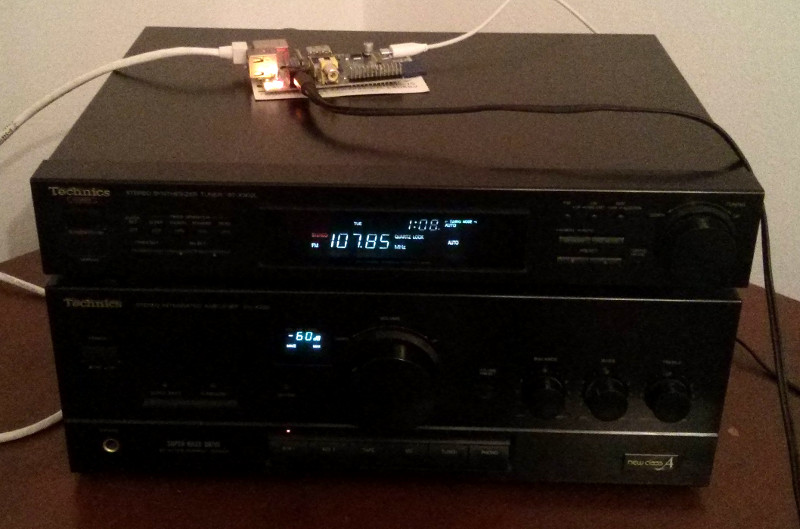
I have a 25 years old Technics hifi system that still works fine, and I gave it a new life by replacing the CD player and cassette player modules with a Raspberry Pi. Technics hifi with a Raspberry Pi attached Connection Each component of the hifi has a mains input and a mains plug that is used to power the next component. The element where the main power lead goes in is the radio component, which has a remote control receiver, a watch and a timer, and will power on the rest of the system when turned on by its power button, the remote control, or the alarm function. I disconnected the cassette and cd player modules, and plugged the Raspberry Pi phone charger/power supply in the free plug behind the amplifier module, at the end of the (now very short) power lead chain. I also connected the audio output of the Raspberry Pi to the CD input of my stereo. The advantage of CD over AUX is that the remote control buttons for switching audio sources don't cover the AUX inputs. With alsamixer I adjusted the output volume to match that of the radio component, so that I can switch between the two without surprising jumps in volume. I used alsactl store to save the mixer levels. Now when I turn the hifi on I also turn the Raspberry Pi on, and when I turn the hifi off, I also cut power from the Raspberry Pi. Operating system Operating system install instructions:
  1. I downloaded a Raspbian Jessie Lite image
  2. I put it on an SD card
  3. I created an empty ssh file on the boot partition
  4. I put the SD card on the Raspberry Pi and turned on the stereo.
  5. ssh pi@raspberrypi password raspberry
  6. sudo raspi-config to change the hostname, the password, and to enlarge the root partition to include all the rest of the space available in the SD card.
Music Player Daemon This is the set up of the music player part, with mpd.
apt install mpd
The configuration file is /etc/mpd.conf. The changes I made are: Make mpd accessible from my local network:
bind_to_address         "any"
Make mpd discoverable:
zeroconf_enabled                "yes"
zeroconf_name                   "stereo"
Allow anyone who visits me to control the playlist, and only me to run admin functions:
password                        "SECRET@read,add,control,admin"
default_permissions             "read,add,control"
At my first try, mpd hung when changing songs. I had to disable dmix by uncommenting the device option in the audio_output configuration. use_mmap is cargo-culted from the archlinux wiki.
audio_output  
        type            "alsa"
        name            "My ALSA Device"
        device          "hw:0,0"        # optional
        use_mmap        "yes"
 
If at some point I'll decide to use other audio software on the system, I'll probably want to play via pulseaudio. Sending music to the stereo I made a little script to sync the music directory on my laptop with /var/lib/mpd/music:
#!/bin/sh
rsync -avz --filter=". sync-stereo.filter" --copy-links --prune-empty-dirs --delete ./ pi@stereo:/var/lib/mpd/music
ssh pi@stereo "chmod u=rwX,go=rX -R /var/lib/mpd/music"
It uses this sync-stereo.filter rules file for rsync:
hide /_archive
include */
include **.mp3
hide *
mpd clients mpc
$ mpc -h stereo status
UltraCat - Unexpected Little Happenings
[playing] #15/22   0:03/4:06 (1%)
volume: 80%   repeat: off   random: on    single: off   consume: off
M.A.L.P. On my phone I installed M.A.L.P. and now I have a remote control for mpd. In its settings, I made a profile for home where I just had to set the hostname for the stereo and the admin password. Cantata On my laptop I installed cantata, set the hostname and password in the preferences, and had the client ready. Profit! Now I can take the remote control of my hi-fi, turn it on, and after a while mpd will resume playing the song that was playing when I last shut it down. I also have realtime player status on my phone and on my laptop, and can control music from either at any time. Friends who visit me can do that as well. Everything was rather straightforward, well documented and easy to replicate. The hardware is cheap and very easy to come by.

Dirk Eddelbuettel: #2: Even Easier Package Registration

Welcome to the second post in rambling random R recommendation series, or R4 for short. Two days ago I posted the initial (actual) post. It provided context for why we need package registration entries (tl;dr: because R CMD check now tests for it, and because it The Right Thing to do, see documentation in the posts). I also showed how generating such a file src/init.c was essentially free as all it took was single call to a new helper function added to R-devel by Brian Ripley and Kurt Hornik. Now, to actually use R-devel you obviously need to have it accessible. There are a myriad of ways to achieve that: just compile it locally as I have done for years, use a Docker image as I showed in the post -- or be creative with eg Travis or win-builder both of which give you access to R-devel if you're clever about it. But as no good deed goes unpunished, I was of course told off today for showing a Docker example as Docker was not "Easy". I think the formal answer to that is baloney. But we leave that aside, and promise to discuss setting up Docker at another time. R is after all ... just R. So below please find a script you can save as, say, ~/bin/pnrrs.r. And calling it---even with R-release---will generate the same code snippet as I showed via Docker. Call it a one-off backport of the new helper function -- with a half-life of a few weeks at best as we will have R 3.4.0 as default in just a few weeks. The script will then reduce to just the final line as the code will be present with R 3.4.0.
#!/usr/bin/r
library(tools)
.find_calls_in_package_code <- tools:::.find_calls_in_package_code
.read_description <- tools:::.read_description
## all what follows is from R-devel aka R 3.4.0 to be
package_ff_call_db <- function(dir)  
    ## A few packages such as CDM use base::.Call
    ff_call_names <- c(".C", ".Call", ".Fortran", ".External",
                       "base::.C", "base::.Call",
                       "base::.Fortran", "base::.External")
    predicate <- function(e)  
        (length(e) > 1L) &&
            !is.na(match(deparse(e[[1L]]), ff_call_names))
     
    calls <- .find_calls_in_package_code(dir,
                                         predicate = predicate,
                                         recursive = TRUE)
    calls <- unlist(Filter(length, calls))
    if(!length(calls)) return(NULL)
    attr(calls, "dir") <- dir
    calls
 
native_routine_registration_db_from_ff_call_db <- function(calls, dir = NULL, character_only = TRUE)  
    if(!length(calls)) return(NULL)
    ff_call_names <- c(".C", ".Call", ".Fortran", ".External")
    ff_call_args <- lapply(ff_call_names,
                           function(e) args(get(e, baseenv())))
    names(ff_call_args) <- ff_call_names
    ff_call_args_names <-
        lapply(lapply(ff_call_args,
                      function(e) names(formals(e))), setdiff,
               "...")
    if(is.null(dir))
        dir <- attr(calls, "dir")
    package <- # drop name
        as.vector(.read_description(file.path(dir, "DESCRIPTION"))["Package"])
    symbols <- character()
    nrdb <-
        lapply(calls,
               function(e)  
                   if (startsWith(deparse(e[[1L]]), "base::"))
                       e[[1L]] <- e[[1L]][3L]
                   ## First figure out whether ff calls had '...'.
                   pos <- which(unlist(Map(identical,
                                           lapply(e, as.character),
                                           "...")))
                   ## Then match the call with '...' dropped.
                   ## Note that only .NAME could be given by name or
                   ## positionally (the other ff interface named
                   ## arguments come after '...').
                   if(length(pos)) e <- e[-pos]
                   ## drop calls with only ...
                   if(length(e) < 2L) return(NULL)
                   cname <- as.character(e[[1L]])
                   ## The help says
                   ##
                   ## '.NAME' is always matched to the first argument
                   ## supplied (which should not be named).
                   ##
                   ## But some people do (Geneland ...).
                   nm <- names(e); nm[2L] <- ""; names(e) <- nm
                   e <- match.call(ff_call_args[[cname]], e)
                   ## Only keep ff calls where .NAME is character
                   ## or (optionally) a name.
                   s <- e[[".NAME"]]
                   if(is.name(s))  
                       s <- deparse(s)[1L]
                       if(character_only)  
                           symbols <<- c(symbols, s)
                           return(NULL)
                        
                     else if(is.character(s))  
                       s <- s[1L]
                     else   ## expressions
                       symbols <<- c(symbols, deparse(s))
                       return(NULL)
                    
                   ## Drop the ones where PACKAGE gives a different
                   ## package. Ignore those which are not char strings.
                   if(!is.null(p <- e[["PACKAGE"]]) &&
                      is.character(p) && !identical(p, package))
                       return(NULL)
                   n <- if(length(pos))  
                            ## Cannot determine the number of args: use
                            ## -1 which might be ok for .External().
                            -1L
                          else  
                            sum(is.na(match(names(e),
                                            ff_call_args_names[[cname]]))) - 1L
                         
                   ## Could perhaps also record whether 's' was a symbol
                   ## or a character string ...
                   cbind(cname, s, n)
                )
    nrdb <- do.call(rbind, nrdb)
    nrdb <- as.data.frame(unique(nrdb), stringsAsFactors = FALSE)
    if(NROW(nrdb) == 0L   length(nrdb) != 3L)
        stop("no native symbols were extracted")
    nrdb[, 3L] <- as.numeric(nrdb[, 3L])
    nrdb <- nrdb[order(nrdb[, 1L], nrdb[, 2L], nrdb[, 3L]), ]
    nms <- nrdb[, "s"]
    dups <- unique(nms[duplicated(nms)])
    ## Now get the namespace info for the package.
    info <- parseNamespaceFile(basename(dir), dirname(dir))
    ## Could have ff calls with symbols imported from other packages:
    ## try dropping these eventually.
    imports <- info$imports
    imports <- imports[lengths(imports) == 2L]
    imports <- unlist(lapply(imports,  [[ , 2L))
    info <- info$nativeRoutines[[package]]
    ## Adjust native routine names for explicit remapping or
    ## namespace .fixes.
    if(length(symnames <- info$symbolNames))  
        ind <- match(nrdb[, 2L], names(symnames), nomatch = 0L)
        nrdb[ind > 0L, 2L] <- symnames[ind]
      else if(!character_only &&
              any((fixes <- info$registrationFixes) != ""))  
        ## There are packages which have not used the fixes, e.g. utf8latex
        ## fixes[1L] is a prefix, fixes[2L] is an undocumented suffix
        nrdb[, 2L] <- sub(paste0("^", fixes[1L]), "", nrdb[, 2L])
        if(nzchar(fixes[2L]))
            nrdb[, 2L] <- sub(paste0(fixes[2L]), "$", "", nrdb[, 2L])
     
    ## See above.
    if(any(ind <- !is.na(match(nrdb[, 2L], imports))))
        nrdb <- nrdb[!ind, , drop = FALSE]
    ## Fortran entry points are mapped to l/case
    dotF <- nrdb$cname == ".Fortran"
    nrdb[dotF, "s"] <- tolower(nrdb[dotF, "s"])
    attr(nrdb, "package") <- package
    attr(nrdb, "duplicates") <- dups
    attr(nrdb, "symbols") <- unique(symbols)
    nrdb
 
format_native_routine_registration_db_for_skeleton <- function(nrdb, align = TRUE, include_declarations = FALSE)  
    if(!length(nrdb))
        return(character())
    fmt1 <- function(x, n)  
        c(if(align)  
              paste(format(sprintf("     \"%s\",", x[, 1L])),
                    format(sprintf(if(n == "Fortran")
                                       "(DL_FUNC) &F77_NAME(%s),"
                                   else
                                       "(DL_FUNC) &%s,",
                                   x[, 1L])),
                    format(sprintf("%d ,", x[, 2L]),
                           justify = "right"))
            else  
              sprintf(if(n == "Fortran")
                          "     \"%s\", (DL_FUNC) &F77_NAME(%s), %d ,"
                      else
                          "     \"%s\", (DL_FUNC) &%s, %d ,",
                      x[, 1L],
                      x[, 1L],
                      x[, 2L])
           ,
          "     NULL, NULL, 0 ")
     
    package <- attr(nrdb, "package")
    dups <- attr(nrdb, "duplicates")
    symbols <- attr(nrdb, "symbols")
    nrdb <- split(nrdb[, -1L, drop = FALSE],
                  factor(nrdb[, 1L],
                         levels =
                             c(".C", ".Call", ".Fortran", ".External")))
    has <- vapply(nrdb, NROW, 0L) > 0L
    nms <- names(nrdb)
    entries <- substring(nms, 2L)
    blocks <- Map(function(x, n)  
                      c(sprintf("static const R_%sMethodDef %sEntries[] =  ",
                                n, n),
                        fmt1(x, n),
                        " ;",
                        "")
                   ,
                  nrdb[has],
                  entries[has])
    decls <- c(
        "/* FIXME: ",
        "   Add declarations for the native routines registered below.",
        "*/")
    if(include_declarations)  
        decls <- c(
            "/* FIXME: ",
            "   Check these declarations against the C/Fortran source code.",
            "*/",
            if(NROW(y <- nrdb$.C))  
                 args <- sapply(y$n, function(n) if(n >= 0)
                                paste(rep("void *", n), collapse=", ")
                                else "/* FIXME */")
                c("", "/* .C calls */",
                  paste0("extern void ", y$s, "(", args, ");"))
            ,
            if(NROW(y <- nrdb$.Call))  
                args <- sapply(y$n, function(n) if(n >= 0)
                               paste(rep("SEXP", n), collapse=", ")
                               else "/* FIXME */")
               c("", "/* .Call calls */",
                  paste0("extern SEXP ", y$s, "(", args, ");"))
             ,
            if(NROW(y <- nrdb$.Fortran))  
                 args <- sapply(y$n, function(n) if(n >= 0)
                                paste(rep("void *", n), collapse=", ")
                                else "/* FIXME */")
                c("", "/* .Fortran calls */",
                  paste0("extern void F77_NAME(", y$s, ")(", args, ");"))
             ,
            if(NROW(y <- nrdb$.External))
                c("", "/* .External calls */",
                  paste0("extern SEXP ", y$s, "(SEXP);"))
            )
     
    headers <- if(NROW(nrdb$.Call)   NROW(nrdb$.External))
        c("#include <R.h>", "#include <Rinternals.h>")
    else if(NROW(nrdb$.Fortran)) "#include <R_ext/RS.h>"
    else character()
    c(headers,
      "#include <stdlib.h> // for NULL",
      "#include <R_ext/Rdynload.h>",
      "",
      if(length(symbols))  
          c("/*",
            "  The following symbols/expresssions for .NAME have been omitted",
            "", strwrap(symbols, indent = 4, exdent = 4), "",
            "  Most likely possible values need to be added below.",
            "*/", "")
       ,
      if(length(dups))  
          c("/*",
            "  The following name(s) appear with different usages",
            "  e.g., with different numbers of arguments:",
            "", strwrap(dups, indent = 4, exdent = 4), "",
            "  This needs to be resolved in the tables and any declarations.",
            "*/", "")
       ,
      decls,
      "",
      unlist(blocks, use.names = FALSE),
      ## We cannot use names with '.' in: WRE mentions replacing with "_"
      sprintf("void R_init_%s(DllInfo *dll)",
              gsub(".", "_", package, fixed = TRUE)),
      " ",
      sprintf("    R_registerRoutines(dll, %s);",
              paste0(ifelse(has,
                            paste0(entries, "Entries"),
                            "NULL"),
                     collapse = ", ")),
      "    R_useDynamicSymbols(dll, FALSE);",
      " ")
 
package_native_routine_registration_db <- function(dir, character_only = TRUE)  
    calls <- package_ff_call_db(dir)
    native_routine_registration_db_from_ff_call_db(calls, dir, character_only)
 
package_native_routine_registration_db <- function(dir, character_only = TRUE)  
    calls <- package_ff_call_db(dir)
    native_routine_registration_db_from_ff_call_db(calls, dir, character_only)
 
package_native_routine_registration_skeleton <- function(dir, con = stdout(), align = TRUE,
                                                         character_only = TRUE, include_declarations = TRUE)  
    nrdb <- package_native_routine_registration_db(dir, character_only)
    writeLines(format_native_routine_registration_db_for_skeleton(nrdb,
                align, include_declarations),
               con)
 
package_native_routine_registration_skeleton(".")  ## when R 3.4.0 is out you only need this line
Here I use /usr/bin/r as I happen to like littler a lot, but you can use Rscript the same way. Easy enough now?

This post by Dirk Eddelbuettel originated on his Thinking inside the box blog. Please report excessive re-aggregation in third-party for-profit settings.

28 March 2017

Keith Packard: DRM-lease

DRM display resource leasing (kernel side) So, you've got a fine head-mounted display and want to explore the delights of virtual reality. Right now, on Linux, that means getting the window system to cooperate because the window system is the DRM master and holds sole access to all display resources. So, you plug in your device, play with RandR to get it displaying bits from the window system and then carefully configure your VR application to use the whole monitor area and hope that the desktop will actually grant you the boon of page flipping so that you will get reasonable performance and maybe not even experience tearing. Results so far have been mixed, and depend on a lot of pieces working in ways that aren't exactly how they were designed to work. We could just hack up the window system(s) and try to let applications reserve the HMD monitors and somehow removing them from the normal display area so that other applications don't randomly pop up in the middle of the screen. That would probably work, and would take advantage of much of the existing window system infrastructure for setting video modes and performing page flips. However, we've got a pretty spiffy standard API in the kernel for both of those, and getting the window system entirely out of the way seems like something worth trying. I spent a few hours in Hobart chatting with Dave Airlie during LCA and discussed how this might actually work. Goals
  1. Use KMS interfaces directly from the VR application to drive presentation to the HMD.
  2. Make sure the window system clients never see the HMD as a connected monitor.
  3. Maybe let logind (or other service) manage the KMS resources and hand them out to the window system and VR applications.
Limitations
  1. Don't make KMS resources appear and disappear. It turns out applications get confused when the set of available CRTCs, connectors and encoders changes at runtime.
An Outline for Multiple DRM masters By the end of our meeting in Hobart, Dave had sketched out a fairly simple set of ideas with me. We'd add support in the kernel to create additional DRM masters. Then, we'd make it possible to 'hide' enough state about the various DRM resources so that each DRM master would automagically use disjoint subsets of resources. In particular, we would.
  1. Pretend that connectors were always disconnected
  2. Mask off crtc and encoder bits so that some of them just didn't seem very useful.
  3. Block access to resources controlled by other DRM masters, just in case someone tried to do the wrong thing.
Refinement with Eric over Swedish Pancakes A couple of weeks ago, Eric Anholt and I had breakfast at the original pancake house and chatted a bit about this stuff. He suggested that the right interface for controlling these new DRM masters was through the existing DRM master interface, and that we could add new ioctls that the current DRM master could invoke to create and manage them. Leasing as a Model I spent some time just thinking about how this might work and came up with a pretty simple metaphor for these new DRM masters. The original DRM master on each VT "owns" the output resources and has final say over their use. However, a DRM master can create another DRM master and "lease" resources it has control over to the new DRM master. Once leased, resources cannot be controlled by the owner unless the owner cancels the lease, or the new DRM master is closed. Here's some terminology:
DRM Master
Any DRM file which can perform mode setting.
Owner
The original DRM Master, created by opening /dev/dri/card*
Lessor
A DRM master which has leased out resources to one or more other DRM masters.
Lessee
A DRM master which controls resources leased from another DRM master. Each Lessee leases resources from a single Lessor.
Lessee ID
An integer which uniquely identifies a lessee within the tree of DRM masters descending from a single Owner.
Lease
The contract between the Lessor and Lessee which identifies which resources which may be controlled by the Lessee. All of the resources must be owned by or leased to the Lessor.
With Eric's input, the interface to create a lease was pretty simple to write down:
int drmModeCreateLease(int fd,
               const uint32_t *objects,
               int num_objects,
               int flags,
               uint32_t *lessee_id);
Given an FD to a DRM master, and a list of objects to lease, a new DRM master FD is returned that holds a lease to those objects. 'flags' can be any combination of O_CLOEXEC and O_NONBLOCK for the newly minted file descriptor. Of course, the owner might want to take some resources back, or even grant new resources to the lessee. So, I added an interface that rewrites the terms of the lease with a new set of objects:
int drmModeChangeLease(int fd,
               uint32_t lessee_id,
               const uint32_t *objects,
               int num_objects);
Note that nothing here makes any promises about the state of the objects across changes in the lease status; the lessor and lessee are expected to perform whatever modesetting is required for the objects to be useful to them. Window System Integration There are two ways to integrate DRM leases into the window system environment:
  1. Have logind "lease" most resources to the window system. When a HMD is connected, it would lease out suitable resources to the VR environment.
  2. Have the window system "own" all of the resources and then add window system interfaces to create new DRM masters leased from its DRM master.
I'll probably go ahead and do 2. in X and see what that looks like. One trick with any of this will be to hide HMDs from any RandR clients listening in on the window system. You probably don't want the window system to tell the desktop that a new monitor has been connected, have it start reconfiguring things, and then have your VR application create a new DRM master, making the HMD appear to have disconnected to the window system and have that go reconfigure things all over again. I'm not sure how this might work, but perhaps having the VR application register something like a passive grab on hot plug events might make sense? Essentially, you want it to hear about monitor connect events, go look to see if the new monitor is one it wants, and if not, release that to other X clients for their use. This can be done in stages, with the ability to create a new DRM master over X done first, and then cleaning up the hotplug stuff later on. Current Status I hacked up the kernel to support the drmModeCreateLease API, and then hacked up kmscube to run two threads with different sets of KMS resources. That ran for nearly a minute before crashing and requiring a reboot. I think there may be some locking issues with page flips from two threads to the same device. I think I also made the wrong decision about how to handle lessors closing down. I tried to let the lessors get deleted and then 'orphan' the lessees. I've rewritten that so that lessees hold a reference on their lessor, keeping the lessor in place until the lessee shuts down. I've also written the kernel parts of the drmModeChangeLease support. Questions

Sylvain Beucler: Practical basics of reproducible builds 2

Let's review what we learned so far: We stopped when compiling a PE .exe produced a varying output.
It turns out that PE carries a build date timestamp. The spec says that bound DLLs timestamps are refered to in the "Delay-Load Directory Table". Maybe that's also the date Windows displays when a system-wide DLL is about to be replaced, too.
Build timestamps looks unused in .exe files though. Anyway, Stephen Kitt pointed out (thanks!) that Debian's MinGW linker binutils-mingw-w64 has an upstream-pending patch that sets the timestamp to SOURCE_DATE_EPOCH if set. Alternatively, one can pass -Wl,--no-insert-timestamp to set it to 0 (though see caveats below):
$ i686-w64-mingw32.static-gcc -Wl,--no-insert-timestamp hello.c -o hello.exe 
$ md5sum hello.exe 
298f98d74e6e913628a8b74514eddcb2  hello.exe
$ /opt/mxe/usr/bin/i686-w64-mingw32.static-gcc -Wl,--no-insert-timestamp hello.c -o hello.exe 
$ md5sum hello.exe 
298f98d74e6e913628a8b74514eddcb2  hello.exe
If we don't care about debug symbols, unlike with ELF, stripped PE binaries look stable too!
$ cd repro/
$ i686-w64-mingw32.static-gcc hello.c -o hello.exe && i686-w64-mingw32.static-strip hello.exe
$ md5sum hello.exe 
6e07736bf8a59e5397c16e799699168d  hello.exe
$ i686-w64-mingw32.static-gcc hello.c -o hello.exe && i686-w64-mingw32.static-strip hello.exe
$ md5sum hello.exe 
6e07736bf8a59e5397c16e799699168d  hello.exe
$ cd ..
$ cp -a repro repro2/
$ cd repro2/
$ i686-w64-mingw32.static-gcc hello.c -o hello.exe && i686-w64-mingw32.static-strip hello.exe
$ md5sum hello.exe 
6e07736bf8a59e5397c16e799699168d  hello.exe
Now that we have the main executable covered, what about the dependencies?
Let's see how well MXE compiles SDL2:
$ cd /opt/mxe/
$ cp -a ./usr/i686-w64-mingw32.static/lib/libSDL2.a /tmp
$ rm -rf * && git checkout .
$ make sdl2
$ md5sum ./usr/i686-w64-mingw32.static/lib/libSDL2.a /tmp/libSDL2.a 
68909ab13181b1283bd1970a56d41482  ./usr/i686-w64-mingw32.static/lib/libSDL2.a
68909ab13181b1283bd1970a56d41482  /tmp/libSDL2.a
Neat - what about another build directory?
$ cd /usr/srx/mxe
$ make sdl2
$ md5sum usr/i686-w64-mingw32.static/lib/libSDL2.a /tmp/libSDL2.a 
c6c368323927e2ae7adab7ee2a7223e9  usr/i686-w64-mingw32.static/lib/libSDL2.a
68909ab13181b1283bd1970a56d41482  /tmp/libSDL2.a
$ ls -l ./usr/i686-w64-mingw32.static/lib/libSDL2.a /tmp/libSDL2.a 
-rw-r--r-- 1 me me 5861536 mars  23 21:04 /tmp/libSDL2.a
-rw-r--r-- 1 me me 5862488 mars  25 19:46 ./usr/i686-w64-mingw32.static/lib/libSDL2.a
Well that was expected.
But what about the filesystem order?
With such an automated build, could potential variations in the order of files go undetected?
Would the output be different on another filesystem format (ext4 vs. btrfs...)? It was a good opportunity to test the disorderfs fuse-based tool.
And while I'm at it, check if reprotest is easy enough to use (the manpage is scary).
Let's redo our basic tests with it - basic usage is actually very simple:
$ apt-get install reprotest disorderfs faketime
$ reprotest 'make hello' 'hello'
...
will vary: environment
will vary: fileordering
will vary: home
will vary: kernel
will vary: locales
will vary: exec_path
will vary: time
will vary: timezone
will vary: umask
...
--- /tmp/tmpk5uipdle/control_artifact/
+++ /tmp/tmpk5uipdle/experiment_artifact/
    --- /tmp/tmpk5uipdle/control_artifact/hello
  +++ /tmp/tmpk5uipdle/experiment_artifact/hello
  stat  
    @@ -1,8 +1,8 @@
     
       Size: 8632       Blocks: 24         IO Block: 4096   regular file
     Links: 1
    -Access: (0755/-rwxr-xr-x)  Uid: ( 1000/      me)   Gid: ( 1000/      me)
    +Access: (0775/-rwxrwxr-x)  Uid: ( 1000/      me)   Gid: ( 1000/      me)
     
     Modify: 1970-01-01 00:00:00.000000000 +0000
     
      Birth: -
# => OK except for permissions
$ reprotest 'make hello && chmod 755 hello' 'hello'
=======================
Reproduction successful
=======================
No differences in hello
c8f63b73265e69ab3b9d44dcee0ef1d2815cdf71df3c59635a2770e21cf462ec  hello
$ reprotest 'make hello CFLAGS="-g -O2"' 'hello'
# => lots of differences, as expected
Now let's apply to the MXE build.
We keep the same build path, and also avoid using linux32 (because MXE would then recompile all the host compiler tools for 32-bit):
$ reprotest --dont-vary build_path,kernel 'touch src/sdl2.mk && make sdl2 && cp -a usr/i686-w64-mingw32.static/lib/libSDL2.a .' 'libSDL2.a'
=======================
Reproduction successful
=======================
No differences in libSDL2.a
d9a39785fbeee5a3ac278be489ac7bf3b99b5f1f7f3e27ebf3f8c60fe25086b5  libSDL2.a
That checks!
What about a full MXE environment?
$ reprotest --dont-vary build_path,kernel 'make clean && make sdl2 sdl2_gfx sdl2_image sdl2_mixer sdl2_ttf libzip gettext nsis' 'usr'
# => changes in installation dates
# => timestamps in .exe files (dbus, ...)
# => libicu doesn't look reproducible (derb.exe, genbrk.exe, genccode.exe...)
# => apparently ar timestamp variations in libaclui
Most libraries look reproducible enough.
ar differences may go away at FreeDink link time since I'm aiming at a static build. Let's try! First let's see how FreeDink behaves with stable dependencies.
We can compile with -Wl,--no-insert-timestamp and strip the binaries in a first step.
There are various issues (timestamps, permissions) but first let's check the executables themselves:
$ cd freedink/
$ reprotest --dont-vary build_path 'mkdir cross-woe-32/ && cd cross-woe-32/ && export PATH=/opt/mxe/usr/bin:$PATH && LDFLAGS='-Wl,--no-insert-timestamp' ../configure --host=i686-w64-mingw32.static --enable-static && make -j$(nproc) && make install-strip DESTDIR=$(pwd)/destdir' 'cross-woe-32/destdir/usr/local/bin'
# => executables are identical!
# Same again, just to make sure
$ reprotest --dont-vary build_path 'mkdir cross-woe-32/ && cd cross-woe-32/ && export PATH=/opt/mxe/usr/bin:$PATH && LDFLAGS='-Wl,--no-insert-timestamp' ../configure --host=i686-w64-mingw32.static --enable-static && make -j$(nproc) && make install-strip DESTDIR=$(pwd)/destdir' 'cross-woe-32/destdir/usr/local/bin'
    --- /tmp/tmp2yw0sn4_/control_artifact/bin/freedink.exe
  +++ /tmp/tmp2yw0sn4_/experiment_artifact/bin/freedink.exe
    @@ -2,20 +2,20 @@
     00000010: b800 0000 0000 0000 4000 0000 0000 0000  ........@.......
     00000020: 0000 0000 0000 0000 0000 0000 0000 0000  ................
     00000030: 0000 0000 0000 0000 0000 0000 8000 0000  ................
     00000040: 0e1f ba0e 00b4 09cd 21b8 014c cd21 5468  ........!..L.!Th
     00000050: 6973 2070 726f 6772 616d 2063 616e 6e6f  is program canno
     00000060: 7420 6265 2072 756e 2069 6e20 444f 5320  t be run in DOS 
     00000070: 6d6f 6465 2e0d 0d0a 2400 0000 0000 0000  mode....$.......
    -00000080: 5045 0000 4c01 0a00 e534 0735 0000 0000  PE..L....4.5....
    +00000080: 5045 0000 4c01 0a00 0000 0000 0000 0000  PE..L...........
     00000090: 0000 0000 e000 0e03 0b01 0219 00f2 3400  ..............4.
     000000a0: 0022 4e00 0050 3b00 c014 0000 0010 0000  ."N..P;.........
     000000b0: 0010 3500 0000 4000 0010 0000 0002 0000  ..5...@.........
     000000c0: 0400 0000 0100 0000 0400 0000 0000 0000  ................
    -000000d0: 00e0 8900 0004 0000 7662 4e00 0200 0000  ........vbN.....
    +000000d0: 00e0 8900 0004 0000 89f8 4e00 0200 0000  ..........N.....
     000000e0: 0000 2000 0010 0000 0000 1000 0010 0000  .. .............
     000000f0: 0000 0000 1000 0000 00a0 8700 b552 0000  .............R..
     00000100: 0000 8800 d02d 0000 0050 8800 5006 0000  .....-...P..P...
     00000110: 0000 0000 0000 0000 0000 0000 0000 0000  ................
     00000120: 0060 8800 4477 0100 0000 0000 0000 0000  . ..Dw..........
     00000130: 0000 0000 0000 0000 0000 0000 0000 0000  ................
     00000140: 0440 8800 1800 0000 0000 0000 0000 0000  .@..............
  stat  
      @@ -1,8 +1,8 @@
       
         Size: 5121536       Blocks: 10008      IO Block: 4096   regular file
       Links: 1
       Access: (0755/-rwxr-xr-x)  Uid: ( 1000/      me)   Gid: ( 1000/      me)
       
      -Modify: 2017-03-26 01:26:35.233841833 +0000
      +Modify: 2017-03-26 01:27:01.829592505 +0000
       
        Birth: -
Gah...
AFAIU there is something random in the linking phase, and sometimes the timestamp is removed, sometimes it's not.
Not very easy to track but I believe I reproduced it with the "hello" example:
# With MXE:
$ reprotest 'i686-w64-mingw32.static-gcc hello.c -I /opt/mxe/usr/i686-w64-mingw32.static/include -I/opt/mxe/usr/i686-w64-mingw32.static/include/SDL2 -L/opt/mxe/usr/i686-w64-mingw32.static/lib -lmingw32 -Dmain=SDL_main -lSDL2main -lSDL2 -lSDL2main -Wl,--no-insert-timestamp -luser32 -lgdi32 -lwinmm -limm32 -lole32 -loleaut32 -lshell32 -lversion -o hello && chmod 700 hello' 'hello'
# => different
# => maybe because it imports the build timestamp from -lSDL2main
# With Debian's MinGW (but without SOURCE_DATE_EPOCH):
$ reprotest 'i686-w64-mingw32-gcc hello.c -I /opt/mxe/usr/i686-w64-mingw32.static/include -I/opt/mxe/usr/i686-w64-mingw32.static/include/SDL2 -L/opt/mxe/usr/i686-w64-mingw32.static/lib -lmingw32 -Dmain=SDL_main -lSDL2main -lSDL2 -lSDL2main -Wl,--no-insert-timestamp -luser32 -lgdi32 -lwinmm -limm32 -lole32 -loleaut32 -lshell32 -lversion -o hello && chmod 700 hello' 'hello'
=======================
Reproduction successful
=======================
No differences in hello
0b2d99dc51e2ad68ad040d90405ed953a006c6e58599beb304f0c2164c7b83a2  hello
# Let's remove -Dmain=SDL_main and let our main() have precedence over the one in -lSDL2main:
$ reprotest 'i686-w64-mingw32.static-gcc hello.c -I /opt/mxe/usr/i686-w64-mingw32.static/include -I/opt/mxe/usr/i686-w64-mingw32.static/include/SDL2 -L/opt/mxe/usr/i686-w64-mingw32.static/lib -lmingw32 -lSDL2main -lSDL2 -lSDL2main -Wl,--no-insert-timestamp -luser32 -lgdi32 -lwinmm -limm32 -lole32 -loleaut32 -lshell32 -lversion -o hello && chmod 700 hello' 'hello'
=======================
Reproduction successful
=======================
No differences in hello
6c05f75eec1904d58be222cc83055d078b4c3be8b7f185c7d3a08b9a83a2ef8d  hello
$ LANG=C i686-w64-mingw32.static-ld --version  # MXE
GNU ld (GNU Binutils) 2.25.1
Copyright (C) 2014 Free Software Foundation, Inc.
$ LANG=C i686-w64-mingw32-ld --version  # Debian
GNU ld (GNU Binutils) 2.27.90.20161231
Copyright (C) 2016 Free Software Foundation, Inc.
It looks like there is a random behavior in binutils 2.25, coupled with SDL2's wrapping of my main(). So FreeDink is nearly reproducible, except for this build timestamp issue that pops up in all kind of situations. In the worse case I can zero it out, or patch MXE's binutils until they upgrade. More importantly, what if I recompile FreeDink and the dependencies twice?
$ (cd /opt/mxe/ && make clean && make sdl2 sdl2_gfx sdl2_image sdl2_mixer sdl2_ttf glm libzip gettext nsis)
$ (mkdir cross-woe-32/ && cd cross-woe-32/ \
  && export PATH=/opt/mxe/usr/bin:$PATH \
  && LDFLAGS="-Wl,--no-insert-timestamp" ../configure --host=i686-w64-mingw32.static --enable-static \
  && make V=1 -j$(nproc) \
  && make install-strip DESTDIR=$(pwd)/destdir)
$ mv cross-woe-32/ cross-woe-32-1/
# Same again...
$ mv cross-woe-32/ cross-woe-32-2/
$ diff -ru cross-woe-32-1/destdir/ cross-woe-32-2/destdir/
[nothing]
Yay!
I could not reproduce the build timestamp issue in the stripped binaries, though it was still varying in the unstripped src/freedinkedit.exe.
I mentioned there was other changes noticed by diffoscope. That one is interesting.
Could be ignored, but we want to generate an identical binary package/archive too, right?
That's where archive meta-data matters.
make INSTALL="$(which install) install -p" could help for static files, but not generated ones.
The doc suggests clamping all files to SOURCE_DATE_EPOCH - i.e. all generated files will have their date set at that timestamp:
$ export SOURCE_DATE_EPOCH=$(date +%s) \
  && reprotest --dont-vary build_path \
  'make ... && find destdir/ -newermt "@$ SOURCE_DATE_EPOCH " -print0   xargs -0r touch --no-dereference --date="@$ SOURCE_DATE_EPOCH "' 'cross-woe-32/destdir/'
Caused by varying umask.
I attempted to mitigate the issue by playing with make install MKDIR_P="mkdir -p -m 755" (1).
However even mkdir -p -m ... does not set permissions for intermediate directories.
Maybe it's better to set and record the umask...
So, aside from minor issues such as BuildIDs and build timestamps, the toolchain is pretty stable as of now.
The issue is more about fixing and recording the build environment.
Which is probably the next challenge :)

Reproducible builds folks: Reproducible Builds: week 100 in Stretch cycle

Welcome to the 100th issue of this weekly news! We hope you have been enjoying our posts and would love to receive some feedback via our mailing list! Anyway, here's what happened in the Reproducible Builds effort between Sunday March 19 and Saturday March 25 2017: Reproducible Builds Hackathon Hamburg 2017 The Reproducible Builds Hamburg Hackathon 2017 (or RB-HH-2017 for short) is a 3-day hacking event taking place May 5th-7th in the CCC Hamburg Hackerspace inside Frappant, as collective art space located witin a historical monument in Hamburg, Germany. The event is open to everyone and we still have some free seats. If you wish to attend, please register your interest as soon as possible. Media coverage Packages reviewed and fixed, and bugs filed Chris Lamb: Reviews of unreproducible packages 30 package reviews have been added, 13 have been updated and 2 have been removed in this week, adding to our knowledge about identified issues. Weekly QA work During our reproducibility testing, FTBFS bugs have been detected and reported by: diffoscope development buildinfo.debian.net development Misc. This week's edition was written by Chris Lamb & Holger Levsen & reviewed by a bunch of Reproducible Builds folks on IRC & the mailing lists.

Axel Beckert: System Tray Icon to Monitor a Linux Software RAID Locally

About a year ago I bought a new workstation computer for myself at home. It s a Tuxedo XUX_Cube which is advertised as gaming PC. But I ordered a slightly atypical non-gamer configuration: Of course the box runs Debian. To be more precise, it runs Debian Sid with sysvinit-core as init system and i3 as window manager. As I usually have no monitoring clients on my laptops and private workstations, I rather often felt the urge to do a cat /proc/mdstat on that box. So at some point I wanted something like smart-notifier, but for Linux Software (MD) RAIDs. And since I found nothing, I did what Open Source guys usually do in such cases: I wrote it myself of course in Perl and called it systray-mdstat. First I wondered about which build system would be most suitable for that task, but in the end I once again went with Dist::Zilla for the upstream build system and hence dh-dist-zilla for the Debian packaging. Ideas for the actual implementation were taken from Wouter s fdpowermon for the systray icon framework in Perl and Myon s mdstat Xymon plugin for an already proven logic to parse /proc/mdstat. (Both, Wouter and Myon have stated in a GnuPG-signed e-mail that I copied less code than would validate their copyrights, so I was able to license it under a single license, namely GNU GPL version 3.) As of now, systray-mdstat is also available as package in Debian Unstable. It won t make it to Stretch as its first line of code has been written after the soft-freeze for Stretch was already in place.

Axel Beckert: Maintaining Debian Packages of Perl Modules with dh-dist-zilla

Maintaining Debian packages of Perl modules usually can be done with the common git-buildpackage (aka gbp) workflow with its three git branches master (or debian), upstream and pristine-tar: This also works more or less fine for Perl modules, where the Debian package maintainer is also the upstream developer. In that case mostly the upstream branch is used (and then maybe called master while the Debian packaging branch is then called debian). But the files needed for a proper so called CPAN distribution of a Perl module often contain redundant information (version numbers, required modules, etc.) which needs to be maintained. And for that, many people prefer Don t Repeat Yourself (DRY) as a principle. Dist::Zilla One nice and common tool for that is Dist::Zilla or short dzil. It generates most redundant but required data out of a central source, e.g. Dist::Zilla s dist.ini or the contained .pm files, etc. dzil build creates tar ball which contains all files necessary by CPAN. But now we have a dilemma: Debian expects those generated files inside the upstream branch while the files are only generated from other files in that branch. There are multiple solutions, but all of them involve committing generated files to the git repository: librun-parts-perl aka Run::Parts (a Perl wrapper around and a pure-perl implementation of Debian s run-parts tool) was initially maintained in the latter way. But especially in cases where we just need a Perl module packaged as .deb without uploading it to CPAN (e.g. project-internal modules), this is a tedious workflow and overkill. It would be much nicer if debhelper would just call dzil to generate all the stuff it needs to build the package. dh-dist-zilla Well, you can do that now, at least with Debian Jessie. This is what dh-dist-zilla does: It is a debhelper sequence plugin which calls dzil build and dzil clean in the right moment and takes care that all dh_auto_* commands look in the directory with the generated files instead of the rather clean project root directory. To use dh-dist-zilla, you just need to add a build-dependency on it and the Dist::Zilla plugins you use, and add --with dist-zilla to your minimal dh-style debian/rules file:
#!/usr/bin/make -f
%:
	dh $@ --with dist-zilla
That s it. With regards to workflow and git branches, you may still want to use separate branches for upstream work and debian work, and you may want to continue to use pristine-tar, but you don t have to commit generated files to git anymore and you can maintain a clean master branch with nearly no redundancy. And if you need to generate to final upstream tar ball for you debian package, just call dh get-orig-source or maybe easier to use with tab completion dh_dist_zilla_origtar. This is how the librun-parts-perl package is maintained nowadays. There s otherwise not much difference to the old, classically maintained versions. More DRY Next step in the DRY evolution is to reduce redundancies between upstream (Dist::Zilla based) packaging and the Debian packaging. There are a few tools available, partially brand new, partially not yet packaged: I wouldn t be surprised if there s more to come in this area. P.S.: I actually started this blog posting in September 2014 and never finished it until now. Had to kick out some already outdated again stuff, but also could add some more recent things.

27 March 2017

Dirk Eddelbuettel: #0: Introducing R^4

So I had been toying with the idea of getting back to the blog and more regularly writing / posting little tips and tricks. I even started taking some notes but because perfect is always the enemy of the good it never quite materialized. But the relatively broad discussion spawned by last week's short rant on Suggests != Depends made a few things clear. There appears to be an audience. It doesn't have to be long. And it doesn't have to be too polished. So with that, let's get the blogging back from micro-blogging. This note forms post zero of what will a new segment I call R4 which is shorthand for relatively random R rambling. Stay tuned.

This post by Dirk Eddelbuettel originated on his Thinking inside the box blog. Please report excessive re-aggregation in third-party for-profit settings.

Next.

Previous.