Introduction: an immutable OS
The
Steam Deck runs SteamOS, a single-user operating system based on Arch Linux. Although derived from a standard package-based distro, the OS in the Steam Deck is immutable and system updates replace the contents of the root filesystem atomically instead of using the package manager.
An immutable OS makes the system more stable and its updates less error-prone, but users cannot install additional packages to add more software. This is not a problem for most users since they are only going to run Steam and its games (which are stored in the home partition). Nevertheless, the OS also has a desktop mode which provides a standard Linux desktop experience, and here it makes sense to be able to install more software.
How to do that though? It is possible for the user to become root, make the root filesytem read-write and install additional software there, but any changes will be gone after the next OS update. Modifying the rootfs can also be dangerous if the user is not careful.
Ways to add additional software
The simplest and safest way to install additional software is with Flatpak, and that s the method recommended in the
Steam Deck Desktop FAQ. Flatpak is already installed and integrated in the system via the
Discover app so I won t go into more details here.
However, while Flatpak works great for desktop applications not every piece of software is currently available, and Flatpak is also not designed for other types of programs like system services or command-line tools.
Fortunately there are several ways to add software to the Steam Deck without touching the root filesystem, each one with different pros and cons. I will probably talk about some of them in the future, but in this post I m going to focus on one that is already available in the system:
systemd-sysext.
About systemd-sysext
This is a tool included in recent versions of systemd and it is designed to add additional files (in the form of
system extensions) to an otherwise immutable root filesystem. Each one of these extensions contains a set of files. When extensions are enabled (aka merged ) those files will appear on the root filesystem using overlayfs. From then on the user can open and run them normally as if they had been installed with a package manager.
Merged extensions are seamlessly integrated with the rest of the OS.
Since extensions are just collections of files they can be used to add new applications but also other things like system services, development tools, language packs, etc.
Creating an extension: yakuake
I m using
yakuake as an example for this tutorial since the extension is very easy to create, it is an application that
some users are demanding and is not
easy to distribute with Flatpak.
So let s create a
yakuake extension. Here are the steps:
1) Create a directory and unpack the files there:
$ mkdir yakuake
$ wget https://steamdeck-packages.steamos.cloud/archlinux-mirror/extra/os/x86_64/yakuake-21.12.1-1-x86_64.pkg.tar.zst
$ tar -C yakuake -xaf yakuake-*.tar.zst usr
2) Create a file called
extension-release.NAME under
usr/lib/extension-release.d with the fields
ID and
VERSION_ID taken from the Steam Deck s
/etc/os-release file.
$ mkdir -p yakuake/usr/lib/extension-release.d/
$ echo ID=steamos > yakuake/usr/lib/extension-release.d/extension-release.yakuake
$ echo VERSION_ID=3.3.1 >> yakuake/usr/lib/extension-release.d/extension-release.yakuake
3) Create an image file with the contents of the extension:
$ mksquashfs yakuake yakuake.raw
That s it! The extension is ready.
A couple of important things: image files must have the
.raw suffix and, despite the name, they can contain any filesystem that the OS can mount. In this example I used SquashFS but other alternatives like EroFS or ext4 are equally valid.
NOTE: systemd-sysext can also use extensions from plain directories (i.e skipping the
mksquashfs part). Unfortunately we cannot use them in our case because overlayfs does not work with the casefold feature that is enabled on the Steam Deck.
Using the extension
Once the extension is created you simply need to copy it to a place where systemd-systext can find it. There are several places where they can be installed (see
the manual for a list) but due to the Deck s partition layout and the potentially large size of some extensions it probably makes more sense to store them in the home partition and create a link from one of the supported locations (
/var/lib/extensions in this example):
(deck@steamdeck ~)$ mkdir extensions
(deck@steamdeck ~)$ scp user@host:/path/to/yakuake.raw extensions/
(deck@steamdeck ~)$ sudo ln -s $PWD/extensions /var/lib/extensions
Once the extension is installed in that directory you only need to enable and start systemd-sysext:
(deck@steamdeck ~)$ sudo systemctl enable systemd-sysext
(deck@steamdeck ~)$ sudo systemctl start systemd-sysext
After this, if everything went fine you should be able to see (and run)
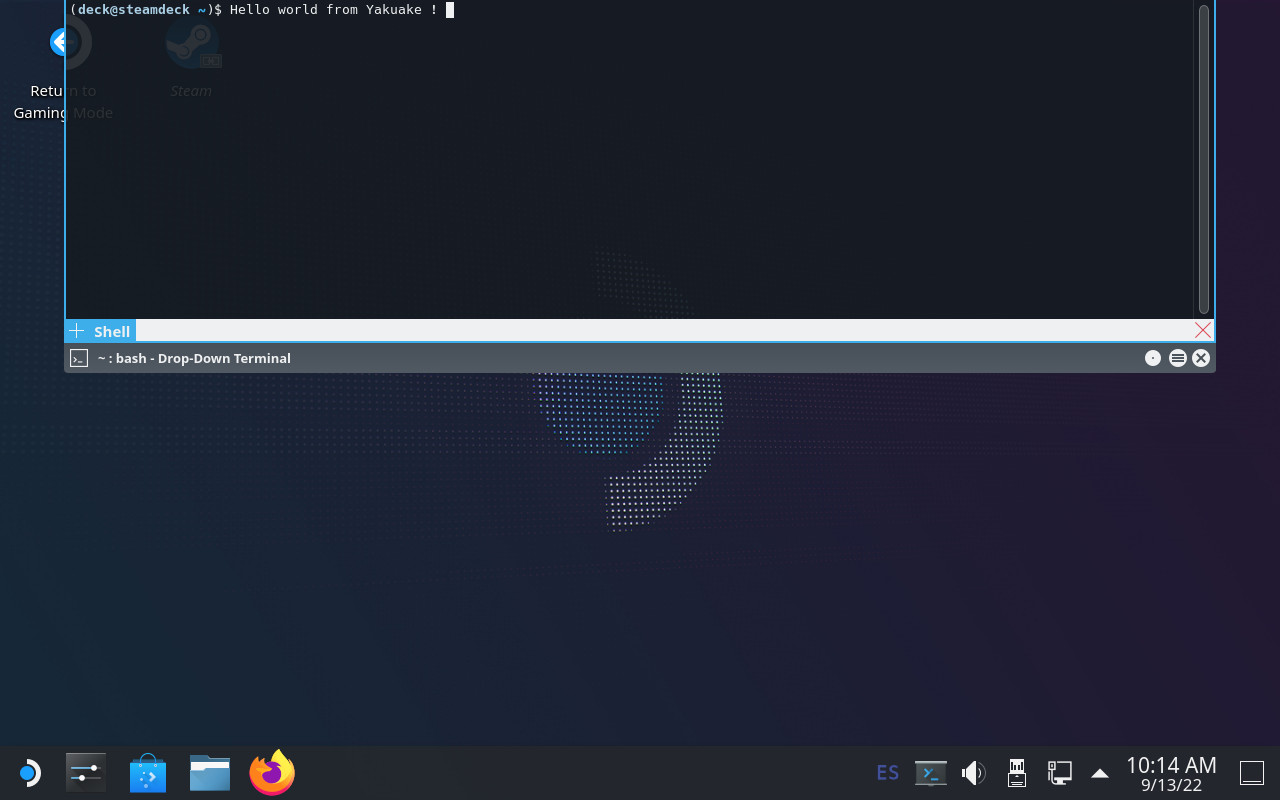
/usr/bin/yakuake. The files should remain there from now on, also if you reboot the device. You can see what extensions are enabled with this command:
$ systemd-sysext status
HIERARCHY EXTENSIONS SINCE
/opt      none       -
/usr      yakuake    Tue 2022-09-13 18:21:53 CEST
If you add or remove extensions from the directory then a simple
systemd-sysext refresh is enough to apply the changes.
Unfortunately, and unlike distro packages, extensions don t have any kind of post-installation hooks or triggers, so in the case of Yakuake you probably won t see an entry in the KDE application menu immediately after enabling the extension. You can solve that by running
kbuildsycoca5 once from the command line.
Limitations and caveats
Using systemd extensions is generally very easy but there are some things that you need to take into account:
- Using extensions is easy (you put them in the directory and voil !). However, creating extensions is not necessarily always easy. To begin with, any libraries, files, etc., that your extensions may need should be either present in the root filesystem or provided by the extension itself. You may need to combine files from different sources or packages into a single extension, or compile them yourself.
- In particular, if the extension contains binaries they should probably come from the Steam Deck repository or they should be built to work with those packages. If you need to build your own binaries then having a SteamOS virtual machine can be handy. There you can install all development files and also test that everything works as expected. One could also create a Steam Deck SDK extension with all the necessary files to develop directly on the Deck

- Extensions are not distribution packages, they don t have dependency information and therefore they should be self-contained. They also lack triggers and other features available in packages. For desktop applications I still recommend using a system like Flatpak when possible.
- Extensions are tied to a particular version of the OS and, as explained above, the
ID and VERSION_ID of each extension must match the values from /etc/os-release. If the fields don t match then the extension will be ignored. This is to be expected because there s no guarantee that a particular extension is going to work with a different version of the OS. This can happen after a system update. In the best case one simply needs to update the extension s VERSION_ID, but in some cases it might be necessary to create the extension again with different/updated files.
- Extensions only install files in
/usr and /opt. Any other file in the image will be ignored. This can be a problem if a particular piece of software needs files in other directories.
- When extensions are enabled the
/usr and /opt directories become read-only because they are now part of an overlayfs. They will remain read-only even if you run steamos-readonly disable !!. If you really want to make the rootfs read-write you need to disable the extensions (systemd-sysext unmerge) first.
- Unlike Flatpak or Podman (including toolbox / distrobox), this is (by design) not meant to isolate the contents of the extension from the rest of the system, so you should be careful with what you re installing. On the other hand, this lack of isolation makes systemd-sysext better suited to some use cases than those container-based systems.
Conclusion
systemd extensions are an easy way to add software (or data files) to the immutable OS of the Steam Deck in a way that is seamlessly integrated with the rest of the system. Creating them can be more or less easy depending on the case, but using them is extremely simple. Extensions are not packages, and systemd-sysext is not a package manager or a general-purpose tool to solve all problems, but if you are aware of its limitations it can be a practical tool. It is also possible to share extensions with other users, but here the usual warning against installing binaries from untrusted sources applies. Use with caution, and enjoy!
 I work on OpenJDK backports:
taking a patch that was committed to a current version of JDK, and adapting it
to an older one. There are four main OpenJDK versions that I am concerned with:
the current version ("jdk"), 8, 11 and 17. These are all maintained in separate
Git(Hub) repositories.
It's very useful to have access to the other JDKs when working on any
particular version. For example, to backport a patch from the latest version to
17, where the delta is not too big, a lot of the time you can cherry-pick the
patch unmodified. To do
 I recently bought a refurbished thinkpad x260. If you have read my
post of my <a href= <!DOCTYPE html>
Laptop refreshment


 But this again does not help me apart from setting some kind of background of where we are.) I have on this blog also shared how Africans have been setting new records in transparency and they did it almost 5 years back. For those new to the blog, African countries have been now broadcasting proceedings of their SC for almost 5 years now. I noticed it when privacy law was being debated and a few handles that I follow on Twitter and elsewhere had gone and given their submission in their SC. It was fascinating to not only hear but also read about the case from multiple viewpoints.
And just to remind people, I am sharing all of this from Pune, Maharashtra which is the second-biggest city in Maharashtra that has something like six million people and probably a million or more transitory students, and casual laborers but then again that doesn t help me other than providing a kind of context to what I m sharing..
Now a couple of years back or more I had asked mum to make a will. If she wanted to bequeath something to somebody else she could do that, had shared about that. There was some article in Indian Express or elsewhere that told people what they should be doing, especially if they had cost the barrier of age 60. Now for reasons best known to her, she refused and now I have to figure out what is the right way to go about doing things.
 This post describes how I ve put together a simple static content server for
kubernetes clusters using a Pod with a persistent volume and multiple
containers: an sftp server to manage contents, a web server to publish them
with optional access control and another one to run scripts which need access
to the volume filesystem.
The sftp server runs using

 More ICFP-inspired experiments using the
 Norman Ramsey shows a formula