Search Results: "beh"

18 December 2015

Martin Pitt: What s new in autopkgtest: LXD, MaaS, apt pinning, and more

The last two major autopkgtest releases (3.18 from November, and 3.19 fresh from yesterday) bring some new features that are worth spreading. New LXD virtualization backend 3.19 debuts the new adt-virt-lxd virtualization backend. In case you missed it, LXD is an API/CLI layer on top of LXC which introduces proper image management, seamlessly use images and containers on remote locations, intelligently caching them locally, automatically configure performant storage backends like zfs or btrfs, and just generally feels really clean and much simpler to use than the classic LXC. Setting it up is not complicated at all. Install the lxd package (possibly from the backports PPA if you are on 14.04 LTS), and add your user to the lxd group. Then you can add the standard LXD image server with
  lxc remote add lco https://images.linuxcontainers.org:8443
and use the image to run e. g. the libpng test from the archive:
  adt-run libpng --- lxd lco:ubuntu/trusty/i386
  adt-run libpng --- lxd lco:debian/sid/amd64
The adt-virt-lxd.1 manpage explains this in more detail, also how to use this to run tests in a container on a remote host (how cool is that!), and how to build local images with the usual autopkgtest customizations/optimizations using adt-build-lxd. I have btrfs running on my laptop, and LXD/autopkgtest automatically use that, so the performance really rocks. Kudos to St phane, Serge, Tycho, and the other LXD authors! The motivation for writing this was to make it possible to move our armhf testing into the cloud (which for $REASONS requires remote containers), but I now have a feeling that soon this will completely replace the existing adt-virt-lxc virt backend, as its much nicer to use. It is covered by the same regression tests as the LXC runner, and from the perspective of package tests that you run in it it should behave very similar to LXC. The one problem I m aware of is that autopkgtest-reboot-prepare is broken, but hardly anything is using that yet. This is a bit complicated to fix, but I expect it will be in the next few weeks. MaaS setup script While most tests are not particularly sensitive about which kind of hardware/platform they run on, low-level software like the Linux kernel, GL libraries, X.org drivers, or Mir very much are. There is a plan for extending our automatic tests to real hardware for these packages, and being able to run autopkgtests on real iron is one important piece of that puzzle. MaaS (Metal as a Service) provides just that it manages a set of machines and provides an API for installing, talking to, and releasing them. The new maas autopkgtest ssh setup script (for the adt-virt-ssh backend) brings together autopkgtest and real hardware. Once you have a MaaS setup, get your API key from the web UI, then you can run a test like this:
  adt-run libpng --- ssh -s maas -- \
     --acquire "arch=amd64 tags=touchscreen" -r wily \
     http://my.maas.server/MAAS 123DEADBEEF:APIkey
The required arguments are the MaaS URL and the API key. Without any further options you will get any available machine installed with the default release. But usually you want to select a particular one by architecture and/or tags, and install a particular distro release, which you can do with the -r/--release and --acquire options. Note that this is not wired into Ubuntu s production CI environment, but it will be. Selectively using packages from -proposed Up until a few weeks ago, autopkgtest runs in the CI environment were always seeing/using the entirety of -proposed. This often led to lockups where an application foo and one of its dependencies libbar got a new version in -proposed at the same time, and on test regressions it was not clear at all whose fault it was. This often led to perfectly good packages being stuck in -proposed for a long time, and a lot of manual investigation about root causes. . These days we are using a more fine-grained approach: A test run is now specific for a trigger , that is, the new package in -proposed (e. g. a new version of libbar) that caused the test (e. g. for foo ) to run. autopkgtest sets up apt pinning so that only the binary packages for the trigger come from -proposed, the rest from -release. This provides much better isolation between the mush of often hundreds of packages that get synced or uploaded every day. This new behaviour is controlled by an extension of the --apt-pocket option. So you can say
  adt-run --apt-pocket=proposed=src:foo,libbar1,libbar-data ...
and then only the binaries from the foo source, libbar1, and libbar-data will come from -proposed, everything else from -release. Caveat:Unfortunately apt s pinning is rather limited. As soon as any of the explicitly listed packages depends on a package or version that is only available in -proposed, apt falls over and refuses the installation instead of taking the required dependencies from -proposed as well. In that case, adt-run falls back to the previous behaviour of using no pinning at all. (This unfortunately got worse with apt 1.1, bug report to be done). But it s still helpful in many cases that don t involve library transitions or other package sets that need to land in lockstep. Unified testbed setup script There is a number of changes that need to be made to testbeds so that tests can run with maximum performance (like running dpkg through eatmydata, disabling apt translations, or automatically using the host s apt-cacher-ng), reliable apt sources, and in a minimal environment (to detect missing dependencies and avoid interference from unrelated services these days the standard cloud images have a lot of unnecessary fat). There is also a choice whether to apply these only once (every day) to an autopkgtest specific base image, or on the fly to the current ephemeral testbed for every test run (via --setup-commands). Over time this led to quite a lot of code duplication between adt-setup-vm, adt-build-lxc, the new adt-build-lxd, cloud-vm-setup, and create-nova-image-new-release. I now cleaned this up, and there is now just a single setup-commands/setup-testbed script which works for all kinds of testbeds (LXC, LXD, QEMU images, cloud instances) and both for preparing an image with adt-buildvm-ubuntu-cloud, adt-build-lx[cd] or nova, and with preparing just the current ephemeral testbed via --setup-commands. While this is mostly an internal refactorization, it does impact users who previously used the adt-setup-vm script for e. g. building Debian images with vmdebootstrap. This script is now gone, and the generic setup-testbed entirely replaces it. Misc Aside from the above, every new version has a handful of bug fixes and minor improvements, see the git log for details. As always, if you are interested in helping out or contributing a new feature, don t hesitate to contact me or file a bug report.

11 December 2015

Matthias Klumpp: What s up in Tanglu?

tanglu logo pureIt is time again for another Tanglu blogpost (to be honest, this article is pretty much overdue  ). I want to shine a spotlight on the work that s done in Tanglu, be it ongoing or past work done for the new release. Why is the new release taking longer than usual? As you might have noticed, usually a new Tanglu release (Tanglu 4 Dasyatis ) should be released this month. We decided a while ago, however, to defer the release and are now aiming for an release in February / March 2016. Reason for this change in schedule is the GCC 5 transition (and more importantly the huge amount of follow-up transitions) as well as some other major infrastructure tasks, which we would like to complete and give them a good amount of testing before releasing. Also, some issues with our build system, and generally less build power than in previous releases is a problem (At least the Debile build-system issues could be worked around or solved). The hard disk crash in the forum and bugtracking server also delayed the start of the Tanglu 4 development process a lot. In all of these tasks, manpower is of course the main problem  Software Tasks General infrastructure tasks Improvements on Synchrotron Synchrotron, the software which is synchronizing the Tanglu archive with the Debian archive, received a few tweaks to make it more robust and detect installability of packages more reliably. We also run it more often now. Rapidumo improvements Rapidumo is a software written to complement dak (the Debian Archive Kit) in managing the Tanglu archive. It performs automatic QA tasks on the archive and provides a collection of tools to perform various tasks (like triggering package rebuilds). For Tanglu 4, we sometimes drop broken packages from the archive now, to speed up transitions and to remove packages which got uninstallable more quickly. Packages removed from the release suite still have a chance to enter it again, but they need to go through Tanglu s staging area again first. The removal process is currently semiautomatic, to avoid unneccessary removals and breakage. Rapidumo could benefit from some improvements and an interactive web interface (as opposed to static HTML pages) would be nice. Some early work on this is done, but not completed (and has a very low priority at the moment). DEP-11 integration There will be a bigger announcement on AppStream and DEP-11 in the next days, so I keep this terse: Tanglu will go for full AppStream integration with the next release, which means no more packaged metadata, but data placed directly in the archive. Work on this has started in Tanglu, but I needed to get back to the drawing board with it, to incorporate some new ideas for using synergies with Debian on generating the DEP-11 metadata. Phabricator Phabricator has been integrated well into our infrastructure, but there are still some pending tasks. E.g. we need subprojects in Phabricator, and a more powerful Conduit interface. Those are upstream bugs on Phabricator, and are actively being worked on. As soon as the missing features are available in Phabricator, we will also pursue the integration of Tanglu bug information with the Debian DistroTracker, which was discussed at DebConf this summer. UEFI support UEFI support is a tricky beast. Full UEFI support is a release-goal for Tanglu 4 (so we won t release without it). At time, our Live-CDs start on pure EFI systems, but there are several reported issues with the Calamares live-installer as well as Debian-Installer, which fails to install GRUB correctly. Work on resolving these problems is ongoing. Major LiveCD rework Tanglu 4 will ship with improved live-cds, which e.g. allow selecting the preferred locale early in the bootloader. We switched from live-boot to manage our live sessions to casper, the same tool which is also used in Ubuntu. Casper fixed a few issues we had, and brought some new, but overall using it was a good choice and work on making top-notch live-cds is progressing well. KDE Plasma Integration of the latest Plasma release is progressing, but its speed has slowed down since fewer people are working on it. If you want to help Tanglu s KDE Workspace integration, please help! For the upcoming release, the Plasma 5 packages which we created based on a collaboration with Kubuntu for the previous Tanglu 3 release have been merged with their Debian counterparts. This action fortunately was possible without major problems. Now Tanglu is (mostly) using the same Plasma 5 packages as Debian again (lots of Kudos go the the Kubuntu and Debian Qt/KDE packagers!). GNOME The same re-merge with Debian has been done on Tanglu s GNOME flavor (Tanglu also shipped with a more recent GNOME release than Debian in Tanglu 3). So Tanglu 4 GNOME and Debian Testing GNOME are at (almost) the same level. Unfortunately, the GNOME team is heavily understaffed a GNOME team member left at the beginning of the year for personal reasons, and the team now only has one semi-active member and me. Other An fvwm-nightshade spin is being worked on :-) . Apart from that, there are no teams maintaining other flavors in Tanglu. Security & Stable maintenance Thanks to several awesome people, the current Tanglu Stable release (Tanglu 3 Chromodoris ) receives regular updates, even for many packages which are not in the fully supported set. Tangluverse Tasks Tasks (not) done in the global Tanglu universe. HTTPS for community sites Thanks to our participation in the Let s Encrypt closed beta program, Tanglu websites like the user forums and bugtracker have been fully encrypted for a while, which should make submitting data to these sites much more secure. So far, we didn t encounter issues, which means that we will likely aim for getting HTTPS encryption enabled on every Tanglu website. Tanglu.org website The Tanglu main website didn t receive much love at all. It could use a facelift and more importantly updated content about Tanglu. So far, nobody volunteered to update the website, so this task is still open. It is, however, a high-priority task to increase our public visibility as a project, so updating the website is definitely something which will be done soon. Promotion It doesn t hurt to think about how to sell Tanglu as brand : What is Tanglu? Our motivation, our goals? What is our slogan? How can we communicate all of this to new users, without having them to read long explanations? (e.g. the Fedora Project has this nicely covered on their main website, and their slogan Freedom, Friends, Features, First immediately communicates the project s key values) Those are issues engineers don t think about often, still it is important to present Tanglu in a way that is easy to grasp for people hearing about it for the first time. So far, no people are working on this task specifically, although it regularly comes up on IRC. Sponsoring & Government Tanglu is by design not backed by any corporation. However, we still need to get our servers paid. Currently, Tanglu is supported by three sponsors, which basically provide the majority of our infrastructure. Also, developers provide additional machines to get Tanglu running and/or packages built. Still, this dependency on very few sponsors paying the majority of the costs is very bad, since it makes Tanglu vulnerable in case one sponsor decides to end sponsorship. We have no financial backing to be able to e.g. continue to pay an important server in case it s sponsor decides to drop sponsorship. Also, since Tanglu is no legal entity, accepting donations is hard for us at time, since a private person would need to accept the money on behalf of Tanglu. So we can t easily make donating to Tanglu possible (at least not in the way we want donations to be). These issues are currently being worked on, there are a couple of possible solutions on the table. I will write about details as soon as it makes sense to go public with them. In general, I am very happy with the Tanglu community: The developer community is a pleasure to work with, and interactions with our users on the forums or via the bugtracker are highly productive and friendly. Although the development speed has slowed down a bit, Tanglu is still an active and awesome project, and I am looking forward to the cool stuff we will do in future!

7 December 2015

Francois Marier: Tweaking Cookies For Privacy in Firefox

Cookies are an important part of the Web since they are the primary mechanism that websites use to maintain user sessions. Unfortunately, they are also abused by surveillance marketing companies to follow you around the Web. Here are a few things you can do in Firefox to protect your privacy.

Cookie Expiry Cookies are sent from the website to your browser via a Set-Cookie HTTP header on the response. It looks like this:
HTTP/1.1 200 OK
Date: Mon, 07 Dec 2015 16:55:43 GMT
Server: Apache
Set-Cookie: SESSIONID=65576c6c64206e6f2c657920756f632061726b636465742065686320646f2165
Content-Length: 2036
Content-Type: text/html;charset=UTF-8
When your browser sees this, it saves that cookie for the given hostname and keeps it until you close the browser. Should a site want to persist their cookie for longer, they can add an Expires attribute:
Set-Cookie: SESSIONID=65576c...; expires=Tue, 06-Dec-2016 22:38:26 GMT
in which case the browser will retain the cookie until the server-provided expiry date (which could be in a few years). Of course, that's if you don't instruct your browser to do things differently.

Third-Party Cookies So far, we've only looked at first-party cookies: the ones set by the website you visit and which are typically used to synchronize your login state with the server. There is however another kind: third-party cookies. These ones are set by the third-party resources that a page loads. For example, if a page loads JavaScript from a third-party ad network, you can be pretty confident that they will set their own cookie in order to build a profile on you and serve you "better and more relevant ads".

Controlling Third-Party Cookies If you'd like to opt out of these, you have a couple of options. The first one is to turn off third-party cookies entirely by going back into the Privacy preferences and selecting "Never" next to the "Accept third-party cookies" setting (network.cookie.cookieBehavior = 1). Unfortunately, turning off third-party cookies entirely tends to break a number of sites which rely on this functionality (for example as part of their for login process). A more forgiving option is to accept third-party cookies only for sites which you have actually visited directly. For example, if you visit Facebook and login, you will get a cookie from them. Then when you visit other sites which include Facebook widgets they will not recognize you unless you allow cookies to be sent in a third-party context. To do that, choose the "From visited" option (network.cookie.cookieBehavior = 3). In addition to this setting, you can also choose to make all third-party cookies automatically expire when you close Firefox by setting the network.cookie.thirdparty.sessionOnly option to true in about:config.

Other Ways to Limit Third-Party Cookies Another way to limit undesirable third-party cookies is to tell the browser to avoid connecting to trackers in the first place. This functionality is now built into Private Browsing mode and enabled by default. To enable it outside of Private Browsing too, simply go into about:config and set privacy.trackingprotection.enabled to true. You could also install the EFF's Privacy Badger add-on which uses heuristics to detect and block trackers, unlike Firefox tracking protection which uses a blocklist of known trackers.

My Recommended Settings On my work computer I currently use the following:
network.cookie.cookieBehavior = 3
network.cookie.lifetimePolicy = 3
network.cookie.lifetime.days = 5
network.cookie.thirdparty.sessionOnly = true
privacy.trackingprotection.enabled = true
which allows me to stay logged into most sites for the whole week (no matter now often I restart Firefox Nightly) while limiting tracking and other undesirable cookies as much as possible.

6 December 2015

Jose M. Calhariz: Taking over the development of at daemon.

I decided some time ago to take over the development of at daemon. Here is a new release of at v3.1.17 From the Changelog:
at 3.1.17 (2015-08-31):
  Jose M Calhariz:
        at.1.in: Document behaviour when using past time, thanks Kelly Price (Closes: #639900).
        Makefile.in: On distclean remove at.allow.5, auto generated file.

4 December 2015

Ritesh Raj Sarraf: Freedom, Privacy and Our Choices

When I bought my Lenovo Yoga 2 13, I had great plans. I wanted a device, that I could use both, as a laptop, and also as a tablet. The path hasn't been easy. But then, no path in Free Software against Freedom and Privacy has been easy. The choice is left to us, the users. I had been a long time KDE User. With KDE's decision to have different UIs for different form factors (plasma active, plasma netbook, plasma desktop), it was now time to try something different. I had 2 choices to explore: Unity and GNOME. But given that Unity is not feasible in Debian, the obvious first option to explore was GNOME. And I guess my timing was perfect. I started with 3.14 which showed great promises about touch support, followed by 3.16 and now 3.18. There's still a long way to go, but GNOME definitely is in the right direction and improves impressively with each release. I would like to thank the Debian GNOME Team. You guys just are amazing. The pace at which the packages are prepared and pushed, it is a tough job. So, thank you. Now that I use GNOME, I also follow some GNOME development, file bugs and read User Feedback. While (many of) the design decisions that GNOME makes today is in line with what I desire, there are other users who aren't happy. Many don't like the new UI design GNOME is heading to, i.e. the fusion of the UI such that it is usable on both form factors: Desktop and Tablet. People find the Toolbars bloated. GNOME developer Allan Day has a good blog post showing the facts. But I think there's the other aspect which needs to be emphasized. By improving the same tools, the GNOME devs are making them capable to be used both, on Laptops and Tablets. This is important to me as a user. I still have the freedom of the tools I use.. And those tools don't sniff. By using the same tools in both modes, I also can reliably build a workflow. I remember when I was moving from IceDove to Evolution. It was painful, but once done, I now have an email client I can still use with basic touch workflow. If you take current GNOME out of the picture, what would a user do. Live with a Laptop and a Tablet, 2 separate device. The laptop running Debian and the Tablet ??? In the direction GNOME is in, it allows me to be liberated for both the use cases. My most valuable assets: data and time, both are efficient in use. And not to forget the reason for this blog entry: Freedom and Privacy. Sure you can choose not to buy/use a tablet at all, and live in a world 10yrs behind. By improving the same tools for both use cases, GNOME is also ensuring that they don't throw away learnings from the past. Today Gtk is touch ready and the same libs also are running when on Laptop. A feature addition/enhancement gets leveraged by both. The Search Bar addition into File Dialog is available both, in Laptop and Tablet mode. And the list could go on.... On the other hand, I'm not sure what the KDE User Experience is today. But if I have to log out of my plasma desktop session, to use in Tablet Mode (plasma active), that workflow is already a broken one. I do miss the flexibility KDE used to provide, where in a substantial part of the user flow could be heavily customized. This is one gripe I have with the GNOME Project in general. They just don't balance things at all. Elegance is not about cutting out features. There are simple things you'll miss in GNOME if you come from KDE. Like Ctrl+R in Kwrite. You can't do that in GEdit. Today, with companies like Google, who are developing tools that are cross-platform, stand as good examples as to what GNOME/KDE should do. Don't bloat the UI, but then again don't strip it off either. The Chromium Browser's UI is a great example. The Chromium UI Devs are pretty strict on what new visible field can be added. But under one Wrench button, they provide a world for everyone to be happy. Power Users can run through the option available, and Super Power Users can use things like chrome://settings and chrome://flags I the new world today, where without a proprietary stack running on your mobil device, it is literally useless; Efforts like that of from the GNOME Project, gives some hope.

Categories:

Keywords:

Like:

3 December 2015

Arturo Borrero Gonz lez: current status of HA stack on Debian


Let's analyse the current status of the HA (high availability) stack on Debian.

For me, the two most important packages are corosync and pacemaker.
It is widely known that Debian jessie was released without these two packages in shape.

But, why?
Problem 1One of the main problems was with the relationship between pacemaker and libqb.
In short, a libqb issue prevented pacemaker to be built for Debian jessie. And that wasn't fixed in time for the Debian jessie stable release.
You can read the Debian bug #768618 [pacemaker: FTBFS in jessie: build-dependency not installable: libqb-dev (>= 0.16.0.real)] to know a bit more about the issue.
Problem 2
While at it, the corosync package was in very bad shape.
To get an idea of what I mean for bad shape, just look at the size of the changelog of the first try to fix the package, almost 90 lines long.
Problem 3
Perhaps the most important problem: the Debian team behind the HA stack seems inactive.

This was sent by one of the members, 19 Jan 2015:
[...]
I wonder if there are any active members of the Debian linux-ha team.
[...]

So, there is clearly lack of manpower, lack of interest in maintaining the stack.
I'm sure the first 2 problems could have been resolved in time if the Debian team were active.
It's Debian! How is this possible!?I have asked that myself several times. Debian is a community and collaborative project. This means that the quality of the product (the OS itself) is directly related to the amount of effort spent on it (by people that in most cases aren't being paid for the task).
I believe that in such specific pieces of software, we require a bit more push from companies which are using it for their own benefit as well.

Also, perhaps the Debian QA team may step in and do something about the situation, let's say simply distributing a big REQUEST FOR HELP alert in all official Debian channels.
So, what if I need to run now corosync+pacemaker in Debian?
I'm sorry, you should stick to Debian wheezy :-(

Fortunately, the versions shipped in Debian wheezy are fine. Unfortunately, Debian wheezy contains lots of old software (such as the kernel).
What should I expect for Debian stretch?
Well, some good news: corosync and libqb have been already fixed and they look good.
The pacemaker package is still lacking the needed updates, but there are some people [slowly] working on it.
I myself have contributed a bit: tested some related packages, opened some bugs, and so on. See #801853 and #801870 for instance.

Note that the development status is not easy to follow. Among other things, the 'official' git packaging repos aren't being used.

From the user/sysadmin point of view, any important news will be reflected in the Debian package trackers. Here are links to both:
(BTW the new Debian tracker: what a nice tool)
I want to contribute!By now, I recommend you to head to the Debian IRC channel #debian-ha

2 December 2015

Andrea Veri: Three years and counting

It s been a while since my last what s been happening behind the scenes e-mail so I m here to report on what has been happening within the GNOME Infrastructure, its future plans and my personal sensations about a challenge that started around three (3) years ago when Sriram Ramkrishna and Jeff Schroeder proposed my name as a possible candidate for coordinating the team that runs the systems behind the GNOME Project. All this followed by the official hiring achieved by Karen Sandler back in February 2013. The GNOME Infrastructure has finally reached stability both in terms of reliability and uptime, we didn t have any service disruption this and the past year and services have been running smoothly as they were expected to in a project like the one we are managing. As many of you know service disruptions and a total lack of maintenance were very common before I joined back in 2013, I m so glad the situation has dramatically changed and developers, users, passionates are now able to reach our websites, code repositories, build machines without experiencing slowness, downtimes or
unreachability. Additionally all these groups of people now have a reference point they can contact in case they need help when coping with the infrastructure they daily use. The ticketing system allows users to get in touch with the members of the Sysadmin Team and receive support right away within a very short period of time (Also thanks to Pagerduty, service the Foundation is kindly sponsoring) Before moving ahead to the future plans I d like to provide you a summary of what has been done during these roughly three years so you can get an idea of why I define the changes that happened to the infrastructure a complete revamp:
  1. Recycled several ancient machines migrating services off of them while consolidating them by placing all their configuration on our central configuration management platform ran by Puppet. This includes a grand total of 7 machines that were replaced by new hardware and extended warranties the Foundation kindly sponsored.
  2. We strenghten our websites security by introducing SSL certificates everywhere and recently replacing them with SHA2 certificates.
  3. We introduced several services such as Owncloud, the Commits Bot, the Pastebin, the Etherpad, Jabber, the GNOME Github mirror.
  4. We restructured the way we backup our machines also thanks to the Fedora Project sponsoring the disk space on their backup facility. The way we were used to handle backups drastically changed from early years where a magnetic tape facility was in charge of all the burden of archiving our data to today where a NetApp is used together with rdiff-backup.
  5. We upgraded Bugzilla to the latest release, a huge thanks goes to Krzesimir Nowak who kindly helped us building the migration tools.
  6. We introduced the GNOME Apprentice program open-sourcing our internal Puppet repository and cleansing it (shallow clones FTW!) from any sensitive information which now lives on a different repository with restricted access.
  7. We retired Mango and our OpenLDAP instance in favor of FreeIPA which allows users to modify their account information on their own without waiting for the Accounts Team to process the change.
  8. We documented how our internal tools are customized to play together making it easy for future Sysadmin Team members to learn how the infrastructure works and supersede existing members in case they aren t able to keep up their position anymore.
  9. We started providing hosting to the GIMP and GTK projects which now completely rely on the GNOME Infrastructure. (DNS, email, websites and other services infrastructure hosting)
  10. We started providing hosting not only to the GIMP and GTK projects but to localized communities as well such as GNOME Hispano and GNOME Greece
  11. We configured proper monitoring for all the hosted services thanks to Nagios and Check-MK
  12. We migrated the IRC network to a newer ircd with proper IRC services (Nickserv, Chanserv) in place.
  13. We made sure each machine had a configured management (mgmt) and KVM interface for direct remote access to the bare metal machine itself, its hardware status and all the operations related to it. (hard reset, reboot, shutdown etc.)
  14. We upgraded MoinMoin to the latest release and made a substantial cleanup of old accounts, pages marked as spam and trashed pages.
  15. We deployed DNSSEC for several domains we manage including gnome.org, guadec.es, gnomehispano.es, guadec.org, gtk.org and gimp.org
  16. We introduced an account de-activation policy which comes into play when a contributor not committing to any of the hosted repositories at git.gnome.org since two years is caught by the script. The account in question is marked as inactive and the gnomecvs (from the old cvs days) and ftpadmin groups are removed.
  17. We planned mass reboots of all the machines roughly every month for properly applying security and kernel updates.
  18. We introduced Mirrorbrain (MB), the mirroring service serving GNOME and related modules tarballs and software all over the world. Before introducing MB GNOME had several mirrors located in all the main continents and at the same time a very low amount of users making good use of them. Many organizations and companies behind these mirrors decided to not host GNOME sources anymore as the statistics of usage were very poor and preferred providing the same service to projects that really had a demand for these resources. MB solved all this allowing a proper redirect to the closest mirror (through mod_geoip) and making sure the sources checksum matched across all the mirrors and against the original tarball uploaded by a GNOME maintainer and hosted at master.gnome.org.
I can keep the list going for dozens of other accomplished tasks but I m sure many of you are now more interested in what the future plans actually are in terms of where the GNOME Infrastructure should be in the next couple of years. One of the main topics we ve been discussing will be migrating our Git infrastructure away from cgit (which is mainly serving as a code browsing tool) to a more complete platform that is surely going to include a code review tool of some sort. (Gerrit, Gitlab, Phabricator) Another topic would be migrating our mailing lists to Mailman 3 / Hyperkitty. This also means we definitely need a staging infrastructure in place for testing these kind of transitions ideally bound to a separate Puppet / Ansible repository or branch. Having a different repository for testing purposes will also mean helping apprentices to test their changes directly on a live system and not on their personal computer which might be running a different OS / set of tools than the ones we run on the GNOME Infrastructure. What I also aim would be seeing GNOME Accounts being the only authentication resource in use within the whole GNOME Infrastructure. That means one should be able to login to a specific service with the same username / password in use on the other hosted services. That s been on my todo list for a while already and it s probably time to push it forward together with Patrick Uiterwijk, responsible of Ipsilon s development at Red Hat and GNOME Sysadmin. While these are the top priority items we are soon receiving new hardware (plus extended warranty renewals for two out of the three machines that had their warranty renewed a while back) and migrating some of the VMs off from the current set of machines to the new boxes is definitely another task I d be willing to look at in the next couple of months (one machine (ns-master.gnome.org) is being decommissioned giving me a chance to migrate away from BIND into NSD). The GNOME Infrastructure is evolving and it s crucial to have someone maintaining it. On this side I m bringing to your attention the fact the assigned Sysadmin funds are running out as reported on the Board minutes from the 27th of October. On this side Jeff Fortin started looking for possible sponsors and came up with the idea of making a brochure with a set of accomplished tasks that couldn t have been possible without the Sysadmin fundraising campaign launched by Stormy Peters back in June 2010 being a success. The Board is well aware of the importance of having someone looking at the infrastructure that runs the GNOME Project and is making sure the brochure will be properly reviewed and published. And now some stats taken from the Puppet Git Repository:
$ cd /git/GNOME/puppet && git shortlog -ns
3520 Andrea Veri
506 Olav Vitters
338 Owen W. Taylor
239 Patrick Uiterwijk
112 Jeff Schroeder
71 Christer Edwards
4 Daniel Mustieles
4 Matanya Moses
3 Tobias Mueller
2 John Carr
2 Ray Wang
1 Daniel Mustieles Garc a
1 Peter Baumgarten
and from the Request Tracker database (52388 being my assigned ID):
mysql> select count(*) from Tickets where LastUpdatedBy = '52388';
+----------+
  count(*)  
+----------+
  3613  
+----------+
1 row in set (0.01 sec)
mysql> select count(*) from Tickets where LastUpdatedBy = '52388' and Status = 'Resolved';
+----------+
  count(*)  
+----------+
  1596  
+----------+
1 row in set (0.03 sec)
It s been a long run which made me proud, for the things I learnt, for the tasks I ve been able to accomplish, for the great support the GNOME community gave me all the time and most of all for the same fact of being part of the team responsible of the systems hosting the GNOME Project. Thank you GNOME community for your continued and never ending backing, we daily work to improve how the services we host are delivered to you and the support we receive back is fundamental for our passion and enthusiasm to remain high!

Dirk Eddelbuettel: RcppCCTZ 0.0.1

A new package! A couple of weeks ago folks at Google released CCTZ: a C++ library for translating between absolute and civil times using the rules of a time zone. It requires only a proper C++11 compiler and the standard IANA time zone data base which standard Unix, Linux, OS X, ... computers tend to have in /usr/share/zoneinfo. And as the world needs nothing more than additional date, time, or timezones libraries, I started to quickly create a basic R wrapper package. This stalled as the original version of CCTZ used an __int128 for extended precision. That is not only not portable, but also prohibits compilation on baby computers still running a 32 OS (such as my trusted X1 laptop merrily plugging along with 4 gb of ram under Linux). Hence I filed an issue ticket which, lo and behold, got resolved two days ago. And so now we have a shiny new RcppCCTZ package on CRAN in a very basic version 0.0.1. It happily runs all the original examples from CCTZ as e.g. this one:
// from examples/hello.cc
//
// [[Rcpp::export]]
int helloMoon()  
    cctz::TimeZone syd;
    if (!cctz::LoadTimeZone("Australia/Sydney", &syd)) return -1;
    // Neil Armstrong first walks on the moon
    const auto tp1 = cctz::MakeTime(1969, 7, 21, 12, 56, 0, syd);
    const std::string s = cctz::Format("%F %T %z", tp1, syd);
    Rcpp::Rcout << s << "\n";
    cctz::TimeZone nyc;
    cctz::LoadTimeZone("America/New_York", &nyc);
    const auto tp2 = cctz::MakeTime(1969, 7, 20, 22, 56, 0, nyc);
    return tp2 == tp1 ? 0 : 1;
 
which results in
R> library(RcppCCTZ)
R> helloMoon()
1969-07-21 12:56:00 +1000
[1] 0
R>
indicating that the two civil times in fact correspond to the same absolute times when Armstrong walked on the moon. If you want to learn more about CCTZ, there was a corresponding talk CppCon (Youtube, Slides). I hope this provides a starting point for some new interesting computation on time from R. Collaboration welcome via the RcppCCTZ GitHub repo.

This post by Dirk Eddelbuettel originated on his Thinking inside the box blog. Please report excessive re-aggregation in third-party for-profit settings.

29 November 2015

Dirk Eddelbuettel: gtrends 1.3.0 now on CRAN: Google Trends in R

Sometime earlier last year, I started to help Philippe Massicotte with his gtrendsR package---which was then still "hiding" in relatively obscurity on BitBucket. I was able to assist with a few things related to internal data handling as well as package setup and package builds--but the package is really largely Philippe's. But then we both got busy, and it wasn't until this summer at the excellent useR! 2015 conference that we met and concluded that we really should finish the package. And we both remained busy... Lo and behold, following a recent transfer to this GitHub repository, we finalised a number of outstanding issues. And Philippe was even kind enough to label me a co-author. And now the package is on CRAN as of yesterday. So install.packages("gtrendsR") away and enjoy! Here is a quiick demo:
## load the package, and if options() are set appropriately, connect
## alternatively, also run   gconnect("someuser", "somepassword")
library(gtrendsR)
## using the default connection, run a query for three terms
res <- gtrends(c("nhl", "nba", "nfl"))
## plot (in default mode) as time series
plot(res)
## plot via googeVis to browser
## highlighting regions (probably countries) and cities
plot(res, type = "region")
plot(res, type = "cities")
The time series (default) plot for this query came out as follows a couple of days ago:
Example of gtrendsR query and plot
One really nice feature of the package is the rather rich data structure. The result set for the query above is actually stored in the package and can be accessed. It contains a number of components:
R> data(sport_trend)
R> names(sport_trend)
[1] "query"     "meta"      "trend"     "regions"   "topmetros"
[6] "cities"    "searches"  "rising"    "headers"  
R>
So not only can one look at trends, but also at regions, metropolitan areas, and cities --- even plot this easily via package googleVis which is accessed via options in the default plot method. Furthermore, related searches and rising queries may give leads to dynamics within the search. Please use the standard GitHub issue system for bug reports, suggestions and alike.

This post by Dirk Eddelbuettel originated on his Thinking inside the box blog. Please report excessive re-aggregation in third-party for-profit settings.

25 November 2015

Daniel Pocock: Introducing elfpatch, for safely patching ELF binaries

I recently had a problem with a program behaving badly. As a developer familiar with open source, my normal strategy in this case would be to find the source and debug or patch it. Although I was familiar with the source code, I didn't have it on hand and would have faced significant inconvenience having it patched, recompiled and introduced to the runtime environment. Conveniently, the program has not been stripped of symbol names, and it was running on Solaris. This made it possible for me to whip up a quick dtrace script to print a log message as each function was entered and exited, along with the return values. This gives a precise record of the runtime code path. Within a few minutes, I could see that just changing the return value of a couple of function calls would resolve the problem. On the x86 platform, functions set their return value by putting the value in the EAX register. This is a trivial thing to express in assembly language and there are many web-based x86 assemblers that will allow you to enter the instructions in a web-form and get back hexadecimal code instantly. I used the bvi utility to cut and paste the hex code into a copy of the binary and verify the solution. All I needed was a convenient way to apply these changes to all the related binary files, with a low risk of error. Furthermore, it needed to be clear for a third-party to inspect the way the code was being changed and verify that it was done correctly and that no other unintended changes were introduced at the same time. Finding or writing a script to apply the changes seemed like the obvious solution. A quick search found many libraries and scripts for reading ELF binary files, but none offered a patching capability. Tools like objdump on Linux and elfedit on Solaris show the raw ELF data, such as virtual addresses, which must be converted manually into file offsets, which can be quite tedious if many binaries need to be patched. My initial thought was to develop a concise C/C++ program using libelf to parse the ELF headers and then calculating locations for the patches. While searching for an example, I came across pyelftools and it occurred to me that a Python solution may be quicker to write and more concise to review. elfpatch (on github) was born. As input, it takes a text file with a list of symbols and hexadecimal representations of the patch for each symbol. It then reads one or more binary files and either checks for the presence of the symbols (read-only mode) or writes out the patches. It can optionally backup each binary before changing it.

20 November 2015

Daniel Pocock: Databases of Muslims and homosexuals?

One US presidential candidate has said a lot recently, but the comments about making a database of Muslims may qualify as the most extreme. Of course, if he really wanted to, somebody with this mindset could find all the Muslims anyway. A quick and easy solution would involve tracing all the mobile phone signals around mosques on a Friday. Mr would-be President could compel Facebook and other social networks to disclose lists of users who identify as Muslim. Databases are a dangerous side-effect of gay marriage In 2014 there was significant discussion about Brendan Eich's donation to the campaign against gay marriage. One fact that never ranked very highly in the debate at the time is that not all gay people actually support gay marriage. Even where these marriages are permitted, not everybody who can marry now is choosing to do so. The reasons for this are varied, but one key point that has often been missed is that there are two routes to marriage equality: one involves permitting gay couples to visit the register office and fill in a form just as other couples do. The other route to equality is to remove all the legal artifacts around marriage altogether. When the government does issue a marriage certificate, it is not long before other organizations start asking for confirmation of the marriage. Everybody from banks to letting agents and Facebook wants to know about it. Many companies outsource that data into cloud CRM systems such as Salesforce. Before you know it, there are numerous databases that somebody could mine to make a list of confirmed homosexuals. Of course, if everybody in the world was going to live happily ever after none of this would be a problem. But the reality is different. While discrimination: either against Muslims or homosexuals - is prohibited and can even lead to criminal sanctions in some countries, this attitude is not shared globally. Once gay people have their marriage status documented in the frequent flyer or hotel loyalty program, or in the public part of their Facebook profile, there are various countries where they are going to be at much higher risk of prosecution/persecution. The equality to marry in the US or UK may mean they have less equality when choosing travel destinations. Those places are not as obscure as you might think: even in Australia, regarded as a civilized and laid-back western democracy, the state of Tasmania fought tooth-and-nail to retain the criminalization of virtually all homosexual conduct until 1997 when the combined actions of the federal government and high court compelled the state to reform. Despite the changes, people with some of the most offensive attitudes are able to achieve and retain a position of significant authority. The same Australian senator who infamously linked gay marriage with bestiality has successfully used his position to set up a Senate inquiry as a platform for conspiracy theories linking Halal certification with terrorism. There are many ways a database can fall into the wrong hands Ironically, one of the most valuable lessons about the risk of registering Muslims and homosexuals was an injustice against the very same tea-party supporters a certain presidential candidate is trying to woo. In 2013, it was revealed IRS employees had started applying a different process to discriminate against groups with Tea party in their name. It is not hard to imagine other types of rogue or misinformed behavior by people in positions of authority when they are presented with information that they don't actually need about somebody's religion or sexuality. Beyond this type of rogue behavior by individual officials and departments, there is also the more sinister proposition that somebody truly unpleasant is elected into power and can immediately use things like a Muslim database, surveillance data or the marriage database for a program of systematic discrimination. France had a close shave with this scenario in the 2002 presidential election when
Jean-Marie Le Pen, who has at least six convictions for racism or inciting racial hatred made it to the final round in a two-candidate run-off with Jacques Chirac. The best data security The best way to be safe- wherever you go, both now and in the future - is not to have data about yourself on any database. When filling out forms, think need-to-know. If some company doesn't really need your personal mobile number, your date of birth, your religion or your marriage status, don't give it to them.

19 November 2015

Miriam Ruiz: Projects, Conflicts and Emotions

The Debian Project includes many people, groups and teams with different goals, priorities and ways of doing things. Diversity is a good thing, and the results of the continuous interaction, cooperation and competition among different points of view and components make up a successful developing framework both in Debian and in other Free / Libre / Open Source Software communities. The cost of this evolutionary paradigm is that sometimes there are subprojects that might have been extremely successful and useful that are surpassed by newer approaches, or that have to compete with alternative approaches that were not there before, and which might pursue different goals or have a different way of doing things that their developers find preferable in terms of modularity, scalability, stability, maintenance, aesthetics or any other reason. Whenever this happens, the emotional impact on the person or group of people that are behind the established component (or process, or organizational structure), that is being questioned and put under test by the newer approach can be important, particularly when they have invested a lot of time and effort and a considerable amount of emotional energy doing a great job for many years. Something they should be thanked for. This might be particularly hard when -for whatever reason- the communication between both teams is not too fluent or constant, and sometimes the author or authors of the solution that was considered mainstream until then might feel left out and their territory stolen. As generally development teams and technical people in the Free / Libre / Open Source world are more focused on results than on relationships, projects are generally not too good at managing this (emotional, relational) situations, even though they (we) are gradually learning and improving. What has happened with the Debian Live Project is indeed a hurtful situation, even though it s probably an unavoidable one. The Debian Live Project has done a great job for many years and it is sad to see it dying abruptly. A new competing approach is on its way with a different set of priorities and different way of doing things, and all that can be done at the moment is to thank Daniel for all his work, as well as everyone who has made the Debian Live Project successful for so many years, also thank the people who are investing their time and effort in developing something that might be even better. Lets wait and see. Source of the image: Conflict Modes and Managerial Styles by Ed Batista

14 November 2015

Craig Small: Mixing pysnmp and stdin

Depending on the application, sometimes you want to have some socket operations going (such as loading a website) and have stdin being read. There are plenty of examples for this in python which usually boil down to making stdin behave like a socket and mixing it into the list of sockets select() cares about. A while ago I asked an email list could I have pysnmp use a different socket map so I could add my own sockets in (UDP, TCP and a zmq to name a few) and the Ilya the author of pysnmp explained how pysnmp can use a foreign socket map. This sample code below is merely an mixture of Ilya s example code and the way stdin gets mixed into the fold. I have also updated to the high-level pysnmp API which explains the slight differences in the calls.
  1. from time import time
  2. import sys
  3. import asyncore
  4. from pysnmp.hlapi import asyncore as snmpAC
  5. from pysnmp.carrier.asynsock.dispatch import AsynsockDispatcher
  6.  
  7.  
  8. class CmdlineClient(asyncore.file_dispatcher):
  9.     def handle_read(self):
  10.     buf = self.recv(1024)
  11.     print "you said  ".format(buf)
  12.  
  13.  
  14. def myCallback(snmpEngine, sendRequestHandle, errorIndication,
  15.                errorStatus, errorIndex, varBinds, cbCtx):
  16.     print "myCallback!!"
  17.     if errorIndication:
  18.         print(errorIndication)
  19.         return
  20.     if errorStatus:
  21.         print('%s at %s' % (errorStatus.prettyPrint(),
  22.               errorIndex and varBinds[int(errorIndex)-1] or '?')
  23.              )
  24.         return
  25.  
  26.     for oid, val in varBinds:
  27.     if val is None:
  28.         print(oid.prettyPrint())
  29.     else:
  30.         print('%s = %s' % (oid.prettyPrint(), val.prettyPrint()))
  31.  
  32. sharedSocketMap =   
  33. transportDispatcher = AsynsockDispatcher()
  34. transportDispatcher.setSocketMap(sharedSocketMap)
  35. snmpEngine = snmpAC.SnmpEngine()
  36. snmpEngine.registerTransportDispatcher(transportDispatcher)
  37. sharedSocketMap[sys.stdin] = CmdlineClient(sys.stdin)
  38.  
  39. snmpAC.getCmd(
  40.     snmpEngine,
  41.     snmpAC.CommunityData('public'),
  42.     snmpAC.UdpTransportTarget(('127.0.0.1', 161)),
  43.     snmpAC.ContextData(),
  44.     snmpAC.ObjectType(
  45.         snmpAC.ObjectIdentity('SNMPv2-MIB', 'sysDescr', 0)),
  46.     cbFun=myCallback)
  47.  
  48. while True:
  49.     asyncore.poll(timeout=0.5, map=sharedSocketMap)
  50.     if transportDispatcher.jobsArePending() or transportDispatcher.transportsAreWorking():
  51.         transportDispatcher.handleTimerTick(time())
Some interesting lines from the above code: With all this I can handle keyboard presses and network traffic, such as a simple SNMP poll.

11 November 2015

Jonathan Dowland: Useful Mac programs

A little over a year ago I wrote about how I'd been using a Mac as my main work machine. I hadn't written anything on the subject since. Here are four useful Mac programs that I can recommend to people. Sizeup, from Irradiated Software. A bit Like Windows' aero snap, but on steroids. I love this. I regularly move windows between two desktops (external and internal display), resize and centre them or put them in one quarter of the screen with just a few presses. The "snapback" feature is also great. X Lossless Decoder (XLD). A handy transcoder that can use QuickTime encoders and so can write out Apple/Quicktime/iTunes-encoded AAC/MP4 files en-mass, translating file meta-data.
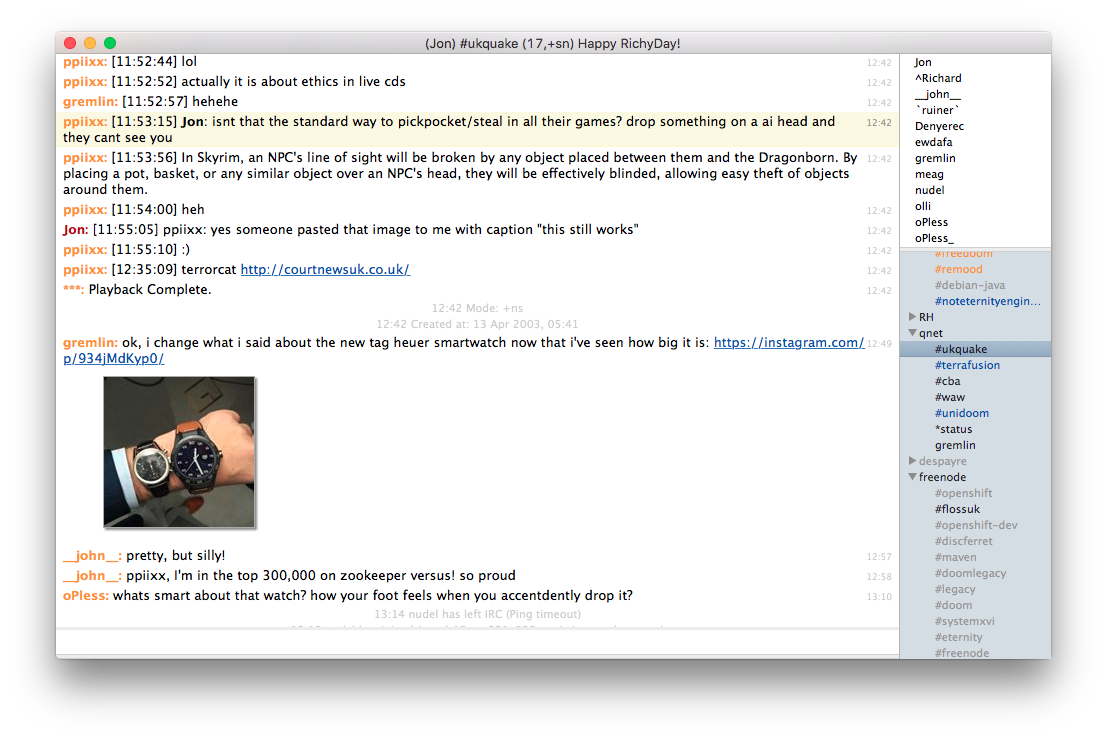
LimeChat LimeChat
LimeChat, an IRC client. I theme it to look like Colloquy. The net result is pretty clean. I like using a proportional-font for text things, so getting IRC out of a terminal is a win for me. LimeChat automatically fetches and thumbnails URIs to images that people paste in channels, which is either incredibly convenient or a curse, depending on the channel. You can toggle that behaviour but only across the whole client, not on a channel or network basis. Finally, 1Password is an incredibly slick password manager. I use it in a very basic fashion: no mobile client, no syncing to anything outside of my workstation. You could also use LastPass which is similar and has a Linux client. I haven't tried it, but there's a third party tool to read 1Password password stores on Linux written by Ryan Coleman of SDL fame called 1pass.

8 November 2015

Andrew Cater: MiniDebconf ARM Cambridge 1525 8 November

Good talk on what it means to transfer LARGE data sets in academia and the downfalls of networking.

Peter Green is about to give a talk on Raspbian - these talks filling in for the missing talk mentioned earlier

Raspbian project - What is it, why it was needed, who is behind it etc.

Lots of typing around me and IRC on #debconf-cambridge

7 November 2015

Andrew Cater: Debconf, ARM, Cambridge - 1250 7 November

Lunchtime - full talks over for the minute. Lightning talks may happen soon-ish.

Isolated knots of people chatting: Video Sprint folk chatting about how much can be done in time for Debconf 2016 in South Africa in the break out room.

Three or four people on laptops immediately behind me. Activity never stops

Thanks go to ARM for the venue in a good auditorium space, and also to the other sponsors who have sponsored our lunches or other expenses - and the staff here on the weekend / out of hours which I would guess is unusual.

Andrew Cater: Mini Debconf ARM Cambridge 1115 7 November

Between talks - coding and testing going on in the row infront of me - vmdebootstrap rework for Debian Live CD still going on.

Beaglebone SBC hanging from a Thinkpad in the row behind

Others talking - most getting coffee

Next up - Daniel Silverstone on Lua

6 November 2015

Matthew Garrett: Why improving kernel security is important

The Washington Post published an article today which describes the ongoing tension between the security community and Linux kernel developers. This has been roundly denounced as FUD, with Rob Graham going so far as to claim that nobody ever attacks the kernel.

Unfortunately he's entirely and demonstrably wrong, it's not FUD and the state of security in the kernel is currently far short of where it should be.

An example. Recent versions of Android use SELinux to confine applications. Even if you have full control over an application running on Android, the SELinux rules make it very difficult to do anything especially user-hostile. Hacking Team, the GPL-violating Italian company who sells surveillance software to human rights abusers, found that this impeded their ability to drop their spyware onto targets' devices. So they took advantage of the fact that many Android devices shipped a kernel with a flawed copy_from_user() implementation that allowed them to copy arbitrary userspace data over arbitrary kernel code, thus allowing them to disable SELinux.

If we could trust userspace applications, we wouldn't need SELinux. But we assume that userspace code may be buggy, misconfigured or actively hostile, and we use technologies such as SELinux or AppArmor to restrict its behaviour. There's simply too much userspace code for us to guarantee that it's all correct, so we do our best to prevent it from doing harm anyway.

This is significantly less true in the kernel. The model up until now has largely been "Fix security bugs as we find them", an approach that fails on two levels:

1) Once we find them and fix them, there's still a window between the fixed version being available and it actually being deployed
2) The forces of good may not be the first ones to find them

This reactive approach is fine for a world where it's possible to push out software updates without having to perform extensive testing first, a world where the only people hunting for interesting kernel vulnerabilities are nice people. This isn't that world, and this approach isn't fine.

Just as features like SELinux allow us to reduce the harm that can occur if a new userspace vulnerability is found, we can add features to the kernel that make it more difficult (or impossible) for attackers to turn a kernel bug into an exploitable vulnerability. The number of people using Linux systems is increasing every day, and many of these users depend on the security of these systems in critical ways. It's vital that we do what we can to avoid their trust being misplaced.

Many useful mitigation features already exist in the Grsecurity patchset, but a combination of technical disagreements around certain features, personality conflicts and an apparent lack of enthusiasm on the side of upstream kernel developers has resulted in almost none of it landing in the kernels that most people use. Kees Cook has proposed a new project to start making a more concerted effort to migrate components of Grsecurity to upstream. If you rely on the kernel being a secure component, either because you ship a product based on it or because you use it yourself, you should probably be doing what you can to support this.

Microsoft received entirely justifiable criticism for the terrible state of security on their platform. They responded by introducing cutting-edge security features across the OS, including the kernel. Accusing anyone who says we need to do the same of spreading FUD is risking free software being sidelined in favour of proprietary software providing more real-world security. That doesn't seem like a good outcome.

comment count unavailable comments

5 November 2015

Andrew Cater: MiniDebconf2015, ARM Cambridge 1320 5 November

Back after lunch - chatting about video and stuff with the Video Team sprint.
Thanks to the ARM employees swiping us in and out and shepherding the bunch of us over to lunch and keeping track of us.

From behind me, there's the chat over sorting out a switch to handle the LAN setup to test the video equipment later on.

Next door, they're busy, busy, busy - four tables full of people working fairly quietly. Steve McIntyre (Sledge) is running around facilitating, answering questions, sorting out "stuff"

Front desk are still front desking although most of us have arrived: I'm guessing they'll be busiest over the weekend.

Three of us on laptops doing whatever in here: Helen busy working to make sense of scribbled notes on whiteboards into a proper diagramming package - green and red marker pen on two walls full of whiteboard becomes a sensible project - objectives, bullet points, tasking - seemingly far too much organisation for this sort of thing and not the way some of us naturally work but necessary if we're not to forget something tiny but vital.

Thanks for this expertise, Helen, that most of us don't have :)


Andrew Cater: Cambridge MiniDebConf2015 - ARM, Cambridge 1030 5 November

Now safely here - good to be home with the family. Some old faces who were here last year, some new.

Roomful of laptops: fairly quiet hum of people coding. I've stolen what could be the largest table - but I have integrated a Cubietruck so far this morning :)

Next door is the Video team sprint - working to try and get something sorted to replace dvswitch - the software behind all the Debconf videos.

ARM staff helpful as ever, good surroundings and, of course, good coffee :)

Next.

Previous.