Search Results: "ads"

2 July 2024

Colin Watson: Free software activity in June 2024

My Debian contributions this month were all sponsored by Freexian. You can support my work directly via Liberapay.

Junichi Uekawa: July.

July. My recent coding was around my AC controls at home. That's about it.

Ben Hutchings: FOSS activity in June 2024

Ben Hutchings: FOSS activity in May 2024

1 July 2024

Ben Hutchings: FOSS activity in April 2024

Niels Thykier: Debian packaging with style black

When I started working on the language server for debputy, one of several reasons was about automatic applying a formatting style. Such that you would not have to remember to manually reformat the file. One of the problems with supporting automatic formatting is that no one agrees on the "one true style". To make this concrete, Johannes Schauer Marin Rodrigues did the numbers of which wrap-and-sort option that are most common in https://bugs.debian.org/895570#46. Unsurprising, we end up with 14-15 different styles with various degrees of popularity. To make matters worse, wrap-and-sort does not provide a way to declare "this package uses options -sat". So that begged the question, how would debputy know which style it should use when it was going to reformat file. After a couple of false-starts, Christian Hofstaedtler mentioned that we could just have a field in debian/control for supporting a "per-package" setting in responds to my concern about adding a new "per-package" config file. At first, I was not happy with it, because how would you specify all of these options in a field (in a decent manner)? But then I realized that one I do not want all these styles and that I could start simpler. The Python code formatter black is quite successful despite not having a lot of personalized style options. In fact, black makes a statement out of not allowing a lot of different styles. Combing that, the result was X-Style: black (to be added to the Source stanza of debian/control), which every possible reference to the black tool for how styling would work. Namely, you outsource the style management to the tool (debputy) and then start using your focus on something else than discussing styles. As with black, this packaging formatting style is going to be opinionated and it will evolve over time. At the starting point, it is similar to wrap-and-sort -sat for the deb822 files (debputy does not reformat other files at the moment). But as mentioned, it will likely evolve and possible diverge from wrap-and-sort over time. The choice of the starting point was based on the numbers posted by Johannes #895570. It was not my personal favorite but it seemed to have a majority and is also close to the one suggested by salsa pipeline maintainers. The delta being -kb which I had originally but removed in 0.1.34 at request of Otto Kek l inen after reviewing the numbers from Johannes one more time. To facilitate this new change, I uploaded debputy/0.1.30 (a while back) to Debian unstable with the following changes:
  • Support for the X-Style: black header.
  • When a style is defined, the debputy lsp server command will now automatically reformat deb822 files on save (if the editor supports it) or on explicit "reformat file" request from the editor (usually indirectly from the user).
  • New subcommand debputy reformat command that will reformat the files, when a style is defined.
  • A new pre-commit hook repo to run debputy lint and debputy reformat. These hooks are available from https://salsa.debian.org/debian/debputy-pre-commit-hooks version v0.1 and can be used with the pre-commit tool (from the package of same name).
The obvious omission is a salsa-pipeline feature for this. Otto has put that on to his personal todo list and I am looking forward to that.
Beyond black Another thing I dislike about our existing style tooling is that if you run wrap-and-sort without any arguments, you have a higher probability of "trashing" the style of the current package than getting the desired result. Part of this is because wrap-and-sort's defaults are out of sync with the usage (which is basically what https://bugs.debian.org/895570 is about). But I see another problem. The wrap-and-sort tool explicitly defined options to tweak the style but provided maintainers no way to record their preference in any machine readable way. The net result is that we have tons of diverging styles and that you (as a user of wrap-and-sort) have to manually tell wrap-and-sort which style you want every time you run the tool. In my opinion that is not playing to the strengths of neither human nor machine. Rather, it is playing to the weaknesses of the human if anything at all. But the salsa-CI pipeline people also ran into this issue and decided to work around this deficiency. To use wrap-and-sort in the salsa-CI pipeline, you have to set a variable to activate the job and another variable with the actual options you want. The salsa-CI pipeline is quite machine readable and wrap-and-sort is widely used. I had debputy reformat also check for the salsa-CI variables as a fallback. This fallback also works for the editor mode (debputy lsp server), so you might not even have to run debputy reformat. :) This was a deliberate trade-off. While I do not want all us to have all these options, I also want Debian packaging to be less painful and have fewer paper cuts. Having debputy go extra lengths to meet wrap-and-sort users where they are came out as the better solution for me. A nice side-effect of this trade-off is that debputy reformat now a good tool for drive-by contributors. You can safely run debputy reformat on any package and either it will apply the styling or it will back out and inform you that no obvious style was detected. In the latter case, you would have to fallback to manually deducing the style and applying it.
Differences to wrap-and-sort The debputy reformat has some limitations or known differences to wrap-and-sort. Notably, debputy reformat (nor debputy lsp server) will not invoke wrap-and-sort. Instead, debputy has its own reformatting engine that provides similar features. One reason for not running wrap-and-sort is that I want debputy reformat to match the style that debputy lsp server will give you. That way, you get consistent style across all debputy commands. Another reason is that it is important to me that reformatting is safe and does not change semantics. This leads to two regrettable known differences to the wrap-and-sort behavior due to safety in addition to one scope limitation in debputy:
  1. debputy will ignore requests to sort the stanzas when the "keep first" option is disabled (-b --no-keep-first). This combination is unsafe reformatting. I feel it was a mistake for wrap-and-sort to ever allow this but at least it is no longer the default (-b is now -bk by default). This will be less of a problem in debhelper-compat 15, since the concept of "main package" will disappear and all multi-binary source packages will be required to use debian/package.install rather than debian/install.
  2. debputy will not reorder the contents of debhelper packaging files such as debian/install. This is also an (theoretical) unsafe thing to do. While the average package will not experience issues with this, there are rare corner cases where the re-ordering can affect the end result. I happen to know this, because I ran into issues when trying to optimize dh_install in a way that assumed the order did not matter. Stuff broke and there is now special-case code in dh_install to back out of that optimization when that happens.
  3. debputy has a limited list of wrap-and-sort options it understands. Some options may cause debputy to back out and disable reformatting entirely with a remark that it cannot apply that style. If you run into a case of this, feel free to file a feature request to support it. I will not promise to support everything, but if it is safe and trivially doable with the engine already, then I probably will.
As stated, where debputy cannot implement the wrap-and-sort styles fully, then it will currently implement a subset that is safe if that can be identified or back out entirely of the formatting when it cannot. In all cases, debputy will not break the formatting if it is correct. It may just fail at correcting one aspect of the wrap-and-sort style if you happen to get it wrong. It is also important to remember that the prerequisite for debputy applying any wrap-and-sort style is that you have set the salsa-CI pipeline variables to trigger wrap-and-sort with the salsa-CI pipeline. So there is still a CI check before the merge that will run the wrap-and-sort in its full glory that provides the final safety net for you.
Just give me a style In conclusion, if you, like me, are more interested in getting a consistent style rather than discussing what that style should be, now you can get that with X-Style: black. You can also have your custom wrap-and-sort style be picked up automatically for drive-by contributors.
$ apt satisfy 'dh-debputy (>= 0.1.30), python3-lsprotocol'
# Add  X-Style: black  to  debian/control  for "just give me a style"
#
# OR, if there is a specific  wrap-and-sort  style for you then set
# SALSA_CI_DISABLE_WRAP_AND_SORT=no plus set relevant options in
# SALSA_CI_WRAP_AND_SORT_ARGS in debian/salsa-ci.yml (or .gitlab-ci.yml)
$ debputy reformat
It is sadly not yet in the salsa-ci pipeline. Otto is looking into that and hopefully we will have it soon. :) And if you find yourself often doing archive-wide contributions and is tired of having to reverse engineer package formatting styles, consider using debputy reformat or debputy lsp server. If you use debputy in this way, please consider providing feedback on what would help you.

Guido G nther: Free Software Activities June 2024

A short status update of what happened on my side last month. Was able to test our Cellbroadcast bits, feedbackd became more flexible regarding LEDs, Phosh 0.40 is out, and some more. Phosh Phoc gmobile phosh-mobile-settings phosh-wallpapers emacs Debian ModemManager Feedbackd Livi Calls Chatty meta-phosh Libhandy If you want to support my work see donations.

30 June 2024

Joachim Breitner: Do surprises get larger?

The setup Imagine you are living on a riverbank. Every now and then, the river swells and you have high water. The first few times this may come as a surprise, but soon you learn that such floods are a recurring occurrence at that river, and you make suitable preparation. Let s say you feel well-prepared against any flood that is no higher than the highest one observed so far. The more floods you have seen, the higher that mark is, and the better prepared you are. But of course, eventually a higher flood will occur that surprises you. Of course such new record floods are happening rarer and rarer as you have seen more of them. I was wondering though: By how much do the new records exceed the previous high mark? Does this excess decrease or increase over time? A priori both could be. When the high mark is already rather high, maybe new record floods will just barley pass that mark? Or maybe, simply because new records are so rare events, when they do occur, they can be surprisingly bad? This post is a leisurely mathematical investigating of this question, which of course isn t restricted to high waters; it could be anything that produces a measurement repeatedly and (mostly) independently weather events, sport results, dice rolls. The answer of course depends on the distribution of results: How likely is each possible results.

Dice are simple With dice rolls the answer is rather simple. Let our measurement be how often you can roll a die until it shows a 6. This simple game we can repeat many times, and keep track of our record. Let s say the record happens to be 7 rolls. If in the next run we roll the die 7 times, and it still does not show a 6, then we know that we have broken the record, and every further roll increases by how much we beat the old record. But note that how often we will now roll the die is completely independent of what happened before! So for this game the answer is: The excess with which the record is broken is always the same. Mathematically speaking this is because the distribution of rolls until the die shows a 6 is memoryless. Such distributions are rather special, its essentially just the example we gave (a geometric distribution), or its continuous analogue (the exponential distributions, for example the time until a radioactive particle decays).

Mathematical formulation With this out of the way, let us look at some other distributions, and for that, introduce some mathematical notations. Let X be a random variable with probability density function (x) and cumulative distribution function (x), and a be the previous record. We are interested in the behavior of Y(a) = X a X > x i.e. by how much X exceeds a under the condition that it did exceed a. How does Y change as a increases? In particular, how does the expected value of the excess e(a) = E(Y(a)) change?

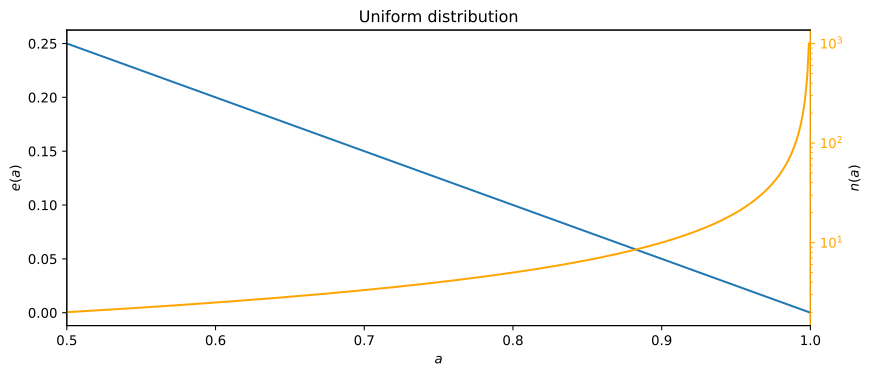
Uniform distribution If X is uniformly distributed between, say, 0 and 1, then a new record will appear uniformly distributed between a and 1, and as that range gets smaller, the excess must get smaller as well. More precisely, e(a) = E(X a X > a) = E(X X > a) a = (1 a)/2 This not very interesting linear line is plotted in blue in this diagram:
The expected record surpass for the uniform distribution The expected record surpass for the uniform distribution
The orange line with the logarithmic scale on the right tries to convey how unlikely it is to surpass the record value a: it shows how many attempts we expect before the record is broken. This can be calculated by n(a) = 1/(1 (a)).

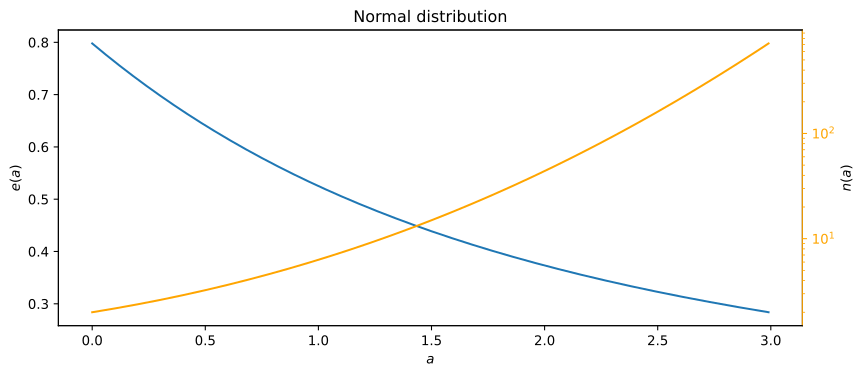
Normal distribution For the normal distribution (with median 0 and standard derivation 1, to keep things simple), we can look up the expected value of the one-sided truncated normal distribution and obtain e(a) = E(X X > a) a = (a)/(1 (a)) a Now is this growing or shrinking? We can plot this an have a quick look:
The expected record surpass for the normal distribution The expected record surpass for the normal distribution
Indeed it is, too, a decreasing function! (As a sanity check we can see that e(0) = (2/ ), which is the expected value of the half-normal distribution, as it should.)

Could it be any different? This settles my question: It seems that each new surprisingly high water will tend to be less surprising than the previously assuming high waters were uniformly or normally distributed, which is unlikely to be helpful. This does raise the question, though, if there are probability distributions for which e(a) is be increasing? I can try to construct one, and because it s a bit easier, I ll consider a discrete distribution on the positive natural numbers, and consider at g(0) = E(X) and g(1) = E(X 1 X > 1). What does it take for g(1) > g(0)? Using E(X) = p + (1 p)E(X X > 1) for p = P(X = 1) we find that in order to have g(1) > g(0), we need E(X) > 1/p. This is plausible because we get equality when E(X) = 1/p, as it precisely the case for the geometric distribution. And it is also plausible that it helps if p is large (so that the next first record is likely just 1) and if, nevertheless, E(X) is large (so that if we do get an outcome other than 1, it s much larger). Starting with the geometric distribution, where P(X > n X n) = pn = p (the probability of again not rolling a six) is constant, it seems that these pn is increasing, we get the desired behavior. So let p1 < p2 < pn < be an increasing sequence of probabilities, and define X so that P(X = n) = p1 pn 1 (1 pn) (imagine the die wears off and the more often you roll it, the less likely it shows a 6). Then for this variation of the game, every new record tends to exceed the previous more than previous records. As the p increase, we get a flatter long end in the probability distribution.

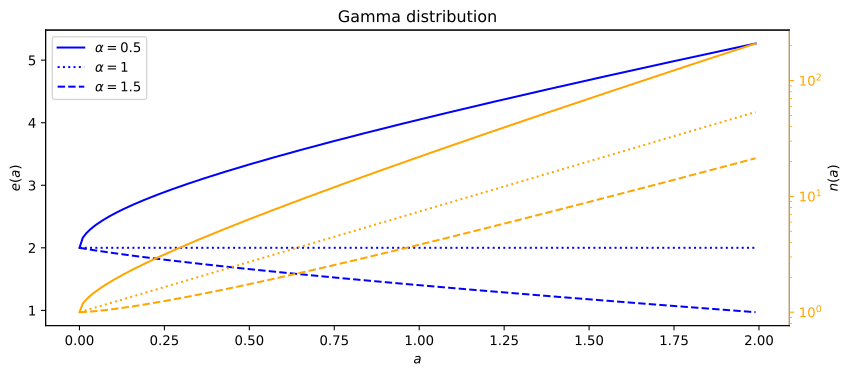
Gamma distribution To get a nice plot, I ll take the intuition from this and turn to continuous distributions. The Wikipedia page for the exponential distribution says it is a special case of the gamma distribution, which has an additional shape parameter , and it seems that it could influence the shape of the distribution to be and make the probability distribution have a longer end. Let s play around with = 2 and = 0.5, 1 and 1.5:
The expected record surpass for the gamma distribution The expected record surpass for the gamma distribution
  • For = 1 (dotted) this should just be the exponential distribution, and we see that e(a) is flat, as predicted earlier.
  • For larger (dashed) the graph does not look much different from the one for the normal distribution not a surprise, as for , the gamma distribution turns into the normal distribution.
  • For smaller (solid) we get the desired effect: e(a) is increasing. This means that new records tend to break records more impressively.
The orange line shows that this comes at a cost: for a given old record a, new records are harder to come by with smaller .

Conclusion As usual, it all depends on the distribution. Otherwise, not much, it s late.

28 June 2024

Matthew Palmer: Checking for Compromised Private Keys has Never Been Easier

As regular readers would know, since I never stop banging on about it, I run Pwnedkeys, a service which finds and collates private keys which have been disclosed or are otherwise compromised. Until now, the only way to check if a key is compromised has been to use the Pwnedkeys API, which is not necessarily trivial for everyone. Starting today, that s changing. The next phase of Pwnedkeys is to start offering more user-friendly tools for checking whether keys being used are compromised. These will typically be web-based or command-line tools intended to answer the question is the key in this (certificate, CSR, authorized_keys file, TLS connection, email, etc) known to Pwnedkeys to have been compromised? .

Opening the Toolbox Available right now are the first web-based key checking tools in this arsenal. These tools allow you to:
  1. Check the key in a PEM-format X509 data structure (such as a CSR or certificate);
  2. Check the keys in an authorized_keys file you upload; and
  3. Check the SSH keys used by a user at any one of a number of widely-used code-hosting sites.
Further planned tools include live checking of the certificates presented in TLS connections (for HTTPS, etc), SSH host keys, command-line utilities for checking local authorized_keys files, and many other goodies.

If You Are Intrigued By My Ideas and wish to subscribe to my newsletter, now you can! I m not going to be blogging every little update to Pwnedkeys, because that would probably get a bit tedious for readers who aren t as intrigued by compromised keys as I am. Instead, I ll be posting every little update in the Pwnedkeys newsletter. So, if you want to keep up-to-date with the latest and greatest news and information, subscribe to the newsletter.

Supporting Pwnedkeys All this work I m doing on my own time, and I m paying for the infrastructure from my own pocket. If you ve got a few dollars to spare, I d really appreciate it if you bought me a refreshing beverage. It helps keep the lights on here at Pwnedkeys Global HQ.

27 June 2024

Jonathan McDowell: Sorting out backup internet #4: IPv6

The final piece of my 5G (well, 4G) based based backup internet connection I needed to sort out was IPv6. While Three do support IPv6 in their network they only seem to enable it for certain devices, and the MC7010 is not one of those devices, even though it also supports IPv6. I use v6 a lot - over 50% of my external traffic, last time I looked. One suggested option was that I could drop the IPv6 Router Advertisements when the main external link went down, but I have a number of internal services that are only presented on v6 addresses so I needed to ensure clients in the house continued to have access to those. As it happens I ve used the Hurricane Electric IPv6 Tunnel Broker in the past, so my pass was re-instating that. The 5G link has a real external IPv4 address, and it s possible to update the endpoint using a simple HTTP GET. I added the following to my /etc/dhcp/dhclient-exit-hooks.d/modem-interface-route where we are dealing with an interface IP change:
# Update IPv6 tunnel with Hurricane Electric
curl --interface $interface 'https://username:password@ipv4.tunnelbroker.net/nic/update?hostname=1234'
I needed some additional configuration to bring things up, so /etc/network/interfaces got the following, configuring the 6in4 tunnel as well as the low preference default route, and source routing via the 5g table, similar to IPv4:
pre-up ip tunnel add he-ipv6 mode sit remote 216.66.80.26
pre-up ip link set he-ipv6 up
pre-up ip addr add 2001:db8:1234::2/64 dev he-ipv6
pre-up ip -6 rule add from 2001:db8:1234::/64 lookup 5g
pre-up ip -6 route add default dev he-ipv6 table 5g
pre-up ip -6 route add default dev he-ipv6 metric 1000
post-down ip tunnel del he-ipv6
We need to deal with IPv4 changes in for the tunnel endpoint, so modem-interface-route also got:
ip tunnel change he-ipv6 local $new_ip_address
/etc/nftables.conf had to be taught to accept the 6in4 packets from the tunnel in the input chain:
# Allow HE tunnel
iifname "sfp.31" ip protocol 41 ip saddr 216.66.80.26 accept
Finally, I had to engage in something I never thought I d deal with; IPv6 NAT. HE provide a /48, and my FTTP ISP provides me with a /56, so this meant I could do a nice stateless 1:1 mapping:
table ip6 nat  
  chain postrouting  
    type nat hook postrouting priority 0
    oifname "he-ipv6" snat ip6 prefix to ip6 saddr map   2001:db8:f00d::/56 : 2001:db8:666::/56  
   
 
This works. Mostly. The problem is that HE, not unreasonably, expect your IPv4 address to be pingable. And it turns out Three have some ranges that this works on, and some that it doesn t. Which means it s a bit hit and miss whether you can setup the tunnel. I spent a while trying to find an alternative free IPv6 tunnel provider with a UK endpoint. There s less call for them these days, so I didn t manage to find any that actually worked (or didn t have a similar pingable requirement). I did consider whether I wanted to end up with routes via a VM, as I described in the failover post, but looking at costings for VMs with providers who could actually give me an IPv6 range I decided the cost didn t make it worthwhile; the VM cost ended up being more than the backup SIM is costing monthly. Finally, it turns out happy eyeballs mostly means that when the 5G ends up on an IP that we can t setup the IPv6 tunnel on, things still mostly work. Browser usage fails over quickly and it s mostly my own SSH use that needs me to force IPv4. Purists will groan, but this turns out to be an acceptable trade-off for me, at present. Perhaps if I was seeing frequent failures the diverse routes approach to a VM would start to make sense, but for now I m pretty happy with the configuration in terms of having a mostly automatic backup link take over when the main link goes down.

26 June 2024

Gunnar Wolf: Many terabytes for students to play with. Thanks Debian!

LIDSOL students receiving their new hard drives My students at LIDSOL (Laboratorio de Investigaci n y Desarrollo de Software Libre, Free Software Research and Development Lab) at Facultad de Ingenier a, UNAM asked me to help them get the needed hardware to set up a mirror for various free software projects. We have some decent servers (not new servers, but mirrors don t require to be top-performance), so A couple of weeks ago, I approached the Debian Project Leader (DPL) and suggested we should buy two 16TBhard drives for this project, as it is the most reasonable cost per byte point I found. He agreed, and I bought the drives. Today we had a lab meeting, and I handed them over the hardware. Of course, they are very happy and thankful with the Debian project In the last couple of weeks, they have already set up an Archlinux mirror (https://archlinux.org/mirrors/fi-b.unam.mx), and now that they have heaps of storage space, plans are underway to set up various other mirrors (of course, a Debian mirror will be among the first).

25 June 2024

Gunnar Wolf: Find my device - Whether you like it or not

I received a mail today from Google (noreply-findmydevice@google.com) notifying me that they would unconditionally enable the Find my device functionality I have been repeatedly marking as unwanted in my Android phone. The mail goes on to explain this functionality works even when the device is disconnected, by Bluetooth signals (aha, so turn off Bluetooth will no longer turn off Bluetooth? Hmmm ) Of course, the mail hand-waves that only I can know the location of my device. Google cannot see or use it for other ends . First, should we trust this blanket statement? Second, the fact they don t do it now means they won t ever? Not even if law enforcement requires them to? The devices will be generating this information whether we want it or not, so it s just a matter of opening the required window. Targetting an individual in a crowd Of course, it is a feature many people will appreciate and find useful. And it s not only for finding lost (or stolen) phones, but the mail also mentions tags can be made available to store in your wallet, bike, keys or whatever. But it should be opt-in. As it is, it seems it s not even to opt out of it.

Thomas Lange: FAI 6.2.3 released, FAIme adds Trixie support

A new FAI version was released and the FAIme service is using this new release. You can now also create installation images for Debian 13 (testing aka Trixie). https://fai-project.org/FAIme/ Another new feature of the FAIme service will be announced at DebConf24 in August.

Russ Allbery: INN 2.7.2

This is a bug fix and minor feature release over INN 2.7.1, and the upgrade should be painless. You can download the new release from ISC or my personal INN pages. The latter also has links to the full changelog and the other INN documentation. For the full list of changes, see the INN 2.7.2 NEWS file. As always, thanks to Julien LIE for preparing this release and doing most of the maintenance work on INN!

24 June 2024

Dirk Eddelbuettel: x13binary 1.1.61 on CRAN: Maintenance

The x13binary team is thrilled to share the availability of Release 1.1.61 of the x13binary package providing the X-13ARIMA-SEATS program by the US Census Bureau which arrived on CRAN earlier today. This release brings two updates suggested by the tireless CRAN maintainers. Kurt Hornik suggested to now also ignore stderr when calling the x13 binary via system: it appears that builds under the new-ish and clang-based flang-new now emit on stderr even if Fortran-based binaries did not before. So we adjust. And Brian Ripley pointed out that our Makefile for creating the x13 binary was not quite as is should be, which we adjusted. And I just realized I should have named this 1.1.60-2 to follow the upstream convention but didn t. Next time. Courtesy of my CRANberries, there is also a diffstat report for this release showing changes to the previous release. If you like this or other open-source work I do, you can sponsor me at GitHub.

This post by Dirk Eddelbuettel originated on his Thinking inside the box blog. Please report excessive re-aggregation in third-party for-profit settings.

Dirk Eddelbuettel: digest 0.6.36 on CRAN: Big endian, maintenance

Release 0.6.36 of the digest package arrived at CRAN today and has also been uploaded to Debian. digest creates hash digests of arbitrary R objects. It can use a number different hashing algorithms (md5, sha-1, sha-256, sha-512, crc32, xxhash32, xxhash64, murmur32, spookyhash, blake3,crc32c, xxh3_64 and xxh3_128), and enables easy comparison of (potentially large and nested) R language objects as it relies on the native serialization in R. It is a mature and widely-used package (with 69.1 million downloads just on the partial cloud mirrors of CRAN which keep logs) as many tasks may involve caching of objects for which it provides convenient general-purpose hash key generation to quickly identify the various objects. This release updates one contributed C++ function to be compliant with R s revent preference for explicit declaration of REMAP, and improves the behavior under the (increasingly rare) big endian system via a patch to blake3 as well as a hint that spookyhash under big endian may not meed its reference output from little endian . My CRANberries provides a summary of changes to the previous version. For questions or comments use the issue tracker off the GitHub repo. For documentation (including the changelog) see the documentation site. If you like this or other open-source work I do, you can now sponsor me at GitHub.

This post by Dirk Eddelbuettel originated on his Thinking inside the box blog. Please report excessive re-aggregation in third-party for-profit settings.

21 June 2024

Dirk Eddelbuettel: nanotime 0.3.9 on CRAN: Bugfix

A quick bug fix release 0.3.9 for our nanotime package is now on CRAN, following up on the 0.3.8 release made this week. nanotime relies on the RcppCCTZ package (as well as the RcppDate package for additional C++ operations) and offers efficient high(er) resolution time parsing and formatting up to nanosecond resolution, using the bit64 package for the actual integer64 arithmetic. Initially implemented using the S3 system, it has benefitted greatly from a rigorous refactoring by Leonardo who not only rejigged nanotime internals in S4 but also added new S4 types for periods, intervals and durations. The 0.3.8 release added a accurate parameter for POSIXct conversions, and it turns out that this did not test as expected on arm64 so we disabled the test on that platform. The NEWS snippet below has the full details.

Changes in version 0.3.9 (2024-06-21)
  • Condition two tests to not run on arm64 (Dirk in #129 fixing #128)

Thanks to my CRANberries, there is a diffstat report for this release. More details and examples are at the nanotime page; code, issue tickets etc at the GitHub repository and all documentation is provided at the nanotime documentation site. If you like this or other open-source work I do, you can sponsor me at GitHub.

This post by Dirk Eddelbuettel originated on his Thinking inside the box blog. Please report excessive re-aggregation in third-party for-profit settings.

Bits from Debian: Recherche d'un th me pour Trixie, la prochaine version de Debian

Chaque dition de Debian b n ficie d'un nouveau th me brillant visible sur l' cran d'amor age, l' cran de connexion et, de la fa on la plus vidente, sur le fond d' cran. Debian pr voit de publier Trixie, sa prochaine version, durant l'ann e venir. Et, comme toujours, nous avons besoin de vous pour cr er son th me ! Vous avez l'occasion de concevoir un th me qui inspirera des milliers de personnes quand ils travaillent sur leur machine Debian. Pour disposer des d tails les plus r cents, veuillez vous r f rer la page du wiki. Nous voudrions profiter de cette occasion pour remercier Juliette Taka Belin pour avoir cr le th me Emerald pour Bookworm. La date limite pour les propositions est le 19 septembre 2024. Le th me est habituellement choisi en se basant sur ce qui para t le plus : Si vous souhaitez disposer plus d'informations, veuillez utiliser la liste de diffusion Debian Desktop.

Bits from Debian: Looking for the artwork for Trixie the next Debian release

Each release of Debian has a shiny new theme, which is visible on the boot screen, the login screen and, most prominently, on the desktop wallpaper. Debian plans to release Trixie, the next release, next year. As ever, we need your help in creating its theme! You have the opportunity to design a theme that will inspire thousands of people while working in their Debian systems. For the most up to date details, please refer to the wiki. We would also like to take this opportunity to thank Juliette Taka Belin for doing the Emerald theme for bookworm. The deadlines for submissions is: 2024-09-19 The artwork is usually picked based on which themes look the most: If you'd like more information or details, please post to the Debian Desktop mailing list.

Next.

Previous.