Search Results: "ed"

24 November 2013

Jan Wagner: Running icinga with lighttpd on Debian whezzy (and a Raspberry)

At first we need to install Icinga and lighttpd:
aptitude install icinga lighttpd
We need to enable the lighttpd cgi and authentication module:
lighttpd-enable-mod cgi && ighttpd-enable-mod auth
Let's create a config for Icinga (in a subdir of the default vHost). As you can see, you don't need any 'setenv.add-environment' on wheezy (at least):
vi /etc/lighttpd/conf-available/50-icinga.conf
<noscript><pre><code>&lt;html&gt;&lt;body&gt;You are being &lt;a href=&quot;https://github.com/gist/7602246&quot;&gt;redirected&lt;/a&gt;.&lt;/body&gt;&lt;/html&gt;</code></pre></noscript>
50-icinga.conf Let's create a config file with credentials for the user icingaadmin:
htpasswd -c /etc/icinga/htpasswd.users icingaadmin
Now we just need to enable the icinga config and reload the lighttpd:
lighttpd-enable-mod icinga && /etc/init.d/lighttpd force-reload
At this point you should find a working Icinga setup at http://yourip/icinga P.S. Does anybody know how to setup a buildenv (preferable as crossbuild on amd64) for Raspbian, as the Debian armhf packages are not compatible to raspbian and so there is no access to the Backports repository? Cool would be to get a sbuild env running, so it can be integrated into a buildd.

Petter Reinholdtsen: New chrpath release 0.15

After many years break from the package and a vain hope that development would be continued by someone else, I finally pulled my acts together this morning and wrapped up a new release of chrpath, the command line tool to modify the rpath and runpath of already compiled ELF programs. The update was triggered by the persistence of Isha Vishnoi at IBM, which needed a new config.guess file to get support for the ppc64le architecture (powerpc 64-bit Little Endian) he is working on. I checked the Debian, Ubuntu and Fedora packages for interesting patches (failed to find the source from OpenSUSE and Mandriva packages), and found quite a few nice fixes. These are the release notes: New in 0.15 released 2013-11-24: You can download the new version 0.15 from alioth. Please let us know via the Alioth project if something is wrong with the new release. The test suite did not discover any old errors, so if you find a new one, please also include a testsuite check.

23 November 2013

Steve Kemp: Things have settled down nicely

I've now completed all my KVM migrations. Moving my personal virtual machines from one host to another. There were a few niggles, for example I didn't have a working IPv6 allocation at the time I moved things so I had to set that up post-migration. I've also joined each of the hosts into a VPN which makes cross-guest communication secure and simple. Finally I've overhauled my firewalls and service lists. I installed a couple of extra guests, using libvirt and booting from the Debian ISO. The Debian installer continues to impress, though it did make me think I should overhaul my PXE setup at home. It wouldn't be hard to have a Raspberry PI running as a TFTP + DHCP server. You could plug it into a network, reboot your desktop, and then have it boot into the imager. At the moment I run DHCP + TFTPD + etc on my main desktop, and that allows me to reimage any of the hosts in the flat easily, except itself obviously. The last time I reinstalled this system I had to reconfigure DHCP + PXE + TFTP on another host. I think the next time I need to reinstall any system I'll "waste" an SD-card on an image-server host. Finally I've recently read the Rick Cook Wizardy Series: Fun idea. Horrible puns. Some of the books were too long, or left plot elements dangling, but on average they were more good than bad. Albeit a little predictable and "simple".

Russell Coker: Failures of Intelligence Agencies

There s been an ongoing news issue related to the NSA that I m not going to directly comment on, Charles Stross has one of the more interesting comments about it [1]. One of his major points is that any success at government secrecy relies on the type of work environment that existed 40+ years ago. Corporatism has killed government secrecy now it s a matter of time before corporate whistle-blowers start seriously leaking documents. One article that Charles links to is an interesting and insightful blog post Adam Curtis wrote for the BBC about the many failures of MI5 [2]. I think that everyone is aware of their biggest failures but from Adam s article it seems that they have only failed and never succeeded in anything. I wonder whether ASIO is any better, it s probably not (the Wikipedia page notes the involvement of MI5 in creating ASIO). It seems that the best way of achieving the goals of ASIO and MI5 would be to disband those organisations and assign regular police to do such work, after all it s been proven that British police are better at catching spies than MI5.

Mike Hommey: Don t trust python s os.execv

Python is nice and all, but its low-level functions have real disruptive discrepancies between platforms. Case at point:
import os
os.execvp("sh", ["sh", "-c", "exit 1"])
As a UNIXy person, I d expect running the above script to return an error code of 1. And I would be perfectly right on UNIX systems. On Windows, it returns 0. You d think such a difference in behavior would be documented? It s not. Thank you python.

22 November 2013

Iustin Pop: Z rich at night

Last weekend I realised that one of the advantages of winter is that it gets dark quite early - so I took a short walk through Z rich at night to take a set of pictures. I usually only shoot handheld at night, which has its limitations, and this time I took a tripod with me. It's a very cheap tripod which I have for many years now and I don't really use - and the test was to see if it's actually usable for long exposures. The results can be seen on my Smugmug gallery. Some of the pictures I really like, but that's not the main point - I learned a lot in just an hour or so. First, the tripod worked. Well, it's cheap and plasticky, so "mirror delay 3" was absolutely needed, but with that the pictures got out reasonably sharp, even at 30s exposure. Second, I forgot my cable release at home, even though I explicitly wanted to take it, so "mirror delay 3" became my remote release. Logistics aside, the most interesting thing was that in the dark, the enemy is light, and not darkness. In the city, the contrast between darkness and strong lights results in a large dynamic range requirement, and - to me - that was a surprising realisation. As an example, in this picture, I had to use f/22 to get the desired exposure time, as the light was too strong. Another surprising realisation was that, if you're shooting with 30s exposure time, a person passing in front of the camera (but not staying in the same place) will leave no trace. At shorter exposures, or when the person has a low transversal speed, then it will show, but otherwise, you don't have to care too much . Something that I knew but it was not nice to be reminded of is how "broken" auto white balance is in presence of artificial lighting (basically low temperature). Add the fact that in a non-trivial scene you have multiple lights with different temperatures makes any night scene interesting - I had to manually fix white balance for the entire album, and I don't think I got it right. And finally - light pollution. The sky above Z rich was cloudy, and the clouds were glowing orange/reddish. I can't wait to get somewhere a bit far from civilisation with a nice, dark sky

Enrico Zini: loncity

Airports Photo of a commercial in London City airport saying 'In the lap of luxury - Want to reach a captive audience with dwell time? Why advertise anywhere else? - London City Airport Media Sales' In the airport, we are not travellers. We are a captive audience with dwell time. In other words, suckers stuck in a room where the only pastime provided is spending money and staring at advertisements selling advertisement space in rooms full of suckers like them.

Joey Hess: 2013 git-annex user survey

Similar to the yearly git user survey, I am doing a 2013 git-annex user survey. If you use git-annex, please take a few minutes to answer my questions!
Since this blog post is too short, let me also announce a minor spinoff project from git-annex that I have recently released. git-repair is a complement to git fsck that can fix up arbitrarily damaged git repositories. As well as avoiding the need to rm -rf a damaged repository and re-clone, using git-repair can help rescue commits you've made to the damaged repository and not yet pushed out. I've been testing git-repair with evil code that damages git repositories in random ways. It has now successfully repaired tens of thousands of damaged repositories. In the process, I have found some bugs in git itself.

Vincent Sanders: Error analysis is the sweet spot for improvement

Although Don Norman was discussing designers attitude to user errors I assert the same is true for programmers when we use static program analysis tools.

The errors, or rather defects in the jargon, that a static analysis tools produce can be considered low cost well formed bug reports available very early in the development process.

When I say low cost it is because they can be found by a machine without a user or fellow developer wasting their time finding them. Well formed comes because the machine can describe exactly how it came to the logical deduction leading to the defect.
IntroductionStatic analysis is in general terms using the computer to examine a program for logic errors beyond those of pure syntax before it is executed. Examining a running program for defects is known as dynamic program analysis and while a powerful tool in its own right is not the topic of discussion.

This analysis has historically been confined to compiled languages as their compilers already had the Abstract Syntax Tree (AST) of the code available for analysis. As an example the C language (released in 1972) had the lint tool (released in 1979) based on the PCC compiler.

Practical early compilers (I am generalising here as the 19070s were a time of white hot innovation in computing and examples of just about any innovation in the field could probably be found) were pretty primitive and produced executables which were less good than hand written assembler output. Due to practical constraints the progress of optimising compilers was not as rapid as might be desired so static analysis was largely used as an external process.

Before progressing I ought to explain why I just mixed the concept of an optimising compiler and static analysis. The act of optimisation within those compilers requires program analysis, from which they can generate defect reports which we all know and love as compiler warnings, also explaining why many warnings only appear at higher optimisation levels where deeper analysis is required.

The attentive reader may now enquire as to why we would need external analysis tools when our compilers already perform the task. The answer stems from the issue that a compiler is trying to reconcile many desirable traits including:
The slow progress in creating optimising compilers initially centred around the problem of getting the compiled output in a reasonable time to allow for a practical edit-compile-run-debug cycle although the issues more recently have moved more towards the compiler implementation costs.

Because the output generation time is still a significant factor compilers limit the level of static analysis performed to that strictly required to produce good output. In standard operation optimising compilers do not do the extended analysis necessary to find all the defects that might be detectable.

An example: compiling one 200,000 line C program with the clang (v3.3) compiler producing x86 instruction binaries at optimisation level 2 takes 70 seconds but using the clang based scan-build static analysis tool took 517 seconds or more than seven times as long.
Using static analysis
As already described warnings are a by-product of an optimising compilers analysis and most good programmers will endeavour to remove all warnings from a project. Thus almost all programmers are already using static analysis to some degree.

The external analysis tools available can produce many more defect reports than the compiler alone as long as the developer is prepared to wait for the output. Because of this delay static analysis is often done outside the usual developers cycle and often integrated into a projects Continuous Integration (CI) system.

The resulting defects are usually presented as annotated source code with a numbered list of logical steps which shows how the defect can present. For example the steps might highlight where a line of code allocates memory from the heap and then an exit path where no reference to the allocated memory is kept resulting in a resource leak.

Once the analysis has been performed and a list of defects generated the main problem with this technology rears its ugly head, that of so called "false positives". The analysis is fundamentally an undecidable problem (it is a variation of the halting problem) and relies on algorithms to generate approximate solutions. Because of this some of the identified defects are erroneous.

The level of erroneous defect reports varies depending on the codebase being analysed and how good the analysis tool being used is. It is not uncommon to see false positive rates, even with the best tools, in excess of 10%

Good tools allow for this and provide ways to supply additional context through model files or hints in the source code to suppress the incorrect defect reports. This is analogous to using asserts to explicitly constrain variable values or a type cast to suppress a type warning.

Even once the false positives have been dealt with there comes the problem of defects which while they may be theoretically possible take so many steps to achieve that their probability is remote at best. These defects are often better categorized as a missing constraint and the better analysis tools generate fewer than the more naive implementations.

An issue with some defect reports is that often defects will appear in a small number of modules within programs, generally where the developers already know the code is of poor quality, thus not adding useful knowledge about a project.

As with all code quality tools static analysis can be helpful but is not a panacea code may be completely defect free but still fail to function correctly.
Defect DensityA term that is often used as a metric for code quality is the defect density. This is nothing more than the ratio of defect to thousands of lines of code e.g. a defect density of 0.9 means that there is approximately one defect found in every 1100 lines of code.

The often quoted industry average defect density value is 1, as with all software metrics this can be a useful indicator but should not be used without understanding.

The value will be affected by improvements in the tool as well as how lines of code are counted so is exceptionally susceptible to gaming and long term trends must be treated with scepticism.
Practical examplesI have integrated two distinct static analysis tools into the development workflow for the NetSurf project which I shall present as case studies. These examples show a good open source solution and a commercial offering highlighting the issues with each.

Several other solutions, both open source and commercial, exist many of which have been examined and discarded as either impractical or proving less useful than those selected. However the investigation was not comprehensive and only considered what was practical for the project at the time.
clangThe clang project is a frontend to the LLVM project providing an optimising compiler for the C, C++ and objective C languages. As part of this project the compiler has been enhanced to run a collection of "checkers" which implement various methods of analysis on the code being compiled.

The "scan-build" tool is provided to make the using these features straightforward. This tool generates defect reports as a series of html files which show the analysis results.


NetSurf CI system scan-build overview
Because the scan-build takes in excess of eight minutes on powerful hardware the NetSurf developers are not going to run this tool themselves as a matter of course. To get the useful output without the downsides it was decided to integrate the scan into the CI system code quality checks.

NetSurf CI system scan-build result list
Whenever a git commit happens to the mainline branch and the standard check build completes successfully on all target architectures the scan is performed and the results are published as a list of defects.

The list is accessible directly through the CI interface and also incorporates a trend graph showing how many defects were detected in each build.

A scan-build report showing an extremely unlikely path to a defect
Each defect listed has a detail link which reveals the full analysis and logic necessary to cause the defect to occur.

Unfortunately even NetSurf which is a relatively small piece of software (around 200,000 lines of code at time of writing) causes 107 defects to be emitted by scan-build.

All but 25 of the defects are however "Dead Store" where the code has a value assigned but is never checked. These errors are simply not interesting to the developers and are occurring in code generated by a tool.

Of the remaining defects identified the majority are false positives and several (like the example in the image above) are simply improbable requiring a large number of steps to reach.

This shows up the main problem with the scan-build tool in that there is no way to suppress certain checks, mark defects as erroneous or avoid false positives using a model file. This reduces the usefulness of these builds because the developers all need to remember that this list of defects is not relevant.

Most of the NetSurf developers know that the project currently has 107 outstanding issues and if a code change or tool improvement were to change that value we have to manually work through the defect list one by one to check what had changed.
CoverityThe coverity SAVE tool is a commercial offering from a company founded in the Computer Systems Laboratory at Stanford University in Palo Alto, California. The results of the original novel research has produced a good solution which improved on analysis tools previously available.

Coverity Interface showing summary of NetSurf analysis. Layout issues are a NetSurf bug
The company hosts a gratis service for open source projects, they even provide scans for the Linux kernel so project size does not appear to be an issue.

The challenges faced integrating the coverity tool into the build process differed from clang however the issue of execution time remained and the CI service was used.

The coverity scanning tool is a binary executable which collects data on the build which is then submitted to the coverity service to be analysed. This tool obviously relies upon the developer running the executable to trust coverity to some degree.

A basic examination of the binary was performed and determined the executable was not establishing network connections or performing and observably undesirable behaviour. From this investigation the decision was made that running the tool inside a sandbox environment on a CI build slave was safe. The CI system also submits the collected results in a compressed form directly to the coverity scan service.

Care must be taken to only submit builds according to the services Acceptable Use Policy which limits the submission frequency of NetSurf scans to every other day. To ensure the project stays within the rules the build performed by the CI system is manually controlled and confined to a subset of NetSurf developers.
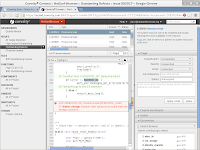
Coverity connect defect management console for NetSurfThe results are presented using the coverity connect web technology based defect management tool. Access to the coverity connect interface is controlled by a user management system which precludes publicly publishing the results within the CI system.

Unfortunately NetSurf itself does not currently have good enough JavaScript DOM bindings to support this interface so another browser must be used to view it.

Despite the drawbacks the quality of the analysis results is greatly superior to the clang solution. The false positive rate is very low while finding many real issues which had not been previously detected.

The analysis can be enhanced by use of collection configuration and modelling files which remove intended constructions from consideration reducing the false positive rate to very low levels. The ability to easily and persistently suppress false positives through the web interface is also available.

The false positive management capabilities coupled with a user interface that makes understanding the defect path simple make this solution very practical and indeed the NetSurf developers have removed over 50 actual issues within a relatively short period since the introduction of the tool.

Not all of those defects could be considered serious but they had the effect of encouraging deeper inspection of some very dubious smelling source.
ConclusionsThe principle conclusions of implementing and using static analysis have been:

When I started looking at this technology I was somewhat dubious about its usefulness but I have definitely changed my mind. It is a useful addition to any non-trivial project and the return on time and effort should be repaid handsomely in all but already perfect code (if you believe you have such code I have a bridge to sell you).

Russ Allbery: Review: The Pathway to Awesomeness

Review: The Pathway to Awesomeness, by Mark Forster
Publisher: Hyperink
Copyright: October 2013
ASIN: B00FXGXMPQ
Format: Kindle
Pages: 97
Mark Forster is probably my favorite time management (or, if you prefer, attention management) writer. The place to start with Forster if you're not familiar with him is Do It Tomorrow, not here. Unlike the other books by him I've reviewed, this is just an edited collection of blog posts presented in a convenient ebook form, without even an ISBN number. But if you've read his books (at least the ones that aren't out of print and cost a fortune), this is a convenient way to not have to trawl back through his blog and read the articles in a more convenient fashion. For me, it was also an easy way to give him a bit of money for his blog. Unless you have a similar motive, I don't think the content to price ratio is worth it. But I think everything is still up at Get Everything Done in case anything here strikes your fancy. As with most blog compilations, The Pathway to Awesomeness (I really hate that title) is composed of a whole bunch of fairly short articles, rarely more than three pages each, vaguely collected by topic. The first few are rather general and focused on the normal self-help platitudes that try to build up your sense that you're in control of your own life. But Forster doesn't take too long to get to what he's best at: short ideas, mental tools, interesting tricks, and simple techniques. Even more so than his books, due to the nature of this collection, there's a huge variety here, which means you can probably find something that strikes a chord no matter what attention management problem you've been running into. That's one of the main reasons why I prefer his writing: he tries to provide a giant toolbox instead of a single, streamlined System For Everyone. The other thing I like about Forster is that he is much more blunt than many authors about the biggest problem I have with attention management: trying to do more than anyone could possibly do given the available time. There are some more essays here about that, and several of them are quite good. I think my favorite is the short essay in which he points out how often people decide to do some task for a particular reason, and then get so engrossed in the performance of that task that they forget the original reason, risking sinking far more energy into that task than is actually warranted. Like a lot of Forster's observations, it's obvious in retrospect, but he has a way of phrasing those observation so that they shake the right thing loose in my head and let me re-evaluate something I was doing. Regular readers of Forster's blog know that he loves playing around with different simple to-do list management systems. Unfortunately, none of those are here, so don't pick this up expecting a collection of articles about Superfocus, Autofocus, etc. It makes sense given the topic of this collection, which is more general advice rather than systems, but this collection is so short that I wish he'd added a section on system development. I would have enjoyed reading a collection of all of his miniature systems together in one place and showing how he tweaked and changed them over time, particularly if he'd added some discussion of why he made each change and what goals he was trying to meet with each system. Ah well. If you aren't already familiar with Forster, there's no point in this, but if you are, I got a few new tidbits out of it and will probably skim through it a few more times. Buying it is mostly an exercise in putting money in the tip jar, and his writing is much less polished here (and more prone to cliches), but I still enjoyed reading through it. Rating: 7 out of 10

21 November 2013

Russ Allbery: Small but lovely haul

A few things for which I'd been waiting for quite some time were released, so there was another book order. Allie Brosh Hyperbole and a Half (graphic novel)
Jacqueline Carey Dark Currents (sff)
Debra Dunbar A Demon Bound (sff)
Nicola Griffith Hild (historical)
Ursula K. Le Guin The Unreal and the Real, Volume 1 (sff)
Ursula K. Le Guin The Unreal and the Real, Volume 2 (sff)
Ken Stern With Charity for All (non-fiction) I'm trying to buy fewer books given how many I have and haven't read, and also because I've been on a gaming tear recently and there are only so many hours in the day. Unfortunately, playing a lot of video games means reading fewer books. So I'm trying for quality rather than quantity, and this particular order has one of the best densities of hopefully good books as anything I've ordered in a while. For those who aren't familiar with Allie Brosh, Hyperbole and a Half is one of the most brilliant blogs that I've ever read, and this is a collection plus new stories and new illustrations. I specifically got the hardcover, which is beautiful and very high-quality. I've been waiting for Hild for years since Griffith started talking about writing it on her blog, and now I have the lovely hardcover in my hands. That's probably going to be Christmas reading. The Le Guin is a two-volume hardcover collection of Le Guin's personal favorites from her large lifetime oeuvre of short fiction.

Craig Small: WordPress password bots

Browsing through my logs I noticed that one particular IP address was continuously trying to go to wp-login.php After a few more greps, it seems he really likes this URL. So, Mr 37.115.188.210 congratulations for testing a few things and welcome to the blocklist. I love fail2ban, but initially I didn t have it for the wordpress login. That needed to get fixed real quick, so a visit to the wordpress plugins site and we have WP fail2ban up and running. And doesn t it work well:
2013-11-21 22:54:47,742 fail2ban.actions: WARNING [wordpress] Ban 37.115.188.210
2013-11-21 22:58:29,037 fail2ban.actions: WARNING [wordpress] Unban 37.115.188.210
2013-11-21 22:58:39,450 fail2ban.actions: WARNING [wordpress] Ban 37.115.188.210
2013-11-21 23:08:40,164 fail2ban.actions: WARNING [wordpress] Unban 37.115.188.210
2013-11-21 23:09:27,241 fail2ban.actions: WARNING [wordpress] Ban 37.115.188.210
2013-11-21 23:19:27,919 fail2ban.actions: WARNING [wordpress] Unban 37.115.188.210
2013-11-21 23:20:09,991 fail2ban.actions: WARNING [wordpress] Ban 37.115.188.210
2013-11-21 23:30:10,689 fail2ban.actions: WARNING [wordpress] Unban 37.115.188.210
You get the idea! I ve sent a message off to the responsible ISP, we ll see how that goes.

Gunnar Wolf: Back aches...

This year, I had slowly taken again running. It's an activity I enjoy, even though I'm far from the condition I had when I did it every day My maximum was running about 8Km four days a week (ocassionally up to 15Km, say, on weekends)... But I slowly drifted out of it over the last three years. Yes, I have taken it up now and then, but dropped out again after a few weeks. Well, this year it felt I was getting back in the routine. Not without some gaps, but I had ran most weeks since July at least once, but usually two times. I started slowly, doing about 3Km close to home, but didn't take much to go back to my usual routes inside UNAM, doing a modest average of 4.5-5Km per run, and averaging somewhat over 8Km/h (6.5 min/Km). But... Well, I cannot relate precisely what happened on this Exactly a month ago, after a very average run (even a short one, 3.6Km), I had a lower back ache. Didn't pay too much attention to it, but it was strange since the first day, as I often have upper back aches Never lower. The pain came and went slowly several times. I kept cycling to work, although not every day. On October 27th, I even took the time to do the Ciclot n, a nice 38Km (including the ~5Km distance from home) around central Mexico City. I enjoyed the ride, even though every stop and re-start of the bike was a bit painful what hurts is to get off and on the bike: The posture change. But the pain has been almost constantly there. When I stand up, or when I sit down, it's about five minutes until the body gets used to the new position and stops hurting. Another strange data point: This last weekend (together with a national holiday) we went to a small conference in Guadalajara, and then to visit our friends in Guanajuato. So, we spent 12 hours on the bus there (12 Yes, there was an accident on the road, and we could not pass... So many hours were wasted there, and going back to a junction to take an alternative, longer road), then one night in a hotel bed, and two nights in our friends' guest mattresses which are not precisely luxury-grade. And Sunday night... I had no pain at all! Came back home, and after only one night back in our bed... I just could not move. I had the strongest pain so far. Could not even walk without some help. We went to the orthopedist a friend recommended, and I was seriously bending my posture: While that part of my posture is usually stable, my right hip was about 2cm higher than the left one, and my shoulders were almost 7cm displaced from my hips! So... Well, I'm having a cocktail of painkillers and antiinflamatories. The doctor says next week he wants me to have a tomography taken to better understand the causes for this. And, of course, tomorrow I'm leaving for Festival de Software Libre in Puerto Vallarta. I'm going there by plane, so no big hassle. But the way back, it will be 12 more hours on a bus. I'm... not precisely looking forward to this bus ride :( Anyway... I sorely miss my bike+running :(

Petter Reinholdtsen: All drones should be radio marked with what they do and who they belong to

Drones, flying robots, are getting more and more popular. The most know ones are the killer drones used by some government to murder people they do not like without giving them the chance of a fair trial, but the technology have many good uses too, from mapping and forest maintenance to photography and search and rescue. I am sure it is just a question of time before "bad drones" are in the hands of private enterprises and not only state criminals but petty criminals too. The drone technology is very useful and very dangerous. To have some control over the use of drones, I agree with Daniel Suarez in his TED talk "The kill decision shouldn't belong to a robot", where he suggested this little gem to keep the good while limiting the bad use of drones:
Each robot and drone should have a cryptographically signed I.D. burned in at the factory that can be used to track its movement through public spaces. We have license plates on cars, tail numbers on aircraft. This is no different. And every citizen should be able to download an app that shows the population of drones and autonomous vehicles moving through public spaces around them, both right now and historically. And civic leaders should deploy sensors and civic drones to detect rogue drones, and instead of sending killer drones of their own up to shoot them down, they should notify humans to their presence. And in certain very high-security areas, perhaps civic drones would snare them and drag them off to a bomb disposal facility. But notice, this is more an immune system than a weapons system. It would allow us to avail ourselves of the use of autonomous vehicles and drones while still preserving our open, civil society.
The key is that every citizen should be able to read the radio beacons sent from the drones in the area, to be able to check both the government and others use of drones. For such control to be effective, everyone must be able to do it. What should such beacon contain? At least formal owner, purpose, contact information and GPS location. Probably also the origin and target position of the current flight. And perhaps some registration number to be able to look up the drone in a central database tracking their movement. Robots should not have privacy. It is people who need privacy.

Steve McIntyre: Mini-Debconf in Cambridge, November 14-17 2013

Phew, we did it! We successfuly ran our mini-conf last weekend. We welcomed roughly 60 people to the ARM offices in Cambridge over the 4 days. We started off with two days of sprint time, set aside for focussed hacking. We had a selection of ARM development boards on hand that people were playing with, plus a number of other people working on various other projects. The sprint sessions also saw some lively discussions on a couple of topics: the status of the ARM ports in Debian and automated system testing. Saturday and Sunday saw us move over to the more traditional style of conference session. Two full days of talks covered a wide range of topics: system testing to git tools, Debian ftp team work to bootstrapping the new arm64 port, improving ways of tracking and crediting Debian contributions to dealing with the new world of UEFI. Several volunteers from the DebConf video team were on hand too, so our talks were streamed live and recorded too - look out for them online soon! The mini-conf went well and feedback from attendees was universally positive, so we're already planning to run another similar event next year and maybe even apply to host a full DebConf in Cambridge soon too. :-) Many more details about the conference are in the debconf wiki at https://wiki.debconf.org/wiki/Miniconf-UK/2013 . Thanks to the sponsors who helped to make it all happen: ARM, Boston, Open@Citrix/Xen and Codethink/Baserock.

Michael Banck: 21 Nov 2013

PostgreSQL talk at Linux-Stammtisch

Next Wednesday (November 27th), the Munich Linux-Stammtisch is happening again. This time the topic will be Open-Source databases. Mathias Brandstetter will present MySQL and I will give a talk about PostgreSQL.

So if you are from or around Munich and using/interested in PostgreSQL in particular or databases in general, come around! The Stammtisch is in the Maximiliansst berl at Hofbr ukeller, starting from 19:00. As a Brotzeit is sponsored for attendees, you need to sign up either at the Xing page or here.

Craig Small: Quieting dbus

I run a program called logcheck which regularly scans the logfiles looking for interesting things . One of these interesting things (to logcheck, not to me at first) was dbus complaining about mythtv. The logs look something like this:
Nov 17 05:08:18 elmo dbus-daemon[1621]: dbus[1621]: [system] Rejected send message, 2 matched rules; type="method_call", sender=":1.236" (uid=999 pid=3669 comm="/usr/bin/mythfilldatabase --verbose general --logl") interface="org.freedesktop.NetworkManager" member="GetDevices" error name="(unset)" requested_reply="0" destination="org.freedesktop.NetworkManager" (uid=0 pid=1930 comm="/usr/sbin/NetworkManager ")
What this is is the dbus daemon rejecting a message being sent from mythfilldatabase that wants to go to NetworkManager. Looking at NetworkManager s dbus configuration, its doing all the right things. So it s a simple matter of just fixing up the dbus configuration and you re done. Then I hit the first snag; the dbus documentation is a little sad. I remember seeing a show where they MRI scanned some artifacts to get to the writing and then used a maker-bot to recreate the hidden writing. They then painstakingly translated it using a team of experts to work out the English translation. Working out the dbus configurations is not quite that difficult, but it s close. The easiest way is to copy something and see if it works, which is what I did. I created a file /etc/dbus-1/system.d/mythtv.conf which permitted the myth user access to the GetDevices method. It looks like:
<!DOCTYPE busconfig PUBLIC
 "-//freedesktop//DTD D-BUS Bus Configuration 1.0//EN"
 "http://www.freedesktop.org/standards/dbus/1.0/busconfig.dtd">
<busconfig>
        <policy user="mythtv">
                <allow send_destination="org.freedesktop.NetworkManager"
                       send_interface="org.freedesktop.NetworkManager"
                       send_member="GetDevices"/>
        </policy>
</busconfig>
Reloaded dbus and all went quiet.

Jon Dowland: Winter has arrived

Winter has come A nice view at work this morning.

Andreas Metzler: goodbye, downhill.at.eu.org

I needed to switch servers from vserver to Xen and therefore ended up with a new IP address. As a consequence I am losing downhill.at.eu.org as mail domain. because it seems to be impossible nowadays to change eu.org MX records. You can reach me on bebt.de nowadays.

20 November 2013

Matt Zimmerman: Scaling Human Systems: Management

This is part 6 in a series on organizational design and growth.
The change from a business that the owner-entrepreneur can run with helpers to a business that requires management is a sweeping change. [...] One can compare the two kinds of business to two different kinds of organism: the insect, which is held together by a tough, hard skin, and the vertebrate animal, which has a skeleton. Land animals that are supported by a hard skin cannot grow beyond a few inches in size. To be larger, animals must have a skeleton. Yet the skeleton has not evolved out of the hard skin of the insect; for it is a different organ with different antecedents. Similarly, management becomes necessary when an organization reaches a certain size and complexity. But management, while it replaces the hard-skin structure of the owner-entrepreneur, is not its successor. It is, rather, its replacement. Peter Drucker
What it means Management is the art of enabling people to cooperate in achieving shared goals. I ve written elsewhere about what management is not. Management is a multifaceted discipline which is centered on people and the environment in which they work. Why it s important In very small organizations, management can be comparatively easy, and happen somewhat automatically, especially between people who have worked together before. But as organizations grow, management becomes a first-class concern, requiring dedicated practice and a higher degree of skill. Without due attention to management, coordination becomes excessively difficult, working systems are outgrown and become strained, and much of the important work described in this series just won t happen. Management is part of the infrastructure of the organization, and specifically the part which enables it to adapt and change as it grows. Old Status Quo People generally just do stuff , meaning there is little conscious understanding of the system in which people are working. If explicit managers exist, their jobs are poorly understood. Managers themselves may be confused or uncertain about what their purpose is, particularly if they are in such a role for the first time. The organization itself has probably developed more through accretion than deliberate design. New Status Quo People work within systems which help coordinate their work. These systems are consciously designed, explicitly communicated, and changed as often as necessary. Managers guide and coordinate the development and continuous improvement of these systems. The role of managers in the organization is broadly understood, and managers receive the training, support and coaching they need to be successful. Behaviors that help Obstacles that stand in our way

Next.

Previous.
