Search Results: "ag"

11 April 2013

Russ Allbery: Hugo nominee haul

I need to write up new Kindle books, of which there are now quite a few due to various sales plus the Hugo nominee slate, but I got another set of paper books and they're sitting in front of me. So here's a list. Saladin Ahmed Throne of the Crescent Moon (sff)
Elizabeth Bear Shattered Pillars (sff)
Ta-Nehisi Coates The Beautiful Struggle (non-fiction)
Guy Gavriel Kay River of Stars (sff)
Jenny Larson Let's Pretend This Never Happened (non-fiction)
Domenica Ruta With or Without You (non-fiction)
Jay Wexler The Odd Clauses (non-fiction) Ahmed's book is the remaining Hugo nominee that I didn't already pick up. I'm delighted to see the diversity on the Hugo and particularly the Nebula slate this year, and I'm curious to see the spin that Ahmed brings to the epic fantasy genre. Bear's book is the sequel to Range of Ghosts, another book I'm very much looking forward to reading to but haven't yet. I'm rather behind on reading Bear's work right now. Let's Pretend This Never Happened, With or Without You, and The Beautiful Struggle are all memoirs, of varying degrees of seriousness. I've gotten hooked on Coates's writing at The Atlantic, and I highly recommend it if you've not yet seen it. Domenica Ruta's memoir is the latest Indiespensible selection. Jay Wexler's book was recommended by Lowering the Bar, a legal humor blog whose entire archives I'm slowly reading. But the highlight of this order is Kay's River of Stars, which is a sequel of sorts to one of my favorite books ever. This is probably the book I'll read during my next vacation.

Andrew Pollock: [life/repatexpat] Differences on how one purchases petrol

The differences between how one fuels one's car are quite pronounced, between California and Australia. Firstly, if you're paying with plastic, it's a given that you can pay at the pump. I could count on my hands the number of times I've had to walk into a gas station to pay for gas in the US. Having a small child, I was not looking forward to having to either leave her in the car so I could pay for my petrol, or having to deal with all of the rigmarole of getting her out of her car seat, just so she can accompany me inside the petrol station to make a brief transaction and then have to get her back into her car seat again. Not to mention how it drags out the whole process. Yesterday I had to wait for a pump while everyone leaves their car, queues inside to pay a single cashier, and then returns to their car and drives away. It'd be an interesting Productivity Commission report to see how much time is lost, just so people can be tempted by the high-margin items inside. Then there's pumping the petrol. California, being all hippy, requires all the fuel nozzles to have these fandangled "vapour recovery" things, which basically fit over the part of the pump that goes inside the fuel tank and does some sort of, well, vapour recovery. The upside, you're not sniffing fumes while you're pumping your petrol. The other fabulous thing about Californian fuel pumps is you can lock the handle down, so you don't have to stand there like a shag on a rock squeezing the handle while a $100 trickles into your car. You can get back in your car and listen to the radio. Or clean your windscreen. Or entertain your kid. I'd love to know why Australian pumps don't lock on any more. I have memories from my early childhood of them locking on. So yeah, I think Australians lose out quite badly when it comes to the petrol station experience. I was pleased to discover that the Woolworths branded Caltex petrol stations seem to have some sort of pay at the pump infrastructure, it just requires you to have their specific credit card or something. I need to do more research, because if I can pay at the pump, I will.

Russ Allbery: Review: Familiar

Review: Familiar, by J. Robert Lennon
Publisher: Greywolf
Copyright: 2012
ISBN: 1-55597-535-6
Format: Hardcover
Pages: 205
This is the first book of an experiment. I'm fairly well-read in science fiction and fantasy and increasingly well-read in non-fiction of interest (although there's always far more of that than I'll get to in a lifetime), but woefully unfamiliar with what's called "mainstream" literature. Under the principal that things people are excited about are probably exciting, I've wanted to read more and understand the appeal. Powell's, which I like to support anyway, has a very nice (albeit somewhat expensive) book club called Indiespensable, which sends its subscribers very nice editions of new works that Powell's thinks are interesting, with a special focus on independent publishers. So I signed up and hope to stick with it for at least a year. (The trick will be fitting these books in amongst my regular reading.) Familiar is the first feature selection I received. Elisa Brown is a mother with a dead son and a living one, a failing marriage, an affair, and a life that is, in short, falling apart. Then, while driving back from her annual pilgrimage from her son's grave, the world seems to twist and change. She finds herself dressed for business, wearing a nametag and apparently coming back from a work-related convention, driving a car that's entirely unfamiliar to her. When she gets home, everything else has changed too: her marriage seems to be on firmer ground, but based on rules she doesn't understand. She has a different job, different clothes, a different body in some subtle ways. And both of her sons are alive. I'm going to have to have a long argument with myself about where to (meaninglessly) categorize this on my review site, since in construction it is an alternate reality story and therefore a standard SF trope. Any SF reader is going to immediately assume Elisa has somehow been transported into an alternate reality with a key divergence point from her own. But that's not Lennon's focus. He stays ambiguous on the question of whether this is really happening or whether Elisa had some sort of nervous breakdown, and while some amount of investigation of the situation does take place, it's the sort of investigation that an average person with no access to special resources or scientific knowledge and a completely unbelievable story would be able to do: Internet conspiracy chatrooms and some rather dodgy characters. The focus is instead on Elisa's reaction to the situation, her choices about how to treat this new life, and on how she processes her complex emotions about her family and herself. I had profoundly mixed feelings about this book when I finished it, and revisiting it to review it, I still do. The writing is excellent: spare, evocative, and enjoyable to read. Lennon has a knack for subjective description of emotion and physical experience. The reader feels Elisa's deep discomfort with her changed body and her changed car, her swings between closed-off emotions and sudden emotional connection with a specific situation, and her struggle with the baffling question of how to come to terms with a whole new life. The part of the book from about the middle to nearly the end is excellent. Video games make an appearance and are handled surprisingly well. And when Elisa starts being blunt with people, I found myself both liking her and caring about what happens to her. On the other hand, Familiar also has some serious problems, and one of the biggest is the reaction I feared I'd have to mainstream literature: until Elisa started opening up and taking action, I found it extremely difficult to care about anyone in this book. They're all so profoundly petty, so closed off and engrossed in what seem like depressing and utterly boring lives. I'm sure that some of this is intentional and is there to lay the groundwork for Elisa's own self-discovery, but even towards the end of that self-discovery, everything here is so relentlessly middle-class suburbia that I felt stifled just reading about it. I think it's telling that no one in this book ever seems to have any substantial problem with money, or even with work. Elisa walks into a job that she's never done before and within a few weeks is doing it so well that she can take large amounts of time to wander around for plot purposes. This is a book about highly privileged people being miserable in a bubble. While those people certainly do exist, and I can believe that they act like this, I'm not sure how much I want to read about them. Thankfully, the plot does lead Elisa to poke some holes in that bubble, if never get out of it entirely. This is also another one of those stories in which every character has massive communication problems. Now, this deserves some caveats: Elisa's communication problems with her husband are part of the problem that starts the book and are clearly intentional, as are her communication difficulties with her children. And she's not really close enough to anyone to confide in them. But even with those caveats, no one in this book really talks to anyone else. It's amazing that anyone forms any connections at all, given how many walls and barriers they have around themselves. As someone with a bit of a thing for communication, this drove me nuts to read about, particularly in the first half of the book. But the worst problem is that Lennon completely blows the ending. And by that I don't just mean that I disliked the ending. I mean the ending is so unbelievable and so contrary to the entire rest of the book, at least the way I was reading and understanding it, that I think Familiar is a much better novel if you just remove the final scene entirely. It was such a bizarre and unnecessary twist that I found it infuriating. I don't want to spoil an ending, even a bad ending, so I'll only say this: it felt to me like Lennon just wasn't comfortable with his setting and plot driver and couldn't leave it alone. I think an experienced SF author wouldn't have made this mistake. There were two obvious possible conclusions to draw from the setting, plus a few interesting combinations, and I think someone comfortable with this sort of alternate reality story would have taken one of those options, any of which would have been a reasonable dismount for the plot. Alternately, they could have left it entirely ambiguous to the end and explored why the explanation may not actually matter. But Lennon seemed to me to have a tin ear for plausibility and for the normal flow of this sort of story and seems to have taken it as license for arbitrary events, thus completely violating the internal consistency and emergent rules that he'd spent the rest of the book building. I've mostly talked about my reactions to the characters and the writing and have not said much about the plot. That's somewhat intentional, since figuring out where the story will go is one of the best parts of this book. It's surprisingly tense and well-crafted for not having that much inherent dramatic tension. The excellent writing kept me reading through the first part, when I hated everyone in the story, and then Elisa started taking responsibility for her own life and actions and I started really enjoying the book while being constantly surprised. I think it's the sort of story that's best to take without too much foreknowledge of where it's going. I'm going to call this first experiment a qualfied success. Familiar was certainly interesting to read, and quite different from what I normally read despite the SF premise. If it weren't for the ending, I'd be recommending it to other people. Rating: 6 out of 10

Bdale Garbee: Batteries and Pyro Circuits

Keith and I have discovered a change in the behavior of the protection circuits integrated in the LiPo batteries we sell for use with Altus Metrum products that poses a risk for our customers. This post is meant to document what we now know, communicate changes we're planning as a result, and explain what we think flyers of our existing electronics and batteries may want to do to maximize their chances of successful flights. Background Choosing batteries and designing pyro circuits for high power rocketry avionics involves a variety of trade-offs. Reliability is the highest concern, both because nobody wants to lose an airframe due to a failed pyro event, and also because airframes recovering anomalously have safety implications. But we also care about other factors including cost and weight, and usually want to minimize the complexity of both the electronics and the overall installation. The objective of a pyro circuit is to dump enough energy rapidly into an electric match to cause it to catch fire. We need batteries both to power the electronics that decide when to fire the charge, and to provide the energy that actually ignites the match. The two most common battery types seen in the rocketry hobby are alkaline cells, often the nominal 9V rectangular variety, and rechargeable batteries based on Lithium Polymer (LiPo) chemistry. LiPo cells are 3.7 volts per cell nominal voltage, are very light, and have a high energy density. LiPo capacity is measured in units of current times time, so an 850mAh cell should be able to deliver 850 milliamps for an hour. The battery industry also uses something called a "C rate" to describe how fast the battery can be usefully discharged, wich is a multiplier relative to the battery capacity. So a battery with 850mAh capacity and a "2C" rating can deliver current at a sustained rate of 1700mA until discharged, while the same capacity at a "5C" rating can deliver 4250mA. By comparison, most 9V alkaline batteries are actually composed of 6 individual 1.5V cells enclosed in a wrapper. It's hard to get hard numbers for capacity and discharge rate, since in an alkaline cell the two are not independent, and the discharge rate is related to the volume of each individual cell. The data sheet for an Energizer 522 shows just over 600mAh at a 25mA discharge rate, dropping to about 300mAh at a 500mA discharge rate. Importantly for use in pyro circuits, LiPo cells have a very low source impedance, which means they can source immense amounts of current. It's not unusual for cells in the 1000mAh range to have ratings in excess of 30C! Because this rapid discharge ability can pose a risk of fire, it's common for LiPo cells to come with a "protection board" integrated into the battery assembly that is designed to limit the current to some rate such as 2C continuous duty. In large airframes, or projects that involve staging, air-starts, or other complex pyro event sequences, the most reliable approach will always be to use separate batteries for the control electronics and the source of pyro firing power. In the limit, having separate pyro batteries for each pyro charge with the control electronics only providing the switching to connect the batteries to the charges could even make sense. But for most airframes, this is overkill, and the increases in mass, volume, and wiring complexity just don't make sense. The challenge, then, is how to design electronics that will robustly initiate pyro events without negatively affecting the rest of the electronics when operating from a single shared battery. Altus Metrum Pyro Circuits The very first prototypes of TeleMetrum were designed to use a single-cell LiPo battery, and had an on-board 100mA charging circuit. Because we needed 5 volts to power the accelerometer, we had a small switching regulator that up-converted the LiPo voltage, and we used some of that regulator's output to charge a 1000uF capacitor. The pyro circuit used Fairchild FDN335N N-channel MOSFET switches in a low-side switching configuration to dump the energy stored in the capacitor through an attached ematch. Those FETs had an on resistance of under a tenth of an ohm in our operating conditions. The circuit worked very reliably, but the 1000uF electrolytic cap was huge and we struggled with the mechanics of such a large part hanging off the board... It turns out that 3.7 volts is way more than enough to fire a typical low-current e-match or equivalents like the Quest Q2G2 igniters. In fact, bench testing with a good digital oscilloscope showed that a typical e-match with resistance of 1.3-1.8 ohms will fire in approximately 13 microseconds when hit with the nominal 3.7 volts from a LiPo. So, starting with our v0.2 boards, we switched to using the LiPo battery voltage directly to fire the pyro charges, eliminating the clunky electrolytic capacitor entirely. We also switched to the Fairchild FDS9926A dual N-channel MOSFET whose specs are better in all regards for our application. The on resistance is down around 40 milli-ohms in our circuit, such that the current ratings are much higher (FET current limits are primarily driven by how much heat is generated due to current flowing through the channel's on resistance). Because using the LiPo voltage directly means we're effectively temporarily putting a very low resistance across the battery during the pyro events, the input voltage to the voltage regulator gets pulled down. To ensure the processor could "ride through" these events, we added a 100uF surface mount bulk capacitor on the 3.3 volt regulated voltage rail, which bench testing demonstrated was more than sufficient to maintain processor operation through pyro events. And that is essentially the same pyro circuit on all the boards, both TeleMetrum and TeleMini, that we have shipped to date. What's Changed The LiPo batteries we source and sell with our electronics come with a protection board and cable terminated in a 2-pin, 2mm "JST" connector. The specs on the protection board have always been "2C continuous", but we observed the ability to source much higher currents for short periods such as the 13 micro-seconds or so required to fire an e-match. Thus these protection circuits seemed just fine .. we could fire e-matches with a burst of current but were protected against short circuits in the wiring or our boards by the 2C continuous limit. Unfortunately, the most recent batch of batteries we sourced seem to have a much "twitchier" protection circuit. We can draw more than 2C for short bursts, but not as much as with prior boards, and not for as long an interval. With a 1 ohm power resistor on the pyro terminals of one of our boards, we get about 9 milliseconds of power before the protection circuit cuts in and shuts the battery down. The power stays down until all load is removed, which at least means the board is turned off and back on again, and in some cases could even mean the battery is unplugged and re-plugged since we draw trace current to keep the GPS memory alive even when the power is turned off, and at least some of the new batteries see that as enough to keep the power turned off after an over-current event. For many e-matches, this isn't an issue, since 9 milliseconds is way longer than the 13 microseconds needed to fire the charge. Unfortunately, we've discovered that many of the e-matches bought and used in the rocketry hobby are actually made for use in the fireworks industry, where it is desireable to retain continuity after firing so that series connections of e-matches all can fire even if some fire faster than others! This means that while the resistance goes up some after firing, sometimes the drain on the battery remains sufficient to cause the protection circuit to kick in even after the pyro charge has fired. What We're Doing About It If we remove the protection circuit from the LiPo (or jumper around it), all existing Altus Metrum products will operate successfully with pyro charges thave have an effective resistance of as low as 1 ohm. That's lower than any e-match or Q2G2 we've ever seen, so in effect what this means is that if you have an existing Altus Metrum flight computer, and you remove the LiPo protection circuit, you're good to go. This does not really make things any more "dangerous", since our battery chargers are all current limited and our discharge patterns will never cause heating of the battery. Frankly, in a rocket, the most likely way to cause a problem with a LiPo is by smashing or puncturing the actual battery during bench work or during a crash... and those cause the same problems with or without a protection board present. In the future, we will ship batteries that have either a much higher C rating on the protection circuit, or have no protection circuit at all. The number of problems reported by actual customers that we think should be attributed to LiPo protection circuit boards is very low, and we suspect most of our customers who are happily flying their boards can continue to do so. Ground testing where you fire pyro charges (or at least e-matches) using RF to issue the commands (not USB, since the LiPo charger is running any time USB is connected!) will confirm whether there's a problem. If the board resets (does startup beeps) after a pyro event, or shuts down completely (no LED activity), then you have a problem. If the matches light and the board keeps running, you're good to go. However, any Altus Metrum customer with LiPo batteries sourced from us or our distributors who is worried about this problem (even if you haven't seen problems in ground testing or previous flights), and who doesn't want to try soldering on the battery circuit board yourself, is welcome to contact us about removing the protection circuit for you. We won't charge anything other than shipping. To take advantage of this offer, just send email to fixmybattery@altusmetrum.org telling us how many of which capacity batteries you have that you'd like updated, and we'll respond with an RMA number and shipping details. Going Even Further As previously indicated, with the LiPo protection circuits removed, all of our current products will work reliably with at least 1 ohm across the pyro terminals. That should cover all real-world flying conditions just fine, but we're not satisfied yet. We've designed a new pyro control circuit that transfers the maximum possible energy to the load regardless of battery voltage without ever allowing the voltage to the processor to droop at all. We're testing this new circuit in various prototypes now, and if it pans out it will probably show up first in MegaMetrum and then trickle down to TeleMetrum and TeleMini as those products are updated later this year. The new pyro circuit tolerates 0 ohms (dead shorts) on the pyro terminals for as long as the battery can provide current, which is as good as it gets. We think the circuit is clever enough that we'll probably write more about it once we're finished validating it.

10 April 2013

Lars Wirzenius: Machine-parseable embedded license summary information

There is no common way to express license information in each source file at the moment. Some people embed license information in each file, others keep it in README or another file at the top of the source tree. Worse, there is no common syntax to express the license information in a machine-parseable way. If we had this, we could have tools that, for example, tell you if you're trying to merge code that has an incompatible license. Obviously, this kind of thing can never work perfectly. People keep inventing new licenses, and it is not possible for a computer program to fully understand any license. It is not clear humans can do that, either. However, it would be possible to do it to a number of well-known licenses, which would help most of the time. A classic 20/80 situation. I would like to suggest a syntax, similar to Emacs's "Hey Emacs" modelines, for embedding a summary of the license, or licenses, for a source file, in such a way that it can be programmatically extracted and parsed and analysed. With this syntax, one could then write a tool to ensure that all files in a project have the same license, or that all licenses are compatible with the project's overall license. Such a tool will, of course, rely on heuristics and assumptions. For example, it needs to assume the machine-parseable license summary is correct, and rely on a ruleset on what licenses are compatible with what licenses. Things can go wrong. That's life. Remember, this is aiming at doing the 20% of the work that will work 80% of the time, not perfection. I don't have a tool written, but I have a suggestion for the syntax.
/*
 * Copyright 2013 Lars Wirzenius
 *
 * tl;dr =*= Licenses: GPL-3+ or Expat, and Artistic =*=
 *
 * Blah. Blah. Blah. Imagine long, boring license texts 
 * here.
 */
The important part is this:
=*= Licenses: GPL-3+ or Expat, and Artistic =*=
The =*= prefix and suffix and the word Licenses are there to make grepping reasonably reliable without too many false positives, and to allow comment characters and other text on the same line. The actual license summary follows the syntax and semantics of the Debian copyright-format 1.0 specification, which I chose because it exists and has had a fair bit of review so far, and is reasonably expressive. The license summaries can be extracted with the following GNU sed invocation:
sed -n '/.*=\*= [Ll]icen[cs]es\?: \(.*\)=\*=.*/s//\1/p'
I allowed various forms of the word license, since it's a word that a lot of people will get wrong, and it's easy to catch all four common forms. So, does anyone else think this might be useful? Would you use it in your own projects?

Peter Makholm: Reviewing my own regular expressions

Regular expressions are a wonderful tool, but as many other powerful tools they tend to be misused. If I had a penny for everytime I recommended against using regular expressions for parsing HTML fragments . yeah you know what I mean. This time made me think a bit about my own use of regular expressions. Do I ever fall in the trap of misusing regular expressions myself? Looking at my current code base I couldn t find any glaring misuses, if I could only get a list of all the regular expressions in my current project. Regular expressions to the rescue? No, that would probably be quite an horrible adventure. Luckily I have tools to parse Perl: PPI to the rescue: <script src="https://gist.github.com/pmakholm/5354001.js"></script> A few hundred regular expressions. Most of them just matching simple substrings (in some cases case insensitive) or just short hand for testing a handful of equalities in one go. The only zero-width assertions we are using are the word boundary and quantifiers are mostly used on simple character classes like \d, \s, [0-9a-f] and a few anything but this one or two characters ([^>]). Lessons learned: 1) PPI is cool. 2) I really do use regular expressions as I preach.

Paul Wise: Inadequate software

Just 168 of the 4961 packages (3%) I have installed are inadequate. Unfortunately those packages collectively have 3440 inadequacies. How much of the software on your system has these inadequacies? You can find out today by installing Jakub Wilk's software, which is appropriately named adequate. It is now available in Debian unstable. I recommend enabling the apt hook which notifies you when software you are installing is inadequate. Other ways of being notified when you are installing inadequate software include apt-listbugs and debsecan. If you are interested in software quality, Debian's QA activities wiki page provides a good overview of the quality assurance activities that are being worked on within the context of Debian. If you want to provide better quality software for Debian, please keep an eye on the PTS pages for software you maintain. You can also run various automated checks on your software before you make new releases or upload them to the Debian archive. More people are needed to improve and expand upon Debian's existing quality assurance activities and infrastructure. Come join us today!

Andrew Pollock: [life/repatexpat] Day #10 of repatriation -- got wheels

Finally, finally, I've got a car. I had this grand plan of using a friend of a friend who was a car buyer to source me a car and have it ready for me at the airport when I arrived. That didn't work out so well, so I resorted to carsales.com.au and found something very quickly. I could have bought it last Friday, if I'd wanted to forego the RACQ inspection, but I hate used cars at the best of times, and so I want to do what I can do avoid buying a lemon, so I had to wait until Monday for the inspection. I got the report in the early afternoon on Monday, and the only thing it highlighted was a bit of oil on the front differential housing. I contacted the dealer and he said he'd get it looked at. I got an SMS from him on Tuesday morning saying the car would be ready after 3pm, but by the time I could arrange with Kristy for a ride, we just missed the bank, so I couldn't get the bank cheque to pay for it, so we rescheduled for this morning. The shipping container was delivered to Sarah's place on Monday, and there's been a steady stream of boxes arriving at my place. It was good to be able to transport some of those myself today, and there'll be more to move tomorrow. I need to sort out storage options, because one thing I don't want is for there to be too much clutter in my home. I think there'll be another trip to IKEA in my near future. At least I can do that all on my own now. It's so great to have independent mobility again.

9 April 2013

Bits from Debian: Call for participants in Debian for the Google Summer of Code

The Google Summer of Code is a program that allows post-secondary students aged 18 and older to earn a stipend writing code for Free and Open Source Software projects during the summer. For the eighth time, Debian has just been accepted as a mentoring organization for this year's program. If you're an eligible student, now is the time to take a look at our project ideas list, engage with the mentors for the projects you find interesting, and start working on your application!
Please read the FAQ and the Program Timeline on Google's website. If you are interested, we encourage you to come and chat with us on irc (#debian-soc on irc.oftc.net), or to send an email to the SoC coordination mailing-list. Most of the GSoC related information in Debian can be found on our wiki pages, but feel free to ask us directly on irc or via email. We're looking forward to work with amazing students again this summer!

Sylvestre Ledru: A New Identi.ca/Twitter feed: Debian uploads

After the Debian new packages, removal and bugs feeds (see the previous blog posts), I also plugged a feed with the last uploads in the archive:
Debian uploads on Identi.ca
Debian uploads on Twitter As a reminder, here is the list.
For identi.ca:
Debian uploads
Debian NEW queue
Debian bugs
Debian removed packages For Twitter:
Debian uploads
Debian NEW queue
Debian bugs
Debian removed packages

Wouter Verhelst: Dear HP,

I bought a ScanJet N6350 a few years back, in the belief that it would work. After all, you write free Linux drivers for all your printers, and when those printers are multifunctional printers with scanners, you do make sure the scanner bits of those printers work too. So it shouldn't be too hard to write a Linux driver for that scanner too, right? Apparently it is. For some reason that I can't imagine, you decided that my money is worth more than my stress levels. Dear HP, you suck. I fail to understand how the basic loss of functionality after a failed scan managed to get through your testing. I fail to understand why you think Linux users should be able to print, but not scan. And I especially fail to understand why I should waste my time with such an expensive device that can't even perform its basic functionality with more than 10% success rate.

Michal &#268;iha&#345;: phpMyAdmin at GSoC 2013

phpMyAdmin has been accepted for Google Summer of Code 2013. So if you are a student and thinking about how to spend this summer, you might want to join us. This year we will have fresh mentor blood and we have prepared dozen of ideas, so in case you are interested, it's really the time to start to work on your application. We require you to contribute before GSoC, so that we can see you can handle the code and our tools. All details you might need are available in our applicant guide. Our requirements might sound strict, but without them, we would drown in hundredths of applications with no clue how to decide, so do your homework and prepare perfect application. If you have any questions, get in touch with us on mailing list and get ready for April 22th, when you can submit the application.

Filed under: English Phpmyadmin 0 comments Flattr this!

Russ Allbery: Review: Judge Sn Goes Golfing

Review: Judge Sn Goes Golfing, by John Scalzi
Artist: Gahan Wilson
Publisher: Subterranean
Copyright: 2009
Printing: 2012
ISBN: 1-59606-479-X
Format: Kindle
Pages: 32
As you may have guessed, this is yet another short story by Scalzi that was rolled into the Subterranean Scalzi Super Bundle. This one is a bit longer than the ones I've previously reviewed, and is also illustrationed. Unlike some of the others, it's not available on-line for free... as a written work at least. There's an abridged audio version available for free from Subterranean Press's web site, though. Like the other stories I've reviewed so far, it's humor, but I think it's a bit more successful and substantial than the previous short stories. Judge Bufan Nigun Sn is an extremely foul-tempered alien judge who loves to golf, despite being terrible at it. He's a sort of circuit court judge for a larger galactic civilization, of which Earth is now part. (There's a smattering of background world-building, but it's not the core of the story.) Golf is his passion, in several senses of the word: his habit of getting into nasty fights with his fellow players and otherwise making public and occasionally injurious scenes has gotten him banned from every course in the Washington DC area, both public and private. Except, that is, for Dulles Woods, a dire, badly-maintained course designed via nepotism and theft whose business model is primarily based on letting the people banned from every other course golf there. And charging them extra to let caddies accompany them. The plot of this story is about a particular game of golf, dramatically foreshadowed by the opening sentence. But the story is really about Judge Sn's relationship to golfing and to the notorious Dulles Woods. It's one of the better jobs I've seen of writing a thoroughly unlikable person into a gloriously foul-tempered charm. It's also a story about a golf course and golfer who thoroughly deserve each other, and about how it feels to suddenly have something go right after grinding out hours and hours of work on a hobby that is supposed to be fun but manages to fall into some horribly compelling middle ground between enjoyment and rage-inducing frustration. Speaking as someone who is known to grind out video game completions while swearing at the television, I can sympathize. I got thoroughly hooked by Scalzi's descriptions of Judge Sn's mental state and enjoyed this story far more than I expected to. Sadly, when the plot does finally arrive, I thought it was a letdown. Scalzi throws in a highly improbable coincidence to create action, and while that's a legitimate plot technique (particularly in humor), it works best when the author goes back afterwards and fills in the back story of the coincidence. Pratchett does this extremely well. Scalzi, alas, doesn't really bother, and while suspension of disbelief isn't as relevant for this sort of story, I thought it was a missed opportunity. The ending seemed to be missing some sort of punch or background twist. That said, I really liked the character study and I think the story is well worth the 99 cents it's still selling for on the Kindle (and quite possibly other platforms; I haven't checked). If buying short stories on the Kindle is something you want to do, I recommend this one to your attention. Rating: 7 out of 10

8 April 2013

Soeren Sonnenburg: Shogun got accepted at Google Summer of Code 2013

We are happy to announce that the shogun machine learning toolbox will participate in this years google summer of code :-) SHOGUN is designed for unified large-scale learning for a broad range of feature types and learning settings, like classification, regression, or exploratory data analysis. In case you are a talented student interested in implementing and learning about machine learning algorithms - we are looking for you! We have collected a number of ideas [1] that we consider worthwhile implementing. And don't forget to apply [2]!

[1] http://shogun-toolbox.org/page/Events/gsoc2013_ideas

[2] http://google-melange.appspot.com/gsoc/org/google/gsoc2013/shogun

Daniel Pocock: Google Summer of Code, tips for students

I've had quite a few queries about the project ideas for Google Summer of Code on the Lumicall and Debian project pages and I'm publishing some notes here to help people get the best chance of participating, while also helping people's expectations. Firstly, Google is responsible for administering the program and payments, they have the last word on which projects and students participate and free software developers like myself have no direct control over this. In other words, while I would encourage students to make contributions to free software projects to familiarize themselves with the way we work, I can not promise that this will automatically lead to selection. If you are a student, do go ahead and feel free to comment on or make contributions to projects, this helps mentors to see your capabilities very quickly, but don't do any more than you would have done if the GSoC program didn't exist. In any case, building up a portfolio of work that is visible on sites like github does help your employment prospects in the long run. If a development manager is looking at 100 CVs for a job vacancy, and one of them has a strong portfolio on github or Debian, there is a good chance that one person will get an interview - although it doesn't guarantee they get the job. Where to start? If you are a student and you are already heavily involved in some free software project then you probably don't need to read the rest of this. The reality is that GSoC is meant to help bring more people into the free software community and this means we need to help people get their foot in the door. That is what I am addressing here, with examples from my own possible projects. When I went through university in the 90s, there was a very strong UNIX culture in our computer science department and the wider engineering faculty. There were also winds of change, for example, a new dean who wanted to change everything to Windows and a central IT management agenda to abolish campus computers and force students to carry and maintain their own laptops. Around the world, every campus has a different approach. I was fortunate to have UNIX topics like the vi text editor, shell programming and even LaTeX taught as a formal part of the course, students coming after me may have missed those opportunities. I understand that some students have not encountered these concepts at all today. That said, most mentors have a fairly wide tolerance for these things: it is not expected that students know these things, rather, it is an opportunity for you to start learning them whether it is part of your course or not. The key concept here is to be a self-starter: it is not what you know, but your enthusiasm to go and try the things you don't know. That is the very thing you can start doing now, even before the program commences. Doing this will definitely help you identity the areas of free software and Debian that you are most likely to get excited about, and that will lead to a successful project. Some general ideas to get started
  • If your campus hasn't taught UNIX in a formal sense, please familiarise yourself with the basics. While some companies do have more jobs working with other platforms, and some campuses have sadly tried to adapt their courses to prepare students for that limited subset of companies, all the best jobs I've had involve UNIX or Linux. I've never worked for a hedge fund that didn't use Linux. Hollywood uses Linux, NASA does too, but learning Linux is not rocket science. Basic things to understand include the vi text editor, shell scripts and using a command line tool for version control, preferably git. As you will be the system administrator of your own desktop or laptop, it's essential to understand some basic concepts like volume management too.
  • If you need to run some Windows software (some courses do require that), use VirtualBox or a similar solution to run both Windows and Linux on your computer or laptop. The VirtualBox documentation is very good and will help you start quickly. My own laptop runs Debian 7 (wheezy) as the main operating system, and I have Windows and Solaris in VirtualBox for some business applications.
  • My own course included a project that involved downloading the open source GNU make program, writing a patch and testing it. If you've never done something like that, please try. Instead of downloading a project tarball, these days you will typically clone the project's git repository. Even if you only make some trivial change that you will never share, it is good to prove that you can compile and successfully execute something like this.
Some specific ideas for my own projects
  • For Lumicall or Android development, just work your way through the build instructions that are published for all contributors. Trying the f-droid build instructions is also a good way to start.
  • For any of the Debian projects, please make sure you have installed Debian 7 (wheezy) on a desktop, laptop or virtual machine. Just follow the installation guide
  • Once you have installed Debian, try installing whichever one of my packages interests you. Try to configure and use it. Prove that the package works in a normal installation. Look at the log files. Run the test cases.
  • Next, try obtaining the source code and building the package. Debian makes it very easy. Here is an example for reSIProcate, the same works for any other package. As root:
    # apt-get update
    # apt-get build-dep resiprocate
    
    will obtain all the necessary build tools. Then, as a normal user:
    $ mkdir ~/src/resiprocate
    $ cd ~/src/resiprocate
    $ apt-get source resiprocate
    $ cd resiprocate
    $ dpkg-buildpackage -rfakeroot -j12
    
    In a few minutes, you should find the packages (*.deb files) are created.
  • Now, you could try making some small change to the package and compiling it again. Verify that your change works.
If you've successfully got to this point, then there is every chance you will be able to successfully complete a GSoC project. If you struggled along the way, that is OK too, the important thing to do is to engage with the community and learn how to ask for help. The Debian GSoC wiki provides some excellent ideas about engaging with the project using IRC chat and mailing lists. It is also very worthwhile trying to find a local group or a free software event that Debian is attending near you and spending a few hours with people who can look at any problems you have and give you quick solutions.

Matthias Klumpp: Tanglu status report

Hello everyone! I am very excited to report about the awesome progress we made with Tanglu, the new Debian-based Linux-Distribution. :) First of all, some off-topic info: I don t feel comfortable with posting too much Tanglu stuff to Planet-KDE, as this is often not KDE-related. So, in future Planet-KDE won t get Tanglu information, unless it is KDE-related ;-) You might want to take a look at Planet-Tanglu for (much) more information. So, what happened during the last weeks? Because I haven t had lectures, I nearly worked full-time on Tanglu, setting up most of the infrastructure we need. (this will change with the next week, where I have lectures again, and I also have work to do on other projects, not just Tanglu ^^) Also, we already have an awesome community of translators, designers and developers. Thanks to them, the Tanglu-Website is now translated to 6 languages, more are in the pipeline and will be merged later. Also, a new website based on the Django framework is in progress. The Logo-Contest We ve run a logo-contest, to find a new and official Tanglu logo, as the previous logo draft was too close to the Debian logo (I asked the trademark people at Debian). More than 30 valid votes (you had to be subscribed to a Tanglu Mailinglist) were received for 7 logo proposals, and we now have a final logo: Tanglu Logo (Text) I like it very much :) Fun with dak I decided to use dak, the Debian Archive Kit, to handle the Tanglu archive. Choosing dak over smaller and easy-to-use solutions had multiple reasons, the main reason is that dak is way more flexible than the smaller solution (like reprepro or min-dak) and able to handle the large archive of Tanglu. Also, dak is lightning fast. And I would have been involved with dak sooner or later anyway, because I will implement the DEP-11 extension to the Debian Archive later (making the archive application-friendly). duckWorking with dak is not exactly fun. The documentation is not that awesome, and dak contains many hardcoded stuff for Debian, e.g. it often expects the unstable suite to be present. Also, running dak on Debian Wheezy turned out to be a problem, as the Python module apt_pkg changed the API and dak naturally had problems with that. But with the great help of some Debian ftpmasters (many thanks to that!), dak is now working for Tanglu, managing the whole archive. There are still some quirks which need to be fixed, but the archive is in an usable state, accepting and integrating packages. The work on dak is also great for Debian: I resolved many issues with non-Debian dak installations, and made many parts of dak Wheezy-proof. Also, I added a few functions which might also be useful for Debian itself. All patches have of course been submitted to upstream-dak. ;-) Wanna-build and buildds GearThis is also nearly finished :) Wanna-build, the software which manages all buildds for an archive, is a bit complicated to use. I still have some issues with it, but it does it s job so far. (need to talk to the Debian wanna-build admins for help, e.g. wanna-build seems to be unable to handle arch:all-only packages, also, build logs are only submitted in parts) The status of Tanglu builds can be viewed at the provisoric Buildd-Status pages. Setting up a working buildd is also a tricky thing, it involves patching sbuild to escape bug #696841 and applying various workarounds to make the buildd work and upload packages correctly. I will write instructions how to set-up and maintain a buildd soon. At time, we have only one i386 buildd up and running, but more servers (in numbers: 3) are prepared and need to be turned into buildds. After working on Wanna-build and dak, I fully understand why Canonical developed Launchpad and it s Soyuz module for Ubuntu. But I think we might be able to achieve something similar, using just the tools Debian already uses (maybe a little less confortable than LP, but setting up an own LP instance would have been much more trouble). Debian archive import The import of packages from the Debian archive has finished. Importing the archive resulted in many issues and some odd findings (I didn t know that there are packages in the archive which didn t receive an upload since 2004!), but it has finally finished, and the archive is in a consistent state at time. To have a continuous package import from Debian while a distribution is in development, we need some changes to wanna-build, which will hopefully be possible. Online package search The Online-Package-Search is (after resolving many issues, who expected that? :P ) up and running. You can search for any package there. Some issues are remaining, e.g. the file-contents-listing doesn t work, and changelog support is broken, but the basic functionality is there. Tanglu Bugtracker We now also have a bugtracker which is based on the Trac software. The Tanglu-Bugtracker is automatically synced with the Tanglu archive, meaning that you find all packages in Trac to report bugs against them. The dak will automatically update new packages every day. Trac still needs a few confort-adjustments, e.g. submitting replies via email or tracking package versions. Tanglu base system tanglu-platform-smallThe Tanglu metapackages have been published in a first alpha version. We will support GNOME-3 and KDE4, as long as this is possible (= enough people working on the packaging). The Tanglu packages will also depend on systemd, which we will need in GNOME anyway, and which also allows some great new features in KDE. Side-effect of using systemd is at least for the start that Tanglu boots a bit slow, because we haven t done any systemd adjustments, and because systemd is very old. We will have to wait for the systemd and udev maintainers to merge the packages and release a new version first, before this will improve. (I don t want to do this downstream in Tanglu, because I don t know the plans for that at Debian (I only know the information Tollef Fog Heen & Co. provided at FOSDEM)) The community The community really surprised me! We got an incredible amount of great feedback on Tanglu, and most of the people liked the idea of Tanglu. I think we are one of the less-flamed new distributions ever started ;-) . Also, without the very active community, kickstarting Tanglu would not have been possible. My guess was that we might be able to have something running next year. Now, with the community help, I see a chance for a release in October :) The only thing people complained about was the name of the distribution. And to be really honest, I am not too happy with the name. But finding a name was an incredibe difficult process (finding something all parties liked), and Tanglu was a good compromise. Tanglu has absolutely no meaning, it was taken because it sounded interesting. The name was created by combining the Brazilian Tangerine (Clementine) and the German Iglu (igloo). I also dont think the name matters that much, and I am more interested in the system itself than the name of it. Also, companies produce a lot of incredibly weird names, Tanglu is relatively harmless compared to that ;-) . In general, thanks to everyone participating in Tanglu! You are driving the project forward! The first (planned) release I hereby announce the name of the first Tanglu release, 1.1 Aequorea Victoria . It is Daniel s fault that Tanglu releases will be named after jellyfishes, you can ask him why if you want ;-) I picked Aequorea, because this kind of jellyfish was particularly important for research in molecular biology. The GFP protein, a green fluorescent protein (=GFP), caused a small revolution in science and resulted in a Nobel Prize in 2008 for the researchers involved in GFP research (for the interested people: You can tag proteins with GFP and determine their position using light microscopy. GFP also made many other fancy new lab methods possible). Because Tanglu itself is more or less experimental at time, I found the connection to research just right for the very first release. We don t have a time yet when this version will be officially released, but I expect it to be in October, if the development speed increases a little and more developers get interested and work on it. Project Policy We will need to formalize the Tanglu project policy soon, both the technical and the social policies. In general, regarding free software and technical aspects, we strictly adhere to the Dbian Free Software Guidelines, the Debian Social Contract and the Debian Policy. Some extra stuff will be written later, please be patient! Tanglu OIN membership I was approached by the Open Invention Network, to join it as member. In general, I don t have objections to do that, because it will benefit Tanglu. However, the OIN has a very tolerant public stance on software patents, which I don t like that much. Debian did not join the OIN for this reason. For Tanglu, I think we could still join the OIN without someone thinking that we support the stance on software patents. Joining would simply be pragmatic: We support the OIN as a way to protect the Linux ecosystem from software patents, even if we don t like the stance on software patents and see it differently. Because this affects the whole Tanglu project, I don t want to decide this alone, but get some feedback from the Tanglu community before making a decision. Can I install Tanglu now? Yes and no. We don t provide installation images yet, so trying Tanglu is a difficult task (you need to install Debian and then upgrade it to Tanglu) if you want to experiment with it, I recomment trying Tanglu in a VM. I want to help! Great, then please catch one of us on IRC or subscribe to the mailinglists. The best thing is not to ask for work, but suggest something you want to do, others will then tell you if that is possible and maybe help with the task. Packages can for now only be uploaded by Debian Developers, Ubuntu Developers or Debian Maintainers who contacted me directly and whose keys have been verified. This will be changed later, but at the current state of the Tanglu archive (= less safety checks for packages), I only want people to upload stuff who definitely have the knowledge to create sane packages (you can also proove that otherwise, of course). We will later establish a new-member process. If you want to provide a Tanglu archive mirror, we would be very happy, so that the main server doesn t have to carry all the load. If you have experience in creating Linux Live-CDs or have worked with the Ubiquity installer, helping with these parts would be awesome! Unfortunately, we cannot reuse parts of Linux Mint Debian, because many of their packages don t build from source and are repackaged binaries, which is a no-go for the Tanglu main archive. Sneak peek And here is a screenshot of the very first Tanglu installation (currently more Debian than Tanglu):



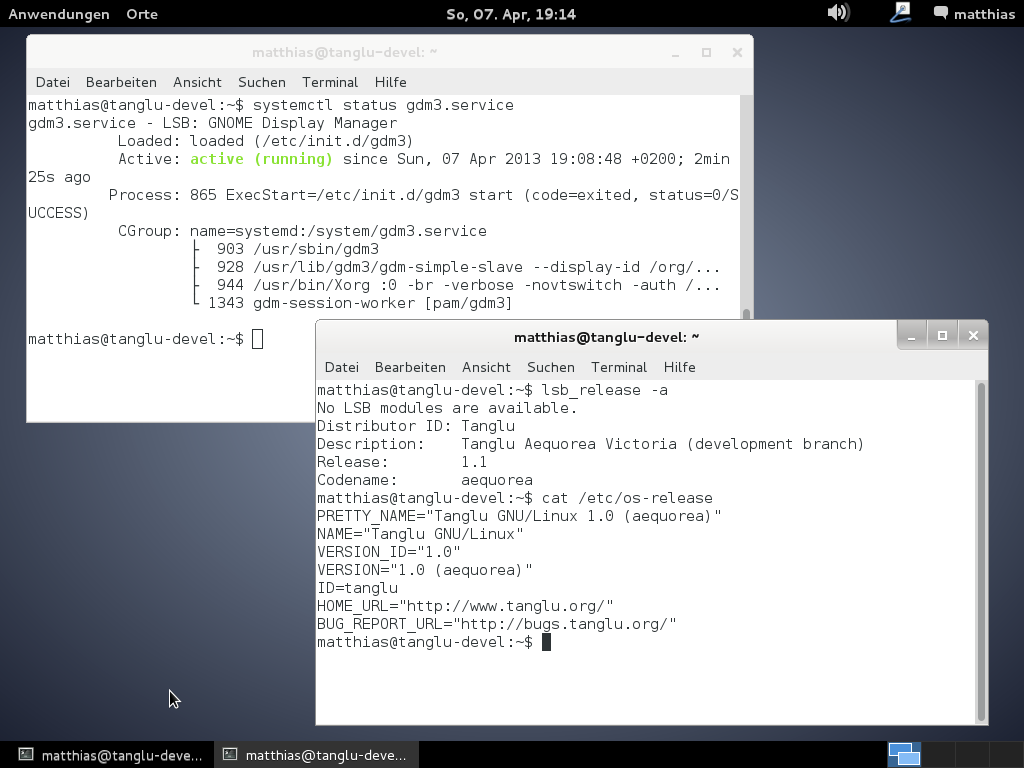
tanglu_sneak-peek_screenshot Something else I am involved in Debian for a very long time now, first as Debian Maintainer and then as Debian Developer and I never thought much about the work the Debian system administrators do. I didn t know how dak worked or how Wanna-build handles the buildds and what exactly the ftpmasters have to do. By not knowing, I mean I knew the very basic theory and what these people do. But this is something different than experiencing how much work setting up and maintaining the infrastructure is and what an awesome job the people do for Debian, keeping it all up and running and secure! Kudos for that, to all people maintaining Debian infrastructure! You rock! (And I will never ever complain about slow buildds or packages which stay in NEW for too long ;-) )

Bits from Debian: Debian joins Free & Open Source Software Outreach Program for Women

The GNOME Foundation started the Free & Open Source Software Outreach Program for Women, OPW, in 2010. In the January-April 2013 round, many other FOSS organizations joined the program. We are happy to announce that Debian will also join in the next round from June-September and we'll offer one internship. You can find more details about Debian's participation in the program at Debian OPW page. Call for mentors and projects OPW allows applicants to work on any kind of project, including coding, design, marketing, web development... The Debian Google Summer of Code projects will be offered also as possible projects for OPW, but GSoC only allows coding projects. If you have any idea of a non-coding project and you want to mentor it, please contact us in the soc-coordination mailing list adding [OPW] in subject. OPW works in the same way as GSoC except Google doesn't play a part here. The same advice that is provided for GSoC mentors works for OPW mentors. Call for participants The main goal of this program is to increase the number of women in FOSS, so all women who are not yet a Debian Developer or a Debian Maintainer are encouraged to apply. There are no age restrictions and applicants don't need to be a student. If you want to apply, you must follow three steps:
  1. Choose a project from this list. There are two lists, one for GSoC and another with non-coding tasks that can be only offered by the OPW. Those lists may change and add or remove more projects in the next few weeks.
  2. Make a small contribution to Debian. Projects will add a task the applicant must complete as part of the pre-selection process. If no task is provided, you are welcome to ask the mentors of the project. You can also make a different extra task of the one listed to show your skills and interest.
  3. Create a page in the Debian wiki with your application. You can do so under pseudonym, but in that case, please give us information about yourself privately by email to the coordinators listed in the Debian OPW page!

7 April 2013

Rapha&#235;l Hertzog: My Free Software Activities in March 2013

This is my monthly summary of my free software related activities. If you re among the people who made a donation to support my work (114.19 , thanks everybody!), then you can learn how I spent your money. Otherwise it s just an interesting status update on my various projects. Simple-CDD and debian-cd I tried to use wheezy s version of debian-cd and simple-cdd to generate an automatic installer. In this process, I filed a couple of bugs on simple-cdd (#701963: type-handling package is gone and should not be listed in default.downloads, and #701998: the --keyboard parameter is not working with wheezy s debian-installer) and I commited fixes for a few issues in debian-cd: Debian France I completed the new website for Debian France and I put it online. Later I merged some supplementary enhancements prepared by Tanguy Ortolo (and I gave him commits rights at the same time). I tried to update our Galette installation to the latest upstream version but I reverted to the former version after having encountered two problems (filed here and here). In the process, I created a Debian package for galette (you can grab it on git.debian.org). I also suggested an idea of improvement for Galette s paypal plugin and it has been quickly implemented. Thus I updated the plugin installed on france.debian.net. Kali related work It s been a few months that I have been helping the Kali team to prepare this new Debian derivative. Now that the derivative has gone public, I can attribute some of my Debian work to my collaboration with the Kali team. This month I contributed a few features and fixes to debian-installer and live-build: After the launch, we registered Kali in the derivative census. Paul Wise quickly reported some misfiled bugs from early Kali users and I discovered that reportbug was not behaving properly even though we correctly updated base-files (see #703678 on reportbug and #703677 on lsb-release). Misc packaging work DPL election I also spent quite some time to read and participate to the discussions on debian-vote since it was campaigning time for the DPL candidates Thanks This was a rather active month if you take into account the fact that I got a second son Lucas on March 6th. See you next month for a new summary of my activities.

4 comments Liked this article? Click here. My blog is Flattr-enabled.

Olivier Berger: Migrating picture tags from KPhotoAlbum to digiKam (or others) through IPTC

I've occasionally used KPhotoAlbum for a few years and eventually added many tags to the pictures. But I've decided I wanted to try other tools, and digiKam seems to be the best option from the many reviews I've read. Still, there's apparently no automatic feature to import into digiKam the tags set in KPhotoAlbum. Fortunately, some smart people have implemented Perl tools allowing to overcome this issue. The process involves modifying the pictures to save the tags inside the files, using the IPTC standard. Then, digiKam will be able to load the tags from the modified files. Here's a copy of the (translated) kphotoalbum2iptc.pl script (the original as in french) I copied from this blog post (in french too). I've been able to generate .deb packages for the required 2 perl libs dependencies using the method described in the referenced post , with : dh-make-perl --build --cpan Image::Kimdaba and dh-make-perl --build --cpan Image::IPTCInfo

Thanks to Pierre Doucet and Bruno Adele for sharing this. Hope this helps.

Andrew Pollock: [life/repatexpat] Getting online

I'd decided ahead of time that I wanted to use Internode as my ISP, and had ordered a Naked DSL service from them and also decided to bundle my mobile phone with them as well. For reasons that only made sense to me 7 years ago, I've been paying Telstra to keep my mobile number going, but I've long since lost the SIM. My current phone has a micro-SIM anyway, so I needed a replacement SIM. My grand plan had been to order the SIM, order the number port from Telstra to Internode, and then, well, profit from the moment I stuck the SIM in my phone. Unfortunately the port didn't go through as planned, and I was left incommunicado for the better part of two and a half days. I felt like I had my hands tied behind my back not having a mobile data service. It was also mildly annoying not being able to call people or be contactable, given the amount of running around I was doing. But it got resolved and is fast becoming a distant memory. The DSL service required a Telstra technician to come out (I'm not actually sure why) and that was scheduled for Thursday. I happened to catch him while he was at my building's MDF, and had a bit of a chat with him. He was a Scotsman, and I didn't get all the details, but he was going on about how he was only there to operate on the exchange side of the MDF, and I'd have to get someone else to jumper it up to my apartment. This wasn't what I expected from an installation service, but sure enough when I finally got around to plugging the ADSL modem in on Saturday morning, there was no line sync to be had. A call to Internode confirmed that he'd only jumpered it up to exchange side of the MDF. What was even more annoying was I'm pretty sure I saw him yanking out jumper wires from the MDF when he was working on it. Jumper wires that connected the exchange side of the MDF to my apartment. I was not thrilled with the idea of waiting (and paying) for a cabling contractor to come out and hook up a couple of bits of jumper wire, so I put out a call on Facebook for a Krone tool and a tone generator, and Brent was able to come through for me. He dropped the gear around while I was out shopping with Kristy, and when we got back, I located the pair for my unit, and rejumpered the existing jumper wire that I'm pretty sure the Telstra technician had disconnected. Lo and behold, my ADSL started working. I felt pretty proud of myself. It's fun operating at Layer 1 every now and then. The FRITZ!Box Fon WLAN 7270 is quite the beast of a box. Not only is it an ADSL modem, it's a wireless router, DECT base station, VoIP thingy and an answering machine! I've managed to connect my Engin account up to it, so once I get a DECT handset, I'll be able to make VoIP calls through it. I don't need to run Asterisk any more.

Next.

Previous.