Search Results: "mak"

14 November 2023

John Goerzen: It s More Important To Recognize What Direction People Are Moving Than Where They Are

I recently read a post on social media that went something like this (paraphrased): If you buy an EV, you re part of the problem. You re advancing car culture and are actively hurting the planet. The only ethical thing to do is ditch your cars and put all your effort into supporting transit. Anything else is worthless. There is some truth there; supporting transit in areas it makes sense is better than having more cars, even EVs. But of course the key here is in areas it makes sense. My road isn t even paved. I live miles from the nearest town. And get into the remote regions of the western USA and you ll find people that live 40 miles from the nearest neighbor. There s no realistic way that mass transit is ever going to be a thing in these areas. And even if it were somehow usable, sending buses over miles where nobody lives just to reach the few that are there will be worse than private EVs. And because I can hear this argument coming a mile away, no, it doesn t make sense to tell these people to just not live in the country because the planet won t support that anymore, because those people are literally the ones that feed the ones that live in the cities. The funny thing is: the person that wrote that shares my concerns and my goals. We both care deeply about climate change. We both want positive change. And I, ahem, recently bought an EV. I have seen this play out in so many ways over the last few years. Drive a car? Get yelled at. Support the wrong politician? Get a shunning. Not speak up loudly enough about the right politician? That s a yellin too. The problem is, this doesn t make friends. In fact, it hurts the cause. It doesn t recognize this truth:
It is more important to recognize what direction people are moving than where they are.
I support trains and transit. I ve donated money and written letters to politicians. But, realistically, there will never be transit here. People in my county are unable to move all the way to transit. But what can we do? Plenty. We bought an EV. I ve been writing letters to the board of our local electrical co-op advocating for relaxation of rules around residential solar installations, and am planning one myself. It may well be that our solar-powered transportation winds up having a lower carbon footprint than the poster s transit use. Pick your favorite cause. Whatever it is, consider your strategy: What do you do with someone that is very far away from you, but has taken the first step to move an inch in your direction? Do you yell at them for not being there instantly? Or do you celebrate that they have changed and are moving?

12 November 2023

Lukas M rdian: Netplan brings consistent network configuration across Desktop, Server, Cloud and IoT

Ubuntu 23.10 Mantic Minotaur Desktop, showing network settings We released Ubuntu 23.10 Mantic Minotaur on 12 October 2023, shipping its proven and trusted network stack based on Netplan. Netplan is the default tool to configure Linux networking on Ubuntu since 2016. In the past, it was primarily used to control the Server and Cloud variants of Ubuntu, while on Desktop systems it would hand over control to NetworkManager. In Ubuntu 23.10 this disparity in how to control the network stack on different Ubuntu platforms was closed by integrating NetworkManager with the underlying Netplan stack. Netplan could already be used to describe network connections on Desktop systems managed by NetworkManager. But network connections created or modified through NetworkManager would not be known to Netplan, so it was a one-way street. Activating the bidirectional NetworkManager-Netplan integration allows for any configuration change made through NetworkManager to be propagated back into Netplan. Changes made in Netplan itself will still be visible in NetworkManager, as before. This way, Netplan can be considered the single source of truth for network configuration across all variants of Ubuntu, with the network configuration stored in /etc/netplan/, using Netplan s common and declarative YAML format.

Netplan Desktop integration On workstations, the most common scenario is for users to configure networking through NetworkManager s graphical interface, instead of driving it through Netplan s declarative YAML files. Netplan ships a libnetplan library that provides an API to access Netplan s parser and validation internals, which is now used by NetworkManager to store any network interface configuration changes in Netplan. For instance, network configuration defined through NetworkManager s graphical UI or D-Bus API will be exported to Netplan s native YAML format in the common location at /etc/netplan/. This way, the only thing administrators need to care about when managing a fleet of Desktop installations is Netplan. Furthermore, programmatic access to all network configuration is now easily accessible to other system components integrating with Netplan, such as snapd. This solution has already been used in more confined environments, such as Ubuntu Core and is now enabled by default on Ubuntu 23.10 Desktop.

Migration of existing connection profiles On installation of the NetworkManager package (network-manager >= 1.44.2-1ubuntu1) in Ubuntu 23.10, all your existing connection profiles from /etc/NetworkManager/system-connections/ will automatically and transparently be migrated to Netplan s declarative YAML format and stored in its common configuration directory /etc/netplan/. The same migration will happen in the background whenever you add or modify any connection profile through the NetworkManager user interface, integrated with GNOME Shell. From this point on, Netplan will be aware of your entire network configuration and you can query it using its CLI tools, such as sudo netplan get or sudo netplan status without interrupting traditional NetworkManager workflows (UI, nmcli, nmtui, D-Bus APIs). You can observe this migration on the apt-get command line, watching out for logs like the following:
Setting up network-manager (1.44.2-1ubuntu1.1) ...
Migrating HomeNet (9d087126-ae71-4992-9e0a-18c5ea92a4ed) to /etc/netplan
Migrating eduroam (37d643bb-d81d-4186-9402-7b47632c59b1) to /etc/netplan
Migrating DebConf (f862be9c-fb06-4c0f-862f-c8e210ca4941) to /etc/netplan
In order to prepare for a smooth transition, NetworkManager tests were integrated into Netplan s continuous integration pipeline at the upstream GitHub repository. Furthermore, we implemented a passthrough method of handling unknown or new settings that cannot yet be fully covered by Netplan, making Netplan future-proof for any upcoming NetworkManager release.

The future of Netplan Netplan has established itself as the proven network stack across all variants of Ubuntu Desktop, Server, Cloud, or Embedded. It has been the default stack across many Ubuntu LTS releases, serving millions of users over the years. With the bidirectional integration between NetworkManager and Netplan the final piece of the puzzle is implemented to consider Netplan the single source of truth for network configuration on Ubuntu. With Debian choosing Netplan to be the default network stack for their cloud images, it is also gaining traction outside the Ubuntu ecosystem and growing into the wider open source community. Within the development cycle for Ubuntu 24.04 LTS, we will polish the Netplan codebase to be ready for a 1.0 release, coming with certain guarantees on API and ABI stability, so that other distributions and 3rd party integrations can rely on Netplan s interfaces. First steps into that direction have already been taken, as the Netplan team reached out to the Debian community at DebConf 2023 in Kochi/India to evaluate possible synergies.

Conclusion Netplan can be used transparently to control a workstation s network configuration and plays hand-in-hand with many desktop environments through its tight integration with NetworkManager. It allows for easy network monitoring, using common graphical interfaces and provides a single source of truth to network administrators, allowing for configuration of Ubuntu Desktop fleets in a streamlined and declarative way. You can try this new functionality hands-on by following the Access Desktop NetworkManager settings through Netplan tutorial.
If you want to learn more, feel free to follow our activities on Netplan.io, GitHub, Launchpad, IRC or our Netplan Developer Diaries blog on discourse.

Petter Reinholdtsen: New and improved sqlcipher in Debian for accessing Signal database

For a while now I wanted to have direct access to the Signal database of messages and channels of my Desktop edition of Signal. I prefer the enforced end to end encryption of Signal these days for my communication with friends and family, to increase the level of safety and privacy as well as raising the cost of the mass surveillance government and non-government entities practice these days. In August I came across a nice recipe on how to use sqlcipher to extract statistics from the Signal database explaining how to do this. Unfortunately this did not work with the version of sqlcipher in Debian. The sqlcipher package is a "fork" of the sqlite package with added support for encrypted databases. Sadly the current Debian maintainer announced more than three years ago that he did not have time to maintain sqlcipher, so it seemed unlikely to be upgraded by the maintainer. I was reluctant to take on the job myself, as I have very limited experience maintaining shared libraries in Debian. After waiting and hoping for a few months, I gave up the last week, and set out to update the package. In the process I orphaned it to make it more obvious for the next person looking at it that the package need proper maintenance. The version in Debian was around five years old, and quite a lot of changes had taken place upstream into the Debian maintenance git repository. After spending a few days importing the new upstream versions, realising that upstream did not care much for SONAME versioning as I saw library symbols being both added and removed with minor version number changes to the project, I concluded that I had to do a SONAME bump of the library package to avoid surprising the reverse dependencies. I even added a simple autopkgtest script to ensure the package work as intended. Dug deep into the hole of learning shared library maintenance, I set out a few days ago to upload the new version to Debian experimental to see what the quality assurance framework in Debian had to say about the result. The feedback told me the pacakge was not too shabby, and yesterday I uploaded the latest version to Debian unstable. It should enter testing today or tomorrow, perhaps delayed by a small library transition. Armed with a new version of sqlcipher, I can now have a look at the SQL database in ~/.config/Signal/sql/db.sqlite. First, one need to fetch the encryption key from the Signal configuration using this simple JSON extraction command:
/usr/bin/jq -r '."key"' ~/.config/Signal/config.json
Assuming the result from that command is 'secretkey', which is a hexadecimal number representing the key used to encrypt the database. Next, one can now connect to the database and inject the encryption key for access via SQL to fetch information from the database. Here is an example dumping the database structure:
% sqlcipher ~/.config/Signal/sql/db.sqlite
sqlite> PRAGMA key = "x'secretkey'";
sqlite> .schema
CREATE TABLE sqlite_stat1(tbl,idx,stat);
CREATE TABLE conversations(
      id STRING PRIMARY KEY ASC,
      json TEXT,
      active_at INTEGER,
      type STRING,
      members TEXT,
      name TEXT,
      profileName TEXT
    , profileFamilyName TEXT, profileFullName TEXT, e164 TEXT, serviceId TEXT, groupId TEXT, profileLastFetchedAt INTEGER);
CREATE TABLE identityKeys(
      id STRING PRIMARY KEY ASC,
      json TEXT
    );
CREATE TABLE items(
      id STRING PRIMARY KEY ASC,
      json TEXT
    );
CREATE TABLE sessions(
      id TEXT PRIMARY KEY,
      conversationId TEXT,
      json TEXT
    , ourServiceId STRING, serviceId STRING);
CREATE TABLE attachment_downloads(
    id STRING primary key,
    timestamp INTEGER,
    pending INTEGER,
    json TEXT
  );
CREATE TABLE sticker_packs(
    id TEXT PRIMARY KEY,
    key TEXT NOT NULL,
    author STRING,
    coverStickerId INTEGER,
    createdAt INTEGER,
    downloadAttempts INTEGER,
    installedAt INTEGER,
    lastUsed INTEGER,
    status STRING,
    stickerCount INTEGER,
    title STRING
  , attemptedStatus STRING, position INTEGER DEFAULT 0 NOT NULL, storageID STRING, storageVersion INTEGER, storageUnknownFields BLOB, storageNeedsSync
      INTEGER DEFAULT 0 NOT NULL);
CREATE TABLE stickers(
    id INTEGER NOT NULL,
    packId TEXT NOT NULL,
    emoji STRING,
    height INTEGER,
    isCoverOnly INTEGER,
    lastUsed INTEGER,
    path STRING,
    width INTEGER,
    PRIMARY KEY (id, packId),
    CONSTRAINT stickers_fk
      FOREIGN KEY (packId)
      REFERENCES sticker_packs(id)
      ON DELETE CASCADE
  );
CREATE TABLE sticker_references(
    messageId STRING,
    packId TEXT,
    CONSTRAINT sticker_references_fk
      FOREIGN KEY(packId)
      REFERENCES sticker_packs(id)
      ON DELETE CASCADE
  );
CREATE TABLE emojis(
    shortName TEXT PRIMARY KEY,
    lastUsage INTEGER
  );
CREATE TABLE messages(
        rowid INTEGER PRIMARY KEY ASC,
        id STRING UNIQUE,
        json TEXT,
        readStatus INTEGER,
        expires_at INTEGER,
        sent_at INTEGER,
        schemaVersion INTEGER,
        conversationId STRING,
        received_at INTEGER,
        source STRING,
        hasAttachments INTEGER,
        hasFileAttachments INTEGER,
        hasVisualMediaAttachments INTEGER,
        expireTimer INTEGER,
        expirationStartTimestamp INTEGER,
        type STRING,
        body TEXT,
        messageTimer INTEGER,
        messageTimerStart INTEGER,
        messageTimerExpiresAt INTEGER,
        isErased INTEGER,
        isViewOnce INTEGER,
        sourceServiceId TEXT, serverGuid STRING NULL, sourceDevice INTEGER, storyId STRING, isStory INTEGER
        GENERATED ALWAYS AS (type IS 'story'), isChangeCreatedByUs INTEGER NOT NULL DEFAULT 0, isTimerChangeFromSync INTEGER
        GENERATED ALWAYS AS (
          json_extract(json, '$.expirationTimerUpdate.fromSync') IS 1
        ), seenStatus NUMBER default 0, storyDistributionListId STRING, expiresAt INT
        GENERATED ALWAYS
        AS (ifnull(
          expirationStartTimestamp + (expireTimer * 1000),
          9007199254740991
        )), shouldAffectActivity INTEGER
        GENERATED ALWAYS AS (
          type IS NULL
          OR
          type NOT IN (
            'change-number-notification',
            'contact-removed-notification',
            'conversation-merge',
            'group-v1-migration',
            'keychange',
            'message-history-unsynced',
            'profile-change',
            'story',
            'universal-timer-notification',
            'verified-change'
          )
        ), shouldAffectPreview INTEGER
        GENERATED ALWAYS AS (
          type IS NULL
          OR
          type NOT IN (
            'change-number-notification',
            'contact-removed-notification',
            'conversation-merge',
            'group-v1-migration',
            'keychange',
            'message-history-unsynced',
            'profile-change',
            'story',
            'universal-timer-notification',
            'verified-change'
          )
        ), isUserInitiatedMessage INTEGER
        GENERATED ALWAYS AS (
          type IS NULL
          OR
          type NOT IN (
            'change-number-notification',
            'contact-removed-notification',
            'conversation-merge',
            'group-v1-migration',
            'group-v2-change',
            'keychange',
            'message-history-unsynced',
            'profile-change',
            'story',
            'universal-timer-notification',
            'verified-change'
          )
        ), mentionsMe INTEGER NOT NULL DEFAULT 0, isGroupLeaveEvent INTEGER
        GENERATED ALWAYS AS (
          type IS 'group-v2-change' AND
          json_array_length(json_extract(json, '$.groupV2Change.details')) IS 1 AND
          json_extract(json, '$.groupV2Change.details[0].type') IS 'member-remove' AND
          json_extract(json, '$.groupV2Change.from') IS NOT NULL AND
          json_extract(json, '$.groupV2Change.from') IS json_extract(json, '$.groupV2Change.details[0].aci')
        ), isGroupLeaveEventFromOther INTEGER
        GENERATED ALWAYS AS (
          isGroupLeaveEvent IS 1
          AND
          isChangeCreatedByUs IS 0
        ), callId TEXT
        GENERATED ALWAYS AS (
          json_extract(json, '$.callId')
        ));
CREATE TABLE sqlite_stat4(tbl,idx,neq,nlt,ndlt,sample);
CREATE TABLE jobs(
        id TEXT PRIMARY KEY,
        queueType TEXT STRING NOT NULL,
        timestamp INTEGER NOT NULL,
        data STRING TEXT
      );
CREATE TABLE reactions(
        conversationId STRING,
        emoji STRING,
        fromId STRING,
        messageReceivedAt INTEGER,
        targetAuthorAci STRING,
        targetTimestamp INTEGER,
        unread INTEGER
      , messageId STRING);
CREATE TABLE senderKeys(
        id TEXT PRIMARY KEY NOT NULL,
        senderId TEXT NOT NULL,
        distributionId TEXT NOT NULL,
        data BLOB NOT NULL,
        lastUpdatedDate NUMBER NOT NULL
      );
CREATE TABLE unprocessed(
        id STRING PRIMARY KEY ASC,
        timestamp INTEGER,
        version INTEGER,
        attempts INTEGER,
        envelope TEXT,
        decrypted TEXT,
        source TEXT,
        serverTimestamp INTEGER,
        sourceServiceId STRING
      , serverGuid STRING NULL, sourceDevice INTEGER, receivedAtCounter INTEGER, urgent INTEGER, story INTEGER);
CREATE TABLE sendLogPayloads(
        id INTEGER PRIMARY KEY ASC,
        timestamp INTEGER NOT NULL,
        contentHint INTEGER NOT NULL,
        proto BLOB NOT NULL
      , urgent INTEGER, hasPniSignatureMessage INTEGER DEFAULT 0 NOT NULL);
CREATE TABLE sendLogRecipients(
        payloadId INTEGER NOT NULL,
        recipientServiceId STRING NOT NULL,
        deviceId INTEGER NOT NULL,
        PRIMARY KEY (payloadId, recipientServiceId, deviceId),
        CONSTRAINT sendLogRecipientsForeignKey
          FOREIGN KEY (payloadId)
          REFERENCES sendLogPayloads(id)
          ON DELETE CASCADE
      );
CREATE TABLE sendLogMessageIds(
        payloadId INTEGER NOT NULL,
        messageId STRING NOT NULL,
        PRIMARY KEY (payloadId, messageId),
        CONSTRAINT sendLogMessageIdsForeignKey
          FOREIGN KEY (payloadId)
          REFERENCES sendLogPayloads(id)
          ON DELETE CASCADE
      );
CREATE TABLE preKeys(
        id STRING PRIMARY KEY ASC,
        json TEXT
      , ourServiceId NUMBER
        GENERATED ALWAYS AS (json_extract(json, '$.ourServiceId')));
CREATE TABLE signedPreKeys(
        id STRING PRIMARY KEY ASC,
        json TEXT
      , ourServiceId NUMBER
        GENERATED ALWAYS AS (json_extract(json, '$.ourServiceId')));
CREATE TABLE badges(
        id TEXT PRIMARY KEY,
        category TEXT NOT NULL,
        name TEXT NOT NULL,
        descriptionTemplate TEXT NOT NULL
      );
CREATE TABLE badgeImageFiles(
        badgeId TEXT REFERENCES badges(id)
          ON DELETE CASCADE
          ON UPDATE CASCADE,
        'order' INTEGER NOT NULL,
        url TEXT NOT NULL,
        localPath TEXT,
        theme TEXT NOT NULL
      );
CREATE TABLE storyReads (
        authorId STRING NOT NULL,
        conversationId STRING NOT NULL,
        storyId STRING NOT NULL,
        storyReadDate NUMBER NOT NULL,
        PRIMARY KEY (authorId, storyId)
      );
CREATE TABLE storyDistributions(
        id STRING PRIMARY KEY NOT NULL,
        name TEXT,
        senderKeyInfoJson STRING
      , deletedAtTimestamp INTEGER, allowsReplies INTEGER, isBlockList INTEGER, storageID STRING, storageVersion INTEGER, storageUnknownFields BLOB, storageNeedsSync INTEGER);
CREATE TABLE storyDistributionMembers(
        listId STRING NOT NULL REFERENCES storyDistributions(id)
          ON DELETE CASCADE
          ON UPDATE CASCADE,
        serviceId STRING NOT NULL,
        PRIMARY KEY (listId, serviceId)
      );
CREATE TABLE uninstalled_sticker_packs (
        id STRING NOT NULL PRIMARY KEY,
        uninstalledAt NUMBER NOT NULL,
        storageID STRING,
        storageVersion NUMBER,
        storageUnknownFields BLOB,
        storageNeedsSync INTEGER NOT NULL
      );
CREATE TABLE groupCallRingCancellations(
        ringId INTEGER PRIMARY KEY,
        createdAt INTEGER NOT NULL
      );
CREATE TABLE IF NOT EXISTS 'messages_fts_data'(id INTEGER PRIMARY KEY, block BLOB);
CREATE TABLE IF NOT EXISTS 'messages_fts_idx'(segid, term, pgno, PRIMARY KEY(segid, term)) WITHOUT ROWID;
CREATE TABLE IF NOT EXISTS 'messages_fts_content'(id INTEGER PRIMARY KEY, c0);
CREATE TABLE IF NOT EXISTS 'messages_fts_docsize'(id INTEGER PRIMARY KEY, sz BLOB);
CREATE TABLE IF NOT EXISTS 'messages_fts_config'(k PRIMARY KEY, v) WITHOUT ROWID;
CREATE TABLE edited_messages(
        messageId STRING REFERENCES messages(id)
          ON DELETE CASCADE,
        sentAt INTEGER,
        readStatus INTEGER
      , conversationId STRING);
CREATE TABLE mentions (
        messageId REFERENCES messages(id) ON DELETE CASCADE,
        mentionAci STRING,
        start INTEGER,
        length INTEGER
      );
CREATE TABLE kyberPreKeys(
        id STRING PRIMARY KEY NOT NULL,
        json TEXT NOT NULL, ourServiceId NUMBER
        GENERATED ALWAYS AS (json_extract(json, '$.ourServiceId')));
CREATE TABLE callsHistory (
        callId TEXT PRIMARY KEY,
        peerId TEXT NOT NULL, -- conversation id (legacy)   uuid   groupId   roomId
        ringerId TEXT DEFAULT NULL, -- ringer uuid
        mode TEXT NOT NULL, -- enum "Direct"   "Group"
        type TEXT NOT NULL, -- enum "Audio"   "Video"   "Group"
        direction TEXT NOT NULL, -- enum "Incoming"   "Outgoing
        -- Direct: enum "Pending"   "Missed"   "Accepted"   "Deleted"
        -- Group: enum "GenericGroupCall"   "OutgoingRing"   "Ringing"   "Joined"   "Missed"   "Declined"   "Accepted"   "Deleted"
        status TEXT NOT NULL,
        timestamp INTEGER NOT NULL,
        UNIQUE (callId, peerId) ON CONFLICT FAIL
      );
[ dropped all indexes to save space in this blog post ]
CREATE TRIGGER messages_on_view_once_update AFTER UPDATE ON messages
      WHEN
        new.body IS NOT NULL AND new.isViewOnce = 1
      BEGIN
        DELETE FROM messages_fts WHERE rowid = old.rowid;
      END;
CREATE TRIGGER messages_on_insert AFTER INSERT ON messages
      WHEN new.isViewOnce IS NOT 1 AND new.storyId IS NULL
      BEGIN
        INSERT INTO messages_fts
          (rowid, body)
        VALUES
          (new.rowid, new.body);
      END;
CREATE TRIGGER messages_on_delete AFTER DELETE ON messages BEGIN
        DELETE FROM messages_fts WHERE rowid = old.rowid;
        DELETE FROM sendLogPayloads WHERE id IN (
          SELECT payloadId FROM sendLogMessageIds
          WHERE messageId = old.id
        );
        DELETE FROM reactions WHERE rowid IN (
          SELECT rowid FROM reactions
          WHERE messageId = old.id
        );
        DELETE FROM storyReads WHERE storyId = old.storyId;
      END;
CREATE VIRTUAL TABLE messages_fts USING fts5(
        body,
        tokenize = 'signal_tokenizer'
      );
CREATE TRIGGER messages_on_update AFTER UPDATE ON messages
      WHEN
        (new.body IS NULL OR old.body IS NOT new.body) AND
         new.isViewOnce IS NOT 1 AND new.storyId IS NULL
      BEGIN
        DELETE FROM messages_fts WHERE rowid = old.rowid;
        INSERT INTO messages_fts
          (rowid, body)
        VALUES
          (new.rowid, new.body);
      END;
CREATE TRIGGER messages_on_insert_insert_mentions AFTER INSERT ON messages
      BEGIN
        INSERT INTO mentions (messageId, mentionAci, start, length)
        
    SELECT messages.id, bodyRanges.value ->> 'mentionAci' as mentionAci,
      bodyRanges.value ->> 'start' as start,
      bodyRanges.value ->> 'length' as length
    FROM messages, json_each(messages.json ->> 'bodyRanges') as bodyRanges
    WHERE bodyRanges.value ->> 'mentionAci' IS NOT NULL
  
        AND messages.id = new.id;
      END;
CREATE TRIGGER messages_on_update_update_mentions AFTER UPDATE ON messages
      BEGIN
        DELETE FROM mentions WHERE messageId = new.id;
        INSERT INTO mentions (messageId, mentionAci, start, length)
        
    SELECT messages.id, bodyRanges.value ->> 'mentionAci' as mentionAci,
      bodyRanges.value ->> 'start' as start,
      bodyRanges.value ->> 'length' as length
    FROM messages, json_each(messages.json ->> 'bodyRanges') as bodyRanges
    WHERE bodyRanges.value ->> 'mentionAci' IS NOT NULL
  
        AND messages.id = new.id;
      END;
sqlite>
Finally I have the tool needed to inspect and process Signal messages that I need, without using the vendor provided client. Now on to transforming it to a more useful format. As usual, if you use Bitcoin and want to show your support of my activities, please send Bitcoin donations to my address 15oWEoG9dUPovwmUL9KWAnYRtNJEkP1u1b.
11 November 2023

Matthias Klumpp: AppStream 1.0 released!

Today, 12 years after the meeting where AppStream was first discussed and 11 years after I released a prototype implementation I am excited to announce AppStream 1.0!    Check it out on GitHub, or get the release tarball or read the documentation or release notes!

Some nostalgic memories I was not in the original AppStream meeting, since in 2011 I was extremely busy with finals preparations and ball organization in high school, but I still vividly remember sitting at school in the students lounge during a break and trying to catch the really choppy live stream from the meeting on my borrowed laptop (a futile exercise, I watched parts of the blurry recording later). I was extremely passionate about getting software deployment to work better on Linux and to improve the overall user experience, and spent many hours on the PackageKit IRC channel discussing things with many amazing people like Richard Hughes, Daniel Nicoletti, Sebastian Heinlein and others. At the time I was writing a software deployment tool called Listaller this was before Linux containers were a thing, and building it was very tough due to technical and personal limitations (I had just learned C!). Then in university, when I intended to recreate this tool, but for real and better this time as a new project called Limba, I needed a way to provide metadata for it, and AppStream fit right in! Meanwhile, Richard Hughes was tackling the UI side of things while creating GNOME Software and needed a solution as well. So I implemented a prototype and together we pretty much reshaped the early specification from the original meeting into what would become modern AppStream. Back then I saw AppStream as a necessary side-project for my actual project, and didn t even consider me as the maintainer of it for quite a while (I hadn t been at the meeting afterall). All those years ago I had no idea that ultimately I was developing AppStream not for Limba, but for a new thing that would show up later, with an even more modern design called Flatpak. I also had no idea how incredibly complex AppStream would become and how many features it would have and how much more maintenance work it would be and also not how ubiquitous it would become. The modern Linux desktop uses AppStream everywhere now, it is supported by all major distributions, used by Flatpak for metadata, used for firmware metadata via Richard s fwupd/LVFS, runs on every Steam Deck, can be found in cars and possibly many places I do not know yet.

What is new in 1.0?

API breaks The most important thing that s new with the 1.0 release is a bunch of incompatible changes. For the shared libraries, all deprecated API elements have been removed and a bunch of other changes have been made to improve the overall API and especially make it more binding-friendly. That doesn t mean that the API is completely new and nothing looks like before though, when possible the previous API design was kept and some changes that would have been too disruptive have not been made. Regardless of that, you will have to port your AppStream-using applications. For some larger ones I already submitted patches to build with both AppStream versions, the 0.16.x stable series as well as 1.0+. For the XML specification, some older compatibility for XML that had no or very few users has been removed as well. This affects for example release elements that reference downloadable data without an artifact block, which has not been supported for a while. For all of these, I checked to remove only things that had close to no users and that were a significant maintenance burden. So as a rule of thumb: If your XML validated with no warnings with the 0.16.x branch of AppStream, it will still be 100% valid with the 1.0 release. Another notable change is that the generated output of AppStream 1.0 will always be 1.0 compliant, you can not make it generate data for versions below that (this greatly reduced the maintenance cost of the project).

Developer element For a long time, you could set the developer name using the top-level developer_name tag. With AppStream 1.0, this is changed a bit. There is now a developer tag with a name child (that can be translated unless the translate="no" attribute is set on it). This allows future extensibility, and also allows to set a machine-readable id attribute in the developer element. This permits software centers to group software by developer easier, without having to use heuristics. If we decide to extend the developer information per-app in future, this is also now possible. Do not worry though the developer_name tag is also still read, so there is no high pressure to update. The old 0.16.x stable series also has this feature backported, so it can be available everywhere. Check out the developer tag specification for more details.

Scale factor for screenshots Screenshot images can now have a scale attribute, to indicate an (integer) scaling factor to apply. This feature was a breaking change and therefore we could not have it for the longest time, but it is now available. Please wait a bit for AppStream 1.0 to become deployed more widespread though, as using it with older AppStream versions may lead to issues in some cases. Check out the screenshots tag specification for more details.

Screenshot environments It is now possible to indicate the environment a screenshot was recorded in (GNOME, GNOME Dark, KDE Plasma, Windows, etc.) via an environment attribute on the respective screenshot tag. This was also a breaking change, so use it carefully for now! If projects want to, they can use this feature to supply dedicated screenshots depending on the environment the application page is displayed in. Check out the screenshots tag specification for more details.

References tag This is a feature more important for the scientific community and scientific applications. Using the references tag, you can associate the AppStream component with a DOI (Digital object identifier) or provide a link to a CFF file to provide citation information. It also allows to link to other scientific registries. Check out the references tag specification for more details.

Release tags Releases can have tags now, just like components. This is generally not a feature that I expect to be used much, but in certain instances it can become useful with a cooperating software center, for example to tag certain releases as long-term supported versions.

Multi-platform support Thanks to the interest and work of many volunteers, AppStream (mostly) runs on FreeBSD now, a NetBSD port exists, support for macOS was written and a Windows port is on its way! Thank you to everyone working on this

Better compatibility checks For a long time I thought that the AppStream library should just be a thin layer above the XML and that software centers should just implement a lot of the actual logic. This has not been the case for a while, but there was still a lot of complex AppStream features that were hard for software centers to implement and where it makes sense to have one implementation that projects can just use. The validation of component relations is one such thing. This was implemented in 0.16.x as well, but 1.0 vastly improves upon the compatibility checks, so you can now just run as_component_check_relations and retrieve a detailed list of whether the current component will run well on the system. Besides better API for software developers, the appstreamcli utility also has much improved support for relation checks, and I wrote about these changes in a previous post. Check it out! With these changes, I hope this feature will be used much more, and beyond just drivers and firmware.

So much more! The changelog for the 1.0 release is huge, and there are many papercuts resolved and changes made that I did not talk about here, like us using gi-docgen (instead of gtkdoc) now for nice API documentation, or the many improvements that went into better binding support, or better search, or just plain bugfixes.

Outlook I expect the transition to 1.0 to take a bit of time. AppStream has not broken its API for many, many years (since 2016), so a bunch of places need to be touched even if the changes themselves are minor in many cases. In hindsight, I should have also released 1.0 much sooner and it should not have become such a mega-release, but that was mainly due to time constraints. So, what s in it for the future? Contrary to what I thought, AppStream does not really seem to be done and fetature complete at a point, there is always something to improve, and people come up with new usecases all the time. So, expect more of the same in future: Bugfixes, validator improvements, documentation improvements, better tools and the occasional new feature. Onwards to 1.0.1!

Reproducible Builds: Reproducible Builds in October 2023

Welcome to the October 2023 report from the Reproducible Builds project. In these reports we outline the most important things that we have been up to over the past month. As a quick recap, whilst anyone may inspect the source code of free software for malicious flaws, almost all software is distributed to end users as pre-compiled binaries.

Reproducible Builds Summit 2023 Between October 31st and November 2nd, we held our seventh Reproducible Builds Summit in Hamburg, Germany! Our summits are a unique gathering that brings together attendees from diverse projects, united by a shared vision of advancing the Reproducible Builds effort, and this instance was no different. During this enriching event, participants had the opportunity to engage in discussions, establish connections and exchange ideas to drive progress in this vital field. A number of concrete outcomes from the summit will documented in the report for November 2023 and elsewhere. Amazingly the agenda and all notes from all sessions are already online. The Reproducible Builds team would like to thank our event sponsors who include Mullvad VPN, openSUSE, Debian, Software Freedom Conservancy, Allotropia and Aspiration Tech.

Reflections on Reflections on Trusting Trust Russ Cox posted a fascinating article on his blog prompted by the fortieth anniversary of Ken Thompson s award-winning paper, Reflections on Trusting Trust:
[ ] In March 2023, Ken gave the closing keynote [and] during the Q&A session, someone jokingly asked about the Turing award lecture, specifically can you tell us right now whether you have a backdoor into every copy of gcc and Linux still today?
Although Ken reveals (or at least claims!) that he has no such backdoor, he does admit that he has the actual code which Russ requests and subsequently dissects in great but accessible detail.

Ecosystem factors of reproducible builds Rahul Bajaj, Eduardo Fernandes, Bram Adams and Ahmed E. Hassan from the Maintenance, Construction and Intelligence of Software (MCIS) laboratory within the School of Computing, Queen s University in Ontario, Canada have published a paper on the Time to fix, causes and correlation with external ecosystem factors of unreproducible builds. The authors compare various response times within the Debian and Arch Linux distributions including, for example:
Arch Linux packages become reproducible a median of 30 days quicker when compared to Debian packages, while Debian packages remain reproducible for a median of 68 days longer once fixed.
A full PDF of their paper is available online, as are many other interesting papers on MCIS publication page.

NixOS installation image reproducible On the NixOS Discourse instance, Arnout Engelen (raboof) announced that NixOS have created an independent, bit-for-bit identical rebuilding of the nixos-minimal image that is used to install NixOS. In their post, Arnout details what exactly can be reproduced, and even includes some of the history of this endeavour:
You may remember a 2021 announcement that the minimal ISO was 100% reproducible. While back then we successfully tested that all packages that were needed to build the ISO were individually reproducible, actually rebuilding the ISO still introduced differences. This was due to some remaining problems in the hydra cache and the way the ISO was created. By the time we fixed those, regressions had popped up (notably an upstream problem in Python 3.10), and it isn t until this week that we were back to having everything reproducible and being able to validate the complete chain.
Congratulations to NixOS team for reaching this important milestone! Discussion about this announcement can be found underneath the post itself, as well as on Hacker News.

CPython source tarballs now reproducible Seth Larson published a blog post investigating the reproducibility of the CPython source tarballs. Using diffoscope, reprotest and other tools, Seth documents his work that led to a pull request to make these files reproducible which was merged by ukasz Langa.

New arm64 hardware from Codethink Long-time sponsor of the project, Codethink, have generously replaced our old Moonshot-Slides , which they have generously hosted since 2016 with new KVM-based arm64 hardware. Holger Levsen integrated these new nodes to the Reproducible Builds continuous integration framework.

Community updates On our mailing list during October 2023 there were a number of threads, including:
  • Vagrant Cascadian continued a thread about the implementation details of a snapshot archive server required for reproducing previous builds. [ ]
  • Akihiro Suda shared an update on BuildKit, a toolkit for building Docker container images. Akihiro links to a interesting talk they recently gave at DockerCon titled Reproducible builds with BuildKit for software supply-chain security.
  • Alex Zakharov started a thread discussing and proposing fixes for various tools that create ext4 filesystem images. [ ]
Elsewhere, Pol Dellaiera made a number of improvements to our website, including fixing typos and links [ ][ ], adding a NixOS Flake file [ ] and sorting our publications page by date [ ]. Vagrant Cascadian presented Reproducible Builds All The Way Down at the Open Source Firmware Conference.

Distribution work distro-info is a Debian-oriented tool that can provide information about Debian (and Ubuntu) distributions such as their codenames (eg. bookworm) and so on. This month, Benjamin Drung uploaded a new version of distro-info that added support for the SOURCE_DATE_EPOCH environment variable in order to close bug #1034422. In addition, 8 reviews of packages were added, 74 were updated and 56 were removed this month, all adding to our knowledge about identified issues. Bernhard M. Wiedemann published another monthly report about reproducibility within openSUSE.

Software development The Reproducible Builds project detects, dissects and attempts to fix as many currently-unreproducible packages as possible. We endeavour to send all of our patches upstream where appropriate. This month, we wrote a large number of such patches, including: In addition, Chris Lamb fixed an issue in diffoscope, where if the equivalent of file -i returns text/plain, fallback to comparing as a text file. This was originally filed as Debian bug #1053668) by Niels Thykier. [ ] This was then uploaded to Debian (and elsewhere) as version 251.

Reproducibility testing framework The Reproducible Builds project operates a comprehensive testing framework (available at tests.reproducible-builds.org) in order to check packages and other artifacts for reproducibility. In October, a number of changes were made by Holger Levsen:
  • Debian-related changes:
    • Refine the handling of package blacklisting, such as sending blacklisting notifications to the #debian-reproducible-changes IRC channel. [ ][ ][ ]
    • Install systemd-oomd on all Debian bookworm nodes (re. Debian bug #1052257). [ ]
    • Detect more cases of failures to delete schroots. [ ]
    • Document various bugs in bookworm which are (currently) being manually worked around. [ ]
  • Node-related changes:
    • Integrate the new arm64 machines from Codethink. [ ][ ][ ][ ][ ][ ]
    • Improve various node cleanup routines. [ ][ ][ ][ ]
    • General node maintenance. [ ][ ][ ][ ]
  • Monitoring-related changes:
    • Remove unused Munin monitoring plugins. [ ]
    • Complain less visibly about too many installed kernels. [ ]
  • Misc:
    • Enhance the firewall handling on Jenkins nodes. [ ][ ][ ][ ]
    • Install the fish shell everywhere. [ ]
In addition, Vagrant Cascadian added some packages and configuration for snapshot experiments. [ ]

If you are interested in contributing to the Reproducible Builds project, please visit our Contribute page on our website. However, you can get in touch with us via:

7 November 2023

Melissa Wen: AMD Driver-specific Properties for Color Management on Linux (Part 2)

TL;DR: This blog post explores the color capabilities of AMD hardware and how they are exposed to userspace through driver-specific properties. It discusses the different color blocks in the AMD Display Core Next (DCN) pipeline and their capabilities, such as predefined transfer functions, 1D and 3D lookup tables (LUTs), and color transformation matrices (CTMs). It also highlights the differences in AMD HW blocks for pre and post-blending adjustments, and how these differences are reflected in the available driver-specific properties. Overall, this blog post provides a comprehensive overview of the color capabilities of AMD hardware and how they can be controlled by userspace applications through driver-specific properties. This information is valuable for anyone who wants to develop applications that can take advantage of the AMD color management pipeline. Get a closer look at each hardware block s capabilities, unlock a wealth of knowledge about AMD display hardware, and enhance your understanding of graphics and visual computing. Stay tuned for future developments as we embark on a quest for GPU color capabilities in the ever-evolving realm of rainbow treasures.
Operating Systems can use the power of GPUs to ensure consistent color reproduction across graphics devices. We can use GPU-accelerated color management to manage the diversity of color profiles, do color transformations to convert between High-Dynamic-Range (HDR) and Standard-Dynamic-Range (SDR) content and color enhacements for wide color gamut (WCG). However, to make use of GPU display capabilities, we need an interface between userspace and the kernel display drivers that is currently absent in the Linux/DRM KMS API. In the previous blog post I presented how we are expanding the Linux/DRM color management API to expose specific properties of AMD hardware. Now, I ll guide you to the color features for the Linux/AMD display driver. We embark on a journey through DRM/KMS, AMD Display Manager, and AMD Display Core and delve into the color blocks to uncover the secrets of color manipulation within AMD hardware. Here we ll talk less about the color tools and more about where to find them in the hardware. We resort to driver-specific properties to reach AMD hardware blocks with color capabilities. These blocks display features like predefined transfer functions, color transformation matrices, and 1-dimensional (1D LUT) and 3-dimensional lookup tables (3D LUT). Here, we will understand how these color features are strategically placed into color blocks both before and after blending in Display Pipe and Plane (DPP) and Multiple Pipe/Plane Combined (MPC) blocks. That said, welcome back to the second part of our thrilling journey through AMD s color management realm!

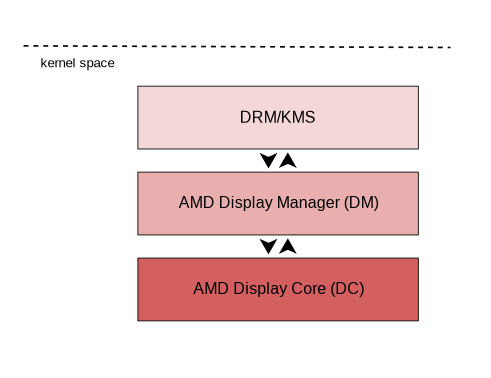
AMD Display Driver in the Linux/DRM Subsystem: The Journey In my 2022 XDC talk I m not an AMD expert, but , I briefly explained the organizational structure of the Linux/AMD display driver where the driver code is bifurcated into a Linux-specific section and a shared-code portion. To reveal AMD s color secrets through the Linux kernel DRM API, our journey led us through these layers of the Linux/AMD display driver s software stack. It includes traversing the DRM/KMS framework, the AMD Display Manager (DM), and the AMD Display Core (DC) [1]. The DRM/KMS framework provides the atomic API for color management through KMS properties represented by struct drm_property. We extended the color management interface exposed to userspace by leveraging existing resources and connecting them with driver-specific functions for managing modeset properties. On the AMD DC layer, the interface with hardware color blocks is established. The AMD DC layer contains OS-agnostic components that are shared across different platforms, making it an invaluable resource. This layer already implements hardware programming and resource management, simplifying the external developer s task. While examining the DC code, we gain insights into the color pipeline and capabilities, even without direct access to specifications. Additionally, AMD developers provide essential support by answering queries and reviewing our work upstream. The primary challenge involved identifying and understanding relevant AMD DC code to configure each color block in the color pipeline. However, the ultimate goal was to bridge the DC color capabilities with the DRM API. For this, we changed the AMD DM, the OS-dependent layer connecting the DC interface to the DRM/KMS framework. We defined and managed driver-specific color properties, facilitated the transport of user space data to the DC, and translated DRM features and settings to the DC interface. Considerations were also made for differences in the color pipeline based on hardware capabilities.

Exploring Color Capabilities of the AMD display hardware Now, let s dive into the exciting realm of AMD color capabilities, where a abundance of techniques and tools await to make your colors look extraordinary across diverse devices. First, we need to know a little about the color transformation and calibration tools and techniques that you can find in different blocks of the AMD hardware. I borrowed some images from [2] [3] [4] to help you understand the information.

Predefined Transfer Functions (Named Fixed Curves): Transfer functions serve as the bridge between the digital and visual worlds, defining the mathematical relationship between digital color values and linear scene/display values and ensuring consistent color reproduction across different devices and media. You can learn more about curves in the chapter GPU Gems 3 - The Importance of Being Linear by Larry Gritz and Eugene d Eon. ITU-R 2100 introduces three main types of transfer functions:
  • OETF: the opto-electronic transfer function, which converts linear scene light into the video signal, typically within a camera.
  • EOTF: electro-optical transfer function, which converts the video signal into the linear light output of the display.
  • OOTF: opto-optical transfer function, which has the role of applying the rendering intent .
AMD s display driver supports the following pre-defined transfer functions (aka named fixed curves):
  • Linear/Unity: linear/identity relationship between pixel value and luminance value;
  • Gamma 2.2, Gamma 2.4, Gamma 2.6: pure power functions;
  • sRGB: 2.4: The piece-wise transfer function from IEC 61966-2-1:1999;
  • BT.709: has a linear segment in the bottom part and then a power function with a 0.45 (~1/2.22) gamma for the rest of the range; standardized by ITU-R BT.709-6;
  • PQ (Perceptual Quantizer): used for HDR display, allows luminance range capability of 0 to 10,000 nits; standardized by SMPTE ST 2084.
These capabilities vary depending on the hardware block, with some utilizing hardcoded curves and others relying on AMD s color module to construct curves from standardized coefficients. It also supports user/custom curves built from a lookup table.

1D LUTs (1-dimensional Lookup Table): A 1D LUT is a versatile tool, defining a one-dimensional color transformation based on a single parameter. It s very well explained by Jeremy Selan at GPU Gems 2 - Chapter 24 Using Lookup Tables to Accelerate Color Transformations It enables adjustments to color, brightness, and contrast, making it ideal for fine-tuning. In the Linux AMD display driver, the atomic API offers a 1D LUT with 4096 entries and 8-bit depth, while legacy gamma uses a size of 256.

3D LUTs (3-dimensional Lookup Table): These tables work in three dimensions red, green, and blue. They re perfect for complex color transformations and adjustments between color channels. It s also more complex to manage and require more computational resources. Jeremy also explains 3D LUT at GPU Gems 2 - Chapter 24 Using Lookup Tables to Accelerate Color Transformations

CTM (Color Transformation Matrices): Color transformation matrices facilitate the transition between different color spaces, playing a crucial role in color space conversion.

HDR Multiplier: HDR multiplier is a factor applied to the color values of an image to increase their overall brightness.

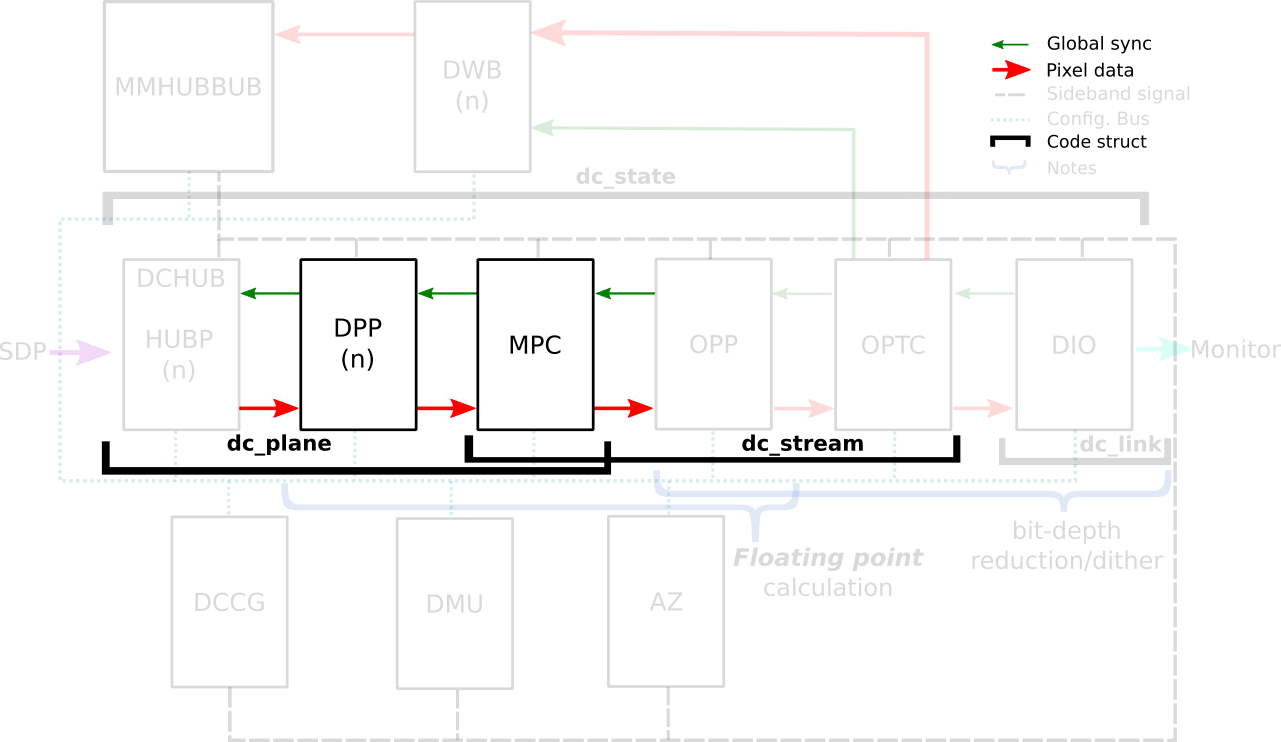
AMD Color Capabilities in the Hardware Pipeline First, let s take a closer look at the AMD Display Core Next hardware pipeline in the Linux kernel documentation for AMDGPU driver - Display Core Next In the AMD Display Core Next hardware pipeline, we encounter two hardware blocks with color capabilities: the Display Pipe and Plane (DPP) and the Multiple Pipe/Plane Combined (MPC). The DPP handles color adjustments per plane before blending, while the MPC engages in post-blending color adjustments. In short, we expect DPP color capabilities to match up with DRM plane properties, and MPC color capabilities to play nice with DRM CRTC properties. Note: here s the catch there are some DRM CRTC color transformations that don t have a corresponding AMD MPC color block, and vice versa. It s like a puzzle, and we re here to solve it!

AMD Color Blocks and Capabilities We can finally talk about the color capabilities of each AMD color block. As it varies based on the generation of hardware, let s take the DCN3+ family as reference. What s possible to do before and after blending depends on hardware capabilities describe in the kernel driver by struct dpp_color_caps and struct mpc_color_caps. The AMD Steam Deck hardware provides a tangible example of these capabilities. Therefore, we take SteamDeck/DCN301 driver as an example and look at the Color pipeline capabilities described in the file: driver/gpu/drm/amd/display/dcn301/dcn301_resources.c
/* Color pipeline capabilities */
dc->caps.color.dpp.dcn_arch = 1; // If it is a Display Core Next (DCN): yes. Zero means DCE.
dc->caps.color.dpp.input_lut_shared = 0;
dc->caps.color.dpp.icsc = 1; // Intput Color Space Conversion  (CSC) matrix.
dc->caps.color.dpp.dgam_ram = 0; // The old degamma block for degamma curve (hardcoded and LUT).  Gamma correction  is the new one.
dc->caps.color.dpp.dgam_rom_caps.srgb = 1; // sRGB hardcoded curve support
dc->caps.color.dpp.dgam_rom_caps.bt2020 = 1; // BT2020 hardcoded curve support (seems not actually in use)
dc->caps.color.dpp.dgam_rom_caps.gamma2_2 = 1; // Gamma 2.2 hardcoded curve support
dc->caps.color.dpp.dgam_rom_caps.pq = 1; // PQ hardcoded curve support
dc->caps.color.dpp.dgam_rom_caps.hlg = 1; // HLG hardcoded curve support
dc->caps.color.dpp.post_csc = 1; // CSC matrix
dc->caps.color.dpp.gamma_corr = 1; // New  Gamma Correction  block for degamma user LUT;
dc->caps.color.dpp.dgam_rom_for_yuv = 0;
dc->caps.color.dpp.hw_3d_lut = 1; // 3D LUT support. If so, it's always preceded by a shaper curve. 
dc->caps.color.dpp.ogam_ram = 1; //  Blend Gamma  block for custom curve just after blending
// no OGAM ROM on DCN301
dc->caps.color.dpp.ogam_rom_caps.srgb = 0;
dc->caps.color.dpp.ogam_rom_caps.bt2020 = 0;
dc->caps.color.dpp.ogam_rom_caps.gamma2_2 = 0;
dc->caps.color.dpp.ogam_rom_caps.pq = 0;
dc->caps.color.dpp.ogam_rom_caps.hlg = 0;
dc->caps.color.dpp.ocsc = 0;
dc->caps.color.mpc.gamut_remap = 1; // Post-blending CTM (pre-blending CTM is always supported)
dc->caps.color.mpc.num_3dluts = pool->base.res_cap->num_mpc_3dlut; // Post-blending 3D LUT (preceded by shaper curve)
dc->caps.color.mpc.ogam_ram = 1; // Post-blending regamma.
// No pre-defined TF supported for regamma.
dc->caps.color.mpc.ogam_rom_caps.srgb = 0;
dc->caps.color.mpc.ogam_rom_caps.bt2020 = 0;
dc->caps.color.mpc.ogam_rom_caps.gamma2_2 = 0;
dc->caps.color.mpc.ogam_rom_caps.pq = 0;
dc->caps.color.mpc.ogam_rom_caps.hlg = 0;
dc->caps.color.mpc.ocsc = 1; // Output CSC matrix.
I included some inline comments in each element of the color caps to quickly describe them, but you can find the same information in the Linux kernel documentation. See more in struct dpp_color_caps, struct mpc_color_caps and struct rom_curve_caps. Now, using this guideline, we go through color capabilities of DPP and MPC blocks and talk more about mapping driver-specific properties to corresponding color blocks.

DPP Color Pipeline: Before Blending (Per Plane) Let s explore the capabilities of DPP blocks and what you can achieve with a color block. The very first thing to pay attention is the display architecture of the display hardware: previously AMD uses a display architecture called DCE
  • Display and Compositing Engine, but newer hardware follows DCN - Display Core Next.
The architectute is described by: dc->caps.color.dpp.dcn_arch

AMD Plane Degamma: TF and 1D LUT Described by: dc->caps.color.dpp.dgam_ram, dc->caps.color.dpp.dgam_rom_caps,dc->caps.color.dpp.gamma_corr AMD Plane Degamma data is mapped to the initial stage of the DPP pipeline. It is utilized to transition from scanout/encoded values to linear values for arithmetic operations. Plane Degamma supports both pre-defined transfer functions and 1D LUTs, depending on the hardware generation. DCN2 and older families handle both types of curve in the Degamma RAM block (dc->caps.color.dpp.dgam_ram); DCN3+ separate hardcoded curves and 1D LUT into two block: Degamma ROM (dc->caps.color.dpp.dgam_rom_caps) and Gamma correction block (dc->caps.color.dpp.gamma_corr), respectively. Pre-defined transfer functions:
  • they are hardcoded curves (read-only memory - ROM);
  • supported curves: sRGB EOTF, BT.709 inverse OETF, PQ EOTF and HLG OETF, Gamma 2.2, Gamma 2.4 and Gamma 2.6 EOTF.
The 1D LUT currently accepts 4096 entries of 8-bit. The data is interpreted as an array of struct drm_color_lut elements. Setting TF = Identity/Default and LUT as NULL means bypass. References:

AMD Plane 3x4 CTM (Color Transformation Matrix) AMD Plane CTM data goes to the DPP Gamut Remap block, supporting a 3x4 fixed point (s31.32) matrix for color space conversions. The data is interpreted as a struct drm_color_ctm_3x4. Setting NULL means bypass. References:

AMD Plane Shaper: TF + 1D LUT Described by: dc->caps.color.dpp.hw_3d_lut The Shaper block fine-tunes color adjustments before applying the 3D LUT, optimizing the use of the limited entries in each dimension of the 3D LUT. On AMD hardware, a 3D LUT always means a preceding shaper 1D LUT used for delinearizing and/or normalizing the color space before applying a 3D LUT, so this entry on DPP color caps dc->caps.color.dpp.hw_3d_lut means support for both shaper 1D LUT and 3D LUT. Pre-defined transfer function enables delinearizing content with or without shaper LUT, where AMD color module calculates the resulted shaper curve. Shaper curves go from linear values to encoded values. If we are already in a non-linear space and/or don t need to normalize values, we can set a Identity TF for shaper that works similar to bypass and is also the default TF value. Pre-defined transfer functions:
  • there is no DPP Shaper ROM. Curves are calculated by AMD color modules. Check calculate_curve() function in the file amd/display/modules/color/color_gamma.c.
  • supported curves: Identity, sRGB inverse EOTF, BT.709 OETF, PQ inverse EOTF, HLG OETF, and Gamma 2.2, Gamma 2.4, Gamma 2.6 inverse EOTF.
The 1D LUT currently accepts 4096 entries of 8-bit. The data is interpreted as an array of struct drm_color_lut elements. When setting Plane Shaper TF (!= Identity) and LUT at the same time, the color module will combine the pre-defined TF and the custom LUT values into the LUT that s actually programmed. Setting TF = Identity/Default and LUT as NULL works as bypass. References:

AMD Plane 3D LUT Described by: dc->caps.color.dpp.hw_3d_lut The 3D LUT in the DPP block facilitates complex color transformations and adjustments. 3D LUT is a three-dimensional array where each element is an RGB triplet. As mentioned before, the dc->caps.color.dpp.hw_3d_lut describe if DPP 3D LUT is supported. The AMD driver-specific property advertise the size of a single dimension via LUT3D_SIZE property. Plane 3D LUT is a blog property where the data is interpreted as an array of struct drm_color_lut elements and the number of entries is LUT3D_SIZE cubic. The array contains samples from the approximated function. Values between samples are estimated by tetrahedral interpolation The array is accessed with three indices, one for each input dimension (color channel), blue being the outermost dimension, red the innermost. This distribution is better visualized when examining the code in [RFC PATCH 5/5] drm/amd/display: Fill 3D LUT from userspace by Alex Hung:
+	for (nib = 0; nib < 17; nib++)  
+		for (nig = 0; nig < 17; nig++)  
+			for (nir = 0; nir < 17; nir++)  
+				ind_lut = 3 * (nib + 17*nig + 289*nir);
+
+				rgb_area[ind].red = rgb_lib[ind_lut + 0];
+				rgb_area[ind].green = rgb_lib[ind_lut + 1];
+				rgb_area[ind].blue = rgb_lib[ind_lut + 2];
+				ind++;
+			 
+		 
+	 
In our driver-specific approach we opted to advertise it s behavior to the userspace instead of implicitly dealing with it in the kernel driver. AMD s hardware supports 3D LUTs with 17-size or 9-size (4913 and 729 entries respectively), and you can choose between 10-bit or 12-bit. In the current driver-specific work we focus on enabling only 17-size 12-bit 3D LUT, as in [PATCH v3 25/32] drm/amd/display: add plane 3D LUT support:
+		/* Stride and bit depth are not programmable by API yet.
+		 * Therefore, only supports 17x17x17 3D LUT (12-bit).
+		 */
+		lut->lut_3d.use_tetrahedral_9 = false;
+		lut->lut_3d.use_12bits = true;
+		lut->state.bits.initialized = 1;
+		__drm_3dlut_to_dc_3dlut(drm_lut, drm_lut3d_size, &lut->lut_3d,
+					lut->lut_3d.use_tetrahedral_9,
+					MAX_COLOR_3DLUT_BITDEPTH);
A refined control of 3D LUT parameters should go through a follow-up version or generic API. Setting 3D LUT to NULL means bypass. References:

AMD Plane Blend/Out Gamma: TF + 1D LUT Described by: dc->caps.color.dpp.ogam_ram The Blend/Out Gamma block applies the final touch-up before blending, allowing users to linearize content after 3D LUT and just before the blending. It supports both 1D LUT and pre-defined TF. We can see Shaper and Blend LUTs as 1D LUTs that are sandwich the 3D LUT. So, if we don t need 3D LUT transformations, we may want to only use Degamma block to linearize and skip Shaper, 3D LUT and Blend. Pre-defined transfer function:
  • there is no DPP Blend ROM. Curves are calculated by AMD color modules;
  • supported curves: Identity, sRGB EOTF, BT.709 inverse OETF, PQ EOTF, HLG inverse OETF, and Gamma 2.2, Gamma 2.4, Gamma 2.6 EOTF.
The 1D LUT currently accepts 4096 entries of 8-bit. The data is interpreted as an array of struct drm_color_lut elements. If plane_blend_tf_property != Identity TF, AMD color module will combine the user LUT values with pre-defined TF into the LUT parameters to be programmed. Setting TF = Identity/Default and LUT to NULL means bypass. References:

MPC Color Pipeline: After Blending (Per CRTC)

DRM CRTC Degamma 1D LUT The degamma lookup table (LUT) for converting framebuffer pixel data before apply the color conversion matrix. The data is interpreted as an array of struct drm_color_lut elements. Setting NULL means bypass. Not really supported. The driver is currently reusing the DPP degamma LUT block (dc->caps.color.dpp.dgam_ram and dc->caps.color.dpp.gamma_corr) for supporting DRM CRTC Degamma LUT, as explaning by [PATCH v3 20/32] drm/amd/display: reject atomic commit if setting both plane and CRTC degamma.

DRM CRTC 3x3 CTM Described by: dc->caps.color.mpc.gamut_remap It sets the current transformation matrix (CTM) apply to pixel data after the lookup through the degamma LUT and before the lookup through the gamma LUT. The data is interpreted as a struct drm_color_ctm. Setting NULL means bypass.

DRM CRTC Gamma 1D LUT + AMD CRTC Gamma TF Described by: dc->caps.color.mpc.ogam_ram After all that, you might still want to convert the content to wire encoding. No worries, in addition to DRM CRTC 1D LUT, we ve got a AMD CRTC gamma transfer function (TF) to make it happen. Possible TF values are defined by enum amdgpu_transfer_function. Pre-defined transfer functions:
  • there is no MPC Gamma ROM. Curves are calculated by AMD color modules.
  • supported curves: Identity, sRGB inverse EOTF, BT.709 OETF, PQ inverse EOTF, HLG OETF, and Gamma 2.2, Gamma 2.4, Gamma 2.6 inverse EOTF.
The 1D LUT currently accepts 4096 entries of 8-bit. The data is interpreted as an array of struct drm_color_lut elements. When setting CRTC Gamma TF (!= Identity) and LUT at the same time, the color module will combine the pre-defined TF and the custom LUT values into the LUT that s actually programmed. Setting TF = Identity/Default and LUT to NULL means bypass. References:

Others

AMD CRTC Shaper and 3D LUT We have previously worked on exposing CRTC shaper and CRTC 3D LUT, but they were removed from the AMD driver-specific color series because they lack userspace case. CRTC shaper and 3D LUT works similar to plane shaper and 3D LUT but after blending (MPC block). The difference here is that setting (not bypass) Shaper and Gamma blocks together are not expected, since both blocks are used to delinearize the input space. In summary, we either set Shaper + 3D LUT or Gamma.

Input and Output Color Space Conversion There are two other color capabilities of AMD display hardware that were integrated to DRM by previous works and worth a brief explanation here. The DC Input CSC sets pre-defined coefficients from the values of DRM plane color_range and color_encoding properties. It is used for color space conversion of the input content. On the other hand, we have de DC Output CSC (OCSC) sets pre-defined coefficients from DRM connector colorspace properties. It is uses for color space conversion of the composed image to the one supported by the sink. References:

The search for rainbow treasures is not over yet If you want to understand a little more about this work, be sure to watch Joshua and I presented two talks at XDC 2023 about AMD/Steam Deck colors on Gamescope: In the time between the first and second part of this blog post, Uma Shashank and Chaitanya Kumar Borah published the plane color pipeline for Intel and Harry Wentland implemented a generic API for DRM based on VKMS support. We discussed these two proposals and the next steps for Color on Linux during the Color Management workshop at XDC 2023 and I briefly shared workshop results in the 2023 XDC lightning talk session. The search for rainbow treasures is not over yet! We plan to meet again next year in the 2024 Display Hackfest in Coru a-Spain (Igalia s HQ) to keep up the pace and continue advancing today s display needs on Linux. Finally, a HUGE thank you to everyone who worked with me on exploring AMD s color capabilities and making them available in userspace.

Matthew Palmer: PostgreSQL Encryption: The Available Options

On an episode of Postgres FM, the hosts had a (very brief) discussion of data encryption in PostgreSQL. While Postgres FM is a podcast well worth a subscribe, the hosts aren t data security experts, and so as someone who builds a queryable database encryption system, I found the coverage to be somewhat lacking. I figured I d provide a more complete survey of the available options for PostgreSQL-related data encryption.

The Status Quo By default, when you install PostgreSQL, there is no data encryption at all. That means that anyone who gets access to any part of the system can read all the data they have access to. This is, of course, not peculiar to PostgreSQL: basically everything works much the same way. What s stopping an attacker from nicking off with all your data is the fact that they can t access the database at all. The things that are acting as protection are perimeter defences, like putting the physical equipment running the server in a secure datacenter, firewalls to prevent internet randos connecting to the database, and strong passwords. This is referred to as tortoise security it s tough on the outside, but soft on the inside. Once that outer shell is cracked, the delicious, delicious data is ripe for the picking, and there s absolutely nothing to stop a miscreant from going to town and making off with everything. It s a good idea to plan your defenses on the assumption you re going to get breached sooner or later. Having good defence-in-depth includes denying the attacker to your data even if they compromise the database. This is where encryption comes in.

Storage-Layer Defences: Disk / Volume Encryption To protect against the compromise of the storage that your database uses (physical disks, EBS volumes, and the like), it s common to employ encryption-at-rest, such as full-disk encryption, or volume encryption. These mechanisms protect against offline attacks, but provide no protection while the system is actually running. And therein lies the rub: your database is always running, so encryption at rest typically doesn t provide much value. If you re running physical systems, disk encryption is essential, but more to prevent accidental data loss, due to things like failing to wipe drives before disposing of them, rather than physical theft. In systems where volume encryption is only a tickbox away, it s also worth enabling, if only to prevent inane questions from your security auditors. Relying solely on storage-layer defences, though, is very unlikely to provide any appreciable value in preventing data loss.

Database-Layer Defences: Transparent Database Encryption If you ve used proprietary database systems in high-security environments, you might have come across Transparent Database Encryption (TDE). There are also a couple of proprietary extensions for PostgreSQL that provide this functionality. TDE is essentially encryption-at-rest implemented inside the database server. As such, it has much the same drawbacks as disk encryption: few real-world attacks are thwarted by it. There is a very small amount of additional protection, in that physical level backups (as produced by pg_basebackup) are protected, but the vast majority of attacks aren t stopped by TDE. Any attacker who can access the database while it s running can just ask for an SQL-level dump of the stored data, and they ll get the unencrypted data quick as you like.

Application-Layer Defences: Field Encryption If you want to take the database out of the threat landscape, you really need to encrypt sensitive data before it even gets near the database. This is the realm of field encryption, more commonly known as application-level encryption. This technique involves encrypting each field of data before it is sent to be stored in the database, and then decrypting it again after it s retrieved from the database. Anyone who gets the data from the database directly, whether via a backup or a direct connection, is out of luck: they can t decrypt the data, and therefore it s worthless. There are, of course, some limitations of this technique. For starters, every ORM and data mapper out there has rolled their own encryption format, meaning that there s basically zero interoperability. This isn t a problem if you build everything that accesses the database using a single framework, but if you ever feel the need to migrate, or use the database from multiple codebases, you re likely in for a rough time. The other big problem of traditional application-level encryption is that, when the database can t understand what data its storing, it can t run queries against that data. So if you want to encrypt, say, your users dates of birth, but you also need to be able to query on that field, you need to choose between one or the other: you can t have both at the same time. You may think to yourself, but this isn t any good, an attacker that breaks into my application can still steal all my data! . That is true, but security is never binary. The name of the game is reducing the attack surface, making it harder for an attacker to succeed. If you leave all the data unencrypted in the database, an attacker can steal all your data by breaking into the database or by breaking into the application. Encrypting the data reduces the attacker s options, and allows you to focus your resources on hardening the application against attack, safe in the knowledge that an attacker who gets into the database directly isn t going to get anything valuable.

Sidenote: The Curious Case of pg_crypto PostgreSQL ships a contrib module called pg_crypto, which provides encryption and decryption functions. This sounds ideal to use for encrypting data within our applications, as it s available no matter what we re using to write our application. It avoids the problem of framework-specific cryptography, because you call the same PostgreSQL functions no matter what language you re using, which produces the same output. However, I don t recommend ever using pg_crypto s data encryption functions, and I doubt you will find many other cryptographic engineers who will, either. First up, and most horrifyingly, it requires you to pass the long-term keys to the database server. If there s an attacker actively in the database server, they can capture the keys as they come in, which means all the data encrypted using that key is exposed. Sending the keys can also result in the keys ending up in query logs, both on the client and server, which is obviously a terrible result. Less scary, but still very concerning, is that pg_crypto s available cryptography is, to put it mildly, antiquated. We have a lot of newer, safer, and faster techniques for data encryption, that aren t available in pg_crypto. This means that if you do use it, you re leaving a lot on the table, and need to have skilled cryptographic engineers on hand to avoid the potential pitfalls. In short: friends don t let friends use pg_crypto.

The Future: Enquo All this brings us to the project I run: Enquo. It takes application-layer encryption to a new level, by providing a language- and framework-agnostic cryptosystem that also enables encrypted data to be efficiently queried by the database. So, you can encrypt your users dates of birth, in such a way that anyone with the appropriate keys can query the database to return, say, all users over the age of 18, but an attacker just sees unintelligible gibberish. This should greatly increase the amount of data that can be encrypted, and as the Enquo project expands its available data types and supported languages, the coverage of encrypted data will grow and grow. My eventual goal is to encrypt all data, all the time. If this appeals to you, visit enquo.org to use or contribute to the open source project, or EnquoDB.com for commercial support and hosted database options.

5 November 2023

Vincent Bernat: Non-interactive SSH password authentication

SSH offers several forms of authentication, such as passwords and public keys. The latter are considered more secure. However, password authentication remains prevalent, particularly with network equipment.1 A classic solution to avoid typing a password for each connection is sshpass, or its more correct variant passh. Here is a wrapper for Zsh, getting the password from pass, a simple password manager:2
pssh()  
  passh -p <(pass show network/ssh/password   head -1) ssh "$@"
 
compdef pssh=ssh
This approach is a bit brittle as it requires to parse the output of the ssh command to look for a password prompt. Moreover, if no password is required, the password manager is still invoked. Since OpenSSH 8.4, we can use SSH_ASKPASS and SSH_ASKPASS_REQUIRE instead:
ssh()  
  set -o localoptions -o localtraps
  local passname=network/ssh/password
  local helper=$(mktemp)
  trap "command rm -f $helper" EXIT INT
  > $helper <<EOF
#!$SHELL
pass show $passname   head -1
EOF
  chmod u+x $helper
  SSH_ASKPASS=$helper SSH_ASKPASS_REQUIRE=force command ssh "$@"
 
If the password is incorrect, we can display a prompt on the second tentative:
ssh()  
  set -o localoptions -o localtraps
  local passname=network/ssh/password
  local helper=$(mktemp)
  trap "command rm -f $helper" EXIT INT
  > $helper <<EOF
#!$SHELL
if [ -k $helper ]; then
   
    oldtty=\$(stty -g)
    trap 'stty \$oldtty < /dev/tty 2> /dev/null' EXIT INT TERM HUP
    stty -echo
    print "\rpassword: "
    read password
    printf "\n"
    > /dev/tty < /dev/tty
  printf "%s" "\$password"
else
  pass show $passname   head -1
  chmod +t $helper
fi
EOF
  chmod u+x $helper
  SSH_ASKPASS=$helper SSH_ASKPASS_REQUIRE=force command ssh "$@"
 
A possible improvement is to use a different password entry depending on the remote host:3
ssh()  
  # Grab login information
  local -A details
  details=($ =$ (M)$ :-"$ (@f)$(command ssh -G "$@" 2>/dev/null) " :#(host hostname user) * )
  local remote=$ details[host]:-details[hostname] 
  local login=$ details[user] @$ remote 
  # Get password name
  local passname
  case "$login" in
    admin@*.example.net)  passname=company1/ssh/admin ;;
    bernat@*.example.net) passname=company1/ssh/bernat ;;
    backup@*.example.net) passname=company1/ssh/backup ;;
  esac
  # No password name? Just use regular SSH
  [[ -z $passname ]] &&  
    command ssh "$@"
    return $?
   
  # Invoke SSH with the helper for SSH_ASKPASS
  # [ ]
 
It is also possible to make scp invoke our custom ssh function:
scp()  
  set -o localoptions -o localtraps
  local helper=$(mktemp)
  trap "command rm -f $helper" EXIT INT
  > $helper <<EOF 
#!$SHELL
source $ (%):-%x 
ssh "\$@"
EOF
  command scp -S $helper "$@"
 
For the complete code, have a look at my zshrc. As an alternative, you can put the ssh() function body into its own script file and replace command ssh with /usr/bin/ssh to avoid an unwanted recursive call. In this case, the scp() function is not needed anymore.

  1. First, some vendors make it difficult to associate an SSH key with a user. Then, many vendors do not support certificate-based authentication, making it difficult to scale. Finally, interactions between public-key authentication and finer-grained authorization methods like TACACS+ and Radius are still uncharted territory.
  2. The clear-text password never appears on the command line, in the environment, or on the disk, making it difficult for a third party without elevated privileges to capture it. On Linux, Zsh provides the password through a file descriptor.
  3. To decipher the fourth line, you may get help from print -l and the zshexpn(1) manual page. details is an associative array defined from an array alternating keys and values.

Petter Reinholdtsen: Test framework for DocBook processors / formatters

All the books I have published so far has been using DocBook somewhere in the process. For the first book, the source format was DocBook, while for every later book it was an intermediate format used as the stepping stone to be able to present the same manuscript in several formats, on paper, as ebook in ePub format, as a HTML page and as a PDF file either for paper production or for Internet consumption. This is made possible with a wide variety of free software tools with DocBook support in Debian. The source format of later books have been docx via rst, Markdown, Filemaker and Asciidoc, and for all of these I was able to generate a suitable DocBook file for further processing using pandoc, a2x and asciidoctor, as well as rendering using xmlto, dbtoepub, dblatex, docbook-xsl and fop. Most of the books I have published are translated books, with English as the source language. The use of po4a to handle translations using the gettext PO format has been a blessing, but publishing translated books had triggered the need to ensure the DocBook tools handle relevant languages correctly. For every new language I have published, I had to submit patches dblatex, dbtoepub and docbook-xsl fixing incorrect language and country specific issues in the framework themselves. Typically this has been missing keywords like 'figure' or sort ordering of index entries. After a while it became tiresome to only discover issues like this by accident, and I decided to write a DocBook "test framework" exercising various features of DocBook and allowing me to see all features exercised for a given language. It consist of a set of DocBook files, a version 4 book, a version 5 book, a v4 book set, a v4 selection of problematic tables, one v4 testing sidefloat and finally one v4 testing a book of articles. The DocBook files are accompanied with a set of build rules for building PDF using dblatex and docbook-xsl/fop, HTML using xmlto or docbook-xsl and epub using dbtoepub. The result is a set of files visualizing footnotes, indexes, table of content list, figures, formulas and other DocBook features, allowing for a quick review on the completeness of the given locale settings. To build with a different language setting, all one need to do is edit the lang= value in the .xml file to pick a different ISO 639 code value and run 'make'. The test framework source code is available from Codeberg, and a generated set of presentations of the various examples is available as Codeberg static web pages at https://pere.codeberg.page/docbook-example/. Using this test framework I have been able to discover and report several bugs and missing features in various tools, and got a lot of them fixed. For example I got Northern Sami keywords added to both docbook-xsl and dblatex, fixed several typos in Norwegian bokm l and Norwegian Nynorsk, support for non-ascii title IDs added to pandoc, Norwegian index sorting support fixed in xindy and initial Norwegian Bokm l support added to dblatex. Some issues still remains, though. Default index sorting rules are still broken in several tools, so the Norwegian letters , and are more often than not sorted properly in the book index. The test framework recently received some more polish, as part of publishing my latest book. This book contained a lot of fairly complex tables, which exposed bugs in some of the tools. This made me add a new test file with various tables, as well as spend some time to brush up the build rules. My goal is for the test framework to exercise all DocBook features to make it easier to see which features work with different processors, and hopefully get them all to support the full set of DocBook features. Feel free to send patches to extend the test set, and test it with your favorite DocBook processor. Please visit these two URLs to learn more: If you want to learn more on Docbook and translations, I recommend having a look at the the DocBook web site, the DoCookBook site and my earlier blog post on how the Skolelinux project process and translate documentation, a talk I gave earlier this year on how to translate and publish books using free software (Norwegian only). As usual, if you use Bitcoin and want to show your support of my activities, please send Bitcoin donations to my address 15oWEoG9dUPovwmUL9KWAnYRtNJEkP1u1b.

4 November 2023

Dirk Eddelbuettel: RcppEigen 0.3.3.9.4 on CRAN: Maintenance, Matrix Changes

A new release 0.3.3.9.4 of RcppEigen arrived on CRAN yesterday, and went to Debian today. Eigen is a C++ template library for linear algebra: matrices, vectors, numerical solvers, and related algorithms. This update contains a small amount of the usual maintenance (see below), along with a very nice pull request by Mikael Jagan which simplifies to interface with the Matrix package and inparticular the CHOLMOD library that is part of SuiteSparse. This release is coordinated with lme4 and OpenMx which are also being updated. The complete NEWS file entry follows.

Changes in RcppEigen version 0.3.3.9.4 (2023-11-01)
  • The CITATION file has been updated for the new bibentry style.
  • The package skeleton generator has been updated and no longer sets an Imports:.
  • Some README.md URLs and badged have been updated.
  • The use of -fopenmp has been documented in Makevars, and a simple thread-count reporting function has been added.
  • The old manual src/init.c has been replaced by an autogenerated version, the RcppExports file have regenerated
  • The interface to package Matrix has been updated and simplified thanks to an excllent patch by Mikael Jagan.
  • The new upload is coordinated with packages lme4 and OpenMx.

Courtesy of CRANberries, there is also a diffstat report for the most recent release. If you like this or other open-source work I do, you can sponsor me at GitHub.

This post by Dirk Eddelbuettel originated on his Thinking inside the box blog. Please report excessive re-aggregation in third-party for-profit settings.

3 November 2023

Scarlett Gately Moore: KDE: Big fixes for Snaps! Debian and KDE neon updates.

KDE Snap Marble
A big thank you goes to my parents this week for contributing to my survival fund. With that I was able to make a big push on fixing some outstanding issues on some of our snaps.
KDE neon: No major blowups this week. Worked out issues with kmail-account-wizard thanks to David R! This is now in the hands of upstream ( porting not complete ) Worked on more orange -> green packaging fixes. Debian: Fixed bug https://bugs.debian.org/cgi-bin/bugreport.cgi?bug=1054713 in squashfuse Thanks for stopping by. Please help fund my efforts! <noscript><a href="https://liberapay.com/sgmoore/donate"><img alt="Donate using Liberapay" src="https://liberapay.com/assets/widgets/donate.svg" /></a></noscript> Donate https://gofund.me/b8b69e54

2 November 2023

Reproducible Builds: Farewell from the Reproducible Builds Summit 2023!

Farewell from the Reproducible Builds summit, which just took place in Hamburg, Germany: This year, we were thrilled to host the seventh edition of this exciting event. Topics covered this year included:

as well as countless informal discussions and hacking sessions into the night. Projects represented at the venue included:
Debian, openSUSE, QubesOS, GNU Guix, Arch Linux, phosh, Mobian, PureOS, JustBuild, LibreOffice, Warpforge, OpenWrt, F-Droid, NixOS, ElectroBSD, Apache Security, Buildroot, Systemd, Apache Maven, Fedora, Privoxy, CHAINS (KTH Royal Institute of Technology), coreboot, GitHub, Tor Project, Ubuntu, rebuilderd, repro-env, spytrap-adb, arch-repro-status, etc.

A huge thanks to our sponsors and partners for making the event possible:
Aspiration

Event facilitation

Mullvad

Platinum sponsor


If you weren t able to make it this year, don t worry; just look out for an announcement in 2024 for the next event.

1 November 2023

Matthew Garrett: Why ACPI?

"Why does ACPI exist" - - the greatest thread in the history of forums, locked by a moderator after 12,239 pages of heated debate, wait no let me start again.

Why does ACPI exist? In the beforetimes power management on x86 was done by jumping to an opaque BIOS entry point and hoping it would do the right thing. It frequently didn't. We called this Advanced Power Management (Advanced because before this power management involved custom drivers for every machine and everyone agreed that this was a bad idea), and it involved the firmware having to save and restore the state of every piece of hardware in the system. This meant that assumptions about hardware configuration were baked into the firmware - failed to program your graphics card exactly the way the BIOS expected? Hurrah! It's only saved and restored a subset of the state that you configured and now potential data corruption for you. The developers of ACPI made the reasonable decision that, well, maybe since the OS was the one setting state in the first place, the OS should restore it.

So far so good. But some state is fundamentally device specific, at a level that the OS generally ignores. How should this state be managed? One way to do that would be to have the OS know about the device specific details. Unfortunately that means you can't ship the computer without having OS support for it, which means having OS support for every device (exactly what we'd got away from with APM). This, uh, was not an option the PC industry seriously considered. The alternative is that you ship something that abstracts the details of the specific hardware and makes that abstraction available to the OS. This is what ACPI does, and it's also what things like Device Tree do. Both provide static information about how the platform is configured, which can then be consumed by the OS and avoid needing device-specific drivers or configuration to be built-in.

The main distinction between Device Tree and ACPI is that Device Tree is purely a description of the hardware that exists, and so still requires the OS to know what's possible - if you add a new type of power controller, for instance, you need to add a driver for that to the OS before you can express that via Device Tree. ACPI decided to include an interpreted language to allow vendors to expose functionality to the OS without the OS needing to know about the underlying hardware. So, for instance, ACPI allows you to associate a device with a function to power down that device. That function may, when executed, trigger a bunch of register accesses to a piece of hardware otherwise not exposed to the OS, and that hardware may then cut the power rail to the device to power it down entirely. And that can be done without the OS having to know anything about the control hardware.

How is this better than just calling into the firmware to do it? Because the fact that ACPI declares that it's going to access these registers means the OS can figure out that it shouldn't, because it might otherwise collide with what the firmware is doing. With APM we had no visibility into that - if the OS tried to touch the hardware at the same time APM did, boom, almost impossible to debug failures (This is why various hardware monitoring drivers refuse to load by default on Linux - the firmware declares that it's going to touch those registers itself, so Linux decides not to in order to avoid race conditions and potential hardware damage. In many cases the firmware offers a collaborative interface to obtain the same data, and a driver can be written to get that. this bug comment discusses this for a specific board)

Unfortunately ACPI doesn't entirely remove opaque firmware from the equation - ACPI methods can still trigger System Management Mode, which is basically a fancy way to say "Your computer stops running your OS, does something else for a while, and you have no idea what". This has all the same issues that APM did, in that if the hardware isn't in exactly the state the firmware expects, bad things can happen. While historically there were a bunch of ACPI-related issues because the spec didn't define every single possible scenario and also there was no conformance suite (eg, should the interpreter be multi-threaded? Not defined by spec, but influences whether a specific implementation will work or not!), these days overall compatibility is pretty solid and the vast majority of systems work just fine - but we do still have some issues that are largely associated with System Management Mode.

One example is a recent Lenovo one, where the firmware appears to try to poke the NVME drive on resume. There's some indication that this is intended to deal with transparently unlocking self-encrypting drives on resume, but it seems to do so without taking IOMMU configuration into account and so things explode. It's kind of understandable why a vendor would implement something like this, but it's also kind of understandable that doing so without OS cooperation may end badly.

This isn't something that ACPI enabled - in the absence of ACPI firmware vendors would just be doing this unilaterally with even less OS involvement and we'd probably have even more of these issues. Ideally we'd "simply" have hardware that didn't support transitioning back to opaque code, but we don't (ARM has basically the same issue with TrustZone). In the absence of the ideal world, by and large ACPI has been a net improvement in Linux compatibility on x86 systems. It certainly didn't remove the "Everything is Windows" mentality that many vendors have, but it meant we largely only needed to ensure that Linux behaved the same way as Windows in a finite number of ways (ie, the behaviour of the ACPI interpreter) rather than in every single hardware driver, and so the chances that a new machine will work out of the box are much greater than they were in the pre-ACPI period.

There's an alternative universe where we decided to teach the kernel about every piece of hardware it should run on. Fortunately (or, well, unfortunately) we've seen that in the ARM world. Most device-specific simply never reaches mainline, and most users are stuck running ancient kernels as a result. Imagine every x86 device vendor shipping their own kernel optimised for their hardware, and now imagine how well that works out given the quality of their firmware. Does that really seem better to you?

It's understandable why ACPI has a poor reputation. But it's also hard to figure out what would work better in the real world. We could have built something similar on top of Open Firmware instead but the distinction wouldn't be terribly meaningful - we'd just have Forth instead of the ACPI bytecode language. Longing for a non-ACPI world without presenting something that's better and actually stands a reasonable chance of adoption doesn't make the world a better place.

comment count unavailable comments

31 October 2023

Iustin Pop: Raspberry PI OS: upgrading and cross-grading

One of the downsides of running Raspberry PI OS is the fact that - not having the resources of pure Debian - upgrades are not recommended, and cross-grades (migrating between armhf and arm64) is not even mentioned. Is this really true? It is, after all a Debian-based system, so it should in theory be doable. Let s try!

Upgrading The recently announced release based on Debian Bookworm here says:
We have always said that for a major version upgrade, you should re-image your SD card and start again with a clean image. In the past, we have suggested procedures for updating an existing image to the new version, but always with the caveat that we do not recommend it, and you do this at your own risk. This time, because the changes to the underlying architecture are so significant, we are not suggesting any procedure for upgrading a Bullseye image to Bookworm; any attempt to do this will almost certainly end up with a non-booting desktop and data loss. The only way to get Bookworm is either to create an SD card using Raspberry Pi Imager, or to download and flash a Bookworm image from here with your tool of choice.
Which means, it s time to actually try it turns out it s actually trivial, if you use RPIs as headless servers. I had only three issues:
  • if using an initrd, the new initrd-building scripts/hooks are looking for some binaries in /usr/bin, and not in /bin; solution: install manually the usrmerge package, and then re-run dpkg --configure -a;
  • also if using an initrd, the scripts are looking for the kernel config file in /boot/config-$(uname -r), and the raspberry pi kernel package doesn t provide this; workaround: modprobe configs && zcat /proc/config.gz > /boot/config-$(uname -r);
  • and finally, on normal RPI systems, that don t use manual configurations of interfaces in /etc/network/interface, migrating from the previous dhcpcd to NetworkManager will break network connectivity, and require you to log in locally and fix things.
I expect most people to hit only the 3rd, and almost no-one to use initrd on raspberry pi. But, overall, aside from these two issues and a couple of cosmetic ones (login.defs being rewritten from scratch and showing a baffling diff, for example), it was easy. Is it worth doing? Definitely. Had no data loss, and no non-booting system.

Cross-grading (32 bit to 64 bit userland) This one is actually painful. Internet searches go from it s possible, I think to it s definitely not worth trying . Examples: Aside from these, there are a gazillion other posts about switching the kernel to 64 bit. And that s worth doing on its own, but it s only half the way. So, armed with two different systems - a RPI4 4GB and a RPI Zero W2 - I tried to do this. And while it can be done, it takes many hours - first system was about 6 hours, second the same, and a third RPI4 probably took ~3 hours only since I knew the problematic issues. So, what are the steps? Basically:
  • install devscripts, since you will need dget
  • enable new architecture in dpkg: dpkg --add-architecture arm64
  • switch over apt sources to include the 64 bit repos, which are different than the 32 bit ones (Raspberry PI OS did a migration here; normally a single repository has all architectures, of course)
  • downgrade all custom rpi packages/libraries to the standard bookworm/bullseye version, since dpkg won t usually allow a single library package to have different versions (I think it s possible to override, but I didn t bother)
  • install libc for the arm64 arch (this takes some effort, it s actually a set of 3-4 packages)
  • once the above is done, install whiptail:amd64 and rejoice at running a 64-bit binary!
  • then painfully go through sets of packages and migrate the set to arm64:
    • sometimes this work via apt, sometimes you ll need to use dget and dpkg -i
    • make sure you download both the armhf and arm64 versions before doing dpkg -i, since you ll need to rollback some installs
  • at one point, you ll be able to switch over dpkg and apt to arm64, at which point the default architecture flips over; from here, if you ve done it at the right moment, it becomes very easy; you ll probably need an apt install --fix-broken, though, at first
  • and then, finish by replacing all packages with arm64 versions
  • and then, dpkg --remove-architecture armhf, reboot, and profit!
But it s tears and blood to get to that point

Pain point 1: RPI custom versions of packages Since the 32bit armhf architecture is a bit weird - having many variations - it turns out that raspberry pi OS has many packages that are very slightly tweaked to disable a compilation flag or work around build/test failures, or whatnot. Since we talk here about 64-bit capable processors, almost none of these are needed, but they do make life harder since the 64 bit version doesn t have those overrides. So what is needed would be to say downgrade all armhf packages to the version in debian upstream repo , but I couldn t find the right apt pinning incantation to do that. So what I did was to remove the 32bit repos, then use apt-show-versions to see which packages have versions that are no longer in any repo, then downgrade them. There s a further, minor, complication that there were about 3-4 packages with same version but different hash (!), which simply needed apt install --reinstall, I think.

Pain point 2: architecture independent packages There is one very big issue with dpkg in all this story, and the one that makes things very problematic: while you can have a library package installed multiple times for different architectures, as the files live in different paths, a non-library package can only be installed once (usually). For binary packages (arch:any), that is fine. But architecture-independent packages (arch:all) are problematic since usually they depend on a binary package, but they always depend on the default architecture version! Hrmm, and I just realise I don t have logs from this, so I m only ~80% confident. But basically:
  • vim-solarized (arch:all) depends on vim (arch:any)
  • if you replace vim armhf with vim arm64, this will break vim-solarized, until the default architecture becomes arm64
So you need to keep track of which packages apt will de-install, for later re-installation. It is possible that Multi-Arch: foreign solves this, per the debian wiki which says:
Note that even though Architecture: all and Multi-Arch: foreign may look like similar concepts, they are not. The former means that the same binary package can be installed on different architectures. Yet, after installation such packages are treated as if they were native architecture (by definition the architecture of the dpkg package) packages. Thus Architecture: all packages cannot satisfy dependencies from other architectures without being marked Multi-Arch foreign.
It also has warnings about how to properly use this. But, in general, not many packages have it, so it is a problem.

Pain point 3: remove + install vs overwrite It seems that depending on how the solver computes a solution, when migrating a package from 32 to 64 bit, it can choose either to:
  • overwrite in place the package (akin to dpkg -i)
  • remove + install later
The former is OK, the later is not. Or, actually, it might be that apt never can do this, for example (edited for brevity):
# apt install systemd:arm64 --no-install-recommends
The following packages will be REMOVED:
  systemd
The following NEW packages will be installed:
  systemd:arm64
0 upgraded, 1 newly installed, 1 to remove and 35 not upgraded.
Do you want to continue? [Y/n] y
dpkg: systemd: dependency problems, but removing anyway as you requested:
 systemd-sysv depends on systemd.
Removing systemd (247.3-7+deb11u2) ...
systemd is the active init system, please switch to another before removing systemd.
dpkg: error processing package systemd (--remove):
 installed systemd package pre-removal script subprocess returned error exit status 1
dpkg: too many errors, stopping
Errors were encountered while processing:
 systemd
Processing was halted because there were too many errors.
But at the same time, overwrite in place is all good - via dpkg -i from /var/cache/apt/archives. In this case it manifested via a prerm script, in other cases is manifests via dependencies that are no longer satisfied for packages that can t be removed, etc. etc. So you will have to resort to dpkg -i a lot.

Pain point 4: lib- packages that are not lib During the whole process, it is very tempting to just go ahead and install the corresponding arm64 package for all armhf lib package, in one go, since these can coexist. Well, this simple plan is complicated by the fact that some packages are named libfoo-bar, but are actual holding (e.g.) the bar binary for the libfoo package. Examples:
  • libmagic-mgc contains /usr/lib/file/magic.mgc, which conflicts between the 32 and 64 bit versions; of course, it s the exact same file, so this should be an arch:all package, but
  • libpam-modules-bin and liblockfile-bin actually contain binaries (per the -bin suffix)
It s possible to work around all this, but it changes a 1 minute:
# apt install $(dpkg -i   grep ^ii   awk ' print $2 ' grep :amrhf sed -e 's/:armhf/:arm64')
into a 10-20 minutes fight with packages (like most other steps).

Is it worth doing? Compared to the simple bullseye bookworm upgrade, I m not sure about this. The result? Yes, definitely, the system feels - weirdly - much more responsive, logged in over SSH. I guess the arm64 base architecture has some more efficient ops than the lowest denominator armhf , so to say (e.g. there was in the 32 bit version some rpi-custom package with string ops), and thus migrating to 64 bit makes more things faster , but this is subjective so it might be actually not true. But from the point of view of the effort? Unless you like to play with dpkg and apt, and understand how these work and break, I d rather say, migrate to ansible and automate the deployment. It s doable, sure, and by the third system, I got this nailed down pretty well, but it was a lot of time spent. The good aspect is that I did 3 migrations:
  • rpi zero w2: bullseye 32 bit to 64 bit, then bullseye to bookworm
  • rpi 4: bullseye to bookworm, then bookworm 32bit to 64 bit
  • same, again, for a more important system
And all three worked well and no data loss. But I m really glad I have this behind me, I probably wouldn t do a fourth system, even if forced And now, waiting for the RPI 5 to be available See you!

Russell Coker: Links October 2023

The Daily Kos has an interesting article about a new more effective method of desalination [1]. Here is a video of a crazy guy zapping things with 100 car batteries [2]. This is sonmething you should avoid if you want to die of natural causes. Does dying while making a science video count for a Darwin Award? A Hacker News comment has an interesting explanation of Unix signals [3]. Interesting documentary on the rise of mega corporations [4]. We need to split up Google, Facebook, and Amazon ASAP. Also every phone platform should have competing app stores. Dave Taht gave an interesting LCA lecture about Internet congestion control [5]. He also referenced a web site about projects to alleviate the buffer bloat problem [6]. This tiny event based sensor is an interesting product [7]. It could lead to some interesting (but possibly invasive) technological developments in phones. Tara Barnett s Everything Open lecture Swiss Army GLAM had some interesting ideas for community software development [8]. Having lots of small programs communicating with APIs is an interesting way to get people into development. Actually Hardcore Overclocking has an interesting youtube video about the differences between x8 and x14 DDR4 DIMMs [9]. Interesting YouTube video from someone who helped the Kurds defend against Turkey about how war tunnels work [10]. He makes a strong case that the Israeli invasion of the Gaza Strip won t be easy or pleasant.

Bits from Debian: Call for bids for DebConf24

Due to the current state of affairs in Israel, who were to host DebConf24, the DebConf committee has decided to renew calls for bids to host DebConf24 at another venue and location. The DebConf committee would like to express our sincere appreciation for the DebConf Israeli team, and the work they've done over several years. However, given the uncertainty about the situation, we regret that it will most likely not be possible to hold DebConf in Israel. As we ask for submissions for new host locations we ask that you please review and understand the details and requirements for a bid submission to host the Debian Developer Conference. Please review the template for a DebConf bid for guidelines on how to sumbit a proper bid. To submit a bid, please create the appropriate page(s) under DebConf Wiki Bids, and add it to the "Bids" section in the main DebConf 24 page. There isn't very much time to make a decision. We need bids by the end of November in order to make a decision by the end of the year. After your submission is completed please send us a notification at debconf-team@lists.debian.org to let us know that your bid submission is ready for review. We also suggest hanging out in our IRC chat room #debconf-team. Given this short deadline, we understand that bids won't be as complete as they would usually be. Do the best you can in the time available. Bids will be evaluated according to The Priority List. You can get in contact with the DebConf team by email to debconf-team@lists.debian.org, or via the #debconf-team IRC channel on OFTC or via our Matrix Channel. Thank you, The Debian Debconf Committee

29 October 2023

Joachim Breitner: Squash your Github PRs with one click

TL;DR: Squash your PRs with one click at https://squasher.nomeata.de/. Very recently I got this response from the project maintainer at a pull request I contributed: Thanks, approved, please squash so that I can merge. It s nice that my contribution can go it, but why did the maintainer not just press the Squash and merge button , and instead adds the this unnecessary roundtrip to the process? Anyways, maintainers make the rules, so I play by them. But unlike the maintainer, who can squash-and-merge with just one click, squashing the PR s branch is surprisingly laberous: Github does not allow you to do that via the Web UI (and hence on mobile), and it seems you are expected to go to your computer and juggle with git rebase --interactive. I found this rather annoying, so I created Squasher, a simple service that will squash your branch for you. There is no configuration, just paste the PR url. It will use the PR title and body as the commit message (which is obviously the right way ), and create the commit in your name:
Squasher in actionSquasher in action
If you find this useful, or found it to be buggy, let me know. The code is at https://github.com/nomeata/squasher if you are curious about it.

Aigars Mahinovs: Figuring out finances part 4

At the end of the last part of this, we got a Home Assistant OS installation that contains in itself a Firefly III instance and that contains all the current financial information. Now I will try to connect the two. While it could be nice to create a fully-featured integration for Firefly III to Home Assistant to communicate all interesting values and events, I have an interest on programming a more advanced data point calculation for my budget needs, so a less generic, but more flexible approch is a better one for me. So I was quite interested when among the addons in the Home Assistant Addon Store I saw AppDaemon - a way to simply integrate arbitrary Python processing with Home Assistant. Let's see if that can do what I want. For start, after reading the tutorial , I wanted to create a simple script that would use Firefly III REST API to read the current balance of my main account and then send that to Home Assistant as a sensor value, which then can be displayed on a dashboard. As a quick try I modified the provided hello_world.py that is included in the default AppDaemon installation:
import requests
from datetime import datetime
import appdaemon.plugins.hass.hassapi as hass
app_token = "<FIREFLY_PERSONAL_ACCESS_TOKEN>"
firefly_url = "<FIREFLY_URL>"
class HelloWorld(hass.Hass):
    def initialize(self):
        self.run_every(self.set_asset, "now", 60 * 60)
    def set_asset(self, kwargs):
        ent = self.get_entity("sensor.firefly3_asset_sparkasse_main")
        if not ent.exists():
            ent.add(
                state=0.0,
                attributes= 
                    "native_value": 0.0,
                    "native_unit_of_measurement": "EUR",
                    "state_class": "measurement",
                    "device_class": "monetary",
                    "current_balance_date": datetime.now(),
                 )
        r = requests.get(
            firefly_url + "/api/v1/accounts?type=asset",
            headers= 
                "Authorization": "Bearer " + app_token,
                "Accept": "application/vnd.api+json",
                "Content-Type": "application/json",
         )
        data = r.json()
        for account in data["data"]:
            if not "attributes" in account or "name" not in account["attributes"]:
                continue
            if account["attributes"]["name"] != "Sparkasse giro":
                continue
            self.log("Account :" + str(account["attributes"]))
            ent.set_state(
                state=account["attributes"]["current_balance"],
                attributes= 
                    "native_value": account["attributes"]["current_balance"],
                    "current_balance_date": datetime.fromisoformat(account["attributes"]["current_balance_date"]),
                 )
            self.log("Entity updated")
It uses a URL and personal access token to access Firefly III API, gets the asset accounts information, then extracts info about current balance and balance date of my main account and then creates and/or updates a "sensor" value into Home Assistant. This sensor is with metadata marked as a monetary value and as a measurement. This makes Home Assistant track this value in the database as a graphable changing value. I modified the file using the File Editor addon to edit the /config/appdaemon/apps/hello.py file. Each time the file is saved it is reloaded and logs can be seen in the AppDaemon Logs section - main_log for logging messages or error_log if there is a crash. Useful to know that requests library is included, but it hard to see in the docks what else is included or if there is an easy way to install extra Python packages. This is already a very nice basis for custom value insertion into Home Assistant - whatever you can with a Python script extract or calculate, you can also inject into Home Assistant. With even this simple approach you can monitor balances, budgets, piggy-banks, bill payment status and even sum of transactions in particular catories in a particular time window. Especially interesting data can be found in the insight section of the Firefly III API. The script above uses a trigger like self.run_every(self.set_asset, "now", 60 * 60) to simply run once per hour. The data in Firefly will not be updated too often anyway, at least not until we figure out how to make bank connection run automatically without user interaction and not screw up already existing transactions along the way. In theory a webhook API of the Firefly III could be used to trigger the data update instantly when any transaction is created or updated. Possibly even using Home Assistant webhook integration. Hmmm. Maybe. Who am I kiddind? I am going to make that work, for sure! :D But first - how about figuring out the future? So what I want to do? In short, I want to predict what will be the balance on my main account just before the next months salary comes in. To do this I would:
  • take the current balance of the main account
  • if this months salary is not paid out yet, then add that into the balance
  • deduct all still unpaid bills that are due between now and the target date
  • if the credit card account has not yet been reset to the main account, deduct current amount on the cards
  • if credit card account has been reset, but not from main account deducted yet, deduct the reset amount
To do that I need to use the Firefly API to read: current account info, status of all bills including next due date and amount, transfer transactions between credit cards and main account and something that would store the expected salary date and amount. Ideally I'd use a recurring transaction or a income bill for this, but Firefly is not really cooperating with that. The easiest would be just to hardcode that in the script itself. And this is what I have come up with so far. To make the development process easier, I separated put the params for the API key and salary info and app params for the month to predict for, and predict both this and next months balances at the same time. I edited the script locally with Neovim and also ran it locally with a few mocks, uploading to Home Assistant via the SSH addon when the local executions looked good. So what's next? Well, need to somewhat automate the sync with the bank (if at all possible). And for sure take a regular database and config backup :D

Russell Coker: Hello Kitty

I ve just discovered a new xterm replacement named Kitty [1]. It boasts about being faster due to threading and using the GPU and it does appear faster on some of my systems but that s not why I like it. A trend in terminal programs in recent years has been tabbed operation so you can have multiple sessions in one OS window, this is something I ve never liked just as I ve never liked using Screen to switch between sessions when I had the option of just having multiple sessions on screen. The feature that I like most about Kitty is the ability to have a grid based layout of sessions in one OS window. Instead of having 16 OS windows on my workstation or 4 OS windows on a laptop with different entries in the window list and the possibility of them getting messed up if the OS momentarily gets confused about the screen size (a common issue with laptop use) I can just have 1 Kitty window that has all the sessions running. Kitty has Kitten processes that can do various things, one is icat which displays an image file to the terminal and leaves it in the scroll-back buffer. I put the following shell code in one of the scripts called from .bashrc to setup an alias for icat.
if [ "$TERM" == "xterm-kitty" ]; then
  alias icat='kitty +kitten icat'
fi
The kitten interface can be supported by other programs. The version of the mpv video player in Debian/Unstable has a --vo=kitty option which is an interesting feature. However playing a video in a Kitty window that takes up 1/4 of the screen on my laptop takes a bit over 100% of a CPU core for mpv and about 10% to 20% for Kitty which gives a total of about 120% CPU use on my i5-6300U compared to about 20% for mpv using wayland directly. The option to make it talk to Kitty via shared memory doesn t improve things. Using this effectively requires installing the kitty-terminfo package on every system you might ssh to. But you can set the term type to xterm-256color when logged in to a system without the kitty terminfo installed. The fact that icat and presumably other advanced terminal functions work over ssh by default is a security concern, but this also works with Konsole and will presumably be added to other terminal emulators so it s a widespread problem that needs attention. There is support for desktop notifications in the Kitty terminal encoding [2]. One of the things I m interested in at the moment is how to best manage notifications on converged systems (phone and desktop) so this is something I ll have to investigate. Overall Kitty has some great features and definitely has the potential to improve productivity for some work patterns. There are some security concerns that it raises through closer integration between systems and between programs, but many of them aren t exclusive to Kitty.

Valhalla's Things: Forgotten Yeast Bread or Pan Sbagliato

Posted on October 29, 2023
a wide and flat round loaf of bread with a well cooked crust I ve made it again. And again. And a few more times, and now it has an official household name, Pan Sbagliato , or Wrong Bread . And this is the procedure I ve mostly settled on; starting on the day before (here called Saturday) and baking it so that it s ready for lunch time (on what here is called Sunday). Saturday: around 13:00
In a bowl, mix together and work well:
  • 250 g water;
  • 400 g flour;
  • 8 g salt;
cover to rise.
Saturday: around 18:00
In a small bowl, mix together:
  • 2-3 g yeast;
  • 10 g water;
  • 10 g flour.
Saturday: around 21:00
In the bowl with the original dough, add the contents of the small bowl plus:
  • 100 g flour;
  • 100 g water;
and work well; cover to rise overnight.
Sunday: around 8:00
Pour the dough on a lined oven tray, leave in the cold oven to rise.
Sunday: around 11:00
Remove the tray from the oven, preheat the oven to 240 C, bake for 10 minutes, then lower the temperature to 160 C and bake for 20 more minutes. Waiting until it has cooled down a bit will make it easier to cut, but is not strictly necessary.
the loaf cut in half, to show thin stripes of crumb from the high hydration. I ve had up to a couple of hours variations in the times listed, with no ill effects.

Next.

Previous.