Search Results: "joey"

6 December 2005

Joey Hess: ending the tyranny of unix permissions

In Debian, we work on developing a unix-style operating system, and when the project was getting started, the obvious way to deal with delegating powers to various people was naturaly to use standard unix permmissions on our master server. So the list administrators were the only people who could write to the list configs and archives, the BTS admins were the only ones who could write to the BTS, the archive admins were the only ones who could manipulate the archive, the build daemon admins were the only ones who could modify various bits of that stuff, etc. As time went on, these services were split off to seprate machines and in some cases access to the machine running a service was limited to the maintainers of that service, again in a way that would be familiar to unix admins everywhere. But as time went on and things like revision control systems became available, Debian also began to make some choices that didn't involve unix permission or host based security. The best example of this is the Debian bug tracking system, which allows anyone to manipulate any bug status in any way without any authentication at all. It works because the BTS keeps a record of all changes, and informs interested parties about changes, so vandalism or accidents can be reverted. Aside from spam, vandalism in the BTS is such a rare problem that I cannot think of an example. Thus the Debin BTS partakes somewhat of the WikiNature, although it predates the wiki by a long time. The archive itself only uses unix permissions at its core, while the upper layers do not partake of them: Any maintainer can upload any package and superscede data in the archive automatically, although actual unix write permissions are very limited. The archive administrators use archives of old versions of packages, automated checks, and forced manual review of certian classes of packages (such as NEW) to limit this so that Developers don't make messes. Social norms are used to avoid other problems. The Debian website is in an interesting period in its history. It's been maintained in a way that mostly avoids unix permissions for a long time, by keeping it in CVS and building it automatically. However, for reasons that I suspect have never been adequately explored, not all Debian developers can commit, you have to be in the webwml group. Though gaining access to the webwml groupo is trivial for any Debian developer. But the most interesting thing is that Debian now also has an official wiki, which is open to editing by all, and that increasingly it is used for at least the more fluid and development-based website stuff. For example, the debian-installer home page is a thin stub giving the essential information and links, and mostly linking to the wiki for the rest. The debian-installer project itself occupys another point on the scale between locked down unix permissions and free modification by all. People have to get an alioth account and demonstrate basic competance to get debian-installer write access, but don't need to be Debian developers or spend more than an hour or so to get access. Once you have access, you can change anything in svn (and everything is in svn) we don't limit write access to parts of the project. We avoid malicious commits through patch review. I could give many more examples of subsystems in Debian that exist at different point in the spectrum between locked down unix permissions and a wiki. There seems to be a definite pull toward moving away from unix permissions, once ways can be found to do so that are secure or that allow bad changes to be reverted (and blame properly assigned). Cases of moving in the other direction are rare (one case of this is the further locking down of the Debian archive server and BTS server after the server compromise last year). Anyway, the point of this is that, if you survey the parts of dealing with the project where Debian developers feel most helpless and unempowered, the parts that are over and over again the subject of heated discussions and complaints, you will find that those are the parts of the project where unix permissions still hold sway. This can range from simple cases such as a cron job that only one person can look at and modify[1], to various data files that could perhaps be kept in svn, but aren't, all the way through to stuff like the Debian keyring. I would love to see a full list developed, although many of the things that remain are obscure little corners like certian blacklists in the BTS, bits of the buildd infrastructure that only a half dozen people know about, etc. The challenge, then is to find ways to open things up to everyone, without throwing security out the window. It has to be done a piece at time, and some of the pieces that are left are the ones most resistant to this change. I hope that people can keep this progression away from unix permissions in mind while working on Debian infrastructure. (If I ever ran for Debian Project Leader (which I won't), this would be one of the areas that I would be sure to investigate basing my platform on. Speaking of which, it's nearly election season again, isn't it?)
[1] The best solution I have found to this common problem so far is simply to keep the cron job in svn with everything else, and if someone modifies it, review it and update it via semi-automated means (some simple command). There are probably better ways to do it.

Martin 'Joey' Schulze: Why I joined LinuxTag

In 1999 I went to LinuxTag as a Debian representative after the project has received an offer to staff a booth there. I took over the maintenance and organised the first Debian meeting in Germany. I also gave two talks during this event, one of them was even repeated on the second day. We've had a lot of fun and since this was the first meeting of Debian affiliated people in Germany, it was very interesting to connect faces to mail addresses and to learn more about the people behind a name. This LinuxTag was the last such event that took place at the University Kaiserslautern. Free projects such as KDE and Debian have been offered a booth in one building from which one could reach the lecture rooms, while company booths were located in the Mensa building with their own professional booths. It was a warm weekend and the Jolt people have supported us with cool and caffeined drinks. We had the opportunity to use a lecture room for sleeping with other project members. Klaus Knopper was supporting the network and supervised the security team, and hence, had the unfortunate job to move away all project members from their booths, out of the building or into the lecture room. I've heard, that he had a hard time, and still believes that Debian people don't need sleep. I guess we should have moved him into the lecture room for a sleep instead. This '99 LinuxTag was quite a real success. It took place at the rise of the dot com era and all people were happy about the event. There were about 7,000 visitors in total on both days. The city of Kaiserslautern has called the university several times since there were no free hotel rooms anymore. Former events happened more or less unnoticed by locals, but not anymore in 1999. After the show was over, we dismantled the booth, moved away our own equipment and left the place. However, I made the "mistake" to notice that the LinuxTag people, who have provided us such a great opportunity, still had work to do since they had to dismantle the booth system and clean the ground floor. My biggest "mistake" was that I didn't run away and have a nice evening but decided to help and ask other booth members who were still around to do the same. Having cleaned up the location quite fast was not the only result. Oliver Zendel, who was in charge of talking to the community and who offered Debian the booth, spoke to me afterwards and wondered whether I would be interested to join the team. Well, I knew how to organise stuff, can talk to people, know quite some people in the community, the LinuxTag people were a cool team, so why not. So for the event in 2000 I was in charge of the projects exhibition. In 2000 we also had to move out of the university of Kaiserslautern since 7,000 visitors were already too much for that small university and city. That's why we eventually moved to the Stuttgart fair. That was an interesting experience. It was also interesting to see how such an event can be organised by a team of friends and how the acceptance in the business world was. In Stuttgart we were able to use a small office (max. 15m ) for the entire team as working space. Two computers were installed which we were allowed to touch but not to install a real system on. Hence, Klaus brought Knoppix CDs. This was the first time that I learned about the Knoppix Live CD. Together with my notebook we've had three desks and could work. However, today I really wonder how this could have worked with so many people, but apparently it really did. Due to the need and my experience in both talking to the press and being the press I joined the LinuxTag press team and even held the final press conference, while my colleague held the opening press conference. So after all projects were happy, the show went fine and most of the office jobs were done, I prepared a press release together with others and maintained the final conference. This was also the first time LinuxTag has organised a business congress as a special extra program for business representatives. It was also the time I experienced the need for several supporters for various tasks. In that year, a dozen supporters were paid as "security" who also drove the shopping for us. Hence, I already acquired some people who supported us as volunteers. That was also the time when Benny joined the team. In 2000 the exhibition boomed and there were a lot of large dot com company booths, which was very nice because LinuxTag arose from a students association and became more and more professional, a platform for both companies and projects. It was organised just like a Free Software project and worked non-commercially. Despite several flame wars and disputes, which seem to be normal, it was organised by friends who believed of a higher goal. It was very nice and gave me a warm feeling when looking at what we have achieved. However, I had nothing to do with commercial interests, income, acquisition, invoices etc., so I may have missed a lot. This year, LinuxTag was planned to take place in one exhibition hall, but there were so many companies interested in running a booth that a second exhibition hall was later rented as well. That's why there were two adjacent halls instead of one large location. In 2001 we were using a different exhibition hall, a larger one due to the strong demand in 2000, but still at the Stuttgart fair. This time I was also in charge of the supporters and already dispatched jobs during the event. From time to time I also maintained the shuttle service to the airport to pick up speakers or take back speakers, which I've also done in 2000. This time we've had a larger office in which all of use fit and which was a nice working atmosphere. We were also able to provide more booth space to Free Software projects. In that year I've automatically taken over the office and communication with the outside world, collecting and distribution information. I don't think this was planned, but it just happened since I was able to do the job besides my other obligations. I also gave a talk about Debian, even though others in the team considered me insane for doing that as well. With a lot of help by the local user group, we were able to offer project members a cheap sleeping opportunity. The LUG acquired a gym hall during the night an cooked in the student's office "Hellblaues Nilpferd". After I've picked up Hans Reiser I went there for a snack with him before dumping him at the hotel. It was a nice atmosphere. One of the lead people for this effort, Hubert Kai er, was suddenly overtaken by death two weeks ago. In 2002 LinuxTag moved to Karlsruhe and thus to a new fair where everything had to start again from zero. We had to get acquainted with the local company and their representatives and learn how the new fairground works. The fairground was more interesting since there was a large open area between the conference site and the exhibition hall. Looking at past years, it was used by visitors. Thanks a lot to Jochen Topf from GUUG and members of the local user group KaLUG a lot of community events happened during LinuxTag. They maintained an Internet caf in the conference building and organised the legendary KaLUG party which has become a regular LinuxTag event. In addition to that I've also worked more and more and took over more areas where I noticed help was needed and that I could manage it. So it happened that I took over more work at and before LinuxTag which finally resulted in two months of work were I don't remember a day on which I've worked less than 8 hours for LinuxTag in 2005. In 2002 I worked on the coding marathon and delegated the tasks and support during LinuxTag to two other people, so it will run independent of me. Since I was the first of the team to arrive in Karlsruhe, I also built up the office and the storage. Due to the large distance I had to leave Oldenburg the day before I want to arrive in Karlsruhe, so that I was at the fairground at last at 10 o'clock on Sunday morning. Before the event a lot of issues had to be negotiated with various parties, which required quite a lot of work. Until 2004 the entire team was working in their spare time without getting paid for their LinuxTag work. The higher goal was the impulse and all of us had neglected one issue or another that wasn't important for LinuxTag. We've had some external service providers at least since 2002. The acquisition became a difficult task for students who liked to work until the morning and get up at lunch time, since many companies expect a partner that is available for them from 9 to 5. That's why Charter was eventually hired and this year ergomedia. For press work newthinking was hired. This year the social event was also organised by them. However, having two people from the board of directors being paid by the association for their LinuxTag work from April, and external service providers that were also paid, was something I considered problematic if not unfair, looking at how other people commit to LinuxTag and don't get a monetary compensation. Several people still worked a lot on LinuxTag in their spare time and had to live from something as well. It caused resentment in the team.

5 December 2005

Anthony Towns: Security Infrastructure Changes

Delays suck. I’m actually skipping ahead here, I’d meant to blog about updating the dak codebase into shape for whatever changes were coming up first, but it turns out I’m not in the mood for that. Besides which, most of this entry is preprepared. In the last few entries we went over the background for updating our security infrastructure to make it possible to have security team members that don’t worry about vendor-sec issues (process, overview, NIv2 aka NINJA, queue-build issues), all the while skipping fairly lightly over the question of what has to actually happen. That happens to be the way I prefer to work, lots of background tinkering, then spend as little time on actual implementation as possible; it has it’s drawbacks, but hey, I like it. Anyway, the second last step is working out in detail what’s going to happen. The delay in question was trying to get the security team to sign off on it, but unfortunately they’re busy enough that that looks like it’ll being an indefinite delay, so I’m going with the “well, ftpmaster maintains the dak/katie infrastructure for the security team, so in the end it’s our call on what’s best anyway” line of thought, and just plunging in. Fortunately the current and final plan should make pretty minimal changes to how the existing security team operate anyway, even assuming a massive testing security operation happening in parallel with them – so the downside risk is already pretty minimal. (And it was, afterall, developed in consultation with Joey, and then shopped around a few folks who’ve been doing security work for testing and kernels) What is that plan, you may well ask. It’s something like this: First, let’s restate the idea:
Concept Allow two teams to exist, the current security team as the “vendor-sec subteam”, and the full team which can expand to also include the testing-security people and others interested and able to help out with security work but who do not have access to vendor-sec.
Then, we want to think about the processes that are involved at a global level. First for uploads that can’t be made public until some later date, and can only be worked on by the “vendor-sec” enabled security team.
  • Source upload to queue/unchecked (as now)
    • Upload is authenticated etc
    • Upload is moved to queue/embargoed
  • Upload is autobuilt
    • Logs are sent to a procmail address
    • Logs are forwarded (by procmail) onto the vendor-sec subteam
    • Logs are signed and sent back
    • Binaries are uploaded to queue/unchecked
    • Binaries are moved to queue/embargoed
  • Uploads (source + binaries) are approved from queue/embargoed by
  • running amber
    • Uploads are moved into the archive
    • The archive is mirrored
  • The approver issues an advisory
And likewise for issues that don’t need so much secrecy:
  • Source upload to queue/unchecked-disembargo (new directory)
    • Upload is authenticated etc
    • Source+version added to unembargo table
    • Upload is moved to queue/unembargoed
  • Upload is autobuilt
    • Logs are sent to a procmail address
    • Logs are forwarded (by procmail, after checking unembargo table) onto the full team
    • Logs are signed and sent back
    • Binaries are uploaded to queue/unchecked
    • Noting that the source is in the unembargo table, Binaries are moved to queue/unembargoed
  • Uploads (source + binaries) are approved from queue/unembargoed by running amber
    • Uploads are moved into the archive
    • The archive is mirrored
  • The approver issues an advisory
Processes are great, but they have to be supported by proper information handling, so it’s worth looking at what the above actually means for the on-disk structures, too. This is particularly important, since filesystem level security is mostly how we wall off vendor-sec stuff from other users of the system (whether they’re also working on security issues, or doing, eg, web page maintenance or something equally random). Voila:
queue/unchecked, queue/unchecked-dismebargo
    world writable
    accessible only by katie
    contents automatically cleared every 15m
queue/embargoed
    writable only by katie
    accessible by vendor-sec subteam
    amber allows packages to be ACCEPTed
    [...] allows packages to be REJECTed
queue/unembargoed
    writable only by katie
    accessible by full team
    amber allows packages to be ACCEPTed
    [...] allows packages to be REJECTed
queue/accepted
    packages only sit in accepted briefly while amber is running
And finally, to sum things up, this is what a member of the security team should expect to actually do to release an advisory:
  • Upload package to queue/unchecked (or queue/unchecked-disembargo)
  • Wait for build logs to be sent to your address
  • Check and sign those build logs
  • Check the final packages in queue/embargoed (or queue/unembargoed)
  • Run amber over the packages to accept them
  • Fill in the template advisory generated and send it to the -announce list
The differences between that process and the current one used by the security team is pretty minor, ttbomk: currently uploads sit in queue/accepted not queue/embargoed, and currently the security team ignore the template advisories amber generates preferring to make their own – aiui, this is mostly due to delays in actually receiving the advisory template since amber mails it instead of leaving it somewhere convenient on disk. Anyway, that’s what the plan looks like. We should see how well it survives contact with the enemy, or at least reality, remarkably soon. (Of course, I guess “political issues” could always foul it up completely anyway, particularly going by the fact that it’s been more or less the only problem raised by the folks I’ve passed this on to… Oh well, reconstruct that bridge when we get to it, I guess)

Martin 'Joey' Schulze: Past LinuxTag Commitment

For me this year's event was the most successful and wonderful LinuxTag I've eve been to. I've worked during LinuxTag as much as I could and did my best to make it the best event ever. If I commit myself to something, I try to work properly and generate proper results. This was the same for LinuxTag. As a result, this year I had many tasks to work on. First of all I managed the community and free projects so that they had an opportunity to present themselves to the broad audience during LinuxTag. This required months of communication with members of all attending projects and negotiating their needs. It also required to gather information about the various parts of LinuxTag that also affected projects. Since it is boring having to answer the same questions all the time I decided not doing that anymore and once started to maintain an FAQ that intends to contain all important information for exhibiting projects. Last year I've also added an location plan with information about shops and restaurants nearby and this year I contributed a map for getting to the AKK where the legendary KaLUG party was organised. Being responsible for the projects I was required to decide which project are suited to get a sponsored booth, its size and its location. This year we have had the opportunity to use the ground floor of the conference building in addition to the regular exhibition ground, so that we've could use about 700m in total for the projects exhibition. I've worked nearly two entire weekends to get the booths assigned properly and to have proper graphics. For the conference building I also created the "official" booth map, booth naming, booth signs and booth numbering. One weekend was planned, the other was an accident since we had to rearrange some booths. Exhibiting projects and other community and Free Software oriented projects also had the opportunity to use two workshop rooms for workshops, BoF sessions, meetings and talks. For these I maintained the schedule and negotiated with the speakers and projects, and also acquired moderators for both rooms for the entire time. The people who organised the Accessibility booth people managed to get green light for building a large booth and a so called forum, which is an open talk area, but without any support. Since they couldn't fill in all slots and you can't dismantle a forum in the middle of the show, I've taken over its maintenance and schedule and managed to complete it with interesting talks, setting up, looking for moderators and dismantling. One of these talks I've even held on my own. Fortunately, a DJ contacted us and was able to provide his PA, boxes, microphone and stuff. Without him, the forum would have been an utter disaster. To support the projects we had to build up the network in the main exhibition hall for them on our own. Otherwise it would have cost us several thousand euro, which we didn't have. So I had to draw plans containing the cables we had to lay, calculated the length and decide where to deposit switches and stuff. On the day before the show opened, several supporters went around with a large ladder laying the cable. In the conference building this was done by the KaLUG. I've also coached the supporters during LinuxTag, and was even present at a special short meeting for and with supporters in order to reflect the past day and talk about the next day. This year was the first time I really had the time to attend the meeting and thank our supporters. Before the show started I've also negotiated food arrangements with a restaurant and a colleague so that we had lunch during the show. I ate from it as well, but didn't manage to eat every day unfortunately. Most additional signs of A4 and A3 size that we used during LinuxTag in order to help visitors and officials to find their way were designed and printed by me. Many of them were the result of last year's aftermath. Most of them were fixed with adhesive tape by our supporters. The Coding Marathon was supervised by me as LinuxTag representative. It was organised by HP, intel and Red Hat and, of course, negotiated with the acquise team of LinuxTag. The Coding Marathon was a half day programming session for visitors. The resulting code is released under the GNU GPL and winners were awarded with prizes at the end of each day. This required me to attend several phone conferences, name one or two interested people from "LinuxTag" who would propose a task and head the marathon during one day. Last year already, when I took over this job, With p2 and Arne I've already found two competent people, and this year also added Alex Schmehl for a task I proposed. Naturally, it was not possible for me to moderate the Coding Marathon during LinuxTag due to other obligations. When I arrived at LinuxTag the week before it officially started my first job was to build up the office and prepare the rooms so that the entire "team" could work inside properly. The first office should be used by supporters for general requests and customers, with a desk for me as well. The next room was meant to host the speakers office and the other rooms were intended to be back offices or private rooms. In order to be able to work properly in the office I've also brought with my some of my network equipment and set up the office LAN, server and printer. I had already experienced cable problems last year, that prevented us to use 100MBit/s switches, so that antiquated 10MBit/s hubs had to be used. I've also supervised our daily shopping tours and collected demand for various items from others. The most important items were fluids since it was quite warm during LinuxTag and collapsing core members and supporters are no fun. Other food had to be fetched as well. A lot of other items had to be purchased as well, in order to run LinuxTag and be able to fix or improve various areas. One or two supporters were taking the car for the shopping tours. When I arrived in Karlsruhe the HP booth was already being built. The other, smaller booths followed on Monday. Hence, on Monday and Tuesday I also supervised the building of the booths. It's important that somebody is around for questions, both from booth builders and from officials of the fairground. One also has to check if the booths are built properly and that they don't cause a risk for the exhibition hall, neighbour booths, smoke detectors and stuff. Issues should be corrected as soon as possible so that they don't become problems later. As soon as I arrived I also took over our own storage area and maintained deliveries for booths that haven't built up yet. Several companies negotiated with me before the show so that I knew which deliveries to expect and could move them to their respective booths as soon as they were built up. This year the first X.Org developers conference took place right before LinuxTag as well. I negotiated with both the X.Org people and the fairground people so that this developers conference could really take place. Unfortunately the plans and acknowledgements were sent out quite late so we were in a hurry getting everything set up and organised. Since we experienced network problems this year, they had not network as well, so did we in the office. Two days without a network connection. Pure horror. On Thursday the legendary KaLUG party took place. The location had to be prepared for the party, for which several supporters went there before the party has started. It was planned that I attend the party, so I went there at about 1 a.m. For some reason I didn't manage to leave the fairground earlier, and on the way to the AKK some of my friends who were also supporters were on their way home, excusing themselves for leaving before I arrived. Eumh... When I arrived at the party I first checked the situation and saw loads of uncleaned pots and stuff. Since nobody was cleaning them, I jumped into the mobile kitchen and started cleaning before I even ate or drank anything. That was fun, though a bit unplanned. The social event on Friday was organised by Claudia from a service provider who got some support from me before the show and during the show. Several supporters helped her clean the area that was unused for several years. During the evening I only gave away free tickets for the supporters and moved inside afterwards, always looking around if everything was ok, negotiating with her, of course. Very well managed, I can only say. This year I gave three talks during LinuxTag. Usually I only give zero or one during such an event, due to my other obligations. However, this time I felt, that I should make a maximum use of LinuxTag, anticipating the future. Hence, it started with Debian Security held during this year's Debian day, followed by Howto LinuxTag on the following day and finally Debian Internals together with other Debian developers. After the last talk I had about two hours to calm down again and initiate the general dismantling. Fortunately I've already planned a lot before the event because after my final talk I was a bit exhausted and needed to calm down and get into LinuxTag organisation again. Dismantling is the most parallel work at LinuxTag because all booths are dismantled at once and many people are running around with arbitrary stuff. One really has to take care of ones own stuff or it gets lost faster than one can shout. During the evening the entire fairground was cleaned, from all conference rooms the audio and video technique was removed again, all bottles and glasses were moved back into the office, the movable walls collected and moved back to their owners, the Internet caf was dismantled and computers moved back into their respective boxes. Some exhibitors had to use extra storage space temporarily. The Community forum in the conference hall had to be dismantled and chairs stacked properly. The same goes for tables and chairs used by the projects booths in both, the exhibition hall and the conference building. The network for projects had to be removed again, cables and switches secured. All additional signs had to be removed again. Since we have used some durable signs that could be used for future events again these had to be removed carefully and secured again. We've also ordered a container for paper since a lot of paper had to be thrown away and throwing away large amounts of junk is expensive. This way we were able to get rid of paper stuff a bit cheaper, but had to take extra care so that only paper went into this container. Hence, we needed a supporter who stayed with the container until it was fetched again. When the internal LinuxTag party in the office was nearly over, I came back into the office with all other areas finished, ready to start dismantling the office - usually the colleagues don't let me because they want to party and don't have any obligations anymore. That sucks a lot. So, again the internal party went on nearly without notice by me, but I'm used to that. This year I had already taken this into account and organised some stuff for an after work party (contrary to the other while-others-work party) outside of the office with supporters, friends and some team members that were still sober. This night we went to bed after 5a.m. and hence had a chance to get a quick breakfast already (we didn't use it, though). It was when we thought "Yes, this was a hell of an event!" I usually went to bed at 1 to 3a.m. and got up again at 5 or 6a.m. so that I was able to work on the important stuff that I committed myself to, and so that I was able to chat with friends and supporters in the evening. That was something I really missed on past events. Last year I probably wouldn't have spoken to Alfie if he hadn't placed himself into my way as a brake block. Thanks Alfie! This year such a maneuver wasn't required. In order to be able to work on so many areas during LinuxTag I tried to optimise the workflow and the processing as much as I could. I also used several sheets and paper to write down stuff for later processing so that my brain was kept clear and I don't become insane (or more insane, for what it's worth). That worked quite well and all areas I worked in worked fine as well, since I had time to talk to people even during the day. Even after my talks I wasn't flooded by phone requests like last year. After the event I had to drive some 750km back, after having only little sleep. Getting to Karlsruhe is always the easy part. Driving back is exhausting because I'm usually quite exhausted and in need of a lot of sleep. I won't disclose how long it took me to reach Oldenburg but it was faster than last year.

3 December 2005

Joey Hess: next debconf

Only 5 months until the next DebConf, in Oaxtepec MX this time. As I read tonight the very well done Final Report for DebConf5, and remember that excellent conference I am already looking forward to the next one. I've been thinking about driving down from Virginis to Oaxtepec instead of flying in. It's a long drive, but maybe I could stop at a few DD's houses and/or travel down with some. In fact, I hope we get a lot of American DDs who have not been able to make recent DebConfs now that it's so relatively near to home. So, time to think about any talks I'd like to give there. The absolute best talk at DebConf5, the one I would most like to emulate, was Enrico's polygen extravaganza. The key things were that a) Dr. Zini rules b) it was a simple talk introducing us to something fun c) large quantities of running code were written on the projector during the talk. I might try to emulate the parts that I can (without taking Enrico-emulation medication) to some degree in one talk, if I can just find the right subject. Since I hate writing papers for talks, I also got an idea for a way to use a talk time slot that will be impossible to write a paper for before time. Gotta hurry, since it turns out talk submission closes amazingly soon: On the 6th!

2 December 2005

Martin 'Joey' Schulze: Volunteer LinuxTag Work

Without the vast number of voluntary supporters past LinuxTag events wouldn't have been possible at all. On the financial side LinuxTag has always made only little profit after the event. Without these nearly 100 volunteers who have supported us directly during the event and during its preparation the show wouldn't have been possible. Without the help of so many supporters during the event, the entire show isn't possible. Hence, it is important to either generate more income and be able to pay for hostesses and callboys or manage a proper environment in which many supporters want to help. For this, accepting the importance of the supporters, acknowledging their work and supporting them with food, fluids, fun and other advantages is very important. To my regret, I have to admit that this has not always been the case inside the core team. I have argued in favour of the supporters several times, so hopefully not much of it has been noticed by them. Supporters have worked in several different areas. I'll try to list them below but I'm sure I already forgot half of them even though I have coached most supporters directly or indirectly. We have maintained the parking ground so we were able to ensure that the Festplatz in the middle of LinuxTag is not abused as a parking place during the event. This required us to maintain a gate with at least one gatekeeper from 6 a.m. to 10 p.m. This was a lot of work, and it wasn't that interesting, but good for people who want to read or hack in the gatekeeper pavilion. We have manually built the projects network in the exhibition halls. In the conference building it was built by the KaLUG. All information signs and plans had to be drawn, printed, magnified and fixed at their respective locations. There are a lot of additional signs that we have maintained to help visitors find their way. I'm sure still a lot of signs were missing. I have used the opportunity to prepare most of them after the last event, so that we have less work for the new one. Our own office had to be set up, since we've used naked rooms with only some cupboards, tables and chairs inside. More furniture had to be arranged, the network had to be built up, the server had to be installed or configured, the printer had to be attached, the network configuration needed testing, the desks had to be set up. For some years now one to three volunteers have helped us in the office in order to support the core team and so that we are able to present visitors, exhibitors, the press etc. We've had an an additional human firewall who worked for two or three days usually and was able to support most people already without clogging the office room. The firewall (Arne) himself had the idea to become a firewall several years ago and I have to agree that it was a very good idea. However, with the exhibitor support maintained at a special booth at the entrance less work had to be done for the firewall this year. Several large and self-standing signs had to be prepared or repaired after the had been broken at the last event or their content has been obsoleted. Signs for the gate from above had to be printed and fixed at proper locations so that exhibitors find their way. We have built up the entire audio and video equipment on our own with a service provider from Bremen. Since this affected up to six rooms a lot of equipment and cables had to be moved, installed and dismantled after the show. For this we've helped J rg and Sven with several volunteers. The business congress had to be prepared as well. Stuff for the attendees had to be created and taken to the conference building. The entrance counter for it had to be maintained and staffed. Doors had to be secured. Deliveries had to be maintained in a storage area, since before LinuxTag a lot of stuff is delivered to LinuxTag without the target booth built up already. During setting up the booth, the booth builders also had to be supported and problems detected, discussed and corrected. During the entire time of our siege of the fairground we've had to maintain our own storage of fluids and food. Due to the high temperatures having around enough fluids was very important. In addition to this demands for several goods also required us to send somebody out for shopping each day. In order not to die of starvation during the event we have also organised a delicious lunch for all supporters and core team members. Kudos to Thomas we were able to order large pots of salad and cooked food for two years so that we didn't have to eat unhealthy food (such as fat pizza for six days) and everybody could decide on their own how much they want to eat. In the years before we've had rented a cook and even ordered Pizza. The food had to be fetched from the restaurant, arranged, together with table clothes, cutlery and stuff, and finally taken back at the evening. Cutlery had to be cleaned regularly as well. For the social event the location had to be cleaned and prepared. This year we've had the great opportunity to use the Nancy Caf which was unused for about 10 years, and hence required a lot of cleaning. As it turned out just before the show began, it required a lot more cleaning than expected. However, thanks to the competent and highly motivated supporters the location was cleaned in time. Kudos to Claudia, this year's social event was also one of the most successful. For the legendary KaLUG party the location had to be prepared as well and the food cooked. Looking at the pictures, the pavilions had to be built, tables and chairs arranged, cutlery and fluids organised. In the evening all the stuff had to be cleaned as well. This year KaLUG had organised a so called "Sp lmobil" that helped with doing the washing-up, but somebody had to work in it as well. The KaLUG has maintained the Internet caf in the conference building and has set up the network for the exhibiting projects in the conference building. For this they have acquired a lot of computers and network equipment that had to be built up and dismantled after the show. They have also acquired a number of movable walls for separating booths and providing poster space. During the show we have distributed fluids for the conference rooms and exchanged information posters and flyers with the daily schedules. When you're giving a talk, your throat often gets quite dry, hence, a cup of fresh water is a good cure, but requires the organisator to maintain water and cups. Since the conference program changed daily posters and handouts had to be exchanged during the evening. Project exhibitors were supported directly by us while company exhibitors were supported by a service provider. Additionally all speakers had to be supported as well. The conference rooms were also maintained by a moderator who supported the speaker, announced the talks and speakers, ran (!) around with a microphone, helped in case of technical problems and maintained the schedule. Even though it may look strange for an outsider there are a lot of costs that emerge when such an event is organised at a commercial fairground. LinuxTag has always had the problem of only little yield after all bills have been paid after the show but had to start preparing the event for the upcoming year. In the past years it was always a struggle to continue with only little financial substance trying to get the next event set up properly. LinuxTag has been unique in its configuration, looking at its history, its organisation structure, its size and its components. There are basically only three ways of creating income: commercial exhibition, business congress and sponsoring. All three have obviously been on the descending path for several years now, reducing a lot of flexibility for the organisation. This income has had to be used for all expenses. On the other side there are a lot of areas that just cost money, such as the conference building, exhibition hall, hotel, travel reimbursements, projects booths, advertising. In addition to that we've had two service providers that have taken over some tasks and needed to be paid as well. A very rough overview is in my Howto LinuxTag talk from this summer.

1 December 2005

Martin 'Joey' Schulze: Voluntary Work vs. Paid Work

In several semi- or non-commercial associations work is done by volunteers who spend a lot of their spare time and energy for the goals of the association. This works fine as long as all people who are spending a lot of time on the goals are treated the same and work voluntarily. When some people decide that some people should get paid for their work, while others, who don't work significantly less, don't get paid for their work an uneasy situation is created. Why are some people treated better and get paid for their work while others don't get paid, but still work a lot on the same or similar issues? Why should those, who have to make money in other areas in order to live at all, continue to work voluntarily? I have always argued that in such constellations one must not have volunteers and paid workers do the same work. The only exceptions are volunteers who have stated that they want to do the same work, even though they don't get paid for it. Otherwise you'll create dissatisfaction of the volunteers, which in turn will most probably result in less volunteers, at least in the long term. Also volunteer work should be more interesting and relaxed than paid work, so that the volunteers have more freedoms and develop more fun doing the volunteer work they were asked to do. Paid work is fine for boring tasks that not enough volunteers are comfortable with, such as standing around asking visitors at an exhibition for their tickets, keeping people out of areas where they don't belong, working at a counter, folding and packing stuff etc. Looking at LinuxTag, we had such situations twice. First of all, two members of the board of directors have been on the payroll of the LinuxTag association for three or four months, while the others of the team have worked voluntarily. The same or at least a lot of similar work has been done by the same people before voluntarily. This has caused resentment by those who have worked for LinuxTag in their spare time, or even full-time for several months without getting a Penny for it. In addition to that there were two external service providers that have worked on some tasks (such as press coordination, social event and business acquisition) which didn't interfere with volunteer work. We've had those for years and especially for business acquisition it is important since they can maintain regular 9-to-5 business hours. These companies have worked very well, and we've had a great social event this year, after several years with extremely problematic social events. A second situation arose after it was clear that not enough hostesses were available and volunteers should work side by side with them. There is no problem as long as the volunteers want this. However, normally they don't. Many of them enjoy their freedom, not having to work for the entire time but having enough time to walk around and talk to people etc. Most volunteers feel very strange when they are asked to do the same job voluntarily while their neighbour is paid for it. In the Debian project I have always objected to paying some developers while not paying others. In my opinion, the best situation would be a company that employs a developer for regular company work but lets them work on Debian and Free Software issues for 30-60 % of their time. However, I have to admit that those, who work on Debian more or less for the entire day, and, hence, don't have enough time for their studies, jobs or work, will have to get some revenue or they will starve to death sooner or later. On the other hand, if they get paid for the work, they can't easily take a day off and enjoy their non-computer life. Err... I've heard that some people do...

Joey Hess: money

I've followed AJ's experiment in funding free software development with his AJ Market with interest and have thrown money in the pot once or twice for some of the projects I care about. It's an interesting approach. I'm too lazy to do anything like that, or rather, I'm already paid sufficiently to work on free software that doing a joeyh market would too much resemble work. However, I did decide to try something I've seen done occasionally, since I also wonder how that works out -- I added a paypal donations button to the website for one piece of free software. Just as a test, to see if it annoys anyone, and if anyone bothers clicking on it. I chose alien since it's well known, regularly used by a suprisingly large number of people and even appears on the first page of otherwise quite amusing results on a google search for "alien". (I suppose that adding google ads to the page would generate more money, but in a probably less interesting way.) Unlike AJ, I won't promise that clicking on the link will motivate me to work on anything. In fact, the most likely use of any money I get from this will be to pass the buck along to the AJ market or something similar.

30 November 2005

Martin 'Joey' Schulze: ffis e.V. still considered charitable

At the beginning of this month we have received the assignment from the local tax office stating that the ffis e.V. is exempted from several tax classes. Apparently we have managed the association in a proper way and are able to continue so in the future. This letter is also an implicit statement that the association may write tax-deductible donation receipts for the next five years which is very good news. In another letter the last modification to our charter of the association has been approved by the legal office. We are now able to plan the next plenum which should take place soon anyway. Our plan is to hold the meeting in December.

26 November 2005

Anthony Towns: The NIv2 Plot

So having found time to catch up satisfactorily on the implementation, time to get back into the blogging. After working out what you actually want to do, the next step in implementing stuff, in my book, is to make sure you fully understand the context of the stuff you’re trying to change. In this case, the “unapproved” queue concept comes from some thoughts from quite a while ago that come under the heading “NIv2” for “new incoming v2”. For reference, the original “new incoming” was the switch to separate queues for new, byhand, and accepted packages, which was followed by a notable update shortly after to make accepted autobuilding possible. That setup works, but has a few problems. One is that packages sit in accepted for quite a while (up to a full 24h), and occassionally in that time it can become inappropriate to actually add the package to the archive – for instance if it’s a build of a package that’s then removed from the archive. This results in an UNACCEPT, and requires manual intervention, since potentially it can result in weird inconsistencies, such as bug closures. Another is that files in the various queues aren’t tracked in the database, which can result in files (particularly upstream tarballs) being lost or left behind, and also requires some unpleasant special casing in the code. A final concern is that one of the bigger time sinks in the daily pulse is the apt-ftparchive scan, which is actually just doing work that’s already been done in order to allow packages in accepted to be autobuilt. Put all those concerns together with the ones mentioned last week, and you get the impetus for NIv2. The principle of that is to put stuff in the queue into the database properly, simplify it, extend the queuing support to deal with different queues, and move stuff from accepted directly into the pool every quarter hour, though only pushing to buildds that frequently, leaving updates of Packages files and mirror pushes to still be daily, or every few hours or whatever. This is what that bit looked like in the dak TODO:
[hard, long term] unchecked -> accepted should go into the db, not a suite, but similar. this would allow katie to get even faster, make madison more useful, decomplexify specialacceptedautobuild and generally be more sane. may even be helpful to have e.g. new in the DB, so that we avoid corner cases like the .orig.tar.gz disappearing ‘cos the package has been entirely removed but was still on stayofexecution when it entered new.
Obviously, it needed to get defined a little more clearly than that to work out how much the changes for the security queues I’m interested in depend on the other changes, and what they actually mean in detail. After some IRC discussion we came up with more or less the following summary of what NIv2 actually means:
How NIv2 should work. q/accepted goes away; once packages are accepted, they get added straight into the pool and the database. At this point they’re added to a micro-suite for the buildds, and so apt-ftparchive can cache the package contents; and a symlink tree is made up so incoming.d.o works. The micro-suite might or mightn’t be a fully fledged suite in the database. Presumably it wouldn’t be visible in dists/ though. The micro-suite probably should contain packages uploaded to unstable for X hours, where X is 48 or 2x pulse-interval or similar. This means UNACCEPT is impossible and apt-ftparchive takes less time in cron.daily. q/byhand and q/new get new friends: q/sec-embargoed, q/sec-unembargoed, q/stable-updates. Rather than checking for “byhand” entries, or a lack of overrides; uploads get diverted to those queues if they’re uploaded to security or stable, and get moved out of there when a security team member or stable RM (ie, Joey) runs an amber/lisa-esque command. This means sec-embargoed and sec-unembargoed need to be autobuilt. This also means that proposed-updates can be a full suite, and point releases can be a matter of (a) adding proposed-updates to stable; (b) removing old versions from stable; (c) removing packages that have to be dropped; and users can put “stable + proposed-updates” in their sources.list reasonably sanely. This also means that REJECTs from accepted (security) or the archive (p-u) aren’t needed. It means the queue ends up looking like:
    unchecked      [uploads go here, insecure]
    holding        [secured]
    new            [waiting NEW processing]
    byhand         [waiting byhand processing]
    stable-updates [waiting stable RM approval]
    done           [.changes files for accepted packages]
    reject         [.changes, .reason and rejected stuff]
    bts_version_track [data for BTS]
with q/accepted disappearing and q/proposed-updates and q/old-proposed-updates being replaced by the stable-updates / oldstable-updates queues.
One of the nice parts about this is that it breaks down fairly neatly into three sets of changes: supporting additional queues, removing the accepted queue, and tracking queue stuff in the database. It does make those changes more or less dependent though – the new queues need to be autobuilt in the way accepted is at present; so it makes sense to add the queues before removing accepted so as not to lose the queue autobuild support. The above actually can be simplified a little further – instead of managing a microsuite for changes since the last update, it’s possible to add accepted packages directly to the real suite; and generate the Packages files needed for autobuilding by querying packages accepted to unstable in the last 24 or 48 hours, simply by adding a field to track upload time for binaries as well as sources. In any event, this thus makes generalising the queue autobuild support the next challenge.

24 November 2005

Daniel Burrows: Thread pattern recognition

After reading the dpkg-sig thread, I finally realized that I could have saved a lot of my time by I taking Joey Hess's advice on thread patterns and deleting or at least ignoring most of its subthreads.

23 November 2005

Antti-Juhani Kaijanaho: I voted for the "editorial" changes

I voted for the "editorial" changes to the Social Contract. At the time it seemed like the right thing to do. I considered writing a rant about the lack of supporting information for the GR. There was no published rationale that I could find, nobody advocated either side, as far as I could see, and there was not even a diff indicating the changes. Well, I soon found out myself that a diff would have been mostly useless, as the wording changes were fairly thorough. It did not help me make my mind. Of course, I could have read mail archives of the vote mailing list. My past experience told me not to bother. It was likely that I could not find the relevant pieces of information I sought for without investing too much time to it.
I wrote the above about a hour ago and was interrupted by having to catch the bus. Now I noticed that there was a request for discussion on devel-announce about a month ago. It is clear that I could have participated in the discussion, but I had faith in all the sides being represented in the discussion without my involvement, and I assumed that rationales and advocacy would be present and easily locatable when the voting time came. When the actual call for votes appeared, I no longer remembered that mail. It seems I was not the only one. I made my decision based on reading the proposal, comparing it to the current wording and not noticing the bomb. Nobody pointed the bomb out to me, either. I assumed that a GR marked "editorial" would really be editorial, not intended to change the meaning of the document. As we have seen, this assumption was faulty. What we should learn from this incident is, in my opinion, that all general resolutions should be accompanied with an official rationale document (similar to DPL election platforms) with rebuttals from people who oppose the change. Campaigning should be more visible. I do not agree with Joey Hess's assessment that GRs are not a good idea for Debian. I would not have had (did not have) the time to participate in a discussion seeking a consensus, and thus it cannot be assumed that all of the 200 or so developers who voted would have participated. The problem with respect to the low number of voters is in my opinion that the issue being decided seemed to me (and thus probably many others) uncompilcated and void of any disagreement. There was even no counterproposals! I would assume that many people did not vote because they believed that it would pass anyway. All of our other general resolutions have enjoyed more voters; I believe the reason is that they were considered more controversial by many and hence many more felt the need to make their voices heard.

22 November 2005

Clint Adams: GUI music players

First, I should point out that I hate GUIs. Then I should point out that I don't want to play music with a GUI music player. I'm including ncurses-type things like cplay in the GUI category. They've always made my skin crawl. So, why am I testing out GUI music players? It's because I didn't didn't realize that I misread the Audioscrobbler spec. Now that we've established that I don't know what I'm talking about, let's move on. Yesterday, I followed the suggestion of some KDE people and tried amaroK. I was pleasantly surprised. It was pretty, it was functional, the UI didn't piss me off, and it kept showing me a picture of Mako for some reason I still can't figure out. Here's where it fell down: it wanted me to select tracks based on album/artist info in the file tags; the musicbrainz lookup function is not as useful as tp_tagger; when I tried to play tracks off of a slow networked filesystem, it skipped a bit, then it shoved its head up its ass and ate itself. It managed to finish the track before it disabled its frontal lobe, but it didn't send the data to last.fm. So, amaroK was a lot better than I expected, but unacceptable. People seem to like Quod Libet. Joey and Erinn. So when I tried it today, I didn't expect it to be awful. Here's what it has over amaroK: it doesn't fall over and die when trying to deal with files on a slow networked filesystem. It just skips. You may be thinking that this could be easily solved with proper buffering. I'd think that too, if it didn't skip when playing files on the local hard drive. You may be wondering why I'm trying to play music on an old 486. I'm not. This is a Pentium 4 2.8GHz under almost no load. This is ridiculous. Compared to amaroK, this thing is ugly as sin, and incredibly awkward. That includes the metadata editor that people keep raving about for some reason. Furthermore, when I rearrange songs in the Play Queue, it occasionally ignores me and plays the track that used to be at the top of the list. Rhythmbox also has problems with skipping, so I guess that gstreamer is the devil. I'm not filing bugs because I don't intend to ever use these programs again.

20 November 2005

Martin 'Joey' Schulze: R.I.P. Hubert Kaisser

I was told 90 minutes ago that a friend of mine, Hubert Kaisser, who helped support the projects and community at LinuxTag 2001 in Stuttgart and was present on IRC all the time until last week passed away yesterday.

Erinn Clark: quod libet

Joey Hess blogs about how nice Quod Libet is. In general, I agree with him. I use it at work now, though I've historically preferred cplay as it's nice and simple and does what I want. Due to the popularity of Audioscrobbler and my curiosity about it, I decided I'd try out some of the clients that support it. It was sort of a rude awakening to discover that QL won't actually work on AMD64, which I use at home. The reason for the bug not being fixed (or RC for that matter) is really sort of funny in a sad way. EDIT: Hmm, that didn't take long. The bug's now fixed (of course, not due to my whiny blogging, but rather due to Steve upgrading the bug to RC.) Something valuable to take away from this: amd64 bugs that qualify are RC and should be treated as such. I'd probably still hesitate to upgrade severities in the future without input from an RM, but at least now it's not a questionable situation. Also, yay, now I can use QL at home. Thanks for the quick fix, Joe. Thou ninja'st. :)

Joey Hess: pictures..

From Anna.
(movie)

Erinn Clark: quod libet

Joey Hess blogs about how nice Quod Libet is. In general, I agree with him. I use it at work now, though I've historically preferred cplay as it's nice and simple and does what I want. Due to the popularity of Audioscrobbler and my curiosity about it, I decided I'd try out some of the clients that support it. It was sort of a rude awakening to discover that QL won't actually work on AMD64, which I use at home. The reason for the bug not being fixed (or RC for that matter) is really sort of funny in a sad way.

Joey Hess: quod libet

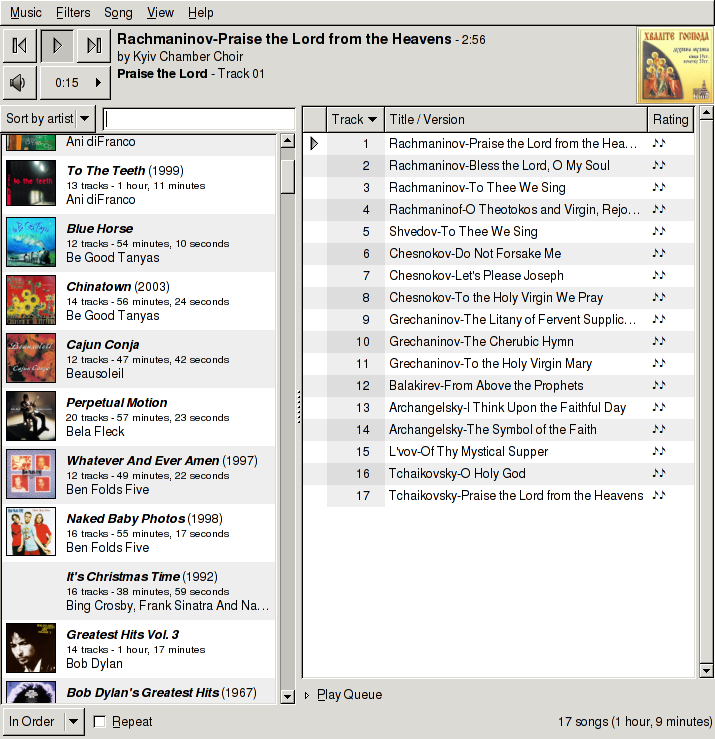
screenshot Earlier I dismissed the quod libet music player since it needed 20% of my laptop's cpu to play music. The new version has been improved, it only needs a still exorbitant 13%, but at home I use my shuttle PC for music now, so CPU usage doesn't matter. And I think quod libet is worth the slightly lowered battery life on the road too. There's no end to the features -- and plugins full in all kinds of interesting edges (onscreen display, audioscrobbler, alarm clock) -- and while it's still under development with a rough spot here and there, mostly around the plugins, it mostly just works. I'm especially impressed at how powerful the tag editing is in quod libet. It makes it so easy to clean up the missing and broken metadata in even a large sound library like mine, and the effects are so immediate and nice as things get sorted into the right place, albums ordered as missing track info is added, album covers displayed, that it's addictive just to putter around in there. Some other features that IMHO make it worth using include the ramdom album plugin, which lets it pick a new album at random when it finishes playing the current one (my collection is too varied and big for random track play to work, but this, mostly, does), the gorgeous album list, and the queue, an odd little feature that lets you insert any songs you like into a play queue, to play after the currently playing song. Which solves a lot situations I've been in before. And the little details are all there too, little things like right-clicking on the play button to turn off the music player after the current song finishes; and automatically and quickly finding new music on startup; and properly supporting multiple artist albums. And that just scratches the surface of things I've found to like over a day.. there's a whole regexp/tag based search engine in there, a music prefernces learning system with weighted playback, internet radio, playlists and more. And it's actively developed, and kinda oddly marketed squarely at Debian users. Buh-bye rhythmbox..

Joey Hess: sandbox

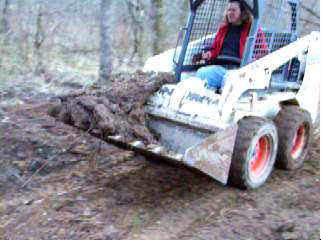
I think that driving a bobcat is the most fun you can have for $20/hour of someone else's money. And I can't help but flash back to old anime when I am the robot monster in my mobile suit. Tired now, pics sometime..

18 November 2005

Christoph Berg: Hacking DDPO

Over the last few weeks, I've implemented some new features in DDPO. The system, originally written by Igor Genibel, is a mix of Python, Perl, and PHP generated from WML, so it's quite interesting to see how these languages interact. The main new features are the ability to add arbitrary packages to the list displayed, and an automatic listing of all NMUs and sponsored uploads in the new "uploads" section. (Thanks to Ryan Murray, Joerg Jaspert, and Joey Schulze for helping fix the projectb for that!) I won't repeat the details here, read the d-d-a posting for that. Another nice thing is the link to Ian Lynagh's popcon graphs which I had mostly ignored so far. Have a look at my DDPO page to see the new features - feedback welcome!

Next.

Previous.