Search Results: "jam"

10 March 2007

Benjamin Mako Hill: What's Wrong With My iPod?

Last November I wrote about an iPod liberation party we held in Cambridge. As I mentioned then, it was a huge success. Mika just got around to polishing up a short documentary video she made from footage at the event and a few interviews afterward. The documentary is called, What's Wrong With My iPod? and it acts as an introduction to DRM on iPods and what we can do about it. The video introduces the concept of DRM, the dangers it brings, and describes the role it plays on the iPod. The second half is about iRony, our iPod liberation party, and RockBox. Please pass the video links around to your friends -- especially those who might not be up to speed on DRM. If it inspires you, think about running your own iPod Liberation Party (instructions here). You can view it on blip.tv (only MP4 until their converter catches up), on YouTube, or you can just download the OGG theora file (also in high quality).

9 March 2007

MJ Ray: Gov: Links for 2007-03-09

We the undersigned petition the Prime Minister to promote the use of Open Document Format within the UK government.
Government documents must be available for tens if not hundreds of years. Currently much electronic documentation is stored in proprietary formats, such as Microsoft's .doc format. In order to allow future generations access to these documents it is imperative that they be in a fully documented standard. Open Document Format (ISO/IEC 26300:2006) is now the international document standard and as such should be supported by the Government.
The Weston Mercury - News: Council chief probe costs 34k
This happened in North Somerset and I remember something similar happening in West Norfolk. When will councillors stop using expensive lawyers to defend themselves at the taxpayers' expense?
opensource - epetition response
Ambivalent reply from the PM's office.
Town and parish councils
Kewstoke is used as a case study, but the link goes nowhere now...
The Irascible Professor-commentary of the day 02-08-07. Movie star teachers.
I've given up watching hero-teacher films. It's really not like that. I guess the oppressive bureaucracy of state education, with pressure from executive teachers to fiddle the student numbers, wouldn't make a good film.
The Irascible Professor-commentary of the day 03-06-07. Why I hope mhy children won't become educators.
Don't let your children grow up to become salesm^Wteachers.
NO2ID:newsletter 66
"Saturday, 10th March - King's Lynn street stall to advertise forthcoming public meeting, from 10am. Volunteers needed! Contact kings.lynn@no2id.net or text/call James on 07778 966395."
Tories want to free (software) Whitehall
The shadow chancellor gets all over the BBC as a result of his party's latest conversion.
Neighbourhood Fix-It
Another better-than-local-councils system from MySociety.
Concerto for blunt instrument: Ode to the No Longer Active
"We held a place for you // But you were busy // You've been so busy lately."

Edd Dumbill: My preview of the O'Reilly Emerging Technology Conference 2007

I was honoured to be on the ETech 07 programme committee. Alas, I can't get there this year due to the very enjoyable reason of recent parenthood. Nevertheless, here are some of the talks I'd earmarked to attend.
Creating Addictive User Experiences (Kathy Sierra)Is it possible to say too many good things about Kathy Sierra? Any project or product built with attention to her advice about empowering users gets a huge head start to popularity and success. I was fortunate enough to spend a day with Kathy last year on a training course, and it was great to see the passion and commitment from her writing runs through her as a person, even behind the scenes.Applied Web Heresies (Avi Bryant)I'd go to this one out of insatiable curiosity. I believe that web conventions enable rapid application design (c.f. REST in Rails) but here's an argument that not following them also reaps rewards. Attend this talk prepared for involvement. I've never met a Squeaker without attitude.
Making Offline Web Applications a Reality (Zimbra)A short product talk, but taking web apps offline is an area to watch. Even if you don't think offline is that important to you, many of the same principles apply to application mobility. Take that key app data off onto your phone, watch or memory stick.Collective Intelligence, Indeterminacy, and the Illusion of Control (Charles Armstrong)More user-facing stuff. How do you give a user of a large nondeterministic piece of social software the idea that they're in control? This is an important topic to me: note how many pieces of social software fall by the wayside right away. For some, it's lack of utility, but that's influenced too by the degree of engagement and control a user feels.
No Program Left Behind: Liberating TV from the Tyranny of the Ephemeral (Tom Loosemore)There is no good reason not to listen to Tom Loosemore. Especially when he feels strongly about something. The idea of this talk is a "vision of a cheap consumer device sitting under your TV that will capture, store, and share all TV, forever." The TV industry sure needs its visionaries.
Patterns: From Fabrics to Fabrication (Dale Dougherty)Dale was responsible for getting my XML career off the ground, and you can find him at work behind some of the smartest things O'Reilly's done over the years. Make magazine was one of those, and now he's moving on to Craft. Design patterns for, er, real designs.RFID Guardian: A Personal Platform for RFID Privacy Management (Melanie Rieback)
Jamming bad RFIDs. Having just taken delivery of an RFID-enabled passport, this is starting to come home to me.Super Ninja Privacy Techniques for Web App Developers (Marc Hedlund)Despite the cute title, lots of good stuff here. Expectnation is going to end up with a truck load of user registrations, and their privacy is important to me. I imagine there'll be some good debate in the Q&A session for this talk.JavaScript: It's Happening All Over Again! (James A. Duncan)I've recently got the JS bug, thanks to JQuery. It's actually a fun and malleable language to work in. I'd go to this talk looking for fellow travellers and hints, though I'm a bit skeptical about Zimki itself.


5 March 2007

Kartik Mistry: New DigiCam

* Finally, I got my new digital camema Samsung DigiMax S700!. Now, my adventure in digital photography is about to start. Thanks Hiral & Atin for this! Some cool/bad features:
+ 7.2 MP, 3x Optical Zoom, 5x Digital Zoom
+ Large 2.5″ LCD
- No Viewfinder, so battery eater! * LDTP Package is fixed now. * I forgot that it was Holi yesterday and couldn’t found any shop open in my native Palanpur. Meet Vinay/Anil/Manish in hurry and back by night bus. Well, bus was jam packed and I had to standup during the whole journey.

1 March 2007

Benjamin Mako Hill: The Revolution Will Be Colorful

I forgot to mention the coolest thing about the last Ubucon in my summary. I heard that my friend Sean Moss-Pultz (the person who started the OpenMoko project) would be in New York the week of Ubucon so I managed to contact him and get him to drop by on his way to the airport so we could have lunch. To my surprise, he had one of the early versions of the free-phone for me (I wasn't expecting one for several weeks). I had brought my OLPC XO so, for the first time ever (as far as we know) we managed to get the two coolest, and most important, technology platform projects in the world together. While the XO and OpenMoko share a commitment to freedom, the similarities between the projects are, in fact, also skin deep. If we all work hard, we can look forward to a future that is free. Apparently, it's also white with bright trim.
/copyrighteous/images/xo_plus_openmoko-03-boot.jpg
/copyrighteous/images/xo_plus_openmoko-01.jpg
Apologies for the pictures taken from my current inferior, both ethically and technically, mobile phone.

Benjamin Mako Hill: Ubucon NYC

I had a great time at Ubucon a couple of weeks ago. I ended up running two sessions. After an initial opening, I opened the conference with a talk on how folks can participate in Ubuntu. The talk was roughly based on Andreas Lloyd's absolutely wonderful Contribute To Ubuntu page in the Ubuntu wiki. His page was, in turn, based on my own Participate In Ubuntu page. The talk tried to provide a solution to the common question of, "I love Ubuntu and want to give back! How can I?" -- when I was answering info@ubuntu.com (for my sins), I would get this question several times each day. The talk was a relatively straight forward walk through the different teams and group working in Ubuntu along with examples of their projects and fun anecdotes from my experience in the community along the way. I worked in a bit of talking about different community governance structures and issues and the membership process. Trying to cram an overview of the community and its different subsections into an hour is a pretty sobering experience. There's a lot going on and I barely had a chance to give a poor description of the most visible things going on. In the afternoon, I reminded folks (and myself) that I know a little of this tech stuff too by walking folks through a quick introduction to building and modifying Debian or Ubuntu packages. It was a quick variant on the "Debian Packaging for Sysadmins" talks that I've given in the past. Of course, the best part was getting to hang out with some folks I know from the community and to meet a bunch of new people. It was a blast and I'm definitely looking forward to the next one.

28 February 2007

Gon ri Le Bouder: Another great idea by Jamendo

Jamendo is a CreativeCommon/Free sharing music plateform more and more famous. Yesterday they released a new tool to discover artist that is quite impressive. It’s called Spiral. Spiral screenshot

Adam Rosi-Kessel: More Espresso Art

Via Jamie, an interview with an amazing espresso artist. As I’ve wondered before, it would be interesting to know if anyone has ever attempted to protect their copyright in espresso art. On further reflection, I think espresso art should meet the “fixed in a tangible medium” requirement, at least as much as ice sculptures which also tend to lose their form over time. I assume ice sculptures can be protected, although could not find an example in a quick search. I suspect the copyright office would accept a photograph as “identifying material” for the purposes of a registration deposit on a cup of espresso, as in the case of sculptural works. Be sure to check out the embedded video — it eliminates any concern that the espresso art photographs might have been digitally enhanced.

25 February 2007

Adam Rosi-Kessel: Grimmelmann and Kozinski on Law

I recently came across two old and unrelated writings about law, both of which are worth reading, especially for people with strong opinions but no formal training. The first is this piece, entitled Seven Ways in Which Code Equals Law (And One in Which It Does Not), by recently-appointed New York Law School professor James Grimmelmann and EFF Legal Director Cindy Cohn. Several observations are particularly appropriate for the slashdot crowd (and, to a lesser extent, certain members of the Debian community and others who grew up on a diet of BASIC, Pascal, and then C and later perl). I especially like this bit about “hacking the law”:
Some people, seeing this connection, and remembering the values of good code, try to improve the legal system by treating it as a computer. People come to me with ideas for hacking the law. The government says that cryptography is a weapon, they say, but the Bill of Rights says we have the right to bear arms. So that means we have a Constitutional right to use cryptography. But the legal system isn t a computer. If you can t convince a judge that what you re proposing is consistent with the values underlying a law, your argument will go nowhere. People go to jail every year because they think they ve found a way to hack the Sixteenth Amendment. The income tax is illegal, they say, or, The income tax is voluntary, see, it says so right here, and then they get convicted of tax evasion and sent to jail. We did convince several judges about the Constitutional dimension of cryptography, but the claim started from the values of the First Amendment, not a mechanical reading of its words. It s a category mistake to treat the legal system as just another architecture with its own specialized language. Code and law are different ways of regulating; they have different textures. All of those people who are required to make the legal system work leave their mark on its outcomes: they make a certain amount of drift and discretion almost inevitable. Code doesn t have such a limit: it can make perfectly hard-nosed bright-line rules and hold everyone in the world to them. Code is capable of a kind of regulatory clarity and intensity that law can only state, never really achieve.
I don’t entirely agree with the other article, entitled What I Ate For Breakfast and Other Mysteries of Judicial Decision Making by outspoken Ninth Circuit Judge Alex Kozinski (unofficial site maintained by Aaron Swartz, wikipedia entry). For example, I think critical legal studies has resulted in some interesting insights, some of which actually have practical applciation. Still, Judge Kozinski makes an important point about the numerous factors that act as a check on discretion in judicial decisionmaking:
It is popular in some circles to suppose that judicial decision making can be explained largely by frivolous factors, perhaps for example the relationship between what judges eat and what they decide. Answering questions about such relationships is quite simple - it is like being asked to write a scholarly essay on the snakes of Ireland: There are none. But as far back as I can remember in law school, the notion was advanced with some vigor that judicial decision making is a farce. Under this theory, what judges do is glance at a case and decide who should win - and they do this on the basis of their digestion (or how they slept the night before or some other variety of personal factors). If the judge has a good breakfast and a good night’s sleep, he might feel lenient and jolly, and sympathize with the downtrodden. If he had indigestion or a bad night’s sleep, he might be a grouch and take it out on the litigants. Of course, even judges can’t make both sides lose; I know, I’ve tried. So a grouchy mood, the theory went, is likely to cause the judge to take it out on the litigant he least identifies with, usually the guy who got run over by the railroad or is being foreclosed on by the bank. This theory immodestly called itself Legal Realism. Just to prove that even the silliest idea can be pursued to its illogical conclusion, Legal Realism spawned Critical Legal Studies. As I understand this so-called theory, the notion is that because legal rules don’t mean much anyway, and judges can reach any result they wish by invoking the right incantation, they should engraft their own political philosophy onto the decision-making process and use their power to change the way our society works. So, if you accept that what a judge has for breakfast affects his decisions that day, judges should be encouraged to have a consistent diet so their decisions will consistently favor one set of litigants over the other. I am here to tell you that this is all horse manure. And, like all horse manure, it contains little seeds of truth from which tiny birds can take intellectual nourishment. The little truths are these: Under our law judges do in fact have considerable discretion in certain of their decisions: making findings of fact, interpreting language in the Constitution, statutes and regulations; determining whether officials of the executive branch have abused their discretion; and, fashioning remedies for violations of the law, including fairly sweeping powers to grant injunctive relief. The larger reality, however, is that judges exercise their powers subject to very significant constraints. They simply can’t do anything they well please.
Finally, I will link, but not embed, this video of the Anna Nicole Smith court order, for an entirely different perspective on the legal process. You almost don’t really want to have to see this stuff.

24 February 2007

James Morrison: crack

Last weekend (I have a post I'll finish soon about that) was getting up at the crack of dawn, this weekend is getting up at the crack of noon. It's good to get up early :)

Joey Hess: whadda week

I've been in a good mood toward the end of this week as the stuff I've gotten done has reached that critical mass that makes me feel I'm accomplishing something. First, I got a nice new domain for ikiwiki, with an irc channel for good measure, and there's also work on a Google Summer of code application for ikiwiki afoot. Then there was rather a lot of useful feedback and patches on ikiwiki, and a few nights ago a very tricky race condition was discovered. Batting around possible fixes for it on irc for several hours was pretty useful, it's a lot easier to think about locking, deadlock, races, etc, when there are some other minds to share the thinking. I eventually came up with a fix that seems ok, around 5 am that morning. Yes, my sleep schedule has been suffering.. On Thursday I took a digression into RL to fix some cladding that was pulled away from the eves of my house by a badly attached cable. I ended up wandering around Lowe's for over an hour -- when did that become such a fun thing to do? Oh yeah, when I bought a house.. Some kids were playing hide and seek; maybe a bit dangerous there but it has to be the funnest possible place to do it. Anyway, amoung other things I bought a collapsable ladder and had an interesting time on it 2 stories up while avoiding the nearby electric wire. Also fixed a broken latch on my wardrobe. Concurrent with all this, in $DAY_JOB, I've been working on the armel port of Debian, including getting d-i to work with it. Since this is an unofficial port, that is not gpg signed currently, this also gave me a chance to make d-i capable of dealing with an unsigned repository. Earlier this evening, I almost completed my first armel install on an nslu2, and I expect to release images by Monday. Finally, AJ reminded me about an item that'd been on my TODO list for far too long; some way for James to deal with gpg keyrings that doesn't treat them as binary blobs. I'd been meaning to work on that for oh, 2 years? 3? And I must have been thinking about it in the background a bit, because I fairly quickly came up with this gpg changesets idea, which is basically a dedicated revision control system, and a data format that's not too horrible (though it could be much nicer with support in gpg). Quickly followed by a whole working sample implementation that I hope James, or someone, will find useful.

Benjamin Mako Hill: Fit For an Emperor

I found this box outside my apartment labeled, "The Emperor Clothes." Fortunately, the contents were exactly what I was expecting.    Surely clothing fit for an emperor. That is of course, if you are fit enough to appreciate them.

23 February 2007

James Morrison: Crazy friday

Wow, today is nuts, I've gotten 3.75 invites to parties for only tonight. That's 3 real invites, an invite to crash a games night and critical mass. So 3 events in the city and 2 in mtn view. Well, the christmas tree that's still up and a huge bottle of Jaeger have made my choice. Why did I move to the city again?

22 February 2007

Benjamin Mako Hill: Notorious in Libraries

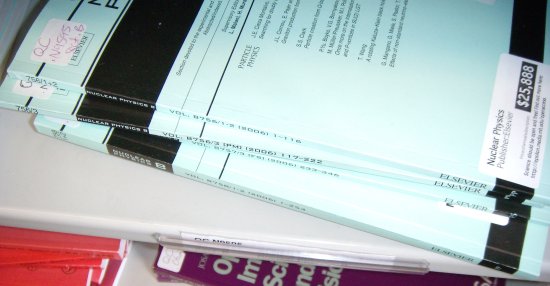
My Overprice Tags projects from a few days back has been getting a bunch of attention. Perhaps most interesting, the MIT libraries -- whose journals we defaced augmented in the project -- have been unbelievably positive about the project! They've written up a very positive description of the event on their website and published an interview with me as well!

21 February 2007

Martin F. Krafft: Leaving Limerick

I have returned home after five weeks of Ph.D. research in Limerick. I've come a bit further on the way towards my thesis but still have not reached the critical mass moment when my inertia makes me go on and on until the work is done. But in all fairness, I've made a good deal of progress and now should have all I need to work on this in my spare time at home too. I also had a fabulous time outside of the office, being immersed into a wonderful circle of lads and ladies from the very start. I would not be able to capture all the fun in writing about it, so I won't and instead resort to looking forward to my return for a two-day workshop in a little less than three weeks, and another longer stay in April/May. This time, I won't lure my bike along. It was a good idea, but there was too much rain and mud to really enjoy it. Even though transport to and from Limerick (which isn't exactly well-connected to the rest of the world in terms of transport) was mostly painless (thanks to people like Ewan, who'd take me along to Dublin and drop me in front of my hotel), it's probably more trouble than worth especially since I doubt I could get bored around "109/110 Elm Park" (which is where I lived). Daren, Mel, Claire, Jonathan, Cliona, Cathal, Sarah, Caitriona, Lisa, James, Jerry, Karen, Jurij, Gary, Eoin, and everyone else whose name I didn't manage to store (forgive me), I miss y'all already NP: Amorphis / Elegy

Benjamin Mako Hill: Trademark Violation and Greater Evils

Biella Coleman recently mentioned counterfeit drugs in a blog post:
A pirated movie carries little consequence, except for that the movie industry may lose some cash flow. A fake Rolex purchased on the bustling streets of NYC saves you a lot of money (and robs you of a warranty). But counterfeit drugs, the consequences and stakes are at a whole other, more serious, order of things.
Biella's intentions in drawing the analogy are harmless -- people really do lose their lives because of fake drugs while rock-off movies and Rolexes are relatively harmless. However, her aside reminds me of the much less harmless, fair, and honest analogies drawn by Pat Choate in Hot Property who used examples like counterfeit drugs and dishonestly labeled aircraft parts to support a high protectionist position on IP. Because of the arguments made by people like Choate, I believe that there is a subtle danger in the type of analogy that Biella draws that I think we should try to guard against in the future. The danger lies in the fact that these comparisons tend to conflate at least two very different kinds of illegal activity. Trademark violations are illegal. So it selling drugs without approval from regulatory bodies. So is manslaughter and murder -- both terms used in the Times article Biella links to to describe the actions of drug counterfeiters. Laws in most countries already prohibit all of these things and offer increasingly harsh punishments for each action. In fact, selling unlicensed drugs and killing people is much more illegal than violating trademark and making knockoffs. And it should be. When someone commit IP violations in the process of committing much worse crimes, we should focus on highlighting, condemning, and punishing the much worse crime, not the IP violation which in comparison is almost inconsequential. The punishment for counterfeiting drugs may only be a slap on the wrist and that's probably an appropriate punishment for the counterfeiting component of the crime. The other worse crimes that the counterfeiter is also committing should be punished much more harshly. If, as the Dr. Reggi quoted in the Times article complains, "counterfeiting a medicine can be [only] a misdemeanor," we need stronger laws against selling unregulated drugs -- not stronger IP laws. If we confuse and compare bootleg movies and knock-off Rolexes with fake malaria or AIDS drugs, we're likely to come to the opposite conclusion. Our reactions to such situations should be, "People are killing people with fake drugs! We need stronger laws against killing people in these ways." They should not be "People are killing people with fake drugs! Interesting to note that they are also violating trademark laws like other counterfeiters." The former reaction will frame the discussion in a way that lets us treat the bad components of the crime more harshly and will not help IP high protectionists argue for stronger IP through a disingenuous process of guilt by association.

Martin F. Krafft: Beige

James:
"Beige is not a colour, beige it'll become all on its own" (source unknown)
I am sorry, though. NP: Barclay James Harvest / Gone to Earth

20 February 2007

Benjamin Mako Hill: Overprice Tags

Last Thursday (February 15, 2007) was declared National Day of Action for Open Access. To help raise awareness of the movement for open access in scholarly publications at MIT, I got together with a number of other MIT students and placed price tags -- we called them overprice tags -- onto the 100 journals that MIT subscribes to at a cost of more than $5,000 USD per annum.
/copyrighteous/images/overpricetagged_journal.jpg
The project, inspired by a similar project called Seeing Red carried out by a Brown librarian a few years back, was a huge success. You can find information about the project, motivation and experience, see pictures, and find out how you might run a similar event at your institution on the Overprice Tags homepage.

James Morrison: Laundry accident

I managed to have my first real laundry accident today. I washed a bunch of new orange shirts with everything else and anything white came out beige.

Benjamin Mako Hill: Novartis, Stop It

Swiss pharmaceutical company Novartis is currently suing the Indian government over its patent law in an effort to further limit production of generic drugs in India. Among other drugs, the company is trying to stop India's production of generic AIDS medicines that supplies more than half of the developing world. M decins Sans Fronti res (MSF) has a great FAQ and bunch of other information on their access to essential medicines (AEM) site that you should check out if you are unfamiliar with the case. Mika has been working on a variety of AEM projects for a while with quite a few important successes. From a certain perspective, some of the core calls for access to knowledge share common ground with free software, free culture, and anti software patent advocacy that I've been involved in. Of course, it puts things in perspective to see Mika and others in the AEM community point to millions of people and say that those people will die because of an IP maximilist position. Last week, I went with Mika to a protest of Novartis near MIT. It was just below freezing, slushy, raining, sleeting, and probably the worst weather I've ever experienced in Cambridge. Despite all that, it was wonderful to join a large group of activists in Cambridge/Boston and around the world to send a strong message to Novartis. You can watch a video of the protest or see a set of photographs. Both were taken by my friend Jay.

Next.

Previous.