Search Results: "gio"

5 July 2007

Russell Coker: The War Was About Oil!

They admit the truth at last: “We need to ensure, notwithstanding the significant natural resources that our country has been blessed with, that we are able to access the energy requirements in our region and throughout the world” said Brendan Nelson (Australian defence minister). John Howard isn’t admitting it yet, he’s sticking to his lie from 2003 that Iraq had Weapons of Mass Destruction.

4 July 2007

Jeff Bailey: Leif's Dedication


img_8432.jpg
Originally uploaded by jbailey
Photo taken by Alice Robinette
We celebrated Leif's dedication a couple weekends ago on June 17th at the Unitarian Church of Montr al. I got permission from Diane Rollert, our minister, to post the text of it.

(LJ-cut used to keep it from being too long)


Dedication of Leif Alexander Bailey, June 17, 2007

To the Child:
Leif Alexander Bailey, you have come with stardust in your hair, with the rush of planets in your blood, your heart beating out the seasons of eternity, with a shining in your eyes like the sunlight.

Your parents have brought you here to be dedicated, to celebrate the joy they have and to count themselves blessed that you are a part of their family.

As you grow, may you come to love what it is that your parents and this community of Unitarian Universalists value. May you learn to count the number of your days, to weigh their meaning, to gather into your mind the wisdom of your ancestors, to know why we call one thing right and another wrong, and to treasure beauty, mercy and justice in the deepest places of your being.

To the Congregation:
A dedication in the Unitarian Universalist tradition is one of the few sacred rituals we share together as a community. It is a covenant, a promise of love and care, that the entire community bestows upon a child.
Although Leif and his parents are leaving us to pursue new lives in San Francisco, they have chosen to dedicate Leif here in this church that has meant so much to them. Their travels may take them far away, but in this act of dedication today, we will covenant to continue to hold a place of care and concern in our hearts for Leif as he grows. Do you, as this religious community called the Unitarian Church of Montreal, take upon yourselves the privilege and the responsibility of helping to nurture the character and spirit of this child even at a distance?

Congregational Response:
We who are members of this congregation rejoice with this family in the promise of this child. We pledge him now the love and care of this community.

To the Parents:
Angie and Jeff, parents of Leif, please repeat after me this pledge. Leif, we pledge to help you to realize the best that is in you. We will seek, to the best of our ability, to instruct you by our teaching and by our example. We promise to love you with an unselfish love.

To the Child:
Leif, I dedicate you to the service of goodness, beauty and truth. I touch you with this water, which is a symbol of purity, and with this rose which is a symbol of your unfolding life, on your brow, your eyes, your lips, your heart and your hands, that your thoughts, your vision, your speech, your love and your generosity may be dedicated to the care of the earth and its people. We dedicate you that the transcending power of all that is divine may be present in you all your life long.


Closing Prayer:
Spirit of Life and Transcending Source of Love that connects us all, bless this beautiful child Leif this day and all the days of his life. As we rejoice in the promise of Leif s life that stretches out before him, let us remember those no longer with us, especially Leif s grandmother Glennis Bailey who left this earth too soon to meet her grandson, but whose memory and spirit will continue on through him. May Leif continue to serve with strength as his life unfolds so that the richness and wonder of life may be abundantly his. May peace dwell in his heart,and understanding in his mind. May courage strengthen his will and may the love of truth forever guide him.

30 June 2007

Dirk Eddelbuettel: Improving simple charts

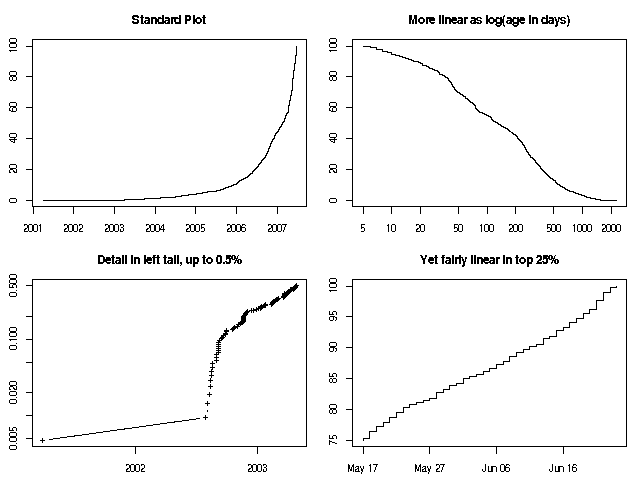
Earlier today and via Planet Debian, Lucas blogged about the 'age distribution' of Debian packages, defined as the time since the last (re-)compilation. He illustrated his findings with an, umm, rather ugly chart. Having climbed onto the soap box once before, I would like to point out how easy it can be to create simple, informative, and, at to least to me, prettier charts using R. Lucas included a URL to the data. The first nice thing to note that we can read the data directly from the URL -- no need to copy the file:
pkgAge <- read.table(file="http://people.debian.org/~lucas/arch-age/arch-age.log", col.names=c("pkg","yyyymmdd"))
read the data into a data.frame which we have given two column names.
pkgAge[,"date"] <- as.Date(as.character(pkgAge[,"yyyymmdd"]), "%Y%m%d")
pkgAge[,"age"] <- as.numeric(difftime(Sys.Date(), pkgAge[,"date"], units="day"))
pkgAge[,"prop"] <- (1:nrow(pkgAge)) / nrow(pkgAge) * 100
We then create three new columns. First is a date, by parsing the (integer) dates (after first casting them into characters) by supplying the format in standard C notation: "%Y%m%d" for year, date and month without any separators or formatters. Now, having the date as an actual date object inside a real data analysis language we can do things as e.g. computing date differences. The difftime function does just that, using the current date as other point. We ask for the return to be in days, and cast this down to a purely numeric vector (instead of datediff object). Lastly, we quickly compute the date proportion in percentages. We can then view the date. Before we plot,
png("packageAges.png", quality=100, width=640, height=480, pointsize=10)
oldpar <- par(mfrow=c(2,2), mar=c(2.5,2.5,3,1))
we direct the charts to a png file of given dimensions, and ask for all plots in one figure (using mfrow with two rows by two) with somewhat smaller figure margins using the mar argument to par. The first chart shows again proportion over date:
with(pkgAge, plot(date, prop, type='l', main="Standard Plot"))
(The with() function simply allows us to refer to the columns by their names without explicit subsetting. plot(pkgAge[,"date",], pkgAge[,"prop"]) is equivalent, but more cumbersome.) As it clear that the data has a fairly long tail in the older dates, we can also try to plot the plot over logarithmic time differences. This doesn't work for dates, but it works for our (positive-valued) age variable:
with(pkgAge, plot(age, prop, type='l', log="x", main="More linear as log(age in days)"))
The very far left tail below 0.5 percent is interesting as the one very old package is clearly an outlier within an outlier region. We use the subset function to take just one portion of the data, use logs, and explicit plotting symbols '+' in a points-and-lines plot:
with(subset(pkgAge, prop0.5), plot(date, prop, type='b', log="y", pch="+", main="Detail in left tail, up to 0.5%"))
Lastly, the upper quartile is fairly linear.
with(subset(pkgAge, prop>75), plot(date, prop, type='l', pch=".", main="Yet fairly linear in top 25%"))
At the end
oldpar <- par(mfrow=c(2,3))
dev.off()
we restore the graphics paramters and close the device (here the file). All this then yields the following chart: Debian Package Age-since-recompile Distributions Updated to correctly display the assignment operator <-
28 June 2007

Biella Coleman: Minimizing Lingusitic Drift for the Sake of Political Clarity and Integrity

I am finally catching up with the remarkably thick goulash of email and blogs entries that comes from traveling for well over a month and today I read one in particular When is Open Source not Open Source? that captivated my interest for it compellingly addresses the dangers that follow from diluting, or one might say hijacking, the term open source. When people learn that I study “free software” one of the most common questions I get asked is: why did I chose free software over open source? The answer is quite simple: given that the bread and butter of my research covers ethics, freedom, and liberalism, free software is the obvious path to follow, yet I also feel like a lot of my work is still relevant to the open source camp because of the affinities between the two. I have long maintained that the ideological gulf between open source and free software is not so great nor impassable, but more modest. As most know, both share a certain strong commitment to access and in a strict technical sense they refer to the same set of licenses. Philosophically there is agreement that openness and, especially, non-discrimination are essential for the quality of software and often by close extension, the vibrancy of community responsible for the software. Of course, when pontificating the ramifications and implications of openness, they do part company and enter into different territories. Free software tends to flag rights and freedoms, while open source meanders into a discussion of markets, business, and competition and in this regard they do craft different visions of the social world and human behavior, etc. But the case that Karl Fogel writes about, where OSI is strongly opposing the use of the term open source for licenses that don’t adhere to the definition demonstrates where the two positions join. As Michael Tiemann from the OSI succinctly put it:
The FSF may have got the orthodoxy wrong, and the OSI may have got the interpretation wrong, but we both agree that prohibition of commercial use without special permission is antithetical to both positions.
There is a unmistakable kernel of agreement and it is great to see the OSI taking such a strong stance in this regard. Now, David Richard’s response, who seeks, I think, to essentially dilute the term open source, is as (or perhaps even more) fascinating for in a nut shell, and using a lot of florid religious imagery, it accuses the OSI of being too rigid! In his own words:
I believe the OSI has a wonderful opportunity to continue being relevant and helping to lead the movement forward. If, however, y’all choose to define your denomination of this religion in a way that we don’t fit in, that’s fine. No hard feelings. It’s your choice. You’ll ultimately be excluding a large congregation and we for one will continue trying to build a church made up of others like ourselves.
In response, I would say that the goal of F/OSS is not to be inclusive of anyone who wants to release bits of source code, but to create the conditions under which software, as it has been defined by the community, can be created. Join the church if you would like to make free/open source software as defined and you can go elsewhere (i.e., create a different term) if you are creating something different, even if it is only slightly different. Integrity matters. And again inclusiveness, if it comes at the expense of the main goal, is not a boon but a danger to F/OSS. The OSI will remain relevant by halting the dilution of the term OSI, not by expanding the definition so that it is left with no substance. And in contradistinction to what David Richard maintains, however, there is a great degree of flexibility within this domain but it does not lie in the strict definition of F/OSS but in the realm of interpretation. You are also free, as Mako and I have argued elsewhere to interpret the significance of F/OSS in multiple ways. And I think this is where the political strength of free software lies. There is interplay between a well-defined goal (in this case for creating free software) and a more flexible realm of interpreting the significance of these technical practice. And we wold lose and I might add, a lot if we became flexible about the strict definition of F/OSS and inflexible about its political significance. I get irked with folks like David Richards who would like to bend open source rules to meet their (often commercial) interests and I find it pretty na ve when folks say the political significance of F/OSS is just x (or worse should be x) for in reality its political significance lies in the fact that it has spawned multiple types of political and economic projects. And there is something almost playfully ironic, (or at least it makes me smile) in this fact. Though there is strict definition contained withing F/OSS, this strictness has, at least to some extent, encouraged by an extreme and very healthy form of political proliferation and promiscuity. More than anyone else I know, Mako has most passionately and thoughtfully argued for the importance of what I would call political clarity and integrity. That is, the importance of having a well articulated definition for social movements, for they act, as he says a rallying point to realize a social movement. Urging the Creative Commons to learn from F/OSS and dare to simultaneously narrow and more clearly define their goals, he states it quite nicely in the following terms:
Free software advocates have been able to use the free software definition as the rallying point for a powerful social movement. Free software, like the concept of freedom in any freedom movement, is something that one can demand, something that one can protest for, and something that one can work toward. Working toward these goals, free and open source software movements have created the GNU/Linux operating system and billions of lines of freely available computer code.
In essence, a definition that people can abide by, respect, and perhaps eventually cherish is the condition of possibility to make working political code. And given how hard it is to make social change happen (at least in comparison to build computer code), we should learn from what F/OSS has to offer. And at the same time there is another lesson embedded in F/OSS. The Free Software Definition is well defined; but it must be emphasized, narrowly so. It does not try to do everything and have everyone pledge allegiance to an inordinately complex set of commitments. Clarity, narrowness, and well-defined goals –> these three attributes have powered it far and wide and I hope it remains so. Now, since the term open source is not trademarked, we are left with the problem of how to challenge the current hijacking of the term. For the solution, I will leave you with Karl Fogel, who I think proposes a good solution:
Note that the OSI s objection is not to the Zimbra license per se. The objection is just to Zimbra s calling that license open source . They can use any license they want, but they shouldn t call it open source unless it actually is. Freedom is freedom, and no amount of spin will change that. So what should we do about this? The term open source isn t trademarked. Years ago, the OSI tried to register it, but it was apparently too generic. …But there is public opinion. What Danese and Michael are proposing doing is organizing a lot of open source developers (and I mean open source according to the traditional definition, the one the OSI and I and most other open source developers I know adhere to) to stand up and, basically, say All of us agree on what the definition of open source is, and we reject as non-open source any license that does not comply with the letter and spirit of the Open Source Definition.

27 June 2007

Martin F. Krafft: Removing background from images

Every now and then, I want to remove the background from an image and replace it with transparency. Instead of painful pixel work with the select tool, the following Gimp recipe does the job quite well, provided the background is a single colour:
  1. Choose Layer->Transparency->Colour to Alpha and select the background colour in the dialog box. Then click OK.
  2. Use the magic wand tool (Z) to select the contiguous region around your object. Make sure to use a sufficiently high threshold such that the selection line coincides with the image's silhouette.
  3. Press Ctrl-I to invert the selection.
  4. Choose Select->Shrink and shrink the selection by a pixel or two.
  5. Create a new, transparent layer. The selection should still be active.
  6. Make the background colour you previously converted to transparent your foreground colour and choose Edit->Fill with FD Colour from the menu.
  7. Switch the two layers such that the current one moves behind the one containing your image.
The method isn't perfect, but it certainly saves me a lot of time. For instance, my new hackergotchi a tribute to Scotland and the local team of DebConf7 only took me a few minutes to get ready. Suggestions still welcome. NP: Barclay James Harvest: Everyone Is Everybody Else

24 June 2007

Mike Hommey: Playing more with LVM, LUKS and the device mapper

Following my previous entry about playing around with LVM, LUKS and the device mapper, I documented myself about internals involved in pvmove, which is more of a challenge, considering there is no such documentation. I could find no useful documentation for either the device mapper or LVM. A bit of good old UTSL later, I could elaborate how to do what I wanted, and realized it was even possible to do in shell script. So here you are : a shell script to transform an LVM physical volume to a LVM over LUKS physical volume,. I’ll detail in between how it works. As the previous script, use at your own risk, it comes with no warranty.
Note you theorically can still access the filesystems underneath without problems. It’s an in-place and live conversion. Also note this is more a proof of concept than a proper, risk-less and well-written solution.

set -e
dev=$1
luks=$(mktemp)
cryptdev=$(basename $dev)_crypt
pvsize=$(pvs -o pe_start,pv_size --units s --noheadings --nosuffix "$dev" awk ' print $1 + $2 ')
devsize=$(blockdev --getsz "$dev")
mchunk=8
The script takes the physical volume device to convert as an argument. Note there is no check for the validity of its value.

dd of="$luks" seek=$devsize count=0 bs=512 2> /dev/null
luksdev=$(losetup -f)
losetup "$luksdev" "$luks"
trap "losetup -d \"$luksdev\"; rm -f \"$luks\"" EXIT
Next, we create a sparse luks file the same size as the device (in case luksFormat would use the size somehow, but I believe it doesn’t), and a loopback device on this file. The trap is here to avoid leaving the loopback device and the file when an error occurs later (though during the conversion itself, it will be pointless).

cryptsetup luksFormat -q "$luksdev"
cryptsetup luksOpen "$luksdev" $ cryptdev _real
read start length crypt format key IVoff cdev offset <<EOF
$(dmsetup table $ cryptdev _real)
EOF
We create a LUKS device, so that we can get the encryption key ($key), and the size of the LUKS header ($offset). Note you need to add –showkey to the dmsetup table command on sid.

if [ $(expr $devsize - $pvsize) -lt $offset ]; then
  echo Not enough free space after LVM physical volume
  cryptsetup luksClose $ cryptdev _real
  exit
fi
Check we have enough space after the LVM physical volume to offset everything by the size of the LUKS header. If not, you can still try again after you reduce the size of the LVM physical volume by an extent.

if [ $(expr $devsize % $offset % $mchunk) -gt 0 ]; then
  echo Last
  cryptsetup luksClose $ cryptdev _real
  exit
fi
This is another check to avoid surprises at the end, when dealing with the last chunk. As the script is written for the moment, it doesn’t support cases where this last chunk is not a multiple of $mchunk. So we need to abort in these.

read major minor <<EOF
$(stat -t "$dev" awk ' print $10,$11 ')
EOF
maps=$(dmsetup deps awk -F: "/\($major, $minor\)/ print \$1 ")
dmsetup create $cryptdev <<EOF
0 $length linear $dev 0
EOF
dmsetup reload $ cryptdev _real <<EOF
$start $length crypt $format $key $IVoff $dev $offset
EOF
dmsetup resume $ cryptdev _real
for map in $ maps ; do
  dmsetup table "$map" sed s,$major:$minor,/dev/mapper/$cryptdev, dmsetup reload "$map"
  dmsetup resume "$map"
done
Here, we create the dev_crypt device mapper that is our fake LUKS device, which starts as a simple linear mapper and will end as a complete crypt mapper. This fake LUKS device is inserted as an intermediate mapper between the LVM device mapper and the real device. So, the LVM device mapper will have this fake LUKS device as backend, and, at the beginning, the fake LUKS device maps linearly to the real device. Note we look for all device mappers using the real device as backend before creating the fake LUKS device to avoid finding the fake LUKS device in the list. Also note dmsetup reload only loads a new table in the INACTIVE slot, and dmsetup resume makes this inactive table LIVE.

cursor=$length
chunk=$offset
while [ $cursor -gt 0 ]; do
  cursor=$(expr $cursor - $chunk)
  if [ $cursor -lt 0 ]; then
    chunk=$(expr $chunk + $cursor)
    cursor=0
  fi
  (
  [ $cursor -ne 0 ] && echo 0 $cursor linear $dev 0
  echo $cursor $chunk mirror core 1 $mchunk 2 $dev $cursor /dev/mapper/$ cryptdev _real $cursor
  [ $cursor -lt $(expr $length - $chunk) ] && echo $(expr $cursor + $chunk) $(expr $length - $cursor - $chunk) crypt $format $key $(expr $IVoff + $cursor + $chunk) $dev $(expr $offset + $cursor + $chunk)
  ) dmsetup reload "$cryptdev"
  dmsetup resume "$cryptdev"
  chunks=$(expr $chunk / $mchunk)
  while ! dmsetup status "$cryptdev" grep "$chunks/$chunks"; do
    true
  done
done
This is where the main work is done : moving the data around. We actually just let the device mapper deal with the data duplication, $offset blocks by $offset blocks ($offset being the LUKS header size), using a mirror target for the chunk being moved. So our disk looks like the following:

We use the extra dev_crypt_real device (the previously remapped LUKS device) as the encryption backend for the mirror.
I haven’t figured a better way to wait for the end of the mirroring than to do a loop checking with dmsetup status, dmsetup wait doesn’t seem to be very helpful here.
Anyways, this is the part of the script where you don’t want a crash to occur. Because if it does, all you can do is start on a rescue system, and try to find where the encrypted part of the disk start to setup a device mapper by hand.
And you’d better have the luks temporary file in a directory that is neither in RAM (think tmpfs) nor in the LVM you are converting (/tmp in a default etch install is, for instance ; note the script works nevertheless fine in this case). Also note the trap will remove the luks temporary file if the script exits…

dmsetup reload "$cryptdev" <<EOF
$start $length crypt $format $key $IVoff $dev $offset
EOF
dmsetup resume "$cryptdev"
dmsetup remove "$ cryptdev _real"
dd if="$luks" of=$dev count=$offset bs=512 2> /dev/null
Final steps of the conversion : our dev_crypt device becomes a full LUKS volume, so we can remove dev_crypt_real and add the LUKS headers at the top of the device we converted. At this moment, the LUKS volume is setup just as if it had been setup by cryptsetup. For LVM to recognize the change properly, you need to run pvscan. Once you ran it, you can do whatever you want with LVM. Now, you may want to add the following to your /etc/crypttab file:

$cryptdev $dev none luks
i.e. hda5_crypt /dev/hda5 none luks if the device was /dev/hda5. And if the LVM volume you converted contains your root filesystem, you should run (for Debian systems):

update-initramfs -u
I tested this successfully under qemu and will give it a shot on my laptop some time soon. Now, because I had a hard time not finding much about the mirror target of the device mapper, here is what I could gather about it. The target syntax is as follows:

<logical_start_sector> <num_sectors> mirror [ core disk ] <num_params> <param> ... <num_mirrors> [ <destination > <start_sector> ] ...
logical_start_sector, num_sectors, destination and start_sector have the same meaning as in other targets.
core and disk are two different log types (to track differences between mirrors), respectively in memory and on disk.
num_params and params depend on the log type: num_mirrors is the number of mirrors and for each mirror, we have a pair destination and start_sector. [ Update: after a quick look at the device mapper source code in Linus’s git tree, updated the mirror target description ]

22 June 2007

Jordi Mallach: Delta de l'Ebre

Last December, I went to the Delta de l'Ebre with a good number of friends to spend one of December's three-day weekends. Les Terres de l'Ebre are the southest region of Catalunya, right next to the border with the Valencian Country. The Ebre river forms a big delta as it meets the Mediterranean, and the great amount of wildlife, specially avian, in the Natural Park makes it a fantastic place to visit. We would sleep, more or less, in Cinta's appartment in L'Ampolla. The first night we managed to fit 17 persons for dinner, and about 14 stayed to sleep in any possible corner of the flat. As soon as the Valencian group arrived, we tried to meet the people coming from the North, but apparently they got lost and we stayed on a sightseeing spot admiring how easily the weather changes here. In an hour or so, we went from a sunny day to a quick but heavy shower and back to sunny. When we finally found each other, we decided it was a bit too late to do anything too special, given the short days in December, so we walked South along the beach, on our way to the Salines, the salt processing facility, in the Punta de la Banya.


Agua para todos... During the walk, we witnessed what the people from the Delta have been warning about for decades: the Delta is disappearing. The progressive overuse of the river's flow, excessive irrigation, damm construction and degradation is killing this unique place. The waters are slowly claiming what once was theirs. An electricity line, at the beginning of our trip being at the end of the beach starts approaching the sea, or viceversa, as you move southward, to end up many metres inside the water. The old people in the Delta still remember the 200m tall lighthouse in the Illa de Buda, which the sea managed to devour.


Sunset at the salines del Delta When we reached the Punta we could watch a beautiful sunset over the mountains of Els Ports, and when it got dark and cold we headed to Tortosa, the area's capital, which I had recently visited for the first time for one of Softcatal 's meetings. There, we had dinner at a bar and met Jordi and Anna for a while, before going back to Ampolla, going to bed relatively early due to everyone being very tired.


On Saturday, we decided to have a look at the Delta... from above. So we drove to the top of the Cim del Caro, where we could admire a great view over the flat farmlands of the Delta, and then found a nice trail which took us to a nice forest, where we had lunch. After a visit to Alfara de Carles, we went back to the house, had a great dinner and played fun games at the table. Unfortunately, Sunday morning was dedicated to cleaning up the mess in the appartment and packing, as part of the group, the Jordis from Alcoi and the twins, had to leave early. The remaining four Valencians decided to go to Deltebre to have a local paella. It was quite good, although the bar tender laughed at our request to eat directly from the paella, rejecting dishes. Small cultural clash. ;)

I remember downloading and viewing the pictures of the trip a few days after getting back in Val ncia, and then losing track of them. Last week, while testing an EPIA board with some random hard drive, I suddenly realised there was a big chance the pictures would be on that drive, and after some search, I found them; I had been close to mkfs the disk a few minutes before. I hadn't stopped blaming myself for misplacing these pictures, as they remind me of this wonderful weekend. Luckily, they are back! Going back to the state of the Delta, experts say it will be mostly gone in 200 years. All of the Terres de l'Ebre have fought against the previous government's "PHN" plan to divert part of the river's flow to the North and South, to supply Barcelona, and specially the South of Val ncia, where the developing of the coastal areas is out of control. I fear that whenever PP regains power in Madrid, they will retake this idea. There is a lot of money involved in building a 700 km long scar in our land. The Delta de l'Ebre is a fantastic place which doesn't deserve a terrible fate like this, only for the benefit of the usual suspects. As the good people of this land would say...

Lo riu  s vida. No al trasvassament!
Lo riu s vida. No al transvasament!

21 June 2007

Jordi Mallach: Delta de l'Ebre

Last December, I went to the Delta de l'Ebre with a good number of friends to spend one of December's three-day weekends. Les Terres de l'Ebre are the southest region of Catalunya, right next to the border with the Valencian Country. The Ebre river forms a big delta as it meets the Mediterranean, and the great amount of wildlife, specially avian, in the Natural Park makes it a fantastic place to visit. We would sleep, more or less, in Cinta's appartment in L'Ampolla. The first night we managed to fit 17 persons for dinner, and about 14 stayed to sleep in any possible corner of the flat. As soon as the Valencian group arrived, we tried to meet the people coming from the North, but apparently they got lost and we stayed on a sightseeing spot admiring how easily the weather changes here. In an hour or so, we went from a sunny day to a quick but heavy shower and back to sunny. When we finally found each other, we decided it was a bit too late to do anything too special, given the short days in December, so we walked South along the beach, on our way to the Salines, the salt processing facility, in the Punta de la Banya.


Agua para todos... During the walk, we witnessed what the people from the Delta have been warning about for decades: the Delta is disappearing. The progressive overuse of the river's flow, excessive irrigation, damm construction and degradation is killing this unique place. The waters are slowly claiming what once was theirs. An electricity line, at the beginning of our trip being at the end of the beach starts approaching the sea, or viceversa, as you move southward, to end up many metres inside the water. The old people in the Delta still remember the 200m tall lighthouse in the Illa de Buda, which the sea managed to devour.


Sunset at the salines del Delta When we reached the Punta we could watch a beautiful sunset over the mountains of Els Ports, and when it got dark and cold we headed to Tortosa, the area's capital, which I had recently visited for the first time for one of Softcatal 's meetings. There, we had dinner at a bar and met Jordi and Anna for a while, before going back to Ampolla, going to bed relatively early due to everyone being very tired.

On Saturday, we decided to have a look at the Delta... from above. So we drove to the top of the Cim del Caro, where we could admire a great view over the flat farmlands of the Delta, and then found a nice trail which took us to a nice forest, where we had lunch. After a visit to Alfara de Carles, we went back to the house, had a great dinner and played fun games at the table. Unfortunately, Sunday morning was dedicated to cleaning up the mess in the appartment and packing, as part of the group, the Jordis from Alcoi and the twins, had to leave early. The remaining four Valencians decided to go to Deltebre to have a local paella. It was quite good, although the bar tender laughed at our request to eat directly from the paella, rejecting dishes. Small cultural clash. ;)

I remember downloading and viewing the pictures of the trip a few days after getting back in Val ncia, and then losing track of them. Last week, while testing an EPIA board with some random hard drive, I suddenly realised there was a big chance the pictures would be on that drive, and after some search, I found them; I had been close to mkfs the disk a few minutes before. I hadn't stopped blaming myself for misplacing these pictures, as they remind me of this wonderful weekend. Luckily, they are back! Going back to the state of the Delta, experts say it will be mostly gone in 200 years. All of the Terres de l'Ebre have fought against the previous government's "PHN" plan to divert part of the river's flow to the North and South, to supply Barcelona, and specially the South of Val ncia, where the developing of the coastal areas is out of control. I fear that whenever PP regains power in Madrid, they will retake this idea. There is a lot of money involved in building a 700 km long scar in our land. The Delta de l'Ebre is a fantastic place which doesn't deserve a terrible fate like this, only for the benefit of the usual suspects. As the good people of this land would say...

Lo riu  s vida. No al transvasament!
Lo riu s vida. No al transvasament!

19 June 2007

Joerg Jaspert: DebConf7 - Blogging from the Cabal Secret Headquarters

I’m now already 9 days in Edinburgh (started writing this at day 5 already :) ), and all of them have been days of “get up at 8h, breakfast, goto Teviot, work until 23h, go back to Hostel”, with some short breaks in Teviots Bar and for Lunch/Dinner. Sounds stressful but actually was (mostly) a lot of fun, preparing the network, setting up all the core servers together with two other admins while at the same time getting a lot of request to change various parts of our Conference Management System Pentabarf to fit some peoples need at various places. The airline managed to get me to EDI, together with a few other Debian people on Friday, 8th June, around noon, where Mark (mhy) Hymers did wait already, so I didn’t need to take a bus to get into the town. On the way to Teviot I also remembered some of the places from back when we did the Venue visit for the DC7 decision. But not many, of course one forgets a lot over the time. At least I was able to remember some food places, which is always a good sign. :) At Teviot we met with Stephen (sgran) Gran to (unsorted list) have some food, unload the car, think about the way to get our uplink to our server room, check into the hostel - and whatever else we did at that day. Next day, officially called Setup day, we started to get two cables from our server room to the place our uplink is - you can see them if you go to the left site of Teviot. (The other two got there a bit later). After that we started with the setup of the network, which is pretty nice this year. We have a lot of sponsored machines that are doing various tasks, a nice network layout involving a lot of vlans to seperate stuff and a lot of (good) crack. What, you dont want to listen to boring details? Ok, here they come: - The main machine is, again, called Homer. Connected with a 2Gbit link to our master switch. It does those little things noone needs, like firewall, local mirror, dns, nagios, routing between various nets we have here, the schedule bot, etc. - There is also a Marge, who is the central point for the whole wireless network, running chillispot to have authentication for it. - Barney is used as a storage server for the video team, having some 1.5TB (raid5) space for the video data. It has 2 additional disks, 500G each, to copy data on and get them home to a video team after the conference. - Our streaming master machine at DC7 is called Lisa, and does not more than streaming for all the local clients and sending the stream out to our streaming master somewhere in the internet which then relays it to our streaming servers kindly offered by a lot of admins all over the world. - We also have Bart and Maggie, which serve as public build boxes for the attendees, where Maggie even runs a distcc open to the whole local network. - You can add the same amount of servers to this list which all do various tasks for the video team. This stuff is all glued together by a set of managed switches building our core backbone, running a number of vlans to seperate the different network segments. Which actually works quite nicely, as even at the time some expert managed to plug a cable into the same switch twice (yay, loop) - the only affected network part was that where he was in. The rest of the conference didn’t even notice it - until all of the admins jumped out of the admin room at once, looking for that fuckup. :) Sounds like crack? Probably is, but is a nice setup all together, and it was fun to set it all up together with Mark and Stephen, the two main admins for this conference who designed most of the whole structure and are the ones that really know it. I already “volunteered” them for the next DebConf to help as admins and really hope they decide to do it. Later on during DebCamp we also had Peter (weasel) Palfrader joining the local admin team. His main work here is related to the video team by hosting the geodns setup for the streaming and by running a local nagios to check the things we need to check. This enabled us to simply tell everyone Use streams.video.debconf.org:8000 wherever you are and you will get to the right server for you. Explaining this in a short way basically goes as “a monitoring tool keeps track of which servers are up and only enables them to resolve. Our geodns server then replies with the right server IPs, depending on in which region of the world you are.”. Which means streams.video.debconf.org will resolve to the local streaming server lisa while you are here, at the same time resolve to a number (those that are up) servers in Europe if you are in Europe or to those in the US if you are there. Nice. (And while I’m already blogging - I do hate my laptops suspend, err - I mean non-suspend mode. Somehow it got worse in the last days, sometimes needing multiple minutes (like 10) to decide to suspend to disk, and the suspend-to-ram still wont work. I should really get someone here that knows this stuff having a look at it. :) ).

17 June 2007

Joerg Jaspert: DebConf7 - Blogging from the Cabal Secret Headquarters

I’m now already 9 days in Edinburgh (started writing this at day 5 already :) ), and all of them have been days of “get up at 8h, breakfast, goto Teviot, work until 23h, go back to Hostel”, with some short breaks in Teviots Bar and for Lunch/Dinner. Sounds stressful but actually was (mostly) a lot of fun, preparing the network, setting up all the core servers together with two other admins while at the same time getting a lot of request to change various parts of our Conference Management System Pentabarf to fit some peoples need at various places. The airline managed to get me to EDI, together with a few other Debian people on Friday, 8th June, around noon, where Mark (mhy) Hymers did wait already, so I didn’t need to take a bus to get into the town. On the way to Teviot I also remembered some of the places from back when we did the Venue visit for the DC7 decision. But not many, of course one forgets a lot over the time. At least I was able to remember some food places, which is always a good sign. :) At Teviot we met with Stephen (sgran) Gran to (unsorted list) have some food, unload the car, think about the way to get our uplink to our server room, check into the hostel - and whatever else we did at that day. Next day, officially called Setup day, we started to get two cables from our server room to the place our uplink is - you can see them if you go to the left site of Teviot. (The other two got there a bit later). After that we started with the setup of the network, which is pretty nice this year. We have a lot of sponsored machines that are doing various tasks, a nice network layout involving a lot of vlans to seperate stuff and a lot of (good) crack. What, you dont want to listen to boring details? Ok, here they come: - The main machine is, again, called Homer. Connected with a 2Gbit link to our master switch. It does those little things noone needs, like firewall, local mirror, dns, nagios, routing between various nets we have here, the schedule bot, etc. - There is also a Marge, who is the central point for the whole wireless network, running chillispot to have authentication for it. - Barney is used as a storage server for the video team, having some 1.5TB (raid5) space for the video data. It has 2 additional disks, 500G each, to copy data on and get them home to a video team after the conference. - Our streaming master machine at DC7 is called Lisa, and does not more than streaming for all the local clients and sending the stream out to our streaming master somewhere in the internet which then relays it to our streaming servers kindly offered by a lot of admins all over the world. - We also have Bart and Maggie, which serve as public build boxes for the attendees, where Maggie even runs a distcc open to the whole local network. - You can add the same amount of servers to this list which all do various tasks for the video team. This stuff is all glued together by a set of managed switches building our core backbone, running a number of vlans to seperate the different network segments. Which actually works quite nicely, as even at the time some expert managed to plug a cable into the same switch twice (yay, loop) - the only affected network part was that where he was in. The rest of the conference didn’t even notice it - until all of the admins jumped out of the admin room at once, looking for that fuckup. :) Sounds like crack? Probably is, but is a nice setup all together, and it was fun to set it all up together with Mark and Stephen, the two main admins for this conference who designed most of the whole structure and are the ones that really know it. I already “volunteered” them for the next DebConf to help as admins and really hope they decide to do it. Later on during DebCamp we also had Peter (weasel) Palfrader joining the local admin team. His main work here is related to the video team by hosting the geodns setup for the streaming and by running a local nagios to check the things we need to check. This enabled us to simply tell everyone Use streams.video.debconf.org:8000 wherever you are and you will get to the right server for you. Explaining this in a short way basically goes as “a monitoring tool keeps track of which servers are up and only enables them to resolve. Our geodns server then replies with the right server IPs, depending on in which region of the world you are.”. Which means streams.video.debconf.org will resolve to the local streaming server lisa while you are here, at the same time resolve to a number (those that are up) servers in Europe if you are in Europe or to those in the US if you are there. Nice. (And while I’m already blogging - I do hate my laptops suspend, err - I mean non-suspend mode. Somehow it got worse in the last days, sometimes needing multiple minutes (like 10) to decide to suspend to disk, and the suspend-to-ram still wont work. I should really get someone here that knows this stuff having a look at it. :) ).

15 June 2007

MJ Ray: Stupidity: Online Banking Authentication

I'm registered with three online banking systems. (Actually, I'm probably on more, but I only use three.) Two of them use similar authentication systems. The third one uses some similar details but adds a random alphanumeric user ID and a load of restrictions on passwords and so, I just locked myself out again which has annoyed me somewhat, as well as blocking my access to some of my money. First of all, adding restrictions to passwords is stupid. It makes them easier to guess by eliminating whole regions of the solution space. If I can send the damn thing to the webserver, that should be all that matters. It also makes me more likely to either store the crippled password or details of the crippling somewhere. And it makes me more likely to lose access, like I just did yet again. How many more of the Security Myths and Passwords do they need to follow? Just put the login in a GUI transmitted unencrypted and they'd have a full house, I think. Secondly, why the devil aren't our banks using things like certificates or multi-site identity services yet? Our national government moves with the efficiency of treacle in snow when it comes to web services, yet it has been using both in its government gateway for years. It's not perfect, but they're working. Meanwhile, we're still waiting for everyone to get on the list of banks that work with GNU/Linux and I've yet to find a PGP- or S/MIME-ready bank. Online banking authentication - stupid bad technology.

DebConf team: Some more streaming relays wanted (Posted by Holger Levsen)

It’s 24h until DebianDay, the day promoting Debian to the general public in Edinburgh, which is the preceeding event of DebConf7. The video setup is almost completly done now. It will allow us to publish the recordings shortly (within hours) afterwards, with very little manual work. Today we’ll be polishing it some more and test everything with three simultaneous streams. Yesterday we successfully tested mixing video from three cameras, which was recorded and streamed to the net. While recording has still the highest priority, the streaming setup this year will (hopefully) also really rock: thanks to the help of some friendly OFTC people we’ll use geoDNS, so that there will be one DNS name for all and the users will automatically be directed to the closest server. The problem is, there is only one server in Australia, and no servers in Asia, Africa and Antarctica. If you have a server in one of these regions, and if can open port 8000 in- and outgoing, please contact us, as described in this mail. Clients will use about 300 kbit/s each. As soon as the geoDNS is in place, I’ll blog again and publish the URL, so that you can watch us testing… :-)

14 June 2007

Sergio Talens-Oliag: Pending sysadmin posts

Since some weeks ago I've been thinking that I'm not writing on my Blog for long periods, mainly because I don't have too much free time and generally I don't have interesting things to say. Anyway now I'm starting to believe that I should write more, at least about technical matters; I've been doing a lot of system administration tasks lately and probably it is a good idea to keep a log of the things I've tried and learnt on this Blog, as my notes can be useful to others or at least for myself. I'm going to bed now, but lets start by enumerating some of the things I must Blog about: The things I would like to look into, if I find the time: And the Operating System I'm using to test all those programs:

Sergio Talens-Oliag: DebConf 7 - sto 0

Once more, I'm not going to the Annual Debian Developers' Conference; I've wanted to go to previous editions, but I've always found excuses not to do it: too far away, bad dates, expensive if not going alone, ... and lately I'm too busy to do Debian related activities, mainly because I still have two jobs and my free time is devoted to my son (code named The Beast), that will be two and a half years old in four days. Anyway, this time I'm a little bit sad, because this edition is closer to home and I could have taken my family with me and be away from a stressing period at work. Oh, well, maybe next year I'll change my life and will be able to go. Let's hope so.

7 June 2007

Adam Rosi-Kessel: Religion, Secularism, and Mystery

To follow up on my early post Christopher Hitchens v. God, Jonah at the Frontal Cortex has some insightful comments on religion and secularism. The money quote:
When people like Dawkins attack wimpy agnostics or moderate believers, they forget that many atheists aren’t uber-rationalists. They carry around tarot cards, not The Selfish Gene.
Jonah also makes a good point that science and religion may not have irreconcilable differences:
It’s important to note that science isn’t necessarily in conflict with our need to believe in some sort of mystery. Modern science, after all, has discovered some of the craziest ideas around, from the principles of quantum physics to the fact that our head holds a trillion cells trafficking in minor jolts of electricity. These ideas are both materialist and mysterious, since they hint at a universe that exceeds the current capacities of our imagination. What Hamlet said to Horatio is still true.
This sort of analysis seems to me far more nuanced and interesting than that advanced by what I’ll call the “vulgar atheists” — Dawkins, Hitchens, Dennett, et al.

5 June 2007

Antti-Juhani Kaijanaho: Book selections

A friend recommended me Steve Miller and Sharon Lee’s Liaden books. The first question, reading order, was not very easy to find an answer to. I went with publication order within the Agent of Change sequence – Agent of Change, Conflict of Honors, Carpe Diem, Plan B, and I Dare. In retrospect it would have been better to start with Conflict of Honors followed by Agent of Change, as this corresponds to story chronology, and AoC and CD have the same protagonists while CoH doesn’t. The story speed between Plan B and I Dare was too fast to break the sequence, but it might have made the latter book fuller if I had read the first batch of prequels Local Custom and Scout’s Progress before it. The second prequel sequence Crystal Soldier and Crystal Dragon works well at any point in the series, as does the third (single-book) prequel sequence Balance of Trade. I’m still reading Fledgling and the first short story collection. Confusing? I thought so, but it definitely is worth the investment. Instead of all the usual superlatives, I’ll say something unique to this series: These books changed my perspective in that I now cannot read (in any fiction) about a character bowing without asking in my head “in which mode, dammit!?”. (Update on 8th June: The friend referred to above, after reading this section, said (I paraphrase): “In the peculiar mode of humans, of course”.) The Liaden books are romances in a (very good) science-fictional setting. With two exceptions, each book creates at least one new lifetime romantic pairing, and they’re in my opinion convincing romances. One of the exceptions deepens one of the earlier relationships, so there is no lack of romance there. The only place I know where one can get all the novels reliably is Webscriptions, as e-books. Some of the paper books seem to be hard to find, and the recent closing down of the main publisher Meisha Merlin cannot help there. * * * The promotional material for The Mote in God’s Eye by Larry Niven and Jerry Pournelle includes a quote by Robert Heinlein: Possibly the finest science fiction novel I have ever read. It is hard for me to disagree with that statement (including the qualifier, in all honesty), having recently read this book. Mote is a complex first-contact story, set in Pournelle’s alternate history (originally future history) universe. It begins in the year 3017. The recently created Second Empire of Man gets a visit from the aliens, leading to a counter-visit by humans to the aliens’ star system. The aliens seem friendly, but are they? What could they possibly be hiding? In retrospect, the Moties remind me (in style, not in detail) of Orson Scott Card’s Piggies (Speaker for the Dead and sequels); I would be surprised if Card had not read this book before writing his. The sequel, The Gripping Hand is not the masterpiece that Mote is, but I had no trouble enjoying it. The solution to the Motie problem has held for decades, but it won’t hold forever, and it might actually be breaking down now. The mission: save both humans and Moties from an eventual assured mutual destruction. * * * I actually started reading Pournelle’s alternate/future history from the cronological beginning. This is another series where reading order becomes a complicated matter, as many of the books tell parallel subthreads of the story; and it becomes even more complicated by the fact that there is an omnibus edition in which the story is told in chronological order, this having been accomplished by breaking the books down into chunks and then arranging the chunks in chronological order. My reading order went as follows: West of Honor, The Mercenary, Prince of Mercenaries, Go Tell the Spartans and Prince of Sparta. This is a good reading order; my only problem with it is that the protagonist of West of Honor fails to appear in most of the other books. The following is not in my opinion a real spoiler, even though it reveals certain key events of the series. The premise is that sometime between the 1970’s and the early decades of the 21st Century the United States and the Soviet Union form a union, called the CoDominium, which dominates the international politics of the Earth for most of the 21st Century. In early 21st Century, faster-than-light travel is discovered, and the CoDominium starts to colonise other star systems, first with voluntary colonists and then with convicts and involuntary colonists. The series takes place in the final decades of CoDominium, and focuses on the actions of one John Christian Falkenberg (though he is not the protagonist of all the books), first as an officer in the CoDominium (extraterrestrial) military, and then as the Colonel of a mercenary outfit, Falkenberg’s Legion. The Legion is at the center of events that eventually (after the events described in these books) leads to the creation of the first Empire of Man. The books are entertaining military science fiction, solid, enjoyable journeyman pieces.

Martin-&#201;ric Racine: Retour sur ma semaine Paris

In a nutshell: I'm extremely tempted to dump Finland and move to France. 6nergies This business networking evening was simply amazing. How about a discussion on the phonetic niceties of Northern versus Central and Southern Vietnamese accents, as a conversation starter? How about another one, on ethnic versus national identities, as the icing on the cake leading towards a business card exchange? Lovely, isn't it? So was the girl... Xin c m n, ng Mai! I however had the nasty surprise of realizing that I no longer speak French to a native level, when Alain did my video profile. Oh, the hesitations... Saaks mie puhuu suomee siin videoesittelyzz ? Eik ha? H ? The Food From Italian pizza to Japanese street noodles you name it, they have the real thing, cooked by expats. No way in hell you'll ever find that quality in Helsinki, especially not for that cheap! The Book Heaven France gave the world this wonderful language book collection called Assimil and the FNAC had them all... minus Le Lithuanien sans peine, whose publication appears forever delayed. Still, as recently found out, they even offer material in languages other than French. Combien vous gagez que le duc de Novgorod-la-Grande aura r ussi assimiler la langue de Moli re avant Debconf7? The People Courteous, smily and easy-going; the exact opposite of the average Finn. What more can I say? The Crossroad Of course, resetting the citizenship counter to zero is not exactly my idea of fun, but then again I have a strong feeling that my 8-year venture into Finnish society has pretty much come to a full circle, so... Y'a-tu quelqu'un dans la r gion parisienne qui cherche un commercial avec une forte exp rience de la gestion de produits bas s sur du logiciel libre et de l'exportation vers la Scandinavie et les pays baltes? En bonus: le ons de joual [en] [fr] gratis, tabarnak! The Paradox Visiting the South Karelia on the Senate Square event and feeling homesick for my adoptive hometown of Lappeenranta, as I kept on running into familiar faces who are still thankful after all these years that I dared become fluent in what they speak out East (which differs tremendously from normalized Finnish). Isn't life ironic, sometimes?

28 May 2007

Sergio Talens-Oliag: Four More Years of Bread and Circus

Today is a sad day for me; since 1995 the Government of the Valencian Community has been in the hands of the PP (Partido Popular) and it seems that it we will have the same until 2011. With this results Valencia will host a Formula One Grand Prix and probably tons of new paper-couch buildings like the Ciutat de les Arts i les Ci ncies. The saddest part is that more than 35% of the population stayed at home; I've always have had the feeling that most of them are more on the left than the right side of the political spectrum; probably the big problem is that the current PSPV (Partit Socialista del Pa s Valenci -PSOE) candidate for the Generalitat is a joke (I would never vote for him) and CPV (Comprom s pel Pa s Valenci ) has been unable to mobilize enough people. On days like this I think about changing my living place, luckily on the two villages where I spend most of my free time, Burjassot and Godella, the left parties have won, something specially important in Godella, where the PP was going to expropriate part of the village to bury the metro station and later pay the bill selling the freed space to put buildings of 4 or 5 floors (the current houses are one or two floors high and have been there for ages). On the other side what I'm seriously considering is moving to another work again, the current job is much better than the previous one, but I've been so unlucky that I'm again working for the local government on two of the biggest projects I'm involved in and it seems that both of them will last for a long time; without a political change I'm sure that it is going to be the same old story, and life is too short to be hitting the same walls for years. Let's see what happens, probably the main problem is that I need to take a break, maybe a four years one would be a good idea... ;)

27 May 2007

Andrew Pollock: [tech] Finding out just how hot the linen cupboard is...

I decided to move the old 1-RU Pentium III server (the thing providing all the storage for my MythTV box via ATAoE) from under the bed in the spare room to the linen cupboard. It had a brief stop in the wardrobe in the spare room, but it didn't really help with the noise. Sarah was a concerned about the heat in the linen cupboard, as this is where the patch panel is, so caesar is already in here, along with an Ethernet switch, an ADSL modem, a wireless access point, and the Vonage ATA. There's a lot of DC plug packs generating heat, so it was a reasonable concern. I figured in this day and age, someone must make some sort of USB temperature sensor, and after some searching around, I discovered the DLP-TEMP-G, which seemed to be about the right price, doing what I wanted. I'm going to say the web page was a bit ambiguous, but it was probably just late at night, because I read the bottom as having the option to buy it from Mouser, or via PayPal directly with DLP Design. So I went down the latter path, because I generally prefer to deal directly with the manufacturer. Turns out what I was actually ordering was just a "Test Application", so that email I'd received the day after I placed my order for two units was all I was going to get. I figured this out after a week or so of wondering when it was going to arrive. They were really good about it, and refunded me my $40, even though I'd received said software, and I placed a new order with Mouser for what I really wanted. Now this time, I just didn't read things thoroughly enough, although I'll still say that things were a little ambiguously worded. The page I've linked to above does say "DLP-TEMP-G and 1 DS18B20 sensor $25.00", but when reading datasheet, it goes on about three sensors, and coming with one that isn't soldered on so that you can optionally run a cable between it and the board. I somehow interpreted this as meaning there were two sensors on the board, and one loose. Not the case. The board supports having up to three DS18B20 sensors attached to it, however you please. It comes with one unattached. In hindsight, why would you want two temperature sensors directly on the board? So the moral of this story is I just can't read. Anyway, I got home from Santa Monica last night, and the goods had finally turned up, so I had a play. The DS18B20 just looks like a transistor. I initially ignored it, and just shoved the USB board in caesar, and it happily recognised it
usb 1-1: new full speed USB device using uhci_hcd and address 8
usb 1-1: configuration #1 chosen from 1 choice
drivers/usb/serial/usb-serial.c: USB Serial support registered for FTDI USB Serial Device
ftdi_sio 1-1:1.0: FTDI USB Serial Device converter detected
drivers/usb/serial/ftdi_sio.c: Detected FT232BM
usb 1-1: FTDI USB Serial Device converter now attached to ttyUSB0
usbcore: registered new driver ftdi_sio
drivers/usb/serial/ftdi_sio.c: v1.4.3:USB FTDI Serial Converters Driver
I then fooled around with minicom, and discovered that the little transistor thing I'd been ignoring was indeed the temperature sensor, as I got a reading of zero back (when using this program I found on the 'net). So I went to bed, and this morning did a bit of messing around with the sensor, and with a bit of creative bending, I've got it sitting in the S1 holes without requiring any soldering. It tells me the linen cupboard is about 44 degrees Celsius. Warm, but I don't think it's in any immediate danger of bursting into flames. Wouldn't surprise me if some of the gear in there isn't too keen about the temperature though. At least we won't have to worry about mold. Next step is to convince cacti to graph it, and nagios to monitor it, and we're in business. Here's a little Python program I knocked up to grab the temperature. pyserial is nice. Read on, Macduff!

24 May 2007

Gunnar Wolf: Top-down and bottom-up: Two approaches for... Hydrodynamics?

Yesterday we had one of our first full-evening rains of this Summer. It started raining around 15:00, and didn't really stop until past 22:00. Most of the time, it was a low intensity rain. Also yesterday, Sergio and I started with the Debian course I recently talked about - Fun!
Now... This course is scheduled at Instituto de Astronom a, which is halfway between my work and my home. 19:00 to 21:00.
I decided to leave early, so we could check some pending details - At 18:00. I biked to Astronom a, about 1.5km. When I arrived, I was as wet as you usually get at a regular rain: I still had some dry spots under my arms and legs. Nothing terrible, although a bit coldish - Anyway, that's a top-down approach for hydrodinamics, the approach most people are used to.
When we finished this session, I had to go out in a rush, as I had a meeting at 20:00 at Balderas (downtown Mexico City, ~25min away by metro). Of course, I was one hour late already, and adding the time it would take me to get home, leave the bike and run to the metro, I could not just sit and wait for the rain to get any easier on me. So I pedalled.
Contrary to what I originally expected, I didn't get soaked wet in the usual pattern. Stronger rain leads to more rain flowing down the road. Yes, almost immediately I felt a cold shudder on my legs and back: The water sprayed from below by my wheels. Of course, the front wheel was even more fun, as it sprayed my face from below - My helmet has a small protuberance at the front to make some shadow, and tilting a bit my head forward prevented the rain from hitting my eyes - but the dirty water, with small bits of wood and whatnot, from the ground found an easy way to my face. My only defense was to close the eyes as much as I could without losing visibility. A strange excercise to do :) Anyway, that's the bottom-up approach for hydrodinamics.
Anyway, by the time I got home, after an extra ~1.5km, my pants were basically a soup. My shirt was not exactly dry, but it still kept me a bit warm. I just ushered inside, grabbed a jacket, and went on for my second meeting.

Next.

Previous.
