Search Results: "dom"

3 May 2017

Reproducible builds folks: Reproducing R packages

In the past couple of weeks, Ximin Luo worked on making R generate reproducible output. This is now mostly complete, and we're waiting on feedback from upstream about our patch. In the meantime, there are a few packages that remain unreproducible, but the issue probably lies in those specific packages rather than the R toolchain. Perhaps you can help out with them, after reading this!
R packages compile into a .rdb database format that contains the package's definitions, plus a .rdx index file for easy lookup in the .rdb file. Usually, there is a main rdb with the package contents, plus another rdb that stores the help data. There is also a paths.rds (same format as .rdx) that contains some more stuff. One can actually read these files by hand using Rscript, see the diffoscope code in rdata.py. If you run that, you can see that path.rds contains some obvious paths, but the other files contain less obvious stuff, and in fact these scripts give identical output for the .rdb files, even though they are bitwise different. To get to the bottom of this, we'll have to use the R debugger. Attached to this post is a script that smooths this process. I ran this against Debian's R packages, but it probably also works with other distros' R packages - try it and see. You run it like ./r-mini-repro-test.sh $pkgdir $builddir and it will output some hashes for you; make sure to install the build dependencies first. You should manually vary both $pkgdir and $builddir to introduce the build-path variations; $builddir can be an arbitrary string but $pkgdir should point to the actual R package's source directory, so I just copy that to two locations and point the script at each of them in turn. Now, we can begin debugging. Before I did this, we had 478 unreproducible R packages so the biggest problem was likely with R itself. I downloaded the source code of both R and a small example package (r-cran-tensor), then figured out how the R packages were actually being built. This resulted in me writing the script above, to speed up debugging. You can read about R's debugger here (no HTTPS), it's a bit primitive but it supports the basic stuff (step, continue, where, print/eval) and that was adequate for me. Debugging R core So let's take a small example with Debian R 3.4.0-1:
$ ../r-mini-repro-test.sh r-cran-tensor-1.5 123
[..]
* installing *source* package  tensor  ...
** package  tensor  successfully unpacked and MD5 sums checked
** R
** preparing package for lazy loading
** help
*** installing help indices
** building package indices
** testing if installed package can be loaded
* DONE (tensor)
[..]
c71a766429151a13e46039f3c37a14edc704004f410c34f8f37a2f098506421d  ./debian/123/usr/lib/R/site-library/tensor/R/tensor.rdx
736b5b4a885db71fb3fe2a538faeefe43c500c4080dbf2c75b97135b98401acd  ./debian/123/usr/lib/R/site-library/tensor/R/tensor.rdb
8a3f9616de7ee78a83b07395dd6ec43c5259d3f1b1b653d397808fc9fc5d96c2  ./debian/123/usr/lib/R/site-library/tensor/help/tensor.rdx
d1ac634987b24606a5da627ec073f45edce2bddf071391dd17c246a0a01eba63  ./debian/123/usr/lib/R/site-library/tensor/help/tensor.rdb
80796cc1a2cfcac40c394153f67617d575e103a405430b8483c2261a903db046  ./debian/123/usr/lib/R/site-library/tensor/help/paths.rds
$ ../r-mini-repro-test.sh r-cran-tensor-1.5 1234
[..]
5f081f4d6f9da1fbe06e374067e6636d926de4cdf09886058b15c5928c636c0d  ./debian/1234/usr/lib/R/site-library/tensor/R/tensor.rdx
7145669891e1b766ca0d8d89fa9c317af716e61a62650abe3a11a848240f1d57  ./debian/1234/usr/lib/R/site-library/tensor/R/tensor.rdb
8a3f9616de7ee78a83b07395dd6ec43c5259d3f1b1b653d397808fc9fc5d96c2  ./debian/1234/usr/lib/R/site-library/tensor/help/tensor.rdx
d1ac634987b24606a5da627ec073f45edce2bddf071391dd17c246a0a01eba63  ./debian/1234/usr/lib/R/site-library/tensor/help/tensor.rdb
80796cc1a2cfcac40c394153f67617d575e103a405430b8483c2261a903db046  ./debian/1234/usr/lib/R/site-library/tensor/help/paths.rds
The files are created by the ** preparing package for lazy loading and ** help steps. In retrospect this seems somewhat obvious from the output, but I had never done R before so I spent a while using strace to be sure; one can see that those files are indeed written to after those strings are printed. Then we can grep the R source code for these strings.
r-base-3.4.0$ grep -Ri "preparing package for lazy loading" src
src/library/tools/R/install.R:                starsmsg(stars, "preparing package for lazy loading")
Reading the file, we see that this happens in the tools:::.install_packages function, and reading it further we see that it calls makeLazyLoading then code2LazyLoadDB then makeLazyLoadDB. Seems promising, let's confirm it before chasing potential wild geese. Important: In the rest of these command-line outputs I'll prepend what I input with >>> but this doesn't actually get printed by Rscript. So don't be surprised that you don't see these, when you're trying to recreate my steps. Also I am a total R noob so possibly there are more elegant ways to do what I'm about to show you; this is what I came up with after 2-3 hours of research.
$ DEBUG=1 ../r-mini-repro-test.sh r-cran-tensor-1.5 123
enter (some or all of) the following into R:
[.. helpful commands ..]
+ R_DEFAULT_PACKAGES= LC_COLLATE=C /usr/lib/R/bin/R --no-restore --slave --args nextArg-lnextArgdebian/123/usr/lib/R/site-librarynextArg-dnextArg.nextArg--built-timestamp="Thu, 01 Jan 1970 00:00:00 +0000"
>>> debug(tools:::makeLazyLoadDB)
>>> tools:::.install_packages()
processing  . 
[..]
** preparing package for lazy loading
debugging in: makeLazyLoadDB(ns, dbbase, compress = compress)
debug:  
[.. source code of makeLazyLoadDB, not yet run ..]
 
OK so we just entered the function and it's paused, in a separate shell let's check what it's doing:
$ find r-cran-tensor-1.5 -name '*.rdb'
[ no output ]
So, no files have been written yet, which means none of the parent functions did anything, we are in the right function (or it's in a child). If we continue the function, we get:
>>> c
exiting from: makeLazyLoadDB(ns, dbbase, compress = compress)
** help
debugging in: makeLazyLoadDB(db, file.path(manOutDir, basename(outDir)))
debug:  
[.. source code of makeLazyLoadDB, not yet run ..]
 
$ find r-cran-tensor-1.5 -name '*.rdb'
r-cran-tensor-1.5/debian/123/usr/lib/R/site-library/tensor/R/tensor.rdb
Then continuing again:
>>> c
exiting from: makeLazyLoadDB(db, file.path(manOutDir, basename(outDir)))
*** installing help indices
** building package indices
** testing if installed package can be loaded
* DONE (tensor)
$ find r-cran-tensor-1.5 -name '*.rdb'
r-cran-tensor-1.5/debian/123/usr/lib/R/site-library/tensor/help/tensor.rdb
r-cran-tensor-1.5/debian/123/usr/lib/R/site-library/tensor/R/tensor.rdb
So it seems likely this function is the correct one. After reading the source code of makeLazyLoadDB, even though I don't understand the whole thing, it looks like possibly this part is the one that does the actual writing:
    for (i in seq_along(vars))  
        key <- if (is.null(from)   is.environment(from))
            lazyLoadDBinsertVariable(vars[i], from, datafile,
                                     ascii, compress,  envhook)
        else lazyLoadDBinsertListElement(from, i, datafile, ascii,
                                         compress, envhook)
        assign(vars[i], key, envir = varenv)
     
So let's step through it and see if the data contains any paths.
$ DEBUG=1 ../r-mini-repro-test.sh r-cran-tensor-1.5 123
[..]
>>> debug(tools:::makeLazyLoadDB)
>>> tools:::.install_packages()
processing  . 
[..]
** preparing package for lazy loading
debugging in: makeLazyLoadDB(ns, dbbase, compress = compress)
debug:  
[.. source code of makeLazyLoadDB, not yet run ..]
 
>>>                                                                             # pressing <Enter> just means "step"
debug: ascii <- as.logical(ascii)                                               # this is the first line of the function
>>>                                                                             # keep stepping
[..]
>>>
debug: for (i in seq_along(vars))  
[.. source code of the inside of the block, not yet run ..]
 
>>>
debug: key <- if (is.null(from)   is.environment(from)) lazyLoadDBinsertVariable(vars[i],
    from, datafile, ascii, compress, envhook) else lazyLoadDBinsertListElement(from,
    i, datafile, ascii, compress, envhook)
>>>
debug: lazyLoadDBinsertVariable(vars[i], from, datafile, ascii, compress,
    envhook)                                                                    # not yet run
If we look at the source code we see that it will try to insert the value of .Internal(getVarsFromFrame(vars[i], from, FALSE))[[1L]] into the file, so let's evaluate it:
>>> .Internal(getVarsFromFrame(vars[i], from, FALSE))[[1L]]
function (x, y)
tensor(x, y, 2, 2)
<environment: namespace:tensor>
>>> typeof(.Internal(getVarsFromFrame(vars[i], from, FALSE))[[1L]])
[1] "closure"
>>> environment(.Internal(getVarsFromFrame(vars[i], from, FALSE))[[1L]])        # get the environment of a closure
<environment: namespace:tensor>
>>> envlist(environment(.Internal(getVarsFromFrame(vars[i], from, FALSE))[[1L]])) # environment as an envlist, more detailed output
$ %*t% 
function (x, y)
tensor(x, y, 2, 2)
<environment: namespace:tensor>
$ %t*% 
function (x, y)
tensor(x, y, 1, 1)
<environment: namespace:tensor>
$ %t*t% 
function (x, y)
tensor(x, y, 1, 2)
<environment: namespace:tensor>
$.__NAMESPACE__.
<environment: 0x55eb55d00be0>
$.__S3MethodsTable__.
<environment: 0x55eb55d166e8>
$.packageName
[1] "tensor"
$tensor
function (A, B, alongA = integer(0), alongB = integer(0))
 
[.. function definition ..]
 
<environment: namespace:tensor>
Nothing obviously containing paths so far, let's keep stepping and dumping the objects
>>>
debug: assign(vars[i], key, envir = varenv)
>>>                                                                             # next iteration now
debug: key <- if (is.null(from)   is.environment(from)) lazyLoadDBinsertVariable(vars[i],
    from, datafile, ascii, compress, envhook) else lazyLoadDBinsertListElement(from,
    i, datafile, ascii, compress, envhook)
>>>
debug: lazyLoadDBinsertVariable(vars[i], from, datafile, ascii, compress,
    envhook)
>>> .Internal(getVarsFromFrame(vars[i], from, FALSE))[[1L]]
function (x, y)
tensor(x, y, 1, 1)
<environment: namespace:tensor>
>>>
[.. more stepping ..]
debug: lazyLoadDBinsertVariable(vars[i], from, datafile, ascii, compress,
    envhook)
>>> .Internal(getVarsFromFrame(vars[i], from, FALSE))[[1L]]
<environment: 0x55eb55d00be0>
>>> envlist(.Internal(getVarsFromFrame(vars[i], from, FALSE))[[1L]])
$S3methods
     [,1] [,2] [,3]
$dynlibs
NULL
$exports
<environment: 0x55eb55d0a4f8>
$imports
$imports$base
[1] TRUE
$lazydata
<environment: 0x55eb55d0a178>
attr(,"name")
[1] "lazydata:tensor"
$path
[1] "/mystupidbuildpath/r-tests/r-cran-tensor-1.5/debian/123/usr/lib/R/site-library/tensor"
$spec
    name  version
"tensor"    "1.5"
Oh, here we go. (In fact we could have got this earlier, it was part of the .__NAMESPACE__. key of the first environment that we examined.) Naturally, you'll sometimes miss stuff, and sometimes go down dead ends when doing something like this, perseverence is important. The names are also a hint, after grepping the R source code for names like "S3methods" and "lazydata" we see that src/library/base/R/namespace.R is the only one that contains all of them, then reading that code in more depth reveals this. After patching it, rebuilding r-base, installing this patched version, then running our tests again, we see that we've eliminated differences in the main rdb file but not the help rdb file. :( In fact, after some more time stepping through the loop repeatedly and printing out all the objects, nothing obvious shows up. Time to re-read the source code of makeLazyLoadDB. We notice that all the lazyLoadDBinsert* functions have a hook parameter that we haven't been stepping through because it's in a separate function. So let's do that. Since it's an inner function, one has to call debug() inside makeLazyLoadDB:
$ DEBUG=1 ../r-mini-repro-test.sh r-cran-tensor-1.5 123
[..]
>>> debug(tools:::makeLazyLoadDB)
>>> tools:::.install_packages()
processing  . 
[..]
** preparing package for lazy loading
debugging in: makeLazyLoadDB(ns, dbbase, compress = compress)
debug:  
[.. source code of makeLazyLoadDB, not yet run ..]
 
>>> c
exiting from: makeLazyLoadDB(ns, dbbase, compress = compress)
** help
debugging in: makeLazyLoadDB(db, file.path(manOutDir, basename(outDir)))
debug:  
[.. source code of makeLazyLoadDB, not yet run ..]
 
[.. stepping through the function ..]
debug: envhook <- function(e)  
[.. function definition ..]
 
>>>                                                                             # step next, to define that function
[.. next statement, we don't care about it ..]
>>> debug(envhook)
[.. then keep stepping through makeLazyLoadDB ..]
>>>
debug: lazyLoadDBinsertVariable(vars[i], from, datafile, ascii, compress,
    envhook)
[.. then keep stepping through makeLazyLoadDB ..]
debug: lazyLoadDBinsertVariable(vars[i], from, datafile, ascii, compress,
    envhook)
[.. hook wasn't run for these previous iterations for some reason, but keep stepping ..]
[.. eventually we get ..]
debugging in: (function (e)
 
[.. function definition ..]
 )(<environment>)                                                               # "(..)(<environment>)" is R's name for that function (actually a closure)
debug:  
[.. source code, not yet run ..]
 
>>> e
/mystupidbuildpath/r-tests/r-cran-tensor-1.5/man/tensor.Rd
>>> typeof(e)
[1] "environment"
>>> envlist(e)
$Enc
[1] "UTF-8"
$encoding
[1] ""
$filename
[1] "/mystupidbuildpath/r-tests/r-cran-tensor-1.5/man/tensor.Rd"
$timestamp
[1] "2002-01-16 11:51:14 CET"
$wd
[1] "/mystupidbuildpath/r-tests/r-cran-tensor-1.5"
After doing the same thing as before, i.e. grepping the R source code for "Enc" "timestamp" etc, we spot a few different places that are setting the wd field. Then after some experimenting, we find that overwriting this in a different file (src/library/tools/R/parseRd.R) seems to work to get rid of this irreproducibility. (This may not be the best; our exact strategy is still being discussed with upstream, but at least we know which areas of the code are responsible.) Exercise for the reader to figure out how to get rid of the paths.rds difference. After doing the previous two, this one is fairly easy. These three issues allowed us to write a preliminary patch that enabled us to reproduce r-cran-tensor.
$ ./r-mini-repro-test.sh r-cran-tensor-1.5 123
[..]
bca9de1351ab265475cf6f1af3f6aff49bde1d209e8fafb33954caa8d90f3462  ./debian/123/usr/lib/R/site-library/tensor/R/tensor.rdx
ac7fffeb751ffc2d13c5317704b19787a7078446d97d1c6f259c93f282e04cef  ./debian/123/usr/lib/R/site-library/tensor/R/tensor.rdb
d989603340d1e8f14c35551ef379956653bf3b6e7b1868b4bf9a66d85820998e  ./debian/123/usr/lib/R/site-library/tensor/help/tensor.rdx
30e543cda9f97c202dc9c0291933940dfe71b94d352f66d8ed6c035c1a722b41  ./debian/123/usr/lib/R/site-library/tensor/help/tensor.rdb
e9f78ba2cca39a6face1ed88fce4bb718d911d567d01db49bc00a3011720ac50  ./debian/123/usr/lib/R/site-library/tensor/help/paths.rds
$ ./r-mini-repro-test.sh r-cran-tensor-1.5 1234
[..]
bca9de1351ab265475cf6f1af3f6aff49bde1d209e8fafb33954caa8d90f3462  ./debian/1234/usr/lib/R/site-library/tensor/R/tensor.rdx
ac7fffeb751ffc2d13c5317704b19787a7078446d97d1c6f259c93f282e04cef  ./debian/1234/usr/lib/R/site-library/tensor/R/tensor.rdb
d989603340d1e8f14c35551ef379956653bf3b6e7b1868b4bf9a66d85820998e  ./debian/1234/usr/lib/R/site-library/tensor/help/tensor.rdx
30e543cda9f97c202dc9c0291933940dfe71b94d352f66d8ed6c035c1a722b41  ./debian/1234/usr/lib/R/site-library/tensor/help/tensor.rdb
e9f78ba2cca39a6face1ed88fce4bb718d911d567d01db49bc00a3011720ac50  ./debian/1234/usr/lib/R/site-library/tensor/help/paths.rds
$ ./r-mini-repro-test.sh r-cran-tensor 1234
[..]
bca9de1351ab265475cf6f1af3f6aff49bde1d209e8fafb33954caa8d90f3462  ./debian/1234/usr/lib/R/site-library/tensor/R/tensor.rdx
ac7fffeb751ffc2d13c5317704b19787a7078446d97d1c6f259c93f282e04cef  ./debian/1234/usr/lib/R/site-library/tensor/R/tensor.rdb
d989603340d1e8f14c35551ef379956653bf3b6e7b1868b4bf9a66d85820998e  ./debian/1234/usr/lib/R/site-library/tensor/help/tensor.rdx
30e543cda9f97c202dc9c0291933940dfe71b94d352f66d8ed6c035c1a722b41  ./debian/1234/usr/lib/R/site-library/tensor/help/tensor.rdb
e9f78ba2cca39a6face1ed88fce4bb718d911d567d01db49bc00a3011720ac50  ./debian/1234/usr/lib/R/site-library/tensor/help/paths.rds
Testing the patch Of course r-cran-tensor is just 1 package, so then we tested this patch on all 478 tagged R packages. Before the patch, all of these were unreproducible. Now 463/478 are reproducible, hurray! The first version of the patch made 2 packages FTBFS ("fail to build from source"), r-bioc-biobase and r-cran-shinybs; this was fixed in a subsequent version of the patch. (Some other packages, r-cran-randomfields r-cran-randomfieldsutils, FTBFS even with an unpatched r-base, due to differences between 3.3.3 and 3.4.0 (#861333), and not because of our patch.) Given the overwhelming proportion of packages that did reproduce, the other 14 packages that are still unreproducible, are quite probably due to issues in those specific packages. Only 2 of these are certainly due to build-path differences: r-cran-runit r-cran-rinside. This is because, we currently see they are reproducible in Debian testing but not Debian unstable. This is slightly misleading, the real reason is not testing vs unstable directly; rather the fact that we (at the time of writing) use the same build path when trying to reproduce Debian testing packages, and different paths for unstable. The other 12 are unreproducible in both testing and unstable, so it either suffers from a non-build-path issue as well as a build-path issue, or only a non-build-path issue. So, further investigation of each package is needed. This is where you can help. :) Debugging R packages To investigate why (for example) r-cran-runit doesn't reproduce despite our patches, we just do the above process again:
$ DEBUG=1 ../r-mini-repro-test.sh r-cran-runit
[..]
>>> debug(tools:::makeLazyLoadDB)
>>> tools:::.install_packages()
processing  . 
a directory
* build_help_types=
* DBG: 'R CMD INSTALL' now doing do_install()
* created lock directory  /mystupidbuildpath/r-tests/r-cran-runit/debian/r-cran-runit/usr/lib/R/site-library/00LOCK-r-cran-runit 
* installing *source* package  RUnit  ...
** package  RUnit  successfully unpacked and MD5 sums checked
** backing up earlier installation
** R
** inst
** preparing package for lazy loading
debugging in: makeLazyLoadDB(ns, dbbase, compress = compress)
debug:  
[.. source code of makeLazyLoadDB ..]
 
We know our irreproducibility is with the help files and not the main package, so c to skip this part:
>>> c
exiting from: makeLazyLoadDB(ns, dbbase, compress = compress)
** help
debugging in: makeLazyLoadDB(db, file.path(manOutDir, basename(outDir)))
debug:  
[.. source code of makeLazyLoadDB ..]
 
Examine the "from" object, grep the output for our builddir
>>> from
$ RUnit-internal 
[..]
$ RUnit-intro 
[..]
[.. etc ..]
[..]
$checkFuncs
\title RUnit check [..]
[..]
  For a simple example see the provided test cases in
  /mystupidbuildpath/r-tests/r-cran-runit/debian/r-cran-runit/usr/lib/R/site-library/RUnit/examples/runitVirtualClassTest.r.
[..]
Found it, now we quit, patch the source code, and try again.
>>> Q
[..]
exit code 1
[.. hack hack hack ..]
$ ../r-mini-repro-test.sh r-cran-runit-0.4.31/ 123
[..]
01347305351a45bb88dab909c56942498e97f5edbe583cf6ab1327138914e315  ./debian/123/usr/lib/R/site-library/RUnit/R/RUnit.rdx
ecde40bdfac5b070acc30a0d5889d9d7f65418844d14312aceff6af5b9d0bf7a  ./debian/123/usr/lib/R/site-library/RUnit/R/RUnit.rdb
182d38ac5adc160eb9edd40d5bd7e27b95b756b8f14cee7d912ba4745ae81bdc  ./debian/123/usr/lib/R/site-library/RUnit/help/RUnit.rdx
f8a9f22acc9f937cb47a92f3979d619e83a791ad734796c2fcd9d0a34e1f11ca  ./debian/123/usr/lib/R/site-library/RUnit/help/RUnit.rdb
5c37672fdc1f325b8a3846f4eafd2624b246ec70ce01d197134fa1b97a9ee849  ./debian/123/usr/lib/R/site-library/RUnit/help/paths.rds
$ ../r-mini-repro-test.sh r-cran-runit-0.4.31/ 1234
[..]
01347305351a45bb88dab909c56942498e97f5edbe583cf6ab1327138914e315  ./debian/1234/usr/lib/R/site-library/RUnit/R/RUnit.rdx
ecde40bdfac5b070acc30a0d5889d9d7f65418844d14312aceff6af5b9d0bf7a  ./debian/1234/usr/lib/R/site-library/RUnit/R/RUnit.rdb
182d38ac5adc160eb9edd40d5bd7e27b95b756b8f14cee7d912ba4745ae81bdc  ./debian/1234/usr/lib/R/site-library/RUnit/help/RUnit.rdx
f8a9f22acc9f937cb47a92f3979d619e83a791ad734796c2fcd9d0a34e1f11ca  ./debian/1234/usr/lib/R/site-library/RUnit/help/RUnit.rdb
5c37672fdc1f325b8a3846f4eafd2624b246ec70ce01d197134fa1b97a9ee849  ./debian/1234/usr/lib/R/site-library/RUnit/help/paths.rds
Works! All finished. :) If yours doesn't, just repeat the above loop; hopefully eventually you'll get there.

1 May 2017

Russ Allbery: Review: Survival

Review: Survival, by Julie E. Czerneda
Series: Species Imperative #1
Publisher: DAW
Copyright: May 2004
ISBN: 0-7564-0180-1
Format: Hardcover
Pages: 401
Dr. Mackenzie Connor, Mac to everyone she works with, is a biodiversity researcher specializing in salmon. In her future United States, humanity seems to have caught on to the importance of preserving wild places and learning about them, and is willing to invest in good equipment and a semi-permanent research installation. This comes with some occasional drawbacks, since she has to fight to get access to the salmon runs inside a nature preserve, but she wouldn't have it any other way. She wins enough of those fights, won the latest, and is now in position to monitor a run in a way that she's never been able to before. She was not expecting an alien to go diving in the middle of her salmon run. She was certainly not expecting that alien to be accompanied by a bureaucrat insisting that this alien's curiosity is more important than her research (hah). But the accompanying letter she receives is scarily persuasive, if maddeningly unhelpful. Much like the apparently jovial, earnest, eager, and very odd alien. Mac's continued hopes that she can quickly put this bizarre intrusion to rest and go back to her salmon are dashed by an impossible power outage, an alien visitor, and a violent kidnapping. Now her best friend and colleague is missing, the bureaucrat is not who he appears to be, and Mac is getting caught up in something that feels way over her head. SF novels feature a lot of science, but not a lot of scientific research. The research that does appear is often impulsive, wildly compressed, or far too focused on the breakthroughs of single people. The SF novel that everyone points to for accurate portrayal of real scientific research is Benford's Timescape, which I found deeply unexciting. Now I have a new novel to point to for a better treatment, although (somewhat disappointingly) Mac's research gets sidelined relatively early in the story and left behind for the conclusion. Czerneda gives us not just a few scientists and an imaginary research project, but an entire operational field station with a history. The Norcoast Salmon Research Facility is located just off-shore in carefully-designed domes to provide easy access to the sea with minimal intrusion into the local ecology. It's a bustling mix of research scientists, engineers, and the ever-present seasonal grad students, who come and go in all their immature enthusiasm and are viewed with a motherly bemusement that I immediately recognized from years of working at a university. Mac splits administrative duties with another scientist in an arrangement that will be familiar to academics everywhere, and the book opens with a mutually suspicious but mostly scripted turf fight with the guardian of the neighboring wildlife trust, the same fight they've been having every six months for years. I know Czerneda is herself a biologist by training; I'm not sure what her other academic background is, but if she hasn't spent years around academics and field studies, she's at least done some excellent research. A lot of novels have a quotidian background that's interrupted by the arrival of the plot. At the start of the story, the characters often care more about their day-to-day lives than the plot, and are dragged into it reluctantly. But one sign of an excellent writer is their ability to get the reader to care about that quotidian background alongside the character, and to sympathize with the character's reluctance to get pulled into the promised (and generally more exciting) novel plot. Czerneda succeeds in this about as well as any writer I've read since Robin McKinley's Sunshine, and that's high praise. I cared about Mac's salmon, I was nearly as irritated as she was when her research was interrupted, and I still want to go back and see more of the experiments and studies she was hoping to run. Interstellar drama and threats to multiple species are all well and good, but the salmon are running! The actual plot is a mysterious threat that turns into a combination of a biological and cultural puzzle and a sort of first-contact story. Mac is not truly the first human to encounter the Dhryn, but she's certainly the first person they've explained anything to, and the first human to go where she goes. Sadly, it also shares some of the characteristics that sour me a bit on biological SF for personal reasons: a bit too much description of food, eating habits, squishy body parts, digestive processes, and biological discomfort. This is mostly a personal gripe, and won't bother other people as much as it does me, but I could have done without bits like the descriptions of Mac's attempts to figure out how to survive on alien cuisine. I'm also dubious of some of the biology of the Dhryn; given the startling bizarreness of Earth biology, maybe I shouldn't be, but I still think there are a few problems with the square-cube law here. But Mac's irrepressible grumpy curiosity makes this story, even in the bits that made me squeamish. I think I'd read any book in which she's the main character. I will warn that the ending is surprisingly dark and wasn't what I was expecting, and Survival doesn't resolve its central mysteries. This is clearly the first book of a trilogy and should be read with that expectation. But I thoroughly enjoyed it, and hopefully the next book will have more salmon. Followed by Migration. Rating: 8 out of 10

30 April 2017

Dirk Eddelbuettel: #6: Easiest package registration

Welcome to the sixth post in the really random R riffs series, or R4 for short. Posts #1 and #2 discussed how to get the now de rigeur package registration information computed. In essence, we pointed to something which R 3.4.0 would have, and provided tricks for accessing it while R 3.3.3 was still R-released. But now R 3.4.0 is out, and life is good! Or at least this is easier. For example, a few days ago I committed this short helper script pnrrs.r to littler:

#!/usr/bin/r
if (getRversion() < "3.4.0") stop("Not available for R (< 3.4.0). Please upgrade.", call.=FALSE)
tools::package_native_routine_registration_skeleton(".")
So with this example script pnrrs.r soft-linked to /usr/local/bin (or ~/bin) as I commonly do with littler helpers, all it takes is
cd some/R/package/source
pnrrs.r
and the desired file usable as src/init.c is on stdout. Editing NAMESPACE is quick too, and we're all done. See the other two posts for additional context. If you don't have littler, the above also works with Rscript.

This post by Dirk Eddelbuettel originated on his Thinking inside the box blog. Please report excessive re-aggregation in third-party for-profit settings.

Paul Wise: FLOSS Activities April 2017

Changes

Issues

Review

Administration
  • Debian systems: quiet a logrotate warning, investigate issue with DNSSEC and alioth, deploy fix on our first stretch buildd, restore alioth git repo after history rewrite, investigate iptables segfaults on buildd and investigate time issues on a NAS
  • Debian derivatives census: delete patches over 5 MiB, re-enable the service
  • Debian wiki: investigate some 403 errors, fix alioth KGB config, deploy theme changes, close a bogus bug report, ping 1 user with bouncing email, whitelist 9 email addresses and whitelist 2 domains
  • Debian QA: deploy my changes
  • Debian mentors: security upgrades and service restarts
  • Openmoko: debug mailing list issue, security upgrades and reboots

Communication
  • Invite Wazo to the Debian derivatives census
  • Welcome ubilinux, Wazo and Roopa Prabhu (of Cumulus Linux) to the Debian derivatives census
  • Discuss HP/ProLiant wiki page with HPE folks
  • Inform git history rewriter about the git mailmap feature

Sponsors The libconfig-crontab-perl backports and pyvmomi issue were sponsored by my employer. All other work was done on a volunteer basis.

Matthew Garrett: Looking at the Netgear Arlo home IP camera

Another in the series of looking at the security of IoT type objects. This time I've gone for the Arlo network connected cameras produced by Netgear, specifically the stock Arlo base system with a single camera. The base station is based on a Broadcom 5358 SoC with an 802.11n radio, along with a single Broadcom gigabit ethernet interface. Other than it only having a single ethernet port, this looks pretty much like a standard Netgear router. There's a convenient unpopulated header on the board that turns out to be a serial console, so getting a shell is only a few minutes work.

Normal setup is straight forward. You plug the base station into a router, wait for all the lights to come on and then you visit arlo.netgear.com and follow the setup instructions - by this point the base station has connected to Netgear's cloud service and you're just associating it to your account. Security here is straightforward: you need to be coming from the same IP address as the Arlo. For most home users with NAT this works fine. I sat frustrated as it repeatedly failed to find any devices, before finally moving everything behind a backup router (my main network isn't NATted) for initial setup. Once you and the Arlo are on the same IP address, the site shows you the base station's serial number for confirmation and then you attach it to your account. Next step is adding cameras. Each base station is broadcasting an 802.11 network on the 2.4GHz spectrum. You connect a camera by pressing the sync button on the base station and then the sync button on the camera. The camera associates with the base station via WPS and now you're up and running.

This is the point where I get bored and stop following instructions, but if you're using a desktop browser (rather than using the mobile app) you appear to need Flash in order to actually see any of the camera footage. Bleah.

But back to the device itself. The first thing I traced was the initial device association. What I found was that once the device is associated with an account, it can't be attached to another account. This is good - I can't simply request that devices be rebound to my account from someone else's. Further, while the serial number is displayed to the user to disambiguate between devices, it doesn't seem to be what's used internally. Tracing the logon traffic from the base station shows it sending a long random device ID along with an authentication token. If you perform a factory reset, these values are regenerated. The device to account mapping seems to be based on this random device ID, which means that once the device is reset and bound to another account there's no way for the initial account owner to regain access (other than resetting it again and binding it back to their account). This is far better than many devices I've looked at.

Performing a factory reset also changes the WPA PSK for the camera network. Newsky Security discovered that doing so originally reset it to 12345678, which is, uh, suboptimal? That's been fixed in newer firmware, along with their discovery that the original random password choice was not terribly random.

All communication from the base station to the cloud seems to be over SSL, and everything validates certificates properly. This also seems to be true for client communication with the cloud service - camera footage is streamed back over port 443 as well.

Most of the functionality of the base station is provided by two daemons, xagent and vzdaemon. xagent appears to be responsible for registering the device with the cloud service, while vzdaemon handles the camera side of things (including motion detection). All of this is running as root, so in the event of any kind of vulnerability the entire platform is owned. For such a single purpose device this isn't really a big deal (the only sensitive data it has is the camera feed - if someone has access to that then root doesn't really buy them anything else). They're statically linked and stripped so I couldn't be bothered spending any significant amount of time digging into them. In any case, they don't expose any remotely accessible ports and only connect to services with verified SSL certificates. They're probably not a big risk.

Other than the dependence on Flash, there's nothing immediately concerning here. What is a little worrying is a family of daemons running on the device and listening to various high numbered UDP ports. These appear to be provided by Broadcom and a standard part of all their router platforms - they're intended for handling various bits of wireless authentication. It's not clear why they're listening on 0.0.0.0 rather than 127.0.0.1, and it's not obvious whether they're vulnerable (they mostly appear to receive packets from the driver itself, process them and then stick packets back into the kernel so who knows what's actually going on), but since you can't set one of these devices up in the first place without it being behind a NAT gateway it's unlikely to be of real concern to most users. On the other hand, the same daemons seem to be present on several Broadcom-based router platforms where they may end up being visible to the outside world. That's probably investigation for another day, though.

Overall: pretty solid, frustrating to set up if your network doesn't match their expectations, wouldn't have grave concerns over having it on an appropriately firewalled network.

(Edited to replace a mistaken reference to WDS with WPS)

comment count unavailable comments

29 April 2017

Antoine Beaupr : My free software activities, April 2017

Debian Long Term Support (LTS) This is my monthly Debian LTS report. My time this month was spent working on various hairy security issues, most notably XBMC (now known as Kodi) and yaml-cpp.

Kodi directory transversal I started by looking in CVE-2017-5982, a "directory traversal" vulnerability in XBMC (now known as Kodi) which is a technical term for "allow attackers to read any world-readable file on your computer from the network". It's a serious vulnerability which has no known fix. When you enable the "remote control" interface in Kodi, it allows anyone with the password (which is disabled by default) to download any files Kodi has read access to on the machine it's running. Considering Kodi is often connected to multiple services, this may mean elevated compromise and more nasty stuff. I furthered the investigation done with my own analysis which showed the problem is difficult to solve: Kodi internally uses the facility to show thumbnails and media to the user, and there are no clear way of restricting which paths Kodi should have access to. Indeed, Kodi is designed to access mounted file systems and paths in arbitrary locations. In Debian bug #855225, I further confirmed confirmed wheezy and jessie-backports as vulnerable and therefore showed with good certainty that stretch and sid are vulnerable as well. I also suggested possible workaround, but at this point, it's in upstream's hands, as the changes will be intrusive. The file transfer mechanism need to be revamped all over Kodi, or authentication (with a proper password policy), need to be enforced.

Squirrelmail Next I looked at that old webmail software, Squirrelmail, which suffers from a remote code execution vulnerability (CVE-2017-7692) when sending mails with sendmail on the commandline. This is arguably an edge case, but considering the patch was simple, I figured I would provide an update to the LTS community. I tried to get a coordinated release for jessie, since the code is the same, but this wasn't completed at the time of writing. A patch is available and will hopefully be picked up by another LTS worker soon.

Fop and Batik Those issues (CVE-2017-5661 and CVE-2017-5662) were more difficult. The patches weren't clearly documented and there were no upstream references other than security advisories for the first release in years (in the case of batik) or months (in the case of fop), which made it hard to track down the issues. Fortunately, I was able to track down the upstream issues (FOP-2668 and BATIK-1139) where I got confirmation on what the proper fixes were. I could then release DLA-927-1 and DLA-926-1 with the backported patches. I do not use fop or batik. In fact, even after reading the homepage of both products, I couldn't quite figure out what use people could possibly have for that thing. Before uploading the packages, I therefore made packages available for testing for fop and batik.

libsndfile Next up was libsndfile which a bunch of overflows when parsing various audio files. I backported a patch for CVE-2017-7585 CVE-2017-7586 and CVE-2017-7741 which all seemed to be fixed by a single patch usptream. CVE-2017-7742 was also fixed, although with a separate patch. In all of those, i could only test CVE-2017-7741 and CVE-2017-7742, as the others were missing test cases. I provided a test package for a few days then I also figured it would be best to incorporate the security fixes done in stable, which brought in fixes for CVE-2015-7805, CVE-2014-9756 and CVE-2014-9496. So in the end, I ported patches from wheezy to jessie and uploaded the jessie version (reverting certain build changes) into wheezy and uploaded DLA-928-1 with the results.

yaml-cpp I then turned to yaml-cpp, a C++ parser for YAML. This one didn't have a known upstream fix, but I figured I would give it a shot anyways. I ended up writing my first C++ code in years which is still pending review and merge upstream. It's not an easy problem to fix: this is basically an excessive recursion problem that can be used to smash the stack. I figured I could introduce a recursion limit, but as the discussion showed, this is a limited approach: stack size varies on different platforms and it's not easy to find the right limit. The real solution is to rewrite the code to avoid recursion but that's a major code refactoring I didn't feel belong in a LTS update. Besides, this could be better handled by upstream, so I will leave things at that for now. It does make you wonder how much code out there is recursing on untrusted data structures...

kedpm Finally, a friend over at Koumbit.org reported Debian bug #860817, as information leak in kedpm, a password manager I previously maintained. I requested and got assigned CVE-2017-8296 and provided a fix for wheezy and jessie. For unstable and the coming stretch release, I have requested kedpm to be completely removed from Debian (Debian bug #860817) which involved a release notes update (Debian bug #861277). It's unfortunate to see software go, but kedpm wasn't maintained. I wasn't the original author: I just gave a few patches and ended up maintaining that software and not using it. It's a bad situation to be in, as you don't really know what's working and not with the tools you are supposed to be responsible for. There are more modern alternatives available now and I encourage everyone to switch.

Triage Looking for more work, I peeked a bit in the secretary tasks to triage some pending issues. I found that trafficserver could be crashed with simple requests (CVE-2017-5659) so I looked into that issue. My analysis showed that the patch is long and complex and could be difficult to backport to the old version available in wheezy. I also couldn't reproduce the issue in wheezy, so it may be a bug introduced only later, although I couldn't confirm that directly. I also triaged wireshark, where I just noted the maintainer expressed concern that we were taking up issues too fast and will probably take care of this one. I also postponed various issues in GnuTLS (marked "no-dsa") as they affect only a (unfortunately) rarely used part of GnuTLS that has been removed in later version: OpenPGP support.

Other free software work

Debiman I finally got around contributing to the debiman project. I worked on ensuring that there is a dman compatibility in debiman, by shipping dman in the debian-goodies package (Debian bug #860920). I also submitted a pull request to fix the fix about page title, document the custom assets repository, fix a stray bracket and link to the link to venerable man7.org project After a discussion on IRC, I also filed a few more issues: I'm happy to be able to contribute to this important service and I hope the new FAQ I created will be online soon!

XMonad and Emacs I started using writeroom-mode again as part of my work on LWN. As it turns out, my setup was not exactly working: I had to port my config to the new version and windows weren't "sticky" as they should be, a known issue with Xmonad. Indeed, Xmonad doesn't obey the "static" or "all desktops" standard directives. Writeroom is a "distraction-free writing" mode for Emacs, so the irony of working on such a deep distraction in establishing a distraction free environment is not lost on me. Needing to scratch that particular itch, and with the help of clever people from the IRC channel, I was able to make Emacs tell Xmonad to show its window (or "frame" as Emacs likes to call it) on all desktops. This involved creating a new function which I think could be useful in the CopyWindow library:
--   Toggle between "copyToAll" or "killAllOtherCopies". Copies to all
-- workspaces, or remove from all other workspaces, depending on
-- previous state (checked with "wsContainingCopies").
copyToAllToggle :: X ()
copyToAllToggle = do
    -- check which workspaces have copies
    copies <- wsContainingCopies
    if null copies
      then windows copyToAll -- no workspaces, make sticky
      else killAllOtherCopies -- already other workspaces, unstick
There are probably better ways of implementing this directly in the CopyWindow code - wsContainingCopies, in particular, is probably overkill. But it's all I can use directly from my xmonad.hs, so that's what I did. The other bit I needed was something to trigger that function from the outside. I rejected the ServerMode hook because it looked a bit too complicated and there is a built-in facility within X that works without this, which, from Emacs' point of view, is the x-send-client-message function. So I made up a new message identifier and wrote a event hook handler to process it:
--   handle X client messages that tell Xmonad to make a window appear
-- on all workspaces
--
-- this should really be using _NET_WM_STATE and
-- _NET_WM_STATE_STICKY. but that's more complicated: then we'd need
-- to inspect a window and figure out the current state and act
-- accordingly. I am not good enough with Xmonad to figure out that
-- part yet.
--
-- Instead, just check for the relevant message and check if the
-- focused window is already on all workspaces and toggle based on
-- that.
--
-- this is designed to interoperate with Emacs's writeroom-mode module
-- and called be called from elisp with:
--
-- (x-send-client-message nil 0 nil "XMONAD_COPY_ALL_SELF" 8 '(0))
myClientMessageEventHook :: Event -> X All
myClientMessageEventHook (ClientMessageEvent  ev_message_type = mt, ev_data = dt ) = do
  dpy <- asks display
  -- the client message we're expecting
  copyAllMsg <- io $ internAtom dpy "XMONAD_COPY_ALL_SELF" False
  -- if the event matches the message we expect, toggle sticky state
  when (mt == copyAllMsg && dt /= []) $ do
    copyToAllToggle
  -- we processed the event completely
  return $ All True
All that was left was to hook that into Emacs, and I was done! Whoohoo! Full screen total domination, distraction free work! :) I would love to hear from others what they think of that approach, if they have improvements or if the above copyToAllToggle function could be merged in. Ideally, Xmonad would just parse the STICKY client messages and do the right thing - maybe even directly in CopyWindow - but I have found this enough Haskell for one day. You can see the diff on my home directory to see exactly the changes involved to make this configuration work.

Emacs packaging Speaking of Emacs, after complaining in the noisy #emacs IRC channel about the poor TLS configuration of marmelade.org -- and filing a bug (Debian bug #861106) regarding the use of SHA-1 in certificate pinning -- I was told we shouldn't expect trust from third-party ELPA repositories. Marmelade seems to be dead, as the maintainer is "behind the great firewall of China" and MELPA still hasn't figured out how to sign packages. In the end, it seems like there are tons of elpa packages in Debian and that if your favorite one is missing, that's a bug that can be filed and fixed. I first discovered that 6 of the packages I used were already packaged: And so I went ahead and filed a ton more bugs for the packages I am using but that aren't in Debian just yet: Of those, I can't recommend multiple-cursors (MC) enough: I used it at least 4 times just writing this text. It's just awesome. The other ones are also all great in their own right of course, but I feel they are more specific to my workflow whereas MC is just amazing.

ikiwiki I did some more work on ikiwiki the software driving this blog. I created a new plugin to, at least, fix anchors in the table of contents to be human readable. This is something I had done on the MoinMoin wiki almost a decade ago -- which I called then NicerHeadingIds and that I have always found frustrating with Ikiwiki. It turns out the problem was both easier and hairier than I thought. Right from the start, something weird was happening: something was already adding nice headings, but they were somewhat broken. It turns out that multimarkdown already inserts those headers, but I wasn't satisfied with the way they were generated. But even worse, I had the headinganchors plugin enabled, but that plugin wasn't taking effect, because of multimarkdown. And even if it would take effect, it doesn't behave well with non-ASCII characters, which gets turned in their numeric presentation. So I also wrote the i18nheadinganchors plugin that creates better headings and patched the toc plugin so that it can reuse existing anchors if they exist, while keeping backwards compatibility. I hope this gets merged in a future ikiwiki release so I do not have to carry this patch locally too long... In other news, I have upgraded the ikiwiki-hosting package to the latest version and sent a patch upstream to provide HSTS support.

Other stuff I have migrated all my public repos hosted on my home server to either Gitlab.com or Github. I also have repositories on 0xacab and it seemed ludicrous to have 4 different, canonical, places where my code was hosted. I have now about 40 different projects on Gitlab and about 60 on Github, although most of the latter are forks of existing projects. I also made a manpage for stressant and moved the documentation to RTFD which makes it neatly accessible. I also made small incremental improvements (like --directory support). I installed Rainloop on this server to give a nice, mobile-friendly webmail. Instructions to replicate this setup are in mail. In the constant git-annex documentation effort, I tried to draft a user guide that could be a basis for restructuring the documentation to be more easily accessible. I also helped a friend put his documentation on the wiki in splitting a repository. Finally, I also looked into Android stuff a little more. I wrote a usability review of the F-Droid privileged extension that will bring good changes, I hope. I also opened the discussion regarding reproducible builds to try and clarify exactly how those worked to help the Wallabag people ship consistently signed alphas. So far, it seems that it will remain a standard practice on F-Droid to ship packages that are not signed by the official upstream signature, unfortunately, unless upstream provides a reproducible build that is publicly available... Switching to such build is also a hairy issue, as, obviously, the signature changes, which raises the alarm we are trying to avoid in the first place.

John Goerzen: Is there any way to truly secure Docker container contents?

There is much to like about Docker. Much has been written about it, and about how secure the containerization is. This post isn t about that. This is about keeping what s inside each container secure. I believe we have a fundamental problem here. Earlier this month, a study on security vulnerabilities on Docker Hub came out, and the picture isn t pretty. One key finding:
Over 80% of the :latest versions of official images contained at least on high severity vulnerability!
And it s not the only one raising questions. Let s dive in and see how we got here. It s hard to be secure, but Debian makes it easier Let s say you want to run a PHP application like WordPress under Apache. Here are the things you need to keep secure: On Debian (and most of its best-known derivatives), we are extremely lucky to have a wonderful security support system. If you run a Debian system, the combination of unattended-updates, needrestart, debsecan, and debian-security-support will help one keep a Debian system secure and verify it is. When the latest OpenSSL bug comes out, generally speaking by the time I wake up, unattended-updates has already patched it, needrestart has already restarted any server that uses it, and I m protected. Debian s security team generally backports fixes rather than just say here s the new version , making it very safe to automatically apply patches. As long as I use what s in Debian stable, all layers mentioned above will be protected using this scheme. This picture is much nicer than what we see in Docker. Problems We have a lot of problems in the Docker ecosystem:
  1. No built-in way to know when a base needs to be updated, or to automatically update it
  2. Diverse and complicated vendor security picture
  3. No way to detect when intermediate libraries need to be updated
  4. Complicated final application security picture
Let s look at them individually. Problem #1: No built-in way to know when a base needs to be updated, or to automatically update it First of all, there is nothing in Docker like unattended-updates. Although a few people have suggested ways to run unattended-updates inside containers, there are many reasons that approach doesn t work well. The standard advice is to update/rebuild containers. So how do you know when to do that? It is not all that obvious. Theoretically, official OS base images will be updated when needed, and then other Docker hub images will detect the base update and be rebuilt. So, if a bug in a base image is found, and if the vendors work properly, and if you are somehow watching, then you could be protected. There is work in this area; tools such as watchtower help here. But this can lead to a false sense of security, because: Problem #2: Diverse and complicated vendor security picture Different images can use different operating system bases. Consider just these official images, and the bases they use: (tracking latest tag on each) And how about a few unofficial images? The good news is that Debian jessie seems to be pretty popular here. The bad news is that you see everything from Oracle Linux, to Ubuntu, to Debian testing, to Debian oldstable in just this list. Go a little further, and you ll see Alpine Linux, CentOS, and many more represented. Here s the question: what do you know about the security practices of each of these organizations? How well updated are their base images? Even if it s Debian, how well updated is, for instance, the oldstable or the testing image? The attack surface here is a lot larger than if you were just using a single OS. But wait, it gets worse: Problem #3: No way to detect when intermediate libraries need to be updated Let s say your Docker image is using a base that is updated immediately when a security problem is found. Let s further assume that your software package (WordPress, MySQL, whatever) is also being updated. What about the intermediate dependencies? Let s look at the build process for nginx. The Dockerfile for it begins with Debian:stretch-slim. But then it does a natural thing: it runs an apt-get install, pulling in packages from both Debian and an nginx repo. I ran the docker build across this. Of course, the apt-get command brings in not just the specified packages, but also their dependencies. Here are the ones nginx brought in: fontconfig-config fonts-dejavu-core gettext-base libbsd0 libexpat1 libfontconfig1 libfreetype6 libgd3 libgeoip1 libicu57 libjbig0 libjpeg62-turbo libpng16-16 libssl1.1 libtiff5 libwebp6 libx11-6 libx11-data libxau6 libxcb1 libxdmcp6 libxml2 libxpm4 libxslt1.1 nginx nginx-module-geoip nginx-module-image-filter nginx-module-njs nginx-module-xslt ucf Now, what is going to trigger a rebuild if there s a security fix to libssl1.1 or libicu57? (Both of these have a history of security holes.) The answer, for the vast majority of Docker images, seems to be: nothing automatic. Problem #4: Complicated final application security picture And that brings us to the last problem: Let s say you want to run an application in Docker. exim, PostgreSQL, Drupal, or maybe something more obscure. Who is watching for security holes in it? If you re using Debian packages, the Debian security team is. If you re using a Docker image, well, maybe it s the random person that contributed it, maybe it s the vendor, maybe it s Docker, maybe it s nobody. You have to take this burden on yourself, to validate the security support picture for each image you use. Conclusion All this adds up to a lot of work, which is not taken care of for you by default in Docker. It is no surprise that many Docker images are insecure, given this picture. The unfortunate reality is that many Docker containers are running with known vulnerabilities that have known fixes, but just aren t, and that s sad. I wonder if there are any practices people are using that can mitigate this better than what the current best-practice recommendations seem to be?

25 April 2017

Reproducible builds folks: Reproducible Builds: week 104 in Stretch cycle

Here's what happened in the Reproducible Builds effort between Sunday April 16 and Saturday April 22 2017: Upcoming events Reproducible work in other projects Packages reviewed and fixed, and bugs filed Chris Lamb: Chris West: Reviews of unreproducible packages 37 package reviews have been added, 64 have been updated and 16 have been removed in this week, adding to our knowledge about identified issues. One issue type has been updated: Two issue types have been added: Weekly QA work During our reproducibility testing, FTBFS bugs have been detected and reported by: diffoscope development Misc. This week's edition was written by Chris Lamb, Vagrant Cascadian & reviewed by a bunch of Reproducible Builds folks on IRC & the mailing lists.

22 April 2017

Manuel A. Fernandez Montecelo: Debian GNU/Linux port for RISC-V 64-bit (riscv64)

This is a post describing my involvement with the Debian GNU/Linux port for RISC-V (unofficial and not endorsed by Debian at the moment) and announcing the availability of the repository (still very much WIP) with packages built for this architecture. If not interested in the story but you want to check the repository, just jump to the bottom. Roots A while ago, mostly during 2014, I was involved in the Debian port for OpenRISC (or1k) about which I posted (by coincidence) exactly 2 years ago. The two of us working on the port stopped in August or September of that year, after knowing that the copyright of the code to add support for this architecture in GCC would not be assigned to the FSF, so it would never be added to GCC upstream unless the original authors changed their mind (which they didn't) or there was a clean-room reimplementation (which didn't happen so far). But a few other key things contributed to the decision to stop working on that port, which bear direct relationship to this story. One thing that particularly influenced me to stop working on it was a sense of lack of purpose, all things considered, for the OpenRISC port that we were working on. For example, these chips are sometimes used as part of bigger devices by Samsung to control or wake up other chips; but it was not clear whether there would ever be devices with OpenRISC as the main chip, specially in devices powerful enough to run Linux or similar kernels, and Debian on top. One can use FPGAs to synthesise OpenRISC or1k, but these are slow, and expensive when using lots of memory. Without prospects of having hardware easily available to users, there's not much point in having a whole Debian port ready to run on hardware that never comes to be. Yeah, sure, it's fun to create such a port, but it's tons of work to maintain and keep it up to-date forever, and with close to zero users it's very unrewarding. Another thing that contributed to decide to stop is that, at least in my opinion, 32-bit was not future-proof enough for general purpose computing, specially for new devices and ports starting to take off on that time and age. There was some incipient work to create another OpenRISC design for 64-bits, but it was still in an early phase. My secret hope and ultimate goal was to be able to run as much a free-ish computer as possible as my main system. Still today many people are buying and using 32-bit devices, like small boards; but very few use it as their main computer or servers for demanding workloads or complex services. So for me, even if feasible if one is very austere and dedicated, OpenRISC or1k failed that test. And lastly, another thing happened at the time... Enter RISC-V In August 2014, at the point when we were fully acknowledging the problem of upstreaming (or rather, lack thereof) the support for OpenRISC in GCC, RISC-V was announced to the world, bringing along papers with suggestive titles such as Instruction Sets Should Be Free: The Case For RISC-V (pdf) and articles like RISC-V: An Open Standard for SoCs - The case for an open ISA in EE Times. RISC-V (as the previous RISC-n marks) had been designed (or rather, was being designed, because it was and is an as yet unfinished standard) by people from UC Berkeley, including David Patterson, the pioneer of RISC computer designs and co-author of the seminal book Computer Architecture: A Quantitative Approach . Other very capable people are also also leading the project, doing the design and legwork to make it happen see the list of contributors. But, apart from throwing names, the project has many other merits. Similarly to OpenRISC, RISC-V is an open instruction set architecture (ISA), but with the advantage of being designed in more recent times (thus avoiding some mistakes and optimising for problems discovered more recently, as technology evolves); with more resources; with support for instruction widths of 32, 64 and even 128 bits; with a clean set of standard but optional extensions (atomics, float, double, quad, vector, ...); and with reserved space to add new extensions in ordered and compatible ways. In the view of some people in the OpenRISC community, this unexpected development in a way made irrelevant the ongoing update of OpenRISC for 64-bits, and from what I know and for better or worse, all efforts on that front stopped. Also interestingly (if nothing else, for my purposes of running as much a free system as possible), was that the people behind RISC-V had strong intentions to make it useful to create modern hardware, and were pushing heavily towards it from the beginning. And together with this announcement or soonly after, it came the promise of free-ish hardware in the form of the lowRISC project. Although still today it seems to be a long way from actually shipping hardware, at least there was some prospect of getting it some day. On top of all that, about the freedom aspect, both the Berkeley and lowRISC teams engaged since very early on with the free hardware community, including attending and presenting at OpenRISC events; and lowRISC intended to have as much free hardware as possible in their planned SoC. Starting to work on the Debian port, this time for RISC-V So in late 2014 I slowly started to prepare the Debian port, switching on and off. The Userland spec was frozen in 2014 just before the announcement, the Privilege one is still not frozen today, so there was no need to rush. There were plans to upstream the support in the toolchain for RISC-V (GNU binutils, glibc and GCC; Linux and other useful software like Qemu) in 2015, but sadly these did not materialise until late 2016 and 2017. One of the main reasons for the delay was due to the slowness to sort out the copyright assignment of the code to the FSF (again). Still today, only binutils and GCC are upstreamed, and Linux and glibc depend on the Privilege spec being finished, so it will take a while. After the experience with OpenRISC and the support in GCC, I didn't want to invest too much time, lest it all became another dead-end due to lack of upstreaming so I was just cross-compiling here and there, testing Qemu (which still today is very limited for this architecture, e.g. no network support and very limited character and block devices) and trying to find and report bugs in the implementations, and send patches (although I did not contribute much in the end). Incompatible changes in the toolchain In terms of compiling packages and building-up a repository, things were complicate, and less mature and stable than the OpenRISC ones were even back in 2014. In theory, with the Userland spec being frozen, regular programs (below the Operating System level) compiled at any time could have run today; but in practice what happened is that there were several rounds of profound or, at least, disrupting changes in the toolchain before and while being upstreamed, which made the binary packages that I had built to not work at all (changes in dynamic loader, registers where arguments are stored when jumping functions, etc.). These major breakages happened several times already, and kind of unexpectedly at least for the people not heavily involved in the implementation. When the different pieces are upstreamed it is expected that these breakages won't happen; but still there's at least the fundamental bit of glibc, which will probably change things once again in incompatible ways before or while being upstreamed. Outside Debian but within the FOSS / Linux world, the main project that I know of is that some people from Fedora also started a port in mid 2016 and did great advances, but from what I know they put the project in the freezer in late 2016 until all such problems are resolved they don't want to spend time rebootstrapping again and again. What happened recently on the Debian front In early 2016 I created the page for RISC-V in the Debian wiki, expecting that things were at last fully stable and the important bits of the toolchain upstreamed during that year I was too optimistic. Some other people (including Debian folks) have been contributing for a while, in the wiki, mailing lists and IRC channels, and in the RISC-V project mailing lists you will see their names everywhere. However, due to the combination of lack of hardware, software not upstreamed and shortcomings of emulators (chiefly Qemu) make contributions hard and very tedious, nothing much happened recently visible to the outside world in terms of software. The private repository-in-the-making In late 2015 and beginning of 2016, having some free time in my hands and expecting that all things would coalesce quickly, I started to build a repository of binary packages in a more systematic way, with most of the basic software that one can expect in a basic Debian system (including things common to all Linux systems, and also specific Debian software like dpkg or apt, and even aptitude!). After that I also built many others outside the basic system (more than 1000 source packages and 2000 or 3000 arch-dependent binary packages in total), specially popular libraries (e.g. boost, gtk+ version 2 and 3), interpreters (several versions of lua, perl and python, also version 2 and 3) and in general packages that are needed to build many other packages (like doxygen). Unfortunately, some of these most interesting packages do not compile cleanly (more because of obscure or silly errors than proper porting), so they are not included at the moment. I intentionally avoided trying to compile thousands of packages in the archive which would be of nobody's use at this point; but many more could be compiled without much effort. About the how, initially I started cross-compiling and using rebootstrap, which was of great help in the beginning. Some of the packages that I cross-compiled had bugs that I did not know how to debug without a live and native (within emulators) system, so I tried to switch to natively built packages very early on. For that I needed many packages built natively (like doxygen or cmake) which would be unnecessary if I remained cross-compiling the host tools would be used in that case. But this also forced me to eat my own dog food, which even if much slower and tedious, it was on the whole a more instructive experience; and above all, it helped to test and make sure that the the tools and the whole stack was working well enough to build hundreds of packages. Why the repository-in-the-making was private Until now I did not attempt to make the repository available on-line, for several reasons. First because it would be kind of useless to publish files that were not working or would soon not work, due to the incompatible changes in the toolchain, rendering many or most of the packages built useless. And because, for many months now, I expected that things would stabilise and to have something stable really soon now but this didn't happen yet. Second because of lack of resources and time since mid 2016, and because I got some packages only compiled thanks to (mostly small and unimportant, but undocumented and unsaved) hacks, often working around temporary bugs and thus not worth sending upstream; but I couldn't share the binaries without sharing the full source and fulfill licenses like the GNU GPL. I did a new round of clean rebuilds in the last few weeks, just finished, the result is close to 1000 arch-dependent packages. And third, because of lack of demand. This changed in the last few weeks, when other people started to ask me to share the results even if incomplete or not working properly (I had one request in the past, but couldn't oblige in time at the time). Finally, the work so far: repository now on-line So finally, with the great help from Kurt Keville from MIT, and Bytemark sponsoring a machine where most of the packages were built, here we have the repository: The lines for /etc/apt/sources.list are:
 deb [ arch=riscv64 signed-by=/usr/share/keyrings/debian-keyring.gpg ] http://riscv.mit.edu/debian unstable main
 deb-src [ signed-by=/usr/share/keyrings/debian-keyring.gpg ] http://riscv.mit.edu/debian unstable main
The repository is signed with my key as Debian Developer, contained in the file /usr/share/keyrings/debian-keyring.gpg, which is part of the package debian-keyring (available from Debian and derivatives). WARNING!! This repository, though, is very much WIP, incomplete (some package dependencies cannot be fulfilled, and it's only a small percentage of the Debian archive, not trying to be comprehensive at the moment) and probably does not work at all in your system at this point, for the following reasons: The combination of all these shortcomings is specially unfortunate, because without glibc provided it will be difficult that you can get the binaries to run at all; but there are some packages that are arch-dependent but not too tied to libc or the dynamic loader will not be affected. At least you can try one the few static packages present in Debian, like the one in the package bash-static. When one removes moving parts like the dynamic loader and libc, since the basic machine instructions are stable for several years now, it should work, but I wouldn't discard some dark magic that prevents even static binaries from working. Still, I hope that the respository in its current state is useful to some people, at least for those who requested it. If one has the environment set-up, it's easy to unpack the contents of the .deb files and try out the software (which often is not trivial or very slow to compile, or needs lots of dependencies to be built first first). ... and finally, even if not useful at all for most people at the moment, by doing this I also hope that efforts like this spark your interest to contribute to free software, free hardware, or both! :-)

19 April 2017

Reproducible builds folks: Reproducible Builds: week 103 in Stretch cycle

Here's what happened in the Reproducible Builds effort between Sunday April 9 and Saturday April 15 2017: Upcoming events On April 26th Chris Lamb will give a talk at foss-north 2017 in Gothenburg, Sweden on Reproducible Builds. Media coverage Jake Edge wrote a summary of Vagrant Cascadian's talk on Reproducible Builds at LibrePlanet. Toolchain development and fixes Ximin Luo forwarded patches to GCC for BUILD_PATH_PREFIX_MAP support. With this patch to backported to GCC-6, as well as a patched dpkg to set the environment variable, he scheduled ~3,300 packages that are unreproducible in unstable-amd64 but reproducible in testing-amd64 - because we vary the build path in the former but not latter case. Our infrastructure ran these in just under 3 days, and we reproduced ~1,700 extra packages. This is about 6.5% of ~26,100 Debian source packages, and about 1/2 of the ones whose irreproducibility is due to build-path issues. Most of the rest are not related to GCC, such as things built by R, OCaml, Erlang, LLVM, PDF IDs, etc. (The dip afterwards, in the graph linked above, is due to reverting back to an unpatched GCC-6, but we'll be rebasing the patch continually over the next few weeks so the graph should stay up.) Packages reviewed and fixed, and bugs filed Chris Lamb: Chris West: Reviews of unreproducible packages 38 package reviews have been added, 111 have been updated and 85 have been removed in this week, adding to our knowledge about identified issues. 6 issue types have been updated: Added: Updated: Removed: diffoscope development Development continued in git on the experimental branch: Chris Lamb: Weekly QA work During our reproducibility testing, FTBFS bugs have been detected and reported by: Misc. This week's edition was written by Ximin Luo, Chris Lamb & reviewed by a bunch of Reproducible Builds folks on IRC & the mailing lists.

Steve Kemp: 3d-Printing is cool

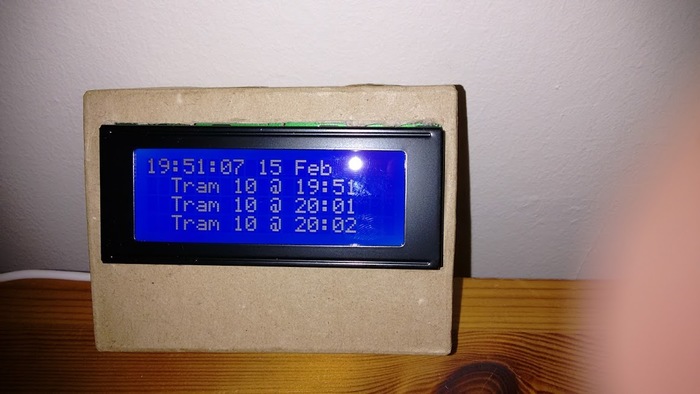
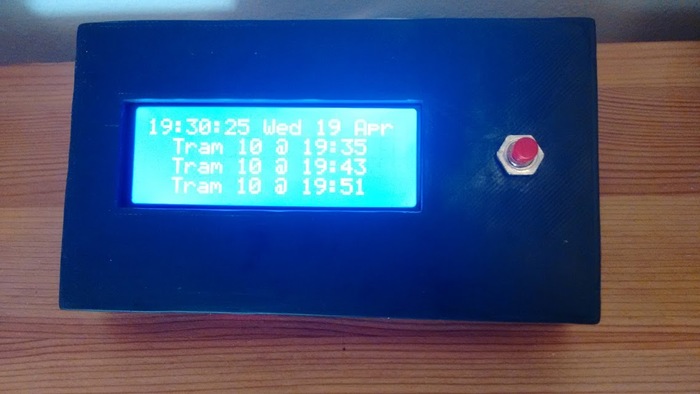
I've heard about 3d-printing a lot in the past, although the hype seems to have mostly died down. My view has always been "That seems cool", coupled with "Everybody says making the models is very hard", and "the process itself is fiddly & time-consuming". I've been sporadically working on a project for a few months now which displays tram-departure times, this is part of my drive to "hardware" things with Arduino/ESP8266 devices . Most visitors to our flat have commented on it, at least once, and over time it has become gradually more and more user-friendly. Initially it was just a toy-project for myself, so everything was hard-coded in the source but over time that changed - which I mentioned here, (specifically the Access-point setup): I've now wired up an input-button to the device too, experimenting with the different ways that a single button can carry out multiple actions: Anyway the software is neat, and I can't think of anything obvious to change. So lets move onto the real topic of this post: 3D Printing. I randomly remembered that I'd heard about an online site holding 3D-models, and on a whim I searched for "4x20 LCD". That lead me to this design, which is exactly what I was looking for. Just like open-source software we're now living in a world where you can get open-source hardware! How cool is that? I had to trust the dimensions of the model, and obviously I was going to mount my new button into the box, rather than the knob shown. But having a model was great. I could download it, for free, and I could view it online at viewstl.com. But with a model obtained the next step was getting it printed. I found a bunch of commercial companies, here in Europe, who would print a model, and ship it to me, but when I uploaded the model they priced it at 90+. Too much. I'd almost lost interest when I stumbled across a site which provides a gateway into a series of individual/companies who will print things for you, on-demand: 3dhubs. Once again I uploaded my model, and this time I was able to select a guy in the same city as me. He printed my model for 1/3-1/4 of the price of the companies I'd found, and sent me fun pictures of the object while it was in the process of being printed. To recap I started like this:
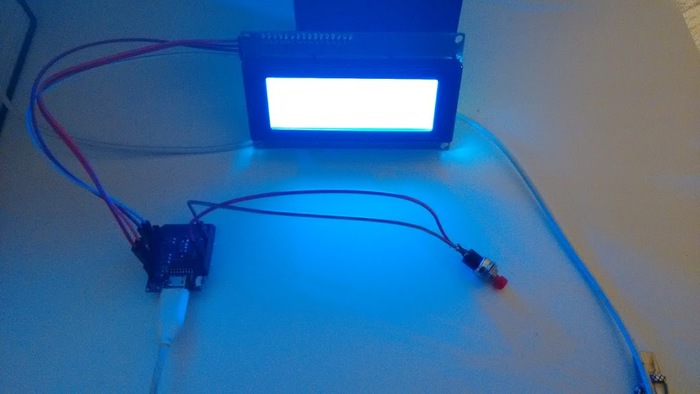
Then I boxed it in cardboard which looked better than nothing, but still not terribly great:
Now I've found an online case-design for free, got it printed cheaply by a volunteer (feels like the wrong word, after-all I did pay him), and I have something which look significantly more professional:
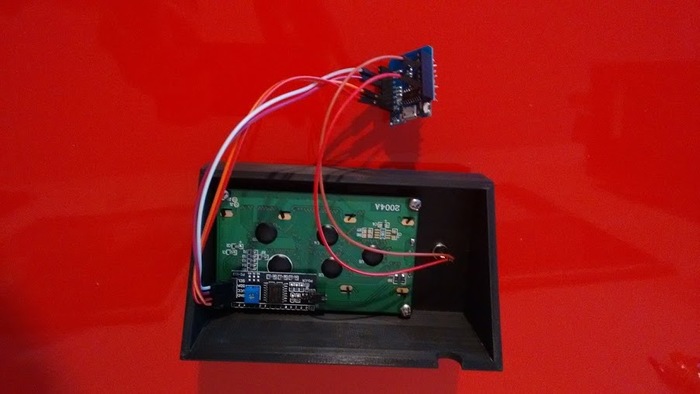
Inside it looks as neat as you would expect:
Of course the case still cost 5 times as much as the actual hardware involved (button: 0.05, processor-board 2.00 and LCD I2C display 3.00). But I've gone from being somebody who had zero experience with hardware-based projects 4 months ago, to somebody who has built a project which is functional and "pretty". The internet really is a glorious thing. Using it for learning, and coding is good, using it for building actual physical parts too? That's something I never could have predicted a few years ago and I can see myself doing it more in the future. Sure the case is a little rough around the edges, but I suspect it is now only a matter of time until I learn how to design my own models. An obvious extension is to add a status-LED above the switch, for example. How hard can it be to add a new hole to a model? (Hell I could just drill it!)

Antoine Beaupr : The rise of Linux-based networking hardware

Linux usage in networking hardware has been on the rise for some time. During the latest Netdev conference held in Montreal this April, people talked seriously about Linux running on high end, "top of rack" (TOR) networking equipment. Those devices have long been the realm of proprietary hardware and software companies like Cisco or Juniper, but Linux seems to be making some significant headway into the domain. According to Shrijeet Mukherjee, VP of Engineering at Cumulus Networks: "we are seeing a 28% adoption rate in the Fortune 50" companies. As someone who has worked in system administration and networking for over a decade, I was surprised by this: switches have always been black boxes of proprietary hardware that we barely get a shell into. But as more and more TOR hardware gets Linux support, some of that work trickles down outside of that niche. Are we really seeing the rise of Linux in high-end networking hardware?

Linux as the standard interface During his keynote at Netdev, Jesse Brandeburg explained that traffic is exploding on the Internet: "From 2006 to 2016 the compound annual growth rate was 78% of network traffic. So the network traffic is growing like crazy. In 2010 to 2023, it's going to grow by a thousand times." He also mentioned Intel was working on devices that could do up to 400 Gbps. In his talk, he argued that Linux has a critical place in the modern world by repeating the mantra that "everything is on the network, and the network runs Linux", but does it really? Through Android, Linux has become the most popular end-user device operating system and is also dominant on the server but what about the actual fabric of the network: the routers and switches that interconnect all those machines? Mukherjee, in his own keynote, argued that even though Linux has achieved dominance in the server and virtualization markets, there is a "discontinuity [...] at the boundary where the host and the network meet" and argued "that the host without the network will not survive". In other words, proprietary hardware and software in the network threaten free software in the server. Even though some manufacturers are already providing a "Linux interface" in their hardware, it is often only some sort of compatibility shell which might be compared with the Ubuntu compatibility layer in Windows: it's not a real Linux. Mukherjee pushed this idea further by saying that those companies are limiting themselves by not using the full Linux stack. He presented Linux as the "top vehicle for innovation" that provides a featureful network stack, citing VXLAN, eBPF, and Quagga as prime features used on switches. Mukherjee also praised the diversity of the user-space Linux ecosystem as something that commercial alternatives can't rival; he compared the faster Linux development to the commercial sector where similar top features stay in the beta stage for up to 3 years. Because of its dominance in the server market, consumers are expecting a Linux-like interface on their networking gear now, which means Linux could be the standard interface all providers strive toward. As a Debian developer, I can't help but smile at the thought; if there's one thing we have not been able to do among Linux distributions, it's pretty much standardize user space in a consistent interface. POSIX is old and incomplete, the FHS is showing its age, and most distributions have abandoned LSB. Yet, the idea is certainly enticing: there is a base set of tools and applications, especially for the Linux kernel, that are standardized: iproute2, ethtool, and iptables are generally consistent across distributions, even though each distribution has its own way of using them. Yet Linux is not dominant, why? Mukherjee identified the problem as "packaging issues" and listed a set of features he would like Linux to improve:
  • Standardization of the ethtool interface. The idea is to make ethtool a de-facto standard to manage switches and ports. Mukherjee gave the example that data centers spend more money on cables than any other hardware and explained that making it easier to identify cables is therefore a key functionality. Getting consistent interface naming was also a key problem identified by numerous participants at the conference. While systemd tried to fix this with the predictable network interface names specification, the interface names are not necessarily predictable across virtual machines or on special hardware; in fact, this was the topic of the first talk of the conference. ethtool also needs to support interfaces that run faster than 1 Gbps, something that still has limited support in Linux at the moment.
  • Scaling of the Linux bridge. Through the rise of "software defined networking", we are likely to see multi-switch virtual environments that need to scale to hundreds of interfaces and devices easily. This is something the Linux bridge was never designed to do and it's showing scalability issues. During the conference, there was hope that the new XDP and eBPF developments could help, but also concerns this would create yet another bridge layer inside the kernel.
Cumulus's goal seems to be to establish Linux as the industry standard for this new era of networking and it is not alone. Through its Open Compute project, Facebook is sharing open designs of data center products and, while we have yet to see commercial off-the-shelf (COTS) 24 and 48-port gigabit switches trickle down to the consumer market, the company is definitely deploying new hardware based on those specifications in its own data centers, and those devices are often based on Linux.

The Linux switch implementation So how exactly do switches work in Linux? The Linux kernel manipulates switches with three different operation structures: switchdev_ops, which we previously covered, ethtool_ops, and netdev_ops. Certain switches, however, also need distributed switch architecture (DSA) features to be properly handled. DSA is a more obscure part of the network stack that allows Linux to represent hardware switches or chains of switches using regular Linux tools like bridge, ifconfig, and so on. While switchdev is a new layer, DSA has been in the kernel since 2.6.28 in 2008. Originally developed to support Marvell switches, DSA is now a generic layer deployed in WiFi access points, set-top boxes, on-board flight entertainment systems, trains, and other industrial equipment. Switches that have an Ethernet controller need DSA, whereas the kernel can support switches without Ethernet controllers directly with switchdev drivers. The first years of DSA's development consisted only of basic maintenance but, in the last three years, DSA has seen a resurgence of contributions, as part of Linux networking push to support hardware offloading and network switches. Between 2014 and 2015, DSA added support for Broadcom hardware, wake on LAN, and hardware port bridging, among other features. DSA's development was parallel to swconfig, written by the OpenWrt project to support the small office and home office (SOHO) routers that the project is targeting. The main difference between swconfig and DSA is that DSA-supported switches show one network interface per port, whereas swconfig-configured switches show up as a single port, which limits the amount of information that can be extracted from the switch. For example, you cannot have per-port traffic statistics with swconfig. That limitation is what led to the creation of the switchdev framework, when swconfig was proposed (then refused) for inclusion in mainline. Another goal of switchdev was to support bridge hardware offloading and network interface card (NIC) virtualization. Also, whereas swconfig uses virtual LAN (VLAN) tagging to address ports, DSA enables the use of device-specific tagging headers to address different ports, which enables DSA to have better control over the switches. This allows, for example, DSA to do internet group management protocol (IGMP) snooping or implement the spanning tree protocol, whereas swconfig doesn't have those features. Some switches are actually connected to the host CPU through an Ethernet interface instead of regular PCI-Express interface, and DSA supports this as well. One advantage that remains in the swconfig approach is that it treats the internal switch as a simple external switch, and addresses ports with standard VLAN tags. This is something DSA could do, as well, but no one has bothered implementing this just yet. For now, DSA drivers use device-specific tagging mechanisms that limit the number of supported devices. Other areas of future improvement for DSA are better multi-chip support, IGMP snooping, and bonding, as well as firewall, NAT, and TC offloading.

Where is the freedom? Given all those technical improvements, you might rightfully wonder if your own wireless router or data center switch runs Linux. In recent years, we have seen more and more networking devices shipped with Linux and sometimes even OpenWrt (e.g. in the case of the Turris Omnia, which we previously covered), and especially on SOHO routers, but it sometimes means a crippled operating system that only offers you a proprietary web interface. But at least those efforts make it easier to deploy free operating systems on those devices. Based on my experience running OpenWrt on wireless routers to build the Montreal mesh network, deploying Linux on routers and switches has always been a manual process. The Ubiquiti hardware being used in the mesh network comes with an OpenWrt derivative, but it includes proprietary drivers and a proprietary web interface. To use the mesh networking protocol that was chosen, it was necessary to deploy custom OpenWrt images by hand. For years, it was a continuous struggle for OpenWrt developers to liberate generation after generation of proprietary hardware with companies like Cisco locking down the venerable WRT platform in 2006 and the US Federal Communications Commission (FCC) rules that forced TP-Link to block free software on its routers, a change that was later reverted. Most hardware providers are obviously not dedicated to software freedom: deploying Linux on their hardware is for them an economic, not political choice. As you might expect, a "Linux router" these days often means a closed device and operating system, using Linux as the only free component. I had the privilege of doing some reverse engineering on the SmartRG SR603n VDSL modem, which also doubles as a WiFi router and VoIP phone adapter. I was able to get a shell on that machine, and what I found was a custom operating system built on top of the Linux kernel. I wrote a detailed report about this two years ago and the situation then was pretty grim. Another experience I had was working over a decade in data centers, which tells an even worse story: most switches and routers there are not running free software at all. We have deployed HP ProCurve switches that provide free (as in beer) software updates and have struggled for years to find free (as in speech) software alternatives for those. We built our own routers using COTS server hardware, at a significant performance cost over the dedicated application-specific integrated circuits (ASICs) built into commercial routers, which do not offer us the trust and flexibility we were looking for. But Linux is definitely making some headway, and has been for a while. When we covered switchdev in February 2016, it was just getting started, but now vendors like Mellanox, Broadcom, Cumulus, and Intel are writing and shipping code using the framework. Cumulus, in particular, is developing a Debian-based distribution (Cumulus Linux) that it deploys for clients on targeted hardware. Most of the hardware in that list, however, is not actually open in the more radical sense: they are devices that can run free software but are not generally open-source hardware. There are some exceptions, but they sit at the higher end of the spectrum: most organizations probably don't need a 100 Gbps ports, let alone the 128 ports in the Backpack switch that Cumulus is shipping. How much this translates to actual freedom for the end-user is therefore questionable. While I have seen encouraging progress on the high end of the hardware spectrum at Netdev, I'm not sure this will translate into immediate wins in the data center or even for home users in the short term. In the long term, however, we will hopefully see some progress in Linux's rise in general-purpose networking hardware following its dominance in general-purpose computing.
The author would like to thank the Netdev organizers for travel assistance. Also, thanks to Andrew Lunn for a technical review of this article. Note: this article first appeared in the Linux Weekly News.

17 April 2017

Sylvain Beucler: Practical basics of reproducible builds 3

On my quest to generate reproducible standalone binaries for GNU FreeDink, I met new friends but currently lie defeated by an unexpected enemy... Episode 1: Episode 2:
First, the random build differences when using -Wl,--no-insert-timestamp were explained.
peanalysis shows random build dates:
$ reprotest 'i686-w64-mingw32.static-gcc hello.c -I /opt/mxe/usr/i686-w64-mingw32.static/include -I/opt/mxe/usr/i686-w64-mingw32.static/include/SDL2 -L/opt/mxe/usr/i686-w64-mingw32.static/lib -lmingw32 -Dmain=SDL_main -lSDL2main -lSDL2 -lSDL2main -Wl,--no-insert-timestamp -luser32 -lgdi32 -lwinmm -limm32 -lole32 -loleaut32 -lshell32 -lversion -o hello && chmod 700 hello && analysePE.py hello   tee /tmp/hello.log-$(date +%s); sleep 1' 'hello'
$ diff -au /tmp/hello.log-1*
--- /tmp/hello.log-1490950327   2017-03-31 10:52:07.788616930 +0200
+++ /tmp/hello.log-1523203509   2017-03-31 10:52:09.064633539 +0200
@@ -18,7 +18,7 @@
 found PE header (size: 20)
     machine: i386
     number of sections: 17
-    timedatestamp: -1198218512 (Tue Jan 12 05:31:28 1932)
+    timedatestamp: 632430928 (Tue Jan 16 09:15:28 1990)
     pointer to symbol table: 4593152 (0x461600)
     number of symbols: 11581 (0x2d3d)
     size of optional header: 224
@@ -47,7 +47,7 @@
     Win32VersionValue: 0
     size of image (memory): 4640768
     size of headers (offset to first section raw data): 1536
-    checksum (for drivers): 4927867
+    checksum (for drivers): 4922616
     subsystem: 3
         win32 console binary
     DllCharacteristics: 0
Stephen Kitt mentioned 2 simple patches (1 2) fixing uninitialized memory in binutils. These patches fix the variation and were submitted to MXE (pull request).
Next was playing with compiler support for SOURCE_DATE_EPOCH (which e.g. sets __DATE__ macros).
The FreeDink DFArc frontend historically displays a build date in the About box:
    "Build Date: %s\n", ..., __TDATE__
sadly support is only landing upstream in GCC 7 :/
I had to remove that date.
Now comes the challenging parts. All my tests with reprotest checked. I started writing a reproducible build environment based on Docker (git browse).
At first I could not run reprotest in the container, so I reworked it with SSH support, and reprotest validated determinism.
(I also generate a reproducible .zip archive, more on that later.) So far so good, but were the release identical when running reprotest successively on the different environments?
(reminder: this is a .exe build that is insensitive to varying path, hence consistent in a full reprotest)
$ sha256sum *.zip
189d0ca5240374896c6ecc6dfcca00905ae60797ab48abce2162fa36568e7cf1  freedink-109.0-bin-buildsh.zip
e182406b4f4d7c3a4d239eee126134ba5c0304bbaa4af3de15fd4f8bda5634a9  freedink-109.0-bin-docker.zip
e182406b4f4d7c3a4d239eee126134ba5c0304bbaa4af3de15fd4f8bda5634a9  freedink-109.0-bin-reprotest-docker.zip
37007f6ee043d9479d8c48ea0a861ae1d79fb234cd05920a25bb3db704828ece  freedink-109.0-bin-reprotest-null.zip
Ouch! Even though both the Docker and my host are running Stretch, there are differences.
For the two host builds (direct and reprotest), there is a subtle but simple difference: HOME.
HOME is invariably non-existant in reprotest, while my normal compilation environment has an existing home (duh!). This caused a subtle bug when cross-compiling with mingw and wine-binfmt:
  checking whether we are cross compiling... no
  checking whether we are cross compiling... yes
The respective binaries were very different notably due to a different config.h.
This can be fixed by specifying --build in addition to --host when calling ./configure. I suggested reprotest have one of the tests with a valid HOME (#860428).
Now comes the big one, after the fix I still got:
$ sha256sum *.zip
3545270ef6eaa997640cb62d66dc610a328ce0e7d412f24c8f18fdc7445907fd  freedink-109.0-bin-buildsh.zip
cc50ec1a38598d143650bdff66904438f0f5c1d3e2bea0219b749be2dcd2c3eb  freedink-109.0-bin-docker.zip
3545270ef6eaa997640cb62d66dc610a328ce0e7d412f24c8f18fdc7445907fd  freedink-109.0-bin-reprotest-chroot.zip
cc50ec1a38598d143650bdff66904438f0f5c1d3e2bea0219b749be2dcd2c3eb  freedink-109.0-bin-reprotest-docker.zip
3545270ef6eaa997640cb62d66dc610a328ce0e7d412f24c8f18fdc7445907fd  freedink-109.0-bin-reprotest-null.zip
There is consistency on my host, and consistency within docker, but both are different.
Moreover, all the .o files were identical, so something must have gone wrong when compiling the libs, that is MXE. After many checks it appears that libstdc++.a is different.
Just overwriting it gets me a consistent FreeDink release on all environments.
Still, when rebuilding it (make gcc), libstdc++.a always has the same environment-dependent checksum.
45f8c5d50a68aa9919ee3602a4e3f5b2bd0333bc8d781d7852b2b6121c8ba27b  /opt/mxe/usr/lib/gcc/i686-w64-mingw32.static/5.4.0/libstdc++.a  # host
6870b84f8e17aec4b5cf23cfe9c2e87e40d9cf59772a92707152361b6ebc1eb4  /opt/mxe/usr/lib/gcc/i686-w64-mingw32.static/5.4.0/libstdc++.a  # docker
The 2 libraries are much different, there's barely any blue in hexcompare. At that time, I realized that the Docker "official" Debian are not really official, as Joey explains.
Could it be that Docker maliciously tampered with the compiler as Ken Thompson warned in 1984?? Well before jumping to conclusion let's mix & match.
$ sudo env -i /usr/sbin/chroot chroot-docker/
$ exec bash -l
$ cd /opt/mxe
$ touch src/gcc.mk
$ sha256sum /opt/mxe/usr/lib/gcc/i686-w64-mingw32.static/5.4.0/libstdc++.a 
6870b84f8e17aec4b5cf23cfe9c2e87e40d9cf59772a92707152361b6ebc1eb4  /opt/mxe/usr/lib/gcc/i686-w64-mingw32.static/5.4.0/libstdc++.a
$ make gcc
[build]     gcc                    i686-w64-mingw32.static
[done]      gcc                    i686-w64-mingw32.static                                 2709464 KiB    7m2.039s
$ sha256sum /opt/mxe/usr/lib/gcc/i686-w64-mingw32.static/5.4.0/libstdc++.a 
45f8c5d50a68aa9919ee3602a4e3f5b2bd0333bc8d781d7852b2b6121c8ba27b  /opt/mxe/usr/lib/gcc/i686-w64-mingw32.static/5.4.0/libstdc++.a
# consistent with host builds
$ sudo tar -C chroot -c .   docker import - chroot-debootstrap
$ docker run -ti chroot-debootstrap /bin/bash
$ sha256sum /opt/mxe/usr/lib/gcc/i686-w64-mingw32.static/5.4.0/libstdc++.a
45f8c5d50a68aa9919ee3602a4e3f5b2bd0333bc8d781d7852b2b6121c8ba27b  /opt/mxe/usr/lib/gcc/i686-w64-mingw32.static/5.4.0/libstdc++.a
$ touch src/gcc.mk
$ make gcc
[build]     gcc                    i686-w64-mingw32.static
[done]      gcc                    i686-w64-mingw32.static                                 2709412 KiB    7m6.608s
$ sha256sum /opt/mxe/usr/lib/gcc/i686-w64-mingw32.static/5.4.0/libstdc++.a
6870b84f8e17aec4b5cf23cfe9c2e87e40d9cf59772a92707152361b6ebc1eb4  /opt/mxe/usr/lib/gcc/i686-w64-mingw32.static/5.4.0/libstdc++.a
# consistent with docker builds
So, AFAICS when building with: then depending on whether running in a container or not we get a consistent but different libstdc++.a. This kind of issue is not detected with a simple reprotest build, as it only tests variations within a fixed build environment.
This is quite worrisome, I intend to use a container to control my build environment, but I can't guarantee that the container technology will be exactly the same 5 years from now. All my setup is simple and available for inspection at https://git.savannah.gnu.org/cgit/freedink.git/tree/autobuild/freedink-w32-snapshot/. I'd very much welcome enlightenment :)

Ross Gammon: My March 2017 Activities

March was a busy month, so this monthly report is a little late. I worked two weekends, and I was planning my Easter holiday, so there wasn t a lot of spare time. Debian
  • Updated Dominate to the latest version and uploaded to experimental (due to the Debian Stretch release freeze).
  • Uploaded the latest version of abcmidi (also to experimental).
  • Pinged the bugs for reverse dependencies of pygoocanvas and goocanvas with a view to getting them removed from the archive during the Buster cycle.
  • Asked for help on the Ubuntu Studio developers and users mailing lists to test the coming Ubuntu Studio 17.04 release ISO, because I would be away on holiday for most of it.
Ubuntu
  • Worked on ubuntustudio-controls, reverting it back to an earlier revision that Len said was working fine. Unfortunately, when I built and installed it from my ppa, it crashed. Eventually found my mistake with the bzr reversion, fixed it and prepared an upload ready for sponsorship. Submitted a Freeze Exception bug in the hope that the Release Team would accept it even though we had missed the Final Beta.
  • Put a new power supply in an old computer that was kaput, and got it working again. Set up Ubuntu Server 16.04 on it so that I could get a bit more experience with running a server. It won t last very long, because it is a 32 bit machine, and Ubuntu will probably drop support for that architecture eventually. I used two small spare drives to set up RAID 1 & LVM (so that I can add more space to it later). I set up some Samba shares, so that my wife will be able to get at them from her Windows machine. For music streaming, I set up Emby Server. I wold be great to see this packaged for Debian. I uploaded all of my photos and music for Emby to serve around the home (and remotely as well). Set up Obnam to back up the server to an external USB stick (temporarily until I set up something remote). Set LetsEncrypt with the wonderful Certbot program.
  • Did the Release Notes for Ubuntu Studio 17.04 Final Beta. As I was in Brussels for two days, I was not able to do any ISO testing myself.
Other
  • Measured up the new model railway layout and documented it in xtrkcad.
  • Started learning Ansible some more by setting up ssh on all my machines so that I could access them with Ansible and manipulate them using a playbook.
  • Went to the Open Source Days conference just down the road in Copenhagen. Saw some good presentations. Of interest for my previous work in the Debian GIS Team, was a presentation from the Danish Municipalities on how they run projects using Open Source. I noted how their use of Proj 4 and OSGeo. I was also pleased to see a presentation from Ximin Luo on Reproducible Builds, and introduced myself briefly after his talk (during the break).
  • Started looking at creating a Django website to store and publish my One Name Study sources (indexes). Started by creating a library to list some of my recently read Journals. I will eventually need to import all the others I have listed in a cvs spreadsheet that was originally exported from the commercial (Windows only) Custodian software.
Plan status from last month & update for next month Debian For the Debian Stretch release:
  • Keep an eye on the Release Critical bugs list, and see if I can help fix any. In Progress
Generally:
  • Package all the latest upstream versions of my Debian packages, and upload them to Experimental to keep them out of the way of the Stretch release. In Progress
  • Begin working again on all the new stuff I want packaged in Debian.
Ubuntu
  • Start working on an Ubuntu Studio package tracker website so that we can keep an eye on the status of the packages we are interested in. Started
  • Start testing & bug triaging Ubuntu Studio packages. In progress
  • Test Len s work on ubuntustudio-controls Done
  • Do the Ubuntu Studio Zesty 17.04 Final Beta release. Done
  • Sort out the Blueprints for the coming Ubuntu Studio 17.10 release cycle.
Other
  • Give JMRI a good try out and look at what it would take to package it. In progress
  • Also look at OpenPLC for simulating the relay logic of real railway interlockings (i.e. a little bit of the day job at home involving free software fun!). In progress

16 April 2017

Shirish Agarwal: single person cult-based political parties

Summer heat

Summer heat

I would like to start with sharing is the mercury has been shot in recent times to record temperatures. For instance, Pune has been recording temperatures between 41 and 43 degrees consistently. The result of that has been a massive reduction in volunteer activity on my part as well as some reduction in work activity. The body wants and needs to conserve energy. Even my mobile phone s lithium-ion battery becomes too hot and I have to turn it off in the crucial time from 12 17:00 hrs after which the weather cools down a bit. I am curious to know if I m the only one or there are others like me. I have seen quite a few construction, re-construction and renovation projects taking quite a hit by this incredible heat wave. If it isn t climate change then I don t know what is. And this is not limited to Pune but the whole of Western Maharashtra, Gujarat, Madhya Pradesh and quite a few parts of North India too. In Pune we are expecting it to hit 45 degrees pretty soon. And I don t see this ending anytime soon, at least till July when the rains comes and we have some relief from this weather. Balasaheb Thackeray, Founder Shiv Sena Balasaheb Thakre/Thackeray founded the Shiv Sena in/around 1966. While he was cartoonist by trade, most of his cartoons were anti-migrant in nature. The target was the urban, unemployed Marathi youth based mostly in Mumbai and the suburbs. The Shiv Sena vandalized properties run by South Indian businessman, Gujaratis. The Shiv Sena and Balasaheb Thackeray were also responsible in part due to the massive closure of cloth mills in South Mumbai. While the workers struggled to make ends meet, some whose wife and children died, fell into prostitution, drugs or whatever they could to make ends meet while the party and more important Mr. Balasahab Thackeray prospered. In spite of the many threats, there are and were many South Indians who prospered inspite of Shiv Sena s threats. Gujaratis on the other hand went back to Gujarat and now Surat rivals Mumbai. Another decade or so and Surat and not Mumbai would be the financial capital of India, the way Gujaratis are working towards it. Then in the 90 s people from U.P. and Bihar came in search of livelihood, again the same rhetoric and even attacks were done against people from U.P. and Bihar. The only thing that was missing for all these people is a domicile certificate which you can get only after living 15 years in Mumbai. The only thing that they and other political parties have been successful is murdering journalists. I m sad to report that Maharashtra, my home state has a very bad report card in preventing such murders. And it s both the State and the Centre who have to share the blame equally. Come to 2017 and Shiv Sena doesn t have a leg to stand on. Balasaheb Thackeray is no more, his son didn t inherit Balasaheb s fiery character and the nephew has now another outfit called Maha Navnirman Sena. Also, all those who were one-time outsiders are now residents of Mumbai (with the domicile certificate) and hence registered voters. There is another angle to it as well, Marathas for far too long thought that people they will elect from their community will do something from their community just like auto rickshaw drivers thought that educated unemployed youth from their community would be better than the agents who rip them off whenever they have some work in the local R.T.O. (Road Transport Office) . Similar to auto rickshaw drivers, the Marathas realized that none of the leaders whom they elected would ever do the work. This is why when last year there were huge Maratha rallies all over the state (peaceful demonstrations all around though). I just shared Pune as am most concerned with my city although similar rallies were held in Mumbai (Khargar), Nagpur, Solapur among other places that I know of. But as shown on youtube there was no central leadership (a.k.a. leaders) and still they were the most disciplined lot. While the Marathas may say one thing, in part they are also culprits of their own past. My interactions with few Marathas was that they are still smitten by what happened in the second and the third Anglo-Maratha War . It is sad because I do see them adding lot of value provided they keep a cool head as I have seen some do. Business or service is the game only for cooler heads. Things came to a head though about couple of weeks back when Mr. Ravindra Gaikwad, a Shiv Sena M.P. assaulted some elderly Air India Staff. While things have cooled down since then, it only belittles both the person and the party. If anything, Air India can be accused of being to gentleman like in the whole case. The only crime of its own making is it has been looted since the beginning by Indian MP s and their relatives with over-staffing and old age of the planes and being over-priced in an extremely price sensitive market. It doesn t have any low-cost options but all of that is another story altogether. Converse to this, the current Prime Minister, Mr. Narendra Modi and Malcolm Turnbull enjoyed the ride of the Delhi Metro. In Politics as well as in life, symbolism scores big. That showed where Mr. Modi s priorities lie and where Mr. Gaikwad s. In the end, the writing seems to be on the wall for not just the Shiv Sena but I would say all single-personality based parties. They need to widen both their political scope and activities and have prominent personalities with strong leadership taking the country along rather than being petty-minded.
Filed under: Miscellenous Tagged: #17th century, #Air India, #anti-migrant policy, #Indian Summer, #Maratha, #Maratha History, #Me Maratha, #Me Maratha rallies, #planet-debian

15 April 2017

Gunnar Wolf: On Dmitry Bogatov and empowering privacy-protecting tools

There is a thorny topic we have been discussing in nonpublic channels (say, the debian-private mailing list... It is impossible to call it a private list if it has close to a thousand subscribers, but it sometimes deals with sensitive material) for the last week. We have finally confirmation that we can bring this topic out to the open, and I expect several Debian people to talk about this. Besides, this information is now repeated all over the public Internet, so I'm not revealing anything sensitive. Oh, and there is a statement regarding Dmitry Bogatov published by the Tor project But I'll get to Tor soon. One week ago, the 25-year old mathematician and Debian Maintainer Dmitry Bogatov was arrested, accused of organizing riots and calling for terrorist activities. Every evidence so far points to the fact that Dmitry is not guilty of what he is charged of He was filmed at different places at the times where the calls for terrorism happened. It seems that Dmitry was arrested because he runs a Tor exit node. I don't know the current situation in Russia, nor his political leanings But I do know what a Tor exit node looks like. I even had one at home for a short while. What is Tor? It is a network overlay, meant for people to hide where they come from or who they are. Why? There are many reasons Uninformed people will talk about the evil wrongdoers (starting the list of course with the drug sellers or child porn distributors). People who have taken their time to understand what this is about will rather talk about people for whom free speech is not a given; journalists, political activists, whistleblowers. And also, about regular people Many among us have taken the habit of doing some of our Web surfing using Tor (probably via the very fine and interesting TAILS distribution The Amnesiac Incognito Live System), just to increase the entropy, and just because we can, because we want to preserve the freedom to be anonymous before it's taken away from us. There are many types of nodes in Tor; most of them are just regular users or bridges that forward traffic, helping Tor's anonymization. Exit nodes, where packets leave the Tor network and enter the regular Internet, are much scarcer Partly because they can be quite problematic to people hosting them. But, yes, Tor needs more exit nodes, not just for bandwidth sake, but because the more exit nodes there are, the harder it is for a hostile third party to monitor a sizable number of them for activity (and break the anonymization). I am coincidentially starting a project with a group of students of my Faculty (we want to breathe life again into LIDSOL - Laboratorio de Investigaci n y Desarrollo de Software Libre). As we are just starting, they are documenting some technical and social aspects of the need for privacy and how Tor works; I expect them to publish their findings in El Nigromante soon (which means... what? ), but definitively, part of what we want to do is to set up a Tor exit node at the university Well documented and with enough academic justification to avoid our network operation area ordering us to shut it down. Lets see what happens :) Anyway, all in all Dmitry is in for a heavy time. He has been detained pre-trial at least until June, and he faces quite serious charges. He has done a lot of good, specialized work for the whole world to benefit. So, given I cannot do more, I'm just speaking my mind here in this space. [Update] Dmitry's case has been covered in LWN. There is also a statement concerning the arrest of Dmitry Bogatov by the Debian project. This case is also covered at The Register.

Dirk Eddelbuettel: #5: Easy package information

Welcome to the fifth post in the recklessly rambling R rants series, or R4 for short. The third post showed an easy way to follow R development by monitoring (curated) changes on the NEWS file for the development version r-devel. As a concrete example, I mentioned that it has shown a nice new function (tools::CRAN_package_db()) coming up in R 3.4.0. Today we will build on that. Consider the following short snippet:
library(data.table)
getPkgInfo <- function()  
    if (exists("tools::CRAN_package_db"))  
        dat <- tools::CRAN_package_db()
      else  
        tf <- tempfile()
        download.file("https://cloud.r-project.org/src/contrib/PACKAGES.rds", tf, quiet=TRUE)
        dat <- readRDS(tf)              # r-devel can now readRDS off a URL too
     
    dat <- as.data.frame(dat)
    setDT(dat)
    dat
 
It defines a simple function getPkgInfo() as a wrapper around said new function from R 3.4.0, ie tools::CRAN_package_db(), and a fallback alternative using a tempfile (in the automagically cleaned R temp directory) and an explicit download and read of the underlying RDS file. As an aside, just this week the r-devel NEWS told us that such readRDS() operations can now read directly from URL connection. Very nice---as RDS is a fantastic file format when you are working in R. Anyway, back to the RDS file! The snippet above returns a data.table object with as many rows as there are packages on CRAN, and basically all their (parsed !!) DESCRIPTION info and then some. A gold mine! Consider this to see how many package have a dependency (in the sense of Depends, Imports or LinkingTo, but not Suggests because Suggests != Depends) on Rcpp:
R> dat <- getPkgInfo()
R> rcppRevDepInd <- as.integer(tools::dependsOnPkgs("Rcpp", recursive=FALSE, installed=dat))
R> length(rcppRevDepInd)
[1] 998
R>
So exciting---we will hit 1000 within days! But let's do some more analysis:
R> dat[ rcppRevDepInd, RcppRevDep := TRUE]  # set to TRUE for given set
R> dat[ RcppRevDep==TRUE, 1:2]
           Package Version
  1:      ABCoptim  0.14.0
  2: AbsFilterGSEA     1.5
  3:           acc   1.3.3
  4: accelerometry   2.2.5
  5:      acebayes   1.3.4
 ---                      
994:        yakmoR   0.1.1
995:  yCrypticRNAs  0.99.2
996:         yuima   1.5.9
997:           zic     0.9
998:       ziphsmm   1.0.4
R>
Here we index the reverse dependency using the vector we had just computed, and then that new variable to subset the data.table object. Given the aforementioned parsed information from all the DESCRIPTION files, we can learn more:
R> ## likely false entries
R> dat[ RcppRevDep==TRUE, ][NeedsCompilation!="yes", c(1:2,4)]
            Package Version                                                                         Depends
 1:         baitmet   1.0.0                                                           Rcpp, erah (>= 1.0.5)
 2:           bea.R   1.0.1                                                        R (>= 3.2.1), data.table
 3:            brms   1.6.0                     R (>= 3.2.0), Rcpp (>= 0.12.0), ggplot2 (>= 2.0.0), methods
 4: classifierplots   1.3.3                             R (>= 3.1), ggplot2 (>= 2.2), data.table (>= 1.10),
 5:           ctsem   2.3.1                                           R (>= 3.2.0), OpenMx (>= 2.3.0), Rcpp
 6:        DeLorean   1.2.4                                                  R (>= 3.0.2), Rcpp (>= 0.12.0)
 7:            erah   1.0.5                                                               R (>= 2.10), Rcpp
 8:             GxM     1.1                                                                              NA
 9:             hmi   0.6.3                                                                    R (>= 3.0.0)
10:        humarray     1.1 R (>= 3.2), NCmisc (>= 1.1.4), IRanges (>= 1.22.10),\nGenomicRanges (>= 1.16.4)
11:         iNextPD   0.3.2                                                                    R (>= 3.1.2)
12:          joinXL   1.0.1                                                                    R (>= 3.3.1)
13:            mafs   0.0.2                                                                              NA
14:            mlxR   3.1.0                                                           R (>= 3.0.1), ggplot2
15:    RmixmodCombi     1.0              R(>= 3.0.2), Rmixmod(>= 2.0.1), Rcpp(>= 0.8.0), methods,\ngraphics
16:             rrr   1.0.0                                                                    R (>= 3.2.0)
17:        UncerIn2     2.0                          R (>= 3.0.0), sp, RandomFields, automap, fields, gstat
R> 
There are a full seventeen packages which claim to depend on Rcpp while not having any compiled code of their own. That is likely false---but I keep them in my counts, however relunctantly. A CRAN-declared Depends: is a Depends:, after all. Another nice thing to look at is the total number of package that declare that they need compilation:
R> ## number of packages with compiled code
R> dat[ , .(N=.N), by=NeedsCompilation]
   NeedsCompilation    N
1:               no 7625
2:              yes 2832
3:               No    1
R>
Isn't that awesome? It is 2832 out of (currently) 10458, or about 27.1%. Just over one in four. Now the 998 for Rcpp look even better as they are about 35% of all such packages. In order words, a little over one third of all packages with compiled code (which may be legacy C, Fortran or C++) use Rcpp. Wow. Before closing, one shoutout to Dirk Schumacher whose thankr which I made the center of the last post is now on CRAN. As a mighty fine and slim micropackage without external dependencies. Neat.

This post by Dirk Eddelbuettel originated on his Thinking inside the box blog. Please report excessive re-aggregation in third-party for-profit settings.

14 April 2017

Laura Arjona Reina: Underestimating Debian

I had two issues in the last days that lead me a bit into panic until they got solved. In both cases the issue was external to Debian but I first thought that the problem was in Debian. I m not sure why I had those thoughts, I should be more confident in myself, this awesome operating system, and the community around it! The good thing is that I ll be more confident from now on, and I ve learned that hurry is not a good friend, and I should face my computer problems (and everything in life, probably) with a bit more patience (and backups). Issue 1: Corrupt ext partition in a laptop I have a laptop at home with dual boot Windows 7 + Debian 9 (Stretch). I rarely boot the Windows partition. When I do, I do whatever I need to do/test there, then install updates, and then shutdown the laptop or reboot in Debian to feel happy again when using computers. Some months ago I noticed that booting in Debian was not possible and I was left in an initramfs console that was suggesting to e2fsck /dev/sda6 (my Debian partition). Then I ran e2fsck, say a to fix all the issues found, and the system was booting properly. This issue was a bit scary-looking because of the e2fsck output making screen show random numbers and scrolling quickly for 1 or 2 minutes, until all the inodes or blocks or whatever were fixed. I thought about the disk being faulty, and ran badblocks, but faced the former boot issue again some time after, and then decided to change the disk (then I took the opportunity to make backups, and install a fresh Debian 9 Stretch in the laptop, instead of the Debian 8 stable that was running). The experience with Stretch has been great since then, but some days ago I faced the boot issue again. Then I realised that maybe the issue was appearing when I booted Debian right after using Windows (and this was why it was appearing not very often in my timeline  ). Then I payed more attention to the message that I was receiving in the console
Superblock checksum does not match superblock while trying to open /dev/sda6
 /dev/sda6:
 The superblock could not be read or does not describe a valid ext2/ext3/ext4
 filesystem. If the device is valid and it really contains an ext2/ext3/ext4
 filesystem (and not swap or ufs or something else), then the superblock
 is corrupt, and you might try running e2fsck with an alternate superblock:
 e2fsck -b 8193
 or
 e2fsck -b 32768
and searched about it, and also asked about it to my friends in the redeslibres XMPP chat room  I found this question in the AskUbuntu forum that was exactly my issue (I had ext2fsd installed in Windows). My friends in the XMPP room friendly yelled booo! at me for letting Windows touch my ext partitions (I apologised, it will never happen again!). I now consistently could reproduce the issue (boot Windows, then boot Debian, bang!: initramfs console, e2fsck, reboot Debian, no problem, boot Windows, boot Debian, again the problem, etc). I uninstalled the ext2fsd program and tried to reproduce the issue, and I couldn t reproduce it. So happy end. Issue 2: Accessing Android internal memory to backup files The other issue was with my tablet running Android 4.0.4. It was facing a charge issue, and I wanted to backup the files there before sending it to repair. I connected the tablet with USB to my laptop, and enabled USB debugging. The laptop recognized a MZ604 camera connected, but Dolphin (the file browser of my KDE Plasma desktop) could not show the files. I looked at the settings in the tablet to try to find the setting that allowed me to switch between camera/MTP when connecting with USB, but couldn t find it. I guessed that the tablet was correctly configured because I recall having made a backup some months ago, with no hassle (in Debian 8). I checked that my Debian (9) had installed the needed packages:
 ii kio-mtp 0.75+git20140304-2 amd64 access to MTP devices for applications using the KDE Platform
 ii libmtp-common 1.1.12-1 all Media Transfer Protocol (MTP) common files
 ii libmtp-runtime 1.1.12-1+b1 amd64 Media Transfer Protocol (MTP) runtime tools
 ii libmtp9:amd64 1.1.12-1+b1 amd64 Media Transfer Protocol (MTP) library
So I had no idea about what was going on. Then I suspected some problem in my Debian (maybe I was needing some driver for the Motorola tablet?) and booted Windows 7 to see what happened there. Windows detected a MZ604 device too, but couldn t access the files either (when clicking in the device, no folders were shown). I began to search the internet to see if there were some Motorola drivers out there, and then found the clue to enable the correct settings in the Android device: you need to go to Settings > Storage, and then press the 3-dots button that makes the Menu function, and then appears USB computer connection and there, you can enable Camera or MTP. Very hidden setting! I enabled MTP, and then I could see the folders and files in my Windows system (without need of installing any additional driver), and make my backup. And of course after rebooting and trying in Debian, it worked too. Some outcomes/conclusions Comments? You can comment on this post using this pump.io thread.
Filed under: My experiences and opinion Tagged: Android, Debian, English, KDE, Libre software for Windows

13 April 2017

Antoine Beaupr : New approaches to network fast paths

With the speed of network hardware now reaching 100 Gbps and distributed denial-of-service (DDoS) attacks going in the Tbps range, Linux kernel developers are scrambling to optimize key network paths in the kernel to keep up. Many efforts are actually geared toward getting traffic out of the costly Linux TCP stack. We have already covered the XDP (eXpress Data Path) patch set, but two new ideas surfaced during the Netconf and Netdev conferences held in Toronto and Montreal in early April 2017. One is a patch set called af_packet, which aims at extracting raw packets from the kernel as fast as possible; the other is the idea of implementing in-kernel layer-7 proxying. There are also user-space network stacks like Netmap, DPDK, or Snabb (which we previously covered). This article aims at clarifying what all those components do and to provide a short status update for the tools we have already covered. We will focus on in-kernel solutions for now. Indeed, user-space tools have a fundamental limitation: if they need to re-inject packets onto the network, they must again pay the expensive cost of crossing the kernel barrier. User-space performance is effectively bounded by that fundamental design. So we'll focus on kernel solutions here. We will start from the lowest part of the stack, the af_packet patch set, and work our way up the stack all the way up to layer-7 and in-kernel proxying.

af_packet v4 John Fastabend presented a new version of a patch set that was first published in January regarding the af_packet protocol family, which is currently used by tcpdump to extract packets from network interfaces. The goal of this change is to allow zero-copy transfers between user-space applications and the NIC (network interface card) transmit and receive ring buffers. Such optimizations are useful for telecommunications companies, which may use it for deep packet inspection or running exotic protocols in user space. Another use case is running a high-performance intrusion detection system that needs to watch large traffic streams in realtime to catch certain types of attacks. Fastabend presented his work during the Netdev network-performance workshop, but also brought the patch set up for discussion during Netconf. There, he said he could achieve line-rate extraction (and injection) of packets, with packet rates as high as 30Mpps. This performance gain is possible because user-space pages are directly DMA-mapped to the NIC, which is also a security concern. The other downside of this approach is that a complete pair of ring buffers needs to be dedicated for this purpose; whereas before packets were copied to user space, now they are memory-mapped, so the user-space side needs to process those packets quickly otherwise they are simply dropped. Furthermore, it's an "all or nothing" approach; while NIC-level classifiers could be used to steer part of the traffic to a specific queue, once traffic hits that queue, it is only accessible through the af_packet interface and not the rest of the regular stack. If done correctly, however, this could actually improve the way user-space stacks access those packets, providing projects like DPDK a safer way to share pages with the NIC, because it is well defined and kernel-controlled. According to Jesper Dangaard Brouer (during review of this article):
This proposal will be a safer way to share raw packet data between user space and kernel space than what DPDK is doing, [by providing] a cleaner separation as we keep driver code in the kernel where it belongs.
During the Netdev network-performance workshop, Fastabend asked if there was a better data structure to use for such a purpose. The goal here is to provide a consistent interface to user space regardless of the driver or hardware used to extract packets from the wire. af_packet currently defines its own packet format that abstracts away the NIC-specific details, but there are other possible formats. For example, someone in the audience proposed the virtio packet format. Alexei Starovoitov rejected this idea because af_packet is a kernel-specific facility while virtio has its own separate specification with its own requirements. The next step for af_packet is the posting of the new "v4" patch set, although Miller warned that this wouldn't get merged until proper XDP support lands in the Intel drivers. The concern, of course, is that the kernel would have multiple incomplete bypass solutions available at once. Hopefully, Fastabend will present the (by then) merged patch set at the next Netdev conference in November.

XDP updates Higher up in the networking stack sits XDP. The af_packet feature differs from XDP in that it does not perform any sort of analysis or mangling of packets; its objective is purely to get the data into and out of the kernel as fast as possible, completely bypassing the regular kernel networking stack. XDP also sits before the networking stack except that, according to Brouer, it is "focused on cooperating with the existing network stack infrastructure, and on use-cases where the packet doesn't necessarily need to leave kernel space (like routing and bridging, or skipping complex code-paths)." XDP has evolved quite a bit since we last covered it in LWN. It seems that most of the controversy surrounding the introduction of XDP in the Linux kernel has died down in public discussions, under the leadership of David Miller, who heralded XDP as the right solution for a long-term architecture in the kernel. He presented XDP as a fast, flexible, and safe solution. Indeed, one of the controversies surrounding XDP was the question of the inherent security challenges with introducing user-provided programs directly into the Linux kernel to mangle packets at such a low level. Miller argued that whatever protections are expected for user-space programs also apply to XDP programs, comparing the virtual memory protections to the eBPF (extended BPF) verifier applied to XDP programs. Those programs are actually eBPF that have an interesting set of restrictions:
  • they have a limited size
  • they cannot jump backward (and thus cannot loop), so they execute in predictable time
  • they do only static allocation, so they are also limited in memory
XDP is not a one-size-fits-all solution: netfilter, the TC traffic shaper, and other normal Linux utilities still have their place. There is, however, a clear use case for a solution like XDP in the kernel. For example, Facebook and Cloudflare have both started testing XDP and, in Facebook's case, deploying XDP in production. Martin Kafai Lau, from Facebook, presented the tool set the company is using to construct a DDoS-resilience solution and a level-4 load balancer (L4LB), which got a ten-times performance improvement over the previous IPVS-based solution. Facebook rolled out its own user-space solution called "Droplet" to detect hostile traffic and deploy blocking rules in the form of eBPF programs loaded in XDP. Lau demonstrated the way Facebook deploys a three-part chained eBPF program: the first part allows debugging and dumping of packets, the second is Droplet itself, which drops undesirable traffic, and the last segment is the load balancer, which mangles the packets to tweak their destination according to internal rules. Droplet can drop DDoS attacks at line rate while keeping the architecture flexible, which were two key design requirements. Gilberto Bertin, from Cloudflare, presented a similar approach: Cloudflare has a tool that processes sFlow data generated from iptables in order to generate cBPF (classic BPF) mitigation rules that are then deployed on edge routers. Those rules are created with a tool called bpfgen, part of Cloudflare's BSD-licensed bpftools suite. For example, it could create a cBPF bytecode blob that would match DNS queries to any example.com domain with something like:
    bpfgen dns *.example.com
Originally, Cloudflare would deploy those rules to plain iptables firewalls with the xt_bpf module, but this led to performance issues. It then deployed a proprietary user-space solution based on Solarflare hardware, but this has the performance limitations of user-space applications getting packets back onto the wire involves the cost of re-injecting packets back into the kernel. This is why Cloudflare is experimenting with XDP, which was partly developed in response to the company's problems, to deploy those BPF programs. A concern that Bertin identified was the lack of visibility into dropped packets. Cloudflare currently samples some of the dropped traffic to analyze attacks; this is not currently possible with XDP unless you pass the packets down the stack, which is expensive. Miller agreed that the lack of monitoring for XDP programs is a large issue that needs to be resolved, and suggested creating a way to mark packets for extraction to allow analysis. Cloudflare is currently in a testing phase with XDP and it is unclear if its whole XDP tool chain will be publicly available. While those two companies are starting to use XDP as-is, there is more work needed to complete the XDP project. As mentioned above and in our previous coverage, massive statistics extraction is still limited in the Linux kernel and introspection is difficult. Furthermore, while the existing actions (XDP_DROP and XDP_TX, see the documentation for more information) are well implemented and used, another action may be introduced, called XDP_REDIRECT, which would allow redirecting packets to different network interfaces. Such an action could also be used to accelerate bridges as packets could be "switched" based on the MAC address table. XDP also requires network driver support, which is currently limited. For example, the Intel drivers still do not support XDP, although that should come pretty soon. Miller, in his Netdev keynote, focused on XDP and presented it as the standard solution that is safe, fast, and usable. He identified the next steps of XDP development to be the addition of debugging mechanisms, better sampling tools for statistics and analysis, and user-space consistency. Miller foresees a future for XDP similar to the popularization of the Arduino chips: a simple set of tools that anyone, not just developers, can use. He gave the example of an Arduino tutorial that he followed where he could just look up a part number and get easy-to-use instructions on how to program it. Similar components should be available for XDP. For this purpose, the conference saw the creation of a new mailing list called xdp-newbies where people can learn how to create XDP build environments and how to write XDP programs.

In-kernel layer-7 proxying The third approach that struck me as innovative is the idea of doing layer-7 (application) proxying directly in the kernel. This comes from the idea that, traditionally, we build firewalls to segregate traffic and apply controls, but as most services move to HTTP, those policies become ineffective. Thomas Graf, presented this idea during Netconf using a Star Wars allegory: what if the Death Star were a server with an API? You would have endpoints like /dock or /comms that would allow you to dock a ship or communicate with the Death Star. Those API endpoints should obviously be public, but then there is this /exhaust-port endpoint that should never be publicly available. In order for a firewall to protect such a system, it must be able to inspect traffic at a higher level than the traditional address-port pairs. Graf presented a design where the kernel would create an in-kernel socket that would negotiate TCP connections on behalf of user space and then be able to apply arbitrary eBPF rules in the kernel. Graf's design of in-kernel proxying In this scenario, instead of doing the traditional transfer from Netfilter's TPROXY to user space, the kernel directly decapsulates the HTTP traffic and passes it to BPF rules that can make decisions without doing expensive context switches or memory copies in the case of simply wanting to refuse traffic (e.g. issue an HTTP 403 error). This, of course, requires the inclusion of kTLS to process HTTPS connections. HTTP2 support may also prove problematic, as it multiplexes connections and is harder to decapsulate. This design was described as a "pure pre-accept() hook". Starovoitov also compared the design to the kernel connection multiplexer (KCM). Tom Herbert, KCM's author, agreed that it could be extended to support this, but would require some extensions in user space to provide an interface between regular socket-based applications and the KCM layer. In any case, if the application does TLS (and lots of them do), kTLS gets tricky because it breaks the end-to-end nature of TLS, in effect becoming a man in the middle between the client and the application. Eric Dumazet argued that HA-Proxy already does things like this: it uses splice() to avoid copying too much data around, but it still does a context switch to hand over processing to user space, something that could be fixed in the general case. Another similar project that was presented at Netdev is the Tempesta firewall and reverse-proxy. The speaker, Alex Krizhanovsky, explained the Tempesta developers have taken one person month to port the mbed TLS stack to the Linux kernel to allow an in-kernel TLS handshake. Tempesta also implements rate limiting, cookies, and JavaScript challenges to mitigate DDoS attacks. The argument behind the project is that "it's easier to move TLS to the kernel than it is to move the TCP/IP stack to user space". Graf explained that he is familiar with Krizhanovsky's work and he is hoping to collaborate. In effect, the design Graf is working on would serve as a foundation for Krizhanovsky's in-kernel HTTP server (kHTTP). In a private email, Graf explained that:
The main differences in the implementation are currently that we foresee to use BPF for protocol parsing to avoid having to implement every single application protocol natively in the kernel. Tempesta likely sees this less of an issue as they are probably only targeting HTTP/1.1 and HTTP/2 and to some [extent] JavaScript.
Neither project is really ready for production yet. There didn't seem to be any significant pushback from key network developers against the idea, which surprised some people, so it is likely we will see more and more layer-7 intelligence move into the kernel sooner rather than later.

Conclusion All of this work aims at replacing a rag-tag bunch of proprietary solutions that recently came up to bypass the Linux kernel TCP/IP stack and improve performance for firewalls, proxies, and other key edge network elements. The idea is that, unless the kernel improves its performance, or at least provides a way to bypass its more complex code paths, people will work around it. With this set of solutions in place, engineers will now be able to use standard APIs to hook high-performance systems into the Linux kernel.
The author would like to thank the Netdev and Netconf organizers for travel assistance, Thomas Graf for a review of the in-kernel proxying section of this article, and Jesper Dangaard Brouer for review of the af_packet and XDP sections. Note: this article first appeared in the Linux Weekly News.

Rapha&#235;l Hertzog: Freexian s report about Debian Long Term Support, March 2017

A Debian LTS logoLike each month, here comes a report about the work of paid contributors to Debian LTS. Individual reports In March, about 190 work hours have been dispatched among 14 paid contributors. Their reports are available: Evolution of the situation The number of sponsored hours has been unchanged but will likely decrease slightly next month as one sponsor will not renew his support (because they have switched to CentOS). The security tracker currently lists 52 packages with a known CVE and the dla-needed.txt file 40. The number of open issues continued its slight increase not worrisome yet but we need to keep an eye on this situation. Thanks to our sponsors New sponsors are in bold.

No comment Liked this article? Click here. My blog is Flattr-enabled.

Next.

Previous.