Search Results: "ads"

17 July 2024

Gunnar Wolf: Script for weather reporting in Waybar

While I was living in Argentina, we (my family) found ourselves checking for weather forecasts almost constantly weather there can be quite unexpected, much more so that here in Mexico. So it took me a bit of tinkering to come up with a couple of simple scripts to show the weather forecast as part of my Waybar setup. I haven t cared to share with anybody, as I believe them to be quite trivial and quite dirty. But today, V ctor was asking for some slightly-related things, so here I go. Please do remember I warned: Dirty. Forecast I am using OpenWeather s open API. I had to register to get an APPID, and it allows me for up to 1,000 API calls per day, more than plenty for my uses, even if I am logged in at my desktops at three different computers (not an uncommon situation). Having that, I set up a file named /etc/get_weather/, that currently reads:
# Home, Mexico City
LAT=19.3364
LONG=-99.1819
# # Home, Paran , Argentina
# LAT=-31.7208
# LONG=-60.5317
# # PKNU, Busan, South Korea
# LAT=35.1339
#LONG=129.1055
APPID=SomeLongRandomStringIAmNotSharing
Then, I have a simple script, /usr/local/bin/get_weather, that fetches the current weather and the forecast, and stores them as /run/weather.json and /run/forecast.json:
#!/usr/bin/bash
CONF_FILE=/etc/get_weather
if [ -e "$CONF_FILE" ]; then
    . "$CONF_FILE"
else
    echo "Configuration file $CONF_FILE not found"
    exit 1
fi
if [ -z "$LAT" -o -z "$LONG" -o -z "$APPID" ]; then
    echo "Configuration file must declare latitude (LAT), longitude (LONG) "
    echo "and app ID (APPID)."
    exit 1
fi
CURRENT=/run/weather.json
FORECAST=/run/forecast.json
wget -q "https://api.openweathermap.org/data/2.5/weather?lat=$ LAT &lon=$ LONG &units=metric&appid=$ APPID " -O "$ CURRENT "
wget -q "https://api.openweathermap.org/data/2.5/forecast?lat=$ LAT &lon=$ LONG &units=metric&appid=$ APPID " -O "$ FORECAST "
This script is called by the corresponding systemd service unit, found at /etc/systemd/system/get_weather.service:
[Unit]
Description=Get the current weather
[Service]
Type=oneshot
ExecStart=/usr/local/bin/get_weather
And it is run every 15 minutes via the following systemd timer unit, /etc/systemd/system/get_weather.timer:
[Unit]
Description=Get the current weather every 15 minutes
[Timer]
OnCalendar=*:00/15:00
Unit=get_weather.service
[Install]
WantedBy=multi-user.target
(yes, it runs even if I m not logged in, wasting some of my free API calls but within reason) Then, I declare a "custom/weather" module in the desired position of my ~/.config/waybar/waybar.config, and define it as:
"custom/weather":  
    "exec": "while true;do /home/gwolf/bin/parse_weather.rb;sleep 10; done",
"return-type": "json",
 ,
This script basically morphs a generic weather JSON description into another set of JSON bits that display my weather in the way I prefer to have it displayed as:
#!/usr/bin/ruby
require 'json'
Sources =  :weather => '/run/weather.json',
           :forecast => '/run/forecast.json'
           
Icons =  '01d' => ' ', # d   day
         '01n' => ' ', # n   night
         '02d' => ' ',
         '02n' => ' ',
         '03d' => ' ',
         '03n' => ' ',
         '04d'  => ' ',
         '04n' => ' ',
         '09d' => ' ',
         '10n' =>  '  ',
         '10d' => ' ',
         '13d' => ' ',
         '50d' => ' '
         
ret =  'text': nil, 'tooltip': nil, 'class': 'weather', 'percentage': 100 
# Current weather report: Main text of the module
begin
  weather = JSON.parse(open(Sources[:weather],'r').read)
  loc_name = weather['name']
  icon = Icons[weather['weather'][0]['icon']]   ' ' + f['weather'][0]['icon'] + f['weather'][0]['main']
  temp = weather['main']['temp']
  sens = weather['main']['feels_like']
  hum = weather['main']['humidity']
  wind_vel = weather['wind']['speed']
  wind_dir = weather['wind']['deg']
  portions =  
  portions[:loc] = loc_name
  portions[:temp] = '%s  %2.2f C (%2.2f)' % [icon, temp, sens]
  portions[:hum] = '  %2d%%' % hum
  portions[:wind] = ' %2.2fm/s %d ' % [wind_vel, wind_dir]
  ret['text'] = [:loc, :temp, :hum, :wind].map   p  portions[p] .join(' ')
rescue => err
  ret['text'] = 'Could not process weather file (%s   %s: %s)' % [Sources[:weather], err.class, err.to_s]
end
# Weather prevision for the following hours/days
begin
  cast = []
  forecast = JSON.parse(open(Sources[:forecast], 'r').read)
  min = ''
  max = ''
  day=Time.now.strftime('%Y.%m.%d')
  by_day =  
  forecast['list'].each_with_index do  f,i 
    by_day[day]  = []
    time = Time.at(f['dt'])
    time_lbl = '%02d:%02d' % [time.hour, time.min]
    icon = Icons[f['weather'][0]['icon']]   ' ' + f['weather'][0]['icon'] + f['weather'][0]['main']
    by_day[day] << f['main']['temp']
    if time.hour == 0
      min = '%2.2f' % by_day[day].min
      max = '%2.2f' % by_day[day].max
      cast << '          min: <b>%s C</b> max: <b>%s C</b>' % [min, max]
      day = time.strftime('%Y.%m.%d')
      cast << '        <b>%04d.%02d.%02d</b>  ' %
              [time.year, time.month, time.day]
    end
    cast << '%s   %2.2f C    %2d%%   %s %s' % [time_lbl,
                                                f['main']['temp'],
                                                f['main']['humidity'],
                                                icon,
                                                f['weather'][0]['description']
                                               ]
  end
  cast << '          min: <b>%s</b> C max: <b>%s C</b>' % [min, max]
  ret['tooltip'] = cast.join("\n")
  
rescue => err
  ret['tooltip'] = 'Could not process forecast file (%s   %s)' % [Sources[:forecast], err.class, err.to_s]
end
# Print out the result for Waybar to process
puts ret.to_json
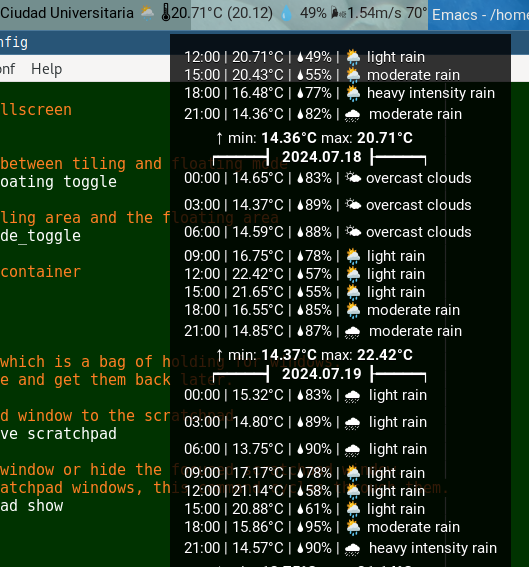
The end result? Nothing too stunning, but definitively something I find useful and even nicely laid out: Screenshot Do note that it seems OpenWeather will return the name of the closest available meteorology station with (most?) recent data for my home, I often get Ciudad Universitaria, but sometimes Coyoac n or even San ngel Inn.

Mike Gabriel: Weather Experts with Translation Skills Needed!

Lomiri Weather App goes Open Meteo In Ubuntu Touch / Lomiri, Maciej Sopy o has updated Lomiri's Weather App to operate against a different weather forecast provider (Open Meteo). Additionally, the new implementation is generic and pluggable, so other weather data providers can be added-in later. Big thanks to Maciej for working on this just in time (the previous implementation's API has recently been EOL'ed and is not available anymore to Ubuntu Touch / Lomiri users). Lomiri Weather App - new Meteorological Terms part of the App now While the old weather data provider implementation obtained all the meteorological information as already localized strings from the provider, the new implementation requires all sorts of weather conditions being translated within the Lomiri Weather App itself. The meteorological terms are probably not easy to translate for the usual software translator, so special help might be required here. Call for Translations: Lomiri Weather App So, if you feel entitled to help here, please join the Hosted Weblate service [1] and start working on Lomiri Weather App. Thanks a lot! light+love
Mike Gabriel (aka sunweaver) [1] https://hosted.weblate.org/
[2] https://hosted.weblate.org/projects/lomiri/lomiri-weather-app/

Gunnar Wolf: Scholarly spam Wulfenia

I just got one of those utterly funny spam messages And yes, I recognize everybody likes building a name for themselves. But some spammers are downright silly. I just got the following mail:
From: Hermine Wolf <hwolf850@gmail.com>
To: me, obviously  
Date: Mon, 15 Jul 2024 22:18:58 -0700
Subject: Make sure that your manuscript gets indexed and showcased in the prestigious Scopus database soon.
Message-ID: <CAEZZb3XCXSc_YOeR7KtnoSK4i3OhD=FH7u+A5xSMsYvhQZojQA@mail.gmail.com>
This message has visual elements included. If they don't display, please   
update your email preferences.
*Dear Esteemed Author,*
Upon careful examination of your recent research articles available online,
we are excited to invite you to submit your latest work to our esteemed    
journal, '*WULFENIA*'. Renowned for upholding high standards of excellence 
in peer-reviewed academic research spanning various fields, our journal is 
committed to promoting innovative ideas and driving advancements in        
theoretical and applied sciences, engineering, natural sciences, and social
sciences. 'WULFENIA' takes pride in its impressive 5-year impact factor of 
*1.000* and is highly respected in prestigious databases including the     
Science Citation Index Expanded (ISI Thomson Reuters), Index Copernicus,   
Elsevier BIOBASE, and BIOSIS Previews.                                     
                                                                           
*Wulfenia submission page:*                                                
[image: research--check.png][image: scrutiny-table-chat.png][image:        
exchange-check.png][image: interaction.png]                                
.                                                                          
Please don't reply to this email                                           
                                                                           
We sincerely value your consideration of 'WULFENIA' as a platform to       
present your scholarly work. We eagerly anticipate receiving your valuable 
contributions.                                                             
*Best regards,*                                                            
Professor Dr. Vienna S. Franz                                              
Scholarly spam Who cares what Wulfenia is about? It s about you, my stupid Wolf cousin!

16 July 2024

Bits from Debian: Wind River Platinum Sponsor of DebConf24

windriverlogo We are pleased to announce that Wind River has committed to sponsor DebConf24 as a Platinum Sponsor. For nearly 20 years, Wind River has led in commercial open source Linux solutions for mission-critical enterprise edge computing. With expertise across aerospace, automotive, industrial, telecom, more, the company is committed to open source through initiatives like eLxr, Yocto, Zephyr, and StarlingX. With this commitment as Platinum Sponsor, Wind River is contributing to make possible our annual conference, and directly supporting the progress of Debian and Free Software, helping to strengthen the community that continues to collaborate on Debian projects throughout the rest of the year. Wind River plans to announce an exiting new project based on Debian at this year's DebConf! Thank you very much, Wind River, for your support of DebConf24! Become a sponsor too! DebConf24 will take place from 28th July to 4th August 2024 in Busan, South Korea, and will be preceded by DebCamp, from 21st to 27th July 2024. DebConf24 is accepting sponsors! Interested companies and organizations should contact the DebConf team through sponsors@debconf.org, or visit the DebConf24 website at https://debconf24.debconf.org/sponsors/become-a-sponsor/.

15 July 2024

Thomas Lange: FAIme adds Korean language support

In two weeks DebConf24, the Debian conference starts in Busan, South Korea. Therefore I've added support for the Korean language into the web service of FAI: https://fai-project.org/FAIme/ Another new feature of the FAIme service will be announced at DebConf24 in August.

12 July 2024

Freexian Collaborators: Monthly report about Debian Long Term Support, June 2024 (by Roberto C. S nchez)

Like each month, have a look at the work funded by Freexian s Debian LTS offering.

Debian LTS contributors In June, 18 contributors have been paid to work on Debian LTS, their reports are available:
  • Adrian Bunk did 47.0h (out of 74.25h assigned and 11.75h from previous period), thus carrying over 39.0h to the next month.
  • Arturo Borrero Gonzalez did 6.0h (out of 6.0h assigned).
  • Bastien Roucari s did 20.0h (out of 20.0h assigned).
  • Ben Hutchings did 15.5h (out of 16.0h assigned and 8.0h from previous period), thus carrying over 8.5h to the next month.
  • Chris Lamb did 18.0h (out of 18.0h assigned).
  • Daniel Leidert did 4.0h (out of 8.0h assigned and 2.0h from previous period), thus carrying over 6.0h to the next month.
  • Emilio Pozuelo Monfort did 23.25h (out of 49.5h assigned and 10.5h from previous period), thus carrying over 36.75h to the next month.
  • Guilhem Moulin did 4.5h (out of 13.0h assigned and 7.0h from previous period), thus carrying over 15.5h to the next month.
  • Lee Garrett did 17.0h (out of 25.0h assigned and 35.0h from previous period), thus carrying over 43.0h to the next month.
  • Lucas Kanashiro did 5.0h (out of 10.0h assigned and 10.0h from previous period), thus carrying over 15.0h to the next month.
  • Markus Koschany did 40.0h (out of 40.0h assigned).
  • Ola Lundqvist did 10.0h (out of 6.5h assigned and 17.5h from previous period), thus carrying over 14.0h to the next month.
  • Roberto C. S nchez did 5.25h (out of 7.75h assigned and 4.25h from previous period), thus carrying over 6.75h to the next month.
  • Santiago Ruano Rinc n did 22.5h (out of 14.5h assigned and 8.0h from previous period).
  • Sean Whitton did 6.5h (out of 6.0h assigned and 0.5h from previous period).
  • Stefano Rivera did 0.5h (out of 0.0h assigned and 10.0h from previous period), thus carrying over 9.5h to the next month.
  • Sylvain Beucler did 9.0h (out of 24.5h assigned and 35.5h from previous period), thus carrying over 51.0h to the next month.
  • Thorsten Alteholz did 14.0h (out of 14.0h assigned).

Evolution of the situation In June, we have released 31 DLAs. Notable security updates in June included:
  • git: multiple vulnerabilities, which may result in privilege escalation, denial of service, and arbitrary code execution
  • sendmail: SMTP smuggling allowed remote attackers bypass SPF protection checks
  • cups: arbitrary remote code execution
Looking further afield to the broader Debian ecosystem, LTS contributor Bastien Roucari s also patched sendmail in Debian 12 (bookworm) and 11 (bullseye) in order to fix the previously mentioned SMTP smuggling vulnerability. Furthermore, LTS contributor Thorsten Alteholz provided fixes for the cups packages in Debian 12 (bookworm) and 11 (bullseye) in order to fix the aforementioned arbitrary remote code execution vulnerability. Additionally, LTS contributor Ben Hutchings has commenced work on an updated backport of Linux kernel 6.1 to Debian 11 (bullseye), in preparation for bullseye transitioning to the responsibility of the LTS (and the associated closure of the bullseye-backports repository). LTS Lucas Kanashiro also began the preparatory work of backporting parts of the rust/cargo toolchain to Debian 11 (bullseye) in order to make future updates of the clamav virus scanner possible. June was the final month of LTS for Debian 10 (as announced on the debian-lts-announce mailing list). No additional Debian 10 security updates will be made available on security.debian.org. However, Freexian and its team of paid Debian contributors will continue to maintain Debian 10 going forward for the customers of the Extended LTS offer. Subscribe right away if you sill have Debian 10 which must be kept secure (and which cannot yet be upgraded).

Thanks to our sponsors Sponsors that joined recently are in bold.

11 July 2024

Petter Reinholdtsen: More than 200 orphaned Debian packages moved to git, 216 to go

In April, I started migrating orphaned Debian packages without any version control system listed in debian/control to git. This morning, my Debian QA page finally reached 200 QA packages migrated. In reality there are a few more, as the packages uploaded by someone else after my initial upload have disappeared from my QA uploads list. As I am running out of steam and will most likely focus on other parts of Debian moving forward, I hope someone else will find time to continue the migration to bring the number of orphaned packages without any version control system down to zero. Here is the updated recipe if someone want to help out. To locate packages to work on, the following one-liner can be used:
PGPASSWORD="udd-mirror" psql --port=5432 --host=udd-mirror.debian.net \
  --username=udd-mirror udd -c "select source from sources \
   where release = 'sid' and (vcs_url ilike '%anonscm.debian.org%' \
   OR vcs_browser ilike '%anonscm.debian.org%' or vcs_url IS NULL \
   OR vcs_browser IS NULL) AND maintainer ilike '%packages@qa.debian.org%' \
   order by random() limit 10;"
Pick a random package from the list and run the latest edition of the script debian-snap-to-salsa with the package name as the argument to prepare a git repository with the existing packaging. This will download old Debian packages from snapshot.debian.org. Note that very recent uploads will not be included, so check out the package on tracker.debian.org. Next, run gbp buildpackage --git-ignore-new to verify that the package build as it should, and then visit https://salsa.debian.org/debian/ and make sure there is not already a git repository for the package there. I also did git log -p debian/control and look for vcs entries to check if the package used to have a git repository on Alioth, and see if it can be a useful starting point moving forward. If all this check out, I created a new gitlab project below the Debian group on salsa, push the package source there and upload a new version. I tend to also ensure build hardening is enabled, if it prove to be easy, and check if I can easily fix any lintian issues or bug reports. If the process took more than 20 minutes, I dropped it and moved on to another package. If I found patches in debian/patches/ that were not yet passed upstream, I would send an email to make sure upstream know about them. This has proved to be a valuable step, and caused several new releases for software that initially appeared abandoned. :) As usual, if you use Bitcoin and want to show your support of my activities, please send Bitcoin donations to my address 15oWEoG9dUPovwmUL9KWAnYRtNJEkP1u1b.

10 July 2024

Freexian Collaborators: Debian Contributions: YubiHSM packaging, unschroot, live-patching, and more! (by Stefano Rivera)

Debian Contributions: 2024-06 Contributing to Debian is part of Freexian s mission. This article covers the latest achievements of Freexian and their collaborators. All of this is made possible by organizations subscribing to our Long Term Support contracts and consulting services.

YubiHSM packaging, by Colin Watson Freexian is starting to use YubiHSM devices (hardware security modules) as part of some projects, and we wanted to have the supporting software directly in Debian rather than needing to use third-party repositories. Since Yubico publish everything we need under free software licences, Colin packaged yubihsm-connector, yubihsm-shell, and python-yubihsm from https://developers.yubico.com/, in some cases based partly on the upstream packaging, and got them all into Debian unstable. Backports to bookworm will be forthcoming once they ve all reached testing.

unschroot by Helmut Grohne Following an in-person discussion at MiniDebConf Berlin, Helmut attempted splitting the containment functionality of sbuild --chroot-mode=unshare into a dedicated tool interfacing with sbuild as a variant of --chroot-mode=schroot providing a sufficiently compatible interface. While this seemed technically promising initially, a discussion on debian-devel indicated a desire to rely on an existing container runtime such as podman instead of using another Debian-specific tool with unclear long term maintenance. None of the existing container runtimes meet the specific needs of sbuild, so further advancing this matter implies a compromise one way or another.

Linux live-patching, by Santiago Ruano Rinc n In collaboration with Emmanuel Arias, Santiago is working on the development of linux live-patching for Debian. For the moment, this is in an exploratory phase, that includes how to handle the different patches that will need to be provided. kpatch could help significantly in this regard. However, kpatch was removed from unstable because there are some RC bugs affecting the version that was present in Debian unstable. Santiago packaged the most recent upstream version (0.9.9) and filed an Intent to Salvage bug. Santiago is waiting for an ACK by the maintainer, and will upload to unstable after July 10th, following the package salvaging rules. While kpatch 0.9.9 fixes the main issues, it still needs some work to properly support Debian and the Linux kernel versions packaged in our distribution. More on this in the report next month.

Salsa CI, by Santiago Ruano Rinc n The work by Santiago in Salsa CI this month includes a merge request to ease testing how the production images are built from the changes introduced by future merge requests. By default, the pipelines triggered by a merge request build a subset of the images built for production, to reduce the use of resources, and because most of the time the subset of staging images is enough to test the proposed modifications. However, sometimes it is needed to test how the full set of production images is built, and the above mentioned MR helps to do that. The changes include documentation, so hopefully this will make it easier to test future contributions. Also, for being able to include support for RISC-V, Salsa CI needs to replace kaniko as the tool used to build the images. Santiago tested buildah, but there are some issues when pushing built images for non-default platform architectures (i386, armhf, armel) to the container registry. Santiago will continue to work on this to find a solution.

Miscellaneous contributions
  • Stefano Rivera prepared updates for a number of Python modules.
  • Stefano uploaded the latest point release of Python 3.12 and the latest Python 3.13 beta. Both uncovered upstream regressions that had to be addressed.
  • Stefano worked on preparations for DebConf 24.
  • Stefano helped SPI to reconcile their financial records for DebConf 23.
  • Colin did his usual routine work on the Python team, upgrading 36 packages to new upstream versions (including fixes for four CVEs in python-aiohttp), fixing RC bugs in ipykernel, ipywidgets, khard, and python-repoze.sphinx.autointerface, and packaging zope.deferredimport which was needed for a new upstream version of python-persistent.
  • Colin removed the user_readenv option from OpenSSH s PAM configuration (#1018260), and prepared a release note.
  • Thorsten Alteholz uploaded a new upstream version of cups.
  • Nicholas Skaggs updated xmacro to support reproducible builds (#1014428), DEP-3 and DEP-5 compatibility, along with utilizing hardening build flags. Helmut supported and uploaded package.
  • As a result of login having become non-essential, Helmut uploaded debvm to unstable and stable and fixed a crossqa.debian.net worker.
  • Santiago worked on the Content Team activities for DebConf24. Together with other DebConf25 team members, Santiago wrote a document for the head of the venue to describe the project of the conference.

9 July 2024

Steve Kemp: The CP/M emulator is good enough, I think.

My previous post mentioned that I'd added some custom syscalls to my CP/M emulator and that lead to some more updates, embedding a bunch of binaries within the emulator so that the settings can be tweaked at run-time, for example running:
!DEBUG 1
!CTRLC 1
!CCP ccpz
!CONSOLE adm-3a
Those embedded binaries show up on A: even if they're not in the pwd when you launch the emulator. Other than the custom syscalls I've updated the real BDOS/BIOS syscalls a bit more, so that now I can run things like the Small C compiler, BBC BASIC, and more. (BBCBasic.com used to launch just fine, but it turned out that the SAVE/LOAD functions didn't work. Ooops!) I think I've now reached a point where all the binaries I care about run, and barring issues I will slow down/stop development. I can run Turbo Pascal, WordStar, various BASIC interpreters, and I have a significantly improved understanding of how CP/M works - a key milestone in that understanding was getting SUBMIT.COM to execute, and understanding the split between the BDOS and the BIOS. I'd kinda like to port CP/M to a new (Z80-based) system - but I don't have such a thing to hand, and I guess there's no real need for it. Perhaps I can say I'm "done" with retro stuff, and go back to playing Super Mario Bros (1985) with my boy!

8 July 2024

Thorsten Alteholz: My Debian Activities in June 2024

FTP master This month I accepted 270 and rejected 23 packages. The overall number of packages that got accepted was 279.

Debian LTS This was my hundred-twentieth month that I did some work for the Debian LTS initiative, started by Raphael Hertzog at Freexian. During my allocated time I uploaded or worked on: This month handling of the CVE of cups was a bit messy. After lifting the embargo of the CVE, a published patch did not work with all possible combinations of the configuration. In other words, in cases of having only one local domain socket configured, the cupsd did not start and failed with a strange error. Anyway, upstream published a new set of patches, which made cups work again. Unfortunately this happended just before the latest point release for Bullseye and Bookworm, so that the new packages did not make it into the release, but stopped in the corresponding p-u-queues: stable-p-u and old-p-u. I also continued to work on tiff and last but not least did a week of FD and attended the monthly LTS/ELTS meeting. Debian ELTS This month was the seventy-first ELTS month. During my allocated time I tried to upload a new version of cups for Jessie and Stretch. Unfortunately this was stopped due to an autopkgtest error, which I could not reproduce yet. I also wanted to finally upload a fixed version of exim4. Unfortunately this was stopped due to lots of CI-jobs for Buster. Updates for Buster are now also availble from ELTS, so some stuff had to prepared before the actual switch end of June. Additionally everything was delayed due to a crash of the CI worker. All in all this month was rather ill-fated. At least the exim4 upload will happen/already happened in July. I also continued to work on an update for libvirt, did a week of FD and attended the LTS/ELTS meeting. Debian Printing This month I uploaded new upstream or bugfix versions of: This work is generously funded by Freexian! Debian Astro This month I uploaded a new upstream or bugfix version of: All of those uploads are somehow related to /usr-move. Debian IoT This month I uploaded new upstream or bugfix versions of: Debian Mobcom The following packages have been prepared by the GSoC student Nathan: misc This month I uploaded new upstream or bugfix versions of: Here as well all uploads are somehow related to /usr-move

Dirk Eddelbuettel: RcppArmadillo 14.0.0-1 on CRAN: New Upstream

armadillo image Armadillo is a powerful and expressive C++ template library for linear algebra and scientific computing. It aims towards a good balance between speed and ease of use, has a syntax deliberately close to Matlab, and is useful for algorithm development directly in C++, or quick conversion of research code into production environments. RcppArmadillo integrates this library with the R environment and language and is widely used by (currently) 1158 other packages on CRAN, downloaded 35.1 million times (per the partial logs from the cloud mirrors of CRAN), and the CSDA paper (preprint / vignette) by Conrad and myself has been cited 587 times according to Google Scholar. Conrad released a new major upstream version 14.0.0 a couple of days ago. We had been testing this new version extensively over several rounds of reverse-dependency checks across all 1100+ packages. This revealed nine packages requiring truly minor adjustments which eight maintainers made in a matter of days; all this was coordinated in issue #443. Following the upload, CRAN noticed one more issue (see issue #446) but this turned out to be local to the package. There are also renewed deprecation warnings with some Armadillo changes which we will need to address one-by-one. Last but not least with this release we also changed the package versioning scheme to follow upstream Armadillo more closely. The set of changes since the last CRAN release follows.

Changes in RcppArmadillo version 14.0.0-1 (2024-07-05)
  • Upgraded to Armadillo release 14.0.0 (Stochastic Parrot)
    • C++14 is now the minimum recommended C++ standard
    • Faster handling of compound expressions by as_scalar(), accu(), dot()
    • Faster interactions between sparse and dense matrices
    • Expanded stddev() to handle sparse matrices
    • Expanded relational operators to handle expressions between sparse matrices and scalars
    • Added .as_dense() to obtain dense vector/matrix representation of any sparse matrix expression
    • Updated physical constants to NIST 2022 CODATA values
  • New package version numbering scheme following upstream versions
  • Re-enabling ARMA_IGNORE_DEPRECATED_MARKE for silent CRAN builds

Courtesy of my CRANberries, there is a diffstat report relative to previous release. More detailed information is on the RcppArmadillo page. Questions, comments etc should go to the rcpp-devel mailing list off the Rcpp R-Forge page. If you like this or other open-source work I do, you can sponsor me at GitHub.

This post by Dirk Eddelbuettel originated on his Thinking inside the box blog. Please report excessive re-aggregation in third-party for-profit settings.

7 July 2024

Dirk Eddelbuettel: RcppSimdJson 0.1.12 on CRAN: Maintenance

A new maintenance release 0.1.12 of the RcppSimdJson package is now on CRAN. RcppSimdJson wraps the fantastic and genuinely impressive simdjson library by Daniel Lemire and collaborators. Via very clever algorithmic engineering to obtain largely branch-free code, coupled with modern C++ and newer compiler instructions, it results in parsing gigabytes of JSON parsed per second which is quite mindboggling. The best-case performance is faster than CPU speed as use of parallel SIMD instructions and careful branch avoidance can lead to less than one cpu cycle per byte parsed; see the video of the talk by Daniel Lemire at QCon. This release responds to another CRAN request, this time to accomodate compilation under C++20 with g++-14. As this was alreadt addressed upstream in simdjson it was simply a matter of upgrading to the current upstream which Daniel did in a PR. The (once again very short) NEWS entry for this release follows.

Changes in version 0.1.12 (2024-07-05)
  • Updated benchmarks now include 'yyjsonr'
  • simdjson was upgraded to version 3.95 (Daniel in #92 fixing #91)
  • Additional small update for C++20 compilation under g++-14

Courtesy of my CRANberries, there is also a diffstat report for this release. For questions, suggestions, or issues please use the issue tracker at the GitHub repo. If you like this or other open-source work I do, you can now sponsor me at GitHub.

This post by Dirk Eddelbuettel originated on his Thinking inside the box blog. Please report excessive re-aggregation in third-party for-profit settings.

Niels Thykier: Improving packaging file detection in Debian

Debian packaging consists of a directory (debian/) containing a number of "hard-coded" filenames such as debian/control, debian/changelog, debian/copyright. In addition to these, many packages will also use a number of optional files that are named via a pattern such as debian/ PACKAGE .install. At a high level the patterns looks deceptively simple. However, if you start working on trying to automatically classify files in debian/ (which could be helpful to tell the user they have a typo in the filename), you will quickly realize these patterns are not machine friendly at all for this purpose.
The patterns deconstructed To appreciate the problem fully, here is a primer on the pattern and all its issues. If you are already well-versed in these, you might want to skip the section. The most common patterns are debian/package.stem or debian/stem and usually the go to example is the install stem ( a concrete example being debian/debhelper.install). However, the full pattern consists of 4 parts where 3 of them are optional.
  • The package name followed by a period. Optional, but must be the first if present.
  • The name segment followed by a period. Optional, but must appear between the package name (if present) and the stem. If the package name is not present, then the name segment must be first.
  • The stem. Mandatory.
  • An architecture restriction prefixed by a period. Optional, must appear after the stem if present.
To visualize it with [foo] to mark optional parts, it looks like debian/[PACKAGE.][NAME.]STEM[.ARCH] Detecting whether a given file is in fact a packaging file now boils down to reverse engineering its name against this pattern. Again, so far, it might still look manageable. One major complication is that every part (except ARCH) can contain periods. So a trivial "split by period" is not going to cut it. As an example:
debian/g++-3.0.user.service
This example is deliberately crafted to be ambiguous and show this problem in its full glory. This file name can be in multiple ways:
  • Is the stem service or user.service? (both are known stems from dh_installsystemd and dh_installsystemduser respectively). In fact, it can be both at the same time with "clever" usage of --name=user passed to dh_installsystemd.
  • The g++-3.0 can be a package prefix or part of the name segment. Even if there is a g++-3.0 package in debian/control, then debhelper (until compat 15) will still happily match this file for the main package if you pass --name=g++-3.0 to the helper. Side bar: Woe is you if there is a g++-3 and a g++-3.0 package in debian/control, then we have multiple options for the package prefix! Though, I do not think that happens in practice.
Therefore, there are a lot of possible ways to split this filename that all matches the pattern but with vastly different meaning and consequences.
Making detection practical To make this detection practical, lets look at the first problems that we need to solve.
  1. We need the possible stems up front to have a chance at all. When multiple stems are an option, go for the longest match (that is, the one with most periods) since --name is rare and "code golfing" is even rarer.
  2. We can make the package prefix mandatory for files with the name segment. This way, the moment there is something before the stem, we know the package prefix will be part of it and can cut it. It does not solve the ambiguity if one package name is a prefix of another package name (from the same source), but it still a lot better. This made its way into debhelper compat 15 and now it is "just" a slow long way to a better future.
A simple solution to the first problem could be to have a static list of known stems. That will get you started but the debhelper eco-system strive on decentralization, so this feels like a mismatch. There is also a second problem with the static list. Namely, a given stem is only "valid" if the command in question is actually in use. Which means you now need to dumpster dive into the mess that is Turning-complete debhelper configuration file known as debian/rules to fully solve that. Thanks to the Turning-completeness, we will never get a perfect solution for a static analysis. Instead, it is time to back out and instead apply some simplifications. Here is a sample flow:
  1. Check whether the dh sequencer is used. If so, use some heuristics to figure out which addons are used.
  2. Delegate to dh_assistant to figure out which commands will be used and which debhelper config file stems it knows about. Here we need to know which sequences are in use from step one (if relevant). Combine this with any other sources for stems you have.
  3. Deconstruct all files in debian/ against the stems and known package names from debian/control. In theory, dumpster diving after --name options would be helpful here, but personally I skipped that part as I want to keep my debian/rules parsing to an absolute minimum.
With this logic, you can now:
  • Provide typo detection of the stem (debian/foo.intsall -> debian/foo.install) provided to have adequate handling of the corner cases (such as debian/*.conf not needing correction into debian/*.config)
  • Detect possible invalid package prefix (debian/foo.install without foo being a package). Note this has to be a weak warning unless the package is using debhelper compat 15 or you dumpster dived to validate that dh_install was not passed dh_install --name foo. Agreed, no one should do that, but they can and false positives are the worst kind of positives for a linting tool.
  • With some limitations, detect files used without the relevant command being active. As an example, the some integration modes of debputy removes dh_install, so a debian/foo.install would not be used.
  • Associate a given file with a given command to assist users with the documentation look up. Like debian/foo.user.service is related to dh_installsystemduser, so man dh_installsystemduser is a natural start for documentation.
I have added the logic for all these features in debputy though the documentation association is currently not in a user facing command. All the others are now diagnostics emitted by debputy in its editor support mode (debputy lsp server) or via debputy lint. In the editor mode, the diagnostics are currently associated with the package name in debian/control due to technical limitations of how the editor integration works. Some of these features will the latest version of debhelper (moving target at times). Check with debputy lsp features for the Extra dh support feature, which will be enabled if you got all you need. Note: The detection is currently (mostly) ignoring files with architecture restrictions. That might be lifted in the future. However, architecture restricted config files tend to be rare, so they were not a priority at this point. Additionally, debputy for technical reasons ignores stem typos with multiple matches. That sadly means that typos of debian/docs will often be unreported due to its proximity to debian/dirs and vice versa.
Diving a bit deeper on getting the stems To get the stems, debputy has 3 primary sources:
  1. Its own plugins can provide packager provided files. These are only relevant if the package is using debputy.
  2. It is als possible to provide a debputy plugin that identifies packaging files (either static or named ones). Though in practice, we probably do not want people to roll their own debputy plugin for this purpose, since the detection only works if the plugin is installed. I have used this mechanism to have debhelper provide a debhelper-documentation plugin to enrich the auto-detected data and we can assume most people interested in this feature would have debhelper installed.
  3. It asks dh_assistant list-guessed-dh-config-files for config files, which is covered below.
The dh_assistant command uses the same logic as dh to identify the active add-ons and loads them. From there, it scans all commands mentioned in the sequence for the PROMISE: DH NOOP WITHOUT ...-hint and a new INTROSPECTABLE: CONFIG-FILES ...-hint. When these hints reference a packaging file (as an example, via pkgfile(foo)) then dh_assistant records that as a known packaging file for that helper. Additionally, debhelper now also tracks commands that were removed from the sequence. Several of the dh_assistant subcommand now use this to enrich their (JSON) output with notes about these commands being known but not active.
The end result With all of this work, you now get:
$ apt satisfy 'dh-debputy (>= 0.1.43~), debhelper (>= 13.16~), python3-lsprotocol, python3-levenshtein'
# For demo purposes, pull two known repos (feel free to use your own packages here)
$ git clone https://salsa.debian.org/debian/debhelper.git -b debian/13.16
$ git clone https://salsa.debian.org/debian/debputy.git -b debian/0.1.43
$ cd debhelper
$ mv debian/debhelper.install debian/debhelper.intsall
$ debputy lint
warning: File: debian/debhelper.intsall:1:0:1:0: The file "debian/debhelper.intsall" is likely a typo of "debian/debhelper.install"
    File-level diagnostic
$ mv debian/debhelper.intsall debian/debhleper.install
$ debputy lint
warning: File: debian/debhleper.install:1:0:1:0: Possible typo in "debian/debhleper.install". Consider renaming the file to "debian/debhelper.debhleper.install" or "debian/debhelper.install" if it is intended for debhelper
    File-level diagnostic
$ cd ../debputy
$ touch debian/install
$ debputy lint --no-warn-about-check-manifest
warning: File: debian/install:1:0:1:0: The file debian/install is related to a command that is not active in the dh sequence with the current addons
    File-level diagnostic
As mentioned, you also get these diagnostics in the editor via the debputy lsp server feature. Here the diagnostics appear in debian/control over the package name for technical reasons. The editor side still needs a bit more work. Notably, changes to the filename is not triggered automatically and will first be caught on the next change to debian/control. Likewise, changes to debian/rules to add --with to dh might also have some limitations depending on the editor. Saving both files and then triggering an edit of debian/control seems to work reliable but ideally it should not be that involved. The debhelper side could also do with some work to remove the unnecessary support for the name segment with many file stems that do not need them and announce that to debputy. Anyhow, it is still a vast improvement over the status quo that was "Why is my file silently ignored!?".

6 July 2024

Dirk Eddelbuettel: binb 0.0.7 on CRAN: Maintenance

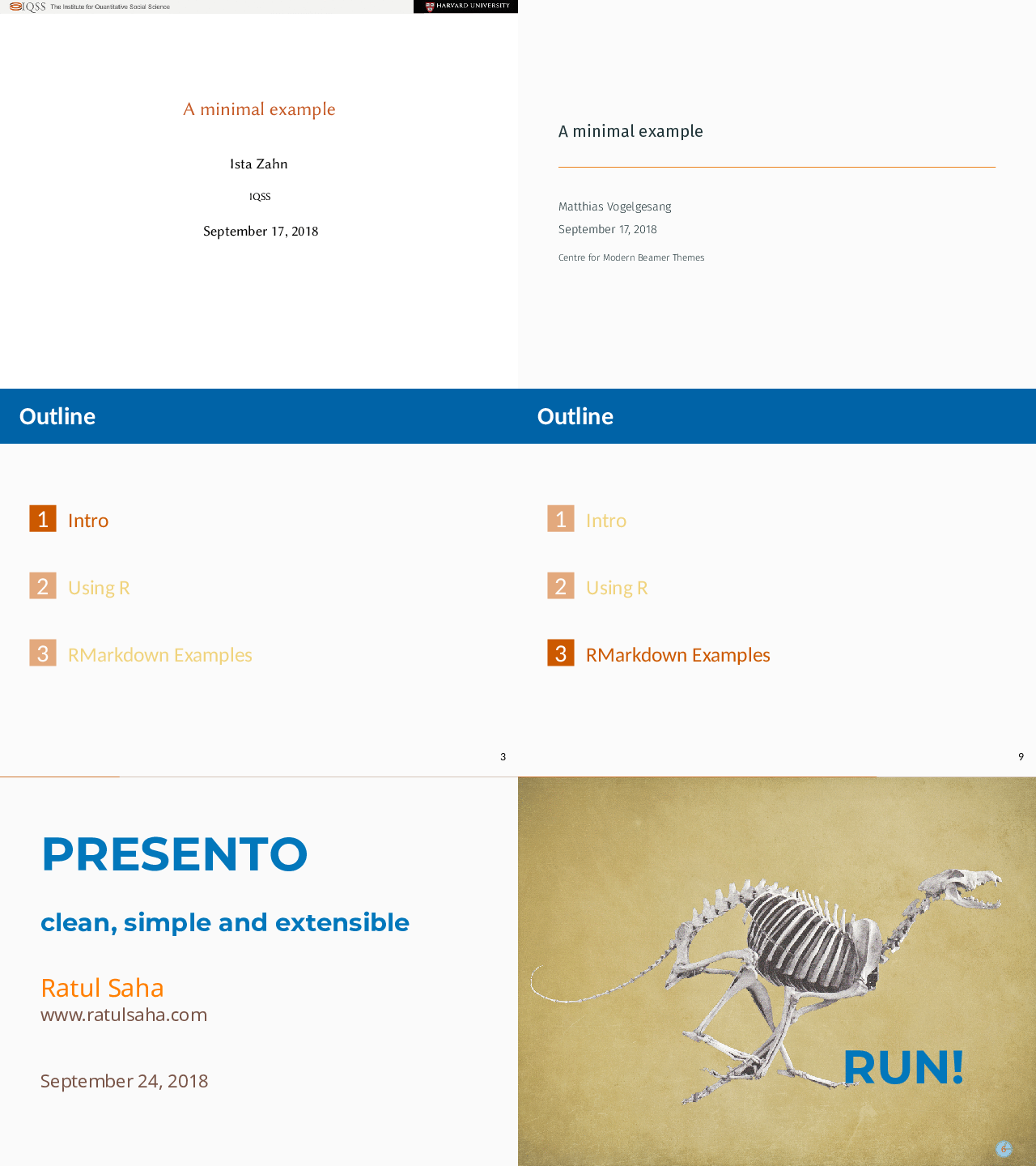
The seventh release of the binb package, and first in four years, is now on CRAN. binb regroups four rather nice themes for writing LaTeX Beamer presentations much more easily in (R)Markdown. As a teaser, a quick demo combining all four themes is available; documentation and examples are in the package. This release contains a CRAN-requested fix for a just-released new pandoc version which deals differently with overflowing bounding boxes from graphics; an added new LaTeX command is needed. We also polished continuous integration and related internals a few times but this does not contain directly user-facing changes in the package.

Changes in binb version 0.0.7 (2024-07-06)
  • Several rounds of small updates to ge continuous integration setup.
  • An additional LaTeX command needed by pandoc (>= 3.2.1) has been added.

CRANberries provides a summary of changes to the previous version. For questions or comments, please use the issue tracker at the GitHub repo. If you like this or other open-source work I do, you can now sponsor me at GitHub.

This post by Dirk Eddelbuettel originated on his Thinking inside the box blog. Please report excessive re-aggregation in third-party for-profit settings.

4 July 2024

Arturo Borrero Gonz lez: Wikimedia Toolforge: migrating Kubernetes from PodSecurityPolicy to Kyverno

Le ch teau de Val re et le Haut de Cry en juillet 2022 Christian David, CC BY-SA 4.0, via Wikimedia Commons This post was originally published in the Wikimedia Tech blog, authored by Arturo Borrero Gonzalez. Summary: this article shares the experience and learnings of migrating away from Kubernetes PodSecurityPolicy into Kyverno in the Wikimedia Toolforge platform. Wikimedia Toolforge is a Platform-as-a-Service, built with Kubernetes, and maintained by the Wikimedia Cloud Services team (WMCS). It is completely free and open, and we welcome anyone to use it to build and host tools (bots, webservices, scheduled jobs, etc) in support of Wikimedia projects. We provide a set of platform-specific services, command line interfaces, and shortcuts to help in the task of setting up webservices, jobs, and stuff like building container images, or using databases. Using these interfaces makes the underlying Kubernetes system pretty much invisible to users. We also allow direct access to the Kubernetes API, and some advanced users do directly interact with it. Each account has a Kubernetes namespace where they can freely deploy their workloads. We have a number of controls in place to ensure performance, stability, and fairness of the system, including quotas, RBAC permissions, and up until recently PodSecurityPolicies (PSP). At the time of this writing, we had around 3.500 Toolforge tool accounts in the system. We early adopted PSP in 2019 as a way to make sure Pods had the correct runtime configuration. We needed Pods to stay within the safe boundaries of a set of pre-defined parameters. Back when we adopted PSP there was already the option to use 3rd party agents, like OpenPolicyAgent Gatekeeper, but we decided not to invest in them, and went with a native, built-in mechanism instead. In 2021 it was announced that the PSP mechanism would be deprecated, and removed in Kubernetes 1.25. Even though we had been warned years in advance, we did not prioritize the migration of PSP until we were in Kubernetes 1.24, and blocked, unable to upgrade forward without taking actions. The WMCS team explored different alternatives for this migration, but eventually we decided to go with Kyverno as a replacement for PSP. And so with that decision it began the journey described in this blog post. First, we needed a source code refactor for one of the key components of our Toolforge Kubernetes: maintain-kubeusers. This custom piece of software that we built in-house, contains the logic to fetch accounts from LDAP and do the necessary instrumentation on Kubernetes to accommodate each one: create namespace, RBAC, quota, a kubeconfig file, etc. With the refactor, we introduced a proper reconciliation loop, in a way that the software would have a notion of what needs to be done for each account, what would be missing, what to delete, upgrade, and so on. This would allow us to easily deploy new resources for each account, or iterate on their definitions. The initial version of the refactor had a number of problems, though. For one, the new version of maintain-kubeusers was doing more filesystem interaction than the previous version, resulting in a slow reconciliation loop over all the accounts. We used NFS as the underlying storage system for Toolforge, and it could be very slow because of reasons beyond this blog post. This was corrected in the next few days after the initial refactor rollout. A side note with an implementation detail: we stored a configmap on each account namespace with the state of each resource. Storing more state on this configmap was our solution to avoid additional NFS latency. I initially estimated this refactor would take me a week to complete, but unfortunately it took me around three weeks instead. Previous to the refactor, there were several manual steps and cleanups required to be done when updating the definition of a resource. The process is now automated, more robust, performant, efficient and clean. So in my opinion it was worth it, even if it took more time than expected. Then, we worked on the Kyverno policies themselves. Because we had a very particular PSP setting, in order to ease the transition, we tried to replicate their semantics on a 1:1 basis as much as possible. This involved things like transparent mutation of Pod resources, then validation. Additionally, we had one different PSP definition for each account, so we decided to create one different Kyverno namespaced policy resource for each account namespace remember, we had 3.5k accounts. We created a Kyverno policy template that we would then render and inject for each account. For developing and testing all this, maintain-kubeusers and the Kyverno bits, we had a project called lima-kilo, which was a local Kubernetes setup replicating production Toolforge. This was used by each engineer in their laptop as a common development environment. We had planned the migration from PSP to Kyverno policies in stages, like this:
  1. update our internal template generators to make Pod security settings explicit
  2. introduce Kyverno policies in Audit mode
  3. see how the cluster would behave with them, and if we had any offending resources reported by the new policies, and correct them
  4. modify Kyverno policies and set them in Enforce mode
  5. drop PSP
In stage 1, we updated things like the toolforge-jobs-framework and tools-webservice. In stage 2, when we deployed the 3.5k Kyverno policy resources, our production cluster died almost immediately. Surprise. All the monitoring went red, the Kubernetes apiserver became irresponsibe, and we were unable to perform any administrative actions in the Kubernetes control plane, or even the underlying virtual machines. All Toolforge users were impacted. This was a full scale outage that required the energy of the whole WMCS team to recover from. We temporarily disabled Kyverno until we could learn what had occurred. This incident happened despite having tested before in lima-kilo and in another pre-production cluster we had, called Toolsbeta. But we had not tested that many policy resources. Clearly, this was something scale-related. After the incident, I went on and created 3.5k Kyverno policy resources on lima-kilo, and indeed I was able to reproduce the outage. We took a number of measures, corrected a few errors in our infrastructure, reached out to the Kyverno upstream developers, asking for advice, and at the end we did the following to accommodate the setup to our needs: I have to admit, I was briefly tempted to drop Kyverno, and even stop pursuing using an external policy agent entirely, and write our own custom admission controller out of concerns over performance of this architecture. However, after applying all the measures listed above, the system became very stable, so we decided to move forward. The second attempt at deploying it all went through just fine. No outage this time When we were in stage 4 we detected another bug. We had been following the Kubernetes upstream documentation for setting securityContext to the right values. In particular, we were enforcing the procMount to be set to the default value, which per the docs it was DefaultProcMount . However, that string is the name of the internal variable in the source code, whereas the actual default value is the string Default . This caused pods to be rightfully rejected by Kyverno while we figured the problem. I sent a patch upstream to fix this problem. We finally had everything in place, reached stage 5, and we were able to disable PSP. We unloaded the PSP controller from the kubernetes apiserver, and deleted every individual PSP definition. Everything was very smooth in this last step of the migration. This whole PSP project, including the maintain-kubeusers refactor, the outage, and all the different migration stages took roughly three months to complete. For me there are a number of valuable reasons to learn from this project. For one, the scale is something to consider, and test, when evaluating a new architecture or software component. Not doing so can lead to service outages, or unexpectedly poor performances. This is in the first chapter of the SRE handbook, but we got a reminder the hard way This post was originally published in the Wikimedia Tech blog, authored by Arturo Borrero Gonzalez.

Samuel Henrique: Debian's curl now supports HTTP3

tl;dr Starting with curl 8.0.0-2, you can now use HTTP3.
curl --http3-only https://example.com
Or, if you would like to try it out in a container:
podman run debian:unstable apt install --update -y curl && curl --http3-only https://example.com
(in case you haven't noticed, apt now has the --update option for the upgrade and install commands, although not available on stable yet)

Availability
  • Debian unstable - Since 2024-07-02
  • Debian testing - Since 2024-07-18
  • Debian 12/bookworm backports - Expected by the end of August 2024.
  • Debian 12/bookworm - Due to the mechanisms we have in place to make sure Debian stable is in fact stable, we will never be able to ship this in the regular repository. Users can make use of the backports repositories instead.
  • Debian derivatives - Rolling releases will get it by the time it's on Debian testing (e.g.: Kali Linux). Stable derivatives only in their next major release.

The challenge HTTP3 is fresh new, well... not really, but at least fresh enough that I'm not aware of any other Linux distribution supporting it on curl, the reason is likely two-fold:
  1. OpenSSL is not there yet OpenSSL still doesn't have proper HTTP3 support, and given that OpenSSL is so widely used, almost every curl distributor/packager will build curl with it and thus changing the TLS backend to something else is risky. Unfortunately, proper support for the OpenSSL libcurl is unlikely to come anytime before the end of this year, the OpenSSL performance is not good enough yet as of version 3.3. Daniel Stenberg has written about the state of this multiple times, most recently at HTTP/3 in curl mid 2024, if you're interested, I suggest reading through his other posts as well. Some might have noticed that nginx does support HTTP3 through OpenSSL, although when you look closely, it's not exactly perfect:
    An SSL library that provides QUIC support is recommended to build nginx, such as BoringSSL, LibreSSL, or QuicTLS. Otherwise, the OpenSSL compatibility layer will be used that does not support early data.
    As you can see, they don't recommend using OpenSSL, and when doing so, you don't get complete support.

  2. HTTP3 support for GnuTLS/nghttp3/ngtcp2 is recent The non-experimental support arrived back in October 2023, and so that's when I started seriously planning for this. curl has been working on HTTP3 support for years, and so it did support other TLS backends before that, but out of them, the one most feasible for a distribution to ship would be GnuTLS, which gets HTTP3 support through ngctp2 and nghttp3.

How it was done The Debian curl package has historically shipped at least two variants of libcurl, an OpenSSL and a GnuTLS one. The OpenSSL libcurl can't support HTTP3 for the reasons explained above, but the GnuTLS libcurl can (with ngtcp2 and nghtp3). Debian packages can choose which version of libcurl to link against (without having to modify any upstream source code). Debian's "git" package being a famous example of a package that links against the GnuTLS libcurl. Enabling HTTP3 on curl was done in three steps:
  1. Make sure all required dependencies fulfill the minimum requirements.
  2. Enable HTTP3 for GnuTLS libcurl.
  3. Change the libcurl used by the curl CLI, from OpenSSL to GnuTLS.
curl's HTTP3 support requires a somewhat recent version of nghttp3 and updating that required a transition (due to the SONAME bump), while we've also had months of freeze for transitions due to the time_t transition. After the dependencies were in place, enabling HTTP3 for the GnuTLS libcurl was straightforward. Then, for the last part, we had to switch the TLS backend used by the curl CLI. Doing the swap is also quite easy on the packaging level, but we have to consider the chances of this change breaking our users' environments.

Ensuring there are no breakages The first thing to consider regarding breakages is that this change is not going to be pushed directly to the current Debian stable releases, it will be present in the next stable release (13/trixie) but the current one will stick to the version that's already shipped. Secondly, we have to consider the risk of losing the ability to use certain parameters from the curl CLI which could be limited to the OpenSSL backend. During curl-up 2024, the curl developers pointed out the existence of a page that lists the TLS related options and the backends they work with. Analysing that page, ignoring all of the options that are suffixed with "BLOB" (only pertinent to the library, not the CLI), the only one left which is attention worthy is CURLOPT_ECH.
This experimental feature requires a special build of OpenSSL, as ECH is not yet supported in OpenSSL releases. In contrast ECH is supported by the latest BoringSSL and wolfSSL releases.
As it turns out, Encrypted Client Hello is experimental and it's not supported by the vanilla OpenSSL. This was enough of an investigation for me to go ahead with the change. Noting that even in the worst case scenario (we find a horrible regression), we can rollback without having affected a single stable release. Now that the package is on Debian unstable, the CI tests (autopkgtest) of every package that depends on curl is currently running, the results are compared against the migration-reference (in this case, the curl CLI with OpenSSL, before the change). If everything goes right, curl with HTTP3 support will migrate to Debian testing in around 5 days. If we spot any issues, we'll have to solve them first and it's going to be hard to predict how long it takes, although it's fair to expect less than a month.

Feedback Feel free to join the Matrix room for the Debian curl maintainers:
https://matrix.to/#/#debian-curl-maintainers:matrix.org

Acknowledgements It took us a bit longer than expected to be able to enable HTTP3, nonetheless it's still early enough to be excited about. A lot of people were crucial to make this happen. I should recognize in the first place, obviously, the curl developers and the developers of the supporting libraries: GnuTLS, nghttp3, ngtcp2. Participating in the curl-up 2024 conference helped me get motivated to push this through, besides becoming aware of the right documentation to research for impact. On the Debian side, Sakirnth Nagarasa <sakirnth> was responsible for updating and taking care of the transition for nghttp3 and ngtcp2. Also on the Debian side, I've got loads of help and support from the co-maintainers of the curl package: Sergio Durigan Junior <sergiodj> and Carlos Henrique Lima Melara <charles>.

Changes since publication

2024-07-18
  • Update date of availability for Debian testing and expected date for bookworm backports.
  • We have historically spoken Portuguese in the room but we'll switch to English in case anyone joins.

3 July 2024

Mike Gabriel: Polis - a FLOSS Tool for Civic Participation -- Initial Evaluation and Adaptation (episode 2/5)

Here comes the 2nd article of the 5-episode blog post series written by Guido Berh rster, member of staff at my company Fre(i)e Software GmbH. Enjoy also this read on Guido's work on Polis,
Mike
Table of Contents of the Blog Post Series
  1. Introduction
  2. Initial evaluation and adaptation (this article)
  3. Issues extending Polis and adjusting our goals
  4. Creating (a) new frontend(s) for Polis
  5. Current status and roadmap
Polis - Initial evaluation and adaptation The Polis code base consists of a number of components, the administration and participation interfaces, a common web backend, and a statistics processing server. Both frontends and the backend are written in a mixture of JavaScript and TypeScript, only the statistics processing server is written in Clojure. In case of self hosting the preferred method of deployment is via Docker containers using Docker Compose or any other orchestrator. The participation frontend for conversations can either be used as a standalone web page or be embedded via an iframe. For our planned use case we initially defined the following goals: After a preliminary evaluation of our own and consulting with Policy Lab UK who were also evaluating and testing Polis and had already made a range of improvements related to self-hosting as well as bug fixes and modernization changes we decided to take their work as a base for our adaptations with the intent of submitting generally useful changes back to the Polis project. Subsequently, a number of changes were implemented, including the removal of hardcoded domain names, the elimination of unnecessary cookies and third-party requests, support for an alternative email sending service, and the option of disabling Facebook and X integration. For the branding our approach was to add an option allowing websites which are embedding conversations in an iframe to load an alternative stylesheet for overriding the native Polis branding. For this to be practical we intended to use CSS custom properties for defining branding-related styles such as colors and fonts. That approach turned out to be problematic because although the Polis participation frontend stylesheet is generated via SCSS and some of the colors are parameterized, however, they are not used consistently throughout the SCSS stylesheets, unfortunately. In addition the frontend templates contain a large amount of hardcoded style attributes. While we succeeded in implementing user-defined stylesheets, it took a disproportionate amount of development resources to parameterize all used colors and fonts via CSS custom properties aggravated by the fact that the SCSS and template files are huge and contain many unused rules and code.

Samuel Henrique: Announcing wcurl: a curl wrapper to download files

tl;dr Whenever you need to download files through the terminal and don't feel like using wget:
wcurl example.com/filename.txt
Manpage:
https://manpages.debian.org/unstable/curl/wcurl.1.en.html

Availability (comes installed with the curl package):
  • Debian unstable - Since 2024-07-02
  • Debian testing - Since 2024-07-18
  • Debian 12/bookworm backports - Expected by the end of August 2024.
  • Debian 12/bookworm - Depends on whether Debian's release team will approve it, it could be available in the next point release.
  • Debian derivatives - Rolling releases will get it by the time it's on Debian testing (e.g.: Kali Linux). Stable derivatives only in their next major release.
If you don't want to wait for the package update to arrive, you can always copy the script and place it in your /usr/bin, the code is here:
https://github.com/Debian/wcurl/blob/main/wcurl
https://salsa.debian.org/debian/wcurl/-/blob/main/wcurl?ref_type=heads

Smoother CLI experience Starting with curl version 8.8.0-2, the Debian's curl package now ships a wcurl executable. wcurl is the solution for those who just need to download files without having to remember curl's parameters for things like automatically naming the files. Some people, myself included, would fall back to using wget whenever there was a need to download a file. Sometimes even installing wget just for that usecase. After all, it's easier to remember "apt install wget" rather than "curl -L -O -C - ...". wcurl consists of a simple shell script that provides sane defaults for the curl invocation, for when the use case is to just download files. By default, wcurl will:
  • Encode whitespaces in URLs;
  • Download multiple URLs in parallel if the installed curl's version is >= 7.66.0;
  • Follow redirects;
  • Automatically choose a filename as output;
  • Avoid overwriting files if the installed curl's version is >= 7.83.0 (--no-clobber);
  • Perform retries;
  • Set the downloaded file timestamp to the value provided by the server, if available;
  • Default to the protocol used as https if the URL doesn't contain any;
  • Disable curl's URL globbing parser so and [] characters in URLs are not treated specially.
Example to download a single file:
wcurl example.com/filename.txt
If you ever need to set a custom flag, you can make use of the --curl-options wcurl option, anything set there will be passed to the curl invocation. Just beware that if you need to set any custom flags, it's likely you will be better served by calling curl directly. The --curl-options option is there to allow for some flexibility in unforeseen circumstances.

The need for wcurl I've always felt a bit ashamed of not remembering curl's parameters for downloading a file and automatically naming it, having resorted to wget most of the times this was needed (even installing wget when it wasn't there, just for this). I've spoken to a few other experienced people I know and confirmed what could be obvious to others: a lot of people struggle with this. Recently, the curl project released the results of 2024's curl survey, which also showed this is as a much needed feature, just look at some of the answers:

Q: Which curl command line option do you think needs improvement and how?
-O, I really want wget like functionality where I don't have to specify the name
Downloading a file (like wget) could be improved - with automatic naming of the file
downloading files - wget is much cleaner
I wish the default behaviour when GETting a binary was to drop it on disk. That's the only reason 'wget foo.tgz" is still ingrained in my muscle memory .
Maybe have a way to download without specifying something in -o (the only reason i used wget still)
--remote-time should be default
--remote-name-all could really use a short flag

Q: If you miss support for something, tell us what!
"Write the data to the file named in the URL (or in redirects if I'm feeling daring), and timestamp the file to the last-modified-date". This is the main reason I'm still using wget.
I can finally feel less bad about falling back to wget due to not remembering the parameters I want.

Idealization vs. reality I don't believe curl will ever change its default behavior in such a way that would accommodate this need, as that would have a side-effect of breaking things which expect the current behavior (the blast radius is literally the solar system). This means a new executable needs to be shipped side-by-side with curl, an opportunity to start fresh and work with a more focused use case (to download files). Ideally, this new executable would be maintained by the curl project, make use of libcurl under-the-hood, and be available everywhere. Nobody wants to worry if their systems have the tool or not, it should always be there. Given I'm just a Debian Developer, with not as much free time as I wish, I've decided to write a simple shell script wrapper calling the curl CLI under-the-hood. wcurl will come installed with the curl package from now on, and I will check with the release team about shipping it on the current Debian stable as well. Shipping wcurl in other distros will be up to them (Debian-derivatives should pick it up automatically, though). We've tried to make it easy for anyone to ship this by using the curl license, keeping the script POSIX-compliant, and shipping a manpage. Maybe if there's enough interest across distributions, someone might sign up for implementing this in upstream curl and increase its reach. I would be happy with the curl project reusing the wcurl name when that happens. It's unlikely that wcurl would be shipped by curl upstream as it is, assuming they would prefer a solution that uses libcurl direclty (more similar to curl the CLI, to maintain). In the worst case, wcurl becomes a Debian-specific tool that only a few people are aware of, in the best case, it becomes the new go-to CLI tool for simply downloading files. I would be happy if at least someone other than me finds it useful.

Naming is hard When I started working on it, I was calling the new executable "curld" (stands for "curl download"), but then when discussing this in one of our weekly calls in the Debian Bras lia community, it was mentioned that this could be confused for a daemon. We then settled for the name "wcurl", suggested by Carlos Henrique Lima Melara <charles>. It doesn't really stand for anything, but it's very easy to remember. You know... "it's that wget alternative for when you want to use curl instead" :)

Feedback I'm hosting the code on Github and Debian's GitLab instance, feel free to open an issue to provide feedback.
https://salsa.debian.org/debian/wcurl
https://github.com/Debian/wcurl We also have a Matrix room for the Debian curl maintainers:
https://matrix.to/#/#debian-curl-maintainers:matrix.org

Acknowledgments The idea for wcurl came a few days before the curl-up conference 2024. I've been thinking a lot about developer productivity in the terminal lately, different tools and better defaults. Before curl-up, I was also thinking about packaging improvements for the curl package. I don't remember what exactly happened, but I likely had to download something and felt a bit ashamed of maintaining curl and not remembering the parameters to download files the way I wanted. I first discussed this idea in the conference, where I asked the participants about it and there were no concerns raised, and some people said I should give it a go. Participating in curl-up was a really great experience and I'm thankful for the interactions I've had there. On the Debian side, I've got reviews of the code and manpage by Sergio Durigan Junior <sergiodj>, Guilherme Puida Moreira <puida> and Carlos Henrique Lima Melara <charles>. Sergio ended up rewriting the tool to be POSIX-compliant (my version was written in bash), so he takes all the credit for the portability.

Changes since publication

2024-07-18
  • Update date of availability for Debian testing and expected date for bookworm backports.
  • Mention charles as the person who suggested "wcurl" as a name.
  • Update wcurl's -o/--opts options, it's now just --curl-options.
  • Remove mention of language spoken in the Matrix room, we are using English now.
  • Update list of features of wcurl.

2 July 2024

Bits from Debian: Bits from the DPL

Dear Debian community, Statement on Daniel Pocock The Debian project has successfully taken action to secure its trademarks and interests worldwide, as detailed in our press statement. I would like to personally thank everyone in the community who was involved in this process. I would have loved for you all to have spent your volunteer time on more fruitful things. Debian Boot team might need help I think I've identified the issue that finally motivated me to contact our teams: for a long time, I have had the impression that Debian is driven by several "one-person teams" (to varying extents of individual influence and susceptibility to burnout). As DPL, I see it as my task to find ways to address this issue and provide support. I received private responses from Debian Boot team members, which motivated me to kindly invite volunteers to some prominent and highly visible fields of work that you might find personally challenging. I recommend subscribing to the Debian Boot mailing list to see where you might be able to provide assistance. /usrmerge Helmut Grohne confirmed that the last remaining packages shipping aliased files inside the package set relevant to debootstrap were uploaded. Thanks a lot for Helmut and all contributors that helped to implement DEP17. Contacting more teams I'd like to repeat that I've registered a BoF for DebConf24 in Busan with the following description: This BoF is an attempt to gather as much as possible teams inside Debian to exchange experiences, discuss workflows inside teams, share their ways to attract newcomers etc. Each participant team should prepare a short description of their work and what team roles ( openings ) they have for new contributors. Even for delegated teams (membership is less fluid), it would be good to present the team, explain what it takes to be a team member, and what steps people usually go to end up being invited to participate. Some other teams can easily absorb contributions from salsa MRs, and at some point people get commit access. Anyway, the point is that we work on the idea that the pathway to become a team member becomes more clear from an outsider point-of-view. I'm lagging a bit behind my team contacting schedule and will not manage to contact every team before DebConf. As a (short) summary, I can draw some positive conclusions about my efforts to reach out to teams. I was able to identify some issues that were new to me and which I am now working on. Examples include limitations in Salsa and Salsa CI. I consider both essential parts of our infrastructure and will support both teams in enhancing their services. Some teams confirmed that they are basically using some common infrastructure (Salsa team space, mailing lists, IRC channels) but that the individual members of the team work on their own problems without sharing any common work. I have also not read about convincing strategies to attract newcomers to the team, as we have established, for instance, in the Debian Med team. DebConf attendance The amount of money needed to fly people to South Korea was higher than usual, so the DebConf bursary team had to make some difficult decisions about who could be reimbursed for travel expenses. I extended the budget for diversity and newcomers, which enabled us to invite some additional contributors. We hope that those who were not able to come this year can make it next year to Brest or to MiniDebConf Cambridge or Toulouse tag2upload On June 12, Sean Whitton requested comments on the debian-vote list regarding a General Resolution (GR) about tag2upload. The discussion began with technical details but unfortunately, as often happens in long threads, it drifted into abrasive language, prompting the community team to address the behavior of an opponent of the GR supporters. After 560 emails covering technical details, including a detailed security review by Russ Allbery, Sean finally proposed the GR on June 27, 2024 (two weeks after requesting comments). Firstly, I would like to thank the drivers of this GR and acknowledge the technical work behind it, including the security review. I am positively convinced that Debian can benefit from modernizing its infrastructure, particularly through stronger integration of Git into packaging workflows. Sam Hartman provided some historical context [1], [2], [3], [4], noting that this discussion originally took place five years ago with no results from several similarly lengthy threads. My favorite summary of the entire thread was given by Gregor Herrmann, which reflects the same gut feeling I have and highlights a structural problem within Debian that hinders technical changes. Addressing this issue is definitely a matter for the Debian Project Leader, and I will try to address it during my term. At the time of writing these bits, a proposal from ftpmaster, which is being continuously discussed, might lead to a solution. I was also asked to extend the GR discussion periods which I will do in separate mail. Talk: Debian GNU/Linux for Scientific Research I was invited to have a talk in the Systems-Facing Track of University of British Columbia (who is sponsoring rack space for several Debian servers). I admit it felt a bit strange to me after working more than 20 years for establishing Debian in scientific environments to be invited to such a talk "because I'm DPL". Kind regards Andreas.

Mike Gabriel: Polis - a FLOSS Tool for Civic Participation -- Introduction (episode 1/5)

This is the first article of a 5-episode blog post series written by Guido Berh rster, member of staff at my company Fre(i)e Software GmbH. Thanks, Guido for being on the Polis project. Enjoy the read on the work Guido has been doing over the past months,
Mike
A team lead by Raoul Kramer/BetaBreak is currently adapting Polis for evaluation and testing by several Dutch provincial governments and central government ministries. Guido Berh rster (author of this article) who is an employee at Fre(i)e Software GmbH has been involved in this project as the main software developer. This series of blog posts describes how and why Polis was initially modified and adapted, what issues the team ran into and how this ultimately lead them to start a new Open Source project called Particiapp for accelerating the development of alternative Polis frontends compatible to but independent from the upstream project. Table of Contents of the Blog Post Series
  1. Introduction (this article)
  2. Initial evaluation and adaptation
  3. Issues extending Polis and adjusting our goals
  4. Creating (a) new frontend(s) for Polis
  5. Current status and roadmap
Polis - The Introduction What is Polis? Polis is a platform for participation which helps to gather, analyze and understand viewpoints of large groups of participants on complex issues. In practical terms participants take part in conversations on a predefined topic by voting on statements or submitting their own statements (referred to as comments in Polis) for others to vote on1. Through statistical analysis including machine learning participants are sorted into groups based on similarities in voting behavior. In addition, group-informed and overall consensus statements are identified and presented to participants in real-time. This allows for participants to react to and refine statements and either individually or through a predefined process to come to an overall consensus. Furthermore, the order in which statements are presented to participants is influenced by a complex weighting system based on a number of factors such as variance, recency, and frequency of skipping. This so called comment routing is intended to facilitate a meaningful contribution of participants without requiring them to vote on each of a potentially huge number of statements 2. Polis open-ended nature sets it apart from online surveys using pre-defined questions and allows its users to gather a more accurate picture of the public opinion. In contrast to a discussion forum or comment section where participants directly reply to each other, it discourages unproductive behavior such as provocations or personal attacks by not presenting statements in chronological order in combination with voting. Finally, its comment routing is intended to provide scalability towards a large number of participants which generate a potentially large number of statements. The project was developed and is maintained by The Computational Democracy Project, a USA-based non-profit organization which provides a hosted version and offers related services. It is also released as Open Source software under the AGPL 3.0 license. Polis has been used in a variety of different contexts as part of broader political processes facilitating broader political participation and opinion-forming, and gathering feedback and creative input. Use of Polis in Taiwan One prominent use case of Polis is its adoption as part of the vTaiwan participatory governance project. Established by the g0v civic tech community in the wake of the 2014 mass protests by the Sunflower movement, the vTaiwan project enables consultations on proposed legislation among a broad range of stakeholders including government ministries, lawmakers, experts, interest groups, civil society as well as the broader public. Although the resulting recommendations are non-binding, they exert pressure on the government to take action and recommendations have been adopted into legislation.345 vTaiwan uses Polis for large-scale online deliberations as part of a structured participation process. These deliberations take place after identifying and involving stakeholders and experts and providing through information about the topic at hand to the public. Citizens are then given the opportunity to vote on statements or provide alternative proposals which allows for the refinement of ideas and ideally leads to a consensus at the end. The results of these online deliberations are then curated, discussed in publicly broadcast face-to-face meetings which ultimately produce concrete policy recommendations. vTaiwan has in numerous cases given impulses resulting in government action and provided significant input e.g. on legislation regulating Uber or technological experiments by Fintech startups.35 See also
  1. https://compdemocracy.org/Polis/
  2. https://compdemocracy.org/comment-routing/
  3. https://info.vtaiwan.tw/
  4. https://www.theguardian.com/world/2020/sep/27/taiwan-civic-hackers-polis-consensus-social-media-platform
  5. https://www.technologyreview.com/2018/08/21/240284/the-simple-but-ingenious-system-taiwan-uses-to-crowdsource-its-laws/

Next.

Previous.