Search Results: "ag"

3 May 2013

Richard Hartmann: Release Critical Bug report for Week 18

Releezy Tomorrow morning at around 0900 UTC, a lot of very dedicated people will start working on the actual release of Debian 7.0 (wheezy). A huge thank you to everyone who worked on getting Debian to this point. I for one welcome our new penguin overlord! Housekeeping These will obviously be the last rc bug stats in this release cycle. I am still unsure what to do with this particular series until the next freeze and feedback would be appreciated. Possible approaches are continuing as is, putting this into its own specific feed, decreasing the frequency to once a month, or to simply stop until jessie is frozen. An ikiwiki poll may be overkill. Or not. Remaining bugs As of right now, there are two bugs open: Both relate to weird behaviour by apt when upgrading from squeeze to wheezy. These bugs will not be truly closed, but merely ignored, for wheezy's release. If you happen to encounter the message above, it's best to consult the release notes for possible workarounds. Stats The UDD bugs interface currently knows about the following release critical bugs: How do we compare to the Squeeze release cycle?
Week Squeeze Wheezy Diff
43 284 (213+71) 468 (332+136) +184 (+119/+65)
44 261 (201+60) 408 (265+143) +147 (+64/+83)
45 261 (205+56) 425 (291+134) +164 (+86/+78)
46 271 (200+71) 401 (258+143) +130 (+58/+72)
47 283 (209+74) 366 (221+145) +83 (+12/+71)
48 256 (177+79) 378 (230+148) +122 (+53/+69)
49 256 (180+76) 360 (216+155) +104 (+36/+79)
50 204 (148+56) 339 (195+144) +135 (+47/+90)
51 178 (124+54) 323 (190+133) +145 (+66/+79)
52 115 (78+37) 289 (190+99) +174 (+112/+62)
1 93 (60+33) 287 (171+116) +194 (+111/+83)
2 82 (46+36) 271 (162+109) +189 (+116/+73)
3 25 (15+10) 249 (165+84) +224 (+150/+74)
4 14 (8+6) 244 (176+68) +230 (+168/+62)
5 2 (0+2) 224 (132+92) +222 (+132/+90)
6 release! 212 (129+83) +212 (+129/+83)
7 release+1 194 (128+66) +194 (+128/+66)
8 release+2 206 (144+62) +206 (+144/+62)
9 release+3 174 (105+69) +174 (+105/+69)
10 release+4 120 (72+48) +120 (+72/+48)
11 release+5 115 (74+41) +115 (+74/+41)
12 release+6 93 (47+46) +93 (+47/+46)
13 release+7 50 (24+26) +50 (+24/+26)
14 release+8 51 (32+19) +51 (+32/+19)
15 release+9 39 (32+7) +39 (+32/+7)
16 release+10 20 (12+8) +20 (+12/+8)
17 release+11 24 (19+5) +24 (+19/+5)
18 release+12 2 (2+0) +2 (+2/+0)
Graphical overview of bug stats thanks to azhag:

Daniel Kahn Gillmor: It's Advertising all the way down

Today i saw a billboard on the side of a bus. It was from a cable TV channel, bragging about how well-connected their viewers are (presumably on the internet, social media, blogs, etc). It shows a smiling, attractive man, with text next to him saying something like "I told 9000 people what smartphone to buy". What happened here? And almost all of these steps count as positive economic activity when we try to measure whether the US economy is healthy. I am depressed by this tremendous waste of time and effort.Tags: advertising

DebConf team: Registration is now open for DebConf13 (Posted by Didier Raboud)

Dear all,
Going to DebConf13!
Registration is now open for DebConf13, which will take place in Le Camp near Vaumarcus, Switzerland, from Sunday 11 August to Saturday 17 August 2013. The registration deadline for those who wish to make sponsorship applications is Wednesday 15 May 2013. After this date, you can still register, but you will need to pay for accommodation and food. Registration If you want to attend DebConf13, go to the Registration page and follow the procedure outlined there. Please even read the website page if you attended previous conferences, because it explains some important changes with respect to previous years. DebCamp We are planning to prepend the current DebConf week with additional DebCamp days, but we need some more time to sort out the details. We also need more money to be able to fully sponsor DebCamp for everyone or to extend it to more than a few days. If you would like this to happen, please contact us and help find additional sponsorship. We will send another announcement about DebCamp as soon as registration for DebCamp opens. Thank you
Be a sponsor for DebConf13!
DebConf13 thanks its two platinum sponsors, Google and the Matanel Foundation, as well as all other sponsors. We look forward to welcoming you to Le Camp in August! The DebConf team

DebConf team: The DebConf13 matching fund completes, raising 2500 USD, twice (Posted by Didier Raboud)

The DebConf13 matching fund announced previously is now complete. The matching sponsor, Brandorr Group will match the collected amount of 2513 USD, resulting in 5026 USD of sponsoring money for DebConf13, for the benefit of all attendees. Despite raising only slightly more than half of the expected money, this first experience of raising funds through this matching fund mechanism can be considered successful.
DebConf is very important to the health of Debian, and Debian is very important to our team, so we re doing what we can to help. In this case we really wanted to see if we could provide an incentive for individual users of Debian to donate to the project. It seems like it worked well, and we d love to do something like this again in the future.
Brian Gupta, Brandorr Group
DebConf13 continues to welcome donations from individuals and is also seeking further sponsors. Registration opening Registration for DebConf13 will be opening shortly: stay tuned! We look forward to welcoming you to Vaumarcus!

2 May 2013

Joey Hess: the #newinwheezy game: STM

Debian wheezy includes a bunch of excellent new Haskell libraries. I'm going to highlight one that should be interesting to non-Haskell developers, who may have struggled with writing non-buggy threaded programs in other languages: libghc-stm-dev I had given up on most threaded programs before learning about Software Transactional Memory. Writing a correct threaded program, when multiple threads needed to modify the same state, needed careful uses of locking. In my experience, locking is almost never gotten right the first time. A real life example I encountered is an app that displays a queue of files to be downloaded, and a list of files currently downloading. Starting a new download would go something like this:
startDownload = do
    file <- getQueuedFile
    startDownloadThread file
    push file currentDownLoads
But there's a point in time in which another thread, that refreshes the display, could then see an inconsistent state, where the file is in neither place. To fix this, you'd need to add lock checking around all accesses to the download queue and current downloads list, and lock them both here. (And be sure to always take the locks in the same order!) But, it's worse than that, because how is getQueuedFile implemented? If the queue is empty, it needs to wait on a file being added. But how can a file be added the queue if we've locked it in order to perform this larger startDownload operation? What should be really simple code has become really complex juggling of locks. STM deals with this in a much nicer way:
startDownload = atomically $ do
    file <- getQueuedFile
    startDownloadThread file
    push file currentDownLoads
Now the two operations are performed as one atomic transaction. It's not possible for any other thread to see an inconsistent state. No explicit locking is needed. And, getQueuedFile can do whatever waiting it needs to, also using STM. This becomes part of the same larger transaction, in a way that cannot deadlock. It might be implemented like this:
getQueuedFile = atomically $
    if empty downloadQueue
        then retry
        else pop downloadQueue
When the queue is empty and this calls "retry", STM automatically waits for the queue to change before restarting the transaction. So this blocks until a file becomes available. It does it without any locking, and without you needing to explicitly tell STM what you're waiting on. I find this beautiful, and am happier with it the more I use it in my code. Functions like getQueuedFile that run entirely in STM are building blocks that can be snapped together without worries to build more and more complex things. For non-Haskell developers, STM is also available in Clojure, and work is underway to add it to gcc. There is also Hardware Transactional Memory coming, to speed it up. Although in my experience it's quite acceptably fast already. However, as far as I know, all these other implementations of STM leave developers with a problem nearly as thorny as the original problem with locking. STM inherently works by detecting when a change is made that conflicts with another transaction, throwing away the change, and retrying. This means that code inside a STM transaction may run more than once. Wait a second.. Doesn't that mean this code has a problem?
startDownload = atomically $ do
    file <- getQueuedFile
    startDownloadThread file
    push file currentDownLoads
Yes, this code is buggy! If the download thread is started, but then STM restarts the transaction, the same file will be downloaded repeatedly. The C, Clojure, etc, STM implementations all let you write this buggy code. Haskell, however, does not. The buggy code I showed won't even compile. The way it prevents this involves, well, monads. But essentially, it is able to use type checking to automatically determine that startDownloadThread is not safe to put in the middle of a STM transaction. You're left with no choice but to change things so the thread is only spawned once the transaction succeeds:
startDownload = do
    file <- atomically $ do
        f <- getQueuedFile
        push f currentDownLoads
        return f
    startDownloadThread file
If you appreciate that, you may want to check out some other #newinwheezy stuff like libghc-yesod-dev, a web framework that uses type checking to avoid broken urls and XSS attacks, and also makes heavy use of threading, so is a great fit for using with STM. And libghc-quickcheck2-dev, which leverages the type system to automatically test properties about your program.

Axel Beckert: New web browsers in Wheezy

Since there is so much nice new stuff in Debian Wheezy, I have to split up my contributions to Mika s #newinwheezy game on Planet Debian. Here s the next bunch, this time web browsers:
Dillo Screenshot
dillo
The FLTK-based lightweight GUI web browser Dillo comes with its own rendering engine (no JavaScript, incomplete CSS support) was already in Debian before, but was removed before the release of Debian Squeeze, because Dillo 2 relied on FLTK 2.x which had an unclear license situation back then and never made it into Debian. In the meanwhile Dillo 3 relies on FLTK 1.3 as FLTK upstream abandoned the 2.0 branch and continued development on the 1.3 branch. So I brought Dillo back into Debian with its 3.0.x release.

Netsurf Screenshot
netsurf
The RiscOS-originating lightweight GUI web browser Netsurf was already in Debian, too, but didn t make it into Debian Squeeze as it needed the Lemon parser generator (part of the SQLite source) to build back then and a change in Lemon caused Netsurf to no more build properly in the wrong moment. Netsurf supports CSS 2.1, but has no JavaScript support either. I d consider its rendering engine more complete than Dillo s.

XXXTerm Screenshot
surf and xxxterm
Surf and XXXTerm are both simple and minimalistic webkit-based browsers. Surf is easy to embed in other applications and XXXTerm features vi-like keybindings for heavy keyboard users.
To be continued ;-)

Axel Beckert: New SSH-related stuff in Wheezy

Mika had the nice idea of doing a #newinwheezy game on Planet Debian, so let s join: There are (at least) two new SSH related tools new in Debian Wheezy:
mosh
is the mobile shell , an UDP based remote shell terminal which works better than SSH in case of lag, packet loss or other forms of bad connection. I wrote about mosh in more detail about a year ago. mosh is also available for Debian Squeeze via squeeze-backports.
sshuttle
is somewhere between port-forwarding and VPN. It allows forward arbitrary TCP connections over an SSH connection without the need to configure individual port forwardings. It does not need root access on the server-side either. I wrote about sshuttle in more detail about a year ago.
To be continued ;-)

Francesca Ciceri: May 1st

Anarchists in Carrara, May 1st Sun.
Anarchy flags.
Red roses for Gaetano Bresci, Sacco and Vanzetti, Giordano Bruno (among others).
Fava beans and Pecorino.
Old anarchists songs, at top of your lungs.
The beautiful streets of Carrara. May 1st is my Christmas.

Michael Prokop: The #newinwheezy game: Grml packages in Debian/wheezy

Following up on the #newinwheezy game: Debian/wheezy is the first Debian release which ships packages from the Grml system. Grml became an official Debian Derivative and I m very happy that three major projects of Grml found their official way into Debian: As the description states grml2usb is interesting for getting Grml onto a USB device when the dd(1) approach ( dd if=grml.iso of=/dev/sdX ) just isn t flexible enough. grml-debootstrap provides a decent way to install Debian systems from the command line. As its author I might be biased but I ve to mention that it s working so nice that it is in use at several of my customers for automated roll-outs without any worries at all, and I got reports from other companies that they are very happy users of it as well. Finally the grml-rescueboot packages provides a very simple and nice way to boot a rescue system from within GRUB (short version: throw a Grml ISO to /boot/grml/, run update-grub and be done). PS: Thanks everyone for joining the #newinwheezy game over at planet.debian.org. :)

Raphael Geissert: An ever-growing mirrors network, a year later

A year ago I wrote about Debian's ever-growing mirrors network, so it is time to review the numbers.

Compared to the numbers from last year, today Debian is being served via http by about 370 mirrors world-wide, and is also available via ftp from 330 mirrors. So that's an increase of 40 mirrors in one year!

The number of countries with Debian mirrors also increased to 76, 3 more since last year.

This has only been possible thanks to the sponsors hosting the mirrors.
During this year some sponsors have had to retire their mirrors, sometimes ceasing years of contributions to the project and its community.

A big thanks is deserved to past and current sponsors.

Russ Allbery: Review: The System of the World

Review: The System of the World, by Neal Stephenson
Series: The Baroque Cycle #3
Publisher: William Morrow
Copyright: 2004
ISBN: 0-06-052387-5
Format: Hardcover
Pages: 892
This is the third book of the three-volume Baroque Cycle. I think you could, if you really wanted, read it without reading the previous volumes; Stephenson is certainly long-winded enough that you can pick up most of what's going on while you read. It's been a year since I read the second volume, and I only resorted to Wikipedia a couple of times to remember plot elements (and mostly from the first book). However, I wouldn't recommended starting here. Many of the character relationships, and most of the underpinning of the plot, is established in the previous volumes and given more significance by them. You would also miss The Confusion, which is the best book of the series, although none of this series rises to the level at which I'd recommend it except under specific circumstances. Quicksilver establishes the characters of Daniel Waterhouse, a fictional Puritan whose family was close to Cromwell and who became a friend to Isaac Newton in the days following the Restoration; Jack Shaftoe, a vagabond who wanders Europe in a sequence of improbable adventures; and Eliza, who becomes a friend to Leibniz and a spy for William of Orange. The Waterhouse sections are prominent in Quicksilver: full of the early history of the Royal Society, alchemy, and a small amount of politics. Of those three characters, Eliza is by far the most interesting, which meant that I was delighted when The Confusion dropped Waterhouse almost entirely and mixed Eliza's further story with more improbable but entertaining sea adventures of Jack Shaftoe. You will immediately sense my root problem with The System of the World when you hear that it is almost entirely about Daniel Waterhouse. While Eliza and Jack both appear, they play supporting roles at best, and Eliza's wonderful sharp intelligence and pragmatic survival skills are left out almost entirely. Instead, this is a novel about Waterhouse's return to England after spending quite a bit of time in the American colonies working on calculating machines. He is almost immediately entangled in dangerous politics from multiple directions: the precarious national politics in England near the end of the reign of Queen Anne, Isaac Newton's attempts to maintain the currency of England as Master of the Mint, and a bombing attempt that may have been aimed at him, may have been aimed at Newton, and may have been aimed at someone else entirely. Much of the book consists of an extended investigation of this bombing plot, skullduggery involving counterfeiters, and attempts to use the currency and the Mint as part of the political conflict between Whigs and Tories, mixed in with attempts to construct a very early computer (this is Stephenson, after all). Leibniz and Eliza come into this only as confidants of the Hanoverians. All this may sound exciting, and there are parts of it that hold the attention. But this book sprawls as badly as Quicksilver did. There's just too much detail without either enough plot or enough clarity. Stephenson tries to make you feel, smell, and hear the streets of London and the concerns of an idiosyncratic group of semi-nobles during one of the more interesting junctures of British history, but he does that by nearly drowning you in it, and without providing enough high-level guidance. For most of the book, I felt like I was being given a tour of a house on my hands and knees with a magnifying glass. It's a bad sign when the reader of a historical novel is regularly resorting to Wikipedia, not to follow interesting tangents of supporting material, but to try to get a basic sense of the players and the politics involved because the author never explains them clearly. If you're more familiar with the details of British history than I am, and can more easily follow the casual intermixing of two or three forms of address for the same historical figure, you may not have that problem. But I think other structural issues remain, and one of the largest is Waterhouse himself. Jack Shaftoe, and particularly Eliza, are more interesting characters because they're characters. They're not always particularly believable, but they attack the world with panache and are constantly squirming into the center of things. Stephenson's portrayals of Newton, Leibniz, the Duke of Marlborough, Sophia of Hanover, Peter the Great, and the other historical figures who show up here are interesting for different reasons: Stephenson has history to draw on and elaborate, and it's fascinating to meet those people from a different angle than dry lists of accomplishments. History has a way of providing random details that are too bizarre to make up; Isaac Newton, for example, actually did disguise himself to infiltrate London criminal society in pursuit of counterfeiters while he was Master of the Mint! Waterhouse, for me, has none of these advantages. He is an invented character in whom I have no pre-existing interest. He drifts through events largely through personal connections, all of which seem to be almost accidental. He's welcome in the councils of the Royal Society because he's apparently a scientist, but the amount of actual science we see him doing is quite limited. His nonconformist background allies him squarely with the Whigs, but his actual position on religious matters seems much less set than the others around him. What he seems to want, more than anything else, is to help Leibniz in the development of a computer and to reconcile Newton and Leibniz. And he's not particularly effective at either. In short, he has little in the way of memorable character or dynamism, despite being the primary viewpoint character, and seems to exist mostly to know everyone and be everywhere that's important to the story. He feels like an authorial insertion more than a character. It's quite easy to believe that Stephenson himself would have loved to be in exactly the role and situation that Waterhouse finds himself in throughout the book, in the middle of the councils of the wise and powerful, in just the right position to watch the events of history. I can sympathize, but it doesn't make for engrossing reading. Novels live and die by the strength of their characters, particularly their protagonists; I want more than just a neutral viewpoint. The third major structural problem that I had with this book is that I think Stephenson buries his lede. After finishing it, I think this is a book with a point, a central premise around which all the events of the story turn, and which is the philosophical culmination of The Baroque Cycle as a whole. But Stephenson seems oddly unwilling to state that premise outright until the very end of the book. For the first half, one could be forgiven in thinking this is a story about alchemy and the oddly heavy gold that's been a part of the story since The Confusion, or perhaps about foundational but forgotten work on computation that preceded Babbage by a century. But those all turn out to be side stories, sometimes even without a proper conclusion. I appreciate honoring the intelligence of the reader, and I presume that Stephenson would like to guide the reader through the same process of realization that the characters go through, but I think he takes this much too far and fails to make the realization clear. I'll therefore state what I believe is the premise outright, since I think it's a stronger book with this idea in mind: The System of the World is a continuation of the transformational economics shown in The Confusion into the realm of politics. Specifically, it's about the replacement of people with systems, about the journey towards Parliamentary supremacy, central banking, and the persistent state, and about the application of scientific principles of consistency and reproducibility to politics and economics (however fitfully and arbitrarily). Quicksilver was about the rise of science; The Confusion was, in retrospect, about the rise of economics; and The System of the World tries to be about the rise of technocratic modern politics, barely perceptible among the squabbles between Tories and Whigs. I think that's a fascinating premise, and I would have loved to read a book that tackles it head-on. That's a concept that is much more familiar from the late 19th and early 20th centuries in the context of Marxism, early socialism, technological utopianism, and similar attempted applications of scientific analysis to political and human behavior for the betterment of human civilization. Shifting that 200 years earlier and looking at a similar question from the perspective of the giants of the Enlightenment feels full of of potential. There are moments when I think Stephenson captures the sense of a seismic shift in how economies are run, knowledge is established, and civilizations are knit together. But, most of the time, it just isn't clear. There's so much other stuff in this book, and in the whole series: so many false starts, digressions, abandoned plots, discarded characters, and awkward attempts at romance (as much as I like the characters, Stephenson's portrayal of the relationship between Eliza and Jack is simply ridiculous and not particularly funny) that the whole weight of the edifice crushes what I think is the core concept. Stephenson is never going to be sparse. When you start a Stephenson novel, you know it's going to be full of chunks of partly digested encyclopedia and random research findings that may have nothing to do with the plot. But his best books (Snow Crash, The Diamond Age, even Cryptonomicon) have an underlying structure off of which all of those digressions are hung. You can see the bones beneath the flesh, and the creature they create is one you want to get to know. I'm not sure there are any bones here, and that may be the peril, for Stephenson, of writing historical fiction. I wonder if he felt that the structure of history would provide enough structure by itself that he could wrap a few plots around the outside of it and call it good. If so, it didn't work, at least for me. A lot of things happen. Some of them are even exciting and tense. A lot of people meet, interact, and show off their views of the world. A great deal of history, research, and sense of place is described in painstaking detail. But at the end of the book, I felt like I had to reach for some sort of point and try to retrofit it to the story. Lots happened, but there wasn't a novel. And that makes it quite hard to get enthused by the book. If you adored Quicksilver, I suspect you will also like this. I think they're the most similar. If, like I did, you thought The Confusion was a significant step up in enjoyment in the series and were hoping the trend will continue, I'm sad to report that it didn't. If you were considering whether to read the whole series and were waiting to see what I thought of the end, my advice is to give The Baroque Cycle a pass unless you absolutely love Stephenson's digressions, don't care if they're about history instead of current technology, and cannot live without 3,000 pages of them. It's not that they're bad books, but they're very long books, they take a significant investment of time and attention, and I think that, for most readers, there are other books that would repay a similar investment with more enjoyment. Rating: 5 out of 10

Paul Tagliamonte: Me, as an Ubuntu Community Member

Recently, some folks have brought it to my attention that I m not so good at making my work with Ubuntu known. I d like to clarify my role. Yes, I m still an Ubuntu member. Yes, I m still active. Yes, I care about Ubuntu. A lot. To insinuate otherwise is wholly wrong. I ve been with Ubuntu for just about 5 years now, and to misrepresent that would be a damn shame. I mostly do work in Debian these days, where I make sure packages upstream support Ubuntu, and work to help create a solid Debian, which provides a strong base for Ubuntu to work from.


Every Debian developer is also an Ubuntu developer, because one way to contribute to Ubuntu is to contribute to Debian.

- SABDFL

I also spend time to make sure Ubuntu / Debian relations remain strong, and that Debian folks know they can count on a friendly face to interface with the Ubuntu ers, or the Ubuntu ers knowing they can count on a friend to help.

To be clear; I m not active in the Ubuntu community channels anymore. I m still very much active with Ubuntu on the whole.

Hope that clears things up for folks.

1 May 2013

Russ Allbery: WebAuth 4.5.1

Unfortunately, as always seems to happen with large releases, one of the features that we added in WebAuth 4.5.0 wasn't adequately tested and had some lingering issues. In this case, it was a last minute change: from a UI perspective, we decided it was better to present the user with a checkbox (checked by default) saying "remember my login on this computer" instead of a checkbox (off by default) saying "this is a public computer; don't remember me." People are much more familiar with the former than the latter. Unfortunately, due to how HTML checkboxes work, this required changing the default in the code, and that turned out to break single sign-on completely. We were assuming we should not maintain single sign-on credentials by default, so all the WebLogin interactions that never passed through the forms so that the form could establish a default would delete the cookies. This should be all sorted out in this release, along with a few other edge cases that became apparent when I thought harder about this. The documentation also makes clearer the required template changes when upgrading from versions prior to 4.5.0. We also snuck in one new feature: the user information service can pass a message to the user through to the confirmation page. You can get the latest release from the official WebAuth distribution site or from my WebAuth distribution pages.

Daniel Pocock: British Telecom attacks free software with patent demands

The Register is reporting that British Telecom is now attacking the VoIP industry by claiming that it has patents over the IETF standardised Session Initition Protocol (SIP RFC 3261) SIP is widely implemented in free software, in standalone products such as Lumicall and in Linux distributions such as Debian that carry a wide variety of SIP servers, SIP proxies and SIP clients, including the default chat client Empathy It remains to be seen whether they will engage in a similar attack on related protocols like XMPP / Jabber Many of the VoIP companies under attack are heavy users of free software

Rapha&#235;l Hertzog: My Free Software Activities in April 2013

This is my monthly summary of my free software related activities. If you re among the people who made a donation to support my work (102.70 , thanks everybody!), then you can learn how I spent your money. Otherwise it s just an interesting status update on my various projects. Debian France Work on Galette. I spent quite some time on Debian France s galette installation (the web application handling its member database), first converting its Postgres database to UTF-8, then upgrading to 0.7.4 while working-around many known problems. I also created Debian packages of three Galette plugins that we have been using (galette-plugin-paypal, galette-plugin-admintools, galette-plugin-fullcard). But every time I use galette, I tend to find something to report. This month I filed 5 tickets: I tested quite some fixes prepared by the upstream author (3 of the above bugs are already fixed) and this lead to the 0.7.4.1 bugfix release. Preliminary work on new bylaws. I have setup a git repository to make it easier to collaborate on new versions of our bylaws and internal rules. The goal is to make Debian France a trusted organization of Debian and to update everything to be compliant with the association 1901 law (we currently have a special statute reserved to associations from Alsace/Moselle). Kali Linux Improve accessibility support in Debian Wheezy. Offensive Security wanted Kali Linux to be fully accessible to disabled people. Since Wheezy was suffering from some serious regressions in that area, we hired Emilio Pozuelo Monfort to fix #680636 and #689559 in gdm3. On my side, I updated debian-installer s finish-install to correctly pre-configure the system when you make an install with speech synthesis (patch submitted in #705599).
Thanks to accommodating release managers, this work has already been integrated in Wheezy and won t have to wait the first point release. Fix bugs in Debian s live desktop installer. We also wanted to enable the desktop installer in the Kali live DVD. While our first tries a few months ago failed, this time it worked almost out of the box (thanks to Ben Armstrong who fixed it). I still identified a few issues that I fixed in debian-installer-launcher s git repository. Packaging and misc Debian work I also spent a significant number of hours to answer questions of students who want to participate in Google s summer of code and who are interested by the rewrite of the Package Tracking System with Python and Django. Some of the discussions happened on debian-qa@lists.debian.org. Thanks See you next month for a new summary of my activities.

One comment Liked this article? Click here. My blog is Flattr-enabled.

Antoine Beaupr : New Debian release: my contributions to the #newinwheezy game

So while I haven't work exceptionally hard to help with the Debian Wheezy release (I merely help with a few RC bugs and organised a bug squashing party), I still have a few significant contributions to the release. So here's my claim to fame to the #newinwheezy game:

Russ Allbery: Review: Questions for a Soldier

Review: Questions for a Soldier, by John Scalzi
Publisher: Subterranean
Copyright: 2005
Printing: 2012
ISBN: 1-59606-468-4
Format: Kindle
Pages: 28
Yet another short story from the Subterranean Scalzi Super Bundle collection, which is padding out my numbers this year since I don't seem to be writing as many reviews. Unlike some of the others, this one is fairly hard to come by if you didn't buy the original chapbook or the issue of Subterranean Magazine that included it. But don't worry, you're not really missing anything. Questions for a Soldier is really a short story, and slight even for that. It's a pendant to Old Man's War, a close-up of one stop in a good will tour that John Perry, the protagonist of that novel, does during it. In universe, it's basically a propaganda piece for the Colonial Defense Force that fleshes out some more of the background, mainly from the CDF side, of Scalzi's future universe. What Scalzi is doing here is mildly interesting: he's trying to capture the style of this sort of public affairs, feel-good speaking engagement but balance that against his portrayal of Perry as an honest straight shooter. Perry does a lot of the careful presentation of both sides that one would expect from someone who knows he's standing up to represent one side of an issue but doesn't want to make the propaganda too obvious. As a portrayal of a political speech of the subgenre "trying not to act like a politician," I think Scalzi successfully captures the tone. That's probably also why I found it vaguely annoying, since I think such speeches are a classic form of manipulation. Take someone (who may even honestly be a person of good will), put them up in front of a crowd, don't tell them what they have to say but make sure they're representing something that they're at least somewhat proud of, and let social pressure and expectations take care of the rest. The person will come across as honest and open (since they consider themselves to be), they don't actually know anything damaging, and they'll want to present their side in a good light. Humans are wonderful at rationalizations. The audience comes away feeling like the people they may be politically opposed to are human, and good people, and they can't be doing anything that upsetting since that fellow was a nice, upstanding person who told some great war stories and was clearly putting themselves in danger to protect the rest of us. It blunts political outrage and anger, justified or not, with a bit of "we're all on the same side and we're all good people" emotional camaraderie without any danger of any real revelations, uncomfortable information, or dangerous theories being expressed. Scalzi does a good job holding up a mirror here, and he also gives Perry the opportunity to make the solid (if quite predictable and dangerously incomplete) case for a professional military (and a completely cliched case for world, or galactic, peace). It all sounds quite believable because Perry obviously believes it. (That does not mean that Scalzi believes it; he's writing a character in a time, place, and role when the character believed those things.) But, at the end, it's a bit of political fluff that isn't really a story (no plot) and adds little to the larger series in which it was embedded. The later novels in the Old Man's War series raise the questions asked here in a much more forceful and direct way, in ways that produce at least a few answers. The general style is the sort of speech that you could find almost anywhere in US politics. If you have the collection anyway, it's mildly interesting to take apart what Scalzi is portraying here and think about it a bit, but it's completely missable. Rating: 5 out of 10

30 April 2013

Gunnar Wolf: Activities facing the next round of Trans-Pacific Partnership negotiations ( #yaratpp )

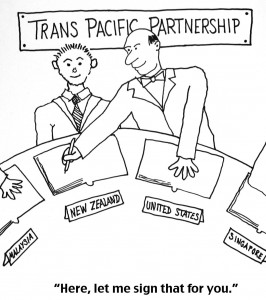
Excuse me for the rush and lack of organization... But this kind of things don't always allow for proper planning. So, please bear with my chaos ;-) What is the Trans-Pacific Partnership? Yet another secretely negotiated international agreement that, among many chapters, aims at pushing a free-market based economy, as defined by a very select few Most important to me, and to many of my readers: It includes important chapters on intellectual property and online rights. Hundreds of thousands of us along the world took part in different ways on the (online and "meat-space") demonstrations against the SOPA/PIPA laws back in February 2012. We knew back then that a similar project would attempt to bite us back: Well, here it is. Only this time, it's not only covering copyright, patents, trademark, reverse engineering, etc. TPP is basically a large-scale free trade agreement on steroids. The issue that we care about now is just one of its aspects. Thus, it's way less probable we can get a full stop for TPP as we got for SOPA. But we have to get it on the minds of as many people as possible! Learn more with this infography distributed by the EFF. Which countries? The countries currently part of TPP are Chile, Peru, New Zealand, Australia, Malaysia, Brunei, Singapore, Vietnam And, of course, the USA. Mexico, Canada and Japan are in the process of joining the partnership. A group of Mexican senators are travelling to Lima to take part of this round. Image by Colin Beardon (It's Our Future, NZ) What are we doing about it? As much as possible! I tried to tune in with Peru's much more organized call The next round of negotiations will be in Lima, Peru, between May 14 and 24. Their activities are wildly more organized than ours: They are planning a weekend-long Camping for Internet freedom, with 28 hours worth of activities. As for us, our activities will be far more limited, but I still hope to have an interesting session: Poster design by Gacela. Thanks! This Friday, we will have Aula Magna, Facultad de Ingenier a, UNAM, M xico DF, from 10AM and until 3PM. We do not have a clear speakers program, as the organization was quite rushed. I have invited several people who I know will be interesting to hear, and I expect a good part of the discussion to be a round table. I expect we will:

  1. Introduce people working on different corners of this topic
  2. Explain in some more detail what TPP is about
  3. Come up with actions we can take to influence Mexico's joining of TPP
  4. And this will be at Facultad de Ingenier a. Another explicit goal of this session will be, of course, to bring the topic closer to the students!
We want you! So... I am posting this message also as a plead for help. Do you think you can participate here? Were you among the local organizers for the anti-SOPA movement? Do you have some insight on TPP you can share? Do you have some gear to film+encode the talks? (as they will surely be interesting!) Or, is the topic just interesting for you? Well, please come and join us! So, again: Friday, 2012-05-03, 10:00-15:00
AttachmentSize
Poster. Desgin by Gacela Thanks!457.49 KB
Infography about TPP distributed by the EFF392.45 KB
"Here, let me sign this for you". Image by Colin Beardon.27.08 KB

Gunnar Wolf: Activities facing the next round of Trans-Pacific Partnership negotiations ( #yaratpp #tpp #internetesnuestra )

Excuse me for the rush and lack of organization... But this kind of things don't always allow for proper planning. So, please bear with my chaos ;-) What is the Trans-Pacific Partnership? Yet another secretely negotiated international agreement that, among many chapters, aims at pushing a free-market based economy, as defined by a very select few Most important to me, and to many of my readers: It includes important chapters on intellectual property and online rights. Hundreds of thousands of us along the world took part in different ways on the (online and "meat-space") demonstrations against the SOPA/PIPA laws back in February 2012. We knew back then that a similar project would attempt to bite us back: Well, here it is. Only this time, it's not only covering copyright, patents, trademark, reverse engineering, etc. TPP is basically a large-scale free trade agreement on steroids. The issue that we care about now is just one of its aspects. Thus, it's way less probable we can get a full stop for TPP as we got for SOPA. But we have to get it on the minds of as many people as possible! Learn more with this infography distributed by the EFF. Which countries? The countries currently part of TPP are Chile, Peru, New Zealand, Australia, Malaysia, Brunei, Singapore, Vietnam And, of course, the USA. Mexico, Canada and Japan are in the process of joining the partnership. A group of Mexican senators are travelling to Lima to take part of this round. Image by Colin Beardon (It's Our Future, NZ) What are we doing about it? As much as possible! I tried to tune in with Peru's much more organized call The next round of negotiations will be in Lima, Peru, between May 14 and 24. Their activities are wildly more organized than ours: They are planning a weekend-long Camping for Internet freedom, with 28 hours worth of activities. As for us, our activities will be far more limited, but I still hope to have an interesting session: Poster design by Gacela. Thanks! This Friday, we will have Aula Magna, Facultad de Ingenier a, UNAM, M xico DF, from 10AM and until 3PM. We do not have a clear speakers program, as the organization was quite rushed. I have invited several people who I know will be interesting to hear, and I expect a good part of the discussion to be a round table. I expect we will:
  1. Introduce people working on different corners of this topic
  2. Explain in some more detail what TPP is about
  3. Come up with actions we can take to influence Mexico's joining of TPP
  4. And this will be at Facultad de Ingenier a. Another explicit goal of this session will be, of course, to bring the topic closer to the students!
We want you! So... I am posting this message also as a plead for help. Do you think you can participate here? Were you among the local organizers for the anti-SOPA movement? Do you have some insight on TPP you can share? Do you have some gear to film+encode the talks? (as they will surely be interesting!) Or, is the topic just interesting for you? Well, please come and join us! Some more informative links BE THERE! So, again: Friday, 2012-05-03, 10:00-15:00 [Update] So, 2012-05-03 came and went. And thankfully, Alfredo was there to record most of the talk! So, you can download the video: Gunnar Wolf, Salvador Alc ntar: Qu es TPP? Por qu me debe preoucpar? Qu podemos hacer?
AttachmentSize
Poster. Design by Gacela Thanks!457.49 KB
Infography about TPP distributed by the EFF392.45 KB
"Here, let me sign this for you". Image by Colin Beardon.27.08 KB

Next.

Previous.