Search Results: "tar"

10 November 2008

Kurt Roeckx: Finding which sector belongs to which file on a RAID device.

I got this nice message (and some others) in my log today:
smartd: Device: /dev/sdd, 2 Currently unreadable (pending) sectors After running a smartctl -t long /dev/sdd smartctl now reports:
ID# ATTRIBUTE_NAME          FLAG     VALUE WORST THRESH TYPE      UPDATED  WHEN_FAILED RAW_VALUE
  5 Reallocated_Sector_Ct   0x0033   200   200   140    Pre-fail  Always       -       0
  9 Power_On_Hours          0x0032   089   089   000    Old_age   Always       -       8719
196 Reallocated_Event_Count 0x0032   200   200   000    Old_age   Always       -       0
197 Current_Pending_Sector  0x0012   200   200   000    Old_age   Always       -       2
198 Offline_Uncorrectable   0x0010   200   200   000    Old_age   Offline      -       0
[...]
SMART Error Log Version: 1
ATA Error Count: 10 (device log contains only the most recent five errors)
[...]
Error 10 occurred at disk power-on lifetime: 8692 hours (362 days + 4 hours)
  When the command that caused the error occurred, the device was active or idle.
  After command completion occurred, registers were:
  ER ST SC SN CL CH DH
  -- -- -- -- -- -- --
  40 51 08 78 e5 89 e0  Error: UNC 8 sectors at LBA = 0x0089e578 = 9037176
  Commands leading to the command that caused the error were:
  CR FR SC SN CL CH DH DC   Powered_Up_Time  Command/Feature_Name
  -- -- -- -- -- -- -- --  ----------------  --------------------
  25 00 08 78 e5 89 2f 00  45d+06:36:27.880  READ DMA EXT
  25 00 08 70 e5 89 2f 00  45d+06:36:27.798  READ DMA EXT
  25 00 08 68 e5 89 2f 00  45d+06:36:27.308  READ DMA EXT
  25 00 08 e0 77 e5 35 00  45d+06:36:27.295  READ DMA EXT
  25 00 08 60 e5 89 2f 00  45d+06:36:26.653  READ DMA EXT
[...]
Error 9 occurred at disk power-on lifetime: 8692 hours (362 days + 4 hours)
  When the command that caused the error occurred, the device was active or idle.
  After command completion occurred, registers were:
  ER ST SC SN CL CH DH
  -- -- -- -- -- -- --
  40 51 08 60 e5 89 e0  Error: UNC 8 sectors at LBA = 0x0089e560 = 9037152
SMART Self-test log structure revision number 1
Num  Test_Description    Status                  Remaining  LifeTime(hours)  LBA_of_first_error
# 1  Extended offline    Completed: read failure       90%      8715         797566305
# 2  Extended offline    Completed without error       00%      8198         -
Notice that 197 Current_Pending_Sector indicates that there are 2 sectors with a problem. Note that the SMART error log shows LBA sectors 9037176 (0x89e578) and 9037152 (0x89e560) but it's limited to 0xffffff. The self test logs shows us the proper LBA error at 797566305 (0x2f89e561) which has a 0x2f in front, and also shows us that it's the second sector in the block of 8 we tried to read. The kernel log also shows:
ata4.00: exception Emask 0x0 SAct 0x0 SErr 0x0 action 0x0
ata4.00: (BMDMA2 stat 0xc0009)
ata4.00: cmd 25/00:08:60:e5:89/00:00:2f:00:00/e0 tag 0 cdb 0x0 data 4096 in
         res 51/40:00:61:e5:89/00:00:2f:00:00/f0 Emask 0x9 (media error)
So I've tried to reproduce the error with:
# dd if=/dev/sdd of=797566305 skip=797566305 bs=512 count=1 iflag=direct
1+0 records in
1+0 records out
512 bytes (512 B) copied, 1.27727 s, 0.4 kB/s
Notice that it can actually read that block, it just seems to take a while. And the error log now contains:
  After command completion occurred, registers were:
  ER ST SC SN CL CH DH
  -- -- -- -- -- -- --
  40 51 01 61 e5 89 e0  Error: UNC 1 sectors at LBA = 0x0089e561 = 9037153
Because it's part of a RAID device I could just let the whole disk resync, but I was a little curious which files were in it. So I found this document that explains on how to find which files has the problem. But it only has examples covering ext2/ext3 on a partition and LVM and nothing about RAID device. So it looks like someone using RAID 0 will have a hard time finding the file that's having a problem. So following the document we start with:
# fdisk -lu /dev/sdd
Disk /dev/sdd: 500.1 GB, 500107862016 bytes
255 heads, 63 sectors/track, 60801 cylinders, total 976773168 sectors
Units = sectors of 1 * 512 = 512 bytes
Disk identifier: 0x000578f9
   Device Boot      Start         End      Blocks   Id  System
/dev/sdd1   *          63      385559      192748+  fd  Linux raid autodetect
/dev/sdd2       972864270   976768064     1951897+  fd  Linux raid autodetect
/dev/sdd3          385560   972864269   486239355   fd  Linux raid autodetect
Partition table entries are not in disk order
In /proc/mdstat we see:
md1 : active raid5 sda3[0] sdd3[3] sdc3[2] sdb3[1]
      1458717696 blocks level 5, 64k chunk, algorithm 2 [4/4] [UUUU]
So sdd3 is part of md1 and I have an ext3 filesytsem on that. Tune2fs -l grep Block gives:
Block count:              364679424
Block size:               4096
Blocks per group:         32768
mdadm tells me:
# mdadm -QE /dev/sdd3
/dev/sdd3:
          Magic : a92b4efc
        Version : 00.90.00
           UUID : 747b071a:a70f723b:c3a9ed44:15845cbf
  Creation Time : Mon Nov 12 20:13:51 2007
     Raid Level : raid5
  Used Dev Size : 486239232 (463.71 GiB 497.91 GB)
     Array Size : 1458717696 (1391.14 GiB 1493.73 GB)
   Raid Devices : 4
  Total Devices : 4
Preferred Minor : 1
    Update Time : Mon Nov 10 10:57:28 2008
          State : clean
 Active Devices : 4
Working Devices : 4
 Failed Devices : 0
  Spare Devices : 0
       Checksum : 4b3147f4 - correct
         Events : 78
         Layout : left-symmetric
     Chunk Size : 64K
      Number   Major   Minor   RaidDevice State
this     3       8       51        3      active sync   /dev/sdd3
   0     0       8        3        0      active sync   /dev/sda3
   1     1       8       19        1      active sync   /dev/sdb3
   2     2       8       35        2      active sync   /dev/sdc3
   3     3       8       51        3      active sync   /dev/sdd3
I've been told that 0.90 stores the superblock at the end of the device, so that makes it a little easier. And this seems to agree:
# cat /sys/block/md1/md/dev-sdd3/offset
0
We have a left-symmetric layout, so in raid5_compute_sector() we see
	stripe = chunk_number / data_disks;
	*dd_idx = chunk_number % data_disks;
[...]
	case ALGORITHM_LEFT_SYMMETRIC:
		*pd_idx = data_disks - stripe % raid_disks;
		*dd_idx = (*pd_idx + 1 + *dd_idx) % raid_disks;
So it looks like the chunks are located on the disk like:
stripesdasdbsdcsdd
0D 0D 1D 2P 0-2
1D 4D 5P 3-5D 3
2D 8P 6-8D 6D 7
3P 9-11D 9D 10D 11
4D 12D 13D 14P 12-14
With each of those 64K. The problem is at 797566305 and the partition started at 385560. So that's at sector 797180745 inside partition sdd3. Each sector is 512 bytes and a chunk is 65536 bytes which gets us 128 sectors per chunk. If we want to know which the stride the sector is on we do: 797180745/128=6227974.5703125 This means that the stripe is number 6227974 and that it's sector 0.5703125*128=73 on sdd3 within that chunk. The parity is on disk: pd_idx = 3 - 6227974 % 4 = 1, being sdb. To get the chunk we need to multiply with the number of data disks (3) and since it's the forth disk and the parity is on the second disk we need to add 1 and get: 6227974*3+1=18683923 So calculating that back to sectors we multiply it with the number of sectors per chunk again and add our offset in the chunk: 18683923*128+73=2391542217 To test that our math is any good we try:
# dd if=/dev/md1 of=797566305.2 skip=2391542217 bs=512 count=1 iflag=direct
1+0 records in
1+0 records out
512 bytes (512 B) copied, 5.99103 s, 0.1 kB/s
We see an error message in the kernel log, there are 2 new errors in the error log, so it seems that everything is calculated correctly. The files are also identical. The file system is in blocks of 4096 bytes, so for the file system this is block 2391542217*512/4096=298942777.125 Then we use debugfs:
# debugfs
debugfs 1.41.2 (02-Oct-2008)
debugfs:  open /dev/md1
debugfs:  icheck 298942777
Block   Inode number
298942777       <block not found>
Which isn't making any sense to me, since I get that error about every 2 hour when a certain cronjob runs. 298942777 / 32768 (Blocks per group) = 9123.00955. So I wonder if ext3 is keeping some meta data there and debugfs doesn't tell that? Anyway, at some point I was running a smartctl -t long /dev/sdd again because I couldn't reproduce the error anymore, the cronjob started, and I then found alot of errors in my log again and now it included:
raid5:md1: read error corrected (8 sectors at 797180744 on sdd3)
It's so much fun that disks always behaves the same trying to read the same sector. Smartctl now reports:
  5 Reallocated_Sector_Ct   0x0033   200   200   140    Pre-fail  Always       -       0
196 Reallocated_Event_Count 0x0032   200   200   000    Old_age   Always       -       0
197 Current_Pending_Sector  0x0012   200   200   000    Old_age   Always       -       0
198 Offline_Uncorrectable   0x0010   200   200   000    Old_age   Offline      -       0
I assume the kernel removed the pending sector by writing to it. The other pending error was already gone for some time, I assume new data got written to that one.

Uwe Hermann: OpenOCD, a Free Software JTAG utility with ARM and MIPS support

JTAG adapter for parallel port Just FYI, I've recently updated the OpenOCD Debian package in unstable. OpenOCD is a Free Software JTAG utility which currently supports quite a large number of JTAG adapters and various CPUs/targets (many ARM and now also some MIPS ones). It's being used by a number of Free Software related projects such as OpenMoko and many others. Here's an example of how you usually use the (new) OpenOCD with a cheapo parallel port JTAG device. First, start the OpenOCD server, providing it an interface config file and a target config file (you can copy/adapt them from /usr/lib/openocd/ interface,target /*.cfg, or use those files directly if they work for your target, of course).
  $ openocd -f parport.cfg -f lpc2148.cfg
Then, in another xterm for example, connect to the now-running OpenOCD telnet server. Here you can now run various commands to probe, control and program the JTAG device(s). Try help for a list of commands. As an example, for flashing a binary onto some LPC2148 eval board you would do something like this:
  $ telnet localhost 4444
  Trying 127.0.0.1...
  Connected to localhost.
  Escape character is '^]'.
  Open On-Chip Debugger
  > reset init
  JTAG device found: 0x4f1f0f0f (Manufacturer: 0x787, Part: 0xf1f0, Version: 0x4)
  srst pulls trst - can not reset into halted mode. Issuing halt after reset.
  target state: halted
  target halted in Thumb state due to debug-request, current mode: Supervisor
  cpsr: 0x800000f3 pc: 0x7fffd2a2
  requesting target halt and executing a soft reset
  target state: halted
  target halted in ARM state due to debug-request, current mode: Supervisor
  cpsr: 0x800000d3 pc: 0x00000000
  > flash write_image /home/foo/program.bin 0
  wrote 1236 byte from file /home/foo/program.bin in 0.533683s (2.261701 kb/s)
  > resume 0
The final resume 0 will start to execute your program on the ARM LPC2148 microcontroller. Check out the openocd info page (info openocd on the command line) for lots more documentation.

David Bremner: Using Org Mode as a time tracker

I have been meaning to fix this up for a long time, but so far real work keeps getting in the way. The idea is that C-C t brings you to this week's time tracker buffer, and then you use (C-c C-x C-i/C-c C-x C-o) to start and stop timers. The only even slightly clever is stopping the timer and saving on quitting emacs, which I borrowed from the someone on the net. Oh, and one of the things I meant to fix was the dependence on mhc. Sorry. Here is the snippet from my .emacs
(require 'org-timetracker)
(setq   ott-file
  (expand-file-name 
    (let ((now (mhc-date-now)))
      (format "~/.org/%04d/%02d.org" 
         (mhc-date-yy now) (mhc-date-cw now)))))
It needs emacs restarted once a week, in order to pick up the new file name. The main guts of the hack are here. The result might look like the this (works better in emacs org-mode. C-c C-x C-d for a summary)

Gunnar Wolf: 4 Rodada Nacional Tri-Estatal M xico-Pachuca

Yesterday I took part of the fourth inter-state bike ride, requesting the construction of proper and safe cycling ways. Tens of Mexican bike-rider organizations were part of the organization, althought the effort is basically grouped under the Ciclopistas y Ciclov as Interestatales project - For further details on the route we took, you can look at the M xico-Pachuca road map, although it was not followed literally.
I am very happy I decided to take part of this - I went with Adri n, but after the first rest/grouping we lost track of each other, and decided the best would be for each to go at his own pace. He managed to do the 95Km ride, I decided to stop at about 85 (I set my target to the first houses of Pachuca, so I could say I arrived ;-) ) and took a ride from the barredoras that were trailing us. Still, 85Km in about six hours (including the two rests) are well over what I expected to endure. And although the conditions were not ideal (i.e. there was some re-pavement jobs in a large portion between Tizayuca and Pachuca, which led to poor road conditions in some areas, and the dry, horrid smell of tar in others; we cycled along the vehicles in the very busy highway, so we didn't exactly get a dose of clean air), it was great. And I thought each of my muscles would hurt like hell today, but no, they are just feeling lazy ;-)
The GPS tracking on Nokia SportsTracker, The GPS tracking on OpenStreetMap

David Welton: Generating Rails Fixtures From Large Datasets

I've been working with Tomaso Minelli doing some Rails work, and one thing we needed to do was set up some tests. The situation we are in is that we already have a large set of data to work with in our development environment, but getting that data into .yml files is no easy task. Since we have a fairly large number of interdependent tables, dumping one of them alone is pretty useless, unless you manage to get the other tables it links to, and so on and so forth. Dumping all the data would make testing quite slow, and really is too much to be useful. Here's the rough solution we arrived at:

@fixtures =  
@seen =  
# Do something with a fixture.  In this case, we store it for later.
def handle_fixture(record)
  @fixtures[record.class.table_name]  = []
  @fixtures[record.class.table_name] << record
end
# Get some sort of unique way of identifiying a record - class name and id.
def unique_record(record)
  return record.class.to_s + " " + record.id.to_s
end
# Grab all the relations of a class and add them to the queue.
def add_fixture(record)
  ur = unique_record(record)
  if @seen[ur]
    puts "LOOP!"
    return
  end
  @seen[ur] = true
  puts "Fixture for # record.class.name  - ID # record.id "
  handle_fixture(record)
  record.class.reflections.each do  k, r 
    begin
      if r.macro == :has_many  
          r.macro == :has_and_belongs_to_many
        related = record.send(r.name).send('find', :all, :limit => STARTING_LIMIT)
      else
        related = record.send(r.name)
      end
      related = [related] unless related.is_a?(Array)
      related.each do  related_record 
        if related_record
          puts "    New Record # related_record.class.name  # related_record.id "
          @todo << related_record
        end
      end
    rescue => e
      puts "    ERROR: # e :\n# e.backtrace.inspect "
    end
  end
end
@todo = []
namespace :db do
  namespace :fixtures do
    desc 'Create YAML test fixtures starting from a single model using reflections'
    task :modelbase => :environment do
      STARTING_CLASS = Foobar
      STARTING_FIND  = :all
      STARTING_LIMIT = 1
      tmp = 0
      totale = STARTING_CLASS.find(STARTING_FIND, :limit => STARTING_LIMIT).size
      STARTING_CLASS.find(STARTING_FIND, :limit => STARTING_LIMIT).each do  m 
        tmp += 1
        puts "# tmp  su # totale : # m.id "
        @todo << m
      end
      while true
        if @todo.length == 0
          break
        end
        add_fixture(@todo.pop)
      end
      puts "\n\n# '='*80 \nScan Finished\n# '='*80 \n\n"
      @fixtures.each do  name, fixture 
        if fixture.size > 0
          i = "000"
          filename = "# RAILS_ROOT /test/fixtures/# name .yml"
          puts "Create # filename  for class # fixture.class.name "
          FileUtils.mkdir(File.dirname(filename)) unless Dir[File.dirname(filename)].size > 0
          File.open("# RAILS_ROOT /test/fixtures/# name .yml", 'w') do  file 
            file.write fixture.inject( )    hash, record 
              hash["# record.class.table_name _# i.succ! "] = record.attributes
              hash
             .to_yaml
          end
        else
          puts "Fixture for # name  is EMPTY"
        end
      end
    end
  end
end
It's written in a somewhat quick and dirty way, but it gets the job done. What it does: It takes a single class - hopefully a well connected one - fetches a few of them, and goes from there, exploring all the other objects that the initial ones are connected to, and then dumping them in .yml files in the fixtures/ directory. It could certainly use more work:
  • Additional starter classes, for ones that aren't connected to others.
  • Intelligent examination of data and data sets...
  • For example you could check to see what classes aren't connected to the others and use them as starter classes.
  • If you wanted to waste a lot of cycles, you could also try and aim for a representative set of examples. For an object that has_many something elses, you could try and find one with zero, one with one, and one with a lot, to cover various cases. That could quickly get out of hand for largish data sets though.
  • I'm sure there are various other tweaks, knobs, and levers that could be added to work more efficiently. I'd love to see them!

9 November 2008

Adam Rosi-Kessel: Roslindale Scoop: Himalayan Bistro Coming to the Neighborhood

I have it on very good authority* that our favorite Indian/Nepali restaurant, Himalayan Bistro, is coming to Roslindale (from West Roxbury), into the oft-turned-over location last assigned to NuVo, and Gusto before that. Perhaps the third “-o” restaurant will be a charm. Assuming they serve up the same superlative food and atmosphere as the West Roxbury location, I’m sure this one will be a keeper. (My only concern is that having the two restaurants so close to each other may result in self-competition.) *Authority = Himalayan Bistro delivery guy. You don’t get much more authoritative than that. In other Roslindale Restaurant news, we heard via RVMS recently that Robyn’s Bar and Grill has changed hands to the owners of the Halfway Cafe in Dedham, which could be a change for the better. Roslindale did not need another pizza/sports-bar, and still does not need one, although maybe that’s all the Robyn’s location will ever be. Even more recently, however, we heard an unconfirmed rumor from a neighbor that the sale fell through and Robyn’s is not changing owners. In other potentially disappointing news, the Roslindale Emac and Bolio’s has changed owners again, this time to a co-owner of the Blue Star Restaurant. I want to like Blue Star, but they can’t seem to get the most basic short-order cooking tasks right. A diner must, first and foremost, deliver greasy food fast, hot, and at the same time for the entire group. At worst, serve the kids first. It also helps for the food to be consistent. Blue Star in our experience (many visits) only occasionally satisfies the basic diner requirements, much less delivers any sort of creative urban-chic reinterpretation of the classic retro diner. (By contrast, Deluxe Town Diner in Watertown is our current Greater Boston favorite — it’s always a good sign when a greasy spoon also actively caters to vegans.) Which brings me to Emac and Bolio’s, which apparently will be renamed “Select Caf .” First, why give up the goodwill associated with the Emac’s trademark? Second, the initial signs of the change-over are not promising. A handwritten sign posted in the window announces that the cafe is under new management, and (1) no credit or debit cards will be accepted and (2) no Emac and Bolio’s gift certificates will be honored. I’d love to be proved wrong about this, but I’m pessimistic that this is going to be the Change We Need in Roslindale — namely, a top rate artisanale snobby espresso shop. We can only hope that Simon’s, Flatblack, Cafe Nation, Diesel, or another of their ilk will come occupy one of the vacant storefronts on the courtyard. That we have any vacancies at all in the square, much less several, is a crime against humanity. Technorati Tags: ,

Raphael Geissert: yummy yummy


Andrew Pollock: [tech] Keeping hard drives cool

I've had this crazy ATA over Ethernet SAN for my MythTV setup for as long as I've been running MythTV. I'm using minotaur, an old Pentium III 1RU VA Linux server as the "head". Originally, I had 4 IDE hard drives, attached to minotaur via IDE-USB adapters. This worked perfectly fine, but I missed the ability to query SMART information, and do other low-level drive tweaking with hddparm So a while ago, NewEgg had a sale on 750Gb SATA drives, and I bought a 4 port eSATA card, and took the plunge with SATA. That all went fine. The entire time, I've had the 4 hard drives themselves just sitting on top of minotaur, on cork trivets. The whole arrangement is in the bottom of our linen closet, as this is where the patch panel for the apartment is. I've graphed the temperature of linen closet for some time now, but the benefit of having hard drives connected via SATA was that I could easily graph the temperature of them as well, which I started doing recently. The catalyst for wanting to do this was that I had a drive fail, and I was concerned that they were getting too hot, just sitting in the closet with no airflow. Matt Bottrell's recent reminder of Google's research into hard drive failures also helped bring this concern to forefront. Seagate's product documentation for the Barracuda 7200.10 claims that ambient operating temperature must be between 0 C and 60 C. I'm assuming that's the environment the hard drive is in, and not the temperature of the drive itself as reported by something like hddtemp. The closet is typically in the high 30's. If you believe what SMART reports, it seems to imply that anything over 45 C is a Bad Thingtm. So after I had a drive fail, I figured I should probably try to do something about the temperature situation, and started looking around for an external enclosure. I'd previously had problems with the IEC-to-Molex power supplies I was using to power the disks, and think that they'd been the cause of some failures of my IDE disks, so was quite eager to stop using them as well, which was something else an external enclosure would give me. I had trouble finding an enclosure that presented 4 separate eSATA ports, and I was talking to Marc about SATA port multipliers, when he mentioned he had a brand-new unused full-height SCSI enclosure, for four disks, which was surplus to his requirements. Since all I really needed was external power and cooling, I thought I could cannibalise this to my needs. Sure enough, I could just remove the SCSI cables and their Centronics connectors, and feed the eSATA cables out the gap they left, and use the molex-SATA power splitters I already had. Because the enclosure was intended for full-height 3.5" hard drives, there was plenty of air space between each disk. The enclosure included two fans. The results? Well the graph speaks for itself:

Graph of hard drive temperatures (I'm not entirely sure why minotaur's internal disk occasionally reports a very low temperature) The added bonus is I've cleaned up the rats nest of cables in the linen closet. So thanks very much, Marc!

Christine Spang: Switching to Colemak

Way back in mid-late May, I switched keyboard layouts from standard US QWERTY to Colemak. I’d played around with the layout a bit before that and thought it seemed pretty solid, but it hadn’t been a good time to switch then. (I did, however, snag the idea of remapping Caps Lock to Backspace from that early trial though, and to this day that’s probably the most annoying thing about typing on QWERTY, because I associate Caps Lock with Backspace on both layouts now. Anyway.) This time, however, I strategically timed it to coincide with the end of classes, so I had no assignments due and could make a fool out of myself during the first few days of my summer job. Smashing success. It only took a couple days to get past the point of extremely frustrating slowness. Two weeks in I was up to 40wpm, which was about the point where I stopped noticing that I’d taken a backwards step in typing speed, as it didn’t really hinder anything I did on a regular basis. By the end of the summer I was back up to the same speed as I’d been prior to switching (around 75wpm). I didn’t really do any typing lessons after the first few days, as I found just doing whatever I would normally do on a computer much more interesting. The biggest hurdle after the initial adaptation of actually being able to type on the layout was, for a command-line lover like myself, dealing with “hjkl” not being a convenient way of navigating around in console apps like mutt, vim, aptitude, and less. After a bit of experimentation, I stole an idea from this page and started adapting my dotfiles to make these programs use ne for jk and st for hl, and that seems to be working out well. The worst key that this clobbers in general is n, but it’s pretty easy to remap that to QWERTY’s n, which is easy to remember and is the hardly-used k on the Colemak layout. For any interested others, I’ve thrown the relevant dotfile snippets up here. I’d been putting off blogging this because I wanted to finish setting up dotfiles/homedirs-in-git la Joey Hess beforehand, but I figure I’ll never actually get it done if I keep using that excuse. For mutt, the given snippet goes in your .muttrc (or whatever you source keybindings into your muttrc from). The same goes for vim. Aptitude keybindings go in .aptitude/config. For less, it’s a little more arcane: first you stick your keybindings in .lesskey, and then you run the command lesskey. I also remapped screen’s escape key to ctrl-t. Why not Dvorak? Dvorak seems to be the most well-known QWERTY alternative around, so why didn’t I switch to that if I wanted something better? I did try Dvorak first, but the incredibly uncomfortable combination of ls on the right pinky was a complete deal-breaker. I also found it very slow-going to try to adapt to Dvorak after typing on QWERTY for years. The Colemak FAQ has some more notes on Dvorak deficiencies that it addresses. Overall, I’ve found typing on Colemak to be remarkably lacking in anything that particularly bothers me. I still type on QWERTY a little, but mostly just for login prompts on Athena workstations and the desktop machine in my room which my roommate sometimes uses. I have to glance down at the keyboard when typing on QWERTY to get it back in my head, but generally I only need it for a few minutes anyway and it’s no big deal. As long as I glance down occasionally I can still maintain a speed level well above that of frustration. On the plus side, this means that if I look at the keyboard when typing normally in Colemak, I get screwed up because I start thinking in QWERTY. So it’s good touch-typing reinforcement in general.

Simon McVittie: Spec-writing On A Plane

(Written on Friday 16th, posted on Monday)

As I write this, I'm on a plane off the coast of the Netherlands, on the way back from a couple of days designing APIs with Rob McQueen and the RTCom people at NRC Helsinki (who we work with on the chat and VoIP functionality for Nokia internet tablets).

We've had a very useful couple of days, mainly designing the next-generation channel requesting and dispatch API for Telepathy (the same APIs I've been doing preparatory work for on the Telepathy mailing list in the last couple of weeks). API sketches for review and comment are either on are on Merge Monkey or on the way there.

Before even reaching Nokia, Rob and I did a lot of design on the plane over to Helsinki, and I took some notes: here they are, by way of a glimpse at how the Telepathy design process works when we don't have a whiteboard[1] :-)

  • Geoloc looks good in principle, needs some more work
    • add more docstrings
    • add a way to ask people for uncached info (RequestLocations)
    • move access control to Co.I.Presence, call it RichPresenceAccessControl?
  • DeliveryReporting looks good, ish
    • improve wording of delivery-echo and rationale
    • when sending a delivery report, add a reason for the status (using Channel_Text_Send_Error?)
  • Uniqueness requirement for (channel, handle_type != 0, handle) is in the way - let's drop it
  • MSN should use "authentic" 1-1 chats, and use Ch.I.UpgradeableToRoom (name tbd) to migrate the underlying switchboard to be a room
  • XMPP should use Ch.I.UpgradeableToRoom too, but the 1-1 channel may also stay open
  • Mutable handle => handle 0 must stay (for requestotron's benefit)
  • bundles ftw
  • renaming: we want SelfHandleChanged in the core
  • TpC* - add ability to subscribe to ifaces ay construct time (blocks Ready) or later
  • Dispatching: when registering a c'handler, specify everything it can handle
  • If a new bundle can be handled in its entirety by the same handler (call it 'the bundle handler'), do it. Otherwise split it up completely (there is no 'bundle handler').
  • If a channel in an existing bundle can be handled by the bundle handler, send it there, else send to the default handler.
  • Group - add SelfHandleChanged, maybe? Also Connection
  • Add HandleOwners: prop a uu , HandleOwnersChanged(a uu , au)
  • Use TargetHandleType, TargetHandle
  • Stringified initiator handle as a separate property
  • Maybe even a FirstMessage property, although this stretches the definition of "immutable"
  • org.freedesktop.Telepathy.Client interface

Nokia's Mikhail Zabaluev kindly took notes for some further discussion we had with him and Alberto Mardegan about the dispatch API, which he already posted to the mailing list.

We hope this API will make it possible to integrate Telepathy into the desktop better - it should make it a lot easier to share connections between processes in a useful way and hand out incoming channels to the appropriate handlers, which was always a major goal for Telepathy. It should also let us and others implement exciting new notification mechanisms (hi to the people on IRC and the mailing list wanting to patch their media players to integrate with Telepathy! :-)
[1]When we do have a whiteboard, the design process is: "Robot101 scribbles on a whiteboard, smcv writes down <tp:rationale> elements"

Simon McVittie: Implementing D-Bus services with telepathy-glib

(Part 1 of an ongoing series: shiny things in telepathy-glib)
16:46 < epmf> tp-glib is made of magic

—#telepathy, 2008-04-15

Rob pointed out today that I'd been promising to blog about telepathy-glib for several months and still haven't done so. I think there's too much to cover in one blog post, so I'll start with the oldest part - implementing a service (typically a Telepathy connection manager).

While telepathy-glib is (obviously) intended for Telepathy implementors, I think the ideas we've been implementing are likely to be useful for any D-Bus API, particularly flexible/complex APIs where an object implements many interfaces.

Introduction to telepathy-glib telepathy-glib started out as a collection of code extracted from our XMPP connection manager, telepathy-gabble, but at some point it grew beyond that into a wrapper around/partial replacement for dbus-glib. We've been quite pleased with it, really :-) My first major round of work on telepathy-glib, during the first half of 2007, was to split it out from telepathy-gabble (versions up to 0.5.9 were released as part of Gabble 0.5.x tarballs, in fact), leading to the release of the 0.6.x stable branch in late September. This was very helpful for implementing connection managers - Salut, Idle and telepathy-sofiasip (our connection managers for link-local XMPP, IRC and SIP) all started off by forking/cargo-culting from Gabble, and achieved huge code reductions by porting to telepathy-glib. Also, Will Thompson used it in his Summer of Code project, telepathy-haze, to go from nothing to a working and useful Telepathy implementation based on libpurple in a matter of a few months. The second major round of work, which I'll discuss in a later article, added client code to telepathy-glib, obsoleting the older/worse libtelepathy and allowing client programs like Empathy and telepathy-stream-engine to be written using telepathy-glib. In the process, I accidentally reinvented DBusGProxy :-) More details to come later!
Some background: service-side code generation
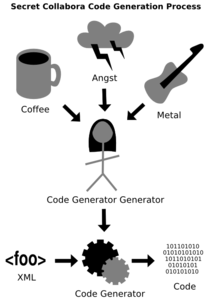
The secret Collabora code-generation process

(credit: daf)

Supporting D-Bus in the GObject world has always involved quite a lot of code generation. The core API of dbus-glib is heavily reliant on varargs functions, which aren't type-safe and are easy to get wrong. dbus-glib contains a program called dbus-binding-tool, which is meant to generate reasonably sane GObject APIs for D-Bus objects. Unfortunately, it seems to be intended to generate a whole GObject at a time. Early versions of telepathy-gabble used dbus-binding-tool plus a script called gengobject.py to generate API stubs for the exported objects; developers then filled in the blanks, and hey presto, we had a GObject on D-Bus. This was fine up to a point, but had a couple of major drawbacks. Whenever we changed the D-Bus API (quite common during the early development of Telepathy), there was a very laborious and error-prone merging process. We ended up with the following process:
  • copy the D-Bus introspection XML from the telepathy-spec repository into a directory xml/pristine (actually, the canonical form for the spec was Python for a while, and we had a script that exported a contrived object onto D-Bus and introspected itself to get the XML - but that's another story!)
  • preprocess the introspection XML to add the dbus-glib CFunctionName annotation, resulting in a directory xml/modified
  • run dbus-binding-tool and a Python script gengobject.py to generate C source in xml/src
  • three-way-diff the old version of xml/src, the new version of xml/src, and the real C code in src to create a new version of src
  • pray that the diff process hadn't randomly exchanged functions' implementations
  • update the resulting code in src so it worked
  • check the whole mess back into darcs
  • hope that nobody else had made changes that would result in darcs conflicts
If you haven't yet gathered, this was a bit of a nightmare. Also, it was very easy to return the wrong thing from a method without noticing - because all the APIs were varargs, the compiler didn't notice, and the first we'd know about it was a mysterious segfault under certain circumstances.
How telepathy-glib fixes code generation telepathy-glib improves on this by taking advantage of this innocuous-looking feature in dbus-glib:
commit 355ef78d98d6fc65715845d56232199162cab12a
Author: Steve Fr cinaux <steve istique net>
Date:   Thu Aug 17 11:48:20 2006 +0200
    Interface support for bindings.
Instead of running dbus-binding-tool or creating GObjects with D-Bus interfaces, we put the entire Telepathy spec through glib-ginterface-gen.py, a distant descendant of Gabble's gengobject.py. For each interface in the spec, we generate a GInterface that mirrors the D-Bus interface. Any GObject that implements the GInterface automatically gets the D-Bus interface if it's exported onto D-Bus. There are a few non-obvious refinements, though:
  • The signature of the method implementation is always in the mode that dbus-glib calls "asynchronous", where the method implementation can either send a reply message before or after it returns. For "slow" methods, this is the only thing you can do. For instance, many Telepathy D-Bus methods can't return anything until some TCP round-trips to the server have happened. This is also the only thing you can do if you want to extract extra information, like the sender's unique name, from the method-call message (dbus-glib's "synchronous" API doesn't allow this to be done). For "fast" methods, sending a reply message before returning is just as easy as using the "synchronous" API (it's just a difference of syntax), and has an API consistent with that of the "slow" methods, making it easier for service authors.

  • The layout of the GInterface vtable is private, and (auto-generated) accessor functions are used to fill in implementations. This means our ABI doesn't change just because we re-ordered functions in the spec.

  • If no implementation is provided for a method, we just raise an appropriate error (org.freedesktop.Telepathy.Errors.NotImplemented), rather than suffering an assertion failure. This means we can safely add methods to an interface.

  • While we're generating code anyway, we generate some static inline wrapper functions which wrap dbus_g_method_return(), to have type-safe method returns. You can easily check that a method replies with correct types, by checking that the implementation of Foo() replies by calling tp_svc_some_interface_return_from_foo().

  • Similarly, we generate wrapper functions to emit signals, to get type-safe signal emission.

Not all interfaces are stable enough to be included in telepathy-glib's stable API and ABI, so some of our other projects include a copy of the telepathy-glib code-generation tools, and generate their own "mini-telepathy-glib" (traditionally in a /extensions/ directory) for their implementation-specific (drafts of) interfaces. This isn't yet as polished as it ought to be (mainly because we don't want to freeze the augmented-introspection-XML format that we write the Telepathy spec in, because it's rather ad-hoc and hackish in places) but it works quite well in practice. To see what this looks like in practice, have a look at the examples in telepathy-glib, or at a Telepathy connection manager like telepathy-gabble.
Mixins and base classes Another feature of telepathy-glib which makes life easier for connection manager authors is that it provides "mixins" and base classes which implement some of the GInterfaces. There's absolutely nothing magic about the base classes - they don't have any access to private implementation details of the GInterfaces, they just implement them like everyone else does. The "mixins" are only slightly more magical - they store some extra state inside the structures representing GObjects and their classes, and use it to provide default implementations of some or all of the methods on a particular interface (or two interfaces, in the case of the new TpMessageMixin). I'll leave it up to Rob to explain those in greater detail, since I seem to remember that he invented them :-P The examples and regression tests in telepathy-glib are quite good examples of how these work in practice.

Simon McVittie: Encrypted root filesystem on a Debian laptop

I've been meaning to document this for ages... My laptop is set up with an encrypted root filesystem using LVM and dmcrypt. It also has a small Debian stable system for recovery purposes (I don't have a CD drive, so if everything goes horribly wrong, I can't just boot from a live CD). Here's how to set up something similar:

Step 1. Set up the recovery system Start the Debian lenny (beta) installer as usual. (I originally used etch, but these instructions are for lenny - either should work.) When you get to "Partition disks", choose "Manual". Here's the partitioning scheme to use:
  • main partition for LVM, taking up the whole disk minus 1GB or so. select "Do not use", for now
  • 1GB recovery partition at the end of the disk (this will also be the main system's /boot, since /boot needs to be unencrypted anyway). Use the defaults: ext3 mounted at /.
Finish partitioning and write changes to disk, and wait for the base system to install. Say yes to installing Grub to the MBR for now (it might be possible to do the install more cleanly by installing Grub to the recovery partition's boot sector instead - I haven't tested that). Reboot into the freshly installed recovery system and satisfy yourself that it works.

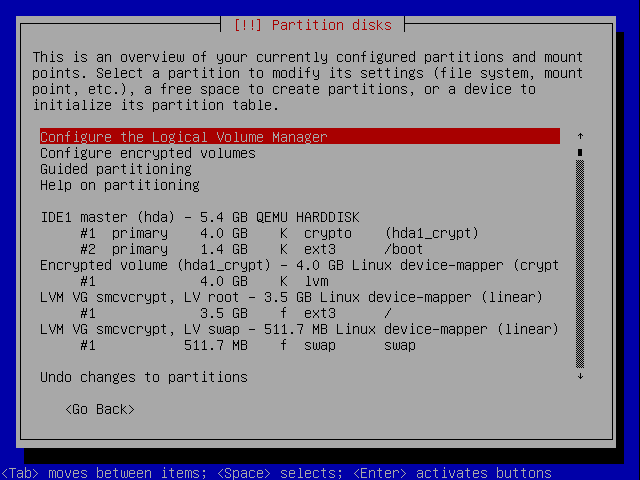
Step 2. Set up the main system Now boot the Debian installer again. This time it's for your installed system. At the "Partition disks" stage, choose "Manual" again. Select the main partition and choose "Use as: physical volume for encryption". Next select "Configure encrypted volumes". Your main partition will now be randomized - this is slow - and some time later you'll be asked for a passphrase. You'll have to type this in at each boot. Select the contents of the "disk" Encrypted volume (hda1_crypt) and choose Use as: physical volume for LVM. Now "Configure the Logical Volume Manager" and create a Volume Group. I always use the laptop's hostname as the VG name (this reduces confusion if you ever plug the disk into another machine for disaster recovery). Create a Logical Volume called swap, the size you want your swap space to be. If you plan to use suspend-to-disk, this needs to be at least as large as your RAM. Create a Logical Volume called root, for the root filesystem. If you want separate "partitions" for things like /home, now is a good time to create them too; if you want to use my schroot howto, leave some unallocated space in the VG for that. Set your swap LV to be used as a swap area, and your root LV to be used as ext3 mounted at /. If you wanted extra LVs, set them up too. Also set your recovery partition to be used as ext3, mounted on /boot, and not reformatted. It should now look something like this (smcvcrypt is the name of a KVM virtual machine in which I've been testing these instructions, normally you'd have the laptop's hostname there). Screenshot from d-i Proceed with the installation. Install Grub to the MBR - this will temporarily make the recovery system unbootable, but shrug never mind. Finish the installation and reboot into your new main system.

Step 3. Make them dual-boot Within the main system your recovery system is also visible, at /boot. Bind-mount /dev onto /boot/dev, chroot into /boot, and run "update-grub /dev/hda2", where hda2 is the partition where the recovery partition is. Leave the chroot. Edit /boot/grub/menu.lst and put this right at the end:
title Go to recovery system
root (hd0,1)
chainloader +1
(Replace (hd0,1) with what Grub thinks the recovery partition is - the second number is the partition number starting from 0, so /dev/hda5 would be (hd0,4) and so on.) Also edit /boot/boot/grub/menu.lst and put this right at the end:
title Back to main system
root (hd0)
chainloader +1
Also, still in /boot/boot/grub/menu.lst, go to the top of the file and change the colour scheme to something else (I used a red background) to indicate that this boot menu is for the recovery system. Reboot and try it out. You should now have an extra boot menu option, "Recovery system". Selecting it will switch to the recovery system's boot menu, which has an option to switch back, and so on. Each boot menu also has some entries for kernels, any of which will boot with the appropriate root filesystem (encrypted root for the main system, unencrypted for the recovery system). Success!

Sylvain Le Gall: OCaml meeting 2009 in Grenoble

Since September 2008, Alan Schmitt and I have decided to organize a new OCaml Meeting following the JFLA. This will be the second time of such an event. Last year we were 50 people -- after a very short period for organizing it (less than a month). This year we decided to prepare things earlier. As a matter of fact, the last year events has at least generated a peak in OCaml mailing list (602 message in January, 487 in february...) It also has given birth to several things like planet and forge. It has also help to start things like batteries. I hope this year events will help people to meet and exchange great ideas for OCaml promotion. Waiting to see a lot of "OCaml"ers at OCaml Meeting 2009.

Russell Coker: LUV Talk about Cloud Computing

Last week I gave a talk for the Linux Users of Victoria about Cloud Computing and Amazon EC2 [1]. I was a little nervous as I was still frantically typing the notes a matter of minutes before my talk was due to start (which isn’t ideal). But it went well. There were many good questions and the audience seemed very interested. The talk will probably appear on the web (it was recorded and I signed a release form for the video). Also I have just noticed that Amazon have published a license document for their AMI tools, so I have added the package ec2-ami-tools to my Debian/Lenny repository (for i386 and AMD64) with the following APT sources.list line: deb http://www.coker.com.au lenny misc Also the Amazon license [2] might permit adding it to the non-free section of Debian, if so I’m prepared to maintain it in Debian for the next release - but I would prefer that someone who knows Ruby take it over.

8 November 2008

Steve McIntyre: 3rd Free Software Congress in Valencia

I spent much of this week in Alicante. It was wonderful to have a few days away from the beginnings of Winter in Cambridge - Alicante's in South West Spain, right on the Mediterranean. It's a lovely city, although it was very quiet due to the time of year. I was invited down to Alicante by organisers of the Congr s de Programari Lliure, Comunitat Valenciana, to present a talk about Debian. That I did, and as always my slides and photos are available in case people are interested. I wasn't too sure about what level to aim the talk, so I deliberately went for a general introduction to Debian. That seems to have been the correct level - nobody threw anything at me, and nobody was visibly falling asleep. *grin* It's also the first time I've ever given a talk with official translators, which is a weird experience! The main topic for the conference was the new release of Lliurex, Valencia's own GNU/Linux distribution targeted primarily at use in schools. The conference was massive; I was told there were about 1500 attendees in all, most of whom were teachers who wanted to come and learn more about Free Software. There was a good spread of talks and workshops, covering topics from development through to deployment in the classroom. The level of enthusiasm for Free Software here was immense - lots of people were keen to learn more about it and get involved. I was told that out of the 15 regions/states of Spain, 11 of them have now started their own distributions to use in schools! Extremadura were the first region to experiment with Free Software like this, and their success with LinEx was a clear inspiration to their neighbours elsewhere in Spain. As well as the obvious cost advantages of moving from proprietary to Free Software, the local governments also love the freedom to use and modify their software however they like - including the ability to provide their own translations. Conference welcome I met up with a lot of cool people at the conference too. The local education minister (Alejandro Font de Mora) was keen to talk with all the speakers and very enthusiastic about the future of Free Software in his schools. As is increasingly common at FS events around the world, there were of course quite a few Debian people around too. Luciano and Miriam were also giving talks, and I bumped into Rene and Miguel and a whole bunch of others whose names I'm too crap to remember - sorry! I also spoke a lot with Kurt Gramlich, the mega-enthusiastic Skolelinux developer who was also happy to push Debian to everybody he spoke to *grin*. Jon "Maddog" Hall had some excellent ideas that I'm sure we'll all hear more about soon, and his talk was excellent. He did a very good job of explaining how Free Software makes such a difference, including how it helps people to make money. He also explained that due to travel he had missed Halloween at home and he wanted to share the experience of scary masks with the people at the conference: Maddog Bush I had a great time in Alicante, and I'm very grateful for the invitation to go there. I wish that the UK was as far as advanced as Spain in the use of Free Software in education - they've done a huge amount of good work in this area and I'm glad we can help them.

Joerg Jaspert: Debian mirror scripts

With a small mail to our mirrors-announce list, I just opened the work of more than one month to the public. Even better, I strongly encourage every mirror admin to use my scripts, or at least scripts that follow a minimal set of rules I wrote down… Some long time (somewhere in April or May this year) I got added to the Debian mirroradm group. First it was only to get some problems with packages.debian.org solved, but later on I started doing more. This group is basically the one that handles the archvsync user on .debian.org machines and also manages the official Debian mirrors listing. As the archvsync user exists on multiple .debian.org machines, and many of them do mirror a copy of our archive for various reasons, all of them had some version of a mirroring script, and sometimes also a version of a pushmirror script. Unfortunately, as they all had been maintained mostly on their own per machine - they sometimes had evolved a bit different. Additionally all of them had a few problems which could leave us with a broken mirror behind, despite it looking all well. So on Sept. 26 I decided to trash it all and rewrite the script and put it all in a VCS (and selected git). For that I set myself a few goals, like (in no particular order) Now, 109 commits and more than a month later, I was finally able to open the scripts to the wide public. (Had multiple people test them before this, but thats always different than a real “release”). The scripts are in use on all .debian.org machines and some other mirrors already, so I’m fairly sure they work.
As I already wrote, Debian mirror admins are strongly encouraged to use this scriptset and not to invent their own. In case you miss a feature either send me a mail describing it, or better, a patch implementing it. I’m happy to implement as much as possible (and sensible :) ) And while it is discouraged to use own scripts, sometimes people have reasons to have their own, so there is now a minimal set of functionality that such a script MUST support. All of those requirements are easy to fulfill. Well, at least the MUST ones. The first one is basically a given, all scripts I know are doing this already. The second one sounds more complicated, but actually might just be about 4 lines of actual code changes. Just touch an extra file before you gain a lockfile (to avoid two scripts running at the same time) and then rerun rsync as long as that extra file is around. (It helps to rm this trigger file right before you call rsync :) ). The should directive is actually a little more work to implement correctly. I won’t show source here, read the ftpsync script if you want to see it, but I try some small explanation. Background: Debian mirror synchronisation is usually done by scripts that get started via ssh. As mirror operators (understandably) do not like their upstream mirror to be able to login, this is done using “ssh triggers”, a feature I wrote about earlier. Those are sshkeys using a forced command, so nothing else than this command will be run, ever. SSH, if used with such forced commands, has the helpful feature that it sets the environment variable SSH_ORIGINAL_COMMAND containing the original arguments. Which means that, if the mirror pushes you with “ssh yourhost -l mirror sleep 1” you will see *sleep 1 in that variable. It is what many mirror operators currently use when pushing their downstreams. Now, we can use that to tell the receiving end all things we want it to know. If you look in my script you will see that I defined a little more than the minimal arguments. But none of the additional ones are a requirement, they only make life much easier. My script currently understands, additional to the 3 minimal ones:
As if that wasn’t enough, I also had to rewrite the runmirrors script. The old 10-line one just didn’t cope with the more general approach. This script is used to “push” your downstream mirrors, telling them that they need to update. (Which is the only sane way to run a mirror. cron is just not made for mirrors that can update at random times!). One nice new feature of it is the ability to update multiple mirrors nearly at the same time. This is extremely helpful in case of DNS Round Robin entries like security.debian.org (multiple hosts offering the same archive under one hostname). You do not want to have such hosts out of sync. Not even for a minute, if you can avoid that. So we now push the mirrors with sync:stage1 as argument. Then we wait until all of them have finished the stage1 sync before we push them all again, this time with sync:stage2 as argument. This will erase any update delays thanks to network latency / low bandwidth one of the security mirrors might have, as the large transfers (all the binary and source packages) are done in stage1. They can take time, a normal user won’t notice it - the Package and Source indices are not transferred yet. They arevery small and as such transfered pretty fast whenever stage1 is done everywhere and we tell mirrors to do stage2.
All in all it was a pretty nice exercise writing those scripts. Comments: 0

7 November 2008

Andrew McMillan: Multiples of latency

Today someone asked me to take a look at an Evolution enhancement that's just begging to get into trunk. Since this is a Gnome program in a subversion repository I've commenced the process of cloning the repository so I can look at the issue against the current head. At the current rate I should have a copy of the repository by early tomorrow morning, in order to be able to start looking at it. Of course today is when I actually do have some time to spare, and I hope to be fast asleep at the time when I expect this to finish. Presumably subversion isn't this slow for everyone, but since my latency to their repository is 300mS I'm probably on the worst end the pain, with each commit seemingly taking around a second. It sure would be nice if subversion provided some kind of chunked compression of these five-year-old commits, so I could be bandwidth limited, rather than latency challenged. The addition of a day to the checkout of a software project must be a significant barrier to entry for anyone considering contributing. It makes it much less likely to be opportunistic. So far I'm up to r3600 in 75 minutes. That's 75 minutes that I could have spent actually looking at the code, but now it's time for me to go and vote for me...

Axel Beckert: e-mail.is-not-s.ms

When I first read http://two.sentenc.es/ in (if I remember correctly) madduck’s signature, I thought something like “This can’t be! Why are people castrating themself?” Although I really understand that the inventor has good reasons for such a personal policy, I notice how much time I waste by trying to fit all the information I want to transmit in the 160 characters a short messages allows — or, even worse, into the 140 characters microblogging services like identi.ca or Twitter allow. So I had to oppose something to this, but even to only reach the coolness level of the domain “sentenc.es” is hard, you probably can’t top it at all. For luck, I’m not alone and Venty had the right idea for a hostname which has at least some geeky niveau. So here it is, our pleading for e-mails as long and detailed as necessary:

http://e-mail.is-not-s.ms/ A German version will be available soon at http://e-mail.ist-nicht-s.ms/. Feel free to add either URL to your e-mail signature. :-) Oh, and thanks to the Government of Montserrat which allows strangers to register .ms domains without any hassles. :-) Update / FAQ Seems to be necessary to make a few things clear…

  1. No, I do not think that everyone using two.sentenc.es has neither style nor knows anything about grammar or punctuation. What I say is that the site two.sentenc.es itself with its comparision to short messages (and especially without reading the author’s blog post about the site’s background) indirectly suggests to drop grammar, punctuation and style by cramming all information into a limit number of characters as often done with short messages or microblogging. And the limitation in senctences leads to tapeworm sentences which I try to avoid since they’re considered bad style, too.
  2. And yes, it’s consciously written and designed to be the opposite of two.sentenc.es — even the colors and the font — and therefore is of course very close to the original. See it as it parody or satire if the closeness makes you angry.
  3. And no, I currently don’t care if the site makes less sense if you don’t know two.sentenc.es — people usually can follow hyperlinks on websites.
  4. We weren’t the first ones who noticed that e-mail is not SMS. An example of the problem described above from 2001.

John Goerzen: Search for Backup Tools

Since the last time I went looking for backup software, I've still be using rdiff-backup.

It's nice, except for one thing: it always keeps an uncompressed copy of your current state on the disk. This is becoming increasingly annoying.

I did some tests with dar and BackupPC, and both saved considerable disk space over rdiff-backup. The problem with dar, or compressed full/incrementals with tar, is that eventually you have to make a new full backup. You have to do that, *then* delete all your old fulls and incrementals, so there will be times when you have to store a full backup twice.

The hardlinking approach sounds good. It's got a few problems, too. One is that it can lose metadata about, ironically enough, hard links. Another is that few of the hard linking programs offer a compressed on-disk format. Here's what I've been looking at:

BackupPC

Nice on the service. I'm a bit annoyed that it's web-driven rather than commandline-driven, but I can look past that. I can also look past that it won't let me clamp down on ssh access as much as I'd like.

BackupPC writes metadata to disk alongside files, so it can restore hard links, symlinks, device entries, and the like. It also has the nice feature of being able to hard link identical files across machines, so if you're backing up /usr on a bunch of machines and have the same files installed, you save space. Nice.

BackupPC also can compress the files on your disk. It uses pre-compression md5sums for identifying files to hard link, which is nice.

Here's where I get nervous.

BackupPC doesn't just use regular compression, from say gzip or bzip2. It uses its own low-level algorithm centered around the Perl deflate library. And it does it in a nonstandard way owing to a supposed memory issue with zlib. Why they don't just pipe it through gzip or equivalent is beyond me.

This means that, first off, it's using a nonstandard compression format, which makes me nervous to begin with. If that weren't annoying enough, you have to install Perl plus a bunch of modules to extract the thing. This makes me nervous too.

Dirvish

Doesn't support compression.

faubackup

Doesn't support compression.

rdup

Supports compression and encryption. Does not preserve ownership of things unless the destination filesystem does (meaning you must run as root to store your backups.)

Killer lack of feature: it does not preserve knowledge about what was hardlinked on the source system, so when you restore your backup, all hardlinks are lost. Epic fail.

rsnapshot

Doesn't support compression.

StoreBackup

Does support compression, appears to restore metadata in a sane way. Supports backing up to a different machine on the LAN, but only if you set up NFS. Looks inappropriate for doing backups over VPN. Comprehensive, though confusing, manual. Looks like an oddball design with an oddball manual.

So, any suggestions?

6 November 2008

David Moreno Garza: Harlem and the elections

A lot has been said about the elections already. I just want to share my personal experiences about it. During the weekend, Tom invited us to his place in lower Harlem (we live upper Harlem) on 123rd St and Adam Clayton Powell Jr Ave, for Tuesday night. As Tuesday arrived, we didn’t see too many people too excited about it. Living in Harlem, we were pretty used to black people supporting Obama, so getting closer and closer to the elections, we didn’t feel people anxious. On Tuesday, we commuted to work and some of our co-workers got to work late because they have been standing in lines for a couple of hours to vote in polls. The whole day was about talking on how much that day was representing for the US and the world, guessing how they results were going to end up, etc. Later at night, Greg, Phil, Raquel and I headed to Tom’s place for his watch-the-results party. His fridge was full of Blue Moon beer, but he also had some Red Stripe :) Since I like to go light on politics, I preferred some other American variantion, Coors Light :) Vermont, Connecticut and a few other New England states were claimed by the Democrats. Matty, a friend of Tom attending the party brought US maps with the electoral votes on each one for people to color them as they were called. It was pretty fun. At some point we forgot about the maps since it was pretty clear that Obama was gonna win. But when they called him at around 11 pm (and I was starting to feel nicely drunk), the whole neighborhood and people in the streets just went completely nuts. It’s something I hadn’t experienced at all in my life, it was like if Mexico would have won the f tbol World Cup (which yes, it will never happen anytime soon :P), but nicer. People went out to the Harlem State Office Building square were cars were honking, and a huge amount of people gathered to celebrate, play brass music, cheer “Yes We Can”. Ghetto guys, white hippies, curious latinos, Africans, African Americans, Puerto Ricans, just a lot, a lot of people, all kinds of them, just a clusterfuck. They projected Obama’s speech from Chicago and people went nuts. It was just, fucking amazing. The images they projected from Harlem to the outside world was in that same square we were in. Our Flickr set for the celebration here.

Next.

Previous.