Search Results: "tg"

27 January 2010

Gunnar Wolf: Packaging PKP OJS (Open Journals System)

New guidelines for periodic publications' websites at my University favor the different journals we have to use a standardized system And it makes quite a bit of sense. It is quite hard to explain to the people I work with that the content is not only meant to be consumed by humans, but also by other systems; the reasons behind rich content tagging and deep hierarchies for what they would just see as a list of words (think list of authors for an article, list of keywords, and so on). After all, aggregator databases such as Latindex and SciELO have achieved getting this understanding through. And I must be quite grateful, as the University's guidelines point to what appears to be a very well-thought and thorough system, the Open Journal Systems by the Public Knowledge Project, co-funded by several well-regarded universities. OJS is a GPL-2-covered PHP bundle. Anyway I am very glad at least one of my Institute's journal accepted the challenge and decided to go OJS. I know I will quite probably be administering this system long-term. And, being as snobbish as I am, I know I loathe anything installed in my machines that is not either developed by myself or comes in a Debian package. So, as it was not packaged, I made the package Note that I am still not filing an ITP (which means, I have not yet decided whether I will upload this to Debian) because I want first to make sure I do have the needed long-term commitment Besides, I am by far not a PHP person, and being responsible for a package Carries a nontrivial weight. Still, you might be interested in getting it. If you are interested, you can either download the .deb package or add it to your apt repositories (and stay updated with any new releases), by adding this to your /etc/apt/sources.list: deb http://www.iiec.unam.mx/apt/ lenny misc
deb-src http://www.iiec.unam.mx/apt/ lenny misc
Note: My packaging has still a small bug: The installer fails to create the PostgreSQL database. The MySQL database works fine. I will look into it soon So far, I am quite impressed with this program's functionality and the depth/quality of its (online) documentation. Besides, its usage statistics speak for themselves: So, it is quite possible I will be uploading this into Debian in a couple of weeks (hopefully in time to be considered for Squeeze). The reasons I am making it available in my personal repository now is:

25 January 2010

Peter Eisentraut: PostgreSQL: The Universal Database Management System

I'm glad you asked, since I've been pondering this for a while. $subject is my new project slogan. Now I'm not sure whether we can actually use it, because a) it's stolen from Debian, and b) another (commercial, proprietary) database product already uses the "universal database" line.

I have come to appreciate that the "universality" of a software proposition can be a killer feature. For example, Debian GNU/Linux, the "universal operating system", might not be the operating system that is the easiest to approach or use, but once you get to know it, the fact that it works well and the same way on server, desktop, and embedded ensures that you never have to worry about what operating system to use for a particular task. Or Python, it's perhaps not the most geeky nor the most enterprisy programming language, but you can use it for servers, GUIs, scripting, system administration, like few other languages. It might as well be the "universal programming language". A lot of other software is not nearly universal, which means that whenever you move into a new area, you have to learn a lot of things from scratch and cannot easily apply and extend past experiences. And often the results are then poor and expensive.

The nice thing about PostgreSQL is that you never have to worry about whether to use it, because you can be pretty sure that it will fit the job. Even if you don't care whether something is "open source" or "most advanced". But it will fit the job. The only well-known exception is embedded databases, and frankly I think we should try to address that.

MJ Ray: Critical Eye: Google, China, DNS and an Event

My Google Bugs page started off as a blog post back in 2006, but I ve moved it to a more permanent home and started to bring it up to date. Recent additions include the China Controversy updated, a recent search bug added andDNS service added. In just over a month, BathLitFest will be holding a debate on Is Google Good For You? Sunday 28 Feb, 1pm 2pm. The key questions are:
In the data-sharing and database age, how much information are we prepared to give away about ourselves and who, ultimately, controls that information? Is the price of convenient, high-speed communication an almost total loss of privacy? And is it right that one company knows more about us than our government, or even than we know ourselves?
Tickets are on sale, priced 7. That s pretty much what I was pointing out back in 2006. I don t hate Google or anything, but we should be realistic: it is a for-profit company, so probably won t be doing anything truly for free. There s always a payback and we should recognise it as part of making an informed choice about whether to trade with them. It s nice to see these questions getting a more mainstream airing. If you ve got any updates for the Google Bugs page, please let me have them.

20 January 2010

Theodore Ts'o: The Transitive Grace Period Public Licence: good ideas come around

I recently came across the Transitive Grace Period Public License (alternate link) by Zooko Wilcox-O Hearn. I fonud it interesting because it s very similar almost identical to something I had first starting floating about ten years ago. I called it the Temporary Proprietary License (TPL). I m sure this is a case of great minds think alike . One things that I like about my write up is that I gave some of the rationale behind why this approach is a fruitful one:
A while ago, I was talking to Jim Gettys at the IETF meeting in Orlando, and the subject of software licensing issues came up, and he had a very interesting perspective to share about the X Consortium License, and what he viewed as bugs in the GPL. His basic observation was this: Many companies made various improvements to the X code, which they would keep as proprietary and give them a temporary edge in the marketplace. However, since the X code base was continually evolving, over time it became less attractive to maintain these code forks, since it would mean that they would have to be continually merging their enhancements into the evolving code base. Also, in general, the advantage in having the proprietary new feature or speed enhancement typically degraded over time. After all, most companies are quite happy if it takes 18-24 months for their competitor to match a feature in their release. So sometime later, the companies would very often donate their previously proprietary enhancement to the X consortium, which would then fold it into the public release of X. Jim Gettys complaint about the GPL was that by removing this ability for companies to recoup the investment needed to make major developmental improvements to Open Source code bases, companies might not have the incentive do this type of infrastructural improvements to GPL ed projects. Upon reflection, I think this is a very valid model. When Open Vision distributed the Kerberos Administration daemon to MIT, they wanted an 18 month sunset clause in the license which would prevent commercial competitors from turning around and bidding their work against them. My contract with Powerquest for doing the ext2 partition resizer had a similar clause which kept the resizing code proprietary until a suitable timeout period had occurred, at which point it would be released under the GPL. (Note that by releasing under the GPL, it prevents any of Partition Magic s commercial competitors from including it in their proprietary products!)
For more, read the full proposal. No related posts.

Thorsten Glaser: Various topics, and, at least *some* people think!

Marc Fleury, JBoss founder joins the ranks of Tonnerre, me, and other people requesting that MySQL (and MariaDB!) please finally die. Everyone, don't even fork it. Use a real database instead. Or, at least, SQLite. Really. We're going to FOSDEM 2010 (of course I've been at every FOSDEM that was not just an OSDEM, Benny and gecko2 are regular attendees as well, as are other projects of mine such as FreeWRT and Debian GNU/kFreeBSD, by proxy). There will be a recent MirBSD snapshot I've yet got to build, with the new floppy format ustarfs (idea, but no single line of their stinking ridiculously huge code, stolen from NetBSD ) and other improvements (albeit less than I wanted to get done by then). The days before, I'll attend the first FusionForge meeting to break up the French Cabal, with my work hat on. That is also my first time in France (outside of the Elsa ). People, make a good impression on me to overcome the classic prejudices ;-) This weekend I'm going to meet my Debian Application Manager zack, have some good beer (ugh... first this, then Paris, then good belgian beer...) and fix some bugs, all while learning even more. Sounds like fun, but I almost feel overwhelmed, in contrast to the years of much less travelling from my past. I've also started sort-of mentoring Simon, one of our apprentices at work, into the Debian processes. (On an unrelated side note, formorer recently said bpo will become bp.d.o soon. Great!) Please don't laugh at this excuse for a webpage, as I've yet to fill it in, but my CLI for the KDE Wallet is hereby deemed ready for public consumption, with a bug-fix release 2.01 (bugs actually found during preparation of a port to Debian sid and KDE 4, which is much much worse than KDE 3, plus it looks so absolutely disgusting I'm not even sure Windows Mistda is worse). I hope the package will end up in NEW soon (and once progressed to testing I may be able to make the KDE 3 variant official via lenny backports; my WTF *.deb repo will hold them until then.

There are more webpages I need to fill in... mksh's TaC, arc4random (which needs some major redesign as well) and BSD::arc4random, the RANDEX protocol (entropy exchange over IRC) and its plugins and patches, ... Not just Mac OSX (and, I hope, iPhoneOS) will soon come with mksh(1), but also Android (I prepared patches to make it /bin/sh, which works quite well although I need to find out how to make a hardlink so that #!/bin/mksh scripts will run) and Maemo, for which I wrote an mksh package in a garage project, which also needs some love w.r.t. testing on actual devices, menu integration, etc. (Please contact me if you can help with either of the three.) We also have lewellyn:#ksh making a package for the new OpenSolaris system (thanks again). People persuading Apple to put it on the jesusPhone are also welcome. (This does not mean I endorse any of these right now, I'd probably get the most of a WinCE PDA with built-in GPSr, WLAN and maybe GSM/GPRS.) English and French native speakers, please review, and Dutch native speakers may contribute a translation of, our flyers. (Source code for these is not available, sorry. Benny makes them in Quark on System 7 in Basilisk II, used to be Classic until Apple yanked it. But still, they use only free fonts, free imagery or such the MirOS Project is allowed to use, and beat every single other FOSS project flyer I've ever seen by far!) There's probably more I could write, I bet I forgot half of it anyway, but I'll leave it at that for now. Get yourself a nice cup of hot chocolate, pour an Espresso into it, and enjoy the mix with a piece of cake (I'd say strawberry or mousse-pear but all they had was cassis-cr me) and pity me for not knowing any French next month.

18 January 2010

MJ Ray: The Koha Company-go-round

While I was under snow last week, the world saw a flurry of Koha company news. We found out that PTFS is to acquire LibLime and ByWater Solutions and BibLibre are partnering for the U.S. With the past ByWater Solutions and PTFS, Inc. partnering, it seems like four of the younger Koha companies (established 2005, 2007, 2008 and PTFS started with Koha in 2008 I think) are now linked together, so it s not entirely surprising that ByWater congratulates PTFS on the purchase of LibLime. What did surprise me is the impressed with PTFS s resources quote from Liblime owner Josh. Some librarians are asking What will the acquistion of Liblime mean to Koha libraries? but I m wondering what does this mean for the Koha project? Well, there s still our co-op (established 2002) and the other older private Koha companies (Calyx, Katipo and so on), as well as the rest of the younger ones, so I think there s still the motivation for a vendor-neutral non-profit group to host the project. Recent history has shown that it s too painful if any one private company hosts it. It ll be interesting to see how the recent private company deals help that work. If all goes well, a bright new day for Koha, as wizzyrea hopes. On another level, I m a bit disappointed that a theoretical Free and Open Source Software player (even if things like LibLime Enterprise Koha had muddied the water) has been sold to a mixed FOSS+proprietary player. I m almost cross with Liblime s owners for selling up, but I don t know if that s fair. Selling up is a fairly common exit move in private companies, so shouldn t I expect it? Do librarians expect it? Is this why some seem reluctant to buy from start-ups which are still independent? As you may know, TTLLP software.coop is in common ownership, so we can t really be bought. This is a self-defence or legacy-guaranteeing mechanism for our cooperative, where our assets are pledged to other common ownership cooperatives if our corporation dies. I think it also has the fringe benefit that we re a fairly safe home for things like trademarks. This unbuyability means that I feel I m watching the sales and cross-linking of our competitors from the sidelines, from a viewpoint more like Koha users than the other vendors, waiting for the dust to settle and the chips to fall where they may. Whatever happens there, software.coop will still be here. Unsurprisingly, there have been a couple of new entrants into Koha support, although the Liblime-controlled Koha project website doesn t show them yet and reportedly its new support company submission form has been broken for weeks, which is irritating. Interesting co-op-y things are happening in the wider library systems world, too, with Karen Coombs going to work for the OCLC library cooperative and Polaris Library Systems workers buying the company although I m not sure yet if they re becoming a worker co-op or merely employee-owned. I suspect many of these announcements are timed for #alamw10 which is a big US library conference. Has anyone seen more co-op or Koha announcements which I haven t spotted in the conference PR flood?

John Goerzen: Netbook / Notebook Update

Two days ago, I posted about looking for a new netbook or notebook, and asked for people s advice. Since then, I ve done some investigation based on these suggestions. Rejected Candidates First, I ve outright rejected several options. The Thinkpad X100e was out, mainly because it doesn t compare favorably to the Acer 1810TZ. The X100e s battery life is worse than the 1810TZ, it is heaver, and has a single-core CPU. Secondly, the EeePC 1201N was ruled out. Again, its battery life was quite a bit worse than the 1801TZ, and also worse than my existing Eee 901. Finally, the EeePC was out because of its extremely slow performance. Remaining Candidates I took information from notebookcheck for models I was interested in, and those suggested in the comments at the earlier post. After reviewing them, I made a comparison chart showing issues that matter most to me. Candidates: Battery Life Let s start with battery life. The X200s presents an interesting picture here. In the 9-cell battery, we can expect over 15 hours of life in idle mode, and 7 hours when surfing the Internet over wifi. This was best in class performance for the idle and surf tests, but when under load it drops to one of the worst ad only 2.57 hours. This could correlate with what Lars Wirzenius commented, saying the X200s battery life is poor: obviously it is doing a lot of power management in software to achieve its runtimes, and if a default Linux installation isn t doing that power management, battery life could be poor. The other standard in terms of battery life was the Acer 1810TZ, with 12 hours runtime in idle usage and almost 6 when surfing the net with wifi: that s an hour longer than my Eee 901. It was also the best performer under full load of anything on my chart. Disappointing results were turned in by the HP 2530p. Even with a 9-cell battery, it couldn t match the 1810TZ s battery life. The Dell E4200, with its 6-cell battery, fared even worse though I should note notebookcheck hasn t tested the E4200, so those figures come from elsewhere. Candidates: Size and Weight Looking at weight, the X200s and E6200 turn in amazing weights at under 3 pounds for a 12 notebook. HP s 2530p is the heaviest in the group at 3.84 pounds with the 6-cell battery (the 9-cell will be heavier but I couldn t find specs on it). The 1810TZ checks in at 3.1 pounds, a bit more than half a pound heavier than my Eee 901. Considering size, the E4200 is the thinnest in the group at just 0.79 inches thick. The 2530p is also thin, but is one of the deepest. The Eee 901 is smallest in terms of length and depth, but it is the thickest of all. Candidates: Performance Here you can really see why I complain about the Eee 901 being slow. On the PCMark 05 test, it had a third of the performance of the 1810TZ. The best performer was the X200s, followed by HP s 2530p. In terms of hard disk speed, the E4200 was fastest due to its SSD (though I suspect these tests are not fully evaluating write performance). The SSD on the EeePC 901 didn t help it; it finished with less than half the speed of the E4200. Conclusions From this chart, it looks like there are only three really interesting models: the X200s with its top-of-the-line performance and display, the HP 2530p, and the 1810TZ with its stellar battery life. The disappointing battery life on the E4200 rules it out for me. The battery life on the HP 2530p is modiocre, but it has a touchpad. For the 1810TZ, my main concerns are size of screen and the fact that the screen is glossy. I am not at all a fan of glossy screens. For the HP 2530p, we ve had an HP 2510p in at work. Its size is virtually identical to the 2530p, and felt a bit bigger than I d like. It was also lighter than the 2530p, but still a bit heaver that I d like to see. But the 12 screen might be worth it. The X200s lacks a touchpad, which is a major annoyance in my book. I have reports of 7-hour battery life on it with the L9400 CPU under Ubuntu. Another person has reported 12 hours on Arch Linux using a power saving guide (which looks helpful in general as well). Considering size and weight, the X200s is lighter than the 1810TZ, though only by a little if using the 9-cell battery. It s very slightly bigger in every dimension than the 1810TZ, but perhaps not enough to influence the decision. What are your thoughts?

17 January 2010

Gustavo Noronha Silva: Cool hack - html5tube

Did I mention I hate flash? I do. It crashes a lot, and is overall a bad thing for the web, in my opinion. But I do enjoy watching videos on the web, and unfortunately, up to this day, flash is what most sites use to show videos. Months ago I read a couple of blog posts with nice hacks to make Firefox able to play youtube videos without using the flash player. Some recent discussions with colleagues at work got me itching to try my hand at something similar for Epiphany. HTML5Tube working So I went ahead, and wrote a new extension that does just that - in youtube video pages, it finds the flash player element, and replaces it with an HTML5 video tag pointing to the actual movie file. This causes the internal HTML5 media player built into WebKitGTK+, that is based on GStreamer, to play the movie. That means you only need to have the necessary GStreamer magic, and the extension enabled, to enjoy the movie. There are some caveats - in-video text messages are gone (though I m pretty sure we could get them added somehow), playlists, and other places which display videos other than the normal video watching page are not handled, youtube needs to think you have the flash plugin installed, at least, so the only way to make it work right now is to actually have a flash plugin installed. I think we could probably get away with the last problem somehow, by looking at what the totem youtube plugin code does, for instance, and replicating it.

Gustavo Noronha Silva: Content-Encoding in soup - all your gzip are belong to us

One thing everyone forgot to talk about the WebKitGTK+ hackfest was that master Dan Winship added basic Content-Encoding support to libsoup, and patched WebKitGTK+ to use it. If you are using a recent enough version of those you will finally be able to visit web sites that send gzipped content despite the browser saying it could not handle it, like the Internet Archive. This was one of those cases in which the web shows all of its potential to behave weirdly. The HTTP/1.1 RFC says that if an Accept-Encoding header is not present, the server MAY assume the client accepts any encoding, so we were having many sites send us gzip content even though we did not support it. We then started sending a header saying we support identity, and nothing else! . It turns out the web sucks, so many servers were not happy with a full header, and started giving us angry looks (slashdot, for instance, would not render correctly because it started sending encoded CSS files!). We then simplified the header we were sending, which made those servers happy again. Some sites, though, completely ignored our saying we didn t support anything except identity, and sent us gzipped content anyway. Most of these were misbehaving caches (this was the case for Wikipedia), so would work after you asked for a forced reload, which would ignore the cache, but some servers, such as the Internet Archive s didn t really want to talk about encodings - they only wanted to send gzip-encoded content. So, in the end, our only way out was implementing the damn encoding support, which finally happened during the hackfest. Take that, web!

Mirco Bauer: Smuxi 0.7 Release + Smuxi 0.8 Plans + FOSDEM 2010

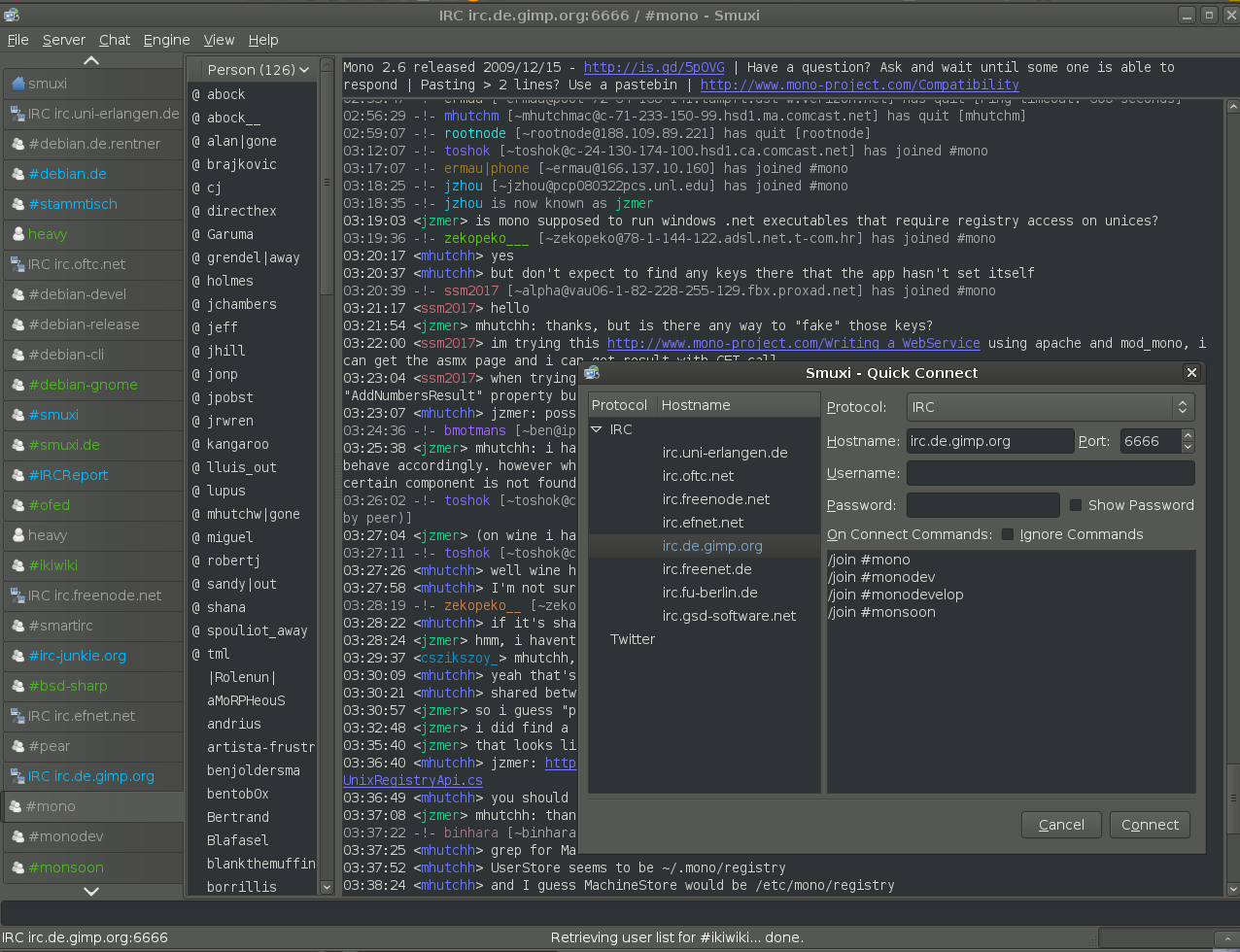
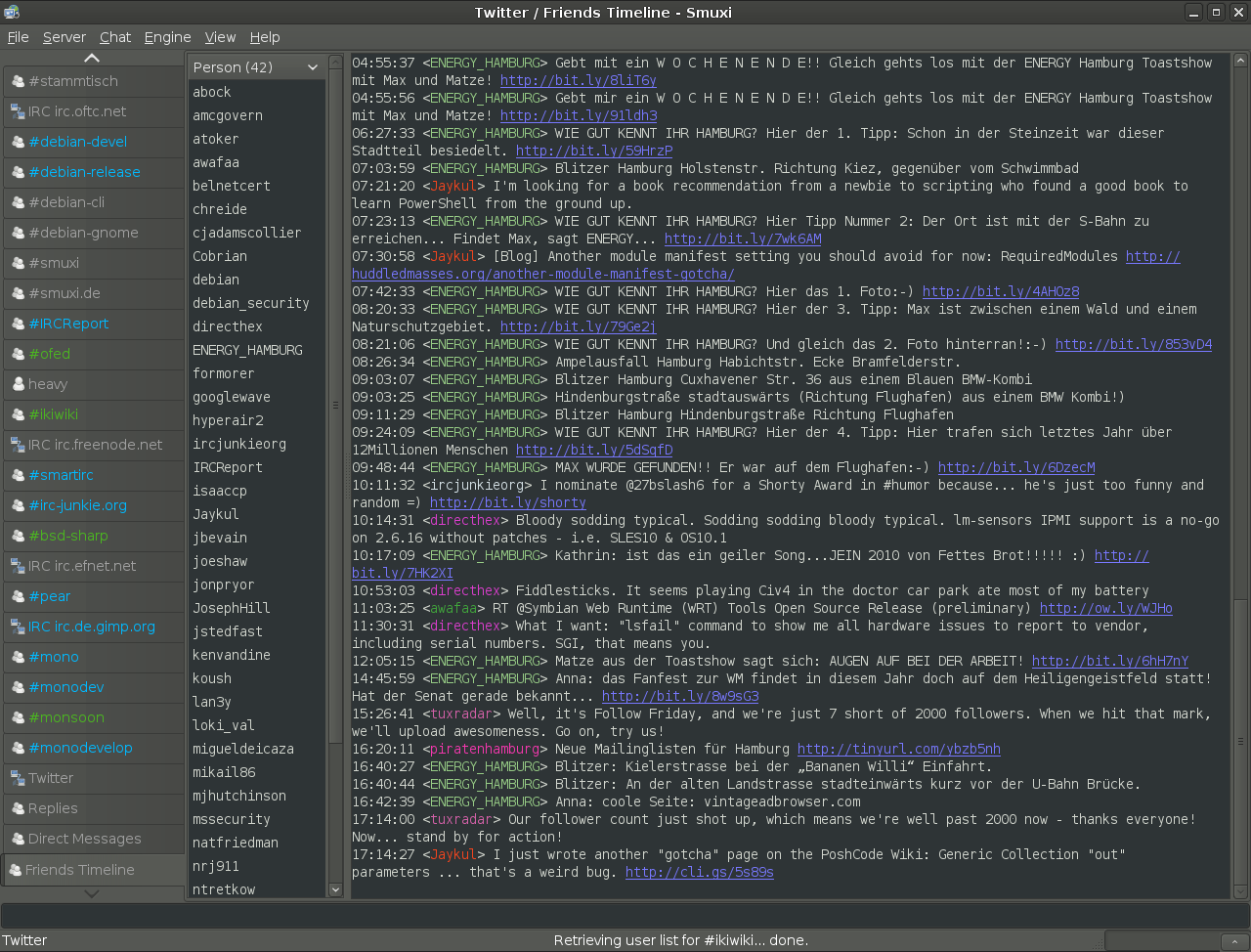
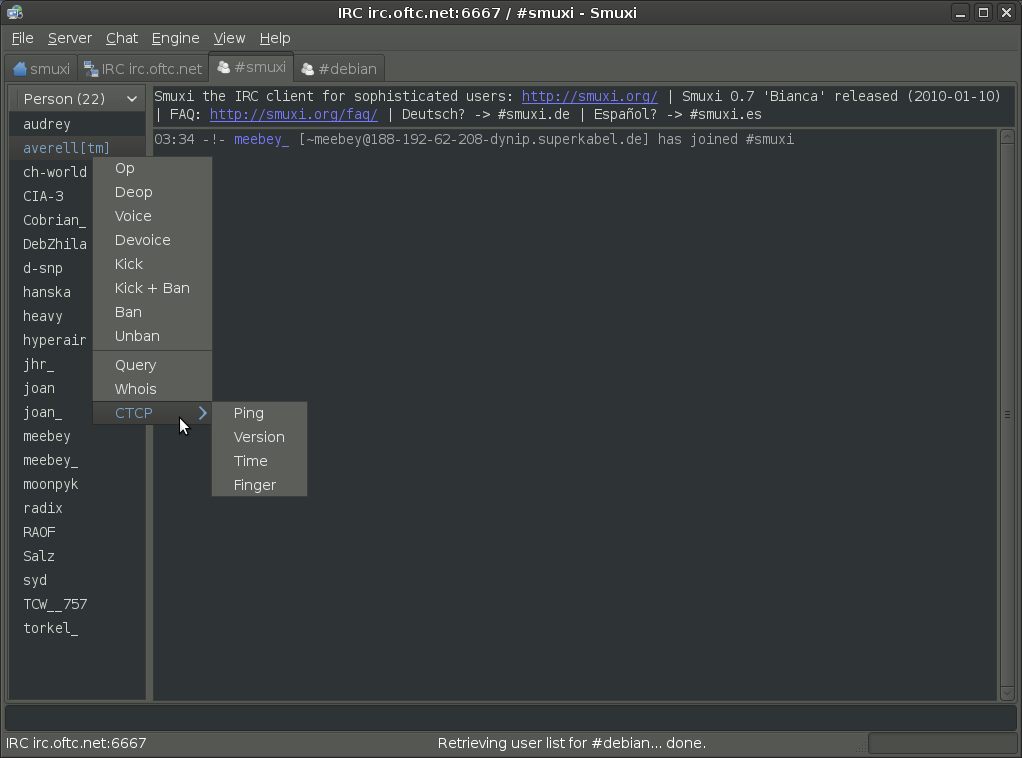
Merry Christmas! Happy New Year! Yeah, it's that time of year again, I am writing a blog post bigsmile.png. As some of you have probably already noticed I managed to get Smuxi 0.7 released a few days ago. Almost all of my Xmas vacation I was hacking on Smuxi. This is the best Smuxi release ever (guaranteed!). The most notable features I implemented in the 0.7 release are: Twitter support, handling for high latency networks (UTMS, WLAN, busy DSL) and an improved IRC experience through tweaks such as splitting oversized messages and new context menus. This release also contains very nice contributions from David Paleino [2] and Cl ment Bourgeois. Both joined the hackfest during my Xmas vacation and made the hacking sessions on Smuxi even more fun. Thanks for that guys! Here you can find a full list of changes. As everbody likes screenshots and as screenshots say a thousand words, here they are: Quick Connect
Twitter
User Menu
Which direction will Smuxi head in after the 0.7 release? For the 0.8 release, I plan to focus on making the IRC support feature complete. That means we will get DCC, SSL, IPv6 and logging support. Nothing of that sounds very special but I am already investigating how Smuxi can be integrated with the promising new Zeitgeist project. I interviewed one of the developers for potential communication between Smuxi and Zeitgeist. Last but not least, I want to announce that I will be attending FOSDEM 2010 in Brussels. I also will give a talk about Smuxi there, scheduled on 2010-02-07 at 16:30. If you want to have a chat, a beer, do some GPG keysigning, or ask me any questions, I am available bigsmile.png PS: If you want more updates than once per year, just follow me on Twitter

16 January 2010

Ingo Juergensmann: Drupal 7 alpha 1 released

As Dries Buytaert, the creator and head of development of Drupal, announced on Twitter, the new major (pre-)version of Drupal, namely Drupal 7 alpha 1 has been released! This was on the 9th birthday of Drupal.

This is great news and the release notes are mentioning some aspects why this is so:

Revamped User Interface
An incredible amount of work has gone into improving the user experience and administration interface. The new administration theme "Seven", the overlay module, the dashboard and the configurable shortcut bar, all lead to a much more user-friendly interface. In-place editing is enabled for blocks and nodes by default, so modifying the content of a site becomes much simpler.

Custom Fields
Drupal 7 bundles in the ability to add custom fields, similar in functionality to the Content Construction Kit (CCK) module. However, fields are no longer limited only to content types; they can be added to users, taxonomy terms, and other entities. Fields also have support for translations.

Image Handling
Drupal 7 brings native image handling to core. Image fields may be added to content, and have image styles applied to them, such as scaling, cropping, and other effects.
Update Manager
Building on Drupal 6's Update module, which keeps site administrators informed when new module and theme releases are available, the new Update Manger module can also install and upgrade modules and themes.

Front-end "under-the-hood" improvements
A new render API allows for highly granular theming, core template files have been revamped to provide more semantic markup, Drupal 7 now has built-in RDFa support, includes jQuery UI and a new AJAX framework, and a new core theme "Stark" which exposes Drupal's markup directly for those who want to dive in and start theming.

In addition, Drupal 7 has several major accessibility enhancements, making it the most accessible release of Drupal to date!

Back-end "under-the-hood" improvements
A revamped database layer resolving nearly all limitations in the Drupal 6 database layer, automated testing framework, new PHP stream-based file API that supports private and public files simultaneously, revamped node access system, new hooks for more flexible system interaction, an Entity API, a job queue API, and many, many, many more improvements.

Drupal 7 is also the most scalable release to date, with features such as built-in proxy server support, advanced caching techniques, and Content Delivery Network support for static files.


Alone the inclusion of CCK and Views are great news, whereas all PostgreSQL users will benefit from the new database layer under the hood. I've tested a pre-alpha development version some weeks ago and that Drupal 7 experience was already great. So, it would be nice to see Drupal 7 in Debian soon as well, but I guess a alpha 1 version might be too early to be packaged.

Miriam Ruiz: Packaging openFrameworks for Ubuntu and Debian

It seems that I m not blogging as often as I was some months ago. The main reason is microblogging, which is somehow quicker, even though briefer. It is also less informative, I guess, because 140 characters is a very limited length. Probably because of that, a friend of mine asked me to write a proper blog entry about this, and I think that he s probably right. openFrameworks is an open source toolkit, released under the MIT license, written in C++ and designed to assist the creative process by providing a simple and intuitive framework for experimentation. According to its authors, it was developed for folks using computers for creative, artistic expression, and who would like low level access to the data inside of media in order manipulate, analyze or explore. I attended a short course in openFrameworks some months ago, and decided that if I wanted to experiment with it, I should somehow structure the building process of the library a bit, remove the dependency on FMOD, which is not DFSG-free, even though that might require remove the whole audio subsystem, make it buildable without Code::Blocks, and hopefully build some more-or-less proper packages. I ve also added some pkg-config files, so that it becomes easier to build projects based in openFrameworks (as easy as g++ source.cpp -o test $(pkg-config openframeworks openframeworks-addons cflags libs) ). Even though the packages are still not as good as they should, they re absolutely usable right now. I ve uploaded them, as well as their dependencies, to my Ubuntu PPA (although I m using those packages in my Debian), in case that someone is interested. I ve also uploaded a couple of tiny examples (the second one downloaded from here) of openFrameworks.

12 January 2010

David Welton: Rough Estimates of the Dollar Cost of Scaling Web Platforms - Part I

I have been pondering the idea behind this article for a while, and finally had a bit of time to implement it. The basic idea is this: certain platforms have higher costs in terms of memory per concurrent connection. Those translate into increased costs in dollar terms.
Nota Bene: Having run LangPop.com for some time, I'm used to people getting hot and bothered about this or that aspect of statistics that are rough in nature, so I'm going to try and address those issues from the start, with more detail below. Methodology All tests were run like so: my new laptop with two cores and four gigs of memory was used as a server, and my older laptop was used to run the ab (Apache Benchmark) program - they're connected via ethernet. I built up to successive levels of concurrency, running first 1 concurrent connection, 2, 10, and so on and so forth. The "server" computer is running Ubuntu 9.10, "karmic". Platforms The platforms I tested: As stated above, it's pretty obvious that using Rails or Django for something so simple is overkill: Better Tests for the Future I would like to run similar tests with a more realistic application, but I simply don't have the time or expertise to sit down and write a blog, say, for all of the above platforms. If I can find a few volunteers, I'd be happy to discuss some rough ideas about what those tests ought to look like. Some ideas: Results With that out of the way, I do think the results are meaningful, and reflect something of what I've seen on various platforms in the real world. First of all, here we look at the total "VSZ" (as ps puts it) or Virtual Size of the process(es) in memory. Much of this might be shared, between libraries, and "copy on write" where applicable. The results are impressive: Rails, followed by Django and PHP eats up a lot of memory for each new concurrent connection. Rails, which I know fairly well, most likely suffers from several problems: 1) it includes a lot of code. That's actually a good thing if you're building a reasonably sized app that makes use of all it has to offer. 2) Its garbage collector doesn't play well with "copy on write". Which is what "Enterprise Ruby" aims to fix. Django and PHP are also fairly large, capable platforms when compared to something small and light like mochiweb. That said, excuses aside, Erlang and Mochiweb are very impressive in how little additional memory they utilize when additional concurrent connections are thrown at them. I was also impressed with Jetty. I don't have a lot of experience with Java on the web (I work more with J2ME for mobile phones), so I expected something a bit more "bloated", which is the reputation Java has. As we'll see below, Jetty does take up a lot of initial memory, but subsequent concurrent connections appear to not take up much. Of course, this is also likely another 'apples and oranges' comparison and it would be good to utilize a complete Java framework, rather than just a tiny web app with one JSP file. So what's this mean in real world terms of dollars and cents? As your Rails application gets more popular, you're going to have to invest relatively more money to make it scale, in terms of memory. For this comparison, I utilized the bytes/dollar that I'm getting for my Linode, which works out to 18,889,040.85 ($79.95 for 1440 MB a month). As we can see, to have a similar amount of concurrent users is essentially free for Mochiweb, whereas with Rails, it has a significant cost. This information is particularly relevant when deciding how to monetize a site: with Erlang and Jetty it would appear that scaling up to lots of users is relatively cheap, so even a small amount of revenue per user per month is going to be a profit, whereas with Rails, scaling up to huge numbers of users is going to be more expensive, so revenue streams such as advertising may not be as viable. It's worth noting that 37 signals, the company that created Rails, is a vocal supporter of charging money for products. There's another interesting statistic that I wanted to include as well. The previous graph shows the average cost per additional concurrent user, but this one shows how much the platform costs (using when there is just one user, so it acts as a sort of baseline: As we can see, Jetty is particularly expensive from this point of view. The default settings (on Ubuntu) seem to indicate that, for instance, the basic $20 a month Linode package would not be sufficient to run Jetty, plus a database, plus other software. I think that the Apache Worker number is off a bit, and may reflect settings made to handle a large number of connections, or perhaps a different MPM would make sense. Source Code / Spreadsheet The spreadsheet I put together is here: http://spreadsheets.google.com/ccc?key=0An76R90VwaRodElEYjVYQXpFRmtreGV3MEtsaWYzbXc&hl=en And the source code (admittedly not terribly well organized) is here: http://github.com/davidw/marginalmemory/

John Goerzen: Sing to Me, Muse

(a review of Homer s Iliad)
Here, therefore, huge and mighty warrior though you be, here shall you die. - Homer (The Iliad)
And with that formidable quote, I begin my review of The Iliad. I shall not exhaust you with a rehashing of the plot; that you can find on Wikipedia. Nor shall I be spending page upon page of analyzing the beautiful imagery, the implications of our understanding of fate and destiny, or all the other things that compel English majors to write page after page on the topic. Nor even shall I try to decipher whether it is a piece of history or a piece of legend. Rather, I intend to talk about why I read it: it s a really good story.
Sing to me, O goddess Muse, the wrath of Achilles, son of Peleus, which brought countless ills upon the Acheans.
As I d be reading it, I d think to myself: Ah ha! Now here we finally have a section of the story that doesn t speak to modern life. Perhaps it was a section the fear of being enslaved or butchered by conquerors, or about pride leading both sides to fight a war they need not have, or a graphic description of a spear going clear through someone s head or neck. And then, I d have to sit and think. Are we really so far removed from that? Here we are, in a supposedly civilized world. We use remotely-operated drones to drop bombs on people, and think it naught but regrettable collateral damage when the brains and intestines of dozens of innocent victims are scattered about, killing them, all for the chance of killing one enemy. But we aren t the only ones to blame; we live in a world in which killing the innocent is often the goal. People fly airplanes into skyscrapers, drop atomic weapons to flatten entire cities, and kill noncombatants in terrible numbers. And for what? A little power, some prestige, some riches, some vengeance, some wounded pride? Slavery is not dead, either. We that can happily afford Internet access most likely abhor the thought. What, though, can we make of the fact that people are starving in this world in record numbers? That our actions may literally wipe some nations off the map? Are those people as free as we are? Do our actions repress them? I suspect you can t read the Iliad without being at least a bit introspective.
Fear, O Achilles, the wrath of heaven; think on your own father and have compassion upon me, who am the more pitiable
One of the great things about reading the Iliad is that I can learn about the culture of the ancient civilizations. Now, of course, one can read about this in history books and Wikipedia. But reading some dry sentence is different from reading a powerful story written by and for them. I know that the Iliad isn t exactly a work of history, but it sure shows what made people tick: their religion, their morals, their behavior, and what they valued. I feel that I finally have some sort of insight into their society, and I am glad of it.
The day that robs a child of his parents severs him from his own kind; his head is bowed, his cheeks are wet with tears, and he will go about destitute among the friends of his father, plucking one by the cloak and another by the shirt. Some one or other of these may so far pity him as to hold the cup for a moment towards him and let him moisten his lips, but he must not drink enough to wet the roof of his mouth; then one whose parents are alive will drive him from the table with blows and angry words.
There are gory battle scenes in the Iliad, but then there are also heart-wrenching tender moments: when Hector leaves his wife to go fight, for instance, and worries about the future of his child if he should die. That s not to say I found the entire story riveting. I would have liked it to be 1/3 shorter. The battle just dragged on and on. And yet, I will grant that there was some purpose served by that: it fatigued me as a reader, which perhaps gave me a small sense of the fatigue felt by the participants in the story.
Why, pray, must the Argives needs fight the Trojans? What made the son of Atreus gather the host and bring them?
A question that was never answered, for either side: why are we so foolish that we must go to war? One tragedy among many is that neither side got smart about it until way too late, if ever they did at all. I read The Illiad in the Butler translation, which overall I liked. Some of these quotes, however, use the Lattimore one. This completes the first item on my 2010 reading list. I leave you with this powerful hope for the future, written almost three thousand years ago. Despite my criticisms above, we have made a lot of progress, haven t we? What a beautiful ideal it is, and what a long ways we have yet to walk.
I wish that strife would vanish away from among gods and mortals, and gall, which makes a man grow angry for all his great mind, that gall of anger that swarms like smoke inside of a man s heart and becomes a thing sweeter to him by far than the dripping of honey.
Sing to me, O goddess, the anger of Achilles, that one day his story may speak less to our hearts, for then will we have outgrown it.

3 January 2010

Robert Collins: More evolution-reliability-speed


Evolution recently moved to a sqlite summary db rather than a custom summary db implementation. Its great to see such reuse of code. However, it s not really a complete transition yet as I ve had cause to find out today. I ve blogged before about performance with the sqlite summary sqlite database. Today I was greet with a crash-on-startup bug which happily has a patch upstream already. Before I looked in the bug tracker though, I did some house cleaning. I started with a 900MB folders.db. Doing a vacuum on the db dropped that to 300MB. It doesn t appear to be something that evolution does itself. Firefox too appears to lack an automatic vacuum. sqlite is an embedded database, and its wonderful at doing that, but its not as install-and-forget as (say) PostgreSQL which does autovacuum. So an additional tip is vacuum your folders, e.g. with http://www.gnome.org/~sragavan/evolution-rebuild-summarydb, a helper script that will run vacuum on all your account summary db s. Note that it *does not rebuild*, it solely vacuums, and as such does not add or delete (modulo bugs in sqlite) data to the summary database. After the housecleaning, I checked that the sqlite database was in good condition:
sqlite3 folders.db
pragma integrity_check;
This returned a number of indexing issues, so I reindexed:
reindex;
Evolution now starts up and crashes in a fraction of a second - a big improvement. Finally, I started looking at the evolution code as I now was fairly confident it was a bug - it was in a sqlite callback function - and the column the function extracts data from (flags) is missing a NOT NULL constraint, but the code doesn't check for NULL - boom. From there to finding the bug report and existing patch was trivial. And this is where my comment on reliability turns up: Evolution doesn't anticipate NULL flag values in its code, so why does it insert them into the database at all ? I suspect its due to some aspect of the incremental conversion to using sqlite summaries. More concerning for me is the possibility that there are many other such crash bugs lurking in the new sqlite based code. There are possibly some clues as to the excessive table scans done by evolution in the use of a flags bitset rather than separate columns, but I haven't looked close enough to really say.

Thorsten Glaser: new MirBSD-current snapshot; more TODO done

The MirBSD Midi-ISO (bi-arch manifold boot) and NetInstall for both i386 and sparc have been upgraded to the 20091226 snapshot (sorry for the delay). A separate news announcement will be done when a full ISO (MirBSD + MirGRML) is done. Other than that, I have fixed a couple of things all over the place, jupp for example. The planned release of mksh R39b is still not done though, as I m only human as well, and too much hacking isn t something one can do without relaxing some in between. On the Debian front, my RCBD #1 was continued, here s #1 results: Explanations: I did go overboard during the first patching session, but I suppose this is what the NM learning period is for too. The autossh maintainer said thanks and will probably integrate my patches, so I don t need to NMU. I could close the dietlibc bug. The other two didn t look as good, I had to separate the fix for the RC bug (and other required fixes, such as ftp-master rejects there were none though) and my other fixes; I submit the former as NMU diffs again and pointed Zack to the .dsc files, and opened the aforementioned two new bugs with the rest of the diffs, so the proper maintainers can take and apply them. There s questioning if gidentd should be removed (see the PR for more); the acorn-fdisk upstream (arm-fdisk it s called there) is not actively developing but will receive patches; the autossh maintainer said thanks but I didn t yet hear back from upstream. The binutils as intel_mode bug was fixed upstream and in experimental for my case, but I had to reopen things because the variant documented in binutils-current still doesn t work, so others (who use the new, more intel-like, syntax) don t run into it. Luk sent me a request to do more mipsel-FTBFS-due-to-toolchain-bugs workarounds. Will do (but can t promise to do so before the upcoming BSP. Robert Millan incorporated something like manifold-boot into GRUB 2, after I described it to him (the debian-bsd@ people are currently sorting out some heisenbugs with it, though). Now there s three variants (but then, this helps spotting bugs that don t appear in all implementations). sendmail 8.13.4 is out, I wonder when OgreBSD will upgrade I could do it myself again, but this time it s not that urgent. Still waiting for the TLS extension, though

1 January 2010

Thorsten Glaser: RCBD #1

My first RC Bug-squashing Day (or rather night): I picked all of them mostly randomly from the list Zack gave me, and except dietlibc they are packages I had not even heard of before. The first one begun easily (track down licencing information, pimp debian/copyright, but I ended up fixing compiler and lintian warnings and even wrote a manpage for it while there (but for this one, I didn t bump the Standards-Version). The second one was only the second one to complete because the others took longer; it s basically a change of a d mon to use two instead of one listening socket, to work with a doble stack OS instead of just a dual stack OS by not using v4-mapped IPv6 addresses (I considered if to use select(2) or poll(2), or to just fork and have two d mons running, but that seemed too ressource-consuming to me so I chose the less-complicated poll(2) method, looking at popa3d(8) s source code (inherited from OpenBSD) in the MirBSD tree since I could not find my network programming book. The third one was basically communicating with upstream; the bug can be blosed with no change to the package. The fourth one took me a while; luckily I have qemu 0.11.0 on MirBSD, and aurel32 s mipsel qemu images helped a great deal; however, cowbuilder --create failed for me, so I ended up waiting almost the entire night for a-g d-u to finish; in the end, it was simply a bug in upstream s configure.ac which is only exposed due to a toolchain bug on mips(el). To do: my AM Zack needs to upload the NMUs (after checking, of course); I need to communicate some of the fixes upstream (the gidentd upstream is NXDOMAIN ), produce a very small testcase for the mipsel toolchain bug, maybe fix some more mipsel FTBFSen as I have a working qemu instance now, but maybe I ll do that at the BSP when I can t find IPv6 bugs or so that I feel I can fix (I also want to do an mksh release which has to be prepared first RSN, and there s still the need to formally publish the MirBSD-current bi-arch snapshot and make another ISO out of it for BT and prepare the multi-BSD USB stick for allbsd.de ). Annoyances: a-g d-u could ask me things at the start before working for some four+ hours instead of in the middle, and the same questions several times (PAM restart). The sid kernel doesn t boot today but did yesterday, the lenny kernel produces this:
Starting the hotplug events dispatcher: udevdudevd[320]: udev: missing sysfs features; please update the kernel or disable the kernel's CONFIG_SYSFS_DEPRECATED option; udev may fail to work correctly
(I hate udev.) And, worst of all, these annoying fireworks (some sounded like originating from inside our staircase, I pity the neighbour s cats) when one wants to hack Finally, I *loathe* CDBS. Debhelper v5 rules! Oh, and I also was under the impression that Firstname LASTNAME was a French thing, and to a much lesser extent Asian. (@bubulle)

29 December 2009

Wouter Verhelst: Perl on the N900

Since about a week, I have a Nokia N900. They're not actually on sale in Belgium yet, but I managed to get hold of one through a grey market shop. The device is quite nice. I do have a few irks with the interface here and there, but Nokia has a public bugzilla that I'll surely use to file bugs whenever and wherever appropriate. And after using it for about a week, I thought of migrating this small application which I once wrote on half an afternoon using perl, postgres, and Gtk2, to the device. It's mainly a cataloguing system that I store my DVD collection in (which has gotten large enough that this is necessary), nothing earthshattering. The ideal candidate to get my feet wet in developing for the N900, so to speak. That effort got stopped dead in its tracks pretty quickly.

Nokia-N900-42-11:~# perl
use Gtk2;
Can't locate Gtk2.pm in @INC (@INC contains: /etc/perl /usr/local/lib/perl/5.8.3 /usr/local/share/perl/5.8.3 /usr/lib/perl5 /usr/share/perl5 /usr/lib/perl/5.8 /usr/share/perl/5.8 /usr/local/lib/site_perl .) at - line 1.
BEGIN failed--compilation aborted at - line 1.
Nokia-N900-42-11:~# apt-cache search perl
perl - Larry Wall's Practical Extraction and Report Language.
libpcrecpp0 - Perl 5 Compatible Regular Expression Library - C++ runtime files
po4a - tools for helping translation of documentation
libpcre3 - Perl 5 Compatible Regular Expression Library - runtime files
libgdbm3 - GNU dbm database routines (runtime version)
perl-base - The Pathologically Eclectic Rubbish Lister.
liblocale-gettext-perl - Using libc functions for internationalization in Perl
Or, in other words: they only ship the perl bits needed to make dpkg run. Hrmpf. This would make stuff slightly more... involved. Oh well.

27 December 2009

Thorsten Glaser: speling[sic!]

With the Lintian 2.3.0 saturday-after-christmas release (by the way, over here if it s done twice it ll really become tradition) I ve run its spelling tests over all of MirOS CVS repository. The result: 293 kinds of typos in 35857 souce files. (Although there are the case things too. Without them, I have 51 typos in 7206 files. Asides from false positives (I used fgrep -rwl[i], and -i and -w don t play well together, and -w mis-catches GTK+ as GTK ) I probably can t (API, source code) or won t fix all of them though.) However, I have some rather hot asia-style food to eat right now, and will need to get up early tomorrow for work, so I am not applying/fixing them right now. (bsiegert@ and gecko2@ however are enjoying themselves at 26C3, see their wlog entries.) Note that all of today s fixes will not make it into the next MirBSD snapshot already, since it s built (i386) and building X11 already (sparc). On the other hand, the next bunch of WTF *.deb files will have them. I also need to fix makefs upstream for Hurd and continue the T&S questionnaire *sigh* Update: I suppose this is my Hello, Pl net Debian! posting (thanks aptituz!) well, my packages in the archive were already lintian clean, in case someone wonders (I did recheck with 2.3.0 though). My point was, why not use checking tools from one universe for another one, viceque versa? (Similar to synergy effects from knowledge.)

24 December 2009

Andrew Pollock: [life] Homeowners!

There was a minor hiccup yesterday. Our mortgage broker called me up towards the end of the day in a flap because something had gone wrong on the seller's side of things, and their bank hadn't accepted the transaction or something. I still don't know the full story. Something about them missing a mortgage payment possibly. Anyway, she was able to arrange for funding and closing today, instead of funding yesterday and closing today, so the outcome was still the same. Now the real fun starts. The first thing I did tonight was program the garage door opener into the Prius' HomeLink thingy built into the rear vision mirror. It's always nice to be able to use a feature, even if it's taken 4 years.

Next.

Previous.