Search Results: "sf"

13 April 2020

Giovanni Mascellani: DKIM for Debian Developers

What is DKIM? DKIM (DomainKeys Identified Mail), as Wikipedia puts it, "is an email authentication method designed to detect forged sender addresses in emails (email spoofing), a technique often used in phishing and email spam". More prosaically, one of the reasons email spam is so abundant is that, given a certain email message, there is no simple way to know for certain who sent it and how reputable they are. So even if people having addresses @debian.org are very nice and well-behaving, any random spammer can easily send emails from whatever@debian.org, and even if you trust people from @debian.org you cannot easily configure your antispam filter to just accept all emails from @debian.org, because spammers would get in too. Since nearly ten years DKIM is there to help you. If you send an email from @debian.org with DKIM, it will have a header like this:
DKIM-Signature: v=1; a=rsa-sha256; c=simple/simple; d=debian.org;
    s=vps.gio.user; t=1586779391;
    bh=B6tckJy2cynGjNRdm3lhFDrp0tD7fF8hS4x0FCfLADo=;
    h=From:Subject:To:Date:From;
    b=H4EDlATxVm7XNqPy2x7IqCchBUz1SxFtUSstB23BAsdyTKJIohM0O4RRWhrQX+pqE
     prPVhzcfNALMwlfExNE69940Q6pMCuYsoxNQjU7Jl/UX1q6PGqdVSO+mKv/aEI+N49
     vvYNgPJNLaAFnYqbWCPI8mNskLHLe2VFYjSjE4GJFOxl9o2Gpe9f5035FYPJ/hnqBF
     XPnZq7Osd9UtBrBq8agEooTCZHbNFSyiXdS0qp1ts7HAo/rfrBfbQSk39fOOQ5GbjV
     6FehkN4GAXFNoFnjfmjrVDJC6hvA8m0tJHbmZrNQS0ljG/SyffW4OTlzFzu4jOmDNi
     UHLnEgT07eucw==
The field d=debian.org is the domain this email claims to be from and the fields bh= and b= are a cryptographic public key signature certifying this fact. How do I check that the email is actually from @debian.org? I use the selector s=vps.gio.user to fetch the public key via DNS, and then use the public key to verify the signature.
$ host -t TXT vps.gio.user._domainkey.debian.org
vps.gio.user._domainkey.debian.org descriptive text "v=DKIM1; k=rsa; s=email; h=sha256; p=" "MIIBIjANBgkqhkiG9w0BAQEFAAOCAQ8AMIIBCgKCAQEAsM/W/kxtKWT58Eak0cfm/ntvurfbkkvugrG2jfvSMnHHkFyfJ34Xvn/HhQPLwX1QsjhuLV+tW+BQtxY7jxSABCee6nHQRBrpDej1t86ubw3CSrxcg1mzJI5BbL8un0cwYoBtUvhCYAZKarv1W2otCGs43L0s" "GtEqqtmYN/hIVVm4FcqeYS1cYrZxDsjPzCEocpYBhqHh1MTeUEddVmPHKZswzvllaWF0mgIXrfDNAE0LiX39aFKWtgvflrYFKiL4hCDnBcP2Mr71TVblfDY0wEdAEbGEJqHR1SxvWyn0UU1ZL4vTcylB/KJuV2gMhznOjbnQ6cjAhr2JYpweTYzz3wIDAQAB"
There it is! Debian declares in its DNS record that that key is authorized to sign outbound email from @debian.org. The spammer hopefully does not have access to Debian's DKIM keys, and they cannot sign emails. Many large and small email services have already deployed DKIM since years, while most @debian.org emails still do not use it. Why not? Because people send @debian.org emails from many different servers. Basically, every DD used their @debian.org address sends email from their own mail server, and those mail servers (fortunately) do not have access to Debian's DNS record to install their DKIM keys. Well, that was true until yesterday! :-) A few weeks ago I poked DSA asking to allow any Debian Developer to install their DKIM keys, so that DDs could use DKIM to sign their emails and hopefully reduce the amount of spam sent from @debian.org. They have done it (thank you DSA very much, especially adsb), and now it is possible to use it! How do I configure it? I will not write here a full DKIM tutorial, there are many around. You have to use opendkim-genkey to generate a key and then configure your mail server to use opendkim to digitally sign outbound email. There are a few Debian-specific things you have to care about, though. First the have to choose a selector, which is a string used to distinguish many DKIM keys belonging to the same domain. Debian allows you to installa a key whose selector is <something>.<uid>.user, where <uid> is your Debian uid (this is done both for namespacing reasons and for exposing who might be abusing the system). So check carefully that your selector has this form. Then you cannot edit directly Debian's DNS record. But you can use the email-LDAP gateway on db.debian.org to install your key in a way similar to how entries in debian.net are handled (see the updated documentation). Specifically, suppose that opendkim-genkey generated the following thing for selector vps.gio.user and domain debian.org:
vps.gio.user._domainkey IN  TXT ( "v=DKIM1; h=sha256; k=rsa; "
      "p=MIIBIjANBgkqhkiG9w0BAQEFAAOCAQ8AMIIBCgKCAQEAsM/W/kxtKWT58Eak0cfm/ntvurfbkkvugrG2jfvSMnHHkFyfJ34Xvn/HhQPLwX1QsjhuLV+tW+BQtxY7jxSABCee6nHQRBrpDej1t86ubw3CSrxcg1mzJI5BbL8un0cwYoBtUvhCYAZKarv1W2otCGs43L0sGtEqqtmYN/hIVVm4FcqeYS1cYrZxDsjPzCEocpYBhqHh1MTeUE"
      "ddVmPHKZswzvllaWF0mgIXrfDNAE0LiX39aFKWtgvflrYFKiL4hCDnBcP2Mr71TVblfDY0wEdAEbGEJqHR1SxvWyn0UU1ZL4vTcylB/KJuV2gMhznOjbnQ6cjAhr2JYpweTYzz3wIDAQAB" )  ; ----- DKIM key vps.gio.user for debian.org
Then you have to carefully copy the content of the p= field (without being fooled by it being split between different strings) and construct a request of the form:
dkimPubKey: vps.gio.user MIIBIjANBgkqhkiG9w0BAQEFAAOCAQ8AMIIBCgKCAQEAsM/W/kxtKWT58Eak0cfm/ntvurfbkkvugrG2jfvSMnHHkFyfJ34Xvn/HhQPLwX1QsjhuLV+tW+BQtxY7jxSABCee6nHQRBrpDej1t86ubw3CSrxcg1mzJI5BbL8un0cwYoBtUvhCYAZKarv1W2otCGs43L0sGtEqqtmYN/hIVVm4FcqeYS1cYrZxDsjPzCEocpYBhqHh1MTeUEddVmPHKZswzvllaWF0mgIXrfDNAE0LiX39aFKWtgvflrYFKiL4hCDnBcP2Mr71TVblfDY0wEdAEbGEJqHR1SxvWyn0UU1ZL4vTcylB/KJuV2gMhznOjbnQ6cjAhr2JYpweTYzz3wIDAQAB
and then send it GPG-signed to changes@db.debian.org:
echo 'dkimPubKey: vps.gio.user blahblahblah'   gpg --clearsign   mail changes@db.debian.org
Then use host -t TXT vps.gio.user._domainkey.debian.org to chech the key gets published (it will probably take some minutes/hours, I don't know). Once it is published, you can enable DKIM in you mail server and your email will be signed. Congratulations, you will not look like a spammer any more! You can send an email to check-auth@verifier.port25.com to check that your setup is correct. They will reply with a report, including the success of DKIM test. Notice that currently Debian's setup only allows you to use RSA DKIM keys and doesn't allow you to set other DKIM fields (but you probably won't need to set them). EDIT DSA made an official announcement about DKIM support, which you might want to check out as well, together with its links. EDIT 2 Now ed25519 keys are supported, the syntax for specifying keys on LDAP is a little bit more flexible and you can also insert CNAME records. See the official documentation for the updated details. So we have solved our problems with spam? Ha, no! DKIM is only a small step. Useful, also because it enable other steps to be taken in the future, but small. In particular, DKIM enables you to say: "This particular email actually comes from @debian.org", but doesn't tell anybody what to do with emails that are not signed. A third-party mail server might wonder whether @debian.org emails are actually supposed to be signed or not. There is another standard for dealing with that, which is called DMARD, and I believe that Debian should eventually use it, but not now: the problem is that currently virtually no email from @debian.org is signed with DKIM, so if DMARC was enabled other mail servers would start to nuke all @debian.org emails, except those which are already signed, a minority. If people and services sending emails from @debian.org will start configuring DKIM on their servers, which is now possible, it will eventually come a time when DMARC can be enabled, and spammers will find themselves unable to send forged @debian.org emails. We are not there yet, but todays we are a little step closer than yesterday. Also, notice that having DKIM on @debian.org only counters spam pretending to be from @debian.org, but there is much more. The policy on what to accept is mostly independent on that on what you send. However, knowing that @debian.org emails have DKIM and DMARC would mean that we can set our spam filters to be more aggressive in general, but whitelist official Debian Developers and services. And the same can be done for other domains using DKIM and DMARC. Finally, notice that some incompatibilities between DKIM and mailing lists are known, and do not have a definitive answer yet. Basically, most mailing list engines modify either the body of the headers in forwarded emails, which means that DKIM does not validate any more. There are many proposed solutions, possibly none completely satisfying, but since spam is not very satisfying as well, something will have to be worked out. I wrote a lot already, though, so I wont't discuss this here.

7 April 2020

Shirish Agarwal: GMRT 2020 and lots of stories

First of all, congratulations to all those who got us 2022 Debconf, so we will finally have a debconf in India. There is of course, lot of work to be done between now and then. For those who would be looking forward to visit India and especially Kochi I would suggest you to hear this enriching tale
I am sorry I used youtube link but it is too good a podcast not to be shared. Those who don t want youtube can use the invidio.us link for the same as shared below. https://www.invidio.us/watch?v=BvjgKuKmnQ4 I am sure there are lot more details, questions, answers etc. but would direct them gently to Praveen, Shruti, Balasankar and the rest who are from Kochi to answer if you have any questions about that history.

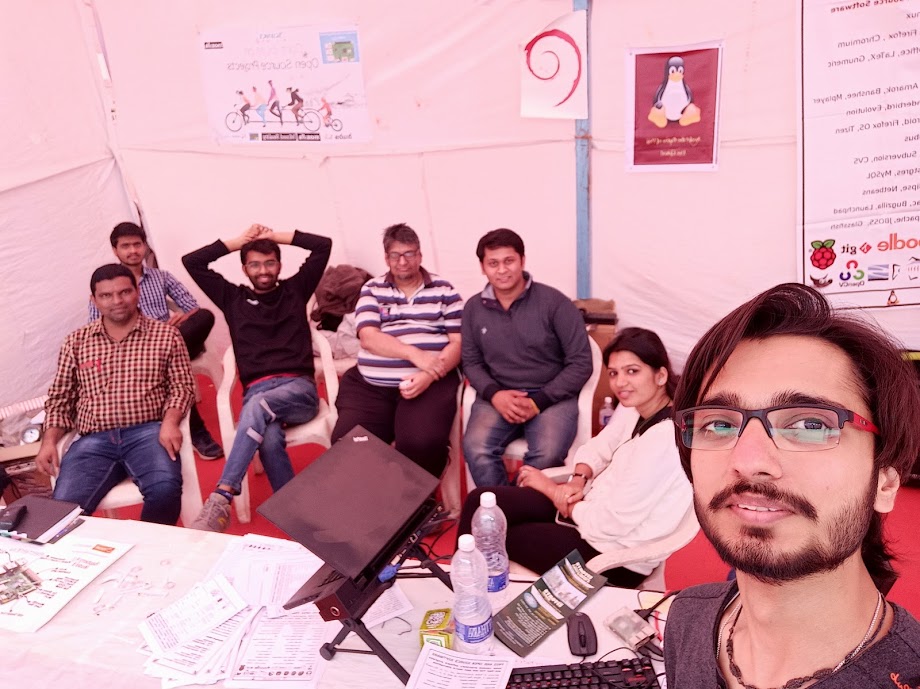
National Science Day, GMRT 2020 First, as always, we are and were grateful to both NCRA as well as GMRT for taking such good care of us. Even though Akshat was not around, probably getting engaged, a few of us were there. About 6-7 from the Mozilla Nasik while the rest representing the foss community. Here is a small picture which commentrates the event
National Science Day, GMRT 2020
While there is and was a lot to share about the event. For e.g. Akshay had bought RPI- Zero as well as RPI-2 (Raspberry Pi s ) and showed some things. He had also bought up a Debian stable live drive with persistence although the glare from the sun was too much that we couldn t show it to clearly to students. This was also the case with RPI but still we shared what and how much we could. Maybe next year, we either ask them to have double screens or give us dark room so we can showcase things much better. We did try playing with contrast and all but it didn t have much of an effect  . Of course in another stall few students had used RPI s as part of their projects so at times we did tell some of the newbies to go to those stalls and see and ask about those projects so they would have a much wider experience of things. The Mozilla people were pushing VR as well as Mozilla lite the browser for the mobile. We also gossiped quite a bit. I shared about indicatelts , a third-party certificate extension although I dunno if I should file a wnpp about it or not. We didn t have a good experience of when I had put an RFP (Request for Package) which was accepted for an extension which had similar functionality which we later come to know was sharing the sites people were using the extension to call home and share both the URL and the IP Address they were using it from. Sadly, didn t leave a good taste in mouth

Delhi Riots One thing I have been disappointed with is the lack of general awareness about things especially in the youth. We have people who didn t know that for e.g. in the Delhi riots which happened recently the law and order (Police) lies with Home Minister of India, Amit Shah. This is perhaps the only capital in the world which has its own Chief Minister but doesn t have any say on its law and order. And this has been the case for last 70 years i.e. since independance. The closest I know so far is the UK but they too changed their tune in 2012. India and especially Delhi seems to be in a time-capsule which while being dysfunctional somehow is made to work. In many ways, it s three body or a body split into three personalities which often makes governance a messy issue but that probably is a topic for another day. In fact, scroll had written a beautiful editorial that full statehood for Delhi was not only Arvind Kejriwal s call (AAP) but also something that both BJP as well as Congress had asked in the past. In fact, nothing about the policing is in AAP s power. All salaries, postings, transfers of police personnel everything is done by the Home Ministry, so if any blame has to be given it has to be given to the Home Ministry for the same.

American Capitalism and Ventilators America had been having a history of high cost healthcare as can be seen in this edition of USA today from 2017 . The Affordable Care Act was signed as a law by President Obama in 2010 which Mr. Trump curtailed when he came into power couple of years back. An estimated 80,000 people died due to seasonal flu in 2018-19 . Similarly, anywhere between 24-63,000 have supposed to have died from Last October to February-March this year. Now if the richest country can t take care of their population which is 1/3rd of the population of this country while at the same time United States has thrice the area that India has. This I am sharing as seasonal flu also strikes the elderly as well as young children more than adults. So in one senses, the vulnerable groups overlap although from some of the recent stats, for Covid-19 even those who are 20+ are also vulnerable but that s another story altogether. If you see the CDC graph of the seasonal flu it is clear that American health experts knew about it. One another common factor which joins both the seasonal flu and covid is both need ventilators for the most serious cases. So, in 2007 it was decided that the number of ventilators needed to be ramped up, they had approximately 62k ventilators at that point in time all over U.S. The U.S. in 2010, asked for bids and got bid from a small californian company called Newport Medic Instruments. The price of the ventilators was approximately INR 700000 at 2010 prices, while Newport said they would be able to mass-produce at INR 200000 at 2010 prices. The company got the order and they started designing the model which needed to be certified by FDA. By 2011, they got the product ready when a big company called Covidgen bought Newport Medic and shutdown the project. This was shared in a press release in 2012. The whole story was broken by New York Times again, just a few days ago which highlighted how America s capitalism rough shod over public health and put people s life unnecessarily in jeopardy. If those new-age ventilators would have been a reality then not just U.S. but India and many other countries would have bought the ventilators as every county has same/similar needs but are unable to pay the high cost which in many cases would be passed on to their citizens either as price of service, or by raising taxes or a mixture of both with public being none the wiser. Due to dearth of ventilators and specialized people to operate it and space, there is possibility that many countries including India may have to make tough choices like Italian doctors had to make as to who to give ventilator to and have the mental and emotional guilt which would be associated with the choices made.

Some science coverage about diseases in wire and other publications Since Covid coverage broke out, the wire has been bringing various reports of India s handling of various epidemics, mysteries, some solved, some still remaining unsolved due to lack of interest or funding or both. The Nipah virus has been amply discussed in the movie Virus (2019) which I shared in the last blog post and how easily it could have been similar to Italy in Kerala. Thankfully, only 24 people including a nurse succumbed to that outbreak as shared in the movie. I had shared about Kerala nurses professionalism when I was in hospital couple of years back. It s no wonder that their understanding of hygeine and nursing procedures are a cut above the rest hence they are sought after not just in India but world-over including US and UK and the middle-east. Another study on respitory illness was bought to my attention by my friend Pavithran.

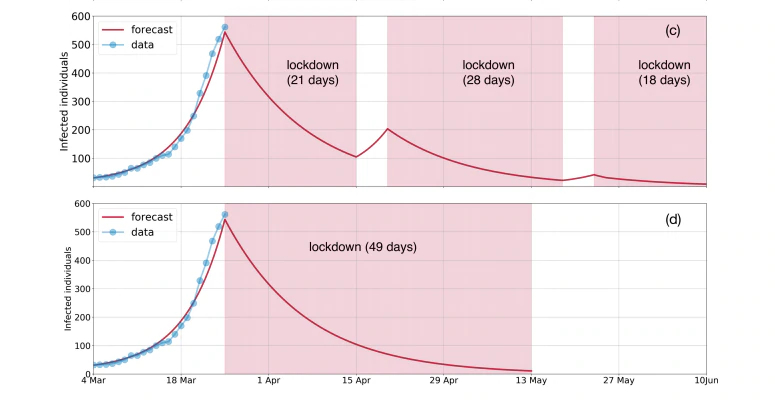
Possibility of extended lockdown in India There was talk in the media of extended lockdown or better put an environment is being created so that an extended lockdown can be done. This is probably in part due to a mathematical model and its derivatives shared by two Indian-origin Cambridge scholars who predict that a minimum 49 days lockdown may be necessary to flatten the covid curve about a week back.
Predictions of the outcome of the current 21-day lockdown (Source: Rajesh Singh, R. Adhikari, Cambridge University)
Alternative lockdown strategies suggested by the Cambridge model (Source: Rajesh Singh, R. Adhikari, Cambridge University)
India caving to US pressure on Hydroxychloroquine While there has been lot of speculation in U.S. about Hydroxychloroquine as the wonder cure, last night Mr. Trump threatened India in a response to a reporter that Mr. Modi has to say no for Hydroxychloroquine and there may be retaliations.
As shared before if youtube is not your cup you can see the same on invidio.us https://www.invidio.us/watch?v=YP-ewgoJPLw Now while there have been several instances in the past of U.S. trying to bully India, going all the way back to 1954. In fact, in recent memory, there were sanctions on India by US under Atal Bihari Vajpayee Government (BJP) 1998 but he didn t buckle under the pressure and now we see our current PM taking down our own notification from a day ago and not just sharing Hydroxychloroquine but also Paracetemol to other countries so it would look as if India is sharing with other countries. Keep in mind, that India, Brazil haven t seen eye to eye on trade agreements of late and Paracetemol prices have risen in India. The price rise has been because the API (Active Pharmaceutical Ingredients) for the same come from China where the supply chain will take time to be fixed and we would also have to open up, although should we, should we not is another question altogether. I talk about supply chains as lean supply chains were the talk since late 90 s when the Japanese introduced Just-in-time manufacturing which lead to lean supply chains as well as lot of outsourcing as consequence. Of course, the companies saved money but at the cost of flexibility and how this model was perhaps flawed was shared by a series of articles in Economist as early as 2004 when there were lot of shocks to that model and would be exaberated since then. There have been frequent shocks to these fragile ecosystem more since 2008 after the financial meltdown and this would put more companies out of business than ever before. The MSME sector in India had already been severely impacted first by demonetization and then by the horrendous implementation of GST whose cries can be heard from all sectors. Also the frequent changing of GST taxes has made markets jumpy and investors unsure. With judgements such as retrospective taxes, AGR (Adjusted Gross Revenue) etc. it made not only the international investors scared, but also domestic investors. The flight of the capital has been noticeable. This I had shared before when Indian Government shared about LRS report which it hasn t since then. In fact Outlook Business had an interesting article about it where incidentally it talked about localcircles, a community networking platform where you get to know of lot of things and whom I am also a member of. At the very end I apologize for not sharing the blog post before but then I was feeling down but then I m not the only one.

6 April 2020

Joachim Breitner: A Telegram bot in Haskell on Amazon Lambda

I just had a weekend full of very successful serious geekery. On a whim I thought: Wouldn't it be nice if people could interact with my game Kaleidogen also via a telegram bot? This led me to learn about how I write a Telegram bot in Haskell and how I can deploy such a Haskell program to Amazon Lambda. In particular the latter bit might be interesting to some of my readers, so here is how went about it.

Kaleidogen Kaleidogen is a little contemplative game (or toy game where, starting from just unicolored disks, you combine abstract circular patterns to breed more interesting patterns. See my FARM 2019 talk for more details, or check out the source repository. BTW, I am looking for help turning it into an Android app!
KaleidogenBot in action

KaleidogenBot in action

Amazon Lambda Amazon Lambda is the Function as a service offering of Amazon Web Services. The idea is that you don t rent a server, where you have to deal with managing the whole system and that you are paying for constantly, but you just upload the code that responds to outside requests, and AWS takes care of the rest: Starting and stopping instances, providing a secure base system etc. When nobody is using the service, no cost occurs. This sounds ideal for hosting a toy Telegram bot: Most of the time nobody will be using it, and I really don't want to have to baby sit yet another service on my server. On Amazon Lambda, I can probably just forget about it. But Haskell is not one of the officially supported languages on Amazon Lambda. So to run Haskell on Lambda, one has to solve two problems:
  • how to invoke the Haskell code on the server, and
  • how to build Haskell so that it runs on the Amazon Linux distribution

A Haskell runtime for Lambda For the first we need a custom runtime. While this sounds complicated, it is actually a pretty simple concept: A runtime is an executable called bootstrap that queries the Lambda Runtime Interface for the next request to handle. The Lambda documentation is phrased as if this runtime has to be a dispatcher that calls the separate function s handler. But it could just do all the things directly. I found the Haskell package aws-lambda-haskell-runtime which provides precisely that: A function
runLambda :: (LambdaOptions -> IO (Either String LambdaResult)) -> IO ()
that talks to the Lambda Runtime API and invokes its argument on each message. The package also provides Template Haskell magic to collect handlers of any JSON-able type and generates a dispatcher, like you might expect from other, more dynamic languages. But that was too much magic for me, so I ignored that and just wrote the handler manually:
main :: IO ()
main = runLambda run
  where
   run ::  LambdaOptions -> IO (Either String LambdaResult)
   run opts = do
    result <- handler (decodeObj (eventObject opts)) (decodeObj (contextObject opts))
    either (pure . Left . encodeObj) (pure . Right . LambdaResult . encodeObj) result
data Event = Event
    path :: T.Text
  , body :: Maybe T.Text
    deriving (Generic, FromJSON)
data Response = Response
    statusCode :: Int
  , headers :: Value
  , body :: T.Text
  , isBase64Encoded :: Bool
    deriving (Generic, ToJSON)
handler :: Event -> Context -> IO (Either String Response)
handler Event body, path  context =
 
I expose my Lambda function to the world via Amazon s API Gateway, configured to just proxy the HTTP requests. This means that my code receives a JSON data structure describing the HTTP request (here called Event, listing only the fields I care about), and it will respond with a Response, again as JSON. The handler can then simply pattern-match on the path to decide what to do. For example this code handles URLs like /img/CAFFEEFACE.png, and responds with an image.
handler :: TC -> Event -> Context -> IO (Either String Response)
handler Event body, path  context
      Just bytes <- isImgPath path >>= T.decodeHex = do
        let pngData = genPurePNG bytes
        pure $ Right Response
              statusCode = 200
            , headers = object [ "Content-Type" .= ("image/png" :: String) ]
            , isBase64Encoded = True
            , body = T.decodeUtf8 $ LBS.toStrict $ Base64.encode pngData
             
     
isImgPath :: T.Text -> Maybe T.Text
isImgPath  = T.stripPrefix "/img/" >=> T.stripSuffix ".png"
If this program would grow more, then one should probably use something more structured for routing here; maybe servant, or bridging towards wai apps (amost like wai-lamda, but that still assumes an existing runtime, instead of simply being the runtime). But for my purposes, no extra layers of indirection or abstraction are needed!

Deploying Haskell to Lambda Building Haskell locally and deploying to different machiens is notoriously tricky; you often end up depending on a shared library that is not available on the other platform. The aws-lambda-haskell-runtime package, and similar projects like serverless-haskell, solve this using stack and Docker two technologies that are probably great, but I never warmed up to them. So instead adding layers and complexities, can I solve this instead my making things simpler? If I compiler my bootstrap into a static Linux binary, it should run on any Linux, including Amazon Linux. Unfortunately, building Haskell programs statically is also notoriously tricky. But it is made much simpler by the work of Niklas Hamb chen and others in the context of the Nix package manager, coordinated in the static-haskell-nix project. The promise here is that once you have set up building your project with Nix, then getting a static version is just one flag away. The support is not completely upstreamed into nixpkgs proper yet, but their repository has a nix file that contains a nixpkgs set with their patches:
let pkgs = (import (sources.nixpkgs-static + "/survey/default.nix")  ).pkgs; in
This, plus a fairly standard nix setup to build the package, yields what I was hoping for:
$ nix-build -A kaleidogen
/nix/store/ppwyq4d964ahd6k56wsklh93vzw07ln0-kaleidogen-0.1.0.0
$ file result/bin/kaleidogen-amazon-lambda
result/bin/kaleidogen-amazon-lambda: ELF 64-bit LSB executable, x86-64, version 1 (SYSV), statically linked, stripped
$ ls -sh result/bin/kaleidogen-amazon-lambda
6,7M result/bin/kaleidogen-amazon-lambda
If we put this file, named bootstrap, into a zip file and upload it to Amazon Lambda, then it just works! Creating the zip file is easily scripted using nix:
  function-zip = pkgs.runCommandNoCC "kaleidogen-lambda"  
    buildInputs = [ pkgs.zip ];
    ''
    mkdir -p $out
    cp $ kaleidogen /bin/kaleidogen-amazon-lambda bootstrap
    zip $out/function.zip bootstrap
  '';
So to upload this, I use this one-liner (line-wrapped for your convenience):
nix-build -A function-zip &&
aws lambda update-function-code --function-name kaleidogen \
  --zip-file fileb://result/function.zip
Thanks to how Nix pins all dependencies, I am fairly confident that I can return to this project in 4 months and still be able to build it. Of course, I want continuous integration and deployment. So I build the project with GitHub Actions, using a cachix nix cache to significantly speed up the build, and auto-deploy to Lambda using aws-lambda-deploy; see my workflow file for details.

The Telegram part The above allows me to run basically any stateless service, and a Telegram bot is nothing else: When configured to act as a WebHook, Telegram will send a request with a message to our Lambda function, where we can react on it. The telegram-api package provides bindigs for the Telegram Bot API (although I had to use the repository version, as the version on Hackage has some bitrot). Slightly simplified I can write a handler for an Update:
handleUpdate :: Update -> TelegramClient ()
handleUpdate Update  message = Just m   = do
  let c = ChatId (chat_id (chat m))
  liftIO $ printf "message from %s: %s\n" (maybe "?" user_first_name (from m)) (maybe "" T.unpack (text m))
  if "/start"  T.isPrefixOf  fromMaybe "" (text m)
  then do
    rm <- sendMessageM $ sendMessageRequest c "Hi! I am @KaleidogenBot.  "
    return ()
  else do
    m1 <- sendMessageM $ sendMessageRequest c "One moment "
    withPNGFile  $ \pngFN -> do
      m2 <- uploadPhotoM $ uploadPhotoRequest c
        (FileUpload (Just "image/png") (FileUploadFile pngFN))
      return ()
handleUpdate _ u =
  liftIO $ putStrLn $ "Unhandled message: " ++ show u
and call this from the handler that I wrote above:
     
      path == "/telegram" =
      case eitherDecode (LBS.fromStrict (T.encodeUtf8 (fromMaybe "" body))) of
        Left err ->  
        Right update -> do
          runTelegramClient token manager $ handleUpdate Nothing update
          pure $ Right Response
              statusCode = 200
            , headers = object [ "Content-Type" .= ("text/plain" :: String) ]
            , isBase64Encoded = False
            , body = "Done"
             
     
Note that the Lambda code receives the request as JSON data structure with a body that contains the original HTTP request body. Which, in this case, is itself JSON, so we have to decode that. All that is left to do is to tell Telegram where this code lives:
curl --request POST \
  --url https://api.telegram.org/bot<token>/setWebhook
  --header 'content-type: application/json'
  --data ' "url": "https://api.kaleidogen.nomeata.de/telegram" '
As a little add on, I also created a Telegram game for Kaleidogen. A Telegram game is nothing but a webpage that runs inside Telegram, so it wasn t much work to wrap the Web version of Kaleidogen that way, but the resulting Telegram game (which you can access via https://core.telegram.org/bots/games) still looks pretty neat.

No /dev/dri/renderD128 I am mostly happy with this setup: My game is now available to more people in more ways. I don t have to maintain any infrastructure. When nobody is using this bot no resources are wasted, and the costs of the service are neglectible -- this is unlikely to go beyond the free tier, and even if it would, the cost per generated image is roughly USD 0.000021. There is one slight disappointment, though. What I find most intersting about Kaleidogen from a technical point of view is that when you play it in the browser, the images are not generated by my code. Instead, my code creates a WebGL shader program on the fly, and that program generates the image on your graphics card. I even managed to make the GL rendering code work headlessly, i.e. from a command line program, using EGL and libgbm and a helper written in C. But it needs access to a graphics card via /dev/dri/renderD128. Amazon does not provide that to Lambda code, and neither do the other big Function-as-a-service providers. So I had to swallow my pride and reimplement the rendering in pure Haskell. So if you think the bot is kinda slow, then that s why. Despite properly optimizing the pure implementation (the inner loop does not do allocations and deals only with unboxed Double# values), the GL shader version is still three times as fast. Maybe in a few years GPU access will be so ubiquitous that it s even on Amazon Lambda; then I can easily use that.

5 April 2020

Vincent Bernat: Safer SSH agent forwarding

ssh-agent is a program to hold in memory the private keys used by SSH for public-key authentication. When the agent is running, ssh forwards to it the signature requests from the server. The agent performs the private key operations and returns the results to ssh. It is useful if you keep your private keys encrypted on disk and you don t want to type the password at each connection. Keeping the agent secure is critical: someone able to communicate with the agent can authenticate on your behalf on remote servers. ssh also provides the ability to forward the agent to a remote server. From this remote server, you can authenticate to another server using your local agent, without copying your private key on the intermediate server. As stated in the manual page, this is dangerous!
Agent forwarding should be enabled with caution. Users with the ability to bypass file permissions on the remote host (for the agent s UNIX-domain socket) can access the local agent through the forwarded connection. An attacker cannot obtain key material from the agent, however they can perform operations on the keys that enable them to authenticate using the identities loaded into the agent. A safer alternative may be to use a jump host (see -J).
As mentioned, a better alternative is to use the jump host feature: the SSH connection to the target host is tunneled through the SSH connection to the jump host. See the manual page and this blog post for more details.
If you really need to use SSH agent forwarding, you can secure it a bit through a dedicated agent with two main attributes: The following alias around the ssh command will spawn such an ephemeral agent:
alias assh="ssh-agent ssh -o AddKeysToAgent=confirm -o ForwardAgent=yes"
With the -o AddKeysToAgent=confirm directive, ssh adds the unencrypted private key to the agent but each use must be confirmed.1 Once connected, you get a password prompt for each signature request:2
ssh-agent prompt confirmation with fingerprint and yes/no buttons
Request for the agent to use the specified private key
But, again, avoid using agent forwarding!

Update (2020-04) In a previous version of this article, the wrapper around the ssh command was a more complex function. Alexandre Oliva was kind enough to point me to the simpler solution above.

Update (2020-04) Guardian Agent is an even safer alternative: it shows and ensures the usage (target and command) of the requested signature. There is also a wide range of alternative solutions to this problem. See for example SSH-Ident, Wikimedia solution and solo-agent.


  1. Alternatively, you can add the keys with ssh-add -c.
  2. Unfortunately, the dialog box default answer is Yes.

2 April 2020

Ulrike Uhlig: Breaking the chain reaction of reactions to reactions

Sometimes, in our day-to-day-interactions, communication becomes disruptive, resembling a chain of reactions to reactions to reactions. Sometimes we lose the capacity to express our ideas and feelings. Sometimes communication just gets stuck, maybe conflict breaks out. When we see these same patterns over and over again, this might be due to the ever same roles that we adopt and play. Learnt in childhood, these roles are deeply ingrained in our adult selves, and acted out as unconscious scripts. Until we notice and work on them. This is a post inspired by contents from my mediation training. In the 1960s, Stephen Karpman has thought of a model of human communication that maps the destructive interactions which occur between people. This map is known as the drama triangle. Karpman defined three roles that interact with each other. We can play one role at work, and a different one at home, and another one with our children. Or we can switch from one role to the other in just one conversation. The three roles are: Does this sound familiar? "Involvement in an unhealthy drama triangle is not something another person is doing to you. It's something you are doing with another person or persons." Well, to be more precise, it's something that we are all doing to each other: "Drama triangles form when participants who are predispositioned to adopt the roles of a drama triangle come together over an issue." (quoted from: Escaping conflict and the Karpman Drama Triangle.) People act out these roles to meet personal (often unconscious) needs. But each of these roles is toxic in that it sees others as problems to react to. In not being able to see that we take on these roles, we keep the triangle going, like in a dispute in which one word provokes another until someone leaves, slamming the door. This is drama. When we are stuck in the drama triangle, no one wins because all three roles "cause pain", "perpetuate shame [and] guilt", and "keep people caught in dysfunctional behavior" (quoted from Lynne Namka: The Drama Triangle, Three Roles of Victim-hood). How to get out of the drama triangle Awareness. To get out of the triangle, it is foremost suggested to be aware of its existence. I agree, it helps. I see it everywhere now. Identifying one's role and starting to act differently. While we switch roles, we generally take on a preferred role that we act out most of the time, and that was learnt in childhood. (I found a test to identify one's common primary role in German.) But how do we act differently? We need to take another look at that uncanny triangle. From the drama triangle to the winner triangle I found it insightful to ask what benefit each role could potentially bring into the interaction.

Acey Choy has created the Winner triangle, in 1990, as an attempt to transform social interactions away from drama. Her winner triangle shifts our perceptions of the roles: the Victim becomes the Vulnerable, the Rescuer becomes the Caring, the Persecutor becomes the Assertive.
Persecutor            Rescuer       Assertive              Caring
I'm right.            I'm good.     I have needs.          I'm listening.
    ----------------------              ----------------------
    \                    /              \                    /
     \                  /                \                  /
      \                /                  \                /
       \              /                    \              /
        \            /                      \            /
         \          /                        \          /
          \        /                          \        /
           \      /                            \      /
            \    /                              \    /
             \  /                                \  /
              \/                                  \/
            Victim                            Vulnerable
            I'm blameless.                    I'm struggling.
Karpman Dreaded Drama Triangle            Choy's Winner Triangle
The Assertive "I have needs." has a calling, aims at change, initiates, and gives feedback. Skills to learn: The Assertive needs to learn to identify their needs, communicate them, and negotiate with others on eye level without shaming, punishing, or belittling them. The Assertive needs to learn to give constructive feedback, without dismissing others. (In the workplace, it could be helpful to have a space for this.) The Assertive could benefit from learning to use I-Statements. The Caring "I'm listening." shows good will and sensitivity, cares, is empathic and supportive. Skills to learn: The Caring needs to learn to respect the boundaries of others: trusting their abilities to think, problem solve and talk for themselves. Therefore, the Caring could benefit from improving their active listening skills. Furthermore the Caring needs to learn to identify and respect their own boundaries and not to do things only because it makes them feel better about themselves. The Vulnerable "I'm struggling." has the skill of seeing and naming problems. Skills to learn: The Vulnerable needs to learn to acknowledge their feelings and needs, practice self-awareness, and self-compassion. They need to untie their self-esteem from the validation of other people. They need to learn to take care of themselves, and to strengthen their problem solving and decision making skills. What has this got to do with autonomy and power structures? Each of these interactions is embedded in larger society, and, as said above, we learn these roles from childhood. Therefore, we perpetually reproduce power structures, and learnt behavior. I doubt that fixing this on an individual level is sufficient to transform our interactions outside of small groups, families or work places. Although that would be a good start. We can see that the triangle holds together because the Victim, seemingly devoid of a way to handle their own needs, transfers care of their needs to the Rescuer, thereby giving up on their autonomy. The Rescuer is provided by the Victim with a sense of autonomy, knowledge, and power, that only works while denying the Victim their autonomy. At the same time, the Persecutor denies everyone else's needs and autonomy, and feels powerful by dismissing others. I've recently mentioned the importance of autonomy in order to avoid burnout, and as a means to control one's own life. If the Rescuer can acknowledge being in the triangle, and give the Victim autonomy, by supporting them with compassion, empathy, and guidance, and at the same time respecting their own boundaries, we could find even more ways to escape the drama triangle. Notes My description of the roles was heavily inspired by the article Escaping Conflict and the Karpman Drama Triangle that has a lot more detail on how to escape the triangle, and how to recognize when we're moving into one of the roles. While the article is informing families living with a person suffering from a spectrum of Borderline Personality Disorder, the content applies to any dysfunctional interaction.

1 April 2020

Sylvain Beucler: Debian LTS and ELTS - March 2020

Debian LTS Logo Here is my transparent report for my work on the Debian Long Term Support (LTS) and Debian Extended Long Term Support (ELTS), which extend the security support for past Debian releases, as a paid contributor. In March, the monthly sponsored hours were split evenly among contributors depending on their max availability - I was assigned 30h for LTS (out of 30 max; all done) and 20h for ELTS (out of 20 max; I did 0). Most contributors claimed vulnerabilities by performing early CVE monitoring/triaging on their own, making me question the relevance of the Front-Desk role. It could be due to a transient combination of higher hours volume and lower open vulnerabilities. Working as a collective of hourly paid freelancers makes it more likely to work in silos, resulting in little interaction when raising workflow topics on the mailing list. Maybe we're reaching a point where regular team meetings will be benefical. As previously mentioned, I structure my work keeping the global Debian security in mind. It can be stressful though, and I believe current communication practices may deter such initiatives. ELTS - Wheezy LTS - Jessie Documentation/Scripts

Russ Allbery: Review: A Grand and Bold Thing

Review: A Grand and Bold Thing, by Ann Finkbeiner
Publisher: Free Press
Copyright: August 2010
ISBN: 1-4391-9647-8
Format: Kindle
Pages: 200
With the (somewhat excessively long) subtitle of An Extraordinary New Map of the Universe Ushering In a New Era of Discovery, this is a history of the Sloan Digital Sky Survey. It's structured as a mostly chronological history of the project with background profiles on key project members, particularly James Gunn. Those who follow my blog will know that I recently started a new job at Vera C. Rubin Observatory (formerly the Large Synoptic Survey Telescope). Our goal is to take a complete survey of the night sky several times a week for ten years. That project is the direct successor of the Sloan Digital Sky Survey, and its project team includes many people who formerly worked on Sloan. This book (and another one, Giant Telescopes) was recommended to me as a way to come up to speed on the history of this branch of astronomy. Before reading this book, I hadn't understood how deeply the ready availability of the Sloan sky survey data had changed astronomy. Prior to the availability of that survey data, astronomers would develop theories and then try to book telescope time to make observations to test those theories. That telescope time was precious and in high demand, so was not readily available, and was vulnerable to poor weather conditions (like overcast skies) once the allocated time finally arrived. The Sloan project changed all of that. Its output was a comprehensive sky survey available digitally whenever and wherever an astronomer needed it. One could develop a theory and then search the Sloan Digital Sky Survey for relevant data and, for at least some types of theories, test that theory against the data without needing precious telescope time or new observations. It was a transformational change in astronomy, made possible by the radical decision, early in the project, to release all of the data instead of keeping it private to a specific research project. The shape of that change is one takeaway from this book. The other is how many problems the project ran into trying to achieve that goal. About a third of the way into this book, I started wondering if the project was cursed. So many things went wrong, from institutional politics through equipment failures to software bugs and manufacturing problems with the telescope mirror. That makes it all the more impressive how much impact the project eventually had. It's also remarkable just how many bad things can happen to a telescope mirror without making the telescope unusable. Finkbeiner provides the most relevant astronomical background as she tells the story so that the unfamiliar reader can get an idea of what questions the Sloan survey originally set out to answer (particularly about quasars), but this is more of a project history than a popular astronomy book. There's enough astronomy here for context, but not enough to satisfy curiosity. If you're like me, expect to have your curiosity piqued, possibly resulting in buying popular surveys of current astronomy research. (At least one review is coming soon.) Obviously this book is of special interest to me because of my new field of work, my background at a research university, and because it features some of my co-workers. I'm not sure how interesting it will be to someone without that background and personal connection. But if you've ever been adjacent to or curious about how large-scale science projects are done, this is a fascinating story. Both the failures and problems and the way they were eventually solved is different than how the more common stories of successful or failed companies are told. (It helps, at least for me, that the shared goal was to do science, rather than to make money for a corporation whose fortunes are loosely connected to those of the people doing the work.) Recommended if this topic sounds at all interesting. Rating: 7 out of 10

31 March 2020

Chris Lamb: Free software activities in March 2020

Here is my monthly update covering what I have been doing in the free software world during March 2020 (previous month): In addition, I did even more hacking on the Lintian static analysis tool for Debian packages, including:
Reproducible builds One of the original promises of open source software is that distributed peer review and transparency of process results in enhanced end-user security. However, whilst anyone may inspect the source code of free and open source software for malicious flaws, almost all software today is distributed as pre-compiled binaries. This allows nefarious third-parties to compromise systems by injecting malicious code into ostensibly secure software during the various compilation and distribution processes. The motivation behind the Reproducible Builds effort is to ensure no flaws have been introduced during this compilation process by promising identical results are always generated from a given source, thus allowing multiple third-parties to come to a consensus on whether a build was compromised. The initiative is proud to be a member project of the Software Freedom Conservancy, a not-for-profit 501(c)(3) charity focused on ethical technology and user freedom. Conservancy acts as a corporate umbrella allowing projects to operate as non-profit initiatives without managing their own corporate structure. If you like the work of the Conservancy or the Reproducible Builds project, please consider becoming an official supporter. This month, I: In our tooling, I also made the following changes to diffoscope, our in-depth and content-aware diff utility that can locate and diagnose reproducibility issues, including preparing and uploading version 138 to Debian: The Reproducible Builds project also operates a fully-featured and comprehensive Jenkins-based testing framework that powers tests.reproducible-builds.org. This month, I reworked the web-based package rescheduling tool to:
Debian LTS This month I have worked 18 hours on Debian Long Term Support (LTS) and 8 hours on its sister Extended LTS project. You can find out more about the Debian LTS project via the following video:
Debian Uploads For the Debian Privacy Maintainers team I requested that the pyptlib package be removed from the archive (#953429) as well as uploading onionbalance (0.1.8-6) to fix test failures under Pytest 3.x (#953535) and a new upstream release of nautilus-wipe. Finally, I sponsored an upload of bilibop (0.6.1) on behalf of Yann Amar.

30 March 2020

Axel Beckert: How do you type on a keyboard with only 46 or even 28 keys?

Some of you might have noticed that I m into keyboards since a few years ago into mechanical keyboards to be precise. Preface It basically started with the Swiss Mechanical Keyboard Meetup (whose website I started later on) was held in the hackerspace of the CCCZH. I mostly used TKL keyboards (i.e. keyboards with just the for me useless number block missing) and tried to get my hands on more keyboards with Trackpoints (but failed so far). At some point a year or two ago, I looking into smaller keyboards for having a mechanical keyboard with me when travelling. I first bought a Vortex Core at Candykeys. The size was nice and especially having all layers labelled on the keys was helpful, but nevertheless I soon noticed that the smaller the keyboards get, the more important is, that they re properly programmable. The Vortex Core is programmable, but not the keys in the bottom right corner which are exactly the keys I wanted to change to get a cursor block down there. (Later I found out that there are possibilities to get this done, either with an alternative firmware and a hack of it or desoldering all switches and mounting an alternative PCB called Atom47.) 40% Keyboards So at some point I ordered a MiniVan keyboard from The Van Keyboards (MiniVan keyboards will soon be available again at The Key Dot Company), here shown with GMK Paperwork (also bought from and designed by The Van Keyboards):
The MiniVan PCBs are fully programmable with the free and open source firmware QMK and started to use that more and more instead of bigger keyboards. Layers With the MiniVan I learned the concepts of layers. Layers are similar to what many laptop keyboards do with the Fn key and to some extent also what the German standard layout does with the AltGr key: Layers are basically alternative key maps you can switch with a special key (often called Fn , Fn1 , Fn2 , etc., or especially if there are two additional layers Raise and Lower ). There are several concepts how these layers can be reached with these keys: My MiniVan Layout For the MiniVan, two additional layers suffice easily, but since I have a few characters on multiple layers and also have mouse control and media keys crammed in there, I have three additional layers on my MiniVan keyboards:

TRNS means transparent, i.e. use the settings from lower layers.
I also use a feature that allows me to mind different actions to a key depending if I just tap the key or if I hold it. Some also call this tap dance . This is especially very popular on the usually rather huge spacebar. There, the term SpaceFn has been coined, probably after this discussion on Geekhack. I use this for all my layer switching keys: With this layout I can type English texts as fast as I can type them on a standard or TKL layout. German umlauts are a bit more difficult because it requires 4 to 6 key presses per umlaut as I use the Compose key functionality (mapped to the Menu key between the spacebars and the cursor block. So to type an on my MiniVan, I have to:
  1. press and release Menu (i.e. Compose); then
  2. press and hold either Shift-Spacebar (i.e. Shift-Fn1) or Slash (i.e. Fn2), then
  3. press N for a double quote (i.e. Shift-Fn1-N or Fn2-N) and then release all keys, and finally
  4. press and release the base character for the umlaut, in this case Shift-A.
And now just use these concepts and reduce the amount of keys to 28: 30% and Sub-30% Keyboards In late 2019 I stumbled upon a nice little keyboard kit shop on Etsy which I (and probably most other people in the mechanical keyboard scene) didn t take into account for looking for keyboards called WorldspawnsKeebs. They offer mostly kits for keyboards of 40% size and below, most of them rather simple and not expensive. For about 30 you get a complete sub-30% keyboard kit (without switches and keycaps though, but that very common for keyboard kits as it leaves the choice of switches and key caps to you) named Alpha28 consisting of a minimal Acrylic case and a PCB and electronics set. This Alpha28 keyboard is btw. fully open source as the source code, (i.e. design files) for the hardware are published under a free license (MIT license) on GitHub. And here s how my Alpha28 looks like with GMK Mitolet (part of the GMK Pulse group-buy) key caps:
So we only have character keys, Enter (labelled Data as there was no 1u Enter key with that row profile in that key cap set; I ll also call it Data for the rest of this posting) and a small spacebar, not even modifier keys. The Default Alpha28 Layout The original key layout by the developer of the Alpha28 used the spacbar as Shift on hold and as space if just tapped, and the Data key switches always to the next layer, i.e. it switches the layer permanently on tap and not just on hold. This way that key rotates through all layers. In all other layers, V switches back to the default layer. I assume that the modifiers on the second layer are also on tap and apply to the next other normal key. This has the advantage that you don t have to bend your fingers for some key combos, but you have to remember on which layer you are at the moment. (IIRC QMK allows you to show that via LEDs or similar.) Kinda just like vi. My Alpha28 Layout But maybe because I m more an Emacs person, I dislike remembering states myself and don t bind bending my fingers. So I decided to develop my own layout using tap-or-hold and only doing layer switches by holding down keys:

A triangle means that the settings from lower layers are used, N/A means the key does nothing.
It might not be very obvious, but on the default layer, all keys in the bottom row and most keys on the row ends have tap-or-hold configurations. Basic ideasBottom row if holdOther rows if holdHow the keys are divided into layersUsing the Alpha28 This layout works surprisingly well for me. Only for Minus, Equal, Single Quote and Semicolon I still often have to think or try if they re on Layer 1 or 2 as on my 40%s (MiniVan, Zlant, etc.) I have them all on layer 1 (and in general one layer less over all). And for really seldom used keys like Insert, PrintScreen, ScrollLock or Pause, I might have to consult my own documentation. They re somewhere in the middle of the keyboard, either on layer 1, 2, or 3. ;-) And of course, typing umlauts takes even two keys more per umlaut as on the MiniVan since on the one hand Menu is not on the default layer and on the other hand, I don t have this nice shifted number row and actually have to also press Shift to get a double quote. So to type an on my Alpha, I have to:
  1. press and release Space-F (i.e. Fn1-F) for Menu (i.e. Compose); then
  2. press and hold A-Spacebar-L (i.e. Shift-Fn1-L) for getting a double quote, then
  3. press and release the base character for the umlaut, in this case L-A for Shift-A (because we can t use A for Shift as I can t hold a key and then press it again :-).
Conclusion If the characters on upper layers are not labelled like on the Vortex Core, i.e. especially on all self-made layouts, typing is a bit like playing that old children s game Memory: as soon as you remember (or your muscle memory knows) where some special characters are, typing gets faster. Otherwise, you start with trial and error or look the documentation. Or give up. ;-) Nevertheless, typing on a sub-30% keyboard like the Alpha28 is much more difficult and slower than on a 40% keyboard like the MiniVan. So the Alpha28 very likely won t become my daily driver while the MiniVan defacto is my already my daily driver. But I like these kind of challenges as others like the game Memory . So I ordered three more 30% and sub-30% keyboard kits and WorldspawnsKeebs for soldering on the upcoming weekend during the COVID19 lockdown: And if I at some point want to try to type with even fewer keys, I ll try a Butterstick keyboard with just 20 keys. It s a chorded keyboard where you have to press multiple keys at the same time to get one charcter: So to get an A from the missing middle row, you have to press Q and Z simultaneously, to get Escape, press Q and W simultaneously, to get Control, press Q, W, Z and X simultaneously, etc. And if that s not even enough, I already bought a keyboard kit named Ginny (or Ginni, the developer can t seem to decide) with just 10 keys from an acquaintance. Couldn t resist when offered his surplus kits. :-) It uses the ASETNIOP layout which was initially developed for on-screen keyboards on tablets.

18 March 2020

Antoine Beaupr : How can I trust this git repository?

Join me in the rabbit hole of git repository verification, and how we could improve it.

Problem statement As part of my work on automating install procedures at Tor, I ended up doing things like:
git clone REPO
./REPO/bootstrap.sh
... something eerily similar to the infamous curl pipe bash method which I often decry. As a short-term workaround, I relied on the SHA-1 checksum of the repository to make sure I have the right code, by running this both on a "trusted" (ie. "local") repository and the remote, then visually comparing the output:
$ git show-ref master
9f9a9d70dd1f1e84dec69a12ebc536c1f05aed1c refs/heads/master
One problem with this approach is that SHA-1 is now considered as flawed as MD5 so it can't be used as an authentication mechanism anymore. It's also fundamentally difficult to compare hashes for humans. The other flaw with comparing local and remote checksums is that we assume we trust the local repository. But how can I trust that repository? I can either:
  1. audit all the code present and all the changes done to it after
  2. or trust someone else to do so
The first option here is not practical in most cases. In this specific use case, I have audited the source code -- I'm the author, even -- what I need is to transfer that code over to another server. (Note that I am replacing those procedures with Fabric, which makes this use case moot for now as the trust path narrows to "trust the SSH server" which I already had anyways. But it's still important for my fellow Tor developers who worry about trusting the git server, especially now that we're moving to GitLab.) But anyways, in most cases, I do need to trust some other fellow developer I collaborate with. To do this, I would need to trust the entire chain between me and them:
  1. the git client
  2. the operating system
  3. the hardware
  4. the network (HTTPS and the CA cartel, specifically)
  5. then the hosting provider (and that hardware/software stack)
  6. and then backwards all the way back to that other person's computer
I want to shorten that chain as much as possible, make it "peer to peer", so to speak. Concretely, it would eliminate the hosting provider and the network, as attackers.

OpenPGP verification My first reaction is (perhaps perversely) to "use OpenPGP" for this. I figured that if I sign every commit, then I can just check the latest commit and see if the signature is good. The first problem here is that this is surprisingly hard. Let's pick some arbitrary commit I did recently:
commit b3c538898b0ed4e31da27fc9ca22cb55e1de0000
Author: Antoine Beaupr  <anarcat@debian.org>
Date:   Mon Mar 16 14:37:28 2020 -0400
    fix test autoloading
    pytest only looks for file names matching  test  by default. We inline
    tests inside the source code directly, so hijack that.
diff --git a/fabric_tpa/pytest.ini b/fabric_tpa/pytest.ini
new file mode 100644
index 0000000..71004ea
--- /dev/null
+++ b/fabric_tpa/pytest.ini
@@ -0,0 +1,3 @@
+[pytest]
+# we inline tests directly in the source code
+python_files = *.py
That's the output of git log -p in my local repository. I signed that commit, yet git log is not telling me anything special. To check the signature, I need something special: --show-signature, which looks like this:
commit b3c538898b0ed4e31da27fc9ca22cb55e1de0000
gpg: Signature faite le lun 16 mar 2020 14:37:53 EDT
gpg:                avec la clef RSA 7B164204D096723B019635AB3EA1DDDDB261D97B
gpg: Bonne signature de  Antoine Beaupr  <anarcat@orangeseeds.org>  [ultime]
gpg:                 alias  Antoine Beaupr  <anarcat@torproject.org>  [ultime]
gpg:                 alias  Antoine Beaupr  <anarcat@anarc.at>  [ultime]
gpg:                 alias  Antoine Beaupr  <anarcat@koumbit.org>  [ultime]
gpg:                 alias  Antoine Beaupr  <anarcat@debian.org>  [ultime]
Author: Antoine Beaupr  <anarcat@debian.org>
Date:   Mon Mar 16 14:37:28 2020 -0400
    fix test autoloading
    pytest only looks for file names matching  test  by default. We inline
    tests inside the source code directly, so hijack that.
Can you tell if this is a valid signature? If you speak a little french, maybe you can! But even if you would, you are unlikely to see that output on your own computer. What you would see instead is:
commit b3c538898b0ed4e31da27fc9ca22cb55e1de0000
gpg: Signature made Mon Mar 16 14:37:53 2020 EDT
gpg:                using RSA key 7B164204D096723B019635AB3EA1DDDDB261D97B
gpg: Can't check signature: No public key
Author: Antoine Beaupr  <anarcat@debian.org>
Date:   Mon Mar 16 14:37:28 2020 -0400
    fix test autoloading
    pytest only looks for file names matching  test  by default. We inline
    tests inside the source code directly, so hijack that.
Important part: Can't check signature: No public key. No public key. Because of course you would see that. Why would you have my key lying around, unless you're me. Or, to put it another way, why would that server I'm installing from scratch have a copy of my OpenPGP certificate? Because I'm a Debian developer, my key is actually part of the 800 keys in the debian-keyring package, signed by the APT repositories. So I have a trust path. But that won't work for someone who is not a Debian developer. It will also stop working when my key expires in that repository, as it already has on Debian buster (current stable). So I can't assume I have a trust path there either. One could work with a trusted keyring like we do in the Tor and Debian project, and only work inside that project, that said. But I still feel uncomfortable with those commands. Both git log and git show will happily succeed (return code 0 in the shell) even though the signature verification failed on the commits. Same with git pull and git merge, which will happily push your branch ahead even if the remote has unsigned or badly signed commits. To actually verify commits (or tags), you need the git verify-commit (or git verify-tag) command, which seems to do the right thing:
$ LANG=C.UTF-8 git verify-commit b3c538898b0ed4e31da27fc9ca22cb55e1de0000
gpg: Signature made Mon Mar 16 14:37:53 2020 EDT
gpg:                using RSA key 7B164204D096723B019635AB3EA1DDDDB261D97B
gpg: Can't check signature: No public key
[1]$
At least it fails with some error code (1, above). But it's not flexible: I can't use it to verify that a "trusted" developer (say one that is in a trusted keyring) signed a given commit. Also, it is not clear what a failure means. Is a signature by an expired certificate okay? What if the key is signed by some random key in my personal keyring? Why should that be trusted?

Worrying about git and GnuPG In general, I'm worried about git's implementation of OpenPGP signatures. There has been numerous cases of interoperability problems with GnuPG specifically that led to security, like EFAIL or SigSpoof. It would be surprising if such a vulnerability did not exist in git. Even if git did everything "just right" (which I have myself found impossible to do when writing code that talks with GnuPG), what does it actually verify? The commit's SHA-1 checksum? The tree's checksum? The entire archive as a zip file? I would bet it signs the commit's SHA-1 sum, but I just don't know, on the top of my head, and neither do git-commit or git-verify-commit say exactly what is happening. I had an interesting conversation with a fellow Debian developer (dkg) about this and we had to admit those limitations:
<anarcat> i'd like to integrate pgp signing into tor's coding practices more, but so far, my approach has been "sign commits" and the verify step was "TBD" <dkg> that's the main reason i've been reluctant to sign git commits. i haven't heard anyone offer a better subsequent step. if torproject could outline something useful, then i'd be less averse to the practice. i'm also pretty sad that git remains stuck on sha1, esp. given the recent demonstrations. all the fancy strong signatures you can make in git won't matter if the underlying git repo gets changed out from under the signature due to sha1's weakness
In other words, even if git implements the arcane GnuPG dialect just so, and would allow us to setup the trust chain just right, and would give us meaningful and workable error messages, it still would fail because it's still stuck in SHA-1. There is work underway to fix that, but in February 2020, Jonathan Corbet described that work as being in a "relatively unstable state", which is hardly something I would like to trust to verify code. Also, when you clone a fresh new repository, you might get an entirely different repository, with a different root and set of commits. The concept of "validity" of a commit, in itself, is hard to establish in this case, because an hostile server could put you backwards in time, on a different branch, or even on an entirely different repository. Git will warn you about a different repository root with warning: no common commits but that's easy to miss. And complete branch switches, rebases and resets from upstream are hardly more noticeable: only a tiny plus sign (+) instead of a star (*) will tell you that a reset happened, along with a warning (forced update) on the same line. Miss those and your git history can be compromised.

Possible ways forward I don't consider the current implementation of OpenPGP signatures in git to be sufficient. Maybe, eventually, it will mature away from SHA-1 and the interface will be more reasonable, but I don't see that happening in the short term. So what do we do?

git evtag The git-evtag extension is a replacement for git tag -s. It's not designed to sign commits (it only verifies tags) but at least it uses a stronger algorithm (SHA-512) to checksum the tree, and will include everything in that tree, including blobs. If that sounds expensive to you, don't worry too much: it takes about 5 seconds to tag the Linux kernel, according to the author. Unfortunately, that checksum is then signed with GnuPG, in a manner similar to git itself, in that it exposes GnuPG output (which can be confusing) and is likely similarly vulnerable to mis-implementation of the GnuPG dialect as git itself. It also does not allow you to specify a keyring to verify against, so you need to trust GnuPG to make sense of the garbage that lives in your personal keyring (and, trust me, it doesn't). And besides, git-evtag is fundamentally the same as signed git tags: checksum everything and sign with GnuPG. The difference is it uses SHA-512 instead of SHA-1, but that's something git will eventually fix itself anyways.

kernel patch attestations The kernel also faces this problem. Linus Torvalds signs the releases with GnuPG, but patches fly all over mailing list without any form of verification apart from clear-text email. So Konstantin Ryabitsev has proposed a new protocol to sign git patches which uses SHA256 to checksum the patch metadata, commit message and the patch itself, and then sign that with GnuPG. It's unclear to me what this solves, if anything, at all. As dkg argues, it would seem better to add OpenPGP support to git-send-email and teach git tools to recognize that (e.g. git-am) at least if you're going to keep using OpenPGP anyways. And furthermore, it doesn't resolve the problems associated with verifying a full archive either, as it only attests "patches".

jcat Unhappy with the current state of affairs, the author of fwupd (Richard Hughes) wrote his own protocol as well, called jcat, which provides signed "catalog files" similar to the ones provided in Microsoft windows. It consists of a "gzip-compressed JSON catalog files, which can be used to store GPG, PKCS-7 and SHA-256 checksums for each file". So yes, it is yet again another wrapper to GnuPG, probably with all the flaws detailed above, on top of being a niche implementation, disconnected from git.

The Update Framework One more thing dkg correctly identified is:
<dkg> anarcat: even if you could do exactly what you describe, there are still some interesting wrinkles that i think would be problems for you. the big one: "git repo's latest commits" is a loophole big enough to drive a truck through. if your adversary controls that repo, then they get to decide which commits to include in the repo. (since every git repo is a view into the same git repo, just some have more commits than others)
In other words, unless you have a repository that has frequent commits (either because of activity or by a bot generating fake commits), you have to rely on the central server to decide what "the latest version" is. This is the kind of problems that binary package distribution systems like APT and TUF solve correctly. Unfortunately, those don't apply to source code distribution, at least not in git form: TUF only deals with "repositories" and binary packages, and APT only deals with binary packages and source tarballs. That said, there's actually no reason why git could not support the TUF specification. Maybe TUF could be the solution to ensure end-to-end cryptographic integrity of the source code itself. OpenPGP-signed tarballs are nice, and signed git tags can be useful, but from my experience, a lot of OpenPGP (or, more accurately, GnuPG) derived tools are brittle and do not offer clear guarantees, and definitely not to the level that TUF tries to address. This would require changes on the git servers and clients, but I think it would be worth it.

Other Projects

OpenBSD There are other tools trying to do parts of what GnuPG is doing, for example minisign and OpenBSD's signify. But they do not integrate with git at all right now. Although I did find a hack] to use signify with git, it's kind of gross...

Golang Unsurprisingly, this is a problem everyone is trying to solve. Golang is planning on hosting a notary which would leverage a "certificate-transparency-style tamper-proof log" which would be ran by Google (see the spec for details). But that doesn't resolve the "evil server" attack, if we treat Google as an adversary (and we should).

Python Python had OpenPGP going for a while on PyPI, but it's unclear if it ever did anything at all. Now the plan seems to be to use TUF but my hunch is that the complexity of the specification is keeping that from moving ahead.

Docker Docker and the container ecosystem has, in theory, moved to TUF in the form of Notary, "a project that allows anyone to have trust over arbitrary collections of data". In practice however, in my somewhat limited experience, setting up TUF and image verification in Docker is far from trivial.

Android and iOS Even in what is possibly one of the strongest models (at least in terms of user friendliness), mobile phones are surprisingly unclear about those kind of questions. I had to ask if Android had end-to-end authentication and I am still not clear on the answer. I have no idea of what iOS does.

Conclusion One of the core problems with everything here is the common usability aspect of cryptography, and specifically the usability of verification procedures. We have become pretty good at encryption. The harder part (and a requirement for proper encryption) is verification. It seems that problem still remains unsolved, in terms of usability. Even Signal, widely considered to be a success in terms of adoption and usability, doesn't properly solve that problem, as users regularly ignore "The security number has changed" warnings... So, even though they deserve a lot of credit in other areas, it seems unlikely that hardcore C hackers (e.g. git and kernel developers) will be able to resolve that problem without at least a little bit of help. And TUF seems like the state of the art specification around here, it would seem wise to start adopting it in the git community as well. Update: git 2.26 introduced a new gpg.minTrustLevel to "tell various signature verification codepaths the required minimum trust level", presumably to control how Git will treat keys in your keyrings, assuming the "trust database" is valid and up to date. For an interesting narrative of how "normal" (without PGP) git verification can fail, see also A Git Horror Story: Repository Integrity With Signed Commits.

16 March 2020

Ulrike Uhlig: Deconstructing the term control freak

Control freaks. You may have called people like this. Or you may have been called one yourself. Maybe you got angry. Or, on the contrary, you felt like being a control freak is a feature, because who would notice all these little details that are not exactly perfect if not you? This post is an attempt to deconstruct the term. Etymological considerations Control - from latin contra- rotulus - refers to the copy of an account register as a means of verification of the original register. So control is about keeping track, not making mistakes, i.e. it's about doing a perfect calculation. The meaning of control in our society is linked to authority, or to policing like in crowd control. What English calls an inspector, is a Kontrolleur in German or contr leur in French. The word is also linked to manufacturing, as in quality control. We also talk about being in control, which is linked to the desire of being autonomous, to be able to act on one's own account. Being in control can also designate a need to preserve one's own integrity: if I have integrity (in the sense of feeling whole), I can self-determine, which is the most fundamental requirement for having one's own identity. Freak - refers to someone who does not fit the norm. Calling someone a freak is per se problematic, because it blames a person for being atypical, abnormal. Freak is a word that, while pointing a finger at difference, at the same time denies people the right to be different and diverse. People can reappropriate such words to make it clear that not fitting the norm is a wanted expression of their diversity we can see that if we follow the history of the word queer for an example. Types of control freaking To me, being a control freak is mostly a feature, if it's about controlling my own life and my own effectiveness. Control freaking becomes troublesome when it's about controlling other people's effectiveness. And it becomes highly problematic when it's about controlling other people's lives. Controlling one's own life Having control over one's own life is a basic human need. In particular people who are part of minorities, people who face discrimination and oppression every day have an increased need for self-determination, and the need to see their existence and their identity acknowledged and accepted by the rest of the world. Too often do we experience that other people (generally the ones with privilege, or not facing the same oppression) try to own the narrative over our lives (1)(2). Calling this control freakish is missing the point, and is probably a sign of looking at it from a perspective of privilege. Controlling one's own effectiveness People produce things. People write code, make ceramics, or write texts, for example. People have a need to control their own effectiveness: they set up routines, product tests, documentation. This type of control is a feature, and can help to release better software, better texts, or perfectly burnt clay pots ultimately controlling one's own effectiveness helps to learn from one's mistakes and to improve routines over time. The grey zone The grey zone describes the zone in between wanting to control one's own effectiveness and wanting to control other people's effectiveness. Here we could situate the type of control freak who does not delegate tasks to others for fear of seeing them done differently then they had expected them to be done. This can be harmful particularly to the person who does not delegate: they can get overworked or burnt out. This type of control freakism might be linked to perfectionism. Controlling other people's effectiveness When we work with other people, our own effectiveness might get in the way of other people's effectiveness, or vice versa. Indeed, it happens - not only in work contexts - that people find themselves in setups in which mutual responsibilities and autonomies conflict with one another because one person is dependent on the other for making decisions or moving things forward as they see fit. (There is generally a relation of dependency between two conflicting parties that is worth looking at (3).) Add to this the fact that, when delegating a task, some people have a hard time also delegating the responsibility and autonomy needed to resolve the task. They lack trust that another person can also do the work, or want that person to do the work exactly in the same way they would do it. (In some cases this can be related to Founder's Syndrome and can result in organizations staying stuck with one or a small group of founders holding knowledge and power, and preventing the organization from growing. Page 11 in the booklet "Working with conflict in our groups" describes how such an informal hierarchy can come into being in grassroot groups.) The (perfectly valid) need behind this type of control freaking could be to make sure that a group of people builds a successful product, releases a fact-checked documentary, or creates a publication without mistakes. But controlling other people's effectiveness as a strategy to satisfy this need can create a non-cooperative climate in which people do not meet each other on eye level, but are dependent on each other, experience a lack autonomy, a break of boundaries, or sometimes feel authority to be overexerted. Acknowledging the need to build a good product, it is possible to create the appropriate strategies to guarantee that the involved people can meet each other on eye level: for example by clearly defining and documenting role-responsibility-accountability along with appropriate decision making processes, or by distributing leadership ( you should totally click on that link!), by looking at inclusive leadership models, by learning from past mistakes, by instating feedback cycles, by making boundaries between the direction of an organization and the day-to-day work clear. An organization I work with has the rule that people can make decisions for themselves if the decision only affects their work, while decisions that affect a team should be made with the team, and decisions that affect the organization as a whole need to be made at the organizational level. They call that a no-brainer, but in organizations with traditional hierarchies, or in grown grassroot environments that have never clearly defined and assigned responsibilities and accountabilities (aka "functional roles") this is not so obvious at all. Controlling someone else's life This type of control freak does not only desire to control their own life but for a reason or another wants to know and control what other people do, think (especially about the control freak), decide, or how they live. In some cases, this type of control freak might even want to force upon others things they should do as a way to be accepted by the control freak. It's what we call narcissism, harassment, abuse. It is unacceptable. Conclusion In summary, the distinctions I came up with in this post describe the boundaries along which control freakism takes hold of someone else's effectiveness or life and ultimately prevents them from self-determining. In German we have the word bergriffig which describes that someone is infringing someone else's boundaries they are over - grabbing, seizing, grasping, taking hold of. Which type of control freak are you, if any?

(1) Like when a West-Berliner in a round of 15 East Germans arrogantly talks about the time when the wall came down and tells the story that he could not go shopping between Thursdays and Sundays because the East Germans bought too many products in the supermarkets while this event marked an unimaginable rift in the biographies of 17 million East Germans, 15 of whom are sitting right in front of him. Thirty years after 1989, many of us are finally starting to question this publicly ( links in German language).

(2) Women experience it similary regularly, see Men Explain Things to me, a book by Rebecca Solnit.

(3) By the way, rather than having "recruited the wrong person" conflict may intrinsically arise as part of certain work relationships, simply due to the inter-dependencies of roles or workers, like in a delivery chain.

15 March 2020

Antoine Beaupr : Remote presence tools for social distancing

As a technologist, I've been wondering how I can help people with the rapidly spreading coronavirus pandemic. With the world entering the "exponential stage" (e.g. Canada, the USA and basically all of Europe), everyone should take precautions and limit practice Social Distancing (and not dumbfuckery). But this doesn't mean we should dig ourselves in a hole in our basement: we can still talk to each other on the internet, and there are great, and free, tools available to do this. As part of my work as a sysadmin, I've had to answer questions about this a few times and I figured it was useful to share this more publicly.

Just say hi using whatever First off, feel free to use the normal tools you normally use: Signal, Facetime, Skype, Zoom, and Discord can be fine to connect with your folks, and since it doesn't take much to make someone's day please do use those tools to call your close ones and say "hi". People, especially your older folks, will feel alone and maybe scared in those crazy times. Every little bit you can do will help, even if it's just a normal phone call, an impromptu balcony fanfare, a remote workout class, or just a sing-along from your balcony, anything goes. But if those tools don't work well for some reason, or you want to try something new, or someone doesn't have an iPad, or it's too dang cold to go on your balcony, you should know there are other alternatives that you can use.

Jitsi We've been suggesting our folks use a tool called "Jitsi". Jitsi is a free software platform to host audio/video conferences. It has a web app which means anyone with a web browser can join a session. It can also do "screen sharing" if you need to work together on a project. There are many "instances", but here's a subset I know about: You can connect to those with your web browser directly. If your web browser doesn't work, try switching to another (e.g. if Firefox doesn't work, try Chrome and vice-versa). There are also apps for desktop and mobile apps (F-Droid, Google Play, Apple Store) that will work better than just using your browser. Jitsi should scale for small meetings up to a dozen people.

Mumble ... but beyond that, you might have trouble doing a full video-conference with a lot of people anyways. If you need to have a large conference with a lot of people, or if you have bandwidth and reliability problems with Jitsi, you can also try Mumble. Mumble is an audio-only conferencing service, similar to Discord or Teamspeak, but made with free software. It requires users to install an app but there are clients for every platform out there (F-Droid, Google Play, Apple Store). Mumble is harder to setup, but is much more efficient in terms of bandwidth and latency. In other words, it will just scale and sound better. Mumble ships with a list of known servers, but you can also connect to those trusted ones:
  • mumble.mayfirst.org - Mayfirst (see also their instructions on how to use it, hosted in New York city
  • mumble.riseup.net - Riseup, an autonomous collective, hosted in Seattle (ask me if you need their password) not a public service
  • talk.systemli.org - systemli, a left-wing network and technics-collective, hosted in Berlin

Live streaming If for some reason those tools still don't scale, you might have a bigger problem on your hands. If your audience is over 100 people, you will not be able to all join in the same conference together. And besides, maybe you just want to broadcast some news and do not need audio or video feedback from the audience. In this case, you need "live streaming". Here, proprietary services are Twitch, Livestream.com and Youtube. But the community also provides alternatives to those. This is more complicated to setup, but just to get you started, I'll link to: For either of those tools, you need an app on your desktop. The Mayfirst instructions use OBS Studio for this, but it might be possible to hotwire VLC to stream video from your computer as well.

Text chat When all else fails, text should go through. Slack, Twitter and Facebook are the best known alternatives here, obviously. I would warn against spending too much time on those, as they can foment harmful rumors and can spread bullshit like a virus on any given day. The situation does not make that any better. But it can be a good way to keep in touch with your loved ones. But if you want to have a large meetings with a crazy number of people, text can actually accomplish wonders. Internet Relay Chat also known as "IRC" (and which oldies might have experienced for a bit as mIRC) is, incredibly, still alive at the venerable age of 30 years old. It is mainly used by free software projects, but can be used by anyone. Here are some networks you can try: Those are all web interface to the IRC networks, but there are also a plenitude of IRC apps you can install on your desktop if you want the full experience.

Whiteboards and screensharing I decided to add this section later on because it's a frequently mentioned "oh but you forgot..." comment I get from this post.
  • Big Blue Button - seems to check all the boxes: free software, VoIP integration, whiteboarding and screen sharing, works from a web browser
  • CodiMD: collaborative text editor with UML and diagrams support
  • Excalidraw: (collaborative) whiteboard tool that lets you easily sketch diagrams that have a hand-drawn feel
I'll also mention that collaborative editors, in general, like Etherpad are just great for taking minutes because you don't have that single person with the load of writing down what people are saying and is too busy to talk. Google Docs and Nextcloud have similar functionality, of course. Update, public Big Blue Button instances: BBB requires one user to register to start the conference, but once that's done, anyone with the secret URL can join.

Common recommendations Regardless of the tools you pick, audio and video streaming is a technical challenge. A lot of things happen under the hood when you pick up your phone and dial a number, and sometimes using a desktop, it can be difficult to get everything "just right". Some advice:
  1. get a good microphone and headset: good audio really makes a difference in how pleasing the experience will be, both for you and your peers. good hardware will reduce echo, feedback and other audio problems. (see also my audio docs)
  2. check your audio/video setup before joining the meeting, ideally with another participant on the same platform you will use
  3. find a quiet place to meet: even a good microphone will pick up noises from the environment, if you reduce this up front, everything will sound better. if you do live streaming and want high quality recording, considering setting up a smaller room to do recording. (tip: i heard of at least one journalist hiding in a closer full of clothes to make recordings, as it dampens the sound!)
  4. mute your microphone when you are not speaking (spacebar in Jitsi, follow the "audio wizard" in Mumble)
If you have questions or need help, feel free to ask! Comment on this blog or just drop me an email (see contact), I'd be happy to answer your questions.

Other ideas Inevitably, when I write a post like this, someone writes something like "I can't believe you did not mention APL!" Here's a list of tools I have not mentioned here, deliberately or because I forgot:
  • Nextcloud Talk - needs access to a special server, but can be used for small meetings (less than 5, or so i heard)
  • Jabber/XMPP - yes, I know, XMPP can do everything and it's magic. but I've given up a while back, and I don't think setting up audio conferences with multiple enough is easy enough to make the cut here
  • Signal - signal is great. i use it every day. it's the primary way I do long distance, international voice calls for free, and the only way I do video-conferencing with family and friends at all. but it's one to one only, and the group (text) chat kind of sucks
Also, all the tools I recommend above are made of free software, which means they can be self-hosted. If things go bad and all those services stop existing, it should be possible for you to run your own instance. Let me know if I forgot anything, but in a friendly way. And stay safe out there. Update: a similar article from the good folks at systemli also recommends Mastodon, Ticker, Wikis and Etherpad. Update 2: same, at SFC, which also mentions Firefox Send and Etherpad (and now I wish I did).

8 March 2020

Ulrike Uhlig: Implementing feedback into our work culture

Everywhere I worked in the past, the only feedback that was asked of employees was during a yearly evaluation meeting. These meetings always felt to me like talking to Santa Claus and his Knecht Ruprecht. I was asked: Were you a good employee last year? If yes, we might give you a raise. If no, admit all your mistakes now, even if we already know everything, ho ho ho. And don't you talk about your feelings, or your well-being, or say anything about the organization's (invisible) hierarchies, otherwise we will put you on the "naughty list", and that's it with candy. The yearly evaluation set aside, there was no other place to give feedback (except by escalating a matter by involving the Labour Court, if you happen to work in France, or going on strike, also mostly part of French culture). Feedback allows to reflect on work processes, to situate oneself, and to get closure. How surprised was I when, some years ago, I received an email from a collaborator asking me: kindly for just few paragraphs (doesn t have to be anything long) to hear from you about the process, your work, challenges you had, or anything else you want to mention there.. Wow!
This simple email allowed me to reflect about: How do we get to a feedback culture? How do we get from German Christmas folklore, protestant work ethics, and the deeply rooted principles of disciplining and punishing to a feedback culture on eye level? It sounds a bit like going from the dark ages to a really cool science fiction utopia with universal peace, telepathy, and magic between all sentient beings on all inhabited planets in the cosmos at least that's how I imagined it as a child, just like some of my heroes did: the cosmonaut girl who saves Earth, the boy who talks to space flowers that give him the capacity to fly, and the little onion who fights for justice (the Italian author was so popular on our side of the iron curtain that a soviet astronomer named a minor planet after him. His wife meanwhile immortalized Karl Marx.) and some romantic part of me hangs on to these ideas. Feedback is not always easy to hear and to give. I-Statements Giving and receiving feedback is hard in a culture where people learnt that when they made a mistake they won't get candy. Or that they have to constantly please other people because they are not worthy by themselves. This can lead to people putting mistakes on one another. Every sentence that starts with You are has the potential of creating a lot of hurt, and anger. Have you heard of I-Statements? They have very powerfully changed my world view, as they shift from accusation to ownership of feelings. So instead of telling someone Your writing style is impossible! You really need to change the way you write., with an I-Statement one could say I have a hard time understanding that part of the text. I-Statements make cooperation possible. Listening actively Feedback is not about being right or wrong, it's first of all about being able to see how another person has experienced a situation. Active listening is a tool that helps with understanding. It might seem easy, but needs quite some practice and a safe space. One part of active listening is to restate what you hear the other person say (by mirroring, or paraphrasing), to make sure you understood, and make sure they know you understood what they were trying to say. You can practise this: in a circle of three people, have one person tell how they experienced a (possibly conflictual) situation, have one person do the active listening, and the third person observing in order to give feedback to the active listener about how they did. Then switch roles, for example clockwise, until everyone has had every role. Encouraging continuous feedback A working feedback culture does not take place only once a year. It needs to be a continuous process and therefore implemented in meetings, teams, eventually on the level of a project. Making clear: Who can I talk to if I experience an issue? is not different than telling developers and users where and how they can report a bug, or request a feature. A safe space to express feedback is key. Encouraging multiple feedback channels Some people might feel less empowered or more vulnerable over a channel than others. Make sure to have different channels for receiving feedback such as email, a point on each meeting agenda, a one-to-one meeting, or a poll. Giving and receiving feedback on eye level In a workplace that does not have a working feedback culture, feedback is easily perceived as policing. If your feedback process consists of asking people to upload a form to a cloud server every 3 months, and you notice that some people don't do it, you could ask yourself if there is an issue with how your colleagues perceive giving feedback in your organization. Do you meet your colleagues on eye level when it comes to feedback? Do you take feedback seriously and act on it? How do you deal with unpleasant feedback? How do you react when colleagues don't meet your expectations? Can people participate in the feedback process within their paid work time? Did everybody understand what the feedback process is about? Don't jump to conclusions Humans are problem solving animals. When someone comes to us with a problem, the first thing we want to do is to solve it, to help them. But sometimes this is uncalled for, it can be disempowering, or prevent people from acquiring competences themselves, and it can even break people's boundaries. So instead of asking What can I do for you?, try asking What do you need right now? People will often reply something that you did not expect at all. Acting on feedback Make sure you have a process to collect feedback (possibly anonymized) and to regularly evaluate if the organization needs to implement changes to thrive. Conclusion I stumbled upon Hans-Christian Dany's critique of feedback again recently, therefore I need to make it clear: I'm not interested in improving capitalist work culture by using cybernetic principles of self-regulation through feedback. Instead, I am interested in improving cooperation between people who work either individually or in organizations on eye level. In this framework, I see feedback processes as profoundly anti-capitalist methods to improve cooperation while working towards common good. Implementing these ideas should be doable: there are organizations who provide feedback training for example. This document, initially aiming at people in cooperatives, gives many insights on communication skills and feedback, the agile and UX worlds do feedback "retrospectives". and otherwise I'll have to go and write science fiction stories for children myself.

7 March 2020

Julian Andres Klode: APT 2.0 released

After brewing in experimental for a while, and getting a first outing in the Ubuntu 19.10 release; both as 1.9, APT 2.0 is now landing in unstable. 1.10 would be a boring, weird number, eh? Compared to the 1.8 series, the APT 2.0 series features several new features, as well as improvements in performance, hardening. A lot of code has been removed as well, reducing the size of the library.

Highlighted Changes Since 1.8

New Features
  • Commands accepting package names now accept aptitude-style patterns. The syntax of patterns is mostly a subset of aptitude, see apt-patterns(7) for more details.
  • apt(8) now waits for the dpkg locks - indefinitely, when connected to a tty, or for 120s otherwise.
  • When apt cannot acquire the lock, it prints the name and pid of the process that currently holds the lock.
  • A new satisfy command has been added to apt(8) and apt-get(8)
  • Pins can now be specified by source package, by prepending src: to the name of the package, e.g.:
    Package: src:apt
    Pin: version 2.0.0
    Pin-Priority: 990
    
    Will pin all binaries of the native architecture produced by the source package apt to version 2.0.0. To pin packages across all architectures, append :any.

Performance
  • APT now uses libgcrypt for hashing instead of embedded reference implementations of MD5, SHA1, and SHA2 hash families.
  • Distribution of rred and decompression work during update has been improved to take into account the backlog instead of randomly assigning a worker, which should yield higher parallelization.

Incompatibilities
  • The apt(8) command no longer accepts regular expressions or wildcards as package arguments, use patterns (see New Features).

Hardening
  • Credentials specified in auth.conf now only apply to HTTPS sources, preventing malicious actors from reading credentials after they redirected users from a HTTP source to an http url matching the credentials in auth.conf. Another protocol can be specified, see apt_auth.conf(5) for the syntax.

Developer changes
  • A more extensible cache format, allowing us to add new fields without breaking the ABI
  • All code marked as deprecated in 1.8 has been removed
  • Implementations of CRC16, MD5, SHA1, SHA2 have been removed
  • The apt-inst library has been merged into the apt-pkg library.
  • apt-pkg can now be found by pkg-config
  • The apt-pkg library now compiles with hidden visibility by default.
  • Pointers inside the cache are now statically typed. They cannot be compared against integers (except 0 via nullptr) anymore.

python-apt 2.0 python-apt 2.0 is not yet ready, I m hoping to add a new cleaner API for cache access before making the jump from 1.9 to 2.0 versioning.

libept 1.2 I ve moved the maintenance of libept to the APT team. We need to investigate how to EOL this properly and provide facilities inside APT itself to replace it. There are no plans to provide new features, only bugfixes / rebuilds for new apt versions.

2 March 2020

Antoine Beaupr : Moving dconf entries to git

I've been managing my UNIX $HOME repository with version control for almost two decades now (first under CVS, then with git). Once in a while, I find a little hack to make this work better. Today, it's dconf/gsettings, or more specifically, Workrave that I want to put in git. I noticed my laptop was extremely annoying compared with my office workstation and realized I never figured out how to write Workrave's configuration to git. The reason is that its configuration is stored in dconf, a binary database format, but, blissfully, I had forgotten about this and tried to figure out where the heck its config was. I was about to give up when I re-remembered this, when I figured I would just do a quick search ("dconf commit to git") and that brought me to Josh Triplett's Debconf 14 talk about this exact topic. The slides are... a little terse, but I could figure out the gist of it. The key is to change the DCONF_PROFILE environment to point to a new config file (say in your .bashrc):
export DCONF_PROFILE=$HOME/.config/dconf/profile
That file (~/.config/dconf/profile) should be created with the following content:
user-db:user
service-db:keyfile/user
  1. The first line is the default: store everything in this huge binary file.
  2. The second is the magic: it stores configuration in a precious text file, in .config/dconf/user.txt specifically.
Then the last step was to migrate config between the two. For that I need a third config file, a DCONF_PROFILE that has only the text database so settings are forcibly written there, say ~/.config/dconf/profile-edit:
service-db:keyfile/user
And then I can migrate my workrave configuration with:
gsettings list-recursively org.workrave   while read schema key val ; do DCONF_PROFILE=~/.config/dconf/profile-edit gsettings set "$schema" "$key" "$val" ; done
Of course, a bunch of those settings are garbage and do not differ from the default. Unfortuantely, there doesn't seem to be a way to tell gsettings to only list non-default settings, so I had to do things by hand from there, by comparing my generated config with:
DCONF_PROFILE=/dev/null gsettings list-recursively org.workrave
I finally ended up with the following user.txt, which is now my workrave config:
[org/workrave/timers/daily-limit]
snooze=1800
limit=25200
[org/workrave/timers/micro-pause]
auto-reset=10
snooze=150
limit=900
[org/workrave/timers/rest-break]
auto-reset=600
snooze=1800
limit=10800
[org/workrave/breaks/micro-pause]
max-preludes=0
That's a nice setup: "YOLO" settings end up in the binary database that I don't care about tracking in git, and a precious few snowflakes get tracked in a text file. Triplett also made a command to change settings in the text file, but I don't think I need to bother with that. It's more critical to copy settings between the two, in my experience, as I rarely have this moment: "oh I know exactly the key setting I want to change and i'll write it down". What actually happens is that I'm making a change in a GUI and later realize it should be synchronized over. (It looks like Triplett does have a tool to do those diffs and transitions, but unfortunately git://joshtriplett.org/git/home doesn't respond at this time so I can't find that source code.) (Update: that git repository can be downloaded with:
git clone https://joshtriplett.org/git/home
It looks like dconfc is designed to copy settings between the two databases. So my above loop would be more easily written as:
dconf dump /org/workrave/   DCONF_PROFILE=~/.config/dconf/profile-edit dconf load /org/workrave/
Certainly simplifies things. dconfd is also nice although it relies on the above dconfe script which makes it (IMHO) needlessly hard to deploy.) Now if only Firefox bookmarks were reasonable again...

1 March 2020

Ulrike Uhlig: Conflict as a clash of strategies and a vector for change

Map of conflict I've been practising Non-Violent Communication (NVC) for several years. It helps me to better understand my feelings and needs. The concepts of NVC can also help to look at conflicts. I would like to introduce a way to look at conflict using the basic concepts of NVC:
  1. Humans have needs. (I would add that this applies to other sentient beings, too).
  2. It's okay to have needs.
  3. When needs are satisfied, we experience pleasant feelings (joy, love, happiness, etc.).
  4. When needs are unsatisfied, we experience unpleasant feelings (sadness, anger, grief, etc.)
  5. To satisfy our needs, we employ strategies. (Example. Need = well-being. Possible strategies = sauna, sleeping, walk in nature, etc.)
  6. When conflict occurs between two parties, it's not the needs that conflict, but the strategies that are employed to satisfy the needs.
An example. May has issues doing all the work they're supposed to do and seeks to talk to their manager about it. The manager repeatedly refuses to receive them, as the manager is very busy. May had the hope to be able to sort their issues out with the manager but now they feel frustrated, and helpless, on top of feeling stressed out. Week after week, May tries to get in touch with the manager, as they don't know how to solve their issue alone. But as their demands become more pressing, the manager starts to feel annoyed, tense, and insecure, and keeps ignoring May's requests. May's needs: communication, cooperation, being understood, being seen, autonomy.
Manager's needs: efficacy, independence, respect, autonomy. Both their needs are legit. Some of them even overlap. The conflict occurs at the level of their strategies: the manager makes the conscious decision to deny May's discussion requests, effectively denying them to voice their concerns and worries, which makes May feel helpless, frustrated, and angry. When May chooses to make their demands more explicit, the manager starts to feel more and more insecure. Working on our strategies There are always different strategies to satisfy our needs. Out of habit, we sometimes fail to see them, and keep using the ever same strategies. How could May deal with the situation differently? When we are aware of the need strategies dynamics, we can work on strategies without compromising our needs. When we are not, we are running in circles, effectively worsening the situation. The manager could also employ different strategies as they start noticing that they are feeling tense and insecure. Which ones could that be? There are also inappropriate strategies, and if not aware, the manager could well end up employing one of those: What would be appropriate strategies for the manager? Transforming organizations Working on strategies is a good first step. But generally the emotional work effectively lies on the shoulders of the individual with lower rank in the organization who lacks control and corresponding privileges to deal with the conflict. I believe that when conflict occurs in the workplace, it is important to draw further conclusions that would benefit the organization as a whole. In the above example, such conclusions could be: These are just some ideas for a fictitious conflict, but you get the idea.
Conflicts effectively are chances for the organization, or the involved parties, to grow in maturity.
More about working with conflict and conflict mapping tools in this great publication.

29 February 2020

Chris Lamb: Free software activities in February 2020

Here is my monthly update covering what I have been doing in the free software world during February 2020 (previous month): For the Tails privacy-oriented operating system, I uploaded the following packages to Debian:
Reproducible builds One of the original promises of open source software is that distributed peer review and transparency of process results in enhanced end-user security. However, whilst anyone may inspect the source code of free and open source software for malicious flaws, almost all software today is distributed as pre-compiled binaries. This allows nefarious third-parties to compromise systems by injecting malicious code into ostensibly secure software during the various compilation and distribution processes. The motivation behind the Reproducible Builds effort is to provide the ability to demonstrate these binaries originated from a particular trusted source release: if identical results are generated from a given source in all circumstances, reproducible builds provides the means for multiple third-parties to reach a consensus on whether a build was compromised via distributed checksum validation or some other scheme. The initiative is proud to be a member project of the Software Freedom Conservancy, a not-for-profit 501(c)(3) charity focused on ethical technology and user freedom. Conservancy acts as a corporate umbrella allowing projects to operate as non-profit initiatives without managing their own corporate structure. If you like the work of the Conservancy or the Reproducible Builds project, please consider becoming an official supporter. This month, I: In our tooling, I also made the following changes to diffoscope, our in-depth and content-aware diff utility that can locate and diagnose reproducibility issues, including uploading version 137 to Debian:
Debian I submitted a Request for Package (RFP) bug for hsd, a blockchain-based top-level domain DNS protocol implementation that underpins Handshake and worked on some initial packaging. (#952472)
Debian LTS This month I have worked 18 hours on Debian Long Term Support (LTS) and 12 hours on its sister Extended LTS project. You can find out more about the project via the following video:
Uploads Finally, I made a non-maintainer upload of adminer (4.7.6-1) on behalf of Alexandre Rossi.

23 November 2017

Russ Allbery: Holiday haul

Catching up on accumulated book purchases. I'm going to get another burst of reading time over the holidays (and am really looking forward to it). Alfred Bester The Stars My Destination (sff)
James Blish A Case of Conscience (sff)
Leigh Brackett The Long Tomorrow (sff)
Algis Budrys Who? (sff)
Frances Hardinge Fly By Night (sff)
Robert A. Heinlein Double Star (sff)
N.K. Jemisin The Obelisk Gate (sff)
N.K. Jemisin The Stone Sky (sff)
T. Kingfisher Clockwork Boys (sff)
Ursula K. Le Guin City of Illusions (sff)
Ursula K. Le Guin The Complete Orsinia (historical)
Ursula K. Le Guin The Dispossessed (sff)
Ursula K. Le Guin Five Ways to Forgiveness (sff)
Ursula K. Le Guin The Left Hand of Darkness (sff)
Ursula K. Le Guin Planet of Exile (sff)
Ursula K. Le Guin Rocannon's World (sff)
Ursula K. Le Guin The Telling (sff)
Ursula K. Le Guin The World for Word Is Forest (sff)
Fritz Leiber The Big Time (sff)
Melina Marchetta Saving Francesca (mainstream)
Richard Matheson The Shrinking Man (sff)
Foz Meadows An Accident of Stars (sff)
Dexter Palmer Version Control (sff)
Frederick Pohl & C.M. Kornbluth The Space Merchants (sff)
Adam Rex True Meaning of Smekday (sff)
John Scalzi The Dispatcher (sff)
Julia Spencer-Fleming In the Bleak Midwinter (mystery)
R.E. Stearns Barbary Station (sff)
Theodore Sturgeon More Than Human (sff)
I'm listing the individual components except for the Orsinia collection, but the Le Guin are from the Library of America Hainish Novels & Stories two-volume set. I had several of these already, but I have a hard time resisting a high-quality Library of America collection for an author I really like. Now I can donate a bunch of old paperbacks. Similarly, a whole bunch of the older SF novels are from the Library of America American Science Fiction two-volume set, which I finally bought since I was ordering Library of America sets anyway. The rest is a pretty random collection of stuff, although several of them are recommendations from Light. I was reading through her old reviews and getting inspired to read (and review) more.

20 November 2017

Reproducible builds folks: Reproducible Builds: Weekly report #133

Here's what happened in the Reproducible Builds effort between Sunday November 5 and Saturday November 11 2017: Upcoming events On November 17th Chris Lamb will present at Open Compliance Summit, Yokohama, Japan on how reproducible builds ensures the long-term sustainability of technology infrastructure. We plan to hold an assembly at 34C3 - hope to see you there! LEDE CI tests Thanks to the work of lynxis, Mattia and h01ger, we're now testing all LEDE packages in our setup. This is our first result for the ar71xx target: "502 (100.0%) out of 502 built images and 4932 (94.8%) out of 5200 built packages were reproducible in our test setup." - see below for details how this was achieved. Bootstrapping and Diverse Double Compilation As a follow-up of a discussion on bootstrapping compilers we had on the Berlin summit, Bernhard and Ximin worked on a Proof of Concept for Diverse Double Compilation of tinycc (aka tcc). Ximin Luo did a successful diverse-double compilation of tinycc git HEAD using gcc-7.2.0, clang-4.0.1, icc-18.0.0 and pgcc-17.10-0 (pgcc needs to triple-compile it). More variations are planned for the future, with the eventual aim to reproduce the same binaries cross-distro, and extend it to test GCC itself. Packages reviewed and fixed, and bugs filed Patches filed upstream: Patches filed in Debian: Patches filed in OpenSUSE: Reviews of unreproducible packages 73 package reviews have been added, 88 have been updated and 40 have been removed in this week, adding to our knowledge about identified issues. 4 issue types have been updated: Weekly QA work During our reproducibility testing, FTBFS bugs have been detected and reported by: diffoscope development Mattia Rizzolo uploaded version 88~bpo9+1 to stretch-backports. reprotest development reproducible-website development theunreproduciblepackage development tests.reproducible-builds.org in detail Misc. This week's edition was written by Ximin Luo, Bernhard M. Wiedemann, Chris Lamb and Holger Levsen & reviewed by a bunch of Reproducible Builds folks on IRC & the mailing lists.

18 November 2017

Joey Hess: stupid long route

There's an old net story from the 80's, which I can't find right now, but is about two computers, 10 feet apart, having a ridiculously long network route between them, packets traveling into other states or countries and back, when they could have flowed over a short cable. Ever since I read that, I've been collecting my own ridiculously long routes. ssh bouncing from country to country, making letters I type travel all the way around the world until they echo back on my screen. Tasting the latency that's one of the only ways we can viscerally understand just how big a tangle of wires humanity has built. Yesterday, I surpassed all that, and I did it in a way that hearkens right back to the original story. I had two computers, 20 feet apart, I wanted one to talk to the other, and the route between the two ended up traveling not around the Earth, but almost the distance to the Moon. I was rebuilding my home's access point, and ran into a annoying bug that prevented it from listening to wifi. I knew it was still connected over ethernet to the satellite receiver. I connected my laptop to the satellite receiver over wifi. But, I didn't know the IP address to reach the access point. Then I remembered I had set it up so incoming ssh to the satellite receiver was directed to the access point. So, I sshed to a computer in New Jersey. And from there I sshed to my access point. And the latency was amazing. Because, every time I pressed a key: Not bad for a lazy solution to a problem that could have been solved by walking across the room, eh? Previously: roundtrip latency from a cabin with dialup in 2011

Next.

Previous.