Search Results: "pm"

15 October 2017

Iain R. Learmonth: Free Software Efforts (2017W41)

Here s my weekly report for week 41 of 2017. In this week I have explored some Java 8 features, looked at automatic updates in a few Linux distributions and decided that actually I don t need swap anymore.

Debian The issue that was preventing the migration of the Tasktools Packaging Team s mailing list from Alioth to Savannah has now been resolved. Ana s chkservice package that I sponsored last week has been ACCEPTED into unstable and since MIGRATED to testing.

Tor Project I have produced a patch for the Tor Project website to update links to the Onionoo documentation now this has moved (#23802 ). I ve updated the Debian and Ubuntu relay configuration instructions to use systemctl instead of service where appropriate (#23048 ). When a Tor relay is less than 2 years old, an alert will now appear on Atlas to link to the new relay lifecycle blog post (#23767 ). This should hopefully help new relay operators understand why their relay is not immediately fully loaded but instead it takes some time to ramp up. I have gone through the tickets for Tor Cloud and did not find any tickets that contain any important information that would be useful to someone reviving the project. I have closed out these tickets and the Tor Cloud component no longer has any non-closed tickets (#7763, #8544, #8768, #9064, #9751, #10282, #10637, #11153, #11502, #13391, #14035, #14036, #14073, #15821 ). I ve continued to work on turning the Atlas application into an integrated part of Tor Metrics (#23518 ) and you can see some progress here. Finally, I ve continued hacking on a Twitter bot to tweet factoids about the public Tor network and you can now enjoy some JavaDoc documentation if you d like to learn a little about its internals. I am still waiting for a git repository to be created (#23799 ) but will be publishing the sources shortly after that ticket is actioned.

Sustainability I believe it is important to be clear not only about the work I have already completed but also about the sustainability of this work into the future. I plan to include a short report on the current sustainability of my work in each weekly report. I have not had any free software related expenses this week. The current funds I have available for equipment, travel and other free software expenses remains 60.52. I do not believe that any hardware I rely on is looking at imminent failure. I d like to thank Digital Ocean for providing me with futher credit for their platform to support my open source work. I do not find it likely that I ll be travelling to Cambridge for the miniDebConf as the train alone would be around 350 and hotel accomodation a further 600 (to include both me and Ana).

Norbert Preining: TeX Live Manager: JSON output

With the development of TLCockpit continuing, I found the need for and easy exchange format between the TeX Live Manager tlmgr and frontend programs like TLCockpit. Thus, I have implemented JSON output for the tlmgr info command. While the format is not 100% stable I might change some thing I consider it pretty settled. The output of tlmgr info --data json is a JSON array with JSON objects for each package requested (default is to list all).
[ TLPackageObj, TLPackageObj, ... ]
The structure of the JSON object TLPackageObj reflects the internal Perl hash. Guaranteed to be present keys are name (String) and avilable (Boolean). In case the package is available, there are the following further keys sorted by their type: A rather long example showing the output for the package latex, formatted with json_pp and having the list of files and the long description shortened:
[
    
      "installed" : true,
      "doccontainerchecksum" : "5bdfea6b85c431a0af2abc8f8df160b297ad73f6a324ca88df990f01f24611c9ae80d2f6d12c7b3767308fbe3de3fca3d11664b923ea4080fb13fd056a1d0c3d",
      "docfiles" : [
         "texmf-dist/doc/latex/base/README.txt",
         ....
         "texmf-dist/doc/latex/base/webcomp.pdf"
      ],
      "containersize" : 163892,
      "depends" : [
         "luatex",
         "pdftex",
         "latexconfig",
         "latex-fonts"
      ],
      "runsize" : 414,
      "relocated" : false,
      "doccontainersize" : 12812184,
      "srcsize" : 752,
      "revision" : 43813,
      "srcfiles" : [
         "texmf-dist/source/latex/base/alltt.dtx",
         ....
         "texmf-dist/source/latex/base/utf8ienc.dtx"
      ],
      "category" : "Package",
      "cataloguedata" :  
         "version" : "2017/01/01 PL1",
         "topics" : "format",
         "license" : "lppl1.3",
         "date" : "2017-01-25 23:33:57 +0100"
       ,
      "srccontainerchecksum" : "1d145b567cf48d6ee71582a1f329fe5cf002d6259269a71d2e4a69e6e6bd65abeb92461d31d7137f3803503534282bc0c5546e5d2d1aa2604e896e607c53b041",
      "postactions" : [],
      "binsize" :  ,
      "longdesc" : "LaTeX is a widely-used macro package for TeX, [...]",
      "srccontainersize" : 516036,
      "containerchecksum" : "af0ac85f89b7620eb7699c8bca6348f8913352c473af1056b7a90f28567d3f3e21d60be1f44e056107766b1dce8d87d367e7f8a82f777d565a2d4597feb24558",
      "executes" : [],
      "binfiles" :  ,
      "name" : "latex",
      "catalogue" : null,
      "docsize" : 3799,
      "available" : true,
      "runfiles" : [
         "texmf-dist/makeindex/latex/gglo.ist",
         ...
         "texmf-dist/tex/latex/base/x2enc.dfu"
      ],
      "shortdesc" : "A TeX macro package that defines LaTeX"
    
]
What is currently not available via tlmgr info and thus also not via the JSON output is access to virtual TeX Live databases with several member databases (multiple repositories). I am thinking about how to incorporate this information. These changes are currently available in the tlcritical repository, but will enter proper TeX Live repositories soon. Using this JSON output I will rewrite the current TLCockpit tlmgr interface to display more complete information.

13 October 2017

Lisandro Dami n Nicanor P rez Meyer: Qt 4 and 5 and OpenSSL1.0 removal

Today we received updates on the OpenSSL 1.0 removal status:

<https://bugs.debian.org/cgi-bin/bugreport.cgi?bug=828522#206>
<https://bugs.debian.org/cgi-bin/bugreport.cgi?bug=859671#19>

So those removal bugs' severities will be raised to RC in aproximately a month.

We still don't have any solutions for Qt 4 or 5.

For the Qt 5 case we will probably keep the bug open until Qt 5.10 is in the archive which should bring OpenSSL 1.1 support *or* FTP masters decide to remove OpenSSL1.0. In this last case the fate will be the same as with Qt4, below.

For Qt4 we do not have patches available and there will probably be none in time (remember we do not have upstream support). That plus the fact that we are actively trying to remove it from the archive it means we will remove openssl support. This might mean that apps using Qt4:

- Might cease to work.
- Might keep working:
- Informing their users that no SSL support is available programmer did a good job.
- Not informing their users that no SSL support is available and establishing connections non the less programmer might have not done a good job.

Trying to inform users as soon as possible,

Lisandro for the Qt/KDE team.

Michal &#268;iha&#345;: Weblate 2.17

Weblate 2.17 has been released today. There are quite some performance improvements, improved search, improved access control settings and various other improvements. Full list of changes: Update: The bugfix 2.17.1 is out as well, fixing testsuite errors in some setups: If you are upgrading from older version, please follow our upgrading instructions. You can find more information about Weblate on https://weblate.org, the code is hosted on Github. If you are curious how it looks, you can try it out on demo server. You can login there with demo account using demo password or register your own user. Weblate is also being used on https://hosted.weblate.org/ as official translating service for phpMyAdmin, OsmAnd, Turris, FreedomBox, Weblate itself and many other projects. Should you be looking for hosting of translations for your project, I'm happy to host them for you or help with setting it up on your infrastructure. Further development of Weblate would not be possible without people providing donations, thanks to everybody who have helped so far! The roadmap for next release is just being prepared, you can influence this by expressing support for individual issues either by comments or by providing bounty for them.

Filed under: Debian English SUSE Weblate

Shirish Agarwal: I need to speak up now X Economics

Dear all, This would be a longish blog post (as most of mine are) compiled over days but as there is so short a time and so much to share. I had previously thought to share beautiful photographs of Ganesh mandals taking out the procession at time of immersion of the idol or the last day of Durga Puja recent events around do not make my mood to share photos at this point in time. I may share some of them in a future blog post or two . Before going further, I would like to offer my sympathies and condolences to people hurt and dislocated in Hurricane Irma , the 2017 Central Mexico Earthquake and lastly the most recent Las Vegas shooting as well as Hurricane Maria in Puerto Rico . I am somewhat nonplussed as to why Americans always want to name, especially hurricanes which destroy people s lives and livelihood built over generations and why most of the hurricanes are named after women. A look at weather.com site unveiled the answer to the mystery. Ironically (or not) I saw some of the best science coverage about Earthquakes or anything scientific reporting and analysis after a long time in mainstream newspapers in India. On another note, I don t understand or even expect to understand why the gunman did what he did 2 days back. Country music AFAIK is one of the most chilled-out kind of music, in some ways very similar to classical Indian singing although they are worlds apart in style of singing, renditions, artists, the way they emote etc. I seriously wish that the gunman had not been shot but caught and reasons were sought about what he did, he did. While this is certainly armchair thinking as was not at the scene of crime, but if a Mumbai Police constable could do it around a decade ago armed only with a lathi could do it, why couldn t the American cops who probably are trained in innumerable ways to subdue people without killing them, did. While investigations are on, I suspect if he were caught just like Ajmal Kasab was caught then lot of revelations might have come up. From what is known, the gentleman was upwardly mobile i.e. he was white, rich and apparently had no reason to have beef with anybody especially a crowd swaying to some nice music, all of which makes absolutely no sense. Indian Economy Slowdown Anyways, back to one of the main reasons of writing this blog post. Few days back, an ex-finance Minister of India Yashwant Sinha wrote what was felt by probably millions of Indians, an Indian Express article called I need to speak up now While there have been many, many arguments made since then by various people. A simple search of I need to speak up would lead to lead to many a result besides the one I have shared above. The only exception I have with the article is the line Forty leading companies of the country are already facing bankruptcy proceedings. Many more are likely to follow suit. I would not bore you but you ask any entrepreneur trying to set up shop in India i.e. ones who actually go through the processes of getting all the licenses for setting up even a small businesses as to the numerous hurdles they have to overcome and laid-back corrupt bureaucracy which they have to overcome. I could have interviewed some of my friends who had the conviction and the courage to set up shop and spent more than half a decade getting all the necessary licenses and approval to set up but it probably would be too specific for one industry or the other and would lead to the same result. Co-incidentally, a new restaurant, leaf opened in my vicinity few weeks before. From the looks it looked like a high-brow, high-priced restaurant hence like many others I did not venture in. After a few days, they introduced south-Indian delicacies like Masala Dosa, Uttapam at prices similar to other restaurants around. So I ventured in and bought some south Indian food to consume between mum and me. Few days later, I became friends with the owner/franchisee and I suggested (in a friendly tone) that why he doesn t make it like a CCD play where many people including yours truly use the service to share, strategize and meet with clients. The CCD joints usually serve coffee and snacks (which are over-priced but still run out pretty fast) but people come as they have chilled-out atmosphere and Wi-Fi access which people need for their smartphones, although the Wi-Fi part may soon become redundant With Reliance Jio making a big play. I also shared why he doesn t add more variety and time (the south Indian items are time-limited) as I see/saw many empty chairs there. Anyways, the shop-owner/franchisee shared his gross costs including salary, stocking, electricity, rent and it doesn t pan out to be serving Rs.80/- dish (roughly a 1US dollar and 25 cents) then serving INR Rs. 400/- a dish (around 6 $USD). One round of INR 400/- + dishes make his costs for the day, around 12 tables were there. It s when they have two full rounds of dishes costing INR 400/- or more that he actually has profits and he is predicting loss for at least 6 months to a year before he makes a rebound. He needs steady customers rather than just walk-ins that will make his business work/click. Currently his family is bearing the costs. He didn t mention the taxes although I know apart from GST there are still some local body taxes that they will have to pay and comply with. There are a multitude of problems for shutting a shop legally as well as they have to again renavigate the bureaucracy for the same. I have seen more than a few retailers downing their shutters for 6-8 months and then either sell it to new management, let go of the lease or simply sell the property to a competitor. The Insolvency and Bankruptcy Code is probably the first proper exit policy for large companies. So the 40 odd companies that Mr. Sinha were talking about were probably sick for a long time. In India, there is also an additional shame of being a failed entrepreneur unlike in the west where Entrepreneurs start on their next venture. As seen from Retailing In India only 3.3% of the population or at the most 4% of the population is directly or indirectly linked with the retail trade. Most of the economy still derives its wealth from the agrarian sector which is still reeling under the pressure from demonetization which happened last year. Al jazeera surprisingly portrayed a truer picture of the effects demonetization had on common citizen than many Indian newspapers did at the time. Because of the South African Debconf, I had to resort to debit cards and hence was able to escape standing in long lines in which many an old and women perished. It is only yesterday that the Government has acknowledged which many prominent Indians have been saying for months now, that we are in a slowdown . Be aware of the terms being used for effect by the Prime Minister. There are two articles which outlines the troubles India is in atm. The only bright spot has been e-commerce which so far has eluded GST although the Govt. has claimed regulations to put it in check. Indian Education System Interestingly, Ravish Kumar has started a series on NDTV where he is showcasing how Indian education sector, especially public colleges have been left to teachers on contract basis, see the first four episodes on NDTV channel starting with the first one I have shared as a hyperlink. I apologize as the series is in Hindi as the channel is meant for Indians and is mostly limited to Northern areas of the Country (mostly) although he has been honest that it is because they lack resources to tackle the amount of information flowing to them. Ravish started the series with sharing information about the U.S. where the things are similar with some teachers needing to sleep in cars because of high-cost of living to some needing to turn to sex-work . I was shocked when I read the guardian article, that is no way to treat our teachers.I went on to read How the American University was Killed following the breadcrumbs along the way. Reading that it seems Indians have been following the American system playbook from the 1980 s itself. The article talks about HMO as well and that seems to have followed here as well with my own experience of hospital fees and drugs which I had to entail a few weeks/month ago. Few years ago, when me and some of my friends had the teaching bug and we started teaching in a nearby municipal school, couple of teachers had shared that they were doing 2-3 jobs to make ends meet. I don t know about others in my group, at least I was cynical because I thought all the teachers were permanent and they make good money only to realize now that the person was probably speaking the truth. When you have to do three jobs to make ends meet from where do you bring the passion to teach young people and that too outside the syllabus ? Also, with this new knowledge in hindsight, I take back all my comments I made last year and the year before for the pathetic education being put up by the State. With teachers being paid pathetically/underpaid and almost 60% teachers being ad-hoc/adjunct teachers they have to find ways to have some sense of security. Most teachers are bachelors as they are poor and cannot offer any security (either male or female) and for women, after marriage it actually makes no sense for them to continue in this profession. I salute all the professors who are ad-hoc in nature and probably will never get a permanent position in their life. I think in some way, thanx to him, that the government has chosen to give 7th pay commisson salary to teachers. While the numbers may appear be large, there are a lot of questions as to how many people will actually get paid. There needs to be lot of vacancies which need to be filled quickly but don t see any solution in the next 2-3 years as well. The Government has taken a position to use/re-hire retired teachers rather than have new young teachers as an unwritten policy. In this Digital India context how are retired teachers supposed to understand and then pass on digital concepts is beyond me when at few teacher trainings I have seen they lack even the most basic knowledge that I learnt at least a decade or two ago, the difference is that vast. I just don t know what to say to that. My own experience with my own mother who had pretty good education in her time and probably would have made a fine business-woman if she knew that she will have a child that she would have to raise by herself alone (along with maternal grand-parents) is testimonial to the fact how hard it is for older people to grasp technology and here I m talking just using the interface as a consumer rather than a producer or someone in-between who has the idea of how companies and governments profit from whatever data is shared one way or the other. After watching the series/episodes and discussing the issue with my mother it was revealed that both her and my late maternal grandfather were on casual/ad-hoc basis till 20-25 years in their service in the defense sector. If Ravish were to do a series on the defense sector he probably would find the same thing there. To add to that, the defense sector is a vital component to a country s security. If 60% of the defense staff in all defense establishments have temporary staff how do you ensure the loyalty of the people working therein. That brings to my mind Ignorance is bliss . Software development and deployment There is another worry that all are skirting around, the present dispensation/government s mantra is minimum government-maximum governance with digital technologies having all solutions which is leading to massive unemployment. Also from most of the stories/incidents I read in the newspapers, mainstream media and elsewhere it seems most software deployments done in India are done without having any system of internal checks and balances. There is no lintian for software to be implemented. Contracts seem to be given to big companies and there is no mention of what prerequisites or conditions were laid down by the Government for software development and deployment and if any checks were done to ensure that the software being developed was in according to government specifications or not. Ideally this should all be in public domain so that questions can be asked and responsibility fixed if things go haywire, as currently they do not. Software issues As my health been not that great, I have been taking a bit more time and depth while filing bugs. #877638 is a good example. I suspect though that part of the problem might be that mate has moved to gtk3 while guake still has gtk-2 bindings. I also reported the issue upstream both in mate-panel as well as guake . I haven t received any response from either or/and upstreams . I also have been fiddling around with gdb to better understand the tool so I can exploit/use this tool in a better way. There are some commands within the gdb interface which seem to be interesting and hopefully I ll try how the commands perform over days, weeks to a month. I hope we see more action on the mate-panel/guake bug as well as move of guake to gtk+3 but that what seemingly seemed like wait for eternity seems to have done by somebody in last couple of days. As shared in the ticket there are lots of things still to do but it seems the heavy lifting has been done but seems merging will be tricky as two developers have been trying to update to gtk+3 although aichingm seems to have a leg up with his 3! branch. Another interesting thing I saw is the below picture. Firefox is out of date on wordpress.com The firefox version I was using to test the site/wordpress-wp-admin was Mozilla Firefox 52.4.0 which AFAIK is a pretty recentish one and people using Debian stretch would probably be using the same version (firefox stable/LTS) rather than the more recent versions. I went to the link it linked to and it gave no indication as to why it thought my browser is out-of-date and what functionality was/is missing. I have found that wordpress support has declined quite a bit and people don t seem to use the forums as much as they used to before. I also filed a few bugs for qalculate. #877716 where a supposedly transitional package removes the actual application, #877717 as the software has moved its repo. to github.com as well as tickets and other things in process and lastly #877733. I had been searching for a calculator which can do currency calculations on the fly (say for e.g. doing personal budgeting for Taiwan debconf) without needing to manually enter the conversion rates and losing something in the middle. While the current version has support for some limited currencies, the new versions promise more as other people probably have more diverse needs for currency conversions (people who do long or short on oil, stocks overseas is just one example, I am sure there are many others) than simplistic mine.
Filed under: Miscellenous Tagged: #American Education System, #bug-filing, #Climate change, #Dignity, #e-commerce, #gtk+3, #gtk2, #Indian Economy 'Slowdown', #Indian Education System, #Insolvency and Bankruptcy Code, #Las Vegas shooting, #Modern Retail in India, #planet-debian, #qalculate, Ad-hoc and Adjunct Professors, wordpress.com

12 October 2017

Dirk Eddelbuettel: RcppArmadillo 0.8.100.1.0

armadillo image We are thrilled to announce a new big RcppArmadillo release! Conrad recently moved Armadillo to the 8.* series, with significant improvements and speed ups for sparse matrix operations, and more. See below for a brief summary. This also required some changes at our end which Binxiang Ni provided, and Serguei Sokol improved some instantiations. We now show the new vignette Binxiang Ni wrote for his GSoC contribution, and I converted it (and the other main vignette) to using the pinp package for sleeker pdf vignettes. This release resumes our bi-monthly CRAN release cycle. I may make interim updates available at GitHub "as needed". And this time I managed to mess up the reverse depends testing, and missed one sync() call on the way back to R---but all that is now taken care of. Armadillo is a powerful and expressive C++ template library for linear algebra aiming towards a good balance between speed and ease of use with a syntax deliberately close to a Matlab. RcppArmadillo integrates this library with the R environment and language--and is widely used by (currently) 405 other packages on CRAN. A high-level summary of changes follows.

Changes in RcppArmadillo version 0.8.100.1.0 (2017-10-05)
  • Upgraded to Armadillo release 8.100.1 (Feral Pursuits)
    • faster incremental construction of sparse matrices via element access operators
    • faster diagonal views in sparse matrices
    • expanded SpMat to save/load sparse matrices in coord format
    • expanded .save(),.load() to allow specification of datasets within HDF5 files
    • added affmul() to simplify application of affine transformations
    • warnings and errors are now printed by default to the std::cerr stream
    • added set_cerr_stream() and get_cerr_stream() to replace set_stream_err1(), set_stream_err2(), get_stream_err1(), get_stream_err2()
    • new configuration options ARMA_COUT_STREAM and ARMA_CERR_STREAM
  • Constructors for sparse matrices of types dgt, dtt amd dst now use Armadillo code for improved performance (Serguei Sokol in #175 addressing #173)
  • Sparse matrices call .sync() before accessing internal arrays (Binxiang Ni in #171)
  • The sparse matrix vignette has been converted to Rmarkdown using the pinp package, and is now correctly indexed. (#176)

Courtesy of CRANberries, there is a diffstat report. More detailed information is on the RcppArmadillo page. Questions, comments etc should go to the rcpp-devel mailing list off the R-Forge page.

This post by Dirk Eddelbuettel originated on his Thinking inside the box blog. Please report excessive re-aggregation in third-party for-profit settings.

11 October 2017

Steve Kemp: A busy week or two

It feels like the past week or two has been very busy, and so I'm looking forward to my "holiday" next month. I'm not really having a holiday of course, my wife is slowly returning to work, so I'll be taking a month of paternity leave, taking sole care of Oiva for the month of November. He's still a little angel, and now that he's reached 10 months old he's starting to get much more mobile - he's on the verge of walking, but not quite there yet. Mostly that means he wants you to hold his hands so that he can stand up, swaying back and forth before the inevitable collapse. Beyond spending most of my evenings taking care of him, from the moment I return from work to his bedtime (around 7:30PM), I've made the Debian Administration website both read-only and much simpler. In the past that site was powered by a lot of servers, I think around 11. Now it has only a small number of machines, which should slowly decrease. I've ripped out the database host, the redis host, the events-server, the planet-machine, the email-box, etc. Now we have a much simpler setup: Finally although I'm slowly making progress with "radio stuff" I've knocked up a simple hack which uses an ultrasonic sensor to determine whether I'm sat in front of my (home) PC. If I am everything is good. If I'm absent the music is stopped and the screen locked. Kinda neat. (Simple ESP8266 device wired to the sensor. When the state changes a message is posted to Mosquitto, where a listener reacts to the change(s).) Oh, not final. I've also transfered my mobile phone from DNA.fi to MoiMobile. Which should complete soon, right now my phone is in limbo, active on niether service. Oops.

10 October 2017

Yves-Alexis Perez: OpenPGP smartcard transition (part 1)

A long time ago, I switched my GnuPG setup to a smartcard based one. I kept using the same master key, but: I've been working with that setup for a few years now and it is working perfectly fine. The signature counter on the OpenPGP basic card is a bit north of 5000 which is large but not that huge, all considered (and not counting authentication and decryption key usage).

One very nice feature of using a smartcard is that my laptop (or other machines I work on) never manipulates the private key directly but only sends request to the card, which is a really huge improvement, in my opinion. But it's also not the perfect solution for me: the OpenPGP card uses a proprietary platform from ZeitControl, named BasicCard. We have very few information on the smartcard, besides the fact that Werner Koch trust ZeistControl to not mess up. One caveat for me is that the card does not use a certified secure microcontroler like you would find in smartcard chips found in debit card or electronic IDs. That means it's not really been audited by a competent hardware lab, and thus can't be considered secure against physical attacks. The cardOS software and the application implementing the OpenPGP specification are not public either and have not been audited either, to the best of my knowledge.

At one point I was interested in the Yubikey Neo, especially since the architecture Yubico used was common: a (supposedly) certified platform (secure microcontroler, card OS) and a GlobalPlatform / JavaCard virtual machine. The applet used in the Yubikey Neo is open-source, too, so you could take a look at it and identify any issue.

Unfortunately, Yubico transitioned to a less common and more proprietary infrastructure for Yubikey 4: it's not longer Javacard based, and they don't provide the applet source anymore. This was not really seen as a good move by a lot of people, including Konstantin Ryabitsev (kernel.org administrator). Also, it wasn't possible even for the Yubico Neo to actually build the applet yourself and inject it on the card: when the Yubikey leaves the facility, the applet is already installed and the smartcard is locked (for obvious security reason). I've tried asking about getting naked/empty Yubikey with developers keys to load the applet myself, but it' was apparently not possible or would have required signing an NDA with NXP (the chip maker), which is not really possible as an individual (not that I really want to anyway).

In the meantime, a coworker actually wrote an OpenPGP javacard applet, with the intention to support latest version of the OpenPGP specification, and especially elliptic curve cryptography. The applet is called SmartPGP and has been released on ANSSI github repository. I investigated a bit, and found a smartcard with correct specification: certified (in France or Germany), and supporting Javacard 3.0.4 (required for ECC). The card can do RSA2048 (unfortunately not RSA4096) and EC with NIST (secp256r1, secp384r1, secp521r1) and Brainpool (P256, P384, P512) curves.

I've ordered some cards, and when they arrived started playing. I've built the SmartPGP applet and pushed it to a smartcard, then generated some keys and tried with GnuPG. I'm right now in the process of migrating to a new smartcard based on that setup, which seems to work just fine after few days.

Part two of this serie will describe how to build the applet and inject it in the smartcard. The process is already documented here and there, but there are few things not to forget, like how to lock the card after provisionning, so I guess having the complete process somewhere might be useful in case some people want to reproduce it.

Reproducible builds folks: Reproducible Builds: Weekly report #128

Here's what happened in the Reproducible Builds effort between Sunday October 1 and Saturday October 7 2017: Media coverage Documentation updates Packages reviewed and fixed, and bugs filed Reviews of unreproducible packages 32 package reviews have been added, 46 have been updated and 62 have been removed in this week, adding to our knowledge about identified issues. Weekly QA work During our reproducibility testing, FTBFS bugs have been detected and reported by: diffoscope development strip-nondeterminism development Rob Browning noticed that strip-nondeterminism was causing serious performance regressions in the Clojure programming language within Debian. After some discussion, Chris Lamb also posted a query to debian-devel in case there were any other programming languages that might be suffering from the same problem. reprotest development Versions 0.7.1 and 0.7.2 were uploaded to unstable by Ximin Luo: It included contributions already covered by posts of the previous weeks, as well as new ones from: tests.reproducible-builds.org Misc. This week's edition was written by Bernhard M. Wiedemann, Chris Lamb, Holger Levsen, Mattia Rizzolo & reviewed by a bunch of Reproducible Builds folks on IRC & the mailing lists.

9 October 2017

Petter Reinholdtsen: Generating 3D prints in Debian using Cura and Slic3r(-prusa)

At my nearby maker space, Sonen, I heard the story that it was easier to generate gcode files for theyr 3D printers (Ultimake 2+) on Windows and MacOS X than Linux, because the software involved had to be manually compiled and set up on Linux while premade packages worked out of the box on Windows and MacOS X. I found this annoying, as the software involved, Cura, is free software and should be trivial to get up and running on Linux if someone took the time to package it for the relevant distributions. I even found a request for adding into Debian from 2013, which had seem some activity over the years but never resulted in the software showing up in Debian. So a few days ago I offered my help to try to improve the situation. Now I am very happy to see that all the packages required by a working Cura in Debian are uploaded into Debian and waiting in the NEW queue for the ftpmasters to have a look. You can track the progress on the status page for the 3D printer team. The uploaded packages are a bit behind upstream, and was uploaded now to get slots in the NEW queue while we work up updating the packages to the latest upstream version. On a related note, two competitors for Cura, which I found harder to use and was unable to configure correctly for Ultimaker 2+ in the short time I spent on it, are already in Debian. If you are looking for 3D printer "slicers" and want something already available in Debian, check out slic3r and slic3r-prusa. The latter is a fork of the former.

8 October 2017

Iain R. Learmonth: Free Software Efforts (2017W40)

Here s my weekly report for week 40 of 2017. In this week I have looked at censorship in Catalonia and had my deleted Facebook account hacked (which made HN front page). I ve also been thinking about DRM on the web.

Debian I have prepared and uploaded fixes for the measurement-kit and hamradio-maintguide packages. I have also sponsored uploads for gnustep-base (to experimental) and chkservice. I have given DM upload privileges to Eric Heintzmann for the gnustep-base package as he has shown to care for the GNUstep packages well. In the near future, I think we re looking at a transition for gnustep- base,back,gui as these packages all have updates. Bugs filed: #877680 Bugs closed (fixed/wontfix): #872202, #877466, #877468

Tor Project This week I have participated in a discussion around renaming the Operations section of the Metrics website. I have also filed a new ticket on Atlas, which I am planning to implement, to link to the new relay lifecycle post on the Tor Project blog if a relay is less than a week old to help new relay operators understand the bandwidth usage they ll be seeing. Finally, I ve been hacking on a Twitter bot to tweet factoids about the public Tor network. I ve detailed this in a separate blog post. Bugs closed (fixed/wontfix): #23683

Sustainability I believe it is important to be clear not only about the work I have already completed but also about the sustainability of this work into the future. I plan to include a short report on the current sustainability of my work in each weekly report. I have not had any free software related expenses this week. The current funds I have available for equipment, travel and other free software expenses remains 60.52. I do not believe that any hardware I rely on is looking at imminent failure.

5 October 2017

Ross Gammon: My FOSS activities for August & September 2017

I am writing this from my hotel room in Bologna, Italy before going out for a pizza. After a successful Factory Acceptance Test today, I might also allow myself to celebrate with a beer. But anyway, here is what I have been up to in the FLOSS world for the last month and a bit. Debian
  • Uploaded gramps (4.2.6) to stretch-backports & jessie-backports-sloppy.
  • Started working on the latest release of node-tmp. It needs further work due to new documentation being included etc.
  • Started working on packaging the latest goocanvas-2.0 package. Everything is ready except for producing some autopkgtests.
  • Moved node-coffeeify experimental to unstable.
  • Updated the Multimedia Blends Tasks with all the latest ITPs etc.
  • Reviewed doris for Antonio Valentino, and sponsored it for him.
  • Reviewed pyresample for Antonio Valentino, and sponsored it for him.
  • Reviewed a new parlatype package for Gabor Karsay, and sponsored it for him.
Ubuntu
  • Successfully did my first merge using git-ubuntu for the Qjackctl package. Thanks to Nish for patiently answering my questions, reviewing my work, and sponsoring the upload.
  • Refreshed the gramps backport request to 4.2.6. Still no willing sponsor.
  • Tested Len s rewrite of ubuntustudio-controls, adding a CPU governor option in particular. There are a couple of minor things to tidy up, but we have probably missed the chance to get it finalised for Artful.
  • Tested the First Beta release of Ubuntu Studio 17.10 Artful and wrote the release notes. Also drafted my first release announcement on the Ubunti Studio website which Eylul reviewed and published.
  • Refreshed the ubuntustudio-meta package and requested sponsorship. This was done by Steve Langasek. Thanks Steve.
  • Tested the Final Beta release of Ubuntu Studio 17.10 Artful and wrote the release notes.
  • Started working on a new Carla package, starting from where V ctor Cuadrado Juan left it (ITP in Debian).

Wouter Verhelst: Patching Firefox

At work, I help maintain a smartcard middleware that is provided to Belgian citizens who want to use their electronic ID card to, e.g., log on to government websites. This middleware is a piece of software that hooks into various browsers and adds a way to access the smartcard in question, through whatever APIs the operating system and the browser in question provide for that purpose. The details of how that is done differ between each browser (and in the case of Google Chrome, for the same browser between different operating systems); but for Firefox (and Google Chrome on free operating systems), this is done by way of a PKCS#11 module. For Firefox 57, mozilla decided to overhaul much of their browser. The changes are large and massive, and in some ways revolutionary. It's no surprise, therefore, that some of the changes break compatibility with older things. One of the areas in which breaking changes were made is in the area of extensions to the browser. Previously, Firefox had various APIs available for extensions; right now, all APIs apart from the WebExtensions API are considered "legacy" and support for them will be removed from Firefox 57 going forward. Since installing a PKCS#11 module manually is a bit complicated, and since the legacy APIs provided a way to do so automatically provided the user would first install an add-on (or provided the installer of the PKCS#11 module sideloads it), most parties who provide a PKCS#11 module for use with Firefox will provide an add-on to automatically install it. Since the alternative involves entering the right values in a dialog box that's hidden away somewhere deep in the preferences screen, the add-on option is much more user friendly. I'm sure you can imagine my dismay when I found out that there was no WebExtensions API to provide the same functionality. So, after asking around a bit, I filed bug 1357391 to get a discussion started. While it took some convincing initially to get people to understand the reasons for wanting such an API, eventually the bug was assigned the "P5" priority -- essentially, a "we understand the need and won't block it, but we don't have the time to implement it. Patches welcome, though" statement. Since having an add-on was something that work really wanted, and since I had the time, I got the go-ahead from management to look into implementing the required code myself. I made it obvious rather quickly that my background in Firefox was fairly limited, though, and so was assigned a mentor to help me through the process. Having been a Debian Developer for the past fifteen years, I do understand how to develop free software. Yet, the experience was different enough that still learned some new things about free software development, which was somewhat unexpected. Unfortunately, the process took much longer than I had hoped, which meant that the patch was not ready by the time Firefox 57 was branched off mozilla's "central" repository. The result of that is that while my patch has been merged into what will eventually become Firefox 58, it looks strongly as though it won't make it into Firefox 57. That's going to cause some severe headaches, which I'm not looking forward to; and while I can certainly understand the reasons for not wanting to grant the exception for the merge into 57, I can't help but feeling like this is a missed opportunity. Anyway, writing code for the massive Open Source project that mozilla is has been a load of fun, and in the process I've learned a lot -- not only about Open Source development in general, but also about this weird little thing that Javascript is. That might actually be useful for this other project that I've got running here. In closing, I'd like to thank Tomislav 'zombie' Jovanovic for mentoring me during the whole process, without whom it would have been doubtful if I would even have been ready by now. Apologies for any procedural mistakes I've made, and good luck in your future endeavours! :-)

4 October 2017

Steve Kemp: Tracking aircraft in real-time, via software-defined-radio

So my last blog-post was about creating a digital-radio, powered by an ESP8266 device, there's a joke there about wireless-control of a wireless. I'm not going to make it. Sticking with a theme this post is also about radio, software-defined radio. I know almost nothing about SDR, except that it can be used to let your computer "do stuff" with radio. The only application I've ever read about that seemed interesting was tracking aircraft. This post is about setting up a Debian GNU/Linux system to do exactly that, show aircraft in real-time above your head! This was almost painless to setup. So I bought this USB device from AliExpress for the grand total of 8.46. I have no idea if that URL is stable, but I suspect it is probably not. Good luck finding something similar if you're living in the future! Once I connected the Antenna to the USB stick, and inserted it into a spare slot it showed up in the output of lsusb:
  $ lsusb
  ..
  Bus 003 Device 043: ID 0bda:2838 Realtek Semiconductor Corp. RTL2838 DVB-T
  ..
In more detail I see the major/minor numbers:
  idVendor           0x0bda Realtek Semiconductor Corp.
  idProduct          0x2838 RTL2838 DVB-T
So far, so good. I installed the development headers/library I needed:
  # apt-get install librtlsdr-dev libusb-1.0-0-dev
Once that was done I could clone antirez's repository, and build it:
  $ git clone https://github.com/antirez/dump1090.git
  $ cd dump1090
  $ make
And run it:
  $ sudo ./dump1090 --interactive --net
This failed initially as a kernel-module had claimed the device, but removing that was trivial:
  $ sudo rmmod dvb_usb_rtl28xxu
  $ sudo ./dump1090 --interactive --net
Once it was running I'd see live updates on the console, every second:
  Hex    Flight   Altitude  Speed   Lat       Lon       Track  Messages Seen       .
  --------------------------------------------------------------------------------
  4601fc          14200     0       0.000     0.000     0     11        1 sec
  4601f2          9550      0       0.000     0.000     0     58        0 sec
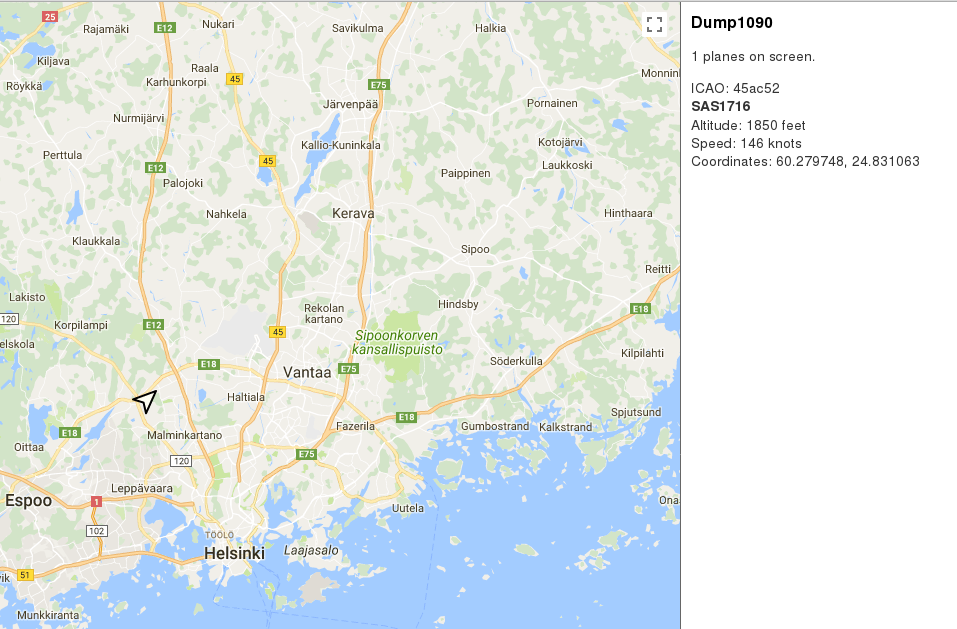
  45ac52 SAS1716  2650      177     60.252    24.770    47    26        1 sec
And opening a browser pointing at http://localhost:8080/ would show that graphically, like so: NOTE: In this view I'm in Helsinki, and the airport is at Vantaa, just outside the city. Of course there are tweaks to be made:

Iain R. Learmonth: MAC Catching

As we walk around with mobile phones in our pockets, there are multiple radios each with identifiers that can be captured and recorded just through their normal operation. Bluetooth and Wifi devices have MAC addresses and can advertise their presence to other devices merely by sending traffic, or by probing for devices to connect to if they re not connected. I found a simple tool, probemon that allows for anyone with a wifi card to track who is at which location at any given time. You could deploy a few of these with Raspberry Pis or even go even cheaper with a number of ESP8266. In the news recently was a report from TfL about their WiFi data collection. Sky News reported that TfL plans to make 322m by collecting data from passengers mobiles . TfL have later denied this but the fact remains that collecting this data is trivial. I ve been thinking about ideas for spoofing mass amounts of wireless devices making the collected data useless. I ve found that people have had success in using Scapy to forge WiFi frames. When I have some free time I plan to look into some kind of proof-of-concept for this. On the underground, this is the way to do this, but above ground I ve also heard of systems that use the TMSI from 3G/4G, not WiFi data, to identify mobile phones. You ll have to be a bit more brave if you want to forge these (please do not, unless using alternative licensed frequencies, you may interfere with mobile service and prevent 999 calls). If you wanted to spy on mobile phones near to you, you can do this with the gr-gsm package now available in Debian.

3 October 2017

Reproducible builds folks: Reproducible Builds: Weekly report #127

Here's what happened in the Reproducible Builds effort between Sunday September 24 and Saturday September 30 2017: Development and fixes in key packages Kai Harries did an initial packaging of the Nix package manager for Debian. You can track his progress in #877019. Uploads in Debian: Packages reviewed and fixed, and bugs filed Patches sent upstream: Reproducible bugs (with patches) filed in Debian: QA bugs filed in Debian: Reviews of unreproducible packages 103 package reviews have been added, 153 have been updated and 78 have been removed in this week, adding to our knowledge about identified issues. Weekly QA work During our reproducibility testing, FTBFS bugs have been detected and reported by: diffoscope development Mattia Rizzolo uploaded version 87 to stretch-backports. strip-nondeterminism development reprotest development tests.reproducible-builds.org reproducible-website development Misc. This week's edition was written by Ximin Luo, Bernhard M. Wiedemann, Holger Levsen and Chris Lamb & reviewed by a bunch of Reproducible Builds folks on IRC & the mailing lists.

2 October 2017

James McCoy: Monthly FLOSS activity - 2017/09 edition

Debian devscripts Before deciding to take an indefinite hiatus from devscripts, I prepared one more upload merging various contributed patches and a bit of last minute cleanup. I also setup integration with Travis CI to hopefully catch issues sooner than "while preparing an upload", as was typically the case before. Anyone with push access to the Debian/devscripts GitHub repo can take advantage of this to test out changes, or keep the development branches up to date. In the process, I was able to make some improvements to travis.debian.net, namely support for DEB_BUILD_PROFILES and using a separate, minimal docker image for running autopkgtests. unibilium neovim Oddly, the mips64el builds were in BD-Uninstallable state, even though luajit's buildd status showed it was built. Looking further, I noticed the libluajit-5.1 ,-dev binary packages didn't have the mips64el architecture enabled, so I asked for it to be enabled. msgpack-c There were a few packages left which would FTBFS if I uploaded msgpack-c 2.x to unstable. All of the bug reports had either trivial work arounds (i.e., forcing use of the v1 C++ API) or trivial patches. However, I didn't want to continue waiting for the packages to get fixed since I knew other people had expressed interest in the new msgpack-c. Trying to avoid making other packages insta-buggy, I NMUed autobahn-cpp with the v1 work around. That didn't go over well, partly because I didn't send a finalized "Hey, I'd like to get this done and here's my plan to NMU" email. Based on that feedback, I decided to bump the remaining bugs to "serious" instead of NMUing and upload msgpack-c. Thanks to Jonas Smedegaard for quickly integrating my proposed fix for libdata-messagepack-perl. Hopefully, upstream has some time to review the PR soon. vim subversion
neovim

1 October 2017

Iain R. Learmonth: Free Software Efforts (2017W39)

Here s my weekly report for week 39 of 2017. In this week I have travelled to Berlin and caught up on some podcasts in doing so. I ve also had some trouble with the RSS feeds on my blog but hopefully this is all fixed now. Thanks to Martin Milbret I now have a replacement for my dead workstation, an HP Z600, and there will be a blog post about this new set up to come next week. Thanks also to S lvan and a number of others that made donations towards getting me up and running again. A breakdown of the donations and expenses can be found at the end of this post.

Debian Two of my packages measurement-kit from OONI and python-azure-devtools used to build the Azure Python SDK (packaged as python-azure) have been accepted by ftp-master into Debian s unstable suite. I have also sponsored uploads for comptext, comptty, fllog, flnet and gnustep-make. I had previously encouraged Eric Heintzmann to become a DM and I have given him DM upload privileges for the gnustep-make package as he has shown to care for the GNUstep packages well. Bugs closed (fixed/wontfix): #8751251, #8751261, #861753, #873083

Tor Project My Tor Project contributions this week were primarily attending the Tor Metrics meeting which I have reported on in a separate blog post.

Sustainability I believe it is important to be clear not only about the work I have already completed but also about the sustainability of this work into the future. I plan to include a short report on the current sustainability of my work in each weekly report. The replacement workstation arrived on Friday and is now up and running. In total I received 308.73 in donations and spent 36.89 on video adapters and 141.94 on replacement hard drives for my NAS (which includes my local Debian mirror and backups). For the Tor Metrics meeting in Berlin, Tor Project paid my flights and accommodation and I paid only for ground transport and food myself. The total cost for ground transport during the trip was 45.92 (taxi to airport, 1 Tageskarte) and total cost for food was 23.46. The current funds I have available for equipment, travel and other free software expenses is now 60.52. I do not believe that any hardware I rely on is looking at imminent failure.

  1. Fixed by a sponsored upload, not by my changes [return]

Paul Wise: FLOSS Activities September 2017

Changes

Issues

Review

Administration
  • icns: merged patches
  • Debian: help guest user with access, investigate/escalate broken network, restart broken stunnels, investigate static.d.o storage, investigate weird RAID mails, ask hoster to investigate power issue,
  • Debian mentors: lintian/security updates & reboot
  • Debian wiki: merged & deployed patch, redirect DDTSS translator, redirect user support requests, whitelist email addresses, update email for accounts with bouncing email,
  • Debian derivatives census: merged/deployed patches
  • Debian PTS: debugged cron mails, deployed changes, reran scripts, fixed configuration file
  • Openmoko: debug reboot issue, debug load issues

Communication

Sponsors The samba bug was sponsored by my employer. All other work was done on a volunteer basis.

28 September 2017

Russ Allbery: Review: The Seventh Bride

Review: The Seventh Bride, by T. Kingfisher
Publisher: 47North
Copyright: 2015
ISBN: 1-5039-4975-3
Format: Kindle
Pages: 225
There are two editions of this book, although only one currently for sale. This review is of the second edition, released in November of 2015. T. Kingfisher is a pen name for Ursula Vernon when she's writing for adults. Rhea is a miller's daughter. She's fifteen, obedient, wary of swans, respectful to her parents, and engaged to Lord Crevan. The last was a recent and entirely unexpected development. It's not that she didn't expect to get married eventually, since of course that's what one does. And it's not that Lord Crevan was a stranger, since that's often how it went with marriage for people like her. But she wasn't expecting to get married now, and it was not at all clear why Lord Crevan would want to marry her in particular. Also, something felt not right about the entire thing. And it didn't start feeling any better when she finally met Lord Crevan for the first time, some days after the proposal to her parents. The decidedly non-romantic hand kissing didn't help, nor did the smug smile. But it's not like she had any choice. The miller's daughter doesn't say no to a lord and a friend of the viscount. The miller's family certainly doesn't say no when they're having trouble paying the bills, the viscount owns the mill, and they could be turned out of their livelihood at a whim. They still can't say no when Lord Crevan orders Rhea to come to his house in the middle of the night down a road that quite certainly doesn't exist during the day, even though that's very much not the sort of thing that is normally done. Particularly before the marriage. Friends of the viscount who are also sorcerers can get away with quite a lot. But Lord Crevan will discover that there's still a limit to how far he can order Rhea around, and practical-minded miller's daughters can make a lot of unexpected friends even in dire circumstances. The Seventh Bride is another entry in T. Kingfisher's series of retold fairy tales, although the fairy tale in question is less clear than with The Raven and the Reindeer. Kirkus says it's a retelling of Bluebeard, but I still don't quite see that in the story. I think one could argue equally easily that it's an original story. Nonetheless, it is a fairy tale: it has that fairy tale mix of magical danger and practical morality, and it's about courage and friendships and their consequences. It also has a hedgehog. This is an T. Kingfisher story, so it's packed full of bits of marvelous phrasing that I want to read over and over again. It has wonderful characters, the hedgehog among them, and it has, at its heart, a sort of foundational decency and stubborn goodness that's deeply satisfying for the reader. The Seventh Bride is a lot closer to horror than the other T. Kingfisher books I've read, but it never fell into my dislike of the horror genre, despite a few gruesome bits. I think that's because neither Rhea nor the narrator treat the horrific aspects as representative of the true shape of the world. Rhea instead confronts them with a stubborn determination and an attempt to make the best of each moment, and with a practical self-awareness that I loved reading about.
The problem with crying in the woods, by the side of a white road that leads somewhere terrible, is that the reason for crying isn't inside your head. You have a perfectly legitimate and pressing reason for crying, and it will still be there in five minutes, except that your throat will be raw and your eyes will itch and absolutely nothing else will have changed.
Lord Crevan, when Rhea finally reaches him, toys with her by giving her progressively more horrible puzzle tasks, threatening her with the promised marriage if she fails at any of them. The way this part of the book finally resolves is one of the best moments I've read in any book. Kingfisher captures an aspect of moral decisions, and a way in which evil doesn't work the way that evil people expect it to work, that I can't remember seeing an author capture this well. There are a lot of things here for Rhea to untangle: the nature of Crevan's power, her unexpected allies in his manor, why he proposed marriage to her, and of course how to escape his power. The plot works, but I don't think it was the best part of the book, and it tends to happen to Rhea rather than being driven by her. But I have rarely read a book quite this confident of its moral center, or quite as justified in that confidence. I am definitely reading everything Vernon has published under the T. Kingfisher name, and quite possibly most of her children's books as well. Recommended, particularly if you liked the excerpt above. There's an entire book full of paragraphs like that waiting for you. Rating: 8 out of 10

Next.

Previous.