Search Results: "hug"

28 June 2011

Matthew Palmer: SSL Session Caching (in nginx)

Given that I was responsible for putting together the system architecture for Github when they moved away from their previous services provider to Anchor Systems, I keep an eye on what's going on there even though I've gotten out of professional IT. Recently(ish), Ryan Tomayko blogged about some experiments in using Amazon CloudFront as a CDN for static assets. While discussing as-yet unsolved performance issues, he quoted a tweet from Shopify's CEO (who I would have thought would have known better):
Protip to make SSL fast: terminate in your load balancer, that makes SSL session cookies actually work.
No, no, NO -- a million times NOOOOOO! Load balancers are, by their very nature, performance chokepoints. You can't horizontally scale your load balancer, because if you do (by, say, putting another load balancer in front of it -- don't laugh, I've seen it done) you've just re-introduced all the same problems that putting SSL on the load balancer was supposed to accomplish (that is, getting SSL session caching to work). The only thing you accomplish by putting your SSL sessions onto the load balancer is bring the moment your load balancer melts down through excessive CPU usage that much closer. I dunno, maybe Shopify doesn't actually do that much traffic or something, but I certainly wouldn't be signing up for that headache if it were my infrastructure. (Sidenote: yes, I know that you can get "SSL hardware accelerators", that put the basic crypto operations into dedicated silicon, but they're rarely cheap, and you can't horizontally scale those, either. They're effectively a specialised and outrageously expensive form of "scaling by bigger hardware" -- which is a valid method of scaling, but one with fairly terminal limitations that certainly wouldn't make it practical for Github). The problem you're trying to solve by centralising SSL operations is that SSL includes a mechanism whereby a client making a new TCP connection can say "here's the crypto details from last time I connected to you" and the server can just pull out all of the per-connection data that would otherwise take a long time (several TCP round trips and a smallish chunk of CPU time) to setup. This can make SSL connections a lot snappier (in Ryan's opinion, "We spend roughly as much time handshaking as we do generating the average dynamic request."), so they're a definite win if you can do it (and yes, you can do it). Webservers don't typically do this caching by default, but setting up a simple SSL session cache for a single nginx or Apache webserver is pretty trivial. Testing it is simple, too: just install gnutls-bin and run:
	gnutls-cli -V -r HOSTNAME  grep 'Session ID'
If all three Session IDs are the same, then you've got SSL session caching running. (If you're wondering why I'm using gnutls-cli rather than openssl s_client, it's because openssl is living in the pre-IPv6 dark ages, and I've got IPv6-only services running I wanted to test). So that's great for your little single-server hosting setup, but per-machine caches aren't much use when you're running behind a load balancer, Github style, because each SSL-enabled TCP connection can very well end up on a different server, and a per-machine cache won't help you very much. (If you think the answer to this problem is "session affinity", you're setting yourself up for a whole other world of pain and suffering.) Here's the kicker, though -- the SSL session is just a small, opaque chunk of bytes (OpenSSL appears to store it internally as an ASN.1 string, but that's an irrelevant implementation detail). An SSL session cache is just a mapping of the SSL session ID (a string) to the SSL session data (another string). We know how to do "shared key-value caches" -- we have the technology. There won't be too many large-scale sites out there that aren't using memcached (or something practically equivalent). So, rather than stuff around trying to run a load balancer with enough grunt to handle all your SSL communication for all time, you can continue to horizontally scale the whole site with as many backend webservers as you need. All that's needed is to teach your SSL-using server to talk to a shared key-value cache. Far be it for me to claim any sort of originality in this idea, though -- patches for Apache's mod_ssl to do this have been floating around for a while, and according to the release notes, the 2.4 series will have it all built-in. However, Github uses nginx, to great effect, and nobody's done the work to put this feature into nginx (that I could find, anyway). Until now. I present, for the edification of all, a series of patches to nginx 0.8.x to provide memcached-enabled SSL session caching. Porting them to other versions of nginx hopefully won't be too arduous, and if you ask nicely I might give it a shot. If you don't use memcached (gasp!), my work should at least be a template to allow you to hook into whatever system you prefer. Sharding the memcached calls wouldn't be hard either, but I'm not a huge fan of that when other options are available. I had originally hoped to be able to say "it works at Github!" as a testimonial, but for some reason it hasn't been deployed there yet (go forth and pester!), so instead I'm just releasing it out there for people to try out on a "well, I don't know that it doesn't work" basis. If it breaks anything, it's not my fault; feel free to supply patches if you want to fix anything I've missed.

Sam Hartman: Dream Plug

As part of trying to help with Freedom Box, I gained access to a Dream Plug The Dream Plug is one of the leading possible platforms for Freedom Box. Computationally it s sexy for a low-power device. There s a 1200 mhz arm with 512m of RAM. As a platform to enable people to create novel applications, it s great. It has multiple USB ports, two ethernets, a built-in 802.11B/G access point, bluetooth, audio, ESATA, Micro SD and full-sized SD. So, whether you application needs storage, networking, audio, or some interesting side device, you re covered. With the optional JTAG adapter it s even fairly friendly to developers: there are options for recovering from most failures and full console access. If you re looking at a reference platform that s still nominally embedded, but that allows you to play around thinking about what your application could do, this is a great option. However, especially for Freedom Box, it s important to remember that the reference board a developer wants is not the same as a cost-reduced product on which to actually deploy something for people to buy. The Dream Plug is wrong for every actual deployment I ve imagined. First, it s huge. If you happen to have free power plugs on your wall with lots of space above and below them, it might be an option. If however, you re like everyone I know and have power strips, constrained spacing, etc, then the industrial engineering will disappoint at every turn. I was hoping for something that kind of looked like an Apple Airport Express. It s significantly larger than that in every dimension. Also, the plug is oriented the wrong way for minimizing the fraction of the power strip it takes up. The power supply part of the device can be detached, although even that is way too huge for a power strip, and the cable between the power supply and the computer is fairly short. You can reconfigure the device without its plug nature: running a cord from a normal power outlet to the power supply. But then if you have to detach the power supply for heat management reasons, you get a cord from the outlet to the power supply and another cord from the supply to the device. Add a few USB or ESATA devices and the octopus of cables begins to resemble some arcane mechanism. (So far, no elder gods have appeared though.) The other issue is that you almost never want all the functionality. You pay for the bluetooth, audio and ESATA in terms of cost, heat and space regardless of whether you use them. I don t have a lot of applications that really take advantage of the full array of hardware. The firmware update mechanism is decidedly not targeted at end-users. The version I obtained had a hacked copy of Debian lenny. No mechanism was provided for replacing the image in a safe manner that did not potentially require the optional highly-non-end-user-compatible JTAG board if something got interrupted. You could either unscrew the device and get to the micro SD card containing the image, or run software to replace the image from within Debian lenny. It s possible to configure the boot loader to run an update image off USB or SD until that succeeds, but doing that is also a non-end-user operation. In conclusion, the name is perfect. This is exactly what hackers need to dream about the power of small computers everywhere. However we must not forget that there s a step required to turn dreams into reality. Just as with any fully proprietary product, Freedom Box will require cost reduction steps, semi-custom boards and actual OEMs to truly be usable. The claim in the previous sentence that the Freedom Box may have proprietary elements is disquieting to some. I think we can put together a software stack that is free with the possible exception of some device firmware. However, my suspicion is that anyone who turns that into a fully realized end-user product will add proprietary elements. I suspect some of the results of the cost reduction process such as resulting semi-custom boards will be proprietary. In many cases though, I suspect some proprietary software elements will be introduced.

27 June 2011

Matthew Palmer: SSL Session Caching (in nginx)

Given that I was responsible for putting together the system architecture for Github when they moved away from their previous services provider to Anchor Systems, I keep an eye on what's going on there even though I've gotten out of professional IT. Recently(ish), Ryan Tomayko blogged about some experiments in using Amazon CloudFront as a CDN for static assets. While discussing as-yet unsolved performance issues, he quoted a tweet from Shopify's CEO (who I would have thought would have known better):
Protip to make SSL fast: terminate in your load balancer, that makes SSL session cookies actually work.
No, no, NO -- a million times NOOOOOO! Load balancers are, by their very nature, performance chokepoints. You can't horizontally scale your load balancer, because if you do (by, say, putting another load balancer in front of it -- don't laugh, I've seen it done) you've just re-introduced all the same problems that putting SSL on the load balancer was supposed to accomplish (that is, getting SSL session caching to work). The only thing you accomplish by putting your SSL sessions onto the load balancer is bring the moment your load balancer melts down through excessive CPU usage that much closer. I dunno, maybe Shopify doesn't actually do that much traffic or something, but I certainly wouldn't be signing up for that headache if it were my infrastructure. (Sidenote: yes, I know that you can get "SSL hardware accelerators", that put the basic crypto operations into dedicated silicon, but they're rarely cheap, and you can't horizontally scale those, either. They're effectively a specialised and outrageously expensive form of "scaling by bigger hardware" -- which is a valid method of scaling, but one with fairly terminal limitations that certainly wouldn't make it practical for Github). The problem you're trying to solve by centralising SSL operations is that SSL includes a mechanism whereby a client making a new TCP connection can say "here's the crypto details from last time I connected to you" and the server can just pull out all of the per-connection data that would otherwise take a long time (several TCP round trips and a smallish chunk of CPU time) to setup. This can make SSL connections a lot snappier (in Ryan's opinion, "We spend roughly as much time handshaking as we do generating the average dynamic request."), so they're a definite win if you can do it (and yes, you can do it). Webservers don't typically do this caching by default, but setting up a simple SSL session cache for a single nginx or Apache webserver is pretty trivial. Testing it is simple, too: just install gnutls-bin and run:
	gnutls-cli -V -r HOSTNAME  grep 'Session ID'
If all three Session IDs are the same, then you've got SSL session caching running. (If you're wondering why I'm using gnutls-cli rather than openssl s_client, it's because openssl is living in the pre-IPv6 dark ages, and I've got IPv6-only services running I wanted to test). So that's great for your little single-server hosting setup, but per-machine caches aren't much use when you're running behind a load balancer, Github style, because each SSL-enabled TCP connection can very well end up on a different server, and a per-machine cache won't help you very much. (If you think the answer to this problem is "session affinity", you're setting yourself up for a whole other world of pain and suffering.) Here's the kicker, though -- the SSL session is just a small, opaque chunk of bytes (OpenSSL appears to store it internally as an ASN.1 string, but that's an irrelevant implementation detail). An SSL session cache is just a mapping of the SSL session ID (a string) to the SSL session data (another string). We know how to do "shared key-value caches" -- we have the technology. There won't be too many large-scale sites out there that aren't using memcached (or something practically equivalent). So, rather than stuff around trying to run a load balancer with enough grunt to handle all your SSL communication for all time, you can continue to horizontally scale the whole site with as many backend webservers as you need. All that's needed is to teach your SSL-using server to talk to a shared key-value cache. Far be it for me to claim any sort of originality in this idea, though -- patches for Apache's mod_ssl to do this have been floating around for a while, and according to the release notes, the 2.4 series will have it all built-in. However, Github uses nginx, to great effect, and nobody's done the work to put this feature into nginx (that I could find, anyway). Until now. I present, for the edification of all, a series of patches to nginx 0.8.x to provide memcached-enabled SSL session caching. Porting them to other versions of nginx hopefully won't be too arduous, and if you ask nicely I might give it a shot. If you don't use memcached (gasp!), my work should at least be a template to allow you to hook into whatever system you prefer. Sharding the memcached calls wouldn't be hard either, but I'm not a huge fan of that when other options are available. I had originally hoped to be able to say "it works at Github!" as a testimonial, but for some reason it hasn't been deployed there yet (go forth and pester!), so instead I'm just releasing it out there for people to try out on a "well, I don't know that it doesn't work" basis. If it breaks anything, it's not my fault; feel free to supply patches if you want to fix anything I've missed.

24 June 2011

Raphaël Hertzog: People behind Debian: Sam Hartman, Kerberos package maintainer

Sam Hartman is a Debian developer since 2000. He has never taken any sort of official role within Debian (that is besides package maintainer), yet I know him for his very thoughtful contributions to discussions both on mailing lists and IRL during Debconf. Until I met him at Debconf, I didn t know that he was blind, and the first reaction was to be impressed because it must be some tremendous effort to read the volume of information that Debian generates on mailing lists. In truth he s at ease with his computer much like I am although he uses it in a completely different way. Read on to learn more, my questions are in bold, the rest is by Sam. Raphael: Who are you? Sam: I m Sam Hartman. I m a 35-year-old software engineer. I am a principal consultant and co-owner of a small consulting company, called Painless Security. I started using Debian in the mid 1990 s around the time of the bo release. I ended up deciding to join the project as a developer in 2000. Raphael: You re blind and yet you re using your computer as effectively as I am. Can you explain us how you setup your computer ? Sam: I gave a talk at Debconf9 on how my computer is set up; you can watch the video for full details. My main laptop runs Debian. I use the gnome-orca package as my primary screen reader. It speaks the Gnome desktop. It does a relatively good job of speaking Iceweasel/Firefox and Libreoffice. While it does speak gnome-terminal, it s not really good enough at speaking terminal programs that I am comfortable using it. So, I run Emacs with the Emacspeak package. Within that, I run the Emacs terminal emulator, and within that, I tend to run Screen. For added fun, I often run additional instances of Emacs within the inner screens. Raphael: Are there important problems in Debian in terms of accessibility to blind people? KDE documentation talks a lot about accessibility, but at least for blind users, the code completely fails to deliver. That means there are a lot of good packages a blind user cannot use. The non-free Adobe Flash player has some accessibility, but it could be a lot better. The free alternatives have none. The free PDF readers have basically no accessibility. You can use pdftotext, but you cannot actually read a PDF in a graphical application. It s way too easy for a misbehaving program to lock up the entire accessibility infrastructure. Gnash is a big culprit here: if my Iceweasel starts Gnash, there s a good chance that either Iceweasel or the entire desktop will appear to hang from an accessibility standpoint. Other programs, including gksu tend to fail in this way. Some of the more dynamic website features like pop up menus or selection lists are really difficult to find and click without causing them to disappear. This gets better and worse over time as the accessibility support in Iceweasel changes and as websites change. Raphael: What s your biggest achievement within Debian? Sam: I decided to be a Debian developer because I thought that in 2000, Debian support for using enterprise security and infrastructure software was lacking. Back then, any software that included crypto functionality was segregated into a special non-us archive. Some of the software was missing; I started by packaging MIT Kerberos for Debian. Other software had security or enterprise features disabled in the packages. At the height of working on this, I was maintaining krb5, some SASL modules, PAM, some PAM modules,OpenAFS, a version of and Ssh with Kerberos support. I was also involved in the effort to resolve the legal issues so that we could move security software into the main archive. I think this work has been a huge success. In fact, it s been such a success that other people are now doing most of the work. I still maintain the krb5 package. When I started I felt like I was pushing against the flow trying to get people to add patches, sometimes even having to fork a package. However, now, I can maintain just one component and there are enough others who shared my original goal that the work continues. These days, I m working on something that s an evolution of this enterprise security work. I m packaging Project Moonshot for Debian and Ubuntu. Project Moonshot is a response to the wide variety of identity management systems such as OpenID, Oauth, SAML, and the like. Moonshot works to create an identity management approach that works well both for the web and for client-server and other applications. The project is a lot of fun, but the role of Debian in the project is also interesting. One of the things we want to show with Moonshot is how our technology can be effective when it is integrated throughout a platform. To really show the potential it needs to work with as many applications in a given platform as possible. The open and collaborative nature of the Debian community makes it possible to introduce a new technology and have that technology evaluated based on its merits. We don t need huge business relationships or marketing deals to integrate our technology: we need some combination of doing the work ourselves and showing others the benefits of working with us. For someone trying to do innovative work, the Debian model is powerful. Raphael: If you could spend all your time on Debian, what would you work on? Sam: I d really love to work with the embedded Debian folks. The vision of a single source base that could be the stack from devices from small embedded devices all the way up to high-end servers is very appealing. Doing that with Debian involves a number of challenges. However with the right people working on meeting these challenges full-time, I think we could offer something promising. I d also love to have the time to contribute to project infrastructure: working on the release team, helping ftpmaster, that sort of thing. However I don t. I m just happy that so much of my consulting practice involves working on open-source software. Raphael: What s the biggest problem of Debian? Sam: There s something really not right about how we transition libraries from unstable to testing. Every time I get involved in a library transition I m shocked at how complicated it is and how disruptive it is both to testing and unstable. We need to look at technology and processes to break up the dependency snarles. For example we don t have good archive tools for keeping old versions of libraries around to ease transitions. If you haven t thought about this issue you ll probably say that I m being overly picky and this can t be the major problem for Debian. However, if you think about how much this impacts our ability to introduce things into unstable around the times of the freeze or about how much it slows the release process, you may begin to appreciate how big of an issue this is. Raphael: Is there someone in Debian that you admire for their contributions? Sam: There are a number of people who have been role models for me over the years. Anthony Towns really helped me understand a lot of what drives free-software projects and what needs to be true for positive motivation. Joey Hess showed us all that sometimes, social problems do have technical solutions. If the tools are so good that doing the right thing is far easier than any other course of action, quality improves.
Thank you to Sam for the time spent answering my questions. I hope you enjoyed reading his answers as I did. Subscribe to my newsletter to get my monthly summary of the Debian/Ubuntu news and to not miss further interviews. You can also follow along on Identi.ca, Twitter and Facebook.

5 comments Liked this article? Click here. My blog is Flattr-enabled.

13 June 2011

Russell Coker: Evil Psychologists

Last year the Psychologist and Baptist minister George Rekers who is famous for anti-homosexuality pseudo-science was discovered to be hiring gay escorts from Rentboy.com. Lots of LULZ there. But the story didn t end there. It turns out that George Rekers did some research on a child who ended up committing suicide as an adult, and the circumstantial evidence suggests that George s actions are directly related to the suicide [1]. The Rentboy.com affair doesn t seem so funny now. The Box Turtle Bulletin has a series of articles about Kirk Andrew Murphy s suicide and the roles of George Rekers and Richard Green in all of this [2], the articles are well written and generally appear to be well researched I recommend reading the articles if you can stomach them (lots of nasty stuff is described). The section answering the question of who s responsible for the mistreatment of Kirk Andrew Murphy [3] where they describe the use of ABA (AKA the Lovaas Technique) is interesting. Ivar Lovaas worked with George Rekers in such research and published a paper with him. The term ABA gets an immediate hostile reaction in the Autism community, but until now I hadn t realised why so many people hate it so much. It seems that to some extent I made the classic mistake of misjudging the reports of Autistic people who are unable to present their case well (as opposed to the psychologists who can present any position very well even if it s utterly insane). In the past I had the impression that ABA wasn t inherently bad, it was just implemented in a bad way in some cases now it seems that ABA was designed in an evil way right from the start. There is one massive problem with the Box Turtle analysis, he says Behavioral analysts don t dig around much into people s feelings, fears, dreams, family relationships or childhood memories. Indeed, in cases like autism, Lovaas s specialty, those avenues of exploration would be irrelevant . It could be that Jim Burroway (the Box Turtle writer) is merely quoting someone else without attribution, but even so saying that the feelings, fears, and dreams of a group of people are irrelevant is just awful, a statement that denies the humanity of a group of people can t be quoted without further explanation. In his article about ABA Jim refers to childhood Autism as a condition for which there is no hope for interior change [4]. I m not sure if he s just saying that Autistic children are incapable of learning or whether it s all Autistic people, in either case it s nonsense in terms of science and nasty as well. Generally I expect that members of various minority groups will show more sympathy to each other than they receive from the general population. Jim s posts are a great disappointment. I understand that he would be rather stressed about the horrible things that George Rekers et al did, but even so he should be able to avoid that sort of thing. Jim is obviously a very talented writer and can do better. One might think that Jim s posts use the word Autism to refer only to the people who are non-verbal (or in other ways less capable than the huge number of Autistic people who work for companies like Google and IBM). But that s no excuse either. You can find blogs and essays written by non-verbal Autistic people that describe their experiences if you care to search for them. It s obvious that they are people too and deserve to be treated as people not objects. Abusing Autistic children to try and make them impersonate NT children is no less evil than abusing children who don t fit gender norms.

8 June 2011

Lars Wirzenius: Test driven distribution development

Disclaimer: There is a huge discussion going on right now in the debian-devel mailing list, about different ways to rearrange how Debian development happens, and maybe to provide a Debian users with an additional release. This blog entry is not a comment on that discussion, which I am ignoring. The discussion did, however, prompt a dent about "test driven development". That prompted a short exchange of thoughts with Tom Marble, and this blog post is a cleaned up version of my part in that discussion.
Currently Debian development happens roughly like this: all packages are uploaded to a part of the Debian archive called unstable. Once they've been in use for a while without serious problems, they get automatically copied into another part called testing. Every year or two, testing is frozen and any remaining problems are fixed, after which all of testing gets copied into yet another part of the archive called stable, and that's the actual release. There is a little bit of automatic testing, but only a little. Almost all testing is done by people, by them using unstable or testing on their usual computers. If they have problems, they report them. Contrast this with development using Test Driven Development, or TDD, and other modern development methodologies. Here's a rough summary of what I do when I write (much) of my software. In addition, I measure coverage to make sure all parts of the code gets tested. I usually aim for 100% coverage, except for those parts that very hard or quite pointless to test. (That's easier to achieve than you'd think, but that's the topic of another blog post.) This all sounds like a lot of bureaucratic nonsense, but what I get out of this is this: once all tests pass, I have a strong confidence that the software works. As soon as I've added all the features I want to have for a release, I can push a button to push it out. (Well, actually there's a little bit more to it.) This does mean I never have bugs in my software. Of course I do. However, there's a lot fewer of them. In fact, there's so few of them, after tests pass, that I would almost be happy to make an automatic release after every successful run of "make check". Another aspect of the way I do development is distributed version control. The relevant feature is powerful branching and merging. Most things I develop happen in short-lived single-purpose branches: whenever I start work on a feature or bugfix, I create a branch for it. (Unless I'm feeling particularly lazy, which happens more often than you'd think.) When I've finished the feature, or fixed the bug, I merge the branch back into the trunk branch. This way, the trunk is always in releaseable state. It might not have all the features I want for the next release, but the features that are there, do work. The branch probably has bugs, but if I've written tests that are good enough, I know the software works well enough. Or that's the idea. Sometimes things go wrong. Then I write more tests and the next time goes better. (It doesn't have to be perfect, as long as it gets better every time.) See the contrast between automatic tests with good coverage, and the Debian style of relying on user feedback? There's no need to wait for user feedback with automatic tests. This speeds up development, makes releasing easier, but most importantly takes away any reason to fear making changes, even big changes. Automatic tests and good test coverage are easy achieve in small projects. For a system as huge as Debian, good test coverage is quite hard to achieve. The thing about automatic tests, though, is that even a little bit of it is helpful, and after you have a few tests, it gets easier to add more. The first test is the hardest to get done, since you need to set up all the infrastructure for it. Debian does do a bit of automatic testing already. (See lintian, piuparts, autopkgtest, edos, etc.) I don't want to belittle that, but I think we could do better. Here's what I would love to see: Since full test coverage is going to be impossible for Debian, some subset should be targeted. Perhaps something like this would suffice to start with: These tests would not guarantee that a set of changes would not break Debian, but they would give a high confidence that at least basic stuff would still work after the changes. Now, obviously implementing all of this I'm dreaming of (it is just past midnight, after all) is going to be impossible. There's way too much work to do, there's not enough tools for writing tests, and it would require too much computing power to run, and so on and so forth. But it's late, and I've had a bad day, and I might as well dream of something nice. Anyway, anyone interested in these things should perhaps help drive DEP8.

3 June 2011

Josselin Mouette: Google Apps knows better what browser you can use

So I just read that Google will only support modern browsers starting 2 months from now.
As of August 1st, we will discontinue support for the following browsers and their predecessors: Firefox 3.5, Internet Explorer 7, and Safari 3. In these older browsers you may have trouble using certain features in Gmail, Google Calendar, Google Talk, Google Docs and Google Sites, and eventually these apps may stop working entirely.
Given the importance of Google, the impact is huge. This company has acquired the power to basically dictate what browser you can provide to your users - otherwise they won t be able to access what many of them now consider vital functionality. Such a decision denotes a grave misunderstanding of the workstation ecosystem from the Google people. It means they consider their only target to be nerdy users with home computers they can (and want to) upgrade and break every 3 months with the latest version of Windows or Fedora. What about corporate computers? What about non-techy people who buy a computer and stick with the OS that was sold with it for 4 years? I m afraid they are still the vast majority of web users. You can t decide to deploy a new version of IE of Firefox on a large number of computers for next month. Sometimes, this is not even possible (hello Windows 2000/XP users). For Debian squeeze, this means no more Firefox for you. Epiphany and Konqueror might still work, but Google loves sending JavaScript that make old versions of Webkit struggle. And anyway, this is just the beginning. In a few months they will tell us to upgrade again to Firefox 4.2 and IE 12. One week after their release, yeah! Let s quote a comment which should help understanding the reasoning behind such decisions.
Andy, while I understand staying on LTS, I think it's a little bit silly to use a mission critical machine for web browsing in that way. Also, there is no reason your browser has to be tied in lockstep to your OS. Two simple solutions:
1. Don't use the built-in browser for your main web browsing. Install Chrome, for example. or,
2. Since LTS is designed for servers and other "can't have any chance of downtime" machines, quit using that machine as your web browsing box and use a personal laptop for such things, which you can keep up to date with the current OS release instead of waiting 2 years.
Belief #1: the browser can (and should) be independent from the OS . It s interesting to note that the same people who say this are the ones who also jerk off at the idea of desktops and phones with tight web integration. This integration comes at a cost: this restricts your ability to change everything in the browser from one day to another. Belief #2: long-term OSes are for mission-critical servers only . Yeah sure, that s why Windows has a lifecycle of 3 years. Desktops are no different at all from servers on this matter. You don t upgrade your desktop every 6 months when you do serious work with it; the cost and the risk are just too high. And anyway, this comes again from the same people who want to upgrade every single component of said mission-critical servers every 2 months to install the latest version of their preferred web framework. Belief #3: people can upgrade their browsers or OSes . No really they can t. Many people wouldn t know how to do this, even with a step-by-step documentation. And in enterprise deployments, they are restricted from doing so. Thanks for spreading the clich that web developers are clueless, spotty nerds, incapable of understanding the needs of production environments. Apparently Google is not exempt from this disease.

31 May 2011

Jordi Mallach: Quinze de maig

Two weeks ago, I was lucky to celebrate my 33th birthday with my closest friends in l'Alqueria. When asked to wish something before blowing the candles on Victor's delicious apple cake, I thought I have basically everything I'd want, but it'd be cool if some real changes happened in this world. Not long after, big demonstrations asking for Real Democracy Now happened throughout the Spanish state, and today, that Sunday seems to be an eternity away. Huge assemblies, thousands of strangers working together, more demonstrations, an election campaign eclipsed by #15m, hundreds of well thought, plausible claims published, the movement crossing the Spanish borders and leaking into France and Greece, the feeling that this is the good one, the basis for a fresh start that can make our lives better, our society a fair one and the possibility to stand in front of the fuckers who have made our lives a lot harder, to tell them it's not going to work like that anymore. All of this in 15 days. Unfortunately, revolution came when I'm in a crucial month to finish my studies and swamped with other little things, so I've been unable to be in the Valencian camp site for more than 3 days. Hopefully when I'm done on the 22nd people will still be taking the square, because Mako and Mika will be visiting then. Yay!

Vincent Sanders: Can you just...

I should have learned by now, no sentence that starts "Can you just" ever ends well. In my experience it means someone else has misunderstood the problem at hand. Then we proceed to the part of the project where (according to my lovely wife) I end up using my condescending voice.

I work through what I have been asked for and eventually, if it goes well you end up defining what the actual, real job needs to be done is. And almost envitably the "Can you just" has become a major job.

Most of us I fear recognise this "pattern" from our working lives with software. Well I am glad to report this pattern exists in real, physical world too.

Last week we took a trip to my parents in law, two thoroughly nice people (I lucked out, no evil mother in law here). I had been asked before I went "Can you just fix the garage door, it sticks". So I took along some basic tools expecting to lubricate a hinge or something.

Turns out it was the garage back door (for humans to get in and out) and...well there were bigger issues. The door frame was rotten and the door had pulled it away from the wall. So a new door frame you say? ah, well, yes

At some point in the past someone had fitted a double glazed window and had, kinda removed the lintle above the door and window! Yes there were several courses of brick masonry wall resting on top of a upvc window frame. The door frame had provided some support till it rotted and fell apart.

The window was under a huge strain and was actually 5cm shorter at one end than the other. The brickwork was no longer mortared and could better be described as a pile of bricks held together with caulking.

Vincent fitting the latch to the new door frame
So my bank holiday weekend was spent removing those bricks, making good, building a frame from 44x97mm planed timber bolted into the walls and covering it with weatherboard. OK it is not masonry but on the other hand it will not be falling on anyone's head any-time soon.

And before anyone comments, yes that frame is true, the spirit level says so. Alas that window frame is very, very wonky indeed and the wall it is sitting on is 4cm out too, so It looks a bit off.

Possibly not my best work but you can hang a couple of hundred kilos from the frame and it not budge so I think its solid enough for this purpose.

Providing my father in law keeps treating it with the wood preserver every couple of years it will not go rotten either and should last a long time.

19 May 2011

MJ Ray: Top 10 Benefits of Mailing List Software

Particularly around local government, but also some not-for-profits and universities, I m trying to persuade people to stop using huge Blind Carbon Copy (BCC) lists that they keep in their address book and switch over to using mailing list manager software. Our co-op even gives some simple mailing list hosting away with web hosting. I think good mailing list software is better because:
  1. List members can help themselves they can subscribe, unsubscribe and set options by sending email to the software or visiting its website, which reduces the worker time required to manage the list. But you can still manage it directly if you prefer.
  2. Your address book is smaller because you don t need every address on the mailing list cluttering up your email software s address book any more
  3. Errors are handled automatically if an address doesn t work any more, the software will unsubscribe it, usually with some safeguards against one-off problems
  4. Privacy is safeguarded dedicated email list software will not put all the mailing list addresses in the To-line by mistake (as often happens with Address Book announcement lists)
  5. Spam is filtered rules can be set centrally and they can be different to the rest of your organisation
  6. Messages can be moderated if needed, the list managers can be asked to pre-approve the messages, or you can set rules to allow some automatically.
  7. Emails can be archived most list software can save copies of messages for you, or put them on the web
  8. You can offer digests offer members the choice between getting every message or daily or weekly batches
  9. Multiple versions can be sent some list software can send different versions of the same email (like rich and plain text, or different languages) as chosen by the user
  10. You can syndicate news some list software can also put your announcements on content management systems or social media
  11. (OK, I ve done 10 there are two more which matter to a tech worker like me which I m going to mention as free extras.) It s more efficient most list software is designed to handle hundreds or thousands of recipients and sends email with more robust settings than a typical desktop email client. It is less likely to fail after recipient 373 and ask you to resend them all.
  12. Comply with standards good list software either follows standards for things like self-service and digests automatically or can be told to do it. Some desktop email software (Outlook?) usually can t.
Do you think these are good reasons? Are there other reasons you would include above some of these? Would they persuade you to stop using your computer s address book?

13 May 2011

Gustavo Noronha Silva: My experience with GNOME 3 so far

You know, GNOME Shell and I are not really strangers to each other for a long time now. I have been using it almost daily as my main desktop since late 2009, when I started shipping it to Debian experimental. That means that I had ample opportunity to both get used to it and witness the huge improvements it had with every new release. My general feeling towards GNOME 3 is this: . Yes, I love it! I love the new themes, I love the window borders, I love the top panel, the overview, the dynamic workspaces, I love the Me menu, I love the clock and the calendar, the system indicators with the beautiful symbolic icons, being able to search for applications in such a nice way, the window animations, the multi-screen support, the new nautilus, the dash, looking glass. It s hard for me to even express how thankful I am and how much admiration I have for the awesome folks who helped bring this to life. Thanks so much!
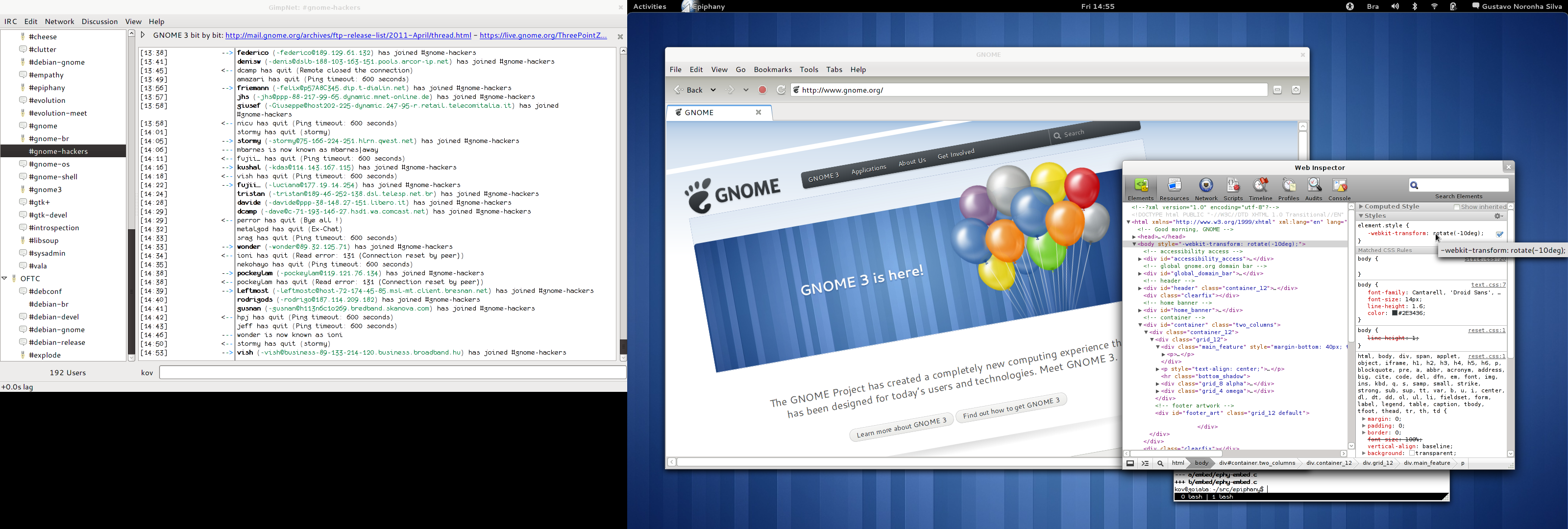
My GNOME3 desktop

My GNOME 3 desktop

After all this time, there are only two things I can say I dislike about GNOME3, apart from some minor wishlists: the alt-tab behaviour and the message tray. Let me expand on those. Message Tray Of the very few things I dislike, there is only 1 I hate and cannot see myself living with: the accordion animation in the message tray. No, really, it s such a terrible, terrible idea. Every single time I try to use that thing I overshoot while moving the mouse to the left, then overshoot again moving the mouse to the right because the frigging icon has moved. It s no good knowing that I can click in the text or in the empty area to its right, it feels wrong. It s terrible that my actual target is moving at all. Every single time I use it is a small frustration for me it s as if the message tray was playing games with me, laughing at me for not having good enough mouse pointer driving skills even more than the infamous sub-menus used to. And I had to go through that penance whenever I wanted to find the person I was chating with to resume the conversation. I wrote an extension that disables the accordion animation by simply not showing the title at all when you hover the icon, and I patched GNOME Shell s CSS to make the icons a bit bigger, so that it s easier for me to hit them with the mouse. It s clearly not ideal, and you still have to click the various people icons to figure out which of your friends who were lazy enough to not add a picture to their IM profiles is that one, but it s still much better than chasing the (smaller) ones around to figure that out. Perhaps we should have the icons be bigger and always have the title bellow them? I don t know, I trust the awesome designers who designed the awesomess that s everywhere else will come up with a great idea.
My Message Tray

My message tray with bigger icons and no accordion animation.

Alt Tab The number 1 feature of workspaces for me has always been locality being able to not see all of the other applications and windows that are open elsewhere. This lowers the amount of noise when I m trying to find something. The overview is very nice in this matter only windows in the current workspace are shown, and even when you have an extra screen, the windows in there appear in that screen. The alt-tab behaviour, on the other hand, of showing all windows and apps, even with the separator, bothers me. It s really useful to have when you want to go to a specific window no matter where it is (I usually use the dash for that, though), but it adds noise when you want to go to a specific window _in this_ workspace, which is the most common use case for my usage. So I copied the alt-tab code over to an extension and modified it so that only windows in the current workspace would be considered. In addition to that, with the windows in the extra screen always being there no matter what workspace you re in (which I think is an awesome idea), they are effectively in all workspaces, so they add constant noise even with my extension. It s also weird to have to look at the main screen to switch to a window in the extra screen. There s a huge discontinuity. What I would prefer is having alt-tab to follow the mouse regarding screens only show windows in the extra screen if you hit alt-tab in there, making sure the selector thing appears in there as well.

12 May 2011

Matthew Garrett: LightDM, or: an examination of a misunderstanding of the problem

LightDM's a from-scratch implementation of an X display manager, ie the piece of software that handles remote X connections, starts any local X servers, provides a login screen and kicks off the initial user session. It's split into a nominally desktop-agnostic core (built directly on xcb and glib) and greeters, the idea being that it's straightforward to implement an environment-specific greeter that integrates nicely with your desktop session. It's about 6500 lines of code in the core, 3500 lines of code in the gtk bindings to the core and about 1000 in the sample gtk greeter, for a total of about 11,000 lines of code for a full implementation. This compares to getting on for 60,000 in gdm. Ubuntu plan to switch to LightDM in their next release (11.10).

This is a ridiculous idea.

To a first approximation, when someone says "Lightweight" what they mean is "I don't understand the problems that the alternative solves". People see gtk and think "Gosh, that's kind of big for a toolkit library. I'll write my own". And at some point they have to write a file dialog. And then they need to implement support for handling remote filesystems. And then they need to know whether the system has a functioning network connection or not, and so they end up querying state from Network Manager. And then they suddenly have a library that's getting on for the size of gtk, has about the same level of complexity and has had much less testing because why would you want to use a lightweight toolkit that either does nothing or is 90% of the size of the alternative and crashes all the time.

Adding functionality means that code gets larger. Given two codebases that are of significantly different sizes, the two possible conclusions are either that (a) the smaller one is massively more competently written than the larger one, or (b) the smaller one does less. The gdm authors have never struck me as incompetent, even if some people may disagree with some of their design decisions, and the LightDM authors don't seem to have argued on that basis either. So the obvious conclusion is that LightDM does less.

And, indeed, LightDM does less. Part of this is by design - as the proposal to the Gnome development list shows, one of the key advantages of LightDM is claimed as it not starting a Gnome session. And from that statement alone, we can already see that there's been a massive failure of understanding the complexity of the problem.

Let's go back to the comparisons of code size. LightDM's simple GTK greeter is about 1000 lines of code. gdm's greeter is almost 20,000. Some of this is arbitrary shiny stuff like the slidy effects that occur, but a lot of it is additional functionality. For example, some of it is devoted to handling the interface with AccountsService so gdm can automatically update when users are created or deleted. Some of it is providing UI for accessibility functionality. Some of it is drawing a clock, which I'll admit may be a touch gratuitous.

But if your argument is that your software is better because it's doing less, you should be able to ensure that you can demonstrate that the differences aren't important. And the differences here are important. For example, one of the reasons gdm starts a local gnome session is that it wants gnome-power-manager to be there to handle power policy. Closing the lid of my laptop should suspend the system regardless of whether it's logged in or not. LightDM takes a different approach. Because there's no session, it has to take care of this kind of thing itself. So the backend daemon code speaks to upower directly, and the greeters ask the daemon to implement their policy decisions.

This is pretty obviously miserable. Now you've got two sets of policy - one at the login screen, and one in your session. How do I ensure they're consistent? The only sane solution is to ignore the functionality the backend provides and have my greeter run gnome-power-manager. And now how about accessibility preferences? Again, if I want to have the same selection of policy, I need to run the same code. So you end up with a greeter that's about as complex and large as the gdm one, and unused functionality in the backend. Lighter weight through code duplication. We have always been at war with Eurasia.

The entirety of LightDM's design is based on a false premise - that you can move a large set of common greeter functionality into a daemon and just leave UI presentation up to the greeter code. And if you believe that, then yes, you can absolutely implement a greeter in 1000 lines of code. It'll behave differently to your desktop - the range of policy you can implement will be limited to what the daemon provides, even if your desktop environment has a different range of features. It'll have worse accessibility for much the same reason. And eventually you'll end up with a daemon that's absolutely huge in order to attempt to provide the superset of functionality that each different desktop makes use of.

The only real problem LightDM solves is that it makes it easier to write custom greeters, and if you're really seeking to differentiate your project based on your login screen then maybe your priorities are a little out of line. I'm sure that Ubuntu will release with a beautiful 3D greeter that has a wonderful transition to the desktop. It's just a shame that it won't do any of the useful things that the existing implementations already do.

And if you think that when LightDM finally has the full feature set of gdm, kdm and lxdm it'll still be fewer lines of code and take less memory - I hear the BSD kernel is lighter weight than Linux. Have fun with it.

( Comments Comment on this)

11 May 2011

Michal Čihař: phpMyAdmin 3.4.0 is out

Today, Marc has released phpMyAdmin 3.4.0. This is huge step and introduces lot of new features. The most noteworthy are: As you can see, many of new features come from last GSoC, it took us almost half year to stabilize all new stuff and make it work nicely together. Thanks to last minute improvements in Japanese, it is fully translated to 15 languages, other translations are little behind, but you can still help improving them for future releases. The master branch is now open to development and we will start to merge patches accumulated in patch tracker for addition after feature freeze. PS: I forgot to mention that this release fixed largest number of feature requests and bugs ever - over 160 issues from sf.net tracker got closed. This can be nicely seen on tracker stats. PS2: Package with new version was just uploaded to Debian.

Filed under: English Phpmyadmin 8 comments Flattr this!

6 May 2011

Raphaël Hertzog: People behind Debian: Steve Langasek, release wizard

Steve Langasek has been contributing to Debian for more than a decade. He was a release manager for sarge and etch, and like many former release managers, he s still involved in the Debian release team although as a release wizard (i.e. more of an advisory role than a day-to-day contributor). Oh, and he did the same with Ubuntu: on the picture on the left, he just announced the release of Ubuntu 10.04 from his Debian-branded laptop. ;-) He has also been maintaining PAM in Debian for as long as can I remember and does a great job at that. He s very knowledgeable and fully deserves his place within the Debian Technical Committee. I m glad he still has the time to participate on several important Debian mailing lists because his contributions are always very useful. I m sure you ll notice this just by reading his answers below. My questions are in bold, the rest is by Steve. Who are you? I m 32 years old, have been running Linux since my first year in college back in 96, and have been a Debian developer now for ten years. Along the way I ve been involved in maintaining a variety of server packages, worked on the Alpha port for a while, did a stint as a release manager for a couple of years, and serve on the technical committee. This year I m also celebrating my ten year anniversary with my lovely wife Patty, who many know as an erstwhile front-desk volunteer at DebConf. God only knows why she puts up with my late-night hacking! These days in my day job I m a manager on the Ubuntu Platform team at Canonical, working to help make Ubuntu a daughter distribution that the Debian community can be proud of. What s your biggest achievement within Debian or Ubuntu? There s no doubt that my biggest achievement in Debian has been overseeing the release of two Debian releases as release manager. On the other hand, the scope of a release is so huge, and it represents the output of so many developers working together, that it would be arrogant to claim the release itself as an achievement of my own. Also, sarge and etch have long since been rotated off of the mirrors so no one cares about them anymore. ;) For a more personal and lasting contribution in the distro itself, I m very proud of writing pam-auth-update. It s a small piece of code, but one that Debian was missing for a long time it s made a big difference to PAM module integration in packages! What are your plans for Debian Wheezy? My top priority for this cycle is to see multiarch through. We re still not far enough along in Debian for most developers to see any difference and once we are, the first thing people are going to see is a fair bit of breakage when we start breaking a lot of assumptions about paths that have been hard-coded upstream. But I m still excited by the progress that is being made here. We should be able to ship wheezy without any ia32-libs package. We might even be able to get rid of all the biarch library packages, including those used by the toolchain itself. 54 packages in testing build-depend on gcc-multilib right now, in order to build 32-bit code to ship in the amd64 package; a bunch of those should go away with absolutely no reduction in functionality, saving us a bit of space in the archive and saving the maintainers a lot of complexity in their packages, while at the same time giving us much better support for cross-compilation than we ve ever had before. It s a tall order, certainly, but the pieces are falling into place one by one. My second priority is to get a policy in Debian around packages integrating upstart jobs. It would of course benefit Ubuntu to have many packages back in sync with Debian, but if all we wanted was to sync with Debian, we could mostly just make debhelper ignore upstart jobs in Debian, prefer them in Ubuntu, and call it good. I m interested in making sure Debian also gets the benefits of being able to use upstart, because as Linux has become increasingly asynchronous (doing more in parallel at start up), the traditional sysvinit has not been able to keep up. There are all kinds of bugs now related to network startup, for instance, that we don t have a good answer for in a sysvinit model but that we can fix with an event-based system. Upstart has been around for a while now, but we ve been slow to integrate it into Debian because it only works on Linux. It would be a shame if right after the first Debian GNU/kFreeBSD technology preview, packages all stopped working on kFreeBSD because they started to assume the availability of upstart! Unfortunately, having been so cautious we now have systemd on the scene, which not only doesn t support non-Linux but seems to be in the process of trying to gobble up other, non-Linux-specific components of the desktop stack. So I have to wonder what the future holds for the free desktop on non-Linux kernels. If you could spend all your time on Debian, what would you work on? Well, based on my previous experiences when I did spend all my time on Debian, I think the answer here is QA / release work. :) Otherwise, I don t know. My hands are full enough now with multiarch that it s hard for me to see what the Next Thing would be. You re a member of the technical committee. In the interview of Bdale Garbee, I have argued that it s not working well. What s your point of view on this topic? Well, I feel a constant low level guilt about my own poor level of activity in the TC; but that doesn t translate into a belief that the system is broken. This is, after all, the decision making body of last resort for technical disputes in Debian, and as such it should really be used sparingly. And if a reputation for glacial deliberation means more developers work out their disputes on their own rather than asking the TC to step in, I think that s actually a healthy thing! I do still wish we were more effective at resolving those issues that do come our way, but there s no silver bullet for this. Though the funny thing is, I ve noticed that the majority of issues that get referred to the TC nowadays never even need us to make a decision; a short conversation with the disputants is often enough to get them to come to an agreement. What s the biggest problem of Debian? By and large, I think Debian is still doing a great job at what it s best at delivering a rock-solid distribution that users can rely on. If I would highlight one problem in Debian, though, it would be that I think we re becoming less innovative as time goes on. Part of that comes from being such a large project that we re bound to be more conservative as an institution; but even though the three pet Debian projects of mine that I mentioned above are fairly innovative (multiarch, pam-auth-update, upstart), each of these has landed first in Ubuntu rather than in Debian. Always with a clear intent of pushing back up into Debian, of course, but it just wasn t possible to do this work within Debian for the first cut without much longer delays. I worry that if Debian is no longer the place to try new things, that we re going to miss out on attracting contributions from the folks who are inspired to make Free Software better and not simply to make it stable. I m not sure how to address this, though. Maybe improved conversations with derivatives such as (but not limited to) Ubuntu, about what crack of the day is being tried where and how that can be integrated into Debian once it s proven to work? I don t think that team-based maintenance or low-threshold NMUs do anything to address this, though, as the kinds of innovation that matter most are ones that require discussion and consensus-finding not just routing around inactive maintainers. Do you have wishes for Debian Wheezy? Well, I d like to see the armhf port get on its feet and become an official port. Over the lifetime of the arm and armel ports, the state of the art on ARM has changed quite a bit; it would be great to see Debian taking advantage of this richer platform, to let people make better use of their hardware via Debian. As a former release manager, you re now a release wizard . I guess you have seen it on debian-devel, there are proposals to not freeze testing and to use another distribution starting as a snapshot of testing to finalize the new stable release. According to your experience, what needs to happen to make this possible? Frankly, I ve stayed out of that discussion because I don t think what s being asked for is possible. I think proponents of a freezeless release have seriously underestimated the amount of work required on the part of the release team to wrangle testing into a releasable product, and that anything that makes propagation of fixes into the pending release more time consuming will make Debian worse on the whole, not better. If people really want to avoid long freezes for the Debian release, the best way they can help this happen is by making Debian more releasable on an ongoing basis, by helping to hold our packages to our shared standards for quality (i.e., by fixing RC bugs!). The biggest factor in long freezes for Debian is the slow rate at which we bring the RC bug count down during the freeze. Back in the sarge, etch days we used to have really great bug squashing parties that would get people together on weekends to hack through RC bugs by the dozens. I don t see that happening as much anymore. I d really like us to get back to that, but my few attempts at this so far since retiring as release manager have led me to think I m really terrible at organizing parties of any kind. :) On the other side, as seen at http://bugs.debian.org/release-critical/, the RC bug count for testing at the beginning of the release cycle keeps getting higher and higher. I d love to know why that is so we can address it. I know we ve gotten better at detecting some classes of RC bugs; that s part of it, but I don t think it explains the whole trend. Is there someone in Debian that you admire for their contributions? Wow, what kind of arrogant jerk would I be if I didn t admire anyone in Debian for their contributions? Debian is and always has been an amazing community of top-notch developers; there are certainly too many I admire to list them all here. Joey Hess certainly makes the list, for his longstanding example of code speaking louder than words and for his ability to get to the heart of common problems and come up with elegant solutions. So does Russ Allbery, who by all accounts had his ability to feel anger in response to email burned out of him at a young age in a flame-related accident on Usenet. ;-) The list goes on, but here I think I have to follow Joey s example and cut the words short.
Thank you to Steve for the time spent answering my questions. I hope you enjoyed reading his answers as I did. Subscribe to my newsletter to get my monthly summary of the Debian/Ubuntu news and to not miss further interviews. You can also follow along on Identi.ca, Twitter and Facebook.

3 comments Liked this article? Click here. My blog is Flattr-enabled.

2 May 2011

Lucas Nussbaum: Debian rolling discussion on -devel@

Here is my attempt at a summary of the rolling discussion currently happening on debian-devel@. It might not be complete, it s probably a bit biased, but I hope that it s still better than nothing. It was also posted on debian-devel@. If you are involved in Debian development, please discuss it on debian-devel@, rather than in the comments of this blog. If you want to provide feedback about the Debian rolling idea, use this Doodle poll and/or the comments of this blog.
Update : Someone had the good idea to vandalize the poll, and remove all the votes from people in favor of rolling. Before the vadalism (log), the results were:
37 votes: I am a Debian user, I use testing or unstable, and I would like rolling to happen.
6 votes: I am a Debian user, I use testing or unstable, and I DON T want rolling to happen.
17 votes: I am a Debian user, I use stable, and I would like rolling to happen.
3 votes: I am a Debian user, I use stable, and I DON T want rolling to happen.
7 votes: I am NOT a Debian user, but I would probably use it if rolling happened.
1 vote: I am NOT a Debian user, and I don t care about rolling. Motivations There s some user demand for rolling releases. For evidence, one can look at the usage of Debian testing or unstable which clearly goes further than the Debian development community. Or at the quickly growing market share of ArchLinux. Or at the interest in LinuxMint and Aptosid. Or at the DPL s report of his interactions with the press. Debian s only official product is its stable releases. While it s a clearly great and useful product, many users and developers don t recognize themselves in it: it contains software that is too old for their needs. The success of Ubuntu is related to this problem: Ubuntu proposes a different compromise between stability and up-to-date-ness. While concurrencing Ubuntu with more frequent stable releases (released every 6-months, for example) doesn t look like the right thing to do, Debian is in a perfect position to provide a rolling release with marginal additional work, since Debian already has testing (and unstable) to build on. The rolling discussion investigates how we could endorse the concept of a rolling release, provided as a product in addition to stable releases. This rolling release would be based on the current testing branch. Benefits for Debian: Current proposed plan for rolling (Disclaimer: this is mostly my view. It is shared by others, but some details might not be) rolling is mostly about (external) communication. It is not expected to change our development processes fundamentally.
It would be a statement by the project (through a GR, for example). A very preliminary draft was proposed by Raphael Hertzog:
Title: Debian endorses usage of testing by end-users, and renames it to rolling The Debian project recognizes that the Debian testing distribution initially created to make it easier to prepare and test the next stable release has become a useful product of its own. It satisfies the needs of users who are looking for the latest stable versions of software and who can cope (or even appreciate) a system that s constantly evolving. The Debian project decides to endorse this usage and will strive to provide a good experience to users of testing . To better communicate this policy change to our users, testing will be renamed rolling .
Yes, it s mostly PR bullshit , and I don t expect it to significantly change Debian development processes. However, communication is necessary if we want to attract new users. What would change is more attention from developers to what happens in testing/rolling, which is a good thing since a better testing/rolling makes it easier to create stable releases from it. Open questions Most of the discussion is about the influence of the introduction of rolling on Debian development processes, and in particular, on the painful process resulting in stable releases. Many fear that, with rolling , it will be harder to get stable releases out. The root question is: if we do rolling, what do we do during freezes? Several options have been mentioned in the thread:
  1. We could decide not to do anything special: just freeze rolling for ~6 months, as we used to freeze testing. That might bore people who like the constant flux of new upstream releases, but if we decide that it s the only way to ensure high-quality stable releases, so be it.
  2. We could decide to fork a frozen branch when we freeze, and continue to manage rolling using migrations from unstable.
  3. We could mix both solutions: freeze rolling for 3 months, so that most of the stabilization work occurs with a single active branch, and then, for the final release preparation, fork frozen off rolling, and unfreeze rolling.
Two kinds of objections have been raised: Other things that were discussed: Tentative personal conclusion I have the impression that advertising testing as a rolling release usable by end-users is generally considered a good thing.
The renaming of testing to rolling is not as consensual, but most opponents have a whatever ; if you want position. How we deal with freezes is the hard point in this discussion. I m personnally in favor of the freeze rolling for 3 months, then fork frozen and unfreeze rolling plan, though it has some problems too (it is not clear whether the required manpower really decreases at the end of freezes). Where do we go from there? After another round of discussion, we might postpone the how to deal with freezes question to later, and proceed with a GR to measure the support for the testing for end-users + s/testing/rolling/ proposal.

28 April 2011

Meike Reichle: What it's like to do Debian Press Work

A few days ago I did an interview for the People Behind Debian series that, among other things, covered my Debian press work and asked what it's like to do that kind of work for Debian. Here's a little addendum: Sometimes Debian Press Work is great: All these people do all this amazing stuff and it's a pure pleasure to talk about it. Our last release was such an experience for example. I was clamped to my laptop for almost 20 hours straight and I had a great time! There was this great common feeling of community, achievement and pride in our work and I was proud and happy to be a part of it. And then there are times like the last few days, where Alex and I went South for 4.5 precious and long-awaited days of vacation and ended up spending the first two of them working on an obituary for a dear and much valued member of our community and once this was done spent the remaining days of our holidays nervously watching the net and drafting and re-drafting press announcements because some <bleep> thought it might be oh-so-hilarous to send out faked cease and desist orders to a Debian user, ostensibly as a funny prank but along the way causing a huge amount of completely unsubstantiated FUD that we'll probably spend weeks clearing up. Somewhere in between these events is what Debian press work is like.

26 April 2011

Julien Danjou: Why not Lua

Since my latest announcement of the Lua workshop, I received a couple of emails asking why I discourage the use of Lua. Actually, I already wrote out many of the things I dislike about Lua. I won't come back on this technical issues here, but since Lua 5.2 is not yet released (it's still at alpha stage), they are still relevant nowadays. Stack based API is harder

The ease of integration of Lua into a C program is one of the point of Lua. They claim it's very easy to integrate Lua into your C application, because it does not use pointer, nor reference counting, nor anything that requires a minimum amount of skills to be used. It uses a virtual stack based approach. You push or pop things on a stack, and refers to them using a relative or absolute index. In order to people who never wrote Lua code to understand, here's a quick example on how this work. The L pointer is a Lua environment.

/* Create a table on the stack: index 1 */
lua_newtable(L);
/* Push a string on the stack: index 2 */
lua_pushstring(L, "hello");
/* Push a number on the stack: index 3 */
lua_pushnumber(L, 123);
/* Set newtable["hello"] = 123 */
lua_settable(L, -3);
You first push a table (in Lua, a table is almost equivalent to what you'd call a hash table in other language), then push the key, the value, and do the assignment operation. In the settable, we use -3 as index, meaning the "3rd item on the stack counting from top". We could also have written lua_settable(L, 1), since the table is also the first item on the stack from the bottom. So far, so good. Problems arise when you do more complicated stuff. My previous example is what you would typically find in a tutorial, but of course, real life is different, and usually more complex. If you cut the things in different parts, it can start to be more complicated. Let's take a look at the following:
/* Create a table on the stack: index 1 */
lua_newtable(L);
/* Push a string on the stack: index 2 */
lua_pushstring(L, "hello");
/* Push a number on the stack: index 3 */
lua_pushnumbe(L, mycomputingfunction());
/* Set newtable["hello"] = 123 */
lua_settable(L, -3);
Here, we do exactly the same thing, but we do not push 123 directly: we compute it. And here's the trick: if your computing function is also using the Lua stack, things can become very messy. As long as your computing function use the stack cleanly by pushing and poping all its item, and returning the stack in the same state it was before, you're safe. The problem is that in a complex program, you also write bugs. You do not chose to, but you do. And sometimes, you forget to pop one of the item you fetched from a table. Imagine that mycomputingfunction is:
int
mycomputingfunctiong(void)
 
  /* Just push the table we want to fetch
     the number from on the stack */
  pushatableonstack(L);
  lua_pushstring(L, "mykey");
  lua_gettable(L, -2);
  return lua_tonumber(L, -1);
 
This function works perfectly. It pushes a table, then a key ("mykey"), then fetches mytable["mykey"] and pops the key (lua_gettable does push value/pop key itself), and then returns the numeric value of the last item (the fetched one) of the stack. However, this function has a bug: it does not pop the table! This does not prevent the function to work. It does not raise a segmentation fault. It does not show any problem under gdb. It does not show any leak under Valgrind. It does now show any problem under any standard C debugging tool. But when you'll start using it, your program will start to do weird things, and you'll have to spend a huge amount of time debugging it manually, dumping the stack content at each step of your program to watch out what's wrong. Another bad thing, that can happen, is some code poping accidentally an item from the stack, or worst, from an empty stack. This does not raise any error on the Lua side, but will break your program in very unfunny way. Even if I've been very meticulous writing awesome, but we hit that problem regularly. The easiest workaround is to use lua_settop(L, 0) to reset the stack to 0 element. Doing this regularly (like after each program event or treatment) can remove left-over items and avoid the never ending stack grow you may experience if your left-over items continue to pile up. Did I tell you I dislike work-around? You could also use lua_call(), which would avoid such an error, but this would require a huge amount of indirection, and would make write more (useless) code. This kind of problem does not exists with pointer based API. If you screw things up, the problem will cause a segmentation fault or leak memory, or cause things you can (easily) debug with standard tools like gdb or Valgrind. No reference counting is a pain in the ass

Userdata objects are variable Lua size objects embedding a C struct you define. It's the equivalent of an object in object oriented language. Lua does not provide any reference counting for the userdata objects. That means you can push this objects on the stack, use them, but they cannot directly reference each others. If you have a "car" userdata and a "wheel" one, the car cannot hold directly a reference to the wheel. This is not possible because userdata are allocated and garbage collected by Lua, and there's no way to increase the reference counting yourself. So the common hack is to store the wheel into a table as a value, and store the table index as an integer into the car data structure. This obviously makes memory leaks tracking harder, add huge level of reference indirection in usage (still more code), and does not make the whole process less error prone (at least in my opinion). No paradigm makes you lose time

Lua is proud to come with no paradigm and to provide metatables. I already showed 3 years ago that it has big flaws. To me, this ain't no good. Lua is not functional, nor it is object oriented. Most people, including me, want one of this paradigm, or any else. Plain old imperative is not enough. So you'll start to build more, or to use something like LOOP, which implements an object model. You'll implement your paradigm. I say life is too short to (re)write a paradigm. In awesome we wanted to have an object oriented approach (this is kind of typical in such a graphical application context), so we tried to build one. To me, this started to be a show stopper when I realized that I've ended writing Python object model into Lua while developing awesome (which aims to be a window manager, not a language). This is one of the reason I stopped hacking on Lua things. I liked Python object model and wanted to have it in Lua, and spending time rewriting Python is just not worth it. I probably should have chose Python, not Lua. YMMV. Embedding may not be a good choice

This is not Lua related, but I want to mention it. Googling for "embedding vs extending" will probably tell you more about why you should double check that you really need to embed Lua rather than to extend it. Being small is not an excuse

One common argument to choose Lua is that it has a small footprint. Yeah, that's true, but that's useless. Bummer! When I program, I don't have any resource usage pressure. People who have such pressure are either paranoids or playing in the world of embedded computers. This is also a no more existing conception since quad core processors equiped phones are coming into the market. I'm rather confident that what we used to call embedded devices are just dead and are now plain computers. But as usual, YMMV. So start to forget about it, run in your underpants and yelling "yay we killed that shit!", and then use real computers stuff. :-) Even if benchmarks show how Lua is damn fast, remember what a benchmark proves: that you can do useless things very fast. Too few extension modules

This is not directly Lua's fault, but there's too few extension modules for Lua. The community is quite small compared to other big languages' ones. So think twice

before you choose Lua (or any other language). My recommendations these days would be not to embed, but to extend. If you really have no choice and need to embed a language into your application, GNU Guile is probably worth considering, because it's a Scheme and therefore a functional language :-), and because it can provides also different languages. Including Lua. Flattr this

24 April 2011

John Goerzen: Adventure: 1 dad, 2 boys, and lots of trains

Terah and I recently decided that each of us could use a day off of not having to do work or supervise boys. Yesterday I had the day off work so that was mine. I took my Kindle, along with its Gutenberg copy of War and Peace, which yes, I m reading for fun. I slept in a bit, then got breakfast and sat down at Botanica, the Wichita Gardens with the Kindle for awhile. That was a nice way to spend the morning. Today was Terah s day off. Initially I thought of taking the boys to The Cosmosphere, one of the world s premier space museums, or to the Kansas Aviation Museum. But then I realized that the Midland Railway, a historic excursion line in Baldwin City, KS, was having their first train trip of the year. And it s the Easter special: you take the train a few miles out of town, get off, the kids do an Easter egg hunt, then also get to get their picture taken with the Easter bunny. Kid paradise, right? What could be better? So this is how my alarm came to be set for 5:15 on a Saturday morning. Oliver woke up early, but I had to get Jacob up. He was groggy, trying to cover his face and ears, and annoyed at me for trying to wake him up. Until I said, Jacob, it s time to get ready for the car trip to the train ride. Can you go get dressed for the day? Silence. Then about 5 seconds later, he jumped up, said, OK dad, I will do it, and he did. We drove our 2.5 hours. I had set out a non-dirty breakfast in the car for them the night before, so they munched while we drove. Then had to wait in a huge line for our tickets. An hour later we had them got the last 3 tickets for the first departure of the day, 10AM and ran to get on the train before it left. Jacob and Oliver both got very quiet. Sometimes Jacob especially does that when he s very excited about things. He doesn t always look it right then, but I knew I d be hearing about it later. He had his face almost pressed to the window the whole way. IMG_5685.JPG Oh, and yes, he dressed himself and I didn t check to make sure he had the correct shirt, or that it wasn t on inside-out, until it was too late. Oops. We rode in an ex-CP car built in 1936. One of the cars on the train was built in the 1890s quite some neat equipment. Anyhow, next came the hunt. There were two large lawns covered in eggs, separated by age group. Jacob and Oliver were in the younger group, but still only got a few eggs (there were lots of other parents, uhm, helping their kids by picking up eggs the kids were too slow to get and putting them in baskets ) But they were thrilled with the experience so that s what counts. They moved the locomotive to the other end of the train for the trip back using an adjacent track. Lots of the kids watched them couple it back on. Jacob and Oliver were particularly interested nothing could have distracted them from watching that train though they didn t particularly like the noise of the horn. IMG_5655.JPG On the way back, someone in an Easter bunny suit was on the train for pictures. I took the boys there. They usually refuse to sit on laps of Santa and such, so I didn t figure much success. They actually agreed to do it. And despite their expressions in this photo, Jacob later told me over and over how much fun it was to be with the Easter bunny. IMG_5671.JPG After we got back, we headed for the car. Jacob insisted on carrying his own Easter bag, and predictably wound up carrying it upside down for awhile. So his bag had some grass in it from picking the candy back up. Oliver discovered some rocks by a ditch and had fun throwing them in to make a splash, so we paused for that for awhile. By this point it was about noon. So at this point, what does a dad who has managed to keep two active boys in line for an hour, help them with an egg hunt and giant rabbit, and keep them from falling into the ditch they re throwing rocks into, do? Say that it s time to eat lunch and then head for home so we can be there in time for supper? Or go for MORE ADVENTURE? I said, Jacob, how would you like to eat lunch inside a big train station in Kansas City? Pause for a couple of seconds to think. YEAH! I have never had lunch in a train station before! Let s go! Shall we go NOW? So I gave them the leftover breakfast to eat during the hour drive on towards the beautiful Kansas City Union Station. It s one of the few grand American train stations that survives intact, and is just stunning. Jacob and Oliver both fell asleep on the way there. We parked, walked inside, and Jacob just froze. Dad WOW! That ceiling is SO HIGH! I can t even reach it! He then raised his hand as high as it would go and said, See dad, it is so high I can t touch it! (Most ceilings are, but this one is indeed much, much taller than most.) We ate lunch in the second level of a restaurant right in the Grand Hall, which Jacob really enjoyed. Here s Jacob, annoyed that I pulled out the camera again: IMG_5693.JPG Then we went exploring for an hour. Jacob talked about his adventure . We went up the elevators and checked out the balconies. Then we found the Model Railroad Experience. And oh my. The boys were visibly the most excited they had been all day. Oliver just froze at the spot he walked through the door, not caring to move and see the rest of the exhibit because he was so fascinated by what he already saw. There was a huge layout in the middle of the room, and smaller ones in adjacent rooms. We finally made our way there, and Oliver just ran round and round one of them, following a train, excitedly yelling There it is! There it is! There it is! Here s a photo from the big layout: IMG_5706.JPG Jacob cried when it was time to go, but I had promised them some dessert before we left, so after a bite of ice cream we were on our way. On the way home, every 15 minutes or so, Jacob would make a remark like this: Dad, the train ride was SO fun! or Dad, I really liked Kansas City Union Station! and so forth, naming every highlight of the day for him several times over: the Easter bunny, the egg hunt, train ride, and everything about Union Station. On the way home, we stopped at our favorite restaurant in Emporia: BobbyD s Merchant St. BBQ. This is always a hit for everyone in the family. A down-home place that has excellent food, is not far off our path, and never seems to have a wait. Yum.

18 April 2011

Steve McIntyre: Lies, damn lies and voting system lies

So we're just over 2 weeks away from our next set of local elections in the UK (May 5th), and alongside those elections we're also being asked about switching to a new voting system for future elections. For a long time we've used the simple First Past The Post (FPTP) system here, but now we have the possbility of moving to Alternative Vote (AV) instead. First Past The Post FPTP is simple to understand - the person who receives more votes than any single other person wins. But that simplicity is the only good thing, and there are many problems with it. It's unfair: in an election with 10 candidate, it's possible for a winner to have just 11% of the vote, even in the case where the other 89% of voters would consider them to be the worst option. It's also very susceptible to tactical voting, leading to nasty tactics in parties' election literature like claiming "party foo cannot win here, so don't waste your vote on them - vote for us instead!". See this Wikipedia article for more background. Alternative Vote AV is slightly more complicated. Instead of just placing a mark against their single preferred candidate, voters are able to rank as many of the candidates as they like. In the case that there is not a clear winner with more than 50% of the votes from the initial count, the lowest-ranked candidate is eliminated and second-choice votes from their supporters are counted and re-distributed for the other candidates. Iterate this process until one candidate gets more than 50% of the total votes. By re-calculating the votes this way, supporters of less popular candidates / parties should no longer feel the pressure to vote tactically and a more accurate picture of voter intention should emerge. The downsides? AV will tend to lead to slower, more expensive counting due to the potential for several rounds. It's still not real proportional voting, but it's better than FPTP in this regard. Again, Wikipedia has a good article about this subject. Other options? I'd be much happier to see discussion / trials of other voting systems. For example, Debian uses a variation on Condorcet called Cloneproof Schwartz Sequential Dropping which is an excellent system for fair voting, but it's very difficult to explain and counting votes is comparatively very expensive. It's bad enough getting ostensibly-intelligent Debian developers to understand this system; extending this to a national election would be impossible in my opinion. It's also not an option on the ballot here... :-) Politicians spreading lies I know this won't come as a major shock for a nationwide referendum, but there's a lot of campaigning going on. And, in the best traditions of political campaigning, there's a huge amount of bullshit being spread. The worst is coming from the "No to AV" campaign, as far as I can see. Without many positive things to claim, various members of the Conservative party (current government, with most to fear from a change of voting system, of course) are spouting outright lies and sowing FUD in all directions:
  1. Claiming that AV will cost 250 million, most of which would be for the cost of electronic voting machines. Except... there's no evidence that these would be needed, nor are there any plans to use them.
  2. Continuing on, highlighting the alleged "extra costs" of AV: campaign poster FUD saying that we need to choose between cardiac facilities for babies and AV, or between equipment for our soldiers and AV. Except... there's no evidence that costs will be that high, nor that we have to make such binary choices.
  3. Claims from senior Conservative figures that changing to AV would mean more votes and legitimacy for extremists like the British National Party. Except... there is no evidence that AV will boost minority extremist parties. The BNP themselves are urging their supporters to vote against AV. Finally, if these parties have a high enough proportion of votes that they should be getting seats in parliament then they should have those seats - this is one of the tenets of democracy. Why should we be choosing a voting system to deliberately disenfranchise people?
  4. Finally, even David Cameron is at it: "too much of the debate about the alternative vote (AV) had so far been dominated by 'scientific' evaluation of the two systems' merits. But for me, politics shouldn't be some mind-bending exercise. It's about what you feel in your gut - about the values you hold dear and the beliefs you instinctively have. And I just feel it, in my gut, that AV is wrong." Well, it's nice that our Prime Minister wants to ignore all the scientific evidence and go with his gut feeling. After all, why would we want to think about choices like this?
Don't swallow the bullshit If you're eligible to vote in the UK, please ignore the bollocks. Make up your own mind how to vote in this referendum, by looking at the facts. I've done that and I'll be voting in favour of switching to AV.

16 April 2011

Russell Coker: Who is the Best Free Software Advocate?

TED is offering an audition for future TED.com talks in New York on the 24th of May [1]. It would be good if we could have someone advocate Free Software there. The audition is a 1 minute talk, the speakers who pass the audition may be offered full ~17 minute lecture slots at the next TED conference, and some of the minute long talks will be published on TED.com (which has many viewers).Larry Lessig has previously given a TED talk about laws that strange creativity [2], while this is fairly typical of the type of talk that TED promotes (in terms of politics and presentation quality), a talk doesn t have to be so well produced to make the grade. Firstly some TED talks seem to be accepted with a lower presentation quality due to the speaker having some special knowledge a TED presentation doesn t have to be so slick if the speaker is sufficiently famous or the talk is particularly interesting. Also there are TEDx events which are organised independently, have less international attention, and therefore less competition for speaking slots. Larry gave a more recent talk at the TEDxNYED event about re-examining the remix and lessons that people on the political left can learn from conservatives about remix legislation [3], this talk is much more informal and also unfortunately has a much lower recording quality. But as it s published on TED.com it will still get a large audience.Promoting Free Software to the TED audience (which includes many senior politicians and other VIPs) would be a major achievement. Even a TEDx talk that gets published on TED.com would get seen by a huge and important audience.Who is capable of giving such a talk? Larry got a standing ovation for his TED talk so it seems most likely that he can give another TED talk without going through the public audition process, but it seems that he has other priorities at this time. Probably most people who have more than 10 years experience doing Free Software development and who have a reasonable amount of experience giving lectures at Free Software conferences could at least manage the TEDx quality and a good portion of the speakers from any of the major Linux conferences could potentially give a talk of TED quality if they spent enough time preparing it.What methods of funding are available? There are probably very few people who would travel far to give a 1 minute talk, Mark Shuttleworth is one person who can afford to travel for such things and who could potentially give a great TED talk (his story is the sort of thing that seems popular with the TED audience). Would any of the Free Software organisations sponsor someone to give such an audition? I would support having Debian funds spent on travel for one of the better Debian advocates to travel to NY for the audition I m sure that there are many other Free Software things that can be done in NY to help justify the expense. Maybe this would be something that is suitable for corporate sponsorship.Finally it seems like a good idea to create some very short talks anyway. It would probably be useful to have leaders of the Free Software community publish minute-long video talks about their favorite projects anyway. In some ways a short talk is a higher form of art than a long lecture, I think that the best talk I ever gave was my 5 minute lightning talk about installing SE Linux.UpdateTED now has a blog post with a FAQ about the talks [4]. Larry Lessig is the first example they cite of how to give a great TED talk!Also you can submit a video without attending New York and there is no restriction on publishing the video elsehere. So if you want to make a great 1 minute video about something important you can just send it to TED and see what happens and then publish it on Youtube or one of the other video services too.

Next.

Previous.