Search Results: "evo"

3 February 2011

Raphaël Hertzog: People behind Debian: Mike Hommey, Firefox/Iceweasel maintainer

Mike Hommey, our Iceweasel maintainer

For as long as I have known Mike, he s been maintaining one of the largest (and most widely used) package: Iceweasel, Debian s default web browser. It s effectively Mozilla s Firefox although it has been renamed to avoid some rules enforced by Mozilla s trademark policy. But we might see Firefox back in Debian read on to know Mike s plans. His story is also very interesting in that he went from simple user to Iceweasel maintainer, and now he s working for Mozilla Corporation. But you already knew that contributing to free software is a good way to grow skills and gain experience that are valuable on the job market, right? ;-) My questions are in bold, the rest is by Mike. Who are you? I am Mike Hommey. I am French, even if my name doesn t sound so. I have been a GNU/Linux user since 1995, using Debian since 1999, and started packaging in 2003. After a long time in the NM queue, I became a DD in 2005. The main reason I started being actively involved is quite selfish: I wanted some things done, and I just did them. My first packages were extensions for the Mozilla Suite, the old one that directly inherited from Netscape Communicator. Later on, I wanted some of these extensions to work with the new kid on the block: Phoenix; or maybe it was already Firebird. By then, integrating extensions was a hassle, and the mozilla-browser maintainer had come up with a script that would make it easier for extension packages. So I ported that script for use with Phoenix/Firebird and sent it to the BTS. Then Phoenix/Firebird became Firefox, and it grew a real extension manager. Except that is was entirely not suited for extensions installed by the packaging system. So I made it work better. And made a few more changes to make Firefox work better. All through patches or NMUs. Then I became co-maintainer, then Firefox couldn t keep its name and became Iceweasel, and, fast-forward until today, I m now taking care of Iceweasel/Xulrunner and Iceape in stable, unstable, experimental and an external repository. This 8 years-long story (wow, I hadn t even realized it had been that long until I wrote it) tells you something: newcomers shouldn t be afraid to stick their hands anywhere, even in big packages. I was only a Mozilla and Phoenix end-user when I started. Apart from Mozilla-related packaging, I also happen to (co-)maintain some other packages in Debian, most notably webkit, though I haven t been very active in the pkg-webkit team recently. There are several reasons for that, the main one being that there are other team members getting the job done. And I can t say that much about the pkg-mozilla team, since there are effectively no other team members. What s your biggest achievement within Debian? I am quite proud that Squeeze will be the first Debian release where Iceweasel works on all supported architectures. Previously, we only knew the package compiled on all these architectures. Starting with Squeeze, we know it passes several of the test suites coming with the source code. This ensures most of the browser is functional. It was actually far from being the case before, as it appeared when the test suites were first enabled. I think it is very important to have properly working packages on all our supported architectures. The current evolution of hardware shows how important it still is. Who would have thought a few years back that we would see ARM or MIPS based netbooks today ? What are your plans for Debian Wheezy? For Debian Wheezy, I would like to improve Iceweasel/Icedove/Iceape integration with the packaging system. Something that would allow to use the apt database to find extensions or plugins, on top of the current behaviour. I also want to improve desktop integration, most notably for KDE. Another thing I d like to see happen is to package google breakpad independently (its source code is currently embedded in chromium and iceweasel, though not built, as far as I know), and have our Mozilla products builds be able to send their crash reports upstream. It is very important that upstream gets direct visibility over what crashes on GNU/Linux systems. It helps making them aware of issues that would otherwise probably remain unnoticed, as there are much more users using distributions packages than upstream tarballs. And not all Debian users report crashes to the BTS. I know at least Fedora and SuSE are already doing it. More importantly, I want to avoid the sad situation we got with Squeeze, where we re going to release a 18 months old Iceweasel. We got there for a combination of reasons, one being that I was preparing for a freeze in December 2009 and focusing on getting 3.5 in shape instead of the then upcoming 3.6. The result was that we didn t get 3.6 packages before upstream released 3.6.3 in April 2010. By then it was too late, considering the uncertainty of the release schedule, to update reverse dependencies and get 3.6 ready for Squeeze. Things are different for 4.0. I m already getting ahead of things, and while reverse dependencies haven t been taken care of, all beta releases have been made available through http://mozilla.debian.net/, usually within hours after upstream release (sometimes even a few hours before official announcement, but always after availability on ftp.mozilla.org). A great share of our patches were also pushed upstream. Several things made that possible: There will be a couple major upstream releases until Wheezy comes along, and I want to make them available early in unstable, even if that means breaking reverse dependencies until they are fixed. Finally, I would like to get other people involved, starting with the Icedove maintainer. Volunteers are very much welcome, for any kind of involvement: bug triaging, documentation (which we are deeply lacking), testing, code People interested can contact the pkg-mozilla team list. As the Debian packaging gets less time consuming, I should be able to spend more time mentoring, which should help. If you could spend all your time on Debian, what would you work on? I actually have been working almost full time on Debian for a few months during a more-or-less purposeful unemployment period. That s when I attempted to add an alert popup when Iceweasel or extensions are upgraded (which was eventually removed because not working very effectively). That s when I worked on Iceweasel 3.6 and the first 4.0 betas. That s when I pushed more than 70 patches upstream, and got upstream commit access. I know for a fact that keeping up with upstream and answering bug reports is already time consuming, and time comes in finite quantity. Working full time on Debian allows to do more than that, as I ve been able to experience first hand. Unfortunately, that doesn t help pay the bills, so it would be best if time could be shared with other persons. Like, actual members in the pkg-mozilla team. ;) Anyways, if I were to work full time on Debian again, I d like to do more than packaging, and help improve some of our infrastructure, most notably the buildd network, to grow some automated way to get packages built on all or some of our architectures. Call that PPA if you want, though I don t think we need something exactly like PPA. We sure do have porter boxes, but there is a huge overhead to get packages built there: you need to first try, then see you lack build dependencies, then wait for admins to install them, then come back and launch your build, and finally come back again much later to see how it went. And that s when it goes smoothly. Repeat for each architecture. It s already cumbersome when it s a small package, so imagine when it s Iceweasel. I d like to be able to push a (signed) .dsc somewhere, say I want it built on that and that architecture, and get binary packages and logs back. It could then be up to developers to distribute them, or not. Sometimes, you re just interested in test suite results. Another related wish would be a way to access build trees of failed builds, possibly on the buildd where it failed. What s the biggest problem of Debian? Lack of contributors, lack of contributors, and lack of contributors. It can sound weird to say that in a community of 1000+ people. But the sad reality is that we ve seen, repeatedly, calls for help in various places from various understaffed teams (most often of effectively one member) for years. So there is obviously a problem getting people to invest time in these teams either on the long term, or at all. I know this is not a very significant metric, but it already should say a lot: I wouldn t be surprised if more than 2/3 of the number of source lines of code in Debian come from less than 5% of the number of packages in the archive, and see less than 5% of the DD/DM population involved. If someone feels like doing the actual math, I m curious to know how far I m from reality, and in what direction. We also lack manpower to be able to make our release development smoother. In a perfect world where manpower is not a scarce resource, we should work on $release+1 when $release is being frozen. Said otherwise, we should have been able to start working on Wheezy in August 2010, or even earlier. You ve been working for Mozilla Corporation for a few months. How does the work look like and what are you working on? I am actually not working full time for MoCo; I am only contracting for 4 days a week. That was a request I made to keep having enough spare time for Debian or other activities. I am working from home, and am pretty much free about when I work, as long as I work long enough. I take advantage of this freedom and the saved commuting time to live a healthier life by doing some sports in the daytime (which also happens to be cheaper). I mostly work with Taras Glek and other people on various aspects of Firefox startup performance. This involves pretty interesting low-level stuff, in which I actually got involved before being contracted. This work has nothing to do with packaging Iceweasel, though I can have a few opportunities to do things somehow related. You told in your blog that you were discussing with Mozilla how Debian could use the Firefox trademark. Can you tell us a bit about the progress you made? I have got an informal approval of the patches we are applying to the Iceweasel 4.0 beta packages. There are a few concerns about using the system cairo library, and the embedded copy of libpng needs to be used to have support for the animated PNGs that are used in the user interface and that are required in Firefox feature-set. Other than that, there are pretty much no objection on the technical side. We managed to get to some common ground as to how to manage stable updates and more generally, changes to our packages, but I m still waiting for an actual agreement draft. While I, as the maintainer, am fine with the way it should look according to my discussions with the people involved at Mozilla, I ll seek review from my fellow Debian Developers when I ll have something to show. I haven t decided yet how this will reflect on the Debian packages, though. For example, would Iceweasel stay? But I do hope Wheezy will get Firefox back. Is there someone in Debian that you admire for their contributions? Not someone, but all past, present and future release team members. This is a team that receives a lot of critics (and I indirectly gave one a few paragraphs ago), yet manages to keep doing an amazing job and its members are very committed to their task. I admire their dedication.
Thank you to Mike for the time spent answering my questions. I hope you enjoyed reading his answers as I did. Subscribe to my newsletter to get my monthly summary of the Debian/Ubuntu news and to not miss further interviews. You can also follow along on Identi.ca, Twitter and Facebook.

8 comments Liked this article? Click here. My blog is Flattr-enabled.

28 January 2011

Amaya Rodrigo: Indignez Vous!

If There is any sort of food for thought worth reading, this is it.
INDIGNEZ-VOUS! GET ANGRY! CRY OUT by St phane Hessel


St phane Hessel, author of Indignez-vous!
After 93 years, it is almost the final act. The end for me is not very far off any more. But it still leaves me a chance to be able to remind others of what acted as the basis of my political engagement. It was the years of resistance to the Nazi occupation -- and the program of social rights worked out 66 years ago by the National Council of the Resistance!

It is to Jean Moulin [murdered founder of the Council] that we owe, as part of this Council, the uniting of all elements of occupied France -- the movements, the parties, the labor unions -- to proclaim their membership in Fighting France, and we owe this to the only leader that it acknowledged, General de Gaulle. From London, where I had joined de Gaulle in March 1941, I learned that this Council had completed a program and adopted it on March 15th, 1944, that offered for liberated France a group of principles and values on which would rest the modern democracy of our country.

These principles and these values, we need today more than ever. It is up to us to see to it, all together, that our society becomes a society of which we are proud, not this society of immigrants without papers -- expulsions, suspicion regarding the immigrants. Not this society where they call into question social security and national retirement and health plans. Not this society where mass media are in the hands of the rich. These are things that we would have refused to give in to if we had been the true heirs of the National Council of the Resistance.


From 1945, after a dreadful drama [WWII], it was an ambitious
resurrection of society to which the remaining contingent of the Council
of the Resistance devoted itself. Let us remember them while creating
national health and pensions plans such as the Resistance wished, as its
program stipulated, "a full plan of French national health and social
security, aimed at assuring all citizens the means of existence whenever
they are unable to obtain them by a job; a retirement allowing the old
workers to finish their days with dignity."

The sources of energy, electricity, and gas, mines, the big banks, were
nationalized. Now this was as the program recommended: "... the return
to the nation of big monopolized means of production, fruits of common
labor, sources of energy, wealth from the mines, from insurance
companies and from big banks; the institution of a true economic and
social democracy involving the ousting of the big economic and financial
fiefdoms from the direction of the economy."

General interest must dominate over special interest. The just man
believes that wealth created in the realm of labor should dominate over
the power of money.

The Resistance proposed, "a rational organization of the economy
assuring the subordination of special interests to general interest, and
the emancipation of 'slaves' of the professional dictatorship that was
instituted just as in the fascist states," which had used the interim
[for two years after the war] government of the Republic as an agent.

A true democracy needs an independent press, and the Resistance
acknowledged it, demanded it, by defending "the freedom of the press,
its honor, and its independence from the State, the power of money and
foreign influence." This is what relieved restrictions on the press from
1944 on. And press freedom is definitely what is in danger today.

The Resistance called for a "real possibility for all French children to
benefit from the most advanced education," without discrimination.
Reforms offered in 2008 go contrary to this plan. Young teachers, whose
actions I support, went so far as refusing to apply them, and they saw
their salaries cut by way of punishment. They were indignant,
"disobeyed," judging these reforms too far from the ideal of the
democratic school, too much in the service of a society of commerce and
not developing the inventive and critical mind enough. 2

All the foundations of the social conquests of the Resistance are
threatened today.

The motive of the Resistance: indignation (Indignez-vous!)

Some dare to say to us that the State cannot afford the expenses of
these measures for citizens any more. But how can there be today a lack
of money to support and extend these conquests while the production of
wealth has been considerably augmented since the Liberation period when
Europe was in ruins? On the contrary, the problem is the power of money,
so much opposed by the Resistance, and of the big, boldfaced, selfish
man, with his own servants in the highest spheres of the State.

Banks, since privatized again, have proved to be concerned foremost for
their dividends and for the very high salaries of their leaders, not the
general interest. The disparity between the poorest and the richest has
never been so great, and amassing money, competition, so encouraged.

The basic motive of the Resistance was indignation!

We, the veterans of the resistance movements and combat forces of Free
France, we call on the young generation to live by, to transmit, the
legacy of the Resistance and its ideals. We say to them: Take our place,
"Indignez-vous!" [Get angry! or Cry out!].

The political, economic, intellectual leaders, and the whole society do
not have to give in, nor allow oppression by an actual international
dictatorship of the financial markets, which threatens peace and
democracy.

I wish for you all, each of you, to have your own motive for
indignation. It is precious. When something outrages you as I was
outraged by Nazism, then people become militant, strong, and engaged.
They join this current of history, and the great current of history must
continue thanks to each individual. And this current goes towards more
justice, more freedom, but not this unbridled freedom of the fox in the
henhouse. The rights contained in the UN Universal Declaration of Human
Rights of 1948 are just that, universal.

If you meet somebody who does not benefit from it, feel sorry for them
but help them to win their rights.

Two visions of history

When I try to understand what caused fascism, what made it so we were
overcome by Hitler and the Vichy [French government that collaborated
with Hitler], I tell myself that the propertied, with their selfishness,
were terrifically afraid of Bolshevik revolution. They were allowed to
lead with their fear.

But if, today as then, an active minority stands up, it will be enough;
we shall be the leavening that makes the bread rise. Certainly, the
experience of a very old person like me, born in 1917, is different from
the experience of the today's young persons. I often ask professors for
the opportunity to interact with their students, and I say to them: You
don't have the same obvious reasons to engage you. For us, to resist was
not to accept German occupation, defeat. It was comparatively simple.
Simple as what followed, decolonization. Then the war in Algeria.

It was necessary that Algeria become independent, it was obvious. As for
Stalin, we all applauded the victory of the Red Army against the Nazis
in 1943. But already we had known about the big Stalinist trials of
1935, and even if it was necessary to keep an ear open towards communism
to compensate against American capitalism, the necessity to oppose this
unbearable form of totalitarianism had established itself as an
obviousness. My long life presented a succession of reasons to outrage
me.

These reasons were born less from an emotion than a deliberate
commitment. As a young student at normal school [teachers college] I was
very influenced by Sartre, a fellow student. His "Nausea" [a novel],
"The Wall," [play], and "The Being and Nothingness" [essay] were very
important in the training of my thought. Sartre taught us, "You are
responsible as individuals." It was a libertarian message. The
responsibility of a person can not be assigned by a power or an
authority. On the contrary, it is necessary to get involved in the name
of one's responsibility as a human being.

When I entered the French Ecole Normale Superieure, Ulm Street, in Paris
in 1939, I entered it as a fervent adherent of the philosopher Hegel,
and I adhered to the thought of Maurice Merleau-Ponty. His teaching
explored concrete experience, that of the body and of its relations with
the senses, one big singular sense faced with a plurality of senses. But
my natural optimism, which wants all that is desirable to be possible,
carried me rather towards Hegel. Hegelism interprets the long history of
humanity as having a meaning: It is the freedom of man progressing step
by step. History is made of successive shocks, and the taking into
account of challenges. The history of societies thus advances; and in
the end, man having attained his full freedom, we have the democratic
state in its ideal form.

There is certainly another understanding of history. It says progress is
made by "freedom" of competition, striving for "always more"; it can be
as if living in a devastating hurricane. That's what it represented to a
friend of my father, the man who shared with him an effort to translate
into German "The Search for Time Lost" [novel] by Marcel Proust.

That was the German philosopher Walter Benjamin. He had drawn a
pessimistic view from a painting by the Swiss painter Paul Klee,
"Angelus Novus," where the face of the angel opens arms as if to contain
and push back a tempest, which he identifies with progress. For
Benjamin, who would commit suicide in September 1940 to escape Nazism,
the sense of history is the overpowering progression of disaster upon
disaster.

Indifference: the worst of attitudes

It is true the reasons to be indignant can seem today less clearly
related or the world too complex. Who's doing the ordering, who decides?
It is not always easy to differentiate between all the currents that
govern us. We are not any more dealing with a small elite whose joint
activities can be clearly seen. It is a vast world, of which we have a
feeling of interdependence.

We live in an interconnectivity as never before. But in this world there
still are intolerable things. To see them, it is well and necessary to
look, to search. I say to the young people, Search little, and that is
what you are going to find. The worst of attitudes is indifference, to
say "I can do nothing there, I'll just manage to get by." By including
yourself in that, you lose one of the essential elements that makes the
human being: the faculty of indignation and the commitment that is a
consequence of it.

They [young people] can already identify two big new challenges:

1. The huge gap which exists between the very poor and the very rich and
that does not cease increasing. It is an innovation of the 20th and 21st
centuries. The very poor in the today's world earn barely two dollars a
day. The new generation cannot let this gap become even greater. The
official reports alone should provoke a commitment.

2. Human rights and state of the planet: I had the chance after the
Liberation to join in the writing of the Universal Declaration of Human
Rights, adopted by the United Nations organization, on December 10th,
1948, in Paris at the palace of Chaillot. It was as principal private
secretary of Henry Laugier, the adjunct general-secretary of the UN, and
as and secretary of the Commission on Human Rights that I with others
was led to participate in the writing of this statement. I wouldn't know
how to forget the role in its elaboration of Ren Cassin, who was
national commissioner of justice and education in the government of Free
France in London in 1941 and won the Nobel peace prize in 1968, nor that
of Pierre Mend s-France in the Economic and Social Council, to whom the
text drafts we worked out were submitted before being considered by the
Third Committee (Social, Humanitarian and Cultural) of the General
Assembly. It was ratified by the 54 member states in session of the
United Nations, and I certified it as secretary.

It is to Ren Cassin that we owe the term "universal rights" instead of
"international rights" as offered by our American and British friends.
This [universal versus international] was key because, at the end of the
Second World War, what was at stake was to becomeereignty," which a
nation can emphasize while it devotes itself to crimes against humanity
on its own soil. Such was the case of Hitler, who felt himself supreme
and authorized to carry out a genocide. This universal statement owed
much to universal revulsion towards Nazism, fascism, and totalitarianism
-- and owes a lot, in our minds, to the spirit of the Resistance.

I had a feeling that it was necessary to move quickly so as not to be
dupes of the hypocrisy that there was in the UN membership, some whom
claimed these values already won but had no intention at all to promote
them faithfully -- claimed that we were trying to impose values on them.

I can not resist the desire to quote Article 15 of the Universal
Declaration of Human Rights (1948): "Everyone has the right to a
nationality." Article 22 says, "Everyone, as a member of society, has
the right to social security and is entitled to realization, through
national effort and international cooperation and in accordance with the
organization and resources of each State, of the economic, social and
cultural rights indispensable for his dignity and the free development
of his personality." And if this statement has a declarative scope, and
not statutory, the Declaration nevertheless has played a powerful role
since 1948. It saw colonized people take it up in their fight for
independence; it sowed minds in a battle for freedom.

I note with pleasure that in the course of last decades there has been
an increase in nongovernmental organizations (NGOs) and social movements
such as ATTAC (Association for the Taxation of Financial Transactions);

also FIDH (International Federation for Human Rights) and Amnesty
International, which are active and competitive. It is obvious that to
be effective today it is necessary to act in a network, to use all
modern means of communication.

To the young people, I say: Look around you, you will find topics that
justify your indignation facts about treatment of immigrants, of
"illegal" immigrants, of the Roma [aka Gypsies]. You will find concrete
situations that lead you to strong citizen action. Search and you shall
find!

My indignation regarding Palestine outrages by Israel [Indignez-vous!]

Today, my main indignation concerns Palestine, the Gaza Strip, and the
West Bank of Jordan. This conflict is outrageous. It is absolutely
essential to read the report by Richard Goldstone, of September 2009, on
Gaza, in which this South African, Jewish judge, who claims even to be a
Zionist, accuses the Israeli army of having committed "acts comparable
to war crimes and perhaps, in certain circumstances, crimes against
humanity" during its "Operation Cast Lead," which lasted three weeks.

I went back to Gaza in 2009 myself, when I was able to enter with my
wife thanks to our diplomatic passports, to study first-hand what this
report said. People who accompanied us were not authorized to enter the
Gaza Strip. There and in the West Bank of Jordan. We also visited the
Palestinian refugee camps set up from 1948 by the United Nations agency
UNRWA, where more than three million Palestinians expelled off their
lands by Israel wait even yet for a more and more problematical return.

As for Gaza, it is a roofless prison for one and a half million
Palestinians. A prison where people get organized just to survive.
Despite material destruction such as that of the Red Crescent hospital
by Operation Cast Lead, it is the behavior of the Gazans, their
patriotism, their love of the sea and beaches, their constant
preoccupation for the welfare of their children, who are innumerable and
cheerful, that haunt our memory. We were impressed by how ingeniously
they face up to all the scarcities that are imposed on them. We saw them
making bricks, for lack of cement, to rebuild the thousands of houses
destroyed by tanks. They confirmed to us that there had been 1400 deaths
including women, children, and oldsters in the Palestinian camp
during this Operation Cast Lead led by the Israeli army, compared to
only 50 injured men on the Israeli side. I share conclusions of the
South African judge. That Jews can, themselves, perpetrate war crimes is
unbearable. Alas, history does not give enough examples of people who
draw lessons from their own history. [The author, St phane Hessel, had
a Jewish father.]

Terrorism, or exasperation?

I know that Hamas [party of Palestine freedom fighters], which had won
the last legislative elections, could not help it that rockets were
launched on Israeli cities in response to the situation of isolation and
blockade in which Gazans exist. I think, naturally, that terrorism is
unacceptable; but it is necessary to acknowledge (from experience in
France) that when people are occupied by forces immensely superior to
their own, popular reaction cannot be altogether bloodless.

Does it serve Hamas to send rockets onto the town of Sd rot [Israeli
town across the border from Gaza]?

The answer is no. This does not serve their purpose, but they can
explain this gesture by the exasperation of Gazans. In the notion of
exasperation, it is necessary to understand violence as the regrettable
conclusion of situations not acceptable to those who are subjected them.

Thus, they can tell themselves, terrorism is a form of exasperation. And
that this "terrorism" is a misnomer. One should not have to resort to
this exasperation, but it is necessary to have hope. Exasperation is a
denial of hope. It is comprehensible, I would say almost natural, but it
still is not acceptable. Because it does not allow one to acquire
results that hope can possibly, eventually produce.

Nonviolence: the way we must learn to follow

I am persuaded that the future belongs to nonviolence, to reconciliation
of different cultures. It is by this way that humanity will have to
enter its next stage. But on this I agree with Sartre: We cannot excuse
the terrorists who throw bombs, but we can understand them. Sartre wrote
in 1947: "I recognize that violence in whatever form it may manifest
itself is a setback. But it is an inevitable setback because we are in a
world of violence. And if it is true that recourse to violence risks
perpetuating it, it is also true it is the sure means to make it stop."

To that I would add that nonviolence is a surer means of making violence
stop. One can not condone the terrorism, using Sartre or in the name of
this principle, during the war of Algeria, nor during the Munich Games
of 1972 the murder attempt made against Israeli athletes. Terrorism is
not productive, and Sartre himself would end up wondering at the end of
his life about the sense of violence and doubt its reason for being.

However, to proclaim "violence is not effective" is more important than
to know whether one must condemn or not those who devote themselves to
it. Terrorism is not effective. In the notion of effectiveness, a
bloodless hope is needed. If there is a violent hope, it is in the poem
of William Apollinaire "that hope is violent," and not in policy.

Sartre, in March 1980, within three weeks of his death, declared: "It is
necessary to try to explain why the world of today, which is horrible,
is only an instant in a long historical development, that hope always
has been one of the dominant forces in revolutions and insurrections,
and how I still feel hope as my conception of the future." [Note 5]

It is necessary to understand that violence turns its back on hope. It
is necessary to prefer to it hope, hope over violence. Nonviolence is
the way that we must learn to follow. So must the oppressors.
10

It is necessary to arrive at negotiations to remove oppression; it is
what will allow you to have no more terrorist violence. That's why you
should not let too much hate pile up.

The message of Mandela and Martin Luther King finds all its pertinence
in the world that overcame the confrontation of ideologies [e.g.,
Nazism] and conquered totalitarianism [e.g.,Hitler]. It is also a
message of hope in the capacity of modern societies to overcome
conflicts by a mutual understanding and a vigilant patience. To reach
that point is necessarily based on rights, against es, such as the
military intervention in Iraq.

We had this economic crisis, but we still did not initiate a new policy
of development. Also, the summit of Copenhagen against climatic warming
did not bring about a true policy for the preservation of the planet.

We are on a threshold between the terror of the first decade and the
possibilities of following decades. But it is necessary to hope, it is
always necessary to hope. The previous decade, that of 1990s, had been a
time of great progress. The United Nations had enough wisdom to call
conferences such as those of Rio on environment, in 1992, and that of
Beijing on women, in 1995. In September 2000, on the initiative of the
general secretary of United Nations, Kofi Annan, the 191 member
countries adopted a statement on the "eight objectives of the millennium
for development," by which they notably promised to reduce poverty in
the world by half before 2015.

My big regret is that neither Obama nor the European Union has yet
committed themselves to what should be the provision for a useful forum
bearing on the fundamental values.

Conclusion

How to conclude this call to be indignant? By saying still what, on the
occasion of the sixtieth anniversary of the program of the National
Council of the Resistance, we said on March 8th, 2004 -- we veterans of
the resistance movements and combat forces of Free France (1940-1945) --
that certainly "Nazism was conquered, thanks to the sacrifice of our
brothers and sisters of the Resistance and United Nations against
fascist barbarism. But this threat did not completely disappear, and our
anger against injustice is ever intact." [Note 6] Also, let us always be
called in "a truly peaceful insurrection against means of mass
communication that offer as a vista for our youth only the consumption
of mass trivia, contempt of the weakest and the culture, a generalized
amnesia, and the hard competition of all against all."

To those who will make the 21st century, we say with our affection:

TO CREATE IS TO RESIST; TO RESIST IS TO CREATE.

27 January 2011

Rob Bradford: Work with us!

Are you graduating this year? Or recently graduated? Do you want to work in Open Source? Do you have the right to work in the UK? Do you want to work with some of the best minds in the field: Chris Lord, of Happy Wombats fame; Damien Lespiau, the Clutter GST mastermind; Emmanuele Bassi, our Clutter super-hero; Jussi Kukkonen, who puts the clue in Geoclue; Ross Burton, our EDS magician; Srini Ragavan, Evolution shiny-thing maker; Thomas Wood, of the MX and control-center massive; Tomas Frydrych, our Antarctic naming scheme generator and of course pippin. Interested? Take a look at our job entry. I should be around as FOSDEM so feel free to corner me to talk.

21 January 2011

Raphaël Hertzog: People behind Debian: Michael Vogt, synaptic and APT developer

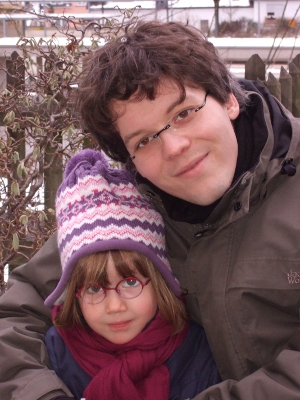
Michael and his daughter Marie

Michael has been around for more than 10 years and has always contributed to the APT software family. He s the author of the first real graphical interface to APT synaptic. Since then he created software-center as part of his work for Ubuntu. Being the most experienced APT developer, he s naturally the coordinator of the APT team. Check out what he has to say about APT s possible evolutions. My questions are in bold, the rest is by Michael. Who are you? My name is Michael Vogt, I m married and have two little daughters. We live in Germany (near to Trier) and I work for Canonical as a software developer. I joined Debian as a developer in early 2000 and started to contribute to Ubuntu in 2004. What s your biggest achievement within Debian or Ubuntu? I can not decide on a single one so I will just be a bit verbose. From the very beginning I was interested in improving the package manager experience and the UI on top for our users. I m proud of the work I did with synaptic. It was one of the earliest UIs on top of apt. Because of my work on synaptic I got into apt development as well and fixed bugs there and added new features. I still do most of the uploads here, but nowadays David Kalnischkies is the most active developer. I also wrote a bunch of tools like gdebi, update-notifier, update-manager, unattended-upgrade and software-properties to make the update/install situation for the user easier to deal with. Most of the tools are written in python so I added a lot of improvements to python-apt along the way, including the initial high level apt interface and a bunch of missing low-level apt_pkg features. Julian Andres Klode made a big push in this area recently and thanks to his effort the bindings are fully complete now and have good documentation. My most recent project is software-center. Its aim is to provide a UI strongly targeted for end-users. The goal of this project is to make finding and installing software easy and beautiful. We have a fantastic collection of software to offer and software-center tries to present it well (including screenshots, instant search results and soon ratings&reviews). This builds on great foundations like aptdaemon by Sebastian Heinlein, screenshots.debian.net by Christoph Haas, ddtp.debian.org by Michael Bramer, apt-xapian-index by Enrico Zini and many others (this is what I love about free software, it usually adds , rarely takes away ). What are your plans for Debian Wheezy? For apt I would love to see a more plugable architecture for the acquire system. It would be nice to be able to make apt-get update (and the frontends that use this from libapt) be able to download additional data (like debtags or additional index file that contains more end-user targeted information). I also want to add some scripts so that apt (optionally) creates btrfs snapshots on upgrade and provide some easy way to rollback in case of problems. There is also some interesting work going on around making the apt problem resolver a more plugable part. This way we should be able to do much faster development. software-center will get ratings&reviews in the upstream branch, I really hope we can get that into Wheezy. If you could spend all your time on Debian, what would you work on? In that case I would start with a refactor of apt to make it more robust about ABI breaks. It would be possible to move much faster once this problem is solved (its not even hard, it just need to be done). Then I would add a more complete testsuite. Another important problem to tackle is to make maintainer scripts more declarative. I triaged a lot of upgrade bug reports (mostly in ubuntu though) and a lot of them are caused by maintainer script failures. Worse is that depending on the error its really hard for the user to solve the problem. There is also a lot of code duplication. Having a central place that contains well tested code to do these jobs would be more robust. Triggers help us a lot here already, but I think there is still more room for improvement. What s the biggest problem of Debian? That s a hard question :) I mostly like Debian the way it is. What frustrated me in the past were flamewars that could have been avoided. To me being respectful to each other is important, I don t like flames and insults because I like solving problems and fighting like this rarely helps that. The other attitude I don t like is to blame people and complain instead of trying to help and be positive (the difference between it sucks because it does not support $foo instead of it would be so helpful if we had $foo because it enables me to let me do $bar ). For a long time, I had the feeling you were mostly alone working on APT and were just ensuring that it keeps working. Did you also had this feeling and are things better nowadays ? I felt a bit alone sometimes :) That being said, there were great people like Eugene V. Lyubimkin and Otavio Salvador during my time who did do a lot of good work (especially at release crunch times) and helped me with the maintenance (but got interested in other area than apt later). And now we have the unstoppable David Kalnischkies and Julian Andres Klode. Apt is too big for a single person, so I m very happy that especially David is doing superb work on the day-to-day tasks and fixes (plus big project like multiarch and the important but not very thankful testsuite work). We talk about apt stuff almost daily, doing code reviews and discuss bugs. This makes the development process much more fun and healthy. Julian Andres Klode is doing interesting work around making the resolver more plugable and Christian Perrier is as tireless as always when it comes to the translations merging. I did a quick grep over the bzr log output (including all branch merges) and count around ~4300 total commits (including all revisions of branches merged). Of that there ~950 commits from me plus an additional ~500 merges. It was more than just ensuring that it keeps working but I can see where this feeling comes from as I was never very verbose. Apt also was never my only project, I am involved in other upstream work like synaptic or update-manager or python-apt etc). This naturally reduced the time available to hack on apt and spend time doing the important day-to-day bug triage, response to mailing list messages etc. One the python-apt side Julian Andres Klode did great work to improve the code and the documentation. It s a really nice interface and if you need to do anything related to packages and love python I encourage you to try it. Its as simple as:
import apt
cache = apt.Cache()
cache["update-manager"].mark_install()
cache.commit()
Of course you can do much more with it (update-manager, software-center and lots of more tools use it). With pydoc apt you can get a good overview. The apt team always welcomes contributors. We have a mailing list and a irc channel and it s a great opportunity to solve real world problems. It does not matter if you want to help triage bugs or write documentation or write code, we welcome all contributors. You re also an Ubuntu developer employed by Canonical. Are you satisfied with the level of cooperation between both projects? What can we do to get Ubuntu to package new applications developed by Canonical directly in Debian? Again a tricky question :) When it comes to cooperation there is always room for improvement. I think (with my Canonical hat on) we do a lot better than we did in the past. And it s great to see the current DPL coming to Ubuntu events and talking about ways to improve the collaboration. One area that I feel that Debian would benefit is to be more positive about NMUs and shared source repositories (collab-maint and LowThresholdNmu are good steps here). The lower the cost is to push a patch/fix (e.g. via direct commit or upload) the more there will be. When it comes to getting packages into Debian I think the best solution is to have a person in Debian as a point of contact to help with that. Usually the amount of work is pretty small as the software will have a debian/* dir already with useful stuff in it. But it helps me a lot to have someone doing the Debian uploads, responding to the bugmail etc (even if the bugmail is just forwarded as upstream bugreports :) IMO it is a great opportunity especially for new packagers as they will not have to do a lot of packaging work to get those apps into Debian. This model works very well for me for e.g. gdebi (where Luca Falavigna is really helpful on the Debian side). Is there someone in Debian that you admire for his contributions? There are many people I admire. Probably too many to mention them all. I always find it hard to single out individual people because the project as a whole can be so proud of their achievements. The first name that comes to my mind is Jason Gunthorpe (the original apt author) who I ve never met. The next is Daniel Burrows who I met and was inspired by. David Kalnischkies is doing great work on apt. From contributing his first (small) patch to being able to virtually fix any problem and adding big features like multiarch support in about a year. Sebastian Heinlein for aptdaemon. Christian Perrier has always be one of my heroes because he cares so much about i18n. Christoph Haas for screenshots.debian.net, Michael Bramer for his work on debian translated package descriptions.
Thank you to Michael for the time spent answering my questions. I hope you enjoyed reading his answers as I did. Subscribe to my newsletter to get my monthly summary of the Debian/Ubuntu news and to not miss further interviews. You can also follow along on Identi.ca, Twitter and Facebook.

4 comments Liked this article? Click here. My blog is Flattr-enabled.

20 January 2011

John Goerzen: Research on deduplicating disk-based and cloud backups

Yesterday, I wrote about backing up to the cloud. I specifically was looking at cloud backup services. I ve been looking into various options there, but also various options for disk-based backups. I d like to have both onsite and offsite backups, so both types of backup are needed. Also, it is useful to think about how the two types of backups can be combined with minimal overhead. For the onsite backups, I d want to see:
  1. Preservation of ownership, permissions, etc.
  2. Preservation of symlinks and hardlinks
  3. Space-efficient representation of changes ideally binary deltas or block-level deduplication
  4. Ease of restoring
  5. Support for backing up Linux and Windows machines
Deduplicating Filesystems for Local Storage Although I initially thought of block-level deduplicating file systems as something to use for offsite backups, they could also make an excellent choice for onsite disk-based backups. rsync-based dedup backups One way to use them would be to simply rsync data to them each night. Since copies are essentially free, we could do (or use some optimized version of) cp -r current snapshot/2011-01-20 or some such to save off historic backups. Moreover, we d get dedup both across and within machines. And, many of these can use filesystem-level compression. The real upshot of this is that the entire history of the backups can be browsed as a mounted filesystem. It would be fast and easy to find files, especially when users call about that file that they deleted at some point in the past but they don t remember when, exactly what it was called, or exactly where it was stored. We can do a lot more with find and grep to locate these things than we could do with tools in Bacula (or any other backup program) restore console. Since it is a real mounted filesystem, we could also do fun things like make tarballs of it at will, zip parts up, scp them back to the file server, whatever. We could potentially even give users direct access to their files to restore things they need for themselves. The downside of this approach is that rsync can t store all the permissions unless it s running as root on the system. Wrappers such as rdup around rsync could help with that. Another downside is that there isn t a central scheduling/statistics service. We wouldn t want the backup system to be hammered by 20 servers trying to send it data at once. So there d be an element of rolling our own scripts, though not too bad. I d have preferred not to authorize a backup server with root-level access to dozens of machines, but may be inescapable in this instance. Bacula and dedup The other alternative I thought of system such as Bacula with disk-based volumes . A Bacula volume is normally a tape, but Bacula can just write them to disk files. This lets us use the powerful Bacula scheduling engine, logging service, pre-backup and post-backup jobs, etc. Normally this would be an egregious waste of disk space. Bacula, like most tape-heritage programs, will write out an entire new copy of a file if even one byte changes. I had thought that I could let block-level dedupe reduce the storage size of Bacula volumes, but after looking at the Bacula block format spec, this won t be possible as each block will have timestamps and such in it. The good things about this setup revolve around using the central Bacula director. We need only install bacula-fd on each server to be backed up, and it has a fairly limited set of things it can do. Bacula already has built-in support for defining simple or complicated retention policies. Its director will email us if there is a problem with anything. And its logs and catalog are already extensive and enable us to easily find out things such as how long backups take, how much space they consume, etc. And it backs up Windows machines intelligently and comprehensively in addition to POSIX ones. The downsides are, of course, that we don t have all the features we d get from having the entire history on the filesystem all at once, and far less efficient use of space. Not only that, but recovering from a disaster would require a more extensive bootstrapping process. A hybrid option may be possible: automatically unpacking bacula backups after they ve run onto the local filesystem. Dedupe should ensure this doesn t take additional space if the Bacula blocksize aligns with the filesystem blocksize. This is certainly not a given however. It may also make sense to use Bacula for Windows and rsync/rdup for Linux systems. This seems, however, rather wasteful and useless. Evaluation of deduplicating filesystems I set up and tested three deduplicating filesystems available for Linux: S3QL, SDFS, and zfs-fuse. I did not examine lessfs. I ran a similar set of tests for each:
  1. Copy /usr/bin into the fs with tar -cpf - /usr/bin tar -xvpf - -C /mnt/testfs
  2. Run commands to sync/flush the disk cache. Evaluate time and disk used at this point.
  3. Rerun the tar command, putting the contents into a slightly different path in the test filesystem. This should consume very little additional space since the files will have already been there. This will validate that dedupe works as expected, and provide a hint about its efficiency.
  4. Make a tarball of both directories from the dedup filesystem, writing it to /dev/zero (to test read performance)
I did not attempt to flush read caches during this, but I did flush write caches. The test system has 8GB RAM, 5GB of which was free or in use by a cache. The CPU is a Core2 6420 at 2.13GHz. The filesystems which created files atop an existing filesystem had ext4 mounted noatime beneath them. ZFS was mounted on an LVM LV. I also benchmarked native performance on ext4 as a baseline. The data set consists of 3232 files and 516MB. It contains hardlinks and symlinks. Here are my results. Please note the comments below as SDFS could not accurately complete the test.
Test ext4 S3QL SDFS zfs-fuse
First copy 1.59s 6m20s 2m2s 0m25s
Sync/Flush 8.0s 1m1s 0s 0s
Second copy+sync N/A 0m48s 1m48s 0m24s
Disk usage after 1st copy 516MB 156MB 791MB 201MB
Disk usage after 2nd copy N/A 157MB 823MB 208MB
Make tarball 0.2s 1m1s 2m22s 0m54s
Max RAM usage N/A 150MB 350MB 153MB
Compression none lzma none gzip-2
It should be mentioned that these tests pretty much ruled out SDFS. SDFS doesn t appear to support local compression, and it severely bloated the data store, which was much larger than the original data. Moreover, it permitted any user to create and modify files, even if the permissions bits said that the user couldn t. tar gave many errors unpacking symlinks onto the SDFS filesystem, and du -s on the result threw up errors as well. Besides that, I noted that find found 10 fewer files than in my source data. Between the huge memory consumption, the data integrity concerns, and inefficient disk storage, SDFS is out of the running for this project. S3QL is optimized for storage to S3, though it can also store its files locally or on an sftp server a nice touch. I suspect part of its performance problem stems from being designed for network backends, and using slow compression algorithms. S3QL worked fine, however, and produced no problems. Creating a checkpoint using s3qlcp (faster than cp since it doesn t have to read the data from the store) took 16s. zfs-fuse appears to be the most-used ZFS implementation on Linux at the moment. I set up a 2GB ZFS pool for this test, and set dedupe=on and compress=gzip-2. When I evaluated compression in the past, I hadn t looked at lzjb. I found a blog post comparing lzjb to the gzip options supported by zfs and wound up using gzip-2 for this test. ZFS really shone here. Compared to S3QL, it took 25s instead of over 6 minutes to copy the data over and took only 28% more space. I suspect that if I selected gzip -9 compression it would have been closer both in time and space to S3QL. But creating a ZFS snapshot was nearly instantaneous. Although ZFS-fuse probably doesn t have as many users as ZFS on Solaris, still it is available in Debian, and has a good backing behind it. I feel safer using it than I do using S3QL. So I think ZFS wins this comparison. I spent quite some time testing ZFS snapshots, which are instantaneous. (Incidentally, ZFS-fuse can t mount them directly as documented, so you create a clone of the snapshot and mount that.) They worked out as well as could be hoped. Due to dedupe, even deleting and recreating the entire content of the original filesystem resulted in less than 1MB additional storage used. I also tested creating multiple filesystems in the zpool, and confirmed that dedupe even works between filesystems. Incidentally wow, ZFS has a ton of awesome features. I see why you OpenSolaris people kept looking at us Linux folks with a sneer now. Only our project hasn t been killed by a new corporate overlord, so guess that maybe didn t work out so well for you <grin>. The Cloud Tie-In This discussion leaves another discussion: what to do about offsite backups? Assuming for the moment that I want to back them up over the Internet to some sort of cloud storage facility, there are about 3 options:
  1. Get an Amazon EC2 instance with EBS storage and rsync files to it. Perhaps run ZFS on that thing.
  2. Use a filesystem that can efficiently store data in S3 or Cloud Files (S3QL is the only contender here)
  3. Use a third-party backup product (JungleDisk appears to be the leading option)
There is something to be said for using a different tool for offsite backups if there is some tool-level issue, that could be helpful. One of the nice things about JungleDisk is that bandwidth is free, and disk is the same $0.15/GB-mo that RackSpace normally charges. JungleDisk also does block-level dedup, and has a central management interface. This all spells nice for us. The only remaining question would be whether to just use JungleDisk to back up the backup server, or to put it on each individual machine as well. If it just backs up the backup server, then administrative burdens are lower; we can back everything there up by default and just not worry about it. On the other hand, if there is a problem with our main backups, we could be really stuck. So I d say I m leaning towards ZFS plus some sort of rsync solution and JungleDisk for offsite. I had two people suggest CrashPlan Pro on my blog. It looks interesting, but is a very closed product which makes me nervous. I like using standard tools and formats gives me more peace of mind, control, and recovery options. CrashPlan Pro supports multiple destinations and says that they do cloud hosting, but don t list pricing anywhere. So I ll probably not mess with it. I m still very interested in what comments people may have on all this. Let me know!

19 January 2011

Gunnar Wolf: Mandate for what?

I lived in Israel between 1994 and 1996 This was just after the signature of the Oslo agreements, the Rabin-Arafat signature. 1994-95 was a beautiful time to be in Israel; there was the excitement of a prospect of real peace with the Palestinians, something that had been just seen as unattainable for the past 50 years. But we also saw the buildup of a huge tension, of real hatred. And the dream of the end of the conflict, of two people living in peace side by side was heavily shattered on November 4 1995, when prime minister Rabin was assassinated. But for the sake of where I'm trying to get to (this post is meant to be about current Mexico, not of Israel 15 years ago), lets go a couple of months back. The Israeli society is a deeply democratic one (although I understand many people feel it is losing that trait). Lots of political propaganda of all sorts, many of it very creative, are posted on the streets And not by the government or by political parties, but by citizen movements. I tried to follow it... I remember a particular sticker that I started seeing very often: Rabin has no mandate over the Golan . At first, I understod that the Golan residents rejected Rabin's authority (but, why was it posted all over the country? And what specifically was it about?), until a friend explained to me that it meant that it rather meant that the right wing all over the country felt that Rabin had no right to push for negotiations involving in any way the Golan heights return to Syria because that was not his electoral platform. So, fast-forward in time, and 12500Km to the west. If you have followed my ramblings for the past ~five years, you are aware of what I think about Mexico's government It is an illegitimate government, which got the power thanks to a dirty and illegal (as per Mexico's legal system) campaign and to voting fraud. And, according to what I have read, around 30% of the population still believe firmly the elections were stolen. But even if they were legal, valid and legitimate What has happened since 2006 should not be seen as valid. In Mexico, we don't have such a democratic culture. The society is not used to demanding anything from the politicians. We often see, as an example, that when talking about political organs, there is a divide everybody understands although makes no sense: We talk about citizens as people unaffiliated to political parties (v.gr. the 1996 Federal Electoral Institute was very well regarded as it was "el IFE ciudadano", and has since then been overtaken by the parties). Why are the parties' members not seen as citizens? Well, maybe because of the same distortion field that makes us believe our de-facto president when he stated that, from the (then) over 28000 people killed in the war campaign against crime (he oficially declared he never used the term war... Of course, he was proved wrong), only ~10% were civilians. In my book, that would mean that ~25000 soldiers have been killed But no, he means mostly drug trafficants. So, as they are not innocent bystanders, they somehow stopped being civilians? But again, I'm straying off the topic. Let us assume for a minute that the 2006 elections were clean legal, and that the campaigns were not diffamatory, and all that. And tha we had a modern government, with the stated separation between the three powers and all that. By today, the Legislative power would have surely called for the government's disolution. Why? Again, we Mexicans are not used to what a democratic system means. We can see over and over examples of people who have been voted to power and forgot/betrayed everything they campaigned for. And we are used to that being... Normal. But, who did we vote for? Given the suposition of this last paragraphs (clean elections led to our current government), did the majority of the population vote for Felipe Calder n, the person? Or did it vote for Partido Acci n Nacional, the abstract entity organized as a party? No. The vote was (should have been) for the political campaign, for the things he promised he would work for, the priorities in the direction he would give the nation. Not too long ago, we took pride of living in a peaceful country. Yes, everybody feared the crime rate in the streets, everybody knew big cities such as the one I live in (and love living in) have deep problems. But the country had good relations and good respect from the international players, and it was mostly safe. And, I don't think any of the few readers that have read this far (regardless of where they live or how much they know me) has that opinion of Mexico anymore. What is now heard inside and outside is that we have a huge organized crime (mostly due to drug traffic), and that it's taking over the country. Why did this happen? The fact is, Calder n lacked legitimacy when he reached the presidency in December 2006. And although his campaign was centered on pushing work generation (his slogan was El presidente del empleo, The president of the jobs), lifting restrictions to entreprises, opening borders, getting more money in our economy... He knew he had to please the people that would protect him from any (then, probable) insurrection: Military and police. Our army has always been more a joke than an army... But they still have their guns. So, contrary to everything he promised, the first things he signed was a salary increase to all order-keeping forces in the country, and an all-out attack against drug traffic cartels. He had to make the order-keeping forces protagonist, useful and loyal. Now, fast-forward again to 2011. The country is living the worst violence since the end of the 1910-1920 revolution. Over 30,000 people have been killed. Economy has fallen as it had not for many years (this was the worst-performing country in America in 2009). Work generation was said to be high, but then corrected to indicate it was mediocre (just about the baseline of population growth). So, the balance so far of four years of... Government? Economic disaster. Social disaster. Promises unachieved. Starting actions he had no mandate to do. Felipe Calder n has no mandate to get us in this war. Even if he had been democratically elected, he would have to step down.

Robert Millan: Finally, amd32 is taking shape

When AMD launched its now widely used 64-bit architecture in year 2000, it started marketing it as a significant step forward because of it having longer word and pointer size. One just has to check the advertising material and notice those big 64 being touted as the main improvement. But it is commonly accepted that most applications don t need a 64-bit address space for anything. Building them in LP64 model is just a waste of memory due to increase of pointer size. Even though this made most applications lag behind, the new architecture still was an improvement in terms of speed because of the AMD revised ISA, featuring changes like: To summarize, most of the merit from AMD64 architecture was in fixing some of the insanity of Intel 386 ISA (instruction set architecture), rather than the increased pointer size which was a source of inefficiency most of the time. Perhaps AMD didn t evaluate this correctly, or perhaps its marketing side won over technical merit. However, although the new hardware is biased towards LP64 data model, it s not actually enforced. It was a matter of time until an independent project took over and attempted to fix this, combining the AMD64 ISA with ILP32 data model. I ve been reading with much interest in the binutils and gcc mailing lists that such project is beginning to take shape. A port of binutils, GCC, GDB and Linux is already available. Future plans include porting Glibc which will make it possible to build a standard GNU derivative out of this. Sadly, I don t have the time to devote to this project myself, but I ll continue following its progress. I m looking forward to bringing this speed boost to my machines.

17 January 2011

Julien Viard de Galbert: Triaging bugs is not that hard !

There is a big thread on -devel that started about Forwarding bugs upstream, the idea is that it should be the maintainer s job. While it s true in general, some understaffed teams are so flooded by bugs that they just can t do it.
I ve seen more than once the X Strike Force asking a user to report upstream (pointing to the relevant BTS) and come back with the tracking URL to be attached to the bug. This was mostly for driver issue if I remember well.
And most users did it, so thanks! Then the thread evolved in lots of directions, I m not following all of it, but there was the question of the bug triaging and as I m doing it for the X packages, I want to share about my experience here. The available triaging docs The debian wiki already have a general Bug Triage page.
The thread pointed to the KDE Bug triaging page.
The X Strike Force has some pages, one on the wiki and a new one more specific to bug triaging on the alioth project s doc.
And when it comes to closing bugs with version information, there is a good read on the wiki: Bugs Version Tracking.
Finally don t hesitate to reopen the BTS documentation whenever you need to write to control@b.d.o ! Now if all those docs don t help you, then try to improve the docs as a first step ! ;) Talk with the maintainer(s) Well I did met Julien Cristau and Cyril Brulebois in person during mini-DebConf Paris/2010 that certainly helped. But we exchanged several mails, or met on IRC channel #debian-x.
But the triaging rules of the X Strike Force (linked above) were pretty clear anyway. My current process This process has evolved over time with the response of several contributors either to help or to fix to my mistakes, thanks!
  1. List bug from UDD: XSF unstable bugs sorted by date.
  2. Pick an old bug (once you answer and UDD runs, the bug moves down the list, so there are always old bugs on the top).
  3. Read the report, don t be afraid by the subject, it might be unrelated, the bug might be merged with other bugs, then reading the other bugs can help.
  4. If relevant try to reproduce it. (most bugs in X are hardware related or specific to one setup, so it s not that often that I have something to test).
  5. Decide what to do, most of the time, I will ping the submitter.
  6. I m a mutt user, and to my help the bts command as a way to open the bug mbox in mutt, that makes it really easy to answer the bug.
    So I launch bts -m show $n where $n is the bug number, and I can then answer the bug from mutt.
    The triaging procedure suggest to ping -submitter, but using mutt it s easier to just reply and add a -quiet to the bug number (this avoid spamming the debian-x with all my pings).
  7. In the message, always try to be kind and helpful, most of the time ask to test newer versions.
  8. Keep track of the pinged bugs, well I do it for my blog but it will be useful anyway, see below.
  9. When the submitter answers, just react accordingly, if the bug can be closed, then close it ! ;)
  10. If after some time, the bug are still not answered, consider closing them (I haven t started that yet, but this will probably get the bug number down faster:) ).
Note: Sometime I don t send the bug to -quiet so that other debian-x subscriber can have a look at the bug. They then can give me advices, or close the bug directly with a stronger reason than any I could have found. ;) To submitters, please keep the bug CCed when you answer, thanks. For the skeptics Yes as a newbie I did some mistakes, but I was always corrected in a nice way, with explanations. Also I try to have a conservative approach, I don t close bugs if I m not sure, I ask if I can close them, so it might take longer, but in the end the effect is the same for the bug, but not the same to the submitter ! ;) Also this work might look boring, but it s actually rewarding, most of the answers I received included a cheerful message thanking me for following up on the bug. Not to mention all I ve learned on Xorg. Conclusion As long as I have time for it, I ll continue to triage bugs and I d love to see others coming to help me on X or probably better go and help some other teams that also need help, and flood the planet with bug triaging reports ! ;) Get involved !

16 January 2011

John Goerzen: 24 hours with Jacob

Friday, I wrote about the train trip Jacob and I were planning to take. Here s the story about it. Friday night, Jacob was super excited. He was running around the house, talking about trains. I had him pack his own backpack with toys this time, which were you guessed it trains. Plus train track. His usual bedtime is around 7. He was still awake in his room at about 11, too excited to sleep. The train was an hour late into Newton, so got up, got ready, and then went into Jacob s room at 3:15AM. I put my arm around him and said his name softly. No response. I said, just a little louder, Jacob, it s time to wake up to go to the train station. There was about a 2-second pause and then he sat bolt upright rubbing his eyes. A couple seconds later, in a very tired but clear voice, OK dad, let s go! That is, I believe, a record for waking up speed for Jacob. We went downstairs, got coats, mittens, hats, etc. on, made sure we had the stuffed butterfly he always sleeps with, and went out the door. As usual, Jacob chattered happily during the entire 15-minute drive to the Amtrak station. One of these days I need to remember to record it because it s unique. He described things to me ranging from the difference between freight and passenger trains, to what the dining car is all about, to tractors and how to ride them safely. Newton has some winter lights , and a few places still had Christmas lights, which were of course big hits. We had to wait a few minutes at the Amtrak station, and Jacob hadn t shown any signs of slowing down yet. He wanted to look at every Amtrak poster, picture, logo, or sign in the building. This generally meant me holding him up high while he leaned over to touch it and make out a few words. Then, of course, he would pick out minute details about the trains, such as how many coach cars he thought they had, and we d visit about that for awhile. We got on at about 4:20. We found our seats, and Jacob showed no signs of calming down, despite having had only 4 hours of sleep (instead of his usual 11) so far. We checked out the buttons for lights. And, of course, he excitedly yelled out, Dad, the train is moving! He spent the next while mostly watching out his window, but also still exploring his space. Finally at about 5, I said, Jacob, I am really tired. I am going to sleep now. Will you sleep too? His response: Oh sure dad, I will sleep with my eyes open! As a result, no sleep was had for Jacob, and only a little for me. The dining car opens for breakfast at 6:30, which is normally a rather foreign time for breakfast on the train for us. But we were both awake so I figured might as well go. So Jacob and I went to the dining car. We sat with a woman going from New Mexico to Lawrence for her grandpa s funeral, though it was expected and she was having a good time on the train. Jacob turned completely shy, and refused to say a word, except maybe a few whispered into my ear. He got his favorite railroad French toast, and had me drizzle some syrup on it. I used the word drizzle for syrup the first time he had French toast on the train, and if I fail to use that word in the dining car, I will hear about it in no uncertain terms from Jacob. He loved his dining car breakfast, but we spent about an hour and a half there. He was really slow at eating because his face was pressed up against the window so much. But that was just fine; we had nowhere else to be, the person eating breakfast with us enjoyed visiting (and, apparently, scaring the dining car staff with tales of bears in the New Mexico mountains). This was what the train trip was all about, after all. We played in the lounge car for awhile. The almost floor-to-ceiling wrap-around windows provided a great view for him, and more opportunities to press his face against a window. We talked about freight trains that he saw, noticed the snow on some of them. Then we found the back of the train and he got to look out the back window. Back at our seat, he played with his toys for about 10 minutes, which was all he used them on the entire trip. There was just too much else to enjoy. When we used the restroom on the train, he d comment on how much he liked the Amtrak soap. It smells SO very very good! He wanted to wash his hands on the train. By late morning, he had decided: Dad, I LOVE this Amtrak soap. It smells like peaches! Shall your hands smell like peaches too? And, when we d get back up to our seats, he d put his hands in my face, saying, Dad, smell that! My hands smell like peaches! It was from the AMTRAK SOAP! At some point, he discovered the airline-style safety brochures in the seat back pockets. These were filled with diagrams of the train car, a few photos, and lots of icons with descriptions. I don t know how many times I read the thing to him, or really how many times he then recited it to me from memory. It was a lot. He spent hours with those brochures. Jacob had already told me that he wanted pizza for lunch, so I got him the kid-sized pizza. It wasn t all that big, and he could have devoured at least half of it when hungry. But he was getting really tired and ate only a few bites of pizza and a few chips. Pretty soon he was leaning up against me, the window, and eventually had his head on the table in some tomato sauce. But he didn t quite fall asleep by the time we went back to our seats, and of course was wide awake by that point. Jacob loves spotting the word Amtrak on things. It was very exciting when he noticed his orange juice at breakfast, and milk at lunch, were Amtrak juice and Amtrak milk due to the logo on the cups. At dinner he noticed we had Amtrak plates, and when I pointed out that his metal fork had the Amtrak logo on it, he got very excited and had to check every piece of silverware within reach. Dad, I have an Amtrak fork too! . And dad, YOU also have an Amtrak fork! We ALL have Amtrak forks! *cackling laughter* I finally insisted that Jacob lay down for some quiet time. I closed the curtains, and he finally did fall asleep less than an hour before our arrival into Galesburg. So by 2:15 he was up to 4.75 hours of sleep, I guess. We stopped in the train station briefly, then started our walk to the Discovery Depot Children s Museum, which was right nearby. Although I made no comment about it, Jacob said, Dad, there is a train museum RIGHT HERE! Yes, you re right Jacob. I can see a steam engine and some cars here. Let s go in! I don t think it s open today. It IS open shall we go check? It wasn t, and that was mighty sad though when he spotted another old caboose sitting outside the children s museum, the day suddenly seemed brighter. He complained of how cold he was, although my suggestion that he stop walking through the big piles of snowdrifts was met with a whiny, But dad, I WANT to do that! We went inside the museum (having to walk right buy the locked caboose thankfully the people at the desk promised to unlock it for us when we were ready) and Jacob started to explore. There was some wooden play trains big enough for children to climb in which he enjoyed, but in general he went from one thing to the next every minute or two as he does when he s really tired or overstimulated. Until, that is, he discovered the giant toy train table. It had a multi-level wooden track setup, and many toy trains with magnetic hitches. It was like what we have at home, only much bigger and fancier. He spent a LONG time with that. We then briefly explored the rest of the museum and went out into the caboose. It wasn t the hit it might have been, possibly because there are several at the Great Plains Transportation Museum that he gets to go in on a somewhat regular basis. After that, he was ready to go back into the museum, but I was feeling rather over-stimulated. On a day when the highs were still well below freezing, it seemed just about every family in Galesburg was crowded into the children s museum, making it loud and crowded which I don t enjoy at all. So I suggested maybe it was snack time instead. A moment s thought, then he started to pull me out of the caboose before I could get my gloves back on Yes dad, I think it IS snack time. Let s go. Let s go NOW! We walked over to Uncle Billy s Bakery (Google link or minimal website). Jacob spotted some sugar cookies shaped like mittens. Despite my reluctance to get him more sugar, he was so excited plus I had barely prevented a meltdown at lunch by promising him that he would get dessert later in the day so he picked two red mitten cookies. I got myself a wonderful peach muffin and a croissant and we sat down at one of the tables by the window. I taught Jacob how to hang his coat on his chair and he lit into those cookies. I spotted a guy at the next table over wearing a BNSF jacket, and asked him if he worked for the railroad. He had retired as an engineer a couple of years ago, and had worked various jobs before that. He grew up in Manhattan, KS and so was interested in our trip and very friendly. While we visited, Jacob devoured his cookies and increasing portions of my snack as well. He told us about a new shop The Stray Cat just two stores down that was having a grand opening event today. They make decorations and art out of basically discarded items, and had some really nifty things that I may have bought had I not been wanting for space in our backpack. Then I spotted Sweets Old-Fashioned Ice Cream, Candy, and Soda Shop across the road. I figured he d love it and I was already in for the sugar so might as well. He picked out some birthday cake flavor ice cream for himself. I got huckleberry ice cream, which he insisted on calling purpleberry and managed to get some tastes of as well. After that, we went to the train station. It was about an hour until our train would be there. I wasn t sure if we d find enough to do, but I shouldn t have worried. Earlier, we had made the happy discovery that the station s restroom featured the Amtrak soap, so there was that. Then there was the model Amtrak train in the ticket window, which Jacob kept wanting to look at while I d hold him. And also, the California Zephyr came in. We watched it arrive from the station window, saw people get off and on, and saw it leave maybe the first time Jacob has witnessed all that in person. And, of course, we looked at the pictures in that train station. The ticketmaster gave Jacob a paper conductor s hat with puzzles and mazes on the back side. And then it was time to get onto our train back home. We ate dinner Jacob again ate little and almost fell asleep and got back to our seats. I let Jacob stay awake until about 8, when he was starting to get a bit fragile. It took him awhile to fall asleep, but he finally did at about 8:30. Today he s still been all excited. He will randomly tell us about bits of the trip, that the man at supper called his grilled cheese sandwich piece little when it was really big, what we did at the ice cream store, etc. And I do think that he is now a train safety expert. All in all, I think that is probably the most excitement he s ever had in 24 hours and it was a lot of fun to be with him for it!

14 January 2011

Jordi Mallach: New project to discuss

Reading Scott's recent announcement on his move to Google was both surprising and a pleasure. Surprising, because it'll take time to stop associating his name to Ubuntu, Canonical, and the nice experiences I had while I worked with them. A pleasure, because his blog post was full of reminiscences of the very early days of a project that ended up being way more successful in just a few years than probably anyone in the Oxford conference could imagine. Scott, best of luck for this new adventure! Scott's write-up includes a sentence that made me remember I had been wanting to write a blog post related to all of this, but was pending Mark Shuttleworth's permission for posting:
Ok, Mark wasn t really a Nigerian 419 scammer, but some people did discard his e-mail as spam! Scott James Remnant
Many know the story of how I ended not being part of the Super-Secret-Debian-Startup Scott mentions. I even wrote about it in a blog post, 3 years ago:
[...] nothing beats the next email which sat for some dramatic 6 months in my messy inbox until I found out in the worst of the possible scenarios. Let's go back to late February, 2004, when I had no job, and I didn't have a clue on what to do with my life.
From: Mark Shuttleworth <mark@hbd.com>
Subject: New project to discuss
To: Jordi Mallach <jordi@debian.org>
Date: Sun, 29 Feb 2004 18:33:51 +0000
[...]
I'm hiring a team of debian developers to work full time on a new
distribution based on Debian. We're making internationalisation a prime
focus, together with Python and regular release management. I've discussed
it with a number of Debian leaders and they're all very positive about it.
[...]
I'm not sure if I totally missed it as it came in, or I skimmed through it and thought WTF?! Dude on crack or I just forgot I need to reply to this email , but I'd swear it was the former. Not long after, no-name-yet.com popped up, the rumours started spreading around Debian channels. Luckily, I got a job at LliureX two months later, where I worked during the following 2 years, but that's another story. I guess it was July or so when Ubuntu was made public, and Mark and his secret team organised a conference (blog entries [1] [2] [3] [4] [5]), just before the Warty release, and I was invited to it, for the same reasons I got that email. During that conference, probably because Mark sent me some email and I applied a filter to get to it, I found the lost email, and felt like digging a hole to hide for a LONG while. I couldn't believe the incredible opportunity I had missed. I went to Mark and said "hey, you're not going to believe this", and he did look quite surprised about someone being such an idiot. I wonder if I should reply to his email today...
When the usual suspects in the secret Spanish Debian Cabal channel read this blog post, they decided Mark deserved a reply, even if it would hit his inbox more than three and a half years late. :) With great care, we crafted an email that would look genuinely stupid in late 2007, but just arrogant and idiotic in 2004, when Ubuntu was just an African word, and the GNU/Linux distribution landscape was quickly evolving at the time, Gentoo Linux had the posh distribution crown, that Debian had held for quite a few years. I even took enough care to forge the X-Operating-System and User-Agent headers so they matched whatever was current in Debian in February 2004, and of course, top-posting seemed most appropriate. So Mark woke up that Monday, fired up his email client, and got... this:
Date: Mon, 1 Mar 2004 09:47:55 +0100
From: Jordi Mallach <jordi@sindominio.net>
To: Mark Shuttleworth <mark@hbd.com>
Subject: Re: New project to discuss
Organization: SinDominio
X-Operating-System: Debian GNU/Linux sid (Linux 2.6.3 i686)
User-Agent: Mutt/1.5.5.1+cvs20040105i
Hi Mark,
Thanks for your email. I nearly deleted this e-mail because for some
reason I thought it was targetted spam.
Your project looks very interesting, almost like a dream come true.
However, I feel a bit uneasy about your proposal. Something just doesn't
fit.
Why would someone start a company to work on /yet another/ Debian
derivative? Have you heard about Progeny's sad story? I think it's a
great example to show that Debian users don't want Debian-based distros,
they want people to work on the "real thing". Besides, I don't think
there's much more place for successful commercial distros, with Red Hat
and SuSE having well-established niches in the US and Europe.
Also, why focus on Debian specifically, Why not, for example, Gentoo,
which has a lot of buzz these days, and looks poised to be the next big
distribution?
To be honest, I think only a few people have the stamina or financial
stability to undertake a project like this, so I'd like to know
a bit more about you, and details on how you plan to sustain the
expenses.
Those are the main issues that worry me about your project. Other than
that, I would be interested in taking part in it, as I'm currently
unemployed and working on something Debian-based would be just too good
to miss.
You can reach me at +34 123 45 67 89, or if you feel like flying people
around Europe, I probably can be in the UK whenever it fits you.
Thanks, and hoping to hear from you again,
Jordi
On Sun, Feb 29, 2004 at 06:33:51PM +0000, Mark Shuttleworth wrote:
> Hi Jordi
>
> We haven't met, but both Jeff Waugh and Martin Michelmayr recommended that
> I get in touch with you in connection with a new project that I'm starting.
>
> I'm hiring a team of debian developers to work full time on a new
> distribution based on Debian. We're making internationalisation a prime
> focus, together with Python and regular release management. I've discussed
> it with a number of Debian leaders and they're all very positive about it.
>
> Would you be available to discuss it by telephone? I'm in the UK, so we
> could probably find a good timezoine easily enough ;-) Let me knof if
> you're keen to discuss it, when and what number to call.
>
> Cheers,
> Mark
>
> --
> Try Debian GNU/Linux. Software freedom for the bold, at www.debian.org
> http://www.markshuttleworth.com/
As you can imagine, his reaction was immediate:
Date: Mon, 22 Oct 2007 11:13:54 +0100
From: Mark Shuttleworth <mark@hbd.com>
To: Jordi Mallach <jordi@sindominio.net>
Subject: Re: New project to discuss
Jordi! I just got this now! Did you recently flush an old mail queue?
With thanks to all the Spanish Cabal members who were involved!

13 January 2011

Dominique Dumont: Debian copyright DEP5 parser/editor/validator/migrator is released

Hello The new version of libconfig-model-perl 1.229 is now available in Debian/Sid. This new version provides a model of Debian s DEP-5 copyright file specification updated according to the CANDIDATE version. (Among other features, like editor/validator for debian/control). The DEP-5 editor must be run in the source package directory (I ll provide an example below) with the following command:
config-edit -application dpkg-copyright
Features: Known issues: Example: The copyright file of libconfig-model-backend-augeas-perl needs to be updated: Here s the original copyright file (slightly edited to protect my mail box and save electrons) :
$ cat debian/copyright
Format-Specification: http://wiki.debian.org/Proposals/CopyrightFormat?action=recall&rev=196 Upstream-Maintainer: Dominique Dumont (ddumont at cpan.org)
Upstream-Source: http://search.cpan.org/dist/Config-Model-Backend-Augeas/
Upstream-Name: Config-Model-Backend-Augeas Copyright: 2008-2009, Dominique Dumont (ddumont at cpan.org)
License: LGPL-2+ Files: debian/*
Copyright: 2009, Dominique Dumont
License: LGPL-2+ License: LGPL-2+
This program is free software; you can redistribute it and/or
[snip]
First, let s just check issues:
$ config-edit -application dpkg-copyright -ui none
Element Upstream-Maintainer of node Debian::Dpkg::Copyright is deprecated
Element Upstream-Source of node Debian::Dpkg::Copyright is deprecated
Element Upstream-Name of node Debian::Dpkg::Copyright is deprecated
Missing Files: specification at top of section number 2. Adding Files: * spec
Then, let s see what s config-edit can fix all by itself:
$ config-edit -application dpkg-copyright -ui none -save
[ same warnings displayed ]
Let s check the result of the migration:
$ config-edit -application dpkg-copyright -ui none
[ good: no more warnings ]
And here s the content of the upgraded file (drum rolls, please):
$ cat debian/copyright
Format: http://dep.debian.net/deps/dep5/
Upstream-Name: Config-Model-Backend-Augeas
Upstream-Contact: Dominique Dumont (ddumont at cpan.org)
Source: http://search.cpan.org/dist/Config-Model-Backend-Augeas/ Files: *
Copyright: 2008-2009, Dominique Dumont (ddumont at cpan.org)
License: LGPL-2+ Files: debian/*
Copyright: 2009, Dominique Dumont
License: LGPL-2+ License: LGPL-2+
This program is free software; you can redistribute it and/or
[snip]
You can see that: Please provide feedback! If you have problem migrating DEP5 files, yell, and we ll fix them. If this migration works fine, don t be shy, please say so. Under the hood:

Most of the migration work is specified in DEP-5 model [2]. Using config-model s GUI [3] to update DEP-5 model, about one hour was spent to: This shows one important feature of Config::Model: maintenance and evolution of a model is not a huge task. Even though copyright files are not configuration files, the same approach can be used to specify model and migration of other configuration files. Now comes the question of the migration as seen by the user. Well, it s your turn now. Try it and tell us how it works! Hopefully, encouraged by your feedback, other people will apply config-model to other specifications or other configuration. All the best (*) E.g, in the text format produced by the model editor GUI: 'Upstream-Contact',

'value_type' => 'string',
'migrate_from' =>
'formula' => '$old_maintainer',
'variables' =>
'old_maintainer' => '- Maintainer'

,
'type' => 'leaf',
'description' => '* Syntax: line based list [snip]'
,

6 January 2011

Gunnar Wolf: Back with Ruby on Debian polemics

Once again, a polemic regarding how to properly integrate the Ruby language and libraries with the Debian distribution has been ignited. Similar arguments were presented in November and December 2008 and September 2010 And excuse me for just refering to my own blog, but there are links to some other posts from there... and there will surely be many others I just missed. There were even nice collaboration attempts (such as DebGem, announced in January 2009... But which apparently never stuck on, as it is still listed as in its public Beta period and lists only support for Debian 4.0 and Ubuntu 8.04 and 8.10). Some days ago, while I was on vacation, I received a mail from Lucas Nussbaum expressing the burnout he had been suffering from this situation. Some days after that, he posted a corresponding blog post - Giving up on Ruby packaging. The comments following his post are most interesting The one comment I'd like to highlight (noting I skimmed a whole deal of them) is by Paul Brannan, one of the original RubyGems authors. Yes, possibly the design criteria for Gems included some mutually-conflicting goals, and they cover some of Debian's goals. Unfortunately, this conflicting criteria... Was resolved to the opposite way we would have wanted (specifically, that a sysadmin should be able to install software with the same tools he was already familiar with). And of course, there are deeper disagreements, which are rightly stemmed from different priorities: Debian (+derivatives) is meant to make user's and sysadmin's lifes simpler. Gems are meant to make developers' lifes simpler. And while all developers are some sort of users, and sysadminsthe reverse is (obviously) not so. A developer maintaining several different codebases will surely suffer (well, this particular developer has surely suffered) if he has to maintain them all using coherent versions of system libraries. When a system is programmed, its developers want to use the greatest, latest tools to offer the best experience and functionality. And it's natural for libraries to evolve over time. However, any sysadmin will grind their teeth at the prospect of having many different versions of libraries, as the Gem model proposes. Why? Well, I was bitten by a minor example of it Bug fixes do not get backported. Of course, if simple bugs are not backported, security and stability of the system as a whole suffers. Often, new software versions will not only add functionality, but improve on how things are done. Not only bugs get corrected, but we get better response times, better memory handling, etc. It might sound harsh to say this, and even more, as a developer it feels I am talking against myself But while development time should be minimized during the system design/implementation, once systems are in production, it should be used to allow for friendlier sysadmin relations. I have to wear both hats at my real-life job. So, what is my take on this? Of course, blaming myself for choosing the wrong version is a no-go. When evaluating a library before using it in my projects, I try to look at its history and API-stability. APIs that change often speak about immature libraries which are still trying to get the right way to implement their functionality; just-started projects might be great and revolutionary, but they do not yet show any kind of long-term committment... And can lead (and have often led me) to painful rewrites when the Next Big Thing is reached. As for the users: Even if your favorite language has the best and friendliest distribution method, users just do not care about what language was a particular piece of software implemented in. Users want to be able to install and uninstall with their system's usual tools. Directly using Gems, CPAN, PEAR and whatnot is just unnatural for users, however convenient they are for developers. Distributions offer a non-technical advantage in this regard as well: A human filter. As an example, as I write this there are 19392 Ruby Gems and 19092 Perl modules in CPAN (note that CPAN stores some older versions but discourages authors from keeping too many - So no, they are still very different in size). Debian has around 30,000 packages. Why is that? Because all Debian packages _must_ be human-generated, human-reviewed, human-submitted. This means, a person must think each packaged piece of code is worth packaging, is stable enough and provides value to users as it is, and is fit for being part of a stable release. I am not saying with this that 90% of CPAN and Gems are crap I am saying that they are probably early implementations, to be installed, tested and improved by developers, and still not apt for general public use. Or maybe not interesting enough to be packaged as a service for the non-techie public at large. Oh, and one last point: Ruby is not a new language anymore. It is a mature, powerful language with different implementations, every time more stable... But it is a language deeply affected by the (not so new anymore either) the appearance of Rails. Why do I say this? Because although the language is in no way tied to Web development, many of its strongest uses are Web-oriented. How does this affect the current discussion? Well, because many people argue that users are no longer needed to install the software. Web systems are installed by sysadmins and used via a Web browser, and sysadmins are expected be more skilled than casual users. Still, in Debian (and in other distributions, surely) we try to make sysadmin's lives simpler I have (again, talking out of personal experience) installed several webapps (and system tools, and whatnot) for which I never followed any instructions besides aptitude install foo Using different languages, frameworks, and so on. Can I troubleshoot their installs? Probably, as there is a common logic for how the distribution I have chosen and specialized in works. Can I find causes for bugs in them? Possibly, although there are some languages and frameworks I dare not touch. Can I get help on getting them out of a tight spot? Surely, as there is a central bug tracking system for my distribution And one of the maintainer's tasks is to separate the problems related to the distribution (packaging, installing, simple user questions and misconceptions) to those derived from real bugs upstream. Anyway I am not saying that our way is the best way. No, by a long shot. Again, developers should have an easy, convenient way for installing whatever they want to play with. And to publish it without jumping through hoops. With this post, I'm only trying to express again why Debian works the way it does. And hope for better cooperation in the future. And as for several comments of what I read in Lucas' post, I think that there is interest for this synergy among some of the most committed Ruby people.

4 January 2011

John Goerzen: Looking back at 2010: reading

A year ago, I posted my reading list for 2010. I listed a few highlights, and a link to my Goodreads page, pointing out that this wasn t necessarily a goal, just a list of things that sounded interesting. I started off with Homer s Iliad, which I tremendously enjoyed and found parallels to modern life surprisingly common in that ancient tale. I enjoyed it so much, in fact, that I quickly jumped to a book that wasn t on my 2010 list: The Odyssey. I made a somewhat controversial post suggesting that the Old Testament of the Bible can be read similar to how we read The Odyssey. Homer turned out to be much more exciting than I d expected. Jordan s Fires of Heaven (WoT #5) was a good read, though it is one of those books that sometimes is action-packed and interesting, and other times slow-moving and almost depressing. I do plan to continue with the series but I m not enjoying it as much as I did at first. War and Peace is something I started late last year. I m about 400 pages into it, which means I ve not even read a third of it yet. It has some moving scenes, and is a fun read overall, but the work it takes to keep all the many characters straight can be a bit frustrating at times. Harvey Cox s The Future of Faith was one of the highlights of the year. A thought-provoking read by someone that embraces both science and religion, and shows a vision of religion that returns to its earlier roots, less concerned about what particular truths a person believes in than it is about more fundamental issues. Marcus Borg s Jesus: Uncovering the Life, Teachings, and Relevance of a Religious Revolutionary began with a surprisingly engaging history lesson on how agriculture caused the formation of domination societies. It also described in a lot of detail how historians analyze ancient texts their drafting, copying, etc. It paints a vivid portrait of Jewish society in the time that Jesus would have lived, and follows the same lines of thought as Cox regarding religion finally moving past the importance of intellectual assent to a set of statements. Among books that weren t on my 2010 list, I also read and here I m not listing all of them, just some highlights: The Cricket on the Hearth in something of a Christmastime tradition of reading one of the shorter Dickens works. I enjoyed it, but not as much as I enjoyed A Christmas Carol last year. Perhaps I made up for that by watching Patrick Stewart as Scrooge instead. How to Disappear Completely was a fun short humorous read, with a very well-developed first-person narrative. Paralleling my interest in amateur radio, I read and studied three books in order to prepare myself for the different exams. In something of a surprise, I laughed a lot at Sh*t My Dad Says, which was more interesting and funny than I expected it to be. All I can say is that Justin s got quite the dad and quite the interesting childhood. I even read two other recent releases: The Politician (about John Edwards) and Game Change (about the 2008 presidential race). Both were interesting, vibrant, and mostly unsourced so hard to know exactly how much to take from them. And finally, reflecting on and travel before my first trip to Europe, Travel as a Political Act, which encourages us to find the fun in my cultural furniture rearranged and my ethnocentric self-assuredness walloped. And that was fun. Now to make up the 2011 list

2 January 2011

Jelmer Vernooij: On the way to Samba 4: Part 2

It's been more than a month since the last status update on my Samba 4 work - much more than the two weeks I promised. During the holidays I finally managed to release the new alpha of Samba 4, as well as releases of some of our companion libraries (tdb, talloc, tevent and ldb). The release includes a significant amount of bug fixes and a lot of work towards a properly functioning Active Directory DC, too much to list here. This release I've mainly been involved in improving our Python bindings and our handling of internal and external libraries. We now use symbol versioning for our copy of Heimdal Kerberos as well as some of our other libraries. Hopefully this will fix some of the issues users of the evolution-mapi plugin have been seeing where they end up with both MIT Kerberos and Heimdal Kerberos loaded into the same process (with all the consequences of overlapping symbol names). Samba 4 now also has the ability to work with the system Heimdal rather than using the bundled copy. I have packaged alpha14 for Debian and Ubuntu (fixing most of the open bugs against the Samba 4 package in the BTS), but am currently waiting for the new release of ldb to pass through NEW before I can upload. The next release is scheduled for the first week of February. cp: Stream of Passion - Haunted

31 December 2010

Dirk Eddelbuettel: R / Finance 2011 Call for Papers: Updated and expanded

One week ago, I sent the updated announcement below to the r-sig-finance list; this was kindly blogged about by fellow committee member Josh and by our pal Dave @ REvo. By now. I also updated the R / Finance conference website. So to round things off, a quick post here is in order as well. It may even get a few of the esteemed reader to make a New Year's resolution about submitting a paper :) Dear R / Finance community, The preparations for R/Finance 2011 are progressing, and due to favourable responses from the different sponsors we contacted, we are now able to offer

  1. a competition for best paper, which given the focus of the conference will award for both an 'academic' paper and an 'industry' paper
  2. availability of travel grants for up to two graduate students provided suitable papers were accepted for presentations
More details are below in the updated Call for Papers. Please feel free to re-circulate this Call for Papers with collegues, students and other associations. Cheers, and Season's Greeting, Dirk (on behalf of the organizing / program committee) Call for Papers: R/Finance 2011: Applied Finance with R April 29 and 30, 2011 Chicago, IL, USA The third annual R/Finance conference for applied finance using R will be held this spring in Chicago, IL, USA on April 29 and 30, 2011. The two-day conference will cover topics including portfolio management, time series analysis, advanced risk tools, high-performance computing, market microstructure and econometrics. All will be discussed within the context of using R as a primary tool for financial risk management, portfolio construction, and trading. Complete papers or one-page abstracts (in txt or pdf format) are invited to be submitted for consideration. Academic and practitioner proposals related to R are encouraged. We welcome submissions for full talks, abbreviated lightning talks, and for a limited number of pre-conference (longer) seminar sessions. Presenters are strongly encouraged to provide working R code to accompany the presentation/paper. Data sets should also be made public for the purposes of reproducibility (though we realize this may be limited due to contracts with data vendors). Preference may be given to presenters who have released R packages. The conference will award two $1000 prizes for best paper: one for best practitioner-oriented paper and one for best academic-oriented paper. Further, to defray costs for graduate students, two travel and expense grants of up to $500 each will be awarded to graduate students whose papers are accepted. To be eligible, a submission must be a full paper; extended abstracts are not eligible. Please send submissions to: committee at RinFinance.com The submission deadline is February 15th, 2011. Early submissions may receive early acceptance and scheduling. The graduate student grant winners will be notified by February 23rd, 2011. Submissions will be evaluated and submitters notified via email on a rolling basis. Determination of whether a presentation will be a long presentation or a lightning talk will be made once the full list of presenters is known. R/Finance 2009 and 2010 included attendees from around the world and featured keynote presentations from prominent academics and practitioners. 2009-2010 presenters names and presentations are online at the conference website. We anticipate another exciting line-up for 2011---including keynote presentations from John Bollinger, Mebane Faber, Stefano Iacus, and Louis Kates. Additional details will be announced via the conference website as they become available. For the program committee:
Gib Bassett, Peter Carl, Dirk Eddelbuettel, Brian Peterson,
Dale Rosenthal, Jeffrey Ryan, Joshua Ulrich

27 December 2010

Petter Reinholdtsen: The many definitions of a open standard

One of the reasons I like the Digistan definition of "Free and Open Standard" is that this is a new term, and thus the meaning of the term has been decided by Digistan. The term "Open Standard" has become so misunderstood that it is no longer very useful when talking about standards. One end up discussing which definition is the best one and with such frame the only one gaining are the proponents of de-facto standards and proprietary solutions. But to give us an idea about the diversity of definitions of open standards, here are a few that I know about. This list is not complete, but can be a starting point for those that want to do a complete survey. More definitions are available on the wikipedia page. First off is my favourite, the definition from the European Interoperability Framework version 1.0. Really sad to notice that BSA and others has succeeded in getting it removed from version 2.0 of the framework by stacking the committee drafting the new version with their own people. Anyway, the definition is still available and it include the key properties needed to make sure everyone can use a specification on equal terms.
The following are the minimal characteristics that a specification and its attendant documents must have in order to be considered an open standard:
  • The standard is adopted and will be maintained by a not-for-profit organisation, and its ongoing development occurs on the basis of an open decision-making procedure available to all interested parties (consensus or majority decision etc.).
  • The standard has been published and the standard specification document is available either freely or at a nominal charge. It must be permissible to all to copy, distribute and use it for no fee or at a nominal fee.
  • The intellectual property - i.e. patents possibly present - of (parts of) the standard is made irrevocably available on a royalty- free basis.
  • There are no constraints on the re-use of the standard.
Another one originates from my friends over at DKUUG, who coined and gathered support for this definition in 2004. It even made it into the Danish parlament as their definition of a open standard. Another from a different part of the Danish government is available from the wikipedia page.
En ben standard opfylder f lgende krav:
  1. Veldokumenteret med den fuldst ndige specifikation offentligt tilg ngelig.
  2. Frit implementerbar uden konomiske, politiske eller juridiske begr nsninger p implementation og anvendelse.
  3. Standardiseret og vedligeholdt i et bent forum (en s kaldt "standardiseringsorganisation") via en ben proces.
Then there is the definition from Free Software Foundation Europe.
An Open Standard refers to a format or protocol that is
  1. subject to full public assessment and use without constraints in a manner equally available to all parties;
  2. without any components or extensions that have dependencies on formats or protocols that do not meet the definition of an Open Standard themselves;
  3. free from legal or technical clauses that limit its utilisation by any party or in any business model;
  4. managed and further developed independently of any single vendor in a process open to the equal participation of competitors and third parties;
  5. available in multiple complete implementations by competing vendors, or as a complete implementation equally available to all parties.
A long time ago, SUN Microsystems, now bought by Oracle, created its Open Standards Checklist with a fairly detailed description.
Creation and Management of an Open Standard
  • Its development and management process must be collaborative and democratic:
    • Participation must be accessible to all those who wish to participate and can meet fair and reasonable criteria imposed by the organization under which it is developed and managed.
    • The processes must be documented and, through a known method, can be changed through input from all participants.
    • The process must be based on formal and binding commitments for the disclosure and licensing of intellectual property rights.
    • Development and management should strive for consensus, and an appeals process must be clearly outlined.
    • The standard specification must be open to extensive public review at least once in its life-cycle, with comments duly discussed and acted upon, if required.
Use and Licensing of an Open Standard
  • The standard must describe an interface, not an implementation, and the industry must be capable of creating multiple, competing implementations to the interface described in the standard without undue or restrictive constraints. Interfaces include APIs, protocols, schemas, data formats and their encoding.
  • The standard must not contain any proprietary "hooks" that create a technical or economic barriers
  • Faithful implementations of the standard must interoperate. Interoperability means the ability of a computer program to communicate and exchange information with other computer programs and mutually to use the information which has been exchanged. This includes the ability to use, convert, or exchange file formats, protocols, schemas, interface information or conventions, so as to permit the computer program to work with other computer programs and users in all the ways in which they are intended to function.
  • It must be permissible for anyone to copy, distribute and read the standard for a nominal fee, or even no fee. If there is a fee, it must be low enough to not preclude widespread use.
  • It must be possible for anyone to obtain free (no royalties or fees; also known as "royalty free"), worldwide, non-exclusive and perpetual licenses to all essential patent claims to make, use and sell products based on the standard. The only exceptions are terminations per the reciprocity and defensive suspension terms outlined below. Essential patent claims include pending, unpublished patents, published patents, and patent applications. The license is only for the exact scope of the standard in question.
    • May be conditioned only on reciprocal licenses to any of licensees' patent claims essential to practice that standard (also known as a reciprocity clause)
    • May be terminated as to any licensee who sues the licensor or any other licensee for infringement of patent claims essential to practice that standard (also known as a "defensive suspension" clause)
    • The same licensing terms are available to every potential licensor
  • The licensing terms of an open standards must not preclude implementations of that standard under open source licensing terms or restricted licensing terms
It is said that one of the nice things about standards is that there are so many of them. As you can see, the same holds true for open standard definitions. Most of the definitions have a lot in common, and it is not really controversial what properties a open standard should have, but the diversity of definitions have made it possible for those that want to avoid a level marked field and real competition to downplay the significance of open standards. I hope we can turn this tide by focusing on the advantages of Free and Open Standards.

26 December 2010

Joey Hess: howto: use google voice on dialup

Here at the Hollow in what can euphemistically be called a "cabin", there is no cell service, and I have not signed up for long distance, as all the phone is normally used for is to call a local dialup internet number. It would be nice to be able to occasionally make outgoing long distance calls in this situation though. With some difficulty, Google voice can be used in this situation. The difficulty is because my google voice number is itself a long distance call from here, so I can't just call it up and use it as intended. And google voice's web interface was not designed with dialup in mind; it assumes you have a phone line that's not carrying your internet connection. verifying the phone This is the tricky part. Google voice wants to call you back on your phone and have you verify a number. To start this process, you need to use the internet. It's impossible to hang up from the net before they call back. Since it's a one-off, I didn't try to automate this, and just had someone do the internet side of the verification, call me with the number, and then trigger google voice to call me back. (Google voice's forums are full of similar stories.) making outgoing long distance calls Here's the fun part. You'll need a shell account somewhere else, where you can download and install pygooglevoice. Then create a ~/.gvoice file, filling in your login info and your phone number.

[auth]
email=
password=
[gvoice]
forwardingNumber=
phoneType=1
Now to make a call, you can just run something like this on the shell account:
sleep 2m; ./gvoice --batch call XXX-XXX-XXXX
The sleep gives you time to free up the phone line. Google voice then calls you and connects you with the number you requested.

25 December 2010

Petter Reinholdtsen: Is Ogg Theora a free and open standard?

The Digistan definition of a free and open standard reads like this:
The Digital Standards Organization defines free and open standard as follows:
  1. A free and open standard is immune to vendor capture at all stages in its life-cycle. Immunity from vendor capture makes it possible to freely use, improve upon, trust, and extend a standard over time.
  2. The standard is adopted and will be maintained by a not-for-profit organisation, and its ongoing development occurs on the basis of an open decision-making procedure available to all interested parties.
  3. The standard has been published and the standard specification document is available freely. It must be permissible to all to copy, distribute, and use it freely.
  4. The patents possibly present on (parts of) the standard are made irrevocably available on a royalty-free basis.
  5. There are no constraints on the re-use of the standard.
The economic outcome of a free and open standard, which can be measured, is that it enables perfect competition between suppliers of products based on the standard.
For a while now I have tried to figure out of Ogg Theora is a free and open standard according to this definition. Here is a short writeup of what I have been able to gather so far. I brought up the topic on the Xiph advocacy mailing list in July 2009, for those that want to see some background information. According to Ivo Emanuel Gon alves and Monty Montgomery on that list the Ogg Theora specification fulfils the Digistan definition. Free from vendor capture? As far as I can see, there is no single vendor that can control the Ogg Theora specification. It can be argued that the Xiph foundation is such vendor, but given that it is a non-profit foundation with the expressed goal making free and open protocols and standards available, it is not obvious that this is a real risk. One issue with the Xiph foundation is that its inner working (as in board member list, or who control the foundation) are not easily available on the web. I've been unable to find out who is in the foundation board, and have not seen any accounting information documenting how money is handled nor where is is spent in the foundation. It is thus not obvious for an external observer who control The Xiph foundation, and for all I know it is possible for a single vendor to take control over the specification. But it seem unlikely. Maintained by open not-for-profit organisation? Assuming that the Xiph foundation is the organisation its web pages claim it to be, this point is fulfilled. If Xiph foundation is controlled by a single vendor, it isn't, but I have not found any documentation indicating this. According to a report prepared by Audun Vaaler og B rre Ludvigsen for the Norwegian government, the Xiph foundation is a non-commercial organisation and the development process is open, transparent and non-Discrimatory. Until proven otherwise, I believe it make most sense to believe the report is correct. Specification freely available? The specification for the Ogg container format and both the Vorbis and Theora codeces are available on the web. This are the terms in the Vorbis and Theora specification:
Anyone may freely use and distribute the Ogg and [Vorbis/Theora] specifications, whether in private, public, or corporate capacity. However, the Xiph.Org Foundation and the Ogg project reserve the right to set the Ogg [Vorbis/Theora] specification and certify specification compliance.
The Ogg container format is specified in IETF RFC 3533, and this is the term:
This document and translations of it may be copied and furnished to others, and derivative works that comment on or otherwise explain it or assist in its implementation may be prepared, copied, published and distributed, in whole or in part, without restriction of any kind, provided that the above copyright notice and this paragraph are included on all such copies and derivative works. However, this document itself may not be modified in any way, such as by removing the copyright notice or references to the Internet Society or other Internet organizations, except as needed for the purpose of developing Internet standards in which case the procedures for copyrights defined in the Internet Standards process must be followed, or as required to translate it into languages other than English. The limited permissions granted above are perpetual and will not be revoked by the Internet Society or its successors or assigns.
All these terms seem to allow unlimited distribution and use, an this term seem to be fulfilled. There might be a problem with the missing permission to distribute modified versions of the text, and thus reuse it in other specifications. Not quite sure if that is a requirement for the Digistan definition. Royalty-free? There are no known patent claims requiring royalties for the Ogg Theora format. MPEG-LA and Steve Jobs in Apple claim to know about some patent claims (submarine patents) against the Theora format, but no-one else seem to believe them. Both Opera Software and the Mozilla Foundation have looked into this and decided to implement Ogg Theora support in their browsers without paying any royalties. For now the claims from MPEG-LA and Steve Jobs seem more like FUD to scare people to use the H.264 codec than any real problem with Ogg Theora. No constraints on re-use? I am not aware of any constraints on re-use. Conclusion 3 of 5 requirements seem obviously fulfilled, and the remaining 2 depend on the governing structure of the Xiph foundation. Given the background report used by the Norwegian government, I believe it is safe to assume the last two requirements are fulfilled too, but it would be nice if the Xiph foundation web site made it easier to verify this. It would be nice to see other analysis of other specifications to see if they are free and open standards.

14 December 2010

Dirk Eddelbuettel: RcppDE 0.1.0

A new package RcppDE has been uploaded in a first version 0.1.0 to CRAN. It provides differential evolution optimisation---a variant of stochastic optimisation that is similar to genetic algorithms but particularly suitable for the floating-point representations common in numerical optimisation. It builds of on the nice DEoptim package by Ardia et al, but reimplements the algorithm in C++ (rather than C) using a large serving of Rcpp and RcppArmadillo. I worked on this on for a few evenings and weekends in October and November and then spent a few more evenings writing a paper / vignette (which is finished as a very first draft now) about it. This was an interesting and captivating problem as I had worked on genetic algorithms going back quite some time to the beginning and then again the end of graduate school (and traces of that early work are near the bottom of my presentations page). So what got me started? DEoptim is a really nice package, but it is implemented in old-school C. There is nothing wrong with that per se, but at the same time that I was wrestling with GAs, I also taught myself C++ which, to put it simply, offers a few more choices to the programmer. I like having those choices. And with all the work that Romain and I have put into Rcpp, I was curious how far I could push this cart if I were to move it along. I made a bet with myself starting from the old saw shorter, easier, faster: pick any two. Would it be possible to achieve all three of these goals? DEoptim, and I take version 2.0-7 as my reference point here, is pretty efficiently yet verbosely coded. Copying a vector takes a loop with an assignment for each element, copying a matrix does the same using two loops. Replacing that with a single statement in C++ is pretty easy. We also have a few little optimisations behind the scenes here and there in Rcpp: would all that be enough to move the needle in terms of performance? And the same time, DEoptim is also full of the uses of the old R API which we often point to in the Rcpp documentation so fixing readibility should be a relatively low-hanging fruit. To cut a long story short, I was able to reduce code size quite easily by using a combination of C++ and Rcpp idioms. I was also able to get to faster: the paper / vignette demostrates consistent speed improvements on all setups that I tested (three standard functions on three small and three larger parameter vectors). More important speed gains were achieved by allowing use of objective functions that are written in C++ which again is both possible and easy thanks to Rcpp. That leaves easier to prove: adding compiled objective functions is one indication; further proof could be provided by, say, moving the inner loop to parallel execution thanks to Open MP which I may attempt over the next few months. So far I'd like to give myself about half a point here. So not quite yet shorter, easier, faster: pick any three, but working on it. Over the next few days I may try to follow up with a blog post or two contrasting some code examples and maybe showing a chart from the vignette.

10 December 2010

Rapha&#235;l Hertzog: People behind Debian: David Kalnischkies, an APT developer

The two first interviews were dedicated to long-time Debian developers. This time I took the opposite approach, I interviewed David Kalnischkies who is not (yet) a Debian developer. But he s contributing to one of the most important software within Debian the APT package manager since 2009. You can already see him in many places in Debian sharing his APT knowledge when needed. English is not his native language and he s a bit shy, but he accepted the interview nevertheless. I would like to thank him for the efforts involved and I hope his story can inspire some people to take the leap and just start helping My questions are in bold, the rest is by David. Who are you? I am David Kalnischkies, 22 years old, living in the small town Erbach near Wiesbaden in Germany and I m studying computer science at the TU Darmstadt. Furthermore I am for more than half a decade now young group leader of my hometown. I never intended to get into this position, but it has similarities with my career in this internet-thingy here. I don t remember why, but in April 2009 I was at a stage that some simple bugs in APT annoyed me so much that I grabbed the source, and most importantly I don t know why I did it but I published my changes in Mai with #433007, a few more bugs and even a branch on launchpad. And this public branch got me into all this trouble in June: I got a mail from Mr. package managment Michael Vogt regarding this branch A few days later I joined an IRC session with him and closely after that my name appeared for the first time in a changelog entry. It s a strange but also addicting feeling to read your own name in an unfamiliar place. And even now after many IRC discussions, bugfixes and features, three Ubuntu Developer Summits and a Google Summer of Code in Debian, my name still appear in places I have never even thought about e.g. in an interview. What s your biggest achievement within Debian? I would like to answer MultiArch in APT as it was my Google Summer of Code project, but as it has (not much) use for the normal user at this point will hopefully change for wheezy I chose three smaller things in squeeze s APT that many people don t even know yet: If your impression is now that I only do APT stuff: that s completely right, but that s already more than enough for me for now as the toolchain behind the short name APT contains so many tools and use cases that you always have something different. You re an active member of the APT development team. Are there plans for APT in Debian Wheezy? What features can we expect? That s very hard to answer, as the team is too small to be able to really plan something. I mean, you can have fancy plans and everything and half a second later someone arrives on the mailing list with a small question which eats days of development time just for debugging But right now the TODO list contains (in no particular order): We will see what will get real for wheezy and what is postponed, but one thing is sure: more will be done for wheezy if you help! If you could spend all your time on Debian, what would you work on? I would spend it on APT s debbugs count zero would be cool to look at! We make progress in this regard, but with the current velocity we will reach it in ten years or so. Reading more mailing lists would be interesting, as I am kind of an information junky. Maintaining a package could be interesting to share the annoyance of a maintainer with handcrafted dependencies just to notice that APT doesn t get it in the way I intended it to be. Through, to make it feel real I need to train a few new APT contributors before so they can point my mistake out, but this unfortunately doesn t depend so much on time but on victims Maybe I could even be working on getting an official status. Beside that, I would love to be able to apt-get dist-upgrade the increasing mass of systems I and many others carry around in their pockets. In regards to my phone, this is already fixed, but there is much room for improvements. What s the biggest problem of Debian? You need to be lucky. You need to talk at the right time to the right person. That s not really a debian-only problem as such, but in a global project full of volunteers you can see it clearly as there are plenty of opportunities to be unlucky. For example, it s unlikely that an interview would be made with me now if Michael had not contacted me in June 2009. In a big project like Debian, you are basically completely lost without a mentor guiding you, so things like the debian-mentors list are good projects, but I am pretty certain they could benefit from some more helping hands. The other thing which I consider a problem is that and I read from time to time some people don t care for translations. That s bad. Yes, a developer is able to read English, otherwise s/he couldn t write code or participate on the mailinglists. Still, I personally prefer to use a translated application if I have the chance as it s simply easier for me to read in my mother tongue, not only because I am dyslexic, but because my mind still thinks in German and not in English. Yes, I could personally fix that by thinking in English only from now on, but its a quite big problem to convince my family which is not really familiar with tech-stuff to use something if they can t understand what is written on screen. It was hard enough to tell my mother how to write an SMS in a German interface. My phone with English words all over the place would be completely unusable for her despite the fact that my phone is powered by Debian and better for the task from a technical point of view. You are not yet an official Debian developer/maintainer, but you re already perceived in the community as one the most knowledgeable person about APT. It s a great start! What s your advice to other people who want to start contributing to Debian in general, and to APT in particular? It was never a goal in my life to start contributing . My goal was and still is to make my life easier by letting the computer work for me. At some point APT hindered the success of this goal, so it needed to be fixed. I didn t expect to open pandora s box. So, my advice is simple: Just start. Ignore the warning signs telling you that this is not easy. They are just telling you that you do something useful. Only artificial problems are easy. Further more, contribution to APT, dpkg or any other existing package is in no way harder than opening an ITP and working on your own, and it s cooler as you have a similar minded team around you to talk to. :) APT didn t accept release codenames as target release was one of the first things I fixed. If I had asked someone if that would be a good starting point the answer would have been a clear no , but I didn t search for a good starting point As a kid I can start playing football by just walking on the field and play or I can sit near the field, watching the others play, while analyzing which position would be the best for me to start ruling out one by one as the technical requirements seem too high Oh bicycle kick that sounds complicated I can t do that Julian Andreas Klode is working on a APT replacement, there s also Cupt by Eugene V. Lyubimkin. Both projects started because their authors are not satisfied with APT, they find APT s code difficult to hack partly due to the usage of C++. Do you share their concerns and what s your opinion on those projects? I don t think C++ is a concern in this regard, after all cupt is currently rewritten to C++0x and APT2 started in vala and is now C + glib last time I checked at least. I personally think that something is wrong if we need to advertise an application by saying in which language it is written The major problem for APT is probably that the code is old : APT does its job for more than 12 years now, under different maintainers with an always changing environment around it: so there are lines in APT which date from a time when nobody knew what a Breaks dependency is, that packages can have long descriptions which can be translated or even that package archives can be signed with a gpg key! And yet we take all those for granted today. APT has proven to adapt to these changes in the environment and became in this process very popular. So I don t think the point is near (if it will come at all) that APT can go into retirement as it is completely replaced by something else. The competitors one the other hand have their first 12 years still to go. And it will be interesting to see how they will evolve and what will be the state of the art in 2022 But you asked what I think about the competitors: I prefer the revolution from inside simply because I can see effects faster as more users will profit from it now. Cupt and co. obviously prefer the normal revolution. The goal is the same, creating the best package manager tool, but the chosen way to the goal is different. aptitude and cupt have an interactive resolver for example: that s something I dislike personally, for others that is the ultimate killer feature. cupt reading the same preference file as APT will have a different pinning result, which we should consider each time someone mentions the word drop-in replacement . APT2 isn t much more than the name which I completely dislike currently from a user point of view, so I can t really comment on that. All of them make me sad as each line invested in boilerplate code like configuration file parsing would be in my eyes better be spent in a bugfix or new feature instead, but I am not here to tell anyone what they should do in their free time But frankly, I don t see them really as competitors: I use the tools I use, if other do that too that s good, if not that s their problem. :) The thing that annoys me really are claims like plan is to remove APT by 2014 as this generates a vi vs. emacs like atmosphere we don t need. If some people really think emacs is a good editor who cares? I really hope we all can drink a beer in 2022 in Milliways, the restaurant at the end of the package universe, remembering the good old 2010 ;) Is there someone in Debian that you admire for his contributions? No, not one, many! Michael Vogt who has nearly the monopole of package manager maintainer by being upstream of APT, synaptics and software center to name only the biggest and still has the time to answer even the dumbest of my questions. :) Jason Gunthorpe for being one of the initial developers behind deity who I will probably never meet in person beside in old comments and commit logs. Christian Perrier for caring so much about translations. Obey Arthur Liu as a great admin for Debian s participation in Google s Summer of Code. Paul Wise for doing countless reviews on debian-mentors which are a good source of information not only for the maintainer of the package under review. I guess I need to stop here because you asked for just one. So let s end with some big words instead: I am just a little cog in the big debian wheel
Thank you to David Kalnischkies for the time spent answering my questions. I hope you enjoyed reading his answers as I did. Subscribe to my newsletter to get my monthly summary of the Debian/Ubuntu news and to not miss further interviews. You can also follow along on Identi.ca, Twitter and Facebook.

3 comments Liked this article? Click here. My blog is Flattr-enabled.

Next.

Previous.